
SKF-201 - Loudspeaker ONKYO - Free user manual and instructions
Find the device manual for free SKF-201 ONKYO in PDF.


| Product Type | Passive Bookshelf Speaker System |
| Model | SKF-201 |
| Brand | Onkyo |
| Speaker Type | 2-Way Bass Reflex |
| Dimensions (W x H x D) | 264 x 981 x 345 mm |
| Weight | 20 kg (44 lbs) |
| Impedance | 6 Ω |
| Maximum Input Power | 150 W |
| Output Sound Pressure Level | 86 dB/W/m |
| Frequency Response | 30 Hz - 35 kHz |
| Crossover Frequency | 1500 Hz |
| Cabinet Capacity | 55 L |
| Woofer | 20 cm Cone x 2 |
| Tweeter | 2.5 cm Dome |
| Magnetic Shielding | Yes (for use near CRT TVs) |
| Binding Posts | Banana Plug Compatible, Bi-Wiring Capable |
| Recommended Amplifier Impedance | 6 Ω or higher |
| Placement | Rigid level surface; ideal equilateral triangle with listener |
| Grille | Detachable |
| Cabinet Finish | Polymer Laminate |
| Cleaning Instructions | Wipe with dry soft cloth; mild soap solution for grille |
| Accessories Included | 2.5 m Speaker Cable, Instruction Manual |
| Safety | Turn off amplifier before connection; avoid short circuits |
Frequently Asked Questions - SKF-201 ONKYO
User questions about SKF-201 ONKYO
0 question about this device. Answer the ones you know or ask your own.
Ask a new question about this device
Download the instructions for your Loudspeaker in PDF format for free! Find your manual SKF-201 - ONKYO and take your electronic device back in hand. On this page are published all the documents necessary for the use of your device. SKF-201 by ONKYO.
USER MANUAL SKF-201 ONKYO
Front Speaker System
Thank you for your purchase of the Onkyo speaker system. Please read this manual thoroughly before using it.
Following the instructions in this manual will enable you to obtain optimum performance and listening enjoyment from your new speaker system.
Please retain this manual for future reference.
Before using this unit
● The speaker cabinet is made of wood and is therefore sensitive to extreme temperatures and humidity. Avoid placing the speaker systems in locations subjected to direct sunlight, or in smokey or in humid places, such as near an air conditioner, humidifier, bathroom, or kitchen. Doing so may result in damage to the speaker.
- Place the unit on a rigid, level surface. Placing it on a slanted surface or weak base not only may cause the unit to fall, but also results in decreased sound quality.
- Be sure to turn off your amplifier before connecting the speaker system. Connecting them with the amplifier's power on may result in damage to the amplifier or the speaker system.
- Keep water or other liquids away from the unit. If water is spilled into the unit, not only the unit but also the speakers themselves may be damaged.
Name and function of each part

Precaution on use
- This speaker system can handle the specified input power when it is used for ordinary music reproduction. If the following abnormal signals are fed to the speaker, however, an overcurrent may flow in the internal circuits, causing burning or breakage of the wires even if the input power is below the specified rating.
- Noise produced when FM station is not tuned in
- Sound produced when fast-forwarding cassette tape deck
- High-frequency sound generated by an oscillator, an electronic musical instruments, etc.
- Oscillating amplifier signals
- Special test signals produced by audio checking CD, etc.
- Sound produced when connecting or disconnecting audio connection cables (Always turn off the amplifier's power before connecting or disconnecting cables.)
- Howling when a microphone is used
- Do not place magnetic objects such as screwdrivers and iron parts near the speaker system since they use speakers with strong magnets. Otherwise, the objects may be attracted, causing injury or damaging the diaphragm.
Connection
- Turn the sound volume to the minimum and turn OFF the amplifier power switch (POWER) before connecting the speaker cables.
● The nominal impedance of this speaker system is 6Ω . Use only amplifiers capable of handling this impedance. - Use the supplied speaker cables to connect between speaker 's binding posts and the amplifier's speaker terminals as illustrated below.
- Connect the speaker cables securely to the terminals, with the core wires twisted properly. In this case, make sure that the core wires do not touch each other. Note that a short circuit in core wires may result in damage to the amplifier.
☆ This speaker system uses banana-plug compatible binding posts.
- Connect the Right and Left speakers (as viewed from the listening position) to the amplifier's corresponding Right and Left speaker terminals.
● Ordinary connection (single-wiring)
- Loosen the LOW-FREQUENCY binding post screws, with the jumper bars attached.
- Insert the speaker wires to the connection holes. Fasten the screws securely again.
To use banana-plug speaker cables, insert the banana plug into the center hole of each binding post.
Note:
Make sure that the HIGH-FREQUENCY jumper bars are not loosened.

● Bi-wiring connection (Remove the attached jumper bars.)
- Using two sets of speaker cables, connect the HIGH FREQUENCY and LOW-FREQUENCY binding posts independently to your amplifier.
- On the amplifier, connect the speaker cables to the speaker output terminals paying close attention to maintain consistent polarity (See below.).
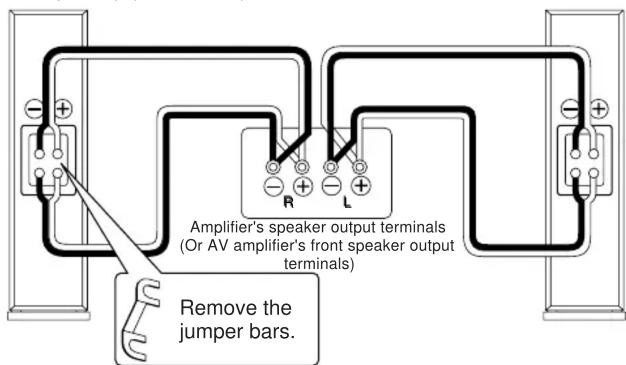
Before turning on the amplifier's power switch:
- Make sure that the positive (+) and negative (−) speaker cables do not contact each other. Otherwise, a short-circuit may occur, causing damage to the amplifier.
- Be sure to connect the speaker cables with correct polarity (connect the speaker's positive (+) and negative (−) binding posts with the amplifier's corresponding speaker terminals). Reversed polarity results in impaired bass-range reproduction, causing mislocalization of the sound image. Also, be sure to connect the Right and Left speakers with the amplifier's corresponding speaker terminals.
- Pull lightly on the speaker cables to ensure that they are connected firmly.
Use with a TV set
In general, Braun tubes used for color television sets, etc. are extremely sensitive and can be affected even by the magnetism of the earth. If a speaker system is used near them, therefore, discoloration or distortion of pictures will occur. To allow use with color television sets, etc., this speaker system is provided with magnetic shielding.
Even so, discoloration may still result, depending on the installation environment. If discoloration occurs, turn off the power of the television set, wait for 15 to 30 minutes and then turn it on again. This activates the self-demagnetizing function of the television set, improving the display condition. If discoloration persists even after performing this remedy, move the speaker apart from the television set. Discoloration may also be caused when a magnet or other magnetizing object exists near the television because of the combined effect.
Placement
The sound quality a speaker system reproduces varies greatly depending on the construction and area of the room where it is installed, as well as the location and size of the furniture. For better-quality sound, observe the following precautions.
- Avoid placing the speaker system on an elevated object such as on concrete blocks. Instead, place it on a rigid floor surface with minimal vibration. Also note that high-quality bass cannot be obtained if the speaker system is unstably positioned. Generally speaking, placing the speaker system on several small-diameter supports results in better bass than placing it directly on the installation surface. Moreover, if you feel the bass reproduced by the system is too weak, move the speaker system closer to the wall behind it. You can thus control the strength of the reproduced bass by the position of the speakers.
- In many rooms, the furniture and wall affect the reproduced sound quality. For stereo sound reproduction, placing the Right and Left speakers in the same condition produces the best results. If they are placed in extremely different conditions, the Right- and Left-channel balance will be adversely affected.
● The ideal placement of the speaker system is as follows: Imagine an equilateral triangle and position the Right and Left speakers on both ends of the base. The ideal listening position is at or slightly to the rear of the triangle apex.
● Glazed doors or surrounding walls in front of the speaker system may cause the resonance of specific frequency ranges due to reflected sound. To eliminate this resonance, place some sound-absorbing material such as a thick curtain in front of the doors or walls.
Attaching and detaching the speaker grilles
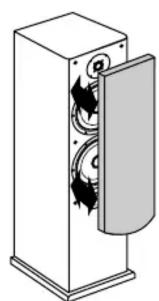
This speaker system uses detachable grilles. Use the following method to attach or detach the grilles.
- While holding the bottom edge of the speaker grille with your both hands, pull it gently toward you to remove the bottom of the grille.
- In the same way, gently pull the upper edge of the speaker grille toward you to remove it from the main unit.
- To replace the grill, push the projections at the corners into the grille plug holes on the speaker cabinet.
natural_image
Diagram of a cabinet with rotating components and directional arrows indicating motion (no text or symbols)ReplacementRemoval

natural_image
Diagram showing two mechanical components with arrows indicating motion, no text or symbols presentSpeaker care
Your Onkyo speakers are finished with a very high quality polymer laminate covering that serves to protect the wood speaker cabinet.
Wipe the cabinet periodically with a dry, silicon-embedded or plain soft cloth.
The covering may be cleaned with a soft cloth moistened with water and a mild soap. Avoid the use of furniture polishes or harsh cleansers.
Use a soft brush or hand vacuum cleaner to remove dust and lint from the grille material.
Specifications
Model SKF-201
Type 2-way bass reflex
Impedance 6 Ω
Maximum input power 150 W
Output sound pressure level 86 dB/W/m
Frequency response 30 Hz-35 kHz
Crossover frequency 1500 Hz
Cabinet capacity 55 L
Speaker Woofer: 20-cm cone x 2
Tweeter: 2.5-cm dome
Dimensions 264 (W) x 981 (H) x 345 (D) mm
(Overall dimensions)
Weight 20 kg
Accessory 2.5-m speaker cable (1)
Instruction manual (1)
Others Magnetic shielding
- Front Speaker System
- Before using this unit
- Precaution on use
- Connection
- ● Ordinary connection (single-wiring)
- ● Bi-wiring connection (Remove the attached jumper bars.)
- Before turning on the amplifier's power switch:
- Use with a TV set
- Placement
- Attaching and detaching the speaker grilles
- Speaker care
- Specifications
Brand : ONKYO
Model : SKF-201
Category : Loudspeaker