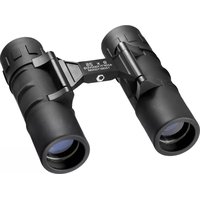
Focus Free - Binoculars Barska - Free user manual and instructions
Find the device manual for free Focus Free Barska in PDF.


| Product Type | Binoculars |
| Brand | Barska |
| Model | Focus Free |
| Magnification | 8x |
| Objective Lens Diameter | 21 mm |
| Focus System | Fixed focus (no adjustment needed) |
| Field of View | 305 ft @ 1000 yds |
| Prism Type | Porro |
| Lens Coating | Fully coated |
| Exit Pupil | 2.6 mm |
| Eye Relief | 10 mm |
| Close Focus | 20 ft |
| Weight | 12 oz (340 g) |
| Dimensions | 4.5 x 3.5 x 1.5 in |
| Body Material | Rubber armor |
| Waterproof | No |
| Fogproof | No |
| Included Accessories | Neck strap, carrying case, lens cloth |
| Power Source | None (optical) |
| Cleaning | Use lens cleaning cloth, avoid solvents |
| Safety Warning | Never look directly at the sun |
| Warranty | Limited lifetime warranty |
| Country of Origin | China |
Frequently Asked Questions - Focus Free Barska
User questions about Focus Free Barska
0 question about this device. Answer the ones you know or ask your own.
Ask a new question about this device
Download the instructions for your Binoculars in PDF format for free! Find your manual Focus Free - Barska and take your electronic device back in hand. On this page are published all the documents necessary for the use of your device. Focus Free by Barska.
USER MANUAL Focus Free Barska
III. WATERPROOF/FOG-PROOF (select models)
Your binocular may be designed and built utilizing the latest waterproof and fog-proof technology. Waterproof models are O-ring sealed for complete protection. Fog proof protection is achieved from dry nitrogen purging to remove all internal moisture.
IV. EYECUPS
Your binocular is fitted with either rubber roll-down or rubber pop-up eyecups designed for your comfort and to exclude extraneous external light. If you wear sun/eye glasses, roll down the eyecups. This will bring your eyes closer to the binocular lens thus providing improved field of view.

Fig.4 BINOCULAR EYECUPS
V. INSTRUCTIONS FOR CARE
If handled with care, this binocular will provide years of trouble-free service. Like any fine optical instrument your binocular should be given sensible care. Non waterproof models should not be exposed to excessive moisture.
- Keep the lens covers (that come with your binocular, except compact models) on the lenses when binoculars are not in use.
- Store binoculars with the eyecups up. Thus avoiding excessive stress and wear on the eyecups in the down position.
- Avoid banging and dropping.
- Store in a cool, dry place.
- Looking directly at the sun with your binocular may be very harmful to you eyes.
VI. CLEANING
- Blow away any dust or debris on the lens (or use a soft lens brush)
- To remove dirt or fingerprints, clean with a soft cotton cloth rubbing in a circular motion. Use of a coarse cloth or unnecessary rubbing may scratch the lens surface and eventually cause permanent damage.
- For a more thorough cleaning, photographic lens tissue and photographic-type lens cleaning fluid or isopropyl alcohol may be used. Always apply the fluid to the cleaning cloth-never directly on the lens.
VERY IMPORTANT
Never attempt to clean your binocular internally or try to take it apart.
CAUTION: DIRECTLY VIEWING THE SUN OR ANY LIGHT SOURCE WITH THIS OPTICAL DEVICE CAN CAUSE PERMANENT EYE DAMAGE.
©2010 BARSKA® | La Verne, CA 91750
www.barska.com BC152

BINOCULAR INSTRUCTIONS

natural_image
Black binoculars with no visible text or symbols on the device itself©2010 BARSKA® | La Verne, CA 91750 models may vary www.barska.com
INSTRUCTIONS FOR USE
This binocular is a precision instrument designed to provide many years of pleasurable viewing. This booklet will help you achieve optimum performance by explaining how you can adjust the binocular to your eyes, and how to care for this instrument. Read the instructions carefully before using your binoculars.
CAUTION: DIRECTLY VIEWING THE SUN OR ANY LIGHT SOURCE WITH THIS OPTICAL DEVICE CAN CAUSE PERMANENT EYE DAMAGE.
I. EYE ADJUSTMENTS (FIGURE 1)
Fig.1 INTERPUPILLARY DISTANCE ADJUSTMENT

The distance between the eyes, called “interpupillary distance” (IPD), varies from person to person. To achieve perfect alignment of lens to eye, follow these simples steps.
- Hold your binocular in the normal viewing position.
- Grasp each barrel firmly. Move the barrels closer together or further apart until you see a single circular field. Always re-set your binocular to this position before using.
HOW TO ADJUST FOR INDIVIDUAL EYE STRENGTH
Human eyes are as individual as fingerprints. This binocular has a feature which allows you to adjust the binocular to your vision. Follow the focusing instructions for your binocular style.
II. FOCUSING
Binoculars have three primary focusing systems, center, individual and focus-free. "Zoom" binoculars utilize the center focus system.
CENTER FOCUS-has a central focusing wheel between the barrels.
INDIVIDUAL FOCUS-each eyepiece is focused separately. Most typically with waterproof/fog-proof models.
FOCUS FREE-binocular require no focusing adjustment.

nter Foo
Wheel
Fig.2 DIOPTER SETTINGS
- Adjust interpupillary distance (Figure 1)
- Keep both eyes "open" at all times.
- Using a lens cover or your hand, cover the objective (front) lens of the side with the "diopter setting"
- Using the center focus wheel, focus the distant object being viewed.
- Cover the other objective lens, then view the same object as explained above.
- Using the "diopter setting" adjustment ring, focus the same object being viewed. Caution should be used as over turning or forcing the diopter eyepiece can damage or cause the eyepiece to break away from the chassis.
- Your binocular should be adjusted for your eyes. Focus at both far and near distance can now be attained simply by turning the center focus wheel.
INDIVIDUAL FOCUS (select models)
-
Adjust interpupillary distance. Make a note of the number which appears on the central hinge scale. Always re-set your binocular to this position before using. (To see a single
-
Cover right objective (front) lens with your hand. Rotate left eyepiece until image is focused.
-
Follow the same procedure for the right eye. The eyepiece should be turned in a counterclockwise direction for more distant objects. With the image now in focus, make a note of the diopter setting for future use.
FOCUS-FREE (select models)
Focus-free binoculars offer “never needs focusing” optical systems.
"ZOOM" FEATURE (select models)
- Follow the steps for focusing as outlined under "Center Focus"
- When focusing a “zoom” binocular, it is best to begin at the highest power. This will provide a more comfortable focus at the lower powers. Set the “zoom” lever at high power.
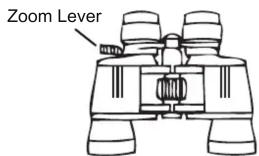
Fig.2 "ZOOM" SETTINGS
- Adjust your binocular for individual eye strength using the "diopter setting"
Your binocular is now adjusted properly for your eyes. You may now “zoom” “out” or “in” on any distant object.
Note: to focus on an object at a closer distance, focus on the object at high power first and then adjust the “zoom” lever to the desired lower power. With any “zoom” instrument, better quality images are possible at lower powers.
- WATERPROOF/FOG-PROOF (select models)
- EYECUPS
- INSTRUCTIONS FOR CARE
- CLEANING
- VERY IMPORTANT
- INSTRUCTIONS FOR USE
- CAUTION: DIRECTLY VIEWING THE SUN OR ANY LIGHT SOURCE WITH THIS OPTICAL DEVICE CAN CAUSE PERMANENT EYE DAMAGE.
- EYE ADJUSTMENTS (FIGURE 1)
- FOCUSING
- INDIVIDUAL FOCUS (select models)
- FOCUS-FREE (select models)
- "ZOOM" FEATURE (select models)
Brand : Barska
Model : Focus Free
Category : Binoculars