
Mini-Mk3 - Loudspeaker Paradigm - Free user manual and instructions
Find the device manual for free Mini-Mk3 Paradigm in PDF.


| Type de produit | Bookshelf speaker |
| Brand | Paradigm |
| Model | Mini-Mk3 |
| Design | 2-way bass reflex |
| Tweeter | 1" (25mm) PTD dome |
| Woofer | 5.5" (140mm) ICP cone |
| Frequency response | 55 Hz - 21 kHz ±3 dB |
| Sensitivity | 89 dB (anechoic) |
| Impedance | 8 ohms nominal |
| Recommended amplifier power | 15 - 100 watts RMS |
| Dimensions (HxWxD) | 12.5" x 7.5" x 9.25" (318 x 191 x 235 mm) |
| Weight | 12.5 lbs (5.7 kg) each |
| Finish options | Black Ash, Cherry, Dark Apple, White |
| Grille | Magnetically attached black grille |
| Binding posts | Bi-wire capable 5-way binding posts |
| Warranty | 5 years (limited) |
| Placement | Bookshelf or stand mounting |
| Cleaning | Wipe with damp cloth, avoid solvents |
| Safety | Place on stable surface, away from heat/moisture |
| Repairability | Contact authorized dealer for parts/service |
Frequently Asked Questions - Mini-Mk3 Paradigm
User questions about Mini-Mk3 Paradigm
0 question about this device. Answer the ones you know or ask your own.
Ask a new question about this device
Download the instructions for your Loudspeaker in PDF format for free! Find your manual Mini-Mk3 - Paradigm and take your electronic device back in hand. On this page are published all the documents necessary for the use of your device. Mini-Mk3 by Paradigm.
USER MANUAL Mini-Mk3 Paradigm
YOU ARE ABOUT TO HEAR the difference a musically accurate speaker makes in your audio system. Please take a few moments to read this manual. Follow all instructions to ensure proper installation and operation for maximum listening enjoyment.
Comprehensive R & D has been undertaken to achieve optimum performance of every individual component part at every design stage. This has enabled PARADIGM to produce speaker systems that have outstanding musical ability and unprecedented value!
Use of the finest components and materials along with sophisticated manufacturing and quality control techniques ensure that this exceptional level of performance will be maintained for many years.
PARADIGM Mk3 PERFORMANCE SERIES speakers are finished in high quality vinyl woodgrain veneer which is both attractive and durable. To clean use a damp, soft cloth. Do not use a strong or abrasive cleaner. Avoid getting any part of the speaker system wet.
NOTE!
IF YOUR PARADIGM SPEAKERS have been transported or stored at temperatures below 10°C (50°F) they must be allowed to warm up to normal room temperature before using, otherwise performance will be significantly affected. This is because of two factors:
- The surround material used in the bass/midrange drive unit is made of a compound that stiffens in colder temperatures.
- The ferrofluid used in the tweeter thickens in colder temperatures.
Although PARADIGM speakers sound great "right out of the carton", they will sound even better after they are "broken-in". We therefore recommend that you play music for several hours before doing any serious listening.
YOUR LISTENING ROOM
PARADIGM SPEAKERS have been designed to provide excellent musical results in a wide variety of domestic settings. It is important to note however, that construction, dimensions and furnishings all play a part in the quality of sound you will ultimately achieve. Your listening room will impose its own character on the performance capabilities of any speaker system. The extra care you take in setting-up PARADIGM speakers in your room will result in greater musical enjoyment. Please consider and try to follow these guidelines:
a) Concrete floors and walls (i.e. basement rooms) tend to aggravate standing wave problem and are less preferred.
b) Rooms where the height, width and length are similar should be avoided as they can exhibit significant standing wave problems. This may result in reduced clarity. If no other room is possible, experiment with loudspeaker placement in your room to minimize the problem.
c) Mid and high frequencies are affected by the amount of soft furnishings in your room such as curtains, carpets, sofas, wallcoverings etc. An excess of such items can produce a dull, lifeless sound. The same room without any soft furnishings will produce a brighter sound. A "normal" quantity of soft furnishings found in most living situations provides the right acoustic space so that the speaker will sound balanced.
IN CANADA: PARADIGM ELECTRONICS INC., 101 HANLAN RD., WOODBRIDGE, ON L4L 3P5 IN THE U.S.: AUDIOSTREAM, MPO BOX 2410, NIAGARA FALLS, NY 14302
SPEAKER LOCATION
PARADIGM SPEAKERS are designed to provide an unusually large listening window and therefore offer quite flexible placement in your listening room. To optimize performance, however, we do suggest that you follow these guidelines:
a) PARADIGM speakers are designed to be free standing. They require an open space between the loudspeakers and the walls and floors of your listening room.
b) Non floor-standing models require speaker stands that bring the tweeter to approximately ear level. We recommend PREMIERTM stands. Some speaker stand models can be further improved by filling with lead shot.
c) The speakers should be positioned at least 30cm (12") from the back wall and at a distance from side walls that is different from the distance to the back wall. Avoid corner placement as this usually produces excessive bass and reduces clarity.
d) Measure the approximate distance from your listening position to the speakers. The speakers should then be positioned approximately 2/3 of that distance from each other. For example, if the listening-position to speakers-position distance is 3m (9ft) then the speakers should be 2m (6ft) apart.
e) The speakers should be turned in so that each speaker is approximately "aimed" toward the listening position.
CONNECTION
BE SURE YOUR AMPLIFIER IS OFF before connecting. This will avoid damage which may result from accidental shorting of speaker cables.
For optimum sound reproduction the use of high-quality audiophile speaker cable is essential. We recommend AUDIOSTREAM™ speaker cable. The following chart identifies minimum gauge requirements for various lengths:
| Length | Diameter | Gauge |
| Under 4.5m (15ft) | 1.3 mm | 16 awg |
| Under 9m (30ft) | 1.6 mm | 14 awg |
| Over 9m (30ft) | 2.0 mm | 12 awg |
Correct polarity, or phase, is critical for proper stereo imaging and bass performance. If you hear a distinct lack of bass and a dislocated stereo image, then your speakers are most likely connected out of phase. Be careful! Connect one speaker at a time to ensure proper connection of left and right channels. The red (+) amplifier terminal must be connected to the red (+) PARADIGM speaker terminal. The same applies to the black (-) terminals. Make sure all wires are firmly fastened.
OTHER OPTIONS
Mk3 PERFORMANCE SERIES speakers have separate terminals for high frequency input and low/mid frequency input. These terminals are connected together, externally, with jumper bars; the speaker cable (+) and (-) can then be connected to either input terminal pair for standard connection.

flowchart
graph TD
    A["RIGHT SPEAKER"] --> B["BI-WIRE HOOK-UP DIAGRAM"]
    B --> C["AMPLIFIER"]
    C --> D["LEFT SPEAKER"]
    D --> E["BI-WIRE HOOK-UP DIAGRAM"]
    style A fill:#f9f,stroke:#333
    style B fill:#ccf,stroke:#333
    style C fill:#cfc,stroke:#333
    style D fill:#fcc,stroke:#333
flowchart
graph TD
    subgraph RIGHT_SPEAKER
        A1["BLACK RED + LOW FREQUENCY INPUT"] --> B1["AMPLIFIER#1"]
        A2["BLACK RED RIGHT"] --> B1
        A3["BLACK RED LEFT"] --> B1
        A4["R L INPUT"] --> B1
        B1 --> C1["PREAMP"]
    end
    subgraph VERTICAL_BI_AMP_HOOK_UP_DIAGRAM
        D1["OUTPUT R"] --> E1["AMPLIFIER#2"]
        D2["R L INPUT"] --> E1
        D3["AMPLIFIER#1"] --> E2["AMPLIFIER#2"]
        D4["R L INPUT"] --> E2
        E1 --> F1["AMPLIFIER#2"]
        E2 --> F2["AMPLIFIER#2"]
    end
    style RIGHT_SPEAKER fill:#f9f,stroke:#333
    style VERTICAL_BI_AMP_HOOK_UP_DIAGRAM fill:#ccf,stroke:#333
    style LEFT_SPEAKER fill:#f9f,stroke:#333

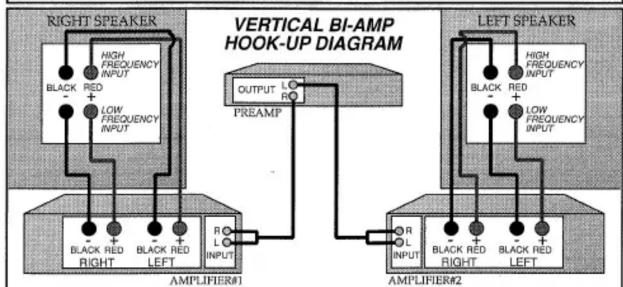
flowchart
graph TD
    A["RIGHT SPEAKER"] --> B["HIGH FREQUENCY INPUT"]
    A --> C["LOW FREQUENCY INPUT"]
    D["AMPLIFIER#1"] --> E["BLACK RED RIGHT"]
    D --> F["BLACK RED LEFT"]
    G["LEFT SPEAKER"] --> H["HIGH FREQUENCY INPUT"]
    G --> I["LOW FREQUENCY INPUT"]
    J["OUTPUT L R"] --> K["PREAMP"]
    K --> L["R L INPUT"]
    L --> M["BLACK RED RIGHT"]
    L --> N["BLACK RED LEFT"]
    O["AMPLIFIER#2"] --> P["R L INPUT"]
    O --> Q["BLACK RED LEFT"]
Removing the jumper bars, however, gives separate access to each frequency-section of the speaker. This allows for two different connection configurations which are described as follows:
BI-WIRING
- WARNING! • Maintain correct polarity to avoid possible speaker or amplifier damage! Make sure that the jumper bars have been removed. Make sure that the Red(+) speaker terminals are connected to one Red (+) amplifier terminal and the Black(-) speaker terminals are connected to one Black (-) amplifier terminal.
Bi-wiring improves clarity and openness with less grain and more solidity to the bass. As it only requires two additional speaker cables, it is also a low cost way to achieve even better performance from your Mk3 PERFORMANCE SERIES speaker.
PASSIVE BI-AMPING
- WARNING!
- Make absolutely sure that jumper bars have been removed from your speakers or serious damage to your amplifier will result!
- Avoid confusion and incorrect wiring. Connect one amplifier at a time.
- Maintain correct polarity! Make sure that Red(+) speaker terminals are connected to Red(+) amplifier terminals and Black(-) speaker terminals are connected to Black (-) amplifier terminals.
- NOTE! Be sure to use amplifiers with identical gain. If uniform amplifier gain is not maintained the left/right stereo balance will be incorrect when vertically bi-amped or the speaker system frequency balance will be incorrect when horizontally bi-amped. To prevent problems use identical amplifiers (Brand and Model) in identical operating mode (stereo or bridged mono).
Passive bi-amping provides a dramatic improvement in clarity, openness and detail - less grain - much better bass solidity and definition. The presentation of music is simply more intelligible and transparent.
With passive bi-amping the speaker's internal passive crossovers remain connected. An external electronic crossover is not required and cannot be used (there is no direct electrical access to individual drive units). This saves expense and set-up difficulties. Passive bi-amping fully optimizes your Mk3 PERFORMANCE SERIES speaker.
To bi-amplify, two power amplifiers are required. Connection can be either "vertical" or "horizontal" as shown. "Vertical" means that one amplifier is dedicated to each speaker - one channel drives the low/mid frequency input and the other drives the high frequency input. "Horizontal" means that one amplifier is driving both low/mid frequency inputs and another the high frequency inputs. Each configuration has advantages and disadvantages.
Vertical bi-amping dedicates an individual amplifier to each speaker. This optimizes stereo separation and will provide an outstanding three-dimensional soundstage with precise image localization.
When listening at loud levels, however, horizontal bi-amping is more optimal. Low/mid frequencies are more demanding on an amplifier than high frequencies. This imbalance can become a problem in the vertical configuration at loud levels - the clipping distortion in the amplifier's "low/mid frequency" channel can crosstalk into the "high frequency" channel and thus result in increased distortion going to the speaker's high frequency input.
Horizontal bi-amping dedicates one amplifier to the speaker's low/mid frequency inputs and another to the speaker's high frequency inputs. Distortion crosstalk between low/mid and high frequency channels can no longer occur. However, stereo separation is reduced from what can be achieved with the vertical configuration. The best configuration for you depends on your listening habits and equipment.
PREVENTING SPEAKER DAMAGE
PARADIGM SPEAKERS are efficient and can be driven to loud listening levels with moderate power. They are also able to handle the output of very powerful amplifiers.
AMPLIFIER DISTORTION - THE #1 CULPRIT!
Amplifier distortion is the principal cause of speaker damage. When listening at loud levels your amplifier may run out of clean power. It will then begin to produce distorted power several times greater than its rated output power. This distortion will damage any speaker very quickly.
MORE POWERFUL AMPLIFIERS ARE SAFER
A 30 watt/channel amplifier will have substantial distortion above 30 watts. When a speaker requires 40 watts, this amplifier will deliver distorted power - which may damage the speaker. A 100 watt/channel amplifier will have substantial distortion above 100 watts, but very low distortion below 100 watts. Thus, when the speaker requires 40 watts, this more powerful amplifier will deliver clean power and speaker damage is less likely to occur.
THE VOLUME CONTROL
Do not be fooled by the Volume Control of your Receiver/Preamplifier. It only adjusts listening level - it is not a "power-output" dial. The amount of amplifier power actually used at a given Volume Control setting depends solely on the nature of the music you are listening to. At a given Volume Control setting a quiet section of music will use less amplifier power than a loud section. With typical pop-rock, jazz or large scale classical music, the rated output power of many Receivers/Amplifiers is often reached when the Volume Control is between the "11 and 1 o'clock" setting (with bass/treble and loudness controls not used - otherwise rated power may be reached at even lower Volume Control settings).
Remember, all amplifiers produce distortion beyond their rated output power. Distortion will damage all speakers. Exercise caution! If you listen at loud levels, be careful to listen for the point of audible distortion... then turn the Volume Control down or your speakers and/or amplifier(s) will be damaged. If louder volumes are desired obtain a more powerful amplifier.
THERE IS A LIMIT!
Although more powerful amplifiers are safer, there is a point at which you could have more power than the speaker can handle. At that point you will overpower the speaker and damage it. Exercise caution! At loud levels do not increase bass/treble controls from zero and ensure that all loudness/contour/bass EQ buttons are off (otherwise rated output power will be reached at lower Volume Control settings). If you listen at loud levels, watch for excessive visible cone excursion (grill removed) from the woofer... then turn the Volume Control down.
THE RIGHT AMOUNT OF POWER
A power-range rating is given as a guide to indicate the minimum and maximum power input, approximately, of your PARADIGM speakers. Amplifiers that exceed your speakers' power-range rating are, in fact, recommended. Their greater power reserves provide better sound. However, exercise caution! Use the speakers within their power-range rating to prevent damage (keep listening levels below the point of excessive visible woofer cone excursion).
W A R R A N T Y
PARADIGM SPEAKERS are warranted to be and remain free of manufacturing and/or material defects for a period of 5 years from the date of the original retail purchase. Within this period, repair, replacement or adjustment of parts for manufacturing and/or material defects will be free of charge.
LIMITATIONS:
- Warranty begins on date of original retail purchase from an AUTHORIZED PARADIGM DEALER only. It is not transferable.
- Warranty applies to product in normal home use.
- Warranty does not apply if the product is used in professional or commercial applications.
WARRANTY IS VOID IF:
• The speaker has been abused (intentionally or accidentally).
- The speaker has been used in conjunction with unsuitable or faulty equipment.
• The speaker has been subjected to damaging signals, derangement in transport, mechanical damage or any abnormal conditions.
- The speaker (including cabinet) has been tampered with or damaged by an unauthorized service facility.
• The serial number plate has been removed or defaced.
OWNER RESPONSIBILITIES:
- Provide normal/reasonable operating care and maintenance.
- Provide proof of purchase (your sales receipt given at time of purchase from your AUTHORIZED PARADIGM DEALER must be retained for proof of purchase-date).
- Provide or pay for transportation charges for product to service facility.
Should servicing be required contact your nearest AUTHORIZED PARADIGM DEALER, PARADIGM ELECTRONICS INC. (in Canada), AUDIOSTREAM, DIVISION OF BAVAN CORPORATION (in the U.S.) or IMPORT DISTRIBUTOR (outside the U.S. and Canada) to arrange, bring in or ship, prepaid, any defective unit.
PARADIGM ELECTRONICS INC. reserves the right to improve the design of any product without assuming any obligation to modify any product previously manufactured.
This warranty is in lieu of all other warranties expressed or implied, of merchantability, fitness for any particular purpose and may not be extended or enlarged by anyone. In no event shall PARADIGM ELECTRONICS INC., their agents or representatives be responsible for any incidental or consequential damages. Some jurisdictions do not allow limitation of incidental or consequential damages, so this exclusion may not apply to you.
- NOTE!
- YOUR LISTENING ROOM
- SPEAKER LOCATION
- CONNECTION
- OTHER OPTIONS
- BI-WIRING
- PASSIVE BI-AMPING
- PREVENTING SPEAKER DAMAGE
- AMPLIFIER DISTORTION - THE #1 CULPRIT!
- MORE POWERFUL AMPLIFIERS ARE SAFER
- THE VOLUME CONTROL
- THERE IS A LIMIT!
- THE RIGHT AMOUNT OF POWER
- W A R R A N T Y
- LIMITATIONS:
- WARRANTY IS VOID IF:
- OWNER RESPONSIBILITIES:
Brand : Paradigm
Model : Mini-Mk3
Category : Loudspeaker