Baja (2005) - Car SUBARU - Free user manual and instructions
Find the device manual for free Baja (2005) SUBARU in PDF.


User questions about Baja (2005) SUBARU
0 question about this device. Answer the ones you know or ask your own.
Ask a new question about this device
Download the instructions for your Car in PDF format for free! Find your manual Baja (2005) - SUBARU and take your electronic device back in hand. On this page are published all the documents necessary for the use of your device. Baja (2005) by SUBARU.
USER MANUAL Baja (2005) SUBARU
Congratulations on choosing a SUBARU vehicle. This Owner's Manual has all the information necessary to keep your SUBARU in excellent condition and to properly maintain the emission control system for minimizing emission pollutants. We urge you to read this manual carefully so that you may understand your vehicle and its operation. For information not found in this Owner's Manual, such as details concerning repairs or adjustments, please contact the dealer from whom you purchased your SUBARU or the nearest SUBARU dealer.
The information, specifications and illustrations found in this manual are those in effect at the time of printing. FUJI HEAVY INDUSTRIES LTD. reserves the right to change specifications and designs at any time without prior notice and without incurring any obligation to make the same or similar changes on vehicles previously sold. This Owner's Manual applies to all models and covers all equipment, including factory installed options. Some explanations, therefore may be for equipment not installed in your vehicle.
Please leave this manual in the vehicle at the time of resale. The next owner will need the information found herein.
natural_image
Line drawing of a sedan car (no text or symbols on the car body)Warranties
■ Warranties for U.S.A.
All SUBARU vehicles distributed by Subaru of America, Inc. and sold at retail by an authorized SUBARU dealer in the United States come with the following warranties:
• SUBARU Limited Warranty
- Emission Control Systems Warranty
• Emissions Performance Warranty
All warranty information, including details of coverage and exclusions, is in the "Warranty and Maintenance Booklet". Please read these warranties carefully.
■ Warranties for Canada
All SUBARU vehicles distributed by Subaru Canada, Inc. and sold at retail by an authorized SUBARU dealer in Canada come with the following warranties:
• SUBARU Limited Warranty
• Anti-Corrosion Warranty
- Emission Control Warranty
All warranty information, including details of coverage and exclusions, is in the "Warranty and Service Booklet". Please read these warranties carefully.
NOTE
This vehicle does not contain mercury devices or parts.
How to use this owner's manual
■ Using your Owner's manual
Before you operate your vehicle, carefully read this manual. To protect yourself and extend the service life of your vehicle, follow the instructions in this manual. Failure to observe these instructions may result in serious injury and damage to your vehicle.
This manual is composed of fourteen chapters. Each chapter begins with a brief table of contents, so you can usually tell at a glance if that chapter contains the information you want.
Chapter 1: Seat, seatbelt and SRS airbags
This chapter informs you how to use the seat and seat-belt and contains precautions for the SRS airbags.
Chapter 2: Keys and doors
This chapter informs you how to operate the keys, locks and windows.
Chapter 3: Instruments and controls
This chapter informs you about the operation of instrument panel indicators and how to use the instruments and other switches.
Chapter 4: Climate control
This chapter informs you how to operate the climate control.
Chapter 5: Audio
This chapter informs you how to operate your audio system.
Chapter 6: Interior and exterior equipments
This chapter informs you how to operate interior and exterior equipments.
Chapter 7: Starting and operating
This chapter informs you how to start and operate your SUBARU.
Chapter 8: Driving tips
This chapter informs you how to drive your SUBARU in various conditions and explains some safety tips on driving.
Chapter 9: In case of emergency
This chapter informs you what to do if you have a problem while driving, such as a flat tire or engine overheating.
Chapter 10: Appearance care
This chapter informs you how to keep your SUBARU looking good.
Chapter 11: Maintenance and service
This chapter informs you when you need to take your SUBARU to the dealer for scheduled maintenance and informs you how to keep your SUBARU running properly.
Chapter 12: Specifications
This chapter informs you about dimension and capacities of your SUBARU.
Chapter 13: Consumer information and Reporting safety defects
This chapter informs you about Tire information, Uniform tire quality grading standards and Reporting safety defects.
Chapter 14: Index
This is an alphabetical listing of all that's in this manual. You can use it to quickly find something you want to read.
■ Safety warnings
You will find a number of WARNINGS, CAUTIONs and NOTES in this manual.
These safety warnings alert you to potential hazards that could result in injury to you or others.
Please read these safety warnings as well as all other portions of this manual carefully in order to gain a better understanding of how to use your SUBARU vehicle safely.
WARNING
A WARNING indicates a situation in which serious injury or death could result if the warning is ignored.
CAUTION
A CAUTION indicates a situation in which injury or damage to your vehicle, or both, could result if the caution is ignored.
NOTE
A NOTE gives information or suggestions how to make better use of your vehicle.
■ Safety symbol

natural_image
Gray circular prohibition symbol with diagonal line (no text or numbers)HSF019AA
You will find a circle with a slash through it in this man-
- CONTINUED -
ual. This symbol means "Do not", "Do not do this", or "Do not let this happen", depending upon the context.
Safety precautions when driving
■ Seatbelt and SRS airbag
WARNING
- All persons in the vehicle should fasten their seatbelts BEFORE the vehicle starts to move. Otherwise, the possibility of serious injury becomes greater in the event of a sudden stop or accident.
- To obtain maximum protection in the event of an accident, the driver and all passengers in the vehicle should always wear seatbelts when the vehicle is moving. The SRS (Supplemental Restraint System) airbag does not do away with the need to fasten seatbelts. In combination with the seatbelts, it offers the best combined protection in case of a serious accident.
Not wearing a seatbelt increases the chance of severe injury or death in a crash even when the vehicle has the SRS airbag. - The SRS airbags deploy with considerable speed and force. Occupants who are out of proper position when the SRS airbag deploys could suffer very serious injuries. Because the SRS airbag needs enough space for deploy-
ment, the driver should always sit upright and well back in the seat as far from the steering wheel as practical while still maintaining full vehicle control and the front passenger should move the seat as far back as possible and sit upright and well back in the seat.
Carefully read the sections "Seat, seatbelt and SRS airbags" in chapter 1 of this owner's manual for instructions and precautions concerning the seatbelt system and SRS airbag system.
■ Child safety
WARNING
- Never hold a child on your lap or in your arms while the vehicle is moving. The passenger cannot protect the child from injury in a collision, because the child will be caught between the passenger and objects inside the vehicle.
- While riding in the vehicle, infants and small children should always be placed in the REAR seat in an infant or child restraint system which is appropriate for the child's age, height and weight. If a child is too big for a child restraint
system, the child should sit in the REAR seat and be restrained using the seatbelts. According to accident statistics, children are safer when properly restrained in the rear seating positions than in the front seating positions. Never allow a child to stand up or kneel on the seat.
- Put children aged 12 and under in the REAR seat properly restrained at all times in a child restraint device or in a seatbelt. The SRS airbag deploys with considerable speed and force and can injure or even kill children, especially if they are 12 years of age and under and are not restrained or improperly restrained. Because children are lighter and weaker than adults, their risk being injured from deployment is greater.
- NEVER INSTALL A REARWARD FACING CHILD SAFETY SEAT IN THE FRONT SEAT. DOING SO RISKS SERIOUS INJURY OR DEATH TO THE CHILD BY PLACING THE CHILD'S HEAD TOO CLOSE TO THE SRS AIRBAG.
- Always use the child safety locks whenever a child rides in the rear seat. Serious injury could result if a child accidentally opened the door and fell out. Refer to the “Door locks” section in chapter 2.
• Always lock the passenger's windows using
- CONTINUED -
the lock switch when children are riding in the vehicle. Failure to follow this procedure could result in injury to a child operating the power window. Refer to the "Power windows" section in chapter 2.
- Never leave unattended children in the vehicle. They could accidentally injure themselves or others through inadvertent operation of the vehicle. Also, on hot or sunny days, temperature in a closed vehicle could quickly become high enough to cause severe or possibly fatal injuries to them.
Carefully read the sections "Child restraint systems", "SRS airbag (Supplemental Restraint System airbag)", and "Seatbelts" in chapter 1 of this owner's manual for instructions and precautions concerning the child restraint system, seatbelt system and SRS airbag system.
■ Engine exhaust gas (carbon monoxide)
WARNING
- Never inhale engine exhaust gas. Engine ex-
haust gas contains carbon monoxide, a colorless and odorless gas which is dangerous, or even lethal, if inhaled.
- Always properly maintain the engine exhaust system to prevent engine exhaust gas from entering the vehicle.
- Never run the engine in a closed space, such as a garage, except for the brief time needed to drive the vehicle in or out of it.
- Avoid remaining in a parked vehicle for a lengthy time while the engine is running. If that is unavoidable, then use the ventilation fan to force fresh air into the vehicle.
• Always keep the front ventilator inlet grille free from snow, leaves or other obstructions to ensure that the ventilation system always works properly.
- If at any time you suspect that exhaust fumes are entering the vehicle, have the problem checked and corrected as soon as possible. If you must drive under these conditions, drive only with all windows fully open.
■ Drinking and driving
WARNING
Drinking and then driving is very dangerous. Alcohol in the bloodstream delays your reaction and impairs your perception, judgment and attentiveness. If you drive after drinking – even if you drink just a little – it will increase the risk of being involved in a serious or fatal accident, injuring or killing yourself, your passengers and others. In addition, if you are injured in the accident, alcohol may increase the severity of that injury. Please don't drink and drive.
Drunken driving is one of the most frequent causes of accidents. Since alcohol affects all people differently, you may have consumed too much alcohol to drive safely even if the level of alcohol in your blood is below the legal limit. The safest thing you can do is never drink and drive. However if you have no choice but to drive, stop drinking and sober up completely before getting behind the wheel.
■ Drugs and driving
WARNING
There are some drugs (over the counter and prescription) that can delay your reaction time and impair your perception, judgment and attentiveness. If you drive after taking them, it may increase your, your passengers' and other persons' risk of being involved in a serious or fatal accident.
If you are taking any drugs, check with your doctor or pharmacist or read the literature that accompanies the medication to determine if the drug you are taking can impair your driving ability. Do not drive after taking any medications that can make you drowsy or otherwise affect your ability to safely operate a motor vehicle. If you have a medical condition that requires you to take drugs, please consult with your doctor.
Never drive if you are under the influence of any illicit mind-altering drugs. For your own health and well-being, we urge you not to take illegal drugs in the first place and to seek treatment if you are addicted to those drugs.
- CONTINUED -
■ Driving when tired or sleepy
WARNING
When you are tired or sleepy, your reaction will be delayed and your perception, judgment and attentiveness will be impaired. If you drive when tired or sleepy, your, your passengers' and other persons' chances of being involved in a serious accident may increase.
Please do not continue to drive but instead find a safe place to rest if you are tired or sleepy. On long trips, you should make periodic rest stops to refresh yourself before continuing on your journey. When possible, you should share the driving with others.
■ Car phone/mobile phone and driving
CAUTION
Do not use a hand-held phone while driving; it may distract your attention from driving and can lead to an accident. If you use a hand-held phone, pull off the road and park in the safe place before using your phone. In some States/
Provinces, only hands-free phones may legally be used while driving.
■ Modification of your vehicle
CAUTION
Your vehicle should not be modified. Modification could affect its performance, safety or durability, and may even violate governmental regulations. In addition, damage or performance problems resulting from modification may not be covered under warranties.
■ Driving with pets
Unrestrained pets can interfere with your driving and distract your attention from driving. In a collision or sudden stop, unrestrained pets or cages can be thrown around inside the vehicle and hurt you or your passengers. Besides, the pets can be hurt under these situations. It is also for their own safety that pets should be properly restrained in your vehicle. Restrain a pet with a special traveling harness which can be secured to the rear seat with a seatbelt or use a pet car-
rier which can be secured to the rear seat by routing a seatbelt through the carrier's handle. Never restrain pets or pet carriers in the front passenger's seat. For further information, consult your veterinarian, local animal protection society or pet shop.
■ Tire pressures
WARNING
Driving at high speeds with excessively low tire pressures can cause the tires to deform severely and to rapidly become hot. A sharp increase in temperature could cause tread separation, and destruction of the tires. The resulting loss of vehicle control could lead to an accident.
Check and, if necessary, adjust the pressure of each tire (including the spare) at least once a month and before any long journey.
Check the tire pressure when the tires are cold.
Use a pressure gauge to adjust the tire pressures to the values shown on the tire placard.
Refer to the "Tires and wheels" section in chapter 11 for detailed information.
■ California proposition 65 warning
WARNING
Engine exhaust, some of its constituents, and certain vehicle components contain or emit chemicals known to the State of California to cause cancer and birth defects or other reproductive harm. In addition, certain fluids in vehicles and certain components of product wear contain or emit chemicals known to the State of California to cause cancer and birth defects or other reproductive harm.
natural_image
Empty grid with dashed lines on white background, no text or symbols presentTable of contents
| Seat, seatbelt and SRS airbags | 1 |
| Keys and doors | 2 |
| Instruments and controls | 3 |
| Climate control | 4 |
| Audio | 5 |
| Interior equipment | 6 |
| Starting and operating | 7 |
| Driving tips | 8 |
| In case of emergency | 9 |
| Appearance care | 10 |
| Maintenance and service | 11 |
| Specifications | 12 |
| Consumer information and Reporting safety defects | 13 |
| Index | 14 |
Illustrated index
■ Exterior

text_image
1 2 3 5 6 7 13 12 11 10 9 8 UBF047BB1) Hood lock release knob (page 11-5)
2) Headlight switch (page 3-18)
3) Bulb replacement (page 11-64)
4) Wiper switch (page 3-25)
5) Moonroof (page 2-31)
6) Roof rail (page 6-24)
7) Door locks (page 2-3)
8) Tire pressure (page 11-46)
9) Flat tires (page 9-12)
10) Tire chains (page 8-15)
11) Fog light button (page 3-23)
12) Tie-down hooks (page 9-23)
13) Towing hook (page 9-23)

text_image
1 2 3 4 5 6 7 UBF048BB1) Rear window defogger button (page 3-26)
2) Fuel filler lid (page 7-4)
3) Child safety locks (page 2-21)
4) Towing hook (page 9-23)
5) Tailgate (page 2-25)
6) Tie-down hooks (page 9-2)
7) Bulb replacement (page 11-61)
8) Licence plate bracket (page 2-26)
- CONTINUED -
Interior
▼ Passenger compartment area
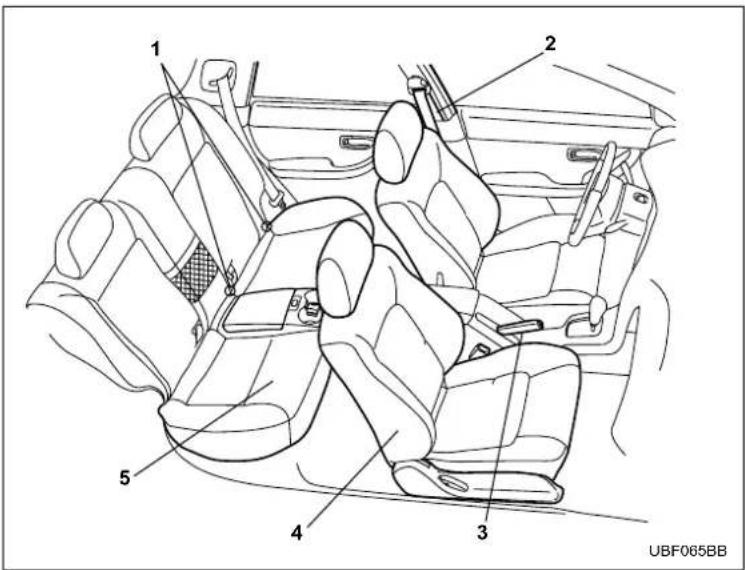
text_image
1 2 3 4 5 UBF065BB1) Lower anchorage for child restraint system (page 2-21)
2) Seatbelt (page 1-14)
3) Parking brake lever (page 7-36)
4) Front seat (page 1-2)
5) Rear seat (page 1-9)
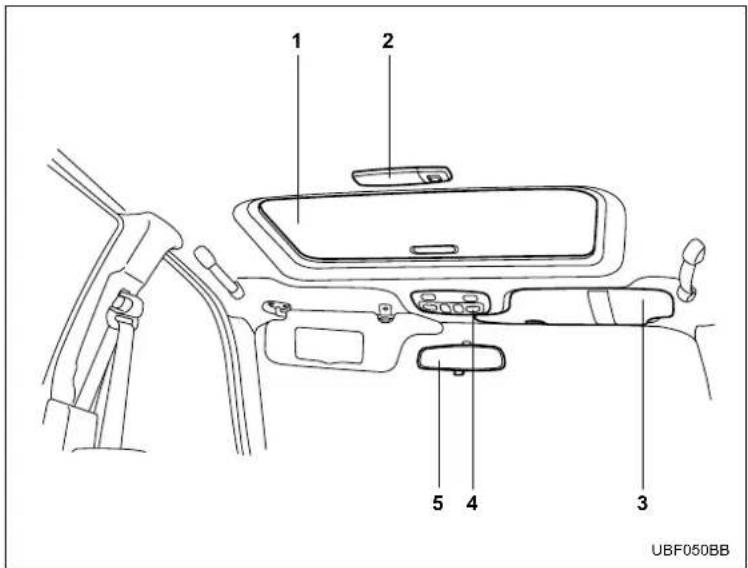
text_image
1 2 5 4 3 UBF050BB1) Moonroof (page 2-31)
2) Interior lights (page 6-2)
3) Sun visors (page 6-3)
4) Map light (page 6-3)
5) Inside mirror (page 3-28)
- CONTINUED -

text_image
1 2 3 4 5 6 7 1 UBF066BB1) Cup holder (page 6-7)
2) Center console (page 6-5)
3) Glove box (page 6-5)
4) Cigarette lighter (page 6-9)
5) Ashtray (page 6-12)
6) Accessory power outlet (page 6-8)
7) Rear center console (page 6-6)
▼ Cargo bed/spare tire/jack

text_image
1 2 3 4 6 5 UBF067BB1) Cargo lamp (page 6-20)
2) Cargo tie-down hooks (page 6-17)
3) Temporary spare tire (page 9-10)
4) Switchback door (page 2-27)
5) Jack/Maintenance tools (page 9-3)
6) Cargo bed extender (page 6-17)
- CONTINUED -
■ Instrument panel

text_image
1 2 3 4 5 6 7 89101112131445161) Door locks (page 2-3)
2) Outside mirror (page 3-30)
3) Light control lever (page 3-18)
4) Combination meter (page 3-6)
5) Wiper control lever (page 3-23)
6) Hazard warning flasher switch (page 3-5)
7) Climate control (page 4-1)
8) Gear shift lever (MT) (page 7-12)/Selector lever (AT) (page 7-15)
9) Audio (page 5-1)
10) Cruise control (page 7-38)
11) Horn (page 3-34)
12) SRS airbag (page 1-47)
13) Tilt steering (page 3-33)
14) Fuse box (page 11-57)
15) Hood lock release knob (page 11-5)
16) Power door locking switch (page 2-5)
17) Power window (page 2-22)
■ Light control and wiper control levers/switches

text_image
1 2 3 4 5 6 7 8 9 10 11 UBF023DB1) Parking light switch (page 3-22)
2) Windshield wiper (page 3-23)
3) Mist (page 3-25)
4) Windshield washer (page 3-25)
5) Wiper control lever (page 3-25)
6) Illumination brightness control (page 3-21)
7) Light control lever (page 3-18)
8) Headlight ON/OFF (page 3-18)
9) Headlight flasher High/Low beam change (page 3-18)
10) Turn signal (for lane change) (page 3-20)
11) Turn signal (page 3-20)
- CONTINUED -
■ Combination meter
▼ Non-turbo models

text_image
1 2 3 4 AIR/RAG ABS AWO F E 0 100 200 300 400 500 600 700 800 900 1000 1100 1200 MPH R P R N D 3 2 1 SECURITY 1 x1000t/min 2 3 4 5 6 7 FUEL DOOR 10:00 RUP, 800°F AT OIL TEMP. CLOSE SET H C 56789 UBF063BB1) Fuel gauge (page 3-8)
2) Speedometer (page 3-6)
3) Tachometer (page 3-7)
4) Temperature gauge (page 3-8)
5) Clock setting knob (page 3-17)
6) Clock and outside temperature indicator (page 3-17, 3-7)
7) Selector lever position indicator (page 3-15)
8) Trip meter A/B selection and trip meter reset knob (page 3-6)
9) Trip meter and odometer (page 3-6)

Turbo models
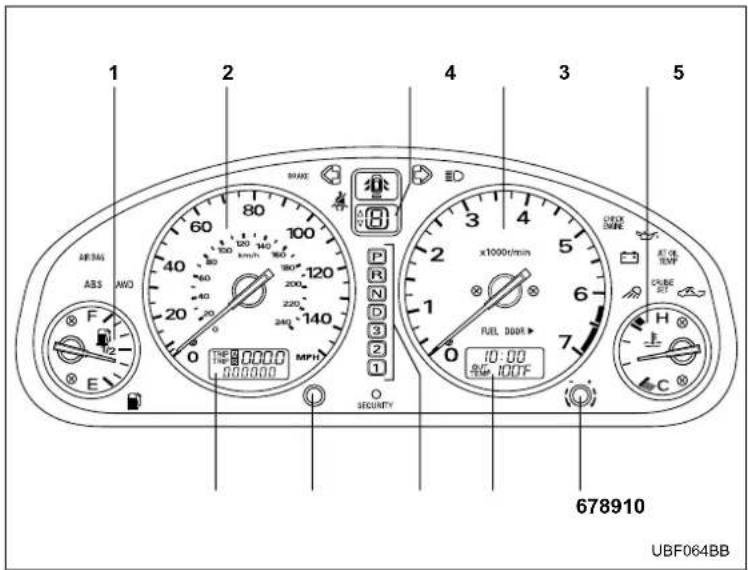
text_image
1 2 3 4 5 ABM ABS AWO F E 678910 UBF064BB1) Fuel gauge (page 3-8)
2) Speedometer (page 3-6)
3) Gear position indicator (page 3-16)
4) Tachometer (page 3-7)
5) Temperature gauge (page 3-8)
6) Clock setting knob (page 3-17)
7) Clock and outside temperature indicator (page 3-17, 3-7)
8) Selector lever position indicator (page 3-15)
9) Trip meter A/B selection and trip meter reset knob (page 3-6)
10) Trip meter and odometer (page 3-6)
- CONTINUED -
▼ Warning and indicator light
| Mark Name Page | ||
| Seatbelt warning light 3-9 | ||
| AIR BAG | SRS airbag system warning light | 3-10 |
| CHECK ENGINE | CHECK ENGINE warning light/Malfunction indicator lamp | 3-10 |
| Charge warning light 3-11 | ||
| Oil pressure warning light 3-12 | ||
| AT OIL TEMP | AT OIL temperature warning light (if equipped) | 3-12 |
| ABS or(ABS) | ABS warning light 3-12 | |
| BRAKE or(!) | Brake system warning light 3-13 | |
| Door ajar warning light 3-14 | ||
| Mark Name Page | ||
| Low fuel warning light 3-14 | ||
| AWD | All-Wheel Drive warning light (if equipped) | 3-14 |
| Switchback door indicator 3-14 | ||
| SECURITY | Security system indicator light (if equipped) | 3-15 |
| Cargo lamp indicator 3-16 | ||
| Turn signal indicator lights 3-16 | ||
| High beam indicator light 3-16 | ||
| CRUISE SET | Cruise control set indicator light | 7-38 |
Seat, seatbelt and SRS airbags
Front seats 1-2
Fore and aft adjustment 1-3
Seat cushion angle and height adjustment (Power seat only) 1-4
Reclining the seatback 1-5
Head restraint adjustment 1-6
Lumbar support (if equipped) 1-7
Seat heater (if equipped) 1-7
Rear seats 1-9
Rear headrest 1-9
Folding down the rear seat 1-10
Seatbelts 1-14
Seatbelt safety tips 1-14
Emergency Locking Retractor (ELR) 1-16
Automatic/Emergency Locking Retractor (A/ELR) 1-16
Seatbelt warning light and chime 1-17
Fastening the seatbelt 1-17
Seatbelt maintenance 1-21
Seatbelt extender 1-22
Front seatbelt pretensioners 1-24
System monitors 1-25
System servicing 1-26
Precautions against vehicle modification ..... 1-27
Child restraint systems 1-28
Where to place a child restraint system ..... 1-29
Choosing a child restraint system 1-31
Installing child restraint systems with A/ELR
seatbelt 1-32
Installation of child restraint systems by use
of lower and tether anchorages (LATCH) .... 1-40
Installing a booster seat 1-45
*SRS airbag (Supplemental Restraint
System airbag) 1-47
Vehicle with driver's and front passenger's
SRS airbags and lap/shoulder restraints ..... 1-47
SRS frontal airbag 1-52
SRS airbag system monitors 1-60
SRS airbag system servicing 1-61
Precautions against vehicle modification ..... 1-62
Front seats
WARNING
- Never adjust the seat while driving to avoid the possibility of loss of vehicle control and of personal injury.
- Before adjusting the seat, make sure the hands and feet of rear seat passengers are clear of the adjusting mechanism.
- Seatbelts provide maximum restraint when the occupant sits well back and upright in the seat. To reduce the risk of sliding under the seatbelt in a collision, the front seatbacks should be always used in the upright position while the vehicle is running. If the front seatbacks are not used in the upright position in a collision, the risk of sliding under the lap belt and of the lap belt sliding up over the abdomen will increase, and both can result in serious internal injury or death.
- The SRS airbags deploy with considerable speed and force. Occupants who are out of proper position when the SRS airbag deploys could suffer very serious injuries. Because the SRS airbag needs enough space for deployment, the driver should always sit upright and
well back in the seat as far from the steering wheel as practical while still maintaining full vehicle control and the front passenger should move the seat as far back as possible and sit upright and well back in the seat.
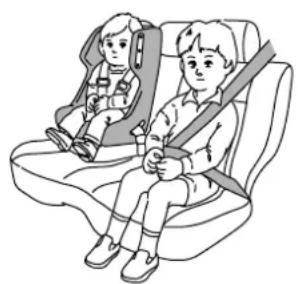
natural_image
Illustration of two children sitting in a car seat, one using a seatbelt (no text or symbols)HS1034BA
WARNING
Put children aged 12 and under in the rear seat properly restrained at all times. The SRS airbag deploys with considerable speed and force and can injure or even kill children, especially if they are 12 years of age and under and are not
restrained or improperly restrained. Because children are lighter and weaker than adults, their risk of being injured from deployment is greater. For that reason, we strongly recommend that ALL children (including those in child seats and those that have outgrown child restraint devices) sit in the REAR seat properly restrained at all times in a child restraint device or in a seatbelt, whichever is appropriate for the child's age, height and weight.
Secure ALL types of child restraint devices (including forward facing child seat) in the REAR seats at all times.
NEVER INSTALL A REARWARD FACING CHILD SEAT IN THE FRONT SEAT. DOING SO RISKS SERIOUS INJURY OR DEATH TO THE CHILD BY PLACING THE CHILD'S HEAD TOO CLOSE TO THE SRS AIRBAG.
According to accident statistics, children are safer when properly restrained in the rear seating positions than in the front seating positions. For instructions and precautions concerning child restraint systems, see the "Child restraint systems" section in this chapter.
■ Fore and aft adjustment
▼ Power seat (if equipped)
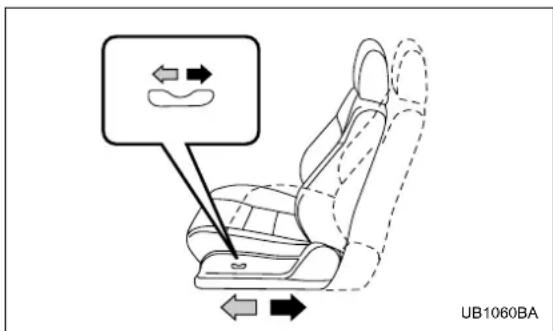
text_image
UB1060BATo adjust the seat forward or backward, move the control switch forward or backward.
- CONTINUED -
▼ Manual type
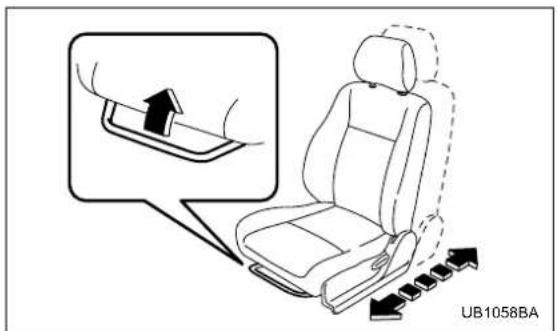
text_image
UB1058BAPull the lever upward and slide the seat to the desired position. Then release the lever and move the seat-back and forth to make sure that it is securely locked into place.
■ Seat cushion angle and height adjustment (Power seat only)

text_image
UB1078BA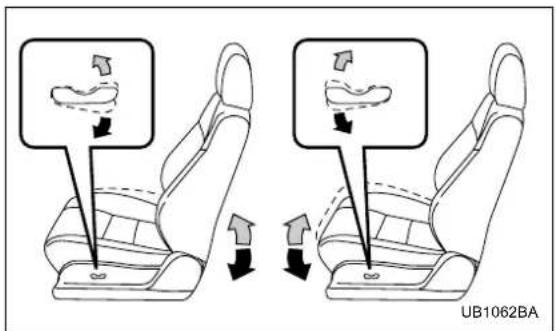
text_image
UB1062BATo adjust the angle and height of the seat cushion, move the control switch in the corresponding direction.
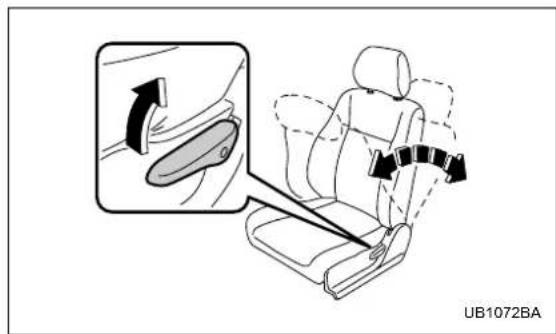
■ Reclining the seatback
text_image
UB1072BAPull the reclining lever up and adjust the seatback to the desired position. Then release the lever and make sure the seat is securely locked into place.
The seatback placed in a reclined position can spring back upward with force when released. When operating the reclining lever to return the seatback, hold it lightly so that it may be raised back gradually.
- CONTINUED -
natural_image
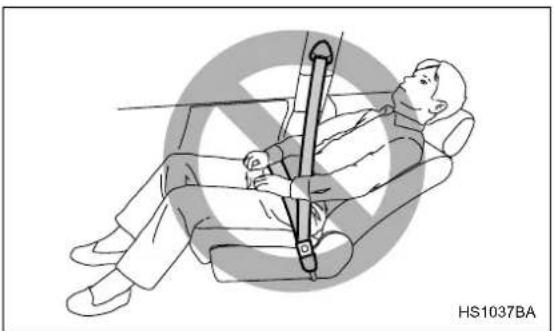
Illustration of a person lying in a seat with a horizontal bar, no text or symbols presentWARNING
To prevent the passenger from sliding under the seatbelt in the event of a collision, always put the seatback in the upright position while the vehicle is in motion. Also, do not place objects such as cushions between the passenger and the seatback. If you do so, the risk of sliding under the lap belt and of the lap belt sliding up over the abdomen will increase, and both can result in serious internal injury or death.
■ Head restraint adjustment

text_image
UB1016BATo raise the head restraint, pull it up. To lower it, push the head restraint down while pressing the release button on the top of the seatback.
The head restraint should be adjusted so that the center of the head restraint is closest to the top of the occupant's ears.
WARNING
Never drive the vehicle with the head restraints removed because they are designed to reduce the risk of serious neck injury in the event that
the vehicle is struck from the rear.
■ Lumbar support (if equipped)
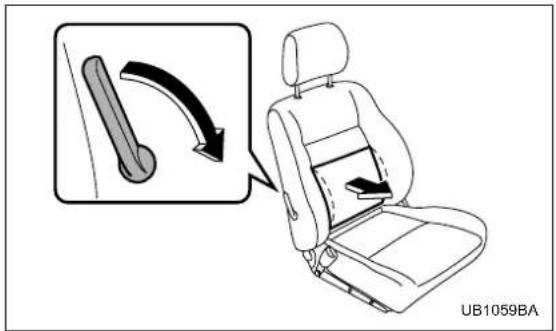
text_image
UB1059BAPull the lever forward or backward. Pulling the lever forward will increase the amount of support for your lower back.
Seat heater (if equipped)
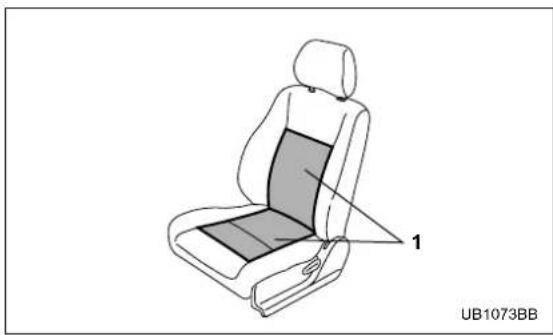
natural_image
Line drawing of a car seat with labeled component '1' and identifier 'UB1073BB' (no text or symbols on the diagram itself)1) Heating element
The seat heater operates when the ignition switch is either in the "ACC" or "ON" position.
- CONTINUED -

text_image
LO HI 1UB1093BB
1) Indicator light
To turn on the seat heater, push the "LO" or "HI" position on the switch, as desired, depending on the temperature. Selecting the "HI" position will make the seat to heat up quickly.
LO: Normal heating
HI: Rapid heating
The indicator located on the switch comes on when the seat heater is in operation. When the vehicle's interior is warmed enough or before you leave the vehicle, be sure to turn the switch off.
CAUTION
- There is a possibility that people with delicate skin may suffer slight burns even at low temperatures if they use the seat heater for a long period of time. When using the heater, always be sure to warn the persons concerned.
- Do not put anything on the seat which insulates against heat, such as a blanket, cushion, or similar items. This may cause the seat heater to overheat.
NOTE
- Use of the seat heater for a long period of time while the engine is not running can cause battery discharge.
- When cleaning the seat, do not use benzine, paint thinner, or any similar materials.
Rear seats
natural_image
Line drawing of a person seated in a car seatbelt, no text or symbols presentWARNING
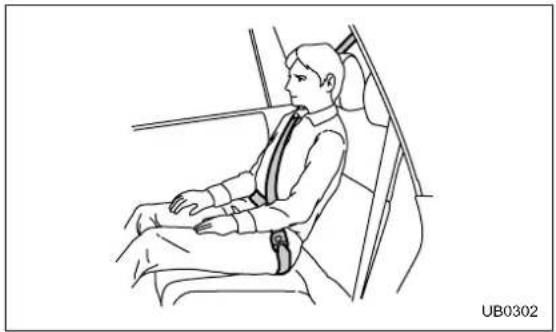
- Seatbelts provide maximum restraint when the occupant sits well back and upright in the seat. Do not put cushions or any other materials between occupants and seatbacks or seat cushions. If you do so, the risk of sliding under the lap belt and of the lap belt sliding up over the abdomen will increase, and both can result in serious internal injury or death.
• To avoid the possibility of serious injury or death, passengers must never be allowed to sit
on the rear center console while the vehicle is in motion. The rear seat of this vehicle is designed for no more than two passengers and is equipped with only two seatbelts.
- Make sure that the rear seatback is securely locked. When it is securely locked, the red marking on the lock is no longer visible. If it is not locked, the seatback may move forward when the vehicle is operated.
■ Rear headrest

natural_image
Line drawing of a mechanical component or bracket with no visible text or symbolsRear headrest are not adjustable, nor removable.
- CONTINUED -
■ Folding down the rear seat
WARNING
• After returning the rear seat to its original position, be certain to place all of the seatbelts and the tab attached to the seat cushion above the seat cushion. And make certain that the shoulder belts are fully visible.
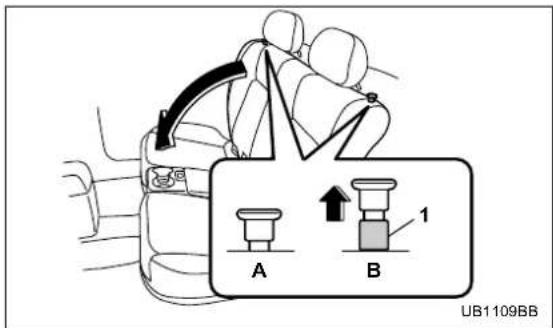
- Make sure that the rear seatback is securely locked after returning the seatback to its original position. When securely locked, the red marking on the lock is no longer visible. If it is not locked securely, the rear seatback may fold down during driving.
- Never allow passengers to ride on the folded rear seatback. Doing so may result in serious injury or death.
- Secure skis and other lengthy items properly to prevent them from being thrown around inside the vehicle and causing serious injury during a sudden stop, a sudden steering maneuver or a rapid acceleration.
natural_image
Simple line drawing of a person sitting on the ground next to stacked boxes, with a diagonal no-smoking symbol in the background (no text or symbols present)HS8005BA
WARNING
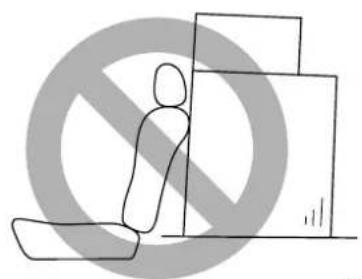
Never stack luggage or other cargo higher than the top of the front seatback because it could tumble forward and injure passengers in the event of a sudden stop or accident.
▼ Folding down the seatback
CAUTION
Before folding down the seatback, check that there is nothing in the seatback pocket. If there is something in the pocket, it could be damaged or cause damage to the seatback and rear center console when the seatback is folded.
text_image
UB1109BB A B 1natural_image
Line drawing of a car interior showing seatbelt and dashboard (no text or symbols)- Unlock the seatback by pulling the release knob up and then fold the seatback down.
- CONTINUED -
▼ Folding down the seat cushion and seatback
CAUTION
Before folding down the seatback, check that there is nothing in the seatback pocket. If there is something in the pocket, it could be damaged or cause damage to the seatback and rear center console when the seatback is folded.

natural_image
Diagram of a car interior showing steering wheel and dashboard (no text or symbols)- Move the front seat forward.
- Store the seatbelts in the seatbelt pockets to prevent them from falling below the cushion.

natural_image
Diagram of a car seat assembly with a close-up inset showing a shoe component (no text or symbols)
natural_image
Diagram of a car interior showing seatbelt and dashboard placement (no text or symbols)- Raise the seat cushion by pulling up the tab.
text_image
A B 1 UB1112CB UB1113BAnatural_image
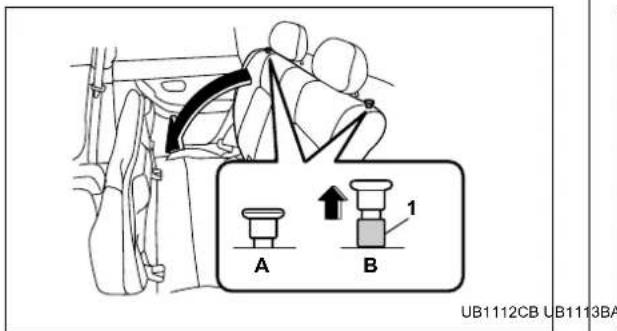
Technical line drawing of a vehicle interior showing a door panel and a highlighted component (no text or symbols)- Unlock the seatback by pulling the release knob up and fold the seatback down. Confirm that the pin located at the bottom of the seat cushion is inserted into the slot at the top of the seatback.
CAUTION
Be careful not to pinch your hand or fingers with the seat cushion or the seatback when performing the fold down operation.
5. To return the rear seat to its original position, raise the seatback and seat cushion until they lock into
- CONTINUED -
place and make sure that they are securely locked. Make sure that the rear seatbelt buckles are not under the seat cushion or seatback, when returning the seat cushion and the seatback to their original position.
CAUTION
Confirm that the rear seatbelts are stored in the seatbelt pocket prior to returning the seat cushion to its original position.
Seatbelts
■ Seatbelt safety tips
WARNING
- All persons in the vehicle should fasten their seatbelts BEFORE the vehicle starts to move. Otherwise, the possibility of serious injury becomes greater in the event of a sudden stop or accident.
- All belts should fit snugly in order to provide full restraint. Loose fitting belts are not as effective in preventing or reducing injury.
- Each seatbelt is designed to support only one person. Never use a single belt for two or more persons – even children. Otherwise, in an accident, serious injury or death could result.
- Replace all seatbelt assemblies including retractors and attaching hardware worn by occupants of a vehicle that has been in a serious accident. The entire assembly should be replaced even if damage is not obvious.
- Put children aged 12 and under in the rear seat properly restrained at all times. The SRS airbag deploys with considerable speed and force and can injure or even kill children, espe-
cially if they are 12 years of age and under and are not restrained or improperly restrained. Because children are lighter and weaker than adults, their risk of being injured from deployment is greater. For all these reasons, we strongly recommend that ALL children (including those in child seats and those that have outgrown child restraint devices) sit in the REAR seat properly restrained at all times in a child restraint device or in a seatbelt, whichever is appropriate for the child's height and weight.
Secure ALL types of child restraint devices (including forward facing child seats) in the REAR seats at all times.
NEVER INSTALL A REARWARD FACING CHILD SEAT IN THE FRONT SEAT. DOING SO RISKS SERIOUS INJURY OR DEATH TO THE CHILD BY PLACING THE CHILD'S HEAD TOO CLOSE TO THE SRS AIRBAG.
According to accident statistics, children are safer when properly restrained in the rear seating positions than in the front seating positions. For instructions and precautions concerning the child restraint system, see the "Child restraint systems" section in this chapter.
▼ Infants or small children
Use a child restraint system that is suitable for your vehicle. See information on "Child restraint systems" in this chapter.
Children
If a child is too big for a child restraint system, the child should sit in the rear seat and be restrained using the seatbelts. According to accident statistics, children are safer when properly restrained in the rear seating positions than in the front seating positions. Never allow a child to stand up or kneel on the seat.
If the shoulder portion of the belt crosses the face or neck, move the child closer to the belt buckle to help provide a good shoulder belt fit. Care must be taken to securely place the lap belt as low as possible on the hips and not on the child's waist. If the shoulder portion of the belt cannot be properly positioned, a child restraint system should be used. Never place the shoulder belt under the child's arm or behind the child's back.
- CONTINUED -
▼ Expectant mothers
natural_image
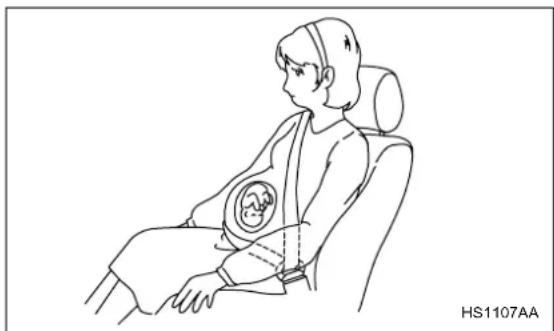
Line drawing of a person seated in a car seat with an IV drip device attached, no text or symbols presentExpectant mothers also need to use the seatbelts. They should consult their doctor for specific recommendations. The lap belt should be worn securely and as low as possible over the hips, not over the waist.
Emergency Locking Retractor (ELR)
The driver's seatbelt has an Emergency Locking Retractor (ELR).
The emergency locking retractor allows normal body movement but the retractor locks automatically during a sudden stop, impact or if you pull the belt very quickly out of the retractor.
■ Automatic/Emergency Locking Retractor (A/ELR)
Each passenger's seatbelt has an Automatic/Emergency Locking Retractor (A/ELR). The Automatic/Emergency Locking Retractor normally functions as an Emergency Locking Retractor (ELR). The A/ELR has an additional locking mode "Automatic Locking Retractor (ALR) mode" intended to secure a child restraint system. When the seatbelt is once drawn out completely and is then retracted even slightly, the retractor locks the seatbelt in that position and the seatbelt cannot be extended. As the belt is rewinding, clicks will be heard which indicate the retractor functions as ALR. When the seatbelt is retracted fully, ALR mode is released.
When securing a child restraint system on the passengers' seats, the seatbelt must be changed over to the Automatic Locking Retractor (ALR) mode.
When the child restraint system is removed, make sure that the retractor is restored to the Emergency Locking Retractor (ELR) function by allowing the seat-belt to retract fully.
For instructions on how to convert the retractor to the ALR mode and restore it to the ELR mode, see the "Child restraint systems" section in this chapter.
■ Seatbelt warning light and chime

Your vehicle is equipped with a seatbelt warning device at the driver's seat.
This device causes the seatbelt warning light on the instrument panel to light up for about six seconds when the ignition switch is turned to the "ON" position to remind the driver to wear the seatbelt. If the driver's seatbelt is not fastened, a warning chime sounds at the same time.
■ Fastening the seatbelt
WARNING
- Never use a belt that is twisted or reversed. In an accident, this can increase the risk or severity of injury.
- Keep the lap belt as low as possible on your hips. In a collision, this spreads the force of the lap belt over stronger hip bones instead of across the weaker abdomen.
- Seatbelts provide maximum restraint when the occupant sits well back and upright in the seat. To reduce the risk of sliding under the seatbelt in a collision, the front seatbacks should be always used in the upright position while the vehicle is running. If the front seat-
backs are not used in the upright position in a collision, the risk of sliding under the lap belt and of the lap belt sliding up over the abdomen will increase, and both can result in serious internal injury or death.
- Do not put cushions or any other materials between occupants and seatbacks or seat cushions. If you do so, the risk of sliding under the lap belt and of the lap belt sliding up over the abdomen will increase, and both can result in serious internal injury or death.

natural_image
Illustration of two individuals seated in a car seat, viewed from the side (no text or symbols)- CONTINUED -
WARNING
Never place the shoulder belt under the arm or behind the back. If an accident occurs, this can increase the risk or severity of injury.
CAUTION
Metallic parts of the seatbelt can become very hot in a vehicle that has been closed up in sunny weather; they could burn an occupant. Do not touch such hot parts until they cool.
▼ Front seatbelts
- Adjust the seat position:
Driver's seat: Adjust the seatback to the upright position. Move the seatback as far from the steering wheel as practical while still maintaining full vehicle control. Front passenger's seat: Adjust the seatback to the upright position. Move the seat as far back as possible.
2. Sit well back in the seat.
3. Pick up the tongue plate and pull the belt out slowly. Do not let it get twisted. If the belt stops before reaching the buckle, return the belt slightly and pull it out
more slowly. If the belt still cannot be unlocked, let the belt retract slightly after giving it a strong pull, then pull it out slowly again.
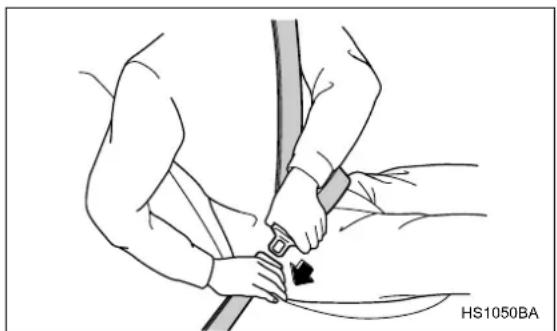
natural_image
Illustration of a person adjusting a seatbelt with a belt, no text or symbols present- Insert the tongue plate into the buckle until you hear a click.

natural_image
Illustration of a person adjusting a seatbelt with arrows indicating motion (no text or symbols)- To make the lap part tight, pull up on the shoulder belt.
- Place the lap belt as low as possible on your hips, not on your waist.
Adjusting the front seat shoulder belt anchor height

natural_image
Technical illustration of two mechanical fasteners with arrows indicating fastening or adjustment (no text or symbols)The shoulder belt anchor height should be adjusted to the position best suited for you. To lower the anchor height, push the release button and slide the anchor down. To raise the anchor height, slide the anchor up. Pull down on the anchor to make sure that it is locked in place.
Always adjust the anchor height so that the shoulder belt passes over the middle of the shoulder without touching the neck.
- CONTINUED -
WARNING
When wearing the seatbelts, make sure the shoulder portion of the webbing does not pass over your neck. If it does, adjust the seatbelt anchor to a lower position. Placing the shoulder belt over the neck may result in neck injury during sudden braking or in a collision.
▼ Unfastening the seatbelt
natural_image
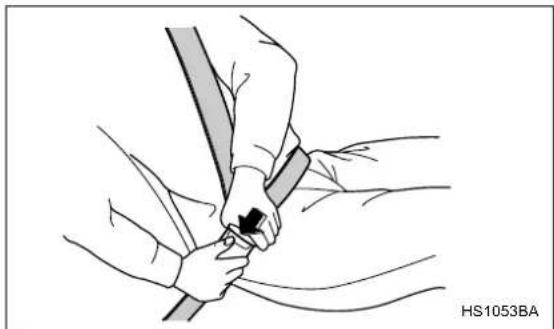
Illustration of a person adjusting a belt buckle, showing hands and a belt buckle (no text or symbols)Push the button on the buckle.
Before closing the door, make sure that the belts are
retracted properly to avoid catching the belt webbing in the door.
▼ Rear seatbelts
-
Sit well back in the seat.
-
Pick up the tongue plate and pull the belt out slowly. Do not let it get twisted. If the belt stops before reaching the buckle, return the belt slightly and pull it out more slowly. If the belt still cannot be unlocked, let the belt retract slightly after giving a strong pull on it, then pull it out slowly again.
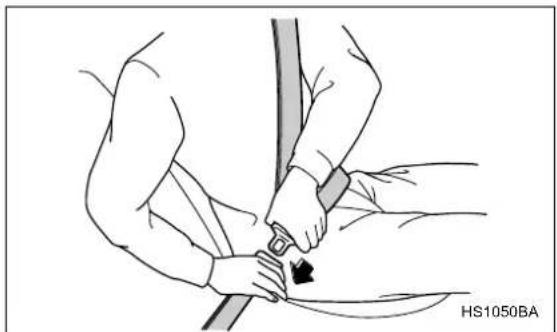
natural_image
Illustration of a person adjusting a seatbelt with a belt, no text or symbols present- Insert the tongue plate into the buckle until you hear a click.
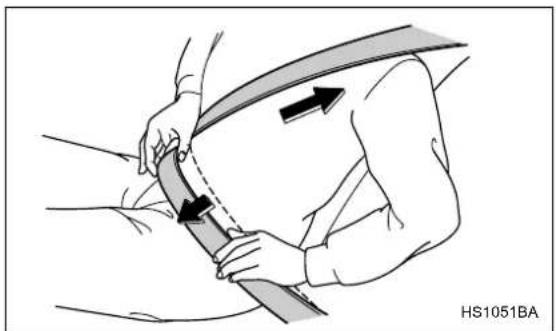
natural_image
Illustration of a person adjusting a seatbelt with arrows indicating motion (no text or symbols)- To make the lap part tight, pull up on the shoulder belt.
- Place the lap belt as low as possible on your hips, not on your waist.
∇ Unfastening the seatbelt

natural_image
Illustration of a person's seatbelt being adjusted for a hand (no text or symbols present)Push the button on the buckle.
Before closing the door, make sure that the belts are retracted properly to avoid catching the belt webbing in the door.
■ Seatbelt maintenance
CAUTION
- Keep the belts free of polishes, oils, chemicals and particularly battery acid.
- Never attempt to make modifications or
- CONTINUED -
changes that will prevent the seatbelt from operating properly.
To clean the seatbelts, use a mild soap and lukewarm water. Never bleach or dye the belts because this could seriously affect their strength.
Inspect the seatbelts and attachments including the webbing and all hardware periodically for cracks, cuts, gashes, tears, damage, loose bolts or worn areas. Replace the seatbelts even if only minor damage is found.
Seatbelt extender
If the front seatbelts are not long enough to permit the tongue plate to engage with the seatbelt buckle, an optional seatbelt extender is available from your SUBARU dealer. When ordering an extender, only order one particularly designed for your vehicle. Several different types of extenders are available to match various varieties of front seatbelt designs. See your SUBARU dealer for assistance.
The extender adds approximately 8 in (200 mm) of length and it can be used for either the driver or front passenger seating position.
WARNING
Be sure to observe the following when using the seatbelt extender.
Failure to follow these instructions and warnings could reduce the effectiveness of the seat-belt and result in more serious injury in the event of a collision.
- Never use the extender when the belt itself is long enough to permit it to be buckled properly. If removal of heavy clothing is all that is needed to permit the seatbelt to be buckled properly, remove the heavy clothing and do not use the
extender.
- Do not use the extender if the buckle of the extender rests over the abdomen.
- Do not let someone else use the extender. Use of an extender when it is not needed could reduce the effectiveness of the seatbelt and result in more serious injury in the event of a collision.
- Use the extender only for the front seatbelts and only for the model for which it was originally provided. Never use the extender for the rear seatbelts or for a different model.
NOTE
When the seatbelt extender is used by a pregnant passenger, consult a doctor to get approval in advance.

natural_image
Mechanical component diagram showing a belt switch assembly with a black arrow indicating direction (no text or symbols on the diagram itself)To connect the extender to the seatbelt, insert the tongue plate into the seatbelt buckle so that the "PRESS" signs on the buckle-release buttons of the extender and the seatbelt are both facing outward as shown in the diagram. You will hear a click when the tongue plate locks into the buckle.
When releasing the seatbelt, press on the buckle-release button on the extender, not on the seatbelt. This helps to prevent damage to the vehicle interior and extender itself.
For the safety of others, the extender should be removed after each use, especially if the next person using the seatbelt does not need one.
Front seatbelt pretensioners
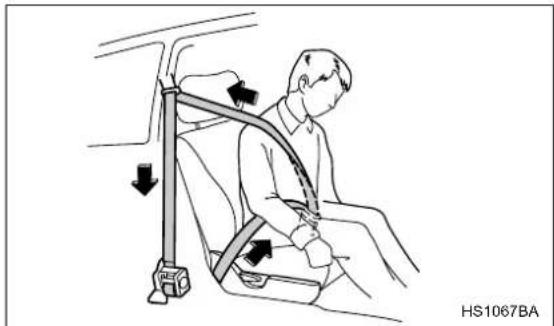
natural_image
Illustration of a person seated in a car seatbelt with arrows indicating seat movement (no text or symbols)The driver's and front passenger's seatbelts have a seatbelt pretensioner. The seatbelt pretensioners are designed to be activated in the event of an accident involving a moderate to severe frontal collision.
The pretensioner sensor also serves as a SRS frontal airbag sensor. If the sensor detects a certain predetermined amount of force during a frontal collision, the front seatbelt is quickly drawn back in by the retractor to take up the slack so that the belt more effectively restrains the front seat occupant.
When a seatbelt pretensioner is activated, an operat-
ing noise will be heard and a small amount of smoke will be released. These occurrences are normal and not harmful. This smoke does not indicate a fire in the vehicle.
Once the seatbelt pretensioner has been activated, the seatbelt retractor remains locked. Consequently, the seatbelt can not be pulled out and retracted and therefore must be replaced.
NOTE
- Seatbelt pretensioners are not designed to activate in minor frontal impacts, in side or in rear impacts or in roll-over accidents.
- The driver's seat and passenger's seat pretensioners and frontal airbag operate simultaneously.
- Pretensioners are designed to function on a one-time-only basis. In the event that a pretensioner is activated, both the driver's and front passenger's seatbelt retractor assemblies must be replaced and only by an authorized SUBARU dealer. When replacing seatbelt retractor assemblies, use only genuine SUBARU parts.
- If either front seatbelt does not retract or cannot be pulled out due to a malfunction or activation of the pretensioner, contact your SUBARU dealer as soon as possible.
- If the front seatbelt retractor assembly or surrounding area has been damaged, contact your SUBARU dealer as soon as possible.
- When you sell your vehicle, we urge you to explain to the buyer that it has seatbelt pretensioners by alerting the buyer to the contents of this section.
WARNING
- To obtain maximum protection, occupants should sit in an upright position with their seatbelts properly fastened. Refer to "Seatbelts" section in this chapter.
- Do not modify, remove or strike the front seatbelt retractor assemblies or surrounding area. This could result in accidental activation of the seatbelt pretensioners or could make the system inoperative, possibly resulting in serious injury. Seatbelt pretensioners have no user-serviceable parts. For required servicing of front seatbelt retractors equipped with seatbelt pretensioners, see your nearest SUBARU dealer.
- When discarding front seatbelt retractor assemblies or scrapping the entire vehicle due to collision damage or for other reasons, consult
your SUBARU dealer.
■ System monitors

text_image
AIR BAG UB4010EASRS airbag system warning light
A diagnostic system continually monitors the readiness of the seatbelt pretensioner while the vehicle is being driven. The seatbelt pretensioners share the control module with the airbag system. Therefore, if any malfunction occurs in a seatbelt pretensioner, the SRS airbag system warning light will illuminate. The SRS airbag system warning light will show normal system operation by lighting for about 6 seconds when
- CONTINUED -
the ignition key is turned to the "ON" position.
The following components are monitored by the indicator:
- Front sub sensor (Right hand side)
- Front sub sensor (Left hand side)
• Airbag control module (including impact sensors) - Seatbelt pretensioner (Driver's side)
- Seatbelt pretensioner (Passenger's side)
- All related wiring
WARNING
If the warning light exhibits any of the following conditions, there may be a malfunction in the seatbelt pretensioners and/or SRS airbag system. Immediately take your vehicle to your nearest SUBARU dealer to have the system checked. Unless checked and properly repaired, the seatbelt pretensioners and/or SRS airbag will not operate properly in the event of a collision, which may increase the risk of injury.
- Flashing or flickering of the indicator light.
-
No illumination of the warning light when the ignition switch is first turned to the "ON" position.
• Continuous illumination of the warning light. -
Illumination of the warning light while driving.
■ System servicing
WARNING
- When discarding a seatbelt retractor assembly or scrapping the entire vehicle damaged by a collision, consult your SUBARU dealer.
- Tampering with or disconnecting the system's wiring could result in accidental activation of the seatbelt pretensioner and/or airbag or could make the system inoperative, which may result in serious injury. The wiring harnesses of the seatbelt pretensioner and SRS airbag systems are covered with yellow insulation and the connectors of the system are yellow for easy identification. Do not use electrical test equipment on any circuit related to the seatbelt pretensioner and airbag systems. For required servicing of the seatbelt pretensioner, see your nearest SUBARU dealer.
CAUTION
The front sub sensors are located in both front fenders and the airbag control module including the impact sensors is located under the center console. If you need service or repair in those areas or near the front seatbelt retractors, we recommend that you have an authorized SUBARU dealer perform the work.
NOTE
If the front part of the vehicle is damaged in an accident to the extent that the seatbelt pretensioner does not operate, contact your SUBARU dealer as soon as possible.
■ Precautions against vehicle modification
Always consult your SUBARU dealer if you want to install any accessory parts to your vehicle.
CAUTION
Do not perform any of the following modifications. Such modifications can interfere with proper operation of the seatbelt pertensioners.
- Attachment of any equipment (bush bar, winches, snow plow, skid plate, etc.) other than genuine SUBARU accessory parts to the front end.
- Modification of the suspension system or front end structure.
- Installation of a tire of different size and construction from the tires specified on the tire placard attached to the door jamb.
Child restraint systems
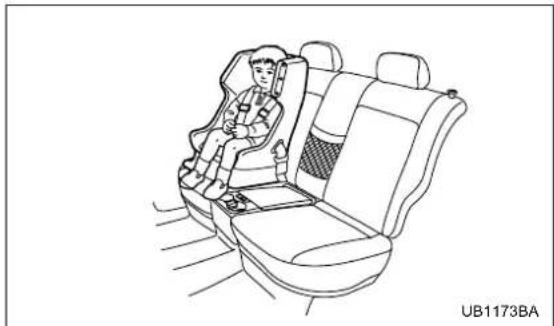
natural_image
Line drawing of a person seated in a car seat, no text or symbols presentInfants and small children should always be placed in an infant or child restraint system in the rear seat while riding in the vehicle. You should use an infant or child restraint system that meets Federal Motor Vehicle Safety Standards or Canada Motor Vehicle Safety Standards, is compatible with your vehicle and is appropriate for the child's age and size. All child restraint systems are designed to be secured in vehicle seats by lap belts or the lap belt portion of a lap/shoulder belt (except those covered under the section in this manual, entitled "Installation of child restraint systems by use of lower and tether anchorages (LATCH)").
Children could be endangered in an accident if their child restraints are not properly secured in the vehicle. When installing the child restraint system, carefully follow the manufacturer's instructions.
According to accident statistics, children are safer when properly restrained in the rear seating positions than in the front seating positions.
All U.S. states and Canadian provinces require that infants and small children be restrained in an approved child restraint system at all times while the vehicle is moving.

natural_image
Illustration of a woman and child seated in a car seat, no text or symbols presentWARNING
Never let a passenger hold a child on his or her lap while the vehicle is moving. The passenger cannot protect the child from injury in a collision, because the child will be caught between the passenger and objects inside the vehicle. Additionally, holding a child in your lap or arms in the front seat exposes that child to another serious danger. Since the SRS airbag deploys with considerable speed and force, the child could be injured or even killed.
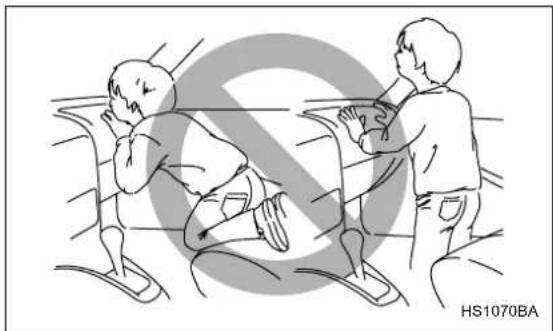
natural_image
Illustration of two adults assisting a child on a stretcher, no text or symbols presentWARNING
Children should be properly restrained at all times. Never allow a child to stand up, or to kneel on any seat. Unrestrained children will be thrown forward during sudden stop or in an accident and can be injured seriously.
Additionally, children standing up or kneeling on or in front of the front seat are exposed another serious danger. Since the SRS airbag deploys with considerable speed and force, the child could be injured or even killed.
■ Where to place a child restraint system
The following are SUBARU's recommendations on where to place a child restraint system in your vehicle.
- CONTINUED -
text_image
B B AUB1170AA
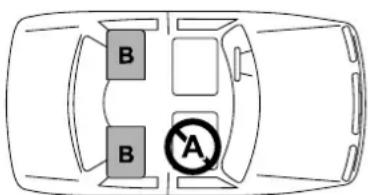
A: Front passenger's seat
You should not install a child restraint system due to the hazard to children posed by the passenger's air-bag.
B: Rear seat
Recommended positions for all types of child restraint systems.
In these positions, Automatic/Emergency Locking Retractor (A/ELR) seatbelts and lower anchorage bars are provided for installing a child restraint system.
WARNING
- Put children aged 12 and under in the rear
seat properly restrained at all times. The SRS airbag deploys with considerable speed and force and can injure or even kill children, especially if they are 12 years of age and under and are not restrained or improperly restrained. Because children are lighter and weaker than adults, their risk of being injured from deployment is greater.
For that reason, be sure to secure ALL types of child restraint devices (including forward facing child seats) in the REAR seats at all times. You should choose a restraint device which is appropriate for the child's age, height and weight. According to accident statistics, children are safer when properly restrained in the rear seating positions than in the front seating positions.

natural_image
Diagram of a car gear shift lever system with a person inside, showing no text or symbols on the diagram itself.WARNING
SINCE YOUR VEHICLE IS EQUIPPED WITH A PASSENGER'S SRS AIRBAG, DO NOT INSTALL A REARWARD FACING CHILD SAFETY SEAT IN THE FRONT PASSENGER'S SEAT. DOING SO RISKS SERIOUS INJURY OR DEATH TO THE CHILD BY PLACING THE CHILD'S HEAD TOO CLOSE TO THE SRS AIRBAG.
■ Choosing a child restraint system
natural_image
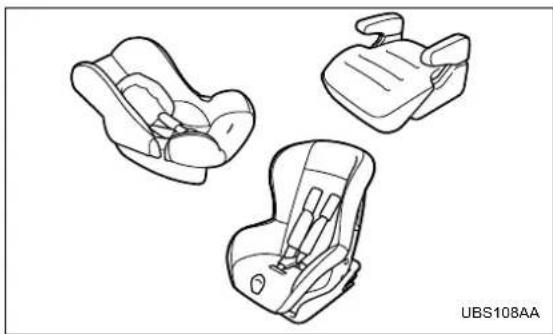
Line drawings of three different car seats (no text or symbols on the car bodies)Choose a child restraint system that is appropriate for the child's age and size (weight and height) in order to provide the child with proper protection. The child restraint system should meet all applicable requirements of Federal Motor Vehicle Safety Standards for United States or Canada Motor Vehicle Safety Standards for Canada. It can be identified by locking for the label on the child restraint system or the manufacture's statement of compliance in the document attached to the system. Also it is important for you to make sure that the child restraint system is compatible with the vehicle in which it will be used.
- CONTINUED -
■ Installing child restraint systems with A/ELR seatbelt
WARNING
- Child restraint systems and seatbelts can become hot in a vehicle that has been closed up in sunny weather; they could burn a small child. Check the child restraint system before you place a child in it. - Do not leave an unsecured child restraint system in your vehicle. Unsecured child restraint systems can be thrown around inside of the vehicle in a sudden stop, turn or accident; it can strike and injure vehicle occupants as well as result in serious injuries or death to the child.
CAUTION
When you install a child restraint system, follow the manufacturer's instructions supplied with it. After installing the child restraint system, check to ensure that it is held securely in position. If it is not held tight and secure, the danger of your child suffering personal injury in
the event of an accident may be increased.
▼ Installing a rearward facing child restraint
text_image
Diagram illustrating car seatbelt buckle assembly with magnified detail showing fastening mechanismUBS109BA
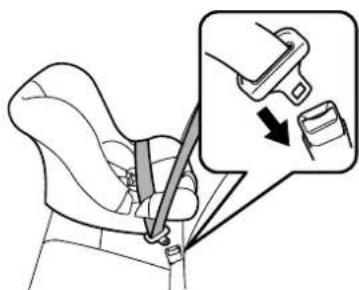
- Place the child restraint system in the rear seating position.
- Run the lap and shoulder belt through or around the child restraint system following the instructions provided by its manufacturer.
- Insert the tongue plate into the buckle until you hear a click.
natural_image
Illustration of a person using a car seatbelt to lift a shoulder, with no text or symbols present.-
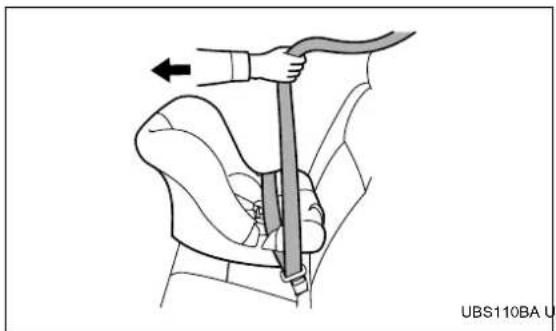
Take up the slack in the lap belt.
-
Pull out the seatbelt fully from the retractor to change the retractor over from the Emergency Locking Retractor (ELR) to the Automatic Locking Retractor (ALR) function. Then, allow the belt to rewind into the retractor. As the belt is rewinding, clicks will be heard which indicate the retractor functions as ALR.

natural_image
Illustration of a person using a belt drive a seatbelt, showing force direction arrows (no text or symbols)- Push and pull the child restraint system forward and from side to side to check if it is firmly secured. Sometimes a child restraint can be more firmly secured by pushing it down into the seat cushion and then tightening the seatbelt.
- Pull at the shoulder portion of the belt to confirm that it cannot be pulled out (ALR properly functioning).
- CONTINUED -

text_image
UG1089BA- To remove the child restraint system, press the release button on the seatbelt buckle and allow the belt to retract completely. The belt will return to the ELR mode.
WARNING
NEVER INSTALL A REARWARD FACING CHILD SEAT IN THE FRONT PASSENGER'S SEAT. DOING SO RISKS SERIOUS INJURY OR DEATH TO THE CHILD BY PLACING THE CHILD'S HEAD TOO CLOSE TO THE SRS AIRBAG.
NOTE
When the child restraint system is no longer in use, remove it and restore the ELR function of the retractor. The function is restored by retracting the seatbelt fully.
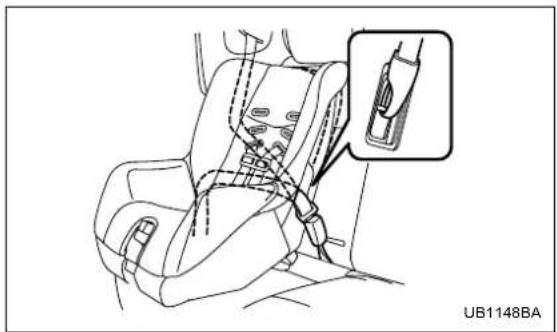
▼ Installing forward facing child restraint systems with seatbelt and tether anchorages
natural_image
Line drawing of a car seatbelt with a close-up inset showing a connector detail (no text or symbols)CAUTION
When you install a child restraint system, follow the manufacturer's instructions supplied with it. After installing the child restraint system, check to ensure that it is held securely in
position. If it is not held tight and secure, the danger of your child suffering personal injury in the event of an accident may be increased.
- Place the child restraint system in the seating position on the rear seat cushion.

text_image
TOP TETHER UB1134CA- Pull the seatback locking knob and fold the seatback forward to see the tether anchorage on the back-side of the seatback.
- CONTINUED -

natural_image
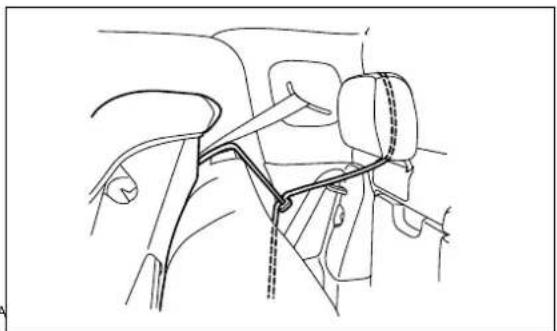
Diagram showing a car seatbelt being adjusted for a hand using a clip, with no visible text or symbols.- Connect the tether belt hook onto the tether anchorage on the backside of the seatback. Take up any slack in the tether belt after connecting it to the tether anchorage.
UB1144BA UB1146BA
natural_image
Line drawing of a car interior showing seatbelt and dashboard (no text or symbols)- Put the other end of the tether belt through under the headrest.
- Return the seatback to the locked position. Confirm that the red mark on the locking knob is no longer visible and check that the seatback is securely locked by moving it back and forth.
- Run the lap and shoulder belt through the child restraint system following the instructions provided by its manufacturer.
natural_image
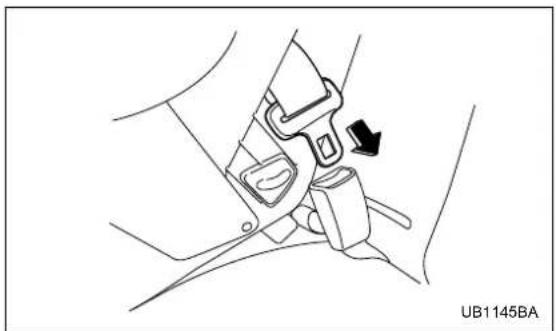
Line drawing of a car seatbelt buckle with a black arrow indicating the buckle's adjustment (no text or symbols present)- Insert the tongue plate into the buckle.

natural_image
Diagram of a car seatbelt switch mechanism with a magnified inset showing the cable attachment (no text or symbols present)-
Take up the slack in the lap belt.
-
Pull out the seatbelt fully from the retractor to change the retractor over from the Emergency Locking Retractor (ELR) to the Automatic Locking Retractor (ALR) function. Then allow the belt to rewind into the retractor. As the belt is rewinding, clicks will be heard which indicate the retractor function as ALR.
natural_image
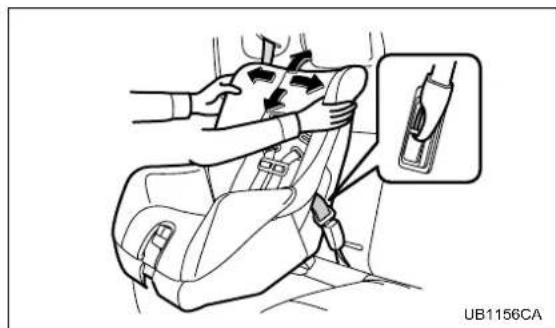
Diagram of a car seatbelt being lifted, showing hand placement and close-up of the seatbelt (no text or symbols present)- While pushing the child restraint into the seat cushion and moving it back and forth and right and left, tighten the seatbelt securely by taking up the slack in the belt.
- CONTINUED -

natural_image
Line drawing of a hand adjusting a car seatbelt with an arrow indicating rotation (no text or symbols)- While pushing the child restraint into the seat cushion and moving it back and forth, pull the upper tether belt straight up to secure the child restraint system firmly by taking up the slack in the belt.
- The loose end of the tether belt should be placed into the gap on the backside of the seatback.
- Before having a child sit in the child restraint system, move it back and forth and right and left to check if it is firmly secured.
- To remove the child restraint system, follow the reverse procedures of installation. Unbuckle the seatbelt and allow the belt to retract completely. The belt will return to the ELR mode.
If you have any question concerning proper child restraint system installation, ask your SUBARU dealer.
NOTE
When the child restraint system is no longer in use, remove it and restore the ELR function of the retractor. The function is restored by retracting the seatbelt fully.
▼ Installation of forward facing child restraint by seatbelt only

natural_image
Line drawing of a car seatbelt with no text or symbols- Place the child restraint system on the seat.
- Run the lap and shoulder belt through or around the child restraint system following the instructions provided by its manufacturer.

natural_image
Line drawing of a car seatbelt buckle with a black arrow indicating the buckle's direction (no text or symbols)- Insert the tongue plate into the buckle.

natural_image
Diagram of a car seatbelt buckle being adjusted, showing rope routing and a black arrow indicating direction (no text or symbols)-
Take up the slack in the lap belt.
-
Pull out the seatbelt fully from the retractor to change the retractor over from the Emergency Locking Retractor (ELR) to the Automatic Locking Retractor (ALR) function. Then allow the belt to rewind into the retractor. As the belt is rewinding, clicks will be heard which indicate the retractor function as ALR.
natural_image
Line drawing of a car seatbelt with hand placement and motion arrows indicating movement (no text or symbols)-
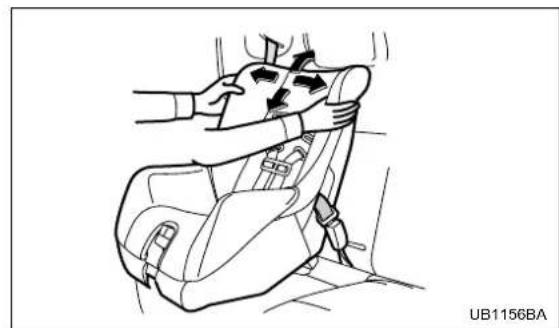
While pushing the child restraint into the seat cushion and moving it back and forth and right and left, tighten the seatbelt securely by taking up the slack in the belt.
-
Before having a child sit in the child restraint system, move it back and forth and right and left to check if it is firmly secured.
- CONTINUED -
- To remove the child restraint system, press the release button on the seatbelt buckle and allow the belt to retract completely. The belt will return to ELR mode.
If you have any question concerning proper child restraint system installation, ask your SUBARU dealer.
NOTE
When the child restraint system is no longer in use, remove it and restore the ELR function of the retractor. The function is restored by retracting the seatbelt fully.
■ Installation of child restraint systems by use of lower and tether anchorages (LATCH)
WARNING
- Child restraint systems and seatbelts can become hot in a vehicle that has been closed up in sunny weather; they could burn a small child. Check the child restraint system before you place a child in it.
- Do not leave an unsecured child restraint system in your vehicle. Unsecured child restraint systems can be thrown around inside of
the vehicle in a sudden stop, turn or accident; it can strike and injure vehicle occupants as well as result in serious injuries or death to the child.
CAUTION
When you install a child restraint system, follow the manufacturer's instructions supplied with it. After installing the child restraint system, check to ensure that it is held securely in position. If it is not held tight and secure, the danger of your child suffering personal injury in the event of an accident may be increased.

text_image
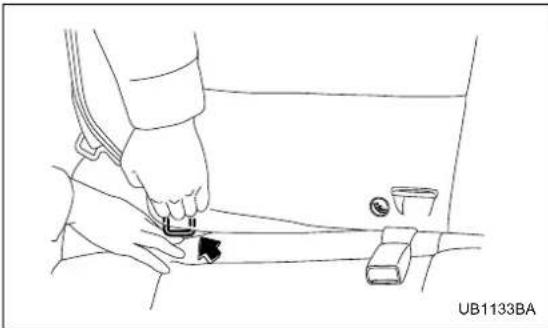
UB1154CASome types of child restraint systems can be installed on the rear seat of your vehicle without use of the seatbelts. Such child restraint systems are secured to the dedicated anchorages provided on the vehicle body. The lower and tether anchorages are sometimes referred to as the LATCH system (Lower Anchors and Tethers for CHildren).
Your vehicle is equipped with four lower anchorages (bars) on the back panel behind the markings on the bottom part of the rear seatback and two upper anchorages (tether anchorages) on the back side of the seatback for accommodating such child restraint systems.
The lower anchorages (bars) are used for installing a child restraint system on the rear seat. For each seating position of the rear seat, two lower anchorages are provided.
The tether anchorages (upper anchorages) are also provided for each seating position of the rear seat.

text_image
UB1174BAYou will find marks "et the bottom of the rear seat seatbacks. These marks indicate the positions of the lower anchorages (bars).
- CONTINUED -
natural_image
Line drawing of a person's seatbelt fastening technique, showing hand positioning and mounting bracket (no text or symbols)Each lower anchorage is located where the seat cushion meets the seatback.
- Place the child restraint system on the rear seat cushion.

text_image
TOP TETHER UB1134CA- Unlock the rear seatback locking knob and fold the seatback forward to see the tether anchorages on the backside of the seatback.

natural_image
Diagram showing a car seatbelt buckle being inserted into a bracket, with no visible text or symbols.- Connect the hook of the upper tether belt onto the tether anchorage on the backside of the seatback. Do not allow slack in the tether belt.
natural_image
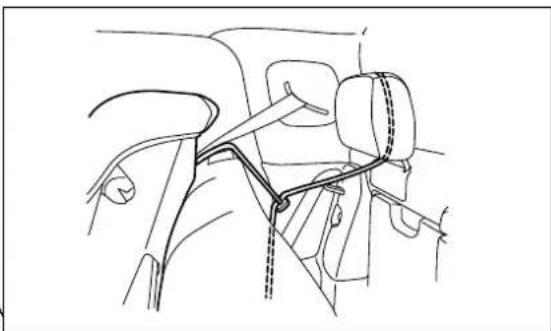
Line drawing of a car interior showing steering wheel, dashboard, and seatbelt (no text or symbols)- Put the other end of the tether belt through under the headrest.
- Return the seatback to the locked position. Confirm that the red mark on the locking knob is no longer visible and check if the seatback has been securely locked by moving it back and forth.
- CONTINUED -
Seat, seatbelt and SRS airbags
text_image
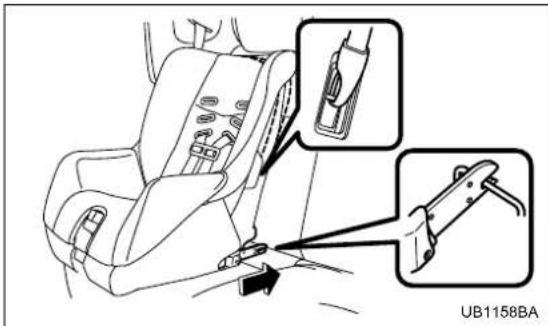
UB1158BA- While following the instructions supplied by the child restraint system manufacturer, connect the lower hooks onto the lower anchorages located at " ℜ marks on the bottom of the rear seatback. When the hooks are connected, make sure the adjacent seatbelts are not caught.

natural_image
Line drawing of a car seatbelt with an inset showing a hand holding a pen (no text or symbols present)- [If your child restraint system is of a flexible attachment type (which uses tether belts to connect the child restraint system properly to the lower anchorages)] While pushing the child restraint into the seat cushion, pull both left and right lower tether belts up to secure the child restraint system firmly by taking up the slack in the belt.

natural_image
Line drawing of a hand pressing down on a car seatbelt, with an arrow indicating the motion direction (no text or symbols)- Pull the upper tether belt straight up to secure the child restraint system firmly by taking up the slack in the belt.
- Put the loose end of the tether belts behind the seatback.
- Before seating a child in the child restraint system, try to move seatback and forth and left and right to verify that it is held securely in position.
- To remove the child restraint system, follow the reverse procedures of installation.
If you have any question concerning proper child restraint system installation, ask your SUBARU dealer.
■ Installing a booster seat
WARNING
- Child restraint systems and seatbelts can become hot in a vehicle that has been closed up in sunny weather; they could burn a small child. Check the child restraint system before you place a child in it.
- Do not leave an unsecured child restraint system in your vehicle. Unsecured child restraint systems can be thrown around inside of the vehicle in a sudden stop, turn or accident; it can strike and injure vehicle occupants as well as result in serious injuries or death to the child.
CAUTION
When you install a child restraint system, follow the manufacturer's instructions supplied with it. After installing the child restraint system, check to ensure that it is held securely in position. If it is not held tight and secure, the danger of your child suffering personal injury in
- CONTINUED -
the event of an accident may be increased.

text_image
UB1128BA- Place the booster seat in the rear seating position and sit the child on it. The child should sit well back on the booster seat.
- Run the lap and shoulder belt through or around the booster seat and the child following the instructions provided by its manufacturer.
- Insert the tongue plate into the buckle until you hear a click. Take care not to twist the seatbelt.
Make sure the shoulder belt is positioned across the center of child's shoulder and that the lap belt is positioned as low as possible on the child's hips.

natural_image
Illustration of a child wearing a seatbelt inside a vehicle, with a close-up inset showing the same seatbelt (no text or symbols present)- To remove the booster seat, press the release button on the seatbelt buckle and allow the belt to retract.
WARNING
- Never use a belt that is twisted or reversed. In an accident, this can increase the risk or severity of injury to the child.
- Never place the shoulder belt under the child's arm or behind the child's back. If an accident occurs, this can increase the risk or severity of injury to the child.
- The seatbelt should fit snugly in order to provide full restraint. Loose fitting belts are not as
effective in preventing or reducing injury.
- Place the lap belt as low as possible on the child's hips. A high-positioned lap belt will increase the risk of sliding under the lap belt and of the lap belt sliding up over the abdomen, and both can result in serious internal injury or death.
- Make sure the shoulder belt is positioned across the center of child's shoulder. Placing the shoulder belt over the neck may result in neck injury during sudden braking or in a collision.
\*SRS airbag (Supplemental Restraint System airbag)
*SRS: This stands for supplemental restraint system. This name is used because the airbag system supplements the vehicle's seatbelts.
■ Vehicle with driver's and front passenger's SRS airbags and lap/shoulder restraints
Your vehicle is equipped with a supplemental restraint system in addition to a lap/shoulder belt at each front seating position.
The supplemental restraint system (SRS) consists of two airbags (driver's and front passenger's frontal airbags).
These SRS airbags are designed only as a supplement to the primary protection provided by the seatbelt.
The system also controls front seatbelt pretensioners. For operation, instructions are precautions concerning the seatbelt pretensioner, see the "Front seatbelt pretensioners" section in this chapter.
- CONTINUED -
WARNING
- To obtain maximum protection in the event of an accident, the driver and all passengers in the vehicle should always wear seatbelts when the vehicle is moving. The SRS airbag is designed only as a supplement to the primary protection provided by the seatbelt. It does not do away with the need to fasten seatbelts. In combination with the seatbelts, it offers the best combined protection in case of a serious accident. Not wearing a seatbelt increases the chance of severe injury or death in a crash even when the vehicle has the SRS airbag.
For instructions and precautions concerning the seatbelt system, see the "Seatbelts" sections in this chapter.
- Do not sit or lean unnecessarily close to the SRS airbag. Because the SRS airbag deploys with considerable speed – faster than the blink of an eye – and force to protect in high speed collisions, the force of an airbag can injure an occupant whose body is too close to SRS airbag.
It is also important to wear your seatbelt to help avoid injuries that can result when the SRS airbag contacts an occupant not in proper posi-
tion such as one thrown forward during pre-accident braking.
Even when properly positioned, there remains a possibility that an occupant may suffer minor injury such as abrasions and bruises to the face or arms because of the SRS airbag deployment force.
- The SRS airbags deploy with considerable speed and force. Occupants who are out of proper position when the SRS airbag deploys could suffer very serious injuries. Because the SRS airbag needs enough space for deployment, the driver should always sit upright and well back in the seat as far from the steering wheel as practical while still maintaining full vehicle control and the front passenger should move the seat as far back as possible and sit upright and well back in the seat.
- Do not place any objects over or near the SRS airbag cover or between you and the SRS airbag. If the SRS airbag deploys, those objects could interfere with its proper operation and could be propelled inside the vehicle and cause injury.

natural_image
Illustration of two children sitting in a car seat, one wearing a seatbelt and the other holding a belt (no text or symbols)HS1034BA
WARNING
Put children aged 12 and under in the rear seat properly restrained at all times. The SRS airbag deploys with considerable speed and force and can injure or even kill children, especially if they are 12 years of age and under and are not restrained or improperly restrained. Because children are lighter and weaker than adults, their risk of being injured from deployment is greater.
For that reason, we strongly recommend that ALL children (including those in child seats and those that have outgrown child restraint devic-
es) sit in the REAR seat properly restrained at all times in a child restraint device or in a seat-belt, whichever is appropriate for the child's age, height and weight.
Secure ALL types of child restraint devices (including forward facing child seats) in the REAR seats at all times.
According to accident statistics, children are safer when properly restrained in the rear seating positions than in the front seating positions.
For instructions and precautions concerning the child restraint system, see the "Child restraint systems" section in this chapter.
- NEVER INSTALL A REARWARD FACING CHILD SEAT IN THE FRONT SEAT. DOING SO RISKS SERIOUS INJURY OR DEATH TO THE CHILD BY PLACING THE CHILD'S HEAD TOO CLOSE TO THE SRS AIRBAG.
- Never allow a child to stand up, or to kneel on the front passenger's seat, or never hold a child on your lap or in your arms. The SRS airbag deploys with considerable force and can injure or even kill the child.
- CONTINUED -
CAUTION
- When the SRS airbag deploys, some smoke will be released. This smoke could cause breathing problems for people with a history of asthma or other breathing trouble. If you or your passengers have breathing problems after SRS airbag deploys, get fresh air promptly.
- A deploying SRS airbag releases hot gas. Occupants could get burnt if they come into direct contact with the hot gas.
NOTE
When you sell your vehicle, we urge you to explain to the buyer that it is equipped with SRS airbags by alerting him to the applicable section in this owner's manual.
Components
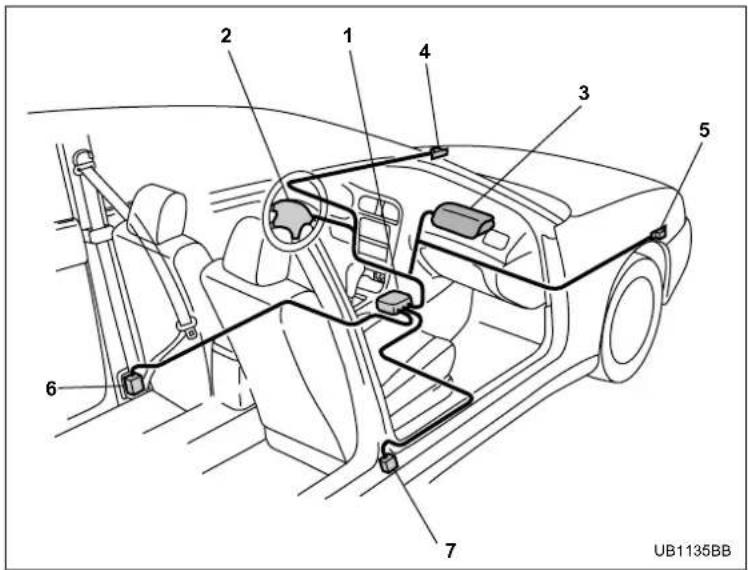
text_image
2 1 4 3 5 6 7 UB1135BB1) Airbag control module (including impact sensors)
2) Airbag module (driver's side)
3) Airbag module (passenger's side)
4) Front sub sensor (left hand side)
5) Front sub sensor (right hand side)
6) Seatbelt pretensioner (driver's side)
7) Seatbelt pretensioner (passenger's side)
- CONTINUED -
■ SRS frontal airbag
The driver's SRS frontal airbag is stowed in the center portion of the steering wheel. The passenger's SRS frontal airbag is stowed near the top of the dashboard under an "SRS AIRBAG" mark.
In a moderate to severe frontal collision, the driver's and front passenger's SRS frontal airbags deploy and supplement the seatbelts by reducing the impact on the driver's and front passenger's head and chest.

natural_image
Diagram of a car gear shift lever with a baby inside, showing no text or symbols on the diagram itself.WARNING
NEVER INSTALL A REARWARD FACING CHILD SAFETY SEAT IN THE FRONT SEAT. DOING SO
RISKS SERIOUS INJURY OR DEATH TO THE CHILD BY PLACING THE CHILD'S HEAD TOO CLOSE TO THE SRS AIRBAG.

natural_image
Illustration of two adults performing CPR on a patient in bed, no text or symbols presentWARNING
Never allow a child to stand up, or to kneel on the front passenger's seat. The SRS airbag deploys with considerable force and can injure or even kill the child.

natural_image
Illustration of a person seated in a car seat with another person resting beside it, no text or symbols present.WARNING
Never hold a child on your lap or in your arms. The SRS airbag deploys with considerable force and can injure or even kill the child.

natural_image
Line drawing of a person seated in a car steering wheel, with a belt and arrow indicating direction (no text or symbols)WARNING
The SRS airbag deploys with considerable speed and force. Occupants who are out of proper position when the SRS airbag deploys could suffer very serious injuries. Because the SRS airbag needs enough space for deployment, the driver should always sit upright and well back in the seat as far from the steering wheel as practical while still maintaining full vehicle control and the front passenger should move the seat as far back as possible and sit upright and well back in the seat. It is also important to wear your seatbelt to help
- CONTINUED -
avoid injuries that can result when the SRS airbag contacts an occupant not in proper position such as one thrown toward the front of the vehicle during pre-accident braking.

natural_image
Interior view of a car dashboard and steering wheel (no text or symbols visible)WARNING
Do not put any objects over the steering wheel pad and dashboard. If the SRS frontal airbag deploys, those objects could interfere with its proper operation and could be propelled inside the vehicle and cause injury.
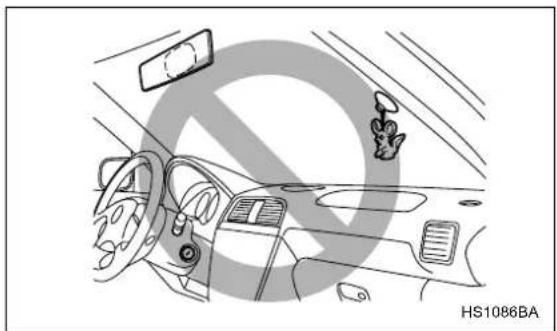
natural_image
Interior view of a car dashboard with steering wheel, dashboard, and steering wheel (no visible text or symbols)WARNING
Do not attach accessories to the windshield, or fit an extra-wide mirror over the rear view mirror. If the SRS airbag deploys, those objects could become projectiles that could seriously injure vehicle occupants.
▼ Operation
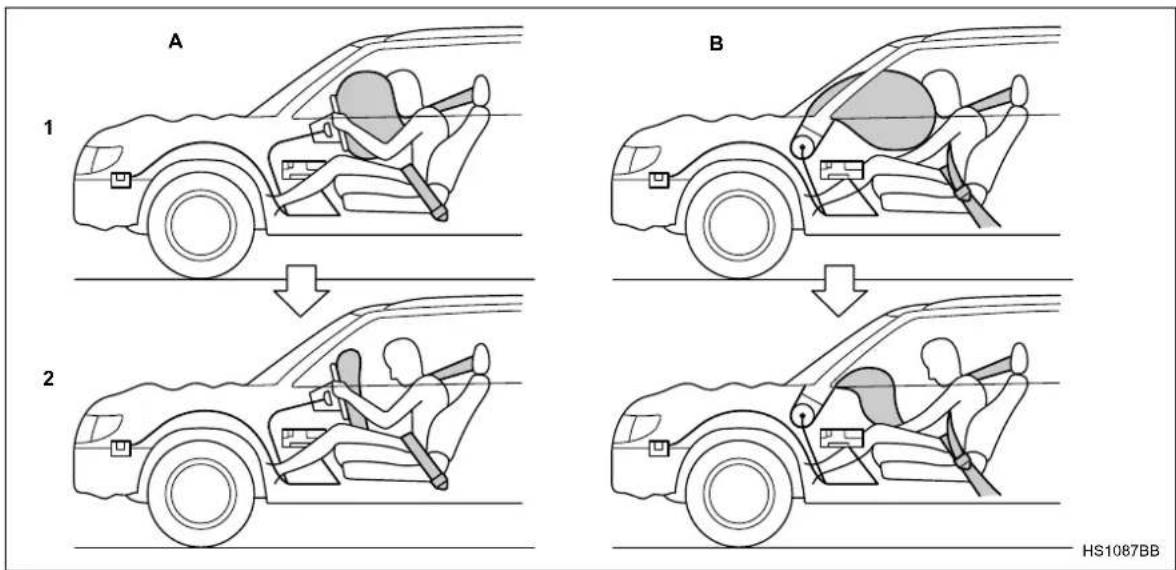
text_image
A B 1 2 HS1087BBA) Driver's side
B) Passenger's side
1) SRS airbags deploy as soon as a collision occurs.
2) After deployment, SRS airbags start to deflate immediately so that the driver's vision is not obstructed.
- CONTINUED -
The SRS airbag can function only when the ignition switch is in the "ON" position.
If the front sub sensors inside the both front fenders and the impact sensors in the airbag control module detect a certain predetermined amount of force during a frontal collision, the control module sends signals to the frontal airbag modules instructing them to inflate the SRS frontal airbags. Then both airbag modules produce gas, which instantly inflates driver's and passenger's SRS frontal airbags. After the deployment, the SRS airbags immediately start to deflate so that the driver's vision is not obstructed. The time required from detecting impact to the deflation of the SRS airbag after deployment is shorter than the blink of an eye.
The front passenger's SRS frontal airbag deploys together with driver's SRS frontal airbag even when no one occupies the front passenger's seat.
When the SRS frontal airbags deploy, the driver's and front passenger's seatbelt pretensioners operate at the same time.
Although it is highly unlikely that the SRS airbag would activate in a non-accident situation, should it occur, the SRS airbag will deflate quickly, not obscuring vision and will not interfere with the driver's ability to maintain control of the vehicle.
When the SRS airbag deploys, a sudden, fairly loud inflation noise will be heard and some smoke will be released. These occurrences are normal result of the deployment. This smoke does not indicate a fire in the vehicle.
CAUTION
Do not touch the SRS airbag system components around the steering wheel and dashboard with bare hands right after deployment. Doing so can cause burns because the components can be very hot as a result of deployment.
The SRS frontal airbag is designed to deploy in the event of an accident involving a moderate to severe frontal collision. It is basically not designed to deploy in lesser frontal impacts because the necessary protection can be achieved by the seatbelt alone. Also, it is basically not designed to deploy in side or rear impacts or in roll-over accidents because deployment of the SRS frontal airbag would not help the occupant in those situations. The SRS airbag is designed to function on a one-time-only basis.
SRS airbag deployment depends on the level of force
experienced in the passenger compartment during a collision. That level differs from one type of collision to another, and it may have no bearing on the visible damage done to the vehicle itself.
Examples of accident in which the SRS frontal airbag will most likely deploy.

natural_image
Line drawing of a pickup truck approaching a slope with a broken crack, labeled UB1136BA (no text on the diagram itself)A head-on collision against a thick concrete wall at a vehicle speed of 12 to 19 mph (20 to 30 km/h) or higher activates the SRS frontal airbag. The SRS frontal airbag will also be activated when the vehicle is exposed to a frontal impact similar in fashion and magnitude to the above-mentioned collision.
Examples of the types of accidents in which it is possible that the SRS frontal airbag will deploy.
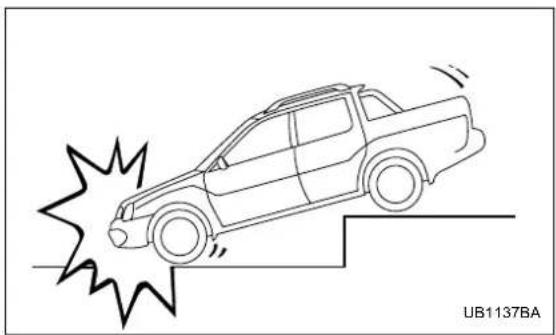
natural_image
Line drawing of a car with a collision effect and exhaust lines, no text or symbols present- CONTINUED -
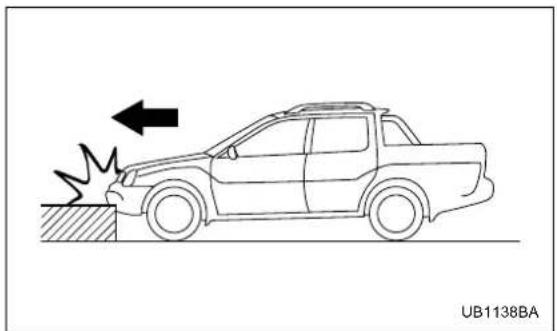
natural_image
Line drawing of a car with an arrow indicating upward motion, showing exhaust or damage (no text or symbols)The SRS frontal airbag may be activated when the vehicle sustains a hard impact in the undercarriage area from the road surface (such as when the vehicle plunges into a deep ditch, is severely bumped or knocked hard against an obstacle on the road such as a curb).
Examples of the types of accidents in which the SRS frontal airbag is unlikely to deploy.
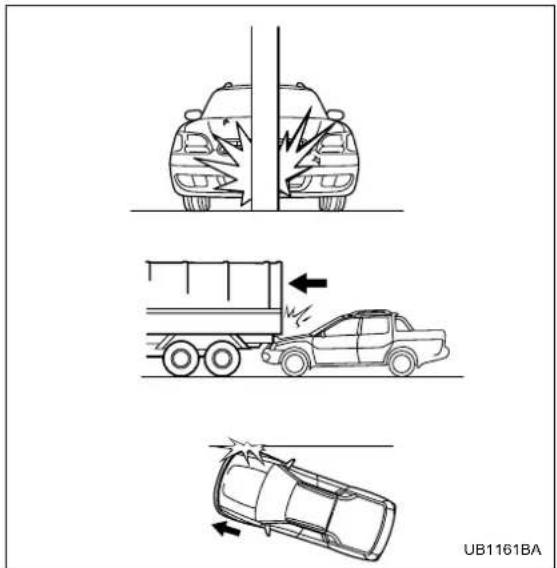
text_image
UB1161BAThere are many types of collisions which might not necessarily require SRS frontal airbag deployment. If the vehicle strikes an object, such as a telephone pole
or sign pole, or if it slides under a truck's load bed, or if it sustains an oblique offset frontal impact, the SRS frontal airbag may not deploy depending on the level of accident forces involved.
Examples of the types of accidents in which the SRS frontal airbag will basically not deploy.

text_image
UB1162BAThe SRS frontal airbag is basically not designed to deploy if the vehicle is struck from side or from behind, or if it rolls onto its side or roof, or if it is involved in a low-
- CONTINUED -
speed frontal collision.
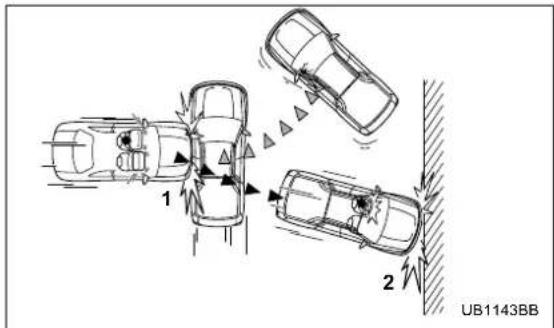
text_image
1 2 UB1143BB1) First impact!
2) Second impact!!
In an accident where the vehicle is impacted more than once, the SRS frontal airbag deploys only once. Example: In the case of a double collision, first with another vehicle, then against a concrete wall in immediate succession, once the SRS frontal airbag is activated on the first impact, it will not be activated on the second.
■ SRS airbag system monitors
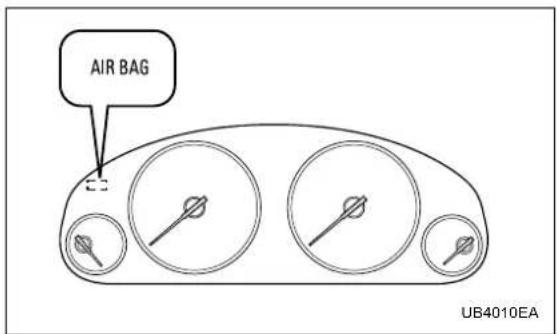
text_image
AIR BAG UB4010EASRS airbag system warning light
A diagnostic system continually monitors the readiness of the SRS airbag system (including front seat-belt pretensioners) while the vehicle is being driven. The SRS airbag system warning light "AIRBAG" will show normal system operation by lighting for about 6 seconds when the ignition key is turned to the "ON" position.
The following components are monitored by the indicator:
- Front sub sensor (Right hand side)
- Front sub sensor (Left hand side)
• Airbag control module (including impact sensors) - Frontal airbag module (Driver's side)
- Frontal airbag module (Front passenger's side)
- Seatbelt pretensioner (Driver's side)
- Seatbelt pretensioner (Front passenger's side)
- All related wiring
WARNING
If the warning light exhibits any of the following conditions, there may be a malfunction in the seatbelt pretensioners and/or SRS airbag system. Immediately take your vehicle to your nearest SUBARU dealer to have the system checked. Unless checked and properly repaired, the seatbelt pretensioners and/or SRS airbag will not operate properly in the event of a collision, which may increase the risk of injury.
- Flashing or flickering of the indicator light.
- No illumination of the warning light when the ignition switch is first turned to the "ON" position.
• Continuous illumination of the warning light. - Illumination of the warning light while driv-
ing.
■ SRS airbag system servicing
WARNING
- When discarding an airbag module or scrapping the entire vehicle damaged by a collision, consult your SUBARU dealer.
- The SRS airbag has no user-serviceable parts. Do not use electrical test equipment on any circuit related to the SRS airbag system. For required servicing of the SRS airbag, see your nearest SUBARU dealer. Tampering with or disconnecting the system's wiring could result in accidental inflation of the SRS airbag or could make the system inoperative, which may result in serious injury. The wiring harnesses of the SRS airbag system are covered with yellow insulation and system connectors are yellow for easy identification.
CAUTION
If you need service or repair in areas listed be-
- CONTINUED -
low, we recommend that you have an authorized SUBARU dealer perform the work. The SRS airbag control module, impact sensors and airbag modules are stored in these areas.
• Under the center console
- Inside each front fender
• Steering wheel and column and nearby areas
- Top of the dashboard on front passenger's side and nearby areas
• Inside each center pillar
In the event that the SRS airbag is deployed, replacement of the system should be performed only by an authorized SUBARU dealer. When the components of the SRS airbag system are replaced, use only genuine SUBARU parts.
To ensure their long-term reliability, the SRS airbags must be inspected by a SUBARU dealer ten years after the date of manufacture, which is shown on the certification label attached to the driver's door.
NOTE
In the following cases, contact your SUBARU dealer as soon as possible.
- The front part of the vehicle was involved in an accident in which the SRS frontal airbags did not
deploy.
- The pad section of the steering wheel or front passenger's frontal airbag cover is scratched, cracked, or otherwise damaged.
■ Precautions against vehicle modification
WARNING
- To avoid accidental activation of the system or rendering the system inoperative, which may result in serious injury, no modifications should be made to any components or wiring of the SRS airbag system.
This includes following modifications:
• Installation of custom steering wheels
- Attachment of additional trim materials to the dashboard
- Installation of additional electrical/electronic equipment such as a mobile two-way radio on or near the SRS airbag system components and/or wiring is not advisable. This could interfere with proper operation of the SRS airbag system.
CAUTION
Do not perform any of the following modifications. Such modifications can interfere with proper operation of the SRS airbag system.
- Attachment of any equipment (brush bar, winches, snow plow, skid plate, etc.) other than genuine SUBARU accessory parts to the front end.
- Modification of the suspension system or front end structure.
- Installation of a tire of different size and construction from the tires specified on the tire placard attached to the driver's door jamb.
Always consult your SUBARU dealer if you want to install any accessory parts to your vehicle.
natural_image
Pure horizontal dashed lines on white background with no text, numbers, or symbolsKeys and doors
Keys 2-2
Key number 2-2
Door locks 2-3
Locking and unlocking from the outside ..... 2-3
Locking and unlocking from the inside ..... 2-4
Power door locking switches 2-5
Remote keyless entry system
(if equipped) 2-7
Locking the doors 2-8
Unlocking the doors 2-8
Illuminated entry 2-9
Vehicle finder function 2-9
Sounding a panic alarm 2-9
Selecting audible signal operation 2-9
Replacing the battery 2-1
Replacing lost transmitters 2-1
Security system (if equipped) 2-15
System operation 2-1
Arming the system 2-1
Disarming the system 2-1
Sounding a panic alarm 2-1
Valet mode 2-18
Passive arming 2-1
Child safety locks 2-2
Windows 2-22
Power windows 2-2
Tailgate 2-25
License plate bracket 2-2
Tilting/sliding moonroof 2-32
Sun shade 2-33
Keys
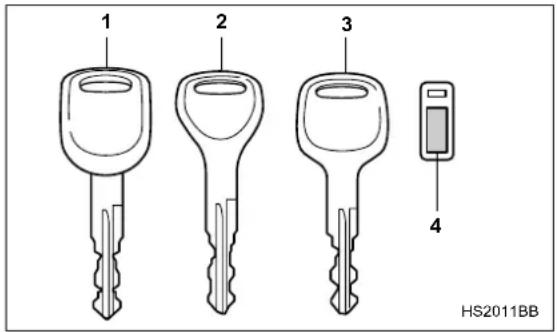
text_image
1 2 3 4 HS2011BB1) Master key
2) Submaster key
3) Valet key
4) Key number plate
Three types of keys are provided for your vehicle. Master key, submaster key and valet key.
The master key and submaster key fit all locks on your vehicle.
- Ignition switch
- Doors
- Glove box
The valet key fits only the ignition switch and door locks. You can keep glove box locked when you leave your vehicle and valet key at a parking facility.
NOTE
If the key is attached to a keyholder or to a large bunch of other keys, centrifugal force may act on it as the vehicle moves, resulting in unwanted turning of the ignition switch. Also, if a large keyholder is attached to the key, your knees or hands may accidentally touch it in a way that turns the ignition switch.
■ Key number
The key number is stamped on the metal plate attached to the key set. Write down the key number and keep it in another safe place, not in the vehicle. This number is needed to make a replacement key if you lose your key or lock it inside the vehicle.
Door locks
■ Locking and unlocking from the outside

natural_image
Diagram of a car handle with a curved handle and circular lock, showing directional arrows (no text or symbols)To lock the door from the outside with the key, insert the key into the keyhole and turn the key toward the rear. To unlock the door, turn the key toward the front. Lift the outside door handle to open an unlocked door.

text_image
1 2 UB2024BDLocking without the key
1) Rotate the lock lever rearward.
2) Close the door.
- CONTINUED -

text_image
1 2 UB2024CBLocking without the key
1) Push the power door locking switch forward.
2) Close the door.
To lock the door from the outside without the key, rotate the lock lever rearward and then close the door.
To lock the door from the outside using the power door locking switch, push the switch forward ("LOCK" side) and then close the door. In this case, all closed doors are locked at the same time.
Always make sure that all doors are locked before leaving your vehicle.
NOTE
Make sure that you do not leave the key inside the vehicle before locking the doors from the outside without the key.
■ Locking and unlocking from the inside
WARNING
Keep all doors locked when you drive, especially when small children are in your vehicle.
Along with the proper use of seatbelts and child restraints, locking the doors reduces the chance of being thrown out of the vehicle in an accident.
It also helps prevent passengers from falling out if a door is accidentally opened, and intruders from unexpectedly opening doors and entering your vehicle.
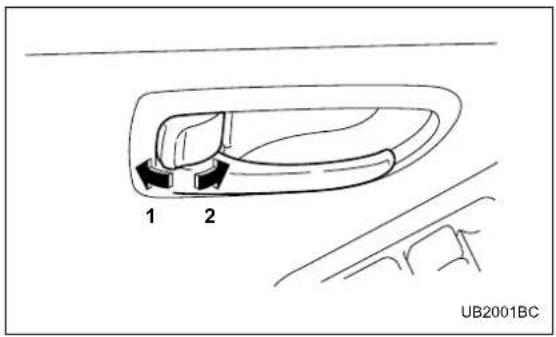
text_image
1 2 UB2001BC1) Lock
2) Unlock
To lock the door from the inside, rotate the lock lever rearward. To unlock the door from the inside, rotate the lock lever forward.
The red mark on the lock lever appears when the door is unlocked.
Pull the inside door handle to open an unlocked door. Always make sure that all doors are closed and locked before starting to drive.
Power door locking switches
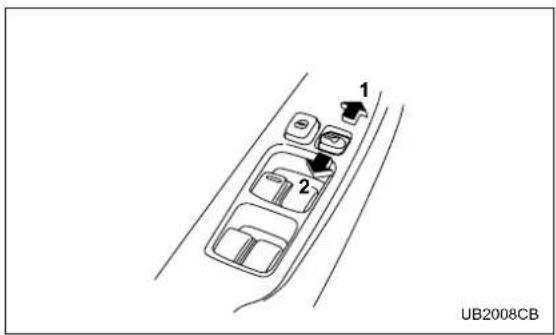
text_image
1 2 UB2008CBDriver's switch
1) Lock
2) Unlock
- CONTINUED -
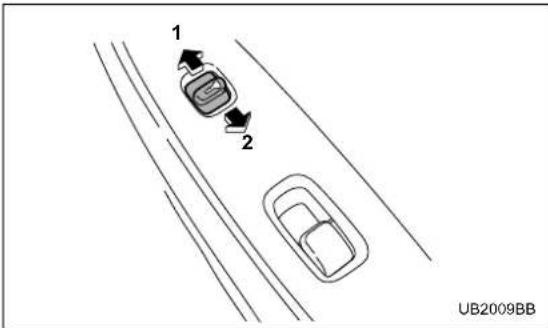
text_image
1 2 UB2009BBFront passenger's switch
1) Lock
2) Unlock
All doors can be locked and unlocked by the power door locking switches located at the driver's side and the front passenger's side doors.
To lock the doors, push the switch forward.
To unlock the doors, push the switch rearward.
When you close the doors after you set the door locks, the doors remain locked.
NOTE
Make sure that you do not leave the key inside the
vehicle before locking the doors from the outside using power door locking switches.
Remote keyless entry system (if equipped)
CAUTION
- Do not expose the transmitter to severe shocks, such as those experienced as a result of dropping or throwing.
- Do not take the transmitter apart except when replacing the battery.
- Do not get the transmitter wet. If it gets wet, wipe it dry with a cloth immediately.
This device complies with Part 15 of the FCC Rules and with RSS-210 of Industry Canada. Operation is subject to the following two conditions: (1) This device may not cause harmful interference, and (2) this device must accept any interference received, including interference that may cause undesired operation.
Changes or modifications not expressly approved by the party responsible for compliance could void the user's authority to operate the equipment.
Two transmitters are provided for your vehicle.
The keyless entry system has the following functions.
- Locking and unlocking the doors without a key
- Sounding a panic alarm
- Arming and disarming the security system (if your vehicle is equipped with an optional security system). See the next section "Security system (if equipped)" for detailed information.
The operable distance of the keyless entry system is approximately 30 feet (10 meters). However, this distance will vary depending on environmental conditions. The system's operable distance will be shorter in areas near a facility or electronic equipment emitting strong radio waves such as a power plant, broadcast station, TV tower, or remote controller of home electronic appliances.
The keyless entry system does not operate when the key is inserted in the ignition switch.
- CONTINUED -

text_image
C B1 B2 A HS2016BBA: "LOCK/ARM" button (Orange)
Press to lock all doors.
Press and Hold to activate panic alarm.
Press three times in a five second period to use vehicle finder function.
B: "UNLOCK/DISARM" button (Blue)
1) Press once to Unlock driver's door.
2) Press a second time to Unlock all other doors.
C: LED
■ Locking the doors
Briefly press the "LOCK/ARM" button (for less than two seconds) to lock all doors. An electronic chirp will sound once and the turn signal lights will flash once.
If any of the doors is not fully closed, an electronic chirp will sound five times and the turn signal lights will flash five times to alert you that the doors are not properly closed. When you close the door, it will automatically lock.
NOTE
If the "LOCK/ALARM" button is pressed for two seconds or longer, the panic alarm will sound. When locking the doors in normal circumstances, press the "LOCK/ALARM" button for less than two seconds. For details on the panic alarm, refer to "Sounding a panic alarm".
■ Unlocking the doors
Briefly press the "UNLOCK/DISARM" button (for less than two seconds) to unlock the driver's door. An electronic chirp will sound twice and the turn signal lights will flash twice. To unlock all doors, briefly press the "UNLOCK/DISARM" button a second time within 5 seconds.
NOTE
If the interval between the first and second presses of the "UNLOCK/DISARM" button (for unlocking of all of the doors) is extremely short, the system may not respond.
■ Illuminated entry
The interior (dome) light will illuminate when the "UN-LOCK/DISARM" button is pressed. These lights stay illuminated for approximately 30 seconds if any of the doors is not opened.
If the "LOCK/ARM" button is pressed before 30 seconds have elapsed, these lights will go out. Also, these lights will go out if the key is inserted in the ignition switch. The interior light switch must be set to the middle position in order for this function to operate.
■ Vehicle finder function
Use this function to find your vehicle parked among many vehicles in a large parking lot. Provided you are within 30 feet (10 meters) of the vehicle, pressing the "LOCK/ARM" button three times in a five-second period will cause your vehicle's horn to sound once and its turn signal lights to flash three times.
■ Sounding a panic alarm
To activate the alarm, keep the "LOCK/ARM" button pressed for more than two seconds.
The horn will sound and the turn signal lights will flash. To deactivate it, press the "LOCK/ARM" button or "UNLOCK/DISARM" button. Unless a button on the remote is pressed, the alarm will be deactivated after ap-
proximately 30 seconds.
■ Selecting audible signal operation
Using an electronic chirp, the system will give you an audible signal when the doors lock and unlock. If desired, you may turn the audible signal off.
To turn the audible signal off, unlock the doors by pushing "UNLOCK/DISARM" button and then simultaneously depress "LOCK/ARM" and "UNLOCK/DISARM" buttons for more than two seconds. An electronic chirp will sound twice and the turn signal lights will flash twice to inform you that the audible signal has been turned off.
To turn the audible signal on, unlock the doors by pushing "UNLOCK/DISARM" button and then simultaneously depress "LOCK/ARM" and "UNLOCK/DISARM" buttons for more than two seconds. An electronic chirp will sound once and the turn signal lights will flash once to inform you that the audible signal has been turned on.
- CONTINUED -
■ Replacing the battery
CAUTION
Do not let dust, oil or water get on or in the transmitter when replacing the battery.
When the transmitter battery begins to get weak, transmitter range will begin to decrease and the LED will not illuminate. Replace the battery as soon as possible.
To replace the battery:
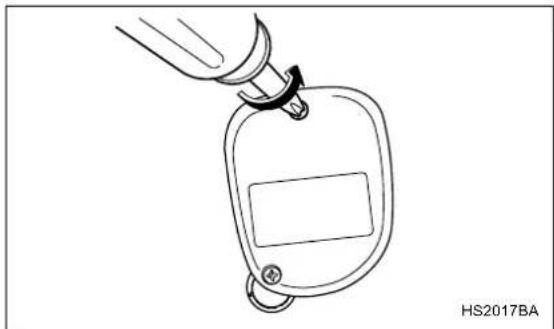
natural_image
Line drawing of a medical device with a clip attached to a rounded square base, labeled HS2017BA (no text or symbols on the diagram itself)- Remove the two screws on the back of the trans-
mitter case by using a Phillips screwdriver.
- Separate the case.
- Remove the old battery from the holder.
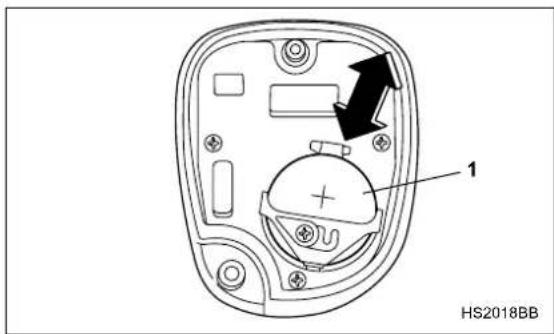
text_image
HS2018BB 11) Positive (+) side facing up
- Replace with a new battery (Type CR2032 or equivalent) making sure to install the new battery with the positive (+) side facing up.
- Install the back half of the transmitter case.
- Reinstall the two screws on the back of the transmitter case.
After the battery is replaced, the transmitter must be synchronized with the keyless entry system's control unit. Press either the "LOCK/ARM" or "UN-
LOCK/DISARM" button six times to synchronize the unit.
■ Replacing lost transmitters
If you lose a transmitter or want to purchase additional transmitters (up to four can be programmed), you should re-program all of your transmitters for security reasons. It is recommended that you have your dealer program all of your transmitters into your system.
▼ Programming the transmitters
The keyless entry system is equipped with a special code learning feature that allows you to program new transmitter codes into the system or to delete old ones. The system can learn up to four unique transmitter codes. The four transmitter codes may be the same or different.
To enter the programming mode:

natural_image
Line drawing of a device with two circular ports and an arrow pointing to a small circular feature (no text or symbols)- Press "UNLOCK/DISARM" button to disarm the security system. (if your vehicle is equipped with the optional security system.)
- CONTINUED -
Keys and doors
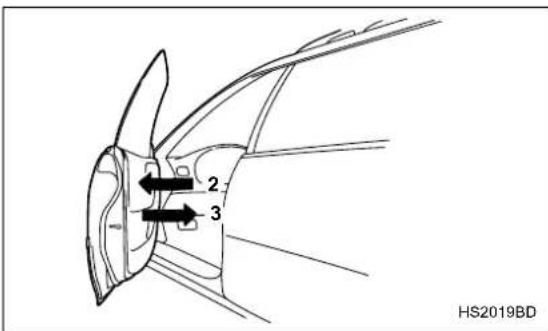
text_image
2 3 HS2019BD- Open the driver's door and sit in the driver's seat.
- Close the driver's door.

text_image
1 2 HS2020BB1) ON
2) LOCK
- Place the ignition key into the ignition switch and cycle the switch from LOCK to ON ten times within 15 seconds. Be sure to stop at the LOCK position. The horn will sound once to indicate that you are in the transmitter programming mode.
NOTE
You must finish the next step (opening the driver's door) within 45 seconds of starting this procedures.
To program the transmitters:

text_image
1 2 HS2019BE-
Open the driver's door.
-
Close the driver's door.
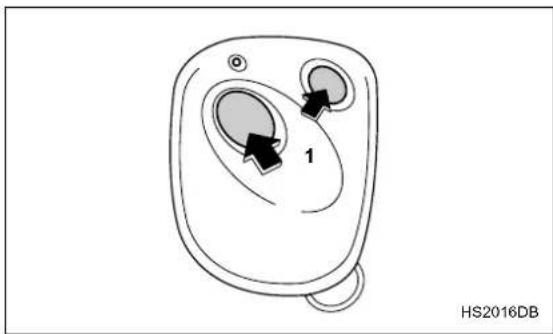
text_image
1 HS2016DB1) Press any button.
3. Press and release any button on the transmitter that you wish to program into the system. The horn will sound twice to indicate that the transmitter has been programmed.
Any additional transmitters can also be programmed at this time. Repeat steps 1 through 3 for an additional transmitter.
To exit the programming mode:
- After all of your transmitters are programmed, remove the key from the ignition switch.
The horn will sound three times to indicate that the
- CONTINUED -
system has exited the programming mode.
- Make sure that the keyless entry system properly operates by operating each transmitter.
▼ Deleting old transmitter codes
The control unit of the keyless entry system has four memory locations to store transmitter codes, giving it the ability to operate with up to four transmitters. When you lose a transmitter, the lost transmitter's code remains in the memory. For security reasons, lost transmitter codes should be deleted from the memory.
To delete old transmitter codes, program four transmitter codes into the system. If you have only one current transmitter, program it four times. If you have two current transmitters, program each one twice. If you have three current transmitters, program two of them once and the third one twice. This process will leave only current transmitter codes in the system's memory.
NOTE
Make sure no one else is operating their keyless entry system within range of your vehicle when programming transmitters. If someone else were to operate their remote transmitter while you are programming your transmitters, it is possible that their transmitter code will be programmed into your system, allowing them unauthorized access
to your vehicle.
Security system (if equipped)
The security system helps to protect your vehicle and valuables from theft. The horn sounds and the turn signal lights flash if someone attempts to break into your vehicle. The starter motor is also interrupted to prevent starting the vehicle without a key.
The system can be armed and disarmed with the remote transmitter.
The system does not operate when the key is inserted into the ignition switch.
■ System operation
The security system will give the following alarm indications when triggered:
- The turn signal lights will flash and the horn will sound intermittently. In addition, the starter motor will not operate.
- The alarm automatically resets after 30 seconds; however, the alarm will reactivate if the vehicle is tampered with again. The alarm will continue for six times if any sensor continues to be activated.
The alarm is triggered by:
- Opening a door.
- Application of physical shock to the vehicle (e.g.
breaking glass or forced entry). Note that there are two alarm levels for shock: warning and alarm. In warning mode, the alarm detects lower level vibrations and triggers 2 warning chirps on the horn and two flashes on the lights as a deterrent to would be vandals. In alarm mode, higher levels of shock are detected and the system will go into full alarm.
- Ignition switch being turned on while in armed state.
NOTE
- The alarm will not be triggered by opening the switchback door.
- The alarm may not be triggered when the window is broken with a sharp-edged tool.
- With the valet mode selected, the security system does not operate and the turn signal lights do not flash when the remote transmitter is used for locking and unlocking.
The security system indicator light in the combination meter flashes twice per second to show that the valet mode is selected.
For details, refer to "Valet mode" in this section.
■ Arming the system
▼ To arm the system using remote transmitter
- Close all windows and moonroof.
- CONTINUED -
Keys and doors
- Remove the key from the ignition switch.
- Open the doors and get out of the vehicle.
- Make sure that the engine hood and switchback door are locked.
- Close all doors.

text_image
1 2 HS2016EB1) Press to Arm the system.
2) Press to Disarm the system.

text_image
1 UB2033BB1) Security system indicator light
- Briefly press the "LOCK/ARM" button (for less than two seconds). All doors will lock, an electronic chirp will sound once, the turn signal lights will flash once and the indicator light starts flashing slowly (approximately once every two seconds).
If any of the doors (except the switchback door) is not fully closed, an electronic chirp sounds five times, the turn signal lights flash five times to alert you that the doors are not properly closed. When you close the door, the system will automatically arm and doors will automatically lock.
▼ To arm the system using power door locking switches
- Close all windows and moonroof.
- Remove the key from the ignition switch.
- Open the doors and get out of the vehicle.
- Make sure that the engine hood and switchback door are locked.
- Close the doors but leave only the driver's door or the front passenger's door open.
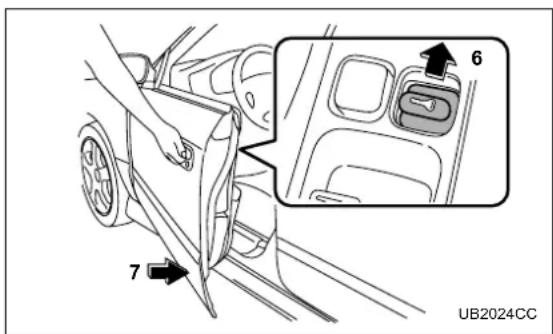
text_image
6 7 UB2024CC- Push the power door locking switch forward ("LOCK" side) to set the door locks.
- Close the door. An electronic chirp will sound once, the turn signal lights will flash once and the indicator light will start flashing slowly (approximately once ev-
ery two seconds) to inform you that the system has armed.
NOTE
The system can be armed even if the engine hood, the windows, the switchback door and/or moon-roof are open. Always make sure that they are fully closed before arming the system.
■ Disarming the system
Briefly press the "UNLOCK/DISARM" button (for less than two seconds) on the remote transmitter. The driver's door will unlock, an electronic chirp will sound twice, the turn signal lights will flash twice and the indicator light will go off.
To unlock all other doors, briefly press the "UNLOCK/DISARM" button a second time.
▼ Emergency disarming
If you cannot disarm the system using the transmitter (i.e. the transmitter is lost, broken or the transmitter battery is too weak), you can disarm the system without using the transmitter.
To disarm the system:
- Unlock the door with the key and then open the door.
- CONTINUED -
- The alarm will sound.
- Insert the key into the ignition switch and cycle it from "LOCK" to "ON" three (3) times within 5 seconds.
■ Sounding a panic alarm
To activate the alarm, keep the "LOCK/ARM" button pressed for more than two seconds.
The horn will sound and the turn signal lights will flash. To deactivate it, press the "LOCK/ARM" button or "UNLOCK/DISARM" button.
Unless a button on the remote is pressed, the alarm will be deactivated after approximately 30 seconds.
■ Valet mode
When you choose the valet mode, the security system does not operate. In valet mode, the remote transmitter is used only for locking and unlocking the doors and panic activation.
To enter the valet mode, open the driver's door and keep the "UNLOCK/DISARM" button depressed for more than two seconds. The security system indicator light will continue to flash 2 times per second indicating that the system is in the valet mode.
To exit valet mode, open the driver's door and keep
the "UNLOCK/DISARM" button pressed for more than two seconds. The indicator will stop flashing.
■ Passive arming
When passive arming mode has been programmed by the dealer, arming of the system is automatically accomplished without using the remote transmitter. Note that in this mode, DOORS MUST BE MANUALLY LOCKED.
▼ To enter the passive mode
Since programming the passive arming mode is a complicated procedure, have it done by your nearest SUBARU dealer.
▼ Arming the system
CAUTION
In passive mode, the system will automatically activate the alarm but WILL NOT automatically lock the doors. In order to lock the doors you must either lock them as indicated in step 4 below or with the key once they have been closed. Failure to lock the doors manually will result in a higher security risk.
- Turn the ignition switch to "ON".
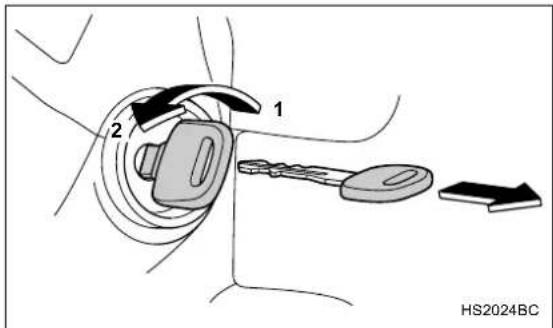
text_image
1 2 HS2024BC1) ON
2) LOCK
- Turn the ignition switch from "ON" to "LOCK" and remove the key from the ignition switch.
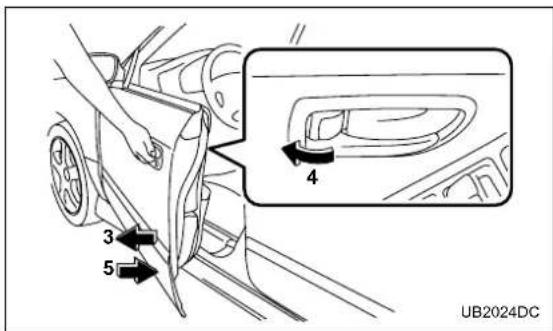
text_image
UB2024DC 4 3 5- Open the doors and get out of the vehicle.
- Before closing the doors, lock all doors with the inside door lock levers.
- Close the doors. The system will automatically arm after one minute.
In the passive mode, the system can also be armed with the remote transmitter or with the power door locking switches. If the remote transmitter or power door lock switch is used to lock the vehicle, arming will take place immediately regardless of whether or not the passive mode has been selected.
▼ Disarming the system
To disarm the system, briefly press the "UNLOCK/
- CONTINUED -
DISARM" button on the transmitter.
▼ Tripped sensor identification
If an electronic chirp sounds four times and the turn signal lights flash four times when you disarm the system, this indicates that the alarm was triggered. The number of times the indicator light flashes indicates what sensor caused the alarm condition.
To enter identification mode:
- Open the driver's door and leave it open.
- Turn the ignition switch to "ON" twice. ("LOCK" → "ON" → "LOCK" → "ON" → "LOCK")
- The indicator light will start flashing.
The indicator light provides the following indications.
Flashing once: Any door has been opened.
Flashing three times: The impact sensor in the system's unit has been activated. This may indicate that your vehicle has been shocked or tampered with by some outside force and/or unauthorized person.
Flashing four times: The ignition switch has been turned on or the battery has been disconnected.
NOTE
The battery must be reconnected before the indicator light will flash.
To exit this mode, close the door and turn the ignition
switch to "ON".
Child safety locks
WARNING
Always use the child safety lock whenever a child rides in the rear seat. Serious injury could result if a child accidentally opened the door and fell out.
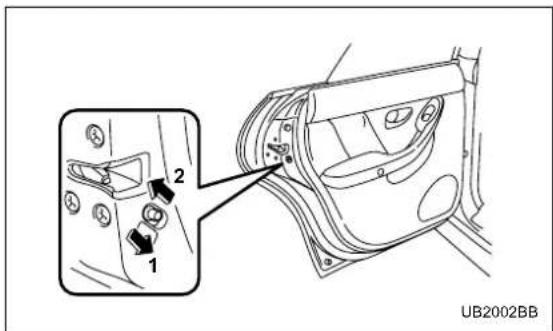
text_image
1 2 UB2002BB1) Lock
2) Unlock
Each rear door has a child safety lock that prevents
the doors from being opened even if the inside door handle is pulled.
When the child safety lock lever is in the lock position, the door cannot be opened from inside regardless of the position of the inner door handle lock lever. The door can only be opened from the outside.
Windows
Power windows
WARNING
To avoid serious personal injury caused by entrapment, you must do the following.
- When operating the power windows, be extremely careful to prevent anyone's fingers, arms, neck or head from being caught in the window.
- Always lock the passengers' windows using the lock switch when children are riding in the vehicle.
- Before leaving the vehicle, always remove the key from the ignition switch for safety and never allow an unattended child to remain in the vehicle. Failure to follow this procedure could result in injury to a child operating the power window.
The power windows operate only when the ignition switch is in the "ON" position.
▼ Driver's side switches

text_image
1 2 3 4 5UB2008BB
1) Lock switch
2) For driver's window
3) For rear left passenger's window
4) For front passenger's window
5) For rear right passenger's window
All door windows can be controlled by the power window switch cluster at the driver side door.
Operating the driver's window
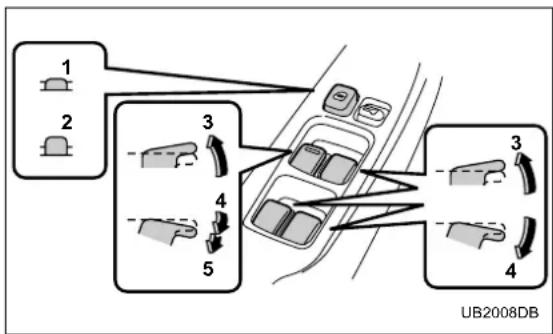
flowchart
graph TD
    A["1 Seat"] --> B["3 Seat"]
    C["2 Seat"] --> B
    D["3 Seat"] --> E["4 Seat"]
    F["4 Seat"] --> E
    G["5 Seat"] --> H["3 Seat"]
    I["5 Seat"] --> H
    J["5 Seat"] --> H
    K["5 Seat"] --> H
    L["5 Seat"] --> M["3 Seat"]
    N["5 Seat"] --> M
    O["5 Seat"] --> M
    P["5 Seat"] --> M
    Q["5 Seat"] --> R["3 Seat"]
    S["5 Seat"] --> R
    T["5 Seat"] --> R
    U["5 Seat"] --> V["3 Seat"]
    W["5 Seat"] --> V
    X["5 Seat"] --> V
    Y["5 Seat"] --> Z["3 Seat"]
    AA["5 Seat"] --> Z
    AB["5 Seat"] --> Z
    AC["5 Seat"] --> AD["3 Seat"]
    AE["5 Seat"] --> AD
    AF["5 Seat"] --> AD
    AG["5 Seat"] --> AH["3 Seat"]
    AI["5 Seat"] --> AH
    AJ["5 Seat"] --> AH
    AK["5 Seat"] --> AL["3 Seat"]
    AM["5 Seat"] --> AL
    AN["5 Seat"] --> AL
    AO["5 Seat"] --> AP["3 Seat"]
    AQ["5 Seat"] --> AP
    AR["5 Seat"] --> AP
    AS["5 Seat"] --> AT["3 Seat"]
    AU["5 Seat"] --> AT
    AV["5 Seat"] --> AT
    AW["5 Seat"] --> AX["3 Seat"]
    AY["UB2008DB"]
Push the switch down lightly and hold it. The window will open as long as the switch is held.
This switch also has a one-touch auto down feature that allows the window to be opened fully without holding the switch.
Push the switch down until it clicks and release it, and the window will fully open. To stop the window half-
way, pull the switch up lightly.
To close:
Pull the switch up lightly and hold it. The window will close as long as the switch is held.
Operating the passengers' windows
To open the passengers' windows, push the appropriate switch down and hold it until the window reaches the desired position. To close the window, pull the switch up and hold it until it reaches the desired position.
▼ Locking the passengers' windows
To lock the passengers' windows, push the lock switch. When the lock switch is in the "LOCK" position, the passengers' windows cannot be opened or closed.
- CONTINUED -
▼ Passengers' side switches

text_image
UB2009CBFront passenger's window switch
1) Open
2) Close
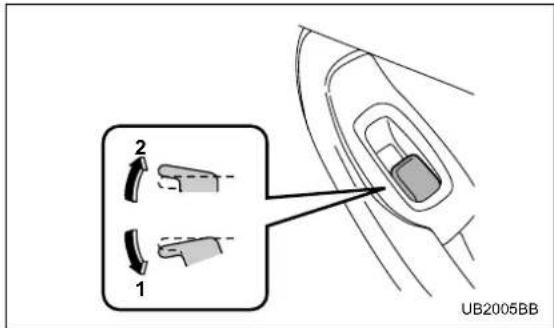
text_image
2 1 UB2005BBRear passenger's window switches
1) Open
2) Close
To open the window, push the switch down and hold it until the window reaches the desired position. To close the window, pull the switch up and hold it until the window reaches the desired position.
When the lock switch on the power window switch cluster, located on the driver's side door, is in the "LOCK" position, the passengers' windows cannot be operated with the passengers' switches.
Tailgate
CAUTION
Keep the tailgate closed when the vehicle is moving. If you must drive with the tailgate open, use the optional SUBARU Bed Extender and place the License Plate Bracket at its fully lowered/open position. Cargo must not stick out beyond the Extender. Otherwise a dangerous road hazard or personal injury could result.

text_image
UB2050BABefore opening the tailgate, remove any object on the
upper surface of the rear bumper to avoid damaging the tailgate.
To open the tailgate, lift up on its handle while pulling the tailgate toward you. The support cables hold the tailgate open.
See "Loading your vehicle" section in Chapter 8 for precautions in loading cargo.
To close the tailgate, firmly push it upward until it latches.
After you put the tailgate back up, pull it back toward you to be sure it latches securely.
- CONTINUED -
■ License plate bracket
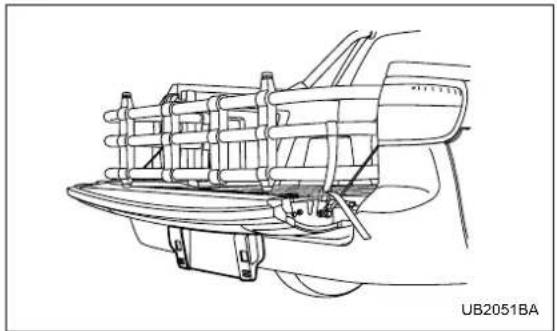
natural_image
Technical line drawing of a mechanical assembly with no visible text or symbolsWhen you drive with the tailgate open and with the bed extender used, the license plate bracket must be placed at its fully lowered/open position to make the rear license plate visible.
CAUTION
In order to avoid damaging the license plate bracket or the bumper, the license plate bracket must be in its fully lowered/open position before the tailgate is lowered.

natural_image
Line drawing of a car front panel with an upward arrow indicator (no text or symbols)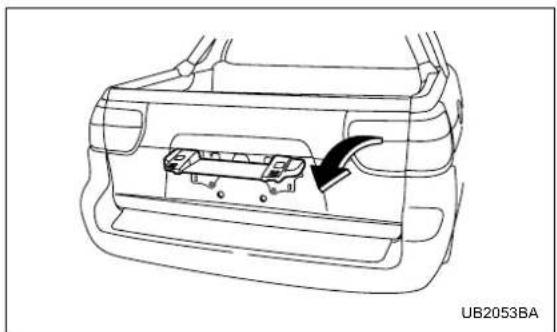
natural_image
Line drawing of a car rear compartment showing internal components and a directional arrow (no text or symbols)To use the license plate bracket at its lowered/open
position, push the two release buttons and pull the license plate bracket up until it clicks. And then open the tailgate.
If your vehicle is equipped with a trailer hitch, remove the ball mount from the hitch receiver tube before opening the tailgate. Failure to follow this procedure could result in damage to the license plate bracket.
When you drive with the tailgate closed, the license plate bracket must be restored to its original position. To restore the license plate bracket to its original position, close the tailgate, and then pull the license plate bracket down until it clicks.
If the license plate bracket is hard to be restored to its original position, mud may have accumulated on the back of the license plate bracket. Remove accumulated mud before pulling the license bracket down.
CAUTION
In order to avoid damaging the license plate bracket or the bumper, the license plate bracket must be restored to its original position until it clicks.
Switchback door
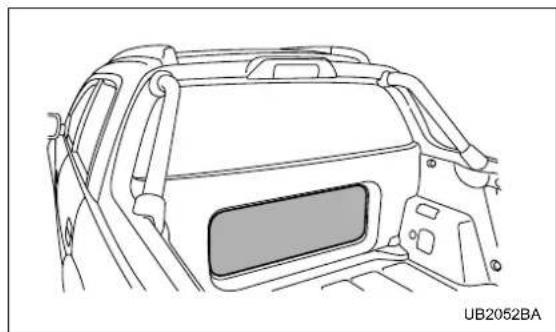
natural_image
Line drawing of a car backrest with a rectangular opening and side panels (no text or symbols)With the switchback door open, you can increase the usable cargo space and can carry long objects.
WARNING
Secure long objects properly to prevent them from sliding forward and causing serious injury during a sudden stop or sharp cornering. Tie long objects down with a rope or something equivalent.
- CONTINUED -
CAUTION
Pay attention that your fingers do not get pinched with the switchback door when opening and closing it.
To open the switchback door:

natural_image
Diagram of a car interior showing seatbelt and dashboard placement (no text or symbols)- Pull up the rear seat cushion. Refer to "Rear seats" section in Chapter 1 for operating details.

text_image
UB1112CB A B 1natural_image
Technical line drawing of a vehicle interior showing a door panel and a gear shift (no text or symbols)- Unlock the rear seatback by pulling up on the knob and fold down the rear seatback. Confirm that the pins located at the bottom of the seat cushion is inserted into the slots at the top of the seatback.
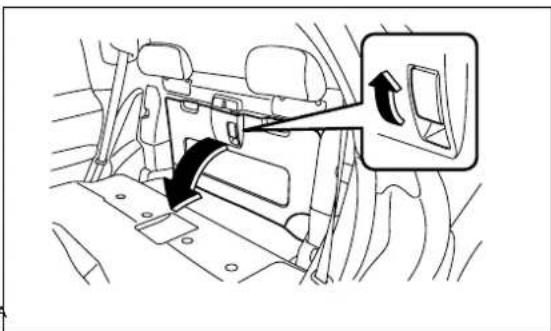
natural_image
Diagram of a car interior showing a seatbelt switch and directional arrow (no text or symbols)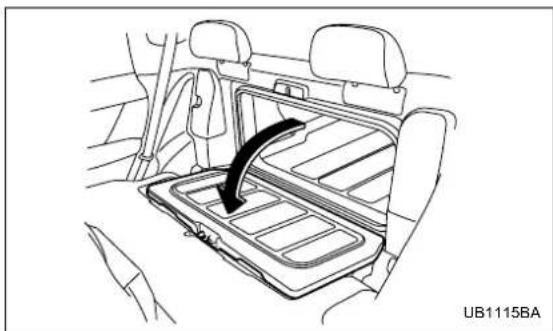
natural_image
Interior view of a car showing the backrest tray with a black arrow indicating direction (no text or symbols)- Fold down the switchback door by releasing the -CONTINUED-
lock knob. Then you can have a flat and larger cargo space.
- Place the long object on the cargo bed through the switchback door opening.
Be sure all items are secured in place.
NOTE
- When opening the switchback door in snow, accumulated snow in the cargo bed may enter the passenger compartment which could result in dampness in the passenger compartment. Prior to opening of the switchback door, brush off the snow completely.
- Close the switchback door whenever you leave the vehicle to prevent unauthorized entry.
WARNING
The switchback door should be kept completely shut when the vehicle is idling in an enclosed or partially enclosed area to avoid the possibility of exhaust gas entering the passenger compartment. Engine exhaust gas contains carbon monoxide, a colorless and odorless gas which is extremely dangerous, or even lethal if inhaled. To ensure that exhaust gas cannot penetrate the switchback door, make certain that there are no obstructions between the door and
the vehicle body that prevent the door from fully closing or that crimp the weather strip around the door.
To close the switchback door, firmly push it upward until it latches.
Return the seatback and seat cushion to their original positions and make sure they are securely locked.
CAUTION
After returning the seatback to its original position, make sure that the rear seatback has been securely locked. When securely locked, the red marks on the locking knobs are no longer visible.
■ Switchback door indicator light

text_image
UB7023EAWhile the ignition switch is in the "ON" position, the switchback door indicator light comes on when the switchback door is open.
While the ignition switch is in the "LOCK" or "ACC" position, the switchback door indicator light flashes for about 20 seconds and goes off when the switchback door is open.
Moonroof (if equipped)
WARNING
Never let anyone's hands, arms, head or any objects protrude from the moonroof. A person could be seriously injured if the vehicle stops suddenly or turns sharply or if the vehicle is involved in an accident.
To avoid serious personal injury caused by entrapment, you must do the following.
- Before closing the moonroof, make sure that no one's hands, arms, neck, head or other objects will be accidentally caught in the moonroof.
- Before leaving the vehicle, always remove the key from the ignition switch for safety and never allow an unattended child to remain in the vehicle. Failure to follow this procedure could result in injury to a child operating the moonroof.
CAUTION
- Do not sit on the edge of the open moonroof.
- CONTINUED -
- Do not operate the moonroof if falling snow or extremely cold conditions have caused it to freeze shut.
■ Tilting/sliding moonroof
The moonroof has both tilting and sliding functions. The moonroof operates only when the ignition switch is in the "ON" position.
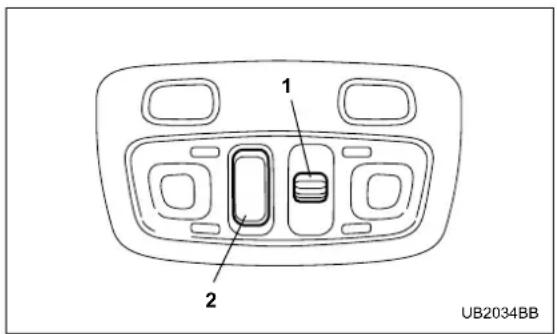
text_image
1 2 UB2034BB1) Open/Close switch
2) Tilt switch
▼ To raise or lower the moonroof
The tilting function will only operate when the moon-
roof is fully closed.
Push the rear side of the "Tilt" switch to raise the moonroof.
Push the front side of the "Tilt" switch to lower the moonroof.
Release the switch after the moonroof has been raised or has been lowered completely. Pushing the switch continuously may cause damage to the moonroof.
▼ To open or close the moonroof
Push the "Open/Close" switch rearward to open the moonroof. The sun shade will be also opened together with the moonroof.
Push the "Open/Close" switch forward to close the moonroof. The moonroof will stop halfway if you continue to press on the switch.
Release the switch once and push it again to close the moonroof completely.
After washing the vehicle or after it rains, wipe away water on the roof prior to opening the moonroof to prevent water drops from falling into the passenger compartment.
NOTE
If the moonroof cannot be closed through the switch operation because of system failure, it can
be closed manually using a hex-headed wrench. For the procedure, refer to "Moonroof – if the moonroof cannot be closed" in Chapter 9 "In case of emergency".
Sun shade

natural_image
Diagram showing a hand pressing a cable into a car's side panel with an arrow indicating left motion (no text or symbols)The sun shade can be slid forward or backward by hand while the moonroof is closed.
If the moonroof is opened, the sun shade also moves back.

natural_image
Pure horizontal dashed lines on white background with no text, numbers, or symbolsInstruments and controls
Ignition switch 3-2
LOCK 3-2
ACC 3-3
ON 3-3
START 3-4
Key reminder chime 3-4
Ignition switch light (if equipped) 3-4
Key interlock release (AT vehicles) 3-4
Hazard warning flasher 3-5
Meters and gauges 3-6
Speedometer 3-6
Odometer/Trip meter 3-6
Tachometer 3-7
Outside temperature indicator (if equipped) .. 3-7
Fuel gauge 3-8
Temperature gauge 3-8
Warning and indicator lights 3-9
Seatbelt warning light and chime 3-9
SRS airbag system warning light 3-10
CHECK ENGINE warning light/Malfunction
indicator lamp 3-10
Charge warning light 3-11
Oil pressure warning light 3-12
AT OIL TEMPerature warning light
(AT vehicles) 3-12
ABS warning light 3-12
Brake system warning light 3-13
Door ajar warning lights 3-14
Switchback door indicator light 3-14
Low fuel warning light 3-14
All-Wheel Drive warning light (AT vehicles) ... 3-14
Security system status indicator light
(if equipped) 3-15
Selector lever position indicator
(AT vehicles) 3-15
Gear position indicator (Turbo-AT vehicles) .. 3-16
Turn signal indicator lights 3-16
High beam indicator light 3-16
Cargo lamp indicator light 3-16
Cruise control set indicator light 3-16
Clock 3-17
Light control switch 3-18
Headlights 3-18
High/low beam change (dimmer) 3-19
Headlight flasher 3-19
Daytime running light system 3-20
Turn signal lever 3-20
Illumination brightness control 3-21
Parking light switch 3-22
Fog light button 3-23
Wiper and washer 3-23
Windshield wiper and washer switches ..... 3-25
Rear window defogger button 3-26
Windshield wiper deicer (if equipped) ..... 3-27
Mirrors 3-28
Inside mirror 3-28
Outside mirrors 3-30
Tilt steering wheel 3-33
Horn 3-34
Ignition switch
WARNING
Never turn the ignition switch to "LOCK" while the vehicle is being driven or towed because that will lock the steering wheel, preventing steering control. And when the engine is turned off, it takes a much greater effort than usual to steer.
The ignition switch has four positions: LOCK, ACC, ON and START.

natural_image
Interior view of a car dashboard with steering wheel and rotary dial (no text or symbols)NOTE
- Keep the ignition switch in the "LOCK" position when the engine is not running.
- Using electrical accessories for a long time with the ignition switch in the "ON" or "ACC" position can cause the battery to go dead.
If the ignition switch will not move from the "LOCK" position to the "ACC" position, turn the steering wheel slightly to the left and right as you turn the ignition switch. - If the key is attached to a keyholder or to a large bunch of other keys, centrifugal force may act on it as the vehicle moves, resulting in unwanted turning of the ignition switch. Also, if a large keyholder is attached to the key, your knees or hands may accidentally touch it in a way that turns the ignition switch.
■ LOCK
The key can only be inserted or removed in this position. The ignition switch will lock the steering wheel when you remove the key.
If turning the key is difficult, turn the steering wheel slightly to the right and left as you turn the key.
▼ Automatic transmission vehicles
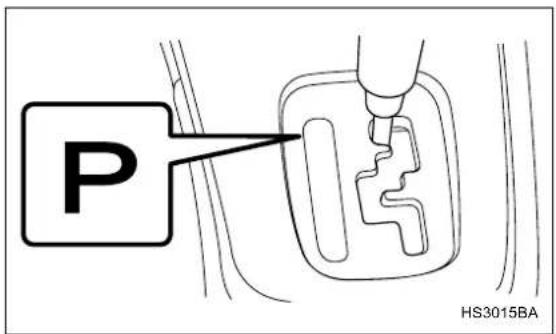
text_image
P HS3015BA
natural_image
Diagram of a car seatbelt mechanism with arrows indicating motion (no text or symbols)The key can be turned from "ACC" to "LOCK" only when the selector lever is in the "P" position.
▼ Manual transmission vehicles
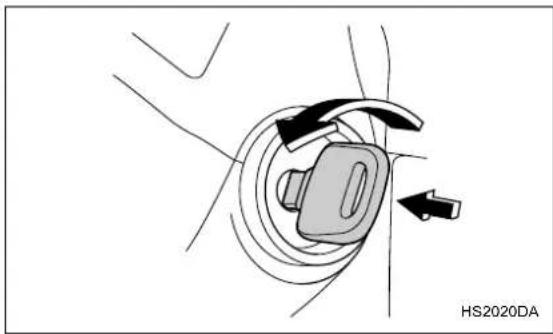
natural_image
Diagram of a mechanical component with directional arrows indicating motion or force (no text or symbols)The key can be turned from "ACC" to "LOCK" only when the key is pushed in while turning it.
ACC
In this position the electrical accessories (radio, cigarette lighter socket, etc.) can be used.
■ ON
This is the normal operating position after the engine
- CONTINUED -
is started.
■ START
CAUTION
Do not turn the ignition switch to the "START" position while the engine is running.
The engine is started in this position. The starter cranks the engine to start it. When the key is released (after the engine has started), the key automatically returns to the "ON" position.
■ Key reminder chime
The reminder chime sounds when the driver's door opens and the key is in the "LOCK" or "ACC" positions. The chime stops when the key is removed from the ignition switch.
■ Ignition switch light (if equipped)
For easy access to the ignition switch in the dark, the ignition switch light comes on when driver's door is opened. The light remains on for 10 seconds and goes out after driver's door is closed or if the key is turned
to the "ON" position.
■ Key interlock release (AT vehicles)
If the key can not be turned to the "LOCK" position even when the selector lever is in the "P" position:
- Take out the screwdriver from the tool bag.

natural_image
Technical line drawing of a mechanical assembly with a tool and component (no text or symbols)- Remove the cover under the steering column using a Phillips screwdriver.

text_image
UG3025BA- Turn the ignition key while pressing the key inter-lock release lever.
Take your vehicle to the nearest SUBARU dealer immediately to have the key interlock system repaired.
Hazard warning flasher

natural_image
Technical line drawing of a vehicle air vent with a warning sign and grid layout (no text or symbols)The hazard warning flasher is used to warn other drivers when you have to park your vehicle under emergency conditions. The hazard warning flasher works with the ignition switch in any position.
To turn on the hazard warning flasher, push the hazard warning button on the instrument panel. To turn off the flasher, push the button again.
NOTE
When the hazard warning flasher is on, the turn signals do not work.
Meters and gauges
■ Speedometer
The speedometer shows the vehicle speed.
■ Odometer/Trip meter
CAUTION
To ensure safety, do not attempt to change the function of the indicator during driving, as an accident could result.

text_image
1 TRIP A TRIP B UB3026BB1) Trip meter
2) Odometer
▼ Odometer
The odometer shows the total distance that the vehicle has been driven.
▼ Double trip meter
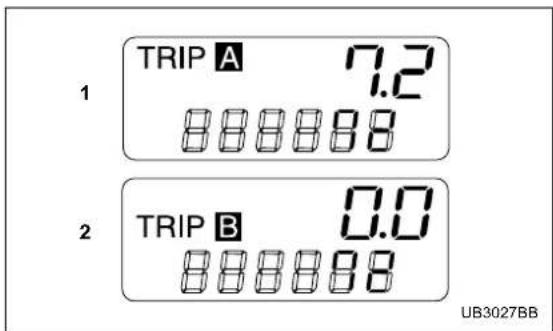
text_image
1 TRIP A 7.2 888888 2 TRIP B 0.0 888888 UB3027BB1) A trip meter
2) B trip meter
The trip meter shows the distance that the vehicle has been driven since you last set it to zero. To change the mode indication, briefly push the knob. Each press of the knob changes the function alternately.
A trip meter B-trip meter
To set the trip meter to zero, select either the A trip or B trip meter and push the knob and keep it pushed for more than 1 second.
NOTE
If the connection between the combination meter and battery is broken for any reason such as vehicle maintenance or fuse replacement, the data recorded on the trip meter will be lost.
Tachometer
CAUTION
Do not operate the engine with the pointer of the tachometer in the red zone. In this range, fuel injection will be cut by the engine control module to protect the engine from overrevving. The engine will resume running normally after the engine speed is reduced below the red zone.
The tachometer shows the engine speed in thousands of revolutions per minute.
■ Outside temperature indicator (if equipped)
The outside temperature indicator shows the outside
- CONTINUED -
temperature in a range from -22 to 122°F (-30 to 50°C).
The indicator can give a false reading under any of the following conditions:
- When there is too much sun.
- During idling; while running at low speeds in a traffic jam; when the engine is restarted immediately following a shutdown.
- When the actual outside temperature falls outside the specified indicator range.
Fuel gauge
The fuel gauge shows the approximate amount of fuel remaining in the tank.
The gauge does not return to "E" even though the ignition switch is in the "ACC" or "LOCK" position.
The gauge may move slightly during braking, turning or acceleration due to fuel level movement in the tank.
■ Temperature gauge
CAUTION
If the pointer exceeds the normal operating range, safely stop the vehicle as soon as possi-
ble.
See "In case of emergency" in chapter 9.

text_image
H 1 CUB2012BB
1) Normal operating range
The temperature gauge shows engine coolant temperature when the ignition switch is in the "ON" position.
The coolant temperature will vary in accordance with the outside temperature and driving conditions.
We recommend that you drive moderately until the pointer of the temperature gauge reaches near the middle of the range. Engine operation is optimum with
the engine coolant at this temperature range and high revving operation when the engine is not warmed up enough should be avoided.
Warning and indicator lights
Several of the warning and indicator lights come on momentarily and then go out when the ignition switch is initially turned to the "ON" position. This permits checking the operation of the bulbs.
Apply the parking brake and turn the ignition switch to the "ON" position. The following lights come on:
Seatbelt warning light
SRS airbag system warning light
CHECK ENGINE warning light / Malfunction indica-
tor lamp
Charge warning light
Oil pressure warning light
AT OIL temperature warning light (AT vehicles)
ABS warning light
Brake system warning light
All-Wheel Drive warning light (AT vehicles)
If any lights fail to come on, it indicates a burned-out bulb or a malfunction of the corresponding system.
Consult your authorized SUBARU dealer for repair.
■ Seatbelt warning light and chime

When the ignition switch is turned to the "ON" position, the seatbelt warning light will come on and the remind-
- CONTINUED -
er chime will sound for about six seconds to remind the driver to fasten the seatbelt.
The seatbelt warning light remains on for about six seconds and turns off automatically after six seconds. The seatbelt reminder chime will turn off when the driver's side seatbelt is buckled or it will turn off automatically after six seconds.
■ SRS airbag system warning light
AIR BAG
WARNING
If the warning light exhibits any of the following conditions, there may be a malfunction in the seatbelt pretensioners and/or SRS airbag system. Immediately take your vehicle to your nearest SUBARU dealer to have the system checked. Unless checked and properly repaired, the seatbelt pretensioners and/or SRS airbag will not operate properly in the event of a collision, which may increase the risk of injury.
- Flashing or flickering of the indicator light.
- No illumination of the warning light when the ignition switch is first turned to the "ON" position.
• Continuous illumination of the warning light.
- Illumination of the warning light while driving.
When the ignition switch is turned to the "ON" position, the SRS airbag system warning light will come on for about six seconds and go out. This shows the SRS frontal airbag and seatbelt pretensioners are in normal operation.
■ CHECK ENGINE warning light/Malfunction indicator lamp
CHECK ENGINE
CAUTION
If the CHECK ENGINE light comes on while you are driving, have your vehicle checked/ repaired by your SUBARU dealer as soon as possible. Continued vehicle operation without having the emission control system checked and repaired as necessary could cause serious damage, which may not be covered by your vehicle's warranty.
If this light comes on steadily or blinks while the engine
is running, it may indicate that there is a problem or potential problem somewhere in the emission control system.
▼ If the light comes on steadily:
If the light comes on steadily while driving or does not go out after the engine starts, an emission control system malfunction has been detected.
You should have your vehicle checked by an authorized SUBARU dealer immediately.
NOTE
This light also comes on when the fuel filler cap is not tightened until it clicks.
If you have recently refueled your vehicle, the cause of the CHECK ENGINE warning light/malfunction indicator lamp coming on could be a loose or missing fuel filler cap. Remove the cap and retighten it until it clicks. Make sure nothing is interfering with the sealing of the cap. Tightening the cap will not make the CHECK ENGINE warning light turn off immediately. It may take several driving trips. If the light does not go out, take your vehicle to your authorized SUBARU dealer immediately.
▼ If the light is blinking:
If the light is blinking while driving, an engine misfire condition has been detected which may damage the
emission control system.
To prevent serious damage to the emission control system, you should do the following:
- Reduce vehicle speed.
- Avoid hard acceleration.
- Avoid steep uphill grades.
- Reduce the amount of cargo, if possible.
- Stop towing a trailer as soon as possible.
The CHECK ENGINE warning light may stop blinking and come on steadily after several driving trips. You should have your vehicle checked by an authorized SUBARU dealer immediately.
■ Charge warning light

If this light comes on when the engine is running, it may indicate that the charging system is not working properly.
If the light comes on while driving or does not go out after the engine starts, stop the engine at the first safe opportunity and check the alternator belt. If the belt is loose, broken or if the belt is in good condition but the light remains on, contact your nearest SUBARU dealer immediately.
- CONTINUED -
■ Oil pressure warning light

CAUTION
Do not operate the engine with the oil pressure warning light on. This may cause serious engine damage.
If this light comes on when the engine is running, it may indicate that the engine oil pressure is low and the lubricating system is not working properly.
If the light comes on while driving or does not go out after the engine starts, stop the engine at the first safe opportunity and check the engine oil level. If the oil level is low, add oil immediately. If the engine oil is at the proper level but the light remains on, contact your nearest SUBARU dealer immediately.
■ AT OIL TEMperature warning light (AT vehicles)
AT OIL TEMP
The AT oil temperature warning light comes on when the ignition switch is turned to the "ON" position and goes out after about two seconds.
If this light comes on when the engine is running, it may indicate that the automatic transmission fluid temperature is too hot.
If the light comes on while driving, it is unnecessary to stop the vehicle, but avoid driving up steep grades or in stop and go traffic.
▼ Automatic transmission control system warning
If the light flashes after the engine starts, it may indicate that the automatic transmission control system is not working properly. Contact your nearest SUBARU dealer for service immediately.
■ ABS warning light
ABS (U.S.)

(Canada)
The ABS warning light comes on when the ignition switch is turned to the "ON" position and goes out after about two seconds.
This is an indication that the ABS system is working properly.
CAUTION
If the warning light behaves as follows, the ABS system may not work properly.
When the warning light is on, the ABS function shuts down; however, the conventional brake system continues to operate normally.
- The warning light does not come on when the ignition switch is turned to the "ON" position.
- The warning light comes on when the ignition switch is turned to the "ON" position, but it does not go out even when the vehicle speed exceeds approximately 8 mph (12 km/h).
- The warning light comes on during driving.
If these occur, have the ABS system repaired at the first available opportunity by your SUBARU dealer.
NOTE
If the warning light behavior is as described below, the ABS system may be considered normal.
- The warning light comes on right after the engine is started but goes out immediately, remaining off.
- The warning light remains on after the engine has been started, but it goes out when the vehicle speed reaches about 8 mph (12 km/h).
- The warning light comes on during driving, but it goes out immediately and remains off.
When driving with an insufficient battery voltage such as when the engine is jump started, the ABS warning light may come on. This is due to the low battery voltage and does not indicate a malfunction. When the battery becomes fully charged, the light will go out.
■ Brake system warning light
BRAKE (U.S.)
(①) (Canada)
WARNING
- Driving with the brake system warning light on is dangerous. This indicates your brake system may not be working properly. If the light remains on, have the brakes inspected by a SUBARU dealer immediately.
- If at all in doubt about whether the brakes are operating properly, do not drive the vehicle. Have your vehicle towed to the nearest SUBARU dealer for repair.
This light has the following two functions:
▼ Parking brake warning
The light comes on with the parking brake applied while the ignition switch is in the "ON" position. It goes out when the parking brake is fully released.
▼ Brake fluid level warning
This light comes on when the brake fluid level has dropped to near the "MIN" level of the brake fluid reservoir with the ignition switch in the "ON" position and with the parking brake fully released.
- CONTINUED -
If the brake system warning light should come on while driving (with the parking brake fully released and with the ignition switch positioned in "ON"), it could be an indication of leaking of brake fluid or worn brake pads. If this occurs, immediately stop the vehicle at the nearest safe place and check the brake fluid level. If the fluid level is below the "MIN" mark in the reservoir, do not drive the vehicle. Have the vehicle towed to the nearest SUBARU dealer for repair.
■ Door ajar warning lights

The specific door ajar warning light comes on if any door is not fully closed.
Always make sure this light is out before you start to drive.
■ Switchback door indicator light

While the ignition switch is in the "ON" position, the switchback door indicator light comes on when the switchback door is open.
While the ignition switch is in the "LOCK" or "ACC" position, the switchback door indicator light flashes for about 20 seconds and goes off when the switchback door is open.
■ Low fuel warning light

The low fuel warning light comes on when the tank is nearly empty about 2.6 US gal (10.0 liters, or 2.2 Imp gal). It only operates when the ignition switch is in the "ON" position.
NOTE
This light does not go out unless the tank is replenished up to an internal fuel quantity of about 3.7 US gal (14 liters, 3.1 Imp gal).
CAUTION
Promptly put fuel in the tank whenever the low fuel warning light comes on. If the engine mis-fired as a result of an empty tank, resulting catalyzer damage could cause damage to the turbocharger.
■ All-Wheel Drive warning light (AT vehicles)
AWD
The All-Wheel Drive warning light comes on when the ignition switch is turned to the "ON" position and goes out after about two seconds.
▼ Turbo models
This light flashes if the vehicle is driven with tires of different diameters or with the air pressure excessively low in any of its tires.
▼ Non-turbo models
This light comes on when All-Wheel Drive is disengaged and the drive mechanism is switched to Front Wheel Drive for maintenance or similar purposes.
This light flashes if the vehicle is driven with tires of different diameters or with the air pressure excessively low in any of its tires.
WARNING
Continued driving with the AWD warning light flashing can lead to powertrain damage. If the AWD warning light flashes, promptly park in a safe place then check whether all four tires are the same diameter and whether any of the tires has a puncture or has lost air pressure for some other reason.
■ Security system status indicator light (if equipped)

This light is found at the bottom center of the combination meter panel.
On vehicles equipped with a security system, it blinks to show the driver the operational status of the security system. For detailed information, refer to the “Security system (if equipped)” in Chapter 2.
- Selector lever position indicator (AT vehicles)

UB3025AA
This indicator shows the position of the selector lever.
- CONTINUED -
■ Gear position indicator (Turbo-AT vehicles)

natural_image
Pure electrical component diagram without any text, numbers, or symbolsWhen the selector lever is in the manual gate, this indicator shows the currently selected gear.
■ Turn signal indicator lights
These lights show the operation of the turn signal or lane change signal.
If the indicator lights do not blink or blink rapidly, the turn signal bulb may be burned out. Replace the bulb as soon as possible. Refer to the "Replacing bulbs" section in chapter 11.
■ High beam indicator light

This light shows that the headlights are in the high beam mode.
This indicator light also comes on when the headlight flasher is operated.
■ Cargo lamp indicator light

CAUTION
Do not switch on the cargo lamp while driving to avoid distracting other drivers.
This indicator light shows that the cargo lamp comes on.
■ Cruise control set indicator light

▼ Non-turbo models
The light comes on when vehicle speed has been set.
▼ Turbo models
The cruise set indicator light comes on when the ignition switch is turned to the "ON" position and goes out after about three seconds.
The light comes on when vehicle speed has been set.
NOTE
- If you move the cruise control lever while turning the ignition switch "ON", the cruise control function is deactivated and the cruise control set indicator light flashes. To reactivate the cruise control function, turn the ignition switch back to the "ACC" or "LOCK" position, and then turn it again to the "ON" position.
- If this indicator light and the “Indicator light flash simultaneously during driving, have the vehicle checked by your nearest SUBARU dealer.
Clock
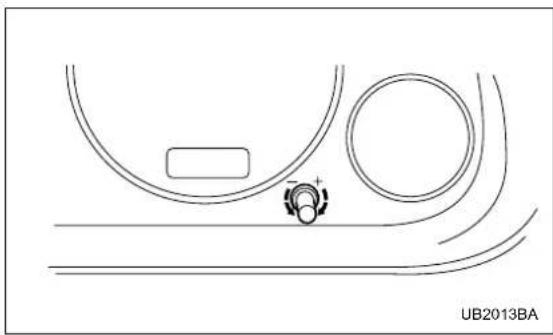
natural_image
Pure diagram of a vehicle interior layout with no text, numbers, or symbolsTo set the time, turn the setting knob clockwise to advance and counterclockwise to retard the time.
CAUTION
To ensure safety, do not attempt to set the time while driving, as an accident from inadequate attention to the road could result.
Light control switch
WARNING
To prevent battery discharge resulting from accidentally leaving your lights on when your vehicle is parked, the light switch operates only when the ignition switch is in the "ON" position. In any other position, the vehicle's lights will be out.
If you park your vehicle on a roadside at night, use the hazard warning flasher to alert the other drivers.
The light switch operates only when the ignition switch is in the "ON" position.
Headlights

text_image
EDGE OFF HS3026BATo turn on the headlights, turn the knob on the end of the turn signal lever.
DOE first position
Parking lights, instrument panel illumination, tail lights and license plate light are on.
≡D second position
Headlights, parking lights, instrument panel illumination, tail lights, and license plate light are on.
■ High/low beam change (dimmer)

text_image
EDGE OFF HS3026CA HTo change from low beam to high beam, push the turn signal lever forward. When the headlights are on high beam, the high beam indicator light "≡D" the instrument panel is also on.
To switch back to low beam, pull the lever back to the detent position.
■ Headlight flasher

text_image
EDGE OFFCAUTION
Do not hold the lever in the flashing position for more than just a few seconds.
To flash the headlights, pull the lever toward you and then release it. The high beam will stay on for as long as you hold the lever. The headlight flasher works even though the lighting switch is in the "OFF" position.
When the headlights are on high beam, the high beam
- CONTINUED -
indicator light " ☐ on the instrument panel also comes on.
■ Daytime running light system
WARNING
The tail lights, parking lights, and side marker lights are not turned on by the daytime running light system. The light switch must always be turned to the “ ” position when it is dark outside.
The low beam headlights will automatically come on at reduced brightness when the engine has started, under the following conditions:
• The parking brake is fully released.
- The light switch is in the "OFF" or " "position.
Turn signal lever
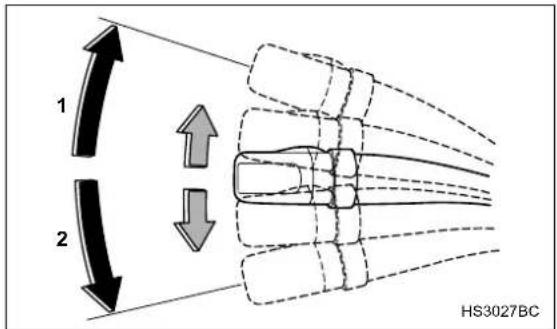
text_image
1 2 HS3027BC1) Right turn
2) Left turn
To activate the right turn signal, push the turn signal lever up. To activate the left turn signal, push the turn signal lever down. When the turn is finished, the lever will return automatically. If the lever does not return after cornering, return the lever to the neutral position by hand.
To signal a lane change, push the turn signal lever up or down slightly and hold it during the lane change. The turn signal indicator lights will flash in the direction
of the turn or lane change. The lever will return automatically to the neutral position when you release it.
Illumination brightness control

text_image
1 2 HS3028BBWhen the lighting switch is in the “ ” position, you can adjust brightness of the instrument panel illumination for better visibility.
To brighten, turn the control dial counterclockwise.
To darken, turn the control dial clockwise.
Parking light switch

text_image
HS3029BAThe parking light switch operates regardless of the ignition switch position.
By pushing the front end of this switch, following lights will come on.
- Parking lights
– Front and rear side marker lights - Tail lights
– License plate lights
To turn off, push the rear end of the parking light switch.
Avoid leaving these lights on for a long time because
that will run down the battery.
Fog light button
UB3030BA
The fog lights operate only when the headlights are on low beam. Push the fog light button to turn the fog lights on.
Press the button again to turn them off.
The indicator light located on the button will illuminate when the fog lights are on.
Wiper and washer
WARNING
In freezing weather, do not use the windshield washer until the windshield is sufficiently warmed by the defroster.
Otherwise the washer fluid can freeze on the windshield, blocking your view.
CAUTION
- Do not operate the washer continuously for more than ten seconds, or when the washer fluid tank is empty. This may cause overheating of the washer motor. Check the washer fluid level frequently, such as at fuel stops.
- Do not operate the wipers when the windshield or rear window is dry. This may scratch the glass, damage the wiper blades and cause the wiper motor to burn out. Before operating the wiper on a dry windshield or rear window, always use the windshield washer.
- In freezing weather, be sure that the wiper blades are not frozen to the windshield or rear window before switching on the wipers. At-
- CONTINUED -
tempting to operate the wiper with the blades frozen to the window glass could cause not only the wiper blades to be damaged but also the wiper motor to burn out. If the wiper blade is frozen to the window glass, be sure to operate the defroster, wiper deicer (if equipped) or rear window defogger before turning on the wiper.
- If the wipers stop during operation because of ice or some other obstruction on the window, the wiper motor could burn out even if the wiper switch is turned off. If this occurs, promptly stop the vehicle in a safe place, turn the ignition switch to the "LOCK" position and clean the window glass to allow proper wiper operation.
- Use clean water if windshield washer fluid is unavailable. In areas where water freezes in winter, use SUBARU Windshield Washer Fluid or the equivalent. (See “Windshield washer fluid” section in chapter 11.)
Also, when driving the vehicle when there are freezing temperatures, use non-freezing type wiper blades.
- Do not clean the wiper blades with gasoline or a solvent, such as paint thinner or benzene. This will cause deterioration of the wiper
blades.
NOTE
- The wiper operates only when the ignition switch is in the "ON" or "ACC" position.
- Clean your wiper blades and window glass periodically with a washer solution to prevent streaking, and to remove accumulations of road salt or road film. Keep the washer button depressed at least for 1 second so that washer solution will be sprinkled all over the windshield or rear window.
- Grease, wax, insects or other material on the windshield or the wiper blades results in jerky wiper operation and streaking on the glass. If you cannot remove those streaks after operating the washer or if the wiper operation is jerky, clean the outer surface of the windshield or rear window and the wiper blades using a sponge or soft cloth with a neutral detergent or mild-abrasive cleaner. After cleaning, rinse the window glass and wiper blades with clean water. The glass is clean if no beads form on the glass when you rinse with water.
- If you cannot eliminate the streaking even after following this procedure, replace the wiper blades with new ones. Refer to the "Replacement of wind-
shield wiper blades" section (chapter 11) for replacement instructions.
■ Windshield wiper and washer switches
▼ Windshield wipers

text_image
OFF INT LO HI 1 UB3022BB1) MIST
To turn the wipers on, push the wiper control lever down.
: Intermittent
LO: Low speed
HI: High speed
To turn the wipers off, return the lever to the "OFF" po-
sition.
▼ Mist (for a single wipe)
For a single wipe of the wipers, pull the lever toward you. The wipers operate until you release the lever.
▼ Wiper intermittent time control (if equipped)

text_image
MUST OFF LO HI UB3024BAWhen the wiper switch is in the "position, turn the dial to adjust the operating interval of the wiper. The operating interval can be adjusted continuously from the shortest interval to the longest.
Two click stop positions of the dial may help you to aim at your desired interval.
- CONTINUED -
▼ Washer

text_image
UB3023BATo wash the windshield, push the washer button at the end of the wiper control lever. The washer fluid sprays until you release the washer button. The wipers operate while you push the button.
Rear window defogger button
CAUTION
- Do not use sharp instruments or window cleaner containing abrasives to clean the inner surface of the rear window. They may damage the conductors printed on the window.
- To prevent the battery from being discharged, do not operate the defogger continuously for any longer than necessary.
The rear window defogger operates only when the ignition switch is in the "ON" position. The rear window defogger button is located on the climate control panel.
The defogger will automatically shut off after about 15 minutes. If the window clears before that time, push the button to turn it off. It also turns off when the ignition switch is turned to the "ACC" or "LOCK" position. If defrosting or defogging is desired when you restart your vehicle, you have to push the button to turn it on again.
UB3028BA
To turn on the defogger, push the button. To turn it off, push the button again. The indicator light located on the button lights up while the rear window defogger is operating.
Windshield wiper deicer (if equipped)
CAUTION
To prevent the battery from being discharged, do not operate the windshield wiper deicer continuously for any longer than necessary.

UB3029BA
The windshield wiper deicer operates only when the ignition switch is in the "ON" position.
Before turning on the windshield wiper deicer, remove any snow from the windshield. To turn on the wind-
- CONTINUED -
shield wiper deicer, push the button. The indicator light located on the button lights up while the windshield wiper deicer is operating.
The windshield wiper deicer will automatically shut off after about 15 minutes. If the wiper blades have been deiced completely before that time, push the button to turn it off. It also turns off when the ignition switch is turned to the "ACC" or "LOCK" position. If deicing is not complete when you restart your vehicle, you have to push the button to turn the deicer on again.
Mirrors
Always check that the inside and outside mirrors are properly adjusted before you start driving.
■ Inside mirror

natural_image
Technical line drawing of a car rear mirror with labeled component (no text or symbols beyond label)1) Tab
The inside mirror has a day and night position. Pull the tab at the bottom of the mirror toward you for the night position. Push it away for the day position. The night position reduces glare from headlights.
▼ Auto-dimming mirror/compass (if equipped)

text_image
1 2 3 4 HS3037BB1) Left button
2) Auto dimming indicator
3) Photosensor
4) Right button
The auto-dimming mirror/compass has an anti-glare feature which automatically reduces glare coming from headlights of vehicles behind you. It also contains a built-in compass.
- By pressing and releasing the left button, the automatic dimming function is toggled on or off. When the automatic dimming function is on, the auto dimming indicator light (green) located to the right of the button
will illuminate.
- By pressing and releasing the right button, the compass display is toggled on or off. When the compass is on, an illuminated compass reading will appear in the lower part of the mirror.
Even with the mirror in anti-glare mode, the mirror surface turns bright if the transmission is shifted into reverse. This is to ensure good rearward visibility during reversing.
▼ Photosensors
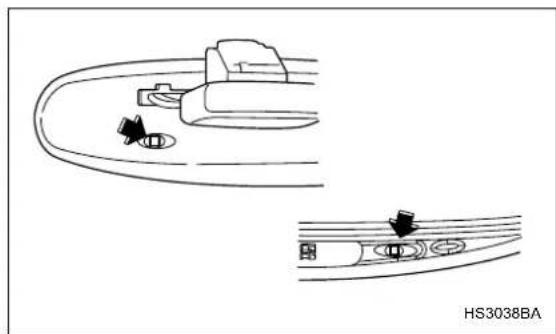
natural_image
Diagram showing a car on a curved road with a directional arrow and a vehicle icon, no readable text or symbols present.The mirror has a photosensor attached on both the front and back sides. If the glare from the headlights of vehicles behind you strikes the mirror, these sensors
- CONTINUED -
detect it and make the reflection surface of the mirror dimmer to help prevent you from being blinded. For this reason, use care not to cover the sensors with stickers, or other similar items. Periodically wipe the sensors clean using a piece of dry soft cotton cloth or an applicator.
Compass calibration
- For optimum calibration, switch off all nonessential electrical accessories (rear window defogger, heater/air conditioning system, spotlight, etc.) and ensure all doors are shut.
- Drive to an open, level area away from large metallic objects or structures and make certain the ignition switch is in the "ON" position.
- Press and hold the left button for 3 seconds then release, and the compass will enter the calibration mode. "CAL" and direction will be displayed.
- Drive slowly in a circle until "CAL" disappears from the display (about two or three circles). The compass is now calibrated.
- Further calibration may be necessary should outside influences cause the mirror to read inaccurately. You will know that this has occurred if your compass begins to read in only limited directions. Should you encounter this situation, return to step one of the above procedure and recalibrate the mirror.
Compass zone adjustment
- The zone setting is factory preset to Zone 8. Refer to the "Compass calibration zone" map at the end of this manual to verify that the compass zone setting is correct for your geographical location.
- Press and hold the right button for 3 seconds then release, and the word "ZONE" will briefly appear and then the zone number will be displayed.
- Press the right hand button repeatedly to cycle the display through all possible zone settings. Stop cycling when the correct zone setting for your location is displayed.
- Releasing the button for 3 seconds will exit the zone setting mode.
■ Outside mirrors
▼ Convex mirror (Passenger side)
WARNING
Objects look smaller in a convex mirror and farther away than when viewed in a flat mirror. Do not use the convex mirror to judge the distance of vehicles behind you when changing lanes. Use the inside mirror (or glance backwards) to determine the actual size and distance of ob-
jects that you view in convex mirror.
▼ Adjusting mirrors

natural_image
Diagram of a car's side panel with directional arrows indicating movement (no text or symbols)To adjust the mirrors by hand, push where indicated by the arrows.
▼ Remote control mirror switch
The remote control mirrors operate only when the ignition switch is in the "ON" or "ACC" position.
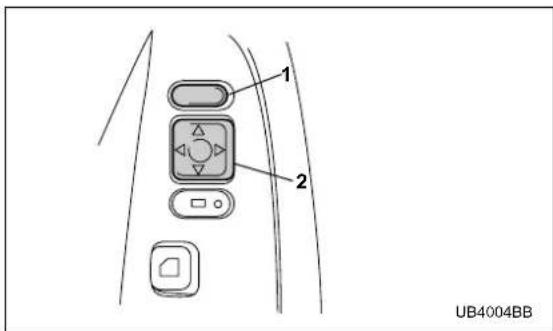
text_image
1 2 UB4004BB1) Selection switch
2) Direction control switch
- Press either end of the selection switch, "L" for the left, "R" for the right.
- Move the direction control switch in the direction you want to move the mirror.
- Return the selection switch to the neutral position to prevent unintentional operation.
The mirrors can also be adjusted manually.
- CONTINUED -
▼ Outside mirror defogger (if equipped)
CAUTION
To prevent the battery from being discharged, do not operate the defogger continuously for any longer than necessary.
The outside mirror defogger operates only when the ignition switch is in the "ON" or "ACC" position.
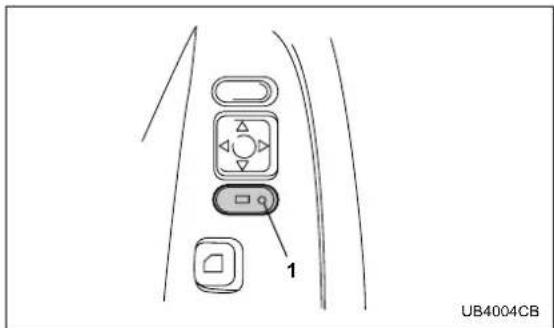
text_image
1 UB4004CB1) Indicator light
To turn on the outside mirror defogger, push the button while the engine is running.
The indicator light located on the button will come on when the outside mirror defogger heater in operation.
To turn it off, push the button again.
Tilt steering wheel
WARNING
Do not adjust the steering wheel tilt position while driving. This may cause loss of vehicle control and result in personal injury.

text_image
HS3043BA- Adjust the seat position. Refer to the "Front seats" section (chapter 1).
- Pull the tilt lock lever down.
- Move the steering wheel to the desired level.
- Push the lever up to lock the steering wheel in
place.
- Make sure that the steering wheel is securely locked by moving it up and down.
Instruments and controls
Horn
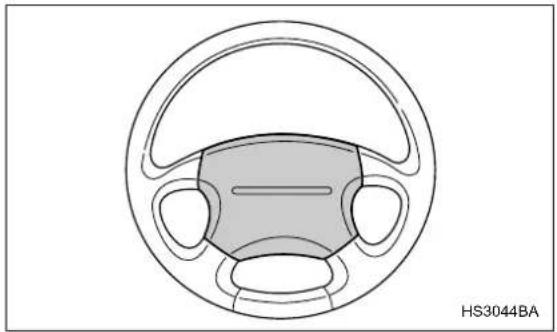
natural_image
Top-down line drawing of a car steering wheel (no text or symbols on the diagram itself)To sound the horn, push the horn pad.
Climate control
Ventilator 4-2
Driver's side ventilators 4-2
Center ventilators 4-2
Front passenger's side ventilators 4-3
Air flow selection 4-4
Manual heating and air conditioning
system 4-5
Control panel 4-5
Heater operation 4-7
Air conditioner operation 4-10
Operating tips for heater and air
conditioner 4-11
Air filtration system (if equipped) 4-13
Ventilator
- Driver's side ventilators
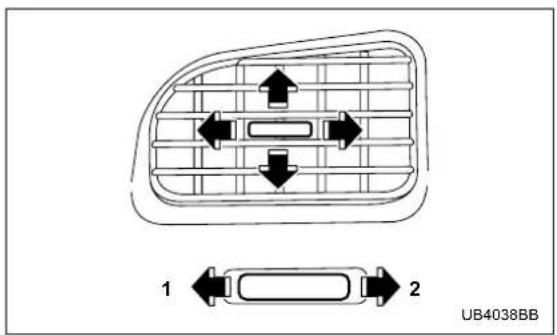
text_image
1 2 UB4038BB1) Open
2) Close
Move the thumb-wheel up and down or right and left to adjust the flow direction.
■ Center ventilators

natural_image
Diagram of a vehicle's front panel with four directional arrows indicating flow or movement (no text or symbols)Move the thumb-wheel up and down or right and left to adjust the flow direction.
■ Front passenger's side ventilators
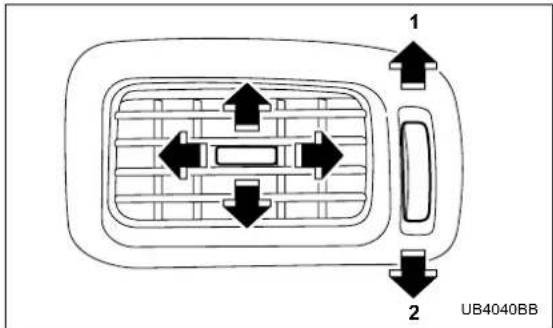
text_image
1 2 UB4040BB1) Open
2) Close
Move the thumb-wheel up and down or right and left to adjust the flow direction.
- CONTINUED -
Air flow selection

text_image
UB4036BAManual heating and air conditioning system
■ Control panel

text_image
1 2 3 4 5 6 A/C UB5004BC1) Temperature control dial
2) Fan speed control dial
3) Air flow control dial
4) Air conditioner button
5) Air inlet selection button
6) Rear window defogger button (Refer to "Rear window defogger button" in chapter 3.)
▼ Temperature control dial
This dial regulates the temperature of air flow from the air outlets over a range from the blue area (cool) to red area (warm).
▼ Fan speed control dial
The fan operates only when the ignition switch is turned to the "ON" position. The fan speed control dial is used to select four fan speeds.
▼ Air flow control dial
This dial has the following five positions:
: Air flows through the instrument panel outlets.
Air flows through the instrument panel outlets and the foot outlets.
Air flows through the foot outlets and some through the windshield defroster outlets.
Air flows through the windshield defroster outlets and foot outlets.
Air flows through the windshield defroster outlets.
- CONTINUED -
NOTE
When the dial is placed in the “” position, the air conditioner compressor operates automatically regardless of the position of the air conditioner button to defog the windshield quickly. At the same time, the air inlet selection is automatically set to “Outside air” mode.
In this state, you cannot select "recirculation" mode by manually pressing the air inlet selection button.
▼ Air conditioner button
text_image
A/C UG4507BAThe air conditioner operates only when the engine is running.
Push the air conditioner button while the fan is in operation to turn on the air conditioner. The indicator light will come on.
Push it again to turn off the air conditioner.
▼ Air inlet selection button
WARNING
Continued operation in the ON position may fog up the windows. Switch to the OFF position as soon as the outside dusty condition clears.

UB4041BA
ON position (Recirculation): Interior air is recirculated inside the vehicle. Push the air inlet selection button to the ON position. The indicator light will come on. Push the air inlet selection button to the ON position for fast cooling with the air conditioner or when driving on a dusty road.
OFF position (Outside Air): Outside air is drawn into the passenger compartment. Push the air inlet selection button again to the OFF position. The indicator light will go off.
Push the air inlet selection button to the OFF position when the interior has cooled to a comfortable temperature and the road is no longer dusty.
■ Heater operation
▼ Defrosting or defogging the windshield
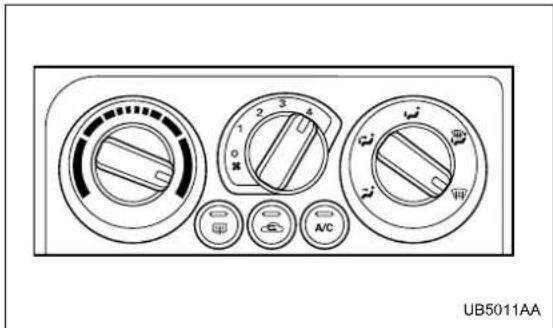
text_image
UB5011AATo direct warm air to the windshield and front door windows:
- Set the air flow control dial to "".
- Turn the temperature control dial all the way to the right.
- Set the fan speed control dial to the highest speed.
NOTE
Warm air also comes out from the right and left air outlets. To stop warm air flow from these outlets, turn the corresponding thumb-wheel to the
- CONTINUED -


Heating and defrosting
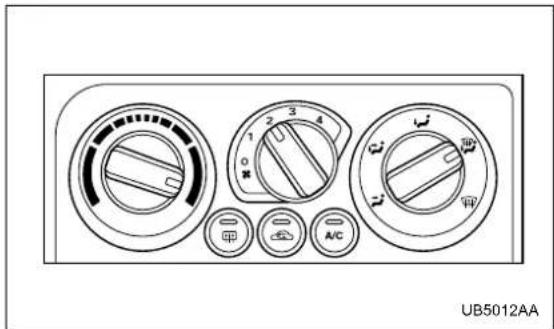
text_image
UB5012AATo direct warm air toward the floor and the windshield:
1. Set the air flow control dial to " "
2. Set the temperature control dial to the desired temperature level.
3. Set the fan speed control dial to the desired speed.
NOTE
Warm air also comes out from the right and left air outlets. To stop warm air flow from these outlets, turn the corresponding thumb-wheel to the

0
Reating.
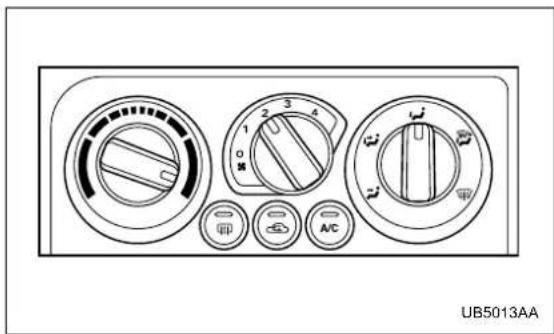
text_image
UB5013AATo direct warm air toward the floor:
1. Set the air inlet selection button to the "OFF" position.
2. Set the air flow control dial to " "
3. Set the temperature control dial to the desired temperature level.
4. Set the fan speed control dial to the desired speed.
NOTE
Warm air also comes out from the right and left air outlets. To stop warm air flow from these outlets, turn the corresponding thumb-wheel to the "Position.
▼ Bi-level heating
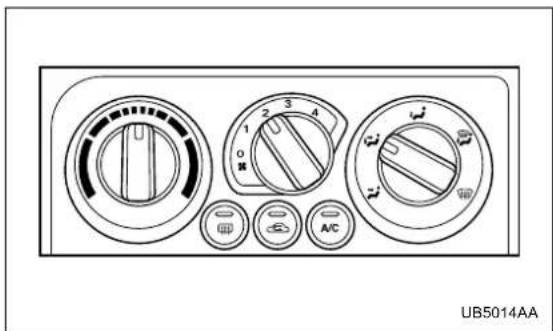
text_image
UB5014AAThis setting allows you to direct air of different temperatures from the instrument panel and foot outlets. The air from the foot outlets is slightly warmer than from the instrument panel outlets.
- Set the air inlet selection button to the "OFF" position.
- Set the air flow control dial to "
- Set the temperature control dial to the desired temperature level.
- Set the fan speed control dial to the desired speed.
Setting the temperature control dial fully turned to the red area or blue area decreases the temperature dif-
ference between the air from the instrument panel outlets and the air from the foot outlets.
▼ Ventilation

text_image
UB5015AATo force outside air through the instrument panel outlets:
- Set the air inlet selection button to the "OFF" position.
- Set the air flow control dial to “.”
- Set the temperature control dial all the way left.
- Set the fan speed control dial to the desired speed.
When driving on a dusty road, set the air inlet control button to the "ON" position.
- CONTINUED -
WARNING
Continued operation with the air inlet selection button in the ON position may fog up the windows. Switch to the OFF position as soon as the outside dusty condition clears.
■ Air conditioner operation
▼ Cooling or dehumidifying
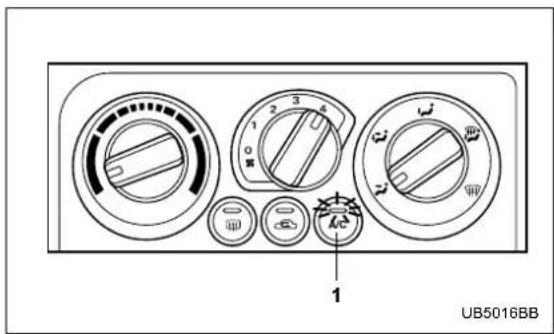
1) ON position
For cooling and dehumidification of the passenger
compartment, performing the following steps will allow air to flow through the instrument panel outlets:
- Set the air inlet selection button to the "OFF" position.
- Set the air flow control dial to "".
- Set the air conditioner button to the "ON" position.
- Set the temperature control dial to the blue area.
- Set the fan speed control dial at the desired speed.
▼ Defrosting or defogging

text_image
UB5011BB 11) ON position
To direct warm air to the windshield and front door windows:
-
Set the air outlet control dial to “”.
-
Set the temperature control dial to the red area.
- Set the fan speed control dial at the highest speed.
Operating tips for heater and air conditioner
▼ Cleaning ventilator grille

natural_image
Line drawing of a sedan car (no text or symbols on the car body)Always keep the front ventilator inlet grille free of snow, leaves, or other obstructions to ensure efficient heating and defrosting. Since the condenser is located in front of the radiator, this area should be kept clean because cooling performance is impaired by any accumulation of insects and leaves on the condenser.
▼ Efficient cooling after parking in direct sunlight
After parking in direct sunlight, drive with the windows
- CONTINUED -
open for a few minutes to allow outside air to circulate into the heated interior. This results in quicker cooling by the air conditioner. Keep the windows closed during the operation of the air conditioner for maximum cooling efficiency.
▼ Lubrication oil circulation in the refrigerant circuit
Operate the air conditioner compressor at a low engine speed (at idle or low driving speeds) a few minutes each month during the off-season to circulate its oil.
▼ Checking air conditioning system before summer season
Check the air conditioner unit for refrigerant leaks, hose conditions, and proper operation each spring. This check is best performed by your SUBARU dealer.
▼ Cooling and dehumidifying in high humidity and low temperature weather condition
Under certain weather conditions (high relative humidity, low temperatures, etc.) a small amount of water vapor emission from the air outlets may be noticed. This condition is normal and does not indicate any problem with the air conditioning system.
▼ Air conditioner compressor shut-off when engine is heavily loaded
To improve acceleration and gas mileage, the air conditioner compressor is designed to temporarily shut off during air conditioner operation whenever the accelerator is fully depressed such as during rapid acceleration or when driving on a steep upgrade.
▼ Refrigerant for your climate control system
Your air conditioner uses ozone friendly refrigerant HFC134a. Therefore, the method of adding, changing or checking the refrigerant is different from the method for CFC12 (freon). Consult your SUBARU dealer for service. Repairs needed as a result of using the wrong refrigerant are not covered under warranty.
Air filtration system (if equipped)
If your vehicle's air conditioning system is equipped with a optional air filtration system, replace the filter element according to the replacement schedule shown below. This schedule should be followed to maintain the filter's dust collection ability. Under extremely dusty conditions, the filter should be replaced more frequently. Have your filter checked or replaced by your SUBARU dealer.
Replacement schedule:
Every 12 months or 9,300 miles (15,000 km) whichever comes first
NOTE
The filter can influence the air conditioning, heating and defroster performance if not properly maintained.
natural_image
Pure horizontal dashed lines on white background with no text, numbers, or symbolsAudio
Antenna system 5-2
Pillar mounted antenna (Non-turbo models) .. 5-2
Roof mounted antenna (Turbo models) ..... 5-2
FM reception 5-3
Installation of accessories 5-4
Audio set 5-4
Type A audio set 5-4
Type B audio set 5-5
In-dash 6 CD auto changer
(Optional audio unit – if equipped) 5-5
AM/FM radio with CD player 5-6
Radio operation 5-6
Compact disc player operation 5-11
CD changer control (if optional in dash CD
changer is connected) 5-13
Type B audio set (if equipped) 5-17
Radio operation 5-17
Built-in CD changer operation 5-23
In-dash 6 CD auto changer (if equipped) .... 5-27
Precautions to observe when handling a compact disc 5-30
Audio
Antenna system
■ Pillar mounted antenna (Non-turbo models)
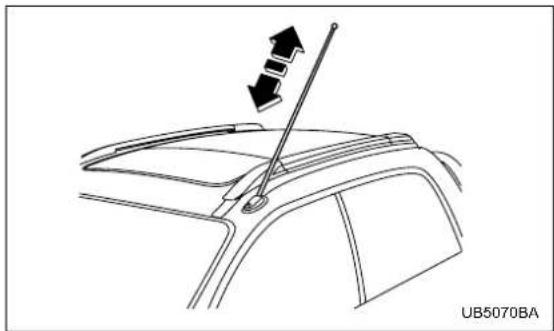
natural_image
Line drawing of a car's front panel with an antenna and directional arrows indicating motion (no text or symbols)Pull the antenna out to extend it to its full length.
■ Roof mounted antenna (Turbo models)

natural_image
Diagram showing a lever mechanism with curved arrows indicating motion, no text or symbols present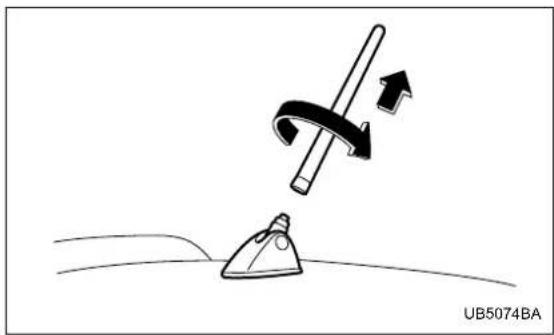
natural_image
Diagram showing a tool interacting with a device, no text or symbols presentStand the roof antenna up for use. You can detach the roof antenna by turning it counterclockwise. When fitting the roof antenna, turn it clockwise and tighten it securely.
CAUTION
When working on the cargo bed, be careful not to get poked in the eye by the roof antenna.
NOTE
- Detach the roof antenna before putting the vehicle in a garage and before washing it in an automatic car wash.
- After detaching the roof antenna, keep the mounting hole free of dirt and dust. If any dirt or dust sticks to the hole, remove it before attaching the roof antenna.
- When detaching the roof antenna, grasp and turn the roof antenna at the base.
- To avoid damaging the roof antenna, be careful not to overtighten it when attaching it.
- Radio reception is not possible with the roof antenna folded down. Also, reception deteriorates if metallic objects are placed near the roof antenna.
■ FM reception
Although FM is normally static free, reception can be affected by the surrounding area, atmospheric conditions, station strength and transmitter distance. Buildings or other obstructions may cause momentary static, flutter or station interference. If reception continues to be unsatisfactory, switch to a stronger station.
Installation of accessories
Always consult your SUBARU dealer before installing a citizen band radio or other transmitting device in your vehicle. Such devices may cause the electronic control system to malfunction if they are incorrectly installed or if they are not suited for the vehicle.
Audio set
Your SUBARU may be equipped with one of the following audio sets. See the pages indicated in this section for operating details.
■ Type A audio set

text_image
PWR VOL PWR VOL SUBARU CD BAND SCAN AUDIO 1 2 3 4 5 RPT 6 RANG TUNE TAXI UB5066AA• Radio operation: refer to page 5-6
• CD (compact disc) player operation: refer to page 5-11
• CD changer control: refer to page 5-13
■ Type B audio set
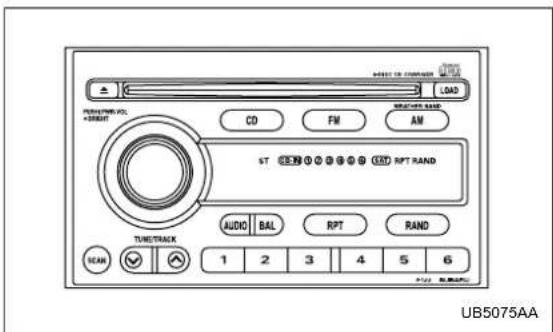
text_image
LOAD CD FM AM ST RPT RAND AUDIO BAL RPT RAND 1 2 3 4 5 6 SCAN TUNETRACK USB5075AA• Radio operation: refer to page 5-17
• Built-in CD changer operation: refer to page 5-23
In-dash 6 CD auto changer (Optional audio unit – if equipped)
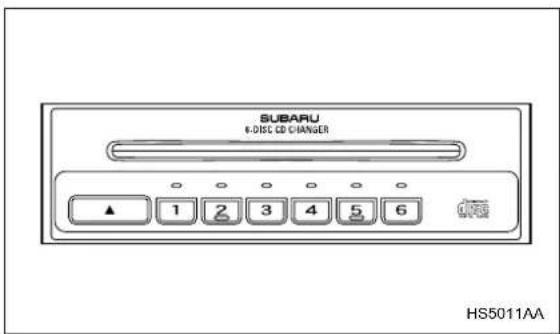
text_image
SUBARU 8-DISC CD CHANGER ▲ 1 2 3 4 5 6 HS5011AA- Inserting and removing a disc or all discs: refer to page 5-27
AM/FM radio with CD player
The audio set will operate only when the ignition switch is in the "ACC" or "ON" position.
■ Radio operation
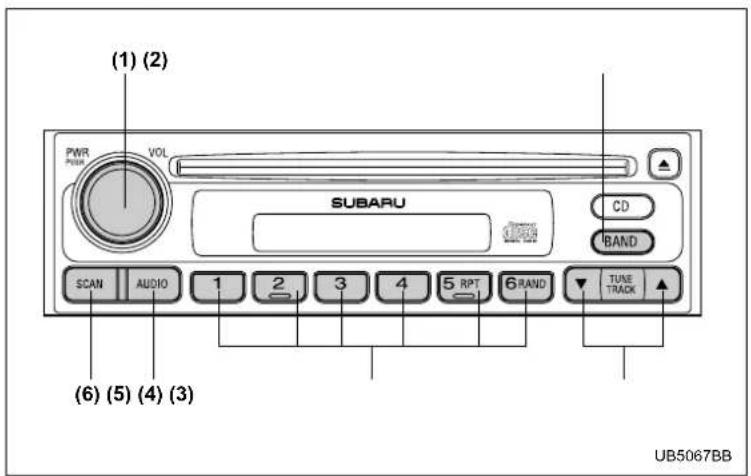
text_image
(1) (2) PWR VOL SUBARU CD BAND SCAN AUDIO 1 2 3 4 5 RPT 6 RAND TUNE TRACK (6) (5) (4) (3) UB5067BB(1) Power switch/Volume, Tone, Balance, Fader control dial
(2) BAND button
(3) Tuning buttons
(4) Preset buttons
(5) AUDIO button
(6) SCAN button
▼ Power switch and volume/bass/treble/fader/balance control
Power switch and volume control (PWR/VOL) The dial (1) is used for both power (ON/OFF) and volume control. The radio is turned ON and OFF by pushing the dial and the volume is controlled by turning the dial.
∇ Tone and balance control (AUDIO)
The volume control dial (1) normally functions as a volume control. This dial becomes a control for Bass, Treble, Fader or Balance when you select the appropriate tone and balance control mode.
Choose desired volume level for each mode by turning the volume control dial. The control function returns to volume control mode after about 5 seconds.
To change control modes: Each brief press of the "AUDIO" button (5) changes control modes in the following sequence starting from volume control mode. (When the radio is first turned on, the control mode is in the volume control.)

flowchart
graph TD
    A["Volume Bass Treble Balance"] --> B["Fader"]
    B --> A
The "AUDIO" button (5) is used for selecting the following control modes:
- CONTINUED -
Audio
| Display Control mode |  HS5014BA HS5014BA | |
| Turn counterclockwise Turn clockwise | ||
| BAS Bass control For less bass sound For more bass sound | ||
| TRE Treble control For less treble sound For more treble sound | ||
| BAL Balance control To increase left speaker volume and decrease right speaker volume | To increase right speaker volume and decrease left speaker volume | |
| FAD Fader control To increase rear speaker volume and decrease front speaker volume | To increase front speaker volume and decrease rear speaker volume | |
| VOL Volume control For less volume For more volume | ||
▼ Waveband selection
▼ FM/AM selection
Push the "BAND" button (2) to select FM1, FM2 or AM reception. The display indicates which one is currently selected.
▼ Stereo indicator
The stereo indicator "ST" will come on when an FM stereo broadcast is received.
▼ Tuning (TUNE)
▼ Manual tuning (TUNE)
Press the “” side of the tuning button (3) to increase the tuning frequency and press the “” side of the button to decrease it.
Each time the button is pressed, the frequency interval can be changed between 10 kHz in the AM mode and 0.2 MHz in the FM mode.
▼ Seek tuning (SEEK)
If the tuning button (3) is pressed for longer than half of a second, the radio will begin to automatically search for receivable frequencies and will stop at the first one found. This function may not be available, however, when radio signals are weak. In such a situation, perform manual tuning to select the desired station.
▼ Automatic tuning (SCAN)
Press the “SCAN” button (6) to change the radio to the SCAN mode. In this mode, the radio scans through the radio band until a station is found. The radio will stop at the station for five seconds while displaying the frequency, after which scanning will continue until the entire band has been scanned from the low end to the high end.
Press the "SCAN" button again to cancel the SCAN mode and to stop on any displayed frequency.
When the "SCAN" button is pressed for automatic tuning, stations are scanned in the direction of low frequencies to high frequencies only.
Automatic tuning may not function properly if the station reception is weakened by distance from the station or proximity to tall buildings and hills.
▼ Selecting preset stations
Presetting a station with a "Preset" button (4) allows you to select that station in a single operation. Up to six AM, FM1 and FM2 stations each may be preset.
▼ How to preset stations
- Press the "BAND" button (2) to select FM1, FM2 or AM reception.
- Press the "SCAN" button or tune the radio manually until the desired station frequency is displayed.
- Press one of the "Preset" buttons for more than 2
- CONTINUED -
Audio
seconds to store the frequency. At this time, there will momentarily be no sound from the radio. If the button is pressed for less than 2 seconds, the preceding selection will remain in memory.
NOTE
- If the connection between the radio and battery is broken for any reason such as vehicle maintenance or radio removal, all stations stored in the preset buttons are cleared. If this occurs, it is necessary to reset the preset buttons.
- If a mobile telephone is placed near the radio, it may cause the radio to emit noise when it receives calls. This noise does not indicate a radio fault.
■ Compact disc player operation
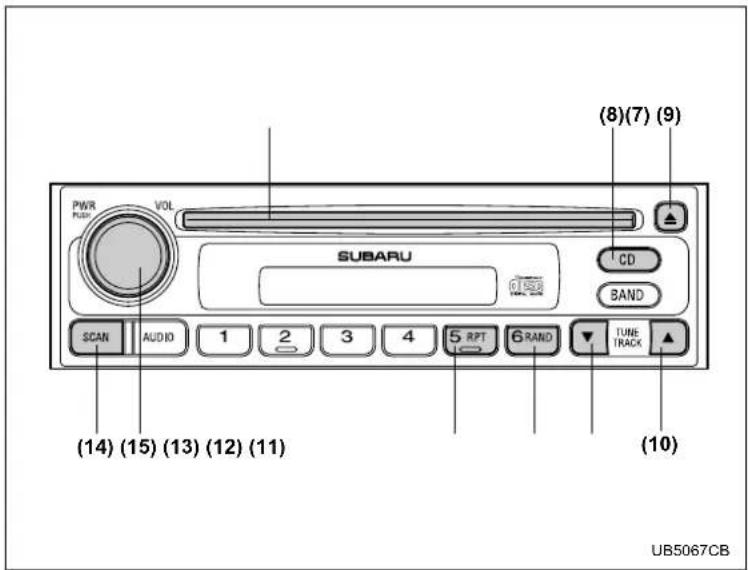
text_image
PWR VOL SUBARU CD BAND SCAN AUDIO 1 2 3 4 5 RPT 6 RAND TUNE TRACK (8)(7) (9) (10) (14) (15) (13) (12) (11) UB5067CB(7) Disc slot
(8) CD button
(9) Eject button
(10) Fast-forwarding and track up button
(11) Fast-reversing and track down button
(12) Random button
(13) Repeat button
(14) Scan button
(15) PWR (power) switch
▼ To playback a compact disc
When CD is not in the player
Hold a disc with a finger in the center hole while gripping the edge of the disc, then insert it in to the slot (with the label side up) and the player will automatically pull the disc into position.
A 8 cm/3 inch CD may also be used without any adapter.
NOTE
- DO NOT INSERT TWO DISCS INTO THE DISC INSERTION SLOT AT A TIME.
- Make sure to always insert a disc with the label side up. If a disc is inserted with the label side down, it might be ejected or the player might shut off.
- After the last song finishes, the player will automatically return to track 1 (the first song on the disc).
When CD is in the player
When the "CD" button (8) is pressed, the player will start playback.
NOTE
After the last song finishes, the player will automatically return to track 1 (the first song on the disc).
▼ To stop playback of a CD
When the "PWR" button (15) is pressed during playback of a CD, the CD stops playing temporarily. To let the CD resume playing, press the button again.
▼ To select a song from its beginning
Forward direction
Briefly press the “” side of the button (10) to skip to the beginning of the next track. Each time this side of the button is pressed, the indicated track number will increase.
Backward direction
Briefly press the “” side of the button (11) to skip to the beginning of the current track. Each time this side of the button is pressed, the indicated track number will decrease.
▼ Fast-forwarding and fast-reversing
∇ Fast-forwarding
Press the “ ” side of the button (10) continuously for more than 0.5 second to fast-forward the disc. Release the button to stop fast-forwarding.
∇ Fast-reversing
Press the “ ” side of the button (11) continuously for more than 0.5 second to fast-reverse the disc. Release the button to stop fast-reversing.
▼ Repeat playback
Use this to play a certain track repeatedly. During playback, press the "RPT" button (13) and release it in less than 2 seconds. The "RPT" indicator will come on and the song will be played continuously. To cancel the repeat mode, press the button again. Then the "RPT" indicator goes out, and normal playback mode is restored.
▼ Random playback
Use this to play the tracks on the disc in random order. During playback, press the "RAND" button (12) and hold it in for more than 2 seconds. The "RAND" indicator will come on and all songs on the disc will be played in a random order.
To cancel the random mode, press the button again. Then the "RAND" indicator goes out, and normal playback mode is restored.
▼ Scan
Press the "SCAN" button (14) and release it in less than 2 seconds, and you can hear the first 10 seconds of each track to search for the desired program. To continue listening to the program, press the "SCAN" button again. After all tracks on the disc has been scanned, normal playback mode is restored.
▼ To eject a disc from the player
When a disc is being played back or when a disc is in the player, press the "Eject" button " ” (9). The disc will be ejected.
The disc may be removed even when the ignition switch is in the "LOCK" position.
NOTE
- Avoid driving the vehicle with a CD sticking out, because vibration might make it fall out.
- To protect the disc, the disc is automatically loaded if it is left in the ejected position for more than approximately 15 seconds (Auto Reload). In this case, the disc is not played.
■ CD changer control (if optional in dash CD changer is connected)
An optional CD changer can be connected to this audio unit. See your SUBARU dealer for more information. For procedures for loading and unloading CDs, refer to "In-dash 6 CD auto changer (Optional audio unit – if equipped)" in this chapter.
- CONTINUED -
Audio
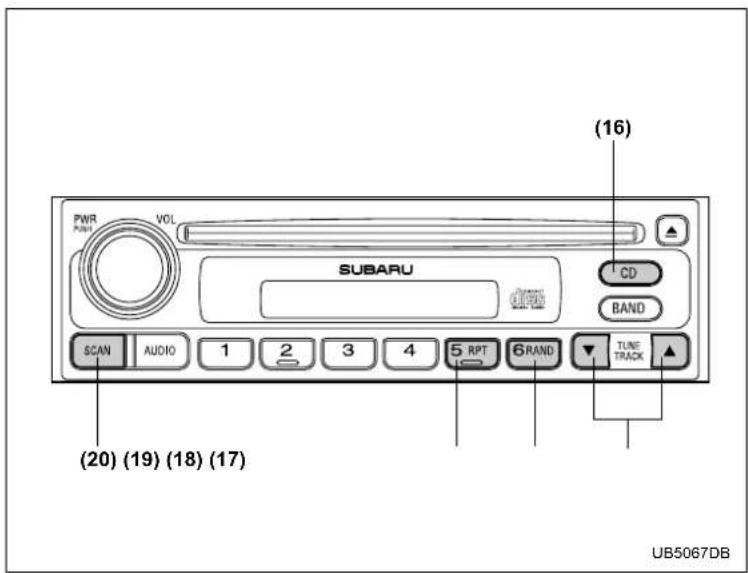
text_image
PWR VOL SUBARU CD BAND SCAN AUDIO 1 2 3 4 5 RPT 6 RAND TUNE TRACK (16) (20) (19) (18) (17) UB5067DB(16) CD button
(17) Track selection buttons
(18) RAND (Random) button
(19) RPT (Repeat) button
(20) SCAN button
▼ To start playback
Press the "CD" button (16). The "CD" indicator will come on and the disc number will appear on the display and the CD changer will start playback.
NOTE
- If the "CD" button is pressed during a radio broadcast, the CD changer will interrupt the broadcast.
- At the end of the disc, playback automatically continues with the next disc.
• After playback on the last disc finishes, the player will automatically return to the first disc. - If you have loaded fewer than 6 discs, any missing disc is automatically skipped.
▼ Selection of a desired disc
Discs cannot be selected using the main audio unit. To select a disc, press one of the "Disc select" buttons (these are numbered from 1 to 6) on the CD changer unit. The disc will begin to play.
▼ To select a song from its beginning
Briefly press the “ ” side of the track selection button (17) to skip to the beginning of the next track and briefly press the “ ” side of the button to skip to the beginning of the current track.
▼ Fast-forwarding and fast-reversing
Press the " ” side of the track selection button (17) continuously for more than a half second to fast-forward the disc.
Press the “” side of the button continuously for more than a half second to fast-reverse the disc. Release the button to stop fast-forwarding or fast-reversing.
▼ Repeat playback
Press the "RPT" button (19) while a song is playing to play the song repeatedly. The "RPT" indicator will come on and the song will be played continuously. To cancel the repeat mode, press the button again. Then the "RPT" indicator goes out, and normal playback mode is restored.
▼ Random playback
Press the "RAND" button (18) while a disc is being played back to play all songs on the disc in a random order. The "RAND" indicator will come on and all songs on the disc will be played in a random order. To cancel the random mode, press the button again. Then the "RAND" indicator goes out, and normal playback mode is restored.
- CONTINUED -
Audio
▼ Scan (a convenient way to become familiar with a disc)
- Press the "SCAN" button (20).
– The display shows “SCAN” and the track number being scanned.
- You hear the first 10 seconds of each track.
– The operation is automatically cleared after playing all programs. Then, normal playback starts.
- Press the "SCAN" button again when you hear a track you like.
– Normal playback resumes.
▼ To stop playback
To stop playback and switch over to the radio mode, press the "BAND" button.
Type B audio set (if equipped)
The radio will operate only when the ignition switch is in the "ACC" or "ON" position.
■ Radio operation

text_image
(1) (2) (3) (4) (5) C-DISC CD CHANGER LOAD PUSHI PWR-VOL • BRIGHT CD FM WEATHER BAND AM ST CD-R 0 2 0 4 5 6 SAT RPT RAND AUDIO BAL RPT RAND SCAN TUNE/TRACK 1 2 3 4 5 6 P122 S/MAPU (8) (6)(7) UB5072BB(1) Power switch, Volume control, Bass/Midrange/Treble control and Fader/Balance control dial
(2) AUDIO (audio mode) button
(3) Fader/Balance selection button
(4) FM button
(5) AM button
(6) Preset buttons
(7) Tuning buttons
(8) SCAN button
Audio
▼ Power switch and volume/bass/treble/fader/balance control (PWR/VOL)
The dial (1) is used for both power (ON/OFF) and volume control. The radio is turned ON and OFF by pushing the dial and the volume is controlled by turning the dial.
This dial is used for bass/midrange/treble controls when the "AUDIO" button (2) is in the depressed position. It is also used for fader/balance controls when the "BAL" button (3) is in the depressed position.
| Display Control mode |  S5014BA S5014BA | ||
| Turn counterclockwise Turn clockwise | |||
| BASS Bass control For less bass sound | For more bass sound | ||
| MIDDLE Midrange control For less midrange sound | For more midrange sound | ||
| TREBLE Treble control For less treble sound | For more treble sound | ||
| FADER Fader control To increase rear speaker volume and decrease front speaker volume | To increase front speaker volume and decrease rear speaker volume | ||
| BALANCE Balance control To increase left speaker volume and decrease right speaker volume | To increase right speaker volume and decrease left speaker volume | ||
| VOLUME | Volume control | For less volume | For more volume |
- CONTINUED -
Tone control
The volume control dial (1) normally function as volume control. The dial become a control for Bass, Midrange or Treble when you select the appropriate tone control mode.
Choose desired volume level for each mode by turning the volume control dial. The control function returns to volume control mode after about 5 seconds.
To change control modes: Each brief press of the "AUDIO" button (2) changes control modes in the following sequence starting from bass control mode. (When the radio is first turned on, the control mode is in the volume control.)

Fader and balance control
The volume control dial (1) normally function as volume control. The dial become the controls for Fader or Balance when you select the appropriate fader and balance control mode.
Choose desired setting for each mode by turning the volume control dial. The control function returns to volume control mode after about 5 seconds.
To change control modes: Each brief press of the
"BAL" button (3) changes control modes in the following sequence starting from fader control mode. (When the radio is turned on, the control mode is in the volume control.)

flowchart
graph LR
    A["VolumeFader Balance"] --> B["Step 1"]
    B --> C["Step 2"]
▽ Display illumination dimness cancellation (BRIGHT)
The brightness of the radio display dims when the light switch is in the “” or “” positions. If this makes the display difficult to read, press the volume dial for more than 1.5 seconds to return the display to original brightness.
eSt subsequently pressing the volume dial again for more than 1.5 seconds or if you can safely do so, turning the light switch to the OFF position and back to the " " position makes the radio display dim again.
▼ FM/AM selection button
▽ FM button
Press the "FM" button (4) for FM reception. The radio will toggle between FM1 and FM2 settings each time the "FM" button (4) is subsequently pressed.
▼ AM button
Press the "AM" button (5) for AM reception.
▼ Stereo indicator
The stereo indicator "ST" will come on when an FM stereo broadcast is received.
▼ Manual tuning (TUNE)
▼ Manual tuning for AM and FM
Push the “ ”side of the tuning button (7) to increase the tuning frequency and press the “ ”side of the button to decrease it.
Each time the button is pressed, the frequency changes 10 KHz in the AM waveband and 0.2 MHz in the FM waveband.
▼ Seek tuning (SEEK)
If the tuning button (7) is pressed for longer than half of a second, the radio will begin to automatically search for receivable frequencies and will stop at the first one found. This function may not be available, however, when radio signals are weak. In such a situation, perform manual tuning to select the desired station.
▼ Automatic tuning (SCAN)
Press the "SCAN" button (8) to change the radio to the SCAN mode. In this mode, the radio scans through the radio band until a station is found. The radio will stop at the station for five seconds while displaying the frequency, after which scanning will continue until the entire band has been scanned from the low end to the high end.
Press the "SCAN" button again to cancel the SCAN mode and to stop on any displayed frequency.
When the "SCAN" button is pressed for automatic tuning, stations are scanned in the direction of low frequencies to high frequencies only.
Automatic tuning may not function properly if the station reception is weakened by distance from the station or proximity to tall buildings and hills.
▼ Selecting preset stations
Presetting a station with a "Preset" button (6) allows you to select that station in a single operation. Up to six AM, FM1 and FM2 stations each may be preset.
▼ How to preset stations
- Press the "FM/AM" selection button to select AM, FM1 or FM2 reception.
- Press the "SCAN" button (8) or tune the radio manually until the desired station frequency is displayed.
- Press one of the "Preset" buttons (6) for at least 1.5 seconds to store the frequency. The frequency of the station will flash once on the display at this time. If the
- CONTINUED -
button is pressed for less than 1.5 seconds, the preceding selection will remain in memory.
NOTE
- If the connection between the radio and battery is broken for any reason such as vehicle maintenance or radio removal, all stations stored in the preset buttons are cleared. If this occurs, it is necessary to reset the preset buttons.
- If a mobile telephone is placed near the radio, it may cause the radio to emit noise when it receives calls. This noise does not indicate a radio fault.
■ Built-in CD changer operation
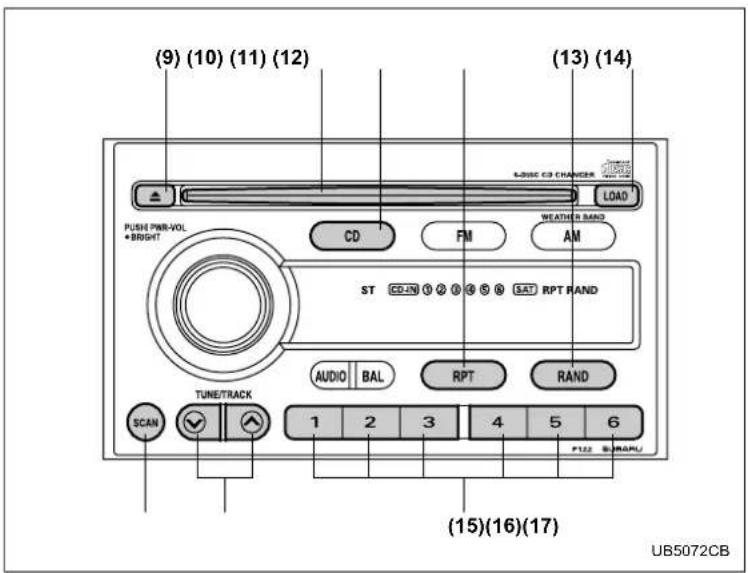
text_image
(9) (10) (11) (12) (13) (14) LOAD PUSH PWR-VOL + BRIGHT CD FM WEATHER BAND AM ST CDLIN 0 2 0 4 5 6 SAT RPT RAND AUDIO BAL RPT RAND SCAN TUNE/TRACK 1 2 3 4 5 6 F122 SIRAPU (15)(16)(17) UB5072CB(9) Eject button
(10) Disc slot
(11) CD (CD player selection) button
(12) Repeat button
(13) Random button
(14) LOAD button
(15) Disc select buttons
(16) Track selection buttons
(17) SCAN button
NOTE
Make sure to always insert a disc with the label side up. If a disc is inserted with the label side down, it might be ejected or the player might shut off.
▼ How to insert a CD(s)
Inserting a CD
- Press "LOAD" button (14). If the magazine in the player has an idle position where you can insert a disc, the "DISC" indicator associated with the idle position will blink.
If no indicator blinks, it means that there is no idle position in the magazine.
- As soon as the "DISC" indicator begins to blink, the "IN" will appear on display for a period of 15 seconds. Insert a disc during the period. The disc will be then automatically drawn in, and the player will begin to play back the first track of the disc.
- To insert more discs in succession, repeat Steps 1 and 2. The magazine will be loaded with discs in the ascending order of position number.
If you do not insert any disc in 15 seconds after you have pressed the "LOAD" button, the player will begin to play back the first track of the last disc you have inserted.
- The disc indicator steadily lights up if a disc is already inserted in the corresponding position of the magazine.
- While the player is in the loading mode, if you press the "FM" button (4) or "AM" button (5), the player will enter the standby mode. Press the "CD" button (11) to start playback.
▼ Inserting a disc in a desired position
- Press the "LOAD" button. If the magazine in the player has an idle position where you can insert a disc, the "DISC" indicator associated with the idle position will blink.
The positions in the magazine the indicator of which steadily lights up are already loaded with discs. - Press the "Disc select" button (15) at the position where you want to insert a disc. The associated "DISC" indicator will blink, and the "IN" will be displayed.
- If you insert a disc during the 15-second period while the "IN" is on display, the disc will be automatically drawn in, and the player will start playback of the disc, beginning with the first track.
- To insert more discs in succession, repeat Steps 1 and 2.
- While the player is in the loading mode, if you press the "FM" button (4) or "AM" button (5), the player will
enter standby mode. Press the "CD" button to start playback.
▼ Loading all the magazine (Full disc loading mode)
- If you continue to press the "LOAD" button for more than 1.5 seconds, the player will produce beep sound and will enter the full disc loading mode.
- A "DISC" indicator will blink, and the "IN" will be on display for a period of 15 seconds. If a disc is successfully loaded during this period, the "DISC" indicator will stop blinking and will steadily light.
- When the loading of a disc is complete, the next "DISC" indicator will blink. Then repeat Step 2.
- When the magazine is filled with discs by repeating Steps 2 and 3, the player will start playback of the discs, beginning with the one inserted first.
If you fail to insert any disc during each 15 seconds interval, the full disc loading mode will be canceled, and the player will start playback of the disc inserted first.
▼ How to play back a CD or make a pause
When there is no CD inserted:
Insert a CD by referring to "How to insert a CD(s)". When a CD is loaded, the player will start playback of the CD, beginning with the first track.
When there are CDs loaded:
Press a desired one of the "Disc select" buttons (15) the "DISC" indicator of which steadily lights up. The player will then start playback of the selected CD, beginning with the first track.
▼ To select a song from its beginning
Forward direction
Briefly press the “” side of the button (16) to skip to the beginning of the next track. Each time the button is pressed, the indicated track number will increase.
Backward direction
Briefly press the “ ” side of the button (16) to skip to the beginning of the current track. Each time the button is pressed, the indicated track number will decrease.
▼ Fast-forwarding and fast-reversing
∇ Fast-forwarding
Press the " side of the button (16) continuously for more than 0.5 second to fast-forward the disc. Release the button to stop fast-forwarding.
∇ Fast-reversing
Press the “ ” side of the button (16) continuously for more than 0.5 second to fast-reverse the disc.
- CONTINUED -
Release the button to stop fast-reversing.
▼ Repeat playback
Press the "RPT" button (12) while a song is playing to play the song repeatedly. The "RPT" indicator will come on and the song will be played continuously. To cancel the repeat mode, press the button again. Then the "RPT" indicator goes out, and normal playback mode is restored.
▼ Random playback
Press the "RAND" button (13) while a disc is being played back to play all songs on the disc in a random order. The "RAND" indicator will come on and all songs on the disc will be played in a random order.
To cancel the random mode, press the button again. Then the "RAND" indicator goes out, and normal playback mode is restored.
▼ Scan
When the "SCAN" button (17) is pressed while the disc is being played back, you can hear the first 10 seconds of each track to search for the desired program. To continue listening to the program, press the "SCAN" button again. After all tracks on the disc have been scanned, normal playback mode is restored.
▼ How to unload CDs from the player
▼ Ejecting a CD from the player
Of the discs loaded, you can select and remove only one disc.
-
Press the "Disc select" button (15) of the disc whose "DISC" indicator is ON.
-
Press the "Eject" button (9). Then the "DISC" indicator associated with the disc you have selected will blink, and the disc will be ejected.
To remove more discs in succession, repeat Steps 1 and 2.
∇ Ejecting all discs from the player (All disc ejection mode)
- If you continue to press the "Eject" button (9), the player will produce beep sound and will enter the all disc ejection mode.
- Remove the disc that has been ejected. The other discs loaded will then be ejected one after another. If you do not remove the disc that has been ejected, the "All disc ejection mode" will be canceled.
NOTE
Avoid driving the vehicle with a CD sticking out, because vibration might make it fall out.
In-dash 6 CD auto changer (if equipped)
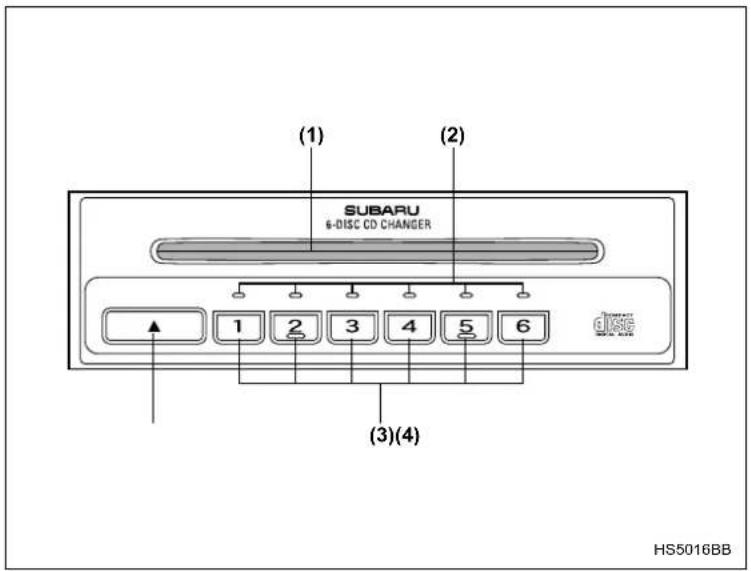
text_image
(1) (2) SUBARU 6-DISC CD CHANGER 1 2 3 4 5 6 (3)(4) HS5016BB(1) Disc slot
(2) Disc indicators (disc No.1 to 6)
(3) Disc select buttons (disc No.1 to 6)
(4) Eject button
CAUTION
- Do not attempt to insert two or more discs into the slot at a time. Doing so can cause mechanical damage to the CD changer.
• Use only music CDs identified by
a m a r k . - Do not use CDs listed below which could cause damage to the CD player.
• 3 inch (8 cm) compact disc. - Any disc with a peel-off or seal on it.
- Any disc with scratches and/or dust.
- Bent disc.
- Cleaning disc.
- CD accessory. (E.g., 3 inch (8 cm) disc adapter)
- Do not insert or remove any disc when the automatic transmission selector lever is in the park position; the selector lever in that position can interfere with disc insertion or removal, causing scratches on the disc surface (for AT vehicles).
▼ To insert a disc
- Press one of the "Disc select" buttons (3) (numbered from 1 to 6) for which the disc indicator light (2)
is "OFF".
The Disc indicator lights are located directly above the corresponding "Disc select" buttons.
- The indicator will begin blinking. The blinking will last for 15 seconds.
During this period, insert a desired disc, and the disc will begin to play. (If any disc is not inserted during this period, the "Disc slot" (1) door will close. Repeat Step 1.)
Be sure to hold a disc with the label side (the side where titles are printed) up.
- To insert another disc, repeat Steps 1 and 2 choosing a different disc select button.
▼ To insert six discs at a time
- Press and hold the "Disc select" button number 1 until all disc indicators begin blinking (about 1.5 seconds).
- The indicators will blink for 15 seconds. During this period, insert desired six discs.
- When all discs are loaded, the first disc will begin to play. (If no disc is inserted within this 15 seconds, the entire disc load sequence will be canceled.)
▼ To remove a disc
-
Press the desired one of the "Disc select" buttons (3) (numbered from 1 to 6) for which the disc indicator light is on.
-
Press the "Eject" button (4). The selected disc will be ejected and the indicator light will begin blinking.
- To remove another disc, repeat Steps 1 and 2 choosing a different "Disc select" button.
(To remove discs when the ignition switch is in the "Lock" position, press the "Eject" button, and the first disc will be ejected. Press the "Eject" button again, and the next disc will be ejected and so on. At this time, the "Disc select" buttons are disabled.)
▼ To remove all discs at one time
- Press and hold the "Eject" button (4) until all "Disc" indicators begin blinking (about 1.5 seconds), and the first disc will be ejected.
- When the disc is removed, the next one will be ejected, and so on.
▼ To replace a playing disc with another
Simply press the desired one of "Disc select" buttons (3) (numbered from 1 to 6) or press the "DISC UP" or "DISC DOWN" button on the radio unit to select the desired disc, and the disc will begin to play.
▼ Disc indicators
Lit: when the corresponding storage tray is occupied by a disc.
Blinking: Disc player is either in loading, eject or changing mode.
OFF: No disc is loaded or the ignition switch is in the "LOCK" position.
▼ Function control
Refer to CD player control operating instructions described in the "AM/FM radio with CD player" section.
Precautions to observe when handling a compact disc
Use only compact discs (CDs) that have the mark shown below. CD-RWs cannot be used. Also, some CD-Rs cannot be played.

text_image
COMPACT DISC DIGITAL AUDIOHS5017AA
- In cold and/or rainy weather, dew can form inside the CD player, preventing normal operation. If this happens, eject the CD and wait for the player to dry out.
-
Skipping may occur when the CD player is subjected to severe vibration (for example, when the vehicle is driven on a rough surface).
-
To remove a disc from the case, press the center of the case and hold both edges of the disc. If the disc surface is touched directly, contamination could cause poor tone quality. Do not touch the disc surface.
- Use a clean disc whenever possible. If there are deposits, wipe the disc surface from the center outward with a dry, soft cloth. Be sure not to use a hard cloth, thinner, benzene, alcohol, etc.
- Do not use any disc that is scratched, deformed, or cracked. Also, do not use any disc that has a non-standard shape (for example, a heart shape). Malfunctions or problems might result.
- A disc is vulnerable to heat. Never keep it either in places exposed to direct sunlight, near heaters or in vehicles parked in the sun or hot days.
Audio
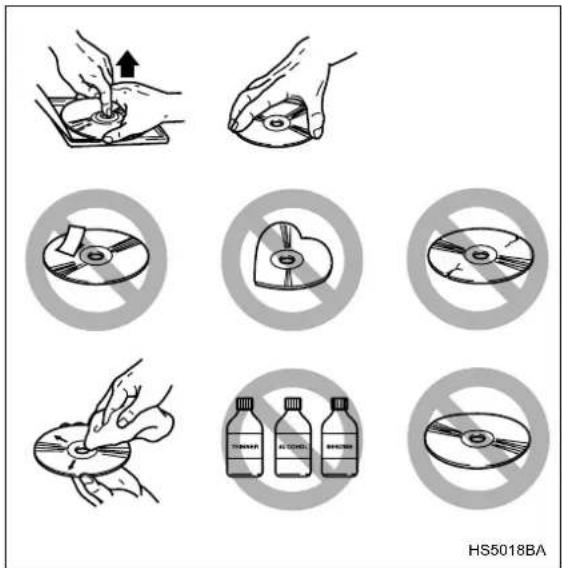
text_image
HS5018BA
natural_image
Pure horizontal dashed lines on white background with no text, numbers, or symbolsInterior and exterior equipments
Interior light 6-2
Dome light 6-2
Map light 6-3
Sunvisors 6-3
Vanity mirror (if equipped) 6-4
Storage compartment 6-4
Glove box 6-5
Center console 6-5
Rear center console 6-6
Coin compartment 6-6
Cup holder 6-7
Front cup holder 6-7
Rear passenger's cup holder 6-8
Accessory power outlet 6-8
Cigarette lighter socket 6-9
Use with a cigarette lighter 6-10
Using as an accessory power outlet 6-11
Ashtray 6-12
Convenience hook 6-13
Coat hook 6-13
Cargo net hooks 6-13
Floor mat (if equipped) 6-15
Cargo bed 6-16
Cargo tie-down hooks 6-17
Bed extender (if equipped) 6-17
Operation 6-18
Bed extender removal 6-19
Cargo lamp 6-20
Soft bed cover (if equipped) 6-21
Securing the cover 6-21
Cover removal 6-22
Cover reinstallation 6-23
Roof rail and crossbar 6-24
Installing carrying attachments on the
crossbars 6-25
Removal and installation of the crossbars .... 6-25
Sport activity lights (if equipped) 6-30
Interior light
■ Dome light
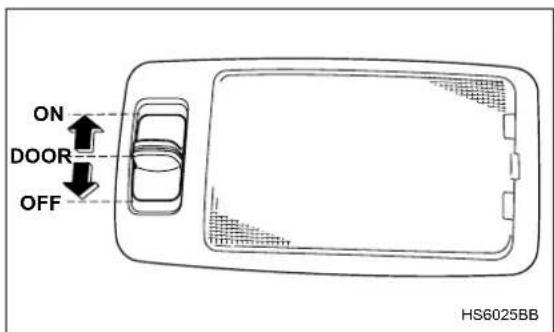
text_image
ON DOOR OFF HS6025BBThe dome light switch has three positions:
ON: The light stays on continuously.
DOOR (middle position): The light comes on when any of the doors is open. The light remains on for several seconds and gradually goes out after all doors are closed.
The light also can be turned on by use of the keyless entry transmitter. See the "Remote keyless entry system (if equipped)" in chapter 2 for detailed information.
OFF: The light stays off.
When leaving your vehicle, make sure the light goes out to avoid battery discharge.
Map light

text_image
1 2 UG6021CB U61) Switches
2) Map lights
To turn on the map light, push the switch. To turn it off, push the switch again.
When leaving the vehicle, make sure the light is turned off to avoid battery discharge.
Sun visors
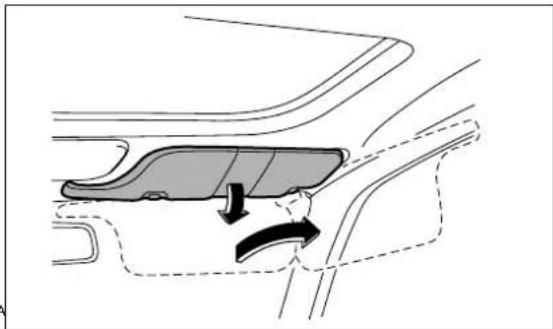
natural_image
Diagram of a car interior showing airflow direction and movement (no text or symbols)To block out glare, swing down the visors. To use the sun visor at a side window, swing it down and move it sideways.
- CONTINUED -
■ Vanity mirror (if equipped)

natural_image
Line drawing of a device with a box and connector, no text or symbols presentTo use the vanity mirror, swing down the sun visor and open the vanity mirror cover.
The light beside the vanity mirror comes on when the ignition switch is either in the "ACC" or "ON" position and the mirror cover is opened.
Storage compartment
Your vehicle has some storage compartments such as a glove box, a center console and so forth, for storage of small items that you often use.
CAUTION
• Always keep the storage compartment closed while driving to reduce the risk of injury in the event of sudden stops or an accident.
- Do not store spray cans, containers with flammable or corrosive liquids or any other dangerous items in the storage compartment.
Glove box

text_image
HS6030BB U 1 21) Lock
2) Unlock
To open the glove box, pull the handle. To close it, push the lid firmly upward.
To lock the glove box, insert the key and turn it clockwise.
■ Center console
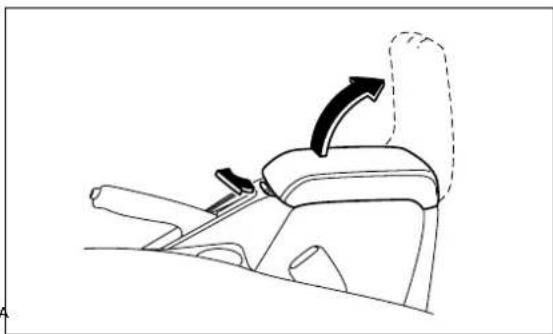
natural_image
Line drawing of a car interior seat with directional arrows indicating movement (no text or symbols)To open the lid, pull up the lock release.
- CONTINUED -
Interior and exterior equipments
■ Rear center console

natural_image
Diagram of a car interior showing a hand valve mechanism with an arrow indicating direction (no text or symbols present)To open the lid, push the button.
■ Coin compartment
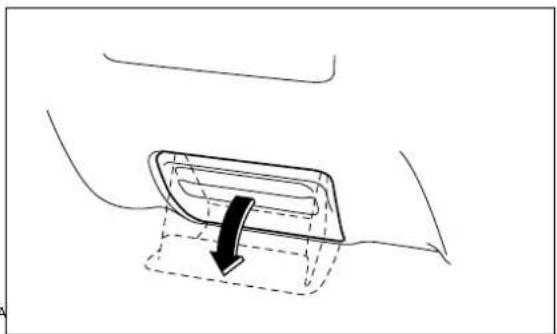
natural_image
Diagram of a car interior showing a handle with a black arrow indicating direction (no text or symbols)To open the coin compartment, pull the upper edge of the lid.
Cup holder
CAUTION
- Do not pick up a cup from the cup holder or put a cup in the holder while you are driving, as this may distract you and lead to an accident.
• Take care to avoid spills. Beverages, if hot, might burn you or your passengers. Spilled beverages may also damage upholstery, carpets or audio equipment.
■ Front cup holder

natural_image
Line drawing of a car gear shift lever and two circular components (no text or symbols)A dual cup holder is built in the center console, beside the parking brake lever.
- CONTINUED -
■ Rear passenger's cup holder
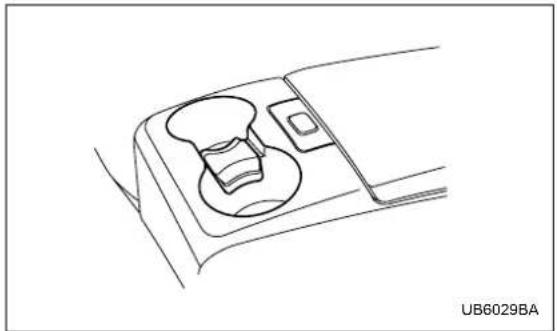
natural_image
Line drawing of a car interior compartment showing handle, seat, and control panel (no text or symbols)A dual cup holder is built in the rear center console.
Accessory power outlet

text_image
M21A22 12V120 UB6057BAThe accessory power outlet is located at the rear of the center console.
Electrical power (12V DC) from the battery is available at the socket when the ignition switch is either in the "ACC" or "ON" position.
You can use an in-car use electrical appliance by connecting it to the accessory power outlet.
CAUTION
- Do not attempt to use a cigarette lighter in the accessory power outlet.
- Do not place any foreign objects, especially metal ones such as coins or aluminum foil, into the accessory power outlet. That could cause a short circuit. Always put the cap on the accessory power outlet when it is not in use.
- Use only electrical appliances which are designed for 12V DC and which consume less than 120W. Overloading the accessory power outlet can cause a short circuit. Do not use double adapters or more than one electrical appliance.
- If the plug on your electric appliance is either too loose or too tight for the accessory power outlet, this can result in a poor contact or cause the plug to get stuck. Only use plugs that fit properly.
- Use of an electric appliance in the accessory power outlet for a long period of time while the engine is not running can cause battery discharge.
- Do not raise the rear seat cushion while an electric appliance is plugged into the accessory power outlet. The rear seat cushion would hit the electric appliance, possibly damaging the accessory power outlet and the electric appliance.
Cigarette lighter socket
CAUTION
- The electrical power socket located on the lower part of the instrument panel is originally designed to use a genuine SUBARU cigarette lighter plug. Do not use non-genuine cigarette lighter plugs in the socket. Doing so may cause a short-circuit and overheating, resulting in a fire.
- If the socket is ever used for a plug-in accessory such as a mobile phone, they may damage the portion of the socket's internal mechanism that causes a cigarette lighter plug to "pop out" after its lighter element is heated. Therefore, do not place a cigarette lighter plug in a socket that has been used, even once, to power a plug-in accessory. Doing so may cause the plug to stick and overheat, creating a potential fire hazard.
- Do not place any foreign objects, especially metal ones such as coins or aluminum foil, into the socket. That could cause a short circuit.
- CONTINUED -

natural_image
Diagram of a car gear shift lever with a magnified inset showing the wheel (no text or symbols)The electrical power socket located on the lower part of the instrument panel can be used as cigarette lighter socket. A cigarette lighter plug is an optional accessory. It is available from your SUBARU dealer. The cigarette lighter socket may also be used as a power source for an in-car use electrical appliance.
■ Use with a cigarette lighter
WARNING
To avoid being burned, never grasp the lighter by the end with the heating element. Doing so could result in injury and could also damage
the heating element.
CAUTION
Do not hold the lighter pushed in, because it will overheat.
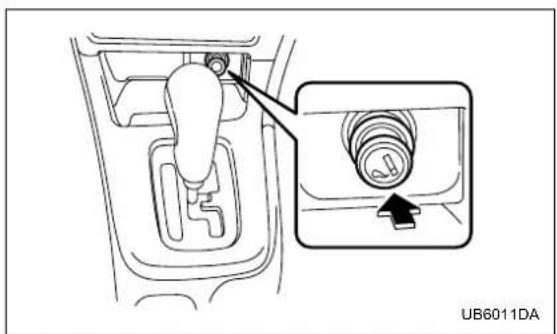
text_image
UB6011DAThe cigarette lighter operates only when the ignition switch is in the "ON" and "ACC" positions. To use the cigarette lighter, push in the knob and wait a few moments. It will automatically spring up when ready for use.
■ Using as an accessory power outlet
Electrical power (12V DC) from the battery is available at the socket when the ignition switch is either in the "ACC" or "ON" position.
If you use the socket as an accessory power outlet, take the following precautions.
When the socket is not in use, always put the cap on the socket to prevent any foreign object from entering it.
CAUTION
- Use only in-car use electrical appliances which are designed for 12V DC and which consume less than 120W. Overloading the socket can cause a short circuit. Do not use double adapters or more than one electrical appliance.
- If the plug on your electric appliance is either too loose or too tight for the socket, this can result in a poor contact or cause the plug to get stuck. Only use plugs that fit properly.
- Use of an electric appliance in the socket for a long period of time while the engine is not running can cause battery discharge.
- Before driving your vehicle, make sure that the plug and the cord on your electrical appliance will not interfere with your shifting gears
and operating the accelerator and brake pedals. If they do, do not use the electrical appliance while driving.
If the socket has been used for electrical appliances, damage may have been done to the internal mechanism that cause a cigarette lighter to "pop-out" after its element has been heated. For that reason, a cigarette lighter, even if it is a genuine part, should not be used in the socket. If you want to use the socket for a cigarette lighter again, or to protect your purchaser before you sell your vehicle, have your SUBARU dealer replace the socket with a new one.
Ashtray
CAUTION
Do not use ashtrays as waste receptacles or leave a lighted cigarette in an ashtray. This could cause a fire.
Fully close the ashtray after using it to help reduce residual smoke.
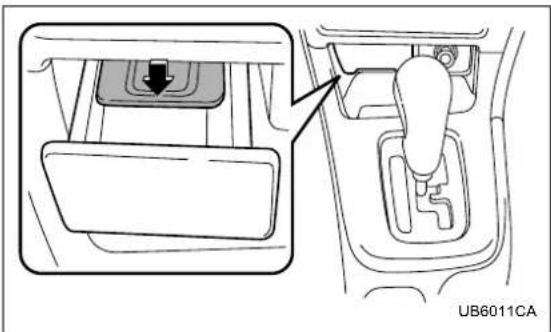
text_image
UB6011CATo open the ashtray, pull the lid out.
To remove the ashtray for cleaning, open it and pull it
out while pushing the inner plate down.
Convenience hook
Coat hook
CAUTION
Never hang anything on the coat hook that might obstruct the driver's view or that could cause injury in sudden stops or in a collision. And do not hang items on the coat hook that weigh 2.2 lbs (1 kg) or more.
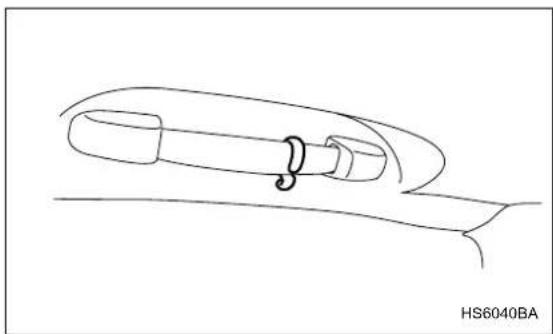
natural_image
Simple line drawing of a mechanical component with a curved handle and a loop, no text or symbols present.The coat hook is attached to each rear passenger's
hand grip.
■ Cargo net hooks
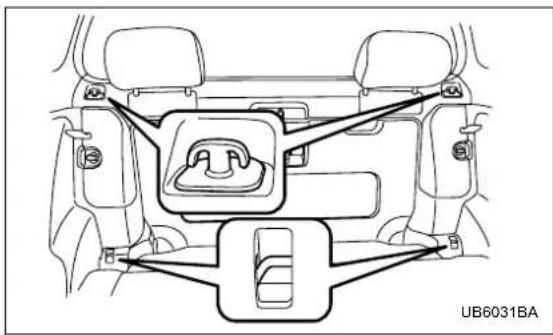
text_image
UB6031BA- CONTINUED -

natural_image
Technical line drawing of a car interior showing structural components and a zoomed-in section (no text or symbols)There are four hooks on the back panel behind the rear seatback.
These hooks can be used for installing a cargo net so that small and light items can be held next to the back panel when the rear seatback is in the down position.
Fold the rear seatback forward by pulling the release knob up for access to the hooks.
There are two hooks on the back of the rear seatback. Using these hooks and the two hooks at the bottom of the back panel, it is possible to use a cargo net to retain luggage on the folded-down rear seatback.
CAUTION
After returning the seatback to its original position, make sure that the rear seatback has been securely locked. When securely locked, the red marks on the locking knobs are no longer visible.
Floor mat (if equipped)
CAUTION
Make sure the driver's floor mat is placed back in its proper location and correctly secured on its retaining pin. If the floor mat slips forward and interferes with the movement of the pedals during driving, it could cause an accident.

natural_image
Diagram of a car interior showing foot and seat components with a warning symbol (no text or labels)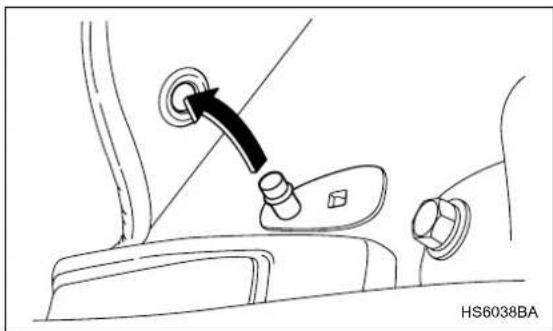
natural_image
Line drawing of a car seatbelt switch with a black arrow indicating the lever (no text or symbols present)A retaining pin is located on the driver's side of the vehicle. The floor mat is secured using the built-in grommet, by placing the grommet over the pin and pushing downward.
Cargo bed
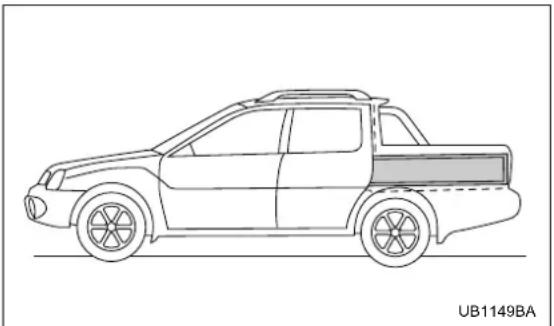
natural_image
Side profile line drawing of a pickup truck (no text or symbols on the vehicle itself)WARNING
- Never fill gasoline containers on the cargo bed. Static electricity may ignite gasoline vapor when filling portable containers. Approved containers must be removed from the vehicle and placed on the ground when filling.
Do not fill any portable container on a vehicle.
- Never allow anyone to ride in the cargo bed. It is not designed for passengers. They should ride in the seats with the seatbelts securely fastened. Otherwise they are much more likely to
suffer serious injury or death in a sudden braking or in a collision.
CAUTION
- Do not exceed the cargo load rating of your vehicle. Refer to the "Loading your vehicle" section in Chapter 8.
- Be sure cargo is secured properly. Unsecured cargo in the cargo bed can be thrown around during sudden braking, in a sharp turn or during rapid acceleration, which could create a dangerous road hazard.
- To avoid creating a dangerous road hazard or causing personal injury, cargo must not stick out beyond the tailgate.
- Never drive the vehicle with the tailgate open unless the optional SUBARU Bed Extender is used.
Cargo should be placed in the cargo bed. Make sure all items are secured in place.
Be careful to keep the vehicle balanced. Locating the weight as low and far forward as possible helps maintain balance.
There are two water drain holes at both sides of the
front end of the cargo bed. Keep those holes clear and free from obstructions.
■ Cargo tie-down hooks

natural_image
Top-down line drawing of a car backrest with seatbelt and door panel (no text or symbols)The cargo bed is equipped with four tie-down hooks so that cargo can be secured with a luggage net or ropes.
Bed extender (if equipped)
The bed extender is designed to increase the usable cargo area of the bed.
CAUTION
- When the tailgate and bed extender are in the "open/outward" position, the license plate bracket must be lowered and locked into position before the vehicle is driven (see section "License plate bracket" under the heading of "Tailgate" in Chapter 2 for more information on the function of the license plate bracket). In order to avoid damaging the license plate bracket or the bumper, make certain that the license plate bracket is in its fully lowered/open position before the tailgate is lowered.
- Do not exceed the cargo load rating of your vehicle. Refer to "Loading your vehicle" section in Chapter 8.
- Locking buckles must be engaged into the tailgate latch while the vehicle is in motion.
- When the bed extender is not in use, the tailgate should be closed.
- Do not use the bed extender or tailgate to secure cargo.
- CONTINUED -
- Remove the bed extender for vehicle "Off Road" use.
- To avoid creating a dangerous road hazard or causing personal injury, cargo must not stick out beyond the bed extender.
- To avoid damage, the tailgate and bed extender must remain in the closed/inward position when towing with a trailer hitch.
• To avoid damage, clean the bed extender only with soap, water and a soft brush.
Operation
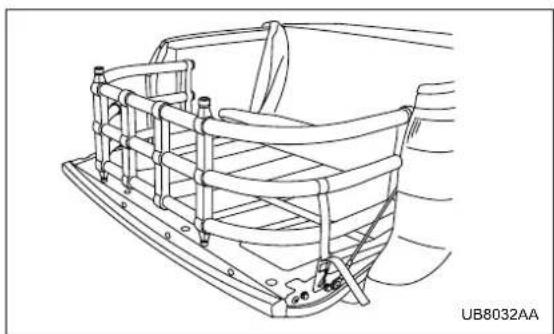
natural_image
Technical line drawing of a boat hull with visible structural ribs and hull details (no text or symbols)Open/Outward Position – To use the bed extender in the open/outward position, simply lower your license plate bracket (see section "License plate bracket" under heading of "Tailgate" in Chapter 2), open your tailgate, and rotate the bed extender until it sits on the tailgate.

natural_image
Technical line drawing of a mechanical assembly with no visible text or symbolsAfter you have rotated the bed extender, lock the black buckle pin into the tailgate latch by pushing downward until you hear two clicks. Then tighten the tether straps. Repeat this process for the other side. When you want to return the tailgate and the bed extender to the closed/inward position, pull on the tailgate release handle to disengage the tethers.
NOTE
Use care when rotating bed extender. Do not permit the buckles to come in contact with vehicle sheet metal and bed trim.
Closed/Inward Position – With the tailgate closed and the bed extender in the inward position, small loads can be placed inside the vehicle bed between the tailgate and the extender (groceries, ice chests, etc.).
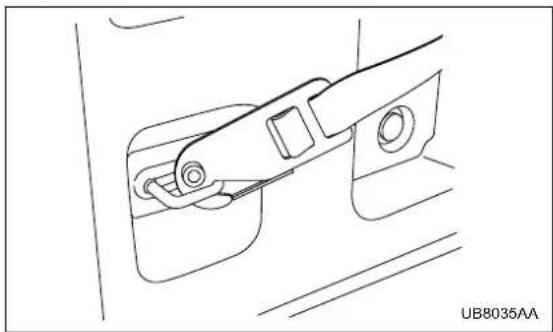
natural_image
Technical line drawing of a mechanical component with a handle and mounting bracket (no text or symbols)The bed extender should be secured to the rear set of vehicle cargo hooks. Latch the buckle onto the rear cargo hooks and then tighten the tether straps. To disengage the tethers, loosen the tether straps and de-
press the latch pin.
■ Bed extender removal

natural_image
Technical line drawing of a vehicle chassis with an upward arrow indicating motion (no text or symbols)The bed extender can be removed from the vehicle by rotating the extender into a vertical position then lifting straight up.
Cargo lamp
text_image
CARGO LAMPUB3018AA
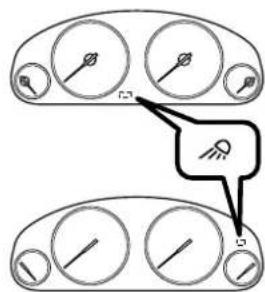
text_image
Diagram showing two car dashboard controls with gauges and a pointer indicating a measurement or navigation point.UB7023DA
The cargo lamp comes on and goes off whenever the cargo lamp switch is pushed regardless of the position of the ignition switch. The cargo lamp indicator light located in the meter panel will illuminate when the cargo lamp is on.
When leaving your vehicle, make sure the lamp is turned off to avoid battery discharge.
CAUTION
Do not switch on the cargo lamp while driving to avoid distracting other drivers.
Soft bed cover (if equipped)

text_image
UB6061BAWARNING
Before installing the soft bed cover, carefully read the warning labels on the inside wall of the cargo bed.
CAUTION
- Do not place cargo on top of the bed cover.
-
Do not use the hard bed cover section as a step.
-
Do not use the bed cover to secure cargo.
• To avoid damage, clean the bed cover with only soap, water and a soft brush. - Remove the soft portion of the bed cover before taking the vehicle through a car wash.
The bed cover is designed to cover the cargo area of the bed. The bed cover is water resistant, but not waterproof.
■ Securing the cover

natural_image
Line drawing of a person adjusting a cable or rope, no text or symbols present- CONTINUED -

natural_image
Line drawing of hands holding a tool over a surface, no text or symbols presentTo secure the soft portion of the bed cover to the bed, simply start from either side of the vehicle and place the plastic strip under the rail. Slide your hand down the side of the vehicle pushing the plastic strip under the rail as you go. Continue this around the entire length of the bed. Fasten both closeout wraps with Velcro around the rear chrome bars so that they are secure. Your cover should be tight and ready to conceal items in the bed from view.
■ Cover removal
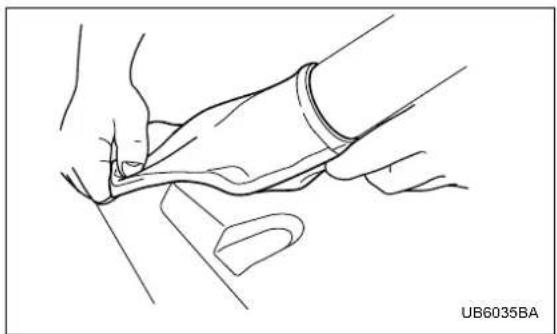
natural_image
Line drawing of a hand gripping a small object, possibly a tool or device, with no visible text or symbols.
natural_image
Line drawing of hands performing a medical procedure on a patient's abdomen (no text or symbols)The soft portion of the bed cover can be removed from the bed cover's hard section for cleaning or storage. Unfasten the Velcro on the tube closeout wraps and firmly pull the cover out to one side.
■ Cover reinstallation
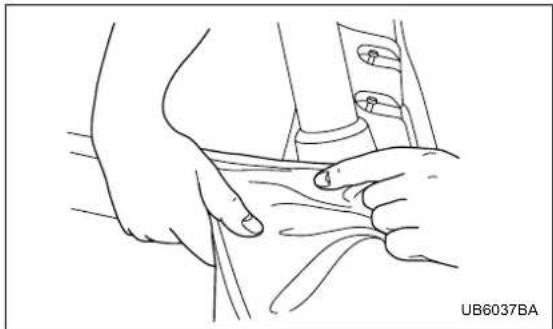
natural_image
Line drawing of a hand performing a medical or orthopedic procedure on a patient's arm (no text or symbols present)The soft portion of the bed cover can be reinstalled onto the bed cover's hard section. Start by inserting the left front edge of the soft portion into the right side of the hard cover. This area is flared out to ease installation.

natural_image
Line drawing of a car interior showing a seatbelt and handle (no text or symbols)As you insert (and pull) the soft portion of the bed cover into the bed cover's hard section, make sure the next 10 to 15 inches (250 to 380 mm) of the soft portion are straight and ready to enter the flared out portion of the hard section.
Once you have pulled the soft portion of the bed cover onto the bed cover's hard section, make sure the soft portion is equally centered on both sides. To complete the installation, refer to "Securing the cover".
Roof rail and crossbar
CAUTION
- For cargo carrying purposes, the roof rail must be used together with a roof crossbar kit and the appropriate carrying attachment. The roof rail must never be used alone to carry cargo. Otherwise, damage to the roof or paint or a dangerous road hazard due to loss of cargo could result. - When using the roof crossbar kit, make sure that the total weight of the crossbars, carrying attachment and cargo does not exceed the maximum load limit. Overloading may cause damage to the vehicle and create a safety hazard.
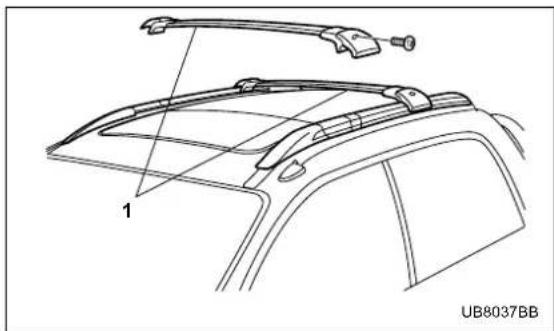
text_image
1 UB8037BB1) Crossbar kit
The roof rail is not designed to carry cargo by itself. Cargo can be carried after securing the roof crossbar kit to the roof rail and installing the appropriate carrying attachment. When installing the roof crossbar kit, follow the manufacturer's instructions.
When you carry cargo on the roof using the roof cross-bar kit and a carrying attachment, never exceed the maximum load limit explained below. You should also be careful that your vehicle does not exceed the Gross Vehicle Weight Rating (GVWR) and front and rear Gross Axle Weight Rating (GAWR). See the "Loading your vehicle" section in Chapter 8 for information on
loading cargo into or onto your vehicle. The maximum load limit of the cargo, crossbars and carrying attachment must not exceed 100 lbs (45 kg). Place the heaviest load at the bottom, nearest the roof, and evenly distribute the cargo. Always properly secure all cargo.
■ Installing carrying attachments on the crossbars
When installing any carrying attachment such as a bike carrier, ski carrier, kayak carrier, cargo basket, etc. on the crossbars, follow the manufacturer's instructions and make sure that the attachment is securely fixed to the crossbars. Use only attachments designed specifically for the crossbars. A set of the crossbars is designed to carry loads (cargo and attachment) of not more than 100 lbs (45 kg). Before operating the vehicle, make sure that the cargo is properly secured on the attachment.
NOTE
Remember that the vehicle's center of gravity is altered with the weight of the load on the roof, thus affecting the driving characteristics.
Drive carefully. Avoid rapid starts, hard cornering and abrupt stops. Crosswind effects will be increased.
■ Removal and installation of the crossbars
CAUTION
Do not carry cargo on the roof when the crossbars are removed. Luggage on the roof will be thrown forward or backward in sudden stops or rapid accelerations, resulting in a dangerous road hazard.
The crossbars can be removed when you do not use the roof to carry cargo.
- CONTINUED -
▼ To remove the crossbar
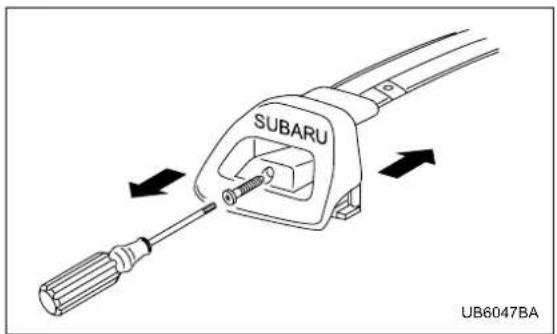
text_image
SUBARU UB6047BA
text_image
SUBARU UB6048BA- Loosen and remove the T-30 torx® head screw from the side of each crossbar end support.
- Move the end support and inner clamp to unhook each side of the crossbar from the roof rail.
- Carefully raise the crossbar from roof rails.
NOTE
It may be necessary to move the Front crossbar rearward, near the center of the roof rail for easier removal. Use care not to cross-thread the screw in the insert if it has been removed.
▼ To install the crossbar
NOTE
Both Crossbars have a label indicating the direction of mount. If they are not present, orient with the larger section of the Crossbar towards the front of vehicle (see below). The Front Crossbar also has a MAXIMUM LOAD Label affixed to it.
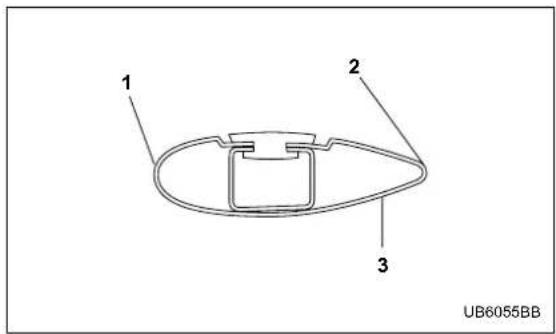
text_image
1 2 3 UB6055BB1) Front
2) Rear
3) Crossbar (section)
Front crossbar:
Front crossbar has 100 LBS. Load Label on left hand side.
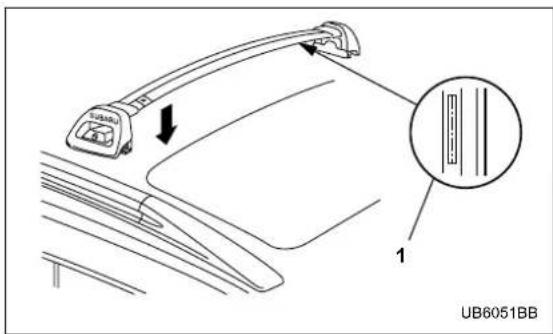
text_image
UB6051BB 11) Load label
- CONTINUED -
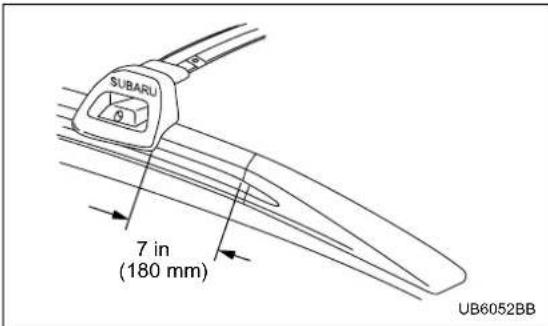
text_image
SUBARU 7 in (180 mm) UB6052BB- Before placing the crossbar on the roof rails, make sure that the T-30 torx® head screw is fully loosened from each end support.
- Spread the inner clamp and the end support as far apart as possible.
- With the front direction arrow label on the top right side of the crossbar pointing toward the front of the vehicle, carefully place the crossbar across the top of the vehicle so that the crossbar end supports rest on the top of the roof rails 7 inches (180 mm) rearward in the front radius of the roof rail.
- Move the end support and inner clamp to hook under the end of the roof rail on both sides and loosely assemble the T-30 torx® head screw with the tool pro-
vided into the threaded insert in the inner clamp on each end of the crossbar.
NOTE
It may be necessary to start the inner clamp and end support at the center of the roof rail for easier installation, then move the crossbar forward. Use care not to cross-thread the screw in the insert if it has been removed.
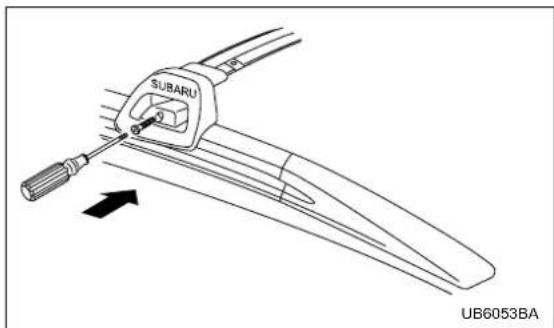
natural_image
Technical line drawing of a Subaru car blade tool with screwdriver, showing no text or symbols- Adjust the alignment of the crossbar on the roof rails, and if available, use a T-30 torx® bit and torque wrench and tighten the T-30 torx® head screws to 30 to 35 lbf·in (3.4 to 4.0 N·m, 0.35 to 0.41 kgf·m) of torque (or tighten securely with the torx® wrench pro-
vided).
Rear crossbar:
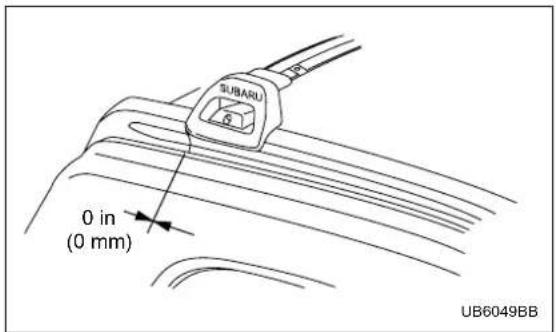
text_image
SUBARU 0 in (0 mm) UB6049BB
text_image
SUBARU UB6050BAInstall the rear crossbar in the same manner as the front crossbar.
NOTE
- The rear crossbar should be positioned just in front of the rear radius in the roof rail.
- Before each use of the roof crossbar, make sure the four T-30 crossbar clamp screws have been checked, and retightened if necessary to 35 lbf·in (4.0 N·m, 0.41 kgf·m), as outlined in Step #5 above.
Sport activity lights (if equipped)

text_image
SPORT LIGHTS 1 UB6041BB1) Indicator light
The sport activity lights will operate only when the parking brake is engaged. Push the "SPORT LIGHTS" switch to turn the sport activity lights on. Press the switch again to turn them off.
The indicator light located on the switch will illuminate when the sport activity lights are on.
NOTE
• In most states, the sport activity lights must have stone shields installed when the vehicle is
operated on public roads.
- In most states, the sport activity lights may not be operated when the vehicle is in motion on a public road.

natural_image
Line drawing of a vehicle chassis with two circular components mounted on a platform (no text or symbols)The sport activity lights mount to the vehicle front cross bar. The sport activity lights cross bar wire harness connects to the roof wire harness and then to the vehicle's electrical system.
A tool is provided which will activate the sport activity lights' positioning to be modified, so that each lamp can be aimed or rotated. The lamps can be mounted in two positions, upright (normal) or forward (downward). The lamps should be rotated to the forward
(downward) position when washing your vehicle.
If you choose to remove sport activity lights, the following sequence should be utilized:
- Disconnect the roof harness from the cross bar harness connector.
- Attach the water proof connector cap to the roof harness connector.
- Care should be used when removing or installing this electrical product.
natural_image
Pure horizontal dashed lines on white background with no text, numbers, or symbolsStarting and operating
Fuel 7-2
Fuel requirements 7-2
Fuel filler door and cap 7-4
State emission testing (U.S. only) 7-7
Preparing to drive 7-9
Starting the engine 7-9
Manual transmission vehicle 7-9
Automatic transmission vehicle 7-10
Stopping the engine 7-12
Manual transmission 7-12
Shifting speeds 7-13
Driving tips 7-14
Automatic transmission
(Non-turbo models) 7-15
Selector lever 7-16
Driving tips 7-19
Shift lock release 7-20
Automatic transmission (Turbo models) ... 7-21
Selector lever 7-22
Selector lever reverse inhibiting function ..... 7-25
Selection of SPORTSHIFT mode
(manual mode) 7-27
Driving tips 7-29
Shift lock release 7-30
Limited slip differential (LSD) 7-31
Power steering 7-31
Braking 7-32
Braking tips 7-32
Brake system 7-32
Disc brake pad wear warning indicators ..... 7-33
ABS (Anti-lock Brake System) 7-33
ABS system self-check 7-34
ABS warning light 7-34
Parking your vehicle 7-36
Cruise control 7-38
To set cruise control 7-38
To temporarily cancel the cruise control ..... 7-39
To turn off the cruise control 7-40
To change the cruising speed 7-40
Cruise control set indicator light 7-41
Fuel
CAUTION
Use of a fuel which is low in quality or use of an inappropriate fuel additive may cause engine damage.
■ Fuel requirements
▼ Non-turbo models
The 2.5-liter engine is designed to operate using unleaded gasoline with an octane rating of 87 AKI or higher.
▼ Turbo models
The 2.5-liter turbo engine is designed to operate using premium unleaded gasoline with an octane rating of 91 AKI or higher. If premium unleaded gasoline is not available, regular unleaded gasoline with an octane rating of 87 AKI or higher may be temporarily used. For optimum engine performance and driveability, it is required that you use premium grade unleaded gasoline.
▼ Fuel octane rating
This octane rating is the average of the Research Octane and Motor Octane numbers and is commonly referred to as the Anti Knock Index (AKI).
Using a gasoline with a lower octane rating can cause persistent and heavy knocking, which can damage the engine. Do not be concerned if your vehicle sometimes knocks lightly when you drive up a hill or when you accelerate. See your dealer or a qualified service technician if you use a fuel with the specified octane rating and your vehicle knocks heavily or persistently.
▼ Unleaded gasoline
The neck of the fuel filler pipe is designed to accept only an unleaded gasoline filler nozzle. Under no circumstances should lead gasoline be used because it will damage the emission control system and may impair driveability and fuel economy.
▼ Gasoline for California-certified LEV
Your vehicle was certified to California's low emission vehicle (LEV) standards as indicated on the underhood tune-up label. It is designed to optimize engine and emission control system performance with gasoline that meets the clean burning low-sulfur California gasoline specifications. If you live in any other state than California, your vehicle will operate on gasoline meeting Federal specifications. Gasoline sold outside
California is permitted to have higher sulfur levels, which may affect the performance of your vehicle's catalytic converter and may produce a sulfur exhaust odor or smell. SUBARU recommends that you try a different brand of unleaded gasoline having lower sulfur to determine if the problem is fuel related before returning your vehicle to an authorized dealer for service.
▼ MMT
Some gasoline contains an octane-enhancing additive called MMT (Methylcyclopentadienyl Manganese Tricarbonyl). If you use such fuels, your emission control system performance may deteriorate and the CHECK ENGINE warning light/Malfunction indicator lamp may turn on. If this happens, return to your authorized SUBARU Dealer for service. If it is determined that the condition is caused by the type of fuel used, repairs may not be covered by your warranty.
▼ Gasoline for cleaner air
Your use of gasoline with detergent additives will help prevent deposits from forming in your engine and fuel system. This helps keep your engine in tune and your emission control system working properly, and is a way of doing your part for cleaner air. If you continuously use a high quality fuel with the proper detergent and other additives, you should never need to add any fuel system cleaning agents to your fuel tank.
Many gasolines are now blended with materials called oxygenates. Use of these fuels can also help keep the air cleaner. Oxygenated blend fuels, such as MTBE (Methyl Tertiary Butyl ether) or ethanol (ethyl or grain alcohol) may be used in your vehicle, but should contain no more than 15% MTBE or 10% ethanol for the proper operation of your SUBARU.
In addition, some gasoline suppliers are now producing reformulated gasoline, which is designed to reduce vehicle emissions. SUBARU approves the use of reformulated gasoline.
If you are not sure what the fuel contains, you should ask your service station operators if their gasoline contains detergents and oxygenates and if they have been reformulated to reduce vehicle emissions.
As additional guidance, only use fuels suited for your vehicle as explained below.
- Fuel should be unleaded and have an octane rating no lower than that specified in this manual.
- Methanol (methyl or wood alcohol) is sometimes mixed with unleaded gasoline. Methanol can be used in your vehicle ONLY if it does not exceed 5% of the fuel mixture AND if it is accompanied by sufficient quantities of the proper cosolvent and corrosion inhib-
- CONTINUED -
itors required to prevent damage to the fuel system. Do not use fuel containing methanol EXCEPT under these conditions.
- If undesirable driveability problems are experienced and you suspect they may be fuel related, try a different brand of gasoline before seeking service at your SUBARU dealer.
- Fuel system damage or driveability problems which result from the use of improper fuel are not covered under the SUBARU Limited Warranty.
■ Fuel filler door and cap
▼ Refueling
WARNING
- Gasoline vapor is highly flammable. Before refueling, always first stop the engine and make sure that there are no lighted cigarettes, open flames or electrical sparks in the adjacent area.
- When opening the cap, do not remove the cap quickly. Fuel may be under pressure and spray out of the fuel filler neck especially in hot weather, which may cause injury.
- Never fill gasoline containers on the cargo bed. Static electricity may ignite gasoline vapor when filling portable containers. Approved
containers must be removed from the vehicle and placed on the ground when filling. Do not fill any portable container on a vehicle.
CAUTION
- Never add any cleaning agents to the fuel tank. The addition of a cleaning agent may cause damage to the fuel system.
- Make sure that the cap is tightened until it clicks to prevent fuel spillage in the event of an accident.
- Do not let fuel spill on the exterior surfaces of the vehicle. Fuels may cause paint damage, which is not covered under the SUBARU Limited Warranty.
- Always use a genuine SUBARU fuel filler cap. If you use the wrong cap, it may not fit or have proper venting, and your fuel tank and emission control system might be damaged.
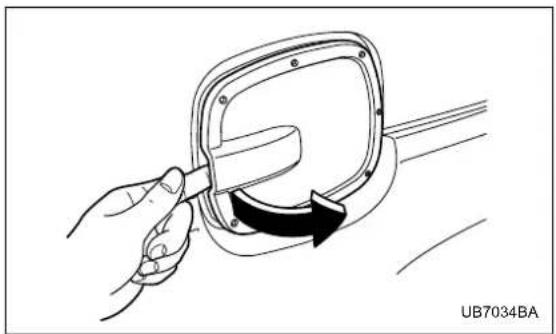
natural_image
Illustration of a hand using a tool to adjust a mechanical component with an arrow indicating rotation (no text or symbols)- To open the fuel filler door, pull it outward.

text_image
1/0 2 UB7030BB1) Open
2) Close
- Remove the fuel filler cap by turning it slowly counterclockwise.
- Stop filling the tank after the fuel filler pump automatically clicks off. Do not add any more fuel.
- Put the cap back on, turn it clockwise until you hear a clicking sound. Be certain not to catch the tether under the cap while tightening.
- Close the fuel filler door completely.
If you spill any fuel on the painted surface, rinse it off immediately. Otherwise, the painted surface could be damaged.
- CONTINUED -
NOTE
FUEL DOOR
HS3023AA
- You will see the "FUEL DOOR" sign in the combination meter. This indicates that the fuel filler door (lid) is located on the right side of the vehicle.
- If the fuel filler cap is not tightened until it clicks or if the tether is caught under the cap, the CHECK ENGINE warning light may come on. Refer to the "Warning and indicator lights" section located in chapter 3.
- (Turbo models only) Promptly put fuel in the tank whenever the low fuel warning light comes on. If the engine misfired as a result of an empty tank, resulting catalyzer damage could cause
damage to the turbocharger.
State emission testing (U.S. only)
WARNING
Testing of an All-Wheel Drive vehicle must NEVER be performed on a single two-wheel dynamometer. Attempting to do so will result in uncontrolled vehicle movement and may cause an accident or injuries to persons nearby.
CAUTION
Resultant vehicle damage due to improper testing is not covered under the SUBARU Limited Warranty and is the responsibility of the state inspection program or its contractors or licensees.
At state inspection time, remember to tell your inspection or service station in advance not to place your SUBARU AWD vehicle on a two-wheel dynamometer. Otherwise, serious transmission damage will result.
Some states have started using dynamometers in their state inspection programs in order to meet their
obligation under federal law to implement stricter vehicle emission standards to reduce air pollution from vehicles. A dynamometer is a treadmill or roller-like testing device that allows your vehicle's wheels to turn while the vehicle remains in one place. Depending on the severity of a state's air pollution problems, the states must adopt either a "basic" or "enhanced" vehicle emission inspection test. Normally, a portion of the basic emission test consists of an emission inspector inserting an analyzer probe into the exhaust pipe of an idling vehicle for a short period of time. States with more severe air pollution problems are required to adopt an enhanced vehicle emission test. This test simulates actual driving conditions on a dynamometer and permits more accurate measurement of tailpipe emitted pollution than the basic emission test.
The U.S. Environmental Protection Agency (EPA) and states using two-wheel dynamometers in their emission testing programs have EXEMPTED SUBARU AWD vehicles from the portion of the testing program that involves a two-wheel dynamometer.
There are some states that use four-wheel dynamometers in their testing programs. When properly used, that equipment will not damage an AWD SUBARU vehicle.
Under no circumstances should the rear wheels be
- CONTINUED -
jacked off the ground, nor should the driveshaft be disconnected for state emission testing.
The EPA has issued regulations for inspecting the On-Board Diagnostic (OBD) system as part of the state emissions inspection. The OBD system is designed to detect engine and transmission problems that might cause vehicle emissions to exceed allowable limits. These inspections apply to all 1996 model year and newer passenger cars and light trucks.
- The inspection of the OBD system consists of a visual operational check of the “CHECK ENGINE” warning light/malfunction indicator lamp (MIL) and an examination of the OBD system with an electronic scan tool while the engine is running.
- A vehicle passes the OBD system inspection if proper the “CHECK ENGINE” warning light/MIL illumination is observed, there is no stored diagnostic trouble codes, and the OBD system readiness monitors are complete.
- A vehicle fails the OBD inspection if the “CHECK ENGINE” warning light/MIL is not properly operating or there is one or more diagnostic trouble codes stored in vehicle's computer with the “CHECK ENGINE” warning light/MIL illuminated.
- A state emission inspection may reject (not pass or fail) a vehicle if the number of OBD system readiness
monitors "Not Ready" is greater than three. Under this condition, the vehicle operator should be instructed to drive his/her vehicle for a few days to set the monitors and return for an emission re-inspection.
- Owners of rejected or failing vehicles should contact their SUBARU Dealer for service.
Preparing to drive
You should perform the following checks and adjustments every day before you start driving.
- Check that all windows, mirrors, and lights are clean and unobstructed.
- Check the appearance and condition of the tires. Also check tires for proper inflation.
- Look under the vehicle for any sign of leaks.
- Check that the hood is fully closed.
- Check the adjustment of the seat.
- Check the adjustment of the inside and outside mirrors.
- Fasten your seatbelt. Check that your passengers have fastened their seatbelts.
- Check the operation of the warning and indicator lights when the ignition switch is turned to the "ON" position.
- Check the gauges, indicator and warning lights after starting the engine.
NOTE
Engine oil, engine coolant, brake fluid, washer fluid and other fluid levels should be checked daily, weekly or at fuel stops.
Starting the engine
CAUTION
Do not operate the starter motor continuously for more than ten seconds. If the engine fails to start after operating the starter for five to ten seconds, wait for ten seconds or more before trying again.
■ Manual transmission vehicle
- Apply the parking brake.
- Turn off unnecessary lights and accessories.
- Press the clutch pedal to the floor and shift the shift lever into neutral.
Hold the clutch pedal to the floor while starting the engine. The starter motor will only operate when the clutch pedal is pressed fully to the floor. - Turn the ignition switch to the "ON" position and check the operation of the warning and indicator lights. Refer to the "Warning and indicator lights" section (chapter 3).
- Turn the ignition switch to the "START" position without depressing the accelerator pedal. Release the key immediately after the engine has started.
- CONTINUED -
If the engine does not start, try the following:
1) Turn the ignition switch to the "OFF" position and wait for at least 10 seconds. After checking that the parking brake is firmly set, turn the ignition switch to the "START" position while depressing the accelerator pedal slightly (about a quarter of the full stroke). Release the accelerator pedal as soon as the engine starts.
2) If this fails to start the engine, turn the ignition switch back to the "OFF" position and wait for at least 10 seconds. Then fully depress the accelerator pedal and turn the ignition switch to the "START" position. If the engine starts, quickly release the accelerator pedal.
3) If this fails to start the engine, turn the ignition switch again to the "OFF" position. After waiting for 10 seconds or longer, turn the ignition switch to the "START" position without depressing the accelerator pedal.
4) If the engine still refuses to start, contact your nearest SUBARU dealer for assistance.
- Confirm that all warning and indicator lights have gone off after the engine has started. The fuel injection system automatically lowers the idle speed as the engine warms up.
NOTE (Turbo models)
The engine may be difficult to start when the bat-
tery has been disconnected and reconnected (for maintenance or other purposes). This difficulty is caused by the electronically controlled throttle's self-diagnosis function. To overcome it, keep the ignition switch in the "ON" position for approximately 10 seconds before starting the engine.
■ Automatic transmission vehicle
CAUTION
If you restart the engine while the vehicle is moving, shift the selector lever into the "N" position. Do not attempt to place the selector lever of a moving vehicle into the "P" position.
- Apply the parking brake.
- Turn off unnecessary lights and accessories.
- Shift the selector lever to the "P" or "N" position (preferably "P" position). The starter will only operate when the select lever is at the "P" or "N" position.
- Turn the ignition switch to the "ON" position and check the operation of the warning and indicator lights. Refer to the "Warning and indicator lights" section (chapter 3).
- Turn the ignition switch to the "START" position
without depressing the accelerator pedal. Release the key immediately after the engine has started. If the engine does not start, try the following:
1) Turn the ignition switch to the "OFF" position and wait for at least 10 seconds. After checking that the parking brake is firmly set, turn the ignition switch to the "START" position while depressing the accelerator pedal slightly (about a quarter of the full stroke). Release the accelerator pedal as soon as the engine starts.
2) If this fails to start the engine, turn the ignition switch back to the "OFF" position and wait for at least 10 seconds. Then fully depress the accelerator pedal and turn the ignition switch to the "START" position. If the engine starts, quickly release the accelerator pedal.
3) If this fails to start the engine, turn the ignition switch again to the "OFF" position. After waiting for 10 seconds or longer, turn the ignition switch to the "START" position without depressing the accelerator pedal.
4) If the engine still refuses to start, contact your nearest SUBARU dealer for assistance.
- Confirm that all warning and indicator lights have gone out after the engine has started. The fuel injection system automatically lowers the idle speed as the engine warms up.
While the engine is warming up, make sure that the selector lever is at the "P" or "N" position and that the parking brake is applied.
NOTE (Turbo models)
The engine may be difficult to start when the battery has been disconnected and reconnected (for maintenance or other purposes). This difficulty is caused by the electronically controlled throttle's self-diagnosis function. To overcome it, keep the ignition switch in the "ON" position for approximately 10 seconds before starting the engine.
Stopping the engine
WARNING
Do not stop the engine when the vehicle is moving. This will cause loss of power to the power steering and the brake booster, making steering and braking more difficult. It could also result in accidental activation of the "LOCK" position on the ignition switch, causing the steering wheel to lock.
The ignition switch should be turned off only when the engine is idling.
Manual transmission
WARNING
Do not drive the vehicle with the clutch disengaged (i.e., when the clutch pedal is depressed) or with the shift lever in the neutral position. Engine braking has no effect in either of these conditions and the risk of an accident is consequently increased.
CAUTION
Shift into reverse ONLY when the vehicle has completely stopped. It may cause damage to the transmission to try shifting into reverse when the vehicle is moving.
The manual transmission is a fully synchromeshed, 5-forward-speeds and 1-reverse-speed transmission.

flowchart
graph TD
    A["Gear Shift Mechanism"] --> B["Directional Arrow ①"]
    A --> C["Directional Arrow ③"]
    A --> D["Directional Arrow ⑤"]
    A --> E["Directional Arrow ②"]
    A --> F["Directional Arrow ④"]
    A --> G["Directional Arrow ⑧"]
    style A fill:#f9f,stroke:#333
    style B fill:#ccf,stroke:#333
    style C fill:#ccf,stroke:#333
    style D fill:#ccf,stroke:#333
    style E fill:#ccf,stroke:#333
    style F fill:#ccf,stroke:#333
    style G fill:#ccf,stroke:#333
The shift pattern is shown on the shift lever knob. When shifting from 5th gear to reverse gear, first return the shift lever to the neutral position then shift into reverse gear.
To change gears, fully depress the clutch pedal, move the shift lever, and gradually let up on the clutch pedal. If it is difficult to shift into gear, put the transmission in neutral, release the clutch pedal momentarily, and then try again.
■ Shifting speeds
▼ Recommended shifting speeds
The best compromise between fuel economy and vehicle performance during normal driving is ensured by shifting up at the speeds listed in the following table.
| Shift up mph (km/h) | |
| 1st to 2nd 15 (24) | |
| 2nd to 3rd 25 (40) | |
| 3rd to 4th 40 (65) | |
| 4th to 5th 45 (73) |
▼ Maximum allowable speeds
WARNING
When shifting down a gear, ensure that the vehicle is not travelling at a speed exceeding the Maximum Allowable Speed for the gear which is about to be selected. Failure to observe this precaution can lead to engine over-revving and this in turn can result in engine damage.
In addition, sudden application of engine brakes when the vehicle is travelling on a slip-
- CONTINUED -
pery surface can lead to wheel locking; as a consequence, control of the vehicle may be lost and the risk of an accident increased.
The following table shows the maximum speeds that are possible with each different gear.
Never exceed the speed limit below for each gear position except for brief acceleration in an emergency. The tachometer's needle will enter the red area if these speeds are exceeded. Failure to observe this precaution can lead to excessive engine wear and poor fuel economy.
mph (km/h)
| Gear Non-turbo models Turbo models | |
| 1st 31 (50) 29 (47) | |
| 2nd 52 (84) 48 (78) | |
| 3rd 74 (119) 71 (114) | |
Never exceed posted speed limits.
- Driving tips
Do not drive with your foot resting on the clutch pedal and do not use the clutch to hold your vehicle at a standstill on an upgrade. Either of those actions may cause clutch damage.
Do not drive with your hand resting on the shift lever. This may cause wear on the transmission components.
When it is necessary to reduce vehicle speed due to slow traffic, turning corners, or driving up steep hills, downshift to a lower gear before the engine starts to labor.
On steep downgrades, downshift the transmission to 4th, 3rd or 2nd gear as necessary; this helps to maintain a safe speed and to extend brake pad life.
In this way, the engine provides a braking effect. Remember, if you “ride” (over use) the brakes while descending a hill, they may overheat and not work properly.
The engine may, on rare occasions, knock when the vehicle rapidly accelerates or rapidly pulls away from a standstill. This phenomenon does not indicate a fault.
Automatic transmission (Non-turbo models)
WARNING
Do not shift from the "P" or "N" position into the "D", "3", "2", "1" or "R" position while depressing the accelerator pedal. This may cause the vehicle to jump forward or backward.
CAUTION
- Shift into the "P" or "R" position only after the vehicle is completely stopped. Shifting while the vehicle is moving may cause damage to the transmission.
- Do not race the engine for more than five seconds in any position except the "N" or "P" position when the brake is set or the tires are on blocks. This may cause the automatic transmission fluid to overheat.
- Avoid shifting from one of the forward driving positions into the "R" position or vice versa until the vehicle has completely stopped. Such shifting may cause damage to the transmis-
sion.
The automatic transmission is electronically controlled and provides 4 forward speeds and 1 reverse speed.
NOTE
Immediately after a disconnected battery is reconnected or ATF (automatic transmission fluid) is replaced, you may feel that the automatic transmission operation is somewhat unusual.
This results from erasure or invalidation of data the on-board computer has collected and stored in memory to allow the transmission to shift at the most appropriate times for the current condition of your vehicle. Optimized shifting will be restored as the vehicle continues to be driven for a while.
- CONTINUED -
- Selector lever
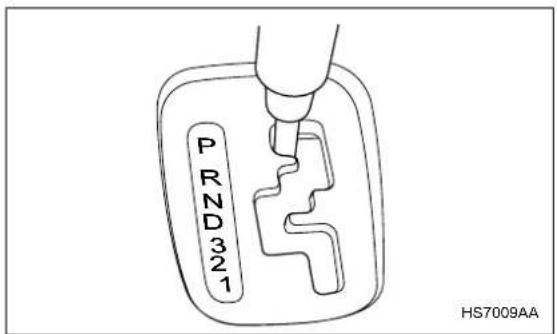
text_image
PRND321 HS7009AA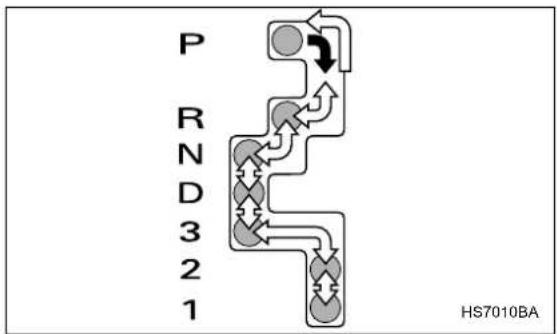
flowchart
graph TD
    P["Port P"] --> R["Port R"]
    R --> N["Port N"]
    N --> D["Port D"]
    D --> 3["Port 3"]
    3 --> 2["Port 2"]
    2 --> 1["Port 1"]
    1 --> HS7010BA["HS7010BA"]
→ : With the brake pedal depressed, move the lever along the gate.
: Move the lever along the gate.
The selector lever has seven positions.
▼ P (Park)
This position is for parking the vehicle and starting the engine.
In this position, the transmission is mechanically locked to prevent the vehicle from rolling freely.
When you park the vehicle, first set the parking brake fully, then shift into the "P" position. Do not hold the vehicle with only the transmission.
A shift interlock function is employed in the automatic transmission system to ensure safe starting of the vehicle.
To shift the selector lever from the "P" to the any other position, you have to depress the brake pedal fully when the ignition switch is in the "ON" position. This prevents the vehicle from lurching when it is started.
If the shift lever does not move from the "P" position with the brake pedal depressed, refer to the "Shift lock release" section in this chapter.
▼ R (Reverse)
This position is for backing the vehicle.
To shift from "N" to "R" position, first stop the vehicle completely then move the lever to "R" position.
▼ N (Neutral)
WARNING
Do not drive the vehicle with the selector lever in the "N" (neutral) position. Engine braking has no effect in this condition and the risk of an accident is consequently increased.
This position is for restarting a stalled engine.
In this position the wheels and transmission are not locked. In this position, the transmission is neutral; the vehicle will roll freely, even on the slightest incline unless the parking brake or foot brake is on.
Avoid coasting with the transmission neutral.
During coasting, the engine braking does not act.
▼ D (Drive)
This position is for normal driving.
The transmission automatically shifts into a suitable gear from 1st to 4th according to the vehicle speed and the acceleration you require.
When more acceleration is required in this position, press the accelerator pedal fully to the floor and hold that position. The transmission will automatically downshift to 3rd, 2nd or 1st gear. When you release the pedal, the transmission will return to the original gear position.
While climbing a grade
When driving up a hill, undesired upshift to 4th gear is prevented from taking place when the accelerator is released. This minimizes the chance of subsequent downshifting to a lower gear when accelerating again. This prevents repeated upshifting and downshifting resulting in a smoother operation of the vehicle.
- CONTINUED -
NOTE
The transmission may downshift to 2nd or 1st gear, depending on the way the accelerator pedal is pressed to accelerate the vehicle again.
While going down a hill
When descending a steep hill, depressing the brake pedal will cause the transmission to downshift to 3rd gear, thus applying engine braking. Reacceleration for a short time will cause the transmission to upshift normally.
NOTE
In some cases, depressing the brake pedal on a downhill grade does not result in an automatic downshift to 3rd gear. This can happen when the automatic transmission fluid temperature is very low, for example, during driving shortly after the vehicle has been parked for an extended period of time. When the ATF temperature has risen to a certain level, automatic downshift normally takes place. In the meantime, downshift manually for engine braking as required.
Also, downshifting when braking downhill will not occur at speeds above approximately 50 mph (80 km/h).
▼ 3 (Third)
This position is for using engine braking when going down a hill or for climbing a grade.
The transmission automatically shifts into a suitable gear from 1st to 3rd according to the vehicle speed and the acceleration you require.
When more acceleration is required in this position, press the accelerator pedal fully to the floor and hold that position. The transmission will automatically downshift to 2nd or 1st gear. When you release the pedal, the transmission will return to the original gear position.
▼ 2 (Second)
This position is for using engine braking when going down a hill or for climbing a steep grade.
In this position, the transmission holds in the 2nd gear. Use this position when starting off from a standstill on slippery road surfaces such as mud or snow. It will ensure greater traction.
▼ 1 (First)
This position is for driving up or down very steep grades, or driving through mud or sand, or on slippery surfaces. In this position, the transmission holds in the 1st gear.
▼ Maximum speeds
WARNING
When shifting down a gear, ensure that the vehicle is not travelling at a speed exceeding the Maximum Allowable Speed for the gear which is about to be selected. Failure to observe this precaution can lead to engine over-revving and this in turn can result in engine damage. In addition, sudden application of engine brakes when the vehicle is travelling on a slippery surface can lead to wheel locking; as a consequence, control of the vehicle may be lost and the risk of an accident increased.
The following tables show the maximum speeds that are possible with each different gear.
When shifting down a gear, it is important to confirm that the current vehicle speed is not in excess of the Maximum Allowable Speed of the gear which is about to be selected.
mph (km/h)
| Position Non-turbo models | |
| 1 23 (38) | |
| 2 55 (89) | |
| 3 91 (147) | |
Never exceed posted speed limits.
NOTE
In order to prevent over-revving during deceleration of the vehicle, the transmission will remain in the current gear if the speed of the vehicle is in excess of the Maximum Allowable Speed for the gear to which the selector lever has been moved.
■ Driving tips
- Always apply the foot or parking brake when the vehicle is stopped in the "D", "3", "2", "1" or "R" position.
- Always set the parking brake when parking your vehicle. Do not hold the vehicle with only the transmission.
- Do not keep the vehicle in a stationary position on an uphill grade by using the "D", "3", "2", or "1" position. Use the brake instead.
- CONTINUED -
The engine may, on rare occasions, knock when the vehicle rapidly accelerates or rapidly pulls away from a standstill. This phenomenon does not indicate a fault.
Shift lock release
If the selector lever does not move from the "P" position with the brake pedal depressed and the ignition switch in the "ON" position, perform the following steps:
To override the shift lock:
- Set the parking brake and stop the engine.
- Take out the screwdriver from the tool bag.
- Remove the cover by prying on the edge with the flat-head screwdriver.

text_image
PRND321 HS7009BA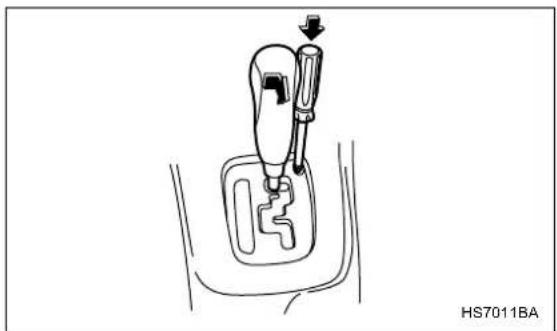
natural_image
Mechanical gear shift lever diagram showing tool and valve (no text or symbols)-
Insert the screwdriver into the hole.
-
Push down on the screwdriver and move the selector lever from the "P" to the "N" position.
- Remove the screwdriver from the hole. Depress the brake pedal and start the engine.
Take your vehicle to the nearest SUBARU dealer immediately to have the system repaired.
Automatic transmission (Turbo models)
WARNING
Do not shift from the "P" or "N" position into the "D", "3", "2", "1" or "R" position while depressing the accelerator pedal. This may cause the vehicle to jump forward or backward.
CAUTION
- Shift into the "P" or "R" position only after the vehicle is completely stopped. Shifting while the vehicle is moving may cause damage to the transmission.
- Do not race the engine for more than five seconds in any position except the "N" or "P" position when the brake is set or when wheel blocks are used. This may cause the automatic transmission fluid to overheat.
- Avoid shifting from one of the forward driving positions into the "R" position or vice versa until the vehicle has completely stopped. Such shifting may cause damage to the transmis-
- CONTINUED -
sion.
The automatic transmission is electronically controlled and provides 4 forward speeds and 1 reverse speed. Also, it has a manual mode.
NOTE
Immediately after ATF (automatic transmission fluid) is replaced, you may feel that the automatic transmission operation is somewhat unusual. This results from invalidation of data which the on-board computer has collected and stored in memory to allow the transmission to shift at the most appropriate times for the current condition of your vehicle. Optimized shifting will be restored as the vehicle continues to be driven for a while.
- Selector lever

text_image
1 P R E N D A UB7026BB1) Release button
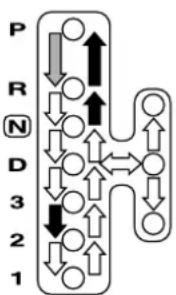
flowchart
graph TD
    P --> A
    R --> B
    N --> C
    D --> D
    3 --> E
    2 --> F
    1 --> G
    A --> H
    B --> I
    C --> J
    D --> K
    E --> L
    F --> M
    G --> N
    H --> O
    I --> P
    J --> Q
    K --> R
    L --> S
    M --> T
    N --> U
    O --> V
    P --> W
    Q --> X
    R --> Y
    S --> Z
    T --> AA
    U --> AB
    V --> AC
    W --> AD
    X --> AE
    Y --> AF
    Z --> AG
    AA --> AH
: When the brake pedal depressed, shift while pressing the button in.
→ : Shift while pressing the button in. → : Shift without pressing the button.
The selector lever has seven positions, "P", "R", "N", "D", "3", "2" and "1", and also has a manual gate for using SPORTSHIFT mode.
The release button must be pushed to select the "P", "R", or "2" positions.
▼ P (Park)
This position is for parking the vehicle and starting the engine.
In this position, the transmission is mechanically
locked to prevent the vehicle from rolling freely.
When you park the vehicle, first set the parking brake fully, then shift into the "P" position. Do not hold the vehicle with only the transmission.
A shift interlock function is employed in the automatic transmission system to ensure safe starting of the vehicle.
To shift the selector lever from the "P" to any other position, you have to depress the brake pedal fully then push the release button on the selector lever when the ignition switch is in the "ON" position. This prevents the vehicle from lurching when it is started.
If the shift lever does not move from the "P" position with the brake pedal depressed, the release button pushed in, and the ignition switch in the ON position, refer to the "Shift lock release" section in this chapter.
▼ R (Reverse)
This position is for backing the vehicle.
To shift from the "N" to "R" position, first stop the vehicle completely then move the lever to the "R" position while pushing the release button.
- CONTINUED -
▼ N (Neutral)
WARNING
Do not drive the vehicle with the selector lever in the "N" (neutral) position. Engine braking has no effect in this condition and the risk of an accident is consequently increased.
This position is for restarting a stalled engine.
In this position the wheels and transmission are not locked. In this position, the transmission is neutral; the vehicle will roll freely, even on the slightest incline unless the parking brake or foot brake is on.
Avoid coasting with the transmission neutral.
During coasting, there is no engine braking effect.
NOTE
If the selector lever is in the "N" position when you stop the engine for parking, you may not subsequently be able to move it to the "R" and "P" positions. If this happens, turn the ignition switch to the "ON" position. You will then be able to move the selector lever to the "P" position.
▼ D (Drive)
This position is for normal driving.
The transmission automatically shifts into a suitable gear from 1st to 4th according to the vehicle speed and the acceleration you require.
When more acceleration is required in this position, press the accelerator pedal fully to the floor and hold that position. The transmission will automatically downshift to 3rd, 2nd or 1st gear. When you release the pedal, the transmission will return to the original gear position.
To use the SPORTSHIFT mode, move the lever from this position into the manual gate.
While climbing a grade
When driving up a hill, undesired upshift to 4th gear is prevented from taking place when the accelerator is released. This minimizes the chance of subsequent downshifting to a lower gear when accelerating again. This prevents repeated upshifting and downshifting resulting in a smoother operation of the vehicle.
NOTE
The transmission may downshift to 2nd or 1st gear, depending on the way the accelerator pedal is pressed to accelerate the vehicle again.
While going down a hill
When descending a steep hill, depressing the brake pedal will cause the transmission to downshift to 3rd
gear, thus applying engine braking. Reacceleration for a short time will cause the transmission to upshift normally.
NOTE
In some cases, depressing the brake pedal on a downhill grade does not result in an automatic downshift to 3rd gear. This can happen when the automatic transmission fluid temperature is very low, for example, during driving shortly after the vehicle has been parked for an extended period of time. When the ATF temperature has risen to a certain level, automatic downshift normally takes place. In the meantime, downshift manually for engine braking as required.
Also, downshifting when braking downhill will not occur at speeds above approximately 50 mph (80 km/h).
▼ 3 (Third)
This position is for using engine braking when going down a hill or for climbing a grade.
The transmission automatically shifts into a suitable gear from 1st to 3rd according to the vehicle speed and the acceleration you require.
When more acceleration is required in this position, press the accelerator pedal fully to the floor and hold that position. The transmission will automatically downshift to 2nd or 1st gear. When you release the pedal, the transmission will return to the original gear position.
▼ 2 (Second)
To shift from the "3" to "2" position, push the release button.
This position is for using engine braking when going down a hill or for climbing a steep grade.
In this position, the transmission holds in the 2nd gear. Use this position when starting off from a standstill on slippery road surfaces such as mud or snow. It will ensure greater traction.
▼ 1 (First)
This position is for driving up or down very steep grades, or driving through mud or sand, or on slippery surfaces. In this position, the transmission holds in the 1st gear.
- Selector lever reverse inhibiting function
This function prevents accidental movement of the selector lever to the "R" position while the vehicle is moving.
- CONTINUED -
The function becomes operational when the vehicle reaches a speed of approximately 6 mph (10 km/h). Once operational, it prevents the selector lever from being moved from the "N" position to the "R" position. When the vehicle speed drops below 6 mph (10 km/h), the function is canceled. The selector lever can then be moved to the "R" and "P" positions.
When the ignition switch has been turned to the "OFF" position, movement of the selector lever from the "N" position to the "R" position is possible for a limited time period and then becomes impossible. Also, the selector lever cannot be moved to the "R" position when it has been placed in the "P" position and then placed again in the "N" position. When movement of the selector lever from the "N" position to the "R" position has become impossible, turn the ignition switch back to the "ON" position then move the selector lever to the "P" position. Pressing the selector lever release button also makes it possible to move the selector lever to the "P" position at this time.
▼ Selector lever release button

text_image
P R2D3AT UB7039BAIf you inadvertently have turned the ignition switch to the "OFF" position with the selector lever in the "N" position, proceed as follows. By referring to the "Shift lock release" section in this chapter, remove the shift lock release cover. Then, with the screwdriver inserted into the hole, move the selector lever to the "P" position. If the selector lever reverse inhibiting function fails, have the vehicle inspected by the nearest SUBARU dealer.
■ Selection of SPORTSHIFT mode (manual mode)

text_image
1 UB7027BB1) Selector lever
- Select the SPORTSHIFT mode by moving the selector lever into the manual gate from the "D" position with the vehicle stationary or moving.
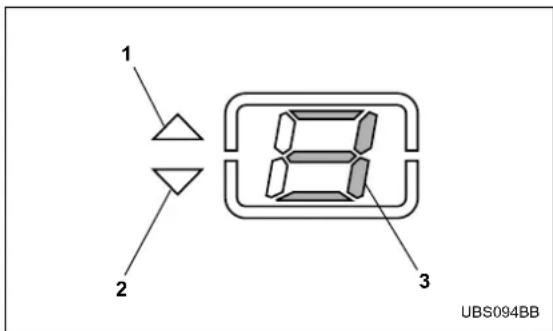
text_image
1 2 8 3 UBS094BB1) Lamp showing whether upshift is possible
2) Lamp showing whether downshift is possible
3) Indication of currently selected gear
- Once the SPORTSHIFT mode is selected, the currently selected gear is shown by the shift position indicator in the meter cluster. Next to this indication, arrow-shaped lamps show whether an upshift is possible and whether a downshift is possible.
Lamps showing whether upshifting and downshifting are possible:
The and lamps show whether upshifting and downshifting are possible. When both lamps are off, SPORTSHIFT operation is not possible. When both lamps are on, upshifting and downshifting are both
- CONTINUED -
possible. When only the lamp is on, only upshifting is possible. When only the lamp is on, only downshifting is possible.
- Perform gearshifts using the selector lever. You can shift by one gear at a time in the 1st-to-4th-gear range.
Upshifting
Shift to the next-higher gear (in the 1st-to-4th-gear range) by pushing the selector lever toward the "+" end of the manual gate.
Downshifting
Shift to the next-lower gear (in the 1st-to-4th-gear range) by pushing the selector lever toward the “-” end of the manual gate.
- To deselect the SPORTSHIFT mode, return the selector lever to the "D" position from the manual gate.
NOTE
Please read the following points carefully and bear them in mind when using the SPORTSHIFT mode.
- When the temperature of the automatic transmission fluid is lower or higher than normal, warning beeps are emitted and the shift position indicator shows “-”. If these warnings are issued, deselect the SPORTSHIFT mode to protect the auto-
matic transmission from damage.
- Automatic gearshifts do not take place in the SPORTSHIFT mode. Perform gearshifts in accordance with road conditions so that the tachometer needle does not enter the red zone. If the engine speed reaches a predetermined level, a fuel-cut function will operate. Shift up if this happens.
- If you attempt to shift down when the engine speed is too high, i.e., when a downshift would push the tachometer needle beyond the red zone, beeps will be emitted to warn you that the downshift is not possible.
- If you attempt to shift up when the vehicle speed is too low, the transmission will not respond.
- You can perform a skip-shift (for example, from 4th to 2nd or from 2nd to 4th) by operating the selector lever twice in rapid succession.
- The transmission automatically selects 1st gear when the vehicle stops moving. It will not permit a standing start in 2nd gear.
▼ Maximum speeds
WARNING
When down shifting a gear, ensure that the vehicle is not travelling at a speed exceeding the Maximum Allowable Speed for the gear which
is about to be selected. Failure to observe this precaution can lead to engine over-revving and this in turn can result in engine damage. In addition, sudden application of engine braking caused by downshifting when the vehicle is travelling on a slippery surface can lead to wheel locking; as a consequence, control of the vehicle may be lost and the risk of an accident increased.
The following tables show the maximum speeds that are possible with each different gear.
When down shifting, it is important to confirm that the current vehicle speed is not in excess of the Maximum Allowable Speed of the gear which is about to be selected.
mph (km/h)
| Position Turbo models | |
| 1 29 (47), 36 (58) | * |
| 2 60 (96), 62 (100) | * |
| 3 102 (164), 102 (164) | * |
*: SPORTSHIFT mode
Never exceed posted speed limits.
NOTE
- In order to prevent over-revving during acceleration of the vehicle, the transmission will automatically shift to the next higher gear if the Maximum Allowable Speed for the current gear is reached.
- Similarly, in order to prevent over-revving during deceleration of the vehicle, the transmission will remain in the current gear if the speed of the vehicle is in excess of the Maximum Allowable Speed for the gear to which the selector lever has been moved.
- Driving tips
- Always apply the foot or parking brake when the vehicle is stopped in the "D", "3", "2", "1", or "R" position.
- Always set the parking brake when parking your vehicle. Do not hold the vehicle with only the transmission.
- Do not keep the vehicle in a stationary position on an uphill grade by using the "D", "3", "2" or "1" position. Use the brake instead.
- The engine may, on rare occasions, knock when the vehicle rapidly accelerates or rapidly pulls away from a standstill. This phenomenon does not indicate a fault.
- CONTINUED -
Shift lock release
If the selector lever does not move from the "P" position with the brake pedal depressed and the ignition switch in the "ON" position, perform the following steps:
To override the shift lock:
- Set the parking brake and stop the engine.
- Take out the screwdriver from the tool bag.
- Remove the cover by prying on the edge with the flat-head screwdriver.

natural_image
Line drawing of a mechanical lever mechanism with no text or symbols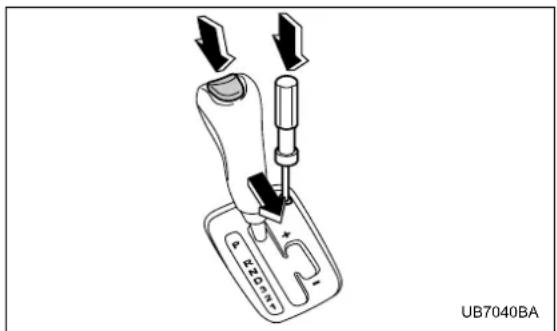
text_image
UB7040BA-
Insert the screwdriver into the hole.
-
Push down on the screwdriver, push down the button and move the selector lever from the "P" to the "N" position.
- Remove the screwdriver from the hole. Depress the brake pedal and start the engine.
Take your vehicle to the nearest SUBARU dealer immediately to have the system repaired.
Limited slip differential (LSD)
CAUTION
- Never start the engine while a tire on one side is jacked up, as the vehicle may move.
- If one rear tire is spinning in mud, avoid continued spinning at high speed as this could adversely affect the LSD.
- If a different size rear tire is temporarily used (as in an emergency), it will adversely affect the LSD. Always replace it with a regular size tire as soon as possible.
The LSD provides optimum distribution of power according to the difference in revolutions between the right and left rear wheels that may be caused by certain driving conditions, thereby improving driving stability on snow-covered, muddy or other slippery roads.
Power steering
CAUTION
Do not hold the steering wheel at the fully locked position left or right for more than five seconds. This may damage the power steering pump.
The power steering system operates only when the engine is running.
If you lose power steering assist because the engine stops or the system fails to function, you can steer but it will take much more effort.
NOTE
Right after the engine has been started and before it has warmed up, you may hear a noise coming from areas adjacent to the power steering pump which is located at the right-front area of the engine compartment. This noise is normal. It does not indicate power steering system trouble.
Braking
■ Braking tips
WARNING
Never rest your foot on the brake pedal while driving. This can cause dangerous overheating of the brakes and needless wear on the brake pads and linings.
▼ When the brakes get wet
When driving in rain or after washing the vehicle, the brakes may get wet. As a result, brake stopping distance will be longer. To dry the brakes, drive the vehicle at a safe speed while lightly depressing the brake pedal to heat up the brakes.
▼ Use of engine braking
Remember to make use of engine braking in addition to foot braking. When descending a grade, if only the foot brake is used, the brakes may start working improperly because of brake fluid overheating, caused by overheated brake pads. To help prevent this, shift into a lower gear to get stronger engine braking.
▼ Braking when a tire is punctured
Do not depress the brake pedal suddenly when a tire is punctured. This could cause a loss of control of the vehicle. Keep driving straight ahead while gradually reducing speed. Then slowly pull off the road to a safe place.
■ Brake system
▼ Two separate circuits
Your vehicle has a dual circuit brake systems. Each circuit works diagonally across the vehicle. If one circuit of the brake system should fail, the other half of the system still works. If one circuit fails, the brake pedal will go down much closer to the floor than usual and you will need to press it down much harder. And a much longer distance will be needed to stop the vehicle.
▼ Brake booster
The brake booster uses engine manifold vacuum to assist braking force. Do not turn off the engine while driving because that will turn off the brake booster, resulting in poor braking power.
The brakes will continue to work even when the brake booster completely stops functioning. If this happens, however, you will have to push the pedal much harder
than normal and the braking distance will increase.
■ Disc brake pad wear warning indicators
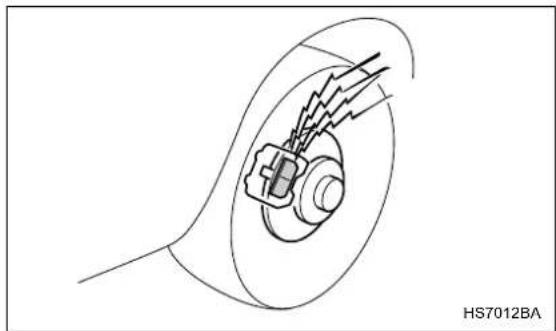
natural_image
Technical line drawing of a mechanical component with internal components and directional arrows (no text or symbols)The disc brake pad wear warning indicators on the disc brakes give a warning noise when the brake pads are worn.
If a squeaking or scraping noise is heard from the disc brakes while braking, immediately have your vehicle inspected by the nearest SUBARU dealer.
ABS (Anti-lock Brake System)
WARNING
Always use the utmost care in driving – overconfidence because you are driving with an ABS equipped vehicle could easily lead to a serious accident.
CAUTION
- The ABS system does not always decrease stopping distance. You should always maintain a safe following distance from other vehicles.
- When driving on badly surfaced roads, gravel roads, icy road, or over deep newly fallen snow, stopping distances may be longer for a vehicle with the ABS system than one without. When driving under these conditions, therefore, reduce your speed and leave ample distance from other vehicles.
- When you feel the ABS system operating, you should maintain constant brake pedal pressure. Do not pump the brake pedal since doing so may defeat the operation of the ABS system.
- CONTINUED -
The ABS system prevents the lock-up of wheels which may occur during sudden braking or braking on slippery road surfaces. This helps prevent the loss of steering control and directional stability caused by wheel lock-up.
When the ABS system is operating, you may hear a chattering noise or feel a slight vibration in the brake pedal. This is normal when the ABS operates.
The ABS system will not operate when the vehicle speed is below approximately 6 mph (10 km/h).
■ ABS system self-check
You may feel a slight shock in the brake pedal and hear the operating sound of ABS from the engine compartment just after the vehicle is started. This is caused by an automatic functional test of the ABS system being carried out and does not indicate any abnormal condition.
■ ABS warning light

text_image
ABS UB4010GAThe ABS warning light comes on when the ignition switch is turned to the "ON" position and goes out after about two seconds.
This is an indication that the ABS system is working properly.
CAUTION
If the warning light behaves as follows, the ABS system may not be working properly.
When the warning light is on, the ABS function shuts down; however, the conventional brake system continues to operate normally.
- The warning light does not come on when the ignition switch is turned to the "ON" position.
- The warning light comes on when the ignition switch is turned to the "ON" position, but it does not go out even when the vehicle speed exceeds approximately 8 mph (12 km/h).
- The warning light comes on during driving. If these occur, have the ABS system repaired at the first available opportunity by your SUBARU dealer.
NOTE
If the warning light behavior is as described below, the ABS system may be considered normal.
- The warning light comes on right after the engine is started but goes out immediately, remaining off.
- The warning light remains on after the engine has been started, but it goes out when the vehicle speed reaches about 8 mph (12 km/h).
- The warning light comes on during driving, but it goes out immediately and remains off.
When driving with an insufficient battery voltage such as when the engine is jump started, the ABS warning light may come on. This is due to the low battery voltage and does not indicate a malfunction. When the
battery becomes fully charged, the light will go out.
Parking your vehicle
WARNING
- Never leave unattended children or pets in the vehicle. They could accidentally injure themselves or others through inadvertent operation of the vehicle. Also, on hot or sunny days, the temperature in a closed vehicle could quickly become high enough to cause severe or possibly fatal injuries to them.
- Do not park the vehicle over flammable materials such as dry grass, waste paper or rags, as they may burn easily if they come near hot engine or exhaust system parts.
- Be sure to stop the engine if you take a nap in the vehicle. If engine exhaust gas enters the passenger compartment, occupants in the vehicle could die from carbon monoxide (CO) contained in the exhaust gas.
CAUTION
Never drive while the parking brake is set because this will cause unnecessary wear on the brake linings. Before starting to drive, always
make sure that the parking brake has been fully released.
To set the parking brake, press the brake pedal firmly and hold it down while fully pulling up the parking brake lever.
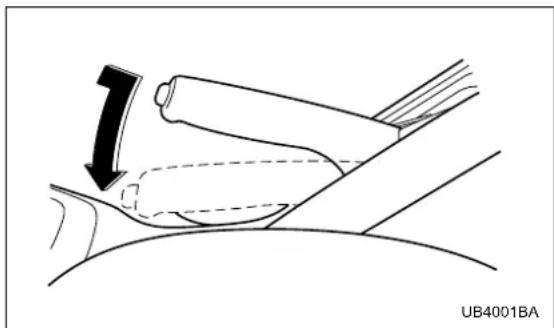
natural_image
Diagram of a car wheelbelt mechanism showing a lever and seat (no text or symbols)To release the parking brake, pull the lever up slightly, press the release button, then lower the lever while keeping the button pressed.
When the parking brake is set while the engine is running, the parking brake warning light comes on. After starting the vehicle, be sure that the warning light has gone out before the vehicle is driven. Refer to the
"Warning and indicator lights" section (chapter 3).
When parking your vehicle, always set the parking brake firmly and put the shift lever in the "1" (1st) for an upgrade or "R" (Reverse) for a downgrade for manual transmission vehicles, or in the "P" (Park) position for automatic transmission vehicles. Always set the parking brake firmly when parking your vehicle. Never rely on the transmission alone to hold the vehicle.
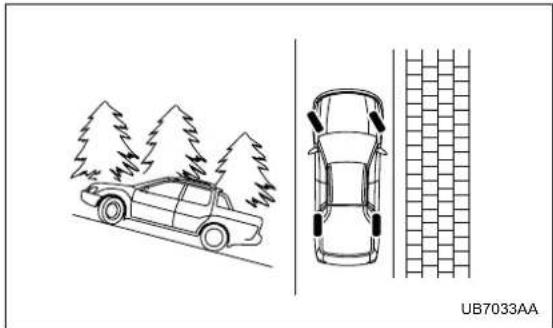
natural_image
Top-down line drawing of a car with trees and a side view showing front, rear, and side views (no text or symbols)When parking on a hill, always turn the steering wheel. When the vehicle is headed up the hill, the front wheels should be turned away from the curb.
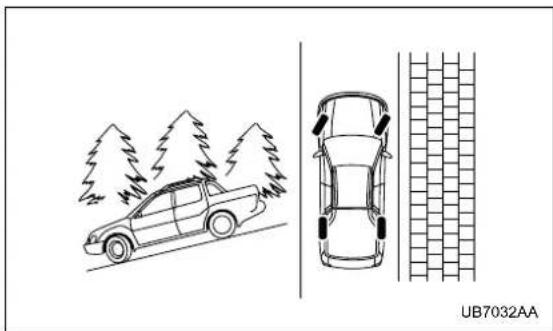
natural_image
Top-down line drawing of a car with trees and a side view showing front and rear views (no text or symbols)When facing downhill, the front wheels should be turned into the curb.
Cruise control
WARNING
Do not use the cruise control under any of the following conditions. This may cause loss of vehicle control:
- driving up or down a steep grade
- driving on slippery or winding roads
- driving in heavy traffic
Cruise control enables you to maintain a constant vehicle speed without holding your foot on the accelerator pedal and it is operative when the vehicle speed is 25 mph (40 km/h) or more. Make sure the main switch is turned "OFF" when the cruise control is not in use to avoid unintentionally by setting the cruise control.
■ To set cruise control
UB7038BA

text_image
HS7018BA- Push the "CRUISE" main switch. The indicator light on the switch will come on.
- Depress the accelerator pedal until the vehicle reaches the desired speed.
- Push the control lever downward in the "SET, COAST" direction and release it. Then release the accelerator pedal.
The vehicle will maintain the desired speed.

text_image
CRUISE SET UB4010KAAt this time, the “” indicator light is illuminated in the combination meter.
Vehicle speed can be temporarily increased while driving with the cruise control activated. Simply depress the accelerator pedal to accelerate the vehicle.
When the accelerator pedal is released, the vehicle will return to and maintain the previous cruising speed.
■ To temporarily cancel the cruise control
There are four ways to cancel the cruise control temporarily:
- Depress the brake pedal.
- Pull the control lever in the "CANCEL" direction. (if so equipped)
- Depress the clutch pedal (manual transmission vehicles only).
- Shift the selector lever into the "N" position (automatic transmission vehicles only).
- Shift the shift lever into neutral position (manual transmission vehicles only).
The “” indicator light in the combination meter goes off when the cruise control is cancelled.
To resume the cruise control after it has been temporarily canceled and with vehicle speed of about 20 mph (32 km/h) or more, push the control lever upward in the “ACCEL, RESUME” direction to return to the original cruising speed automatically.
The " indicator light in the combination meter will automatically come on at this time.
- CONTINUED -
■ To turn off the cruise control
There are two ways to turn off the cruise control:
- Push the main switch again.
- Turn the ignition switch to the "ACC" position (but only when the vehicle is completely stopped).
■ To change the cruising speed
▼ To increase the speed (by control lever)
Push the control lever upward in the "ACCEL, RE-SUME" direction and hold it until the vehicle reaches the desired speed. Then, release the control lever. The vehicle speed at that moment will be memorized and treated as the new set speed.
When the difference between the actual vehicle speed and the set speed is less than 4 mph (6.8 km/h), the set speed can be increased 1 mph (1.6 km/h) each time by pressing the control lever upward in the "AC-CEL, RESUME" direction quickly.
▼ To increase the speed (by accelerator pedal)
-
Depress the accelerator pedal to accelerate the vehicle to the desired speed.
-
Push the control lever downward in the "SET, COAST" direction once. Now the desired speed is set and the vehicle will keep running at that speed without
depressing the accelerator pedal.
NOTE
If the difference between the actual vehicle speed when the control lever is pushed downward and the speed last time you set it is less than 4 mph (6.8 km/h), the vehicle speed will be lowered by 1 mph (1.6 km/h). This occurs because the cruise control system unit regards this lever operation as that intended to decrease the vehicle speed.
▼ To decrease the speed (by control lever)
Push the control lever downward in the "SET, COAST" direction and hold it until the vehicle reaches the desired speed. Then, release the control lever. The vehicle speed at that moment will be memorized and treated as the new set speed.
When the difference between the actual vehicle speed and the set speed is less than 4 mph (6.8 km/h), the set speed can be lowered 1 mph (1.6 km/h) each time by pressing the control lever downward in the "SET, COAST" direction quickly.
▼ To decrease the speed (by brake pedal)
-
Depress the brake pedal to release cruise control temporarily.
-
When the speed decreases to the desired speed,
press the control lever downward in the "SET, COAST" direction once. Now the desired speed is set and the vehicle will keep running at that speed without depressing the accelerator pedal.
■ Cruise control set indicator light
▼ Non-turbo models
The light comes on when vehicle speed has been set.
▼ Turbo models
The Cruise set indicator light comes on when the ignition switch is turned to the "ON" position and goes out after about three seconds.
The light comes on when vehicle speed has been set.
NOTE
- If you move the cruise control lever while turning the ignition switch "ON", the cruise control function is deactivated and the cruise control set indicator light flashes. To reactivate the cruise control function, turn the ignition switch back to the "ACC" or "LOCK" position, and then turn it again to the "ON" position.
- If this indicator light and the “NECK” indicator light flash simultaneously during driving, have the vehicle checked by your nearest SUBARU dealer.
natural_image
Pure horizontal dashed lines on white background with no text, numbers, or symbolsDriving tips
New vehicle break-in driving – the first 1,000 miles (1,600 km) 8-2
Fuel economy hints 8-2
Engine exhaust gas (Carbon monoxide) .... 8-3
Catalytic converter 8-4
Periodic inspections 8-6
Driving in foreign countries 8-6
Driving tips for AWD vehicles 8-7
Off road driving 8-9
Winter driving 8-11
Operation during cold weather 8-11
Driving on snowy and icy roads 8-13
Corrosion protection 8-14
Snow tires 8-14
Tire chains 8-15
Rocking the vehicle 8-16
Loading your vehicle 8-16
Vehicle capacity weight 8-18
GVWR and GAWR (Gross Vehicle Weight Rating and Gross Axle Weight Rating) ...... 8-19
Trailer hitch (if equipped) 8-20
Connecting a trailer 8-20
When you do not tow a trailer 8-24
Trailer towing 8-24
Warranties and maintenance 8-24
Maximum load limits 8-25
Trailer hitches 8-30
Connecting a trailer 8-30
Trailer towing tips 8-33
New vehicle break-in driving – the first 1,000 miles (1,600 km)
The performance and long life of your vehicle are dependent on how you handle and care for your vehicle while it is new. Follow these instructions during the first 1,000 miles (1,600 km):
- Do not race the engine. And do not allow engine speed to exceed 4,000 rpm except in an emergency.
- Do not drive at one constant engine or vehicle speed for a long time, either fast or slow.
- Avoid starting suddenly and rapid acceleration, except in an emergency.
- Avoid hard braking, except in an emergency.
The same break-in procedures should be applied to a newly installed or overhauled engine or when brake pads or brake linings are replaced with new ones.
Fuel economy hints
The following suggestions will help to save your fuel.
- Select the proper gear position for the speed and road conditions.
- Avoid sudden acceleration or deceleration. Always accelerate gently until you reach the desired speed. Then try to maintain that speed for as long as possible.
- Do not pump the accelerator and avoid racing the engine.
- Avoid unnecessary engine idling.
- Keep the engine properly tuned.
- Keep the tires inflated to the correct pressure shown on the tire placard, which is located under the door latch on the driver's side. Low pressure will increase tire wear and fuel consumption.
- Use the air conditioner only when necessary.
- Keep the front and rear wheels in proper alignment.
- Avoid carrying unnecessary luggage or cargo.
Engine exhaust gas (Carbon monoxide)
WARNING
- Never inhale engine exhaust gas. Engine exhaust gas contains carbon monoxide, a colorless and odorless gas which is dangerous, or even lethal, if inhaled.
- Always properly maintain the engine exhaust system to prevent engine exhaust gas from entering the vehicle.
- Never run the engine in a closed space, such as a garage, except for the brief time needed to drive the vehicle in or out of it.
- Avoid remaining in a parked vehicle for a lengthy time while the engine is running. If that is unavoidable, then use the ventilation fan to force fresh air into the vehicle.
- Always keep the front ventilator inlet grille free from snow, leaves or other obstructions to ensure that the ventilation system always works properly.
- If at any time you suspect that exhaust fumes are entering the vehicle, have the problem checked and corrected as soon as possible. If you must drive under these conditions, drive
only with all windows fully open.
NOTE
Due to the expansion and contraction of the metals used in the manufacture of the exhaust system, you may hear a crackling sound coming from the exhaust system for a short time after the engine has been shut off. This sound is normal.
Catalytic converter
WARNING
- Avoid fire hazards. Do not drive or park the vehicle anywhere near flammable materials (e.g. grass, paper, rags or leaves), because the catalytic converter operates at very high temperatures.
- Keep everyone and flammable materials away from the exhaust pipe while the engine is running. The exhaust gas is very hot.
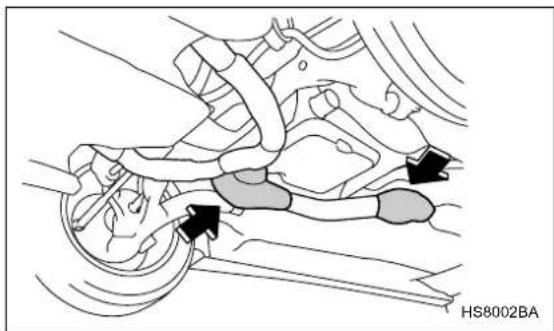
natural_image
Mechanical assembly diagram showing a valve mechanism with directional arrows (no text or symbols)Non-turbo models
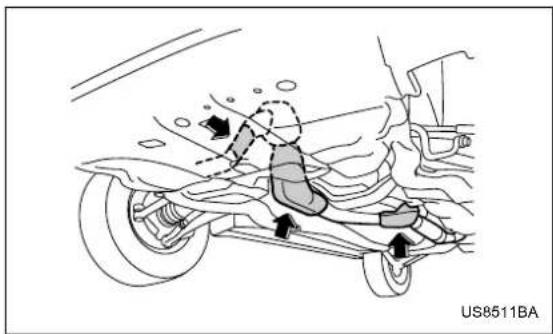
natural_image
Diagram of a car's wheel assembly with motion arrows indicating movement, no text or symbols presentTurbo models
The catalytic converter is installed in the exhaust system. It serves as catalyst to reduce HC, CO and NOx in exhaust gases, thus providing cleaner exhaust.
To avoid damage to the catalytic converter:
- Use only unleaded gasoline. Even a small amount of leaded gasoline will damage the catalytic converter.
- Never start the engine by pushing or pulling the vehicle.
- Avoid racing the engine.
- Never turn off the ignition switch while the vehicle is moving.
- Keep your engine tuned-up. If you feel the engine
running rough (misfiring, backfiring or incomplete combustion), have your vehicle checked and repaired by an authorized SUBARU dealer.
- Do not apply undercoating or rust prevention treatment to the heat shield of catalytic converter and the exhaust system.
Driving tips
Periodic inspections
To keep your vehicle in the best condition at all times, always have the recommended maintenance services listed in the maintenance schedule in the "Warranty and Maintenance Booklet" performed at the specified time or mileage intervals.
Driving in foreign countries
When planning to use your vehicle in another country:
- Confirm the availability of the correct fuel. (Refer to the "Fuel requirements" section in chapter 7.)
- Comply with all regulations and requirements of each country.
Driving tips for AWD vehicles
WARNING
- Always maintain a safe driving speed according to the road and weather conditions in order to avoid having an accident on a sharp turn, during sudden braking or under other similar conditions.
- Always use the utmost care in driving – overconfidence because you are driving an all wheel drive vehicle could easily lead to a serious accident.
natural_image
Diagram of a car with four wheels and directional arrows indicating motion (no text or symbols)HS8003BA
All wheel drive distributes the engine power to all four wheels. AWD vehicles provide better traction when driving on slippery, wet or snow-covered roads and when moving out of mud, dirt and sand. By shifting power between the front and rear wheels, SUBARU AWD can also provide added traction during acceleration, and added engine braking force during deceleration.
Therefore, your SUBARU AWD vehicle may handle differently than an ordinary two wheel drive vehicle and it contains some features unique to AWD. For safety purposes as well as to avoid damaging the AWD system, you should keep the following tips in mind:
- CONTINUED -
Driving tips
- An AWD vehicle is better able to climb steeper roads under snowy or slippery conditions than a two wheel drive vehicle. There is little difference in handling, however, during extremely sharp turns or sudden braking. Therefore, when driving down a slope or turning corners, be sure to reduce your speed and maintain an ample distance from other vehicles.
- When replacing a tire, make sure you use only the same size, circumference, construction, brand, and load range as the original tires listed on the tire placard. Using other sizes, circumferences or construction may result in severe mechanical damage to the drive train of your vehicle and may affect ride, handling, braking, speedometer/odometer calibration, and clearance between the body and tires. It also may be dangerous and lead to loss of vehicle control.
- If you use a temporary spare tire to replace a flat tire, be sure to use the original temporary spare tire stored in the vehicle. Using other sizes may result in severe mechanical damage to the drive train of your vehicle.
- Always check the cold tire pressure before starting to drive. The recommended tire pressure is provided on the tire placard, which is located under the door latch on the driver's side.
- Tire chains should always be placed on the front wheels only.
- There are some precautions that you must observe when towing your vehicle. For detail information, see "Towing" section in chapter 9.
Off road driving
WARNING
- Always maintain a safe driving speed according to the road and weather conditions in order to avoid having an accident on a sharp turn, during sudden braking or under other similar conditions.
- Always use the utmost care in driving – overconfidence because you are driving an all wheel drive vehicle could easily lead to a serious accident.
Because of the AWD feature and higher ground clearance, your SUBARU can be driven on ordinary roads or off-road. But please keep in mind that an AWD SUBARU is neither a conventional off-road vehicle nor an all-terrain vehicle. If you do take your SUBARU off-road, certain common sense precautions such as the following should be taken:
- Make certain that you and all of your passengers are wearing seatbelts.
-
Carry some emergency equipment, such as a towing rope or chain, a shovel, wheel blocks, first aid kit and cell phone or citizens band radio.
-
Drive carefully. Do not take unnecessary risks by driving in dangerous areas or over rough terrain.
- Slow down and employ extra caution at all times. When driving off-road, you will not have the benefit of marked traffic lanes, banked curves, traffic signs and the like.
- Do not drive across steep slopes. Instead, drive either straight up or straight down the slopes. A vehicle can much more easily tip over sideways than it can end over end. Avoid driving straight up or down slopes that are too steep.
- Avoid sharp turning maneuvers, especially at higher speeds.
- Do not grip the inside or spokes of the steering wheel. A bad bump could jerk the wheel and injure your hands. Instead drive with your fingers and thumbs on the outside of the rim.
- If driving through water, such as when crossing shallow streams, first check the depth of the water and the bottom of the stream bed for firmness and ensure that the bed of the stream is flat. Drive slowly and completely through the stream. The water should be shallow enough that it does not reach the vehicle's undercarriage. Water entering the engine air intake or the exhaust pipe or water splashing onto electrical parts may damage your vehicle and may cause it to stall. Never attempt to drive through rushing water; regard-
- CONTINUED -
less of its depth, it can wash away the ground from under your tires, resulting in possible loss of traction and even vehicle rollover.
- Always check your brakes for effectiveness immediately after driving in sand, mud or water. Do this by driving slowly and stepping on the brake pedal. Repeat that process several times to dry out the brake discs and brake pads.
- Do not drive or park over or near flammable materials such as dry grass or fallen leaves, as they may burn easily. The exhaust system is very hot while the engine is running and right after engine stops. This could create a fire hazard.
- After driving through tall grass, mud, rocks, sand, rivers, etc., check that there is no grass, bush, paper, rags, stones, sand, etc. adhering to or trapped on the underbody. Clear off any such matter from the underbody. If the vehicle is used with these materials trapped or adhering to the underbody, a mechanical breakdown or fire could occur.
- Secure all cargo carried inside the vehicle and make certain that it is not piled higher than the seatbacks. During sudden stops or jolts, unsecured cargo could be thrown around in the vehicle and cause injury.
- Do not pile heavy loads on the roof. Those loads raise the vehicle's center of gravity and make it more prone to tip over.
- Cargo should be evenly distributed over the cargo bed. Keep heavier items as low and far forward as possible. Loading the vehicle improperly can deteriorate handling capability and contribute to loss of vehicle control.
- Be sure the cargo is secured properly. Unsecured cargo in the cargo bed can be thrown around when driving on off-road. To prevent loose cargo from entering the passenger compartment, always close the switchback door while driving off-road.
- Always close the tailgate while driving off-road. Also remove the bed extender (if so equipped) to avoid damage.
- If you must rock the vehicle to free it from sand or mud, depress the accelerator pedal slightly and move the selector lever back and forth between "D" and "R" repeatedly. Do not race the engine. For the best possible traction, avoid spinning the wheels when trying to free the vehicle.
- When the road surface is extremely slippery, you can obtain better traction by starting the vehicle with the transmission in 2nd than 1st (both for MT and AT).
- Never equip your vehicle with tires larger than those specified in this manual.
- Wash the vehicle's underbody after off-road driving. Suspension components are particularly prone to dirt buildup, so they need to be washed thoroughly.
- Frequent driving of an AWD vehicle under hard-driving conditions such as rough roads or off roads will necessitate more frequent replacement of engine oil, brake fluid and transmission oil than that specified in the maintenance schedule described in the "Warranty and Maintenance Booklet".
Remember that damage done to your SUBARU while operating it off-road and not using common sense precautions such as those listed above is not eligible for warranty coverage.
Winter driving

natural_image
Cartoon illustration of a snowman driving on a road with mountains in the background (no text or symbols)■ Operation during cold weather
Carry some emergency equipment, such as tire chains, a window scraper, a bag of sand, flares, a small shovel, and jumper cables.
Check the battery and cables. Cold temperatures reduce battery capacity. The battery must be in good condition to provide enough power for cold winter starts.
Use an engine oil of proper grade and viscosity for cold weather. Heavy summer oil will cause harder
- CONTINUED -
starting.
Keep the door locks from freezing by squirting them with deicer or glycerin.
Forcing a frozen door open may damage or separate the rubber weather strips around the door. If the door is frozen, use hot water to melt the ice, and afterwards thoroughly wipe the water away.
Use a windshield washer fluid that contains an anti-freeze solution. Do not use engine antifreeze or other substitutes because they may damage the paint of the vehicle.
▼ Before driving your vehicle
Before entering the vehicle, remove any snow or ice from your shoes because that could make the pedals slippery and dangerous.
While warming up the vehicle before driving, check that the accelerator pedal, brake pedal, and all other controls operate smoothly.
Clear away ice and snow that has accumulated under the fenders to avoid making steering difficult. During severe winter driving, stop when and where it is safe to do so and check under the fenders periodically.
▼ Parking in cold weather
WARNING
Snow can trap dangerous exhaust gases under your vehicle. Keep snow clear of the exhaust pipe and from around your vehicle if you park the vehicle in snow with the engine running.
Do not use the parking brake when parking for long periods in cold weather since it could freeze in that position. Instead, observe the following:
- Place the shift lever in "1" or "R" for manual transmission vehicles, and in "P" for automatic transmission vehicles.
- Use tire stops under the tires to prevent the vehicle from moving.
When the vehicle is parked in snow or when it snows, raise the wiper blades off the glass to prevent damage to them.
When the vehicle has been left parked after use on roads heavily covered with snow, or has been left parked during a snowstorm, icing may develop on the brake system, which could cause poor braking action.
Check for snow or ice buildup on the suspension, disc brakes and brake hoses underneath the vehicle.
If there is caked snow or ice, remove it, being careful not to damage the disc brakes and brake hoses and ABS harness.
▼ Refueling in cold weather
To help prevent moisture from forming in the fuel system and the risk of its freezing, use of an antifreeze additive in the fuel tank is recommended during cold weather.
Use only additives that are specifically designed for this purpose. When an antifreeze additive is used, its effect lasts longer if the tank is refilled whenever the fuel level reaches half empty.
If your SUBARU is not going to be used for an extended period, it is best to have the fuel tank filled to capacity.
■ Driving on snowy and icy roads
WARNING
Do not use the cruise control on slippery roads such as snowy or icy roads. This may cause loss of vehicle control.
To prevent skidding and slipping, avoid sudden brak-
ing, abrupt acceleration, high-speed driving, and sharp turning when driving on snowy or icy roads.
Always maintain ample distance between your vehicle and the vehicle ahead of you to avoid the need for sudden braking.
To supplement the foot brake, use the engine brake effectively to control the vehicle speed. (Shift into a lower gear when necessary.)
Avoid shifting down abruptly. Such behavior can cause the wheels to lock, possibly leading to loss of vehicle control.
An anti-lock brake system (ABS) enhances your vehicle's braking performance on snowy and icy roads. Refer to the "ABS (Anti-lock Brake System)" section in chapter 7 for information on braking on slippery surfaces.
▼ Wiper operation when snowing
Before driving in cold weather, make sure the wiper blades are not frozen to the windshield or rear window. If the wiper blades are frozen to the windshield or rear window, use the defroster with the airflow control dial in the “” position and the temperature control dial set for maximum warmth until the wiper blades are completely thawed out. If your vehicle is equipped with a wiper deicer, it is helpful to thaw the windshield wiper blades.
- CONTINUED -
When driving in snow, if frozen snow starts to stick on the surface of the windshield despite wiper operation, use the defroster with the airflow control dial in " " and the temperature control dial set for maximum warmth. After the windshield gets warmed enough to melt the frozen snow on it, wash it away using the windshield washer.
Snow stuck on the wiper arm prevents the wiper from working effectively. If snow is stuck on the wiper arm, pull off the road to a safe place, then remove it. If you stop the vehicle at road side, use the hazard warning flasher to alert other drivers.
We recommend use of non-freezing type wiper blades (winter blades) during the seasons you could have snow and sub-zero temperatures. Blades of this type give superior wiping performance in snowy conditions. Be sure to use blades that are suitable for your vehicle.
■ Corrosion protection
Refer to the "Corrosion protection" section (chapter 10).
■ Snow tires
WARNING
- When replacing original tires with winter (snow) tires, make sure you use only the same size and construction as recommended. Using other sizes and construction may affect speedometer/odometer calibration and clearance between the body and tires. It also may be dangerous and lead to loss of vehicle control.
- You must install four winter tires that are of the same size, circumferences, construction, brand, and load range. Mixing other sizes, circumferences or constructions may result in severe mechanical damage to the drive train of your vehicle and may affect ride, handling, braking and speedometer/odometer calibration. It also may be dangerous and lead to loss of vehicle control.
- Do not use a combination of radial, belted bias or bias tires since it may cause dangerous handling characteristics and lead to an accident.
Your vehicle is equipped with "all season tires" which are designed to provide an adequate measure of trac-
tion, handling and braking performance in year-round driving. In winter, it may be possible to enhance performance through use of tires designed specifically for winter driving conditions.
If you choose to install winter tires on your vehicle, be sure to use the correct tire size and type. You must install four winter tires that are of the same size, construction, brand and load range and you should never mix radial, belted bias or bias tires since this may result in dangerous handling characteristics. When you choose a tire, make sure that there is enough clearance between the tire and vehicle body.
Remember to drive with care at all times regardless of the type of tires on your vehicle.
Your vehicle comes with P225/60R16 "all season tires" as original equipment. You should be aware that some winter tires with that same size designation may actually be too large for the vehicle and may cause rubbing on sharp turns. Listed below is the winter tire size that we recommend.
Recommended winter (snow) tire size
P215/60R16 Studless
■ Tire chains
CAUTION
Tire chains cannot be used on tires listed below because of lack of clearance between the tires and vehicle body.
• P225/60R16 tires
• P215/60R16 winter (snow) tires
Driving on snowy grades or icy roads may require the use of tire chains, in which case put the chains on the front wheels only. Use only SAE class S type chains that are of the correct size for your tires so as not to damage the vehicle body or suspension.
When driving with tire chains, drive at speeds below 19 mph (30 km/h). When a temporary spare tire is on a front wheel, replace the temporary spare tire with the rear tire on the same side of the vehicle, and then fit chains on the front tires.
Always use the utmost care when driving with tire chains – overconfidence because you are driving with tire chains could easily lead to a serious accident.
- CONTINUED -
■ Rocking the vehicle
If you must rock the vehicle to free it from snow, sand, or mud, depress the accelerator pedal slightly and move the selector lever back and forth between "D" and "R" repeatedly. Do not race the engine. For the best possible traction, avoid spinning the wheels when trying to free the vehicle.
When the road surface is extremely slippery, you can obtain better traction by starting the vehicle with the transmission in 2nd than 1st (both for MT and AT).
Refer to the "Automatic transmission" section in chapter 7 for information on holding the transmission in 2nd position.
Loading your vehicle
WARNING
Never allow passengers to ride on the folded rear seatback or in the cargo bed. Doing so may result in serious injury.

natural_image
Simple line drawing of a person sitting on the floor with a large box and a diagonal no-smoking symbol in the background (no text or labels)HS8005BA
WARNING
- Never stack luggage or other cargo higher than the top of the seatback because it could tumble forward and injure passengers in the
event of a sudden stop or accident. Keep luggage or cargo low, as close to the floor as possible.
- When you carry something inside the vehicle, secure it whenever you can to prevent it from being thrown around inside the vehicle during sudden stops, sharp turns or in an accident.
- Do not pile heavy loads on the roof. These loads raise the vehicle's center of gravity and make it more prone to tip over.
- Secure lengthy items properly to prevent them from shooting forward and causing serious injury during a sudden stop.
- Never exceed the maximum load limit. If you do, some parts on your vehicle can break, or it can change the way your vehicle handles. This could result in loss of control and cause personal injury. Also, overloading can shorten the life of your vehicle.
- Cargo should be evenly distributed over the cargo bed. Keep heavier items as low and far forward as possible. Loading the vehicle improperly can deteriorate handling capability and contribute to loss of vehicle control.
- Be sure the cargo is secured properly. Unsecured cargo in the cargo bed can be thrown around during sudden braking, in a sharp turn
or during rapid acceleration, which could create a dangerous road hazard.
CAUTION
Do not carry spray cans, containers with flammable or corrosive liquids or any other dangerous items inside the passenger compartment.
NOTE
For better fuel economy, do not carry unneeded cargo.
- CONTINUED -
■ Vehicle capacity weight

natural_image
Side profile illustration of a car with driver and passenger inside, labeled UB8031BA (no text or symbols on the diagram itself)The load capacity of your vehicle is determined by weight, not by available cargo space. The total weight you can carry in your vehicle is shown on the vehicle placard attached to the driver's side door jamb. Locate the statement "The combined weight of occupants and cargo should never exceed XXX kg or XXX lbs" on your vehicle's placard. It includes the total weight of driver and all passengers and their belongings, any optional equipment such as a trailer hitch, roof rack or bike carrier, etc., and the tongue load of a trailer.
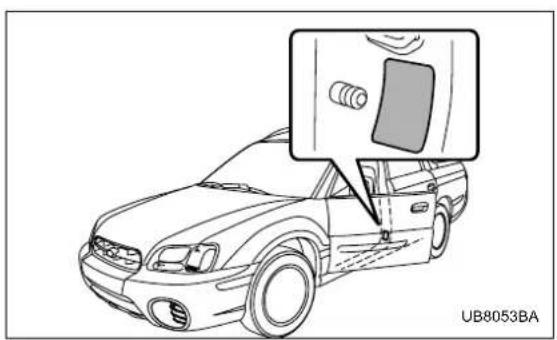
natural_image
Line drawing of a car with an inset showing a door panel and a sensor device (no text or symbols on the car itself)■ GVWR and GAWR (Gross Vehicle Weight Rating and Gross Axle Weight Rating)
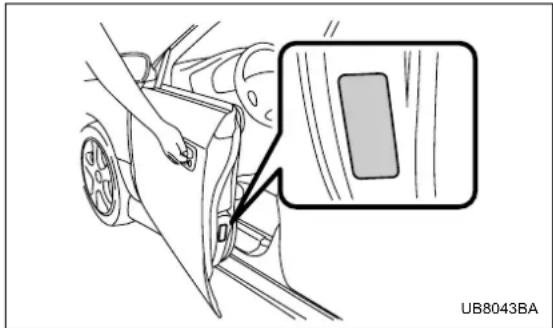
text_image
UB8043BAThe certification label attached to the driver's side door shows GVWR (Gross Vehicle Weight Rating) and GAWR (Gross Axle Weight Rating). The GVW (Gross Vehicle Weight) must never exceed the GVWR. GVW is the combined total of weight of the vehicle, fuel, driver, all passengers, luggage, any optional equipment and trailer tongue load. Therefore, the GVW changes depending on the situation.
In addition, the total weight applied to each axle (GAW) must never exceed the GAWR. The front and
rear GAWs can be adjusted by relocating luggage inside the vehicle.
Even if the total weight of your luggage is lower than the vehicle capacity weight, either front or rear GAW may exceed the GAWR, depending on the distribution of the luggage.
When possible, the load should be evenly distributed throughout the vehicle.
If you carry heavy loads in the vehicle, you should confirm that GVW and front and rear GAWs are within the GVWR and GAWR by putting your vehicle on a vehicle scale, found at a commercial weighing station.
Do not use replacement tires with a lower load range than the originals because they may lower the GVWR and GAWR limitations. Replacement tires with a higher load range than the originals do not increase the GVWR and GAWR limitations.
Trailer hitch (if equipped)
WARNING
- Never exceed the maximum weight specified for the trailer hitch. Exceeding the maximum weight could cause an accident resulting in serious personal injuries. Permissible trailer weight changes depending on the situation. Refer to the next section "Trailer towing" for possible recommendations and limitations.
- Trailer brakes are required when the towing load exceeds 1,000 lbs (453 kg). Be sure your trailer has safety chains and that each chain will hold the trailer's maximum gross weight. Towing trailers without safety chains could create a traffic safety hazard if the trailer separates from the hitch due to coupling damage or hitch ball damage.
- Be sure to check the hitch pin and safety pin for positive locking placement before towing a trailer. If the ball mount comes off the hitch receiver, the trailer could get loose and create a traffic safety hazard.
- Use only the ball mount supplied with this hitch. Use the hitch only as a weight carrying hitch. Do not use with any type of weight dis-
tributing hitch.
The trailer hitch is designed to tow a Class 1 rated load. A maximum of 2,400 lbs (1,087 kg) gross trailer weight and a maximum of 200 lbs (90 kg) gross tongue weight are permissible for the trailer hitch. When you tow a trailer, follow the instructions in the next section "Trailer towing".
■ Connecting a trailer
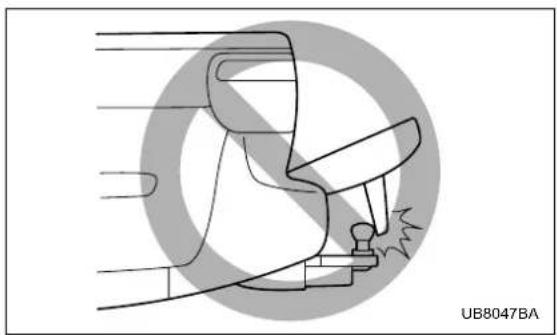
natural_image
Diagram of a car seatbelt mechanism with no text or symbolsCAUTION
The license plate bracket will hit the hitch ball and may be damaged if the tailgate is opened and the license plate bracket is at the lowered/open position. Close the tailgate and return the license plate bracket to its normal position flush against the tailgate itself whenever you tow a trailer or whenever a trailer is hitched to the vehicle.
-
Before connecting the ball mount to the hitch receiver, close the tailgate and return the license plate bracket to its normal retracted position up against the tailgate. Refer to "License plate bracket" under the heading "Tailgate" in chapter 2 for more information on the function of the license plate bracket.
-
Remove the receiver cover from the hitch receiver tube. Then insert the ball mount into the hitch receiver tube.
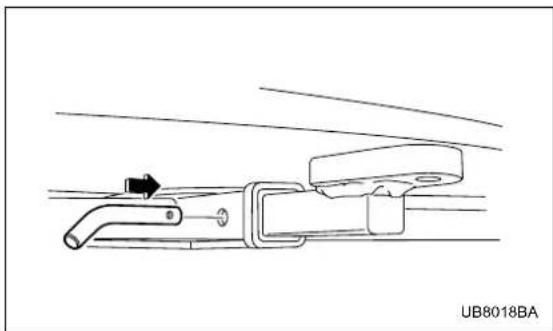
natural_image
Technical line drawing of a mechanical clamp or bracket assembly (no text or symbols)- Insert the hitch pin into the hole on the hitch receiver tube so that the pin passes through the ball mount.
- CONTINUED -

natural_image
Technical line drawing of a mechanical component with a lever and pin (no text or symbols)- Insert the safety pin into the hitch pin securely.
- Pull the ball mount to make sure it does not come off the hitch receiver.

text_image
1 2 UB8020BB1) Hitch ball installation point
2) Hooks for safety chains
-
Use only a hitch ball that is appropriate for the ball mount and your trailer. The hitch ball must be securely installed on the ball mount.
-
Connect your trailer to the hitch ball.
-
Connect the trailer and the hitch with safety chains that will hold the trailer's maximum gross weight. The chains should cross under the trailer tongue to prevent the tongue from dropping onto the ground in case it should disconnect from the hitch ball. Allow sufficient slack in the chains taking tight-turn situations into account; however, be careful not to let them drag on the
ground.
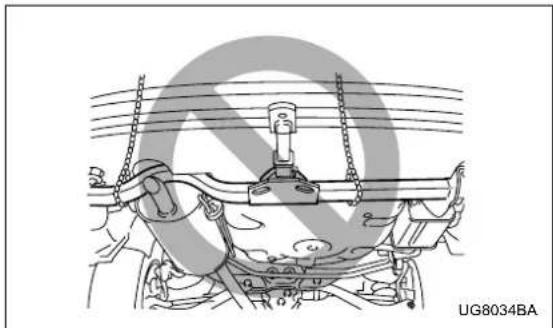
natural_image
Technical line drawing of a mechanical assembly with no visible text or symbolsWARNING
Do not connect safety chains to part of the vehicle other than the safety chain hooks.

natural_image
Technical line drawing of a mechanical clamp or bracket attached to a wire, labeled HS8015BA (no text or symbols on the diagram itself)Hitch harness connector
- Connect the hitch wire harness's black four-pin wire connector to the towing trailer's wire harness.
- Confirm proper function of the hitch wire harness by individually activating the brake, right turn signal, left turn signal, stop, and parking lights on the trailer.
NOTE
Always disconnect the trailer wire harness before launching or retrieving a watercraft.
- CONTINUED -
■ When you do not tow a trailer
CAUTION
Remove the ball mount from the hitch receiver tube when the tailgate is open and the bed extender is used. The rear license plate will not be visible because the license plate bracket can not be used at the lowered/open position when the ball mount is connected.
In addition, the license plate bracket will hit the hitch ball and may be damaged if the tailgate is opened and the license plate bracket is at the lowered/open position.
- Remove the ball mount from the hitch receiver tube and insert the receiver cover onto the hitch receiver tube.
- Place the dust cap over the four-pin connector of the hitch wire harness to protect against possible damage.
- Occasionally lubricate terminals of the four-pin connector using the terminal grease, and cover with the attached rubber cap.
Trailer towing
Your vehicle is designed and intended to be used primarily to carry passengers and cargo. Towing a trailer puts additional loads on your vehicle's engine, drivetrain, brakes, tires and suspension and has an adverse effect on fuel economy.
If you do decide to tow a trailer, your safety and satisfaction depend upon proper use of correct equipment and cautious operation of your vehicle. Seek the advice of your SUBARU dealer to assist you in purchasing a hitch and other necessary towing equipment appropriate for your vehicle. In addition, be sure to follow the instructions on correct installation and use provided by the trailer and other towing equipment manufacturers.
SUBARU assumes no responsibility for injuries or vehicle damage that result from trailer towing equipment, or from any errors or omissions in the instructions accompanying such equipment or for your failure to follow the proper instructions.
■ Warranties and maintenance
SUBARU warranties do not apply to vehicle damage or malfunction caused by trailer towing. If you use your vehicle to tow a trailer, more frequent maintenance will be required due to the additional load. (Refer to "Main-
tenance schedule under severe driving conditions" in the "Warranty and Maintenance Booklet".)
Under no circumstances should a trailer be towed with a new vehicle or a vehicle with any new powertrain component (engine, transmission, differential, wheel bearings, etc.) for the first 1,000 miles (1,600 km) of driving.
■ Maximum load limits
WARNING
Never exceed the maximum load limits explained below. Exceeding the maximum load limits could cause personal injury and/or vehicle damage.
CAUTION
- Adequate size trailer brakes are required when the trailer and its cargo exceed 1,000 lbs (453 kg) total weight.
- Before towing a trailer, check the trailer total weight, GVW, GAWs and tongue load. Make sure the load and its distribution in your vehicle
and trailer are acceptable.
▼ Total trailer weight

natural_image
Simple line drawing of a vehicle on a platform with a wall-mounted clock (no text or symbols)HS8016AA
Total trailer weight
The total trailer weight (trailer weight plus its cargo load) must never exceed the maximum weight shown in the following table.
- CONTINUED -
| Model Conditions Maximum | total trailer weight | |
| MT models W | When towing a trailer without brakes. | 1,000 lbs (453 kg) |
| When towing a trailer with brakes. | 2,400 lbs (1,087 kg) | |
| AT models W | When towing a trailer without brakes. | 1,000 lbs (453 kg) |
| When towing a trailer with brakes. | 2,400 lbs (1,087 kg) | |
| When towing a trailer on a long uphill grade continuously for over 5 miles (8 km) with an outside temperature of 104°F (40°C) or above. | 1,200 lbs (543 kg) | |
▼ Gross Vehicle Weight (GVW) and Gross Vehicle Weight Rating (GVWR)
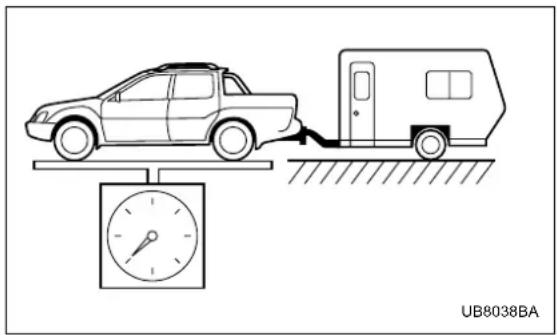
natural_image
Diagram of a car being connected to a vehicle via a pressure gauge, with no visible text or symbols.Gross Vehicle Weight
The Gross Vehicle Weight (GVW) must never exceed the Gross Vehicle Weight Rating (GVWR).
Gross Vehicle Weight (GVW) is the combined total of the weight of the vehicle, driver, passengers, luggage, trailer hitch, trailer tongue load and any other optional equipment installed on your vehicle. Therefore, the GVW changes depending on the situation. Determine the GVW each time before going on a trip by putting your vehicle and trailer on a vehicle scale.

text_image
UB8043BAGVWR is shown on the certification label located on the driver's door of your vehicle.
▼ Gross Axle Weight (GAW) and Gross Axle Weight Rating (GAWR)
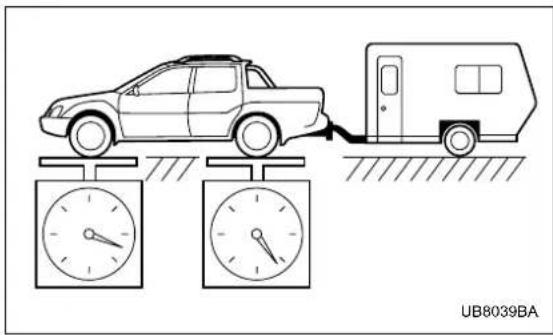
text_image
UB8039BAGross Axle Weight
The total weight applied to each axle (GAW) must never exceed the Gross Axle Weight Rating (GAWR). The front and rear GAWs can be adjusted by relocating passengers and luggage inside the vehicle.
- CONTINUED -
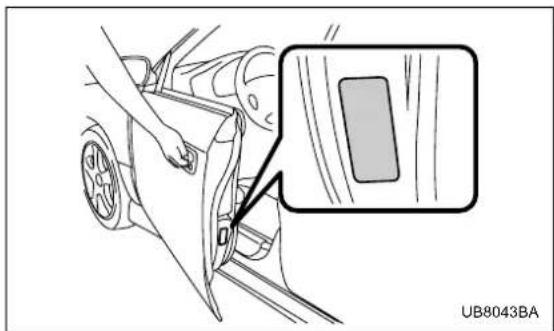
text_image
UB8043BAThe front and rear GAWR are also shown on the certification label.
To check both GVWR and GAWR and to confirm that the total weight and weight distribution are within safe driving limits, you should have your vehicle and trailer weighed at a commercial weighing station.
Be sure that all cargo is firmly secured to prevent a change in weight distribution while driving.
▼ Tongue load

text_image
HS8019AATongue load
WARNING
If the trailer is loaded with more weight in the back of trailer's axle than in the front, the load is taken off the rear axle of the towing vehicle. This may cause the rear wheels to skid, especially during braking or when vehicle speed is reduced during cornering, resulting in oversteer, spin out and/or jackknifing.
Ensure that the trailer tongue load is from 8 to 11 per-cent of the total trailer weight and does not exceed the maximum value of 200 lbs (90 kg).

text_image
1 2 UB8040BB1) Jack
2) Bathroom scale
The tongue load can be weighed with a bathroom scale as shown in the illustration below. When weighing the tongue load, be sure to position the towing coupler at the height at which it would be during actual towing, using a jack as shown.

text_image
F 60% 40% 50% 50% HS8021BBF: Front
The tongue load can be adjusted by proper distribution of the load in the trailer. Never load the trailer with more weight in the back than in the front; approximately 60 percent of the trailer load should be in the front and approximately 40 percent in the rear. Also, distribute the load as evenly as possible on both the left and right sides.
Be sure that all cargo is firmly secured to prevent a change in weight distribution while driving.
- CONTINUED -
■ Trailer hitches
WARNING
Never drill the frame or under-body of your vehicle to install a commercial trailer hitch. If you do, dangerous exhaust gas, water or mud may enter the passenger compartment through the drilled hole. Exhaust gas contains carbon monoxide, a colorless and odorless gas which is dangerous, or even lethal, if inhaled. Also, drilling the frame or under-body of your vehicle could cause deterioration of strength of your vehicle and cause corrosion around the drilled hole.
CAUTION
- Do not modify the vehicle exhaust system, brake system, or other systems when installing a hitch or other trailer towing equipment.
- Do not use axle-mounted hitches as they can cause damage to the axle housing, wheel bearings, wheels or tires.
The use of a genuine SUBARU trailer hitch is recom-
mended. A genuine SUBARU hitch is available from your SUBARU dealer.
If use of a non-genuine hitch is unavoidable, be sure the hitch is suited to your vehicle and trailer. Consult with a professional hitch supplier to assist you in choosing an appropriate hitch for your vehicle. Be sure to follow all of the hitch manufacturer's instructions for installation and use.
Never use a hitch that mounts only to the rear bumper. The bumper is not designed to handle that type of load.
For all types of hitches, regularly check that the hitch mounting bolts and nuts are tight.
■ Connecting a trailer
▼ Trailer brakes
WARNING
- Adequate size trailer brakes are required when the trailer and its cargo exceed 1,000 lbs (453 kg) total weight.
- Do not directly connect your trailer's hydraulic brake system to the hydraulic brake system in your vehicle. Direct connection would cause the vehicle's brake performance to deteriorate
and could lead to an accident.
If your trailer's total weight (trailer weight plus its cargo weight) exceeds 1,000 lbs (453 kg), the trailer is required to be equipped with its own brake system. Electric brakes or surge brakes are recommended, and must be installed properly. Check that your trailer's brakes conform with Federal, state/province and/or other applicable regulations. Your SUBARU's brake system is not designed to be tapped into the trailer's hydraulic brake system. Please ask your SUBARU dealer and professional trailer supplier for more information about the trailer's brake system.
▼ Trailer safety chains
WARNING
Always use safety chains between your vehicle and the trailer. Towing trailer without safety chains could create a traffic safety hazard if the trailer separates from the hitch due to coupling damage or hitch ball damage.
In case the trailer hitch connector or hitch ball should break or become disconnected, the trailer could get
loose and create a traffic safety hazard.
For safety, always connect the towing vehicle and trailer with trailer safety chains. Pass the chains crossing each other under the trailer tongue to prevent the trailer from dropping onto the ground in case the trailer tongue should disconnect from the hitch ball. Allow sufficient slack in the chains taking tight-turn situations into account; however, be careful not to let them drag on the ground.
For more information about the safety chain connection, refer to the instructions for your hitch and trailer.
▼ Side mirrors
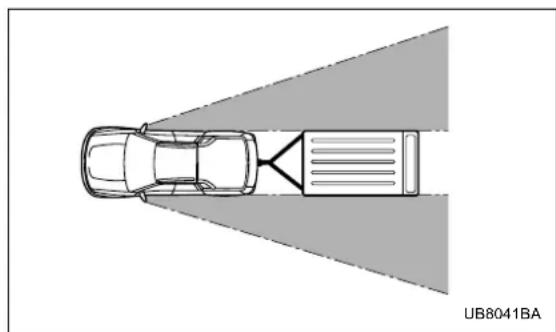
natural_image
Top-down diagram of a car with a vehicle under a spotlight, labeled UB8041BA (no other text or symbols)After hitching a trailer to your vehicle, check that the
- CONTINUED -
standard side mirrors provide a good rearward field of view without significant blind spots. If significant blind spots occur with the vehicle's standard side mirrors, use towing mirrors that conform with Federal, state/province and/or other applicable regulations.
▼ Trailer lights
CAUTION
Direct splicing or other improper connection of trailer lights may damage your vehicle's electrical system and cause a malfunction of your vehicle's lighting system.
Connection of trailer lights to your vehicle's electrical system requires modifications to the vehicle's lighting circuit to increase its capacity and accommodate wiring changes. To ensure the trailer lights are connected properly, please consult your SUBARU dealer. Check for proper operation of the turn signals, the brake lights and parking lights each time you hitch up.
▼ Tires
WARNING
Never tow a trailer when the temporary spare
tire is used. The temporary spare tire is not designed to sustain the towing load. Use of the temporary spare tire when towing can result in failure of the spare tire and/or less stability of the vehicle.
Make sure that all the tires on your vehicle are properly inflated.
The recommended cold tire pressure is shown on the vehicle placard attached to the driver's side door jamb.
Trailer tire condition, size, load rating and proper inflation pressure should be in accordance with the trailer manufacturer's specifications.
In the event your vehicle gets a flat tire when towing a trailer, ask a commercial road service to repair the flat tire.
If you carry a regular size spare tire in your vehicle or trailer as a precaution against getting a flat tire, be sure that the spare tire is firmly secured.
■ Trailer towing tips
CAUTION
- Never exceed 45 mph (72 km/h) when towing a trailer in hilly country on hot days.
- When towing a trailer, steering, stability, stopping distance and braking performance will be different from normal operation. For safety's sake, you should employ extra caution when towing a trailer and you should never speed. You should also keep the following tips in mind:
▼ Before starting out on a trip
- Check that the vehicle and vehicle-to-hitch mounting are in good condition. If any problems are apparent, do not tow the trailer.
- Check that the vehicle sits horizontally with the trailer attached. If the vehicle is tipped sharply up at the front and down at the rear, check the total trailer weight, GVW, GAWs and tongue load again, then confirm that the load and its distribution are acceptable.
- Check that the tire pressures are correct.
-
Check that the vehicle and trailer are connected properly. Confirm that.
-
the trailer tongue is connected properly to the hitch ball.
- the trailer lights connector is connected properly and trailer's brake lights illuminate when the vehicle's brake pedal is pressed, and that the trailer's turn signal lights flash when the vehicle's turn signal lever is operated.
- the safety chains are connected properly. - all cargo in the trailer is secured safety in position. - the side mirrors provide a good rearward field of view without a significant blind spot.
- Sufficient time should be taken to learn the "feel" of the vehicle/trailer combination before starting out on a trip. In an area free of traffic, practice turning, stopping and backing up.
▼ Driving with a trailer
- You should allow for considerably more stopping distance when towing a trailer. Avoid sudden braking because it may result in skidding or jackknifing and loss of control.
- Avoid abrupt starts and sudden accelerations. If your vehicle has a manual transmission, always start out in first gear and release the clutch at moderate engine revolution.
- Avoid uneven steering, sharp turns and rapid lane changes.
- Slow down before turning. Make a longer than nor- - CONTINUED -
mal turning radius because the trailer wheels will be closer than the vehicle wheels to the inside of the turn. In a tight turn, the trailer could hit your vehicle.
- Crosswinds will adversely affect the handling of your vehicle and trailer, causing sway. Crosswinds can be due to weather conditions or the passing of large trucks or buses. If swaying occurs, firmly grip the steering wheel and slow down immediately but gradually.
- When passing other vehicles, considerable distance is required because of the added weight and length caused by attaching the trailer to your vehicle.

text_image
1 2 HS8023BB1) Left turn 2) Right turn
- Backing up with a trailer is difficult and takes practice. When backing up with a trailer, never accelerate or steer rapidly. When turning back, grip the bottom of the steering wheel with one hand and turn it to the left for a left turn, and turn it to the right for a right turn.
- If the ABS warning light illuminates while the vehicle is in motion, stop towing the trailer and have repairs performed immediately by the nearest SUBARU dealer.
▼ Driving on grades
- Before going down a steep hill, slow down and shift into lower gear (if necessary, use 1st gear) in order to utilize the engine braking effect and prevent overheating of your vehicle's brakes. Do not make sudden downshifts.
- When driving uphill in hot weather, the air conditioner may turn off automatically to protect the engine from overheating.
- When driving uphill in hot weather, pay attention to the water temperature gauge pointer (for all vehicles) and AT OIL TEMP warning light (for AT vehicles) since the engine and transmission are relatively prone to overheating under these conditions. If the water temperature gauge pointer approaches the OVERHEAT zone or the AT OIL TEMP warning light illuminates, immediately switch off the air conditioner and stop the vehicle at the nearest safe place. Refer to the "Engine
overheating" section in chapter 9, and "Warning and indicator lights" section in chapter 3.
NOTE (Turbo models only)
In a vehicle that has an automatic transmission, the engine is less likely to overheat with the "D" range selected than it is with the manual mode selected.
- If your vehicle has an automatic transmission, avoid using the accelerator pedal to stay stationary on an uphill slope instead of using the parking brake or foot brake. That may cause the transmission fluid to overheat.
- Non-turbo models only: If your vehicle is equipped with an automatic transmission, avoid driving with the gear selector lever in "D" when towing a heavy trailer to prevent fluid overheating. A lower gear should be used.
▼ Parking on a grade
Always block the wheels under both vehicle and trailer when parking. Apply the parking brake firmly. You should not park on a hill or slope. But if parking on a hill or slope cannot be avoided, you should take the following steps:
- Apply the brakes and hold the pedal down.
- Have someone place wheel blocks under both the
vehicle and trailer wheels.
- When the wheel blocks are in place, release the regular brakes slowly until the blocks absorb the load.
- Apply the regular brakes and then apply the parking brake; slowly release the regular brakes.
- Shift into 1st or reverse gear (manual transmission) or "P" (automatic transmission) and shut off the engine.
natural_image
Pure horizontal dashed lines on white background with no text, numbers, or symbolsIn case of emergency
If you park your vehicle in an emergency .. 9-2
Jack and tools 9-3
Location of jack and tools 9-3
Removing jack and tool bag 9-3
Restoring jack and tools 9-5
Spare tire 9-7
Removing the spare tire 9-7
Re-storage of spare tire 9-9
Temporary spare tire 9-10
Using the temporary spare tire 9-10
Flat tires 9-12
Changing a flat tire 9-12
Jump starting 9-18
How to jump start 9-19
Engine overheating 9-21
If steam is coming from the engine
compartment 9-21
If no steam is coming from the engine
compartment 9-21
Towing 9-22
Towing and tie-down hooks 9-23
Using a flat-bed truck 9-27
Towing with all wheels on the ground 9-27
Moonroof – if the moonroof cannot be
closed 9-28
If you park your vehicle in an emergency

natural_image
Technical line drawing of a vehicle rear panel with a warning symbol (no text or labels)The hazard warning flasher should be used in day or night to warn other drivers when you have to park your vehicle under emergency conditions. Avoid stopping on the road. It is best to safely pull off the road if a problem occurs.
The hazard warning flasher can be activated regardless of the ignition switch position. Turn on the hazard warning by pushing the hazard warning flasher switch. Turn it off by pushing the switch again.
NOTE
When the hazard warning flasher is on, the turn signals do not work.
Jack and tools
The jack supplied with the vehicle is designed only for changing a tire.
Before using the jack, see the "Flat tires" section in this chapter for instructions and precautions.
■ Location of jack and tools

natural_image
Line drawing of a car interior showing the rear seats and dashboard (no text or symbols)The jack and tool bag are located in the left side rear quarter pocket at the back side of the rear seatback.
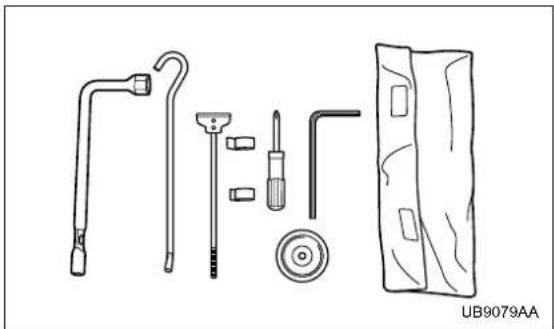
natural_image
Line drawing of various medical or mechanical tools including a catheter, screwdriver, and a device (no text or symbols)A wheel nut wrench, jack drive tube, tire holding rod, tire holding retainer, screwdriver, moonroof wrench and two belts are included in the tool bag.
■ Removing jack and tool bag
CAUTION
Before folding down the seatback, check that there is nothing in the seatback pocket. If there is something in the pocket, it could be damaged or cause damage to the seatback and rear center console when the seatback is folded.
- CONTINUED -
In case of emergency

text_image
A B 1 UB1109BB UB9074- Pull the rear seatback locks up and fold down the rear seatback to gain access to the rear quarter pockets at both sides.
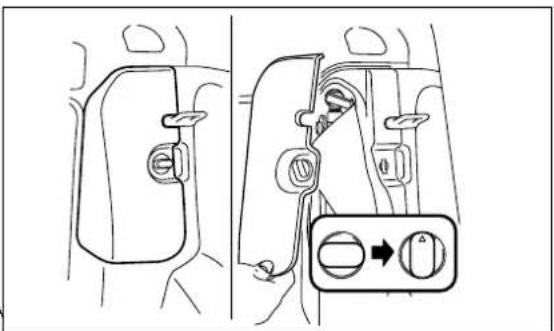
natural_image
Diagram showing car door and side view of a vehicle's rear compartment with control buttons (no text or symbols)- Open the left hand pocket lid by turning the knob.
- Take the tool bag out of the pocket.
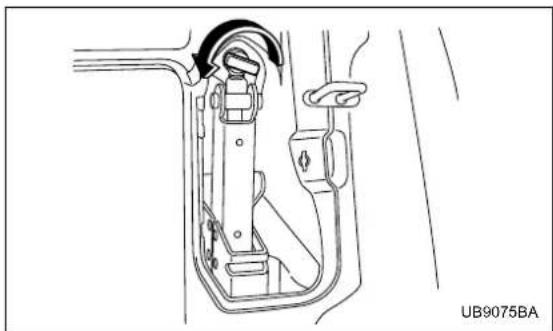
natural_image
Technical line drawing of a mechanical component with no visible text or symbols- Loosen the jack holding screw by turning counterclockwise and remove the jack from the pocket.
NOTE
- Be careful not to lose the jack holding screw after removing it.
• Make sure the jack is well lubricated before using it.
■ Restoring jack and tools

text_image
UB9082BA- Strap the wheel nut wrench, jack drive tube, and tire holding rod together using the two belts, then return them to the tool bag together with the other tools.
- Contract the jack by turning the jack screw counterclockwise to the end.
- CONTINUED -

natural_image
Line drawing of a mechanical assembly with a tool inserted, showing no text or symbols- Place the jack onto the bracket in the pocket.

natural_image
Technical line drawing of a mechanical assembly with no visible text or symbols- Securely fix the jack with the jack holding screw by turning it clockwise.
- Install the left hand pocket lid and lock it by turning the knob.
NOTE
Confirm no looseness exists after securing the jack. Looseness may cause a rattle while the vehicle is moving.
A CAUTION
After the jack and the tool bag have been restored in the rear quarter pocket, make sure that the rear seatback has been securely locked. When securely locked, the red marks on the locking knobs are no longer visible.
Spare tire
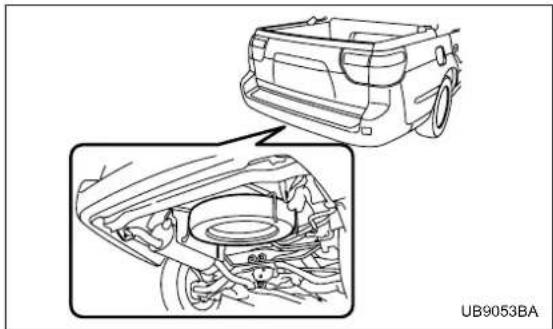
natural_image
Technical line drawing of a car engine compartment showing internal components and structural details (no text or symbols)The spare tire is stored in the spare tire holder located under the rear of the cargo bed.
The spare tire holder has a hoist mechanism that can lower and raise the spare tire easily. The spare tire holder is designed to carry only the temporary spare tire that comes with your vehicle.
Before using the temporary spare tire, see the "Temporary spare tire" section in this chapter for instructions and precautions.
■ Removing the spare tire
- Take the wheel nut wrench out of the tool bag. Refer to the "Jack and tools" section in this chapter for its storage location.
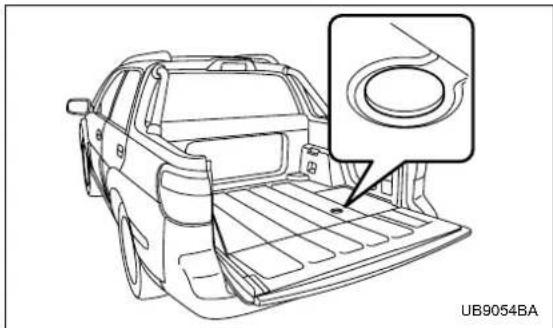
natural_image
Line drawing of a car rear bumper with a magnified inset showing the lid (no text or symbols)-
Open the tailgate and remove the rubber cap from the cargo bed. Pull up the "RELEASE" portion of the cap when removing it.
-
Locate the hex-headed hoist shaft end inside the hole.
- CONTINUED -
In case of emergency

natural_image
Technical diagram of a mechanical assembly with a curved arrow indicating direction (no text or symbols)- Turn the hoist shaft end counterclockwise with the wheel nut wrench until the temporary spare tire is on the ground with enough cable slack to allow you to pull it out from under the vehicle.
CAUTION
Do not put your fingers into the center hole of the temporary spare tire while you pulling it out, because they might be pinched in between the wheel and the retainer.

natural_image
Line drawing of a hand using a tool to clean or repair a tire (no text or symbols)- Tilt the retainer at the end of the cable and pull it through the center of the temporary spare tire.
- After the temporary spare tire is removed from the cable, the cable must be wound up completely by turning the hoist nut shaft clockwise until you hear a clicking sound. Also visually inspect the cable to make certain that there is no longer any slack present.
WARNING
- When using the spare tire hoist: After the temporary spare tire is removed from the cable, wind the cable up completely until the retainer at end of the cable sits against the
underside of the vehicle. Driving with the cable not retracted fully could result in damage to the adjacent under floor parts and lead to a serious accident.
- The spare tire holder is designed to carry only the smaller temporary spare tire. Never store a full size tire (flat or otherwise) in the spare tire holder. Doing so can result in damage to adjacent under floor parts and can lead to a serious accident.
CAUTION
When using the spare tire hoist:
Do not use air tools or power tools to turn the spare tire hoist shaft end. If you do, it could result in severe mechanical damage to the spare tire hoist.
■ Re-storage of spare tire
-
Turn the spare tire hoist shaft end counterclockwise with the wheel nut wrench to loosen the cable sufficiently enough to allow the cable end retainer go through center hole of the temporary spare tire.
-
Insert the retainer through the center hole of the
temporary tire (with the outside of the tire facing up).
- Turn the hoist shaft end clockwise with the wheel nut wrench to wind the cable up completely until you hear a few clicking sounds. Confirm that the temporary spare tire holding cable has been wound up completely by shaking the temporary tire.
CAUTION
If the temporary spare tire is not stored securely, it could damage adjacent areas of the vehicle and make an abnormal noise.
-
Put the rubber cap on the hoist shaft end hole.
-
Place the wheel nut wrench back into the tool bag and store the jack and tool bag in their storage locations.
Temporary spare tire
■ Using the temporary spare tire
WARNING
Never tow a trailer when the temporary spare tire is used. The temporary spare tire is not designed to sustain the towing load. Use of the temporary spare tire when towing can result in failure of the spare tire and/or less stability of the vehicle and may lead to an accident.
CAUTION
Never use any temporary spare tire other than the original. Using other sizes may result in severe mechanical damage to the drive train of your vehicle.
The temporary spare tire is smaller and lighter than a conventional tire and is designed for emergency use only. Remove the temporary spare tire and re-install the conventional tire as soon as possible because the spare tire is designed only for temporary use.
Check the inflation pressure of the temporary spare tire periodically to keep the tire ready for use. The correct pressure is 60 psi (420 kPa, 4.2 kgf/cm ^2 ).
When using the temporary spare tire, note the following:
- Do not exceed 50 mph (80 km/h).
- Do not put a tire chain on the temporary spare tire. Because of the smaller tire size, a tire chain will not fit properly.
- Do not use two or more temporary spare tires at the same time.
- Do not drive over obstacles. This tire has a smaller diameter, so road clearance is reduced.
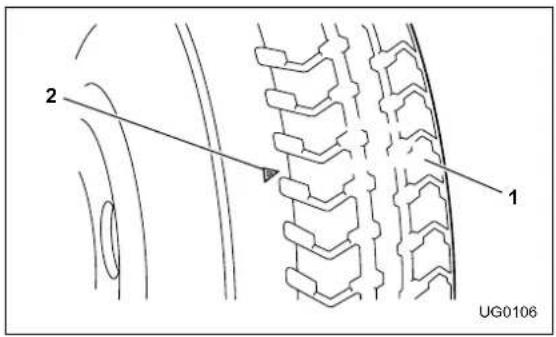
text_image
2 1 UG01061) Tread wear indicator bar
2) Indicator location mark
- When the wear indicator appears on the tread, replace the tire.
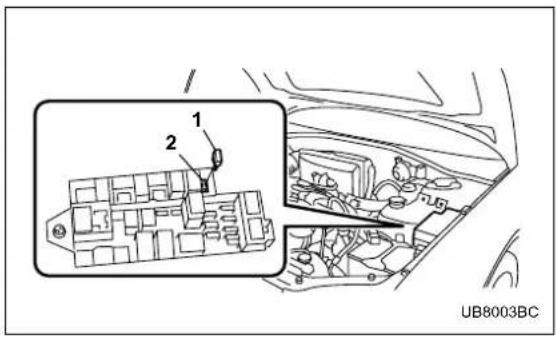
text_image
1 2 UB8003BC1) Spare fuse
2) FWD connector
NOTE
[Automatic transmission vehicles except Turbo vehicle] Before driving your vehicle with the temporary spare tire, put a spare fuse inside the FWD connector located in the engine compartment and confirm that the AWD warning light comes on. The all wheel drive capability of the vehicle has now been deactivated. After re-installing the conventional tire, remove the spare fuse from the FWD connector in order to reactivate all wheel drive.
Flat tires
If you get a flat tire while driving, never brake suddenly; keep driving straight ahead while gradually reducing speed. Then slowly pull off the road to a safe place.
■ Changing a flat tire
WARNING
- Do not jack up the vehicle on an incline or a loose road surface. The jack can come out of the jacking point or sink into the ground and this can result in a serious accident.
- Use only the jack provided with your vehicle. The jack supplied with the vehicle is designed only for changing a tire. Never get under the vehicle while supporting the vehicle with this jack.
- Always turn the engine off before raising the flat tire off the ground using the jack. Never swing or push the vehicle supported with the jack. The jack can come out of the jacking point due to a jolt and this can result in a serious accident.
- Never place a tire or tire changing tools in the passenger compartment after changing
wheels. In a sudden stop or collision, loose equipment could strike occupants and cause injury. Store the tire and all tools in the proper place.
- Park on a hard, level surface, whenever possible, then stop the engine.
- Set the parking brake securely and shift a manual transmission vehicle into reverse or an automatic transmission vehicle into the "P" (Park) position.
- Turn on the hazard warning flasher and have everyone get out of the vehicle.
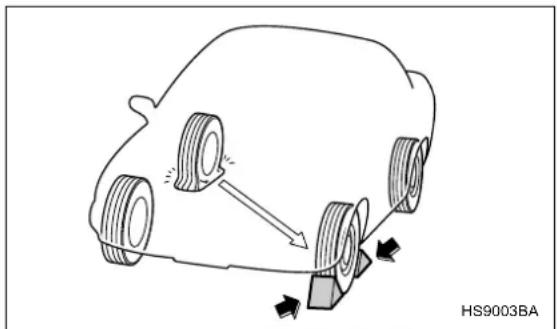
natural_image
Diagram of a car with wheels and a parking roof, showing motion direction (no text or symbols)- Put wheel blocks at the front and rear of the tire di-
agonally opposite the flat tire.
- Take out the spare tire, jack, and wheel nut wrench.
Refer to the sections "Spare tire" and "Jack and tools" in this chapter for their location, instructions and precautions.
After the spare tire is removed from the spare tire holder, the cable must be wound up completely by turning the hoist nut shaft clockwise until you hear a clicking sound. Also visually inspect the cable to make certain that there is no longer any slack present.
▼ Removing the flat tire and installing the spare tire
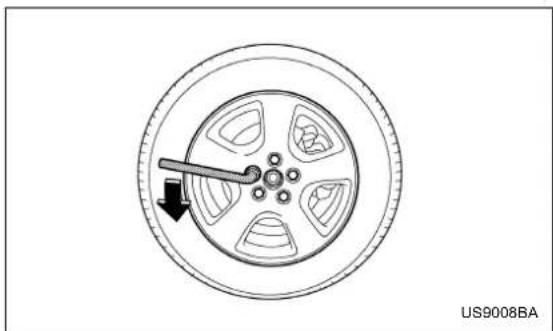
natural_image
Diagram of a car wheel with a directional arrow indicating clockwise motion (no text or symbols on the diagram itself)- Loosen the wheel nuts using the wheel nut wrench
but do not remove the nuts.

text_image
1 UB9088BB1) Jack up point mark
- Place the jack under the side sill at the front or rear jack-up point closest to the flat tire. Jack-up points are
- CONTINUED -
indicated by arrow marks on the side of the side sill skirt.
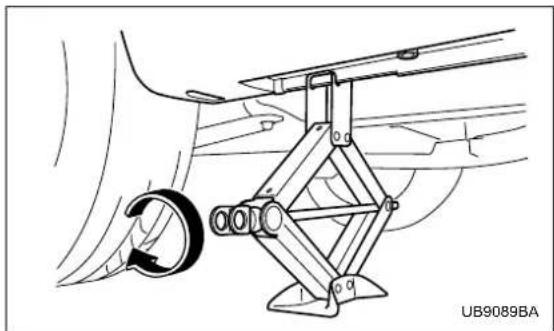
natural_image
Technical line drawing of a mechanical assembly with no visible text or symbols- Turn the jackscrew by hand until the groove of the jack head engages firmly into the jack-up point.

natural_image
Mechanical diagram showing a lever mechanism with a rotating wheel and attached rod (no text or symbols)- Insert the jack drive tube into the jackscrew and attach the wheel nut wrench into the jack drive tube, and turn the handle until the tire clears the ground. Do not raise the vehicle higher than necessary.
- Remove the wheel nuts and the flat tire.

natural_image
Line drawing of a hand adjusting a brake caliper on a car wheel (no text or symbols)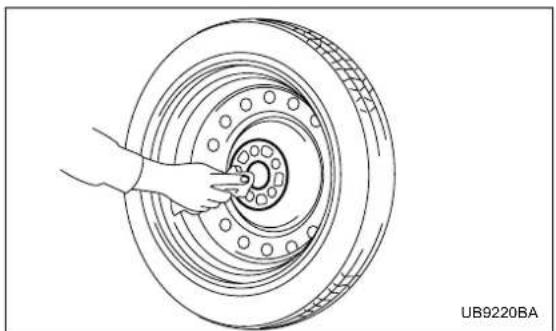
natural_image
Diagram of a hand fastening a car tire with a circular component (no text or symbols)- Before putting the spare tire on, clean the mounting
surface of the wheel and hub with a cloth.
- Put on the spare tire. Replace the wheel nuts. Tighten them by hand.
WARNING
Do not use oil or grease on the wheel studs or nuts when the spare tire is installed. This could cause the nuts to become loose and lead to an accident.
- Turn the jack handle counterclockwise to lower the vehicle.

text_image
UB9078BB- CONTINUED -
- Use the wheel nut wrench to securely tighten the wheel nuts to the specified torque, following the tightening order in the illustration. The torque for tightening the nuts is 74 to 89 lbf·ft (100 to 120 N·m, 10 to 12 kgf·m). This torque is equivalent to applying about 88 to 110 lbs (40 to 50 kg) at the top of the wheel nut wrench provided to your vehicle. Never use your foot on the wheel nut wrench or a pipe extension on the wrench because you may exceed the specified torque. Have the wheel nut torque checked at the nearest automotive service facility.
▼ Storage of the flat tire
CAUTION
- Secure the flat tire in the cargo bed (with the outer side of the wheel facing up) by using the designated tire holding rod and retainer. If the flat tire is not properly secured, it may fall out and create a dangerous road hazard that could lead to a serious accident.
-
Do not store the flat tire under the floor. Doing so could damage the underside of the vehicle.
-
Take the tire holding rod and retainer out of the tool
bag.
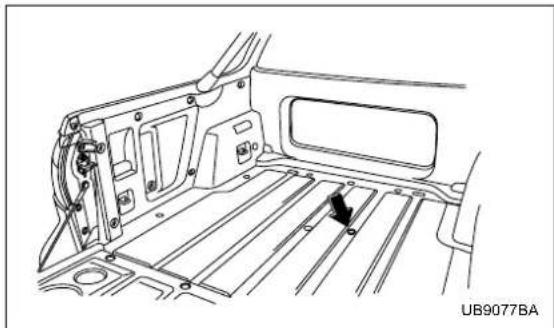
natural_image
Technical line drawing of a vehicle chassis frame with mounting brackets and structural ribs (no text or symbols)- Remove the rubber cap from the cargo bed. Store the rubber cap in a safe place. Pay attention not to lose the rubber cap after removal.

text_image
1 2 UB9062BB UB9063BA1) Holding rod
2) Retainer
-
Place the flat tire in the cargo bed with the outer side of the wheel facing up. For an aluminum wheel, remove the center cap before placing it in the cargo bed.
-
Place the retainer on the center hole of the wheel as illustrated and put the tire holding rod into the retainer.
If the flat tire is separated from its wheel completely, the retailer should be placed upside down on the wheel.
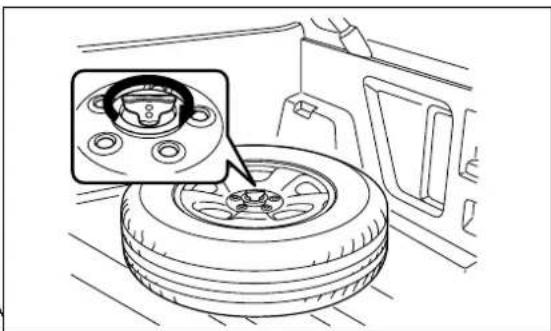
natural_image
Line drawing of a tire with a small inset showing a component detail (no text or symbols)- Secure the flat tire by tightening the tire holding rod.
The tire holding rod and retainer are designed solely to secure a flat tire in emergency. Do not use them for another purpose such as securing cargo.
-
Store the jack and wheel nut wrench in their storage locations.
-
Put the rubber cap back in its original position after everything has been restored.
▼ Driving with the temporary spare tire
Your spare tire is only a temporary spare which is designed for temporary emergency use only. When driving with the temporary spare tire, follow the instruc-
- CONTINUED -
tions and precautions described in the "Temporary spare tire" section in this chapter.
Replace the temporary spare tire with a conventional tire as soon as you can.
Jump starting
WARNING
- Battery fluid is SULFURIC ACID. Do not let it come in contact with the eyes, skin, clothing or the vehicle.
If battery fluid gets on you, thoroughly flush the exposed area with water immediately. Get medical help if the fluid has entered your eyes.
If battery fluid is accidentally swallowed, immediately drink a large amount of milk or water, and obtain immediate medical help.
Keep everyone including children away from the battery.
- The gas generated by a battery explodes if a flame or spark is brought near it. Do not smoke or light a match while jump starting.
- Never attempt jump starting if the discharged battery is frozen. It could cause the battery to burst or explode.
- Whenever working on or around a battery, always wear suitable eye protectors, and remove metal objects such as rings, bands or other metal jewelry.
- Be sure the jumper cables and clamps on them do not have loose or missing insulation.
Do not jump start unless cables in suitable condition are available.
- A running engine can be dangerous. Keep your fingers, hands, clothing, hair and tools away from the cooling fan, belts and any other moving engine parts. Removing rings, watches and ties is advisable.
When your vehicle does not start due to a run down (discharged) battery, the vehicle may be jump started by connecting your battery to another battery (called the booster battery) with jumper cables.
Jump starting is dangerous if it done incorrectly. If you are unsure about the proper procedure for jump starting, consult a competent mechanic.
■ How to jump start
- Make sure the booster battery is 12 volts and the negative terminal is grounded.
- If the booster battery is in another vehicle, do not let the two vehicles touch.
- Turn off all unnecessary lights and accessories.
- Connect the jumper cables exactly in the sequence illustrated.
- CONTINUED -
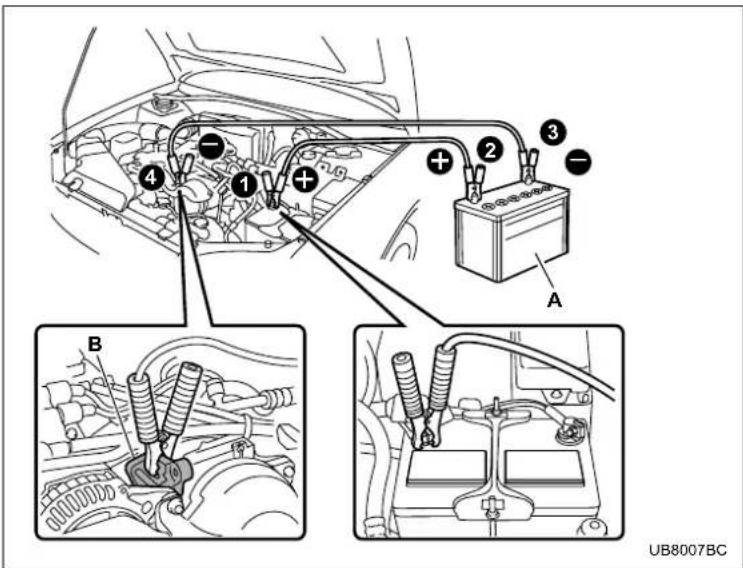
text_image
4 ① + ② ③ - A B UB8007BCA) Booster battery
B) Engine lifting bracket
1) Connect one jumper cable to the positive (+) terminal on the discharged battery.
2) Connect the other end of the jumper cable to the positive (+) terminal of the booster battery.
3) Connect one end of the other cable to the negative (−) terminal of the booster battery.
4) Connect the other end of the cable to the engine lifting bracket.
Make sure that the cables are not near any moving parts and that the cable clamps are not in contact with any other metal.
- Start the engine of the vehicle with the booster battery and run it at moderate speed. Then start the engine of the vehicle that has the discharged battery.
- When finished, carefully disconnect the cables in exactly the reverse order.
Engine overheating
WARNING
Never attempt to remove the radiator cap until the engine has been shut off and has fully cooled down. When the engine is hot, the coolant is under pressure. Removing the cap while the engine is still hot could release a spray of boiling hot coolant, which could burn you very seriously.
If the engine overheats, pull off the road safely and stop the vehicle in a safe place.
■ If steam is coming from the engine compartment
Turn the engine off and get everyone away from the vehicle until it cools down.
■ If no steam is coming from the engine compartment
- Keep the engine running at idling speed.
- Open the hood to ventilate the engine compartment.
- CONTINUED -
Confirm that the cooling fan is turning. If the fan is not turning, immediately turn the engine off and contact your authorized dealer for repair.
- After the engine coolant temperature has dropped, turn off the engine.
If the temperature gauge stays at the overheated zone, turn the engine off.
- After the engine has fully cooled down, check the coolant level in the reserve tank.
If the coolant level is below the "MIN" mark, add coolant up to the "MAX" mark.
- If there is no coolant in the reserve tank, add coolant to the reserve tank. Then remove the radiator cap and fill the radiator with coolant.
If you remove the radiator cap from a hot radiator, first wrap a thick cloth around the radiator cap, then turn the cap counterclockwise slowly without pressing down until it stops. Release the pressure from the radiator. After the pressure has been fully released, remove the cap by pressing down and turning it.
Towing
WARNING
Never tow AWD vehicles (both AT and MT) with the front wheels raised off the ground while the rear wheels are on the ground, or with the rear wheels raised off the ground while the front wheels are on the ground. This will cause the vehicle to spin away due to the operation or deterioration of the center differential.
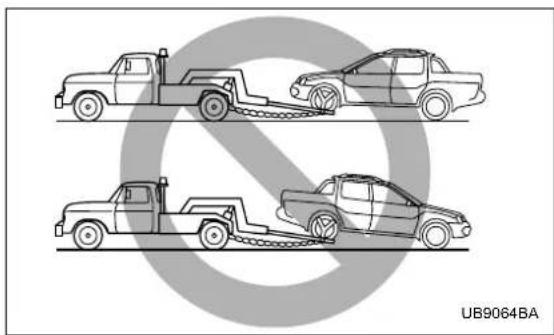
natural_image
Diagram showing three vehicles on a flatbed ramp with a diagonal no-smoking symbol (no text or labels)If towing is necessary, it is best done by your SUBARU
dealer or a commercial towing service. Observe the following procedures for safety.
■ Towing and tie-down hooks
The towing hooks should be used only in an emergency (e.g., to free a stuck vehicle from mud, sand or snow).
CAUTION
- Use only specified towing hooks and tie-down hooks. Never use suspension parts or other body parts for towing or tie-down purposes.
- Never use the tie-down hook closest to the muffler under the vehicle for towing purposes.
- To prevent deformation to the front bumper and the towing hook, do not apply excessive lateral load to the towing hooks.

text_image
Technical diagram showing two mechanical components with labeled parts 1 and 21) Towing hook cover
2) Towing hook
The front towing hook is located on the inside of the towing hook cover below the right hand headlight.
- CONTINUED -
In case of emergency
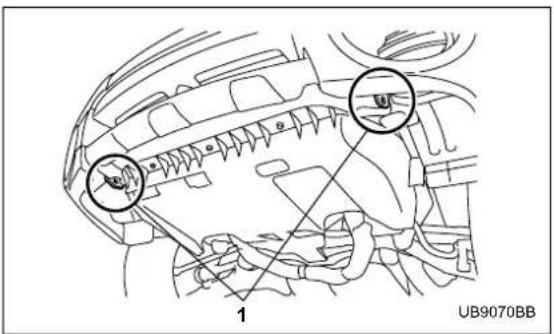
text_image
UB9070BB 11) Tie-down hook 1) Tie-down hook

text_image
1 2 UB9066CB2) Towing and tie-down hook
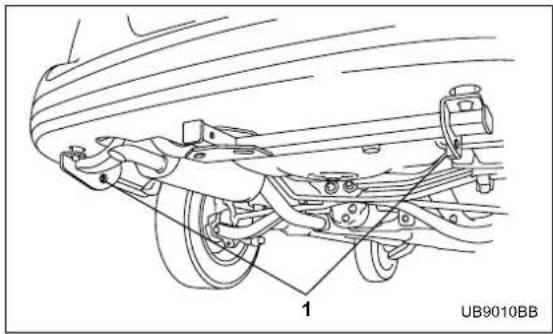
text_image
UB9010BB 1Vehicle with trailer hitch (if equipped)
1) Tie-down hook
▼ Towing hook cover removal procedure
The towing hook cover is secured by tabs that fit into corresponding slots in the vehicle body.
To remove the cover:
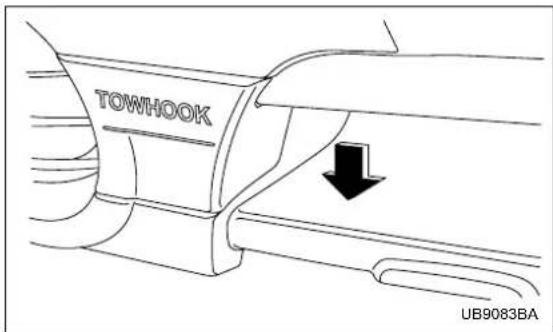
text_image
TOWHOOK UB9083BA- Free the tabs on the towing hook cover by firmly pressing the point indicated by an arrow with the palm of your hand.
- CONTINUED -
In case of emergency

text_image
TOWHOOK UB9084BA- Pull off the towing hook cover.
▼ Towing hook cover installation procedure

natural_image
Technical line drawing of a car wheel assembly (no text or symbols)To reinstall the towing hook cover, push it in on both sides while pushing it back to its original position. Make certain that the tabs at the end of the cover are securely inserted into the corresponding slots in the vehicle's body.
■ Using a flat-bed truck

natural_image
Line drawing of a flatbed truck carrying a sedan on its side (no text or symbols)This is the best way to transport your vehicle. Use the following procedures to ensure safe transportation.
- Shift the selector lever into the "P" position for automatic transmission vehicles or "1st" for manual transmission vehicles.
- Pull up the parking brake lever firmly.
- Secure the vehicle onto the carrier properly with safety chains. Each safety chain should be equally tightened and care must be taken not to pull the chains so tightly that the suspension bottoms out.
■ Towing with all wheels on the ground

natural_image
Line drawing of a pickup truck and a sedan on a road (no text or symbols)WARNING
- Never turn the ignition switch to the "LOCK" position while the vehicle is being towed because the steering wheel and the direction of the wheels will be locked.
- Remember that the brake booster and power steering do not function when the engine is not running. Because the engine is turned off, it will take greater effort to operate the brake pedal and steering wheel.
- CONTINUED -
CAUTION
- If transmission failure occurs, transport your vehicle on a flat-bed truck.
- Do not run the engine while the vehicle is being towed using this method. Transmission damage could result if the vehicle is towed with the engine running.
-
For vehicles with automatic transmission, the traveling speed must be limited to less than 20 mph (30 km/h) and the traveling distance to less than 30 miles (50 km). For greater speeds and distances, transport your vehicle on a flat-bed truck.
-
Check the transmission and differential oil levels and add oil to bring it to the upper level if necessary.
- Release the parking brake and put the transmission in neutral.
- The ignition switch should be in the "ACC" position while the vehicle is being towed.
- Take up slack in the towline slowly to prevent damage to the vehicle.
Moonroof – if the moonroof cannot be closed
If the moonroof cannot be closed with the moonroof switch, you can close the moonroof manually.
- Take out the moonroof wrench and screwdriver from the tool bag.
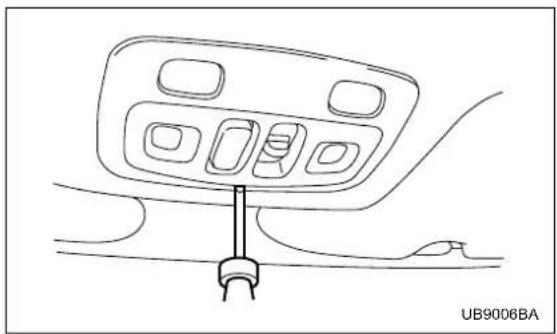
natural_image
Line drawing of a car dashboard with control panel and cable (no text or symbols)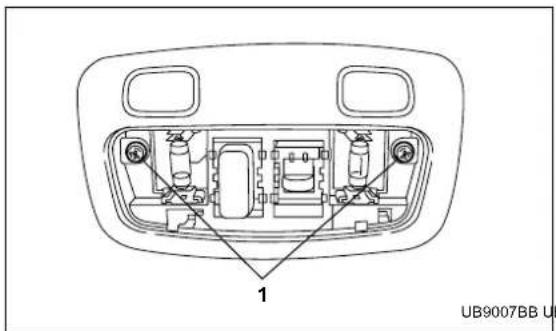
text_image
1 UB9007BB UB1) Screws
- Remove the map light lens by prying the edge of the lens with a flat-head screwdriver, then remove the switch body retaining screws and take off the moon-roof switch.

natural_image
Technical line drawing of a mechanical assembly with no visible text or symbols- Insert the wrench in the end of the motor shaft.
• To lower the moonroof, turn the wrench clockwise.
- To close the moonroof, turn the wrench counterclockwise.
Have your vehicle checked by an authorized SUBARU dealer.

natural_image
Pure horizontal dashed lines on white background with no text, numbers, or symbolsAppearance care
Exterior care 10-2
Washing 10-2
Waxing and polishing 10-3
Cleaning aluminum wheels 10-4
Cleaning fog light lens 10-4
Corrosion protection 10-5
Most common causes of corrosion 10-5
To help prevent corrosion 10-5
Cleaning the interior 10-6
Seat fabric 10-6
Leather seat materials 10-6
Synthetic leather upholstery 10-7
Climate control panel, audio panel, instrument panel, console panel, switches, combination meter, and other plastic surfaces .... 10-7
Exterior care
■ Washing
CAUTION
- When washing the vehicle, the brakes may get wet. As a result, the brake stopping distance will be longer. To dry the brakes, drive the vehicle at a safe speed while lightly pressing the brake pedal to heat up the brakes.
- Do not wash the engine compartment and areas adjacent to it. If water enters the engine air intake, electrical parts or the power steering fluid reservoir, it will cause engine trouble or faulty power steering respectively.
The best way to preserve your vehicle's beauty is frequent washing. Wash the vehicle at least once a month to avoid contamination by road grime.
Wash dirt off with a wet sponge and plenty of lukewarm or cold water. Do not wash the vehicle with hot water and in direct sunlight.
Salt, chemicals, insects, tar, soot and bird droppings should be washed off by using a light detergent, as re-
quired. If you use a light detergent, make certain that it is a neutral detergent. Do not use strong soap or chemical detergents. All cleaning agents should be promptly flushed from the surface and not allowed to dry there. Rinse the vehicle thoroughly with plenty of lukewarm water. Wipe the remaining water off with a chamois or soft cloth.
NOTE
- Before having your vehicle washed in an automatic car wash, retract the pillar mounted antenna or remove the roof mounted antenna to prevent it from being damaged.
- When having your vehicle washed in an automatic car wash, make sure beforehand that the car wash is of suitable type. If the vehicle is equipped with a rear/roof spoiler, it may be damaged by car wash brushes or other equipment.
▼ Washing the underbody
Chemicals, salts and gravel used for deicing road surfaces are extremely corrosive, accelerating the corrosion of underbody components, such as the exhaust system, fuel and brake lines, brake cables, floor pan and fenders, and suspension.
Thoroughly flush the underbody and inside of the fenders with lukewarm or cold water at frequent intervals to reduce the harmful effects of such agents.
Mud and sand adhering to the underbody components may accelerate their corrosion.
After driving off-road or muddy or sandy roads, wash the mud and sand off the underbody.
Carefully flush the suspension and axle parts, as they are particularly prone to mud and sand buildup. Do not use a sharp-edged tool to remove caked mud.
NOTE
Be careful not to damage brake hoses, sensor harnesses, and other parts when washing suspension components.
▼ Using a warm water washer
- Keep a good distance of 12 in (30 cm) or more between the washer nozzle and the vehicle.
- Do not wash the same area continuously.
- If a stain will not come out easily, wash by hand. Some warm water washers are of the high temperature, high pressure type, and they can damage or deform the resin parts such as mouldings, or cause water to leak into the vehicle.
■ Waxing and polishing
Always wash and dry the vehicle before waxing and polishing.
Use a good quality polish and wax and apply them ac-
cording to the manufacturer's instructions. Wax or polish when the painted surface is cool.
Be sure to polish and wax the chrome trim, as well as the painted surfaces. Loss of wax on a painted surface leads to loss of the original luster and also quickens the deterioration of the surface. It is recommended that a coat of wax be applied at least once a month, or whenever the surface no longer repels water.
If the appearance of the paint has diminished to the point where the luster or tone cannot be restored, lightly polish the surface with a fine-grained compound. Never polish just the affected area, but include the surrounding area as well. Always polish in only one direction. A No. 2000 grain compound is recommended. Never use a coarse-grained compound. Coarser grained compounds have a smaller grain-size number and could damage the paint. After polishing with a compound, coat with wax to restore the original luster. Frequent polishing with a compound or an incorrect polishing technique will result in removing the paint layer and exposing the undercoat. When in doubt, it is always best to contact your SUBARU dealer or an auto paint specialist.
NOTE
Be careful not to damage brake hoses, sensor harnesses, and other parts when washing suspen-
- CONTINUED -
sion components.
■ Cleaning aluminum wheels
- Promptly wipe the aluminum wheels clean of any kind of grime or agent. If dirt is left on too long, it may be difficult to clean off.
- Do not use soap containing grit to clean the wheels. Be sure to use a neutral cleaning agent, and later rinse thoroughly with water. Do not clean the wheels with a stiff brush or expose them to a high-speed washing device.
- Clean the vehicle (including the aluminum wheels) with water as soon as possible when it has been splashed with sea water, exposed to sea breezes, or driven on roads treated with salt or other agents.
■ Cleaning fog light lens
- Stop the vehicle in a safe place.
- Stop the engine and turn off the fog lights.
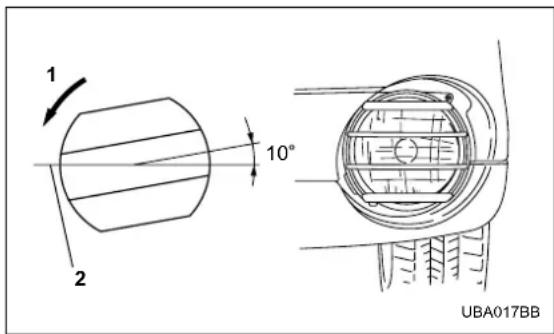
text_image
1 2 10° UBA017BB1) Counter-clockwise
2) Light lens horizontal center line
- Check that the fog lights are not hot. Then, grasp the protector and turn it approximately 10^ counterclockwise.
- Pull the protector off the fog light.
- Wash the lens with water.
- Apply the protector to the lens at an angle of approximately 10^ from the fog light's horizontal center line. Then, turn the protector clockwise until it stops. Finally, check that the protector's horizontal bars are parallel with the fog light's horizontal center line.
Corrosion protection
Your SUBARU has been designed and built to resist corrosion. Special materials and protective finishes have been used on most parts of the vehicle to help maintain fine appearance, strength, and reliable operation.
■ Most common causes of corrosion
The most common causes of corrosion are:
- The accumulation of moisture retaining dirt and debris in body panel sections, cavities, and other areas.
- Damage to paint and other protective coatings caused by gravel and stone chips or minor accidents.
Corrosion is accelerated on the vehicle when:
- It is exposed to road salt or dust control chemicals, or used in coastal areas where there is more salt in the air, or in areas where there is considerable industrial pollution.
- It is driven in areas of high humidity, especially when temperatures range just above freezing.
- Dampness in certain parts of the vehicle remains for a long time, even though other parts of the vehicle may be dry.
- High temperatures will cause corrosion to parts of the vehicle which cannot dry quickly due to lack of
proper ventilation.
■ To help prevent corrosion
Wash the vehicle regularly to prevent corrosion of the body and suspension components. Also, wash the vehicle promptly after driving on any of the following surfaces:
- roads that have been salted to prevent them from freezing in winter
- mud, sand, or gravel
- coastal roads
After the winter has ended, it is recommended that the underbody be given a very thorough washing.
Before the beginning of winter, check the condition of underbody components, such as the exhaust system, fuel and brake lines, brake cables, suspension, steering system, floor pan, and fenders. If any of them are found to be rusted, they should be given an appropriate rust prevention treatment or should be replaced. Contact your SUBARU dealer to perform this kind of maintenance and treatment if you need assistance.
Repair chips and scratches in the paint as soon as you find them.
Check the interior of the vehicle for water and dirt ac-
- CONTINUED -
cumulation under the floor mats because that could cause corrosion. Occasionally check under the mats to make sure the area is dry.
Keep your garage dry. Do not park your vehicle in a damp, poorly ventilated garage. In such a garage, corrosion can be caused by dampness. If you wash the vehicle in the garage or put the vehicle into the garage when wet or covered with snow, that can cause dampness.
If your vehicle is operated in cold weather and/or in areas where road salts and other corrosive materials are used, the door hinges and locks, trunk lid lock, and hood latch should be inspected and lubricated periodically.
Cleaning the interior
Use a vacuum cleaner to get rid of the dust and dirt. Wipe the vinyl areas with a clean, damp cloth.
Seat fabric
Remove loose dirt, dust or debris with a vacuum cleaner. If the dirt is caked on the fabric or hard to remove with a vacuum cleaner, use a soft blush then vacuum it.
Wipe the fabric surface with a tightly wrung cloth and dry the seat fabric thoroughly. If the fabric is still dirty, wipe using a solution of mild soap and lukewarm water then dry thoroughly.
If the stain does not come out, try a commercially-available fabric cleaner. Use the cleaner on a hidden place and make sure it does not affect the fabric adversely. Use the cleaner according to its instructions.
■ Leather seat materials
The leather used by SUBARU is a high quality natural product which will retain its distinctive appearance and feel for many years with proper care.
Allowing dust or road dirt to build up on the surface can cause the material to become brittle and to wear pre-
maturely. Regular cleaning with a soft, moist, natural fiber cloth should be performed monthly, taking care not to soak the leather or allow water to penetrate the stitched seams.
A mild detergent suitable for cleaning woolen fabrics may be used to remove difficult dirt spots, rubbing with a soft, dry cloth afterwards to restore the luster. If your SUBARU is to be parked for a long time in bright sunlight, it is recommended that the seats and headrests be covered, or the windows shaded, to prevent fading or shrinkage.
Minor surface blemishes or bald patches may be treated with a commercial leather spray lacquer. You will discover that each leather seat section will develop soft folds or wrinkles, which is characteristic of genuine leather.
■ Synthetic leather upholstery
The synthetic leather material used on the SUBARU may be cleaned using mild soap or detergent and water, after first vacuuming or brushing away loose dirt. Allow the soap to soak in for a few minutes and wipe off with a clean, damp cloth. Commercial foam-type cleaners suitable for synthetic leather materials may be used when necessary.
NOTE
Strong cleaning agents such as solvents, paint thinners, window cleaner or gasoline must never be used on leather or synthetic interior materials.
■ Climate control panel, audio panel, instrument panel, console panel, switches, combination meter, and other plastic surfaces
Gently wipe away contamination using a clean, soft cloth moistened with cold or lukewarm water.
NOTE
Do not use organic solvents such as paint thinners or gasoline, or strong cleaning agents that contain those solvents.
natural_image
Pure horizontal dashed lines on white background with no text, numbers, or symbolsMaintenance and service
Maintenance schedule 11-3
Maintenance precautions 11-3
Before checking or servicing in the engine compartment 11-4
When you do checking or servicing in the engine compartment while the engine is running 11-5
Engine hood 11-5
Engine compartment overview 11-8
Non-turbo models 11-8 Turbo models 11-9
Engine oil 11-10
Checking the oil level 11-10
Changing the oil and oil filter 11-12
Recommended grade and viscosity 11-15
Recommended grade and viscosity under severe driving conditions 11-16
Cooling system 11-17
Hose and connections 11-18 Engine coolant 11-18
Air cleaner element 11-23
Replacing the air cleaner element 11-23
Spark plugs 11-25
Recommended spark plugs 11-26
Drive belts 11-26
Manual transmission oil 11-27
Checking the oil level 11-27
Recommended grade and viscosity 11-28
Automatic transmission fluid 11-29
Checking the fluid level 11-29
Recommended fluid 11-31
Front differential gear oil (AT vehicles) ..... 11-32
Checking the oil level 11-32
Recommended grade and viscosity 11-32
Rear differential gear oil 11-33
Checking the gear oil level 11-33
Recommended grade and viscosity 11-35
Power steering fluid 11-36
Checking the fluid level 11-36
Recommended fluid 11-37
Brake fluid 11-38
Checking the fluid level 11-38
Recommended brake fluid 11-39
Clutch fluid (MT vehicles) 11-39
Checking the fluid level 11-39
Recommended clutch fluid 11-40
Brake booster 11-41
Brake pedal 11-41
Checking the brake pedal free play 11-41
Checking the brake pedal reserve distance ... 11-42
Clutch pedal
(Manual transmission vehicles) 11-42
Checking the clutch function 11-42
Checking the clutch pedal free play 11-43
Replacement of brake pad and lining ..... 11-43
Breaking-in of new brake pads and linings .... 11-44
Parking brake stroke 11-45
Tires and wheels 11-45
Maintenance and service
Types of tires 11-45
Tire inspection 11-46
Tire pressures and wear 11-46
Wheel balance 11-49
Wear indicators 11-49
Tire rotation 11-50
Tire replacement 11-50
Wheel replacement 11-51
Aluminum wheels 11-52
Windshield washer fluid 11-52
Replacement of windshield wiper blades .. 11-53
Battery 11-56
Fuses 11-57
Main fuse 11-60
Installation of accessories 11-60
Replacing bulbs 11-61
Headlight 11-64
Front fog light 11-68
Front turn signal light, parking light and side
marker light 11-69
Rear combination lights 11-70
Tail light (on the tailgate) 11-72
License plate light 11-74
Map light, dome light and door step light ..... 11-76
High mount stop and cargo light assembly ... 11-77
Sport activity lights (if equipped) 11-79
Maintenance schedule
The scheduled maintenance items required to be serviced at regular intervals are shown in the "Warranty and Maintenance Booklet".
For details of your maintenance schedule, read the separate "Warranty and Maintenance Booklet".
Maintenance precautions
When maintenance and service are required, it is recommended that all work be done by an authorized SUBARU dealer.
If you perform maintenance and service by yourself, you should familiarize yourself with the information provided in this section on general maintenance and service for your SUBARU.
Incorrect or incomplete service could cause improper or unsafe vehicle operation. Any problems caused by improper maintenance and service performed by you are not eligible for warranty coverage.
WARNING
- Testing of an All-Wheel Drive vehicle must NEVER be performed on a single two-wheel dynamometer or similar apparatus. Attempting to do so will result in transmission damage and in uncontrolled vehicle movement and may cause an accident or injuries to persons nearby.
• Always select a safe area when performing maintenance on your vehicle.
• Always be very careful to avoid injury when working on the vehicle. Remember that some of
- CONTINUED -
the materials in the vehicle may be hazardous if improperly used or handled, for example, battery acid.
- Your vehicle should only be serviced by persons fully competent to do so. Serious personal injury may result to persons not experienced in servicing vehicles.
• Always use the proper tools and make certain that they are well maintained. - Never get under the vehicle supported only by a jack. Always use a safety stands to support the vehicle.
- Never keep the engine running in a poorly ventilated area, such as a garage or other closed areas.
- Do not smoke or allow open flames around the fuel or battery. This will cause a fire.
- Because the fuel system is under pressure, replacement of the fuel filter should be performed only by your SUBARU dealer.
- Wear adequate eye protection to guard against getting oil or fluids in your eyes. If something does get in your eyes, thoroughly wash them out with clean water.
- Do not tamper with the wiring of the SRS air-bag system or seatbelt pretensioner system, or attempt to take its connectors apart, as that
may activate the system or it can render it inoperative. The wiring and connectors of these systems are yellow for easy identification. NEVER use a circuit tester for these wiring.
If your SRS airbag or seatbelt pretensioner needs service, consult your nearest SUBARU dealer.
■ Before checking or servicing in the engine compartment
WARNING
• Always stop the engine and set the parking brake firmly to prevent the vehicle from moving.
• Always let the engine cool down. Engine parts become very hot when the engine is running and remain hot for some time after the engine is stopped.
- Do not spill engine oil, engine coolant, brake fluid or any other fluid on hot engine components. This may cause a fire.
- Always remove the key from the ignition switch. When the ignition switch is in the "ON" position, the cooling fan may operate suddenly
even when the engine is stopped.
■ When you do checking or servicing in the engine compartment while the engine is running
WARNING
A running engine can be dangerous. Keep your fingers, hands, clothing, hair and tools away from the cooling fan, belts and any other moving engine parts. Removing rings, watches and ties is advisable.
Engine hood

text_image
UBB008EATo open the hood:
- If the wiper blades are lifted off the windshield, return them to their original positions.
- Pull the hood release knob under the instrument panel.
- CONTINUED -

natural_image
Line drawing of a car's front wheel assembly with a magnified inset showing internal components (no text or symbols)- Release the secondary hood release located under the front grille by moving the lever toward the left.
03BA
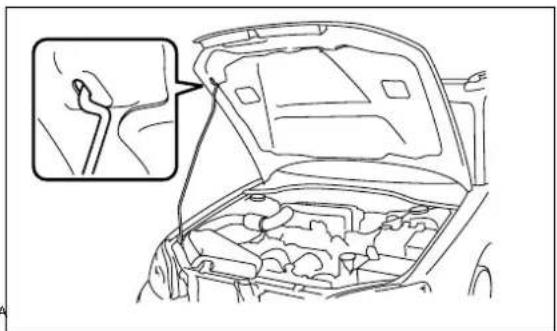
natural_image
Line drawing of a car engine compartment with an open hood and a hand pointing to the side panel (no text or symbols)- Lift up the hood, release the hood prop from its retainer and put the end of the hood prop into the slot in the hood.
To close the hood:
- Lift the hood slightly and remove the hood prop from the slot in the hood and return the prop to its retainer.
- Lower the hood until it approaches about 6 in (15 cm) from the closed position and let it drop.
- After closing the hood, be sure the hood is securely locked.
If this does not close the hood, release it from a slightly higher position. Do not push the hood forcibly to close
it. It could deform the metal.
WARNING
Always check that the hood is properly locked before you start driving. If it is not, it might fly open while the vehicle is moving and block your view, which may cause an accident and serious bodily injury.
Engine compartment overview
■ Non-turbo models

text_image
1 2 3 4 5 8910111213 UBB106BB1) Manual transmission oil level gauge (MT) (page 11-27) or Differential gear oil level gauge (AT) (page 11-32)
2) Air cleaner element (page 11-23)
3) Clutch fluid reservoir (page 11-39)
4) Automatic transmission fluid level gauge (page 11-29)
5) Brake fluid reservoir (page 11-38)
6) Windshield washer tank (page 11-52)
7) Fuse box (page 11-57)
8) Battery (page 11-56)
9) Engine oil filler cap (page 11-10)
10) Engine coolant reservoir (page 11-18)
11) Radiator cap (page 11-18)
12) Engine oil level gauge (page 11-10)
13) Power steering fluid reservoir (page 11-36)
■ Turbo models

text_image
1 2 3 4 5 11 10 9 81213 UBB098CB1) Air cleaner element (page 11-23)
2) Manual transmission oil level gauge (MT) (page 11-27) or Differential gear oil level gauge (AT) (page 11-32)
3) Clutch fluid reservoir (page 11-39)
4) Automatic transmission fluid level gauge (page 11-29)
5) Brake fluid reservoir (page 11-38)
6) Windshield washer tank (page 11-52)
7) Fuse box (page 11-57)
8) Battery (page 11-56)
9) Engine oil filler cap (page 11-10)
10) Engine coolant reservoir (page 11-18)
11) Engine oil level gauge (page 11-10)
12) Radiator cap (page 11-18)
13) Power steering fluid reservoir (page 11-36)
Engine oil
■ Checking the oil level
Check the engine oil level at each fuel stop.
- Park the vehicle on a level surface and stop the engine.
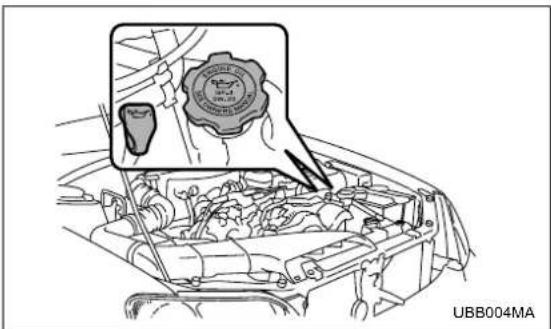
natural_image
Line drawing of a car engine bay with a magnified inset showing the engine compartment (no text or symbols)Non-turbo models

natural_image
Technical line drawing of a car engine bay with visible components and no text or symbolsTurbo models
- Pull out the dipstick, wipe it clean, and insert it again.
- Be sure the dipstick is correctly inserted until it stops with the graphic symbol on its top appearing as shown in the illustration.

text_image
1 2 3 UGB081BBNon-turbo models
1) Notch
2) Upper level
3) Lower level


natural_image
Line drawing of a mechanical component with a central oval feature (no text or symbols)
text_image
1 2 F L 3Turbo models
1) Notch
2) Upper level
3) Lower level
- Pull out the dipstick again and check the oil level on it. If it is below the lower level, add oil to bring the level up to the upper level.
CAUTION
Use only engine oil with the recommended grade and viscosity.
- CONTINUED -
If you check the oil level just after stopping the engine, wait a few minutes for the oil to drain back into the oil pan before checking the level.
To prevent overfilling the engine oil, do not add any additional oil above the upper level when the engine is cold.
The dipstick has a notch above the upper level.
Just after driving or while the engine is warm, the engine oil level reading may be in a range between the upper level and the notch mark. This is caused by thermal expansion of the engine oil.
■ Changing the oil and oil filter
Change the oil and oil filter according to the maintenance schedule in the "Warranty and Maintenance Booklet".
The engine oil and oil filter must be changed more frequently than listed in the maintenance schedule when driving on dusty roads, when short trips are frequently made, or when driving in extremely cold whether.
- Warm up the engine by letting the engine idle for about 10 minutes to ease draining the engine oil.
- Park the vehicle on a level surface and stop the engine.
- Remove the oil filler cap.
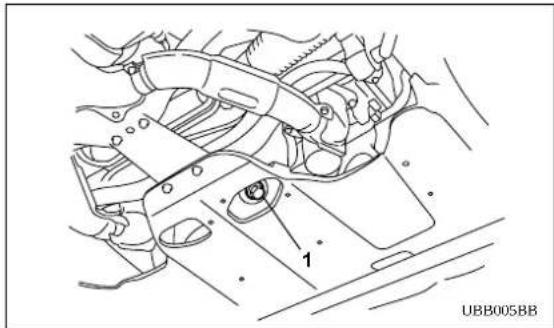
natural_image
Technical line drawing of a mechanical assembly with labeled component '1' (no text or symbols beyond label)1) Drain plug
4. Drain out the engine oil by removing the drain plug while the engine is still warm. The used oil should be drained into an appropriate container and disposed of properly.
WARNING
Be careful not to burn yourself with hot engine oil.
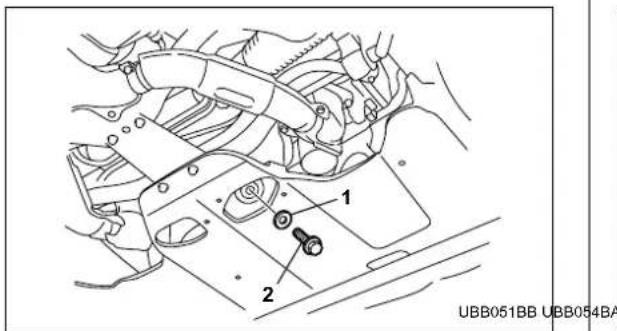
text_image
1 2 UBB051BB UBB054BA1) Sealing washer
2) Drain plug
5. Wipe the seating surface of the drain plug with a clean cloth and tighten it securely with a new sealing washer after the oil has completely drained out.

natural_image
Technical line drawing of a vehicle chassis frame with structural components (no text or symbols)- Remove three clips at the front of the cover under the oil filter.
- CONTINUED -

natural_image
Technical line drawing of a mechanical component with an arrow indicating a specific feature (no text or symbols present)- Slide the cover toward the vehicle front to remove it.
- Remove the oil filter with an oil filter wrench.
- Before installing a new oil filter, apply a thin coat of engine oil to the seal.
- Clean the rubber seal seating area of the bottom of engine and install the oil filter by hand turning. Be careful not to twist or damage the seal.
- Tighten the oil filter by the amount indicated in the following table after the seal makes contact with the bottom of engine.
| Model Oil filter color Part number | Amount of rotation | ||
| Non-turbo models | Black 15208AA080 1 rotation | 2/3 - 3/4 rotation | |
| Light blue 15208AA024 | |||
| White | 15208AA09A | ||
| 15208AA060 | |||
| Turbo models | Black 15208AA080 1 rotation | 2/3 - 3/4 rotation | |
| White 15208AA09A | |||
CAUTION
Never over tighten the oil filter because that can result in an oil leak.
- Reinstall the cover under the oil filter.
- Pour engine oil through the filler neck.
Oil capacity (Guideline):
4.2 US qt (4.0 liters, 3.5 Imp qt)
The oil quantity indicated above is only a guideline. The necessary quantity of oil depends on the quantity of oil that has been drained. The quantity of drained oil differs slightly depending on the temperature of the oil and the time the oil is left flowing out. After refilling the engine with oil, therefore, you must use the dipstick to confirm that the level is correct.
- Start the engine and make sure that no oil leaks appear around the filter's rubber seal and drain plug.
- Run the engine until it reaches the normal operating temperature. Then stop the engine and wait a few minutes to allow the oil drain back. Check the oil level again and if necessary, add more engine oil.
■ Recommended grade and viscosity
CAUTION
Use only engine oil with the recommended grade and viscosity.
Oil grade:
ILSAC GF-3, which can be identified with the new API certification mark (Starburst mark) or API classification SL with the words "ENERGY CONSERVING" (if you cannot obtain the oil with
SL grade, you may use SJ grade "ENERGY CONSERVING" oil).
These recommended oil grades can be identified by looking for either or both of the following marks displayed on the oil container.

text_image
AMERICAN PETROLEUM INSTITUTE FOR GASOLINE ENGINES CERTIFIEDHSB023AA
New API Certification Mark (Starburst Mark)
- CONTINUED -

text_image
API SERVICE &L SAE 5W-30 ENERGY CONSERVING HSB022BBAPI Service label
1) Indicates the oil quality by API designations
2) Indicates the SAE oil viscosity grade
3) Indicates that the oil has fuel saving capabilities
In choosing an oil, you want the proper quality and viscosity, as well as one that will add to fuel economy. The following table lists the recommended viscosities and applicable temperatures.
When adding oil, different brands may be used together as long as they are the same API classification and SAE viscosity as those recommended by SUBARU.

text_image
°C -30 -20 -10 0 10 20 30 40 °F -20 0 6 0 5W-30* 10W-30, 10W-40 HSB024BASAE viscosity No. and applicable temperature
*: 5W-30 is preferred.
20 80 10040
Engine oil viscosity (thickness) affects fuel economy. Oils of lower viscosity provide better fuel economy. However, in hot weather, oil of higher viscosity is required to properly lubricate the engine.
■ Recommended grade and viscosity under severe driving conditions
If the vehicle is used in desert areas, in areas with very high temperatures, or used for heavy-duty applications such as towing a trailer, use of oil with the following grade and viscosities is recommended.
API classification SL (or SJ):
SAE viscosity No.:
30, 40, 10W-50, 20W-40, 20W-50
Cooling system
WARNING
Never attempt to remove the radiator cap until the engine has been shut off and has cooled down completely. Since the coolant is under pressure, you may suffer serious burns from a spray of boiling hot coolant when the cap is removed.
CAUTION
- The cooling system has been filled at the factory with a high quality, corrosion-inhibiting, year-around coolant which provides protection against freezing down to -33^ (-36^) . For adding, use genuine SUBARU coolant or an equivalent: a mixture of 50% soft water and 50% ethylene-glycol basis coolant. Use of improper coolants may result in corrosion in the cooling system. It is important to maintain protection against freezing and corrosion, even if freezing temperatures are not expected. Never mix different kinds of coolant.
- Do not splash the engine coolant over paint-
- CONTINUED -
ed parts. The alcohol contained in the engine coolant may damage the paint surface.
■ Hose and connections
Your vehicle employs an electric cooling fan which is thermostatically controlled to operate when the engine coolant reaches a specific temperature.
If the radiator cooling fan does not operate even when the engine coolant temperature gauge exceeds the normal operating range, the cooling fan circuit may be defective. Check the fuse and replace it if necessary. If the fuse is not blown, have the cooling system checked by your SUBARU dealer.
If frequent addition of coolant is necessary, there may be a leak in the engine cooling system. It is recommended that the cooling system and connections be checked for leaks, damage, or looseness.
■ Engine coolant
▼ Checking the coolant level
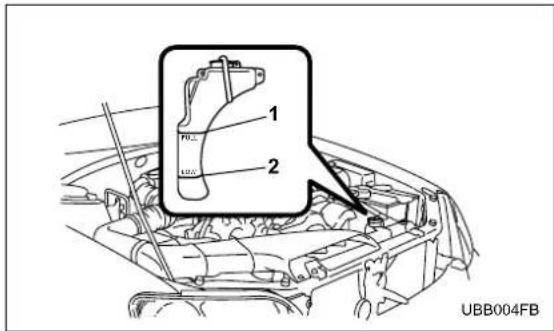
text_image
1 2 UBB004FB1) "FULL" level mark
2) "LOW" level mark
Check the coolant level at each fuel stop.
- Check the coolant level on the outside of the reservoir while the engine is cool.
- If the level is close to or lower than the "LOW" level mark, add coolant up to the "FULL" level mark. If the reserve tank is empty, remove the radiator cap and refill as required.
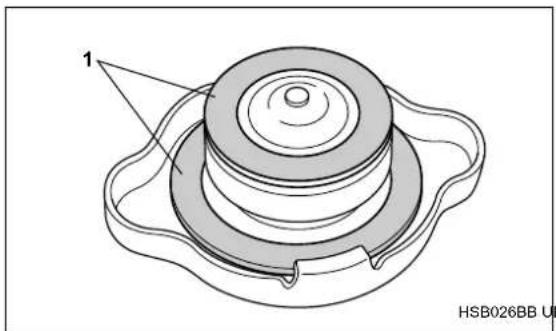
natural_image
Technical diagram of a mechanical component with labeled part 1, no readable text or symbols present1) Rubber gaskets
- After refilling the reserve tank and the radiator, re-install the caps and check that the rubber gaskets inside the radiator cap are in the proper position.
▼ Changing the coolant
Always add genuine SUBARU cooling system conditioner whenever the coolant is replaced.
Change the engine coolant and add genuine SUBARU cooling system conditioner using the following procedures according to the maintenance schedule in the "Warranty and Maintenance Booklet".
- Remove the under cover.
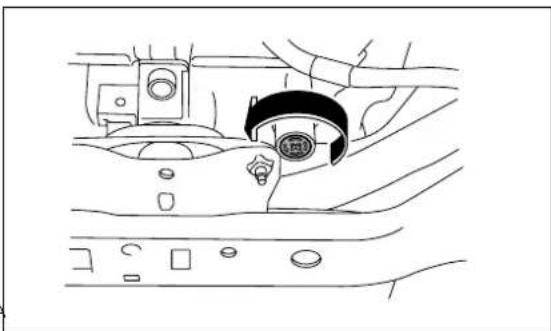
natural_image
Line drawing of a car interior showing dashboard, steering wheel, and dashboard controls (no text or symbols)Non-turbo models
- CONTINUED -
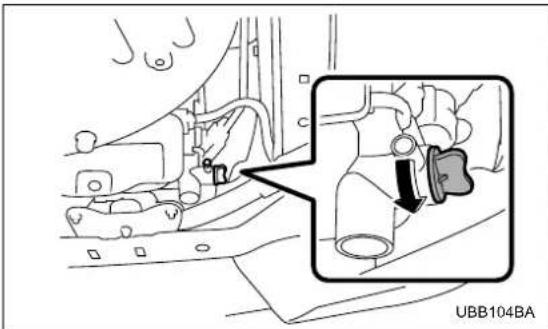
text_image
UBB104BATurbo models
- Place a proper container under the drain plug and loosen the drain plug.
WARNING
Never attempt to remove the radiator cap until the engine has been shut off and has cooled down completely. Since the coolant is under pressure, you may suffer serious burns from a spray of boiling hot coolant when the cap is removed.
- Loosen the radiator cap to drain the coolant from the radiator. Then drain the coolant from the reserve tank. Tighten the drain plug securely.
NOTE (Turbo models)
The cap (without tabs) on top of the radiator does not need to be removed. To add coolant, remove the cap (with tabs) on the coolant tank on top of the engine.
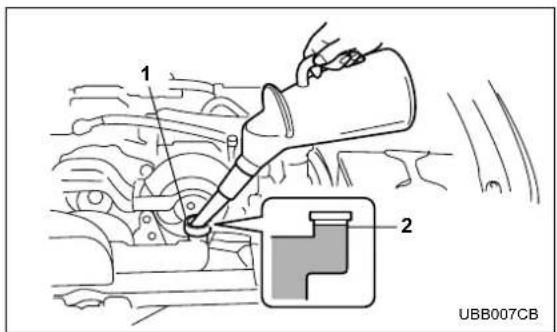
text_image
1 2 UBB007CBNon-turbo models
1) Filler neck
2) Fill up to here

text_image
1 2 USB518BBTurbo models
1) Filler neck
2) Fill up to here
- Slowly pour the coolant and fill up to just below the filler neck, allowing enough room to add genuine SUBARU cooling system conditioner in the radiator. Add genuine SUBARU cooling system conditioner until the coolant level reaches the filler neck. Do not pour the coolant too quickly, as this may lead to insufficient air bleeding and trapped air in the system.
Coolant capacity (Guideline):
Non-turbo models:
MT. 7.2 US qt (6.8 liters, 6.0 Imp qt)
AT. 7.1 US qt (6.7 liters, 5.9 Imp qt)
Turbo models:
MT. 8.1 US qt (7.7 liters, 6.8 Imp qt)
AT. 8.0 US qt (7.6 liters, 6.7 Imp qt)
CAUTION
- Be careful not to spill engine coolant when adding it. If coolant touches the exhaust pipe, it may cause a bad smell, smoke, and/or a fire.
- Do not splash the engine coolant over painted parts. The alcohol contained in the engine coolant may damage the paint surface.
- CONTINUED -

text_image
1 2 UBB004FB1) "FULL" level mark
2) "LOW" level mark
- Pour the coolant and fill to the reservoir tank's "FULL" level mark.
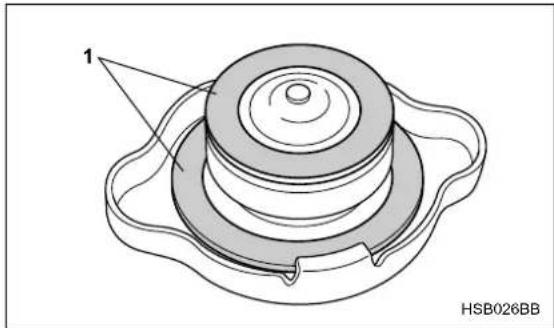
natural_image
Technical line drawing of a mechanical component with labeled part 1, no readable text or symbols beyond label1) Rubber gaskets
-
Put the radiator cap back on and tighten firmly. At this time, make sure that the rubber gasket in the radiator cap is correctly in place.
-
Start and run the engine for more than five minutes at 2,000 to 3,000 rpm.
-
Stop the engine and wait until the coolant cools down (122 to 140°F [50 to 60°C]). If there is any loss of coolant, add coolant to the radiator's filler neck and to the reserve tank's "FULL" level.
-
Put the radiator cap and reservoir cap back on and tighten firmly.
Air cleaner element
WARNING
Do not operate the engine with the air cleaner element removed. The air cleaner element not only filters intake air but also stops flames if the engine backfires. If the air cleaner element is not installed when the engine backfires, you could be burned.
The air cleaner element functions as a filter screen. When the element is perforated or removed, engine wear will be excessive and engine life shortened.
The air cleaner element is a viscous type. It is unnecessary to clean or wash the element.
■ Replacing the air cleaner element
▼ Non-turbo models
Replace the air cleaner element according to the maintenance schedule in the "Warranty and Maintenance Booklet". Under extremely dusty conditions, replace it more frequently. It is recommended that you always use genuine SUBARU parts.

natural_image
Diagram of a car engine compartment with directional arrows indicating motion (no text or symbols)1) Bolt
1. Remove the bolt securing the rear air cleaner element case.
2. Unsnap the three clamps holding the rear air clean-er element case.
- CONTINUED -

natural_image
Technical line drawing of a mechanical assembly with labeled component '1' (no text or symbols beyond label)1) Air cleaner element
- Separate the rear air cleaner element case from the front air cleaner element case and remove the air cleaner element.
- Clean the inside of the front and rear air cleaner element cases with a damp cloth and install a new air cleaner element.
- Insert the four projections on the rear air cleaner element case into the slits on the front air cleaner element case and snap the three clamps on the rear air cleaner element case and then tighten the bolt.
▼ Turbo models

natural_image
Technical line drawing of a vehicle's engine compartment with no visible text or symbols- Unsnap the two clamps holding the air cleaner case cover.
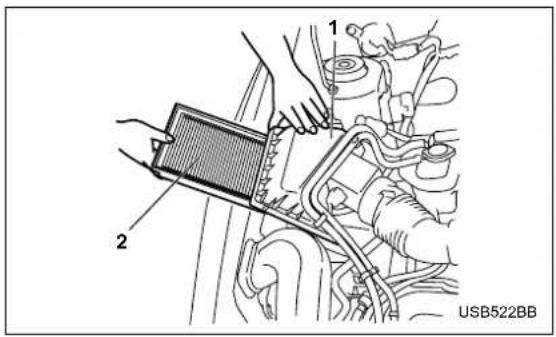
text_image
1 2 USB522BB1) Air cleaner case cover
2) Air cleaner element
-
Open the air cleaner case cover and remove the air cleaner element.
-
Clean the inside of the air cleaner cover and case with a damp cloth and install a new air cleaner element.
To install the air cleaner case cover, insert two projections on the air cleaner case into the slits on the air cleaner case cover and then snap the two clamps on the air cleaner case cover.
Spark plugs
CAUTION
- When disconnecting the spark plug cables, always grasp the spark plug cap, not the cables.
- Make sure the cables are replaced in the correct order.

natural_image
Illustration of two hands holding a tool, one with a curved handle and the other with a circular background showing a crossed handle (no text or symbols)It may be difficult to replace the spark plugs. It is recommended that you have the spark plugs replaced by your SUBARU dealer.
- CONTINUED -
The spark plugs should be replaced according to the maintenance schedule in the "Warranty and Maintenance Booklet".
■ Recommended spark plugs
Non-turbo models:
RC10YC4 (Champion)
BKR6E-11 (NGK)
BKR5E-11 (NGK)
Turbo models:
ILFR6B (NGK)
Drive belts
The alternator, power steering pump, and air conditioner compressor depend on drive belts. Satisfactory performance requires that belt tension be correct.

text_image
1 2 B A 3 HSB033BB1) Power steering pump pulley
2) Air conditioner compressor pulley
3) Crank pulley
in (mm)
| Deflection | ||
| New belt Used be t | ||
| A 0 | 28 - 0.35( 7.0 - 9.0) 0.35 - | 0.43( 9.0 - 11.0) |
| B 0 | 30 - 0.33( 7.5 - 8.5) 0.35 - | 0.40( 9.0 - 10.0) |
To check belt tension, place a straightedge (ruler) across two adjacent pulleys and apply a force of 22 lbs (98 N, 10 kg) midway between the pulleys by using a spring scale. Belt deflection should be the amount specified.
Manual transmission oil
■ Checking the oil level

text_image
1 UBB004DBNon-turbo models
1) Yellow handle
- CONTINUED -
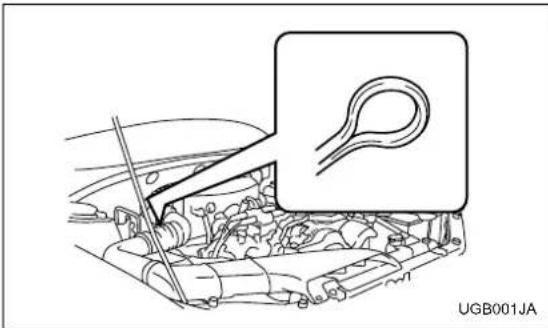
natural_image
Technical line drawing of an engine bay with a magnified inset showing a component detail (no text or symbols)Turbo models
- Park the vehicle on a level surface and stop the engine.
- Pull out the dipstick, wipe it clean, and insert it again.
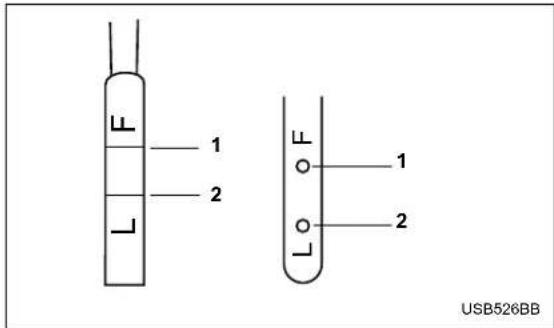
text_image
1 2 USB526BB1) Upper level
2) Lower level
- Pull out the dipstick again and check the oil level on it. If it is below the lower level, add oil through the dipstick hole to bring the level up to the upper level.
■ Recommended grade and viscosity
Each oil manufacturer has its own base oils and additives. Never use different brands together.
Oil grade:
API classification GL-5

other
| Value | Label | |-------|-------| | 90 | 90 | | 85W | 85W | | 80W | 80W | | 75W/90 | 75W/90 |SAE viscosity No. and applicable temperature
Automatic transmission fluid
■ Checking the fluid level
The automatic transmission fluid expands largely as its temperature rises; the fluid level differs according to fluid temperature. Therefore, there are two different scales for checking the level of hot fluid and cold fluid on the dipstick.
Though the fluid level can be checked without warming up the fluid on the "COLD" range, we recommend checking the fluid level when the fluid is at operating temperature.
▼ Checking the fluid level when the fluid is hot Check the fluid level monthly.
- Drive the vehicle several miles to raise the temperature of the transmission fluid up to normal operating temperature; 158 to 176°F (70 to 80°C) is normal.
- Park the vehicle on a level surface and set the parking brake.
- First shift the selector lever in each position. Then shift it in the "P" position, and run the engine at idling speed.
- CONTINUED -
Maintenance and service

text_image
1 UBB004KB1) Yellow handle

text_image
1 HSB018MB1) Yellow handle
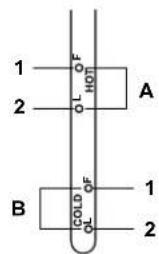
text_image
1 2 A B COLD 1 2HGB061BB
A) HOT range
B) COLD range
1) Upper level
2) Lower level
- Pull out the dipstick and check the fluid level on the gauge. If it is below the lower level on the "HOT" range, add the recommended automatic transmission fluid up to the upper level.
▼ Checking the fluid level when the fluid is cold When the fluid level has to be checked without time to warm up the automatic transmission, check to see that the fluid level is between the lower level and upper level on the "COLD" range. If it is below that range, add
fluid up to the upper level. Be careful not to overfill.
■ Recommended fluid
"Dexron III" Type Automatic Transmission Fluid
Front differential gear oil (AT vehicles)
- Checking the oil level

text_image
1 UBB004EB1) Yellow
- Park the vehicle on a level surface and stop the engine.
- Pull out the dipstick, wipe it clean, and insert it again.
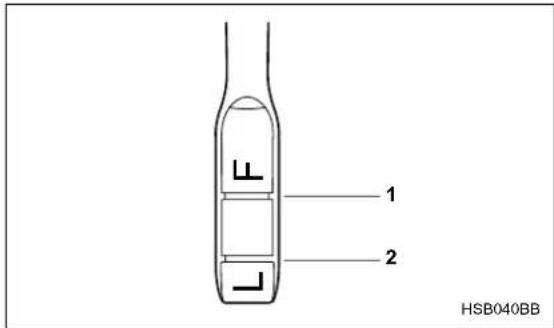
text_image
1 2 HSB040BB1) Upper level
2) Lower level
- Pull out the dipstick again and check the oil level on it. If it is below the lower level, add oil to bring the level up to the upper level.
■ Recommended grade and viscosity
Each oil manufacturer has its own base oils and additives. Never use different brands together.
Oil grade:
API classification GL-5

other
| Value | Label | |-------|-------| | 90 | | | 85W | | | 80W | | | 75W/90| |SAE viscosity No. and applicable temperature
Rear differential gear oil
■ Checking the gear oil level
CAUTION
If the vehicle requires frequent refilling, there may be an oil leak. If you suspect a problem, have the vehicle checked at your SUBARU dealer.
Your vehicle may be equipped with a rear differential protector. The differential protector provides protection to the rear differential assembly during off-road use. Removal of the rear differential protector is not required when checking the oil level.
- CONTINUED -

text_image
1 2 OM-U0213Non-turbo AT
1) Filler plug
2) Drain plug

text_image
1 2 3 OM-U02141) Filler hole
2) Drain hole
3) Oil level

text_image
1 2 HSB042BBOthers
1) Filler plug
2) Drain plug
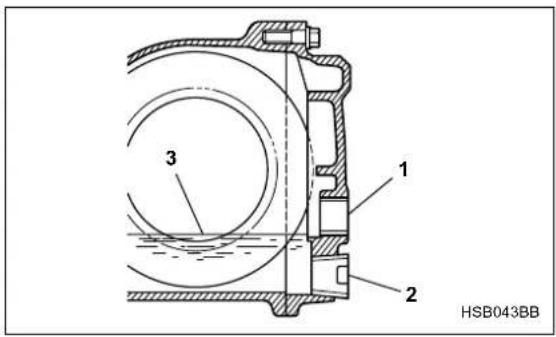
text_image
3 1 2 HSB043BB1) Filler hole
2) Drain hole
3) Oil level
Remove the plug from the filler hole and check the oil level. The oil level should be kept even with the bottom of the filler hole. If the oil level is below the bottom edge of the hole, add oil through the filler hole to raise the level.
■ Recommended grade and viscosity
Each oil manufacturer has its own base oils and additives. Never use different brands together.
- CONTINUED -
Oil grade:
API classification GL-5

other
| Level | Value | |-------|-------| | 90 | 90 | | 85W | 85W | | 80W | 80W | | 75W/90| 75W/90|SAE viscosity No. and applicable temperature
Power steering fluid
■ Checking the fluid level

text_image
1 UBB030BB1) Reservoir tank
WARNING
Be careful not to burn yourself because the fluid may be hot.
CAUTION
- When power steering fluid is being added,
use only clean fluid, and be careful not to allow any dirt into the tank. And never use different brands together.
- Avoid spilling fluid when adding it in the tank.
The power steering fluid expands greatly as its temperature rises; the fluid level differs according to fluid temperature. Therefore, the reservoir tank has two different checking ranges for hot and cold fluids.
Check the power steering fluid level monthly.
- Park the vehicle on a level surface, and stop the engine.

text_image
- HOT MAX - - HOT MIN - - COLD MAX - - COLD MIN - 1 1 HSB045BB1) Specified range
- Check the fluid level of the reservoir tank.
When the fluid is hot after the vehicle has been run: Check that the oil level is between "HOT MIN" and "HOT MAX" on the surface of the reservoir tank.
When the fluid is cool before the vehicle is run: Check that the oil level is between "COLD MIN" and "COLD MAX" on the surface of the reservoir tank.
- If the fluid level is lower than the applicable "MIN" line, add the recommended fluid as necessary to bring the level between the "MIN" and "MAX" line.
If the fluid level is extreme low, it may indicate possible leakage. Consult your SUBARU dealer for an inspection.
■ Recommended fluid
"Dexron III" Type Automatic Transmission Fluid
Brake fluid
■ Checking the fluid level
WARNING
- Never let brake fluid contact your eyes because brake fluid can be harmful to your eyes. If brake fluid gets in your eyes, immediately flush them thoroughly with clean water. For safety, when performing this work, wearing eye protection is advisable.
- Brake fluid absorbs moisture from the air. Any absorbed moisture can cause a dangerous loss of braking performance.
- If the vehicle requires frequent refilling, there may be a leak. If you suspect a problem, have the vehicle checked at your SUBARU dealer.
CAUTION
- Never use different brands of brake fluid together.
- When adding brake fluid, be careful not to allow any dirt into the reservoir.
- Never splash the brake fluid over painted sur-
faces or rubber parts. Alcohol contained in the brake fluid may damage them.
Check the fluid level monthly.

text_image
1 2 UBB004GB1) "MAX" level mark
2) "MIN" level mark
Check the fluid level on the outside of the reservoir. If the level is below "MIN", add the recommended brake fluid to "MAX".
Use only brake fluid from a sealed container.
■ Recommended brake fluid
FMVSS No. 116, fresh DOT 3 or 4 brake fluid
Clutch fluid (MT vehicles)
■ Checking the fluid level
WARNING
Never let clutch fluid contact your eyes because clutch fluid can be harmful to your eyes. If clutch fluid gets in your eyes, immediately flush them thoroughly with clean water. For safety, when performing this work, wearing eye protection is advisable.
CAUTION
- Clutch fluid absorbs moisture from the air. Any absorbed moisture can cause improper clutch operation.
- If the vehicle requires frequent refilling, there may be a leak. If you suspect a problem, have the vehicle checked at your SUBARU dealer.
- Never use different brands of clutch fluid together.
- When clutch fluid is added, be careful not to allow any dirt into the tank.
- CONTINUED -

text_image
1 2 UBB004HB1) "MAX" level mark
2) "MIN" level mark

text_image
1 2 UBB004LB1) "MAX" level mark
2) "MIN" level mark
Check the fluid level on the outside of the reservoir. If the level is below "MIN" level mark, add the recommended clutch fluid to "MAX" level mark.
Use only clutch fluid from a sealed container.
■ Recommended clutch fluid
FMVSS No. 116, fresh DOT 3 or DOT 4 brake fluid
Brake booster
If the brake booster does not operate as described below, have it checked by your SUBARU dealer.
- With the engine off, depress the brake pedal several times, applying the same pedal force each time. The distance the pedal travels should not vary.
- With the brake pedal depressed, start the engine. The pedal should move slightly down to the floor.
- With the brake pedal depressed, stop the engine and keep the pedal depressed for 30 seconds. The pedal height should not change.
- Start the engine again and run for about one minute then turn it off. Depress the brake pedal several times to check the brake booster. Brake booster operates properly if the pedal stroke decreases with each depression.
Brake pedal
Check the brake pedal free play and reserve distance according to the maintenance schedule in the "Warranty and Maintenance Booklet".
■ Checking the brake pedal free play
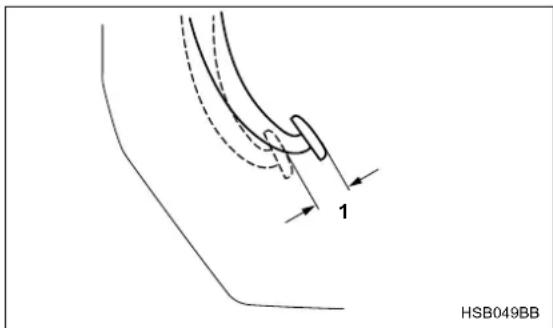
text_image
1 HSB049BB1) 0.04 - 0.12 in (1.0 - 3.0 mm)
Stop the engine and firmly depress the brake pedal several times. Lightly press the brake pedal down with one finger to check the free play with a force of less than 2 lbs (10 N, 1 kg).
If the free play is not within proper specification, con- - CONTINUED -
tact your SUBARU dealer.
- Checking the brake pedal reserve distance

text_image
1 HSB050BB1) More than 2.56 in (65 mm)
Depress the pedal with a force of approximately 66 lbs (294 N, 30 kg) and measure the distance between the upper surface of the pedal pad and the floor.
When the measurement is smaller than the specification, or when the pedal does not operate smoothly, contact with your SUBARU dealer.
Clutch pedal (Manual transmission vehicles)
Check the clutch pedal free play and reserve distance according to the maintenance schedule in the "Warranty and Maintenance Booklet".
■ Checking the clutch function
Check the clutch engagement and disengagement.
-
With the engine idling, check that there are no abnormal noises when the clutch pedal is depressed, and that shifting into 1st or reverse feels smooth.
-
Start the vehicle by releasing the pedal slowly to check that the engine and transmission smoothly couple without any sign of slippage.
■ Checking the clutch pedal free play
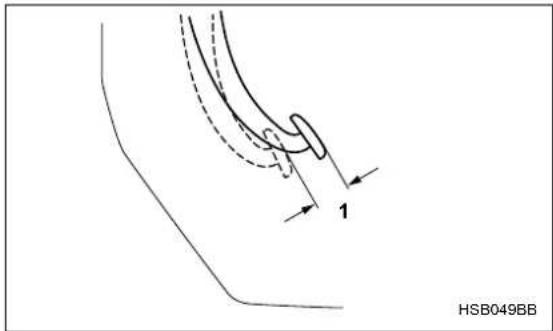
text_image
HSB049BB1) 0.16 - 0.51 in (4.0 - 13.0 mm)
Lightly press the clutch pedal down with your finger until you feel resistance, and check the free play. If the free play is not within proper specification, contact your SUBARU dealer.
Replacement of brake pad and lining
CAUTION
If you continue to drive despite the scraping noise from the audible brake pad wear indicator, it will result in the need for costly brake rotor repair or replacement.
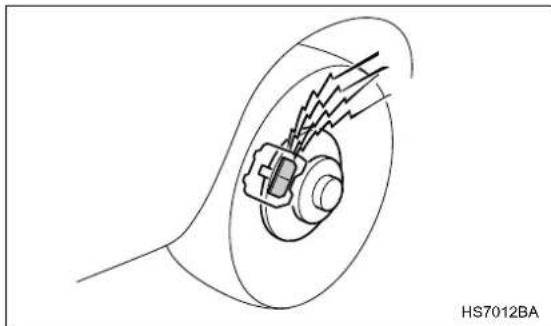
natural_image
Technical line drawing of a mechanical component with internal components and directional arrows (no text or symbols)The right front disc brake and the right rear disc brake have an audible wear indicators on the brake pads. If the brake pads wear close to their service limit, the wear indicator makes a very audible scraping noise
- CONTINUED -
when the brake pedal is applied.
If you hear this scraping noise each time you apply the brake pedal, have the brake pads serviced by your SUBARU dealer as soon as possible.
■ Breaking-in of new brake pads and linings
When replacing the brake pad or lining, use only genuine SUBARU parts. After replacement, the new parts must be broken in as follows:
▼ Brake pad and lining
While maintaining a speed of 30 to 40 mph (50 to 65 km/h), step on the brake pedal lightly. Repeat this five or more times.
▼ Parking brake lining
WARNING
A safe location and situation should be selected for break-in driving.
CAUTION
Pulling the parking brake lever too forcefully
may cause the rear wheels to lock. To avoid this, be certain to pull the lever up slowly and gently.
- Drive the vehicle at a speed of about 22 mph (35 km/h).
- With the parking brake release button pushed in, pull the parking brake lever SLOWLY and GENTLY. (Pulling with a force of approximately 33 lbs [147 N, 15 kg].)
- Drive the vehicle for about 220 yards (200 meters) in this condition.
- Wait 5 to 10 minutes for the parking brake to cool down. Repeat this procedure.
- Check the parking brake stroke. If the parking brake stroke is out of the specified range, adjust it by turning the adjusting nut located on the parking brake lever.
Parking brake stroke:
7 – 8 notches / 44 lbs (196 N, 20 kg)
Parking brake stroke
Check the parking brake stroke according to the maintenance schedule in the "Warranty and Maintenance Booklet". When the parking brake is properly adjusted, braking power is fully applied by pulling the lever up seven to eight notches gently but firmly (about 44 lbs [196 N, 20 kg]). If the parking brake lever stroke is not within the specified range, have the brake system checked and adjusted at your SUBARU dealer.
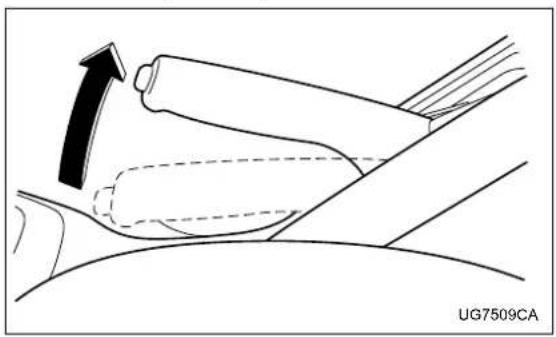
natural_image
Diagram of a car seatbelt mechanism with an arrow indicating clockwise motion (no text or symbols)Tires and wheels
■ Types of tires
You should be familiar with type of tires present on your vehicle.
▼ All season tires
The factory-installed tires on your new vehicle are all season tires.
All season tires are designed to provide an adequate measure of traction, handling and braking performance in year-round driving including snowy and icy road conditions. However all season tires do not offer as much traction performance as winter (snow) tires in heavy or loose snow or on icy roads.
All season tires are identified by "ALL SEASON" and/or "M+S" (Mud & Snow) on the tire sidewall.
▼ Summer tires
Summer tires are high-speed capability tires best suited for highway driving under dry conditions.
Summer tires are inadequate for driving on slippery roads such as on snow-covered or icy roads.
If you drive your vehicle on snow-covered or icy roads, we strongly recommend the use of winter (snow) tires. When installing winter tires, be sure to replace all four tires.
- CONTINUED -
▼ Winter (snow) tires
Winter tires are best suited for driving on snow-covered and icy roads. However winter tires do not perform as well as summer tires and all season tires on roads other than snow-covered and icy roads.
■ Tire inspection
Check on a daily basis that the tires are free from serious damage, nails, and stones. At the same time, check the tires for abnormal wear.
Contact your SUBARU dealer immediately if you find any problem.
NOTE
- When the wheels and tires strike curbs or are subjected to harsh treatment as when the vehicle is driven on a rough surface, they can suffer damage that cannot be seen with the naked eye. This type of damage does not become evident until time has passed. Try not to drive over curbs, pot-holes or on other rough surfaces. If doing so is unavoidable, keep the vehicle's speed down to a walking pace or less, and approach the curbs as squarely as possible. Also, make sure the tires are not pressed against the curb when you park the vehicle.
- If you feel unusual vibration while driving or find
it difficult to steer the vehicle in a straight line, one of the tires and/or wheels may be damaged. Drive slowly to the nearest authorized SUBARU dealer and have the vehicle inspected.
■ Tire pressures and wear
Maintaining the correct tire pressures helps to maximize the tires' service lives and is essential for good running performance. Check and, if necessary, adjust the pressure of each tire (including the spare) at least once a month and before any long journey.
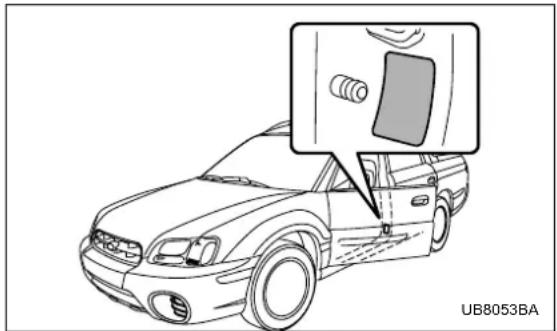
natural_image
Line drawing of a car with an inset showing a door panel and a sensor device (no text or symbols)Check the tire pressures when the tires are cold. Use a pressure gauge to adjust the tire pressures to the
values shown on the tire placard. The tire placard is located on the door pillar on the driver's side.
Driving even a short distance warms up the tires and increases the tire pressures. Also, the tire pressures are affected by the outside temperature. It is best to check tire pressure outdoors before driving the vehicle.
When a tire becomes warm, the air inside it expands, causing the tire pressure to increase. Be careful not to mistakenly release air from a warm tire to reduce its pressure.
NOTE
- The air pressure in a tire increases by approximately 4.3 psi (30 kPa, 0.3 kgf/cm ^2 ) when the tire becomes warm.
- The tires are considered cold when the vehicle has been parked for at least three hours or has been driven less than one mile (1.6 km).
WARNING
Do not let air out of warm tires to adjust pressure. Doing so will result in low tire pressure.
Incorrect tire pressures detract from controllability and ride comfort, and they cause the tires to wear abnor-
mally.
- Correct tire pressure (tread worn evenly)
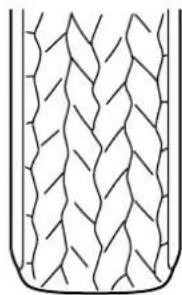
natural_image
Diagram of a U-shaped container filled with fibrous material (no text or symbols)HSB052AA
Roadholding is good, and steering is responsive. Rolling resistance is low, so fuel consumption is also lower.
- CONTINUED -
- Abnormally low tire pressure (tread worn at shoulders)

natural_image
Diagram of a U-shaped container with internal crack pattern, no text or symbols presentRolling resistance is high, so fuel consumption is also higher.
- Abnormally high tire pressure (tread worn in center)

natural_image
Diagram of a cylindrical container with internal branching structure (no text or symbols)Ride comfort is poor. Also, the tire magnifies the effects of road-surface bumps and dips, possibly resulting in vehicle damage.
WARNING
Driving at high speeds with excessively low tire pressures can cause the tires to deform severely and to rapidly become hot. A sharp increase in temperature could cause tread separation, and destruction of the tires. The resulting loss
of vehicle control could lead to an accident.
■ Wheel balance
Each wheel was correctly balanced when your vehicle was new, but the wheels will become unbalanced as the tires become worn during use. Wheel imbalance causes the steering wheel to vibrate slightly at certain vehicle speeds and detracts from the vehicle's straight-line stability. It can also cause steering and suspension system problems and abnormal tire wear. If you suspect that the wheels are not correctly balanced, have them checked and adjusted by your SUBARU dealer. Also have them adjusted after tire repairs and after tire rotation.
NOTE
Loss of correct wheel alignment* causes the tires to wear on one side and reduces the vehicle's running stability. Contact your SUBARU dealer if you notice abnormal tire wear.
*: The suspension system is designed to hold each wheel at a certain alignment (relative to the other wheels and to the road) for optimum straight-line stability and cornering performance.
■ Wear indicators
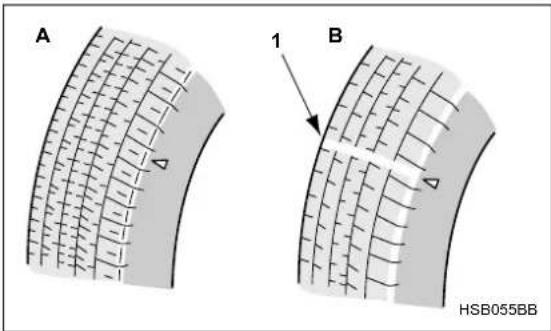
text_image
A 1 B HSB055BBA) New tread
B) Worn tread
1) Tread wear indicator
Each tire incorporates a tread wear indicator, which becomes visible when the depth of the tread grooves decreases to 0.063 in (1.6 mm). A tire must be replaced when the tread wear indicator appears as a solid band across the tread.
WARNING
When a tire's tread wear indicator becomes vis-
- CONTINUED -
ible, the tire is worn beyond the acceptable limit and must be replaced immediately. With a tire in this condition, driving at high speeds in wet weather can cause the vehicle to hydroplane. The resulting loss of vehicle control can lead to an accident.
NOTE
For safety, inspect the tire tread regularly and replace the tires before their tread wear indicators become visible.
■ Tire rotation
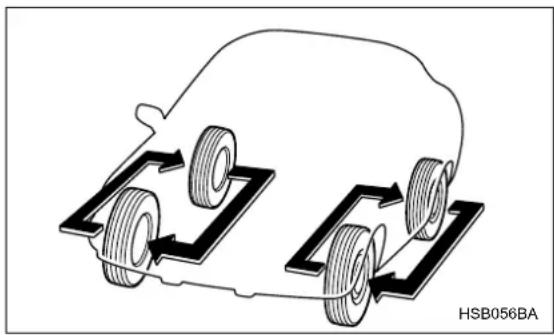
natural_image
Diagram of a car with wheels and directional arrows indicating motion or movement (no text or symbols)Tire wear varies from wheel to wheel. To maximize the life of each tire and ensure that the tires wear uniformly, it is best to rotate the tires every 7,500 miles (12,500 km). Rotating the tires involves switching the front and rear tires on the right hand side of the vehicle and similarly switching the front and rear tires on the left hand side of the vehicle. (Each tire must be kept on its original side of the vehicle.)
Replace any damaged or unevenly worn tire at the time of rotation. After tire rotation, adjust the tire pressures and make sure the wheel nuts are correctly tightened.
After driving approximately 600 miles (1,000 km), check the wheel nuts again and retighten any nut that has become loose.
■ Tire replacement
The wheels and tires are important and integral parts of your vehicle's design; they cannot be changed arbitrarily. The tires fitted as standard equipment are optimally matched to the characteristics of the vehicle and were selected to give the best possible combination of running performance, ride comfort, and service life. It is essential for every tire to have a size and construction matching those shown on the tire placard and to have a speed symbol and load index matching those
shown on the tire placard.
Using tires of a non-specified size detracts from controllability, ride comfort, braking performance, speedometer accuracy and odometer accuracy. It also creates incorrect body-to-tire clearances and inappropriately changes the vehicle's ground clearance.
All four tires must be the same in terms of manufacturer, brand (tread pattern), construction, and size. You are advised to replace the tires with new ones that are identical to those fitted as standard equipment.
For safe vehicle operation, SUBARU recommends replacing all four tires at the same time.
WARNING
- All four tires must be the same in terms of manufacturer, brand (tread pattern), construction, degree of wear, speed symbol, load index and size. Mixing tires of different types, sizes or degrees of wear can result in damage to the vehicle's power train. Use of different types or sizes of tires can also dangerously reduce controllability and braking performance and can lead to an accident.
- Use only radial tires. Do not use radial tires together with belted bias tires and/or bias-ply
tires. Doing so can dangerously reduce controllability, resulting in an accident.
■ Wheel replacement
When replacing wheels due, for example, to damage, make sure the replacement wheels match the specifications of the wheels that are fitted as standard equipment. Replacement wheels are available from SUBARU dealers.
WARNING
Use only those wheels that are specified for your vehicle. Wheels not meeting specifications could interfere with brake caliper operation and may cause the tires to rub against the wheel well housing during turns. The resulting loss of vehicle control could lead to an accident.
Aluminum wheels
Aluminum wheels can be scratched and damaged easily. Handle them carefully to maintain their appearance, performance, and safety.
- When any of the wheels is removed and replaced for tire rotation or to change a flat, always check the tightness of the wheel nuts after driving approximately 600 miles (1,000 km). If any nut is loose, tighten it to the specified torque.
- Never apply oil to the threaded parts, wheel nuts, or tapered surface of the wheel.
- Never let the wheel rub against sharp protrusions or curbs.
- Be sure to fit tire chains on uniformly and completely around the tire, otherwise the chains may scratch the wheel.
- When wheel nuts, balance weights, or the center cap is replaced, be sure to replace them with genuine SUBARU parts designed for aluminum wheels.
Windshield washer fluid
CAUTION
Never use engine coolant as washer fluid because it could cause paint damage.
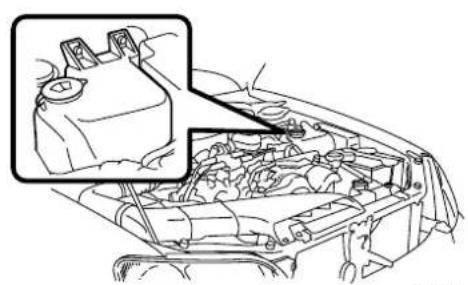
natural_image
Technical line drawing of an engine compartment with a zoomed-in inset showing internal components (no text or symbols)UBB004IA
Check the level of the washer fluid at each fuel stop. If the level is low, fill the fluid up to the neck of the reservoir.
Use windshield washer fluid. If windshield washer fluid is unavailable use clean water.
In areas where water freezes in winter, use an anti-
freeze type windshield washer fluid. SUBARU Windshield Washer Fluid contains 58.5% methyl alcohol and 41.5% surfactant, by volume. Its freezing temperature varies according to how much it is diluted, as indicated in the following table.
Washer Fluid Concentration Freezing Temperature
| 30% | 10.4°F (-12°C) |
| 50% -4°F (-20°C) | |
| 100% -49°F (-45°C) |
Replacement of windshield wiper blades
Grease, wax, insects, or other materials on the windshield or the wiper blade results in jerky wiper operation and streaking on the glass. If you cannot remove the streaks after operating the windshield washer or if the wiper operation is jerky, clean the outer surface of the windshield (or rear window) and the wiper blades using a sponge or soft cloth with a neutral detergent or mild-abrasive cleaner. After cleaning, rinse the windshield and wiper blades with clean water. The windshield is clean if beads do not form when you rinse the windshield with water.
CAUTION
Do not clean the wiper blades with gasoline or a solvent, such as paint thinner or benzene. This will cause deterioration of the wiper blades.
If you cannot eliminate the streaking even after following this method, replace the wiper blades using the following procedures:
- Raise the wiper arm off the windshield.
- CONTINUED -

natural_image
Technical line drawing of a mechanical component with labeled parts (no text or symbols beyond labels)1) Stopper
- Remove the wiper blade assembly by holding its pivot area and pushing it in the direction shown by the arrow while depressing the wiper blade stopper.
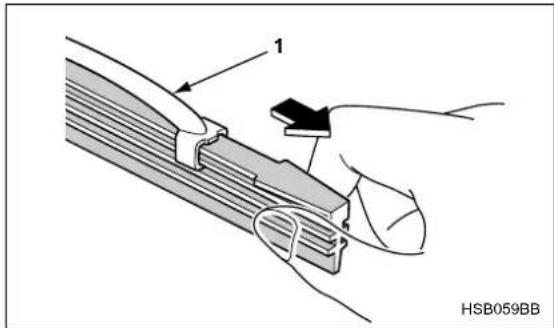
text_image
1 HSB059BB1) Metal support
- Grasp the locked end of the blade rubber assembly and pull it firmly until the stoppers on the rubber are free of the metal support.
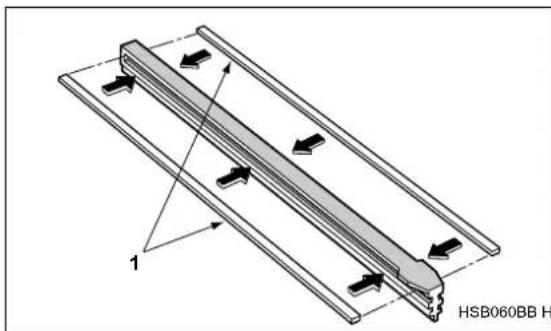
natural_image
Technical diagram of a mechanical assembly with directional arrows and labeled component (HSB060BB H), no readable text or symbols beyond labels.1) Metal spines
- If the new blade rubber is not provided with two metal spines, remove the metal spines from the old blade rubber and install them in the new blade rubber.

natural_image
Technical line drawing of a mechanical component with a black arrow indicating direction (no text or symbols)- Align the claws of the metal support with the grooves in the rubber and slide the blade rubber assembly into the metal support until it locks.
- CONTINUED -
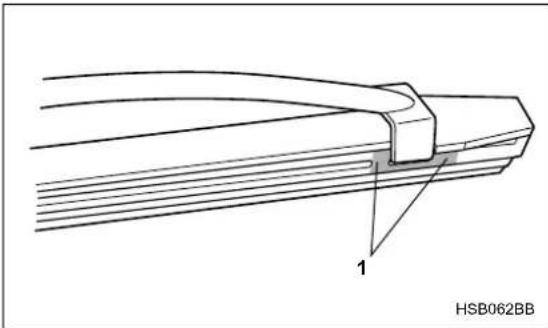
text_image
HSB062BB 11) Stopper
6. Be sure to position the claws at the end of the metal support between the stoppers on the rubber as shown. If the rubber is not retained properly, the wiper blade may scratch the windshield.
7. Install the wiper blade assembly to the wiper arm. Make sure that it locks in place.
8. Lower the wiper arm slowly while holding it with your hand.
Battery
WARNING
- Before beginning work on or near any battery, be sure to extinguish all cigarettes, matches, and lighters. Never expose a battery to an open flame or electric sparks. Batteries give off a gas which is highly flammable and explosive.
- For safety, in case an explosion does occur, wear eye protection or shield your eyes when working near any battery. Never lean over a battery.
- Do not let battery fluid contact eyes, skin, fabrics, or paint because battery fluid is a corrosive acid. If battery fluid gets on your skin or in your eyes, immediately flush the area with water thoroughly. Seek medical help immediately if acid has entered the eyes.
If battery fluid is accidentally swallowed, immediately drink a large amount of milk or water, and seek medical attention immediately.
• To lessen the risk of sparks, remove rings, metal watchbands, and other metal jewelry. Never allow metal tools to contact the positive battery terminal and anything connected to it WHILE you are at the same time in contact with
any other metallic portion of the vehicle because a short circuit will result.
- Keep everyone including children away from the battery.
- Charge the battery in a well-ventilated area.
- Battery posts terminals and related accessories contain lead and lead compounds, chemicals known to the State of California to case cancer and reproductive harm. Batteries also contain other chemicals known to the State of California to cause cancer. Wash hands after handling.
It is unnecessary to periodically check the battery fluid level or periodically refill with distilled water.
CAUTION
Never use more than 10 amperes when charging the battery because it will shorten battery life.
Fuses
CAUTION
Never replace a fuse with one having a higher rating or with material other than a fuse because serious damage or a fire could result.
natural_image
Interior view of a car dashboard and steering wheel, showing a close-up of the steering wheel's side panel with an arrow indicating motion (no text or symbols present)UBB008DA
The fuses are designed to melt during an overload to prevent damage to the wiring harness and electrical equipment. The fuses are located in two fuse boxes. One is located under the instrument panel behind the coin tray on the driver's seat side.
- CONTINUED -
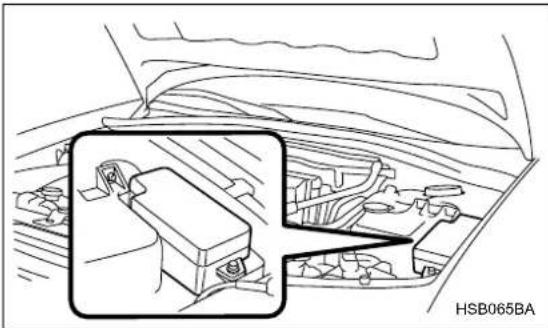
natural_image
Technical line drawing of a car engine compartment with a zoomed-in section view (no text or symbols)The other one is housed in the engine compartment.
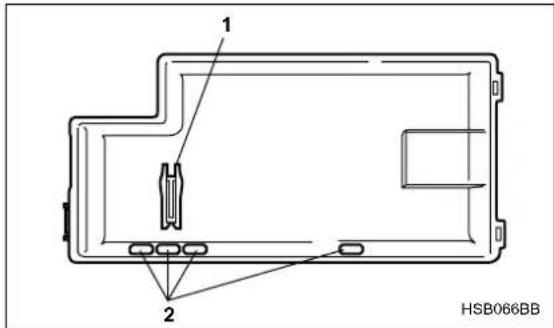
text_image
1 2 HSB066BB1) Fuse puller
2) Spare fuses
The fuse puller and spare fuses are stored in the main fuse box cover in the engine compartment.

natural_image
Two schematic diagrams labeled A and B showing a connector or terminal block with internal wavy lines and mounting holes (no text or symbols beyond labels)A) Good
B) Blown
If any lights, accessories or other electrical controls do not operate, inspect the corresponding fuse. If a fuse has blown, replace it.
- Turn the ignition switch to the "LOCK" position and turn off all electrical accessories.
- Remove the cover.
(For behind the coin tray: open the coin tray and pull it horizontally to remove it.) - Determine which fuse may be blown. The back side of each fuse box cover and the "Fuses and circuits" section in chapter 12 in this manual show the circuit for
each fuse.

text_image
1 HSB068BB1) Fuse puller
- Pull out the fuse with the fuse puller.
- Inspect the fuse. If it has blown, replace it with a spare fuse of the same rating.
- If the same fuse blows again, this indicates that its system has a problem. Contact your SUBARU dealer for repairs.
Main fuse

natural_image
Technical line drawing of a vehicle engine compartment with an inset showing internal components (no text or symbols)Main fuse box
The main fuses are designed to melt during an overload to prevent damage to the wiring harness and electrical equipment. Check the main fuses if any electrical component fails to operate (except the starter motor) and other fuses are good. A melted main fuse must be replaced. Use only replacements with the same specified rating as the melted main fuse. If a main fuse blows after it is replaced, have the electrical system checked by your nearest SUBARU dealer.
Installation of accessories
Always consult your SUBARU dealer before installing fog lights or any other electrical equipment in your vehicle. Such accessories may cause the electronic system to malfunction if they are incorrectly installed or if they are not suited for the vehicle.
Replacing bulbs

text_image
1 2 3 4 5 7 6 UBF047CB- CONTINUED -
Maintenance and service
Wattage Bulb No.
1) Headlight
BAJA-S 12V-65/
9007
55W (HB5)
BAJA, BAJA-B
Low beam 12V-55W H1
High beam 12V-60W 9005
(HB3)
2) Front turn signal 12V-27W 1156NA
(Amber)
3) Map light 12V-8W -
4) Dome light 12V-8W -
5) Door step light 12V-3.4W –
6) Front turn signal light/ 12V-27/ parking and front side 8W marker light
12V-27/ 1157NA
7) Front fog light 12V-51W 9006
8W (Amber)
(HB4)
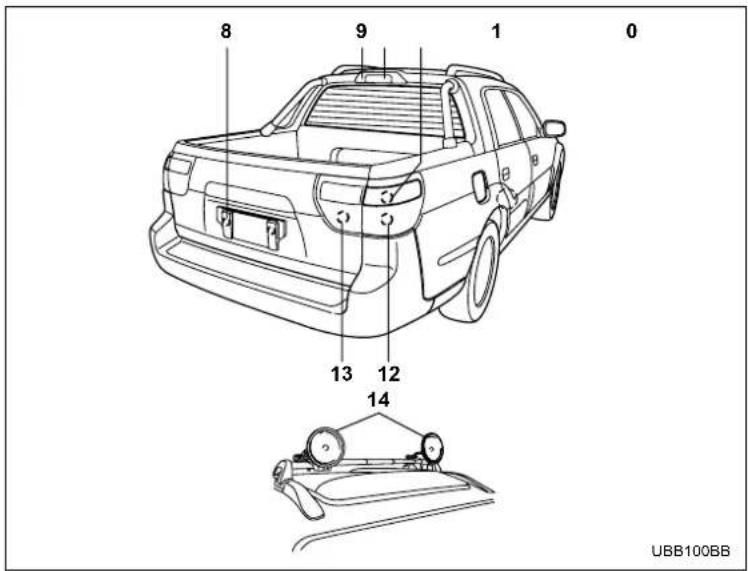
text_image
8 9 1 0 13 12 14 UBB100BB1 1
- CONTINUED -
Wattage Bulb No.
8) License plate light 12V-5W 168
9) Cargo light 12V-13W 912
10) High mount stop light 12V-13W 912
11) Backup light 12V-21W 7440
12) Brake rear turn signal/ tail light 12V-21/ 7443 5W
13) Tail light 12V-5W 168
14) Sports activity lights 12V-55W H3
■ Headlight
CAUTION
Halogen headlight bulbs become very hot while in use. If you touch the bulb surface with bare hands or greasy gloves, finger prints or grease on the bulb surface will develop into hot spots and cause the bulb to break. If there are finger prints or grease on the bulb surface, wipe them away with a soft cloth moistened with alcohol.
NOTE
If headlight aiming is required, consult your SUBARU dealer for proper adjustment of the head-light aim.
BAJA-Sport
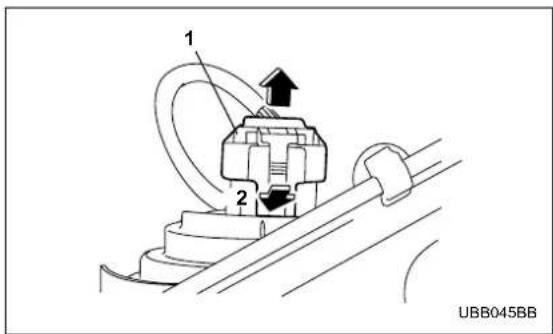
text_image
1 2 UBB045BB1) Electrical connector
2) Push
- Disconnect the electrical connector while pressing the lock release tab.

natural_image
Technical diagram of a mechanical component with concentric rings and mounting features (no text or symbols)-
Remove the bulb holder from the headlight assembly by turning it counterclockwise.
-
Remove the bulb from the headlight assembly.
-
Install the new bulb.
-
Install the bulb holder in the headlight assembly by turning it clockwise until it locks.
-
Remove the electrical connector.
- CONTINUED -
▼ BAJA, BAJA-Turbo
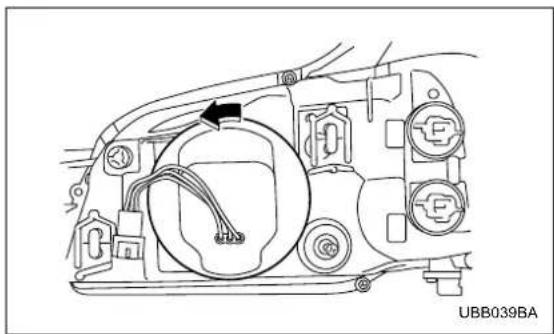
natural_image
Technical line drawing of a car interior showing engine components and wiring (no text or symbols)
text_image
1 2 UBB040BB1) Low beam light bulb
2) High beam light bulb
Remove the headlight bulb cover, by turning it counterclockwise.
▼ Low beam light bulbs
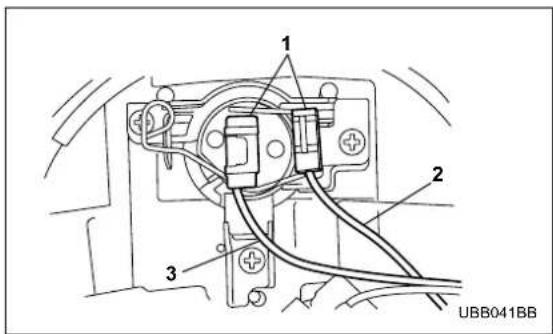
text_image
1 2 3 UBB041BB- Disconnect the electrical connector for the black cable.

natural_image
Diagram of a car interior showing electrical connections and a valve (no text or symbols)- Remove the retainer spring.
- Replace the bulb, then set the retainer spring securely.
- Reconnect the electrical connector for black cable.
- Install the headlight bulb cover.
- CONTINUED -
▼ High beam light bulbs
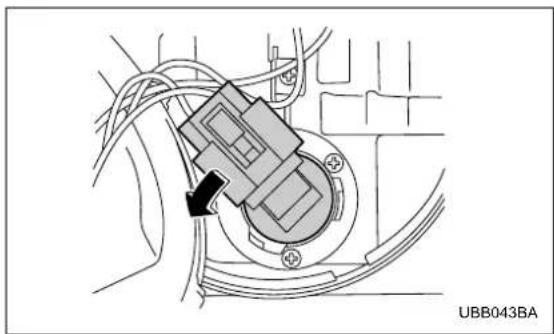
natural_image
Technical diagram of a mechanical component with wiring and a highlighted section, no readable text or symbols present.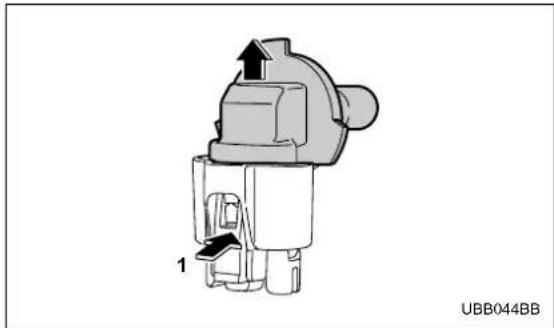
natural_image
Mechanical component diagram showing a valve assembly with directional arrows (no text or symbols)1) Push
- Disconnect the electrical connector from the bulb.
- Remove the bulb from the headlight assembly by turning it counterclockwise.
- Replace the bulb with new one.
- Reconnect the electrical connector. At this time, use care not to touch the bulb surface.
- To install the bulb to the headlight assembly, turn it clockwise until it clicks.
- Install the headlight bulb cover.
■ Front fog light
It may be difficult to replace the bulbs. Have your
SUBARU dealer replace the bulbs if necessary.
■ Front turn signal light, parking light and side marker light
The headlight assembly must be removed before the front turn signal light and parking light bulbs can be replaced. When the headlight assembly has been removed and then reinstalled, it may become necessary to make a headlight aiming adjustment. After a bulb has been replaced, it is recommended that the headlight aiming adjustment be made at a SUBARU dealer.

natural_image
Technical line drawing of a vehicle head panel with mounting bracket and valve (no text or symbols)- Remove the headlight assembly mounting screws located at the top of and the front of the headlight as-
sembly using a Phillips screwdriver or an open-end wrench.
- Move the headlight assembly forward.
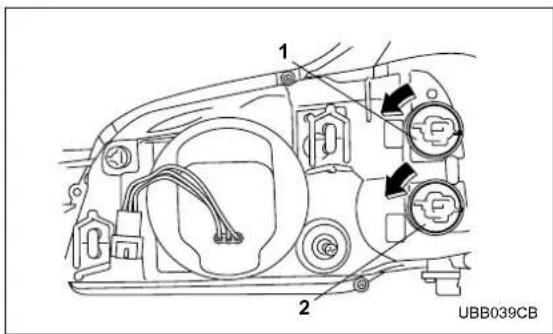
text_image
1 2 UBB039CB1) Front turn signal light bulb 2) Front turn signal light bulb/parking and front side marker light bulb
- Remove the bulb socket from the headlight assembly by turning it counterclockwise.
- CONTINUED -
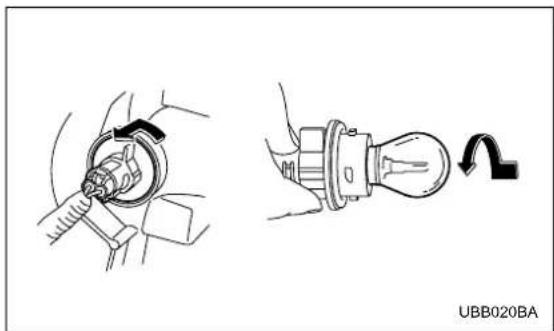
natural_image
Technical illustration showing two mechanical components: a valve assembly and a bulb with a curved arrow (no text or symbols)- Remove the bulb from the socket by pushing it and turning counterclockwise. Install a new bulb in the socket.
- Set the bulb socket into the headlight assembly and turn it clockwise until it locks.
- Set the headlight assembly into the vehicle body. Tighten the mounting screws.
■ Rear combination lights
Rear combination lights are composed of the rear turn signal/brake/tail light and back up lights.
▼ Rear turn signal/Brake/Tail and Back up lights
The rear turn signal/brake/tail light is one bulb with two
filament types.
If any one of them malfunctions, replace the bulb with a new one.
- Open the tailgate.

natural_image
Technical line drawing of a mechanical assembly with no visible text or symbols- Pry the cover from the side of the rear combination light.

natural_image
Technical line drawing of a mechanical assembly with no visible text or symbols- Remove the rear combination light mounting bolts. Then, slide the rear combination light assembly to the rear and remove it from the vehicle.
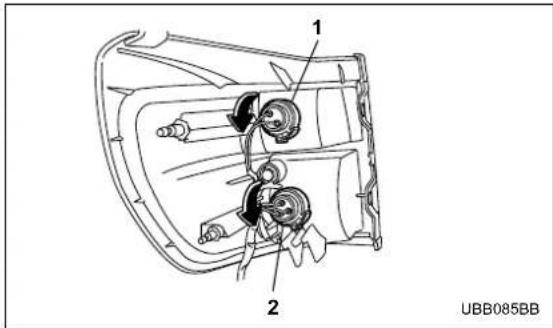
text_image
1 2 UBB085BB1) Back up light bulb
2) Brake/turn/tail/light bulb
-
Remove the bulb socket from the rear combination light assembly by turning it counterclockwise.
-
Remove the bulb from the socket by pulling it.
- Install a new bulb into the socket by pushing it.
- Set the bulb socket into the rear combination light assembly and turn it clockwise until it stops.
- Mount the rear combination light assembly into the vehicle body with two mounting bolts.
- Install the cover by inserting the knobs into the places.
- CONTINUED -
■ Tail light (on the tailgate)
- Open the tailgate.
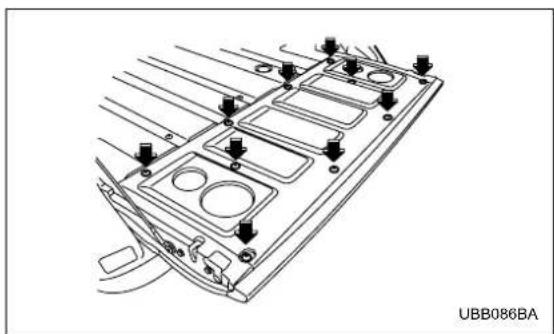
natural_image
Technical line drawing of a mechanical component with mounting holes and a clip, no text or symbols present- Remove the tailgate trim by loosening the installation screws.

natural_image
Technical line drawing of a mechanical component with mounting holes and bolts (no text or symbols)- Remove the tail light cover by loosening the installation screws.

natural_image
Technical line drawing of a mechanical component with no visible text or symbols- Remove the bulb socket from the tail light by turning it counterclockwise.
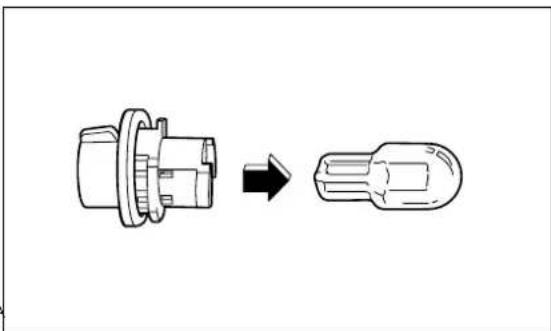
natural_image
Diagram showing a mechanical component being converted into a final assembled part (no text or symbols present)- Remove the bulb from the socket by pulling it.
- Install a new bulb into the socket by pushing it.
- Install the bulb socket into the tail light by turning it clockwise until it stops.
- Install the tail light cover and the tailgate trim.
- CONTINUED -
■ License plate light
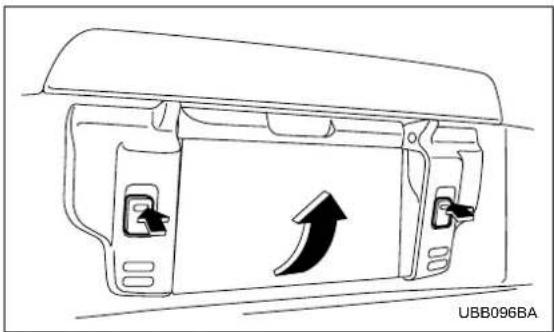
natural_image
Diagram of a vehicle rear door with directional arrow and logo (no text or symbols on diagram)- Push two release buttons and pull the license plate bracket up until it clicks.
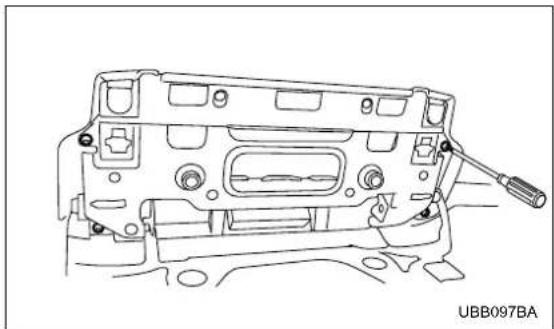
natural_image
Technical line drawing of an internal combustion engine casing with a wrench inserted (no text or symbols)- Remove the two cover installation screws.
- Push the license plate bracket back to the original position.
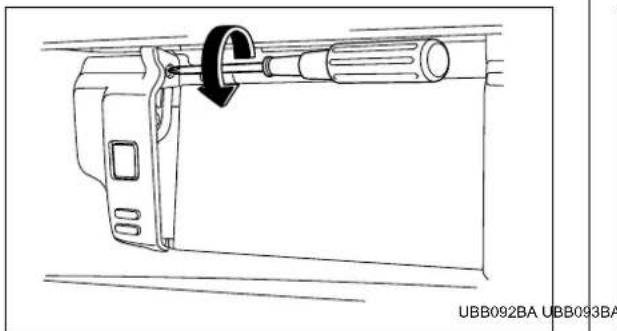
natural_image
Technical line drawing of a mechanical device with a dial indicator (no text or symbols)- Remove the screw from the side of the cover.
- Remove the cover.
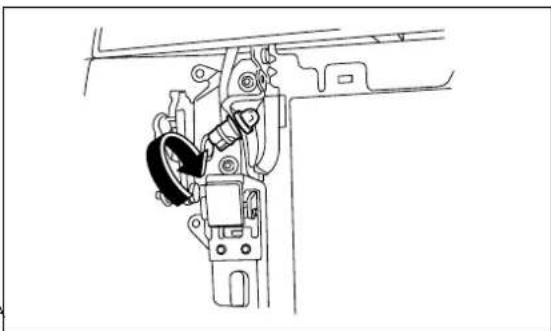
natural_image
Technical line drawing of a mechanical assembly with no visible text or symbols- Remove the bulb socket from the license plate bracket by turning it counterclockwise.
- Pull the bulb out of the socket.
- Install a new bulb in the socket by pushing it.
- Install the bulb socket into the license plate bracket.
- Install the covers by reversing procedures for removal.
- CONTINUED -
■ Map light, dome light and door step light

natural_image
Diagram showing two views of a car dashboard with control panels and buttons, no text or symbols presentMap light
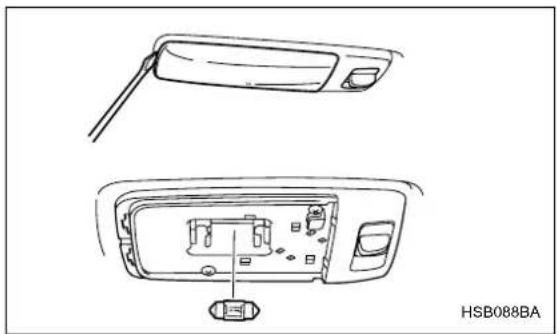
natural_image
Technical line drawing of a car interior panel with a cable and connector, no text or symbols presentDome light

natural_image
Technical line drawing of a car interior with a bracket and cable routing (no text or symbols)Door step light
- Remove the lens by prying the edge of the lens with a flat-head screwdriver.
- Pull the bulb out of the socket. Install a new bulb.
- Reinstall the lens.
■ High mount stop and cargo light assembly

natural_image
Technical line drawing of a car rear panel with two mounting holes and a UBB089BA label (no text or symbols on the diagram itself)- Remove the high mount stop light mounting screws.
- CONTINUED -
Maintenance and service
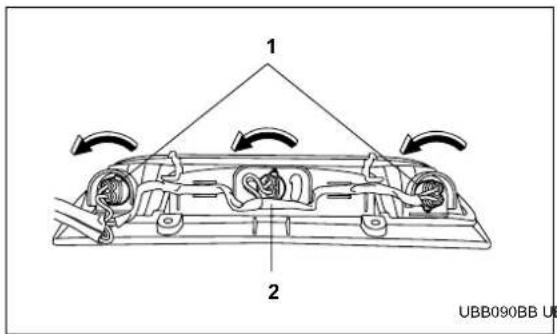
text_image
1 2 UBB090BB UB1) Cargo lights
2) High mount stop lights
- Remove the bulb socket from the light assembly by turning it counterclockwise.
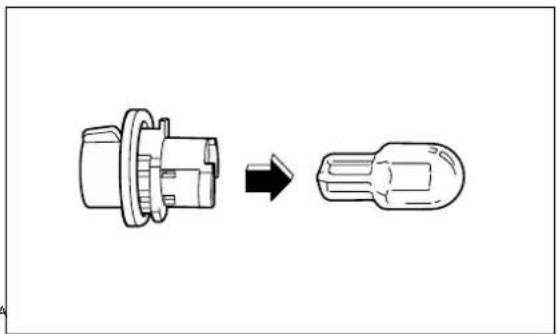
natural_image
Diagram showing a mechanical component before and after transformation, with no text or symbols present.- Remove the bulb from the socket by pulling it.
- Install a new bulb in the socket by pushing it.
- Set the socket into the light assembly and turn it clockwise until it clicks.
- Mount the light assembly with the mounting screws.
■ Sport activity lights (if equipped)
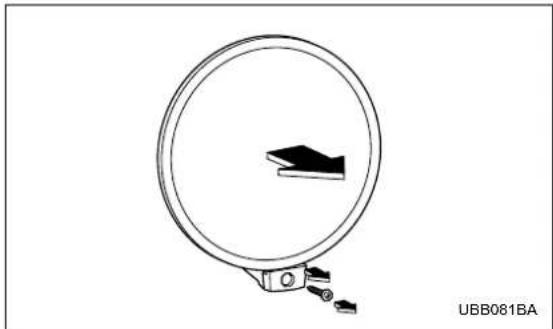
natural_image
Technical line drawing of a circular mechanical component with a central slot and base mount (no text or symbols)- Remove front lamp screw and remove the lens and reflector.
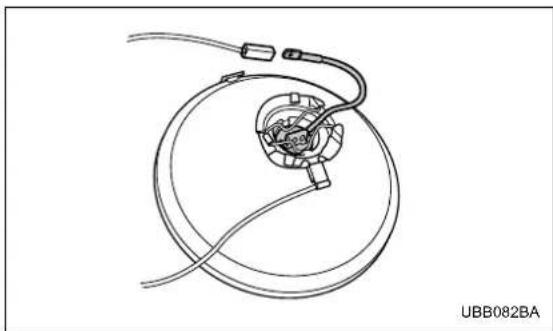
natural_image
Technical line drawing of a mechanical or electrical component with coiled wires and connectors (no text or symbols)- Disconnect the two wires from the lamp electrical connector.
- Squeeze the bulb retainer spring to remove.
- Replace the bulb, then reset the retainer spring securely.
- Reconnect the bulb wire to the electrical connector.
- Install the lens and reflector in the housing and secure with the screw.
NOTE
Other bulbs may be difficult to replace. Have your SUBARU dealer replace these bulbs if necessary.
natural_image
Pure horizontal dashed lines on white background with no text, numbers, or symbolsSpecifications
Specifications 12-2
Dimensions 12-2
Engine 12-2
Electrical system 12-3
Capacities 12-3
Tires 12-4
Wheel alignment 12-4
Fuses and circuits 12-5
Fuse panel located behind the coin tray ..... 12-5
Fuse panel located in the engine compartment 12-6
Bulb chart 12-8
Vehicle identification 12-9
Specifications
These specifications are subject to change without notice.
■ Dimensions
in (mm)
| Model BAJA, BAJA-Sport BAJA-Turbo | ||
| Overall length 199.3 (4,910) | ||
| Overall width 70.1 (1,780) | ||
| Overall height 62.1 (1,760) 62.6 (1,775) | ||
| Wheelbase 104.3 (2,650) | ||
| Tread Front 57.7 (1,465) | ||
| Rear 57.7 (1,465) | ||
| Ground clearance 8.4 (213) | ||
Engine
| Item Non-turbo Turbo | ||
| Engine model EJ251 EJ255 | ||
| Engine type | Horizontally opposed, liquid cooled 4 cylinder, 4 stroke gasoline engine | |
| Displacement cc (cu-in) | 2,457 (150) | |
| Bore × Stroke in (mm) | 3.92 × 3.11 (99.5 × 79.0) | |
| Compression ratio | 10.0 : 1 | 8.2 : 1 |
| Firing order | 1 - 3 - 2 - 4 | |
■ Electrical system
| Battery type and capacity (5HR) MT 55D23L (12-48AH) | ||
| AT 75D23L (12-52AH) | ||
| Alternator 12V-90A | ||
| Spark plugs Non-turbo RC10YC4 (Champion) | ||
| BKR6E-11 (NGK) | ||
| BKR5E-11 (NGK) | ||
| Turbo ILFR6B (NGK) | ||
■ Capacities
| Fuel tank 16.9 US gal (64 liters, 14.1 Imp gal) | |||
| Engine oil 4.2 US qt (4.0 liters, 3.5 Imp qt) | |||
| Transmission oil (MT) 3.7 US qt (3.5 liters, 3.1 Imp qt) | |||
| Transmission fluid (AT) 9.8 US qt (9.3 liters, 8.2 Imp qt) | |||
| AT differential gear oil 1.3 US qt (1.2 liters, 1.1 Imp qt) | |||
| Rear differential gear oil 0.8 US qt (0.8 liters, 0.7 Imp qt) | |||
| Power steering gear fluid 0.7 US qt (0.7 liters, 0.6 Imp qt) | |||
| Engine coolant | Non-turbo | MT | 7.2 US qt (6.8 liters, 6.0 Imp qt) |
| AT | 7.1 US qt (6.7 liters, 5.9 Imp qt) | ||
| Turbo | MT | 8.1 US qt (7.7 liters, 6.8 Imp qt) | |
| AT | 8.0 US qt (7.6 liters, 6.7 Imp qt) | ||
- CONTINUED -
Tires
| Type Steel belted radial, Tubeless | ||
| Tire size P225/60R16 97H | ||
| Wheel size 16 × 6 | ^1/_2JJ | |
| Pressure Front | 33 psi (230 kPa, 2.3 kgf/cm) | ^2) |
| Rear 33 psi (230 kPa, 2.3 kgf/cm) | ^2) | |
| Temporary spare tire Size T145/80R16 | ||
| Pressure 60 psi (420 kPa, 4.2 kgf/cm ^2) | ||
■ Wheel alignment
| Toe Front 0 in (0 mm) | ||
| Rear 0 in (0 mm) | ||
| Camber Front 0°40' | ||
| Rear | -0°05' |
Fuses and circuits
■ Fuse panel located behind the coin tray

text_image
13 14 7 1 15 8 2 16 9 3 17 10 4 18 11 5 19 12 6 20 UBC001BB| Fuse panel Fuse rating Circuit | |
| 1 15A • Heater fan | |
| 2 15A • Heater fan | |
| 3 15A • Power door lock • Keyless entry | |
| 4 20A • Mirror heater • Cigarette lighter • Remote controlled rear view mirrors | |
| 5 10A • Tail light • Parking light | |
| 6 15A • SRS airbag | |
| 7 15A • Front fog light | |
| 8 30A • ABS solenoid | |
| 9 15A • Radio • Clock | |
| 10 15A • Trailer | |
| 11 15A • Engine ignition system • SRS airbag |
- CONTINUED -
Specifications
Fuse panel Fuse rating Circuit
| 12 10A • Illumination brightness control |
| 13 15A • Fuel pump |
| 14 10A • Rear window wiper and washer |
| 15 30A • | Windshield wiper and washer |
| 16 20A • Brake light |
| 17 15A • Air conditioner |
| 18 15A • Backup light |
- Cruise control
- ABS control
| 19 20A • Wiper deicer |
- Sports activity light
- Cargo lamp
| 20 20A • Accessory power outlet |
| • Seat heater |
■ Fuse panel located in the engine compartment
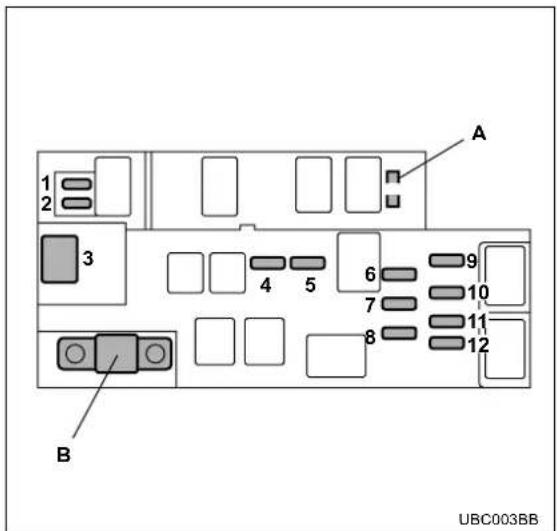
text_image
A 1 2 3 4 5 6 7 8 9 10 11 12 B UBC003BBA) FWD socket
B) Main fuse
| Fuse panel Fuse rating Circuit | |
| 1 20A • Radiator cooling fan (Main) | |
| 2 20A • Radiator cooling fan (Sub) | |
| 3 30A • ABS motor | |
| 4 20A • Rear window defogger | |
| 5 15A • Hazard warning flasher • Horn | |
| 6 15A • Meter • SRS airbag system warning light | |
| 7 10A • Automatic transmis-sion control unit • ABS UNIT | |
| 8 10A • Alternator | |
| 9 15A • Headlight (right side) | |
| 10 15A • Headlight (left side) | |
| 11 20A • Lighting switch |
| Fuse panel Fuse rating Circuit | |
| 12 15A • Clock | • Interior light |
Bulb chart
Description Wattage Bulb No.
Headlight
S models 12V-65/55W 9007 (HB5)
Except S models
Low beam 12V-55W H1
High beam 12V-60W 9005 (HB3)
Front turn signal 12V-27W 1156NA
(Amber)
Spot light 12V-8W –
Dome light 12V-8W –
Door step light 12V-3.4W –
Parking and front 12V-27/8W 1157NA
side marker light (Amber)
Front fog light 12V-51W 9006 (HB4)
Backup light 12V-21W 7440
High mount stop light 12V-13W 912
Brake·Rear turn sig- 12V-21/5W 7443
nal light/Tail light
Rear finisher light 12V-5W 168
License plate light 12V-5W 168
Cargo light 12V-13W 912
Sports activity light 12V-55W H3
Vehicle identification
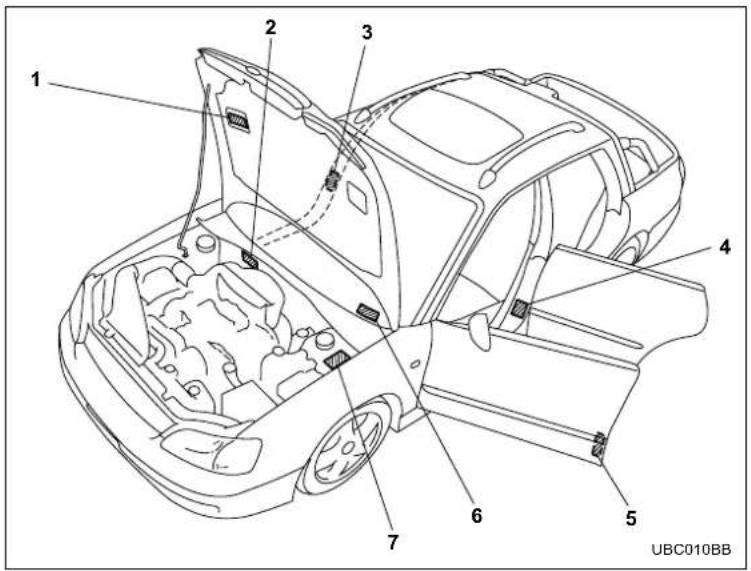
text_image
1 2 3 4 5 6 7 UBC010BB1) Emission control label
2) Vehicle identification number
3) Radio noise label (Canada model)
4) Tire inflation pressure label
5) Certification and bar code label
6) Vehicle identification number plate
7) Model number plate

natural_image
Pure horizontal dashed lines on white background with no text, numbers, or symbolsConsumer information and Reporting safety defects
Tire information 13-2
Tire labeling 13-2
Recommended tire inflation pressure 13-5
Glossary of tire terminology 13-6
Tire care – maintenance and safety practices 13-8
Vehicle load limit – how to determine ..... 13-8
Determining compatibility of tire and vehicle load capacities 13-13
Adverse safety consequences of overloading on handling and stopping and on tires ..... 13-13
Steps for Determining Correct Load Limit ..... 13-13
Uniform tire quality grading standards ..... 13-14
Treadwear 13-14
Traction AA, A, B, C 13-15
Temperature A, B, C 13-15
Reporting safety defects (USA) 13-16
For U.S.A.
The following information has been compiled according to Code of Federal Regulations "Title 49, Part 575".
Tire information
■ Tire labeling
Many markings (e.g. Tire size, Tire Identification Number or TIN) are placed on the sidewall of a tire by tire manufacturers. These marking can provide you with useful information on the tire.
▼ Tire size
Your vehicle comes equipped with P-Metric tire size. It is important to understand the sizing system in selecting the proper tire for your vehicles. Here is a brief review of the tire sizing system with a breakdown of its individual elements.
▼ P Metric
With the P-Metric system, Section Width is measured in millimeters. To convert millimeters into inches, divide by 25.4. The Aspect Ratio (Section Height divided by Section Width) helps pro-
vide more dimensional information about the tire size.
Example:
$$ \frac {\mathbf {P}}{(1)} \frac {2 2 5}{(2)} / \frac {6 0}{(3)} \frac {\mathbf {R}}{(4) (5)} \frac {1 6}{} $$
(1) P = Certain tire type used on light duty vehicles such as passenger cars
(2) Section Width in millimeters
(3) Aspect Ratio (= section height ÷ section width).
(4) R = Radial Construction
(5) Rim diameter in inches
▼ Load and Speed Rating Descriptions
The load and speed rating descriptions will appear following the size designation.
They provide two important facts about the tire. First, the number designation is its load index. Second, the letter designation indicates the tire's speed rating.
Example:
| P | 225 / 60 | R | 16 | 97 | H |
| Size designation | (6) | (7) | |||
(6) Load Index: A numerical code which specifies the maximum load a tire can carry at the speed indicated by its speed symbol, at maximum inflation pressure.
For example, "97" means 1,609 lbs (730 kg)
WARNING
Load indices apply only to the tire, not to the vehicle. Putting a load rated tire on any vehicle does not mean the vehicle can be loaded up to the tire's rated load.
(7) Speed Rating: An alphabetical system describing a tire's capability to travel at established and predetermined speeds.
For example, "H" means 130 mph (210 km/h)
WARNING
- Speed ratings apply only to the tire, not to the vehicle. Putting a speed rated tire on any vehicle does not mean the vehicle can be operated at the tire's rated speed.
- The speed rating is void if the tires are worn out, damaged, repaired, retreaded, or otherwise altered from their original condition. If tires are repaired, retreaded, or otherwise altered, they may not be suitable for original equipment tire designed loads and speeds.
▼ Tire Identification Number (TIN)
Tire Identification Number (TIN) is marked on the intended outboard sidewall. The TIN is composed of four groups. Here is a brief review of the TIN with a breakdown of its individual elements.
| DOT | XX(1) | XX(2) | XXX(3) | XXXX(4) |
(1) Manufacturer's Identification Mark
- CONTINUED -
(2) Tire Size
(3) Tire Type Code
(4) Date of Manufacture
The first two figures identify the week, starting with "01" to represent the first full week of the calendar year; the second two figures represent the year. For example, 0101 means the 1st week of 2001.
▼ Other markings
The following makings are also placed on the sidewall.
▽ Maximum permissible inflation pressure
The maximum cold inflation pressure to which this tire may be inflated. For example, "300 kpa (44 PSI) MAX. PRESS"
▽ Maximum load rating
The load rating at the maximum permissible weight load for this tire. For example, "MAX. LOAD 730 kg (1609 LBS) @ 300 kpa (44 PSI) MAX. PRESS."
WARNING
Maximum load rating applies only to the tire, not to the vehicle. Putting a load rated tire on any vehicle does not mean the vehicle can be loaded up to the tire's rated load.
▽ Construction type
Applicable construction of this tire.
For example, "TUBELESS STEEL BELTED RADIAL"
Construction
The generic name of each cord material used in the plies (both sidewall and tread area) of this tire.
For example, "PLIES: TREAD 2 STEEL + 2 POLYESTER + 1 NYLON SIDEWALL 2 POLYESTER"
Uniform Tire Quality Grading (UTQG)
For details, refer to “Uniform tire quality grading standards” in this chapter.
■ Recommended tire inflation pressure
▼ Recommended cold tire inflation pressure
Recommended cold tire inflation pressure for your vehicle's tires is as follows,
| Tire size P225/60 R16 | 97H | |
| Wheel size 16 × 6 1/2JJ | ||
| Pressure Front | 3 psi (230 kPa, 2.3 kgf/cm2) | |
| Rear | 33 psi (230 kPa, 2.3 kgf/cm2) | |
| Temporary spare tire | Size T | 145/80R16 |
| Pres- sure | 60 psi (420 kPa, 4.2 kgf/cm2) | |
▼ Vehicle placard

natural_image
Line drawing of a car with an inset showing a door panel and sensor array (no text or symbols)The vehicle placard is affixed to the driver's side B-pillar.
- CONTINUED -
Example:

text_image
TIRE AND LOADING INFORMATION SEATING CAPACITY TOTAL 4 FRONT 2 REAR 2 The combined weight of occupants and cargo should never exceed 363kg or 800 lbs. ORIGINAL TIRE SIZE COLD TIRE INFLATION PRESSURE SEE OWNER'S P225/60R16 FRONT 230 kPa,33 PSI MANUAL FOR REAR 230 kPa,33 PSI ADDITIONAL COMPACT SPARE TIRE COLD TIRE INFLATION PRESSURE INFORMATION T145/80R16 420 kPa,60 PSI UBD004AAThe vehicle placard shows original tire size, recommended cold tire inflation pressure on each tire at maximum loaded vehicle weight, seating capacity and loading information.
▼ Adverse safety consequences of under-inflation
Driving at high speeds with excessively low tire pressures can cause the tires to flex severely and to rapidly become hot. A sharp increase in temperature could cause tread separation, and failure of the tire(s). Possible resulting loss of ve-
hicle control could lead to an accident.
▼ Measuring and adjusting air pressure to achieve proper inflation
Check and, if necessary, adjust the pressure of each tire (including the spare) at least once a month and before any long journey. Check the tire pressures when the tires are cold. Use a pressure gauge to adjust the tire pressures to the specific values. Driving even a short distance warms up the tires and increases the tire pressures. Also, the tire pressures are affected by the outside temperature. It is best to check tire pressure outdoors before driving the vehicle. When a tire becomes warm, the air inside it expands, causing the tire pressure to increase. Be careful not to mistakenly release air from a warm tire to reduce its pressure.
■ Glossary of tire terminology
- Cold tire pressure
The pressure in a tire that has been driven less than 1 mile or has been standing for three hours or more.
• Maximum inflation pressure
The maximum cold inflation pressure to which a tire may be inflated.
- Recommended inflation pressure
The cold inflation pressure recommended by a vehicle manufacturer.
- Intended outboard sidewall
1) The sidewall that contains a whitewall, bears white lettering or bears manufacturer, brand, and/or model name molding that is higher or deeper than the same molding on the other sidewall of the tire, or 2) The outward facing sidewall of an asymmetrical tire that has a particular side that must always face outward when mounting on a vehicle.
- Accessory weight
The combined weight (in excess of those standard items which may be replaced) of floor mats, leather seats, cross bars and cargo bed extender to the extent that these items are available as factory-installed equipment (whether installed or not).
- Curb weight
The weight of a motor vehicle with standard equipment including the maximum capacity of fuel, oil, and coolant and air conditioning.
• Maximum loaded vehicle weight
The sum of curb weight, accessory weight, vehicle capacity weight and production options weight.
• Normal occupant weight
150 lbs (68 kg) times the number of occupants (2 occupants).
- Occupant distribution
Distribution of occupants in a vehicle, 2 in front.
• Production options weight
The combined weight of those installed regular production options weighing over 5.1 lbs (2.3 kg) in excess of those standards items which they replace, not previously considered in curb weight or accessory weight.
• Vehicle capacity weight
The total weight of cargo, luggage and occupants that can be added to the vehicle.
• Vehicle maximum load on a tire
Load on an individual tire that is determined by distributing to each axle its share of the maximum loaded vehicle weight and dividing by two.
• Vehicle normal load on a tire
Load on an individual tire that is determined by
- CONTINUED -
distributing to each axle its share of the curb weight, accessory weight, and normal occupant weight and dividing by two.
■ Tire care – maintenance and safety practices
- Check on a daily basis that the tires are free from serious damage, nails, and stones. At the same time, check the tires for abnormal wear.
- Inspect the tire tread regularly and replace the tires before their tread wear indicators become visible. When a tire's tread wear indicator becomes visible, the tire is worn beyond the acceptable limit and must be replaced immediately. With a tire in this condition, driving at even low speeds in wet weather can cause the vehicle to hydroplane. Possible resulting loss of vehicle control can lead to an accident.
- To maximize the life of each tire and ensure that the tires wear uniformly, it is best to rotate the tires every 7,500 miles (12,500 km). Rotating the tires involves switching the front and rear tires on the right hand side of the vehicle and similarly switching the front and rear tires on the
left hand side of the vehicle. (Each tire must be kept on its original side of the vehicle.) Replace any damaged or unevenly worn tire at the time of rotation. After tire rotation, adjust the tire pressures and make sure the wheel nuts are correctly tightened. A tightening torque specification and a tightening sequence specification for the wheel nuts can be found "Flat tires" in Chapter 9.
■ Vehicle load limit – how to determine
The load capacity of your vehicle is determined by weight, not by available cargo space. The load limit of your vehicle is shown on the vehicle placard attached to the driver's side B-pillar. Locate the statement "The combined weight of occupants and cargo should never exceed XXX kg or XXX lbs" on your vehicle's placard.
The vehicle placard also shows seating capacity of your vehicle.
The total load capacity includes the total weight of driver and all passengers and their belongings, any cargo, any optional equipment such as a trailer hitch, roof rack or bike carrier, etc., and the tongue load of a trailer. Therefore cargo ca-
pacity can be calculated by the following method.
Cargo capacity = Load limit - (total weight of occupants + total weight of optional equipment + tongue load of a trailer (if applicable))
For towing capacity information and weight limits, refer to "Trailer towing" in Chapter 8.
▼ Calculating total and load capacities varying seating configurations
Calculate the available load capacity as shown in the following examples:
Example 1A
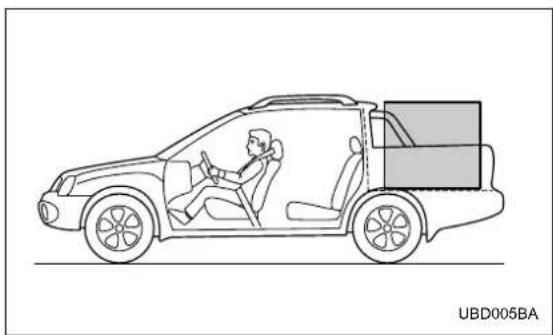
natural_image
Line drawing of a car with driver inside and cargo box on side, no text or symbols presentVehicle capacity weight of the vehicle is 800 lbs (363 kg), which is indicated on the vehicle placard with the statement "The combined weight of occupants and cargo should never exceed 363 kg or 800 lbs".
For example, if the vehicle has one occupant weighing 154 lbs (70 kg) plus cargo weighing 551 lbs (250 kg).
- Calculate the total weight.
Total weight
$$ \begin{array}{l} = \frac {1 5 4 \text { lbs (70 kg) }}{(\text { Occupant }) (\text { Cargo })} + \frac {5 5 1 \text { lbs (250 kg) }}{} \ = 7 0 5 \text { lbs (320 kg) } \ \end{array} $$
- Calculate the available load capacity by subtracting the total weight from the vehicle capacity weight of 800 lbs (363 kg).
- CONTINUED -
Available Load Capacity
$$ = \frac {8 0 0 \text { lbs (363 kg) }}{\text {(Vehicle capacity weight)}} - \frac {7 0 5 \text { lbs (320 kg) }}{\text {(Total weight)}} $$
$$ = 9 5 \text { lbs (43 kg) } $$
- The result of step 2 shows that a further 95 lbs (43 kg) of cargo can be carried.
Example 1B
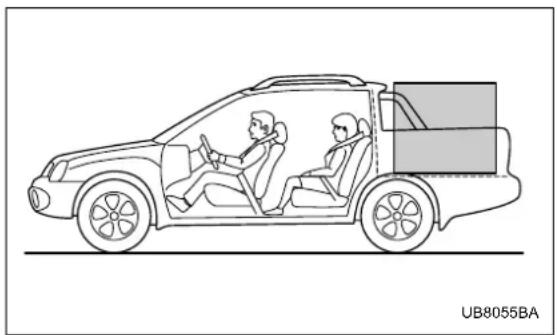
natural_image
Side profile illustration of a car with two people inside, showing driver and passenger (no text or symbols)For example, if a person weighing 176 lbs (80 kg) now enters the same vehicle (bringing the
number of occupants to two), the calculations are as follows:
- Calculate the total weight.
Total weight
$$ = \frac {1 5 4 \text { lbs (70 kg) } + 1 7 6 \text { lbs (80 kg) }}{(\text { Occupant })} $$
$$ + \frac {5 5 1 \text { lbs (250 kg) }}{(\text { Cargo })} $$
$$ = 8 8 1 \text { lbs (400 kg) } $$
- Calculate the available load capacity.
Available Load Capacity
$$ = \frac {8 0 0 \text { lbs (363 kg) }}{\text {(Vehicle capacity weight)}} - \frac {8 8 1 \text { lbs (400 kg) }}{\text {(Total weight)}} $$
$$ = - 8 1 \text { lbs } (- 3 7 \text { kg }) $$
- The total weight now exceeds the capacity weight by 81 lbs (37 kg), so the cargo weight must be reduced by 81 lbs (37 kg) or more.
Example 2A

natural_image
Line drawing of a car driving a moving vehicle with a trailer nearby (no text or symbols)Vehicle capacity weight of the vehicle is 800 lbs (363 kg), which is indicated on the vehicle placard with the statement "The combined weight of occupants and cargo should never exceed 363 kg or 800 lbs".
For example, the vehicle has one occupant weighing 165 lbs (75 kg) plus cargo weighing 265 lbs (120 kg). In addition, the vehicle is fitted with a trailer hitch weighing 22 lbs (10 kg), to which is attached a trailer weighing 1,764 lbs (800 kg). 10% of the trailer weight is applied to the trailer tongue (i.e. Tongue load = 176 lbs (80 kg)).
- Calculate the total weight.
Total weight
$$ \begin{array}{l} = \frac {1 6 5 \text { lbs (75 kg) }}{(\text { Occupant }) (\text { Cargo })} + \frac {2 6 5 \text { lbs (120 kg) }}{} \ + \frac {2 2 \text { lbs (10 kg) }}{\text {(Trailer hitch)}} + \frac {1 7 6 \text { lbs (80 kg) }}{\text {(Tongue load)}} \ = 6 2 8 \text { lbs (285 kg) } \ \end{array} $$
- Calculate the available load capacity.
Available Load Capacity
$$ \begin{array}{l} = \frac {8 0 0 \text { lbs (363 kg) }}{\text {(Vehicle capacity weight)}} - \frac {6 2 8 \text { lbs (285 kg) }}{\text {(Total weight)}} \ = 1 7 2 \text { lbs (78 kg) } \ \end{array} $$
- The result of step 2 shows that a further 172 lbs (78 kg) of cargo can be carried.
- CONTINUED -
Example 2B
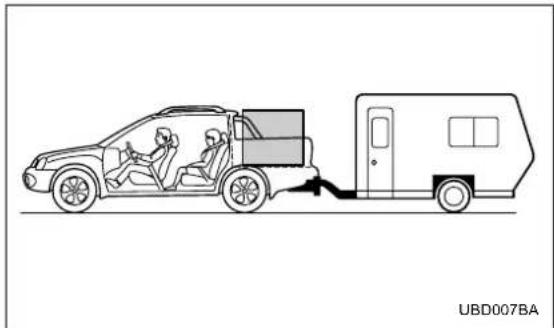
natural_image
Line drawing of a car with two people inside and connected to a small vehicle via a hose (no text or symbols)For example, if a person weighing 143 lbs (65 kg) and a child weighing 40 lbs (18 kg) now enter the same vehicle (bringing the number of occupants to three), and a child restraint system weighing 11 lbs (5 kg) is installed in the vehicle for the child to use, the calculations are as follows:
- Calculate the total weight.
Total weight
$$ = \frac {1 6 5 \text { lbs (75 kg) } + 1 4 3 \text { lbs (65 kg) } + 4 0 \text { lbs (18 kg) }}{(\text { Occupant })} $$
$$ + \frac {1 1 \text { lbs (5 kg) }}{\text {(Child restraint)}} + \frac {2 6 5 \text { lbs (120 kg) }}{\text {(Cargo)}} $$
$$ + \frac {2 2 \text { lbs (10 kg) }}{\text {(Trailer hitch)}} + \frac {1 7 6 \text { lbs (80 kg) }}{\text {(Tongue load)}} $$
$$ = 8 2 2 \text { lbs (373 kg) } $$
- Calculate the available load capacity.
Available Load Capacity
$$ = \frac {8 0 0 \text { lbs (363 kg) }}{\text {(Vehicle capacity weight)}} - \frac {8 2 2 \text { lbs (373 kg) }}{\text {(Total weight)}} $$
$$ = - 2 2 \text { lbs } (- 1 0 \text { kg }) $$
- The total weight now exceeds the capacity weight by 22 lbs (10 kg), so the cargo weight must be reduced by 22 lbs (10 kg) or more.
■ Determining compatibility of tire and vehicle load capacities
The sum of four tires' maximum load ratings must exceed the maximum loaded vehicle weight ("GVWR"). In addition, sum of the maximum load ratings of two front tires and of two rear tires must exceed each axle's maximum loaded capacity ("GAWR"). Original equipment tires are designed to fulfill those conditions.
The maximum loaded vehicle weight is referred to Gross Vehicle Weight Rating (GVWR). And each axle's maximum loaded capacity is referred to Gross Axle Weight Rating (GAWR). The GVWR and each axle's GAWR are shown on the vehicle certification label affixed to the driver's door.
The GVWR and front and rear GAWRs are determined by not only the maximum load rating of tires but also loaded capacities of the vehicle's suspension, axles and other body parts.
Therefore, this means that the vehicle cannot necessarily be loaded up to the tire's maximum load rating on the tire sidewall.
■ Adverse safety consequences of overloading on handling and stopping and on tires
Overloading could affect vehicle handling, stopping distance, vehicle and tire as shown below. This could lead to an accident and possibly result in severe personal injury.
• Vehicle stability will deteriorate.
- Heavy and/or high-mounted loads could increase the risk of rollover.
- Stopping distance will increase.
- Brakes could overheat and fail.
- Suspension, bearings, axles and other body parts could break or experience accelerated wear that will shorten vehicle life.
- Tires could fail.
- Tread separation could occur.
- Tire could separate from its rim.
■ Steps for Determining Correct Load Limit
- Locate the statement "The combined weight of occupants and cargo should never exceed XXX pounds" on your vehicle's placard.
- CONTINUED -
- Determine the combined weight of the driver and passengers that will be riding in your vehicle.
- Subtract the combined weight of the driver and passengers from XXX kilograms or XXX pounds.
- The resulting figure equals the available amount of cargo and luggage load capacity. For example, if the "XXX" amount equals 1,400 lbs (635 kg). and there will be five-150 lb (68 kg) passengers in your vehicle, the amount of available cargo and luggage load capacity is 650 lbs. (1,400 - 750 (5 × 150) = 650 lbs.)
- Determine the combined weight of luggage and cargo being loaded on the vehicle. That weight may not safely exceed the available cargo and luggage load capacity calculated in Step 4.
- If your vehicle will be towing a trailer, load from your trailer will be transferred to your vehicle. Consult this manual to determine how this reduces the available cargo and luggage load capacity of your vehicle.
Uniform tire quality grading standards
This information indicates the relative performance of passenger car tires in the area of treadwear, traction, and temperature resistance. This is to aid the consumer in making an informed choice in the purchase of tires.
Quality grades can be found where applicable on the tire sidewall between tread shoulder and maximum section width. For example:
Treadwear 200 Traction AA Temperature A
The quality grades apply to new pneumatic tires for use on passenger cars. However, they do not apply to deep tread, winter type snow tires, space-saver or temporary use spare tires, tires with nominal rim diameters of 12 inches or less, or to some limited production tires.
All passenger car tires must confirm to Federal Safety Requirements in addition to these grades.
Treadwear
The treadwear grade is a comparative rating
based on the wear rate of the tire when tested under controlled conditions on a specified government test course.
For example, a tire graded 150 would wear one and one-half (1-1/2) times as well on the government course as a tire graded 100. The relative performance of tires depends upon the actual conditions of their use, however, and may depart significantly from the norm due to variations in driving habits, service practices and differences in road characteristics and climate.
■ Traction AA, A, B, C
The traction grades, from highest to lowest, are AA, A, B and C. Those grades represent the tire's ability to stop on wet pavement as measured under controlled conditions on specified government test surfaces of asphalt and concrete. A tire marked C may have poor traction performance.
WARNING
The traction grade assigned to this tire is based on straight-ahead braking traction
tests, and does not include acceleration, cornering, hydroplaning, or peak traction characteristics.
■ Temperature A, B, C
The temperature grades are A (the highest), B, and C, representing the tire's resistance to the generation of heat and its ability to dissipate heat when tested under controlled conditions on a specified indoor laboratory test wheel. Sustained high temperature can cause the material of the tire to degenerate and reduce tire life, and excessive temperature can lead to sudden tire failure. The grade C corresponds to a level of performance which all passenger car tires must meet under the Federal Motor Vehicle Safety Standards No. 109. Grades B and A represent higher levels of performance on the laboratory test wheel than the minimum required by law.
WARNING
The temperature grade for this tire is established for a tire that is properly inflated
- CONTINUED -
and not overloaded. Excessive speed, underinflation, or excessive loading, either separately or in combination, can cause heat buildup and possible tire failure.
Reporting safety defects (USA)
If you believe that your vehicle has a defect which could cause a crash or could cause injury or death, you should immediately inform the National Highway Traffic Safety Administration (NHTSA) in addition to notifying Subaru of America, Inc.
If NHTSA receives similar complaints, it may open an investigation, and if it finds that a safety defect exists in a group of vehicles, it may order a recall and remedy campaign. However, NHTSA cannot become involved in individual problems between you, your dealer, or Subaru of America, Inc. To contact NHTSA, you may either call the Auto Safety Hotline toll-free at 1-800-424-9393 (or 366-0123 in the Washington D.C. area) or write to: NHTSA, U.S. Department of Transportation, Washington, D.C. 20590. You can also obtain other information about motor vehicle safety from the Hotline.
Index
Index
A
ABS (Anti-lock Brake System) 7-33
Warning light 3-12
Accessories 5-4, 11-60
Air cleaner element 11-23
Air conditioner operation 4-10
Air filtration system 4-13
All-Wheel Drive warning light 3-14
Aluminum wheels 11-52
Antenna system 5-2
Anti-lock Brake System (ABS) 7-33
Ashtray 6-12
AT OIL TEMPerature warning light 3-12
Audio set 5-4
Auto-dimming mirror/compass 3-29
Automatic transmission 7-15, 7-21
Capacities 12-3
Fluid 11-29
Selector lever 7-16, 7-22
Shift lock release 7-20, 7-30
SPORTSHIFT mode – Turbo models ...... 7-21
Temperature warning light 3-12
Automatic/Emergency Locking Retractor
(A/ELR) 1-16
AWD warning light 3-14
B
Battery 11-56
Jump starting 9-18
Replacement (Remote keyless entry system) 2-10
Bed extender 6-17
Brake
Booster 11-41
Fluid 11-38
Pad and lining 11-43
Pedal 11-41
Brake pedal
Free play 11-41
Reserve distance 11-42
Brake system 7-32
Warning light 3-13
Braking 7-32
Breaking-in of new brake pads and
linings 11-44
Tips 7-32
Bulb
Chart 12-8
Replacing 11-61
C
Capacities 12-3
Index
Cargo
Bed 6-16
Lamp 6-20
Lamp indicator light 3-16
Net hooks 6-13
Tie-down hooks 6-17
Catalytic converter 8-4
Center
Console 6-5
Ventilators 4-2
Changing
Flat tire 9-12
Oil and oil filter 11-12
Charge warning light 3-11
CHECK ENGINE warning light/
Malfunction indicator lamp 3-10
Checking
Brake pedal free play 11-41
Brake pedal reserve distance 11-42
Clutch function 11-42
Clutch pedal free play 11-43
Engine oil level 11-10
Fluid level 11-29, 11-36, 11-38, 11-39
Gear oil level 11-27, 11-33
Child restraint systems
Installation with seatbelt 1-32
Lower and tether anchorages 1-40
Child safety 5
Locks 2-21
Chime
Key 3-4
Seatbelt 1-17,3-9
Cigarette lighter socket 6-9
Cleaning
Aluminum wheels 10-4
Fog light lens 10-4
Interior 10-6
Ventilator grille 4-11
Clock 3-17
Clutch fluid 11-39
Clutch pedal 11-42
Coat hook 6-13
Coin compartment 6-6
Convenience hook 6-13
Cooling system 11-17
Corrosion protection 10-5
Cover
Soft bed 6-21
Cruise control 7-38
Set indicator light 3-16
Cup holder 6-7
D
Daytime running light system 3-20
Index
Differential gear oil
Front 11-32
Rear 11-33
Dimensions 12-2
Disarming the system 2-17, 2-19
Disc brake pad wear warning indicators 7-33
Dome light 6-2, 11-76
Door ajar warning lights 3-14
Door locks 2-3
Drive belts 11-26
Driving
Car phone/mobile phone 8
Drinking 7
Drugs 7
Foreign countries 8-6
Pets 8
Snowy and icy roads 8-13
Tips 7-14, 7-19, 7-29, 8-7
Tired or sleepy 8
E
Electrical system 12-3
Emergency Locking Retractor (ELR) 1-16
Engine
Compartment overview 11-8
Coolant 11-18
Exhaust gas (Carbon monoxide) 8-3
Hood 11-5
Oil 11-10
Overheating 9-21
Starting 7-9
Stopping 7-12
Exterior care 10-2
F
Flat tires 9-12
Floor mat 6-15
Fluid level
Automatic transmission 11-29
Brake 11-38
Clutch 11-39
Power steering 11-36
Fog light button 3-23
Folding down the rear seat 1-10
Front
Differential gear oil 11-32
Fog light 11-68
Seatbelt pretensioners 1-24
Seats 1-2
Turn signal light, parking light and
side marker light 11-69
Fuel 7-2
Economy hints 8-2
Filler door and cap 7-4
Gauge 3-8
Requirements 7-2
Fuses 11-57
Fuses and circuits 12-5
G
GAWR (Gross Axle Weight Rating) 8-19
Glove box 6-5
GVWR (Gross Vehicle Weight Rating) 8-19
H
Hazard warning flasher 3-5
Head restraint adjustment (Front) 1-6
Headlight flasher 3-19
Headlights 3-18, 11-64
Heater operation 4-7
High beam indicator light 3-16
High mount stop and cargo light assembly ..... 11-77
Horn 3-34
Hose and connections 11-18
|
Ignition switch 3-2
Illuminated entry 2-9
Illumination brightness control 3-21
Indicator light
High beam 3-16
Selector lever position 3-15
Turn signal 3-16
Inside mirror 3-28
Interior light 6-2
J
Jack and tools 9-3
Jump starting 9-18
K
Key
Interlock release 3-4
Number 2-2
Reminder chime 3-4
Keys 2-2
L
Leather seat materials 10-6
License plate bracket 2-26
License plate light 11-74
Light control switch 3-18
Limited slip differential (LSD) 7-31
Loading your vehicle 8-16
Lower tether anchorages 1-40
Index
LSD (Limited slip differential) 7-31
M
Main fuse 11-60
Maintenance
Precautions 11-3
Schedule 11-3
Seatbelt 1-21
Malfunction indicator lamp
(Check Engine light) 3-10
Manual transmission 7-12
Manual transmission oil 11-27
Map light 6-3
Maximum load limits 8-25
Meters and gauges 3-6
Mirrors 3-28
Moonroof 2-31, 9-28
N
New vehicle break-in driving – the first 1,000 miles (1,600 km) 8-2
0
Odometer/Trip meter 3-6
Off road driving 8-9
Oil level
Engine 11-10
Front differential (AT vehicles) 11-32
Manual transmission 11-27
Rear differential 11-33
Oil pressure warning light 3-12
Outside mirrors 3-30
Overheating engine 9-21
P
Parking
Brake 7-36
Brake stroke 11-45
Light switch 3-22
Periodic inspections 8-6
Power
Door locking switches 2-5
Steering 7-31
Steering fluid 11-36
Windows 2-22
R
Rear
Center console 6-6
Combination lights 11-70
Differential gear oil 11-33
Seats 1-9
Rear seat
Folding down 1-10
Rear window
Defogger button 3-26
Recommended
Automatic transmission fluid 11-31
Brake fluid 11-39
Clutch fluid 11-40
Oil grade and viscosity ..... 11-15, 11-16, 11-28,
11-32, 11-35
Power steering fluid 11-37
Spark plugs 11-26
Remote keyless entry system 2-7
Replacement
Brake pad and lining 11-43
Windshield wiper blades 11-53
Replacing
Air cleaner element 11-23
Battery (remote keyless entry system) ...... 2-10
Lost transmitters (keyless entry system) ..... 2-11
Replacing bulbs 11-61
Cargo light assembly 11-77
Dome light 11-76
Front fog light 11-68
Front turn signal light 11-69
Headlight 11-64
High mount stop light assembly 11-77
License plate light 11-74
Map light 11-76
Parking light 11-69
Rear combination lights 11-70
Tail light 11-72
Rocking the vehicle 8-16
Roof rail and crossbar 6-24
s
Seat
Fabric 10-6
Heater 1-7
Seatbelt 4
Maintenance 1-21
Pretensioners 1-24
Safety tips 1-14
Warning light and chime 1-17
Seatbelts 1-14
Security system 2-15
Selector lever 7-16, 7-22
Position indicator 3-15
Shift lock release 7-20, 7-30
Side ventilators 4-2
Snow tires 8-14
Soft bed cover 6-21
Sounding a panic alarm 2-9, 2-18
Spark plugs 11-25
Index
Specifications 12-2
Speedometer 3-6
Sport activity lights 6-30, 11-79
SRS airbag (Supplemental Restraint System airbag) 4, 1-47
SRS airbag system monitors 1-60
SRS airbag system servicing 1-61
SRS airbag system warning light 3-10
SRS frontal airbag 1-52
Starting the engine 7-9
State emission testing (U.S. only) 7-7
Stopping the engine 7-12
Storage compartments 6-4
Sun shades 2-33
Sun visors 6-3
Supplemental Restraint System airbag (SRS) 4, 1-47
Synthetic leather upholstery 10-7
T
Tachometer 3-7
Tail light 11-72
Tailgate 2-25
Temperature gauge 3-8
Temporary spare tire 9-10
Tie-down hooks 9-23
Tilt steering wheel 3-33
Tire
Chains 8-15
Information 13-2
Inspection 11-46
Pressures and wear 11-46
Replacement 11-50
Rotation 11-50
Tires 12-4
Types 11-45
Tires and wheels 11-45
Top tether anchorages 1-40
Towing 9-22
All wheels on the ground 9-27
Flat-bed truck 9-27
Hooks 9-23
Trailer
Hitch 8-20
Hitches 8-30
Towing 8-24
Towing tips 8-33
Turn signal
Indicator lights 3-16
Lever 3-20
v
Valet mode 2-18
Vanity mirror 6-4
Vehicle
Capacity weight 8-18
Identification 12-9
Ventilator 4-2
W
Warning and indicator lights 3-9
Warning lights
ABS 3-12
All-Wheel Drive 3-14
Anti-lock Brake System 3-12
AT OIL TEMPerature 3-12
Brake system 3-13
Charge 3-11
CHECK ENGINE 3-10
Door ajar 3-14
Oil pressure 3-12
Seatbelt 1-17,3-9
SRS airbag system 3-10
Warranties and maintenance 8-24
Washing 10-2
Waxing and polishing 10-3
Wear indicators 11-49
Wheel
Alignment 12-4
Balance 11-49
Replacement 11-51
Windows 2-22
Windshield
Washer fluid 11-52
Wiper and washer switches 3-25
Wiper deicer 3-27
Winter driving 8-11
Wiper and washer 3-23
natural_image
Pure horizontal dashed lines on white background with no text, numbers, or symbols
text_image
U.S Compass Calibration Zones 3 Portland Boise Helena Bismark Minneapolis St. Paul Green Bay Grand Rapids Chicago Columbus Harrisburg Trenton Syracuse Boston Bar Harbor Manchester 13 Sacramento Salt Lake City Cheyenne Pierre Grand Island Evansville Charleston Washington DC 12 Las Vegas Denver Wichita Kansas City Lexington Los Angeles Phoenix Albuquerque Oklahoma City Nashville Littie Rock Dallas Fort Worth Jackson Montgomery Atlanta Columbia Winston-Salem 11 San Antonio New Orleans Orlando 9 7 8 5 6 HSF028AAGAS STATION REFERENCE
Fuel:
▼ Non-turbo models
Use only unleaded gasoline with an octane rating of 87 AKI or higher.
▼ Turbo models
Use premium unleaded gasoline with an octane rating of 91 AKI or higher. If premium unleaded gasoline is not available, regular unleaded gasoline with octane rating of 87 AKI or higher may be temporarily used. For optimum engine performance and driveability, it is required that you use premium grade unleaded gasoline.
■ Fuel octane rating
This octane rating is the average of the Research Octane and Motor Octane numbers and is commonly referred to as the Anti Knock Index (AKI). Refer to "Fuel" section in this manual.
Fuel capacity:
16.9 US gal (64 liters, 14.1 Imp gal)
Engine oil:
Use only API classification SL with the words "ENERGY CONSERVING" and the New API certification mark (starburst mark) displayed on the container (ILSAC GF-3).
Engine oil capacity:
4.2 US qt (4.0 liters, 3.5 Imp qt)
Cold tire pressure:
| Front 33 psi (230 kPa, 2.3 kgf/cm) | 2) |
| Rear 33 psi (230 kPa, 2.3 kgf/cm) | 2) |