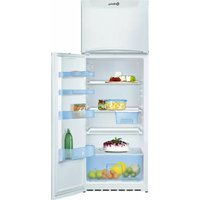
3FEW2416 - Refrigerator BALAY - Free user manual and instructions
Find the device manual for free 3FEW2416 BALAY in PDF.


| Type of Product | Refrigerator |
| Brand | Balay |
| Model | 3FEW2416 |
| Dimensions (H x W x D) | 1850 x 600 x 650 mm |
| Net Weight | 60 kg |
| Energy Source | 230 V ~ 50 Hz |
| Energy Class | A++ |
| Annual Energy Consumption | 180 kWh |
| Climate Class | SN-T |
| Noise Level | 38 dB |
| Type of Cooling | No Frost (Frost Free) |
| Interior Lighting | LED |
| Number of Shelves | 4 adjustable glass shelves |
| Number of Door Bins | 3 |
| Temperature Control | Electronic (digital display) |
| Defrost Method | Automatic (No Frost) |
| Reversible Door | Yes |
| Child Lock | Yes |
| Spare Parts Availability | For at least 10 years |
| Cleaning Instructions | Wipe with soft cloth and mild detergent |
Frequently Asked Questions - 3FEW2416 BALAY
User questions about 3FEW2416 BALAY
0 question about this device. Answer the ones you know or ask your own.
Ask a new question about this device
Download the instructions for your Refrigerator in PDF format for free! Find your manual 3FEW2416 - BALAY and take your electronic device back in hand. On this page are published all the documents necessary for the use of your device. 3FEW2416 by BALAY.
USER MANUAL 3FEW2416 BALAY
natural_image
Line drawing of a refrigerator with open doors and shelves (no text or symbols)Information concerning disposal 15
Safety information 15-17
Installation 17
Changing over the door hinges 17
Aligning the appliance 17
Your new appliance 18
Observe ambient temperature and ventilation 18
Connecting the appliance 19
Turning on and temperature selection 19
Switching-off and setting out of use 20
Arranging food 20-21
Freezing fresh products storing frozen food and making ice 21-23
Defrosting 23
Cleaning 24
Energy saving tips 24
Small problems for self-help 25-26
Calling customer service 26
ES Índice
Information concerning disposal

Disposal of your old opliance
When replacing your old appliance with a new one, please comply with the following:
Old appliances are not worthless rubbish! Valuable raw materials can be reclaimed by recycling old appliances.
Render your old appliance unusable:
- Pull out the mains plug.
- Cut off the power cord and discard with the mains plug.
- Remove the lock to prevent children from locking themselves in the refrigerator and suffocating.
Refrigerators contain refrigerants and the insulation contains gases.
Refrigerant and gases must be disposed of properly. Ensure that tubing of the refrigerant circuit is not damaged prior to proper disposal.

Disposal of packaging
Warning:
Keep children away from packaging materials. Danger of suffocation from folding cartons and plastic film!
You received your new appliance in a protective shipping carton. All packaging materials are environmentally friendly and recyclable. Please contribute to a better environment by disposing of packaging materials in an environmentally-friendly manner.
Please ask your dealer or inquire at your local authority about current means of disposal.
This appliance is labelled in accordance with European Directive 2002/96/EG concerning used electrical and electronic appliances (waste electrical and electronic equipment - WEEE). The guideline determines the framework for the return and recycling of used appliances as applicable throughout the EU.
Safety information Before you switch ON the appliance
Please read the operating and installation instructions carefully. They contain important information on how to install, use and maintain the appliance.
The manufacturer is not liable if you fail to comply with the instructions and warnings. Please retain these operating and installation instructions as they may be required by a subsequent user of the appliance.

Warnings
- This appliance contains a small quantity of environmentally-friendly but flammable R600a refrigerant. Ensure that the tubing of the refrigerant circuit is not damaged during transportation and installation. Leaking refrigerant may cause eye injuries or ignite. If refrigerant is escaping, ensure that:
– there are no naked flames or ignition sources in the vicinity.
– Pull out the mains plug and ventilate the room for several minutes.
- The more refrigerant an appliance contains, the larger the room must be. Leaking refrigerant can form a flammable gas-air mixture in rooms which are too small.
- The room must be at least 1 ~m^3 per 8 g of refrigerant. The amount of refrigerant in your appliance is indicated on the rating plate inside the appliance.
• In an emergency
– Rinse eyes and call a doctor.
- Keep ignition sources and naked flames away from the appliance.
– Pull out the mains plug and ventilate the room for several minutes.
- In the following cases pull out the mains plug or switch off the fuse.
- Defrosting
- Cleaning
Do not pull out the mains plug by tugging the cable.
- Do not switch on damaged or defective appliances. If in doubt, contact your dealer.
- Never use electrical appliances inside the refrigerator (e.g. heater, electric ice maker, etc.).
- Do not store products which contain flammable propellants (e.g. spray cans) or explosive substances in the appliance – Risk of explosion!
- Do not allow children to play with the appliance!
- NEVER use a steam cleaner to defrost or clean the appliance. Steam may come into contact with electrical components and cause a short-circuit or an electric shock.
When using the appliance, comply with the following:
- Never cover or block the ventilation openings!
- Repairs may be performed by qualified technicians only. Improper repairs may put the user in considerable danger.
-
Do not stand or support yourself on the base, drawers or doors, etc.
-
Bottles which contain a high percentage of alcohol must be sealed and stored in an upright position.
- If the appliance features a lock, keep the key out of the reach of children.
- Keep plastic parts and the door seal free of oil and grease. Otherwise, parts and door seal will become porous.
- Do not store bottled or canned drinks (especially carbonated drinks) in the freezer compartment. Bottles and cans will explode.
- Do not put an ice lolly or ice cube directly from the freezer compartment into your mouth. Risk of burns from very low temperatures!
- Never touch frozen food with wet hands. Your hands could freeze to the food!
- Do not scrape off hoarfrost or stuck frozen food with a knife or pointed object. You could damage the refrigerant tubing. Leaking refrigerant may ignite or cause eye injuries.
- Use only agents recommended by the manufacturer to accelerate the defrosting process.
• People who have limited physical, sensory or mental abilities or inadequate knowledge must not use this appliance unless they are supervised or given meticulous instructions
⚠️ Important
- Do not block the ventilation grilles on the refrigerator casing.
- Do not use mechanical devices or any other method to accelerate the thawing-out process, other than those recommended by the manufacturer.
- Do not damage the refrigeration circuit.
• Always use the internal electrical components recommended by the manufacturer for your refrigerator/freezer.
General requirements
The appliance is suitable
• for refrigerating and freezing food,
- for making ice.
The appliance is designed for domestic use.
If the appliance is used industrially, the appropriate standards and regulations shall apply.
The appliance has been interference-suppressed in compliance with EU Directive 89/336/EEC.
The refrigerant circuit has been tested for leaks.
This product complies with the relevant safety regulations for electrical appliances (EN 60335/2/24).
Installation
Install the appliance in a dry, well ventilated room. The installation location should neither be exposed to direct sunlight nor near a heat source, e.g. a cooker, radiator, etc. If installation next to a heat source is unavoidable, use a suitable insulating plate or observe the following minimum distances to heat source:
3 cm to an electric cooker. 30 cm to an oil or solid-fuel cooker.
Appliances with fitted handles must be situated at least 55 mm from the wall on the hinge side so that the door can be opened by 90°.
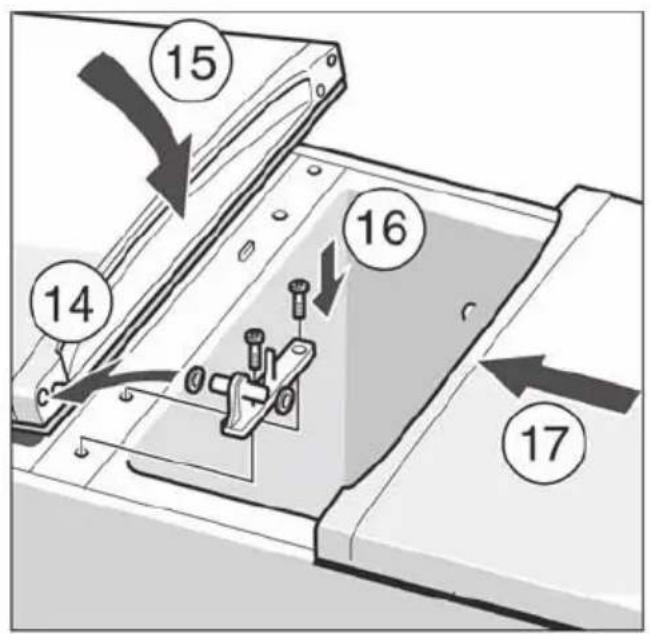
Changing over the door hinges
We recommend that you have the door hinges changes over by our customer service.
Before you start the conversion work, pull out the mains plug or remove the fuse.
Attention! Carefully place the appliance on its back.
Installation in numerical sequence.
- Changing the door handle. Fig. 13/B
- Changing over the door hinges.
Fig. 13/A
Aligning the appliance
Fig. 2
Place the appliance in the designated location and align.
Adjust the height-adjustable feet with a screwdriver.
Your new appliance
Details may differ according to the appliance type, especially with respect to features.
Fig. 1
2 Ice-cube tray
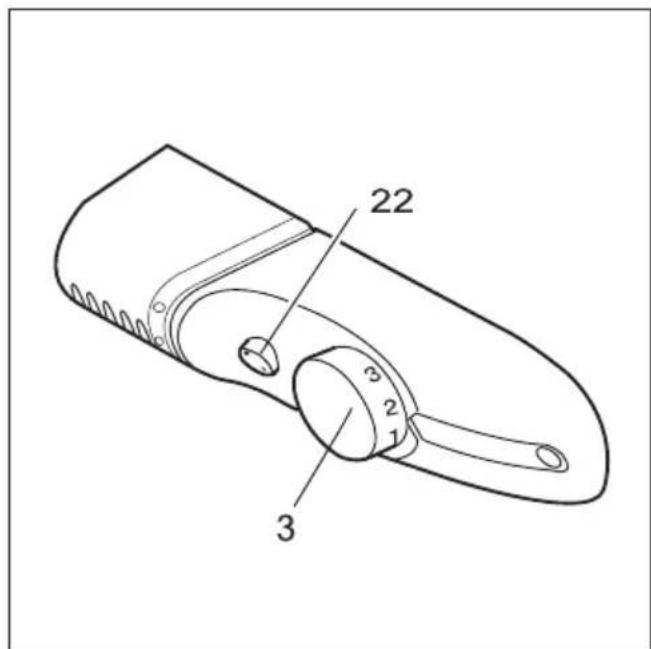
3 Temperature selector/inner light
4 Racks
5 Meat container
7 Discharge gutter for thaw-water
8 Shelf
9 Vegetable bin
12 Egg rack
13 Cheese compartment
14 Butter compartment
15 Container
17 Big shelf
18 Door seal
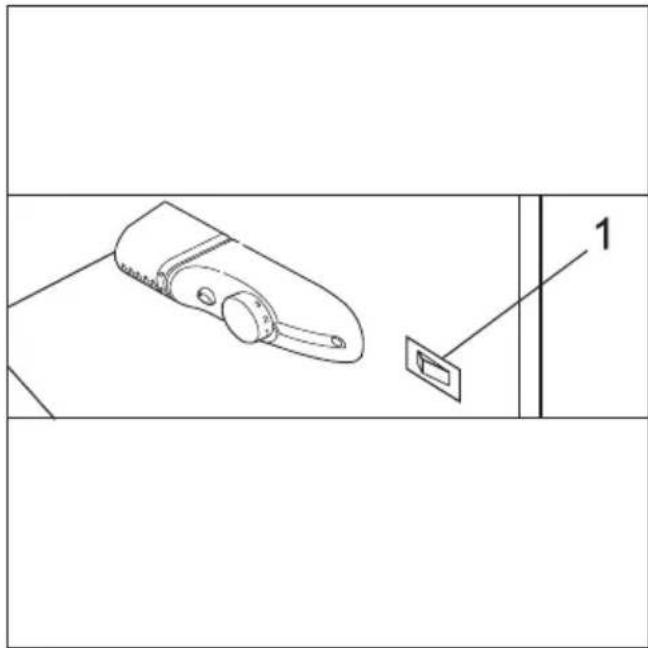
22 Freezer switch (Fig. 3)
A Deep-freezing compartment
B Refrigerator
Observe ambient temperature and ventilation
The climatic class can be found on the rating plate (Fig. 10) and indicates the ambient temperatures at which the appliance can be operated.
| Climatic class Permitted ambient temperature | |
| SN +10 °C to 32 °C | |
| N +16 °C to 32 °C | |
| ST | +16 °C to 38 °C |
| T | +16 °C to 43 °C |
Ventilation
Fig. 4
The air on the rear panel of the appliance heats up. The warm air must be able to escape. Otherwise, the refrigerator must work harder. This will increase the power consumption.
Therefore: Never cover or block ventilation openings!
Usable capacity
Information on the usable capacity can be found inside your appliance on the rating plate.
Connecting the appliance
After installing the appliance, wait at least 12 hour until the appliance starts up. During transportation the oil in the compressor may have flowed into the refrigeration system.
Before switching on the appliance for the first time, clean the interior (see Cleaning).
The socket should be easily accessible. Connect the appliance to 220–230 V/50 Hz alternating current via a correctly installed earthed socket. The socket must be fused with a 10 A fuse or higher.
If the appliance is to be operated in a non-European country, check on the rating plate whether the indicated voltage and current type correspond to the values of your mains supply. The rating plate is located in the appliance at the bottom left-hand side. The mains connection cable may be replaced by an electrician only.
Turning on and temperature selection
Clean the inside of the appliance thoroughly, before using the first time (see cleaning).
Turning on
Turn temperature selector (figure 3) out of the position "O".
The refrigerating process begins.
Should the door of the freezer compartment refuse to come open shortly after having closed it, please wait for two or three minutes for the suction produced, when the door was first opened, to release.
Temperature selection
Use the temperature selector (Figure 3) to adjust the temperature of both freezer and refrigerating compartments.
Observe the high figures yield low degrees of temperature.
When the temperature selector is placed at setting "O" the refrigerating process is turned off.
From setting "1" onwards it starts and increases.
We suggest a medium temperature setting (approximately "2-3")
To freeze foods, rotate the temperature control to "3" (see also "Freezing").
Observe the following for the storage of frozen food:
If the temperature of the room where the appliance has been placed drops below +18°C the freezer switch should be connected. A red mark will indicate it is on (figure 3/22). On connecting the switch, the inner light will remain on at reduced power. This ensures that the temperature required in the freezer compartment for long-life storage of food is maintained.
Switching-off and setting out of use
Switching-off
Turn the temperature selector (Figure 3) to the setting "O".
The refrigerating process stops for the whole appliance.
Setting out of use
If the appliance is set out of use for a long period of time, unplug, allow to defrost and clean. Leave the door of the freezer compartment and appliance's door open.
Arranging food
How to rearrange the inner fittings
The shelf racks in the refrigerator area may be adjusted to different levels. To adjust, pull rack forward, push it down and reinstall at the desired position. (Fig.4).
The containers on the inside of the door may be taken out for cleaning (Fig.6).
Please observe the following when arranging food inside the appliance:
- Allow warm food or beverages to cool down before placing inside the appliance.
-
Wrap or cover food well before placing inside the appliance.
-
Oil or fat should not be allowed to come in contact with the plastic parts of the appliance or with the door seal (these are materials which tend to become easily porous).
- Do not store explosive substances inside the appliance.
- Keep high-proof alcoholic beverages in air-tight bottles or jars and store in upright position.
- The coldest areas in the refrigerator are the rear wall and the area around the bottom shelf.
Example of arrangement
Figure 1
In the freezer compartment (A):
Freezing of fresh products, storage of deep-frozen goods and making ice cubes.
In the refrigerator (B):
On racks (4), from top to bottom: pastries, ready-cooked meals, dairy products.
In the meat containers (5)
meat and cold slices.
On the shelf (8):
Meat, sausages and cold slices.
In the vegetable bin (9):
Vegetables, lettuce and fruit.
In the egg rack (12): eggs.
In the compartments (13 and 14): butter and cheese.
In the door compartment (15):
tubes and small tins.
On the large shelf (17):
large bottles.
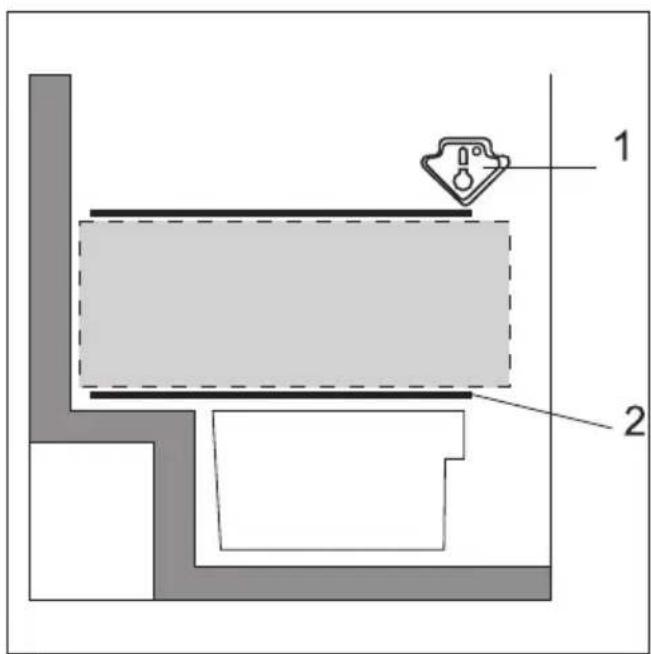
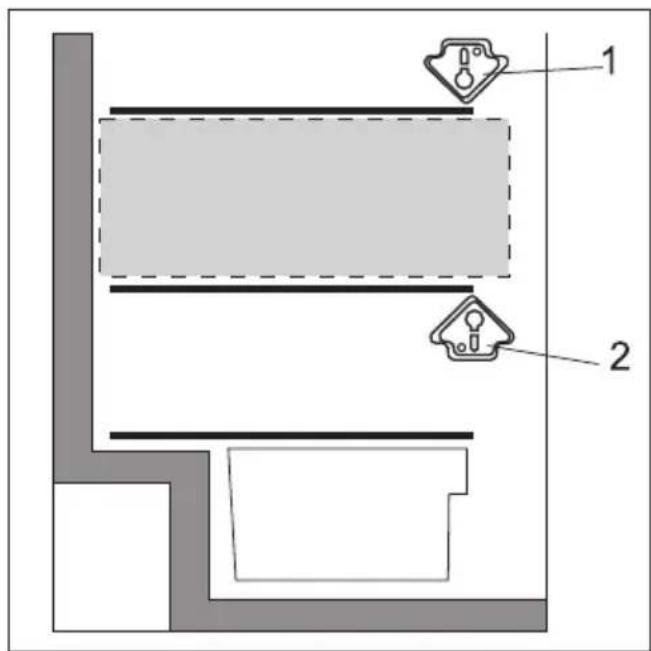
Note refrigeration zones in the refrigerator compartment!
The air circulation in the refrigerator compartment means that there are zones at different temperatures.
Depending on the model, the zone for sensitive foods is right at the bottom between the arrow on the side and the glass surface below (fig. 11/1 and 2) or between the two arrows (fig. 12/1 and 2). Ideal for storing meat, fish, sausage and salad mixtures, etc.
Freezing fresh products storing frozen food and making ice
Observe the following when purchasing deep-frozen food:
- Inspect the package and ensure that it is perfect conditions.
- Check the expiry date stamped on the package; make sure it has not run out.
- Check the thermometer in the freezer of the store where you purchase your goods; it should indicate a temperature lower than -18°C.
- When shopping, ensure that the deep- frozen products are the last items to be purchased; wrap them up in newspaper or place in a insulating bag and take them home at once, place in the home freeze right away.
Wrapping-up
If home freezing, ensure that the products of your choice are absolutely fresh and in perfect condition. Pack food airtight so that it does not lose its taste or dehydrate.
Suitable wrapping material:
Plastic film, polyethylene bags, alu-foil and freezing containers.
All these products are available at your local dealers and most large supermarkets.
Unsuitable wrapping material:
Wrapping paper, wax-coated paper, butcher's paper, cellophane, rubbish bags or used carried bags.
Wrap-up food, press down on parcel to remove all air and seal airtight.
Suitable sealing material:
Rubber bands, plastic clips, string, water-proof adhesive tape or similar.
Plastic and polyethylen bags may be heat-sealed with an appropriate machine.
Label package indicating contents and date of freezing before storing in the freezer compartment.
Freezing capacity:
Information about the max. freezing capacity according to current standards can be found on the rating plate.
The maximum freezing capacity for fresh food in 24 h (distributed on the freezer racks) is indicated on the characteristics plate (in Kg/24h), see figure 10.
To retain the vitamins, nutritional value, appearance and flavour, do not exceed the max. freezing capacity.
If food is frozen in the freezer drawers, the max. freezing capacity will be reduced slightly.
Adjust temperature selector to freezing and switch on freezing process
Turn temperature selector to an average temperature setting (approx. "3") whenever fresh products are put in to freeze.
This temperature setting is sufficient for freezing up to 1,5 kg of food. For larger amounts you should additionally actuate the freezing switch (Fig. 3/22).
(Press the rocker switch -red marking appears).
If takes approximately 24 hours for the freezing process to reach full completion; once the food is thoroughly frozen, you may disengege the freezing switch.
Please observe following when putting fresh food into the freezer compartment:
Please carefully ensure that freshly freezing food does not come into contact with food which is already frozen.
Observe the following tips for better storage of frozen food:
If the temperature of the room where the appliance has been placed drops below +18°C the freezer switch should be connected. A red mark will indicate it is on (figure 3/22). On connecting the switch, the inner light will remain on at reduced power. This ensures that the temperature required in the freezer compartment for long-life storage of food is maintained.
Storage life
To avoid quality loss, it is important not to be exceed the admissible storage life assigned to each product. The length of admissible storage varies from product to product. Fish, cold slices, ready-cooked meals bread and pastries will keep out to two months at a temperature of -18^ C. At the same degree of temperature you may keep meat, poultry and cheese for up to four months and fruit and vegetables for up to six months.
Defrosting frozen products
Depending on the type of food and the use intend for it, you may choose among any of the following defrosting methods:
- at ambient temperature,
- in the refrigerator,
- in an electric oven.
- with/without fanheater,
- in a microwave oven.
You may refreeze food that has partially or totally defrosted provided that:
- in the case of meat and fish, these products were not kept for longer than a day at a temperature of 3^ C or higher;
- in the case of other products, these were not kept for longer than three days at a temperature of 3^ C or higher.
Otherwise, check food for smell, appearance and flavour, if these have remained unaltered, boil, fry, roast or cook food to some kind of ready meal and refreeze. Observe that the maximum admissible storage life in this case is shorter than average.
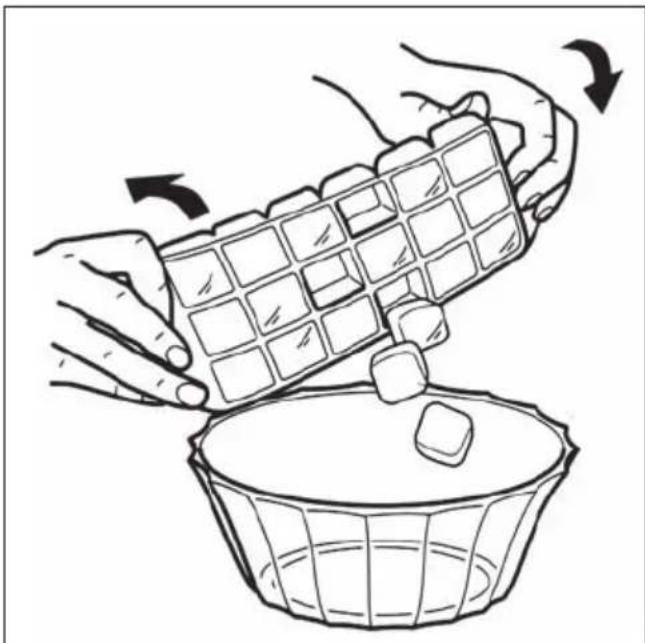
Making ice
Figure 7
Fill ice tray 3/4 full with water and place on the bottom of the freezer compartment.
Ice cubes will be easier to remove if the tray is given a gentle twist.
Defrosting
Refrigerator
The refrigerator defrost automatically. The thaw-water collects in the discharge gutter (figure 8/7) and is then conducted to the refrigerating unit to evaporate.
Ensure that the discharge gutter and the discharge outlet (figure 8/19) are clean at all times, so that water may drain unhindered.
Freezer compartment
For safety reasons, the freezer compartment (Figure 1/A) does not defrost automatically, since the products stored in this area, are not supposed to accidentally thaw out.
Intensive frost and ice build-up adversely influence the cold transmission to the frozen products and cause the rate of energy consumption to increase.
Scrape off frost build-ups
To remove frost build-ups you may use the standard frost scrapers available at most local dealers and large supermarkets.
Ensure that the freezer compartment is not damaged when frost is scraped. Never use sharp or pointed items or metal utensils to remove frost.
Allow ice coats to thaw out
If a thick ice coat has built up inside the freezer compartment, it should be allowed to thaw out.
If there are still frozen products in the freezer, swicht on the freezer swicht (Fig. 3/22) about 4 hours before defrosting so that the food is once again deep frozen.
Observe the following procedure:
- Remove frozen products, wrap up well in newspaper and store in a cool place.
- Turn the temperature selector (Figure 1/3) to setting "O" or unplug. Do not allow thaw water to run into the temperature selector.
- Leave door open and wipe-up thaw water with a cloth or sponge.
- Rub freezer compartment dry, switch appliance on once more and reinsert frozen products.
Defrosting aids
Be extremely careful when using defrosting sprays. These sprays may cause the formation of explosive gases, contain
propellants or substances which may be a major health hazzard and even damage the plastic parts of the appliance.
When making use of these sprays, read the manufacturer's instructions most carefully and adhere strictly to the given indications.
Cleaning
Before cleaning, make it a rule to unplug the appliance and/or disengage the fuse
Use luke-warm water with a little desinfectant and washing-up liquid to clean the entire appliance, except for the door seal. Never use sand, abrasive cleansers or acids, e.g. chemical solvents.
Clean the door seal (Figure 1/18) with clear water and dry thoroughly afterwards.
Do not allow cleaning water to get into the temperature selector.
The discharge gutter (Figure 8/7) and the discharge outlet (Figure 8/19) should be cleaned more frequently to ensure that
thawwater can drain unhindered. Pierce the discharge outlet with a toothpick or similar object to get it clean. Try to prevent cleaning water from getting into discharge outlet and running through to the evaporating plate.
In you so wish, you may additionally use a standard furniture polish to clean the outer cabinet panels. Ensure that the door of the appliance is closed while doing this, to prevent the polish from getting to the door seal or to the plastic parts inside the appliance.
Energy saving tips
• Install appliance in a cool and well ventilated room, do not expose to direct sunlight and keep away from heat sources (radiators, cookers etc.).
- Allow warm food and beverages to cool down before storing in the appliance.
- When defrosting, place the deep-frozen goods inside the refrigerator. The cold loss from the frozen goods can be effectively used-up to assist the cooling process inside the refrigerator.
- Allow freezer compartment to thaw out when ice has built-up. A thick coat of ice adversely affects the cold transmission to the frozen goods and causes the rate of energy consumption to increase.
- When putting in or taking out food, avoid keeping the door of the appliance open for too long.
Small problems for self-help
Before calling the service engineer, check the following points and see if you can solve the problem yourself.
If the service engineer is simply called-in for advice, i.e. if he finds no real fault with the appliance when he visits, you will be charged the full cost of service time, even before the guarantee period has run out.
| Problem | Possible cause |
| Unusual noises: | - The appliance may not be standing level or some kind of object is caught near the refrigerating unit.- A par on the rear wall of the appliance cannot turn freely and rubs against the appliance or against the wall.In this case, bend part carefully away. |
| The inner light does not work: | - The bulb has burnt out. Pull plug out of supply socket. Remove screen (Figure 9) then remove bulb and exchange for a new one, maximum 15W, 220-240 V, E 14 base.- The light switch sitcks (figure 5) Try to get the switch to move. If it doesn't budge call customer service.- The temperature selector (figure 9/3) is on setting “O”. |
| The temperature inside the refrigerator is too cold: | - Temperature setting dial is set at a too low position.- Fresh food was put into freeze without switching on the super-freeze (Fig. 3/22). |
| Cooling output deteriorates: | - The door was opened too often.- A large amount of food was placed in the refrigerator.- A thick layer of frost has built up inside the freezer.- The relief outlet and the ventilation grid are covered.- Some kind of objects is caught between the refrigerating unit and the wall. |
| Total lack of cooling: | - Plug does not fit properly into socket.- The fuse has disengaged.- Temperature selector (figure 1/3) is on setting “O”. |
If you have not managed to solve the problem with help of the above mentioned tips, call customer service.
Do not insist on solving the problem yourself. Above all, refrain from working on the electrical parts.
Try not to open the door of the appliance unnecessarily to avoid cooling loss.
Calling customer service
You can find your local customer service in the telephone directory or in the customer service list. When calling customer service, please quote the product number (E-Nr.) and the production number (FD) of the appliance.
This information can be found on the rating plate (Fig. 10).
To prevent unnecessary call-outs, please assist customer service by quoting the product and production numbers. This will save you additional costs.
natural_image
Diagram showing a mechanical or electrical component with directional arrows indicating motion (no text or symbols)2
3

natural_image
Diagram of a mechanical or structural component with a downward arrow indicating force or direction, surrounded by layered supports (no text or symbols)4
5

natural_image
Diagram of two hands holding a rectangular container with curved arrows indicating flow or movement (no text or symbols)6
natural_image
Illustration of hands placing a cube into a basket with an arrow indicating rotation (no text or symbols)7

8

9

10
11
12



natural_image
Technical diagram of a mechanical clamp or bracket assembly with no visible text or symbols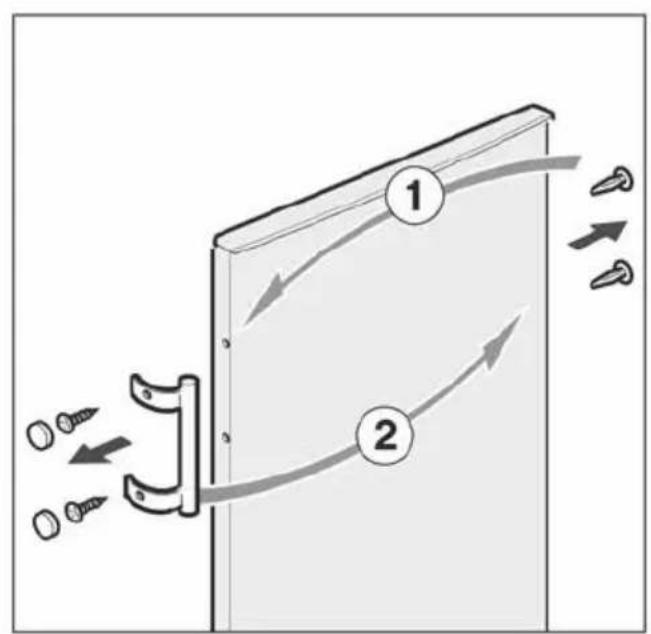
Subject to modification
- ES Índice
- Information concerning disposal
- Disposal of your old opliance
- Disposal of packaging
- Warning:
- Safety information Before you switch ON the appliance
- Warnings
- When using the appliance, comply with the following:
- ⚠️ Important
- General requirements
- Installation
- Changing over the door hinges
- Attention! Carefully place the appliance on its back.
- Aligning the appliance
- Your new appliance
- Fig. 1
- Observe ambient temperature and ventilation
- Ventilation
- Fig. 4
- Usable capacity
- Connecting the appliance
- Turning on and temperature selection
- Turning on
- Temperature selection
- Observe the following for the storage of frozen food:
- Switching-off and setting out of use
- Switching-off
- Setting out of use
- Arranging food
- How to rearrange the inner fittings
- Please observe the following when arranging food inside the appliance:
- Example of arrangement
- Figure 1
- Note refrigeration zones in the refrigerator compartment!
- Freezing fresh products storing frozen food and making ice
- Observe the following when purchasing deep-frozen food:
- Wrapping-up
- Suitable wrapping material:
- Unsuitable wrapping material:
- Suitable sealing material:
- Freezing capacity:
- Adjust temperature selector to freezing and switch on freezing process
- Please observe following when putting fresh food into the freezer compartment:
- Observe the following tips for better storage of frozen food:
- Storage life
- Defrosting frozen products
- Making ice
- Figure 7
- Defrosting
- Refrigerator
- Freezer compartment
- Scrape off frost build-ups
- Allow ice coats to thaw out
- Defrosting aids
- Cleaning
- Before cleaning, make it a rule to unplug the appliance and/or disengage the fuse
- Energy saving tips
- Small problems for self-help
- Calling customer service
Brand : BALAY
Model : 3FEW2416
Category : Refrigerator