Traffic Assist Z250 Ferrari Edition - Gps BECKER - Free user manual and instructions
Find the device manual for free Traffic Assist Z250 Ferrari Edition BECKER in PDF.


User questions about Traffic Assist Z250 Ferrari Edition BECKER
0 question about this device. Answer the ones you know or ask your own.
Ask a new question about this device
Download the instructions for your Gps in PDF format for free! Find your manual Traffic Assist Z250 Ferrari Edition - BECKER and take your electronic device back in hand. On this page are published all the documents necessary for the use of your device. Traffic Assist Z250 Ferrari Edition by BECKER.
USER MANUAL Traffic Assist Z250 Ferrari Edition BECKER
text_image
BECKER TRAFFIC ASSIST PRO Z 250 BECKEROperating instructions

INDEX
→D
→ GB
→ F
→ |
→ E
→ P
→ NL
→ DK
→ S
→ N
→ FIN
→ TR
→ GR
→ PL
→ CZ
→ H
→ SK
Index 2
Safety information 6
The Traffic Assist Pro 8
Use 8
Navigation 8
Music 8
Pictures 8
Video 8
Telephone 8
Unpacking the Traffic Assist Pro 9
Checking the delivery 9
Delivery contents 9
Complaints procedure 9
Handling the packaging 9
Description of unit 10
Traffic Assist Pro - basic unit 10
Cable for power supply from
cigarette lighter 10
Battery 10
SD memory card 11
USB connection cable 11
Unit bracket 11
Accessories 12
Mains power supply unit 12
External microphone 12
External GPS antenna 12
Docking station 12
TMC antenna 12
Headset 13
Information about
documentation 13
Quick start guide 13
Operating instructions 13
Registration 13
Repairs 13
Emissions and disposal 13
Overview Traffic Assist Pro 14
General operation
Maintenance and care 19
Battery quality declaration 20
Display quality declaration 20
Start-up 20
Memory card 20
Inserting memory card 21
Ejecting memory card 21
Power supply 22
Using the battery 22
Connecting to socket 22
Connecting up to power supply 22
Removing power supply 23
Connecting to the cigarette lighter 23
TMC antenna 23
TMC antenna (optional) 24
Installation of the TMC antenna 24
GPS-antenna 24
Unit antenna 24
Connecting up external
antenna 25
Connecting USB storage media 25
Docking station (optional) 25
Switching the Traffic Assist Pro on/off 26
Switching on 26
Switching off 27
Unit bracket 27
Fitting the unit bracket 28
On the windscreen 28
Adjusting the unit bracket 29
Vertical movements 29
Horizontal movements 29
Adding the Traffic Assist Pro 29
Removing the Traffic Assist Pro 29
Basic information about the
touch screen 30
Operation 30
Calibration 30
Basic information about the menus 30
The main menu 30
Entries made with the entry menu 31
Entering characters 31
Adopting suggestions 31
Scrolling through the lists 32
Special characters and umlauts 32
Entering numbers 32
Switching between upper and l
ower case 33
Deleting characters 33
Inserting spaces 33
The On key 33
Volume control 34
INDEX

More maps 34
Installation program 34
Transferring files 34
Transferring using the SD card reader 34
Transferring using the USB port 35
Transferring maps 35
Transmitting music tracks,
pictures and videos 35
Faults 36
Navigational mode 37
What is navigation? 37
Selecting navigation 38
Aids for navigation 38
Rapid access 38
Navigation menu 38
Map display 38
Rapid access 38
Structure of rapid access 39
Navigation menu and map display 39
The list of destinations 39
Icons used 39
Operating rapid access 40
Starting using an existing destination 40
Scrolling in the destinations memory 40
Displaying or editing destination 40
Change to map display 41
Displaying current position 41
Calling up Navigation menu 41
TheNavigation menu 42
Structure of the navigation menu 42
Address 42
Point of interest 42
Select on map 42
Enter coordinates 42
Route planning 42
Settings 42
Navigation menu: Address 43
Selecting a country 43
Select address and start 43
Cancelling navigation 49
Navigation menu: Point of interest 49
Point of interest: Near GPS position 49
Point of interest: nationwide 50
Navigation menu: Select on map 52
Navigation menu: Route planning 53
Route list 53
Using a route 54
The New button 54
The Edit key 55
The Calculate key 55
The Start key 56
Navigation menu: Enter coordinates 56
Navigation menu: Settings 57
The Routing options key 57
The Auto mode key 58
The Format key 59
The Map info key 59
The Route info key 60
The Speed key 61
The TMC button 62
The Time Zone key 63
The Smart Speller button 63
The Junction Info button 63
The Home address button 64
The Volume key 65
The GPS button 65
The button Load map 65
The Offroad button 66
What is dynamic route guidance? 66
Displaying TMC messages on the map 67
Using TMC 67
Reading a message 68
Display the relevant road in the map 68
Updating announcements 68
Taking announcements into c
onsideration when calculating routes 69
Automatic recalculation 69
Manual recalculation 69
Offroad navigation 70
Destination in the offroad area 70
Starting point in the offroad area 70
Map display 71
Map layout 71
Map display without driving guidance 71
Entire map with route guidance 71
Spilt screen with route guidance 72
Route guidance with arrow display 73
Map display with reality view 73
Map display with toolbar 74
→ D
→GB
→ F
→ |
→ E
→ P
→NI
→ DK
→ S
→ N
→ FIN
→ TR
→ GR
→ PL
→ CZ
→ H
→ SK

INDEX
→D
→ GB
→ F
→ |
→ E
→ P
→ NL
→ DK
→ S
→ N
→ FIN
→ TR
→ GR
→ PL
→ CZ
→ H
→ SK
Using the map display 74
Repeat the last voice prompt 74
Changing the announcement volume 74
Additional information 75
Position information 75
Calling up the options menu (toolbar) 76
Displaying/editing directions 77
Zooming and the map (toolbar) 78
Display route (toolbar) 78
Displaying TMC messages (toolbar) 78
Daytime - Night-time design (toolbar) 79
Change display (toolbar) 79
Point northwards (toolbar) 79
Available POIs along the route
(toolbar) 79
Move map (toolbar) 81
Playback of MP3 files during an
active navigation 81
Calling up the telephone function
(toolbar) 81
Telephone mode
Calling up telephone mode
Telephone fast access mode
Configuration of fast access mode
Number list
Icons used
Operating in fast access mode
Dialling an existing number
Scrolling through the number list
Displaying or editing entries
Telephone menu
82
82
82
82
83
83
83
83
83
84
84
Dialling a number
Telephone book
Connecting a mobile phone
Opening the device list
Connecting automatically
Searching for a mobile phone
Connecting from the device list
Disconnecting a mobile phone
Telephone/Bluetooth settings
Switching Bluetooth on/off
Visibility of the Traffic Assist Pro
Activating/deactivating automatic
connection
Refreshing the phonebook
Setting the telephone volume
Device name
Telephone calls
Establishing a call
Answering a call
Ending a call
When route guidance is active
Without route guidance
Music operations
Selecting music playback
The MP3 player
Operating the MP3-Players
Track skip
Play
Pause
Cancelling playback 94
Folder overview
Track repeat/random play function
Setting volume
Navigation during MP3 player
operation
Shutting down the MP3-Player
Pictures mode
Selecting pictures display
The Picture Viewer
Operating the Picture Viewers
Scrolling 98
Slideshow
Full screen
Shutting down the Picture Viewer
Folder viewing mode
Operating folder viewing mode
Subfolders
Scrolling 99
Selecting a picture
Changing folder levels
Closing folder viewing mode
Video mode
Selecting video playback 100
The video player
Operating the video player
Opening and playing videos
Showing the button bar while
video is playing
Pausing and resuming playback
Fast forward/reverse
Setting the volume
95
96
[Non-Text]
96
96
97
97
97
98
[Non-Text]
98
98
98
99
99
99
[Non-Text]
99
99
99
100
[Non-Text]
100
100
100
[Non-Text]
101
101
101
101
INDEX

Settings 102
Selecting the settings 102
The setting menu 102
Operation 102
Selection possibilities 102
Closing the setting menu 102
The individual menu points 103
Energy 103
Displaying the energy supply 103
Ending the status display 103
Day/night display 103
Calibration 104
Starting calibration 104
Language 104
Calling up language selection 104
Turn the page 104
Selecting the language 104
Cancelling the language selection 104
Moodlight 105
Tones 105
Automatic on/off 105
Switching the function on / off 105
Information 106
Factory settings 106
Car integration 106
PIN protection 107
Activating PIN protection 107
Deactivating/changing PIN
protection 107
Specialist words 108
Keywords 110
Technical Data 113
NOTICE 114
EU Declaration of Conformity 114
Disposal of the unit 115
Disposal of the battery 116
Duty to supply information according
to battery legislation (BattrV) 116
Removing the battery 116
The information and data contained in these documents are subject to change without prior notice.
No part of these documents may be reproduced or transmitted for any purpose without express written permission from HARMAN/BECKER Automotive Systems GmbH. All technical information, drawings etc. are subject to copyright law.
© Copyright 2008, HARMAN/BECKER
All rights reserved.
→ D
→GB
→ F
→ |
→ E
→ P
→ NL
→ DK
→ S
→ N
→FIN
→ TR
→ GR
→ PL
→ CZ
→ H
→ SK
⚠ Safety information
- The unit may only be operated if the traffic situation allows for this and if you are absolutely certain that you yourself, your fellow passengers or other road users will not be put at risk, encumbered or disturbed by this.
- The rules of applicable road traffic acts must be observed at all times. Destinations may only be input when the vehicle is stationary.
- The navigational system is only an aid. The data/details provided may in some cases be incorrect. The driver must always decide whether to follow the details given or not. We accept no liability for the navigational system issuing incorrect details. As a result of traffic routing changes and deviating data, inaccurate or incorrect instructions may be given. Drivers should always pay attention to the actual road signs and traffic control. In particular, the navigational system cannot be used as a means of orientation in cases of poor visibility.
- The unit may only be used for its intended purpose. The volume of the navigational system should be set so that noises outside the vehicle can still be heard.
- The unit should be switched off immediately if faults occur (e.g. development of smoke or smells).
- For safety reasons, the unit may only be opened by a specialist. Please contact your local stockist if you require repairs.
SAFETY INFORMATION
• The SD memory card can be removed. Caution! Small children could swallow it.
- The mains voltages (V) indicated on the mains charger, the car charger adapter and the unit must not be exceeded. Failure to observe this can result in destruction of the unit and the charger as well as explosion of the rechargeable battery.
- Never open the unit or the rechargeable battery. Any modification to the unit is also impermissible and renders the type approval invalid.
- Use only genuine BECKER original accessories. This will ensure that all the relevant regulations are complied with and damage to health and property is avoided. Dispose of defective units and the rechargeable battery according to the applicable legal requirements.
- No warranty is granted in the case of improper use. These safety instructions also apply to genuine BECKER original accessories.
→→→ THE TRAFFIC ASSIST PRO
Use
The Traffic Assist Pro is a powerful PND (Personal Navigation Device) for use in vehicles and closed spaces. The unit should be protected from dampness and dirt.
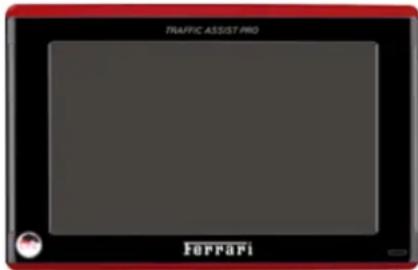
text_image
TRAFFIC ASSIST PRO FerrariThe Traffic Assist Pro can be used as:
- navigational unit
• MP3 (device for playing music) - Picture viewer
- Video player
- Can be used as a very convenient hands-free unit via Bluetooth®
Navigation
Thanks to GPS = Global Positioning System, you no longer need to spend hours searching through road atlases.
Once outside buildings, the receiver antenna integrated in the unit gives you continuous access to navigational possibilities. Depending on reception, you may not be able to use the navigational function inside buildings. When used in vehicles, you may not be able to adequately receive GPS data depending on how the Traffic Assist Pro is installed. In such cases, you will have to connect up an external antenna (does not fall within the scope of supply).
The Traffic Assist Pro is equipped with TMC, which gives you the option of receiving traffic announcements via the TMC antenna provided. Traffic announcements are transmitted when the TMC is active. The system plans an alternative route automatically or on request to avoid traffic problems, depending on the setting.
Music
Thanks to the integrated MP3-Player, you can listen to your favourite tracks when on the go.
Pictures
The Traffic Assist Pro has a Picture Viewer offering many functions for viewing pictures.
Video
Traffic Assist Pro features a video player for playing videos.
Telephone
Your Traffic Assist Pro is equipped with Bluetooth® wireless technology. You can connect a mobile phone equipped with Bluetooth® wireless technology to it via Bluetooth. Your Traffic Assist Pro the serves as a very convenient hands-free unit. In addition, you also have the option of reading out the mobile phone's address book or phonebook.
Unpacking the Traffic Assist Pro
Note:
Your Traffic Assist Pro is supplied in stable packaging. Do not unpack the unit in full if you discover any serious damage to the packaging or its content. If this happens, please contact your local stockist.
Checking the delivery
Before the Traffic Assist Pro is started up, the delivery to ensure that it is complete and in the correct condition (see also page 14). → Carefully unpack the content of the package and check it.
Delivery contents

text_image
Product catalog image showing labeled parts of a digital camera and ear with accessoriess 1h Traffic Assist Prob, the mobile navigation system with integrated MP3 player, video player, picture viewer and extremely convenient Bluetooth® hands-free unit
2 Unit holder
3 12/24 V car power adapter for cigarette lighter socket
4 Memory card (SD memory card) with pre-installed map data
5 TMC antenna
6 USB cable
7 DVD with installer for map data, actual map data and operating instructions (not illustrated).
Complaints procedure
Please contact your local stockist if you have any complaints. The unit can also be sent directly to Harman/Becker in its original packaging.
Handling the packaging
Keep the original packaging in a dry place, at least for the warranty period.
Note:
The packaging should be disposed of correctly in accordance with national disposal guidelines. The packaging must not be burnt. Depending on the country to which the unit is supplied, it may be possible for local stockists to accept packaging.
→→→ THE TRAFFIC ASSIST PRO
→ D
→GB
→ F
→ |
→ E
→ P
→ NL
→ DK
→ S
→ N
→ FIN
→ TR
→ GR
→ PL
→ CZ
→ H
→ SK
Description of unit
The Traffic Assist Pro consists of the basic unit Traffic Assist Pro and the accessories included in the delivery.
You will find photos of the individual parts under:
- "Overview Traffic Assist Pro" on page 14
Note:
The basic unit and accessories must not be opened or modified in any way.
Traffic Assist Pro - basic unit
The basic unit contains all the electronics:
- an integrated antenna,
- a TMC receiver for the reception of traffic messages,
- a touchscreen,
- an integrated loudspeaker for the output of messages during navigation and for MP3 files and phone calls,
- a microphone.
On the sides of the unit, there are also light bars as well as various connections and ports.
You will find more details of the unit under:
• See “Technical Data” on page 113.
Cable for power supply from cigarette lighter
This cable allows the unit to be connected up to the car's cigarette lighter.
The power supply must satisfy the following requirements:
• DC current 12/24 volts 0.5 amps
Battery
When depleted, the integrated rechargeable battery can be recharged by connecting the Traffic Assist Pro to the power supply.
For this purpose, connect the unit via a car power adapter to a 12/24 V socket in a vehicle or via the optional mains power supply unit to the 230 V mains.
Note:
You can charge the Traffic Assist Pro via the car charger cable included in the scope of delivery or via the optionally-available mains power supply unit.
When the Traffic Assist Pro is connected to a PC, it is supplied with power via the PC and does not consume battery power.
A memory card is used as a storage medium for road maps, music tracks and images.
The memory card provided has a storage capacity of 4 GB which is sufficient for almost the entire map set. The Traffic Assist Pro does not support larger memory cards. If you wish to listen to m view pictures/videos using the Traffic Assist Pro, they must be stored on a separate card or a USB storage medium (not included in the scope of delivery).
When not in the unit, the memory card must be stored in a protected dry place away from direct sunlight in the packaging supplied. Avoid touching or dirtying the contact strip.
You will find more details about the memory card under:
- "Technical Data" on page 113
Notes:
The map set requires almost the entire memory capacity. If you intend to listen to music, look at pictures or watch videos on the Traffic Assist Pro. We recommend that you store the relevant data on a separate memory card (not included in scope of delivery). If you wish to listen to music using the Traffic Assist Pro while navigation is underway, it must be stored on the supplied memory card or a USB storage medium. The Traffic Assist Pro does not support the changing of memory cards during navigation.
USB connection cable
The USB connection cable can be used to connect the unit to a standard personal computer by means of the USB port. However, to use the data on the PC, you will first have to install the free "Active Sync" software from Microsoft®.
Unit bracket
The Traffic Assist Pro can be mounted in the vehicle using the unit bracket.
→→→ THE TRAFFIC ASSIST PRO
→ D
→GB
→ F
→ |
→ E
→ P
→ NL
→ DK
→ S
→ N
→ FIN
→ TR
→ GR
→ PL
→ CZ
→ H
→ SK
Accessories
Mains power supply unit
This power supply allows connection of the Traffic Assist Pro to a mains outlet.
Requirements for power supply:
Alternating current
- 100-240 V
0.2 Amps
50-60 Hertz
External microphone
The internal microphone of the Traffic Assist Pro may not be able to achieve satisfactory voice quality if the Traffic Assist Pro is placed unfavourably in the vehicle.
In these cases, please use the optionally available external microphone. Please consult your local specialist dealer.
Details of the connection can be found under "Docking station (optional)" on page 25.
Note:
Connection is only possible using the optionally available docking station.
External GPS antenna
You can use an external antenna to improve reception in vehicles where only limited GPS reception is available (not included in the scope of supply). Please contact your local stockist for more information.
Details of the connection can be found under "Connecting up external antenna" on page 25.
Docking station
The optionally available docking station replaces the carrier plate of the Traffic Assist Pro included in the scope of delivery.
There are various connections on the docking station. These connections can be used to connect the Traffic Assist Pro to an audio system already installed in the vehicle.
Details of the connections on the docking station can be found under "Docking station (optional)" on page 25.
TMC antenna
The dipole antenna for TMC reception included in the scope of delivery can be replaced by the optionally available bow-shaped TMC antenna.
Details of how to install the bow-shaped TMC antenna can be found under "TMC antenna (optional)" on page 24.
When using the Traffic Assist Pro as an MP3 player, commercially available headphones with a 3.5 mm jack or adapter can be connected (not included).
⚠️ Danger!
Prevention of damage to hearing

The use of headphones or earphones over a relatively long period of time at a high vol-
ume may cause permanent damage to your hearing.
Conformity with the limits for sound pressure laid down in the standard NF EN 50332-1:2000 as required by French Article L. 5232-1 is guaranteed.
Note:
Headphones must not be used while driving. Comply with the local national laws and regulations.
Information about documentation
Quick start guide
The Quick Start Guide is designed to provide a brief introduction to operating your Traffic Assist Pro. The most important basic functions of the Traffic Assist Pro are explained in the Quick Start Guide.
Operating instructions
A comprehensive explanation of the Traffic Assist Pro functionalities is contained in these operating instructions.
Registration
You can register your product using our software service, we will then inform you of any new updates and other news. You can register online on the Becker homepage www.mybecker.com.
The "Software update" menu item is located under "SERVICE/SUPPORT".
Repairs
The unit must not be opened if damaged. Please contact your local stockist.
Emissions and disposal
Information on emissions, electromagnetic compatibility and disposal can be found in "NOTICE" on page 114.
→→→ OVERVIEW TRAFFIC ASSIST PRO
→D
→GB
→F
→1
→E
→P
→NL
→DK
→S
→ N
→FIN
→TR
→GR
→ PL
→ CZ
→H
→ SK

Scope of supply
1 Traffic Assist Pro - PND (Personal Navigation Device)
2 Memory card (containing navigational data)
3 USB connection cable
4 Cable for power supply from car's cigarette lighter (12 volts)
5 Unit bracket
6 TMC antenna

Front of unit with controls and displays
1 Touch screen showing the main menu selected
2 Touch screen key
Press = activates the corresponding key command
3 Microphone with flashing activity indicator for Bluetooth
4 On key ()
Press = returns to numerous applications
Press for longer = switches the Traffic Assist Pro on and off
5 Mood light
→→→ OVERVIEW TRAFFIC ASSIST PRO
→D
→GB
→F
→1
→ E
→P
→ NL
→DK
→S
→ N
→FIN
→TR
→GR
→ PL
→ CZ
→H
→ SK

text_image
DECKER ① ②Rear of unit
1 Point for connecting up an external antenna (external antenna not included in the scope of supply)
2 Interface for docking station (docking station not included in the scope of delivery)
OVERVIEW TRAFFIC ASSIST PRO

text_image
① reset on off ② 3Left side of unit
1 SD memory card slot
2 Reset button
3 ON/OFF switch

text_image
Diagram of a device rear panel with numbered labels pointing to key components like USB, GPIO, and USB port.Right side of unit
4 Volume control
Move upwards = increase volume
Move downwards = decrease volume
Press = mute
5 3.5 mm connection for headset/Connection socket for TMC antenna (headset not included in scope of supply)
6 USB port for data carrier containing MP3 or image files
7 Mini USB connection
→→→ OVERVIEW TRAFFIC ASSIST PRO
→D
→GB
→F
→1
→ E
→P
→NL
→DK
→S
→ N
→FIN
→TR
→GR
→ PL
→ CZ
→H
→ SK

text_image
① ② Tool Made Therms -100x
text_image
④ ③Left docking station
1 Connection for telephone mute cable (accessory)
2 Connection for audio signal cable (accessory)/external microphone (accessory)
Right docking station
3 Connection for TMC antenna
4 Connection for external power supply
GENERAL OPERATION
Maintenance and care
The unit is maintenance-free.
For proper care, a commercially available cleansing fluid for electrical devices may be applied using a soft damp cloth.
⚠️Danger!
Danger to life by electrocution. Always switch off the unit and disconnect the mains power supply unit before cleaning the unit, supplied components, or accessories.
Note:
Do not use any aggressive or abrasive substances or cloths which may damage the surface.
The unit must not be exposed to water.
Your mobile navigation system was designed and manufactured with great care and should be treated with equal care. You will enjoy your mobile navigation system for a long time to come if you observe the recommendations listed in the following:
- "Protect your mobile navigation system from water and moisture. If your unit is exposed to moisture, switch it off immediately and disconnect the power supply. Allow the unit to dry at room temperature.
- Do not operate your mobile navigation system in a dusty or dirty environment and do not store it in such an environment.
- Do not store your mobile navigation system in hot environments. High temperatures can shorten the service life of electronic components in your unit, damage the rechargeable batteries and cause certain plastics to warp or melt.
- Do not store your mobile navigation system in cold environments. During operation, when the unit warms up to operating temperature, moisture may form internally, causing damage to electronic components.
- Do not drop your mobile navigation system unit, protect it from shocks and do not shake it. Improper handling can damage components within the unit.
- Never use corrosive or aggressive chemicals, cleaning solutions or aggressive detergents for cleaning.
All the above information applies equally to the mobile navigation system, the rechargeable battery, the mains charging and car power adapters as well as all accessories. Should one of these parts not work properly, please contact your authorised dealer.
Battery quality declaration
The capacity of the rechargeable battery in your mobile navigation system decreases with every charging/discharging cycle. Improper storage at excessively high or low temperatures may also cause a gradual deterioration of capacity. Consequently, the operating time may be substantially reduced even in the case of a fully charged battery.
The rechargeable battery is designed such that it should certainly still be possible for it to be charged and discharged after 6 months of operation of your mobile navigation system.
Display quality declaration
In some cases, for technical reasons, a few discoloured dots (pixels) may be visible on the display. Some pixels may also appear brighter or darker. However, such instances do not represent a product flaw.
Start-up
Once the Traffic Assist Pro has been unpacked and checked for damage, the unit can be started up. The individual start-up stages are:
- insert memory card
- connect to power supply
- Switching on the unit
- Ensuring antenna reception (if navigation is desired)
Memory card
The memory card provided has a storage capacity of 4 GB which is sufficient for one map set. The Traffic Assist Pro does not support larger memory cards.
If you wish to listen to music or view pictures/videos using the Traffic Assist Pro, we recommend that you store this data on a separate memory card or a USB storage medium (not included in the scope of delivery).
If you wish to listen to music using the Traffic Assist Pro while navigation is underway, it must be stored on the supplied memory card or a USB storage medium.
The Traffic Assist Pro does not support changing of the memory card while navigation is underway.
GENERAL OPERATION
Notes:
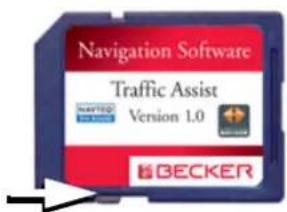
text_image
Navigation Software Traffic Assist Version 1.0 BECKERA small slider is located on one side of the card. If this is pushed in the direction of the arrow, the Memory Card is protected from being overwritten.

natural_image
Close-up of a red and black electronic device with a close-up view showing internal components (no text or symbols visible)The card slot is located on the left side of the unit. The card slot is equipped with a spring-actuated locking and ejector mechanism.
Notes:
The memory card should only ever be inserted and ejected when the unit is switched off. If the unit is not switched off, data may be lost.
Navigational operations are not possible if the memory card containing card data is not inserted. If you remove this during navigation, directions to your destination will be aborted immediately.
Inserting memory card

text_image
TRAFFA3207 PRO TERRAFI→ Remove the memory card from its packaging without touching or soiling the contact bar.
→ Hold the memory card such that the contact bar faces towards the rear of the unit.
→ Guide the memory card into the card slot.
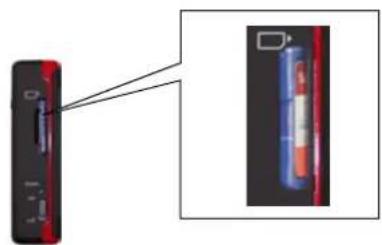
text_image
Diagram showing a device with labeled ports and an inset close-up of its internal structure, likely illustrating a physical or electronic component.→ Exert a little pressure and slide the memory card into the card slot until it snaps in.
Ejecting memory card
The card slot ejects the card so that you can pull it out with two fingers.
→ Use your finger to gently press the memory card against the spring force into the card slot and then release it.
The card is ejected.
→ Remove the memory card and place it in the packaging while ensuring not to touch contact bar.

GENERAL OPERATION
→ D
→GB
→ F
→ |
→ E
→ P
→ NL
→ DK
→ S
→ N
→ FIN
→ TR
→ GR
→ PL
→ CZ
→ H
→ SK
Power supply
Note:
You can charge the Traffic Assist Pro via the car charger cable included in the scope of delivery or via the optionally-available mains power supply unit.
When the Traffic Assist Pro is connected to a PC, it is supplied with power via the PC and does not consume battery power.
Using the battery
The internal power supply is via the integrated rechargeable battery. The rechargeable battery is maintenance-free and does not require any particular care.
Note:
Note that if the battery is completely discharged, it may take up to a minute before the device can be switched on again.
Note:
In the event of a defective battery, please contact your authorised dealer. Please do not attempt to remove the battery yourself.
Connecting to socket
⚠️ Danger of Death!
Make sure that your hands are not damp and that the mains section is dry. Only connect the mains section to a mains supply with which such purposes are permitted.
Connecting up to power supply
Connection to the public mains grid is achieved using the optionally-available mains power supply unit. Please proceed as follows to connect to the mains:
→ Hold the USB connector at the corrugated grip area and push it into the connecting socket to the stop without employing excessive force.

natural_image
Close-up of a hand inserting a USB into a black and red electronic device (no visible text or symbols)→ Use the plug to insert the mains section in the socket.
Removing power supply
→ To remove the power supply, proceed in reverse.
Note:
Remove the mains section if you are not planning on using the Traffic Assist Pro for a long time.
Connecting to the cigarette lighter
Note:
If the cigarette lighter has just been used and is still warm, wait until this has cooled down in its mounting.
Power supplies using a vehicle battery are connected up as follows using the cable supplied for the cigarette lighter.
→ Hold the USB socket at the corrugated grip area and push it into the connecting socket to the stop without employing excessive force.
→ Plug the plug adapter into the cigarette lighter.
Note:
If the engine is switched off, using the vehicle's power supply through the cigarette lighter will slowly drain the vehicle battery! Do not therefore operate the Traffic Assist Pro for extended periods with the engine off.
TMC antenna
The TMC antenna included in the accessories is used to receive traffic announcements.
→ Push the connector on the TMC antenna into the socket without employing excessive force.
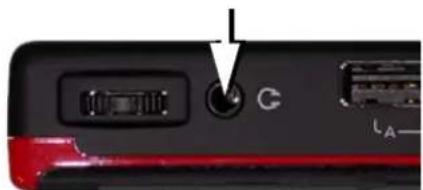
natural_image
Close-up of a black electronic device rear panel showing ports and a switch (no readable text or symbols)Note:
The TMC antenna must be routed so that your ability to drive the vehicle is not impaired.
Headphones cannot be connected when the TMC antenna is connected. However, traffic announcements can be received when the headphones are connected.

GENERAL OPERATION
→D
→GB
→F
→1
→ E
→P
→ NL
→DK
→S
→ N
→FIN
→TR
→GR
→ PL
→ CZ
→H
→ SK
TMC antenna (optional)
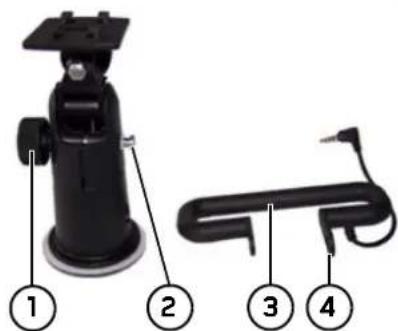
The optionally available bow-shaped TMC antenna can be used instead of the dipole antenna included in the scope of delivery. The antenna still has to be mounted onto the unit holder.
Installation of the TMC antenna
text_image
Diagram of a black handheld device with numbered parts labeled 1 to 4→ Remove the fastening screw ① completely.
→ Push the side of the TMC antenna with the ④⑥② over the lug on the ○ holder.
→ Align the hole on the other side of the TMC antenna ③so that it is positioned over the screw hole for the fastening screw.

natural_image
Black industrial valve or clamp device with adjustable arms and a top-mounted head (no visible text or symbols)→ Install the fastening screw 🟢 again.

natural_image
Black industrial device with adjustable arms and a flat top (no visible text or symbols)The antenna is now mounted.
GPS-antenna
Unit antenna
The GPS antenna is integrated into the housing.
Note:
The integrated GPS antenna is not suitable for use in vehicles with anti-glare windows (metalised thermo-glass or metal foil, indicated by the window label - SIGLA SOL, SIGLA CHROM, SIGLA, KOOL-OF, SUNGATE, etc.) and vehicles with fine-meshed heating wires in the windows.
If this is the case, use an external GPS antenna. Please consult your local specialist dealer.
GENERAL OPERATION
Connecting up external antenna
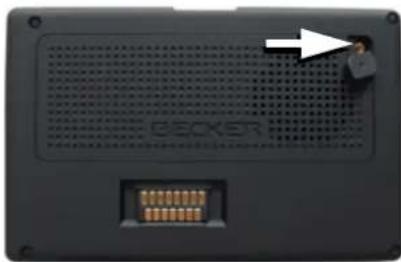
To enable reception under adverse reception conditions, an external GPS antenna can be connected (not included). For this purpose, a closable connecting socket is located on the rear of the housing. If no external antenna is connected, this connection must always be closed again.
natural_image
Close-up of a black electronic device with a perforated grille and a small LED display (no visible text or symbols)→ Open the closure by pulling gently on its upper surface.
→ Connect the external antenna using the optionally available adapter.
Connecting USB storage media
You can connect a USB memory stick or an external hard drive to your Traffic Assist Pro.
Images, music or videos can then be accessed from these storage media.
Notes:
- Only external hard drives with a maximum power consumption of 500mA may be operated. The hard drive can only be operated when the Traffic Assist Pro is powered via the mains adapter or via the car power adapter.
- Please note that when using USB memory sticks to play MP3 files or display images or videos, the battery capacity may be considerably reduced (without external power supply).
The USB port for storage media is located on the right side of the unit.
Docking station (optional)
The optionally available docking station replaces the carrier plate of the Traffic Assist Pro included in the scope of delivery. The connections on the docking station can be used to connect the Traffic Assist Pro to an audio system already installed in the vehicle.
Note:
You can see which connections on the docking station have to be used on Page 18.
Telephone muting
You can connect your Traffic Assist Pro to your audio system using an optionally available cable for telephone muting. If the cable is correctly connected, your Traffic Assist Pro will mute the car radio during navigation announcements.

GENERAL OPERATION
→D
→GB
→F
→1
→E
→P
→NL
→DK
→S
→ N
→FIN
→TR
→GR
→ PL
→ CZ
→H
→ SK
Audio signal output
You can connect your Traffic Assist Pro to your audio system using an optionally available cable for output of the audio signal.
If the cable is correctly connected, you can then output the audio signal via the vehicle audio system.
External microphone
You can connect an external microphone to your Traffic Assist Pro using an optionally available cable.
Switching the Traffic Assist Pro on/off
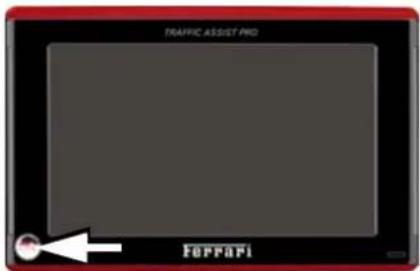
The unit is switched on and off using the key ⚙.
text_image
TRAFFIC ASSIST PRO FerrariNote:
Please deactivate the Becker moodlights while driving in your vehicle in order to prevent visual distraction from the road traffic!
Switching on
→ Set the On/Off switch on the left side of the unit to On.
→ Press the key for a few seconds.
The unit is switched on. The manufacturer's logo appears on the touch screen.

natural_image
Close-up of a yellow racing speedometer with orange dial and red 'RACE' button, set against a black-and-white checkered background (no readable text or symbols beyond basic markings)After you have activated PIN protection (see page 107), the PIN number is then requested.

text_image
PIN: Forgotten PIN? 1 2 3 4 5 6 7 8 9 0 ← OK→ Enter the PIN number using buttons
1 to . 0
GENERAL OPERATION
Note:
Have you forgotten your PIN number?
→ Press the Forgotten PIN? button and follow the instructions.
→ Confirm your entry by pressing the OK button.
The following question appears shortly thereafter: Comply with highway code

text_image
Comply with highway code OK→ If you agree with this request, press the OK key.
Note:
The Traffic Assist Pro may only be used in accordance with the applicable national road traffic act!
Switching off
You can switch the unit off at any time. If necessary, new destinations should first be saved.
→ Press the key for a few seconds.
The unit will enter sleep mode.
→ Switch the On/Off switch to Off for final deactivation of the unit.
Note:
We recommend that you place the Traffic Assist Pro in sleep mode in the event of short interruptions to operation (up to a week).
This significantly reduces the switch-on time and the Traffic Assist Pro finds the satellites required for navigation much faster.
Unit bracket
The Traffic Assist Pro can be attached directly to the windscreen with the unit holder.
Note:
The Traffic Assist Pro and unit bracket must not be exposed to long periods of direct sunlight. Temperatures inside the vehicle of +70 C and higher may damage parts of the bracket.

GENERAL OPERATION
→D
→GB
→F
→1
→ E
→P
→ NL
→DK
→5
→ N
→FIN
→TR
→GR
→ PL
→ CZ
→H
→ SK
text_image
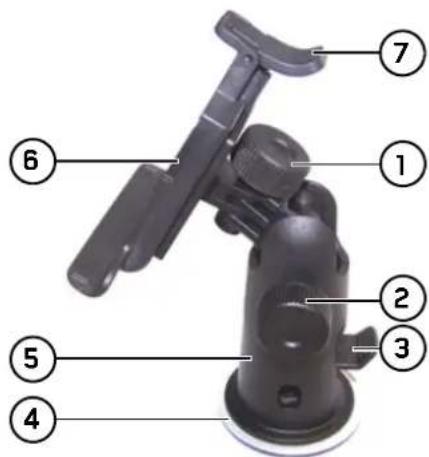
Labeled diagram of a black handheld device with numbered parts for identification1 Fastening screw
2 Fastening screw
3 Lever
4 Suction surface
5 Base
6 Unit holder
7 Clip
Fitting the unit bracket
Note:
Fasten the unit holder such that your field of vision is not impaired when the Traffic Assist Pro is installed and ensure that the unit is outside the deployment area of the airbag.
Ensure that the electrical connection cable does not hamper you from accessing the vehicle's controls.
Also ensure that there is enough space to easily slide the Traffic Assist Pro back out of the bracket.
Clean the attachment surface on the windscreen to ensure that it is clean and free of grease. Do not use greasy or soapy cleaning agents.
On the windscreen
The unit holder can be attached directly to the windscreen via the suction mechanism.
→ Find a suitable position.
→ Press the base (5) with its suction surface against the windshield.
→ Rotate the unit bracket so that the support plate is roughly in the direction of viewing required.
→ Press the lever (3) downwards.
The bracket will have stuck firmly to the windscreen. It can now be set precisely.
To remove, actuate the lever (3) again.
GENERAL OPERATION
Adjusting the unit bracket
The support plate (6) can be swung in two directions (horizontally and vertically). It can thereby be set at virtually every angle of vision to the driver.
Note:
Do not swing the support plate in both directions at the same time! Before moving, always take the Traffic Assist Pro off the unit bracket.
Vertical movements
→ Loosen the fastening screw (2) far enough to be able to swivel the carrier plate (6) downwards from above without using excessive force.
→ Hold the base (5) with one hand and swivel the carrier plate (6) to the desired position with the other hand.
→ Tighten the fastening screw (2) sufficiently so that the Traffic Assist Pro is held securely in place when the vehicle is in motion.
Horizontal movements
→ Loosen the fastening screw (1) far enough to be able to swivel the carrier plate (6) from left to right without exerting excessive force.
→ Hold the base (5) with one hand, and swivel the carrier plate (6) to the desired position with the other hand.
→ Tighten the fastening screw (1) sufficiently so that the Traffic Assist Pro is held securely in place when the vehicle is in motion.
Adding the Traffic Assist Pro
The Traffic Assist Pro is equipped with four guides and the carrier plate (6) has corresponding retaining lugs.
→ Position the Traffic Assist Pro with the guides on the carrier plate retaining lugs (6).
→ Push the Traffic Assist Pro downwards to the stop.
→ Position the Traffic Assist Pro with the attachment points on the bottom of the housing on the carrier plate (6).
→ Press the Traffic Assist Pro onto the carrier plate (6) without using excessive force until the clip (7) engages in the attachment point.
Removing the Traffic Assist Pro
Press the clip (7) on the unit holder with one finger and remove the unit from the unit holder using your free hand.

GENERAL OPERATION
→D
→GB
→F
→1
→ E
→P
→ NL
→DK
→S
→ N
→FIN
→TR
→GR
→ PL
→ CZ
→H
→ SK
Basic information about the touch screen
The Traffic Assist Pro is fitted with a touch screen.
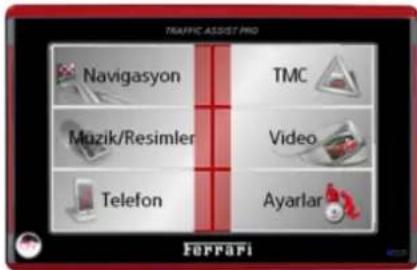
text_image
TRAFFIC ASSIST PRO Navigasyon TMC Muzik/Resimler Video Telefon Ayarlar FerrariNote:
To ensure that the display's surface is not damaged, you may only touch it with your fingers or a blunt, non-smearing object.
Operation
When you touch a button on the touchscreen, the button in question is briefly shown outlined in red to confirm the selection.
If you touch a button that is not active at the moment, a short signal tone sounds.
Calibration
If the touch screen starts responding im-precisely and e.g. buttons have to be touched off-centre in order to be actuated, calibration should be undertaken.
The calibration function is started from the Settings menu (see also page 104).
Basic information about the menus
During operations, you are assisted by various menus and entry windows.
The main menu
The top menu level is the main menu. The individual applications are started from the main menu.
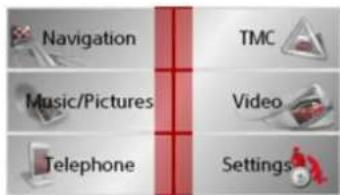
text_image
Navigation Music/Pictures Telephone TMC Video SettingsYou will find information about the individual applications in the corresponding main chapters.
GENERAL OPERATION
Entries made with the entry menu
Some applications require entries to be made via the entry menu. The entry menu is operated in a similar way to a keypad.
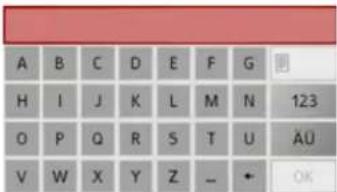
text_image
A B C D E F G H I J K L M N 123 O P Q R S T U AU V W X Y Z - + OKThe character entered on the keypad is displayed in the top line of the entry menu. The central area is used to enter characters. Help functions are provided in the right line. Descriptions of how to operate the menu are provided below.
Entering characters
Characters are entered by pressing the keys in the central area.
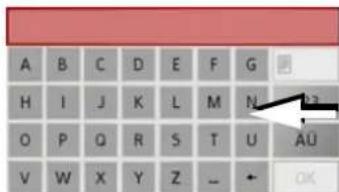
text_image
A B C D E F G H I J K L M N AU O P Q R S T U V W X Y Z _ + OKOnce the entry is complete, the process is concluded by pressing the OK key and the entry passed on to the Traffic Assist Pro for processing.
Adopting suggestions
When a navigation destination is entered, the Traffic Assist Pro compares the entry with the set of data on the memory card. The Traffic Assist Pro then only makes those letters which are possible available for selection and adds a sensible suggestion to the letters already entered.
The suggestion and the non-selectable characters are shown in a lighter font. If the desired input appears in the upper display area after entering the first few letters or numbers, you can immediately accept this suggestion.
Note:
If necessary, you can switch off the smart speller in the navigation settings. It should also be noted that in southern countries (e.g. Italy), the "prefix" (e.g. via Gran Mundo) needs to be entered afterwards (e.g. Gran Mundo_via).

text_image
Bem A B C D E F G H I J K L M N 3 O P O R S T U V W X Y Z _ + OK→ To accept the suggested entry, press the destination or the button OK.

GENERAL OPERATION
→D
→GB
→ F
→1
→ E
→P
→NL
→DK
→5
→ N
→FIN
→TR
→GR
→ PL
→ CZ
→H
→ SK
Scrolling through the lists
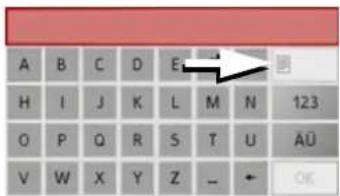
If you have already entered some of the letters of the selection you want, you can use the selection list to display all the destinations containing the combination of letters in question.
text_image
A B C D E H I J K L M N 123 O P Q R S T U AÜ V W X Y Z - ← OK→ To call up the selection list, press the key.
The selection list appears.

bar
| City | Value | |---|---| | Berlin (10117), Berlin | ▲ | | Baabe (18586), Rügen, Mecklenburg-Vorpommern | 1/50 | | Baach (71384), Rems-Murr-Kreis, Baden-Württemberg | ▼ |→ Press the arrow keys on the right hand side of the screen to scroll through the list.
→ Press the destination you want. The destination is adopted and the selection list is closed.
Special characters and umlauts
Special characters and umlauts do not have to used when entering the names of towns and streets. The Traffic Assist Pro will change entries from AE, OE and UE if necessary.
→ If, for example, you are looking for the location "Würzburg", then simply press "WUERZBURG" or "WURZBURG". Special characters can be useful when naming destinations and routes.

text_image
A B C D E F G H I J K L M N 123 O P Q R S AÜ V W X Y Z - + OK→ To change to the special character keypad, press the key. The special character keypad is displayed.

text_image
Ä A A A Ä A A E Ç ABC E E E E I I I I äü Ö Ö Ö Ö Ö Ø Ñ B 123 Ü Ü Ü Ü Y - ← OK→ Enter the special character you want.
As soon as you have entered a special character, the system automatically switches back to the letters keypad.
Entering numbers
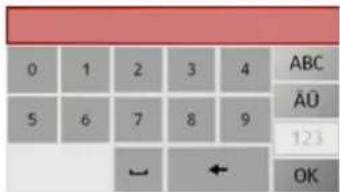
You have to change to the numerical keypad to enter numbers.
→ Press the key.
The numerical keypad is displayed.
text_image
0 1 2 3 4 5 6 7 8 9 ABC AU 123 OK→ To return to entering letters, press ABC.
GENERAL OPERATION
Switching between upper and lower case
During free text entry, it is possible to switch between upper and lower case letters.
→ Press abc .
The display changes to lower case.

text_image
a b c d e ABC h i j k l m n äü o p q r s t u 123 v w x y z - ← OK→ In order to return to upper case, press ABC.
Deleting characters
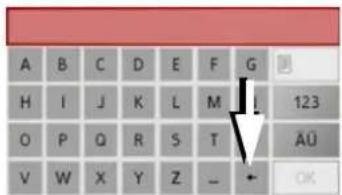
To delete the last character, use the back key.
text_image
A B C D E F G H I J K L M 123 O P Q R S T AU V W X Y Z - OK→ To delete the character to the left of the cursor, press the key.
Inserting spaces
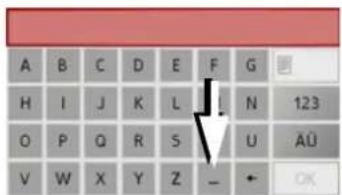
If you have an entry with two words, e.g. for names of towns, the words should be separated by a space.
text_image
A B C D E F G H I J K L N 123 O P Q R S U AÜ V W X Y Z - ← OK→ To enter a space, press the _key.
The On key
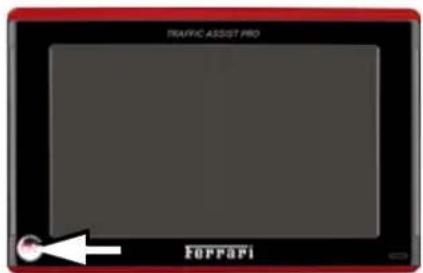
The key is integrated in the bottom left hand corner of the casing.
text_image
TRAFFIC ASSIST PRO SOPPAFiIt has various functions:
- Pressing and holding this button switches the Traffic Assist Pro to standby, or on again.
• depending on the menu context, if pressed briefly, you will be returned to the previous entry level.
Volume control
The volume can be adjusted both via the integrated volume control on the Traffic Assist Pro and in the various applications.
Note:
A description of volume adjustment in the various applications is described in the individual chapters.
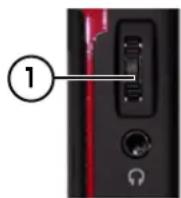
The volume control is located on the right side of the unit Traffic Assist Pro.
→ In order to increase or reduce the volume, press the volume control upwards or downwards.
or
→ Press the volume control in order to mute the Traffic Assist Pro.
More maps
A map set is already installed on the memory card on delivery. In case this does not cover the desired country, an additional map set is available on the accompanying DVD. The countries covered by the individual map sets can be checked using the installer prior to installation.
If you should lose the supplied memory card or if it should become defective, the map set can be installed on another memory card.
Installation program
There is a map installation program on the map DVD. Once the DVD is inserted in a personal computer's DVD drive, this program will usually start up automatically. The program guides you through the installation process.
Otherwise, you will have to start the program manually.
→ Open Windows® Explorer.
→ Select your DVD drive folder.
→ Double click on the "Setup.exe" file.
Transferring files
Files can be transferred indirectly via the memory card or directly via the USB port.
Note:
Only the maps supplied in the Traffic Assist Pro may be used. The installation or transfer of files or programs which limit or modify the function of the Traffic Assist Pro is prohibited!
Transferring using the SD card reader
The simplest and fastest form of transfer is to use a standard SD card reader (does not fall within the scope of supply). The memory card is plugged into this.
The files required are then saved on the memory card using the computer's software.
Transferring using the USB port
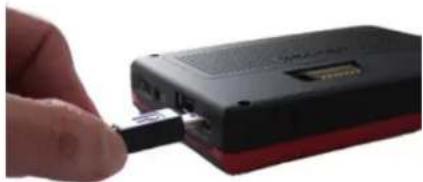
The USB port is used to link the Traffic Assist Pro directly to a personal computer. The Microsoft® Active Sync program must be installed for transmission. Microsoft® Active Sync is contained on the DVD provided.
natural_image
Close-up of a hand inserting a USB into a black and red electronic device (no visible text or symbols)The link then involves several steps:
→ Switch off Traffic Assist Pro.
→ Link the Traffic Assist Pro and computer using the USB cable.
→ Switch on Traffic Assist Pro again (do not press the screen after the unit is switched on).
ActiveSync automatically sets up a link to the Traffic Assist Pro.
Transferring maps
The installation software from the DVD should be used for the transfer. This involves the following stages:
→ switch off Traffic Assist Pro.
→ remove memory card and plug into an SD card reading device or the use the USB cable to connect the Traffic Assist Pro to the computer.
→ boot up the computer and insert the DVD.
→ use the installation program to transfer the map required.
→ slide the memory card back into the Traffic Assist Pro or correctly remove the USB cable.
→ switch the Traffic Assist Pro back on.
The new map is available right away
Transmitting music tracks, pictures and videos
Since the complete set of maps takes up almost all the space on the supplied memory card, you should store pictures, music and videos on a separate memory card or a USB storage medium (not included in the scope of delivery).
The files can be transferred via a card reader or the USB connection.
Note:
Use obvious folder names because these will help you later when you are trying to find the file you want in the Traffic Assist Pro.

GENERAL OPERATION
→D
→ GB
→ F
→ |
→ E
→ P
→ NL
→ DK
→ S
→ N
→ FIN
→ TR
→ GR
→ PL
→ CZ
→ H
→ SK
Faults
Faults in the operating system or in the unit are displayed. If the desired function cannot then be executed, the Traffic Assist Pro should be restarted using the On/Off switch or the reset button.
If the messages reappear or the unit does not function correctly for any other reason, please contact your local stockist.
You can also try to find a solution to your problem in the FAQ in the Support area on the Becker homepage (www.mybecker.com).
Note:
Never attempt to open the unit yourself. Please contact your authorised dealer if you are unable to remedy the fault.
What is navigation?
Navigation (Latin navigare = to travel by sea) is generally understood to mean finding the position of a vehicle, determining the direction of and distance from the desired destination and establishing and following a route to this destination. Navigational aids include the stars, distinct objects, a compass and satellites.
The Traffic Assist Pro uses its GPS receiver to find the vehicle's position. (The Global Positioning System (GPS) was developed by the US military in the 1970's as a missile guidance system.
GPS is based on a total of 24 satellites circling the earth which continuously emit signals. The GPS receiver receives these signals and uses the delay of each of the signals to calculate its distance from the individual satellites. In turn, it can use this information to determine its current geographical position.
The signals of at least three satellites are needed to establish position. If four or more signals are available, height above sea level can also be calculated).
Traffic Assist Pro determines the direction of and distance to the destination with the aid of a digital road atlas on the SD card and the navigation computer.
For safety, directions to the designation are mainly provided verbally. The direction display and map diagram on the touch screen are further aids.
⚠ Safety information
- The road traffic act takes precedence in all circumstances. The navigational system is only an aid. The data/details provided may in some cases be incorrect. The driver must always decide whether to follow the details given or not.
We accept no liability for the navigational system issuing incorrect details. - When first started up, it may take up to 30 minutes before a position can be determined.
• Precedence should always be given to actual traffic signs and local traffic rules.
• The directions only relate to cars. Special recommendations and rules for other vehicles (e.g. commercial vehicles) are not taken into consideration. - Destinations may only be input when the vehicle is stationary.
Selecting navigation
Navigational mode is called up from the main menu.

text_image
Navigation Music/Pictures Telephone TMC Video Settings→ Press the Navigation key in the main menu.
Rapid access is called up.
Aids for navigation
Three aids are provided for navigation and directions: rapid access, navigation menu and map display.
Rapid access
Navigation mode always starts with the fast access for immediate selection of already saved destinations.
Navigation menu
If necessary, the navigation menu can be called up from rapid access, e.g. to enter a new destination not yet provided.
Map display
The map display can also be called up. This doesn't just display the current position but also allows a new destination to be selected.
Rapid access
Rapid access allows you to select from the key functions to quickly start navigation. Rapid access is illustrated below using sample destinations.
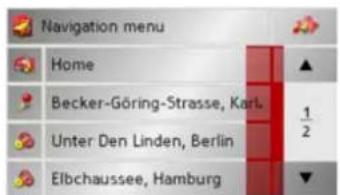
text_image
Navigation menu Home Becker-Göring-Strasse, Karl Unter Den Linden, Berlin Elbchaussee, HamburgStructure of rapid access
Navigation menu and map display
In rapid access, the Navigation menu key for calling up this menu is displayed in the top line on the left.
To the right of this, you will find a key featuring a map symbol. This is used to change over to map viewing mode.
The list of destinations is shown in the lines under this.
The list of destinations
The list of destinations displays all the destinations available for quick selection line-by-line. If you have already entered your home address, you can start route guidance to your home address in the first line. Each line is split into two boxes. Each list box is depicted as a key. The destination is named on the right-hand key and its characteristics shown in the left-hand icon.
Note:
The last 50 destinations are automatically stored in the destinations list. Once the memory's capacity has been fully used up, the oldest destination is automatically deleted whenever a new one is entered. Important destinations can however be protected.
If you select your home address and it has not yet been defined, you will be requested to enter the address.
Icons used
The following icons are used in the list of destinations.
| Icon Meaning | |
 | This destination is a standard destination without any special features. |
 | This destination is protected. Once the destination memory is full, this destination is not automatically deleted. If required, this can be set manually.In the case of a protected entry, you can also determine the position using the fast access function. |
 | This destination is the current home address. |
Operating rapid access
Starting using an existing destination
Destinations already in the destinations memory are listed in the list of destinations.
→ Press the button with the desired destination to start route calculation.
The calculation is started. Once the calculation is complete, the map display appears and directions to the destination begin.
Scrolling in the destinations memory
You can use the keys to scroll through the list display in the direction indicated on the arrow.
The current list page and the total number of its contents appear between the keys.
Displaying or editing destination
Each destination in the destinations memory can be displayed or edited.
→ Press the icon to the left of the destination required.
→ A selection menu appears.

text_image
Show details On map Name this entry Delete this entry Protect this entry| Selection Meaning | |
| Show details | All the data relating to the destination is displayed. |
| On map The map display and toolbar are called up and the destination displayed. | |
| Name this entry | The destination can be renamed. |
| Delete this entry | The destination is deleted from the destination memory. |
| Protect this entry | The destination is protected against automatic deletion. This function is only available in the case of unprotected destinations. |
| Unprotect this entry | Protection of the destination is disabled. This function is only available in the case of protected destinations. |
| Move this entry up | The destination is moved forwards by one position. This function is only available in the case of protected destinations. |
| Move this entry down | The destination is moved back by one position. This function is only available in the case of protected destinations. |
| Delete list All | destinations (including the protected ones) are deleted from the list. The home address is not deleted. |
NAVIGATIONAL MODE
Entries in the selection menu which only appear if a home address has been created:
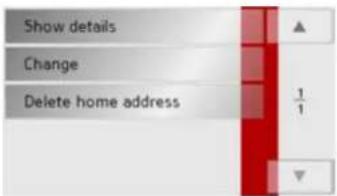
text_image
Show details Change Delete home address| Selection Meaning | |
| Show details | Full home address data is displayed. |
| Set If no address has been entered, selection can be made here. | |
| Change The stored home address can be changed. | |
| Delete home address | The stored home address is deleted. |
Change to map display
You can change to map display from rapid access using the following key.

→ Press the key featuring the map icon. The map display and all its functions appear.
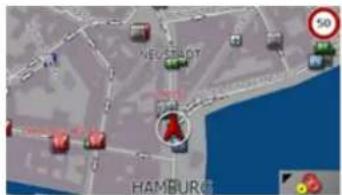
text_image
NEW CHADY 50 HAMBURGDisplaying current position
You can have your current position displayed in the map display.
→ In rapid access, press the key featuring the map icon on the upper edge of the screen.

Calling up Navigation menu
The extended options of the navigation menu are provided by pressing the Navigation menu key.
• See "TheNavigation menu" on page 42.
TheNavigation menu
If you do not want to select a destination quickly or if the planned destination is not yet available in the destinations memory, you can use the navigation menu to determine a new destination.
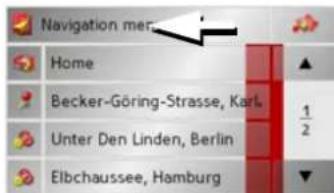
text_image
Navigation mer Home Becker-Göring-Strasse, Karl Unter Den Linden, Berlin Elbchaussee, Hamburg→ In rapid access, press the Navigation menu key at the upper edge of the screen.
The navigation menu appears.

text_image
Address Point of interest Select on map Enter coordinates Route planningStructure of the navigation menu
Address
The various steps from selecting a destination to starting route guidance can be carried out using the Address button.
- See "Navigation menu: Address" on page 43.
Point of interest
Points of interest such as airports and ferry ports, restaurants, hotels, petrol stations or public buildings can be selected and route guidance started via the Point of interest button.
- See "Navigation menu: Point of interest" on page 49.
Select on map
With Select on map, you can select a destination directly on the map and start route guidance.
• See "Navigation menu: Select on map" on page 52.
Enter coordinates
The geographic coordinates for a destination can be entered and route guidance started via the Enter coordinates button.
- See "Navigation menu: Enter coordinates" on page 56.
Route planning
A route with several stopovers can be planned using the Route planning button.
- See "Navigation menu: Route planning" on page 53.
Settings
Various general settings for navigation can be made via the Settings button.
• See "Navigation menu: Settings" on page 57.
NAVIGATIONAL MODE
Navigation menu: Address
A selection window for specifying the destination is opened from the Navigation menu by pressing the Address key.

text_image
Address Point of interest Select on map Enter coordinates Route planning→ In the navigation menu, press the Address button.
The selection window for the address appears.

text_image
Germany Town Postcode Street No. IntersectionSelecting a country
The Country button offers you all the countries available on the memory card for navigation. A country is adopted automatically in the address input menu after selection. If a destination country has already been entered, it appears in the first line and is therefore active.
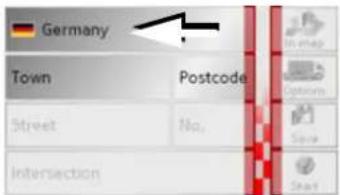
text_image
Germany Town Postcode Street No. Intersection→ Press the destination Country key to access the selection list of countries.
The selection list appears.
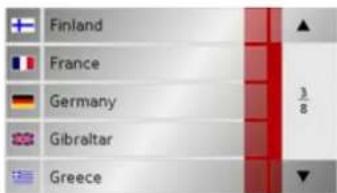
text_image
Finland France Germany Gibraltar Greece→ Press the key of the country you want.
→ If necessary, press the arrow keys on the right-hand edge of the screen to scroll through all the destination countries available.
Note:
Information regarding the various countries is displayed by pressing the flags in front of the country designations.
Select address and start
You can enter the exact destination address in the address entry screen.
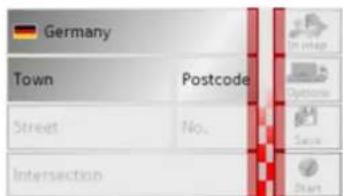
text_image
Germany Town Postcode Street No. IntersectionThe following details can be entered in the address window:
• Town
- Postcode
• Street and building number
- Intersecting roads as an aid to orientation

NAVIGATIONAL MODE
→D
→GB
→F
→1
→ E
→P
→ NL
→DK
→S
→ N
→FIN
→TR
→GR
→ PL
→ CZ
→H
→ SK
You can also:
• display the destination on the map
• define options of the drive profile
• save the destination in the destinations memory
- start directions to the destination immediately.
Selecting the town
The destination town can be entered using its name or postcode. During this process, when each letter is entered a possible town is displayed and/or when each character is entered, a possible postcode is displayed. When the towns are displayed, large towns have priority over the alphabetical sequence. Example: If you enter the initial letter "K", the Traffic Assist Pro indicates "Köln" as a possible city, and not the town which is first alphabetically. Traffic Assist Pro rules out all impossible combinations of letters and postcodes and only activates those boxes of letters and/or characters which will produce an existing town and/or postcode (Smart speller).
→ Select between town entry and post code entry.
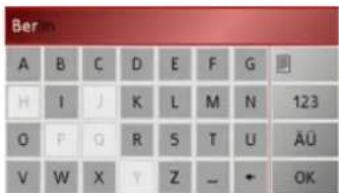
text_image
A B C D E F G H I J K L M N 123 O F O R S T U ÄÜ V W X Y Z _ ← OK→ Consecutively enter the letters for the destination town or the numbers of the post code.
Note:
- If necessary, you can switch off the smart speller in the navigation settings.
- During entry, it should be noted that in southern Europe (e.g. Italy), the "prefix" (e.g. via Gran Mundo) needs to be entered afterwards (e.g. Gran Mundo_via).
- If you enter a post code, the name of the town initially disappears in the input menu. Next, enter the name of the street names. The name of the town is then also displayed.
The OK key
The OK key can be used to transfer the destination selected into the route calculation menu. If the destination required appears in the upper edge of the display once the first letters or numbers have been entered, you can transfer the destination immediately with OK without using the list function.
→ Press the OK key to transfer your destination into the route calculation menu.
Note:
If two words have to be entered, these should be separated by a character.
NAVIGATIONAL MODE
Using the list of towns
If you have already entered some of the letters of the town you want, you can use the list function to display all the towns containing the combination of letters in question.
→ Press the button at the top right corner of the screen in order to open the list of towns.
→ A town is selected by pressing the corresponding button.
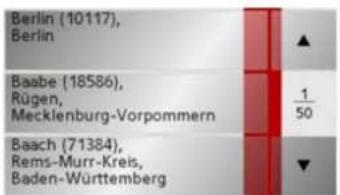
bar
| Location | Value | |---|---| | Berlin (10117), Berlin | ▲ | | Baabe (18586), Rügen, Mecklenburg-Vorpommern | 1/50 | | Baach (71384), Rems-Murr-Kreis, Baden-Württemberg | ▼ |Selecting the street
In the destination street area, the street and building number can be entered separately using a letter and numerical key panel. A possible street is displayed each time a new letter is entered.
Traffic Assist Pro rules out all impossible combinations of letters and only activates those letter boxes which will produce an existing street.
A building number can only be selected once the street has been selected and/or if building numbers are also present in the data.
→ Press the letters of the destination street one another another.
The OK key
The OK key can be used to transfer the destination selected into the route calculation menu. If the destination required appears in the upper edge of the display once the first letters or numbers have been entered, you can transfer the destination immediately with OK without using the list function.
→ Press the OK key to transfer your destination into the route calculation menu.

NAVIGATIONAL MODE
→D
→GB
→ F
→ |
→ E
→ P
→ NL
→ DK
→ S
→ N
→ FIN
→ TR
→ GR
→ PL
→ CZ
→ H
→ SK
Using the list of streets
If you have already entered some of the letters of the street you want, you can use the list function to display all the streets containing the combination of letters in question.
→ Press the button at the top right corner of the screen in order to open the list of streets.
→ The street is selected by pressing the corresponding button.

bar
| Category | Value (%) | |---|---| | Unter Den Birken | ▲ | | Unter Den Eichen | 1/2 | | Unter Den Linden | | | Unter Den Rüstern | | | Unterbaumstrasse | ▼ |Note:
You can display further information regarding the street by pressing the field to the left of the street name. This can be helpful if the street being searched for appears several times in the list.
Selecting the Intersection
After entering the destination town and road, you can enter an intersecting road in order to further limit the choice.
Note:
Instead of entering an intersecting road, you can also enter a house number. Both entries, however, are not possible simultaneously.
→ Press Intersection.
The input menu for the name of the intersecting road appears.
→ Enter the name of the intersecting road and then press OK.
The procedure is the same as for entering a road, See “Selecting the street” on page 45..
When entering an intersecting road, you can also use the road list. See “Using the list of streets” on page 46..
Selecting a house number
After entering the destination town and road, you can enter a house number in order to further limit the choice.
Note:
Instead of entering a house number, you can also enter an intersecting road. Both entries, however, are not possible simultaneously.
→ Press No.
The input menu for the house number appears.
→ Enter the house number and then press OK.
The procedure is essentially the same as for entering a road, See “Selecting the street” on page 45..
→ When entering a house number, you can also use the house number list. The procedure is essentially the same as for the road list. See “Using the list of streets” on page 46..
NAVIGATIONAL MODE
Displaying destination on the map
Once the destination has been entered, you can display it in the map of the surrounding area.
→ Press the In map key to display the destination selected on the map.

text_image
Diagram showing a road intersection with labeled roads, traffic signs, and directional indicatorsOptions for the drive profile
You can also set your driving profile in the address entry field. Press the Options button for this purpose. The settings made here have an effect on calculation of the estimated journey times and the length of the route.

text_image
Standard car Routing type fast Motorways ✓ ✓ ✓ ✓ Ferries ✓ ✓ ✓ ✓ Toll roads ✓ ✓ ✓ ✓→ Select the mode of travel by repeatedly pressing the field at the top left.
→ Select one of the following options by pressing the field on the right next to the Routing type display.
| Setting Meaning | |
| optimum With this option, the optimum route in terms of travel time and mileage is calculated. | |
| fast With this option, the shortest route possible for the time required is calculated. | |
| short With this option, the shortest route is calculated in terms of kilometres travelled. | |
| scenic With this option, the most winding route is calculated. |
With the buttons next to the fields Motorway, Ferries and Toll roads, you can set one of the following options.
| Setting Meaning | |
| Allowed With | this option, the corresponding road type is included in the route calculation. |
| Avoid With this | option, wherever possible, the corresponding road type is avoided. |
| Not permitted | With this option, the corresponding road type is not included in the route calculation. |
→ Press the button to start route guidance to the entered coordinates.
Saving destination
The Save button opens an entry menu for entering a name for the destination entered. If a name has been entered and adopted using OK, the destination is transferred to rapid access and protected there. The entry menu allows you to change between upper and lower case letters.
Starting navigation
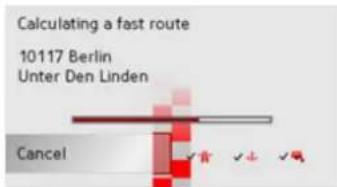
The Start button can be used to start navigation straight away. All the data entered so far is processed in the route calculation. → Press the Start key to start navigation.
text_image
Calculating a fast route 10117 Berlin Unter Den Linden CancelThe route is calculated. The map display then appears and directions to the destination begin.
Note:
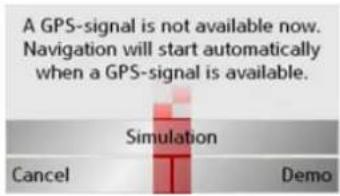
If no GPS signal is available at the time of route calculation, the following display appears.
text_image
A GPS-signal is not available now. Navigation will start automatically when a GPS-signal is available. Simulation Cancel DemoIf the GPS signal is available, route calculation is started automatically. A short route to the selected destination is displayed when Simulation is pressed. A demonstration video is shown by pressing Demo.
NAVIGATIONAL MODE
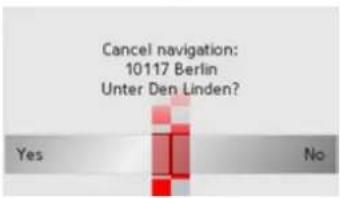
Cancelling navigation
→ Press the key
text_image
Cancel navigation: 10117 Berlin Unter Den Linden? Yes No→ Press the Yes key to confirm that you want to stop.
Navigation menu: Point of interest
Points of interest, or POI for short (Point of Interest), are included in the map and can be displayed on the map. Points of interest include airports and ferry terminals, restaurants, hotels, petrol stations, public buildings etc. Points of interests can be used as navigational destinations.
Note:
Points of interest from the present surroundings can only be selected if the reception is good enough to locate their position.
You can select between:
- a nearby destination,
• a nationwide destination and - a destination in a town.
text_image
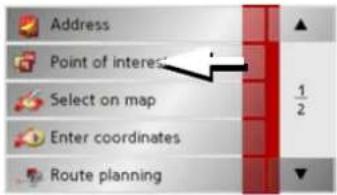
Address Point of interest Select on map Enter coordinates Route planning→Press the Point of interest key to display the points of interest.
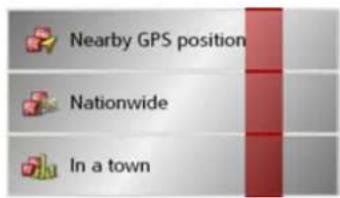
The search area selection window appears.
text_image
Nearby GPS position Nationwide In a townYou can now use the buttons to select the search area you want.
Point of interest: Near GPS position
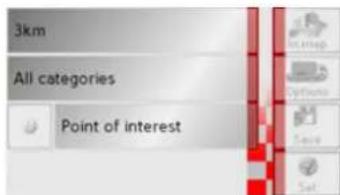
→ Press the Nearby GPS position button.
text_image
3km All categories Point of interestThe following specifications are possible for searches in this point of interest window.
→ In the top button, enter the radius (in kilometres) in which a point of interest should be searched for.
→ From the All categories box, select a main category (e.g. Petrol station). Only those points of interest currently nearby are displayed.
→ Select the subcategory from the subsequent menu (e.g. Aral, Esso).
You will find information about scrolling in lists in the "Scrolling through the lists" on page 32 chapter.
Note:
If you do not select a subcategory, all the POIs from the main category within the selected radius are displayed.
→ Press the Point of interest button to access the input menu.
→ Select the desired POI via the input menu.
For information on working with the input menu, please refer to the section "Entries made with the entry menu" on page 31.
→ For information on scrolling in lists, please refer to the section "Scrolling through the lists" on page 32.
Note:
The Category boxes do not have to be. These are only used to restrict the list of points of interest. In large towns, this list may be very long.
Point of interest: nationwide
→ Touch the Nationwide button.
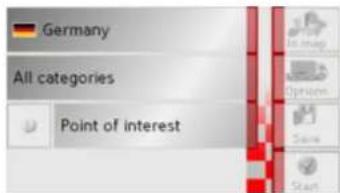
text_image
Germany All categories Point of interest→ Select the desired country.
→ Press the All categories button.

text_image
All categories Petrol Station Parking Restaurant Hotel or Motel→ Select the desired category.
→ Touch the Point of interest key to go to the entry menu.
→ Select the point of interest you want from the entry menu.
NAVIGATIONAL MODE
You will find information about working with the entry menu in the chapter "Entries made with the entry menu" on page 31.
You will find information about scrolling in lists in the "Scrolling through the lists" on page 32 chapter.
Note:
The Category box does not have to be completed. It is only used to restrict the list of points of interest. Depending on the map currently being used, this list may be very extensive.
Point of interest: in a town
→ Touch the In a town button.

text_image
Germany Town Postco. No points of interest Point of interest→ Select the desired country.
→ In the Town or Postcode box enter the town in which you want to search for a point of interest.
→ Press the All categories button.
→ Select a main category (e.g. Culture).
Only the categories available in the town indicated are displayed.
→ Select the subcategory from the subsequent menu (e.g. Museum).
→ Touch the Point of interest key to go to the entry menu.
→ Select the point of interest you want from the entry menu.
You will find information about working with the entry menu in the "Entries made with the entry menu" on page 31 chapter. You will find information about scrolling in lists in the "Scrolling through the lists" on page 32 chapter.
Note:
The Category boxes do not have to be completed. These are only used to restrict the list of points of interest. In large towns, this list may be very long.
Operating options in the POI input menu
Following selection of a POI, the following options are available using the buttons on the right-hand area of the screen:
- Display POIs on the map using the In map button.
- Set the options for the driving profile using the Options button.
- Save the POI in the destination memory using the Save button.
- Start route guidance directly to the POI using the Start button.
You can also display information regarding the selected POI.
→ Press the button for this purpose.
Note:
The button can only be selected if information is actually available.
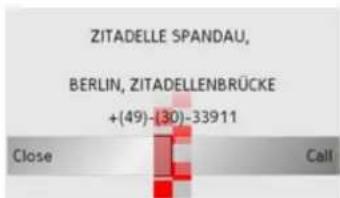
text_image
ZITADELLE SPANDAU, BERLIN, ZITADELLENBRÜCKE +(49)-(30)-33911 Close CallThe available information on the selected POI is displayed (exact address and phone number if available).
The displayed phone number can be called directly by pressing the Call button, provided a telephone is connected via Bluetooth.
Navigation menu: Select on map
If the destination required cannot yet or can no longer be found in the destinations memory, the Select on map button allows you to select it directly.
No address details are asked for in this case.
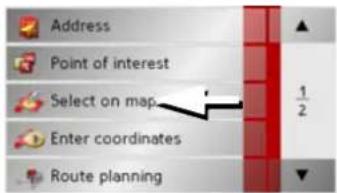
text_image
Address Point of interest Select on map Enter coordinates Route planning→ Press the Select on map key to make a direct selection.
The map display appears.
Note:
You may have to enlarge the area using the zoom buttons and in order to find the desired street. You can also find the desired point by moving the map
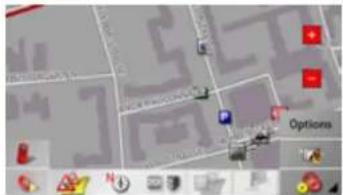
text_image
Options→ Gently press the screen surface until a circle of dots is drawn around the destination requested. The destination is recorded.
Information on the point selected is loaded from the set of data and displayed. There are buttons under the information box which can be used to call up several functions which are provided for the route point selected.

text_image
10117 Berlin An Der Kolonnade Search nearby Add Navigation.SaveNAVIGATIONAL MODE
When route guidance is deactivated, the following buttons are available:
| Button Meaning | |
| Navigation Starts navigation | |
| Add Adds the destination of the stored route last used, See “Navigation menu: Route planning” on page 53.. | |
| Save Allows your destination to be given a name via the entry menu and saves this in the destinations memory | |
| Search nearby | Entry menu as for normal POI entries |
When directions to the destination is active, the Interim destination button is also still available. You can add the selected destination as a stopover for your route guidance from the map.
→ Press a key to undertake the action requested.
Navigation menu: Route planning
The route planning menu allows you to create and select individual routes. For this purpose, enter the individual destination points along the desired route. These points will then be navigated to consecutively without having to make further entries.
→ In Navigation menu, press the Route planning key to access the route menu.
The map symbol appears at the top right of the route menu. The name of the last programmed route is displayed at the top left and the individual stages of this route appear underneath.
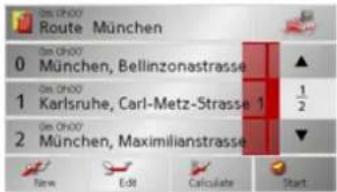
text_image
0 On OhOO München, Bellinzonastrasse ▲ 1 On OhOO Karlsruhe, Carl-Metz-Strasse 1 1/2 2 On OhOO München, Maximilianstrasse ▼ New Edit Calculate StartNote:
The route menu is empty following a reset, or if no route has yet been planned.
Route list
Routes already stored in the system are selected from the route list.
→ Press the button in the route menu. The route list opens.
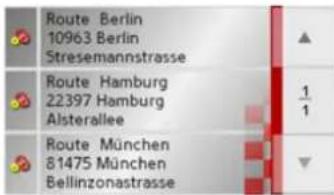
bar
| Category | Value (%) | |---|---| | Route Berlin 10963 Berlin Stresemannstrasse | ▲ | | Route Hamburg 22397 Hamburg Alsterallee | 1/1 | | Route München 81475 München Bellinzonastrasse | ▼ |Scrolling through the list of routes
→ Press the arrow keys on the right hand side of the screen to scroll through the list of routes.
Displaying route details
→ Press button to display the route details.
The Route details window opens. You can also rename or delete the route in this window.
Press the key to return to the route list.

NAVIGATIONAL MODE
→□
→GB
→F
→1
→ E
→P
→NL
→DK
→S
→ N
→FIN
→TR
→GR
→ PL
→ CZ
→H
→ SK
Selecting a route
→ Press a route to select it.
The route is loaded and displayed in the route menu.

text_image
Om OHOO Route München Om OHOO München, Bellinzonastrasse 1 Os OHOO Karlsruhe, Carl-Metz-Strasse 1 1/2 Os OHOO München, Maximilianstrasse New Edit Calculate StartUsing a route
The following buttons are available:
| Key Meaning | |
 | Shows all stages inside actual route in the map. |
 | These keys can be used to scroll up and down through the lists. |
| New Opens the "address window" for entering a new destination address | |
| Edit Activates | individual route points for processing |
| Calculate Calculates the difference in distance and the journey time for the current entries | |
| Start Starts navigation | |
The New button
You can create a new route by pressing the New button.
→ Press New.
An empty route window appears. The Add button appears below this empty window.

text_image
Route Add Delete OK→ Press the Add button.
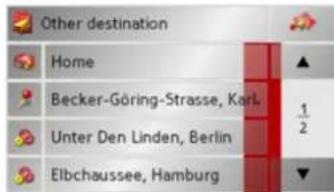
text_image
Other destination Home Becker-Göring-Strasse, Karl Unter Den Linden, Berlin Elbchaussee, Hamburg→ Select a destination from the fast access list displayed.
or
NAVIGATIONAL MODE
→ Switch to the selection between Address, Point of interest or Select on map by pressing the Other destination button and then enter the intermediate destination.
→ Repeat these entries in the route planning window for each intermediate destination by pressing Add.
→ You can move the individual entries by pressing the but tons.
→ Once all the entries have been made in the route planning window, save the destination data by pressing the OK button.
The entry menu appears.
→ Give the destination a meaningful name.
→ Press OK.
Route planning is complete. The Routing options entry window opens.
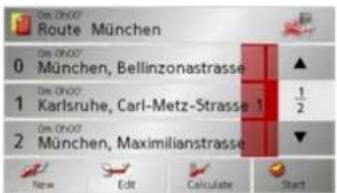
text_image
Om OHOO' Route München Om OHOO' München, Bellinzonastrasse 1 Karlsruhe, Carl-Metz-Strasse 1 Om OHOO' München, Maximilianstrasse Finish Edit Calculate StartThe Edit key
Existing routes can be changed in the Edit menu.
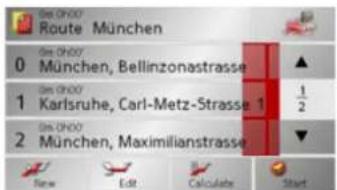
text_image
0 1 2 New Edit Calculate Start→ Press the Edit key to change existing routes.
The route planning window appears. The following functions are available:
| Key Meaning | |
| Add This box | can be used to enter a new route point. |
| Delete This box can be used to delete a high-lighted route point. | |
| OK This box can be used to save the processed route and transfer it to rapid access. | |
| These keys can be used to scroll up and down through the lists. | |
| Individual entries can be moved using these buttons. |
The Calculate key
A planned route can also be calculated without GPS reception so that you can get an overview of the journey.
When doing this, the first route point specified is used as the starting point for the route.
Note:
| During navigation, your current location is the starting point used. The first leg is then the journey to the first route point specified. |
→ Press the button Calculate to have the total distance and probable length of the journey calculated for this route.
The Routing options entry window is opened.
→ Define the settings you want.
→ Press the button.
The route is calculated. A window informs you of the progress of the calculation.
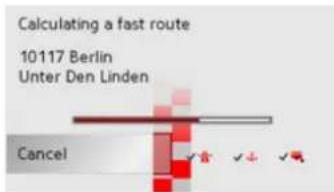
text_image
Calculating a fast route 10117 Berlin Unter Den Linden CancelOnce the calculation is complete, the total distance from the first to the last points on the route and the probable length of the journey for this route are displayed in the Route planning window under the list of route points.

The Start key
→ Press the Start key in the route planning menu.
The route options are displayed again.
→ Press the key again to start navigation.
Note:
If no GPS signal is available, route guidance is started automatically as soon as a signal is received.
Navigation menu: Enter coordinates
You can also enter a destination via geographic coordinates.

text_image
Address Point of interest Select on map Enter coordinat Route planning→ Press Enter coordinates in the navigation menu.
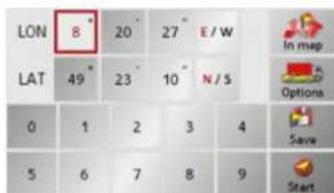
text_image
LON 8 20 27 E/W LAT 49 23 10 N/S 0 1 2 3 4 5 6 7 8 9 In map Options Save Start→ Select the value you wish to change.
→ Then enter the desired values using the 1 to buttons.
→ You can set the direction of the longitude and latitude via LON and LAT using the right-hand buttons in the row.
Note:
The coordinates entered must correspond to WGS84 (World Geodetic System 1984).
→ Press the Start button to start route guidance to the entered coordinates.
NAVIGATIONAL MODE
Navigation menu: Settings
The settings of relevance to the navigation functions can be found in the Settings menu.
Note:
All settings must be confirmed by pressing the OK key. You can exit the current settings button at any time without saving any changes by pressing the key
text_image
Settings 2/2→ Scroll to the menu item Settings in the navigation menu using the button and then press it.
This takes you to the setting menu.
Structure
Various buttons are available in the setting menu:
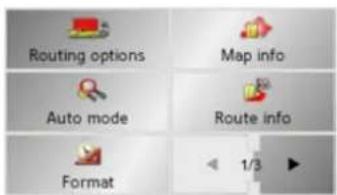
text_image
Routing options Map info Auto mode Route info Format 1/3The functions of the various keys are explained below.
The Routing options key
You can set your drive profile in the Routing options settings window. The settings made here have an effect on the route selection and on the calculation of the estimated journey times.
→ Press Routing options in the settings menu.
The Routing options settings menu appears.
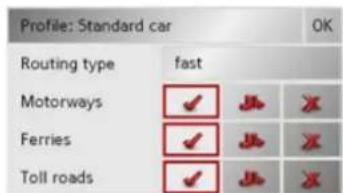
text_image
Profile: Standard car OK Routing type fast Motorways ✓ 🎯 ✗ Ferries ✓ 🎯 ✗ Toll roads ✓ 🎯 ✗→ Select the mode of travel by repeatedly pressing the Profile field.
→ Select one of the following options by pressing the field on the right next to the Routing type display.
| Setting Meaning | |
| optimum With this option, the optimum route in terms of travel time and mileage is calculated. | |
| fast With this option, the shortest route possible for the time required is calculated. | |
| short With this option, the shortest route is calculated in terms of kilometres travelled. | |
| scenic With this option, the most winding route is calculated. |
With the buttons next to the fields Motorway, Ferries and Toll roads, you can set one of the following options.
| Setting Meaning | |
| Allowed With | this option, the corresponding road type is included in the route calculation. |
| Avoid With this | is option, wherever possible, the corresponding road type is avoided. |
| Not permitted | With this option, the corresponding road type is not included in the route calculation. |
→ Confirm your selection by pressing the OK key.
The Auto mode key
You can change the map view settings (2D/3D display, auto zoom and map orientation) in the Auto mode settings window.
→ Press Auto mode in the settings menu.
The Auto mode settings menu appears.
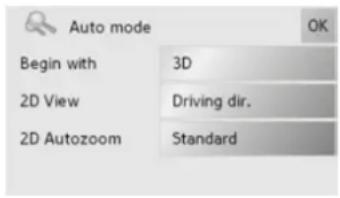
text_image
Auto mode Begin with 3D 2D View Driving dir. 2D Autozoom Standard OKNAVIGATIONAL MODE
| Setting Meaning | |
| Begin with Select whether the standard map view is to be the 3D or the 2D view. | |
| 2D Autozoom | In the case of 2D view navigation, select whether you would like the auto zoom low, normal, high or no auto zoom view as standard.With the Autozoom option, the zoom range varies according to your speed: When you drive slowly, the scale is decreased. When you drive faster, the scale is increased. |
| 2D View In the case of 2D view navigation, select whether the map should be oriented to the north or in the direction of travel as standard. | |
→ Confirm your selection by pressing the OK key.
The Format key
Using the Format configuration window, you can specify which units of measurement to use for time and distance.
→ Press Format in the settings menu.

The Format settings menu appears.

text_image
Format OK Time 12h 24h Distance mls km| Setting Meaning | |
| Time Press this field to toggle between the 12-hour and 24-hour clock display. | |
| Distance Press this field to toggle between the kilometre and mile display. |
→ Confirm your settings by hitting theOK key.
The Map info key
In the Map info settings window, you can make settings for additional information in the map display.
→ Press Map info in the settings menu.

The Map info settings menu appears.
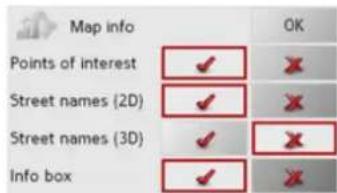
text_image
Map info OK Points of interest ✓ ✗ Street names (2D) ✓ ✗ Street names (3D) ✓ ✗ Info box ✓ ✗| Setting Meaning | |
| Points of interest | If you activate this entry, points of interest are displayed in the map. |
| Street names (2D) | If you activate this entry, all street names are displayed in the 2D map. |
| Street names (3D) | If you activate this entry, all street names are displayed in the 3D map. |
| Info box If you activate this entry,you get displayed thepoint of compass, thespeed and the sea level.(can only be selected ifthe option Full map wassubsequently selected inMap mode.) |
→ With the option buttons, press on either or to enable or disable the requirements.
→ Confirm your selection by pressing the OK key.
The Route info key
In the Route info settings window, you can set which additional information you would like displayed during route guidance.
→ Press Route info in the settings menu.

The Route info settings menu appears.

text_image
Route info Map mode: Full map Info final dest. ✓ Info next dest. ✓ Country Info ✓ OKThe following settings are possible.
Setting Meaning
| Map mode Select the map display option by pressing the button:Full map - the complete map is displayed.Split screen - a split screen appears with map and arrow displayiotic only - only an arrow display appears. | |
| Info final destination | Displays ETA, distance remaining, time until arrival at the main destination. |
| Info next destination | Displays ETA, distance remaining, time until arrival at the part-way destination. |
| Country Info When this function is activated, you automatically receive general traffic information relating to the relevant country when crossing its national border (e.g. speed limits). | |
NAVIGATIONAL MODE
Note:
Depending upon which setting you have selected in Map mode, certain settings in this menu and some of the settings described under "The Map info key" on page 59 can no longer be selected.
→ With the option buttons, press on either or to enable or disable the setting.
→ Confirm your selection by pressing the OK key.
The Speed key
Use the Speed configuration window to choose whether or not you wish to speed limits displayed during navigation. You can also choose whether or not to receive an acoustic warning if you exceed the speed limit.
Note:
This information can only be displayed if it is contained in the map material.
→ Press Speed in the settings menu.

The Speed settings menu appears.
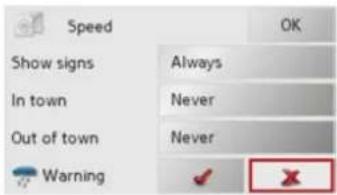
text_image
Speed Show signs In town Out of town Warning Always Never Never ✓ ✗The following settings are possible.
| Setting Meaning have | |
| Show signs | Select whether the speed limits should be displayed never, always or only when the limit is exceeded. |
| In town Select | the amount over the speed limit at which you would like to receive an acoustic warning within built-up areas. |
| Out of town Select | The amount over the speed limit at which you would like to receive an acoustic warning outside built-up areas. |
| Warning Choose | whether you would also like an acoustic warning when you exceed speed limits that are only valid when it is raining, snowing or at specific times of the day (function activated). |
→ Press a button and choose the setting you require.
→ Confirm your selection by pressing the OK key.
⚠️ Danger!
Some of the information contained in the map material may be inaccurate due to short-term or recent changes (such as road works, for example).
Supplying information is secondary to the navigation system's main function, which is traffic monitoring and signposting.
The TMC button
You can make settings for the reception of traffic announcements in the TMC settings window.
→ Press TMC in the settings menu.

The TMC settings window appears.
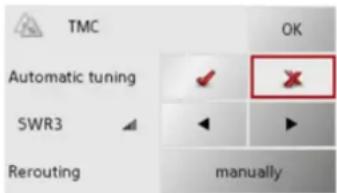
text_image
TMC Automatic tuning SWR3 Rerouting OK ✓ ✗ ← ► manuallySetting Meaning
| Automatic tuning | Select whether to run an automatic search for the station with the best reception (function activated ). |
Setting Meaning
| Press the arrow buttonsto activate the automaticstation search. The currently received TMC station is displayed in theadjacent field. The setting can only be performed if theAutomatic tuningfunction is deactivated. | |
| Rerouting With this button you canselect whether the route changenever, automatically or manuallyshouldbe made. (See "Takingannouncements intoconsideration when calculating routes" onpage 69.) The settingnevercorresponds to deactivating TMC functionality. |
→ Confirm your selection by pressing the OK key.
NAVIGATIONAL MODE
The Time Zone key
Set the relevant time zone for your region in the Time Zone configuration window. This is an important setting for calculating the estimated arrival times.
→ Press Time Zone in the settings menu.

The Time Zone settings menu appears.

text_image
Time zone OK Time zone GMT+01:00 D5T ✓ ✗| Setting Meaning |
| Time zone Specify the relevant timezone for your region. |
| DST Set whether summertime applies ( ) to thecurrent time zone or not( ). |
→ Confirm your settings by pressingOK.
The Smart Speller button
The Smart Speller allows you to enter towns, roads or other destinations that you are searching for more quickly using a logical process of elimination.
→ Press Smart Speller in the settings menu.

The Smart Speller settings menu appears.
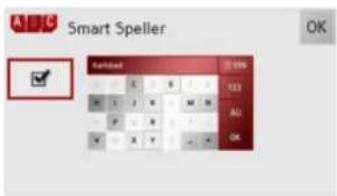
text_image
Smart Speller OK→ Press on the button in order to activate or deactivate the function.
→ Confirm your entry by pressingOK.
The Junction Info button
In the Junction Info settings window you can activate or deactivate the available aids for complex turning manoeuvres, for example at motorway junctions or certain multi-lane roads.
→ Press Junction Info in the settings menu.

The Junction Info settings window appears.

text_image
Junction Info Reality View ✓ ✗ Signpost info ✓ ✗ Lane Info ✓ ✗| Setting Description | |
| Reality View | When the function is activated, realistic images of the current lane situation at motorway junctions are displayed if available. |
| Signpost info | When this function is enabled, you receive information regarding road signs which you should follow. |
| Lane Info When this function is activated, a small arrow indicates which lane you should move into on multi-lane roads. | |
Note:
The information can only be displayed if it is included in the map data.
→ Press on the desired entry in order to activate or deactivate the corresponding function.
→ Confirm your selection by pressing the OK button.
The Home address button
In the Home address window, you can enter and change your home address, as well as displaying the address details.
→ Press Home address in the settings menu.

You see your home address, provided you have already entered it.
To enter your home address:
→ Press Set.
The fast access menu appears.

text_image
Other destination Home Becker-Göring-Strasse, Karl Unter Den Linden, Berlin Elbchaussee, Hamburg→ Press on a destination in the list in order to enter it as the home address.
or
→ Press on the Other destination button in order to access the navigation menu.
In the navigation menu, you can enter your home address in a different manner (e.g. by entering the address details). See "Structure of the navigation menu" on page 42.
Changing an already entered home address:
→ Press Change.
The fast access function appears, further operation is the same as for entering the home address (see above).
NAVIGATIONAL MODE
The Volume key
With the Volume settings window, you can set the general volume for voice announcements for each start of the Traffic Assist Pro, or switch off voice announcements completely. Depending on the situation, you can also adjust the volume in the map display.
→ Press Volume in the settings menu.

The Volume settings window appears.

text_image
Volume - 60 % + OK→ The required volume can be selected via
the - and
→ Confirm your settings by hitting the OK key.
Note:
The volume can also be changed using the volume control located on the side. See "Volume control" on page 34..
The GPS button
The number of satellites received, your current position and your current speed are displayed in the GPS information window. It is also possible to save your current location.
→ Press GPS in the settings menu.

The GPS information window appears.

text_image
GPS status GMT: 00:05:32 SAT: 8 LON: 10°05'42" HDOP: 1.1 LAT: 53°40'48" Speed: 36 km/h Current position Lemsahler Landstrasse Hamburg Germany Save current position→ To save your current location, press the Save current position button.
.Save your location in the same way as described under "Saving destination" on page 48.
The button Load map
The Traffic Assist Pro operates using the map data stored on the memory card. Pressing the Load map button displays the loaded map data.
→ Press Load map in the settings menu.

The Load map settings menu appears.
text_image
Northern-Europe_V41 \Storage Card→ Select the desired map by pressing the relevant button.

NAVIGATIONAL MODE
→□
→GB
→F
→1
→E
→P
→NL
→DK
→ S
→ N
→FIN
→TR
→GR
→ PL
→ CZ
→H
→ SK
The Offroad button
In the Offroad settings window, you can set whether the Traffic Assist Pro starts route guidance if:
- You are in a non-digitised area (offroad).
- Your destination is in a non-digitised area.
With activated offroad function, the Traffic Assist Pro displays the direction of the nearest digitised road, or the direction from the digitised road nearest to the destination, to the destination in the non-digitised area. See "Offroad navigation" on page 70.
→ Press Offroad in the settings menu.

The Offroad settings window appears.

text_image
Offroad Offroad routing OK→ Press either or in order to activate or deactivate the offroad function.
→ Confirm your selection by pressing the OK button.
What is dynamic route guidance?
Dynamic route guidance calculates the route, while taking into account current traffic announcements.
Note:
Dynamic route guidance is not available for all countries (currently only Belgium, Germany, Denmark, France, Italy, The Netherlands, Austria, Sweden, Switzerland and Spain).
In Germany, messages are also received via TMCpro.
TMC reception must be available in order to activate dynamic navigation and the functions described below.
Traffic announcements are transmitted by radio stations via the TMC (Traffic Message Channel) in addition to the radio programme and are received and analysed by the navigation system. Receiving traffic announcements is free of charge.
Note:
As the traffic announcements are transmitted by radio stations, we cannot assume responsibility for the completeness or accuracy of the announcements.
Austria: The location and event code was made available by ASFINAG and BM-VIT.
A continuous check is made for the presence of relevant messages for the selected route. However, traffic problems are also shown on the map even if route guidance is deactivated.

If these continuous checks determine that a traffic announcement is relevant to route guidance, the unit will automatically re-calculate a new route to the destination (See "The button Load map" on page 65.).
Displaying TMC messages on the map
Current TMC messages are displayed on the map graphically. Sections of the route where there are traffic problems are highlighted blue. Arrows indicating the traffic direction which is affected by the traffic problem continue to be displayed.
In addition to the coloured mark, a warning sign is displayed on the stretch of road affected.

Once you have connected the TMC antenna, your Traffic Assist Pro will receive current traffic announcements and dynamic route calculation will be enabled (traffic jam diversion). You can also view traffic announcements directly.
To preset the TMC, See "The button Load map" on page 65.
→ In the map display, activate the (see also page 74) toolbar and press or
→ In the main menu, press TMC (see also page 30).
Note:
The button only becomes visible once you have switched to navigation mode and then called up the main menu again. After switching the Traffic Assist Pro off and on again via the On/Off switch, the TMC button is only visible following the procedure described above.
After pressing one of the two buttons, the message list appears.

text_image
1 x A1 Oldenburg In Holstein > Saarbrücken 1 x A3 Köln > Oberhausen 1 x A3 Frankfurt > KölnYou can scroll through the list using the arrow keys on the right-hand edge of the screen.
The road number (motorway, A-road or district roads), section of road if applicable, traffic direction and the type of problem are displayed in each traffic message.#
Note:
When displaying messages, TMCpro messages are indicated by the following symbol: TMC.
Reading a message
→ Press on the desired message in the list. The message display appears.

text_image
A3 Germany Linz > Elten Würzburg/Randersacker > Würzburg-Heidingsfeld stationary trafficIf the message text is longer than the display space available, the _button appears at the bottom right.
→ Press this button in order to view the remaining message text.
→ Press the arrow buttons scroll in the messages.
→ Press the key 🔒 to return to the message list.
Display the relevant road in the map
→ Press the button in the message display.
The relevant road can be seen in the map.
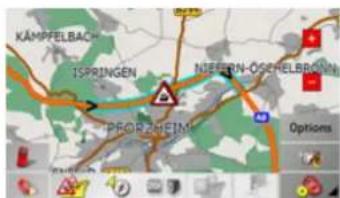
text_image
KÄMPFELBACH TISPRINGEN NEFERN-ÖSCHELBROWN PBRZHEIN OptionsUpdating announcements
→ Press the button in the message display.
NAVIGATIONAL MODE
Taking announcements into consideration when calculating routes
Your Traffic Assist Pro can take traffic announcements into consideration when calculating a route. You have the option of setting this function to automatic or manual under "The button Load map" on page 65.
Automatic recalculation
If a traffic announcement affects your route, a new route is calculated to bypass the problem at the earliest possible convenience.
text_image
The route is being recalculated due to traffic information update. A9 A9, Nürnberg -> München, Hilpoltstein -> Greding: stationary traffic for 1 mile, drivers slowing to lose at accident(s)Manual recalculation
If a traffic announcement affects your route, a window with detailed information on the traffic announcement appears.
text_image
TMC message concerns itinerary A9 A9, Nürnberg -> München, Hilpoltstein -> Greding: stationary traffic for 1 mile, drivers slowing to look at accident(s) Evade IgnoreIf you wish to calculate a detour around the traffic problem, press Evade or alternatively Ignore.
text_image
The route is being recalculated due to traffic information update. A9 A9, Nürnberg -> München, Hilpoltstein -> Greding: stationary traffic for 1 mile, drivers slowing to look at accident(s)Changing status
You can set the function to act upon or ignore an announcement at any time.
→ Activate the toolbar in the map display (see also page 74).
→ Press the △ button.
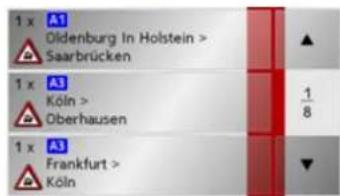
text_image
1 x A3 Oldenburg In Holstein > Saarbrücken 1 x A3 Köln > Oberhausen 1 x A3 Frankfurt > KölnThe message list appears. Messages which are relevant for your route are listed at the beginning.
→ Press the relevant traffic announcement.
→ Press the button at the bottom of the screen to switch between is being evaded and is being ignored.

text_image
A8 Germany Karlsruhe > Stuttgart Pforzheim-West > Heimsheim roadworks, queuing traffic around a bend in the road, Length: 2 mile(s) is being evadedOffroad navigation
Note on legal situation:
Observe the applicable regulations in the country in which you are currently driving.
Driving a vehicle off official roads is not permissible in all countries.
Depending upon which setting has been made under "The Offroad button" on page 66, you can start route guidance if you are currently in a non-digitised area or if your destination is located in a non-digitised area.
If the offroad function is activated, the Traffic Assist Pro guides you:
• to the nearest digitised road or
• from the digitised road nearest to the destination, to the destination in the non-digitised area.
Destination in the offroad area
You can select a destination in a non-digitised area (offroad) via coordinate entry ("Navigation menu: Enter coordinates" on page 56) or via direct selection on the map ("Navigation menu: Select on map" on page 52).
After you have entered the destination and started route guidance, the Traffic Assist Pro guides you directly to the digitised road nearest to the offroad destination.
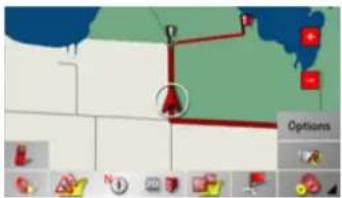
text_image
Map interface screenshot showing a map with location marker and navigation icons, labeled 'Options' in the corner.When you have reached the calculated point on the digitised road (grey destination flag), the Traffic Assist Pro indicates the direction to the offroad destination via a direction arrow.
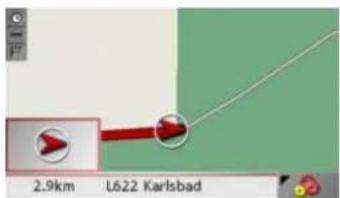
text_image
2.9km L622 KarlsbadStarting point in the offroad area
If you start route guidance in a non-digitised area, the Traffic Assist Pro displays the direction of the nearest digitised road.
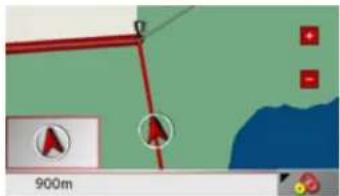
text_image
900mThe point at which you reach the digitised road is indicated by a grey destination flag. When you have reached the digitised road, route guidance continues with standard instructions.
Map display
You can call the map display from various applications using the miniature map icon.

text_image
Navigation menu Home Becker-Göring-Strasse, Karl Unter Den Linden, Berlin Elbchaussee, Hamburg→ Select the key with the map icon. This opens the map display.
Map layout
The configuration depends upon the current operating mode of the Traffic Assist Pro and the setting of Map mode under "The Route info key" on page 60.
Map display without driving guidance

text_image
VEGETT SARAT HAMBURIf the navigation function has not been activated, the map display will cover virtually all of the touchscreen. An icon for switching to configuration mode with a toolbar is always displayed in the lower right-hand corner of the map.
Entire map with route guidance

text_image
0:02 h 2.1 km 21 22 in 80m B2 Unter Pen Linden 36 km 4 203m 5 6 7 8 9 11 Road to which the next driving manoeuvre leads
2 Vehicle speed and altitude above sea level
3 Route
4 Vehicle location
5 Speed limit on the road currently being driven on (display not available for all roads)
6 Traffic lane recommendation (only appears on some multi-lane roads; red arrows = recommended lanes)
Note:
Following the traffic lane recommendations allows you to perform the next driving manoeuvre without changing lanes.
7 Estimated time of arrival, remaining journey time and remaining distance to destination
8 Distance to next driving manoeuvre and currently travelled road.
9 Next driving manoeuvre
If the navigation function has been activated, the position icon will indicate your current location on the map.

The information box at the right edge of the display shows your current speed and the altitude in metres. The information box display can be activated/deactivated in the settings as described under "The Map info key" on page 59.
Information appears in the bottom left corner of the preview area.

natural_image
Simple red arrow pointing right on a light gray background (no text or symbols)The distance remaining is indicated by means of the number of kilometres (or miles) below an arrow. If there are two impending driving manoeuvres in quick succession, a small arrow appears over the first manoeuvre to indicate that another one is coming up.
Depending upon the setting, additional information may be shown in the map display. See "Additional information" on page 75.

text_image
0:14 h 7,2 km 12:11 36 km/h A 203m in 20m Millierntorplatz ① ② ③ ④ ⑤ ⑥ ⑦ ⑧ ⑨1 Speed limit on the road currently being driven on (display not available for all roads)
2 Route
3 Vehicle position
4 Road to which the next driving manoeuvre leads
5 Distance to next driving manoeuvre
6 Traffic lane recommendation (only appears on some multi-lane roads; red arrows = recommended lanes)
NAVIGATIONAL MODE
7 Vehicle speed and altitude above sea level
Note:
If two driving manoeuvres are to be performed in succession within a short time, a small arrow which indicates the second driving manoeuvre appears instead of this information.
8 Next driving manoeuvre
9 Progress bar to illustrate the distance to the next driving manoeuvre
10 Estimated time of arrival, remaining journey time and remaining distance to destination
Route guidance with arrow display

text_image
0:14 h 7,2 km 12:36 ⑧ ① ② ⑥ 90m ⑤ Millennorplatz ③ ⑦ A 2 13m1 Speed limit on the road currently being driven on (display not available for all roads)
2 Next driving manoeuvre
3 Traffic lane recommendation (only appears on some multi-lane roads; red arrows = recommended lanes)
Note:
Following the traffic lane recommendations allows you to perform the next driving manoeuvre without changing lanes.
4 Road to which the next driving manoeuvre leads
5 Distance to next driving manoeuvre
6 Progress bar to illustrate the distance to the next driving manoeuvre
7 Vehicle speed and altitude above sea level
8 Estimated time of arrival, remaining journey time and remaining distance to destination
Map display with reality view
At many motorway junctions, a detailed and realistic display of the motorway junction can be shown.
For this purpose, activate the function Reality View in the settings under "The Junction Info button" on page 63.
If you are guided via a motorway junction by Traffic Assist Pro, the appropriate display is shown.
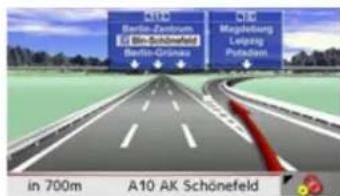
Then follow the lanes marked by the red arrows.

NAVIGATIONAL MODE
→D
→GB
→F
→1
→E
→P
→ NL
→DK
→S
→ N
→FIN
→TR
→GR
→ PL
→ CZ
→H
→ SK
Map display with toolbar
Press the following key to activate the toolbar. Press again to deactivate the toolbar.

The following function keys are displayed in addition to the map display.

text_image
Screenshot of a map interface with location markers and navigation controlsThe following function keys appear in the toolbar:
| Icon Meaning | |
 | See "Display route (toolbar)" on page 78. |
 | See "Displaying TMC messages (toolbar)" on page 78. |
 | See "Daytime - Night-time design (toolbar)" on page 79. |
 | See "Change display (toolbar)" on page 79. |
 | See "Point northwards (toolbar)" on page 79. |
 | See "Available POIs along the route (toolbar)" on page 79. |
 | See "Play" on page 94. |
 | Call up the telephone function. See "Calling up telephone mode" on page 82. |
Using the map display
Repeat the last voice prompt
During route guidance, the system announces important information, e.g. the next driving manoeuvre. The last announcement can be repeated with updated information.

natural_image
Simple red arrow pointing right on a light gray background (no text or symbols)→ Press the preview area while route guidance is active and the toolbar deactivated.
The last announcement is repeated with updated information. The volume is also displayed.
Changing the announcement volume
The volume of announcements can be adjusted.

natural_image
Simple red arrow pointing right with a white horizontal bar on the left (no text or symbols)NAVIGATIONAL MODE
→ Press the preview area while route guidance is active and the toolbar deactivated.

text_image
0:30 h 25 km 20:57 in 300m Carl-Metz-Strasse 0 km/h +111mThe bar display indicates the volume.
→ Press or to increase or decrease the volume.
→ P r e s s in order announcements.
→ Press * again in order to cancel the mute function.
Warning
Always adjust the volume so that you can still hear any ambient noise while driving.
The bar display disappears again automatically after three seconds if no button is pressed.
Note:
The volume can also be changed using the volume control located on the side. See "Volume control" on page 34..
Additional information
At the left edge of the screen, information (estimated time of arrival, remaining journey time and remaining distance to destination/stopover) regarding the main destination and the stopover can be displayed/hidden. The left display window shows the hidden information.


Note:
Additional information can only be switched on/off, if the option Full map was selected in Map mode under "The Route info key" on page 60.
Position information
If you require information regarding a certain point on the map display, the information window can be opened. This displays information on the selected point (if any is stored in the map data) and provides various functions for further action.
→ Move or zoom the map until you see the desired point.
→ Press and hold on the desired point until the information window appears.
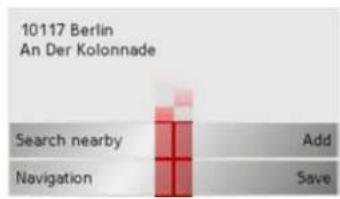
text_image
10117 Berlin An Der Kolonnade Search nearby Add Navigation SaveMake the necessary selection as necessary, See "Navigation menu: Select on map" on page 52.
Calling up the options menu (toolbar)
The Options menu offers a range of useful functions.
→ Press the Options button.
The Options menu is displayed. To close this menu again, use the key or press on the map icon.

text_image
Navi menu Interim destination Next destination Route options Block road
text_image
Navi menu Settings Route description GPS status Country InfoThe following options are available.
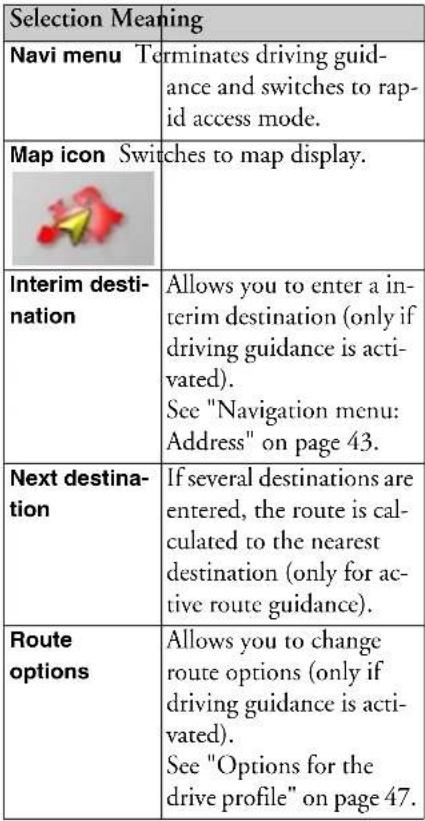 |
| Selection Meaning | |
| Block road | The driving directions planned by the Traffic Assist Pro may be hindered by unanticipated road blocks.This function notifies the system of the length of a road block. Existing road block lengths may be selected. Once the length has been entered, the route is replanned and new directions given (only if driving guidance is activated). |
| Preferences | See "Navigation menu: Settings" on page 57. |
| Route description | You can have directions displayed and block individual route sections. See "Displaying/editing directions" on page 77. |
NAVIGATIONAL MODE
| GPS status | The number of satellites received, your current position and current speed can be displayed using this function. It is also possible to store your current position. |
| Country info | Country-specific information, such as the maximum permissible speed, is displayed. |
Displaying/editing directions
In the directions, you can have the calculated route displayed divided into sections. You also have the option of blocking individual sections and of recalculating the route without these sections.
→ Open the options menu via the toolbar.
→ Select the menu item Route description.
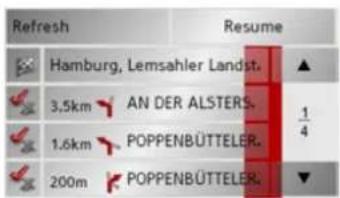
text_image
Refresh Hamburg, Lemsahler Landst. 3,5km AN DER ALSTERS. 1,6km POPPENBÜTTELER. 200m POPPENBÜTTELER. Resume ▲ 1/4 ▼→ Press the arrow buttons scroll through the sections.
You can undo the changes by pressing the Refresh button.
You can return to route guidance without changes by pressing the Resume button.
Blocking a route section
In order to block route sections, press the button before the relevant section.
A blocked section is marked using the button. The block can be cancelled by pressing this button.
→ After you have blocked the desired section, press the Recalculate button.
The route is recalculated and the route guidance display appears.

NAVIGATIONAL MODE
→D
→GB
→F
→1
→ E
→P
→ NL
→DK
→S
→ N
→FIN
→TR
→GR
→ PL
→ CZ
→H
→ SK
Zooming and the map (toolbar)
The map can be zoomed into in steps via the zoom buttons.


→ Press Zoom in +to expand or "zoom in on the map" and view individual features more closely.
→ Press Zoom out to "zoom out from the map" and get a broader overview of the area.
Display route (toolbar)
With this map, the map is automatically zoomed out so that the entire route is displayed. The Display route function is only activated when a route has been selected for driving guidance.

→ Press the Route key.
The map is expanded and the specific route destinations are displayed.
Displaying TMC messages (toolbar)
Press this button to display all TMC traffic announcements received from the station you are currently tuned in to.
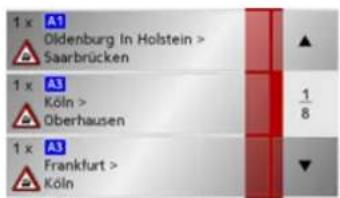
text_image
1 x A1 Oldenburg In Holstein > Saarbrücken 1 x A3 Köln > Oberhausen 1 x A3 Frankfurt > KölnYou have the option of obtaining an overview of the current traffic situation and calculating an alternative route or deleting a previously calculated detour, as required (See “Taking announcements into consideration when calculating routes” on page 69.).

→ Press the TMC announcement button.
A list of TMC announcements opens.
→ Press the arrow buttons on the right of the screen to browse through the list.
NAVIGATIONAL MODE
Daytime - Night-time design (toolbar)
You can choose between daytime or night-time design to adapt the touchscreen to the current light conditions. If you select the night-time design, the key is displayed as activated (depressed).
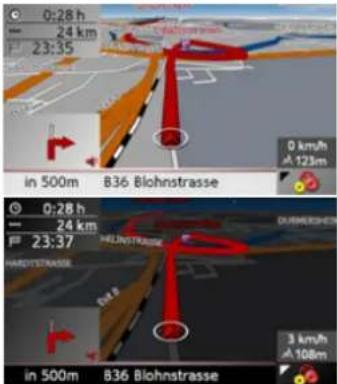
The display is adjusted using the daytime/night-time key.

→ Press the daytime/night-time key. The design is changed. Press the key again to return to the previous design.
Change display (toolbar)
For the map display, 2-D view ☐ 3-D view ☑ are available.

text_image
0:02 h 2:1 km 21:22 50 36 km/h 4.203m in 80m B2 Unter Den Linden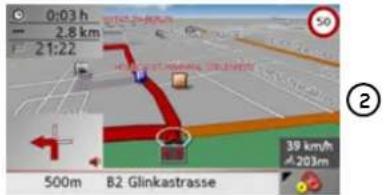
text_image
0:03 h 2.8 km 21:22 50 49 km/h 39 km/h 420m ② 500m 82 GlinkastrasseChange the display using the 3D key.

→ Press the 3D key. The display is changed. Press the key again to return to the previous display.
Point northwards (toolbar)
Use the compass key to orient the map on the touchscreen towards the north.

→ Press the compass key.
The map is pointed north on the touchscreen.
Available POIs along the route (toolbar)
With the POI button, you can display available POIs along the route and set a POI as a stopover.
→ Press the POI button.
A display of the POIs available along the route appears.
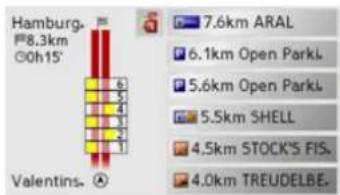
text_image
Hamburg. 8.3km Ø0h15' Valentins. 7.6km ARAL 6.1km Open ParkL 5.6km Open ParkL 5.5km SHELL 4.5km STOCK'S FIS. 4.0km TREUDELBE.A maximum of six POIs are displayed simultaneously. The categories can be recognised by the category icons to the left of the distance information. The distance information represents the direct distance to the POIs.
The stylised road on the left indicates on which side of the road the POIs are located. The numbering of the POIs refers to the position of the POIs in the list on the right (POI No. 1 appears at the very bottom of the list).
To select a POI as a stopover:
→ Press the desired POI.
It is set as the stopover and the Traffic Assist Pro starts route calculation to the stopover.
To set a POI category:
You can set which categories the Traffic Assist Pro should take into account when displaying the POIs.
→ Press the button.
The current settings are displayed.
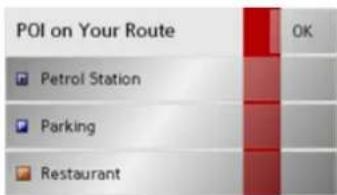
text_image
POI on Your Route Petrol Station Parking Restaurant→ Press one of the categories set, e.g. Petrol station.
The complete category list appears.
→ If necessary, scroll in the list and press one of the categories which you would like to set as a new category, e.g. Railway station.
The current setting is displayed again, the Petrol Station category has now been replaced by the Railway station category.

text_image
POI on Your Route Railway station Parking Restaurant OK→ Proceed in the same manner for the other two categories as necessary.
→ Finally, press OK.
An updated display appears of the POIs available along the route, which takes into account the change in categories.
NAVIGATIONAL MODE

Move map (toolbar)
In move mode, you can shift the map in any direction required. You can do this by "pinning down" the map at any point and then shifting it. With the toolbar activated, press any point on the map and move it in the required direction.
The map is then moved accordingly after a short delay.
Note:
If you wait too long before moving the point, the position information regarding the selected point appears on the map, See “Playback of MP3 files during an active navigation” on page 81.
Playback of MP3 files during an active navigation
Previously recorded MP3 files can be played back while an active navigation is in progress.
→ Press
The MP3 player opens.
You can now play back your music files (refer to "Playback" on page 60).
Calling up the telephone function (toolbar)
It is possible to call up the telephone function while navigation is underway, for example to make a call.
→ Press the button.
The telephone menu opens.
You can now use the telephone function as described under "Telephone mode" on page 82.
→ D
→GB
→ F
→ |
→ E
→ P
→ NL
→ DK
→ S
→ N
→FIN
→ TR
→ GR
→ PL
→ CZ
→ H
→ SK
You can connect your Traffic Assist Pro to a mobile phone equipped with Bluetooth® wireless technology.
The Traffic Assist Pro then serves as a convenient hands-free device.
Notes:
- It is possible that some of the functions described are not available with some mobile phones equipped with Bluetooth® wireless technology.
- If no mobile phone us connected to the Traffic Assist Pro, unusable menu items and entries are displayed as inactive (greyed out).
Calling up telephone mode
Telephone mode can be called up from the main menu or the toolbar on the map display ②

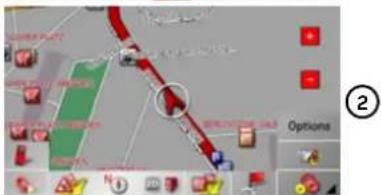
text_image
Map interface screenshot showing a red route with location markers and icons, labeled 'Options' in the corner.→ Press the Telephone button in the main menu to call up telephone mode.
or
→ Press the button in the toolbar on the map display.
The telephone fast access function is called up.
Telephone fast access mode
In fast access mode the last 50 numbers or names which have been dialled, answered or rejected will be displayed in chronological order. Fast access mode is shown below with example telephone numbers and names.

text_image
Phone menu T-mobile 01711234567 0724145678 THOMAS 072414557788Configuration of fast access mode
In fast access mode, the Phone menu button for opening the telephone menu is displayed in the top line. In addition, provided that a telephone has already been connected, the name of the network operator and the strength of the received signal is displayed in the first line. You can call up the navigation function using the button.
The number list is shown in the line below.
Number list
The number list displays, line by line, all numbers/names available for fast dialling. Each line of the number list is divided into two fields. Each list field is in the form of a button. The number/name is shown on the right button and the characteristics of the entry are shown using the left icon.
Notes:
- The last 50 numbers/names are automatically stored in the number list. If the storage capacity of 50 numbers is reached, the oldest number is automatically deleted to make room for a new number. However, important numbers can be protected.
- Entries in fast access mode always only apply to the time during which the mobile phone with Bluetooth® wireless technology was connected to the Traffic Assist Pro. The entries in the fast access mode of the Traffic Assist Pro are not synchronised with the call lists in the mobile phone.
Icons used
The following icons are used in the number list:
Icon Description
| This entry is a standard entry with no special features. | |
| This entry is protected. If the number list is full, this entry is not automatically deleted.This can be performed manually, if required.In the case of a protected entry, you can also determine the position using the fast access function. |
Operating in fast access mode
Dialling an existing number
The numbers/names in the number list can be dialled directly.
Note:
If no telephone has been previously connected, no entry can be dialled.
→ Press the button with the desired entry in order to start the call.
The call will be started.
Scrolling through the number list
Using the buttons, it is possible to scroll through the number list in the direction of the relevant arrow.
The current list page and the total number of pages appear between the buttons.

TELEPHONE MODE
→D
→GB
→F
→1
→E
→P
→ NL
→DK
→5
→ N
→FIN
→TR
→GR
→ PL
→ CZ
→H
→ SK
Displaying or editing entries
Each number stored in fast access mode can be displayed and edited.
→ Press the button field to the left of the desired number.
A selection menu appears.
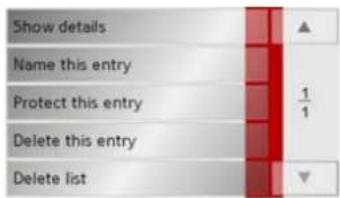
text_image
Show details Name this entry Protect this entry Delete this entry Delete list| Option Description | |
| Show details | The data for the entry is displayed (number and name, call time and call date, if available). |
| Name this entry | The entry can be re-named. |
| Delete this entry | The entry is deleted from the number list. |
| Protect this entry | The entry is protected against automatic deletion (only available on unprotected devices). |
| Option Description | |
| Unprotect this entry | Entry protection is disabled (only available on protected devices). |
| Move this entry up | The entry is moved forward by one position (only available on protected devices). |
| Move this entry down | The entry is moved back by one position (only available on protected devices). |
| Delete list All | destinations (including the protected ones) are deleted from the list. |
Telephone menu
In the telephone menu, you can dial a number directly, open the telephone book, connect your Traffic Assist Pro to a mobile telephone and perform settings for Bluetooth® operation.

text_image
Phone menu 01711234567 0724145678 THOMAS 072414557788→ In fast access mode, press the Phone menu button at the top edge of the screen.
The telephone menu appears.

text_image
Dial number Phone book Connect phone Disconnect phone PreferencesTELEPHONE MODE
Dialling a number
You can enter a telephone number and start a call to this number or store the entered number under any name.
→ In the telephone menu, press the Dial number button.
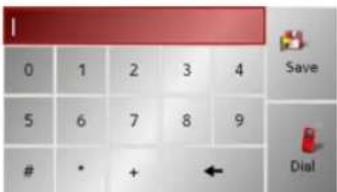
text_image
I 0 1 2 3 4 5 6 7 8 9 # + ← Save Dial→ Enter the desired telephone number using the displayed buttons.
→ Press the Dial button.
The Traffic Assist Pro tries to establish a connection to the desired telephone number. Detailed instructions for operation can be found under "Telephone calls" on page 91.
By pressing the Save button, the entered number can be stored under any name.
Telephone book
The phonebook entries loaded from the SIMcard and from the memory of the mobile phone are displayed in the phonebook. After selecting the desired entry, the corresponding telephone number can be called.
Notes:
- Please note that it can take several minutes to transfer the phonebook.
• The entries loaded from the memory of the mobile phone are displayed surname first in the phonebook. No separation of first name and surname is possible with entries loaded from the SIM card.
→ In the telephone menu, press the Phone book button.
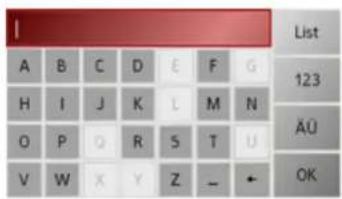
text_image
I A B C D E F G H I J K L M N O P Q R S T U V W X Y Z - ← List 123 ÄÜ OKIf there are more than 30 entries in the telephone book, an input menu appears. If there are fewer than 30 entries, a list of entries is displayed directly.
→ Select the first letter of the desired entry in the input menu.
Notes:
- If, for example, you enter the letters "M" and "I", entries with a surname or first name beginning with "M1" will be displayed. For example "Miller John" or "Bauer Michael".
- You can enter the first letter of the surname and then, separated by a blank (button), the first letter of the first name.
→ Press the OK button when the desired name is displayed in the top line.
The Traffic Assist Pro tries to establish a connection to the desired telephone number. Detailed instructions for operation can be found under "Telephone calls" on page 91.
If the full name has not yet been entered, a list can be called up by pressing the List button. In this list, only those entries appear which correspond to the letters entered so far.
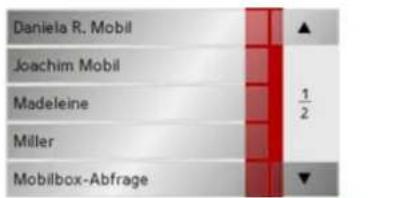
bar
| Entity | Value | | :--- | :--- | | Daniela R. Mobil | ▲ | | Joachim Mobil | 1/2 | | Madeleine | 1/2 | | Miller | 1/2 | | Mobilbox-Abfrage | ▼ |→ Press the arrow buttons scroll through the messages.
→ Press on the desired entry.
The Traffic Assist Pro tries to establish a connection to the desired telephone number.
Connecting a mobile phone
In order to be able to make calls with your Traffic Assist Pro, a mobile phone equipped with Bluetooth® wireless technology must be connected. The various options for establishing a connection are described below.
Opening the device list
→ In the telephone menu, press the Connect phone button.
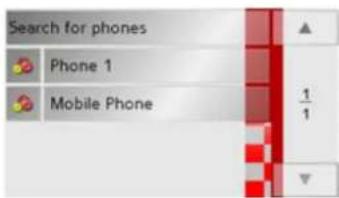
text_image
Search for phones Phone 1 Mobile PhoneThe device list is displayed.
You can search for a mobile phone or connect a mobile phone from the device list.
Note:
If you have not yet established a connection to a mobile phone, the list is empty.
The device list displays, line by line, all devices available for selection.
Each line of the device list is divided into two fields. Each list field is in the form of a button. The device name is shown on the right button and its characteristics are shown using the left icon.
| Icon Description | |
 | This device is a standard device with no special features. |
 | This device is protected. If the device list is full, this device is not automatically deleted.This can be performed manually, if required.In the case of a protected entry, you can also determine the position in the device list. |
By pressing the icon, you can open a menu in which, for example, you can protect the device.
TELEPHONE MODE
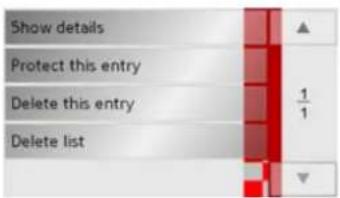
text_image
Show details Protect this entry Delete this entry Delete list| Option Description | |
| Show details | The device data is displayed. |
| Protect this entry | The device is protected against automatic deletion (only available on unprotected devices). |
| Unprotect this entry | Device protection is disabled (only available on protected devices). |
| Move this entry up | The device is moved forward by one position (only available on protected devices). |
| Move this entry down | The device is moved back by one position (only available on protected devices). |
| Delete this entry | The device is deleted from the device list. |
| Option Description | |
| Delete list All devices (including the protected ones) are deleted from the list. |
Connecting automatically
After switching on, your Traffic Assist Pro tries to establish a connection with the last mobile phone connected.
You can activate or deactivate this function as described under "Activating/deactivating automatic connection" on page 90.
The prerequisites for a successful connection are as follows:
- Bluetooth® is activated on your Traffic Assist Pro (See "Telephone/Bluetooth settings" on page 89.).
- The mobile phone is switched on and in range and Bluetooth® is activated.
Searching for a mobile phone
Note:
Before searching, activate Bluetooth® on the mobile phone to be searched for.
→ Open the device list.

text_image
Search for phones Phone 1 Mobile Phone→ Press the Search for phones button.
The search starts.
During the search, any devices found are displayed and the search can be cancelled by pressing the Cancel button.
After the search or after pressing the Cancel button, a list of the devices found is displayed.

text_image
Mobile Phone Phone 1 1/1→ Now press on the name of the mobile phone to be connected.
The Traffic Assist Pro then tries to establish the connection. The mobile phone should then prompt you to enter a password. This password is stipulated by the Traffic Assist Pro.

text_image
Please enter the following PIN code on your cell phone: OK 0000→ Enter the displayed password on the mobile phone.
The connection is established. If the connection is successfully established, the telephone fast access function is displayed.
Connecting from the device list
You can initiate a connection to a mobile phone from the device list. If a mobile phone is already connected, that connection will be terminated and a connection will be established to the selected mobile phone.
→ Open the device list.

text_image
Search for phones Phone 1 Mobile Phone→ Press on the desired mobile phone in the list.
A connection to the selected mobile phone will be established. If the connection is successfully established, the telephone fast access function is displayed.
TELEPHONE MODE
Disconnecting a mobile phone
You can disconnect a connected mobile phone.
→ In the telephone menu, press the Disconnect phone button.
The mobile phone is disconnected after a short time. The telephone fast access function is displayed.
Telephone/Bluetooth settings
In the telephone/Bluetooth settings, you can activate Bluetooth®, assign a Bluetooth name to your Traffic Assist Pro, set the visibility of your Traffic Assist Pro, and adjust the telephone and ringtone volume.
→ In the telephone menu, press the Preferences button.

text_image
Bluetooth activated Detectable by other devices Automatic connection Volume Reload PhonebookThe telephone/Bluetooth settings are displayed.
Switching Bluetooth on/off
Bluetooth must be switched on in order to enable automatic connection to a mobile phone after the Traffic Assist Pro is switched on (see "Connecting automatically" on page 87).
→ Press the Bluetooth activated button in the telephone/Bluetooth settings to switch Bluetooth on off.
Visibility of the Traffic Assist Pro
Here you can specify whether other Bluetooth devices are to be able to recognise the Traffic Assist Pro or not during a search.
→ Press the Detectable by other devices button in the telephone/Bluetooth settings to switch visibility on ☐ or off ☐.

TELEPHONE MODE
→ D
→ GB
→ F
→ |
→ E
→ P
→ NL
→ DK
→ S
→ N
→ FIN
→ TR
→ GR
→ PL
→ CZ
→ H
→ SK
Activating/deactivating automatic connection
Here you can specify whether, after the Traffic Assist Pro is switched on, a connection should automatically be established with the last mobile phone connected.
→ Press the Automatic connection button in the telephone/Bluetooth settings to activate or deactivate automatic connection.
Refreshing the phonebook
You can instruct your Traffic Assist Pro to transfer the phonebook data from the mobile phone again. The phonebook is then refreshed accordingly.
→ Press the Reload Phonebook button in the telephone/Bluetooth settings.
Setting the telephone volume
You can set the volume of the telephone.
→ Press the Volume button in the telephone/Bluetooth settings.
text_image
Volume - 70 % +→ Select the desired volume using the - and buttons.
→ Confirm your settings by pressing the OK button.
Note:
The volume can also be changed using the volume control located on the side. See "Volume control" on page 34..
Device name
You can give your Traffic Assist Pro a name. This name will be displayed by other Bluetooth devices.
Note:
The current name is shown in brackets on the Change device name button.
→ Press the Change device name button in the telephone/Bluetooth settings.
An input menu opens.
→ Enter the desired name.
TELEPHONE MODE
Telephone calls
The available operating options when establishing a call, answering a call and ending a call are included under the item Telephone calls.
Establishing a call
→ Enter a telephone number or select an entry from the fast access function or telephone book.
The number is dialled.
When the call has been answered at the receiver end, the display changes and you are connected to the other party.

bar
| Call Type | Value | |---|---| | Active call | 07248711634 | | End call | Private mode |Notes:
- The call can be returned to the mobile phone and the hands-free function terminated by pressing the Private mode button.
The connection with the mobile phone is automatically re-established after the call is ended. - You can switch to the navigation display during an active call by pressing the button.
Answering a call
A ringtone sounds when an incoming call is received. The following display also appears.
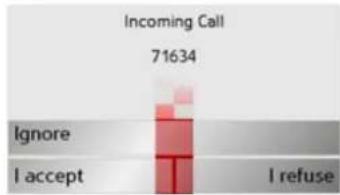
bar
| Category | Count | |---|---| | Incoming Call | 71634 | | Ignore | | | I accept | | | I refuse | |If available, the telephone number and name of the caller are displayed.
| Option Description |
| I accept The call is accepted. If navigation is active, the device returns to the map display. |
| I refuse The call is rejected. The caller hears a busy tone. The last active display is shown. |
| Ignore The ring tone is switched off. The last active display is shown. The call is ended when the caller hangs up. |

TELEPHONE MODE
→D
→GB
→F
→1
→ E
→P
→NL
→DK
→S
→ N
→FIN
→TR
→GR
→ PL
→ CZ
→H
→ SK
Ending a call
How a call is terminated depends on whether route guidance is active or not.
When route guidance is active
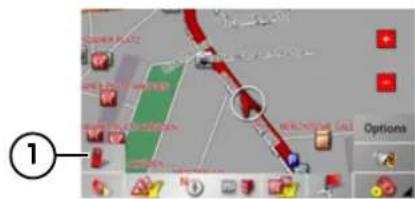
text_image
Screenshot of a map or navigation system interface with labeled components and a numbered step indicator→ In the toolbar, press the button Ⓜ

text_image
Active call 07248711634 End call Private mode→ End the call by pressing the End call button.
The call is ended and the map display is shown.
Without route guidance

text_image
Active call 07248711634 End call Private mode→ Press the End call button.
The call is terminated. The last active display is shown.
MUSIC OPERATIONS
Selecting music playback
The music player is called up from the main menu or as described under "Playback of MP3 files during an active navigation" on page 81.
The devices described in this guide differ in how the music player is selected via the main menu.
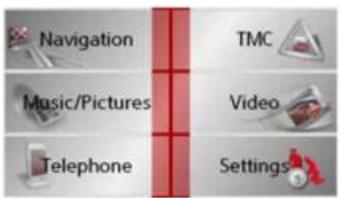
text_image
Navigation Music/Pictures Telephone TMC Video Settings→ Press the Music/Pictures button in the main menu.
If the music player was last selected, this will be called up again directly.
If the picture viewer was last selected, this will be displayed. You can then switch to the music player by pressing the button.
The MP3-Player is called up and appears with its main screen.
- If playback of a music track was stopped previously, that last music track is displayed.
- If this is no longer available, the first track on the memory card is displayed.
- If the memory card contains no tracks, the No music available message appears.
The MP3 player
The MP3 files saved on a memory card can be called up and played using the MP3 player.
Note:
Please refer to "Transmitting music tracks, pictures and videos" on page 35" to find out how to save tracks to the internal memory or on to a memory card.
The MP3-Player is shown below along with its standard display and a sample track.
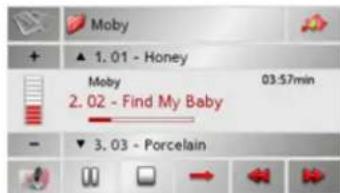
text_image
Moby + ▲ 1.01 - Honey Moby 03:57min 2.02 - Find My Baby - ▼ 3.03 - PorcelainIn the central area of the MP3 player, the title of the currently loaded track with the artist's name and the number in the current folder structure is shown in the title line.
Note:
The artist and track name are taken from the ID3 tag of the MP3 file. If the MP3 track played does not have an ID3 tag, the file name of the track is displayed directly.
Operating the MP3-Players
Various key panels are arranged around the track line to simplify operations.
Track skip
The names of the next and previous track are displayed above and below the current music track.
→ Press a track.
The track in the track line is loaded.
- If the play button is not pressed, the track is not yet played.
- If a piece of music is being played at present, this is stopped and playback of the new track started.
Play
The pieces of music starting from the track displayed in the track line are played when the following key is pressed.

→ Press the key featuring the play icon. The MP3-Player starts playback. The key changes to display the pause icon.

Under the display of the current track, you can see its length, and below it the elapsed time in the form of a bar.
Note:
Depending on the bit rate (compression) of the MP3 track, the times displayed may vary slightly from the actual time.
Pause
Playback can be paused at any time and then continued.
→ Press the key featuring the pause icon. Playback is interrupted. The current track is still displayed in the track line. The button display changes to the Playback icon. Playback is continued by pressing again.
Cancelling playback
You can cancel playback

→ Press the button next to the pause icon. Playback is terminated. If you then restart playback, the track is played from the beginning.
MUSIC OPERATIONS
Folder overview

text_image
Moby ▲ 1.01 - Honey Moby 2.02 - Find My Baby ▼ 3.03 - Porcelain→ Press (see arrow).
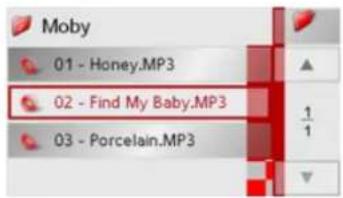
text_image
Moby 01 - Honey.MP3 02 - Find My Baby.MP3 03 - Porcelain.MP3The contents of the current folder appears. The file name appears in the top line and below this, any available subfolders and track titles.
The currently playing track is surrounded by a red frame.
→ Press the button in order to move up one level in the folder structure.

text_image
Music Madonna Moby 03 - teenage dirt bag.MP3 Jean Michel Jarre & VangeloHere as well, the name of the current folder appears in the top line and underneath it the subfolders and then the tracks which it contains.
→ Press on a folder in order to display its contents.
→ Press on a track in order to play it.
Track repeat/random play function
It is possible to have a track continuously repeated or to have the tracks played in random order.

text_image
Moby ▲ 1.01 - Honey Moby 2.02 - Find My Baby ▼ 3.03 - Porcela 03:57min→ Press the button marked with the arrow repeatedly until the desired function is activated.
The displayed icon changes depending upon the selected function.
- Icon - functions are deactivated
- Icon random play function activated
- Icon - track repeat activated
Setting volume
You can increase or decrease the volume by pressing the or buttons.
⚠ Warning
Always adjust the volume so that you can still hear any ambient noise while driving.
→ Press or to increase or decrease the volume.
→ Press in order to mute the music.
→ Press again in order to cancel the mute function.
Note:
The volume can also be changed using the volume control located on the side. See "Volume control" on page 34..
Navigation during MP3 player operation
You can start or continue an active navigation while the MP3 player is playing music.
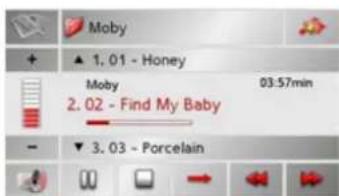
text_image
Moby ▲ 1.01 - Honey Moby 2.02 - Find My Baby ▼ 3.03 - Porcelain→ Press the card symbol on the lower right-hand edge of the screen for this purpose.
The map view is displayed while the music continues to play.
Shutting down the MP3-Player
By pressing the key, the MP3 player is terminated and the main menu is displayed or, if route guidance is activated, the map display appears.
Note:
Bear in mind that music will continue to play when you exit the MP3 menu. Press the pause icon to stop music playback (See "Pause" on page 94.).
Selecting pictures display
The picture viewer is called up from the main menu.
The devices described in this guide differ in how the picture viewer is selected via the main menu.
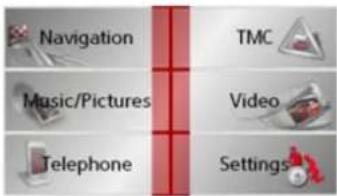
text_image
Navigation Music/Pictures Telephone TMC Video Settings→ Press the Music/Pictures button in the main menu.
If the picture viewer was last selected, this will be called up again directly.
If the music player was last selected, this will be displayed. You can then switch to the picture viewer by pressing the button.
The Picture Viewer is called up and appears with its main screen.
- If the last image displayed is present on the memory card, this will be displayed in the image area.
- If it is no longer available, the next picture in the same folder is displayed. If there are no pictures in the corresponding folder, no pictures are displayed.
- If the memory card contains no pictures, the No pictures available message appears.
The Picture Viewer
Using the picture viewer, the images stored on the memory card of the Traffic Assist Pro can be called up and displayed. The Picture Viewer is shown below along with its standard display and a sample picture.
Notes:
• The formats JPG, PNG, BMP and GIF are supported.
- You can find out how to save image files on a memory card under "Transmitting music tracks, pictures and videos" on page 35.

natural_image
Scenic landscape photo with a lake, forested mountains, and a play button labeled 'Pictures' (no other text or symbols)The picture currently loaded is displayed in the centre of the Picture Viewers.
Operating the Picture Viewers
Various key panels are arranged around the picture display to simplify operations.
Scrolling
The keys can be used to scroll in the direction indicated by the arrow and to therefore move between the pictures at the current folder level.
Slideshow
During the slideshow, all pictures from the current folder level are automatically displayed one after another. The slide-show can be started using the following key.

→ Press the key featuring the slideshow icon.
A prompt appears once all images have been displayed.
→ If you wish to repeat the slide show, press Yes.
→ If you wish to end the slide show, press No.
The slide show will be repeated automatically if no buttons are pressed.
Press the key to end the slide show.
Full screen
In full screen mode, the current picture is enlarged to fill the entire touch screen. Full screen mode can be started using the following keys.

→ Press the key featuring the full screen icon.
The image display changes to full screen and initiates the slide show with the displayed image of the current folder level.
By pressing the left-hand or right-hand touchscreen surface, the previous or next image in the current folder level is displayed.
You can return to the standard screen by pressing the key
Shutting down the Picture Viewer
Press the key to shut down the Picture Viewer. The main menu appears.
PICTURES MODE

Folder viewing mode
Under the picture displayed in the Picture Viewer, the picture's folder level is displayed in a key panel.

→ Press the key panel.
Folder viewing mode appears.
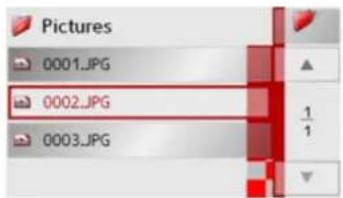
text_image
Pictures 0001.JPG 0002.JPG 0003.JPGIn this viewing mode, the name of the current folder level is displayed in the top line. It content appears in the list provided below the line.
The list fields are also displayed as buttons. Pictures and sub-folders are displayed along with their names.
Operating folder viewing mode
Subfolders
All folders containing image files are included in the folder overview.
Scrolling
You can use the keys to scroll through the list display in the direction indicated by the arrow.
The current list page and the total number of its contents appear between the keys.
Selecting a picture
You can load a picture from the list straight into the Picture Viewer.
→ Press the button of the picture you want.
Folder viewing mode is closed and the Picture Viewer appears along without the picture requested.
Changing folder levels
With the button, you can move to the next highest folder level.
Press the appropriate button to display a subfolder's contents.
Closing folder viewing mode
The folder overview is closed by pressing the key.

Selecting video playback
Video playback is called up from the main menu.

text_image
Navigation Music/Pictures Telephone TMC Video Settings→ In the main menu, press Video.
The following conditions apply after the video player is called up:
- If the last video played is present on the Memory Card, this will be displayed on the video player.
- If this is no longer available, the next video in the same folder is displayed. If there are no videos in the relevant folder, the blank video player display is shown.
The video player
The videos stored on the Memory Card can be played using the video player. The Traffic Assist Pro supports the following video formats:
- MPEG1
• WMV
Note:
You can find out how to store videos on a Memory Card under "Transmitting music tracks, pictures and videos" on page 35".
The following is an example video player display with a video playing.

text_image
Becker_Demo.mpgOperating the video player
Opening and playing videos

text_image
Screenshot of a video player interface with playback controls and playback bar, featuring a red play button and an arrow pointing to the left.→ Press the folder button (see arrow).
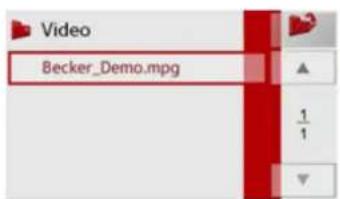
text_image
Video Becker_Demo.mpgThe contents of the current folder appears. The folder name appears in the top line and below this, any available subfolders and videos. The currently playing video is surrounded by a red frame.
→ Press the folder button at the top right in order to move up one level in the folder structure.
VIDEO MODE
Here as well, the name of the current folder appears in the top line and underneath it the subfolders and then the videos which it contains.
→ Press on a folder in order to display its contents.
→ Press on a video in order to play it.
Showing the button bar while video is playing
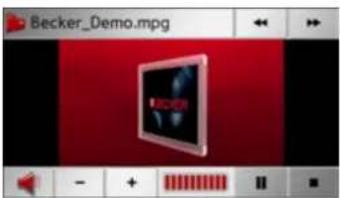
text_image
Becker_Demo.mpgThe button bar is in the lower and upper area of the video player display. The button bar is automatically hidden after a certain video running time.
→ Press on any point on the display in order to show the button bar again.
Pausing and resuming playback
The following buttons are used for this purpose:

→ Show the button bar.
→ Press ☐ pause playback.
Depiction of the button changes to .
→ Press to resume playback.
Depiction of the button changes to .
Fast forward/reverse
The following buttons are used for this purpose:

→ Show the button bar.
→ Press for fast forward.
→ Press for fast reverse.
→ Press ▶o end fast forward or reverse.
Setting the volume
The following buttons are used for this purpose:

→ Show the button bar.
→ Press to reduce the volume and to increase the volume.
→ Press the button to mute or the button to cancel muting.
Note:
The volume can also be changed using the volume control located on the side. See "Volume control" on page 34.
Selecting the settings
You can pre-select various basic settings for all applications of the Traffic Assist Pro.

text_image
Navigation Music/Pictures Telephone TMC Video Settings→ Push the button Settings in the main menu.
This calls up the setting menu for the further selections.
The setting menu
The various setting possibilities can be selected from the setting menu.

text_image
Energy Brightness Calibration Language Mood light 1/3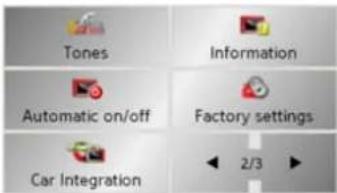
text_image
Tones Information Automatic on/off Factory settings Car Integration 2/3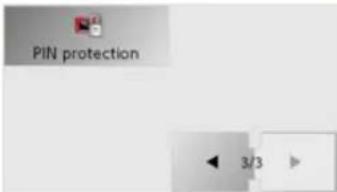
text_image
PIN protection 3/3Operation
Selection possibilities
The desired selection is chosen by pushing the desired button. The functionality of the buttons varies according to the selection and is described under "The individual menu points" on page 103.
You can jump to the next or previous page of the settings by pressing the and buttons.
Closing the setting menu
The setting menu is closed by pushing the key, and the main menu then appears.
The individual menu points
Energy
Your Traffic Assist Pro may be operated using an external power supply unit or using an integrated rechargeable battery.
Note:
The current charge condition is particularly important when operating from batteries. If there is insufficient energy, then the navigational aid cannot be maintained until the destination is reached, for example.
The energy supply and its condition is visualised using the status display.
Displaying the energy supply
The status display can be called up using the following button.

→ Push the button Energy.
The status display is called up and the energy supply is visualised.
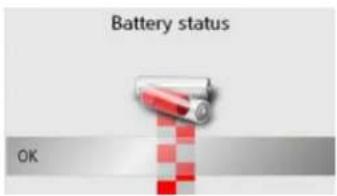
text_image
Battery status OKThe charge condition is displayed using the level gauge. In the example, the battery still has a charge of two thirds of its capacity.
The charging operation is indicated by the mains socket symbol in the status display.
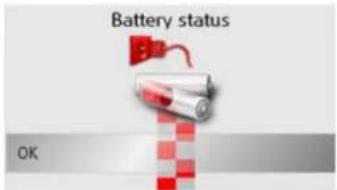
text_image
Battery status OKEnding the status display
By pushing the button OK the status display is ended and the setting menu appears.
Day/night display
Using the following button, you can change between the day and night screen displays:


→ Push the button Brightness.
The brightness of the screen display changes from day to night display or vice versa.
The icon for the active setting is highlighted.
- Left icon: Day display
• Right icon: Night display
Calibration
If the touch-screen reacts incorrectly to the touching of the screen in specific areas, calibration is required.
Starting calibration
The calibration can be started using the following button.

→ Push the button Calibration.
The calibration process is started.
You will be guided through the procedure by means of text instructions.
Language
The text of the touch-screen images can be displayed in various languages.
Calling up language selection
The following button allows selection of various different languages.

→ Push the button Language.
The language selection appears.

text_image
Dansk Deutsch English English EspañolIn the language selection, the available languages are shown in a list which extends over several pages. Each list area is a contact surface. The individual contact surfaces are marked with the language designation and the associated national flag.
Turn the page
These buttons ▲ allow page turning in the direction shown by the arrow through the pages of the list.
The current page of the list and the total number of pages is shown between the buttons.
Selecting the language
If you change the language the software restarts.
→ Push the contact area of the desired language.
Cancelling the language selection
The language selection is closed by pushing the key, and the setting menu then appears.
SETTINGS
Moodlight
Using this button, the light bars on the side can be switched on, switched to red or blue, or switched off completely.

text_image
Mood light Mood light Mood light→ Push the button Mood light.
The light bars are controlled accordingly.
Note:
Please deactivate the Becker moodlights while driving in your vehicle in order to prevent visual distraction from the road traffic!
Tones
You can switch the Traffic Assist Pro signal tones on and off. This can also be effected by clicking on the display buttons.
→ Press Tones.
Depending on the previous setting, the signal tones are switched on or off. The current setting is indicated via display of the relevant icon in colour.

- Left icon: Tones switched on
• Right icon: Tones switched off
Automatic on/off
The Traffic Assist Pro can switch automatically to sleep mode when the vehicle ignition is switched off.
Prerequisite:
• The Traffic Assist Pro must be connected to the vehicle cigarette lighter (see also page 23).
• The cigarette lighter is de-energized after the ignition is switched off.
• The relevant function can be switched on at the Traffic Assist Pro.
Switching the function on / off
→ Press Automatic on/off.
Depending on the previous setting, the function will be switched on or off. The current setting is indicated via display of the relevant icon in colour.

- Left icon: The function is switched on, the Traffic Assist Pro does switch off automatically.
- Right icon: The function is switched off, the Traffic Assist Pro does not switch off automatically.
Information
Information concerning the Traffic Assist Pro is displayed using the following buttons.

→ Push the button Information. The information display appears.

text_image
BECKER Traffic Assist Version: www.mybecker.com ClosePlease note particularly the product designation and the details of the software version. Always quote these details in the event of queries with Harman/Becker service department.
Factory settings
You can reset your Traffic Assist Pro to the factory settings.
This resets all settings that have been changed and deletes the stored destinations, stored routes, number lists and Bluetooth device lists.

→ Press the Factory settings button.

text_image
Do you really want to restore the factory settings? Yes No→ Press the Yes button. The Traffic Assist Pro is reset to the factory settings.
Car integration
When using the optionally available cable for output of the audio signal/connection of a microphone, you must define whether announcements and music are to be output via the internal loudspeakers.

→ Press the Car Integration button.

text_image
Car Integration Internal Speaker→ Switch the internal loudspeaker on using the button or off using the button.
→ Confirm your settings by pressingOK.
SETTINGS
PIN protection
You can protect your Traffic Assist Pro against unauthorised access by means of a four-digit, user-defined PIN.
This PIN is requested after switching on the Traffic Assist Pro via the on/off switch on the left side of the unit. The Traffic Assist Pro is only ready for operation after the correct PIN has been entered.

→ Press the Pin protection button. The PIN protection menu appears.
Activating PIN protection
Open the PIN protection menu.
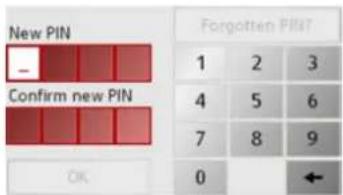
text_image
New PIN - Confirm new PIN OK Forgotten PIN? 1 2 3 4 5 6 7 8 9 0 ←→ Enter a user-defined PIN using buttons
1 to . 0
Note:
Use a number which you can easily remember.
→ Repeat entry of the previously-entered PIN.
→ Confirm your entry by pressing the OK button.
Your Traffic Assist Pro is now protected against unauthorised access and can only be activated with the previously-entered PIN, after switching on via the on/off switch.
Deactivating/changing PIN protection Open the PIN protection menu.
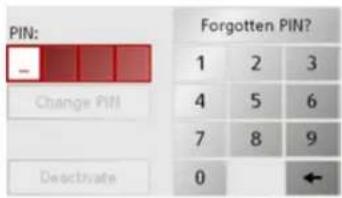
text_image
PIN: - Change PIN Deactivate Forgotten PIN? 1 2 3 4 5 6 7 8 9 0 ←→ Enter the PIN number using buttons 1 to .0
Note:
Have you forgotten your PIN number?
→ Press the Forgotten PIN? button and follow the instructions.
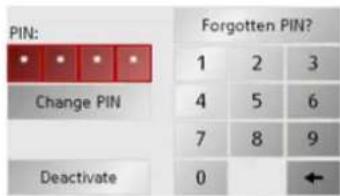
text_image
PIN: Change PIN Deactivate Forgotten PIN? 1 2 3 4 5 6 7 8 9 0 ←→ Press the Deactivate button to switch off PIN protection.
Changing the PIN
→ Press the Change PIN button in order to change the PIN.
→ Proceed as described under Activating PIN protection.
→→→ SPECIALIST WORDS
→D
→GB
→ F
→ |
→ E
→ P
→ NL
→ DK
→ S
→ N
→ FIN
→ TR
→ GR
→ PL
→ CZ
→ H
→ SK
Active Sync
Active Sync is a Microsoft product. This is the standard synchronisation software for Windows mobile units such as your Traffic Assist Pro. The programme can be downloaded free-of-charge from the internet.
Bluetooth
Technology for wireless data transmission over short distances of up to approx. 10 metres.
GMT
(Greenwich Mean Time)
Central European Time
The standard time at 0 degrees of longitude (the longitude which passes through Greenwich, Great Britain). This time is used worldwide for the synchronisation of data collection.
GPS
(Global Positioning System)
GPS determines your actual geographical position by the use of satellites. It is based on 24 satellites which orbit the Earth and emit signals. The GPS receiver receives these signals and calculates the distance to each satellite from the running time differences and thus evaluates its actual current position in terms of geographical length and width. In order to determine the position, signals from at least three satellites are required, and the fourth one allows the height to be determined.
HDOP
(Horizontal Dilution Of Precision)
HDOP states the quality of the positional determination. In theory, values from 0 to 50 are possible, whereby the following applies: the smaller the value the more accurate the positioning (value 0= no deviation from the actual position). Values of up to 8 are acceptable for navigation units.
ID3-Tag
„Index of Contents" of an MP3 title. Contains information such as title, artist, album, year and genre.
JPG/JPEG
(Joint Photographic Experts Group)
The JPEG is the most common type of storage format for dissipating picture compression., i.e. when compressing, details of the picture are lost. Still provides good picture quality despite compression, compression stages are selectable. It is the most common format for representation and exchange of pictures on the internet.
Memory Card
A re-writable storage card. In the Traffic Assist Pro it is a SD card.
MP3
Special compression process for audio data (e.g. music).
SPECIALIST WORDS

File
Index
File on a CD/storage card/microdrive which contains MPS titles.
SD Card
(Secure Digital)
The Secure Digital Card was developed in 2001 by SanDisk on the basis of the older MMC standard. An SD card is a re-writable change-over storage card.
Stylus
A stylus is an input pointer which is used for the operation of touch-screens, mobile phones or PDAs.
The stylus consists basically of a plastic pointer with a softer plastic core. The sleeve is hard and can be gripped and the softer core emerges at the tip and is designed to touch the screen as softly as possible (i.e. without the danger of scratching the screen).
The stylus is more accurate than operation using the fingers, since only the thin tip touches the screen. In addition, dirty marks on the screen caused by finger prints are avoided.
TMC
(Traffic Message Channel)
Traffic announcements transmitted by most FM stations via RDS. Basis for dynamic navigation.
USB
(Universal Serial Bus)
The Universal Serial Bus (USB) is a bus sytem for interconnection of a computer with external USB peripherals for the exchange of data.
→ D
→GB
→ F
→ |
→ E
→ P
→ NL
→ DK
→ S
→ N
→ FIN
→ TR
→ GR
→ PL
→ CZ
→ H
→ SK

KEYWORDS
→D
→ GB
→ F
→ |
→ E
→ P
→ NL
→ DK
→ S
→ N
→ FIN
→ TR
→ GR
→ PL
→ CZ
→ H
→ SK
A
Active Sync 35, 108
Adjusting the volume 65
Autozoom 59
B
Bluetooth settings 89
C
Calling a POI 52
Changing folder levels 99
Changing the map display ..... 60
Closing folder viewing mode ..... 99
D
Daylight saving time 63
Destination memory
changing 83
POIs 51
Destination selection
Entering address 43
from map 52
Point of interest 49
Destinations
home address 39
protected 39,86
save 48
standard 39,86
Destinations memory 40
changing 40
scrolling 40
Dialling a number 85
Display 59
Display street names 60
Displaying current position ..... 41
Distance to destination 60
Drive profile 47
E
Entering
destinations 42
Entering address 43
ETA 60
F
Fast access mode
Icons 83
Fast route 47,58
Ferry 47,57,58
File 109
Folder viewing mode 99
Full screen 98
G
GMT 108
GPS 108
H
HDOP 108
|
ID3 tag 94
ID3-Tag 108
Intended use 6
Intersecting road 46
J
JPG/JPEG 108
L
List of destinations 39
List of routes
edit 54
new route 54
Lists
List of destinations 39
List of streets 46
List of towns 45
Telephone numbers 82
KEYWORDS

M
Main menu 30
Map display ....39
2D, 3D .....59
changing from rapid access ....41
Current position 38
Destination displays .....47
POIs 51
Map symbol key .....41
Memory Card 108
Memory card .....20
Motorway 47,57,58
MP3 94,108
MP3 player 93
calling up 93
shutting down 96
N
Navigation 37
Rapid access ....38
starting 48
Navigation menu ..... 38, 39, 42
structure 42
Number list 83
Dialling a number ....83
editing 84
scrolling 83
0
Operating folder viewing mode .....99
optimum route .....47, 58
P
Part-way destination .....53
Pause 94
Phonebook 85
Picture Viewer 97
shutting down .....98
Picture viewer ....100
PIN 107
PIN forgotten .....27, 107
PIN protection ....107
Play 94
Points of interest 49
display on the map .....60
nearby 49
R
Rapid access ....40
Icons ....39
Reality view 63,73
Repeat current track .....95
Restrictions Ferry 47, 58
Route deleting ....53
fast 47,58
renaming 53
scenic 47,58
short 47,58
Type of 57
Route planning 42,53
S
Safety information 6,37
Scroll in image folder .....100
Scrolling in lists 99
in the pictures folder .....98
SD card 20
Select image display .....100
Selecting a picture .....99
Selecting pictures display .....97
→ D
→GB
→ F
→ |
→ E
→ P
→ NL
→DK
→ S
→ N
→ FIN
→ TR
→ GR
→ PL
→ CZ
→ H
→ SK

KEYWORDS
→D
→ GB
→ F
→ |
→ E
→ P
→ NL
→ DK
→ S
→ N
→ FIN
→ TR
→ GR
→ PL
→ CZ
→ H
→ SK
Selecting street 45
Selecting town 44
Set the volume ....65, 75, 90, 96, 101
Setting the volume 74
Setting volume 96
Settings for navigation ..... 42, 57
Short route 47,58
Shutting down the Picture Viewer .. 98
Slideshow 98
Speed limit 61
Stylus 109
Switching the Traffic Assist Pro on .. 26
T
Telephone book 85
Telephone fast access mode ..... 83
Telephone menu 82, 84
Telephone mode 82
The 93
Time format 59
Time of arrival 60
Time zone 63
TMC 66
Display on the map 67
Recalculating routes 69
Settings 62
TMC antenna 23
Toll road 47,57,58
Travel time 60
Travel time remaining 60
Type of route 57
Type of routing 57
U
Units of measurement 59
USB 109
V
Volume control 34
W
Warnings Speed limit 61
TECHNICAL DATA

- Dimensions:
(W x H x D) in mm 126 x 81 x 20,8
• Weight: 202 grams - Processor: 400 MHz Processor CISC-architecture
- Screen: 4.3 Inch Touch-Screen with 24 Bit colour depth 16,7 Mio Colours Low reflection values
• Storage: 128 MB Flash Storage 64 MB SD-RAM
• SD Card Reader: Support up to 4 GB FAT 32 formatted
- USB Interface: USB 1.1 USB Client 2.0 MINI USB
• Headphone output: 3.5 mm Stereo Socket
• 1 Internal speakers:
2 Watt max.
• Power supply voltage:
5 Volt DC via USB connection
- AC Adapter (not included):
100 - 240 Volt
0.2 Ampere
50 - 60 Hz
Output Voltage 5Volt
→ D
→GB
→ F
→ |
→ E
→ P
→ NL
→ DK
→ S
→ N
→FIN
→ TR
→ GR
→ PL
→ CZ
→ H
→ SK
Dear customer,
In conformance with current EC guidelines, any person may operate this unit. This unit conforms to the current valid European or harmonised national standards. This designation is your guarantee that the unit conforms to the applicable specifications regarding electromagnetic compatibility. This means that interference with other electrical/electronic devices caused by the unit, or interference with this unit caused by other electrical/electronic devices, is largely prevented.
The EC type-approval mark (E13) issued by Luxembourg's Road Traffic Registration Authority in accordance with European Directive ECE-R10 governing the EMC of motor vehicles in its current version authorises installation and operation of the unit in motor vehicles (classes L, M, N and O).
EU Declaration of Conformity
Harman/Becker Automotive Systems GmbH declares herewith that Traffic Assist Pro conforms to the basic requirements of the applicable EU guidelines and in particular conforms to the basic requirements and the other relevant regulations of the R&TTE Directive 1999/5/EU.
You can find a comprehensive EU Declaration of Conformity on our website http://www.mybecker.com under the "Downloads" area for the respective product.
Disposal of the unit
Customer information on the disposal of electrical and electronic devices (private households)
In accordance with the self-imposed principles of Harman/Becker Automotive Systems GmbH, the product has been developed and made from high-quality, recyclable materials and components.
This symbol on the product and/or accompanying documents means that at the end of their life electrical and electronic products must be disposed of separately from domestic waste. Please take these products to communal collecting points or recycling centres for processing and salvage of materials. The units will be accepted there free of charge.
The proper disposal of this product helps protect the environment and prevents harmful effects on humans and the environment which could result from improper handling.
More detailed information on the nearest collecting point or the nearest recycling centre can be obtained from your local council.
For commercial customers in the European Union
Please contact your dealer or supplier if you would like to dispose of this electrical/electronic equipment.
Information on disposal in countries outside of the European Union
This symbol is only valid within the European Union.

Disposal of the battery
Duty to supply information according to battery legislation (BattV)
Batteries must not be disposed of in household waste. It is the duty of the user to return used batteries. Please only dispose of batteries via specialised dealers or at battery collection points. In this way, you make a positive contribution to environmental protection. Since 1998, German battery legislation obligates all citizens to dispose of used batteries exclusively via the retail or at collection points specially equipped for this purpose (statutory obligation to return). It is the duty of the retail and of manufacturers to take back these batteries free of charge and to correctly recycle them or to dispose of them as hazardous waste (statutory obligation to take back). If you wish to return your batteries to us, please send them, with adequate postage, to the following address:
Harman/Becker Automotive Systems GmbH
- Battery recycling -
The lithium ion battery in the Traffic Assist Pro is marked with the adjacent symbol, consisting of a crossed-out waste bin, and the type of battery used.
Removing the battery
Before you hand in your old unit for disposal, the battery must first be removed.

Lithium ion
Note:
Please note that in following the removal instructions for the battery described here, your unit may be destroyed. You should only remove the battery if your unit is old and is to be handed in for disposal.
NOTICE


→ Completely discharge the battery (leave the unit switched on with no power supply until it automatically switches off).
→ Remove the four rubber covers ① from the screw holes.
→ Unscrew and remove the four housing screws ② using a small cross-slot screwdriver.
→ Lever off the rear of the housing using a flat-blade screwdriver (levering at the slits at the side of the housing). ③
→ Lever off the battery (bonded to the circuit board) using a flat-blade screwdriver. ④
→ Pull out the plug of the battery connecting cable.
Note:
Do not reconnect a unit that you have opened to the power supply.