Color LaserJet Enterprise Flow MFP M6800zfsw - Printer HP - Free user manual and instructions
Find the device manual for free Color LaserJet Enterprise Flow MFP M6800zfsw HP in PDF.


User questions about Color LaserJet Enterprise Flow MFP M6800zfsw HP
0 question about this device. Answer the ones you know or ask your own.
Ask a new question about this device
Download the instructions for your Printer in PDF format for free! Find your manual Color LaserJet Enterprise Flow MFP M6800zfsw - HP and take your electronic device back in hand. On this page are published all the documents necessary for the use of your device. Color LaserJet Enterprise Flow MFP M6800zfsw by HP.
USER MANUAL Color LaserJet Enterprise Flow MFP M6800zfsw HP
natural_image
Line drawing of a laboratory instrument with control panel and display (no text or symbols)
HP Color LaserJet Enterprise MFP 6800, 6801, HP Color LaserJet Enterprise Flow MFP 6800, 6801 - User Guide
Legal information
Copyright and License
© Copyright 2023 HP Development Company, L.P.
Reproduction, adaptation, or translation without prior written permission is prohibited, except as allowed under the copyright laws.
The information contained herein is subject to change without notice.
The only warranties for HP products and services are set forth in the express warranty statements accompanying such products and services. Nothing herein should be construed as constituting an additional warranty. HP shall not be liable for technical or editorial errors or omissions contained herein.
Edition 2, 3/2023
Trademark Credits
Adobe ^ , Adobe Photoshop ^ , Acrobat ^ , and PostScript ^ are trademarks of Adobe Systems Incorporated.
Apple and the Apple logo are trademarks of Apple Inc., registered in the U.S. and other countries.
macOS is a trademark of Apple Inc., registered in the U.S. and other countries.
AirPrint is a trademark of Apple Inc., registered in the U.S. and other countries.
Google™ is a trademark of Google Inc.
Microsoft ^® , Windows ^® , and Windows Server ^® are U.S. registered trademarks of Microsoft Corporation.
UNIX ^* is a registered trademark of The Open Group.
Table of contents
1 Printer overview....1
Warning icons....1
Potential shock hazard 2
Printer views 2
Printer front view....2
Printer back view....4
Control-panel view 5
Printer specifications 8
Technical specifications....8
Supported operating systems....10
Mobile printing solutions....12
Printer dimensions....12
Power consumption, electrical specifications, and acoustic emissions 15
Operating-environment range 15
Printer hardware setup and software installation....16
2 Paper trays....17
Load paper to Tray 1 (multipurpose tray)....17
Load Tray 1 (multipurpose tray)....17
Tray 1 (multipurpose tray) paper orientation....19
Load paper to Tray 2....23
Load Tray 2 or the optional 550-sheet trays....23
Tray 2 and the optional 550-sheet trays paper orientation 25
Use alternative letterhead mode....28
Load and print envelopes....29
Print envelopes....29
Envelope orientation....29
Load and print labels....30
Manually feed labels....30
Label orientation 31
3 Supplies, accessories, and parts....32
Order supplies, accessories, and parts....32
Ordering....32
Supplies and accessories....32
Customer self-repair parts....35
Configure the HP toner-cartridge-protection supply settings....35
Introduction....35
Enable or disable the Cartridge Policy feature....36
Enable or disable the Cartridge Protection feature....38
Replace the toner cartridges....40
Toner cartridge information....40
Remove and replace the toner cartridge....42
Replace the toner collection unit (TCU) 44
Replace the toner collection unit (TCU) 44
Replace the staple cartridge (stapler models only)....46
Remove and replace the staple cartridge in the 3-bin stapler/stacker 46
Remove and replace the staple cartridge in the finisher 48
Remove and replace the staple cartridge in the convenience stapler 50
4 Print....52
Print tasks (Windows)....52
How to print (Windows)....52
Automatically print on both sides (Windows)....53
Manually print on both sides (Windows) 53
Print multiple pages per sheet (Windows)....53
Select the paper type (Windows)....54
Additional print tasks....54
Print tasks (macOS)....55
How to print (macOS)....55
Automatically print on both sides (macOS)....55
Manually print on both sides (macOS) 55
Print multiple pages per sheet (macOS)....56
Select the paper type (macOS)....56
Additional print tasks....57
Store print jobs on the printer to print later or print privately 57
Introduction....57
Create a stored job (Windows)....57
Create a stored job (macOS)....58
Print a stored job 59
Delete a stored job....59
Information sent to printer for Job Accounting purposes 60
Mobile printing 60
Mobile printing solutions....60
Wi-Fi, Wi-Fi Direct Print, NFC, and BLE printing....61
HP ePrint via email 62
AirPrint....62
Android embedded printing 63
Print from a USB flash drive 63
Enable the USB port for printing....63
Print USB documents 64
Print using the SuperSpeed USB 3.0 port (wired)....65
Method one: Enable the SuperSpeed USB 3.0 port from the printer control panel menus....65
Method two: Enable the SuperSpeed USB 3.0 port from the HP Embedded Web Server (network-connected printers only)....65
5 Copy....67
Make a copy....67
Copy on both sides (duplex)....69
Additional copy tasks....71
6 Scan....72
Set up Scan to Email....72
Introduction....72
Before you begin 72
Step one: Access the HP Embedded Web Server (EWS)....73
Step two: Configure the Network Identification settings....74
Step three: Configure the Send to Email feature ....74
Step four: Configure the Quick Sets (optional)....84
Step five: Set up Send to Email to use Office 365 Outlook (optional)....84
Set up Scan to Network Folder 87
Introduction......87
Before you begin 87
Step one: Access the HP Embedded Web Server (EWS)....87
Step two: Set up Scan to Network Folder 88
Set up Scan to SharePoint 97
Introduction....97
Before you begin 97
Step one: Access the HP Embedded Web Server (EWS)....97
Step two: Enable Scan to SharePoint and create a Scan to SharePoint Quick Set....98
Scan a file directly to a SharePoint site....100
Quick Set scan settings and options for Scan to SharePoint 101
Set up Scan to USB Drive 102
Introduction....103
Step one: Access the HP Embedded Web Server (EWS)....103
Step two: Enable Scan to USB Drive....103
Step three: Configure the Quick Sets (optional)....104
Default scan settings for Scan to USB Drive setup....105
Default file settings for Save to USB setup....105
Scan to email 106
Introduction....106
Scan to email....106
Scan to job storage 109
Introduction....109
Scan to job storage on the printer 109
Print from job storage on the printer 111
Scan to network folder 111
Introduction....111
Scan to network folder 111
Scan to SharePoint....113
Introduction....114
Scan to SharePoint....114
Scan to USB drive....115
Introduction....116
Scan to USB drive....116
Use HP JetAdvantage business solutions....117
Additional scan tasks....118
7 Fax....119
Set up fax....119
Introduction....119
Set up fax by using the printer control panel....119
Change fax configurations....120
Fax dialing settings....120
General fax send settings....121
Fax receive settings....122
Send a fax....123
Create a fax printing schedule....125
Block incoming faxes 126
Create a list of blocked fax numbers....126
Delete numbers from the list of blocked fax numbers....126
Additional fax tasks....126
8 Manage the printer 128
Advanced configuration with the HP Embedded Web Server (EWS)....128
Introduction......128
How to access the HP Embedded Web Server (EWS)....129
HP Embedded Web Server features....130
Configure IP network settings....138
Printer sharing disclaimer....138
View or change network settings....138
Rename the printer on a network 139
Manually configure IPv4 TCP/IP parameters from the control panel....139
Manually configure IPv6 TCP/IP parameters from the control panel....140
Link speed and duplex settings....140
Printer security features 141
Introduction....141
Security statements....141
Assign an administrator password ....141
IP Security 142
Encryption support: HP High Performance Secure Hard Disks 143
Lock the formatter 143
Energy-conservation settings....143
Set the sleep timer and configure the printer to use 1 watt or less of power....143
Set the sleep schedule....143
HP Web Jetadmin....144
Software and firmware updates....144
9 Solve problems....145
Control panel help system....145
Reset factory settings....146
Introduction....146
Method one: Reset factory settings from the printer control panel....146
Method two: Reset factory settings from the HP Embedded Web Server (network-connected printers only)....146
A "Cartridge is low" or "Cartridge is very low" message displays on the printer control panel or EWS....146
Change the "Very Low" settings....147
Order supplies 148
Printer does not pick up paper or misfeeds....148
Introduction....148
The printer does not pick up paper....148
The printer picks up multiple sheets of paper 151
The document feeder jams, skews, or picks up multiple sheets of paper 153
Clear paper jams....154
Paper jam locations....154
Auto-navigation for clearing paper jams 155
Experiencing frequent or recurring paper jams? 155
31.13.yz jam error in the document feeder 156
13.B2.D1 jam error in Tray 1 (multipurpose tray)....159
13.B2.D2 jam error in Tray 2....161
13.A3 jam error in Tray 3....166
13.A4 jam error in Tray 4....172
13.A4 jam error in Tray 4 (2,100 sheet feeder HCI)....179
13.B2 jam error in right door 186
13.B4 jam errors in the right door 189
13.B9 jam errors in the fuser....191
13.D3 jam errors in the duplexer....195
13.E1 jam error in the output bin....197
13.E2 jam error in top cover ....198
13.60 jam errors in the fuser exit area when printing to a stapler/stacker or floor-standing finisher.....200
13.80, 13.83, or 13.84 jam errors in the 3 Bin Stapler/Stacker 202
13.40 or 13.47 Punch jam error in the Floor-standing finisher....206
13.6, 13.7, or 13.8 jam error in the Floor-standing finisher ....209
Resolving color print quality problems....213
Introduction....213
Troubleshoot print quality....214
Improve copy image quality 226
Check the scanner glass for dirt and smudges....227
Calibrate the scanner....228
Check the paper settings....229
Check the image-adjustment settings....229
Optimize copy quality for text or pictures....230
Improve scan image quality....230
Check the scanner glass for dirt and smudges....230
Check the resolution settings....232
Check the color settings....232
Check the image-adjustment settings....232
Optimize scan quality for text or pictures....233
Check the output-quality settings....234
Improve fax image quality....234
Check the scanner glass for dirt and smudges....234
Check the send-fax resolution settings....236
Check the image-adjustment settings....236
Optimize fax quality for text or pictures....237
Check the error-correction setting....237
Check the fit-to-page setting 238
Send to a different fax machine....238
Check the sender's fax machine....238
Solve wired network problems....238
Introduction....238
Poor physical connection....239
The computer is unable to communicate with the printer 239
The printer is using incorrect link and duplex settings for the network....239
New software programs might be causing compatibility problems....239
The computer or workstation might be set up incorrectly....240
The printer is disabled, or other network settings are incorrect....240
Solve wireless network problems....240
Introduction....240
Wireless connectivity checklist 240
The printer does not print after the wireless configuration completes....241
The printer does not print, and the computer has a third-party firewall installed....241
The wireless connection does not work after moving the wireless router or printer....241
Cannot connect more computers to the wireless printer ....242
The wireless printer loses communication when connected to a VPN 242
The network does not appear in the wireless networks list....242
The wireless network is not functioning....242
Reduce interference on a wireless network....243
Solve fax problems 243
Checklist for solving fax problems 243
General fax problems 245
Appendix A Service and support 247
HP limited warranty statement 247
UK, Ireland, and Malta 248
Austria, Belgium, Germany, and Luxemburg....249
Belgium, France, and Luxemburg 249
Italy 250
Spain 251
Denmark 251
Norway 251
Sweden 252
Portugal....252
Greece and Cyprus 252
Hungary 253
Czech Republic 253
Slovakia....253
Poland 254
Bulgaria....254
Romania....254
Belgium and the Netherlands....255
Finland 255
Slovenia 255
Croatia 256
Latvia 256
Lithuania....256
Estonia 256
HP's Premium Protection Warranty: LaserJet toner cartridge limited warranty statement....257
Long life consumable and maintenance kit limited warranty statement....257
HP policy on non-HP supplies....258
HP anticounterfeit Web site 258
Data stored on the toner cartridge....258
End User License Agreement....259
Customer self-repair warranty service 263
Customer support....263
Appendix B Environmental product stewardship program....265
Protecting the environment....265
Ozone production....265
Power consumption 265
Toner consumption....265
Paper use....266
Plastics....266
HP LaserJet print supplies 266
Paper 266
Material restrictions 266
Battery information....266
Disposal of waste equipment by users (EU, UK, and India)....267
Electronic hardware recycling....267
Brazil hardware recycling information 267
WEEE (Turkey)....268
Chemical substances....268
Product Power Data per European Union Commission Regulation 1275/2008 and the UK Relevant
Statutory Requirements....268
SEPA Ecolabel User Information (China)....268
The regulation of the implementation on China energy label for printer, fax, and copier....268
Restriction on Hazardous Substances statement (India)....269
Substances Table (China) 270
Material Safety Data Sheet (MSDS)....270
EPEAT 271
Substances Table (Taiwan) 272
For more information....273
Appendix C Regulatory information....274
Regulatory statements....274
Regulatory model identification numbers....274
European Union & United Kingdom Regulatory Notice....274
Class 1 consumer laser statement....275
FCC regulations....275
Canada - Industry Canada ICES-003 Compliance Statement 275
VCCI statement (Japan)....275
EMC statement (Korea) 275
EMC statement (China)....276
Power cord instructions....276
Power cord statement (Japan)....276
Laser safety....276
Laser statement for Finland....276
Nordic Statements (Denmark, Finland, Norway, Sweden)....277
GS statement (Germany) 277
Eurasian Conformity (Armenia, Belarus, Kazakhstan, Kyrgyzstan, Russia)....278
EMC statement (Taiwan) 278
Taiwan BSMI USB Port (Walk-up) statement....278
Product stability....279
Telecom (fax) statements....279
Fax Cord Statement....279
Europe Statement for Telecom Operation....279
New Zealand Telecom Statements....279
Additional FCC statement for telecom products (US)....280
Telephone Consumer Protection Act (US)....280
Industry Canada CS-03 requirements 280
Japan Telecom Mark 282
Belarus 282
Wireless statements....282
European regulatory notice 282
FCC compliance statement–United States....282
Australia statement 283
Brazil: (Portuguese) 283
Canadian statements....283
Products with 5 GHz Operation Industry of Canada....283
Exposure to Radio Frequency Radiation (Canada) 283
European Regulatory Notice....284
China CMIIT Wireless Statement....284
Notice for use in Japan 284
Notice for use in Russia 284
Mexico statement....284
Taiwan statement 284
Taiwan NCC statement....284
Thailand Wireless Statement 285
RFID/NFC Statement....285
China Short Range Device Statement 285
Index 286
Printer overview1
Review the location of features on the printer, the physical and technical specifications of the printer, and where to locate setup information.
The following information is correct at the time of publication. For current information, see Support for HP Color LaserJet Enterprise MFP 6800 or Support for HP Color LaserJet Enterprise MFP 6801
For more information:
HP's all-inclusive help for the printer includes the following information:
• Install and configure
- Learn and use
- Solve problems
- Download software and firmware updates
- Join support forums
• Find warranty and regulatory information
Warning icons
Use caution if you see a warning icon on your HP printer, as indicated in the icon definitions.
Figure 1-1 Caution: Electric shock

Figure 1-2 Caution: Hot surface

Figure 1-3 Caution: Keep body parts away from moving parts

Figure 1-4 Caution: Sharp edge in close proximity

Figure 1-5 Warning

Potential shock hazard
Review this important safety information.
- Read and understand these safety statements to avoid an electrical shock hazard.
- Always follow basic safety precautions when using this product to reduce risk of injury from fire or electric shock.
- Read and understand all instructions in the user guide.
- Observe all warnings and instructions marked on the product.
- Use only a grounded electrical outlet when connecting the product to a power source. If you do not know whether the outlet is grounded, check with a qualified electrician.
- Do not touch the contacts on any of the sockets on the product. Replace damaged cords immediately.
- Unplug this product from wall outlets before cleaning.
- Do not install or use this product near water or when you are wet.
• Install the product securely on a stable surface.
• Install the product in a protected location where no one can step on or trip over the power cord.
Printer views
Identify certain parts of the printer and the control panel.
Printer front view
Locate features on the front of the printer.
Figure 1-6 Printer front view - dn, zf, and zfsw models
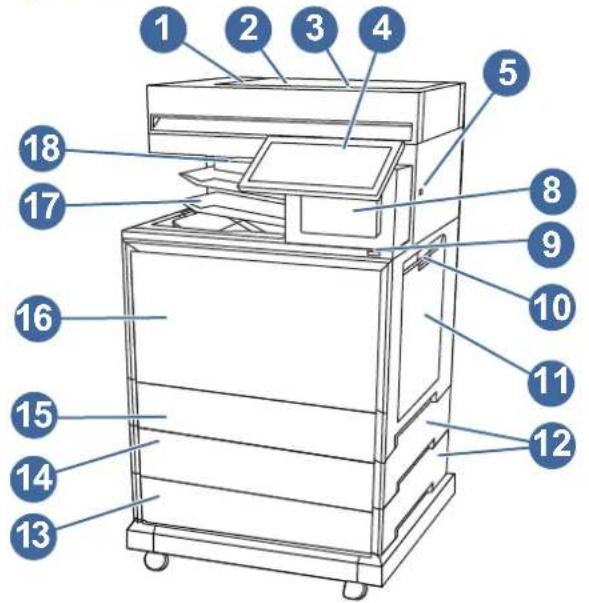
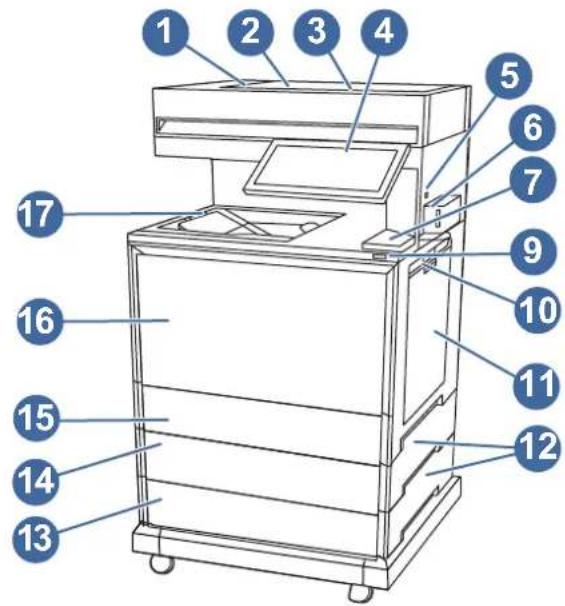
Item Description
| 1 Automatic document feeder output tray |
| 2 Automatic document feeder cover, for access for clearing jams |
| 3 Automatic document feeder input tray |
| 4 Control panel with color touchscreen display (tilts up for easier viewing) |
| 5 Easy-access USB portInsert a USB flash drive for printing or scanning without a computer or to update the printer firmware.NOTE: An administrator must enable this port before use. |
| 6 Convenience staplerNOTE: Not available on models that have the 3-bin stapler/stacker. |
| 7 Hardware integration pocket (HIP) for connecting accessory and third-party devices |
| 8 Staple access door (models with inner finisher) |
| 9 On/off button |
| 10 Right door, for access for clearing jams |
| 11 Tray 1 (multipurpose tray) |
| 12 Tray jam access doors |
| 13 Optional Tray 4 |
| 14 Optional Tray 3 |
| 15 Tray 2 |
| 16 Front door, for access to the toner cartridges |
| 17 Output bin (multi-bin output included with the zfsw models) |
| 18 Hardware integration pocket (HIP) location for models with an inner finisher |
Figure 1-7 Printer front view - zfw+ models
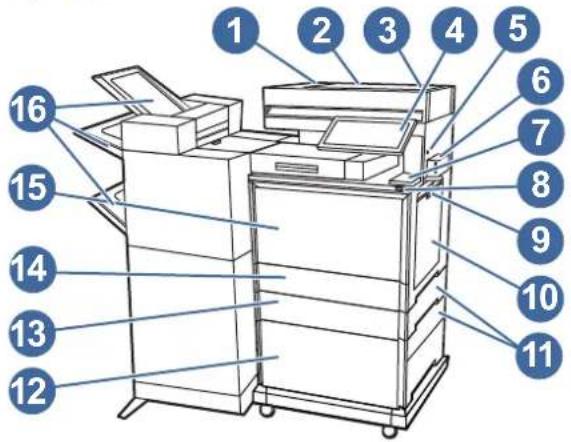
| Item Description |
| 1 Automatic document feeder output tray |
| 2 Automatic document feeder cover, for access for clearing jams |
| 3 Automatic document feeder input tray |
| 4 Control panel with color touchscreen display (tilts up for easier viewing) |
| 5 Easy-access USB portInsert a USB flash drive for printing or scanning without a computer or to update the printer firmware.NOTE: An administrator must enable this port before use. |
| 6 Convenience stapler |
| 7 Hardware Integration pocket (HIP) for connecting accessory and third-party devices |
| 8 On/off button |
| 9 Right door, for access for clearing jams |
| 10 Tray 1 (multipurpose tray) |
| 11 Tray jam access doors |
| 12 High-capacity input Tray 4 |
| 13 Tray 3 |
| 14 Tray 2 |
| 15 Front door, for access to the toner cartridges |
| 16 Output bins on the floor-standing finisher |
Printer back view
Locate features on the back of the printer.
Figure 1-8 Printer back view
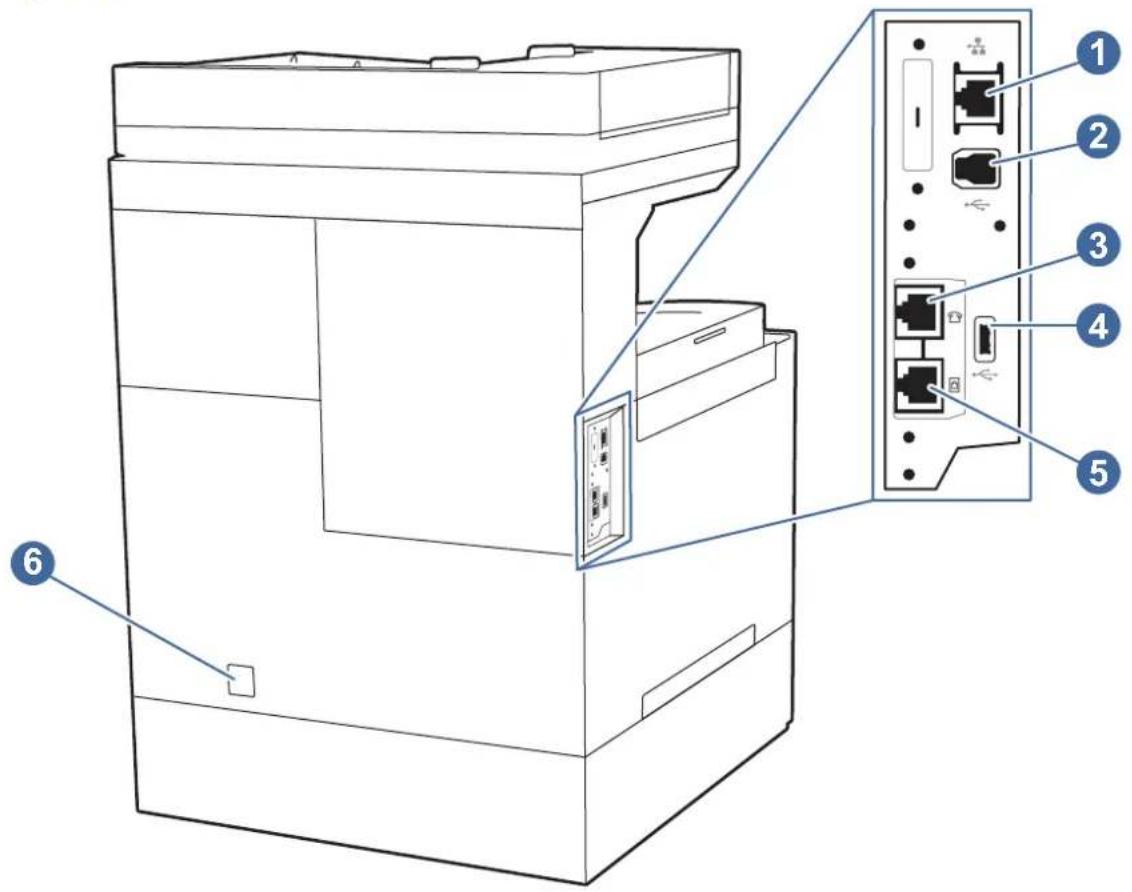
Item Description
1 Local area network (LAN) Ethernet (RJ-45) network port
2 SuperSpeed USB 3.0 Interface port
3 Telephone "line out" port (for attaching an extension phone, answering machine, or other device)
NOTE: This port should remain covered when not in use.
4 SuperSpeed USB 3.0 host port (for job storage and private printing)
NOTE: This port should remain covered when not in use.
5 Fax "line in" port (for attaching the fax phone line to the printer)
6 Power connection
Control-panel view
The control panel provides access to the printer features and indicates the current status of the printer.

NOTE: Tilt the control panel for easier viewing.
The Home screen provides access to the printer features and indicates the current status of the printer.

NOTE: The features that appear on the Home screen can vary, depending on the printer configuration.
Figure 1-9 Control-panel view
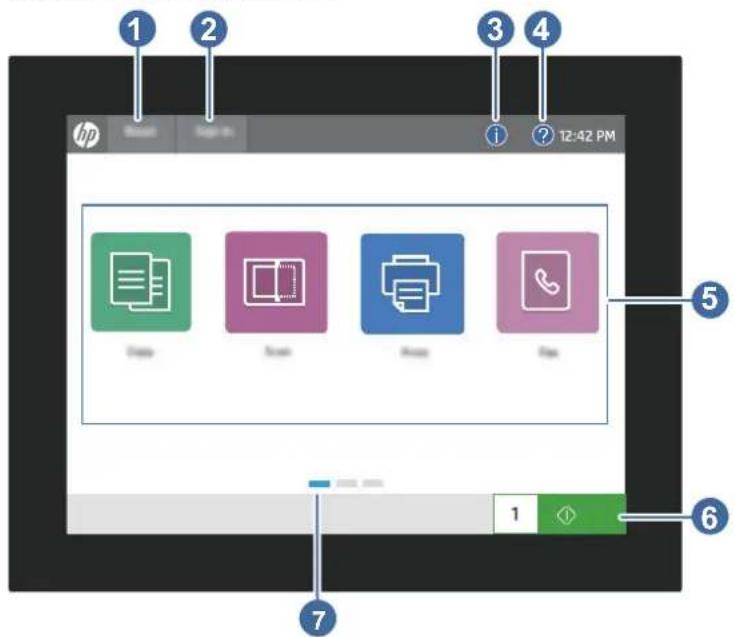
| Item Control Description | |
| 1 Reset button | The Reset button returns the printer to default settings and is always present if users are not logged in. The Reset button is not present when the Sign Out button is present. Touch the Reset button to resume and release jobs from the previous pause state and interrupt mode, reset the quick copy count in the copy count field, exit special modes, reset the display language and the keyboard layout. |
| 2 Sign In or Sign Out button | Touch the Sign In button to access secured features.Touch the Sign Out button to sign out of the printer. The printer restores all options to the default settings.NOTE: This button displays only if the administrator has configured the printer to require permission for access to features. |
| 3 Information button i | Touch the information button to access a screen that provides access to several types of printer information. Touch the buttons at the bottom of the screen for the following information:Display Language: Change the language setting for the current user session.Sleep Mode: Place the printer into sleep mode.Wi-Fi Direct: View Information for how to connect directly to the printer using a phone, tablet, or other device with Wi-Fi (only available when the optional wireless accessory is installed).Wireless: View or change wireless connection settings (only available when the optional wireless accessory is installed).Ethernet: View or change Ethernet connection settings.HP Web Services: View information to connect and print to the printer using HP Web Services (ePrint). |
| 4 Help button ? | Touch the Help button to open the embedded help system.The status line provides information about the overall printer status. |
| 5 Applications area Touch any of the icons to open the application. Swipe the screen sideways to access more applications.NOTE: The available applications vary by printer. The administrator can configure which applications appear and the order in which they appear. | |
| 6 Copy button | Touch the Copy button to start a copy job. |
| 7 Home-screen page indicator | Indicates the number of pages on the Home screen or in an application. The current page is highlighted. Swipe the screen sideways to scroll between pages. |
How to use the touchscreen control panel
Perform the following actions to use the printer touchscreen control panel.
Table 1-1 Touchscreen control panel actions
| Action Description Example | ||
| Touch Touch an item on the screen to select that item or open that menu. Also, when scrolling through menus, briefly touch the screen to stop the scrolling. | Touch the Settings icon to open the Settings app. | |
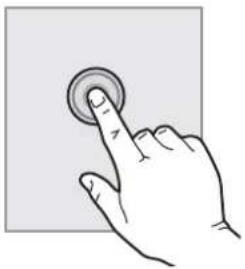 | ||
Table 1-1 Touchscreen control panel actions (continued)
| Action Description Example | |
| Swipe Touch the screen and then move your finger horizontally to scroll the screen sideways. | Swipe until the Settings app displays. |
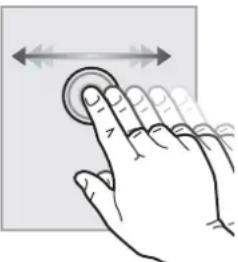 | |
| Scroll Touch the screen and then move your finger vertically to scroll the screen up and down. When scrolling through menus, briefly touch the screen to stop the scrolling. | Scroll through the Settings app. |
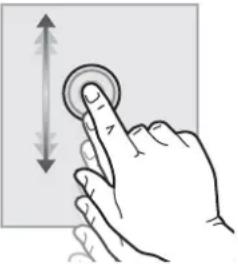 | |
Printer specifications
Determine the specifications for your printer model.
Technical specifications
Review the technical specifications for the printer.
Product numbers for each model
-6800dn - #6QN35A
-6800zf - #6QN36A
-6800zfsw - #6QN37A
-6800zfw+ - #6QN38A
- 6800 Configurable (can be custom-configured when ordered)
- 6801zfsw - #76H10A
-6801zfw+ - #76H11A
- 6801 Configurable (can be custom-configured when ordered)
Table 1-2 Paper handling specifications
| Paper handling features 6800dn 6800zf 6800zfsw | 6800zfw+6801zfw+ | 6800/6801 Configurable | |||
| Tray 1 (100-sheet capacity) | √ | √ | √ | √ | √ |
| Tray 2 (550-sheet capacity) | √ | √ | √ | √ | √ |
| Optional 550-sheet accessory tray | Optional Optional (2) Available option √ | √ | |||
| Printer stand Optional Optional Not available Available option | √ | ||||
| Printer stand with storage compartment | Optional Optional Not available Not available Available option | ||||
| 2,100-sheet High Capacity Paper Tray/Stand | Optional Optional Not available Available option | √ | |||
| Convenience stapler Optional Optional Not available Available option | √ | ||||
| 3-bin Stapler/stacker | Not available | Not available | √ | Not available | Available option |
| Floor-standing finisher with edge stapling and hole punch | Not available Not available Not available Available option | √ | |||
| Automatic duplex printing | √ | √ | √ | √ | √ |
Table 1-3 Connectivity specifications
| Connectivity features | 6800dn 6800zf 6800zfsw | 6801zfsw | 6800zfw+6801zfw+ | 6800/6801 Configurable | |
| 10/100/1000 Ethernet LAN connection with IPv4 and IPv6 | √ | √ | √ | √ | √ |
| Dual-band wireless | Optional Optional | √ | √Available option | ||
| Wifi-Direct and BLE | Optional Optional | √ | √Available option | ||
| SuperSpeed USB 3.0 rear ports and Hi-Speed USB 2.0 front port for walk-up USB printing | √ | √ | √ | √ | √ |
| Hardware Integration pocket (HIP) for connecting accessory and third-party devices | √ | √ | √ | √ | √ |
Table 1-4 Print specifications
| Print features | 6800dn 6800zf 6800zfsw | 6801zfw+ | 6800/6801 Configurable | ||
| 6800zfw+ | 6801zfsw | ||||
| Prints up to 52 pages per minute (ppm) on A4 and 55 ppm on letter-sized paper, with a maximum of 61 ppm on A4 and 65 ppm on letter-sized paper (configured at time of purchase) | √ | √ | √ | Not available Available option | |
| Print features 6800dn 6800zf 6800zfsw | 6801zfw+ | 6800/6801 Configurable | |||
| 6800zfw+ | 6801zfsw | ||||
| Prints up to 61 ppm on A4 and 65 ppm on letter-sized paper | Not available Not available Not available Available option | √ | |||
| Job storage and private printing | √ | √ | √ | √ | √ |
Table 1-5 Copy and scan specifications
| Copy and scan features 6800dn 6800zf 6800zfsw | 6800zfw+ | 6800/6801 Configurable | |||
| 6801zfsw | 6801zfw+ | ||||
| ADF copy/scan speed 160 images-per-minute (ipm) single-sided, and 80 ipm double-sided | √ | Not available Not available Not available Available option | |||
| ADF copy/scan speed 200 ipm single-sided, and 100 ipm double-sided | Not available Available option | √ | √ | ||
| 150-page document feeder with dual-head scanning for single-pass duplex copying and scanning | √ | √ | √ | √ | √ |
| Scan to E-mail, Scan to USB, and Scan to Network Folder options | √ | √ | √ | √ | √ |
Table 1-6 Other specifications
| Other features 6800dn 6800zf 6800zfsw | 6800zfw+ | 6800/6801 Configurable | |||
| 6801zfw | 6801zfw+ | ||||
| 6 GB base memory | √ | √ | √ | √ | √ |
| 500 GB Hard Disk Drive Available option | √ | √ | √ | √ | |
| 512 GB FIPS Hard Disk Drive Optional Optional Optional Available option | |||||
| 32 GB embedded Multi-Media Controller (eMMC) | Not available Not available Not available Not available Available option | ||||
| Small color touchscreen control panel | √ | Not available Not available Not available Available option | |||
| Large color touchscreen control panel | Not available Available option | √ | √ | ||
| Fax features | Optional | √ | √ | √ | Available option |
| HP Trusted Platform Module for encrypting all data that passes through the printer | √ | √ | √ | √ | √ |
Supported operating systems
Learn about supported operating systems.
The following information applies to the Printer-Specific Windows PCL 6 and HP print drivers for macOS and to the software installer.
Windows: The HP Software Installer can be downloaded from the printer support website for this printer and installs the correct "HP PCL.6" print driver, depending on the Windows operating system, along with optional software when using the software installer. Download the "HP PCL.6" print driver from the printer-support website for this printer: www.hp.com/support.
macOS: Mac computers are supported with this printer. Download HP Easy Start either from 123.hp.com or from the Printer Support page, and then use HP Easy Start to install the HP print driver. HP Easy Start is not included in the HP Software Installer.
-
Go to 123.hp.com.
-
Follow the steps provided to download the printer software.
Linux: For information and print drivers for Linux, go to www.hp.com/go/linuxprinting.
UNIX: For information and print drivers for UNIX ^® , go to www.hp.com/go/unixmodelscripts.
Table 1-7 Supported operating systems and print drivers
| Operating system Print driver installed (from the software on the web) | |
| Windows 7 SP1, 32-bit and 64-bit The "HP PCL 6" printer-specific print driver is installed for this operating system as part of the software installation. | |
| Windows 10, 32-bit and 64-bit The "HP PCL-6" printer-specific print driver is installed for this operating system as part of the software installation. | |
| Windows 11, 32-bit and 64-bit The "HP PCL-6" printer-specific print driver is installed for this operating system as part of the software installation. | |
| Windows Server 2003 SP2, 32-bit The "HP PCL 6" printer-specific print driver is available for download from the printer-support website. Download the driver, and then use the Microsoft Add Printer tool to install it.Microsoft retired mainstream support for Windows Server 2003 in July 2010. HP will continue to provide best effort support for the discontinued Server 2003 operating system. Some features and page sizes in the print driver are not supported. | |
| Windows Server 2008 R2, 64-bit The "HP PCL 6" printer-specific print driver is available for download from the printer-support website. Download the driver, and then use the Microsoft Add Printer tool to install it. | |
| Windows Server 2012, 64-bit The PCL 6 printer-specific print driver is available for download from the printer-support website. Download the driver, and then use the Microsoft Add Printer tool to install it. | |
| Windows Server 2012 R2, 64-bit The PCL 6 printer-specific print driver is available for download from the printer-support website. Download the driver, and then use the Microsoft Add Printer tool to install it. | |
| Windows Server 2016, 64-bit The PCL 6 printer-specific print driver is available for download from the printer-support website. Download the driver, and then use the Microsoft Add Printer tool to install it. | |
| Windows Server 2019, 64-bit The PCL 6 printer-specific print driver is available for download from the printer-support website. Download the driver, and then use the Microsoft Add Printer tool to install it. | |
| Windows Server 2022, 64-bit The PCL 6 printer-specific print driver is available for download from the printer-support website. Download the driver, and then use the Microsoft Add Printer tool to install it. | |
| macOS Catalina v10.15, macOS Big Sur v11.0, macOS Monterey v12.0 | To install the print driver, download HP Easy Start from 123.hp.com. Follow the steps provided to install the printer software and print driver. |

NOTE: Supported operating systems can change. For a current list of supported operating systems, go to support.hp.com for HP's all-inclusive help for the printer.

NOTE: For details on client and server operating systems and for HP UPD driver support for this printer, go to www.hp.com/go/upd. Under Additional information, click the links.
Table 1-8 Minimum system requirements
| Windows macOS | |
| •Internet connection | •Internet connection |
| •Dedicated USB 1.1 or 2.0 connection or a network connection | •1 GB of available hard-disk space |
| •2 GB of available hard-disk space | |
Mobile printing solutions
HP offers multiple mobile printing solutions to enable easy printing to an HP printer from a laptop, tablet, smartphone, or other mobile device.
To see the full list and to determine the best choice, go to www.hp.com/go/MobilePrinting.

NOTE: Update the printer firmware to ensure all mobile printing capabilities are supported.
• Wi-Fi Direct on wireless models
AirPrint
- Android Printing
• HP Smart app
Printer dimensions
Make sure your printer environment is large enough to accommodate the printer.
Figure 1-10 Printer dimensions (dn and zf models)
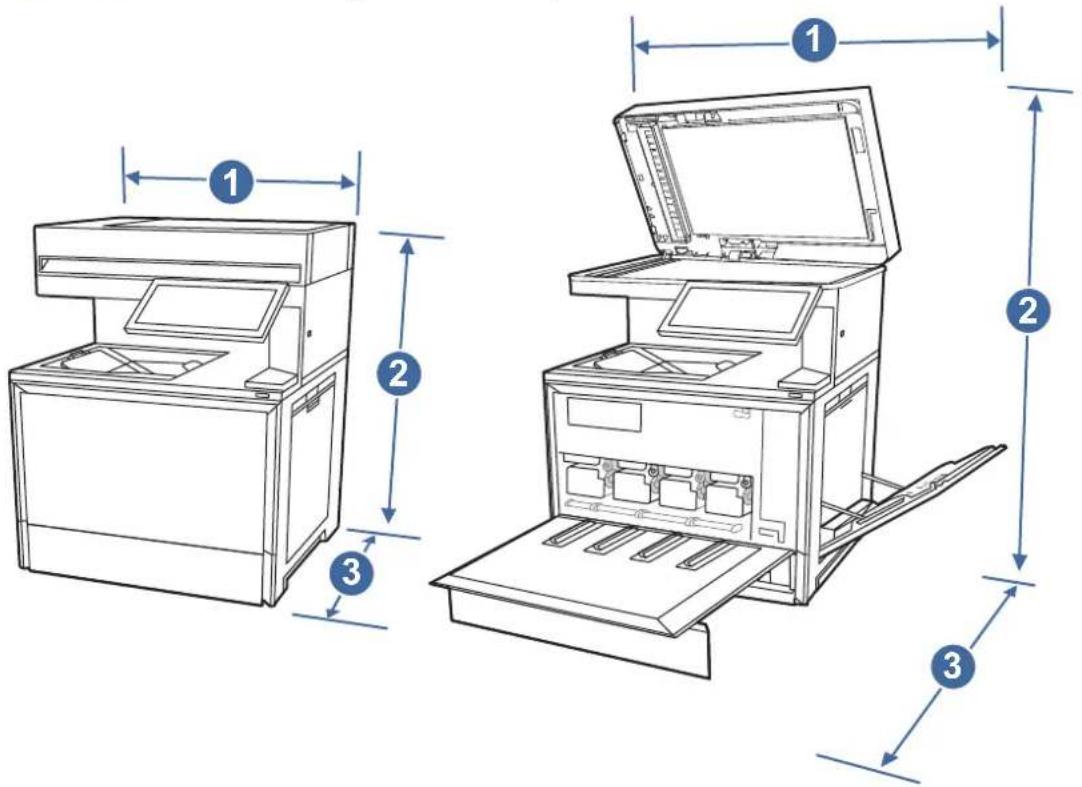
Table 1-9 Dimensions for the printer (dn and zf models)
| Measurement Printer fully closed Printer fully opened | |
| 1. Width 500 mm (19.6 in) 860 mm (33.8 in) | |
| 2. Height 657 mm (25.8 in) 912 mm (36 in) | |
| 3. Depth 460 mm (18.1 in) 770 mm (30.3 in) | |
| Weight (with cartridges) | 42.2 kg (93 lb) 42.2 kg (93 lb) |
Figure 1-11 Printer dimensions (zfsw models)
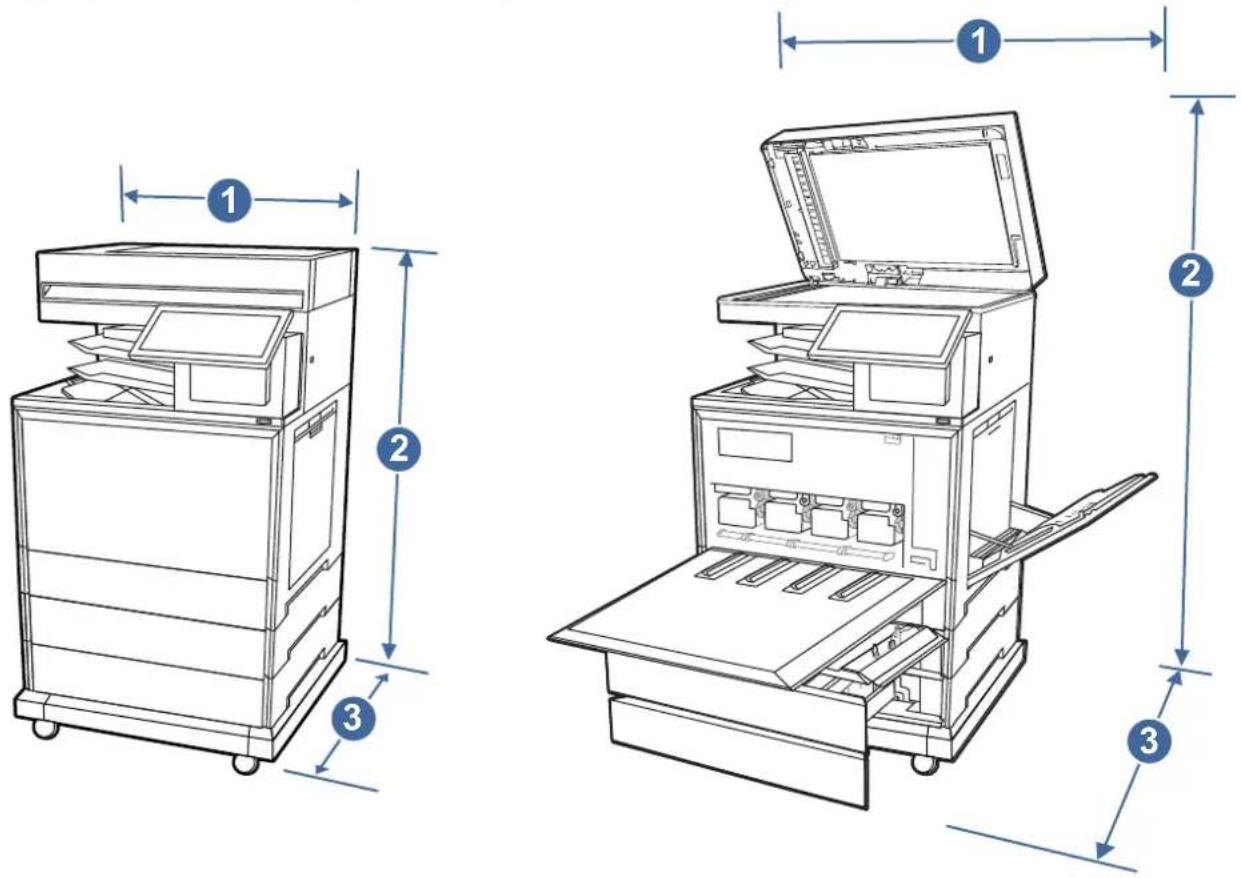
Table 1-10 Dimensions for the printer (zfsw models)
| Measurement Printer fully closed Printer fully opened | |
| 1. Width 520 mm (20.5 in) 860 mm (33.8 in) | |
| 2. Height 1155 mm (45.5 in) 1410 mm (55.5 in) | |
| 3. Depth 528 mm (20.8 in) 838 mm (33 in) | |
| Weight (with cartridges) | 79.45 kg (175.16 lb) 79.45 kg (175.16 lb) |
Figure 1-12 Printer dimensions (zfw+ models)
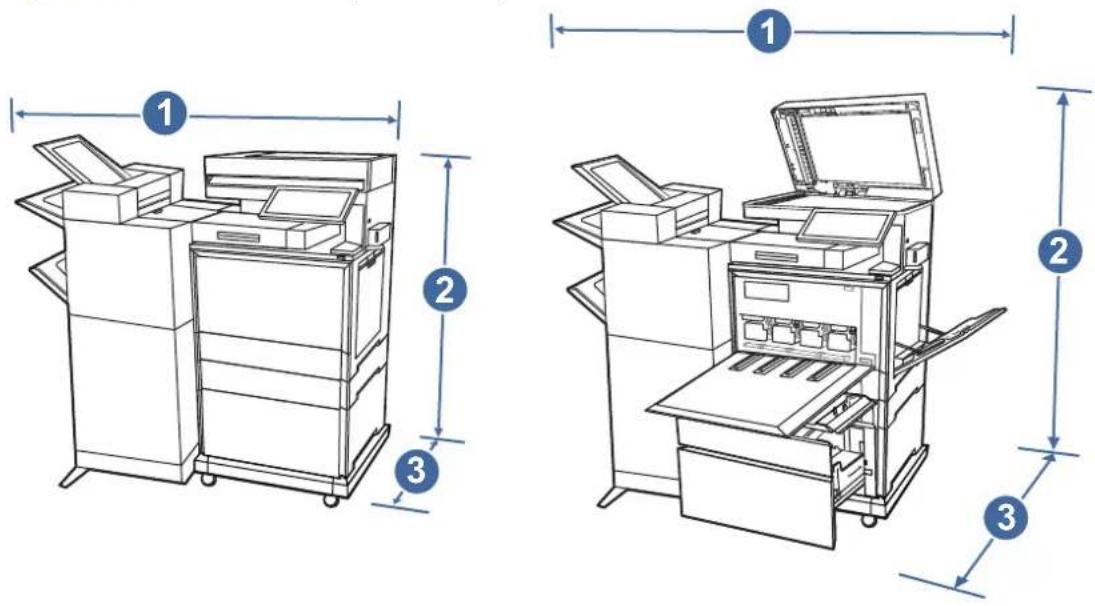
Table 1-11 Dimensions for the printer (zfw+ models)
| Measurement Printer fully closed Printer fully opened | |
| 1. Width 1228 mm (48.3 in) 1588 mm (62.5 in) | |
| 2. Height 1270 mm (50 in) 1393 mm (54.8 in) | |
| 3. Depth 520 mm (20.5 in) 905 mm (35.6 in) | |
| Weight (with cartridges) | 84.45 kg (186.2 lb) 84.45 kg (186.2 lb) |
Power consumption, electrical specifications, and acoustic emissions
In order to operate properly, the printer must be in an environment that meets certain power specifications.
See Support for HP Color LaserJet Enterprise MFP 6800 or Support for HP Color LaserJet Enterprise MFP 6801 for current information.
CAUTION: Power requirements are based on the country/region where the printer is sold. Do not convert operating voltages. This will damage the printer and void the printer warranty.
Operating-environment range
In order to operate properly, the printer must be in an environment that meets certain specifications.
Table 1-12 Operating-environment specifications
| Environment Recommended | Storage | |
| Temperature | 15° to 27°C (59° to 80.6°F) | 10° to 32.5°C (50° to 90.5°F) |
| Relative humidity | 30% to 70% relative humidity (RH) | 10% to 80% relative humidity (RH) |
Printer hardware setup and software installation
For basic setup instructions, see the Hardware Installation Guide that came with the printer. For additional instructions, go to HP support on the web.
Go to Support for HP Color LaserJet Enterprise MFP 6800 or Support for HP Color LaserJet Enterprise MFP 6801 for HP's all-inclusive help for the printer, which includes the following information:
• Install and configure
- Learn and use
- Solve problems
- Download software and firmware updates
- Join support forums
• Find warranty and regulatory information
- Find instructions about how to use the Microsoft Add Printer tool
Paper trays2
Discover how to load and use the paper trays, including how to load special items such as envelopes and labels.
The following information is correct at the time of publication. For current information, see Support for HP Color LaserJet Enterprise MFP 6800 or Support for HP Color LaserJet Enterprise MFP 6801.
For more information:
HP's all-inclusive help for the printer includes the following information:
• Install and configure
- Learn and use
- Solve problems
- Download software and firmware updates
- Join support forums
• Find warranty and regulatory information
Use caution when loading the paper trays.
CAUTION: Do not extend more than one paper tray at a time.
Do not use paper tray as a step.
All trays must be closed while relocating/moving product.
Keep hands out of paper trays or drawers when closing.
If the printer has a keyboard, close keyboard tray when not in use.
Load paper to Tray 1 (multipurpose tray)
The following information describes how to load paper in Tray 1.
CAUTION: To avoid jams, never add or remove paper from Tray 1 during printing.
Load Tray 1 (multipurpose tray)
This tray holds up to 100 sheets of 75 grams per square meter (20 lb) paper, or 10 envelopes.
NOTE: Select the correct paper type in the print driver before printing.
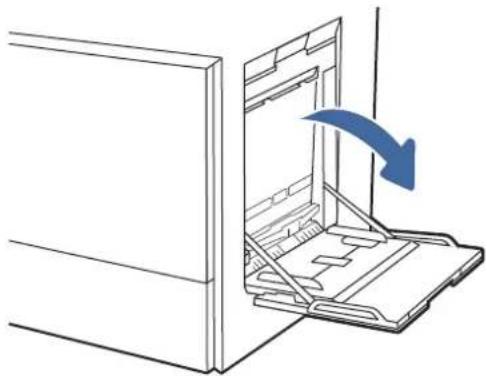
- Open Tray 1.
natural_image
Diagram of a door opening with a blue arrow indicating direction (no text or symbols)-
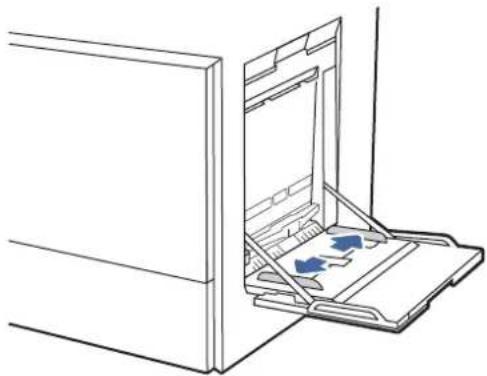
Pull out the tray extension to support the paper, if necessary.
-
Use the adjustment latch to spread the paper guides outward.
natural_image
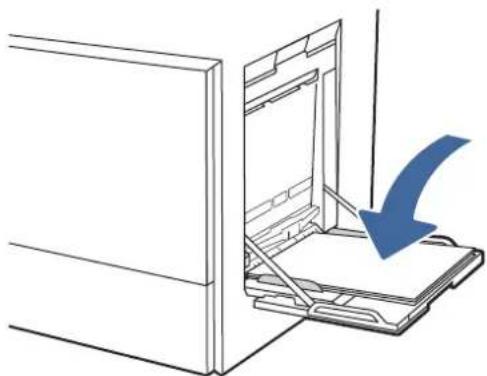
Line drawing of an open refrigerator with a tray and door, showing internal compartments (no text or symbols)- Load paper in the tray.
Make sure that the paper fits under the fill line on the paper guides.

NOTE: The maximum stack height is 10 mm (0.4 in), or approximately 100 sheets of 75 grams per square meter (20 lb) paper.
natural_image
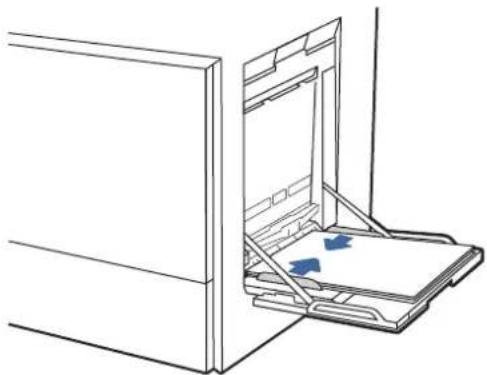
Line drawing of a refrigerator interior with an open drawer and a blue arrow indicating direction (no text or symbols)- Using the adjustment latch, adjust the side guides so that they lightly touch the paper stack, but do not bend it.
natural_image
Line drawing of a refrigerator interior with an open drawer and blue arrows indicating flow or movement (no text or symbols)Tray 1 (multipurpose tray) paper orientation
Position paper correctly in Tray 1 (multipurpose tray) to ensure the best print quality.
Table 2-1 Letterhead or preprinted paper - Portrait
| Duplex mode How to load paper | |
| 1-sided printing Face-down | Bottom edge leading into the printer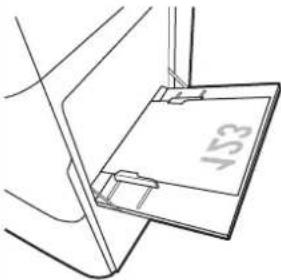 Right side of pre-printed image leading into the printer Right side of pre-printed image leading into the printer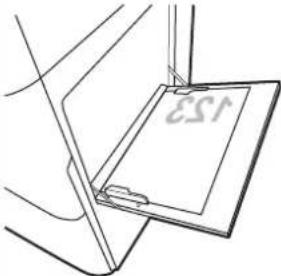 |
| Automatic 2-sided printing or with Alternative Letterhead Mode enabled | Face-upTop edge leading into the printer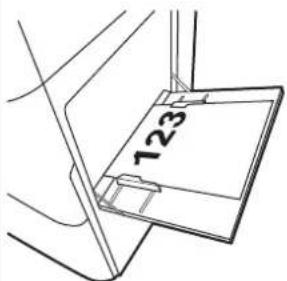 Left side of pre-printed image leading into the printer Left side of pre-printed image leading into the printer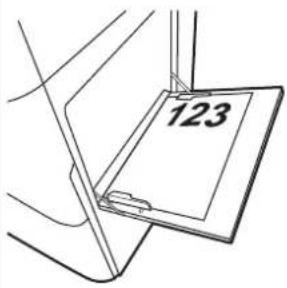 |
Table 2-2 Letterhead or preprinted paper - Landscape
| Duplex mode How to load paper | |
| 1-sided printing Face-down | Right edge of pre-printed image leading into the printer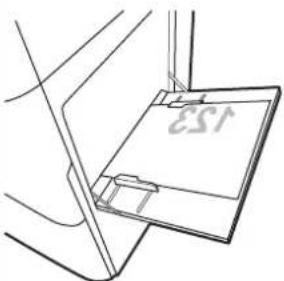 Bottom edge leading into the printer Bottom edge leading into the printer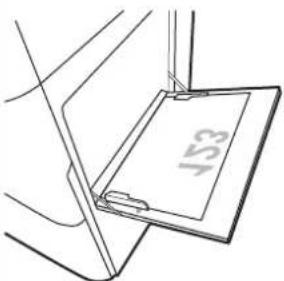 |
| Automatic 2-sided printing or with Alternative Letterhead Mode enabled | Face-upLeft side of the pre-printed image leading into the printer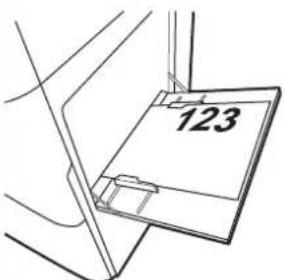 Top edge leading into the printer Top edge leading into the printer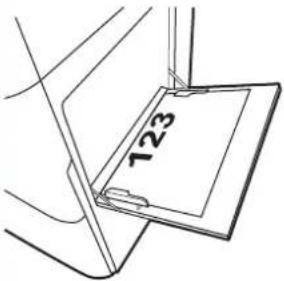 |
Table 2-3 Prepunched paper - Portrait
| Duplex mode How to load paper | |
| 1-sided printing Face-down | Holes toward the back of the printer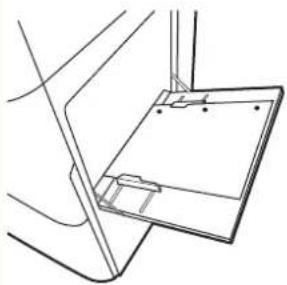 |
| Automatic 2-sided printing or with Alternative Letterhead Mode enabled | Face-upHoles toward the back of the printer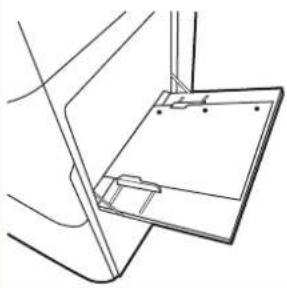 |
Table 2-4 Prepunched paper - Landscape
| Duplex mode How to load paper | |
| 1-sided printing Face-down | Holes away from the printer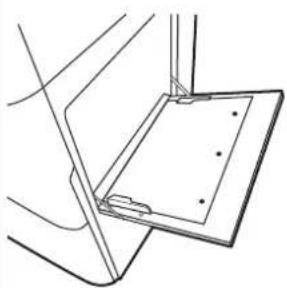 |
| Automatic 2-sided printing or with Alternative Letterhead Mode enabled | Face-upHoles towards the printer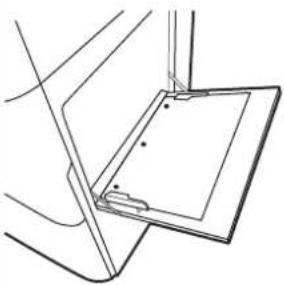 |
Load paper to Tray 2
Review the following information about loading paper to Tray 2.
Load Tray 2 or the optional 550-sheet trays
These trays hold up to 550 sheets of 75 grams per square meter (20 lb) paper.

NOTE: The procedure to load paper to Tray 2 or the optional 550-sheet trays is the same. Only Tray 2 is shown here.
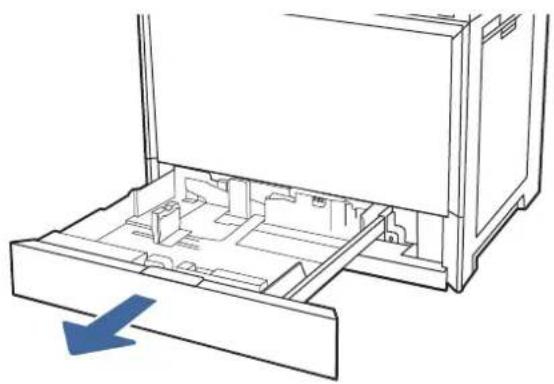
- Open the tray.

NOTE: Do not open any tray while it is in use.
natural_image
Line drawing of a computer chassis with an open drawer and internal compartments, showing a blue arrow indicating compression or disassembly (no text or symbols present)- Before loading paper, adjust the paper-width guides by holding down the blue lock/unlock toggle switch on the rear paper-width guide, pinching the blue adjustment latch on the front paper-width guide, and then sliding the guides to the fully open position.
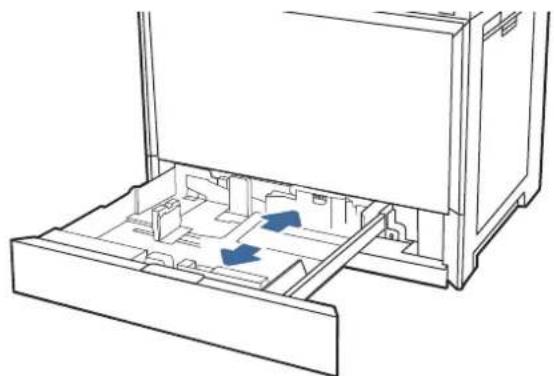
natural_image
Diagram of a computer chassis showing internal components and directional arrows (no text or symbols)- Adjust the paper-length guide by pushing in at the bottom of the blue adjustment latch while sliding the guide to the size of the paper being used.
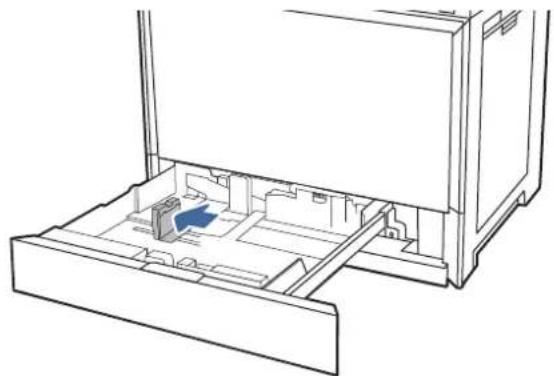
natural_image
Line drawing of an open electronic device with internal components and a blue logo on the base (no text or symbols)- Load paper into the tray.
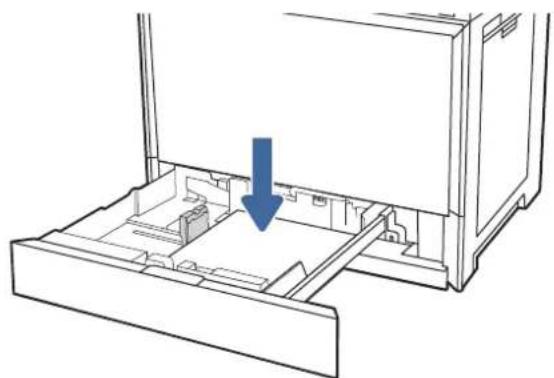
natural_image
Diagram of a device's internal structure showing a blue arrow pointing to a component (no text or symbols present)- Adjust the paper-length and paper-width guides to the size of the paper being used. Check the paper to verify the guides lightly touch the stack, but do not bend it.

NOTE: Do not adjust the paper guides tightly against the paper stack. Adjust them to the indentations or markings in the tray.

NOTE: To prevent jams, adjust the paper guides to the correct size and do not overfill the tray. Be sure that the top of the stack is below the tray full indicator.
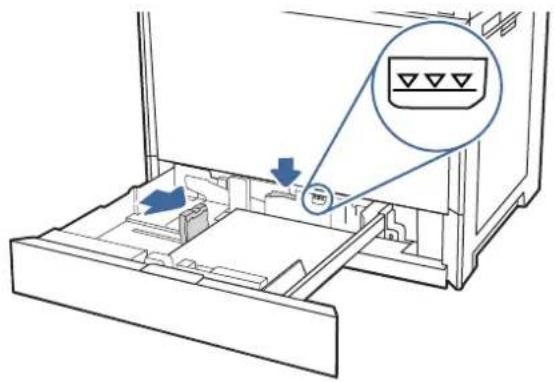
- Close the tray.
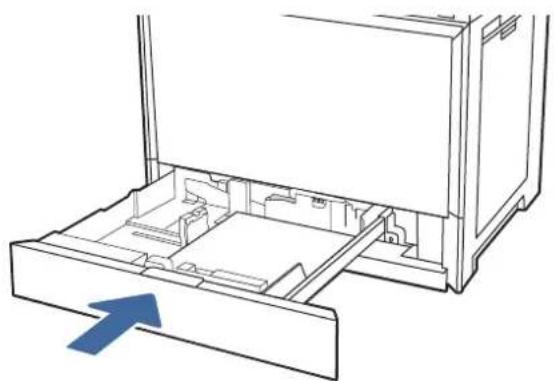
natural_image
Line drawing of a computer drawer with an arrow indicating direction (no text or symbols present)-
The tray configuration message displays on the printer control panel.
-
Select OK to accept the detected type and size, or select Modify to choose a different paper size or type.
For custom-size paper, specify the X and Y dimensions for the paper when the prompt displays on the printer control panel.
Tray 2 and the optional 550-sheet trays paper orientation
Position paper correctly in Tray 2 and the optional 550-sheet trays to ensure the best print quality.
Table 2-5 Letterhead or preprinted paper - Portrait
| Duplex mode How to load paper | |
| 1-sided printing Face-up | Top edge at the back of the tray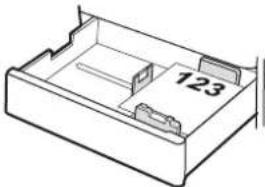 Top edge at the left side of the tray Top edge at the left side of the tray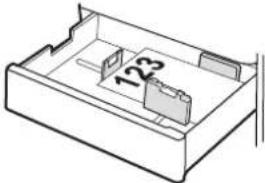 |
| Automatic 2-sided printing or with Alternative Letterhead Mode enabled | Face-downTop edge at the back of the trayNOTE: This is the preferred orientation when printing on A4 or Letter.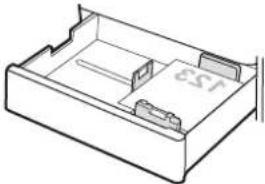 Top edge at the right side of the tray Top edge at the right side of the tray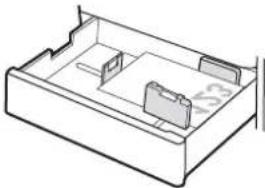 |
Table 2-6 Letterhead or preprinted paper - Landscape
| Duplex mode How to load paper | |
| 1-sided printing Face-up | Top edge at the left side of the tray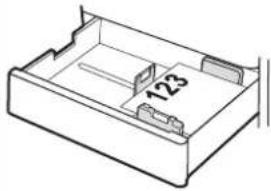 Top edge at the back of the tray Top edge at the back of the tray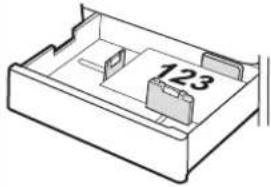 |
| Automatic 2-sided printing or with Alternative Letterhead Mode enabled | Face-downTop edge at the right side of the tray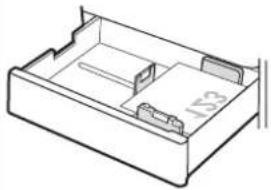 Top edge at the back of the tray Top edge at the back of the tray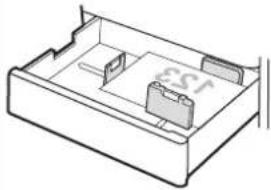 |
Table 2-7 Prepunched paper - Portrait
| Duplex mode How to load paper | |
| 1-sided printing Face-up | Holes at the left side of the tray, with the top of the form at the rear of the printer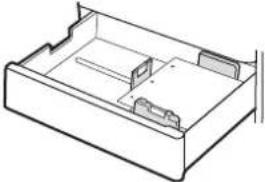 Holes at the back of the tray Holes at the back of the tray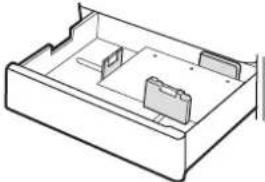 |
| Automatic 2-sided printing or with Alternative Letterhead Mode enabled | Face-downHoles at the right side of the tray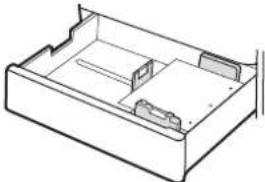 Holes at the back of the tray Holes at the back of the tray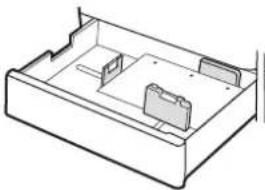 |
Use alternative letterhead mode
Use the Alternative Letterhead Mode feature to load letterhead or preprinted paper into the tray the same way for all jobs, whether printing to one side of the sheet of paper or to both sides. When using this mode, load paper as for automatic duplex printing.
Enable Alternative Letterhead Mode by using the printer control-panel menus
Use the Settings menu to enable Alternative Letterhead Mode.
- From the Home screen on the printer control panel, open the Settings menu.
- Open the following menus:
a. Copy/Print or Print
b. Manage Trays
c. Alternative Letterhead Mode
- Select On.
Load and print envelopes
To print on envelopes, use only Tray 1 (multipurpose tray). Tray 2 and the optional 550-sheet trays do not support envelopes. Tray 1 (multipurpose tray) holds up to 10 envelopes.
Print envelopes
To print envelopes using the manual feed option, follow these steps to select the correct settings in the print driver, and then load the envelopes into the tray after sending the print job to the printer.
- From the software program, select the Print option.
- Select the printer from the list of printers, and then click the Properties or Preferences button to open the print driver.

NOTE: The name of the button varies for different software programs.
-
Click the Paper/Quality tab.
-
In the Paper size drop-down list, select the correct size for the envelopes.
- In the Paper type drop-down list, select Envelope.
- In the Paper source drop-down list, select Manual feed.
- Click the OK button to close the Document Properties dialog box.
- In the Print dialog box, click the OK button to print the job.
Envelope orientation
Envelopes need to be loaded in a specific manner in order to print correctly.
Table 2-8 Envelope orientation
| Tray Envelope size How to load envelopes | |
| Tray 1 Envelope #9, Envelope #10, Envelope Monarch, Envelope DL, Envelope B5, Envelope C5 (wallet), Envelope C6 | Face-downTop edge toward the back of the printer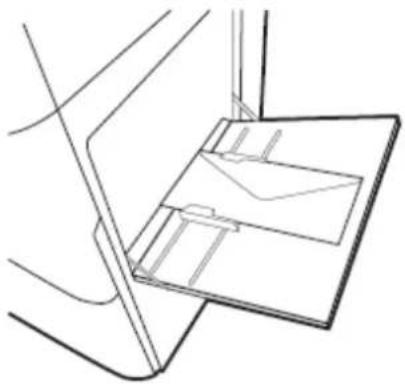 |
| Tray 1 Envelope B5, Envelope C5 (pocket) Face-down | Bottom edge leading into the printer; top flap open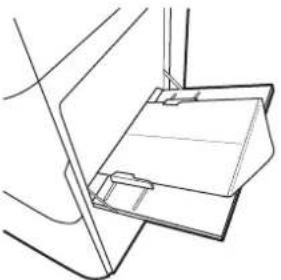 |
Load and print labels
To print on sheets of labels, use only Tray 1 (multipurpose tray). Tray 2, Tray 3 and the optional 2 x 520-sheet trays do not support labels.
Manually feed labels
Use the manual feed mode for Tray 1 (multipurpose tray) to print sheets of labels.
- From the software program, select the Print option.
- Select the printer from the list of printers, and then click the Properties or Preferences button to open the print driver.

NOTE: The name of the button varies for different software programs.
-
Click the Paper/Quality tab.
-
In the Paper size drop-down list, select the correct size for the sheets of labels.
-
In the Paper type drop-down list, select Labels.
- In the Paper source drop-down list, select Manual feed.
- Click the OK button to close the Document Properties dialog box.
- In the Print dialog box, click the Print button to print the job.
Label orientation
Labels need to be loaded in a specific manner in order to print correctly.
Table 2-9 Label orientation
| Tray How to load labels |
| Tray 1 Face-downBottom edge leading into the printer |
Supplies, accessories, and parts3
Order supplies or accessories, replace the toner cartridges, or remove and replace another part.
The following information is correct at the time of publication. For current information, see Support for HP Color LaserJet Enterprise MFP 6800 or Support for HP Color LaserJet Enterprise MFP 6801.
HP's all-inclusive help for the printer includes the following information:
• Install and configure
- Learn and use
- Solve problems
- Download software and firmware updates
- Join support forums
● Find warranty and regulatory information
Order supplies, accessories, and parts
Find out how to obtain replacement supplies, accessories, and parts for the printer.
Ordering
Order parts, supplies, or accessories through one of the following channels.
Table 3-1 Ordering options
| Ordering option Ordering information | |
| Order supplies and paper www.hp.com | ____ |
| Order genuine HP parts or accessories www.hp.com/buy/parts | ____ |
| Order through service or support providers Contact an HP-authorized service or support provider. | |
| Order using the HP Embedded Web Server (EWS) To access, in a supported web browser on your computer, enter the printer IP address or host name in the address/URL field. The EWS contains a link to the HP website, which provides options for purchasing Original HP supplies. | |
Supplies and accessories
Find information about the supplies and accessories that are available for your printer.

NOTE: Cartridges are for distribution and use with their designated product only; they will not work with other printer models.
Table 3-2 Supplies
| Item Cartridge number Part number | ||
| HP 213A Black Original LaserJet Toner Cartridge | 213A W2130A | |
| HP 213A Cyan Original LaserJet Toner Cartridge | 213A W2131A | |
| HP 213A Yellow Original LaserJet Toner Cartridge | 213A W2132A | |
| HP 213A Magenta Original LaserJet Toner Cartridge | 213A W2133A | |
| HP 213X High Yield Black Original LaserJet Toner Cartridge | 213X W2130X | |
| HP 213X High Yield Cyan Original LaserJet Toner Cartridge | 213X W2131X | |
| HP 213X High Yield Yellow Original LaserJet Toner Cartridge | 213X W2132X | |
| HP 213X High Yield Magenta Original LaserJet Toner Cartridge | 213X W2133X | |
| HP 213Y Extra High Yield Black Original LaserJet Toner Cartridge | 213Y W2130Y | |
| HP 213Y Extra High Yield Cyan Original LaserJet Toner Cartridge | 213Y W2131Y | |
| HP 213Y Extra High Yield Yellow Original LaserJet Toner Cartridge | 213Y W2132Y | |
| HP 213Y Extra High Yield Magenta Original LaserJet Toner Cartridge | 213Y W2133Y | |
| HP 217Z Ultra High Yield Black Original LaserJet Toner Cartridge | 217Z W2170Z | |
| HP 217Z Ultra High Yield Cyan Original LaserJet Toner Cartridge | 217Z W2171Z | |
| HP 217Z Ultra High Yield Yellow Original LaserJet Toner Cartridge | 217Z W2172Z | |
| HP 217Z Ultra High Yield Magenta Original LaserJet Toner Cartridge | 217Z W2173Z | |
| HP Staple cartridge pack for the convenience stapler - contains two staple cartridges with 1500 staples each | Not applicable Q7432A | |
| HP Staple Cartridge Refill for the floor-standing finisher or 3-bin stapler/stacker | Not applicable J8J96A |
Table 3-3 Accessories
| Item Description Part number | ||
| HP Color LaserJet 550-sheet Paper Tray Optional (Tray 3) 550-sheet paper feeder 6QN57A | ||
| HP LaserJet 2100 Sheet Paper Tray Optional 2,100-sheet high-capacity paper feeder and stand | 6QN58A | |
| HP Color LaserJet Storage Stand Optional printer stand with storage space | 6QN55A | |
| HP Color LaserJet Stand Optional printer stand 6QN54A | ||
| HP MFP Analog Fax 702 Accessory Optional fax accessory 1M0Q0A | ||
| HP MFP Analog Fax 703 Accessory Optional fax accessoryNOTE: Available in Korea only. | 1M0Q1A | |
| HP LaserJet Workflow Accelerator Card Accelerator card 1M0Q5A | ||
| HP Printing Voice Assistant Accessory to add voice command and screen reader functions to the printer | 478C2A | |
| HP Accessibility Kit | Accessibility tools including an accessible keyboard, prop handle, and braille labels | 2TD64A |
| HP Internal USB Expansion Kit | Two optional USB ports for connecting third-party devices | 4XN67A |
| HP Jetdirect LAN Accessory | HP Jetdirect accessory for network connectivity | 8FP31A |
| HP Foreign Interface Harness | Optional port for connecting third-party devices | B5L31A |
| HP LaserJet Workflow Keyboard - US | External keyboard for Flow models only | 1M0Q2A |
| HP LaserJet Workflow Keyboard - UK | External keyboard for Flow models only | 616H2A |
| HP LaserJet Keyboard Overlay Kit for Simplified Chinese & Traditional Chinese | Language-specific, adhesive overlay for the physical keyboard | A7W12A |
| HP LaserJet Keyboard Overlay Kit-Danish/French-Switzerland/German-Switzerland | Language-specific, adhesive overlay for the physical keyboard | A7W13A |
| HP LaserJet Swedish Overlay Keyboard | Language-specific, adhesive overlay for the physical keyboard | A7W14A |
| HP USB Universal Card Reader | Multiple-protocol proximity card reader | X3D03A |
| HP HIP2 Keystroke Reader | Dual-band, keystroke card reader that can read up to four different card types simultaneously | Y7C05A |
| HP Legic Secure USB Reader | Authentication card reader | 4QL32A |
| HP Removable Hard Drive Enclosure | Hard drive enclosure that can be locked | 2NR12A |
| HP LaserJet Secure Solid State Drive | Solid state hard drive | 1M0Q4A |
| HP 500GB CCC FIPS Hard Disk Drive | Hard disk drive | 9EQ11A |
| HP 500GB CCC FIPS TAA Hard Disk Drive | TAA-compliant hard disk drive | 6HN31A |
| HP Jetdirect 3100w BLE/NFC/Wireless | HP Jetdirect accessory for Wi-Fi, BLE, NFC, and proximity badge reading | 3JN69A |
Customer self-repair parts
Customer self-repair (CSR) parts are available for many HP LaserJet printers to reduce repair time.

NOTE: More information about the CSR program and benefits can be found at www.hp.com/go/csr-support and www.hp.com/go/csr-faq.
Genuine HP replacement parts can be ordered at www.hp.com/buy/parts or by contacting an HP-authorized service or support provider. When ordering, one of the following will be needed: part number, serial number (found on back of printer), product number, or printer name.
- Parts listed as Mandatory self-replacement are to be installed by the customer unless the customer is willing to pay HP service personnel to perform the repair. For these parts, on-site or return-to-depot support is not provided under the HP printer warranty.
- Parts listed as Optional self-replacement can be installed by HP service personnel at your request for no additional charge during the printer warranty period.
Table 3-4 Customer self-repair (CSR) parts
| Item Description Self-replacement | options | Part number | |
| 550-sheet paper input tray Replacement cassette for Tray 2 Mandatory TBD | |||
| HP Color LaserJet 550 sheet Paper Tray | 550-sheet paper feeder (optional Tray 3) | Mandatory 6QN57A | |
Configure the HP toner-cartridge-protection supply settings
A network administrator can configure the toner-cartridge-protection settings using the printer control panel or the HP Embedded Web Server (EWS).
Introduction
Use HP Cartridge Policy and Cartridge Protection to control which cartridges are installed in the printer and protect the cartridges that are installed from theft.
In HP Web Jetadmin, the settings are located under the Device Management pane in the following menu chain: Config > Supplies > Cartridge Policy or Cartridge Protection.
- Cartridge Policy: This feature protects the printer from counterfeit toner cartridges by allowing only genuine HP cartridges to be used with the printer. Using genuine HP cartridges ensures the best possible print quality. When someone installs a cartridge that is not a genuine HP cartridge, the printer control panel displays a message that the cartridge is unauthorized and it provides information explaining how to proceed.
- Cartridge Protection: This feature permanently associates toner cartridges with a specific printer, or fleet of printers, so they cannot be used in other printers. Protecting cartridges protects your investment. When this feature is enabled, if someone attempts to transfer a protected cartridge from the original printer into an unauthorized printer, that printer will not print with the protected cartridge. The printer control panel displays a message that the cartridge is protected, and it provides information explaining how to proceed.
CAUTION: After enabling cartridge protection for the printer, all subsequent toner cartridges installed in the printer are automatically and permanently protected. To avoid protecting a new cartridge, disable the feature before installing the new cartridge.
Turning the feature off does not turn off protection for cartridges that are currently installed.
Enable or disable the Cartridge Policy feature
The Cartridge Policy feature can be enabled or disabled using the control panel or the Embedded Web Server (EWS).

NOTE: Enabling or disabling this feature might require entering an administrator password.
Check with your administrator to determine if an administrator password has been set. EWS passwords cannot be recovered.
Use the printer control panel to enable the Cartridge Policy feature
From the printer control panel, a network administrator can enable the Cartridge Policy feature. This allows only genuine HP cartridges to be used with the printer.
- From the Home screen on the printer control panel, navigate to the Settings application, and then select the Settings icon.
- Open the following menus:
a. Manage Supplies
b. Cartridge Policy
- Select Authorized HP.
Use the printer control panel to disable the Cartridge Policy feature
From the printer control panel, a network administrator can disable the Cartridge Policy feature. This removes the restriction that only genuine HP cartridges can be used.
- From the Home screen on the printer control panel, navigate to the Settings application, and then select the Settings icon.
- Open the following menus:
a. Manage Supplies
b. Cartridge Policy
- Select Off.
Use the HP Embedded Web Server (EWS) to enable the Cartridge Policy feature
From the EWS, a network administrator can enable the Cartridge Policy feature. This allows only genuine HP cartridges to be used with the printer.
- Open the HP Embedded Web Server (EWS):
a. From the Home screen on the printer control panel, touch the Information icon i, and then touch the Ethernet icon to display the IP address or host name.
b. Open a web browser, and in the address line, type the IP address or host name exactly as it displays on the printer control panel. Press the Enter key on the computer keyboard. The EWS opens.

https://10.10.XX.XXX

NOTE: If the web browser displays a message indicating that accessing the website might not be safe, select the option to continue to the website. Accessing this website will not harm the computer.
- Open the Copy/Print tab.
- From the left navigation pane, select Manage Supplies.
- In the Supply Settings area, select Authorized HP from the Cartridge Policy drop-down list.
- Click the Apply button to save the changes.
Use the HP Embedded Web Server (EWS) to disable the Cartridge Policy feature
From the EWS, a network administrator can disable the Cartridge Policy feature. This removes the restriction that only genuine HP cartridges can be used.
- Open the HP Embedded Web Server (EWS):
a. From the Home screen on the printer control panel, touch the Information icon i, and then touch the Ethernet icon to display the IP address or host name.
b. Open a web browser, and in the address line, type the IP address or host name exactly as it displays on the printer control panel. Press the Enter key on the computer keyboard. The EWS opens.

https://10.10.XX.XXX

NOTE: If the web browser displays a message indicating that accessing the website might not be safe, select the option to continue to the website. Accessing this website will not harm the computer.
- Open the Copy/Print tab.
- From the left navigation pane, select Manage Supplies.
- In the Supply Settings area, select Off from the Cartridge Policy drop-down list.
- Click the Apply button to save the changes.
Troubleshoot Cartridge Policy control panel error messages
Review the recommended actions for Cartridge Policy error messages.
Table 3-5 Cartridge Policy control panel error messages
| Error message Description Recommended action | |
| 10.0X.30 UnauthorizedCartridge The administrator has configured this printer to use only genuine HP supplies that are still under warranty. The cartridge must be replaced to continue printing. | Replace the cartridge with a genuine HP toner cartridge.If you believe you purchased a genuine HP supply, visitwww.hp.com/go/anticounterfeit to determine if the toner cartridge is a genuine HP cartridge, and learn what to do if it is not a genuine HP cartridge. |
Enable or disable the Cartridge Protection feature
The Cartridge Protection feature can be enabled or disabled using the control panel or the Embedded Web Server (EWS).

NOTE: Enabling or disabling this feature might require entering an administrator password.
Check with your administrator to determine if an administrator password has been set. EWS passwords cannot be recovered.
Use the printer control panel to enable the Cartridge Protection feature
From the printer control panel, a network administrator can enable the Cartridge Protection feature. This protects the cartridges associated with the printer from being stolen and used in other printers.
- From the Home screen on the printer control panel, navigate to the Settings application, and then select the Settings icon.
- Open the following menus:
a. Manage Supplies
b. Cartridge Protection
- Select Protect Cartridges.
- When the printer prompts to confirm, select Continue to enable the feature.

CAUTION: After enabling cartridge protection for the printer, all subsequent toner cartridges installed in the printer are automatically and permanently protected. To avoid protecting a new cartridge, disable the feature before installing the new cartridge.
Turning the feature off does not turn off protection for cartridges that are currently installed.
Use the printer control panel to disable the Cartridge Protection feature
From the printer control panel, a network administrator can disable the Cartridge Protection feature. This removes protection for any new cartridges installed in the printer.
-
From the Home screen on the printer control panel, navigate to the Settings application, and then select the Settings icon.
-
Open the following menus:
a. Manage Supplies
b. Cartridge Protection
- Select Off.
Use the HP Embedded Web Server (EWS) to enable the Cartridge Protection feature
From the EWS, a network administrator can enable the Cartridge Protection feature. This protects the cartridges associated with the printer from being stolen and used in other printers.
- Open the HP Embedded Web Server (EWS):
a. From the Home screen on the printer control panel, touch the Information icon i, and then touch the Ethernet icon to display the IP address or host name.
b. Open a web browser, and in the address line, type the IP address or host name exactly as it displays on the printer control panel. Press the Enter key on the computer keyboard. The EWS opens.
https://10.10.XX.XXX
NOTE: If the web browser displays a message indicating that accessing the website might not be safe, select the option to continue to the website. Accessing this website will not harm the computer.
-
Open the Copy/Print tab.
-
From the left navigation pane, select Manage Supplies.
-
In the Supply Settings area, select Protect cartridges from the Cartridge Protection drop-down list.
-
Click the Apply button to save the changes.
CAUTION: After enabling cartridge protection for the printer, all subsequent toner cartridges installed in the printer are automatically and permanently protected. To avoid protecting a new cartridge, disable the feature before installing the new cartridge.
Turning the feature off does not turn off protection for cartridges that are currently installed.
Use the HP Embedded Web Server (EWS) to disable the Cartridge Protection feature
From the EWS, a network administrator can disable the Cartridge Protection feature. This removes protection for any new cartridges installed in the printer.
- Open the HP Embedded Web Server (EWS):
a. From the Home screen on the printer control panel, touch the Information icon i, and then touch the Ethernet icon to display the IP address or host name.
b. Open a web browser, and in the address line, type the IP address or host name exactly as it displays on the printer control panel. Press the Enter key on the computer keyboard. The EWS opens.
https://10.10.XX.XXX

NOTE: If the web browser displays a message indicating that accessing the website might not be safe, select the option to continue to the website. Accessing this website will not harm the computer.
- Open the Copy/Print tab.
- From the left navigation pane, select Manage Supplies.
- In the Supply Settings area, select Off from the Cartridge Protection drop-down list.
- Click the Apply button to save the changes.
Troubleshoot Cartridge Protection control panel error messages
Review the recommended actions for Cartridge Protection error messages.
Table 3-6 Cartridge Protection control panel error messages
| Error message Description Recommended action | ||
| 10.0X.57 ProtectedCartridge The cartridge can only be used in the printer or fleet of printers that initially protected it using HP Cartridge Protection.The Cartridge Protection feature allows an administrator to restrict cartridges to work in only one printer or fleet of printers. The cartridge must be replaced to continue printing. | Replace the cartridge with a new toner cartridge. | |
Replace the toner cartridges
Replace the toner cartridges if you receive a message on the printer, or if you have print quality problems.
Toner cartridge information
Review details about ordering replacement toner cartridges.
The printer indicates when the toner-cartridge level is low and very low. The actual toner cartridge life remaining can vary. Consider having a replacement cartridge available to install when print quality is no longer acceptable.
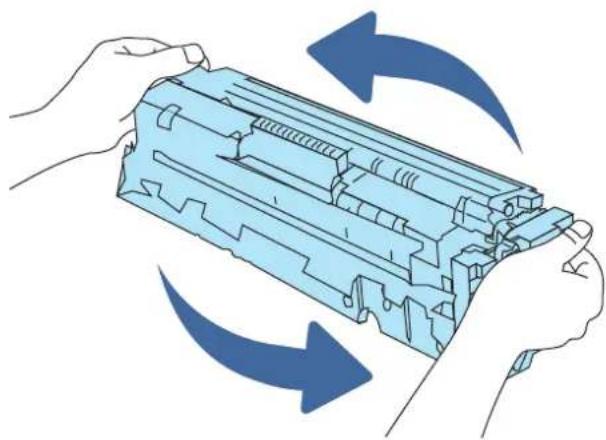
Continue printing with the current cartridge until redistributing the toner no longer yields acceptable print quality. To redistribute the toner, remove the toner cartridge from the printer and gently rock the cartridge back and forth end to end. For graphical representation, see the cartridge replacement instructions. Reinsert the toner cartridge into the printer, and then close the cover.
To purchase cartridges or check cartridge compatibility for the printer, go to www.hp.com/go/suresupply. Scroll to the bottom of the page and verify that the country/region is correct.
Table 3-7 Supplies
| Item Cartridge number Part number | ||
| HP 213A Black Original LaserJet Toner Cartridge | 213A W2130A | |
| HP 213A Cyan Original LaserJet Toner Cartridge | 213A W2131A | |
| HP 213A Yellow Original LaserJet Toner Cartridge | 213A W2132A | |
| HP 213A Magenta Original LaserJet Toner Cartridge | 213A W2133A | |
| HP 213X High Yield Black Original LaserJet Toner Cartridge | 213X W2130X | |
| HP 213X High Yield Cyan Original LaserJet Toner Cartridge | 213X W2131X | |
| HP 213X High Yield Yellow Original LaserJet Toner Cartridge | 213X W2132X | |
| HP 213X High Yield Magenta Original LaserJet Toner Cartridge | 213X W2133X | |
| HP 213Y Extra High Yield Black Original LaserJet Toner Cartridge | 213Y W2130Y | |
| HP 213Y Extra High Yield Cyan Original LaserJet Toner Cartridge | 213Y W2131Y | |
| HP 213Y Extra High Yield Yellow Original LaserJet Toner Cartridge | 213Y W2132Y | |
| HP 213Y Extra High Yield Magenta Original LaserJet Toner Cartridge | 213Y W2133Y | |
| HP 217Z Ultra High Yield Black Original LaserJet Toner Cartridge | 217Z W2170Z | |
| HP 217Z Ultra High Yield Cyan Original LaserJet Toner Cartridge | 217Z W2171Z | |
| HP 217Z Ultra High Yield Yellow Original LaserJet Toner Cartridge | 217Z W2172Z | |
| HP 217Z Ultra High Yield Magenta Original LaserJet Toner Cartridge | 217Z W2173Z |

NOTE: High-yield toner cartridges contain more toner than standard cartridges for increased page yield. For more information, go to www.hp.com/go/toneryield.
Do not remove the toner cartridge from its package until it is time to replace it.

CAUTION: To prevent damage to the toner cartridge, do not expose it to light for more than a few minutes. Cover the green imaging drum if the toner cartridge must be removed from the printer for an extended period of time.
The following illustration shows the toner cartridge components.
Figure 3-1 Toner cartridge components
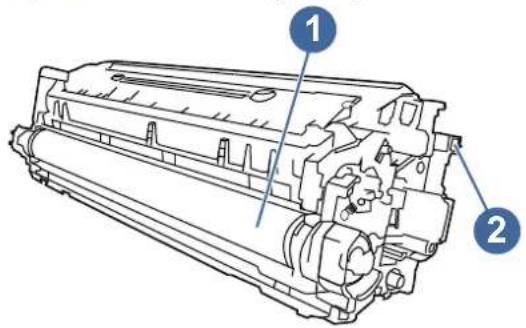
Number Description
1 Imaging drum
CAUTION: Do not touch the imaging drum. Fingerprints can cause print-quality problems.
2 Memory chip
CAUTION: If toner gets on clothing, wipe it off by using a dry cloth and wash the clothes in cold water. Hot water sets toner into fabric.
NOTE: Information about recycling used toner cartridges is in the toner cartridge box or at www.hp.com/hprecycle.
Remove and replace the toner cartridge
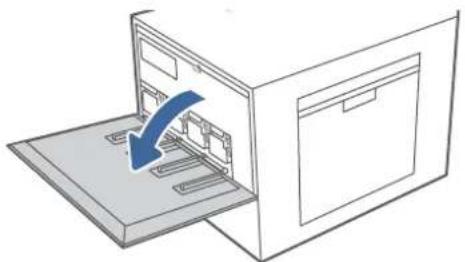
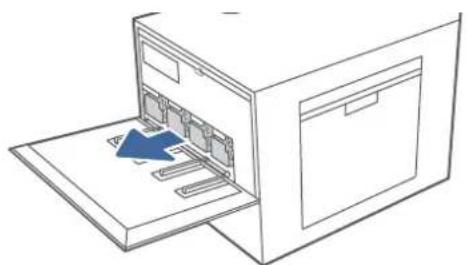
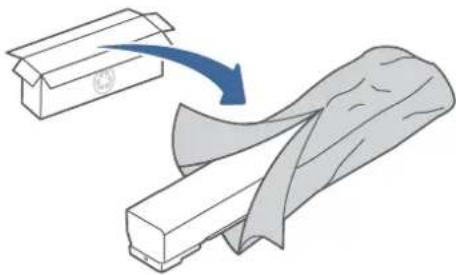
Follow these steps to replace the toner cartridge.
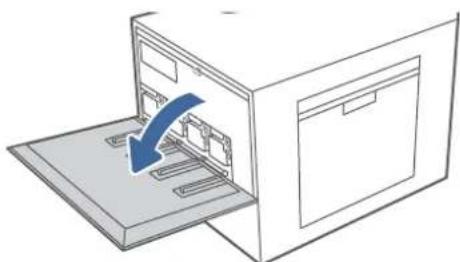
- Open the front door.
natural_image
Diagram of a file transfer or storage operation inside a cabinet, showing a blue arrow indicating the process (no text or symbols present)- Grasp the end of the toner cartridge and pull it straight out of the printer.
natural_image
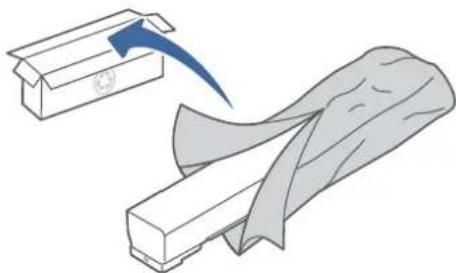
Line drawing of an open storage cabinet with internal compartments and a blue arrow indicating a component (no text or symbols)- Remove the new toner cartridge from its package. Save all packaging for recycling the used toner cartridge.
natural_image
Illustration of a fabric being folded from a box onto a leaf, with no text or symbols present.- Hold both ends of the toner cartridge and rock it back and forth end to end to evenly distribute the toner that is inside.
natural_image
Illustration of hands holding a mechanical component with blue arrows indicating rotation or movement (no text or symbols)- Align the toner cartridge with its slot and insert it into the printer.
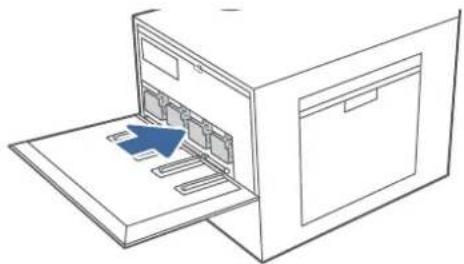
natural_image
Line drawing of an open filing cabinet with a blue arrow pointing to the internal compartments (no text or symbols)- Close the front door.
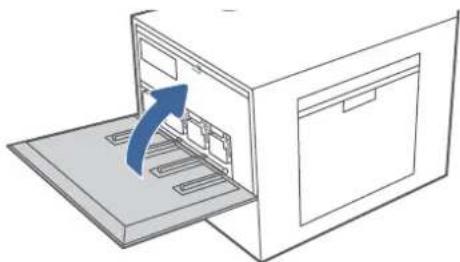
natural_image
Diagram of a kitchen appliance with an open door and a blue arrow indicating direction (no text or symbols)- Pack the used toner cartridge into the box that the new toner cartridge came in. See the enclosed recycling guide for information about recycling.
In the U.S. and Canada, a pre-paid shipping label is included in the box. In other countries/regions, go to www.hp.com/recycle to print a pre-paid shipping label.
Adhere the pre-paid shipping label to the box, and return the used cartridge to HP for recycling.
natural_image
Illustration of a mechanical component being cut with a blue arrow indicating motion (no text or symbols)Replace the toner collection unit (TCU)
Replace the toner collection unit if you receive a message on the printer, or if you have print quality problems.
Replace the toner collection unit (TCU)
Follow these steps to replace the toner collection unit (TCU).
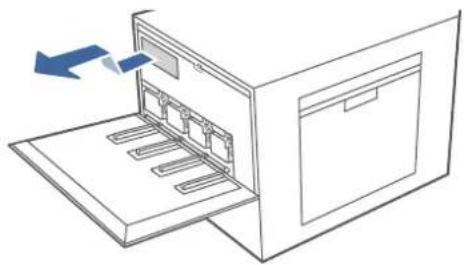
- Open the front door.
natural_image
Diagram of a computer oven with a blue arrow indicating a process or operation, showing internal compartments and storage areas (no text or symbols)- Lift the TCU slightly and then pull it out of the printer.
natural_image
Line drawing of an open refrigerator with a blue arrow indicating the opening (no text or symbols present)
NOTE: Maintain the position of the TCU as you pull it out from the printer. This will ensure that you do not spill any waste toner in the printer. Place the unit into the clear plastic bag the new TCU was packaged in.
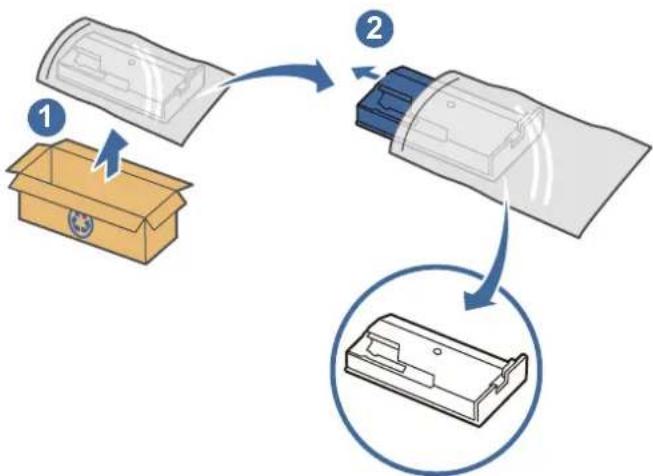
- Remove the new TCU from its package. Save all packaging for recycling the used TCU.
flowchart
graph TD
    A["1: Box with logo"] --> B["2: Inserted device"]
    B --> C["3: Final component with internal structure"]
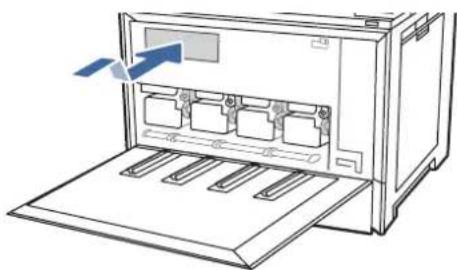
- Install the new TCU by inserting it into the printer, and then lifting slightly to make sure it pushes all the way in.
natural_image
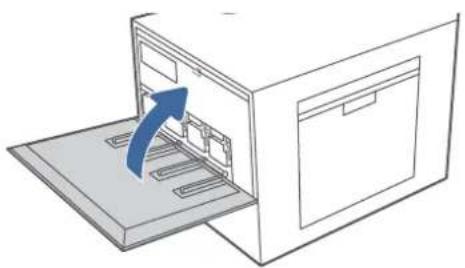
Line drawing of a computer tower with an open panel and a blue arrow indicating the direction (no text or symbols present)- Close the front door.
natural_image
Diagram of a cabinet with an open door and a blue arrow indicating direction (no text or symbols)- Pack the used TCU into the box that the new TCU came in. See the enclosed recycling guide for information about recycling.
In the U.S. and Canada, a pre-paid shipping label is included in the box. In other countries/regions, go to www.hp.com/recycle to print a pre-paid shipping label.
Adhere the pre-paid shipping label to the box, and return the used TCU to HP for recycling.
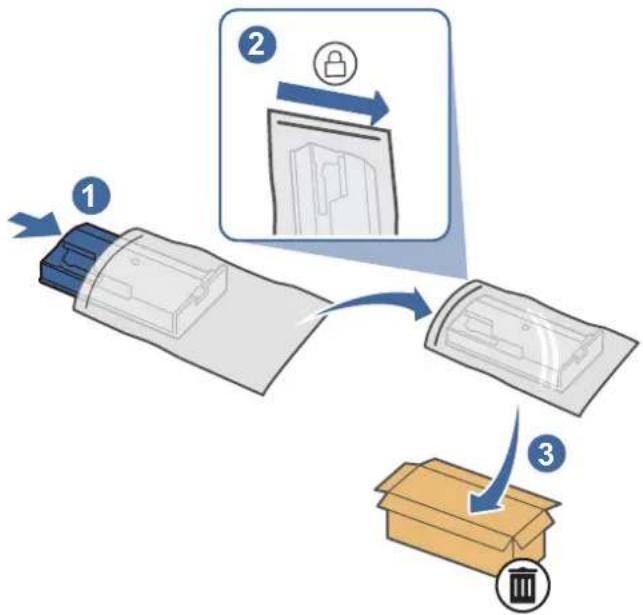
flowchart
graph TD
    A["Step 1: Adding package"] --> B["Step 2: Adjusting package"]
    B --> C["Step 3: Remove waste into box"]
Replace the staple cartridge (stapler models only)
The following applies to models with staplers.
Remove and replace the staple cartridge in the 3-bin stapler/stacker
Use the steps below to remove and replace the staple cartridge in the 3-bin stapler/stacker.
- Open the 3-bin stapler/stacker staple door.
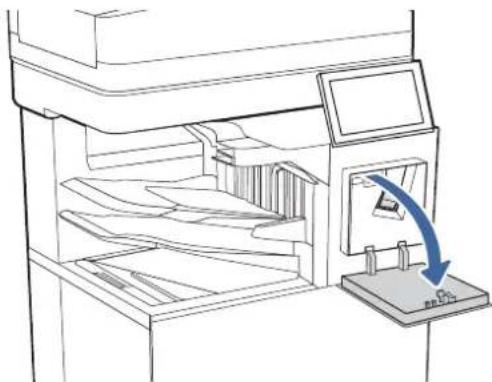
natural_image
Line drawing of a machine with a control panel and directional arrow indicating motion (no text or symbols)- Pull down the colored handle on the staple carriage, and then pull the staple carriage straight out.
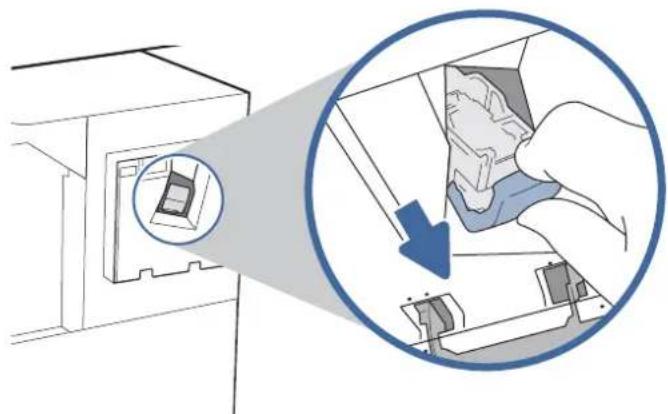
natural_image
Diagram showing a device being processed with a magnified inset highlighting internal components (no text or symbols present)- Remove the staple cartridge from the sled and replace it with the new staple cartridge.
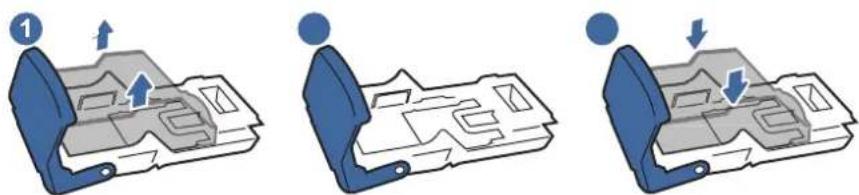

NOTE: Do not dispose of the staple carrier/sled. The sled is not an orderable or replaceable part.
- Reinstall the staple carriage into the stapler by pressing the colored handle inward until it snaps into place.
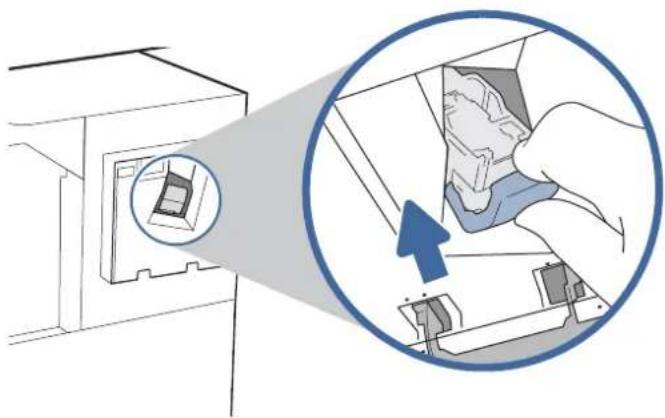
natural_image
Diagram showing a device being inserted into a container with an arrow indicating the process (no text or symbols present)- Close the 3-bin stapler/stacker staple door.
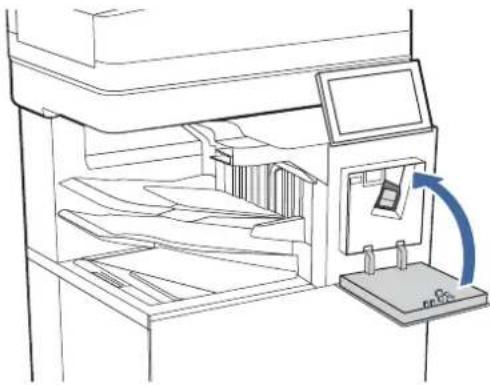
natural_image
Line drawing of a printer or scanner device with a blue arrow indicating rotation or operation (no text or symbols present)Remove and replace the staple cartridge in the finisher
Use the steps below to remove and replace the staple cartridge in the floor-standing finisher.
- Open the finisher door.
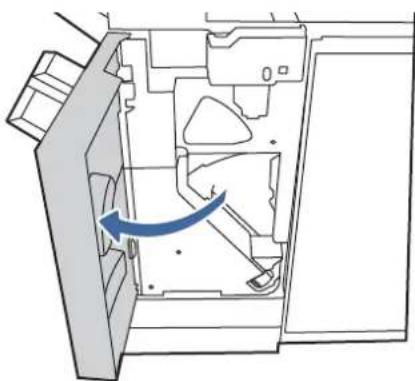
natural_image
Diagram of a mechanical device interior showing internal components and a blue arrow indicating rotation (no text or symbols present)- Pull down the colored handle on the staple carriage, and then pull the staple carriage straight out.
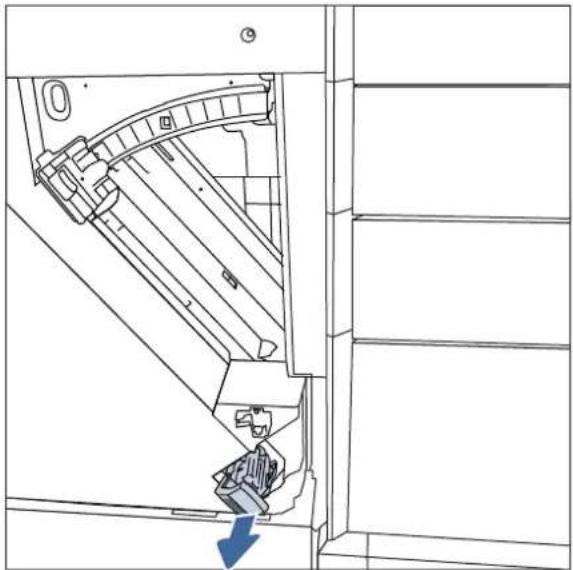
natural_image
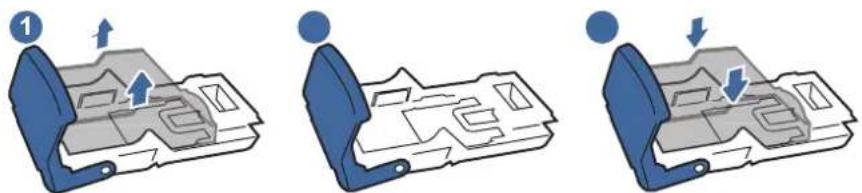
Technical line drawing of a mechanical assembly with a blue arrow indicating a component (no text or symbols present)- Remove the staple cartridge from the sled and replace it with the new staple cartridge.
natural_image
Three-step diagram showing a mechanical component with arrows indicating motion, no text or symbols present.
NOTE: Do not dispose of the staple carrier/sled. The sled is not an orderable or replaceable part.
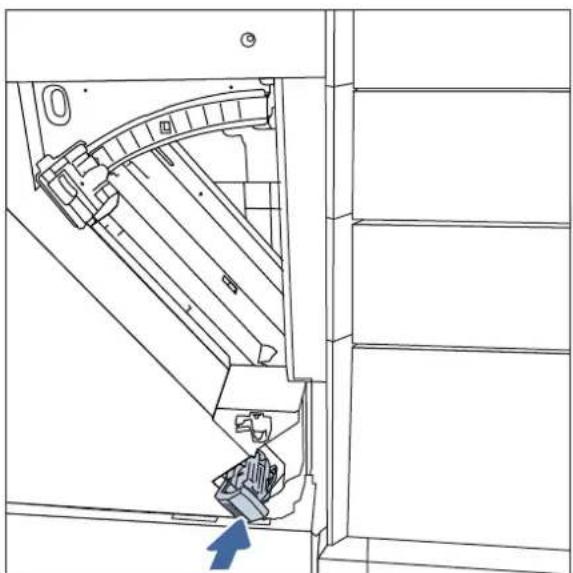
- Reinstall the staple carriage into the stapler by pressing the colored handle inward until it snaps into place.
natural_image
Technical line drawing of a mechanical assembly or lifting mechanism, showing internal components and a blue arrow indicating direction (no text or symbols present)- Close the finisher door.
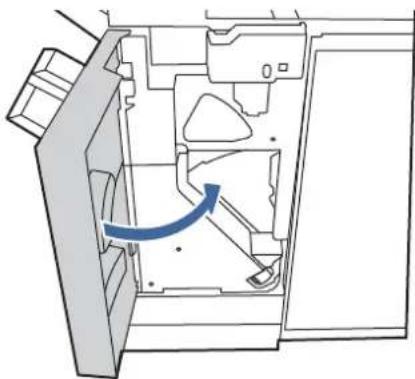
natural_image
Technical line drawing of a mechanical assembly with an arrow indicating direction (no text or symbols)Remove and replace the staple cartridge in the convenience stapler
Use the steps below to remove and replace the staple cartridge in the convenience stapler on the left side of the printer.
- Open the stapler door.
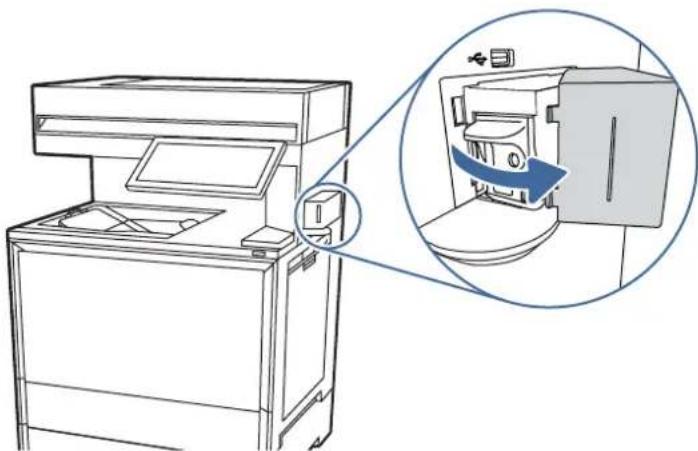
natural_image
Line drawing of a machine with an inset showing a device being inserted (no text or symbols present)- Pull the staple carriage straight out.
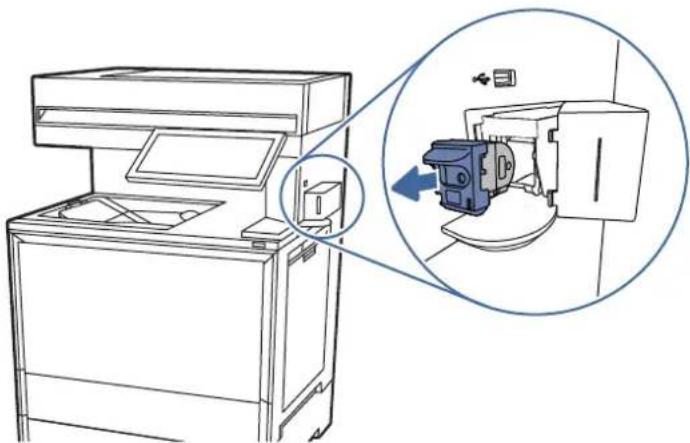
natural_image
Line drawing of a machine with an inset showing a close-up of the internal components (no text or symbols present)- Insert the new staple carriage into the stapler.
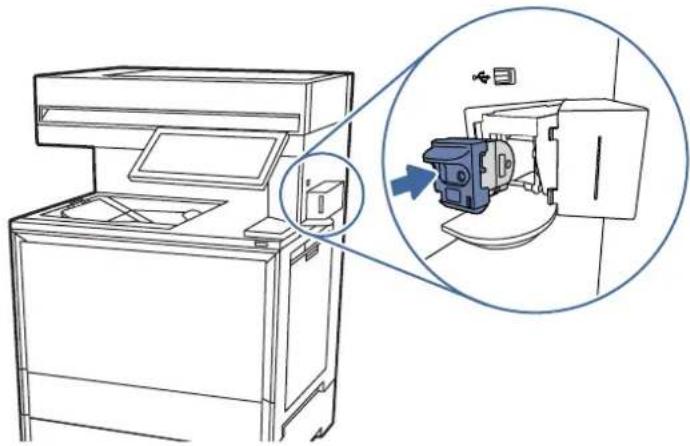
natural_image
Line drawing of a machine with an inset showing a close-up of a device inside (no text or symbols present)- Close the stapler door.
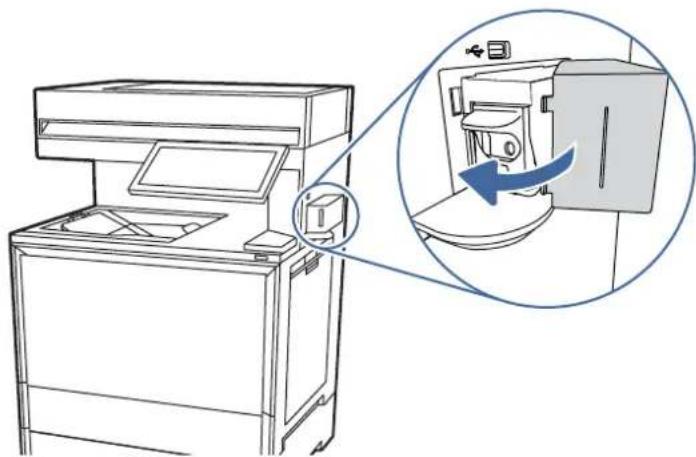
natural_image
Line drawing of a machine with an inset showing a device being processed, no text or symbols present.Print4
Print using the software, or print from a mobile device or USB flash drive.
The following information is correct at the time of publication. For current information, see Support for HP Color LaserJet Enterprise MFP 6800 or Support for HP Color LaserJet Enterprise MFP 6801.
For more information:
HP's all-inclusive help for the printer includes the following information:
• Install and configure
- Learn and use
- Solve problems
- Download software and firmware updates
- Join support forums
● Find warranty and regulatory information
Print tasks (Windows)
Learn about common printing tasks for Windows users.
How to print (Windows)
Use the Print option from a software application to select the printer and basic options for your print job.
The following procedure describes the basic printing process for Windows.
- From the software program, select the Print option.
- Select the printer from the list of printers. To change settings, click the Printer Properties or Preferences button to open the print driver.

NOTE: The name of the button varies for different software programs.
For the HP PCL 6 driver, the HP AiO Printer Remote application downloads additional driver features when More settings is selected.

NOTE: For more information, click the Help (?) button in the print driver.
- Click the tabs in the print driver to configure the available options. For example, set the paper orientation on the Finishing tab, and set the paper source, paper type, paper size, and quality settings on the Paper/Quality tab.
- Click the OK button to return to the Print dialog box. Select the number of copies to print from this screen.
- Click the Print button to print the job.
Automatically print on both sides (Windows)
If your printer has an automatic duplexer installed, you can automatically print on both sides of the paper. Use a paper size and type supported by the duplexer.
- From the software program, select the Print option.
- Select the printer from the list of printers, and then click the Printer Properties or Preferences button to open the print driver.

NOTE: The name of the button varies for different software programs.
For the HP PCL 6 driver, the HP AiO Printer Remote application downloads additional driver features when More settings is selected.
-
Click the Finishing tab.
-
Select Print on both sides. Click OK to close the Document Properties dialog.
-
In the Print dialog, click Print to print the job.
Manually print on both sides (Windows)
Use this procedure for printers that do not have an automatic duplexer installed or to print on paper that the duplexer does not support.
- From the software program, select the Print option.
- Select the printer from the list of printers, and then click the Printer Properties or Preferences button to open the print driver.

NOTE: The name of the button varies for different software programs.
For the HP PCL 6 driver, the HP AiO Printer Remote application downloads additional driver features when More settings is selected.
-
Click the Finishing tab.
-
Select Print on both sides (manually), and then click OK to close the Document Properties dialog.
-
In the Print dialog, click Print to print the first side of the job.
-
Retrieve the printed stack from the output bin, and place it in Tray 1.
-
If prompted, select the appropriate control panel button to continue.
Print multiple pages per sheet (Windows)
When you print from a software application using the Print option, you can select an option to print multiple pages on a single sheet of paper. For example, you might want to do this if you are printing a very large document and want to save paper.
- From the software program, select the Print option.
- Select the printer from the list of printers, and then click the Printer Properties or Preferences button to open the print driver.

NOTE: The name of the button varies for different software programs.
For the HP PCL 6 driver, the HP AiO Printer Remote application downloads additional driver features when More settings is selected.
- Click the Finishing tab.
- Select the number of pages per sheet from the Pages per sheet drop-down.
- Select the correct Print page borders, Page order, and Orientation options. Click OK to close the Document Properties dialog.
- In the Print dialog, click Print to print the job.
Select the paper type (Windows)
When you print from a software application using thePrint option, you can set the paper type you are using for your print job. For example, if your default paper type is Letter, but you are using a different paper type for a print job, select that specific paper type.
- From the software program, select the Print option.
- Select the printer from the list of printers, and then click the Printer Properties or Preferences button to open the print driver.

NOTE: The name of the button varies for different software programs.
For the HP PCL 6 driver, the HP AiO Printer Remote application downloads additional driver features when More settings is selected.
- Click the Paper/Quality tab.
- Select the paper type from the Paper type drop-down list.
- Click OK to close the Document Properties dialog. In the Print dialog, click Print to print the job.
If the tray needs to be configured, a tray configuration message displays on the printer control panel.
- Load the tray with the specified type and size of paper, and then close the tray.
- Touch the OK button to accept the detected type and size, or touch the Modify button to choose a different paper size or type.
- Select the correct type and size, and then touch the OK button.
Additional print tasks
Locate information on the Web for performing common printing tasks.
Go to Support for HP Color LaserJet Enterprise MFP 6800 or Support for HP Color LaserJet Enterprise MFP 6801.
Instructions are available for print tasks, such as the following:
- Create and use printing shortcuts or presets
- Select the paper size, or use a custom paper size
-
Select the page orientation
-
Create a booklet
- Scale a document to fit a specific paper size
- Print the first or last pages of the document on different paper
- Print watermarks on a document
Print tasks (macOS)
Print using the HP printing software for macOS, including how to print on both sides or print multiple pages per sheet.
How to print (macOS)
Use the Print option from a software application to select the printer and basic options for your print job.
The following procedure describes the basic printing process for macOS.
- Click the File menu, and then click the Print option.
- Select the printer.
- Click Show Details or Copies & Pages, and then select other menus to adjust the print settings.
NOTE: The name of the item varies for different software programs. - Click the Print button.

Automatically print on both sides (macOS)
If your printer has an automatic duplexer installed, you can automatically print on both sides of the paper. Use a paper size and type supported by the duplexer.

NOTE: This information applies to printers that include an automatic duplexer.

NOTE: This feature is available if you install the HP print driver. It might not be available if you are using AirPrint".
- Click the File menu, and then click the Print option.
- Select the printer.
- Click Show Details or Copies & Pages, and then click the Layout menu.
macOS 10.14 Mojave and later: Click Show Details, click Two-Sided, and then click the Layout menu.
NOTE: The name of the item varies for different software programs. - Select a binding option from the Two-Sided drop-down list.
- Click the Print button.

Manually print on both sides (macOS)
Use this procedure for printers that do not have an automatic duplexer installed or to print on paper that the duplexer does not support.

NOTE: This feature is available if you install the HP print driver. It might not be available if you are using AirPrint.
- Click the File menu, and then click the Print option.
- Select the printer.
- Click Show Details or Copies & Pages, and then click the Manual Duplex menu.

NOTE: The name of the item varies for different software programs.
- Click the Manual Duplex box, and select a binding option.
- Click the Print button.
- Go to the printer and remove any blank paper that is in Tray 1.
-
If prompted, touch the appropriate control panel button to continue.
-
Retrieve the printed stack from the output bin and place it with the printed-side facing down in the input tray.
Print multiple pages per sheet (macOS)
When you print from a software application using the Print option, you can select an option to print multiple pages on a single sheet of paper. For example, you might want to do this if you are printing a very large document and want to save paper.
- Click the File menu, and then click the Print option.
- Select the printer.
- Click Show Details or Copies & Pages, and then click the Layout menu.

NOTE: The name of the item varies for different software programs.
- From the Pages per Sheet drop-down list, select the number of pages that you want to print on each sheet.
- In the Layout Direction area, select the order and placement of the pages on the sheet.
- From the Borders menu, select the type of border to print around each page on the sheet.
- Click the Print button.
Select the paper type (macOS)
When you print from a software application using thePrint option, you can set the paper type you are using for your print job. For example, if your default paper type is Letter, but you are using a different paper type for a print job, select that specific paper type.
- Click the File menu, and then click the Print option.
-
Select the printer.
-
Click Show Details or Copies & Pages, and then click the Media & Quality menu or the Paper/Quality menu.

NOTE: The name of the item varies for different software programs.
- Select from the Media & Quality or Paper/Quality options.

NOTE: This list contains the master set of options available. Some options are not available on all printers.
• Media Type: Select the option for the type of paper for the print job.
• Print Quality or Quality: Select the resolution level for the print job.
- Edge-To-Edge Printing: Select this option to print close to the paper edges.
- Click the Print button.
Additional print tasks
Locate information on the Web for performing common printing tasks.
Go to Support for HP Color LaserJet Enterprise MFP 6800 or Support for HP Color LaserJet Enterprise MFP 6801.
Instructions are available for print tasks, such as the following:
- Create and use printing shortcuts or presets
- Select the paper size, or use a custom paper size
- Select the page orientation
- Create a booklet
- Scale a document to fit a specific paper size
- Print the first or last pages of the document on different paper
- Print watermarks on a document
Store print jobs on the printer to print later or print privately
Store print jobs in the printer memory for printing at a later time.
Introduction
The following information provides procedures for creating and printing documents that are stored on the USB flash drive. These jobs can be printed at a later time or printed privately.
Create a stored job (Windows)
Store jobs on the USB flash drive for private or delayed printing.
-
From the software program, select the Print option.
-
Select the printer from the list of printers, and then select Printer Properties or Preferences.

NOTE: The name of the button varies for different software programs.
For the HP PCL 6 driver, the HP AiO Printer Remote application downloads additional driver features when More settings is selected.
-
Click the Job Storage tab.
-
Select a Job Storage Mode option:
• Proof and Hold: Print and proof one copy of a job, and then print more copies.
- Personal Job: The job does not print until you request it at the printer control panel. For this job-storage mode, you can select one of the Make Job Private/Secure options. If you assign a personal identification number (PIN) to the job, you must provide the required PIN at the control panel. If you encrypt the job, you must provide the required password at the control panel. The print job is deleted from memory after it prints and is lost if the printer loses power.
- Quick Copy: Print the requested number of copies of a job and store a copy of the job in the printer memory so you can print it again later.
- Stored Job: Store a job on the printer and allow other users to print the job at any time. For this job-storage mode, you can select one of the Make Job Private/Secure options. If you assign a personal identification number (PIN) to the job, the person who prints the job must provide the required PIN at the control panel. If you encrypt the job, the person who prints the job must provide the required password at the control panel.
- To use a custom user name or job name, click the Custom button, and then enter the user name or the job name.
Select which option to use if another stored job already has that name:
• Use Job Name + (1-99): Append a unique number to the end of the job name.
- Replace Existing File: Overwrite the existing stored job with the new one.
- Click the OK button to close the Document Properties dialog box. In the Print dialog box, click the Print button to print the job.
Create a stored job (macOS)
Store jobs on the USB flash drive for private or delayed printing.
- Click the File menu, and then click the Print option.
- In the Printer menu, select the printer.
- Click Show Details or Copies & Pages, and then click the Job Storage menu.

NOTE: If the Job Storage menu is not showing, follow the instructions in the "Disable or enable job storage feature" section to activate the menu.
- In the Mode drop-down list, select the type of stored job.
Proof and Hold: Print and proof one copy of a job, and then print more copies. The first copy prints immediately. Printing of the subsequent copies must be initiated from the device's front control panel. For example, if 10 copies are sent, one copy prints immediately, and the other nine copies will print when the job is retrieved. The job is deleted after all copies are printed.
- Personal Job: The job does not print until someone requests it at the printer control panel. If the job has a personal identification number (PIN), provide the required PIN at the control panel. The print job is deleted from memory after it prints.
- Quick Copy: Print the requested number of copies of a job and store a copy of the job in the printer memory to print it again later. The job is deleted manually or by the job retention schedule.
- Stored Job: Store a job on the printer and allow other users to print the job at any time. If the job has a personal identification number (PIN), the person who prints the job must provide the required PIN at the control panel. The job is deleted manually or by the job retention schedule.
- To use a custom user name or job name, click the Custom button, and then enter the user name or the job name.

NOTE: macOS 10.14 Mojave and later: The print driver no longer includes the Custom button. Use the options below the Mode drop-down list to set up the saved job.
Select which option to use if another stored job already has that name.
• Use Job Name + (1-99): Append a unique number to the end of the job name.
- Replace Existing File: Overwrite the existing stored job with the new one.
-
If you selected the Stored Job or Personal Job option in the Mode drop-down list, you can protect the job with a PIN. Type a 4-digit number in the Use PIN to Print field. When other people attempt to print this job, the printer prompts them to enter this PIN.
-
Click the Print button to process the job.
Print a stored job
Use the following procedure to print a job that is stored in the printer memory.
- From the Home screen on the printer control panel, navigate to the Print application, and then select the Print icon.
- Select Print from Job Storage.
- Select the name of the folder where the job is stored, or select Choose to see the folder list.
- Select the name of the job. If the job is private or encrypted, enter the PIN or password.
- To adjust the number of copies, select the number of copies field. Use the keypad to enter the number of copies to print.
- Select Start or print to print the job.
Delete a stored job
You can delete documents that have been saved to the printer when they are no longer needed. You can also adjust the maximum number of jobs for the printer to store.
Delete a job that is stored on the printer
Use the control panel to delete a job that is stored in the printer memory.
- From the Home screen on the printer control panel, navigate to the Print application, and then select the Print icon.
- Select Print from Job Storage.
- Select the name of the folder where the job is stored or select Choose to see the folder list.
- Select the name of the job. If the job is private or encrypted, enter the PIN or password.
- Select the Trash button to delete the job.
Change the job storage limit
When a new job is stored in the printer memory, the printer overwrites any previous jobs with the same user and job name. If a job is not already stored under the same user and job name, and the printer needs additional space, the printer might delete other stored jobs starting with the oldest.
To change the number of jobs that the printer can store, complete the following procedure:
- From the Home screen on the printer control panel, navigate to the Settings application, and then select the Settings icon.
- Open the following menus:
a. Copy/Print or Print
b. Manage Stored Jobs
c. Temporary Job Storage Limit
- Use the keypad to enter the number of jobs that the printer stores.
- Select OK or Done to save the setting.
Information sent to printer for Job Accounting purposes
Printing jobs sent from drivers on the client (e.g., PC) may send personally identifiable information to HP's Printing and Imaging devices. This information may include, but is not limited to, user name and client name from which the job originated that may be used for job accounting purposes, as determined by the Administrator of the printing device. This same information may also be stored with the job on the mass storage device (e.g., disk drive) of the printing device when using the job storage feature.
Mobile printing
Mobile and ePrint solutions enable easy printing to an HP printer from a laptop, tablet, smartphone, or other mobile device.
Mobile printing solutions
Learn what HP offers for mobile printing solutions.
HP offers multiple mobile and ePrint solutions to enable easy printing to an HP printer from a laptop, tablet, smartphone, or other mobile device. To see the full list and to determine the best choice, go to HP Customer Support - Knowledge Base.
Wi-Fi Direct
- HP ePrint via email (Requires HP Web Services to be enabled and the printer to be registered with HP Connected)
- HP ePrint app (Available for Android, iOS, and Blackberry)
- HP All-in-One Remote app for iOS and Android devices
• HP ePrint software
AirPrint - Android Printing
Wi-Fi, Wi-Fi Direct Print, NFC, and BLE printing
HP provides Wi-Fi Direct Print, Near Field Communication (NFC), and Bluetooth Low Energy (BLE) printing for printers with a supported HP Jetdirect 3100w BLE/NFC/Wireless Accessory. This is an optional accessory.
These features enable Wi-Fi capable (mobile) devices to make a wireless network connection directly to the printer without using a wireless router.
The printer does not need to be connected to the network for this mobile walk-up printing to work.
Use Wi-Fi Direct Print to print wirelessly from the following devices:
- iPhone, iPad, or iPod touch using Apple AirPrint
- Android mobile devices using the Android embedded print solution
For more information on wireless printing, go to www.hp.com/go/LaserJetMobilePrinting.
NFC, BLE, and Wi-Fi Direct Print capabilities can be enabled or disabled from the printer control panel.
Enable wireless printing
To print wirelessly from mobile devices, Wi-Fi Direct must be turned on.
- From the Home screen on the printer control panel, select the Settings menu.
-
Select the following menus:
a. Networking
b. Wi-Fi Direct
c. Status -
Select On, and then select OK to enable wireless printing.
Change the Wi-Fi Direct name
Change the printer Wi-Fi Direct name using the HP Embedded Web Server (EWS).

NOTE: In environments where more than one model of the same printer is installed, it might be helpful to provide each printer a unique Wi-Fi Direct Name for easier printer identification for HP Wi-Fi Direct
printing. The Wireless network names, e.g., Wireless, Wi-Fi Direct, etc. are available on the Information screen by selecting the Information icon and then selecting the Wi-Fi Direct icon .
Complete the following procedure to change the printer Wi-Fi Direct name:
-
From the Home screen on the printer control panel, select the Settings icon.
-
Open the following menus:
a. Networking
b. Wi-Fi Direct
c. Wi-Fi Direct Name
- Use the keypad to change the name in the Wi-Fi Direct Name text field, and then select OK.
HP ePrint via email
Use HP ePrint via email to print documents by sending them as an email attachment to the printer's email address from any email enabled device.
To use HP ePrint via email, the printer must meet these requirements:
- The printer must be connected to a wired or wireless network and have Internet access.
HP Web Services must be enabled on the printer, and the printer must be registered with HP Smart.
Follow this procedure to enable HP Web Services and register with HP Smart:
- Open the HP Embedded Web Server (EWS):
a. From the Home screen on the printer control panel, touch the Information icon i, and then touch the Ethernet icon to display the IP address or host name.
b. From a computer on the same network as the printer, open a web browser. In the address line, type the IP address or host name exactly as it displays on the printer control panel. Press the Enter key on the computer keyboard. The EWS opens.
https://10.10.XX.XXX
NOTE: If the web browser displays a message indicating that accessing the website might not be safe, select the option to continue to the website. Accessing this website will not harm the computer.
-
Click the HP Web Services tab.
-
Select the option to enable Web Services.
NOTE: Enabling Web Services might take several minutes.
- Go to www.hpconnected.com to create an account and complete the setup process.
AirPrint
Direct printing using Apple's AirPrint is supported for iOS and from Mac computers running macOS 10.7 Lion and newer.
Use AirPrint to print directly to the printer from an iPad, iPhone (3GS or later), or iPod touch (third generation or later) in the following mobile applications:
Mail
- Photos
• Safari
iBooks
- Select third-party applications
To use AirPrint, the printer must be connected to the same network (sub-net) as the Apple device. For more information about using AirPrint and about which HP printers are compatible with AirPrint, go to www.hp.com/go/MobilePrinting.

NOTE: Before using AirPrint with a USB connection, verify the version number. AirPrint versions 1.3 and earlier do not support USB connections.
Android embedded printing
HP's built-in print solution for Android and Kindle enables mobile devices to automatically find and print to HP printers that are either on a network or within wireless range for Wi-Fi Direct printing.
The print solution is built into many versions of the operating system.

NOTE: If printing is not available on your device, go to the Google Play > Android apps and install the HP Print Service Plugin.
For more information on how to use Android embedded printing and which Android devices are supported, go to www.hp.com/go/MobilePrinting.
Print from a USB flash drive
This printer features easy-access USB printing to print files without a computer.
The printer accepts standard USB flash drives in the USB port near the control panel. It supports the following types of files:
.pdf
•.prn
.pcl
.ps
.cht
.jpg
.png
Enable the USB port for printing
The USB port is disabled by default. Before using this feature, enable the USB port.
Use one of the following methods to enable the port:
Method one: Enable the USB port from the printer control panel
Use the printer control panel to enable the USB port for printing.
- From the Home screen on the printer control panel, navigate to the Settings application, and then select the Settings icon.
- Open the following menus:
a. Copy/Print or Print
b. Enable Device USB
- Select Enable Print from USB Drive.
Method two: Enable the USB port from the HP Embedded Web Server (network-connected printers only)
Use the HP Embedded Web Server to enable the USB port for printing.
- From the Home screen on the printer control panel, touch the Information icon i, and then touch the Ethernet icon to display the IP address or host name.
- Open a web browser, and in the address line, type the IP address exactly as it displays on the printer control panel. Press the Enter key on the computer keyboard. The EWS opens.
https://10.10.XX.XXX

NOTE: If the web browser displays a message indicating that accessing the website might not be safe, select the option to continue to the website. Accessing this website will not harm the computer.
- Select the Copy/Print tab for MFP models or the Print tab for SFP models.
- In the left menu, select Print from USB Drive Settings.
- Select Enable Print from USB Drive.
- Click Apply.
Print USB documents
Print documents from a USB flash drive.
- Insert the USB flash drive into the easy-access USB port.

NOTE: The port might be covered. For some printers, the cover flips open. For other printers, pull the cover straight out to remove it.
- From the Home screen on the printer control panel, navigate to the Print application, and then select the Print icon.
-
Select Print from USB Drive.
-
Select Choose, select the name of the document to print, and then select Select.

NOTE: The document might be in a folder. Open folders as necessary.
-
To adjust the number of copies, touch the box to the left of the Print button, and then select the number of copies from the keypad that opens. To close the keypad, select the Close button.
-
Select Print to print the document.
Print using the SuperSpeed USB 3.0 port (wired)
Enable the SuperSpeed USB 3.0 port for wired USB printing. The port is located in the interface ports area and is disabled by default.
Use one of the following methods to enable the SuperSpeed USB 3.0 port. Once the port is enabled, install the product software in order to print using this port.
Method one: Enable the SuperSpeed USB 3.0 port from the printer control panel menus
Use the control panel to enable the port.
- From the Home screen on the printer control panel, navigate to the Settings application, and then select the Settings icon.
- Open the following menus:
a. General
b. Enable Device USB
- Select the Enabled option.
Method two: Enable the SuperSpeed USB 3.0 port from the HP Embedded Web Server (network-connected printers only)
Use the HP EWS to enable the port.
- Find the printer IP address. On the printer control panel, select the Information button i, and then select the Network icon to display the IP address or host name.
- Open a web browser, and in the address line, type the IP address exactly as it displays on the printer control panel. Press the Enter key on the computer keyboard. The EWS opens.

https://10.10.XX.XXX

NOTE: If the web browser displays a message indicating that accessing the website might not be safe, select the option to continue to the website. Accessing this website will not harm the computer.
- Select the Security tab.
- On the left side of the screen, select General Security.
- Scroll down to the Hardware Ports and select the following check boxes:
a. Enable Device USB
b. Enable Host USB plug and play
- Click Apply.
Copy5
Make copies with the printer, learn how to copy a two-sided document, and locate additional copy tasks on the web.
The following information is correct at the time of publication. For current information, see Support for HP Color LaserJet Enterprise MFP 6800 or Support for HP Color LaserJet Enterprise MFP 6801.
For more information:
HP's all-inclusive help for the printer includes the following information:
• Install and configure
- Learn and use
- Solve problems
- Download software and firmware updates
- Join support forums
• Find warranty and regulatory information
Make a copy
Copy a document or picture from the scanner glass or automatic document feeder.
- Place the document face-down on the scanner glass, or place it face-up in the document feeder and adjust the paper guides to fit the size of the document.
- From the Home screen on the printer control panel, navigate to the Copy application, and then select the Copy icon.
- To select the number of copies, touch the box next to Copy, use the keypad to enter the number of copies, and then touch the close keypad button.
- Select Optimize Text/Picture to optimize for the type of image being copied: text, graphics, or photos. Select one of the predefined options.
- Set options marked with a yellow triangle before using the preview feature.

NOTE: After the preview scan, these options are removed from the main Options list and are summarized in the Pre-scan Options list. To change any of these options, discard the preview and start over.
Using the preview feature is optional.
- Touch the right pane of the screen to preview the document. In the preview screen, use the buttons on the right of the screen to adjust the preview options and to rearrange, rotate, insert, or remove pages.
Table 5-1 Buttons on the right side of the preview pane
| Button Description | |
 | Use these buttons to toggle between single-page view and thumbnail view. More options are available in thumbnail view than in single-page view. |
 | |
 | Use these buttons to zoom in or out on the selected page.NOTE: Select only one page at a time to use these buttons. |
 | |
 | Use this button to rotate the page 180 degrees.NOTE: This button is available only in the thumbnail view. |
 | Use this button to delete the selected pages.NOTE: This button is available only in the thumbnail view. |
 | Use these buttons to rearrange the pages within the document. Select one or more pages and move them to the left or right.NOTE: These buttons are available only in the thumbnail view. |
 | |
 | Use this button to add a page to the document. The printer prompts to scan additional pages. |
 | Use this button to clear the changes made in the preview and start over. |
 | Touch this button to collapse the preview screen and return to the Copy screen. |
- When the document is ready, touch Copy to begin copying.
Copy on both sides (duplex)
Copy or print on both sides of the paper.
- Place the document face-down on the scanner glass, or place it face-up in the document feeder and adjust the paper guides to fit the size of the document.
- From the Home screen on the printer control panel, navigate to the Copy application, and then select the Copy icon.
-
In the Options pane, select Original Side, and then select the option that describes the original document:
-
Use Automatically detect to detect whether the original is printed on one or both sides of the page.
- Use 1-sided for originals that are printed on one side of the page.
- Use 2-sided (book-style) for originals that flip on the right/left edge of the page, like books. If the image is portrait, the output flips on the long edge of the page. If the image is landscape, the output flips on the short edge of the page.
-
Use 2-sided (flip-style) for originals that flip on the top/bottom edge of the page, like calendars. If the image is portrait, the output flips on the short edge of the page. If the image is landscape, the output flips on the long edge of the page.
-
Select Output Sides, and then select one of these options:
-
1-sided: The output will be 1-sided. However, if the administrator has restricted 1-sided printing, the output will be 2-sided book-style.
- 2-sided (book-style): The output will flip on the right/left edge of the page, like a book. If the image is portrait, the output flips on the long edge of the page. If the image is landscape, the output flips on the short edge of the page.
-
2-sided (flip-style): The output will flip on the top/bottom edge of the page, like a calendar. If the image is portrait, the output flips on the short edge of the page. If the image is landscape, the output flips on the long edge of the page.
-
Set options marked with a yellow triangle before using the preview feature.

NOTE: After the preview scan, these options are removed from the main Options list and are summarized in the Pre-scan Options list. To change any of these options, discard the preview and start over.
Using the preview feature is optional.
- Touch the right pane of the screen to preview the document. In the preview screen, use the buttons on the right of the screen to adjust the preview options and to rearrange, rotate, insert, or remove pages.
Table 5-2 Buttons on the right side of the preview pane
| Button Button function | |
| Thumbnail and page view buttons Use these buttons to toggle between single-page view and thumbnail view. More options are available in thumbnail view than in single-page view. | |
 | |
 | |
| Zoom buttons Use these buttons to zoom in or out on the selected page. | |
 | NOTE: Select only one page at a time to use these buttons. |
 | |
| Rotate button Use this button to rotate the page 180 degrees. | |
 | NOTE: This button is available only in the thumbnail view. |
| Delete button Use this button to delete the selected pages. | |
 | NOTE: This button is available only in the thumbnail view. |
| Arrow buttons Use these buttons to rearrange the pages within the document. Select one or more pages and move them to the left or right. | |
 | NOTE: These buttons are available only in the thumbnail view. |
 | |
| Add page button Use this button to add a page to the document. The printer prompts to scan additional pages. | |
 | |
| Clear preview button Use this button to clear the changes made in the preview and start over. | |
 | |
| Collapse preview button Touch this button to collapse the preview screen and return to the Copy screen. | |
| [ZZZTZ] | |
7. When the document is ready, touch Start to begin copying.
Additional copy tasks
Locate information on the Web for performing common copy tasks.
Go to Support for HP Color LaserJet Enterprise MFP 6800 or Support for HP Color LaserJet Enterprise MFP 6801.
Instructions are available for copy tasks, such as the following:
- Copy or scan pages from books or other bound documents
• Copy mixed-size documents - Copy or scan both sides of an identification card
- Copy or scan a document into a booklet format
Scan6
Scan using the software, or scan directly to email, a USB flash drive, a network folder, or another destination.
The following information is correct at the time of publication. For current information, see Support for HP Color LaserJet Enterprise MFP 6800 or Support for HP Color LaserJet Enterprise MFP 6801.
For more information:
HP's all-inclusive help for the printer includes the following information:
• Install and configure
- Learn and use
- Solve problems
- Download software and firmware updates
- Join support forums
• Find warranty and regulatory information
Set up Scan to Email
The printer has a feature that enables it to scan a document and send it to one or more email addresses.
Introduction
To use this scan feature, the printer must be connected to a network; however, the feature is not available until it has been configured. There are two methods for configuring Scan to Email, the Scan to Email Setup Wizard for basic and Email Setup for advanced.
Use the following information to set up the Scan to Email feature.
Before you begin
To set up the Scan to Email feature, the printer must have an active network connection.
Administrators need the following information before beginning the configuration process.
- Administrative access to the printer
•DNS suffix (e.g., companyname.com)
- SMTP server (e.g., smtp.mycompany.com)

NOTE: If you do not know the SMTP server name, SMTP port number, or authentication information, contact the email/Internet service provider or system administrator for the information. SMTP server names and port names are typically found by doing an Internet search. For example, use terms like "Gmail smtp server name" or "Yahoo smtp server name" to search.
- SMTP server authentication requirements for outgoing email messages, including the user name and password used for authentication, if applicable.

NOTE: Consult your email service provider's documentation for information on digital sending limits for your email account. Some providers may temporarily lock your account if you exceed your sending limit.
Step one: Access the HP Embedded Web Server (EWS)
Open the EWS to start the setup process.

NOTE: The figure in this topic shows an EWS screen for a color printer. However, the procedure below is valid for both color and mono printers.
- From the Home screen on the printer control panel, touch the Information icon ⓘ, and then touch the Ethernet icon to display the IP address or host name.
- Open a web browser, and in the address line, type the IP address or host name exactly as it displays on the printer control panel. Press the Enter key on the computer keyboard. The EWS opens.


NOTE: If the web browser displays a message indicating that accessing the website might not be safe, select the option to continue to the website. Accessing this website will not harm the computer.
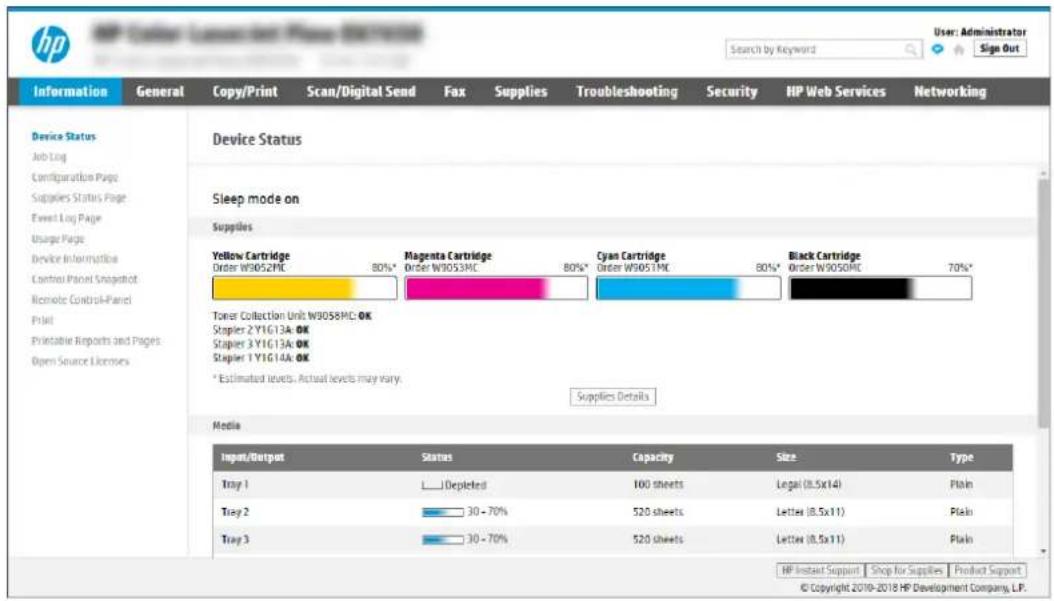
Step two: Configure the Network Identification settings
Configure advanced setting for network identification.

NOTE: Configuring email setup on the Networking tab is an advanced process and might require the assistance of a system administrator.
- Using the EWS top navigation tabs, click Networking.

NOTE: For configuring the network settings for use with Office 365, Step five: Set up Send to Email to use Office 365 Outlook (optional) on page 84
- In the left navigation pane, click TCP/IP Settings. A username/password might be required to access the Network Identification tab of the EWS.
- On the TCP/IP Settings dialog, click the Network Identification tab.
- If DNS is required on the network, in the TCP/IP Domain Suffix area, verify that the DNS suffix for the email client being used is listed. DNS suffixes have this format: companyname.com, gmail.com, etc.
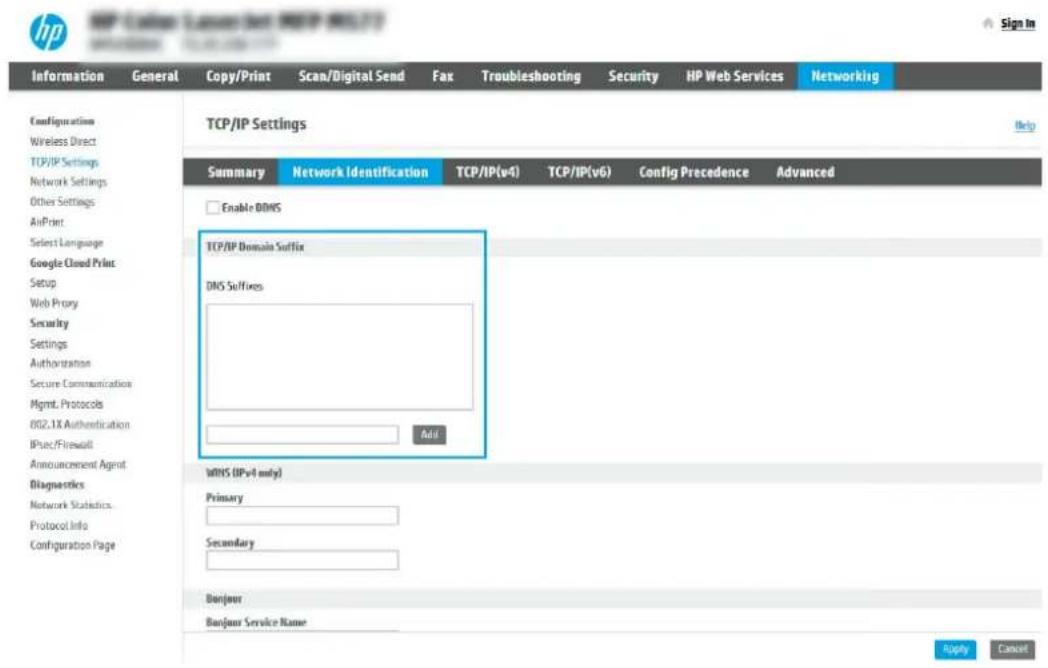

NOTE: If the Domain Name suffix is not set up, use the IP address.
- Click Apply.
- Click OK.
Step three: Configure the Send to Email feature
The two options for configuring Send to Email are the Email Setup Wizard for basic configuration and Email Setup for advanced configuration. Use the following options to configure the Send to Email feature:
Method one: Basic configuration using the Email Setup Wizard
Perform basic configuration using the Email Setup Wizard.
This option opens the Email Setup Wizard in the HP Embedded Web Server (EWS) for basic configuration.
- Using the EWS top navigation tabs, click Scan/Digital Send.
- In the left navigation pane, click Email and Scan to Network Folder Quick Setup Wizards.
- In the Email and Scan to Network Folder Quick Setup Wizards dialog, click the Email Setup link.

NOTE: If a message displays indicating that the Scan to Email feature is disabled, click Continue to proceed with the configuration and enable the Scan to Email feature upon completion.
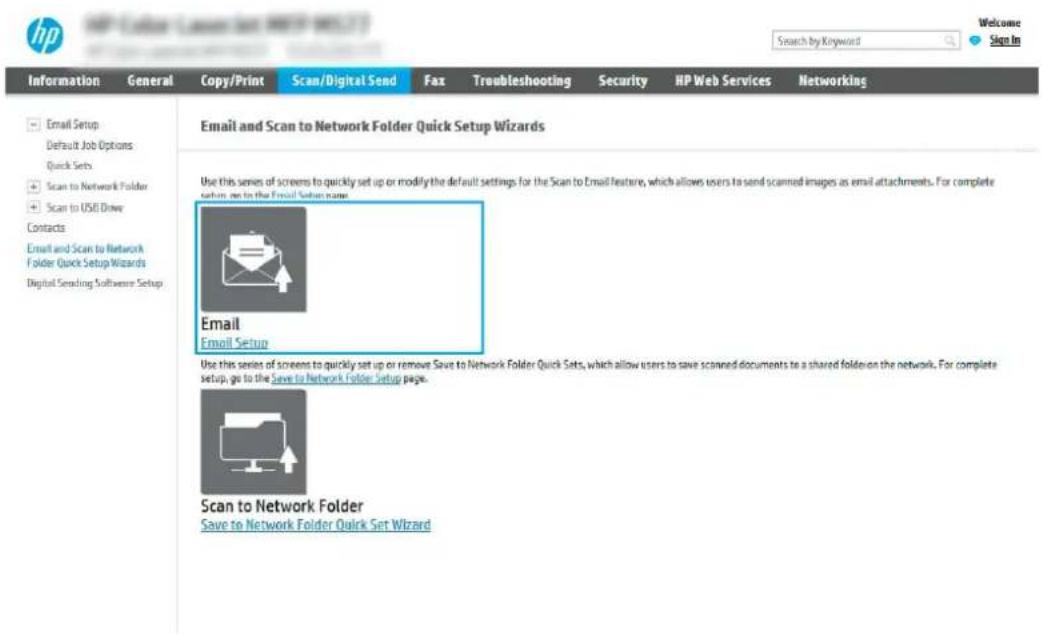
- On the Configure Email Servers (SMTP) dialog, select one of the following options and complete the steps:
- Option one: Use a server already in use by Email.
Select Use a server already in use by Email, and then click Next.
- Option two: Search the network for the outgoing email server.
This option finds outgoing SMTP servers inside your firewall only.
a. Select Search network for outgoing email server, and then click Next.
b. Select the appropriate server from the Configure Email Server (SMTP) list, and then click Next.
c. Select the option that describes the server's authentication requirements:
- Server does not require authentication: Select Server does not require authentication, and then click Next.
-OR-
-Server requires authentication: From the drop-down list, select an authentication option:
- Select Use credentials of user to connect after Sign In at the control panel, and then click Next.
-OR-
- Select Always use these credentials, enter the User name and Password, and then click Next.
- Option three: Add the SMTP server.
a. Select Add SMTP server.
b. Enter the Server Name and Port Number, and then click Next.

NOTE: In most cases, the default port number does not need to be changed.

NOTE: If you are using a hosted SMTP service such as Gmail, verify the SMTP address, port number, and SSL settings from the service provider's website or other sources. Typically, for Gmail, the SMTP address is smtp.gmail.com, port number 465, and the SSL should be enabled.
Please refer to online sources to confirm these server settings are current and valid at the time of configuration.
c. Select the appropriate server authentication option:
- Server does not require authentication: Select Server does not require authentication, and then click Next.
-OR-
– Server requires authentication: Select an option from the Server requires authentication drop-down list:
- Select Use credentials of user to connect after Sign In at the control panel, and then click Next.
-OR-
Select Always use these credentials, enter the User name and Password, and then click Next.
- On the Configure Email Settings dialog, enter the following information about the sender's email address, and then click Next.

NOTE: When setting up the From, Subject, and Message fields, if the User editable check box is unchecked, users will not be able to edit those fields at the printer control panel when sending an email.
Table 6-1 Send email settings
| Option Description | |
| From(Required) | Select one of the following options from the From drop-down list:User’s address (sign-in required)Default From: Enter a default email address and display name in the Default From Email Address and Default Display Name fieldsNOTE: Create an email account for the printer, and use this address for the default email address.NOTE: Configure the email feature so that users must sign in before using it. This prevents users from sending an email from an address that is not their own. |
| Subject(Optional) | Provide a default subject line for the email messages. |
| Message(Optional) | Create a custom message.To use this message for all emails sent from the printer, clear the User editable check box for Message. |
- In the Configure File Scan Settings area, set the default scanning preferences, and then click Next.
Table 6-2 Scan settings
| Option Description |
| File Type Select the default file type for the scanned document: |
| •JPEG |
| •TIFF |
| •MTIFF |
| •XPS |
| •PDF/A |
| HP LaserJet Enterprise Flow MFP printers or MFP printers that are connected to a digital send software (DSS) server also support the following OCR file types: |
| •Text (OCR) |
| •Unicode Text (OCR) |
| •RTF (OCR) |
| •Searchable PDF (OCR) |
| •Searchable PDF/A (OCR) |
| •HTML (OCR) |
| •CSV (OCR) |
| Color/Black Select the default color setting for the scanned document: |
| •Color |
| •Black |
| •Black/Gray |
| •Automatically detect |
| Quality and File Size Select the default output quality for the scanned document: |
| •Low (small file) |
| •Medium |
| •High (large file) |
| Resolution Select the default scan resolution for the scanned document: |
| •75 dpi |
| •150 dpi |
| •200 dpi |
| •300 dpi |
| •400 dpi |
| •600 dpi |
- Review the Summary area, and then click Finish to complete the setup.
Method two: Advanced configuration using the Email Setup
Use the following steps for advanced configuration using the E-mail Setup dialog in the EWS.
- Using the EWS top navigation tabs, click Scan/Digital Send, expand the Email Setup menu in the left navigation pane, and then click Default Job Options.
The Default Job Options page displays the Basic Settings for Scan to Email setup. To access additional settings, click the Advanced Settings button at the bottom of the page. To switch back to basic settings, click the Basic Settings button.

NOTE: This procedure covers the steps for Basic Settings first and then the steps for Advanced Settings.
Figure 6-1 Location of Advanced Settings button
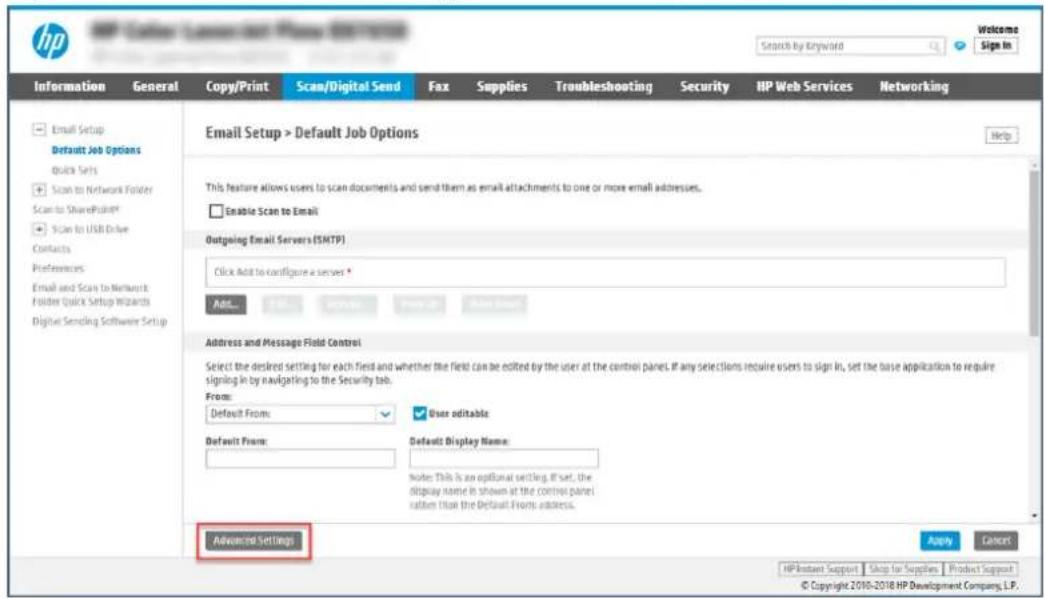
- On the Default Job Options page, select the Enable Scan to Email check box. If this check box is not selected, the feature is unavailable at the printer control panel.
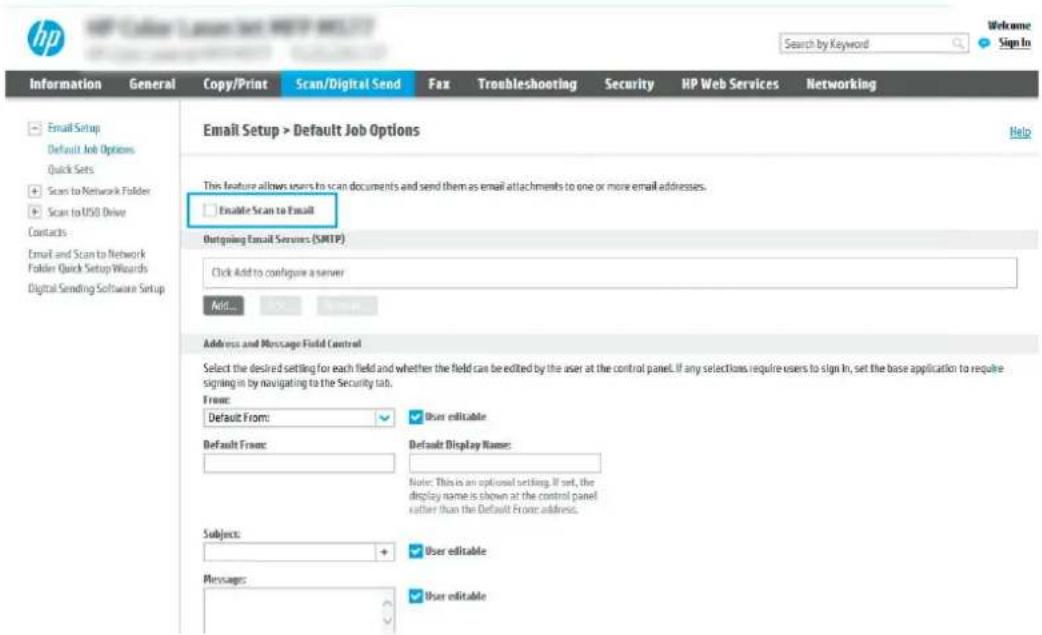
- In the Outgoing Email Servers (SMTP) area, complete the steps for one of the following options:
- Select one of the displayed servers.
- Click Add to start the SMTP wizard.
a. In the SMTP wizard, select one of the following options:
- Option one: I know my SMTP server address or host name: Enter the address of an SMTP server, and then click Next
- Option two: If you do not know the address of the SMTP server, select Search network for outgoing email server, and then click Next. Select the server, and then click Next.

NOTE: If an SMTP server was already created for another printer function, the Use a server already in use by another function option displays. Select this option, and then configure it to be used for the email function.
b. On the Set the basic information necessary to connect to the server dialog, set the options to use, and then click Next.
—Some servers have problems sending or receiving emails that are larger than 5 megabytes (MB). These problems can be prevented by entering a number in Split emails if larger than (MB).
–In most cases, the default port number does not need to be changed. However, when using the Enable SMTP SSL Protocol option, port 587 must be used.
If you are using Google™ Gmail for email service, select the Enable SMTP SSL Protocol check box. Typically, for gmail, the SMTP address is smtp.gmail.com, port number 465, and the SSL should be enabled. Refer to online sources to confirm these server settings are current and valid at the time of configuration.
c. On the Server Authentication Requirements dialog, select the option that describes the server's authentication requirements:
– Server does not require authentication, and then click Next.
—Server requires authentication
From the drop-down box, select Use credentials of user to connect after Sign In at the control panel, and then click Next.
From the drop-down box, select Always use these credentials, enter the Username and Password, and then click Next.

NOTE: If using a signed-in user's credentials, set email to require sign in by the user on the printer control panel. Deny device guest access to email by clearing the check box for email in the Device Guest column in the Sign in and Permission Policies area on the Access Control dialog of the Security tab. The icon in the check box changes from a check mark to a lock.
d. On the Server Usage dialog, choose the printer functions that will send email through this SMTP server, and then click the Next button.
If the server requires authentication, a user name and password for sending automatic alerts and reports from the printer will be required.
e. On the Summary and Test dialog, enter a valid email address in the Send test email to: field, and then click Test.
f. Verify that all of the settings are correct, and then click Finish to complete the outgoing email server set up.
- In the Address and Message Field Control area, enter a From: setting and any of the other optional settings.
Table 6-3 Address and Message Field Control (Basic Settings)
| Feature Description | |
| User editable | To use the Default From address and Default Display Name for all emails sent from this printer (unless a user is signed in), clear the User editable check box.When setting up the address fields, if the User editable check box is cleared, users will not be able to edit those fields at the printer control panel when sending an email. For send-to-me functionality, clear the User editable check boxes for all of the address fields, including the From; To; CC; and BCC: fields, and then set that user’s send email From: their own email address and To: their own email address. |
| Default From: and Default Display Name: | Provide an email address and name to use for the From: address for the email message.NOTE: Create an email account for the printer, and use this address for the default email address.NOTE: Configure the email feature so that users must sign in before using it. This prevents users from sending an email from an address that is not their own. |
| Subject: Provide a default subject line for the email messages. | |
| Message: | Create a custom message. To use this message for all emails sent from the printer, clear or do not select the User editable check box for Message: |
Table 6-4 Address and Message Field Control (Advanced Settings - optional)
| Feature Description | |
| Address Field Restrictions | Specify whether users must select an email address from an address book or whether users are allowed to enter in an email address manually. |
| CAUTION: If Users must select from address book is selected, and any of the address fields are also set as User editable, changes to those editable fields also change the corresponding values in the address book. | |
| To prevent users from changing contacts in the Address Book at the printer control panel, go to the Access Control page on the Security tab, and deny Device Guest access to address book modifications. | |
| Allow invalid email address formats | Select to allow an invalid email address format. |
| To: Provide a To (recipient) email address for emails. | |
| CC: Provide a CC email address for emails. | |
| BCC: Provide a BCC email address for emails. | |
- In the File Settings area, set the default file settings preferences.
Table 6-5 File Settings (Basic Settings)
| Feature Description | |
| File Name | Default file name for the file to be saved.Select the User editable check box to make this setting editable at the printer control panel. |
| File Type Select the file format for the saved file. | |
| Select the User editable check box to make this setting editable at the printer control panel. | |
| Resolution | Set the resolution for the file. Higher resolution images have more dots per inch (dpi), so they show more detail. Lower resolution images have fewer dots per inch and show less detail, but the file size is smaller. |
| Quality and File Size | Select the quality for the file. Higher-quality images require a larger file size than lower-quality images, and they take more time to send. |
| Color/Black | Specify whether copies are to be printed in color, black and gray, or black only (color printers only). |
Table 6-6 File settings (Advanced Settings - optional)
| Feature Description | |
| File Name Prefix Set the default file name prefix used for files saved to a network folder. | |
| File Name Suffix Set the default file name suffix used for files saved to a network folder.Duplicate filename suffix default [filename]_YYYYMMDDT | |
| File Name Preview | Enter a file name, and then click the Update Preview button. |
| File Numbering Format | Select a file name format for when the job is divided into multiple files. |
| Add numbering when job has just one file (ex._1-1) | Select this setting to add numbering to a file name when the job is only one file instead of multiple files. |
| High Compression (smaller file) | Select this setting to compress the scanned file, which reduces the file size. However, the scanning process for a High compression file might take longer than for a Normal compression file. |
| PDF encryption | If the file type is PDF, then this option encrypts the output PDF file. A password must be specified as part of the encryption. The same password must be used to open the file. The user will be prompted to enter a password prior to scanning their job if one has not been set prior to pressing start. |
| Suppress blank pages | If the Suppress blank pages option is enabled, blank pages will be ignored. |
| Create Multiple Files | Select this setting to scan pages into separate files based on a predetermined maximum number of pages per file. |
- Click the Advanced Settings button to display the following settings:
• Signing and Encryption
• Notification (job notification)
- Scan Settings
- In the Signing and Encryption area, set the signing and encryption preferences.
Table 6-7 Signing and Encryption settings
| Feature Description | |
| Signing Select whether to sign the email with a security certificate.Select the User editable check box to make this setting editable at the printer control panel. | |
| Hashing Algorithm Select the algorithm to use for signing the certificate. | |
| Encryption Select whether to encrypt the email.Select the User editable check box to make this setting editable at the printer control panel. | |
| Encryption Algorithm Select the algorithm to use for encrypting the email. | |
| Attribute for Recipient Public Key | Enter which attribute to use to retrieve the recipient's public key certificate from LDAP. |
| Use the recipient public key certificate to verify the recipient | Select this setting to use the recipient's public key certificate to verify the recipient. |
- In the Notification area, select when users will receive notifications about sent emails. The default setting is using the signed in user's email address. If the recipient email address is blank, no notification is sent.
- In the Scan Settings area, set the default scanning preferences.
Table 6-8 Scan Settings
| Feature Description | |
| Original Size Select the page size of the original document. | |
| Original Sides Select whether the original document is single-sided or double-sided. | |
| Optimize Text/Picture Select to optimize the output of a particular type of content. | |
| Content Orientation | Select the way the content of the original document is placed on the page: Portrait or Landscape. |
| Background Cleanup | Select a value to remove faint images from the background or to remove a light background color. |
| Darkness | Select a value to adjust the darkness of the file. |
| Contrast | Select a value to adjust the contrast of the file. |
| Sharpness | Select a value to adjust the sharpness of the file. |
| Image Preview | Select whether to require or make optional a displayed preview of the job or to disable a preview. |
| Cropping Options | Select whether or not to allow a job to be cropped and the type of cropping option. |
| Erase Edges | Select this setting to specify the width of edge margins to be erased, in either inches or millimeters, for the front side and back side of a job. |
- Review the selected options to verify that they are accurate, and then click Apply to complete the setup.
Step four: Configure the Quick Sets (optional)
Quick Sets are optional short-cut jobs that can be accessed on the main Home screen or within the Quick Sets application at the printer. Use the following procedure to configure the Quick Sets.
- In the Email Setup area of the left navigation pane, click Quick Sets.
- Select one of the following options:
- Select an existing Quick Set under Quick Sets Application in the table.
-OR-
- Click Add to start the Quick Set Wizard.
-
If you selected Add, the Quick Sets Setup page opens. Complete the following information:
-
Quick Set Name: Enter a title for the new Quick Set.
- Quick Set Description: Enter a description of the Quick Set.
-
Quick Set Start Option: To set how the Quick Set starts, click either Enter application, then user presses Start or Start instantly when selected from the Home Screen.
-
Define the following settings for the Quick Set: Address and Message Field Control, Signing and Encryption, Notification, Scan Settings, File Settings.
-
Click Finish to save the Quick Set.
Step five: Set up Send to Email to use Office 365 Outlook (optional)
Enable the printer to send an email with an Office 365 Outlook account from the control panel.
Introduction
Microsoft Office 365 Outlook is a cloud-based email system provided by Microsoft which uses Microsoft's Simple Mail Transfer Protocol (SMTP) server to send or receive emails. Complete the following to enable the printer to send an email with an Office 365 Outlook account from the control panel.

NOTE: You must have an email address account with Office 365 Outlook to configure the settings in the EWS.
Configure the outgoing email server (SMTP) to send an email from an Office 365 Outlook account
Configure the outgoing email server using the following procedure.
- Using the EWS top navigation tabs, click Networking.
- In the left navigation pane, click TCP/IP Settings.
-
In the TCP/IP Settings area, click the Network Identification tab.
-
If DNS is required on the network, in the TCP/IP Domain Suffix area, verify that the DNS suffix for the email client being used is listed. DNS suffixes have this format: companyname.com, Gmail.com, etc.
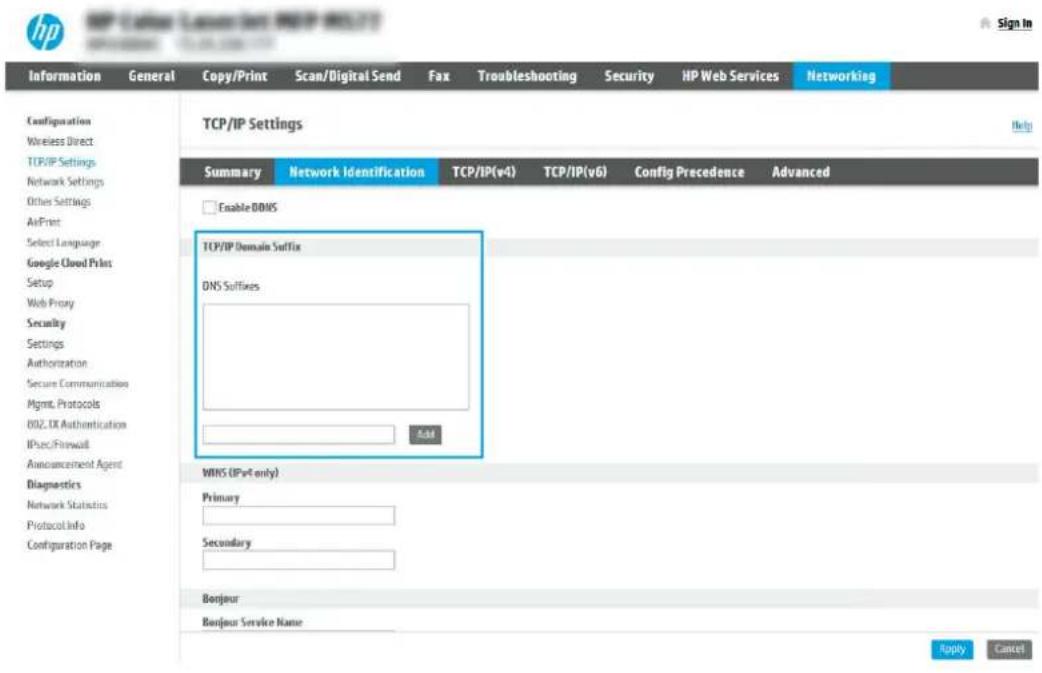

NOTE: If the Domain Name suffix is not set up, use the IP address.
- Click Apply.
- Click the Scan/Digital Send tab.
-
On the left navigation pane, click Email Setup.
-
On the Email Setup page, select the Enable Scan to Email check box. If this check box is not available, the feature is unavailable at the printer control panel.
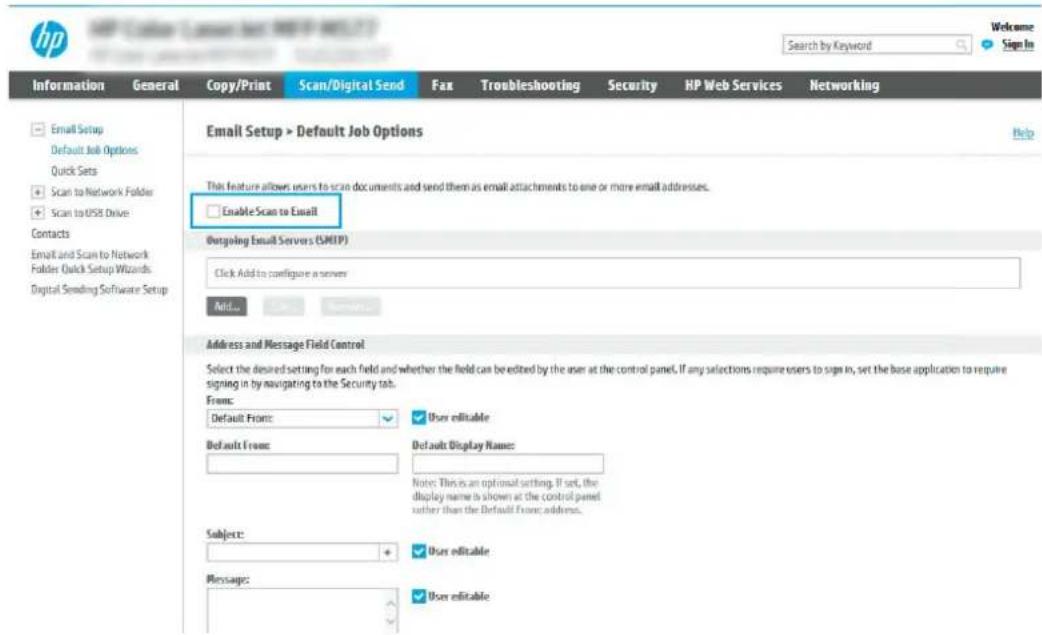
- In the Outgoing Email Servers (SMTP) area, click Add to start the SMTP wizard.
- In the I know my SMTP server address or host name field, type smtp.onoffice.com, and then click Next.
- On the Set the basic information necessary to connect to the server dialog, in the Port Number field, type 587.
NOTE: Some servers have problems sending or receiving emails that are larger than 5 megabytes (MB). These problems can be prevented by entering a number in Split emails if larger than (MB).
- Select the Enable SMTP SSL Protocol check box, and then click Next.
- On the Server Authentication Requirements dialog, complete the following information:
a. Select Server requires authentication.
b. From the drop-down list, select Always use these credentials.
c. In the Username field, type the Office 365 Outlook email address.
d. In the Password field, type the Office 365 Outlook account password, and then click Next.
- On the Server Usage dialog, choose the printer functions that will send email through this SMTP server, and then click the Next button.
- On the Summary and Test dialog, enter a valid email address in the Send a test email to: field, and then click Test.
- Verify that all of the settings are correct, and then click Finish to complete the outgoing email server setup.
For more information, go to Microsoft's Support page.
Set up Scan to Network Folder
Set up the Scan to Folder feature to scan documents directly to network folder.
Introduction
This section explains how to enable and configure the Scan to Network Folder function. The printer has a feature that enables it to scan a document and save it to a network folder. To use this scan feature, the printer must be connected to a network; however, the feature is not available until it has been configured. There are two methods for configuring Scan to Network Folder, the Save to Network Folder Setup Wizard for basic setup and Save to Network Folder Setup for advanced setup.
Before you begin
Have the following items available before you set up the Scan to Network feature.

NOTE: To set up the Scan to Network Folder feature, the printer must have an active network connection.
Administrators need the following items before beginning the configuration process.
- Administrative access to the printer.
- The fully-qualified domain name (FQDN) (e.g., \servername.us.companyname.net\scans) of the destination folder OR the IP address of the server (e.g., \16.88.20.20\scans).

NOTE: The use of the term "server" in this context refers to the computer where the shared folder resides.
Step one: Access the HP Embedded Web Server (EWS)
Open the EWS to start the setup process.

NOTE: The figure in this topic shows an EWS screen for a color printer. However, the procedure below is valid for both color and mono printers.
- From the Home screen on the printer control panel, touch the Information icon i, and then touch the Ethernet icon to display the IP address or host name.
- Open a web browser, and in the address line, type the IP address or host name exactly as it displays on the printer control panel. Press the Enter key on the computer keyboard. The EWS opens.

https://10.10.XX.XXX

NOTE: If the web browser displays a message indicating that accessing the website might not be safe, select the option to continue to the website. Accessing this website will not harm the computer.
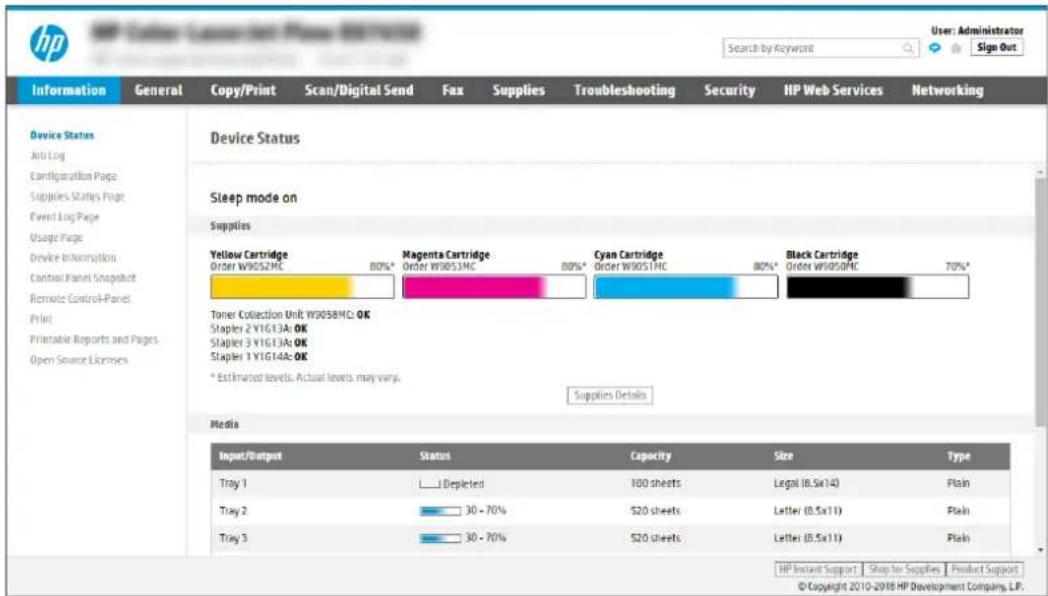
Step two: Set up Scan to Network Folder
Set up Scan to Network Folder using one of the following methods.
Method one: Use the Scan to Network Folder Wizard
Use this option for basic configuration of the Save to Network Folder feature using the Scan to Network Folder wizard.

NOTE: Before you begin: To display the printer's IP address or host name, touch the Information icon and then touch the Network icon on the printer's control panel.
- Using the EWS top navigation tabs, click Scan/Digital Send tab. The Email and Scan to Network Folder Quick Setup Wizards dialog opens.
- In the left navigation pane, click Email and Scan to Network Folder Quick Setup Wizards.
- Click the Save to Network Folder Quick Set Wizard link.
- On the Add or Remove a Save to Network Folder Quick Set dialog, click Add.

NOTE: Quick Sets are shortcut jobs that can be accessed on the printer Home screen or within the Quick Sets application.

NOTE: The Save to Network Folder feature can be minimally configured without creating a quick set. However, without the Quick Set, users must enter the destination folder information at the control panel for each scan job. A quick set is required to include Save to Network Folder metadata.
- On the Add Folder Quick Set dialog, complete the following information:
a. In the Quick Set Title field, type a title.

NOTE: Name the Quick Set something that users can understand quickly (e.g., "Scan and save to a folder").
b. In the Quick Set Description field, type a description explaining what the Quick Set will save.
c. Click Next.
- On the Configure Destination Folder dialog, complete the following information:
a. In the UNC Folder Path field, type a folder path where the scan will go.
The folder path can either be the fully-qualified domain name (FQDN) or the IP address of the server. Be sure that the folder path (e.g., \scans) follows the FQDN or IP address.
FQDN example: \servername.us.companyname.net\scans
IP address example: \16.88.20.20\scans

NOTE: The FQDN can be more reliable than the IP address. If the server gets its IP address via DHCP, the IP address can change. However, the connection with an IP address might be faster because the printer does not need to use DNS to find the destination server.
b. From the Authentication Settings drop-down, select one of the following options:
- Use credentials of user to connect after Sign In at the control panel
• Always use these credentials

NOTE: If Always use these credentials is selected, a user name and password must be entered in the corresponding fields, and the printer's access to the folder must be verified by clicking Verify Access.
c. In the Windows Domain field, type the Windows domain.

TIP: To find the Windows domain in Windows 7, click Start, click Control Panel, click System.
To find the Windows domain in Windows 8, click Search, enter System in the search box, and then click System.
The domain is listed under Computer name, domain, and workgroup settings.
d. Click Next.
- On the Configure File Scan Settings dialog, set the default scanning preferences for the Quick Set, and then click Next.
- Review the Summary dialog, and then click Finish.
Method two: Use Scan to Network Folder Setup
This option enables advanced configuration of the Save to Network Folder feature using the HP Embedded Web Server (EWS) for the printer.

NOTE: Before you begin: To display the printer's IP address or host name, touch the Information icon and then touch the Network icon on the printer's control panel.
Step one: Begin the configuration
Use the following steps to begin Scan to Network Folder setup.
- Click the Scan/Digital Send tab.
- In the left navigation pane, click Scan to Network Folder Setup.
Step two: Configure the Scan to Network Folder settings
Use the following procedure to complete Scan to Network Folder setup.
Step one: Begin the configuration
Use the following steps to begin configuration.
- On the Scan to Network Folder Setup page, select the Enable Scan to Network Folder check box. If this box is not selected, the feature is unavailable at the printer control panel.
- In the Scan to Network Folder area of the left navigation pane, click Quick Sets. Click Add to open the Quick Sets Setup dialog.

NOTE: Quick Sets are shortcut jobs that can be accessed on the printer Home screen or within the Quick Sets application.

NOTE: The Scan to Network Folder feature can be minimally configured without creating a Quick Set. However, without the Quick Set, users must enter the destination folder information at the control panel for each scan job. A Quick Set is required to include Scan to Network Folder metadata.
Complete all of the settings in the Quick Set Setup to fully configure the Scan to Network Folder feature.
Dialog one: Set the Quick Set name, description, and options for user interaction at the control panel
Set the Quick Set details for user interaction at the printer's control panel.
Use the Set the button location for the Quick Set and options for user interaction at the control panel dialog to configure where the Quick Set button will display on the printer control panel and to configure the level of user interaction at the printer control panel.
- In the Quick Set Name field, type a title.

NOTE: Name the Quick Set something that users can understand quickly (e.g., "Scan and save to a folder").
- In the Quick Set Description field, type a description explaining what the Quick Set will save.
- From the Quick Set Start Option list, select one of the following options:
- Option one: Enter application, then user presses Start.
• Option two: Start instantly upon selection.
Select one of the following prompt options :
- Prompt for original sides
- Prompt for additional pages
- Require Preview

NOTE: If Start instantly upon selection is selected, the destination folder must be entered in the next step.
- Click Next.
Dialog two: Folder Settings
Use the Folder Settings dialog to configure the types of folders the printer sends scanned documents to and the folder permissions.
There are two types of destination folders to select from:
• Shared folders or FTP folders
• Personal shared folders
There are two types of folder permissions to select from:
- Read and write access
- Write access only
Configure the destination folder for scanned documents
Select one of the following options to set up a destination folder.
Option 1: Configure the printer to save to a shared folder or FTP folder
To save scanned documents to a standard shared folder or an FTP folder, complete the following steps.
- If it is not already selected, select Save to shared folders or FTP folders.
- Click Add.... The Add Network Folder Path dialog opens.
- On the Add Network Folder Path dialog, select one of the following options:
- Option one: Save to a standard shared network folder.
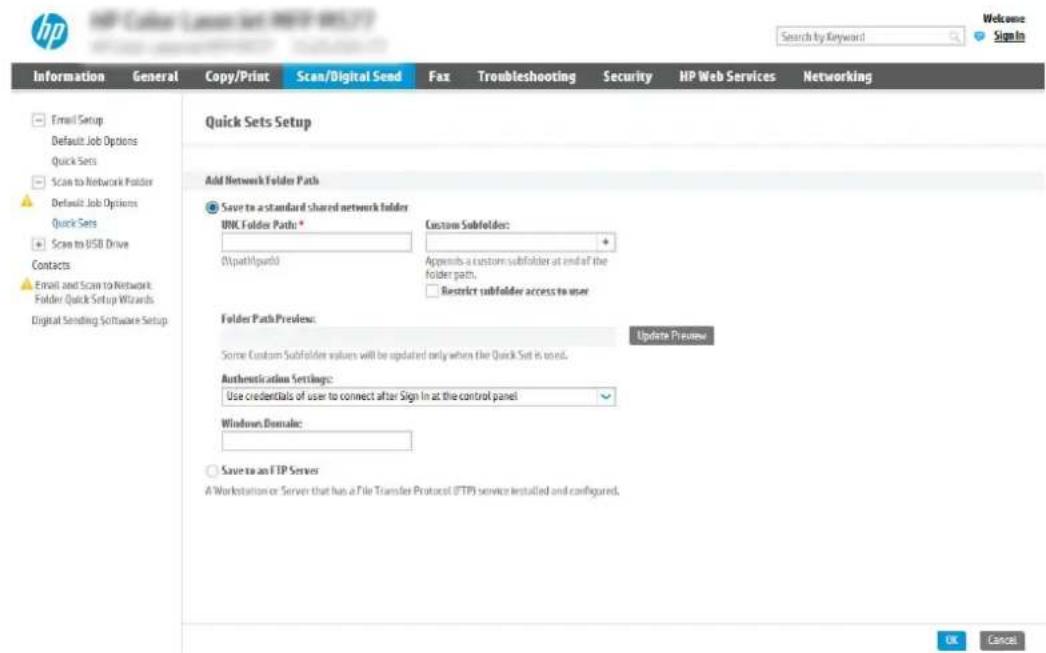
a. If it is not already selected, select Save to a standard shared network folder.
b. In the UNC Folder Path field, type a folder path.
The folder path can either be the fully-qualified domain name (FQDN) or the IP address of the server. Be sure that the folder path (e.g., \scans) follows the FQDN or IP address.
FQDN example: \servername.us.companyname.net\scans
IP address example: \16.88.20.20\scans

NOTE: The FQDN can be more reliable than the IP address. If the server gets its IP address via DHCP, the IP address can change. However, the connection with an IP address might be faster because the printer does not need to use DNS to find the destination server.
c. To automatically create a subfolder for scanned documents in the destination folder, select a format for the subfolder name from the Custom Subfolder list.
To restrict the subfolder access to the user who creates the scan job, select Restrict subfolder access to user.
d. To view the complete folder path for scanned documents, click Update Preview.
e. From the Authentication Settings list, select one of the following options:
—Use credentials of user to connect after Sign In at the control panel
—Always use these credentials

NOTE: If Always use these credentials is selected, a user name and password must be entered in the corresponding fields.
f. In the Windows Domain field, type the Windows domain.

NOTE: To find the Windows domain in Windows 7, click Start, click Control Panel, click System.
To find the Windows domain in Windows 8, click Search, enter System in the search box, and then click System.
The domain is listed under Computer name, domain, and workgroup settings.

NOTE: If a shared folder is set to be accessed by everyone, values for a workgroup name (default is "Workgroup"), a user name, and password must be entered in the corresponding fields. However, if the folder is within a particular user's folders and not Public, the user name and password of that user must be used.

NOTE: An IP address might be necessary instead of a computer name. Many home routers do not handle computer names well, and there is no Domain Name Server (DNS). In this case, it is best to set up a static IP address on the shared PC to alleviate the problem of DHCP assigning a new IP address. On a typical home router, this is done by setting a static IP address that is on the same subnet, but outside the DHCP address range.
g. Click OK.
- Option two: Save to an FTP Server.
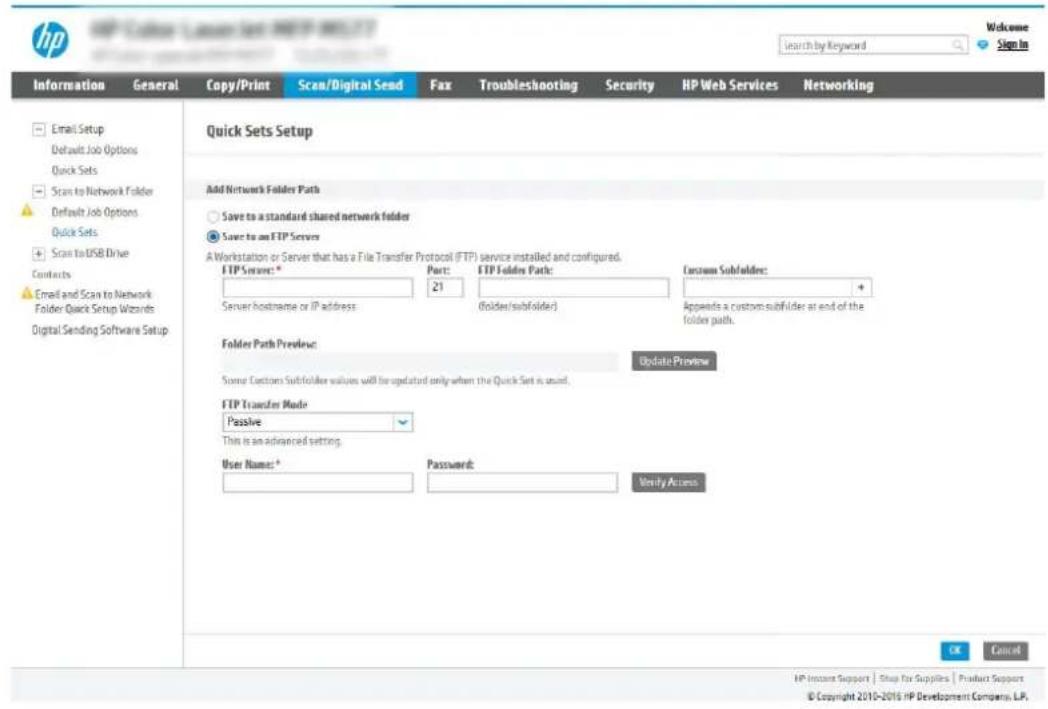

NOTE: If an FTP site is outside the firewall, a proxy server must be specified under the network settings. These settings are located in the EWS Networking tab, under the Advanced options.
a. Select Save to an FTP Server.
b. In the FTP Server field, type the FTP server name or IP address.
c. In the Port field, type the port number.

NOTE: In most cases, the default port number does not need to be changed.
d. To automatically create a subfolder for scanned documents in the destination folder, select a format for the subfolder name from the Custom Subfolder list.
e. To view the complete folder path for scanned documents, click Update Preview.
f. From the FTP Transfer Mode list, select one of the following options:
-Passive
-Active
g. In the Username field, type the user name.
h. In the Password field, type the password.
i. Click Verify Access to confirm the destination can be accessed.
i. Click OK.
Option 2: Configure the printer to save to a personal shared folder
To save scanned documents to a personal shared folder, complete the following steps.

NOTE: This option is used in domain environments where the administrator configures a shared folder for each user. If the Save to a personal shared folder feature is configured, users will be required to sign in at the printer control panel using Windows credentials or LDAP authentication.
- Select Save to a personal shared folder.
- In the Retrieve the device user's home folder using this attribute field, type the user's home folder in the Microsoft Active Directory.

NOTE: Verify that the user knows where this home folder is located on the network.
- To add a user name subfolder at the end of the folder path, select Create subfolder based on user name.
To restrict the subfolder access to the user who creates the scan job, select Restrict subfolder access to user.
Select the destination folder permissions
Select one of the following options to set up destination folder permissions.
Option 1: Configure read and write access
To send scanned documents to a folder configured for read and write access, complete the following steps.

NOTE: Send only to folders with read and write access supports folder verification and job notification.
- If it is not already selected, select Send only to folders with read and write access.
- To require the printer to verify folder access before starting a scan job, select Verify folder access prior to job start.

NOTE: Scan jobs can complete more quickly if Verify folder access prior to job start is not selected; however, if the folder is unavailable, the scan job will fail.
- Click Next.
Option 2: Configure write access only
To send scanned documents to a folder configured for write access only, complete the following steps.

NOTE: Allow sending to folders with write access only does not support folder verification or job notification.

NOTE: If this option is selected, the printer cannot increment the scan filename. It sends the same filename for all scans.
Select a time-related filename prefix or suffix for the scan filename, so that each scan is saved as a unique file, and does not overwrite a previous file. This filename is determined by the information in the File Settings dialog in the Quick Set Wizard.
- Select Allow sending to folders with write access only.
- Click Next.
Dialog three: Notification Settings
Use the Notification Settings dialog to configure when notifications will be sent.
- On the Notification Settings dialog, complete one of the following tasks:
- Option one: Do not notify.
a. Select Do not notify.
b. To prompt the user to review their notification settings, select Prompt user prior to job start, and then click Next.
- Option two: Notify when job completes.
a. Select Notify when job completes.
b. Select the method for delivering the notification from the Method Used to Deliver Notification list.
If the method of notification selected is Email, type the email address in the Notification Email Address field.
c. To include a thumbnail of the first scanned page in the notification, select Include Thumbnail.
d. To prompt the user to review their notification settings, select Prompt user prior to job start, and then click Next.
- Option three: Notify only if job fails.
a. Select Notify only if job fails.
b. Select the method for delivering the notification from the Method Used to Deliver Notification list.
If the method of notification selected is Email, type the email address in the Notification Email Address field.
c. To include a thumbnail of the first scanned page in the notification, select Include Thumbnail.
d. To prompt the user to review their notification settings, select Prompt user prior to job start, and then click Next.
Dialog four: Scan Settings
Complete the scan settings as follows.
On the Scan Settings dialog, set the default scanning preferences for the Quick Set, and then click Next.
Table 6-9 Scan settings
| Feature Description |
| Original Size Select the page size of the original document. |
| Original Sides Select whether the original document is single-sided or double-sided. |
| Optimize Text/Picture Select to optimize for the output of a particular type of content. |
Table 6-9 Scan settings (continued)
| Feature Description | |
| Content Orientation | Select the way the content of the original document is placed on the page: Portrait or Landscape. |
| Background Cleanup | Select a value to remove faint images from the background or to remove a light background color. |
| Darkness Select a value to adjust the darkness of the file. | |
| Contrast Select a value to adjust the contrast of the file. | |
| Sharpness Select a value to adjust the sharpness of the file. | |
| Image Preview | Select whether to require or make optional a displayed preview of the job or to disable a preview. |
| Cropping Options | Select whether or not to allow a job to be cropped and the type of cropping option. |
| Erase Edges | Select this setting to specify the width of edge margins to be erased, in either inches or millimeters, for the front side and back side of a job. |
Dialog five: File Settings
Complete the file settings as follows.
On the File Settings dialog, set the default file settings for the Quick Set, and then click Next.
Table 6-10 File settings
| Feature Description | |
| File Name Prefix Set the default file name prefix used for files saved to a network folder. | |
| File Name Default file name for the file to be saved. | |
| Select the User editable check box to make this setting editable at the printer control panel. | |
| File Name Suffix | Set the default file name suffix used for files saved to a network folder. |
| File Name Preview | Enter a file name, and then click the Update Preview button. |
| File Numbering Format | Select a file name format for when the job is divided into multiple files. |
| Add numbering when job has just one file (ex._1-1) | Select this setting to add numbering to a file name when the job is only one file instead of multiple files. |
| File Type | Select the file format for the saved file. |
| Select the User editable check box to make this setting editable at the printer control panel. | |
| High Compression (smaller file) | Select this setting to compress the scanned file, which reduces the file size. However, the scanning process for a High compression file might take longer than for a Normal compression file. |
| PDF encryption | If the file type is PDF, then this option encrypts the output PDF file. A password must be specified as part of the encryption. The same password must be used to open the file. The user will be prompted to enter a password prior to scanning their job if one has not been set prior to starting the scan. |
| Resolution | Set the resolution for the file. Higher resolution images have more dots per inch (dpi), so they show more detail. Lower resolution images have fewer dots per inch and show less detail, but the file size is smaller. |
| Quality and File Size | Select the quality for the file. Higher-quality images require a larger file size than lower-quality images, and they take more time to send. |
| Color/Black Specify whether copies are to be printed in color, black and gray, or black only. | |
| Suppress blank pages | If the Suppress blank pages option is enabled, blank pages will be ignored. |
| Metadata File Format Use the drop-down list to select the file format for metadata information. | |
| Create Multiple Files | Select this setting to scan pages into separate files based on a predetermined maximum number of pages per file. |
Dialog six: Summary
On the Summary dialog, review the Summary dialog, and then click Finish.
Step three: Complete the configuration
Use the following steps to complete Scan to Network Folder setup.
- In the left navigation pane, click Scan to Network Folder.
- On the Scan to Network Folder page, review the selected settings, and then click Apply to complete the setup.
Set up Scan to SharePoint
Use Scan to SharePoint to scan documents directly to a Microsoft SharePoint site. This feature eliminates the need to scan the documents to a network folder, USB flash drive, or email message, and then manually upload the files to the SharePoint site.
Introduction
Set up the Scan to SharePoint feature, and then scan documents directly to a SharePoint site.
Scan to SharePoint supports all scanning options, including the ability to scan documents as images or use the OCR features to create text files or searchable PDFs.
The feature is disabled by default. Enable Save to Sharepoint in the HP Embedded Web Server (EWS).
Before you begin
Before this procedure can be completed, the destination folder that the scanned files will be saved to must exist on the SharePoint site, and write access must be enabled to the destination folder. Scan to SharePoint is disabled by default.
Step one: Access the HP Embedded Web Server (EWS)
Open the EWS to start the setup process.

NOTE: The figure in this topic shows an EWS screen for a color printer. However, the procedure below is valid for both color and mono printers.
- From the Home screen on the printer control panel, touch the Information icon ⓘ, and then touch the Ethernet icon to display the IP address or host name.
- Open a web browser, and in the address line, type the IP address or host name exactly as it displays on the printer control panel. Press the Enter key on the computer keyboard. The EWS opens.

NOTE: If the web browser displays a message indicating that accessing the website might not be safe, select the option to continue to the website. Accessing this website will not harm the computer.
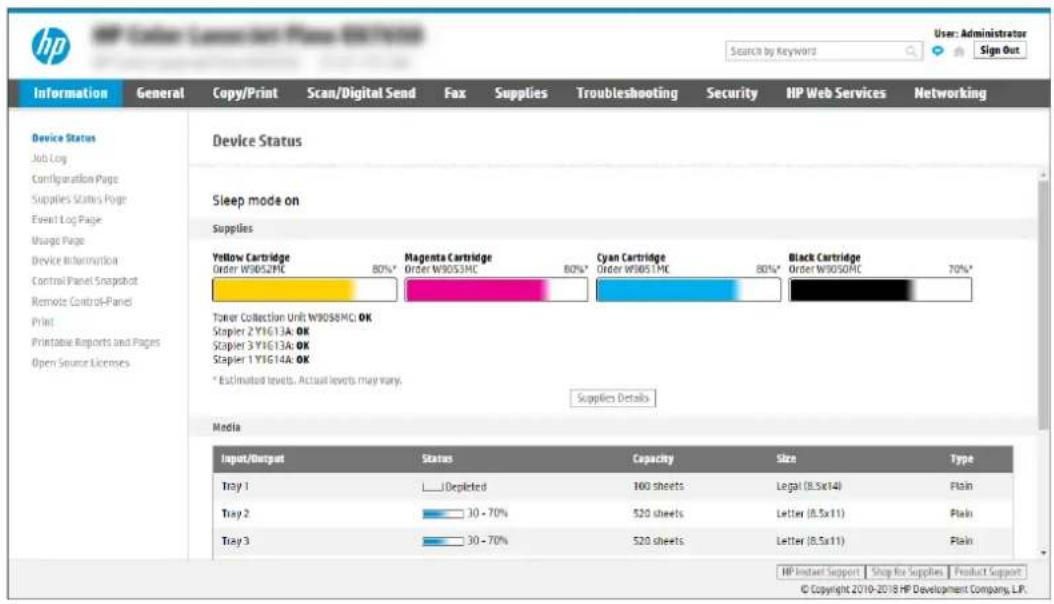
Step two: Enable Scan to SharePoint and create a Scan to SharePoint Quick Set
Follow the steps to enable the Scan to SharePoint feature and create a Scan to SharePoint Quick Set.
- Using the top navigation tabs, click Scan/Digital Send.
- In the left navigation pane, click Scan to SharePoint®.
NOTE: Quick Sets are shortcut jobs that can be accessed on the printer Home screen or within the Quick Sets application.
- Select Enable Scan to SharePoint ^® , and then click Apply.
- In the Scan to SharePoint area of the left navigation pane, click Quick Sets. Click Add to launch the Quick Set Wizard.
- Enter a Quick Set Name (for example, "Scan to SharePoint") and a Quick Set Description.
- Select a Quick Set Start Option to determine what occurs after selecting a Quick Set on the printer control panel, and then click Next.
- Use the following steps to add the path to the SharePoint folder:
a. Click Add on the SharePoint Destination Settings page to open the Add SharePoint Path page.
b. Open another browser window, navigate to the SharePoint folder to use, and then copy the folder path for the SharePoint folder from that browser window.
c. Paste the SharePoint folder path into the SharePoint Path: field.
d. By default, the printer overwrites an existing file that has the same file name as the new file. Clear Overwrite existing files so that a new file with the same name as an existing file is given an updated time/date stamp.
e. Select an option from the Authentication Settings drop-down menu. Select whether it is necessary to sign in to the SharePoint site with credentials, or store the credentials within the Quick Set.

NOTE: Use credentials of user to connect after Sign In at the control panel is selected in the Authentication Settings drop-down menu, the logged-in user must have permission to write to the specified SharePoint site.

NOTE: For security purposes, the printer does not display credentials entered in the Quick Set Wizard.
f. Click OK to complete the SharePoint path setup, and navigate back to the SharePoint Destination Settings page.
-
Select Verify folder access prior to job start to ensure that the SharePoint folder specified as the destination folder is accessible each time the Quick Set is used. If this option is not selected, jobs can be saved to the SharePoint folder more quickly. However, if this option is not selected and the SharePoint folder is inaccessible, the job will fail.
-
Click Next.
-
Set a Condition on Which to Notify on the Notification Settings page. This setting configures the Quick Set to either not notify, or to send email messages or print a summary page if a job either completes successfully or fails. Select one of the following options from the Condition on Which to Notify drop-down menu:
-
Select Do not notify for the Quick Set to not perform any notification action when a job completes successfully or fails.
- Select Notify when job completes to for the Quick Set to send a notification when a job completes successfully.
- Select Notify only if job fails to for the Quick Set to send a notification only when a job fails.
Selecting either Notify when job completes or Notify only if job fails requires the Method Used to Deliver Notification: to be set. Select from the following options:
- Email: Use this option to send an email when the selected notification condition occurs. This option requires a valid email address in the Notification Email Address: field.

NOTE: To use the email notification feature, first configure the email feature on the printer.
- Print: Use this option to print the notification when the selected notification condition occurs.

NOTE: Select Include Thumbnail for either notification option to include a thumbnail image of the first page of the scanned page of the job.
- Click Next.
- Select options from the Scan Settings page, and then click Next. For more information, see Table 6-12 Scan settings for Scan to SharePoint on page 101.
- Select options from the File Settings page, and then click Next. For more information, see Table 6-13 File settings for Scan to SharePoint on page 102.
- Review the summary of settings. Click Finish to save the Quick Set or click Previous to edit the settings.
Scan a file directly to a SharePoint site
Follow the steps to scan a document directly to a SharePoint site.
- Place the document face-down on the scanner glass, or place it face-up in the document feeder and adjust the paper guides to fit the size of the document.
- From the Home screen on the printer control panel, navigate to the Scan application, select the Scan icon, and then select Scan to SharePoint ^® .

NOTE: It might be necessary to sign in to the printer to use this feature.
- Under Quick Sets, touch Select, select a Quick Set, and then select Load.
- Touch the File Name: text field to open a keyboard. Type the name for the file using either the on-screen keyboard or the physical keyboard, and touch the Enter button.
- Touch Options to view and configure settings for the document.
- Touch the right pane of the screen to preview the document. In the preview screen, use the buttons on the right of the screen to adjust the preview options and to rearrange, rotate, insert, or remove pages.
Table 6-11 Buttons on the right side of the preview pane
| Button Description | |
 | Use these buttons to toggle between single-page view and thumbnail view. More options are available in thumbnail view than in single-page view. |
 | |
 | Use these buttons to zoom in or out on the selected page.NOTE: Select only one page at a time to use these buttons. |
 | |
 | Use this button to rotate the page 180 degrees.NOTE: This button is available only in the thumbnail view. |
 | Use this button to delete the selected pages. NOTE: This button is available only in the thumbnail view. |
 | Use these buttons to rearrange the pages within the document. Select one or more pages and move them to the left or right. NOTE: These buttons are available only in the thumbnail view. |
 | |
 | Use this button to add a page to the document. The printer prompts to scan additional pages. |
 | Use this button to clear the changes made in the preview and start over. |
 | Touch this button to collapse the preview screen and return to the Copy screen. |
- When the document is ready, select Send to save it to the SharePoint location.
Quick Set scan settings and options for Scan to SharePoint
Review the settings and options available in the Quick Set Wizard when adding, editing, or copying a Scan to SharePoint Quick Set.
Table 6-12 Scan settings for Scan to SharePoint
| Feature Description | |
| Original Size Select the page size of the original document. | |
| Original Sides Select whether the original document is single-sided or double-sided. | |
| Optimize Text/Picture Select to optimize for the output of a particular type of content. | |
| Content Orientation | Select the way the content of the original document is placed on the page: Portrait or Landscape. |
| Background Cleanup | Select a value to remove faint images from the background or to remove a light background color. |
| Darkness Select a value to adjust the darkness of the file. | |
| Contrast Select a value to adjust the contrast of the file. | |
| Sharpness Select a value to adjust the sharpness of the file. | |
| Image Preview | Select whether to require or make optional a displayed preview of the job or to disable a preview. |
| Cropping Options | Select whether or not to allow a job to be cropped and the type of cropping option. |
| Erase Edges | Select this setting to specify the width of edge margins to be erased, in either inches or millimeters, for the front side and back side of a job. |
Table 6-13 File settings for Scan to SharePoint
| Feature Description | |
| File Name Prefix Set the default file name prefix used for files to be saved. | |
| File Name Default file name for the file to be saved.Select the User editable check box to make this setting editable at the printer control panel. | |
| File Name Suffix Set the default file name suffix used for files to be saved.Duplicate filename suffix default [filename]_YYYYMMDDT | |
| File Name Preview | Enter a file name, and then click the Update Preview button. |
| File Numbering Format | Select a file name format for when the job is divided into multiple files. |
| Add numbering when job has just one file (ex._1-1) | Select this setting to add numbering to a file name when the job is only one file instead of multiple files. |
| File Type Select the file format for the saved file.Select the User editable check box to make this setting editable at the printer control panel. | |
| High Compression (smaller file) | Select this setting to compress the scanned file, which reduces the file size. However, the scanning process for a High compression file might take longer than for a Normal compression file. |
| PDF encryption | If the file type is PDF, then this option encrypts the output PDF file. A password must be specified as part of the encryption. The same password must be used to open the file. The user will be prompted to enter a password prior to scanning their job if one has not been set prior to starting the scan. |
| Resolution | Set the resolution for the file. Higher resolution images have more dots per inch (dpi), so they show more detail. Lower resolution images have fewer dots per inch and show less detail, but the file size is smaller. |
| Quality and File Size | Select the quality for the file. Higher-quality images require a larger file size than lower-quality images, and they take more time to send. |
| Color/Black | Specify whether copies are to be printed in color, black and gray, or black only |
| Suppress blank pages | If the Suppress blank pages option is enabled, blank pages will be ignored. |
| Create Multiple Files | Select this setting to scan pages into separate files based on a predetermined maximum number of pages per file. |
Set up Scan to USB Drive
Enable the Scan to USB Drive feature, which allows you to scan directly to a USB flash drive.
Introduction
The printer has a feature that enables it to scan a document and save it to a USB flash drive. The feature is not available until it has been configured through the HP Embedded Web Server (EWS).
Step one: Access the HP Embedded Web Server (EWS)
Open the EWS to start the setup process.

NOTE: The figure in this topic shows an EWS screen for a color printer. However, the procedure below is valid for both color and mono printers.
- From the Home screen on the printer control panel, touch the Information icon ⓘ, and then touch the Ethernet icon to display the IP address or host name.
- Open a web browser, and in the address line, type the IP address or host name exactly as it displays on the printer control panel. Press the Enter key on the computer keyboard. The EWS opens.


NOTE: If the web browser displays a message indicating that accessing the website might not be safe, select the option to continue to the website. Accessing this website will not harm the computer.
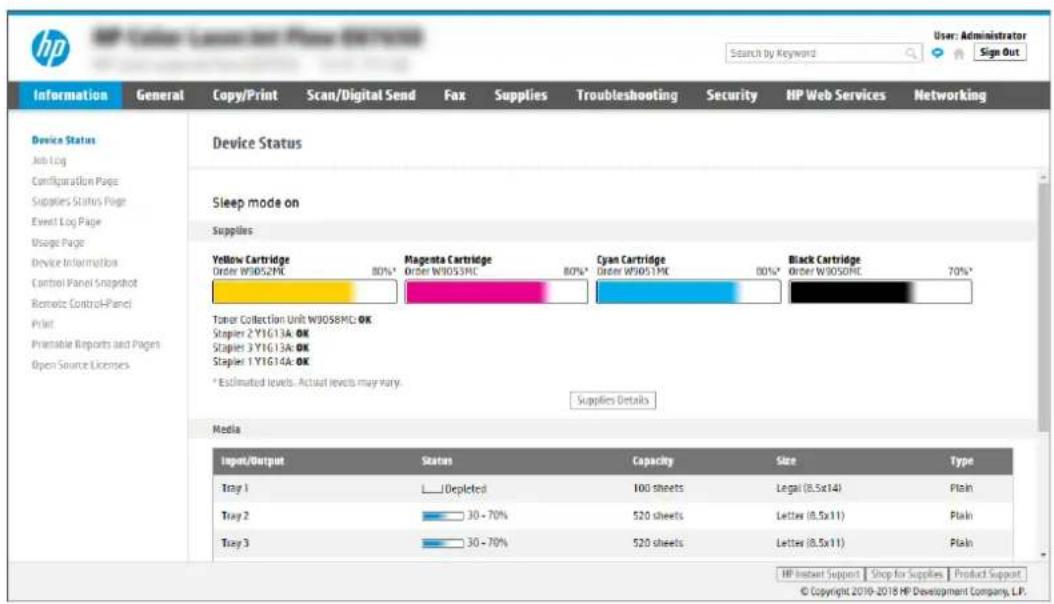
Step two: Enable Scan to USB Drive
Enable Scan to USB Drive using the following steps.
- Select the Security tab.
- Scroll to Hardware Ports and make sure that Enable Host USB plug and play is enabled.
-
Select the Scan/Digital Send tab and then click the Scan to USB Driver Settings option in the left navigation pane.
-
Select the Enable Scan to USB Drive check box.
-
Click Apply at the bottom of the page.

NOTE: Most devices ship with hard disk drives (HDDs) already installed. In some cases, additional storage devices can be added via USB. Verify whether the Save to USB feature needs to be expanded to USB and hard drive.
Step three: Configure the Quick Sets (optional)
Use the following steps to set up Quick Sets for Scan to USB Drive. Quick Sets are shortcut jobs that can be accessed on the printer Home screen or within the Quick Sets application.
- In the Scan to USB Drive area of the left navigation pane, click Quick Sets.
- Select one of the following options:
- Select an existing Quick Set under Quick Sets Application in the table.
-OR-
- Click Add to start the Quick Set Wizard.
- If you clicked Add, the Quick Sets Setup page opens. Complete the following information:
a. Quick Set Name: Enter a title for the new Quick Set.
b. Quick Set Description: Enter a description of the Quick Set.
c. Quick Set Start Option: To set how the Quick Set starts, click either Enter application, then user presses Start or Start instantly when selected from the Home Screen.
-
Select a default location where scanned files are saved on USB storage devices inserted into the USB port on the control panel, and then click Next. The default location options are:
-
Save at root directory of the USB storage device.
-
Create or place in this folder on the USB Storage Device – The path to the folder on the USB storage device must be specified when using this file location option. A backslash \ must be used to separate folder\subfolder names in the path.
-
Select an option from the Condition on Which to Notify: drop-down list, and then click Next.
This setting determines if, or how, users are notified when a Save To USB Quick Set job completes or fails. The options for the Condition on Which to Notify: setting are:
- Do not notify
- Notify when job completes
-
Notify only if job fails
-
Choose the Scan Settings for the Quick Set, and then click Next.

NOTE: For more information on the available scan settings, see Default scan settings for Scan to USB Drive setup on page 105
- Choose the File Settings for the Quick Set, and then click Next.

NOTE: For more information on the available file settings, see Default scan settings for Scan to USB Drive setup on page 105
- Review the summary of settings, and then click Finish to save the Quick Set, or click Previous to edit the settings.
Default scan settings for Scan to USB Drive setup
Review the default settings for Scan to USB Drive setup.
Table 6-14 Scan settings for Scan to USB Drive setup
| Feature Description | |
| Original Size Select the page size of the original document. | |
| Original Sides Select whether the original document is single-sided or double-sided. | |
| Optimize Text/Picture Select to optimize for the output of a particular type of content. | |
| Content Orientation | Select the way the content of the original document is placed on the page: Portrait or Landscape. |
| Background Cleanup | Select a value to remove faint images from the background or to remove a light background color. |
| Darkness Select a value to adjust the darkness of the file. | |
| Contrast Select a value to adjust the contrast of the file. | |
| Sharpness | Select a value to adjust the sharpness of the file. |
| Image Preview | Select whether to require or make optional a displayed preview of the job or to disable a preview. |
| Cropping Options | Select whether or not to allow a job to be cropped and the type of cropping option. |
| Erase Edges | Select this setting to specify the width of edge margins to be erased, in either inches or millimeters, for the front side and back side of a job. |
Default file settings for Save to USB setup
Review the options for Save to USB setup.
Table 6-15 File settings for Save to USB setup
| Option name | Description |
| File Name Prefix | Set the default file name prefix used for files saved to a network folder. |
| File Name | Default file name for the file to be saved.Select the User editable check box to make this setting editable at the printer control panel. |
| File Name Suffix | Set the default file name suffix used for files saved to a network folder.Duplicate filename suffix default [filename]_YYYYMMDDT |
| File Name Preview | Enter a file name, and then click the Update Preview button. |
| File Numbering Format | Select a file name format for when the job is divided into multiple files. |
| Option name Description | |
| Add numbering when job has just one file (ex._1-1) | Select this setting to add numbering to a file name when the job is only one file instead of multiple files. |
| File Type Select the file format for the saved file. | |
| Select the User editable check box to make this setting editable at the printer control panel. | |
| High Compression (smaller file) | Select this setting to compress the scanned file, which reduces the file size. However, the scanning process for a High compression file might take longer than for a Normal compression file. |
| PDF encryption | If the file type is PDF, then this option encrypts the output PDF file. A password must be specified as part of the encryption. The same password must be used to open the file. The user will be prompted to enter a password prior to scanning their job if one has not been set prior to starting the scan. |
| Resolution | Set the resolution for the file. Higher resolution images have more dots per inch (dpi), so they show more detail. Lower resolution images have fewer dots per inch and show less detail, but the file size is smaller. |
| Quality and File Size | Select the quality for the file. Higher-quality images require a larger file size than lower-quality images, and they take more time to send. |
| Color/Black Specify whether copies are to be printed in color, black and gray, or black only. | |
| Suppress blank pages | If the Suppress blank pages option is enabled, blank pages will be ignored. |
| Create Multiple Files | Select this setting to scan pages into separate files based on a predetermined maximum number of pages per file. |
Scan to email
Scan a document directly to an email address or contact list. The scanned document is sent as an email message attachment.
Introduction
The printer has a feature that enables it to scan a document and send it to one or more email addresses.
Scan to email
Use the following steps to scan a document directly to an email address or contact list.
- Place the document face-down on the scanner glass, or place it face-up in the document feeder and adjust the paper guides to fit the size of the document.
- From the Home screen on the printer control panel, navigate to the Scan application, select the Scan icon, and then select Scan to Email.
NOTE: If prompted, type your user name and password.
- Touch the To field to open a keyboard.
NOTE: If you are signed in to the printer, your user name or other default information might appear in the From field. If so, you might not be able to change it.
- Specify the recipients by using one of these methods:
• Use the keypad to enter the address in the To field.
To send to multiple addresses, separate the addresses with a semicolon, or select the Enter button on the touchscreen keyboard after typing each address.
- Use a contact list as follows:
a. Select the Contacts button B that is next to the To field to open the Contacts screen.
b. Select the appropriate contact list.
c. Select a name or names from the list of contacts to add to the recipients list, and then select Add.
-
Complete the Subject, File Name, and Message fields by touching the field and using the touchscreen keyboard to enter information. Select the Close button whenever you need to close the keyboard.
-
To load a Quick Set, select Load, select the Quick Set, and then select Load under the Quick Sets list.

NOTE: Quick Sets are predefined settings for various types of output, such as Text, Photograph, and High Quality. You can select a Quick Set to view the description.
-
To configure settings, such as File Type and Resolution, Original Sides, and Content Orientation, select Options in the lower left corner, and then select the settings from the Options menus. Select Done if prompted.
-
Optional Preview: Touch the right pane of the screen to preview the document. You can use the Expand and Collapse buttons on the left side of the preview pane to expand and collapse the preview screen.
Table 6-16 Buttons on the left side of the preview pane
| Button Description | |
| Expand the preview screen. | |
| Collapse the preview screen. | |
Use the buttons on the right of the screen to adjust the preview options and to rearrange, rotate, insert, or remove pages.
Table 6-17 Buttons on the right side of the preview pane
| Button Description | |
 | Use these buttons to toggle between single-page view and thumbnail view. More options are available in thumbnail view than in single-page view. |
 | |
 | Use these buttons to zoom in or out on the selected page.NOTE: Select only one page at a time to use these buttons. |
 | |
 | Use this button to rotate the page 180 degrees.NOTE: This button is available only in the thumbnail view. |
 | Use this button to delete the selected pages.NOTE: This button is available only in the thumbnail view. |
 | Use these buttons to rearrange the pages within the document. Select one or more pages and move them to the left or right.NOTE: These buttons are available only in the thumbnail view. |
 | |
 | Use this button to add a page to the document. The printer prompts to scan additional pages. |
 | Use this button to clear the changes made in the preview and start over. |
 | Touch this button to collapse the preview screen and return to the Copy screen. |
- When the document is ready, select Send to email it.

NOTE: The printer might prompt you to add the email address to the contact list.
Scan to job storage
Scan a document and save it to a job storage folder on the printer.
Introduction
The printer has a feature that enables it to scan a document and save it to a job storage folder on the printer. You can retrieve the document from the printer and print it when needed.
NOTE: Before you can scan to a storage folder on the printer, your printer administrator or IT department must use the HP Embedded Web Server to enable the feature and configure the settings.
Scan to job storage on the printer
Use this procedure to scan a document and save it to a job storage folder on the printer so that you can print copies at any time.
- Place the document face-down on the scanner glass, or place it face-up in the document feeder and adjust the paper guides to fit the size of the document.
- From the Home screen on the printer control panel, navigate to the Scan application, select the Scan icon, and then select Scan to Job Storage.
NOTE: If prompted, enter your user name and password.
- Select the default storage folder name shown under Folder.
If the printer administrator has configured the option, you can create a new folder. Follow these steps to create a new folder:
a. Select the New Folder icon .
b. Select the New Folder field, type the folder name, and then select OK.
-
Make sure that you have selected the correct folder.
-
Touch the Job Name text field to open a touchscreen keyboard, type the name for the file, and then select the Enter button.
-
To make the job private, select the PIN button , enter a four-digit PIN in the PIN field, and then close the touchscreen keypad.
-
To configure settings, such as Sides and Content Orientation, select Options in the lower left corner, and then select the settings from the Options menus. Select Done for each setting if prompted.
-
Optional Preview: Touch the right pane of the screen to preview the document. You can use the Expand and Collapse buttons on the left side of the preview pane to expand and collapse the preview screen.
Table 6-18 Buttons on the left side of the preview pane
| Button Description | |
 | Expand the preview screen. |
 | Collapse the preview screen. |
Use the buttons on the right of the screen to adjust the preview options and to rearrange, rotate, insert, or remove pages.
Table 6-19 Buttons on the right side of the preview pane
| Button Description | |
 | Use these buttons to toggle between single-page view and thumbnail view. More options are available in thumbnail view than in single-page view. |
 | |
 | Use these buttons to zoom in or out on the selected page.NOTE: Select only one page at a time to use these buttons. |
 | |
 | Use this button to rotate the page 180 degrees.NOTE: This button is available only in the thumbnail view. |
 | Use this button to delete the selected pages.NOTE: This button is available only in the thumbnail view. |
 | Use these buttons to rearrange the pages within the document. Select one or more pages and move them to the left or right. |
| NOTE: These buttons are available only in the thumbnail view. | |
 | |
 | Use this button to add a page to the document. The printer prompts to scan additional pages. |
 | Use this button to clear the changes made in the preview and start over. |
 | Touch this button to collapse the preview screen and return to the Copy screen. |
- When the document is ready, select Save to save the file to the storage folder.
Print from job storage on the printer
Use this procedure to print a scanned document that is in a job storage folder on the printer.
- From the Home screen on the printer control panel, navigate to the Print application, select the Print icon, and then select Print from Job Storage.
- Under Stored Jobs to Print, select Choose, select the folder in which the document is saved, select the document, and then select Select.
- If the document is private, enter the four-digit PIN in the Password field, and then select OK.
- To adjust the number of copies, touch the box to the left of the Print button, and then select the number of copies from the keypad that opens. Select the Close button to close the keypad.
- Select Print to print the document.
Scan to network folder
Scan a document and save it to a folder on the network.
Introduction
The printer can scan a file and save it in a shared folder on the network.
Scan to network folder
Use this procedure to scan a document and save it to a network folder.

NOTE: You might be required to sign in to the printer to use this feature.
- Place the document face-down on the scanner glass, or place it face-up in the document feeder and adjust the paper guides to fit the size of the document.
- From the Home screen on the printer control panel, navigate to the Scan application, select the Scan icon, and then select Scan to Network Folder.
-
Specify a folder destination. Folder options must first be configured by the printer administrator.
-
To select a folder location that the administrator already set up, select Load under Quick Sets and Defaults, select the folder, and then select Load.
- To specify a new folder location, touch the Folder Paths field to open a touchscreen keyboard, type the path to the folder, and then select the Enter button←Enter user credentials if prompted and then select Save to save the path.

NOTE: Use this format for the path: \server\folder, where "server" is the name of the server that hosts the shared folder, and "folder" is the name of the shared folder. If the folder is nested inside other folders, complete all necessary segments of the path to reach the folder. For example: \server\folder\folder

NOTE: The Folder Paths field might have a pre-defined path, and it might not be editable. In this situation, the administrator has configured this folder for common access.
- Touch the File Name text field to open a touchscreen keyboard, type the name for the file, and then select the Enter button
- To configure settings, such as File Type and Resolution, Original Sides, and Content Orientation, select Options in the lower left corner, and then select the settings from the Options menus. Select Done for each setting if prompted.
- Optional Preview: Touch the right pane of the screen to preview the document. You can use the Expand and Collapse buttons on the left side of the preview pane to expand and collapse the preview screen.
Table 6-20 Buttons on the left side of the preview pane
| Button Description | |
| Expand the preview screen. | |
| Collapse the preview screen. | |
Use the buttons on the right of the screen to adjust the preview options and to rearrange, rotate, insert, or remove pages.
Table 6-21 Buttons on the right side of the preview pane
| Button Description | |
 | Use these buttons to toggle between single-page view and thumbnail view. More options are available in thumbnail view than in single-page view. |
 | |
 | Use these buttons to zoom in or out on the selected page.NOTE: Select only one page at a time to use these buttons. |
 | |
 | Use this button to rotate the page 180 degrees.NOTE: This button is available only in the thumbnail view. |
 | Use this button to delete the selected pages.NOTE: This button is available only in the thumbnail view. |
 | Use these buttons to rearrange the pages within the document. Select one or more pages and move them to the left or right.NOTE: These buttons are available only in the thumbnail view. |
 | |
 | Use this button to add a page to the document. The printer prompts to scan additional pages. |
 | Use this button to clear the changes made in the preview and start over. |
 | Touch this button to collapse the preview screen and return to the Copy screen. |
- When the document is ready, select Send to save the file to the network folder.
Scan to SharePoint
Scan a document directly to a SharePoint site.
Introduction
If you have a workflow-equipped printer, you can scan a document and send it to a SharePoint site. This feature eliminates the need to scan the documents to a network folder, USB flash drive, or email message, and then manually upload the files to the SharePoint site.
Scan to SharePoint supports all scanning options, including the ability to scan documents as images or use the OCR features to create text files or searchable PDFs.

NOTE: Before you can scan to SharePoint, your printer administrator or IT department must use the HP Embedded Web Server to enable the feature and set it up.
Scan to SharePoint
Use the following steps to scan a document directly to a SharePoint site.
- Place the document face-down on the scanner glass, or place it face-up in the document feeder and adjust the paper guides to fit the size of the document.
- From the Home screen on the printer control panel, navigate to the Scan application, select the Scan icon, and then select Scan to SharePoint ^® .

NOTE: It might be necessary to sign in to the printer to use this feature.
- Under Quick Sets, touch Select, select a Quick Set, and then select Load.
- Select the File Name: text field to open a keyboard. Type the name for the file, and then select the enter button
- To configure settings, such as File Type and Resolution, Sides, and Content Orientation, select Options in the lower left corner, and then select the settings from the Options menus. Select Done if prompted.
- Optional Preview: Touch the right pane of the screen to preview the document. You can use the Expand and Collapse buttons on the left side of the preview pane to expand and collapse the preview screen.
Table 6-22 Buttons on the left side of the preview pane
| Button Description | |
| Expand the preview screen. | |
| Collapse the preview screen. | |
Use the buttons on the right of the screen to adjust the preview options and to rearrange, rotate, insert, or remove pages.
Table 6-23 Buttons on the right side of the preview pane
| Button Description | |
| Use these buttons to toggle between single-page view and thumbnail view. More options are available in thumbnail view than in single-page view. |
 | |
 | Use these buttons to zoom in or out on the selected page.NOTE: Select only one page at a time to use these buttons. |
 | |
 | Use this button to rotate the page 180 degrees.NOTE: This button is available only in the thumbnail view. |
 | Use this button to delete the selected pages.NOTE: This button is available only in the thumbnail view. |
 | Use these buttons to rearrange the pages within the document. Select one or more pages and move them to the left or right.NOTE: These buttons are available only in the thumbnail view. |
 | |
 | Use this button to add a page to the document. The printer prompts to scan additional pages. |
 | Use this button to clear the changes made in the preview and start over. |
 | Touch this button to collapse the preview screen and return to the Copy screen. |
- When the document is ready, select Send to save it to the SharePoint location.
Scan to USB drive
Scan a document directly to a USB drive.
Introduction
The printer can scan a file and save it to a USB flash drive.
Scan to USB drive
Use the following steps to scan a document directly to a USB drive.

NOTE: You might be required to sign in to the printer to use this feature.
- Place the document face-down on the scanner glass, or place it face-up in the document feeder and adjust the paper guides to fit the size of the document.
- Insert the USB drive into the USB port near the printer control panel.
- From the Home screen on the printer control panel, navigate to the Scan application, select the Scan icon, and then select Scan to USB Drive.
- Select the USB drive under Destination, and then select the save location (either the root of the USB drive or an existing folder).
- Touch the File Name text field to open a touchscreen keyboard, type the name for the file, and then select the Enter button
- To configure settings, such as File Type and Resolution, Original Sides, and Content Orientation, select Options in the lower left corner, and then select the settings from the Options menus. Select Done if prompted.
- Optional Preview: Touch the right pane of the screen to preview the document. You can use the Expand and Collapse buttons on the left side of the preview pane to expand and collapse the preview screen.
Table 6-24 Buttons on the left side of the preview pane
| Button Description | |
| Expand the preview screen. | |
| Collapse the preview screen. | |
Use the buttons on the right of the screen to adjust the preview options and to rearrange, rotate, insert, or remove pages.
Table 6-25 Buttons on the right side of the preview pane
| Button Description | |
 | Use these buttons to toggle between single-page view and thumbnail view. More options are available in thumbnail view than in single-page view. |
| |
| Use these buttons to zoom in or out on the selected page.NOTE: Select only one page at a time to use these buttons. |
| |
| Use this button to rotate the page 180 degrees.NOTE: This button is available only in the thumbnail view. |
| Use this button to delete the selected pages.NOTE: This button is available only in the thumbnail view. |
| Use these buttons to rearrange the pages within the document. Select one or more pages and move them to the left or right.NOTE: These buttons are available only in the thumbnail view. |
| |
| Use this button to add a page to the document. The printer prompts to scan additional pages. |
| Use this button to clear the changes made in the preview and start over. |
| Touch this button to collapse the preview screen and return to the Copy screen. |
- When the document is ready, select Save to save the file to the USB drive.
Use HP JetAdvantage business solutions
HP JetAdvantage solutions are workflow and printing solutions that are easy to use, and both network- and cloud-based. HP JetAdvantage solutions are designed to help businesses of all types, including
healthcare, financial services, manufacturing, and public sector, manage a fleet of printers and scanners.
HP JetAdvantage Solutions include:
• HP JetAdvantage Security solutions
• HP JetAdvantage Management solutions
•HP JetAdvantage Workflow solutions
• HP JetAdvantage Mobile Printing solutions
For more information about HP JetAdvantage business workflow and printing solutions, go to www.hp.com/go/PrintSolutions.
Additional scan tasks
Locate information on the Web for performing common scan tasks.
Go to Support for HP Color LaserJet Enterprise MFP 6800 or Support for HP Color LaserJet Enterprise MFP 6801.
Instructions are available for performing specific scan tasks, such as the following:
- Copy or scan pages from books or other bound documents
- Send a scanned document to a folder in the printer memory
- Copy or scan both sides of an identification card
- Copy or scan a document into a booklet format
7 Fax
Configure the fax features, and send and receive faxes using the printer.
The following information is correct at the time of publication. For current information, see Support for HP Color LaserJet Enterprise MFP 6800 or Support for HP Color LaserJet Enterprise MFP 6801.
For more information:
HP's all-inclusive help for the printer includes the following information:
• Install and configure
- Learn and use
- Solve problems
- Download software and firmware updates
- Join support forums
● Find warranty and regulatory information
Set up fax
Set up the fax features for the printer.
Introduction
This information applies to fax and Flow models, or to other printers when an optional analog fax accessory has been installed. Before continuing, connect the printer to a phone line (for analog fax) or to an Internet or network fax service.
Set up fax by using the printer control panel
Configure the fax features using the control panel.
- From the Home screen on the printer control panel, navigate to the Settings application, and then select the Settings icon.
- Open the following menus:
a. Fax
b. Internal Fax Modem Setup

NOTE: If the Internal Fax Modem Setup menu does not appear in the menu listing, LAN or Internet fax might be enabled. When LAN or Internet fax is enabled, the analog fax accessory is disabled and the Internal Fax Modem Setup menu does not display. Only one fax feature, either LAN fax, analog fax, or Internet fax, can be enabled at a time. To use analog fax when LAN fax is enabled, use the HP Embedded Web Server to disable LAN fax.
-
Select the location from the list on the right side of the screen, and then select Next.
-
Touch the Company Name text field, and use the keypad to type the company name.
- Touch the Fax Number text field, and use the keypad to type the sending fax number. Select Next.
- Verify that the date and time settings are correct. Make changes as necessary, and then select Next.
- If a dialing prefix is required for sending faxes, touch the Dialing Prefix text field, and use the keypad to enter the number.
- Review all the information on the left pane, and then select Finish to complete the fax setup.
Change fax configurations
Change or update fax settings.

NOTE: The settings configured using the control panel override any settings made in the HP Embedded Web Server.
Fax dialing settings
Use the following steps to change the fax dialing settings.
- From the Home screen on the printer control panel, navigate to the Settings application, and then select the Settings icon.
- Open the following menus:
a. Fax
b. Fax Send Settings
c. Fax Dialing Settings
- Configure any of the following settings, and then select Done.
Table 7-1 Fax dialing settings
| Menu item Description | |
| Redial on Error | The Redial on Error feature sets the number of times a fax number will be redialed when an error occurs during a fax transmission. |
| Redial on No Answer | The Redial on No Answer setting selects the number of times the fax accessory redials if the number dialed does not answer. The number of retries is either 0 to 1 (used in the U.S.) or 0 to 2, depending on the location setting. The interval between retries is set by the Redial Interval setting. |
| Redial on Busy | The Redial on Busy setting selects the number of times (0 through 9) the fax accessory redials a number when the number is busy. The interval between retries is set by the Redial Interval setting. |
| Redial Interval | The Redial Interval setting selects the number of minutes between retries if the number dialed is busy or not answering, or if an error occurs.NOTE: You might observe a redial message on the control panel when both the Redial on Busy and Redial on No Answer settings are set to off. This occurs when the fax accessory dials a number, establishes a connection, and then loses the connection. As a result of this error condition, the fax accessory performs three automatic redial attempts regardless of the redial settings. During this redial operation, a message displays on the control panel to indicate that a redial is in progress. |
| Fax Send Speed | The Fax Send Speed setting sets the modem bit rate (measured in bits per second) of the Analog Fax modem while sending a fax.Fast (v.34 - 33.6k)Medium (v.17 - 14.4k)Slow (v.29 - 9.6k) |
| Line Monitor Volume | Use the Line Monitor Volume setting to control the printer's dialing volume level when sending faxes. |
| Dialing Mode | The Dialing Mode setting sets the type of dialing that is used: either tone (touch-tone phones) or pulse (rotary-dial phones). |
| Dialing Prefix | The Dialing Prefix setting allows you to enter a prefix number (such as a "9" to access an outside line) when dialing. This prefix number is automatically added to all phone numbers when dialed. |
| Detect Dial Tone | The Detect Dial Tone setting determines whether the fax checks for a dial tone before sending a fax. |
General fax send settings
Use the following steps to change the fax send settings.
- From the Home screen on the printer control panel, navigate to the Settings application, and then select the Settings icon.
- Open the following menus:
a. Fax
b. Fax Send Settings
c. General Fax Send Settings
- Configure any of the following settings, and then select Done.
Table 7-2 Fax send settings
| Menu item Description | |
| Fax Number Confirmation | When the Fax Number Confirmation feature is enabled, the fax number must be entered twice to ensure that it was entered correctly. The feature is disabled by default. |
| PC Fax Send | Use the PC Fax Send feature to send faxes from a PC. This feature is enabled by default. |
| Error Correction Mode | Normally, the fax accessory monitors the signals on the telephone line while it is sending or receiving a fax. If the fax accessory detects an error during the transmission and the Error Correction Mode setting is on, the fax accessory can request that the error portion of the fax be sent again.The Error Correction Mode feature is enabled by default. You should turn it off only if you are having trouble sending or receiving a fax and if you are willing to accept the errors in the transmission and a probable quality reduction in the image. Turning off the setting might be useful when you are trying to send a fax overseas or receive one from overseas, or if you are using a satellite telephone connection.NOTE: Some VoIP providers might suggest turning off the Error Correction Mode setting. However, this is not usually necessary. |
| Fax Header | Use the Fax Header feature to control whether the header is appended to the top, and content is shifted down, or if the header is overlaid on top of the previous header. |
Fax receive settings
Use the following steps to change the fax receive settings.
- From the Home screen on the printer control panel, navigate to the Settings application, and then select the Settings icon.
- Open the following menus:
a. Fax
b. Fax Receive Settings
c. Fax Receive Setup
- Configure any of the following settings, and then select Done.
Table 7-3 Fax receive settings
| Menu item Description | |
| Receive Mode | TheReceive Modesetting determines how the fax accessory receives fax jobs. Select one of the following options:AutomaticTAMFax/TelManual |
| Rings to Answer | The Rings to Anwersetting determines the number of times the phone rings before the call is answered by the fax accessory.NOTE:The default range for the available options for the Rings to Anwersetting is location-specific. The range of possible Rings to Answeroptions is limited by location.If the fax accessory is not answering, and the Rings to Anwersetting is 1, try increasing it to 2. |
| Ring Volume | The Ring Volumesetting allows you to adjust the ringer volume. |
| Fax Receive Speed | Touch the Fax Receive Speed drop-down menu and select one of the following options:Fast (v.34 - 33.6k)Medium (v.17 - 14.4k)Slow (v.29 - 9.6k) |
| Extension Phone This setting allows you use a separate telephone in conjunction with the fax functions. | |
| Allow Reprinting This setting allows you to reprint received faxes. | |
| Receive to PC This setting allows you to receive faxes directly to your computer. | |
| Fax Polling This setting allows you to enable or disable the fax polling function. | |
| Fax/Tel Ring Time | This setting determines the number of times the phone rings before the fax/tel mode initiates. |
Send a fax
Use the following steps to send a fax from the printer.
- Place the document face-down on the scanner glass, or place it face-up in the document feeder and adjust the paper guides to fit the size of the document.
-
From the Home screen on the printer control panel, navigate to the Fax application, and then select the Fax icon. You might be prompted to type a user name and password.
-
Specify the recipients using one of these methods:
• Use the keypad to enter the recipient or recipients.
Touch the Fax Recipients text field, and then use the keypad to enter the fax number. To send to multiple fax numbers, separate the numbers with a semicolon, or select the Enter button on the touchscreen keyboard after typing each number.
• Use a contact list as follows:
a. Select the Contacts button ☐ that is next to the Fax Recipients field to open the Contacts screen.
b. Select the appropriate contact list.
c. Select a name or names from the list of contacts to add to the recipients list, and then select Add.
- To load a Quick Set, select Load, select the Quick Set, and then select Load under the Quick Sets list.

NOTE: Quick Sets are predefined settings for various types of output, such as Text, Photograph, and High Quality. You can select a Quick Set to view the description.
-
To configure settings, such as Resolution, Sides, and Content Orientation, select Options in the lower left corner, and then select the settings from the Options menus. Select Done if prompted.
-
Optional Preview: Touch the right pane of the screen to preview the document. You can use the Expand and Collapse buttons on the left side of the preview pane to expand and collapse the preview screen.
Table 7-4 Buttons on the left side of the preview pane
| Button Description | |
| Expand the preview screen. |
| [36YZ] | Collapse the preview screen. |
Use the buttons on the right of the screen to adjust the preview options and to rearrange, rotate, insert, or remove pages.
Table 7-5 Buttons on the right side of the preview pane
| Button Description | |
| Use these buttons to toggle between single-page view and thumbnail view. More options are available in thumbnail view than in single-page view. |
 | |
 | Use these buttons to zoom in or out on the selected page.NOTE: Select only one page at a time to use these buttons. |
| |
 | Use this button to rotate the page 180 degrees.NOTE: This button is available only in the thumbnail view. |
 | Use this button to delete the selected pages.NOTE: This button is available only in the thumbnail view. |
 | Use these buttons to rearrange the pages within the document. Select one or more pages and move them to the left or right. |
| NOTE: These buttons are available only in the thumbnail view. | |
 | |
 | Use this button to add a page to the document. The printer prompts to scan additional pages. |
 | Use this button to clear the changes made in the preview and start over. |
 | Touch this button to collapse the preview screen and return to the Copy screen. |
- When the document is ready, select Send to send the fax.
Create a fax printing schedule
Faxes print automatically upon receipt, but they can also be stored and printed on a schedule that you determine. After you create the schedule, you can enable or disable the schedule as needed.
- From the Home screen on the printer control panel, navigate to the Settings application, and then select the Settings icon.
- Open the following menus:
a. Fax
b. Fax Receive Settings
c. Fax Printing Schedule
- Under Incoming Fax Options, select Use Schedule.
- Select New Event.
-
Select an option under Event Type.
-
Begin Printing
-
Begin Storing
-
Choose a time and the day. You can select multiple days.
- Select Save. To add another event, repeat steps 4 - 6.
- Select Done to enable the fax printing schedule.
Block incoming faxes
Use the fax block list setting to create a list of blocked phone numbers. When a fax is received from a blocked phone number, the fax is not printed and is immediately deleted from memory.
Create a list of blocked fax numbers
Use the following steps to create the list of fax numbers to block.
- From the Home screen on the printer control panel, navigate to the Settings application, and then select the Settings icon.
- Open the following menus:
a. Fax
b. Fax Receive Settings
c. Blocked Fax Numbers
-
Use one of the following options to add a number to the list:
-
Select Add Last Sender.
-
Select the New Fax Number field, type the number on the keypad that appears, and then select the Enter button. To add additional numbers, type the number and select the Enter button.
-
Select Done.
Delete numbers from the list of blocked fax numbers
Use the following steps to remove numbers from the list of blocked fax numbers.
- From the Home screen on the printer control panel, navigate to the Settings application, and then select the Settings icon.
- Open the following menus:
a. Fax
b. Fax Receive Settings
c. Blocked Fax Numbers
- Select one or more existing fax numbers in the list, or select Select All if you want to remove all the numbers.
- Select the Trash button ☐, and then select Delete on the confirmation prompt.
Additional fax tasks
Locate information on the Web for performing common fax tasks.
Go to Support for HP Color LaserJet Enterprise MFP 6800 or Support for HP Color LaserJet Enterprise MFP 6801.
Instructions are available for fax tasks, such as the following:
- Create and manage fax speed dial lists
- Configure fax billing codes
- Use a fax printing schedule
- Block incoming faxes
• Fax archiving and forwarding
Manage the printer8
Utilize management tools, configure security and energy-conservation settings, and manage firmware updates for the printer.
The following information is correct at the time of publication. For current information, see Support for HP Color LaserJet Enterprise MFP 6800 or Support for HP Color LaserJet Enterprise MFP 6801.
For more information:
HP's all-inclusive help for the printer includes the following information:
• Install and configure
- Learn and use
- Solve problems
- Download software and firmware updates
- Join support forums
• Find warranty and regulatory information
Advanced configuration with the HP Embedded Web Server (EWS)
Use the HP Embedded Web Server to manage advanced printing functions.
Introduction
Use the HP Embedded Web Server to manage printing functions from a computer instead of the printer control panel.
• View printer status information
- Determine the remaining life for all supplies and order new ones
• View and change tray configurations
• View and change the printer control-panel menu configuration
• View and print internal pages
- Receive notification of printer and supplies events
• View and change network configuration
The HP Embedded Web Server works when the printer is connected to an IP-based network. The HP Embedded Web Server does not support IPX-based printer connections. Internet access is not needed to open and use the HP Embedded Web Server.
When the printer is connected to the network, the HP Embedded Web Server is automatically available.

NOTE: The HP Embedded Web Server is not accessible beyond the network firewall.
How to access the HP Embedded Web Server (EWS)
Use the following steps to open the Embedded Web Server.
- From the Home screen on the printer control panel, touch the Information icon i, and then touch the Ethernet icon to display the IP address or host name.
- Open a web browser, and in the address line, type the IP address or host name exactly as it displays on the printer control panel. Press the Enter key on the computer keyboard. The EWS web page opens.

https://10.10.XX.XXX

NOTE: If the web browser displays a message indicating that accessing the website might not be safe, select the option to continue to the website. Accessing this website will not harm the computer.
To use the HP Embedded Web Server, the browser must meet the following requirements:
Windows ^® 7
- Internet Explorer (version 8.x or greater)
• Google Chrome (version 34.x or greater) - Firefox (version 20.x or greater)
Windows ^® 8 or greater
- Internet Explorer (version 9.x or greater)
• Google Chrome (version 34.x or greater) - Firefox (version 20.x or greater)
Windows 10 or greater
- Microsoft Edge (version 93 or greater)
- Internet Explorer (version 9.x or greater)
- Google Chrome (version 34.x or greater)
- Firefox (version 20.x or greater)
macOS
• Safari (version 5.x or greater)
- Google Chrome (version 34.x or greater)
Linux
• Google Chrome (version 34.x or greater)
- Firefox (version 20.x or greater)
HP Embedded Web Server features
Learn about the HP Embedded Web Server (EWS) features available on each tab.
Figure 8-1 EWS Tabs
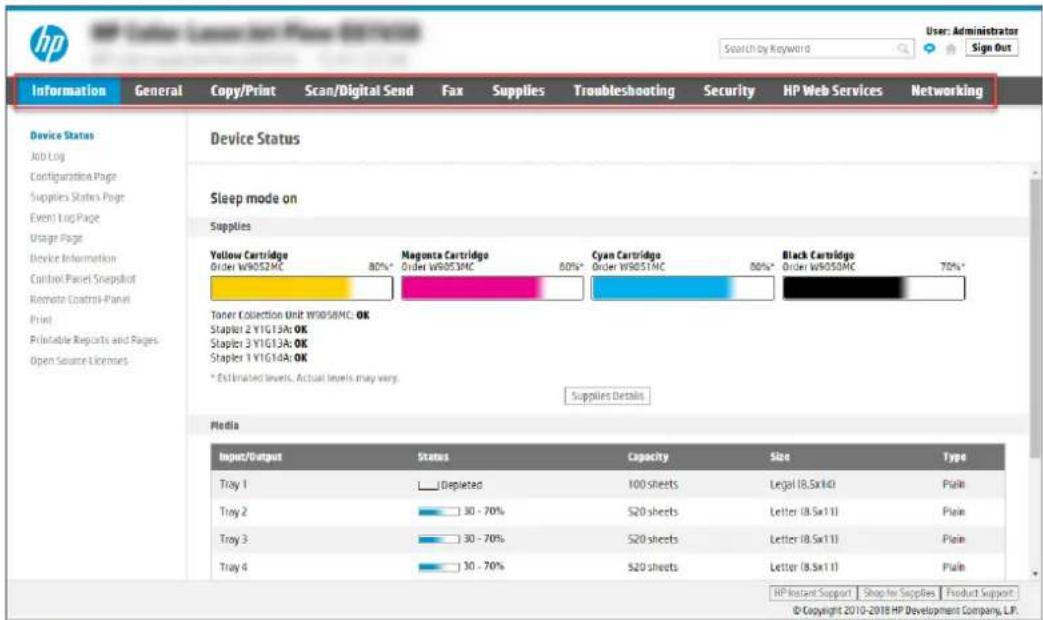

NOTE: Copy/Print, Scan/Digital Send, and Fax tabs only appear for multi-function printers (MFPs). A Print tab appears for single-function printers (SFPs).
Information tab
Refer to the table for settings in the Information tab.
Table 8-1 HP Embedded Web Server Information tab
| Menu Description | |
| Device Status | Shows the printer status and shows the estimated life remaining of HP supplies. The page also shows the type and size of paper set for each tray. To change the default settings, click the Change Settings link. |
| Job Log Provides a list of the jobs that have been processed. | |
| Configuration Page Shows the information found on the configuration page. | |
| Supplies Status Page Shows the status of the supplies for the printer. | |
| Event Log Page | Shows a list of all printer events and errors. Use the HP Instant Support link (In the Other Links area on all HP Embedded Web Server pages) to connect to a set of dynamic web pages that help solve problems. These pages also show additional services available for the printer. |
| Usage Page Shows a summary of the number of pages the printer has printed, grouped by size, type, and paper print path. | |
| Device Information | Shows the printer network name, address, and model information. To customize these entries, click the Device Information menu on the General tab. |
| Control Panel Snapshot | Shows an image of the current screen on the control panel display. |
| Remote Control-Panel | Provides a way to troubleshoot or manage the printer from a browser window on a desktop or laptop. |
| Print Allows the user to send a print-ready file to the printer to be printed. | |
| Printable Reports and Pages | Lists the internal reports and pages for the printer. Select one or more items to print. |
| Open Source Licenses | Shows a summary of the licenses for open source software programs that can be used with the printer. |
General tab
Refer to the table for settings in the General tab.
Table 8-2 HP Embedded Web Server General tab
| Menu Description | |
| Control Panel Customization Reorder, show, or hide features on the control-panel display. | |
| Change the default display language and keyboard layouts. | |
| Quick Sets | Configure jobs that are available in the Quick Sets area of the Home screen on the printer control panel. |
| Alerts Set up email alerts for various printer and supplies events. | |
| Control Panel Settings App | Shows the Settings app options that are available on the printer control panel. |
| General Settings | Configure how the printer recovers from jams and other general printer settings. |
| Edit Other Links | Add or customize a link to another website. This link displays in the footer area on all HP Embedded Web Server pages. |
| Ordering Information | Enter information about ordering replacement toner cartridges. This information displays on the supplies status page. |
| Device Information | Name the printer and assign an asset number to it. Enter the name of the primary contact who will receive information about the printer. |
| Language | Set the language in which to display the HP Embedded Web Server information. |
| Firmware Upgrade | Download and install printer firmware upgrade files. |
| Date/Time Settings | Set the date and time or synchronize with a network time server. |
| Energy Settings | Set or edit a wake time, sleep time, and sleep delay for the printer. Set a different schedule for each day of the week and for holidays.Set which interactions with the printer cause it to wake from sleep mode. |
| Import/Export | Provides import and export functionality for Home Screen settings, Quick Sets, Contacts (Address Books), accounts and permissions, job apps, and other items.The exported .zip file contains one or more .xml settings files or an editable .csv file (containing user accounts or contacts). The file can be imported to other HP products. Import a previously exported .zip file to transfer settings, user accounts, or contacts. |
| Back up and Restore | Create a backup file that contains printer and user data. If necessary, use this file to restore data to the printer. |
| Reset Factory Settings | Restore printer settings to the factory defaults. |
| Solution Installer Install or remove third-party software packages that extend or modify the functionality of the printer. | |
| Job Statistics Settings | Provides connection information about third-party job-statistics services, or enables local serverless device job accounting. |
| Quota Settings | Provides connection information about third-party job-quota services, or enables local device quota service. |
Other Links list
Configure which links display in the footer of the HP Embedded Web Server by using the Edit Other Links menu on the General tab.

NOTE: The following are the default links.
Table 8-3 HP Embedded Web Server Other Links list
| Menu Description | |
| HP Instant Support Connect to the HP website to find solutions to printer problems. | |
| Shop for Supplies | Connect to the HP website for information on purchasing original HP supplies, such as cartridges and paper. |
| Product Support | Connect to the support site for the printer to search for help on various topics. |
Copy/Print tab
Refer to the table for settings in the Copy/Print tab.
Table 8-4 HP Embedded Web Server Copy/Print tab
| Menu Description | |
| Print from USB Drive Settings | Enable or disable the Print from USB Drive menu on the control panel. |
| Manage Stored Jobs Enable or disable the ability to store jobs in the printer memory. | |
| Configure job-storage options. | |
| Default Print Options Configure the default options for print jobs. | |
| Restrict Color(Color printers only) | Permit or restrict color printing and copying. |
| Specify permissions for individual users or for jobs that are sent from specific software programs. | |
| PCL and PostScript Settings | Adjust the PCL and PostScript settings for all print jobs, including copy jobs and received faxes. |
| Print Quality | Configure the print quality settings, including color adjustment, image registration, and allowed paper types. |
| Copy Settings | Configure the default options and Quick Sets for copy jobs. |
| NOTE: If job-specific copy setting options are not set from the control panel at the start of a job, the default settings will be used for the job. | |
| Expert Copy Enable or disable Expert Copy and set the initial copy view. | |
| The Expert Copy feature is available only on some HP MFPs with larger control panels, and is available in FutureSmart 4 firmware 24.7.3 release or later. | |
| Manage Trays Configure settings for paper trays. | |
| Manage Stapler/Stacker | Configure settings for the stapler/stacker for printers that have this feature. |
Scan/Digital Send tab
Refer to the table for settings in the Scan/Digital Send tab.
Table 8-5 HP Embedded Web Server Scan/Digital Send tab
| Menu Description | |
| Scan to Email Setup | Configure the default email settings for digital sending, including the following:Settings for the outgoing mail (SMTP) serverSettings for Email Quick Sets jobsDefault message settings, such as the "From" address and the subject lineSettings for digital signatures and encryptionSettings for email notificationsDefault scan settings for email jobsDefault file settings for email jobs |
| Scan to Network Folder | Configure the network folder settings for digital sending, including the following:Settings for Quick Sets jobs saved in a network folderSettings for notificationsDefault scan settings for jobs saved in a network folderDefault file settings for jobs saved in a network folder |
| Scan to SharePoint® | Configure the SharePoint settings for digital sending, including the following:Settings for Quick Sets jobs saved in a document library on the SharePoint siteDefault settings for jobs saved in a document library on the SharePoint site |
| Scan to USB Drive Configure the USB settings for digital sending, including the following:Settings for Quick Sets jobs saved on a USB flash driveSettings for notificationsDefault scan settings for jobs saved on a USB flash driveDefault file settings for jobs saved on a USB flash drive | |
| Contacts Manage contacts, including the following:Add email addresses into the printer one at a time.Import a large list of frequently-used email addresses on to the printer all at once, rather than adding them one at a time.Export contacts from the printer into a .CSV file on the computer to use as a data backup, or import the records onto another HP printer.Edit email addresses that have already been saved in the printer. | |
| Preferences Manage general scanning settings. | |
| Email and Scan to Network Folder Quick Setup Wizards | Configure the printer to send scanned images as email attachments.Configure the printer to save scanned images to network-folder Quick Sets. Quick Sets provide easy access to files saved on the network. |
| Digital Sending Software Setup | Configure settings related to using optional Digital Sending software. |
Fax tab
Refer to the table for settings in the Fax tab.
Table 8-6 HP Embedded Web Server Fax tab
| Menu Description | |
| Fax Send Setup Configure settings for sending faxes, including the following:Default settings for outgoing faxesSettings for fax Quick Sets jobsSettings for notificationsDefault setting for sending faxes using the internal fax modemSettings for using a LAN fax serviceSettings for using an Internet fax service | |
| Fax Speed Dials Manage speed dials, including the following:Import .CSV files containing email addresses, fax numbers, or user records, so that they can be accessed on this printer.Export email, fax, or user records from the printer into a file on the computer to use as a data backup, or import the records onto another HP printer. | |
| Fax Receive Setup | Configure default print options for incoming faxes, and set up a fax printing schedule. |
| Fax Archive and Forwarding | Enable or disable fax archiving and fax forwarding, and configure basic settings for each:Fax archiving is a method to send a copy of all incoming and outgoing faxes to an email address, a network folder, or an FTP server.Fax forwarding is a method to forward incoming faxes to a different fax device. |
| Fax Activity Log | Contains a list of the faxes that have been sent from or received by this printer. |
Supplies tab
Refer to the table for settings in the Supplies tab.
Table 8-7 HP Embedded Web Server Supplies tab
| Menu Description |
| Manage Supplies Configure how the printer reacts when supplies reach a Very Low state. |
Troubleshooting tab
Refer to the table for settings in the Troubleshooting tab.
Table 8-8 HP Embedded Web Server Troubleshooting tab
| Menu Description | |
| General Troubleshooting Use the following options as appropriate:Reports and Tests area: Select and print several types of reports and tests. Some reports can be viewed in the EWS by clicking the View button.Fax Tools area: Configure settings for fax troubleshooting. (MFP and Digital Sender products with HP analog fax accessory only)OXPd Troubleshooting area: Enable or disable the Allow a Non-Secure Connection for Web Services optionAuto Recovery area: Enable or disable the Enable Auto Recovery option, which allows the printer to auto recover from errors that might require the power to be turned off and on (for example, a 49 error). | |
| Online Help Link to HP cloud-based online help to assist in troubleshooting printing issues. | |
| Diagnostic DataNOTE: This item is available only if an administrator password is set from the Security tab. | Export printer information to a file that can be useful for HP technical support to use for detailed problem analysis. |
| Calibration/Cleaning | Enable the automatic cleaning feature, create and print the cleaning page, and select an option to calibrate the printer immediately. |
| Reset Factory Settings Restore printer settings to factory defaults. | |
| Firmware Upgrade Download and install printer firmware upgrade files. | |
| Scheduled Restart Restart the printer at the frequency or time specified. | |
Security tab
Refer to the table for settings in the Security tab.
Table 8-9 HP Embedded Web Server Security tab
| Menu Description | |
| General Security Settings for general security, including the following: | |
| Configure an administrator password to restrict access to certain features on the printer.Set a custom device Service Access Code.Set PJL password for processing PJL commands.Set file system access and firmware upgrade security.Enable or disable the Host USB port on the control panel or the USB connectivity port on the formatter for printing directly from a computer.View the status of all security settings. | |
| Account Policy Enable administrator account settings. | |
| Access Control | Configure access to printer functions for specific individuals or groups, and select the method individuals use to sign in to the printer. |
| Protect Stored Data Configure and manage the internal storage for the printer. | |
| Configure settings for jobs that are stored on the printer internal storage. | |
| Manage Remote Apps | Manage or whitelist remote apps by importing or deleting certificates that allow devices to use this product. |
| Certificate Management | Install and manage security certificates for access to the printer and the network. |
| Email Domain Restriction | If email functionality is enabled, administrators can limit the email addresses to which the printer can send messages. |
| Security Log Export security event log data to a file that can be used for detailed problem analysis. | |
| Web Service Security | Allow resources on this printer to be accessed by web pages from different domains. If no sites are added to the list, then all sites are trusted. |
| Self Test | Verify that the security functions are running according to expected system parameters. |
HP Web Services tab
Use the HP Web Services tab to configure and enable HP Web Services for this printer. It is necessary to Enable HP Web Services to use the HP ePrint feature.
Table 8-10 HP Embedded Web Server HP Web Services tab
| Menu Description | |
| Web Services Setup | Connect this printer to HP Connected on the web by enabling HP Web Services. |
| Web Proxy | Configure a proxy server if there are issues enabling HP Web Services or connecting the printer to the Internet. |
| HP JetAdvantage | Access solutions that extend the capabilities of the printer |
| Smart Cloud Print | Enable Smart Cloud Print, which allows access to web-based apps that extend the capabilities of the printer. |
Networking tab
Use the Networking tab to configure and secure network settings for the printer when it is connected to an IP-based network. This tab does not display if the printer is connected to other types of networks.
Table 8-11 HP Embedded Web Server Networking tab > Configuration settings
| Menu Description | |
| Wireless Station Configure the initial wireless settings. | |
| NOTE: The configuration options available depend on the print server model. | |
| Wi-Fi Direct | Configure Wi-Fi Direct settings for printers that include embedded Wi-Fi Direct Print and NFC printing or that have a wireless accessory installed. |
| NOTE: The configuration options available depend on the print server model. | |
| TCP/IP Settings Configure TCP/IP settings for IPv4 and IPv6 networks. | |
| NOTE: The configuration options available depend on the print server model. | |
| Network Settings | Configure IPX/SPX, AppleTalk, DLC/LLC, and SNMP settings, depending on the print server model. |
| Other Settings | Configure general printing protocols and services supported by the print server. The available options depend on the print server model, but can include firmware update, LPD queues, USB settings, support information, and refresh rate. |
| AirPrint Enable, set up, or disable network printing from Apple-supported printers. | |
| Select Language Change the language displayed by the HP Embedded Web Server. This page displays if the web pages support multiple languages. Optionally, select supported languages through language-preference settings in the browser. | |
| Select Location Select a country/region for the printer. | |
Table 8-12 HP Embedded Web Server Networking tab > Security settings
| Menu Description | |
| Settings View and restore current security settings to factory-default values. | |
| Configure security settings using the Security Configuration Wizard. | |
| NOTE: Do not use the Security Configuration Wizard to configure security settings if using network-management applications, such as HP Web Jetadmin. | |
| Authorization | Control configuration management and use of this printer, including limiting host access to this printer through an Access Control List (ACL) (for selected print servers on IPv4 networks only). |
| Secure Communication | Configure Transport Layer Security (TLS) protocol and encryption options. |
| Mgmt. Protocols | Configure and manage security protocols for this printer, including the following:Set the security management level for the HP Embedded Web Server, and control traffic over HTTP and HTTPS.Configure the SNMP (Simple Network Management Protocol) operation. Enable or disable the SNMP v1/v2c or SNMP v3 agents on the print server.Control access through protocols that may not be secure, such as printing protocols, print services, discovery protocols, name resolution services, and configuration-management protocols. |
| 802.1X Authentication | Configure 802.1X authentication settings on the Jetdirect print server as required for client authentication on the network, and reset the 802.1X authentication settings to factory-default values.CAUTION: When changing the 802.1X authentication settings; the printer might lose its connection. To reconnect, it might be necessary to reset the print server to a factory-default state and reinstall the printer. |
| IPsec/Firewall View or configure a Firewall policy or an IPsec/Firewall policy. | |
| Announcement Agent | Enable or disable the HP Device Announcement Agent, set the configuration server, and configure mutual authentication using certificates. |
Table 8-13 HP Embedded Web Server Networking tab > Diagnostics settings
| Menu Description | |
| Network Statistics | Display network statistics that are collected and stored on the HP Jetdirect print server. |
| Protocol Info | View a list of network-configuration settings on the HP Jetdirect print server for each protocol. |
| Configuration Page | View the HP Jetdirect configuration page, which contains status and configuration information. |
Configure IP network settings
Use the EWS to configure the printer network settings.
Printer sharing disclaimer
Review the following disclaimer.
HP does not support peer-to-peer networking, as the feature is a function of Microsoft operating systems and not of the HP printer drivers. Go to Microsoft at www.microsoft.com.
View or change network settings
Use the HP Embedded Web Server to view or change IP configuration settings.
- Open the HP Embedded Web Server (EWS):
a. From the Home screen on the printer control panel, touch the Information icon i, and then touch the Ethernet icon to display the IP address or host name.
b. Open a web browser, and in the address line, type the IP address or host name exactly as it displays on the printer control panel. Press the Enter key on the computer keyboard. The EWS opens.

https://10.10.XX.XXX

NOTE: If the web browser displays a message indicating that accessing the website might not be safe, select the option to continue to the website. Accessing this website will not harm the computer.
- Click the Networking tab to obtain network information. Change settings as needed.
Rename the printer on a network
To rename the printer on a network so that it can be uniquely identified, use the HP Embedded Web Server.
- Open the HP Embedded Web Server (EWS):
a. From the Home screen on the printer control panel, touch the Information icon i, and then touch the Ethernet icon to display the IP address or host name.
b. Open a web browser, and in the address line, type the IP address or host name exactly as it displays on the printer control panel. Press the Enter key on the computer keyboard. The EWS opens.

https://10.10.XX.XXX

NOTE: If the web browser displays a message indicating that accessing the website might not be safe, select the option to continue to the website. Accessing this website will not harm the computer.
- Open the General tab.
- On the Device Information page, the default printer name is in the Device Name field. You can change this name to uniquely identify this printer.

NOTE: Completing the other fields on this page is optional.
- Click the Apply button to save the changes.
Manually configure IPv4 TCP/IP parameters from the control panel
Use the control-panel Settings menus to manually set an IPv4 address, subnet mask, and default gateway.
- From the Home screen on the printer control panel, navigate to the Settings application, and then select the Settings icon.
- Open the following menus:
a. Networking
b. Ethernet
c. TCP/IP
d. IPV 4 Settings
e. Config Method
-
Select the Manual option, and then touch the Save button.
-
Open the Manual Settings menu.
- Touch the IP Address, Subnet Mask, or Default Gateway option.
- Touch the first field to open a keypad. Enter the correct digits for the field, and then touch the OK button.
Repeat the process for each field, and then touch the Save button.
Manually configure IPv6 TCP/IP parameters from the control panel
Use the control-panel Settings menus to manually set an IPv6 address.
- From the Home screen on the printer control panel, navigate to the Settings application, and then select the Settings icon.
- To enable manual configuration, open the following menus:
a. Networking
b. Ethernet
c. TCP/IP
d. IPV6 Settings
- Select Enable, and then select On.
- Select the Enable Manual Settings option, and then touch the Done button.
- To configure the address, open the Address menu, and then touch the field to open a keypad.
- Use the keypad to enter the address, and then touch the OK button.
- Touch Save.
Link speed and duplex settings
Use the following steps to make changes to link speed and duplex settings.

NOTE: This information applies only to Ethernet networks. It does not apply to wireless networks.
The link speed and communication mode of the print server must match the network hub. For most situations, leave the printer in automatic mode. Incorrect changes to the link speed and duplex settings might prevent the printer from communicating with other network devices. To make changes, use the printer control panel.

NOTE: The printer setting must match the setting for the network device (a network hub, switch, gateway, router, or computer).

NOTE: Making changes to these settings causes the printer to turn off and then on. Make changes only when the printer is idle.
- From the Home screen on the printer control panel, navigate to the Settings application, and then select the Settings icon.
- Open the following menus:
a. Networking
b. Ethernet
c. Link Speed
-
Select one of the following options:
-
Auto: The print server automatically configures itself for the highest link speed and communication mode allowed on the network.
- 10T Half: 10 megabytes per second (Mbps), half-duplex operation
•10T Full: 10 Mbps, full-duplex operation -
10T Auto: 10 Mbps, automatic-duplex operation
●100TX Half: 100 Mbps, half-duplex operation
●100TX Full: 100 Mbps, full-duplex operation
●100TX Auto: 100 Mbps, automatic-duplex operation
•1000T Full: 1000 Mbps, full-duplex operation -
Touch the Save button. The printer turns off and then on.
Printer security features
Restrict who has access to configuration settings, secure data, and prevent access to valuable hardware components.
Introduction
The printer includes several security features to restrict who has access to configuration settings, to secure data, and to prevent access to valuable hardware components.
Security statements
Review this important security statement.
The printer supports security standards and recommended protocols that help you keep the printer secure, protect critical information on your network, and simplify the way you monitor and maintain the printer.
Assign an administrator password
Assign an administrator password for access to the printer and the HP Embedded Web Server so that unauthorized users cannot change the printer settings.
Use the HP Embedded Web Server (EWS) to set the password
Use the following steps to set a password for the printer.
- Open the HP Embedded Web Server (EWS):
a. From the Home screen on the printer control panel, touch the Information icon i, and then touch the Ethernet icon to display the IP address or host name.
b. Open a web browser, and in the address line, type the IP address or host name exactly as it displays on the printer control panel. Press the Enter key on the computer keyboard. The EWS opens.
https://10.10.XX.XXX
NOTE: If the web browser displays a message indicating that accessing the website might not be safe, select the option to continue to the website. Accessing this website will not harm the computer.
-
Click the Security tab.
-
Open the General Security menu.
-
In the area labeled Set the Local Administrator Password, enter the name to associate with the password in the Username field.
-
Enter the password in the New Password field, and then enter it again in the Verify Password field.
NOTE: To change an existing password, first enter the existing password in the Old Password field.
- Click the Apply button.
IMPORTANT: Make note of the password and store it in a safe place. The administrator password cannot be recovered. If the administrator password is lost or forgotten, contact HP Support for the assistance required to completely reset the printer.
Click here to contact HP Support about resetting the printer password.
Provide user access credentials at the printer control panel
Use the following steps to sign into the control panel.
Some features on the printer control panel can be secured so that unauthorized people cannot use them. When a feature is secured, the printer prompts you to sign in before you can use it. You can also sign in without waiting for a prompt by selecting Sign In from the printer control panel.
Typically, the credentials for signing in to the printer are the same as for signing in to the network. Consult the network administrator for this printer if you have questions about which credentials to use.
-
From the Home screen on the printer control panel, select Sign In.
-
Follow the prompts to enter the credentials.

NOTE: To maintain security for the printer, select Sign Out when you have finished using the printer.
IP Security
IP Security (IPsec) is a set of protocols that control IP-based network traffic to and from the printer. IPsec provides host-to-host authentication, data integrity, and encryption of network communications.
For printers that are connected to the network and have an HP Jetdirect print server, you can configure IPsec by using the Networking tab in the HP Embedded Web Server.
Encryption support: HP High Performance Secure Hard Disks
The hard disk provides hardware-based encryption so you can securely store sensitive data without impacting printer performance. This hard disk uses the latest Advanced Encryption Standard (AES) and has versatile time-saving features and robust functionality.
Use the Security menu in the HP Embedded Web Server to configure the disk.
Lock the formatter
The formatter has a slot that you can use to attach a security cable.
Locking the formatter prevents someone from removing valuable components from it.
Energy-conservation settings
Learn about the energy-conservation settings that are available for the printer.
Set the sleep timer and configure the printer to use 1 watt or less of power
The sleep settings affect how much power the printer uses, the wake/sleep time, how quickly the printer enters sleep mode, and how quickly the printer wakes up from sleep mode.
To configure the printer to use 1 watt or less of power while in sleep mode, enter the time for the Sleep after Inactivity setting.
- From the Home screen on the printer control panel, select Settings.
-
Open the following menus:
-
General
- Energy Settings
-
Sleep Settings
-
Select Sleep after Inactivity to specify the number of minutes the printer is inactive before it enters sleep mode. Enter the appropriate time period.
-
Select Done to save the settings.
Set the sleep schedule
Use the Sleep Schedule feature to configure the printer to automatically wake or go into Sleep mode at specific times on specific days of the week.
- From the Home screen on the printer control panel, navigate to the Settings application, and then select the Settings icon.
- Open the following menus:
a. General
b. Energy Settings
c. Sleep Schedule
- Select the New Event button, and then select the type of event to schedule: Wake Event or Sleep Event.
- For a wake or sleep event, configure the time and the days of the week for the event. Select Save to save the setting.
HP Web Jetadmin
HP Web Jetadmin is an award-winning, industry-leading tool for efficiently managing a wide variety of networked HP products, including printers, multifunction printers, and digital senders. This single solution allows you to remotely install, monitor, maintain, troubleshoot, and secure your printing and imaging environment – ultimately increasing business productivity by helping you save time, control costs, and protect your investment.
HP Web Jetadmin upgrades are periodically made available to provide support for specific product features. Go to www.hp.com/go/webjetadmin for more information.
Software and firmware updates
HP regularly updates features that are available in the printer firmware. To take advantage of the most current features, update the printer firmware.
Download the most recent firmware update file from the web:
Go to Support for HP Color LaserJet Enterprise MFP 6800 or Support for HP Color LaserJet Enterprise MFP 6801. Click Software, Drivers and Firmware.
Solve problems9
Troubleshoot problems with the printer. Locate additional resources for help and technical support.
The following information is correct at the time of publication. For current information, see Support for HP Color LaserJet Enterprise MFP 6800 or Support for HP Color LaserJet Enterprise MFP 6801.
For more information:
HP's all-inclusive help for the printer includes the following information:
• Install and configure
- Learn and use
- Solve problems
- Download software and firmware updates
- Join support forums
• Find warranty and regulatory information
Control panel help system
The printer has a built-in Help system that explains how to use each screen. To open the Help system, touch the Help button in the upper-right corner of the screen.
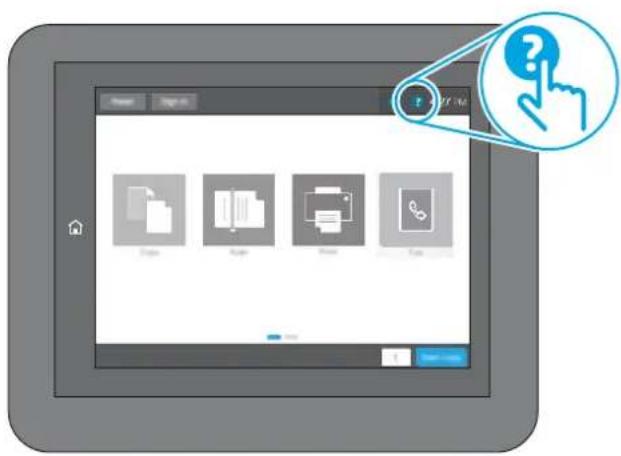
For some screens, the Help opens to a global menu where you can search for specific topics. You can browse through the menu structure by touching the buttons in the menu.
Some Help screens include animations that show specific procedures, such as clearing paper jams.
If the printer alerts of an error or warning, touch the Help button to open a message that describes the problem. The message also contains instructions to help solve the problem.
Reset factory settings
Resetting the printer settings to the factory-set defaults can help resolve problems.
Introduction
Use one of the following methods to reset the printer settings to the original settings from the factory.
Method one: Reset factory settings from the printer control panel
Use the printer control panel to restore the settings to their original values.
- From the Home screen on the printer control panel, navigate to the Settings application, and then select the Settings icon.
- Open the following menus:
a. General
b. Reset Factory Settings
- Select Reset.
A verification message advises that completing the reset function might result in loss of data.
- Select Reset to complete the process.

NOTE: The printer restarts automatically after the reset operation completes.
Method two: Reset factory settings from the HP Embedded Web Server (network-connected printers only)
Use the HP EWS to reset the printer settings to the original settings.
- On the printer control panel, select the Information button i, and then select the Network icon to display the IP address or host name.
- Open the General tab.
- On the left side of the screen, click Reset Factory Settings.
- Click the Reset button.

NOTE: The printer restarts automatically after the reset operation completes.
A “Cartridge is low” or “Cartridge is very low” message displays on the printer control panel or EWS
Review the possible solutions to this issue.
Cartridge is low: The printer indicates when a toner cartridge level is low. Actual toner cartridge life remaining may vary. Consider having a replacement available to install when print quality is no longer acceptable. The toner cartridge does not need to be replaced now.
Continue printing with the current cartridge until redistributing the toner no longer yields acceptable print quality. To redistribute the toner, remove the toner cartridge from the printer and gently rock the cartridge back and forth end to end. Reinsert the toner cartridge into the printer and close the cover.
Cartridge is very low: The printer indicates when the toner cartridge level is very low. Actual toner cartridge life remaining may vary. To extend the life of the toner, gently rock the cartridges back and forth end to end. Consider having a replacement available to install when print quality is no longer acceptable. The toner cartridge does not need to be replaced now unless the print quality is no longer acceptable.
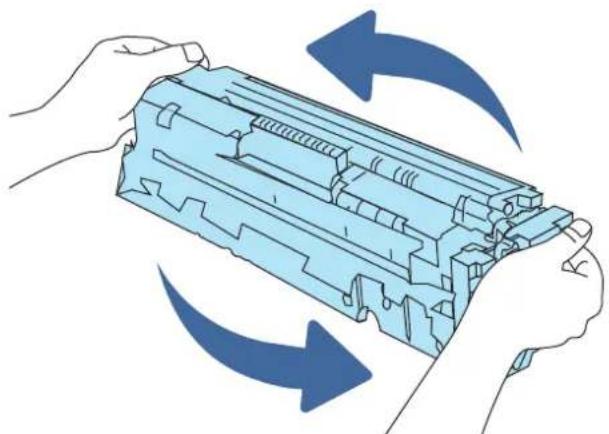
natural_image
Illustration of hands holding a blue mechanical component with directional arrows indicating rotation (no text or symbols)HP's Premium Protection Warranty expires when a message indicating that HP's Premium Protection Warranty on this supply has ended appears on the Supplies Status Page or the EWS.
Change the "Very Low" settings
You can change the way the printer reacts when supplies reach the Very Low state. You do not have to re-establish these settings when you install a new cartridge.
Change the "Very Low" settings at the control panel
Change the setting at the printer control panel.
-
From the Home screen on the printer control panel, navigate to the Settings application, and then select the Settings icon.
-
Open the following menus:
a. Manage Supplies
b. Very Low Behavior
c. Black Cartridge or Color Cartridges
- Select one of the following options:
- Select the Stop option to set the printer to stop printing when the cartridge reaches the Very Low threshold.
- Select the Prompt to continue option to set the printer to stop printing when the cartridge reaches the Very Low threshold. You can acknowledge the prompt or replace the cartridge to resume printing.
- Select the Continue option to set the printer to alert you that the cartridge is very low, and to continue printing beyond the Very Low setting without interaction. This can result in unsatisfactory print quality.
For printers with fax capability
When the printer is set to the Stop or Prompt to continue option, there is some risk that faxes will not print when the printer resumes printing. This can occur if the printer has received more faxes than the memory can hold while the printer is waiting.
The printer can print faxes without interruption when it passes the Very Low threshold if you select the Continue option for the cartridge, but print quality might degrade.
Order supplies
Order supplies and paper for your HP printer.
Table 9-1 Ordering options
| Ordering option Ordering information | |
| Order supplies and paper www.hp.com | ____ |
| Order through service or support providers Contact an HP-authorized service or support provider. | |
| Order using the HP Embedded Web Server (EWS) To access, in a supported web browser on your computer, enter the printer IP address or host name in the address/URL field. The EWS contains a link to the HP website, which provides options for purchasing Original HP supplies. | |
Printer does not pick up paper or misfeeds
Use this information if the printer is not picking up paper from the tray or is picking up multiple sheets of paper at one time.
Introduction
The following solutions can help solve problems if the printer is not picking up paper from the tray or is picking up multiple sheets of paper at one time. Either of these situations can result in paper jams.
The printer does not pick up paper
If the printer does not pick up paper from the tray, try these solutions:
- Open the printer and remove any jammed sheets of paper. Verify that no torn remnants of paper remain inside the printer.
- Load the tray with the correct size of paper for the job.
- Make sure the paper size and type are set correctly on the printer control panel.
- Make sure the paper guides in the tray are adjusted correctly for the size of paper. Adjust the guides to the appropriate indentation in the tray. The arrow on the tray guide should line up exactly with the marking on the tray.

NOTE: Do not adjust the paper guides tightly against the paper stack. Adjust them to the indentations or markings in the tray.
The following images show examples of the paper-size indentations in the trays for various printers. Most HP printers have markings similar to these.
Figure 9-1 Size markings for Tray 1 or the multipurpose tray
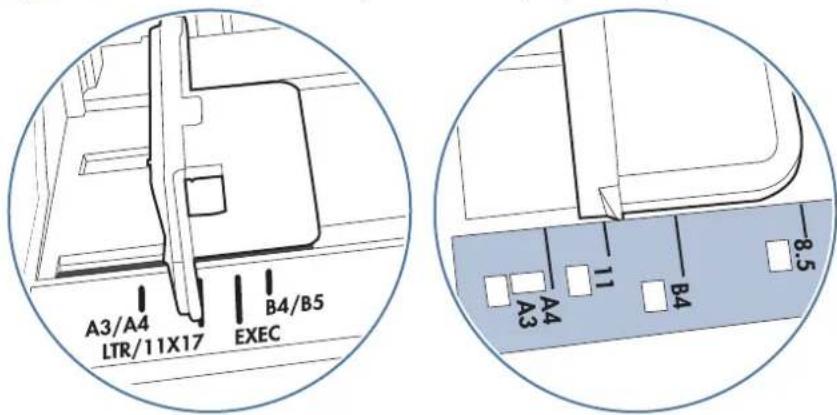
Figure 9-2 Size markings for cassette trays
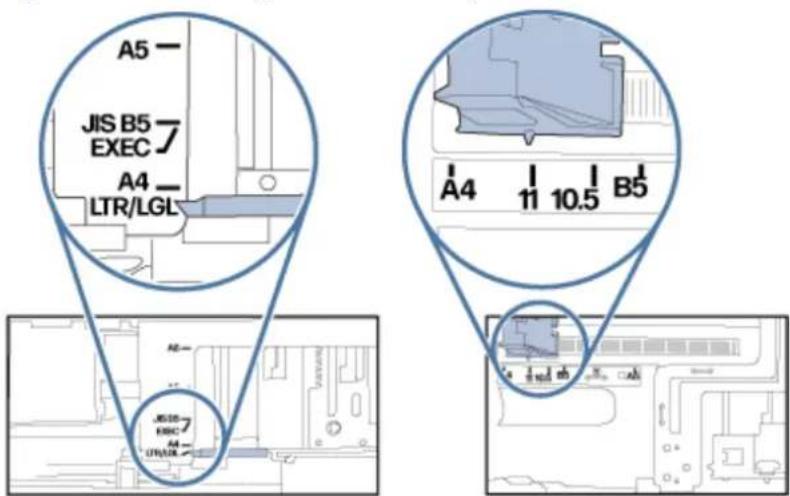
- Verify that the humidity in the room is within specifications for this printer and that paper is being stored in unopened packages. Most reams of paper are sold in moisture-proof wrapping to keep paper dry.
In high-humidity environments, paper at the top of the stack in the tray can absorb moisture, and it might have a wavy or uneven appearance. If this happens, remove the top 5 to 10 sheets of paper from the stack.
In low-humidity environments, excess static electricity can cause sheets of paper to stick together. If this happens, remove the paper from the tray, and flex the stack by holding it at each end and bringing the ends up to form a U shape. Then, rotate the ends down to reverse the U shape. Next, hold each side of the stack of paper and repeat this process. This process releases individual sheets without introducing static electricity. Straighten the paper stack against a table before returning it to the tray.
Figure 9-3 Technique for flexing the paper stack
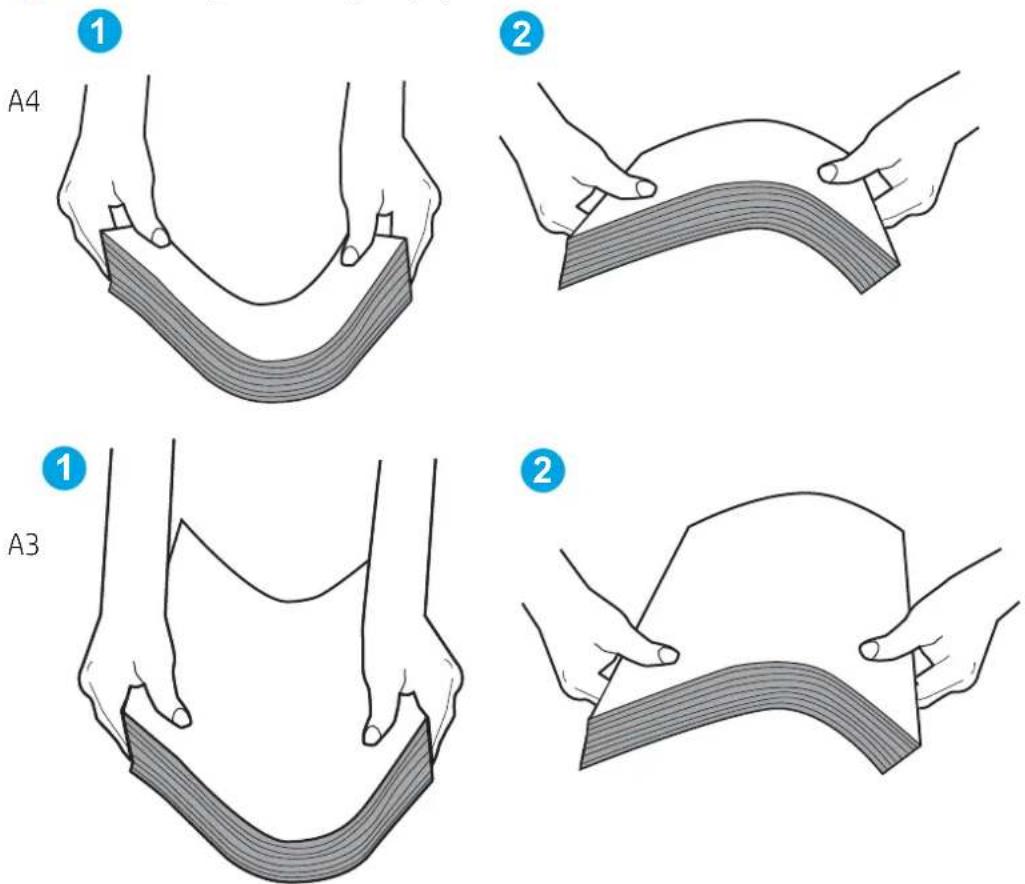
-
Check the printer control panel to see if it is displaying a prompt to feed the paper manually. Load paper, and continue.
-
The rollers above the tray might be contaminated. Clean the rollers with a lint-free cloth dampened with warm water. Use distilled water, if it is available.
CAUTION: Do not spray water directly onto the printer. Instead, spray water on the cloth or dab the cloth in water and wring it out before cleaning the rollers.
The following image shows examples of the roller location for various printers.
Figure 9-4 Roller locations for Tray 1 or the multipurpose tray
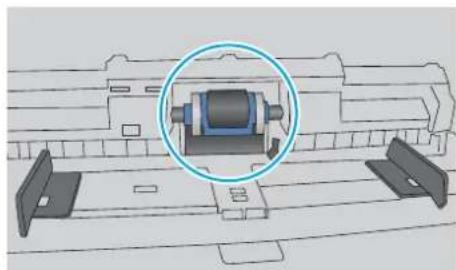
natural_image
Technical line drawing of a mechanical assembly with a highlighted component (no text or symbols)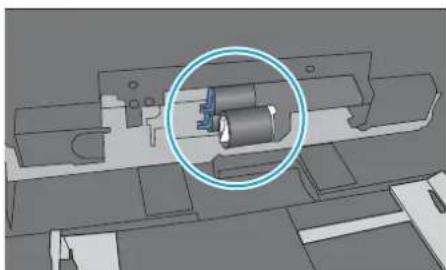
natural_image
3D mechanical assembly diagram showing internal components and a highlighted cylindrical component (no text or symbols)The printer picks up multiple sheets of paper
If the printer picks up multiple sheets of paper from the tray, try these solutions:
- Remove the stack of paper from the tray and flex it, rotate it 180 degrees, and flip it over. Do not fan the paper. Return the stack of paper to the tray.

NOTE: Fanning the paper introduces static electricity. Instead of fanning the paper, flex the stack by holding it at each end and bringing the ends up to form a U shape. Then, rotate the ends down to reverse the U shape. Next, hold each side of the stack of paper and repeat this process. This process releases individual sheets without introducing static electricity. Straighten the paper stack against a table before returning it to the tray.
Figure 9-5 Technique for flexing the paper stack
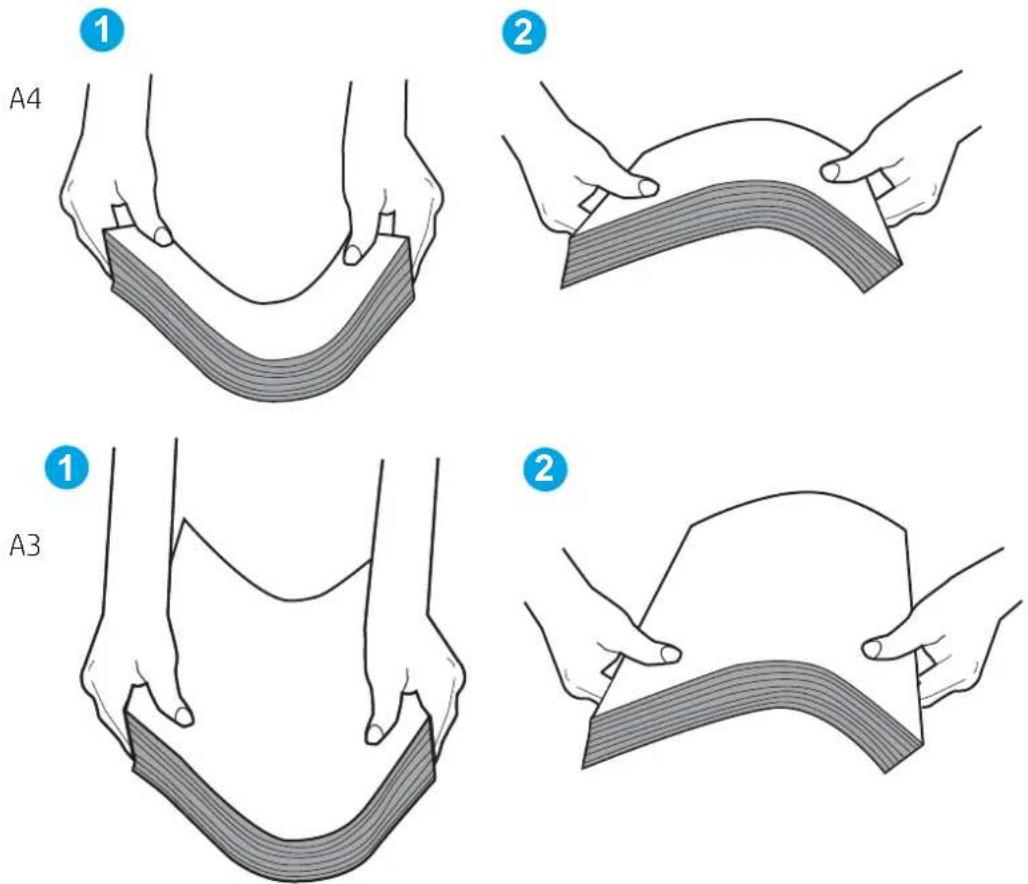
-
Use only paper that meets HP specifications for this printer.
-
Verify that the humidity in the room is within specifications for this printer, and that paper is being stored in unopened packages. Most reams of paper are sold in moisture-proof wrapping to keep paper dry.
In high-humidity environments, paper at the top of the stack in the tray can absorb moisture, and it might have a wavy or uneven appearance. If this happens, remove the top 5 to 10 sheets of paper from the stack.
In low-humidity environments, excess static electricity can cause sheets of paper to stick together. If this happens, remove the paper from the tray and flex the stack as described above.
-
Use paper that is not wrinkled, folded, or damaged. If necessary, use paper from a different package.
-
Make sure the tray is not overfilled by checking the stack-height markings inside the tray. If it is overfilled, remove the entire stack of paper from the tray, straighten the stack, and then return some of the paper to the tray.
The following examples show the stack-height markings in the trays for various printers. Most HP printers have markings similar to these. Also make sure that all sheets of paper are below the tabs near the stack-height marks. These tabs help hold the paper in the correct position as it enters the printer.
Figure 9-6 Stack-height markings
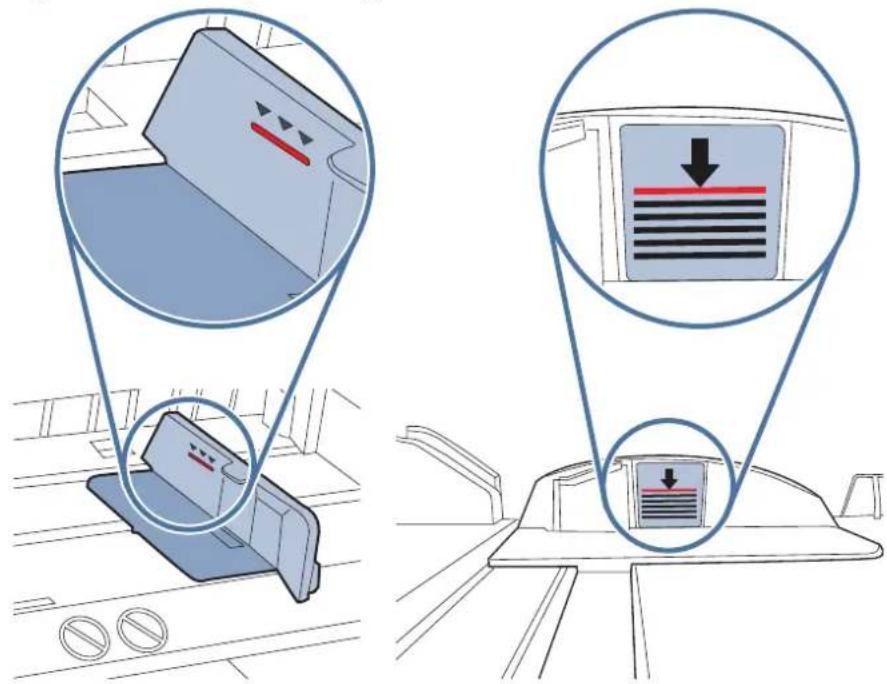
Figure 9-7 Tab for the paper stack
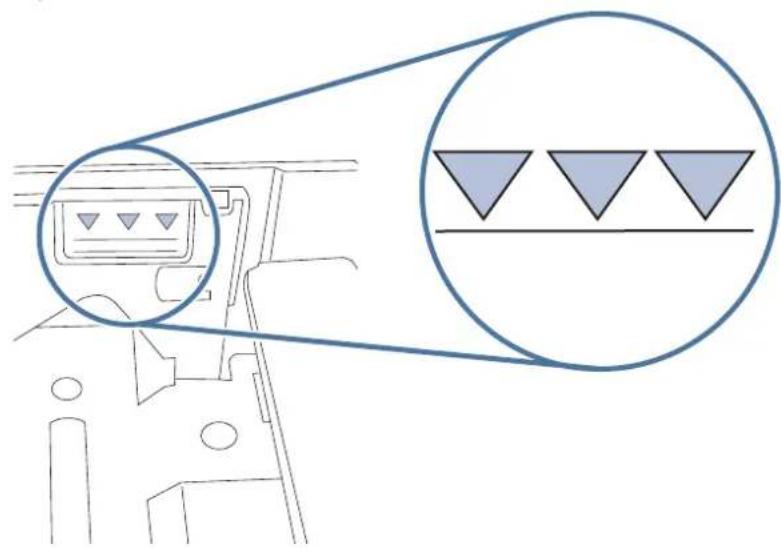
- Make sure the paper guides in the tray are adjusted correctly for the size of paper. Adjust the guides to the appropriate indentation in the tray. The arrow on the tray guide should line up exactly with the marking on the tray.

NOTE: Do not adjust the paper guides tightly against the paper stack. Adjust them to the indentations or markings in the tray.
The following images show examples of the paper-size indentations in the trays for various printers. Most HP printers have markings similar to these.
Figure 9-8 Size markings for Tray 1 or the multipurpose tray
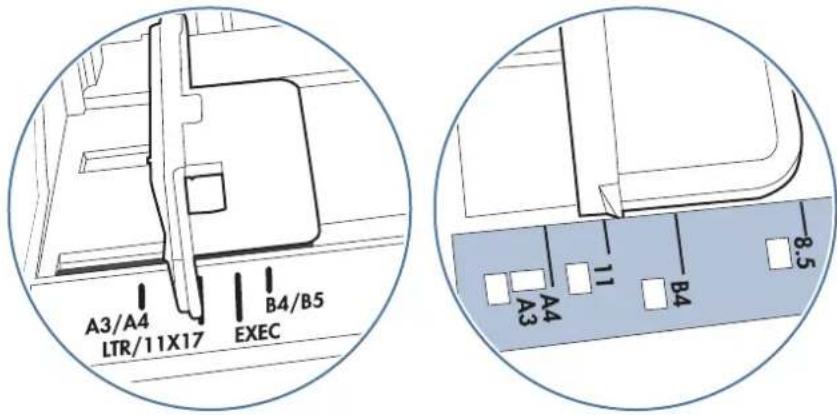
Figure 9-9 Size markings for cassette trays
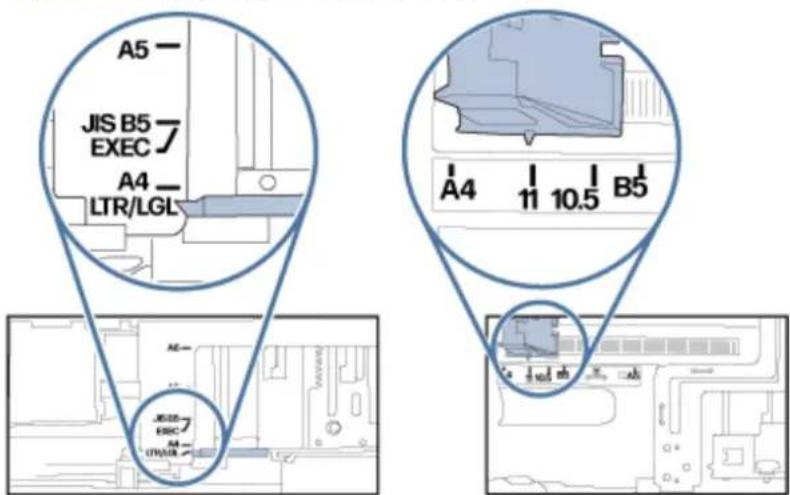
- Make sure the printing environment is within recommended specifications.
The document feeder jams, skews, or picks up multiple sheets of paper
If the document feeder jams, skews, or picks up multiple sheets of paper, try these solutions.

NOTE: This information applies to MFP printers only.
- The original might have something on it, such as staples or self-adhesive notes, that must be removed.
- Check that all rollers are in place and that the roller-access cover inside the document feeder is closed.
- Make sure that the top document-feeder cover is closed.
- The pages might not be placed correctly. Straighten the pages and adjust the paper guides to center the stack.
- The paper guides must be touching the sides of the paper stack to work correctly. Make sure that the paper stack is straight and the guides are against the paper stack.
- The document feeder input tray or output bin might contain more than the maximum number of pages. Make sure the paper stack fits below the guides in the input tray, and remove pages from the output bin.
- Verify that there are no pieces of paper, staples, paper clips, or other debris in the paper path.
- Clean the document-feeder rollers and the separation pad. Use compressed air or a clean, lint-free cloth moistened with warm water. If misfeeds still occur, replace the rollers.
- From the Home screen on the printer control panel, scroll to and touch the Supplies button. Check the status of the document-feeder kit, and replace it if necessary.
Clear paper jams
Use the procedures in this section to clear jammed paper from the printer paper path.
Paper jam locations
Jams can occur in these locations.
Figure 9-10 Jam locations - dn, zf, and zfsw models
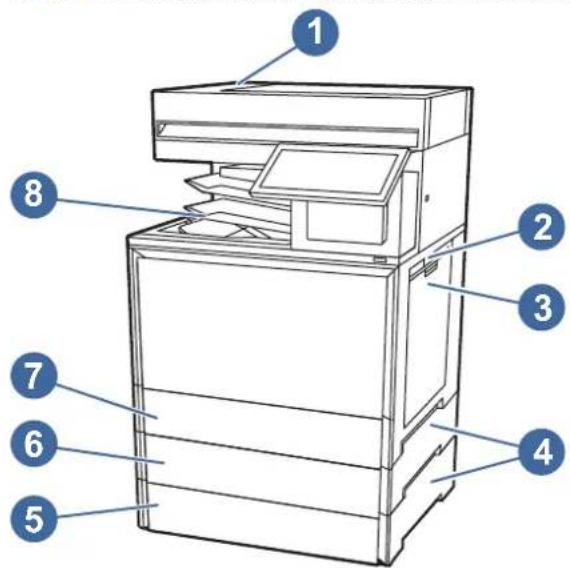
Item
Description
1 Document feeder
2 Right door and fuser area
| Item Description |
| 3 Tray 1 (multipurpose tray) |
| 4 Tray jam access doors |
| 5 Optional Tray 4 |
| 6 Optional Tray 3 |
| 7 Tray 2 |
| 8 Output bin or finisher output trays |
Figure 9-11 Jam locations - zfw+ model
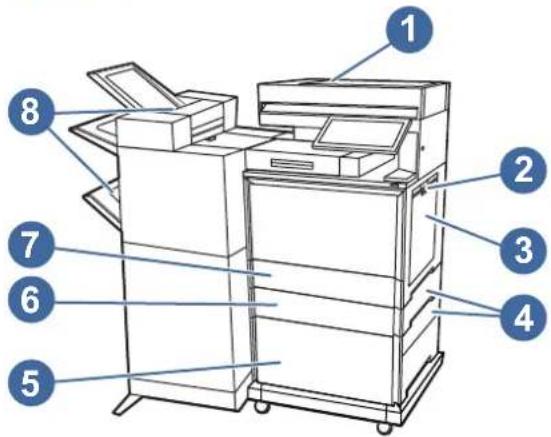
| Item Description |
| 1 Document feeder |
| 2 Right door and fuser area |
| 3 Tray 1 (multipurpose tray) |
| 4 Tray jam access doors |
| 5 Tray 4 (high-capacity input tray) |
| 6 Tray 3 |
| 7 Tray 2 |
| 8 Output bins (floor-standing finisher) |
Auto-navigation for clearing paper jams
Learn about printer jam clearing auto-navigation.
The auto-navigation feature assists in clearing jams by providing step-by-step instructions on the control panel.
When you complete a step, the printer displays instructions for the next step until you have completed all steps in the procedure.
Experiencing frequent or recurring paper jams?
To reduce the number of paper jams, try these solutions.
- Use only paper that meets HP specifications for this printer.
- Use paper that is not wrinkled, folded, or damaged. If necessary, use paper from a different package.
- Use paper that has not previously been printed or copied on.
- Make sure the tray is not overfilled. If it is, remove the entire stack of paper from the tray, straighten the stack, and then return some of the paper to the tray.
- Make sure the paper guides in the tray are adjusted correctly for the size of paper. Adjust the guides so they are touching the paper stack without bending it.
- Make sure that the tray is fully inserted in the printer.
- If you are printing on heavy, embossed, or perforated paper, use the manual feed feature and feed sheets one at a time.
- Open the Trays menu on the printer control panel. Verify that the tray is configured correctly for the paper type and size.
- Make sure the printing environment is within recommended specifications.
31.13.yz jam error in the document feeder
The following information describes how to clear paper jams in the document feeder. When a jam occurs, the control panel displays an animation that assists in clearing the jam.
In addition to the instructions provided below

NOTE: The printer model referenced in this video might be different from your printer model, but the steps to clear the jam are the same.
Recommended action for customers
When a jam occurs, the control panel displays a message and an animation that assists in clearing the jam.
•31.13.01 Jam in document feeder
•31.13.02 Jam in document feeder
•31.13.13 Jam in document feeder
- Remove paper from the exit assembly of the document feeder.
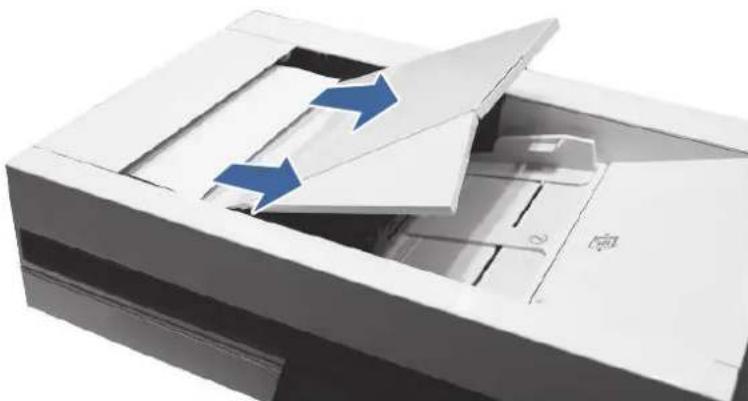
natural_image
3D rendering of a printer with blue arrows indicating flow or movement (no text or symbols)- Open the document-feeder cover.
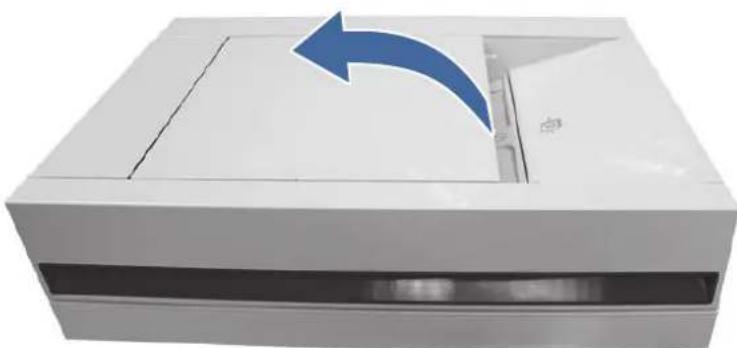
natural_image
White electronic device with a blue arrow pointing to its side panel (no visible text or symbols)- Remove any jammed paper from the document feeder input area.
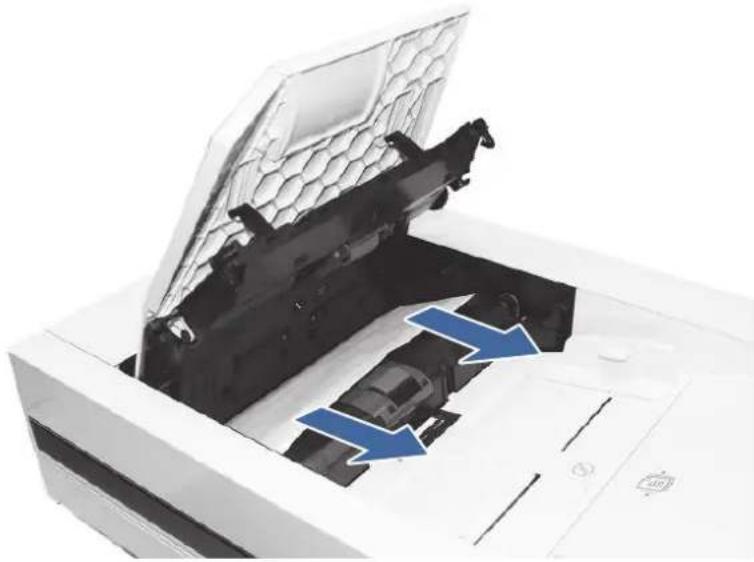
natural_image
White printer with open lid showing internal mechanical components and blue arrows indicating flow direction (no text or symbols)- Lift the document feeder and check the lower side of the feed path.
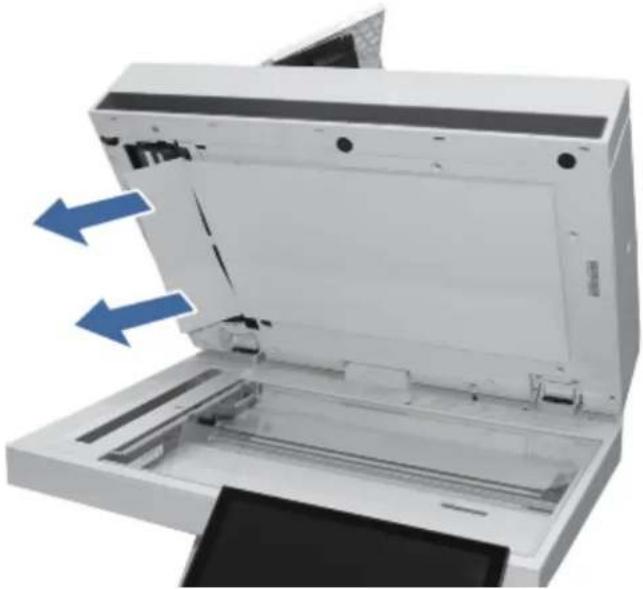
natural_image
Open file organizer with blue arrows indicating compression or disassembly (no text or symbols visible)- Make sure the guides in the document-feeder input tray are adjusted to the correct size for the document before loading paper.
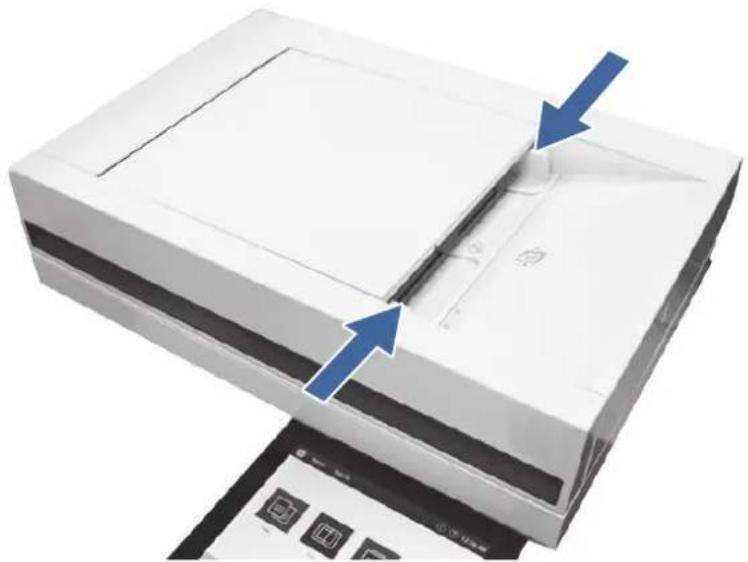
natural_image
White paper filter device with blue arrows pointing to its side panel, no visible text or symbols on the device itself.
NOTE: To avoid document feeder jams, to copy narrow documents, use the flatbed scanner. Remove all staples and paper clips from original documents. Do not feed damaged or wrinkled paper.

NOTE: Original documents that are printed on heavy, glossy paper can jam more frequently than originals that are printed on plain paper.
13.B2.D1 jam error in Tray 1 (multipurpose tray)
Use the following procedure to clear paper jams in Tray 1 (multipurpose tray). When a jam occurs, the control panel displays an animation that assists in clearing the jam.
Recommended action for customers
When a jam occurs, the control panel displays a message and an animation that assists in clearing the jam.
•13.B2.D1 Jam in tray 1
- If you can see the jammed sheet in Tray 1, remove the jammed sheet by gently pulling it straight out.
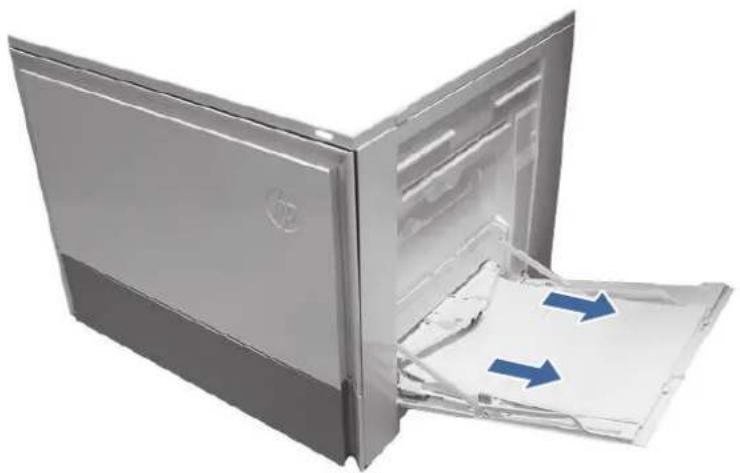
natural_image
3D rendering of a silver HP refrigerator with open door and plastic tray, showing internal compartments and blue directional arrows (no text or symbols)- Open the right door and remove paper from the area shown.
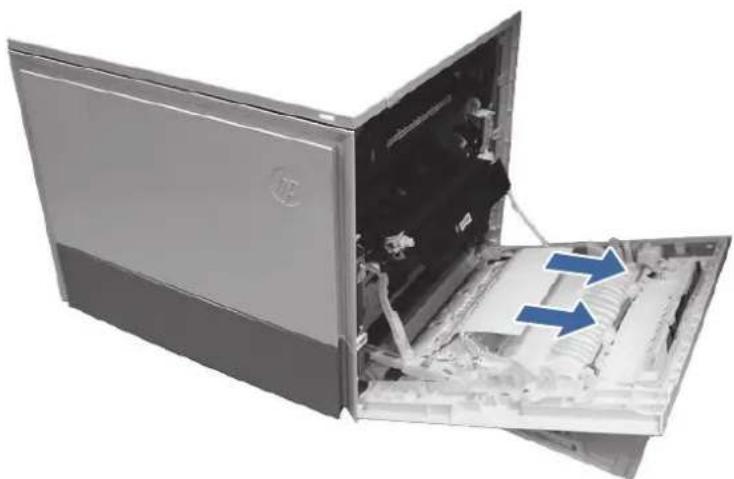
natural_image
Interior view of a computer with open door and internal components, showing blue directional arrows indicating movement (no text or symbols)-
Close the right to allow the printer to clear the message.
-
Make sure the type and quality of the paper being used meets the HP specifications for the printer.
-
Make sure the Tray 1 guides are set to the correct paper size and that the paper tray is not overfilled (paper is below the 3 triangles on the right guide).
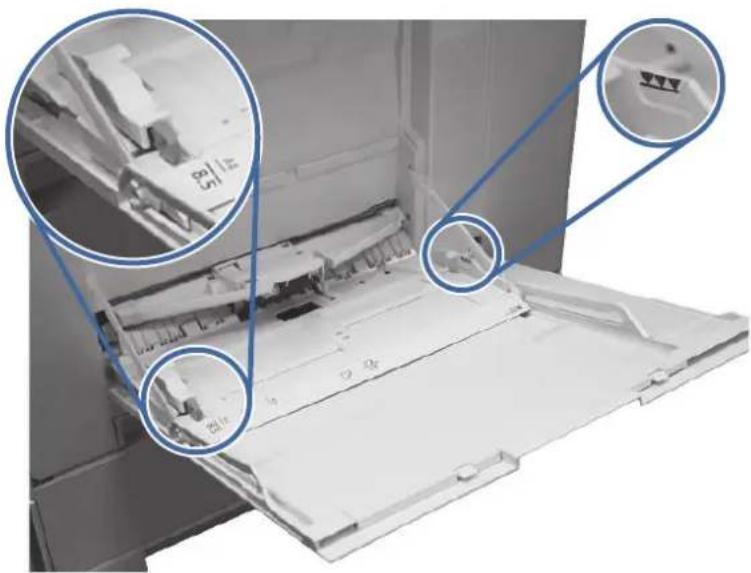
natural_image
Interior view of a refrigerator with open door and internal compartments, showing close-ups of mechanical parts (no text or symbols visible)-
Load the paper back into the tray and restart the print job.
-
If the error persists, contact your HP-authorized service or support provider, or contact customer support at www.hp.com/go/contactHP.
13.B2.D2 jam error in Tray 2
Use the following procedure to check for paper in all possible jam locations related to Tray 2. When a jam occurs, the control panel displays an animation that assists in clearing the jam.
Recommended action for customers
When a jam occurs, the control panel displays a message and an animation that assists in clearing the jam.
•13.B2.D2 Paper jam in tray 2
- Open the right door.
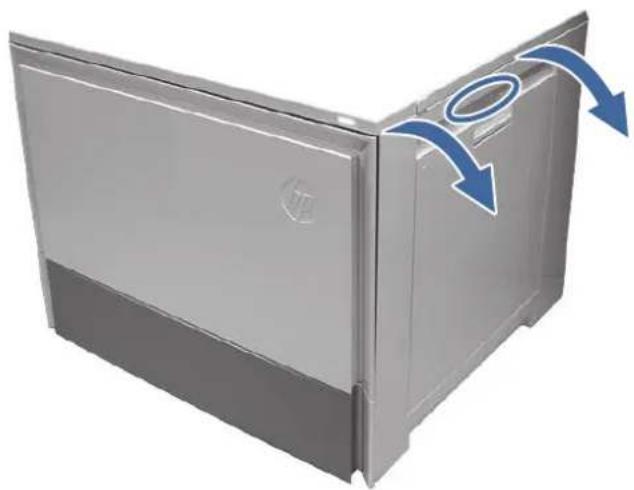
natural_image
Exterior view of a modern office building (no signage)- Gently remove any jammed paper.
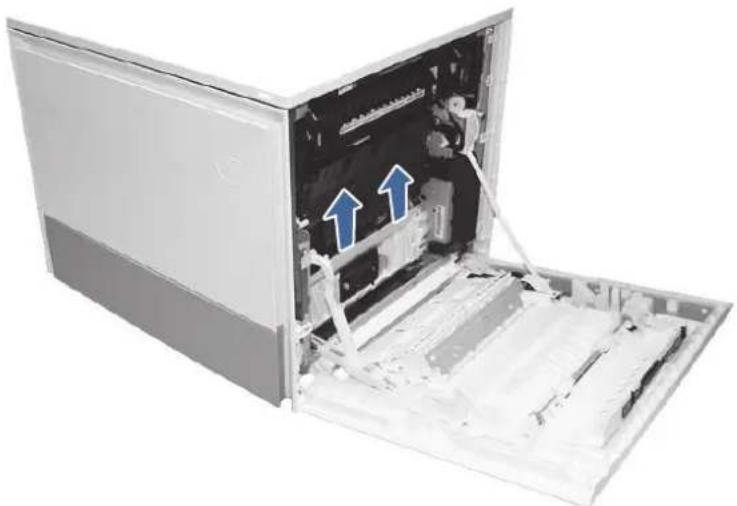
natural_image
Interior view of a computer with open door and internal components, showing blue arrows indicating movement or flow (no text or symbols)-
Close the right door to clear the control panel message.
-
Open Tray 2.
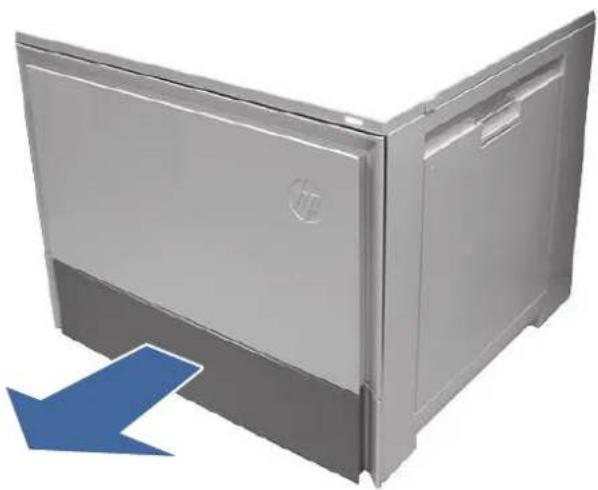
natural_image
Exterior view of a silver hard drive with a blue downward arrow indicating compression (no text or symbols)- Remove the paper from the tray and discard any bent, curled, or damaged sheets.
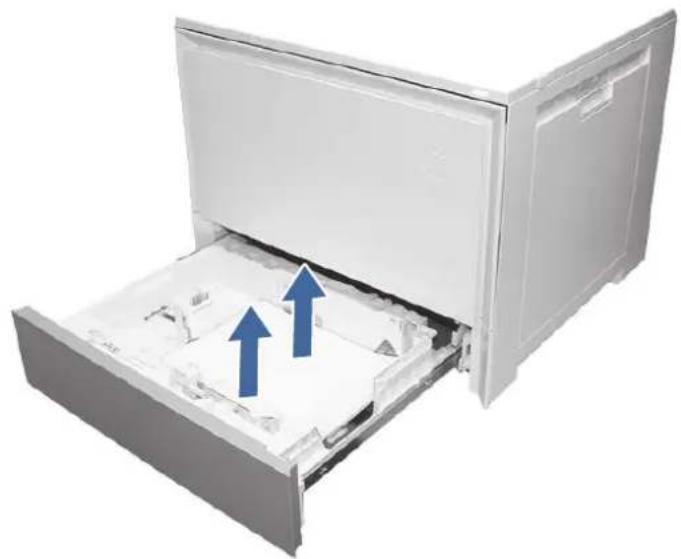
natural_image
Interior view of a white kitchen appliance showing a closed drawer with two blue arrows indicating internal components (no text or symbols visible)- Make sure that the tray width and length guides are set to the correct paper size for the paper being installed into the tray and that the tray is not over filled above the fill mark (line below 3 triangles on rear guide).
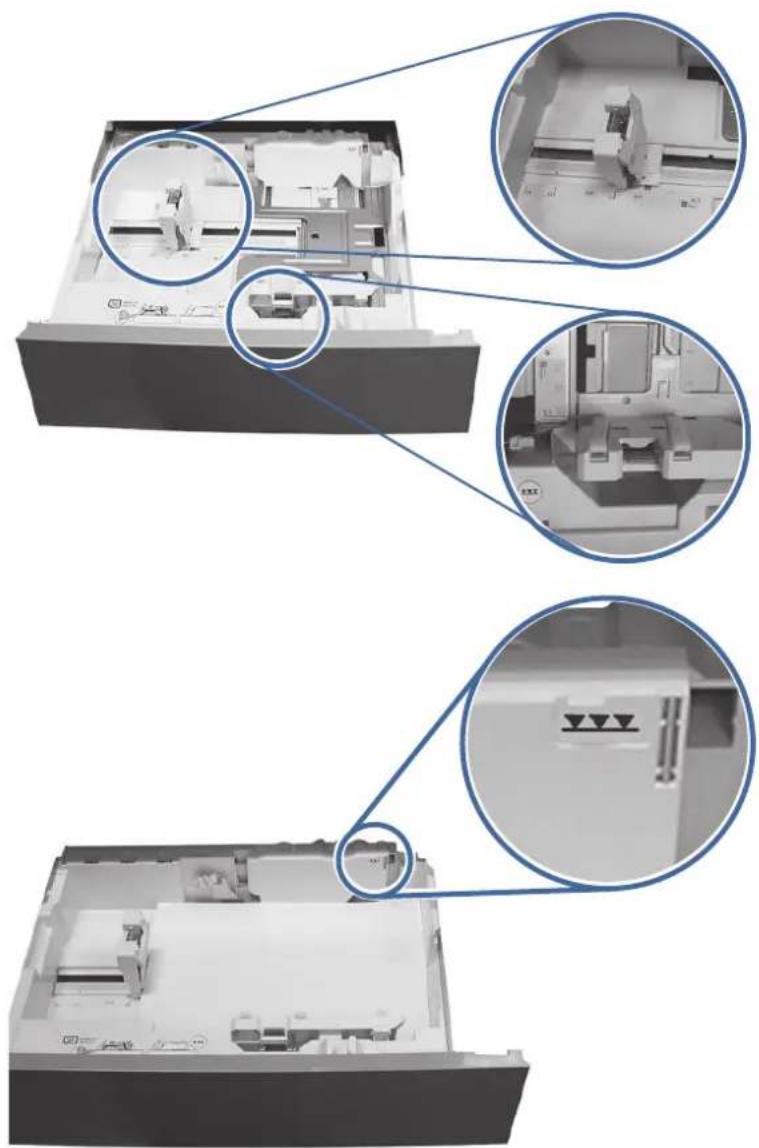
natural_image
Interior view of a mechanical assembly with multiple close-up views of internal components (no visible text or symbols)- Ensure the type and quality of the paper being used meets the HP specifications for the printer.
- If the error persists, clean the Tray 2 pick, feed, separation rollers.
a. Open the right door to access the rollers.
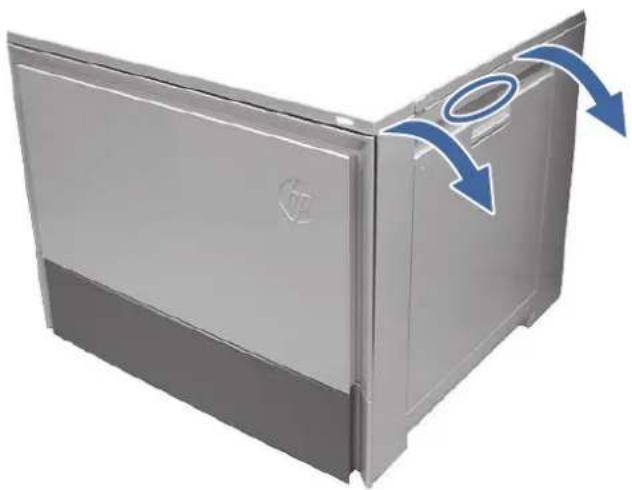
natural_image
3D rendering of a silver rectangular appliance with blue arrows indicating airflow or motion (no text or symbols)b. Locate and remove the Tray 2 separation roller.
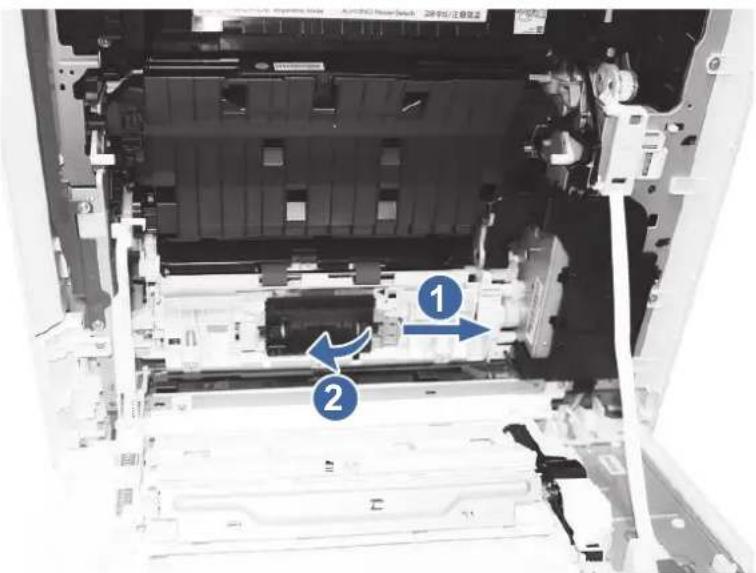
Call-out 1- slide locking lever
Call-out 2- Remove the roller assembly.
c. Remove the Tray 2 pick and feed rollers.
To remove the roller assembly, gently pull on the side of the assembly and slide out as shown.

NOTE: Do not touch the rubber part of the rollers with hands. Oils or debris from hands can cause paper pickup issues.
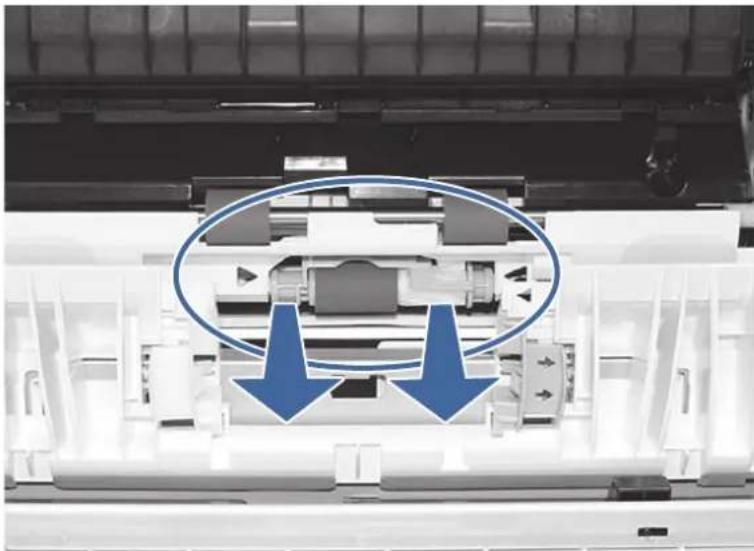
natural_image
Interior view of a refrigerated industrial machine with blue arrows indicating downward motion (no text or symbols visible)d. Clean the rollers with a dampened lint free cloth.
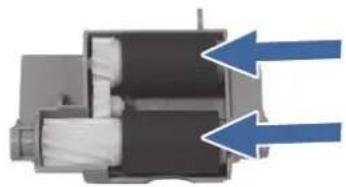
natural_image
Cross-sectional diagram of a mechanical device with two blue arrows indicating direction (no text or symbols)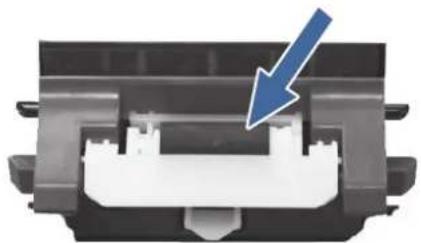
natural_image
Close-up of a mechanical component with a blue arrow pointing to a specific area (no text or symbols visible)e. Reinstall the roller assemblies and close the right door.
f. Run a print job from Tray 2.
- If the error persists, contact your HP-authorized service or support provider, or contact customer support at www.hp.com/go/contactHP.
13.A3 jam error in Tray 3
Follow these troubleshooting steps in the order presented.
Recommended action for customers
Use the following procedure to check for paper in all possible jam locations related to the 550-sheet trays. When a jam occurs, the control panel displays an animation that assists in clearing the jam.
•13.A3.A3 Jam in tray 3
•13.A3.D3 Jam in tray 3
- Open the Tray 3 right side access door.
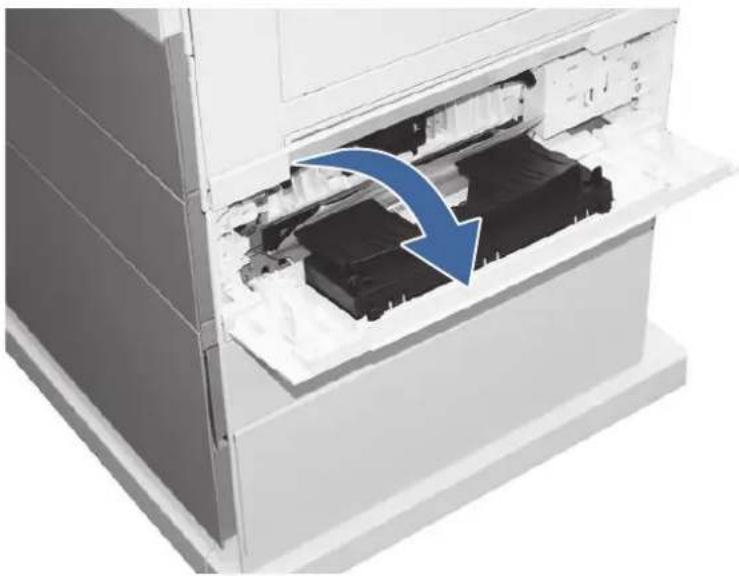
natural_image
Interior view of a computer or server unit showing internal components and a blue arrow indicating a process (no text or symbols present)- Remove any jammed paper found in access area.
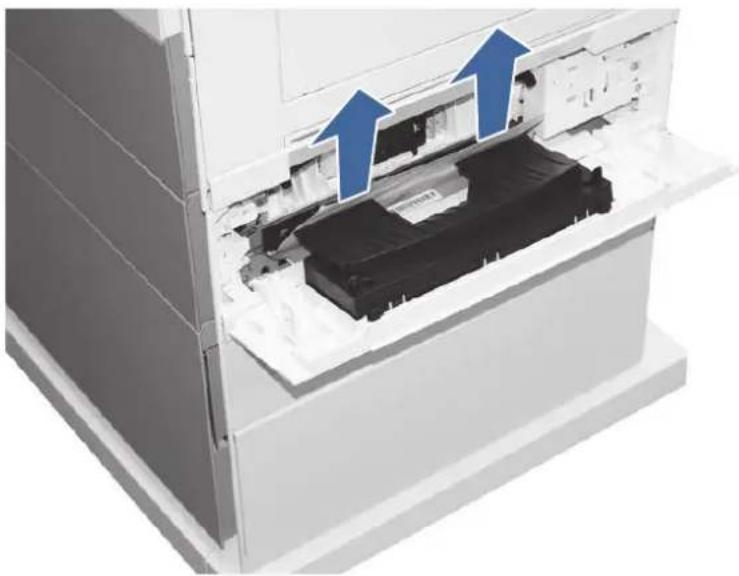
natural_image
3D cutaway view of a refrigerator interior showing internal components and blue arrows indicating flow or movement (no text or symbols)- Open the right door.
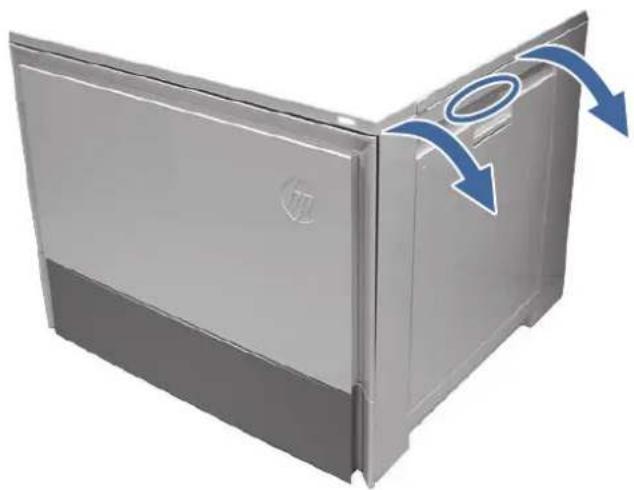
natural_image
3D rendering of a silver refrigerator with blue arrows indicating airflow or change direction (no text or symbols)- Gently remove any jammed paper.
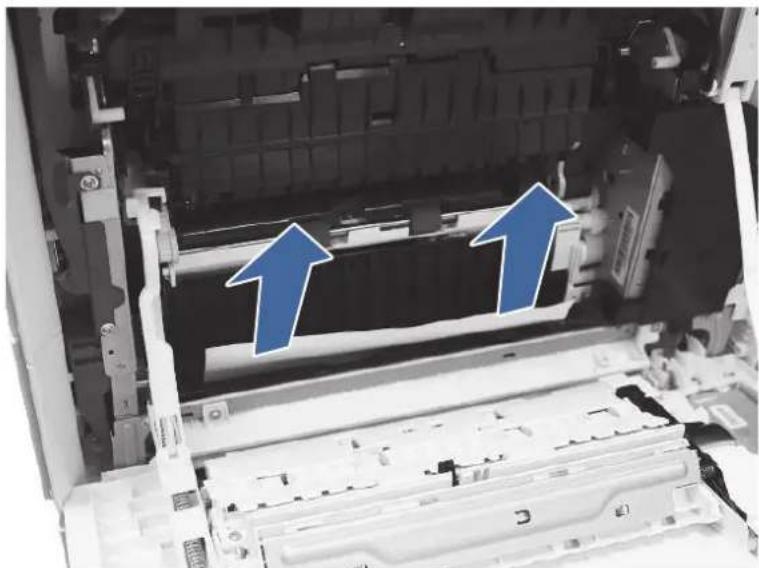
natural_image
Close-up of a printer's internal structure with blue arrows pointing to components (no text or symbols visible)- Open Tray 3.
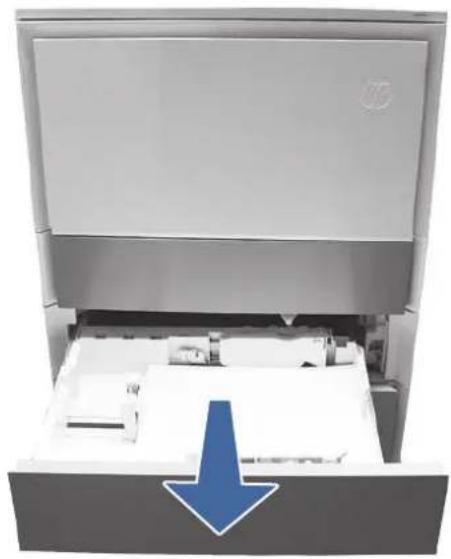
natural_image
Interior view of a printer drawer with paper sheets and a blue arrow pointing to the bottom page (no text or symbols visible)- Remove the paper from the tray and discard any bent, curled, or damaged sheets.
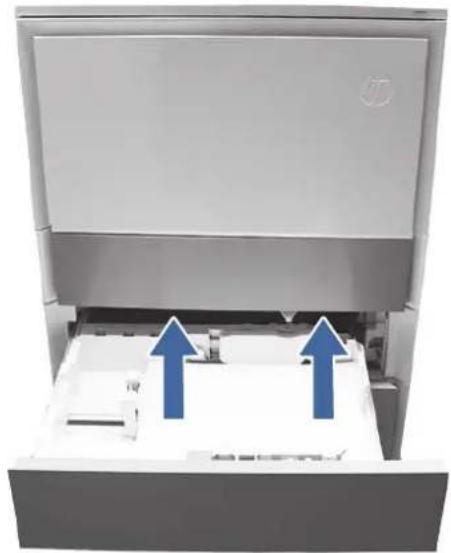
natural_image
Interior view of a printer drawer with two blue arrows pointing to the front panel (no text or symbols visible)- Make sure that the tray width and length guides are set to the correct paper size for the paper being installed into the tray and that the tray is not over filled above the fill mark (line below 3 triangles on rear guide).
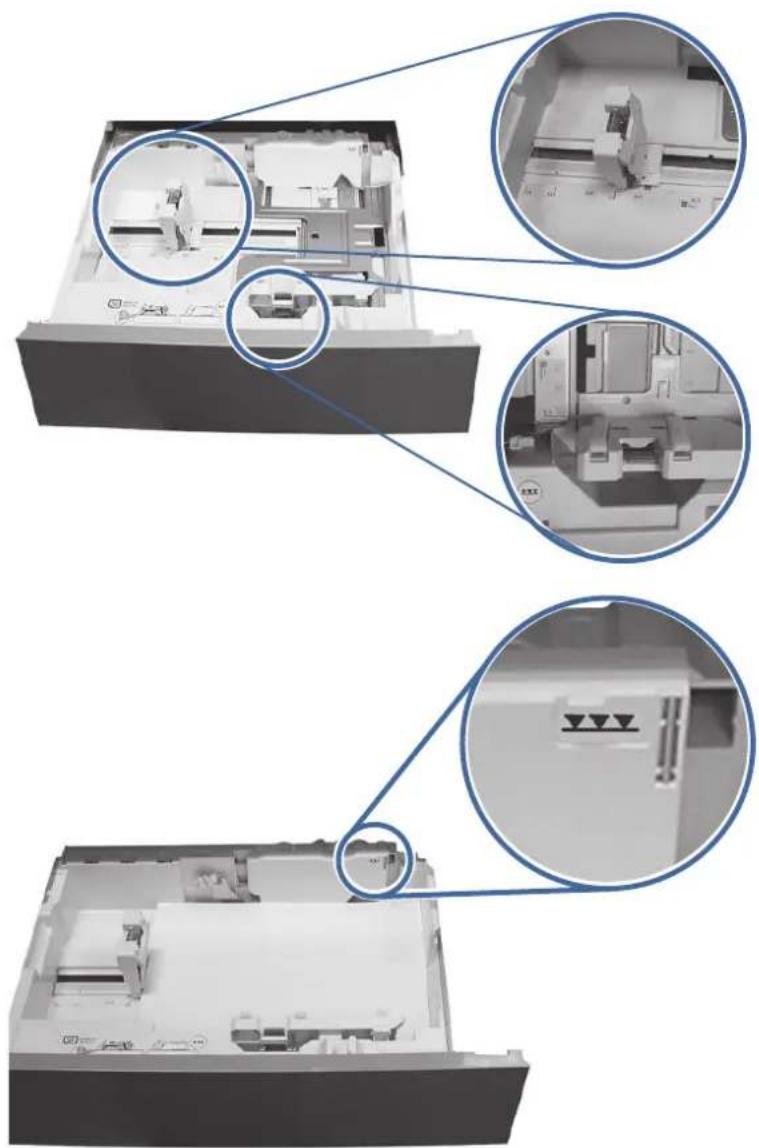
natural_image
Interior view of a technical device showing internal components and close-ups of mechanical parts (no visible text or symbols)-
Ensure the type and quality of the paper being used meets the HP specifications for the printer.
-
If the error persists, clean the Tray 3 pick, feed, separation rollers.
a. Open the Tray 3 right door to access the rollers.
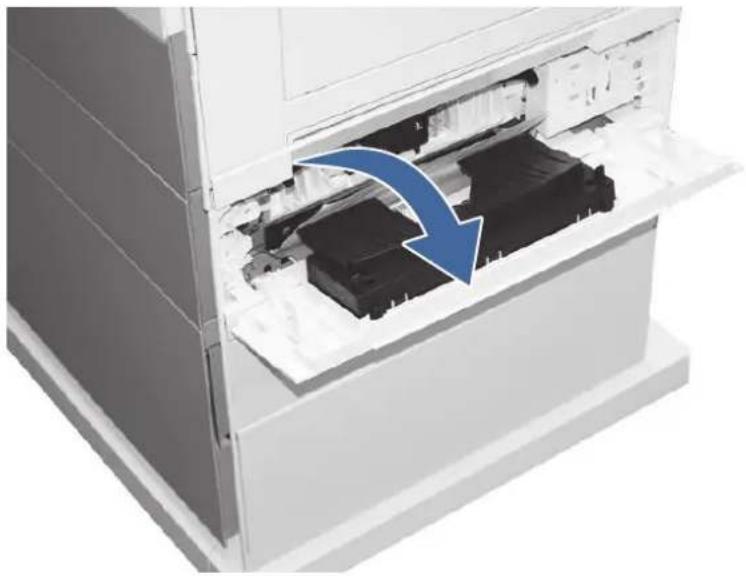
natural_image
3D rendering of a printer internal structure with a blue arrow indicating the process (no text or symbols present)b. Locate and remove the Tray 3 separation roller.
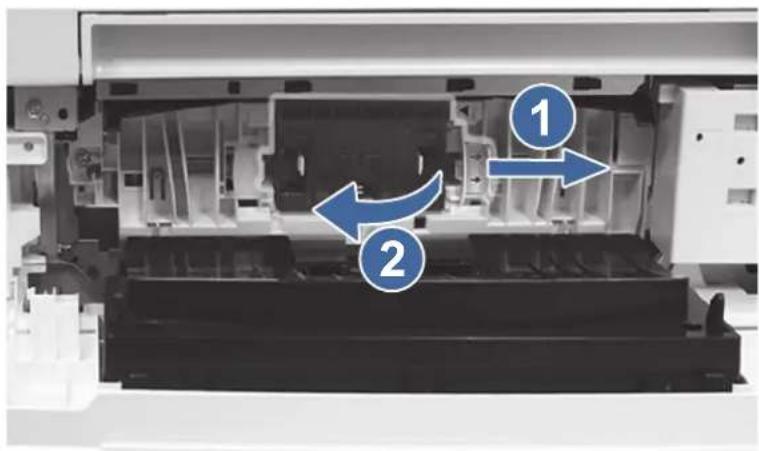
Call-out 1- slide locking lever
Call-out 2- Remove the roller assembly.
c. Remove the Tray 3 pick and feed rollers.
To remove the roller assembly, gently pull on the side of the assembly and slide out as shown.

NOTE: Do not touch the rubber part of the rollers with hands. Oils or debris from hands can cause paper pickup issues.
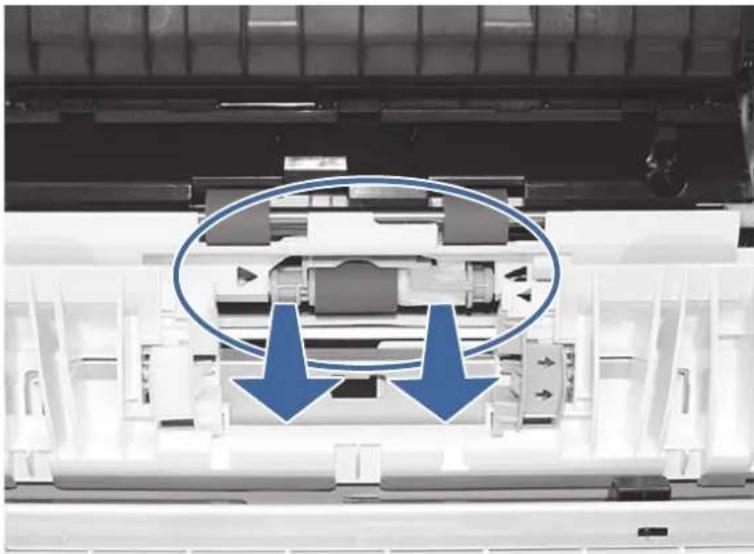
natural_image
Interior view of a refrigerated industrial machine with blue arrows indicating flow or movement (no visible text or symbols)d. Clean the rollers with a dampened lint free cloth.
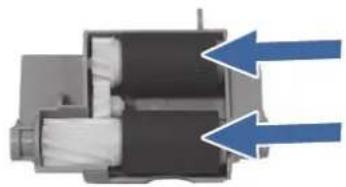
natural_image
Cross-sectional diagram of a mechanical device with two blue arrows indicating direction (no text or symbols)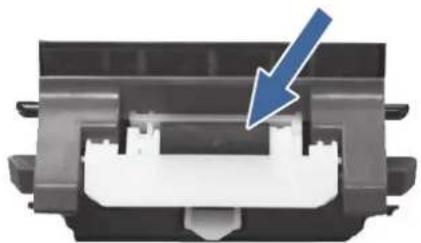
natural_image
Close-up of a mechanical component with a blue arrow pointing to a specific area (no text or symbols visible)e. Reinstall the roller assemblies and close the right door.
f. Run a print job from Tray 3.
- If the error persists, contact your HP-authorized service or support provider, or contact customer support at www.hp.com/go/contactHP.
13.A4 jam error in Tray 4
Use the following procedure to check for paper in all possible jam locations related to the 550 sheet Tray 4. When a jam occurs, the control panel displays an animation that assists in clearing the jam.
Recommended action for customers
When a jam occurs, the control panel displays a message and an animation that assists in clearing the jam.
•13.A4.A4 Paper jam in tray 4
•13.A4.D4 Paper jam in tray 4
- Open the right door.
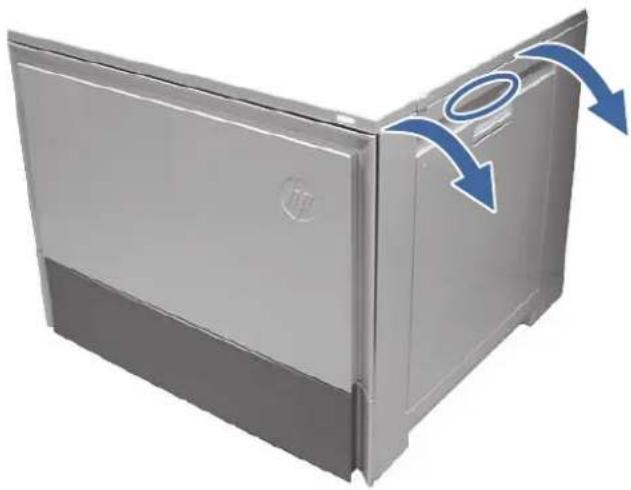
natural_image
3D rendering of a silver rectangular appliance with a blue arrow indicating rotation or change, no text or symbols present.- Gently remove any jammed paper.
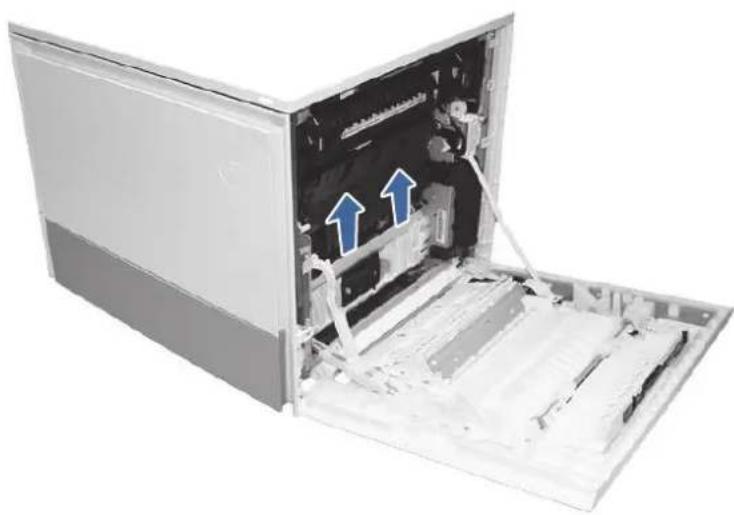
natural_image
Interior view of a computer tower with visible internal components and blue arrows indicating movement or flow (no text or symbols)- Open the Tray 4 right access door.
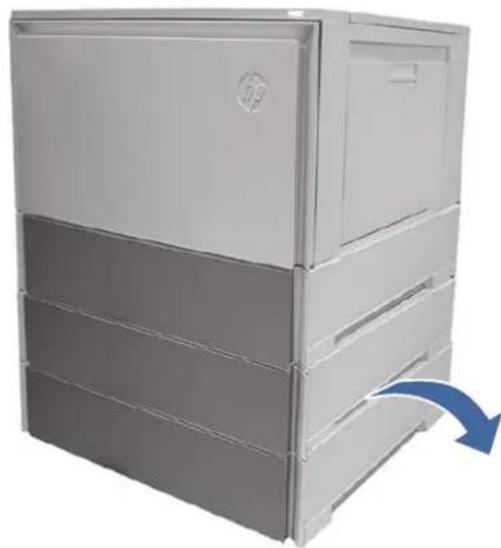
natural_image
Exterior view of a modern office building (no signage)- Gently remove any jammed paper.
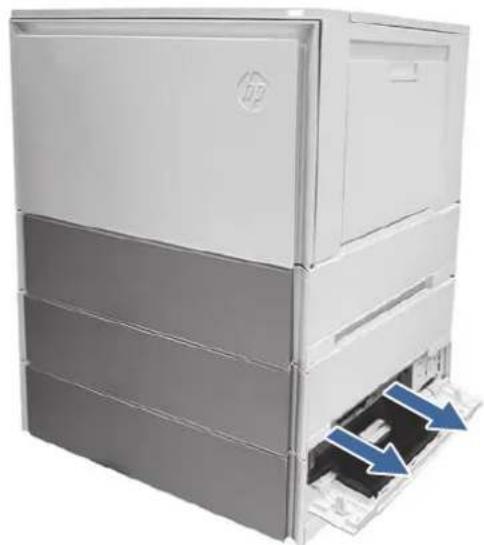
natural_image
Exterior view of a white refrigerator with blue arrows indicating internal components (no text or symbols visible)- Open the Tray 3 access door and gently remove any jammed paper.
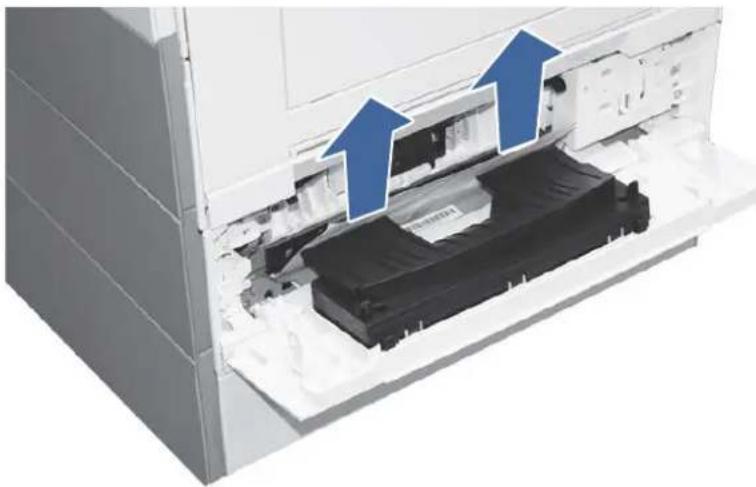
natural_image
3D rendering of a mechanical assembly with blue arrows indicating direction (no text or symbols)-
Close the right door to clear the control panel message.
-
Open Tray 4.
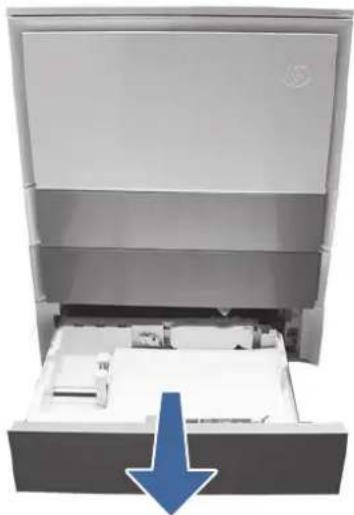
natural_image
Interior view of a computer case with a blue arrow pointing to a device component (no text or symbols visible)- Remove the paper from the tray and discard any bent, curled, or damaged sheets.
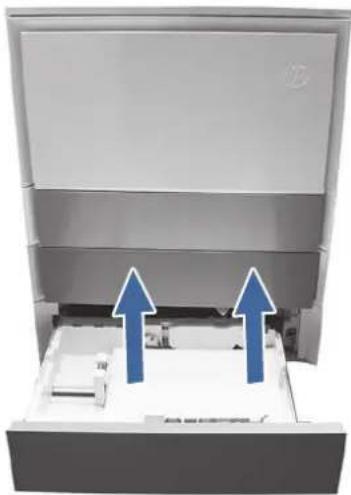
natural_image
Interior view of a refrigerator with two blue arrows pointing to the front panel (no text or symbols visible)- Make sure that the tray width and length guides are set to the correct paper size for the paper being installed into the tray and that the tray is not over filled above the fill mark (line below 3 triangles on rear guide).
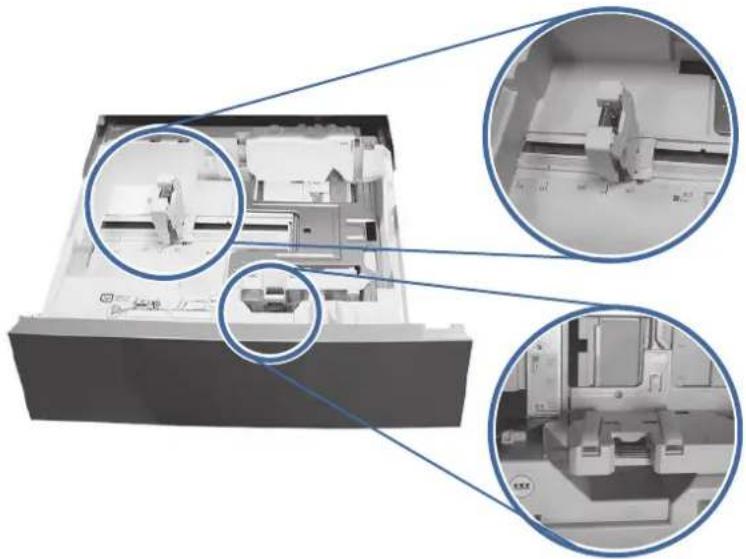
natural_image
Interior view of a 3D printing machine with three circular insets showing internal components (no visible text or labels)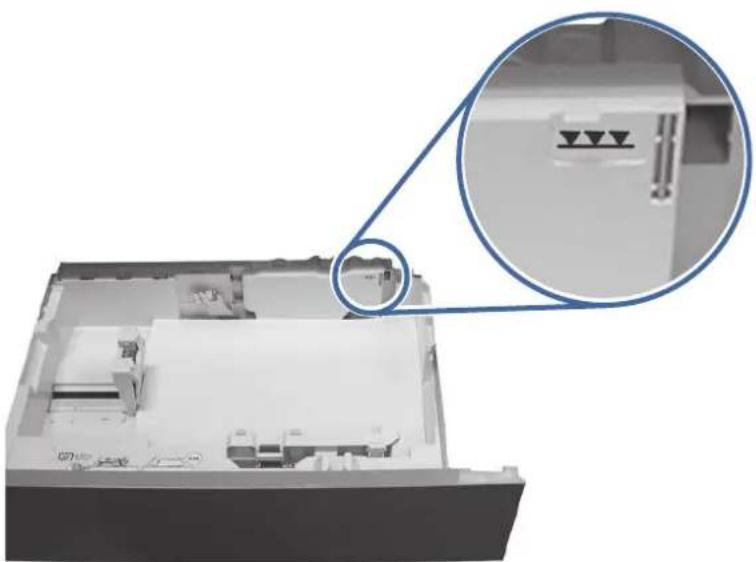
natural_image
Interior view of a computer room with an inset close-up showing internal components (no text or symbols visible)-
Ensure the type and quality of the paper being used meets the HP specifications for the printer.
-
If the error persists, clean the Tray 4 pick, feed, separation rollers.
a. Open the Tray 4 door to access the rollers.
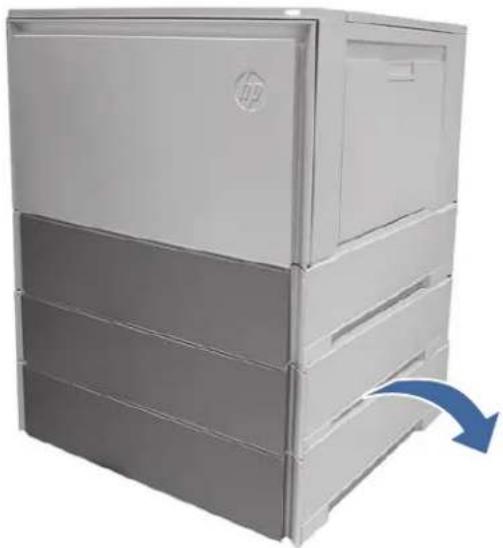
natural_image
Exterior view of a modern multi-tiered refrigerator with a blue arrow indicating rotation (no text or symbols visible)b. Locate and remove the Tray 4 separation roller.
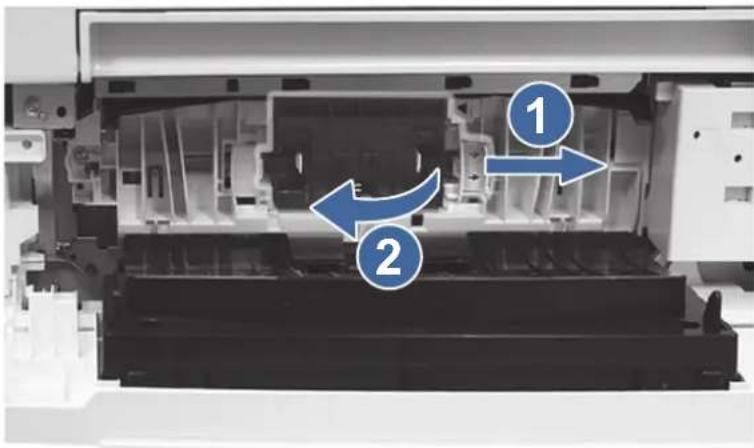
Call-out 1- slide locking lever
Call-out 2- Remove the roller assembly.
c. Remove the Tray 4 pick and feed rollers.
To remove the roller assembly, gently pull on to the side of the rollers as shown.

NOTE: Do not touch the rubber part of the rollers with hands. Oils or debris from hands can cause paper pickup issues.
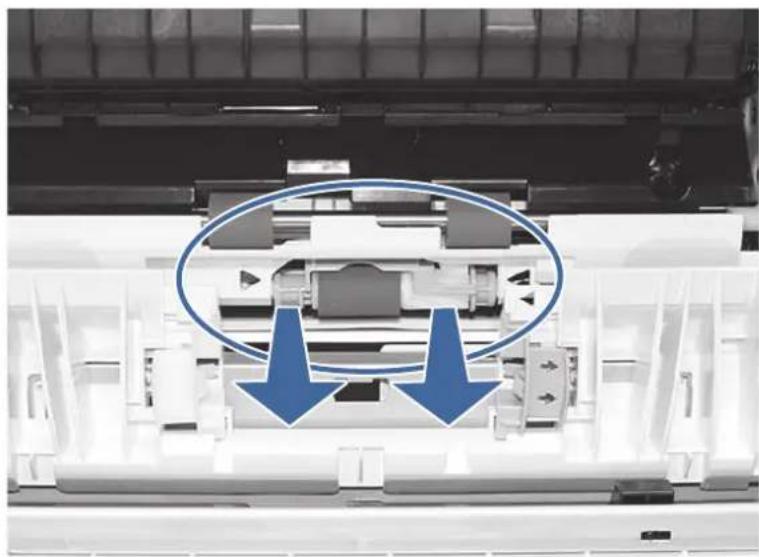
natural_image
Interior view of a printer or printer assembly with two blue arrows pointing to internal components (no visible text or symbols)d. Clean the rollers with a dampened lint free cloth.
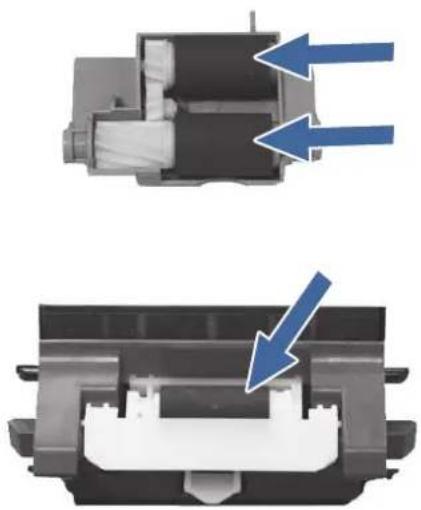
natural_image
Two views of a mechanical component with blue arrows indicating direction, no visible text or symbols.e. Reinstall the roller assemblies and close the right door.
f. Run a print job from Tray 4.
- If the error persists, contact your HP-authorized service or support provider, or contact customer support at www.hp.com/go/contactHP.
13.A4 jam error in Tray 4 (2,100 sheet feeder HCI)
Use the following procedure to check for paper in all possible jam locations related to the HCI Tray 4. When a jam occurs, the control panel displays an animation that assists in clearing the jam.
Recommended action for customers
When a jam occurs, the control panel displays a message and an animation that assists in clearing the jam.
•13.A4.A4 Paper jam in tray 4
•13.A4.D4 Paper jam in tray 4
- Open the printer right door.
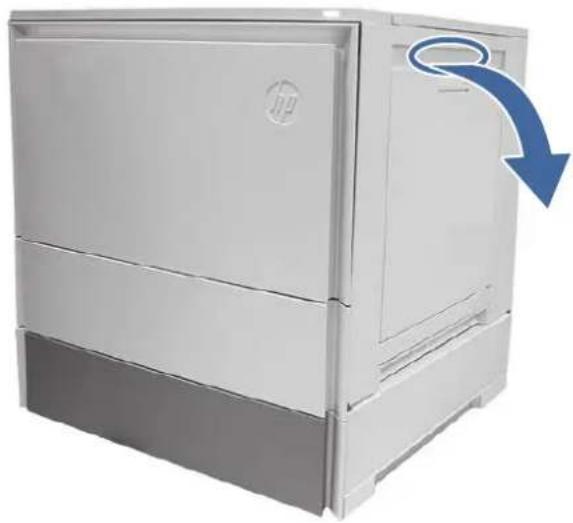
natural_image
Exterior view of a white refrigerator with a blue arrow indicating a downward motion (no text or symbols)- Gently remove any jammed paper.
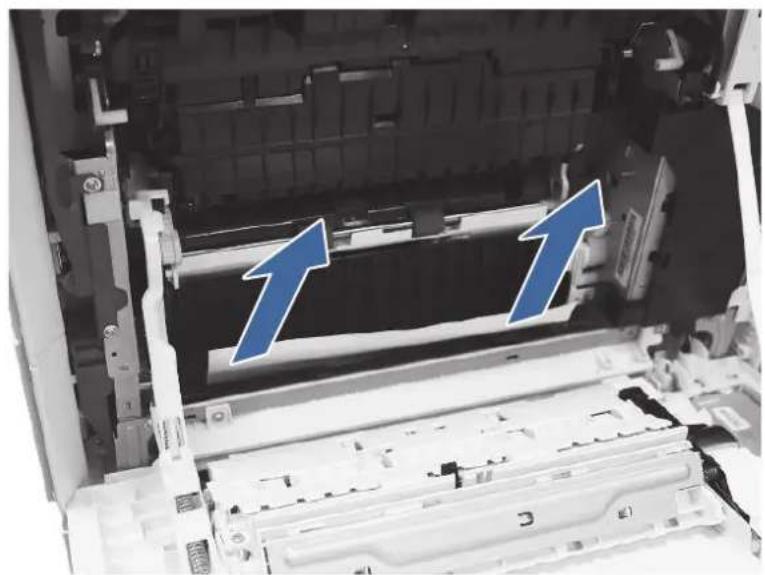
natural_image
Interior view of a printer or printer with visible mechanical components and two blue arrows pointing to the top portion (no text or symbols)- Open the Tray 4 right access door.
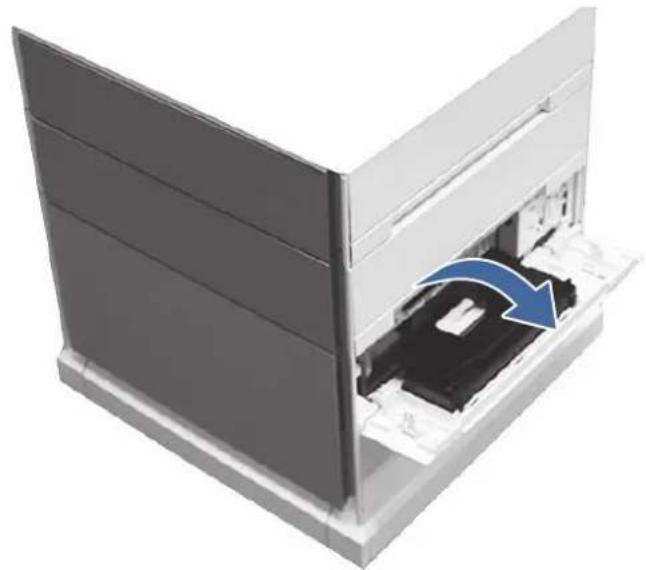
natural_image
3D rendering of a device interior showing a blue arrow indicating a component or operation (no text or symbols present)- Gently remove any jammed paper.
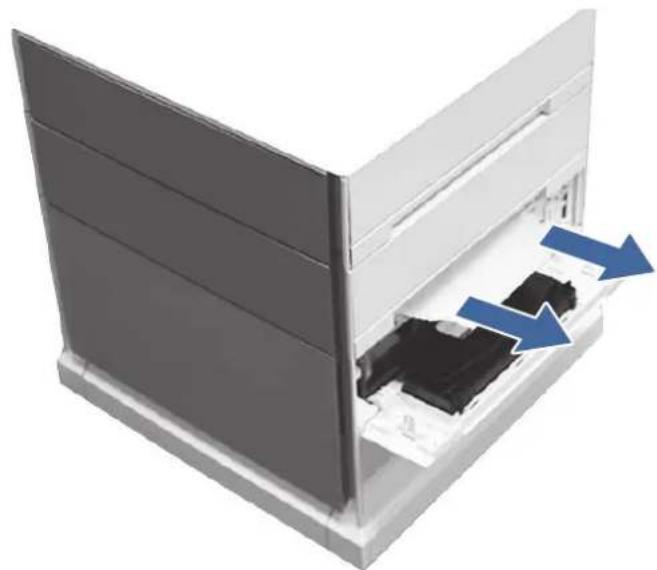
natural_image
3D diagram of a device interior showing internal components and directional arrows (no text or symbols)- Open the Tray 3 access door and gently remove any jammed paper.
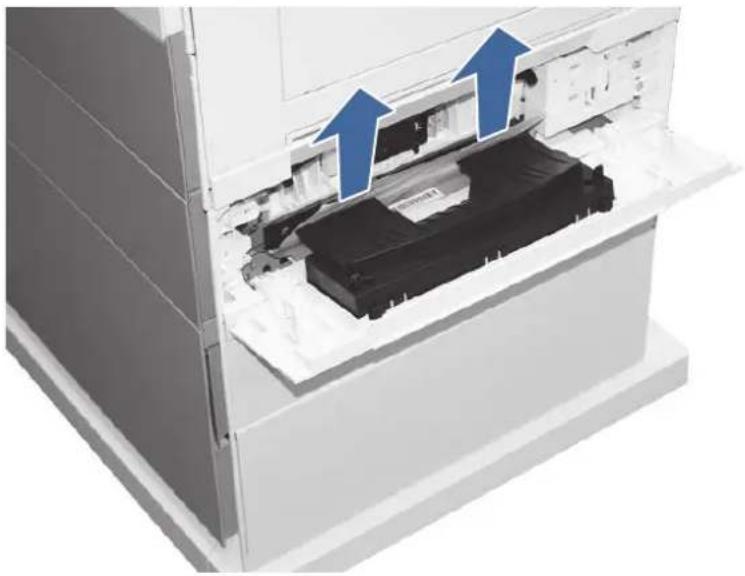
natural_image
3D diagram of a printer internal structure with blue arrows indicating flow or movement (no text or symbols)-
Close the right door to clear the control panel message.
-
Open Tray 4.
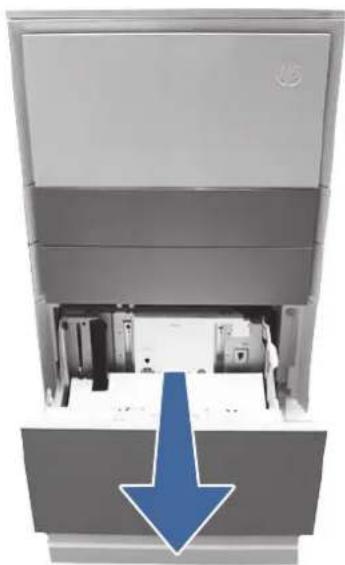
natural_image
Interior view of a computer case with a blue arrow pointing to a component (no text or symbols visible)- Remove the paper from the tray and discard any bent, curled, or damaged sheets.
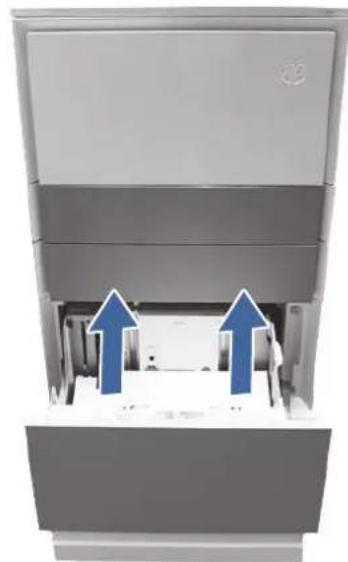
natural_image
Interior view of a refrigerator with two blue arrows indicating upward motion (no text or symbols)- Make sure that the tray width guide is set to the correct paper size for the paper being installed into the tray and that the tray is not over filled above the fill mark (line below 3 triangles on rear guide).
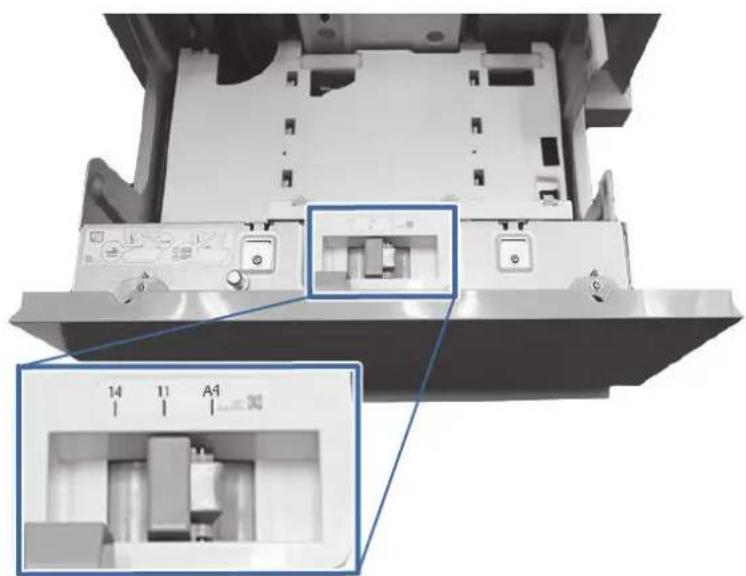
natural_image
Interior view of a computer drive bay with labeled ports and internal compartments (no readable text or symbols)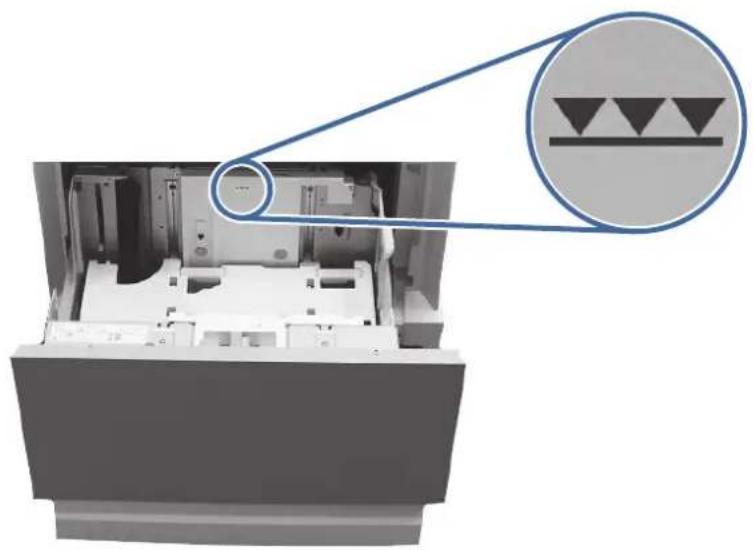
natural_image
Interior view of a printer or printer casing with a magnified inset showing triangular components (no text or symbols visible)-
Ensure the type and quality of the paper being used meets the HP specifications for the printer.
-
If the error persists, clean the Tray 4 pick, feed, and separation rollers.
a. Open the Tray 4 door to access the rollers.
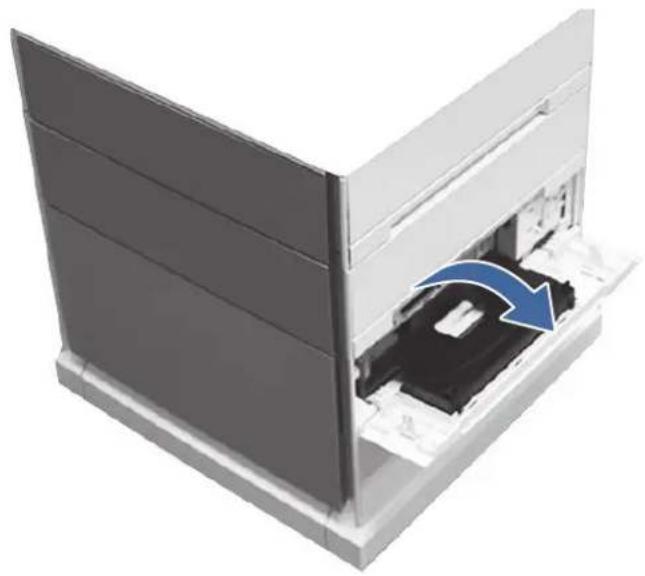
natural_image
3D diagram of a device interior showing a component being inserted, with a blue arrow indicating the direction (no text or symbols present)b. Locate and remove the Tray 4 separation roller.
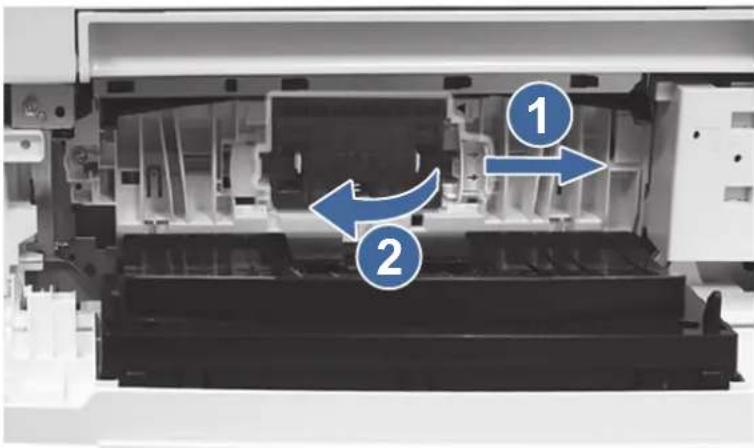
Call-out 1- slide locking lever
Call-out 2- Remove the roller assembly.
c. Remove the Tray 4 pick and feed rollers.
To remove the roller assembly, gently pull on to the side of the rollers as shown.

NOTE: Do not touch the rubber part of the rollers with hands. Oils or debris from hands can cause paper pickup issues.
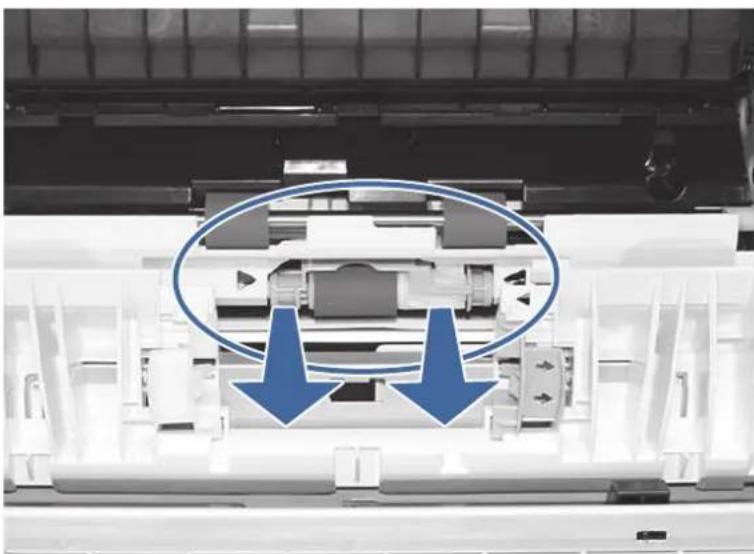
natural_image
Interior view of a printer or printer assembly with two blue arrows pointing to internal components (no visible text or symbols)d. Clean the rollers with a dampened lint free cloth.
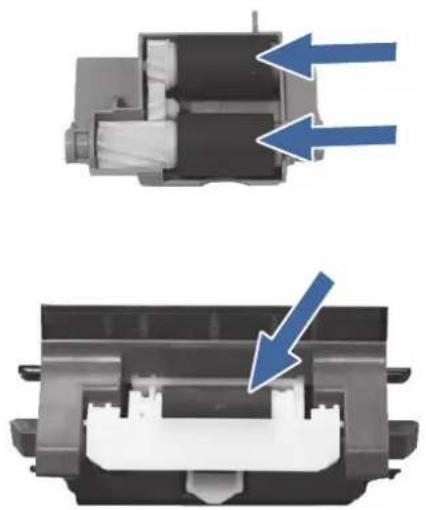
natural_image
Two views of a mechanical component with blue arrows indicating direction, showing internal structure and cross-section (no text or symbols)e. Reinstall the roller assemblies and close the right door.
f. Run a print job from Tray 4.
- If the error persists, contact your HP-authorized service or support provider, or contact customer support at www.hp.com/go/contactHP.
13.B2 jam error in right door
Use the following procedure to clear paper jams in the right door and fuser area. When a jam occurs, the control panel displays an animation that assists in clearing the jam.
Recommended action for customers
When a jam occurs, the control panel displays a message and an animation that assists in clearing the jam.
•13.B2.Az Stay jam in right door
•13.B2.Dz Delay jam in right door
•13.B2.5z Inappropriate to the Delivery Path jam
•13.B2.FF Residual paper jam in right door
z = paper tray. This can be trays 1-5 or "D" for duplex jobs
Or
z = Fuser mode. This can be 0-9 or A-F.

CAUTION:
handling it.

The fuser can be hot while the printer is in use. Wait for the fuser to cool before
- Open the right door.
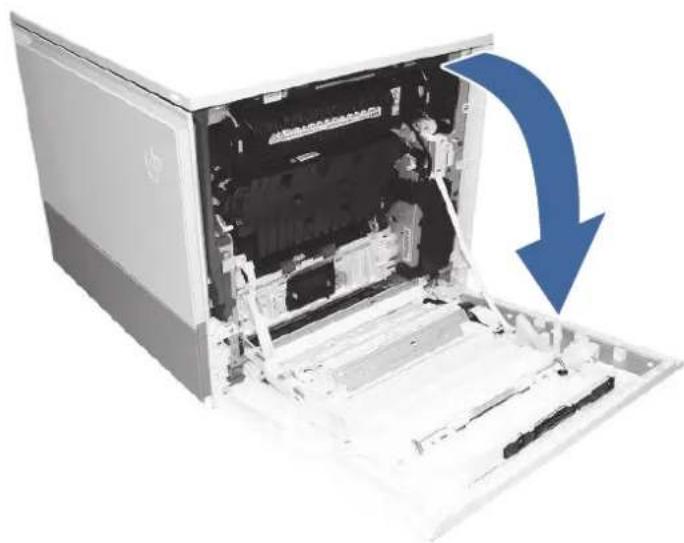
natural_image
Interior view of a computer case with visible internal components and a blue arrow indicating downward motion (no text or symbols)- Gently remove any jammed paper.
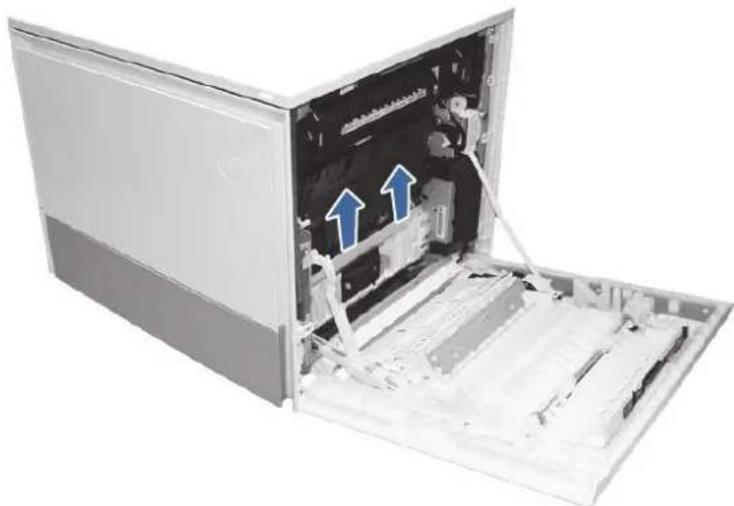
natural_image
Interior view of a computer tower with visible internal components and blue arrows indicating upward movement (no text or symbols)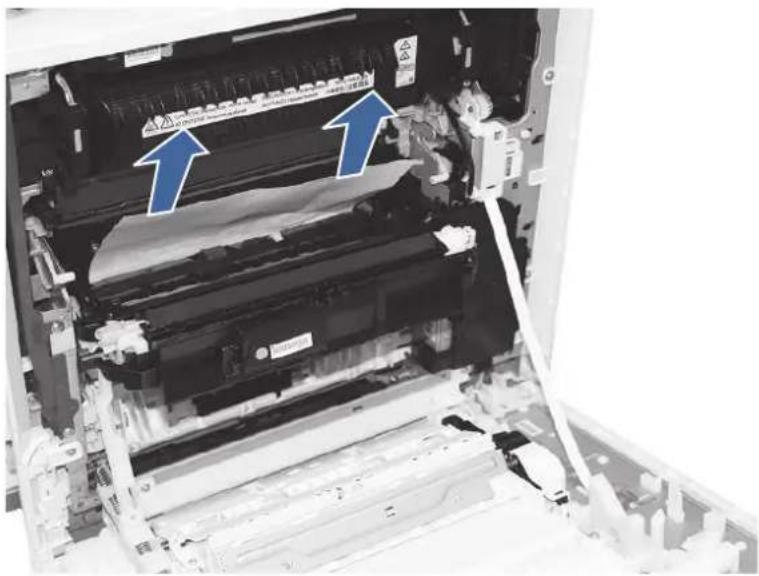
natural_image
Interior view of a printer or printer with visible mechanical components and blue arrows indicating features (no readable text or symbols)- Gently remove any jammed paper from the duplexer paper path.
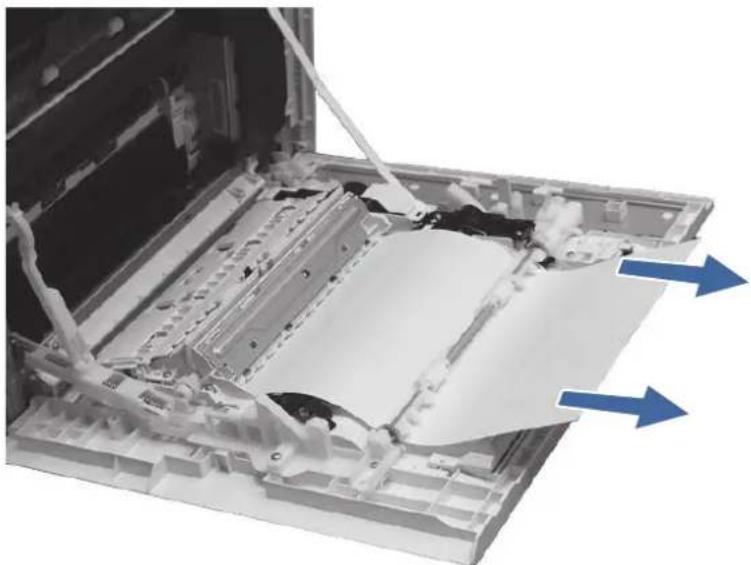
natural_image
Interior view of an open computer case with visible wiring and components, no text or symbols present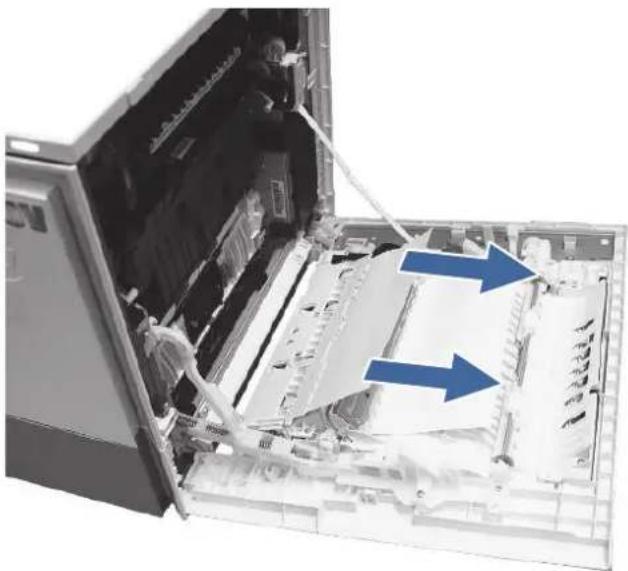
natural_image
Interior view of a computer room showing an open chassis with internal components and blue arrows indicating motion or flow (no text or symbols visible)
IMPORTANT: Make sure the paper being used is not to short for the printers duplexer requirements.
-
Close the right door.
-
Ensure the type and quality of the paper being used meets the HP specifications for the printer.
-
Ensure the paper tray guides are set to the correct size for the paper loaded.
-
If the error persists, contact your HP-authorized service or support provider, or contact customer support at www.hp.com/go/contactHP.
13.B4 jam errors in the right door
Use the following procedure to clear paper jams in the right door and fuser area. When a jam occurs, the control panel displays an animation that assists in clearing the jam.
Recommended action for customers
When a jam occurs, the control panel displays a message and an animation that assists in clearing the jam.
•13.B4.Cz Jam in right door
•13.B4.FF Residual paper jam in right door
z = paper tray. This can be trays 1-5 or "D" for duplex print jobs.

CAUTION:
handling it.

The fuser can be hot while the printer is in use. Wait for the fuser to cool before
- Open the right door.
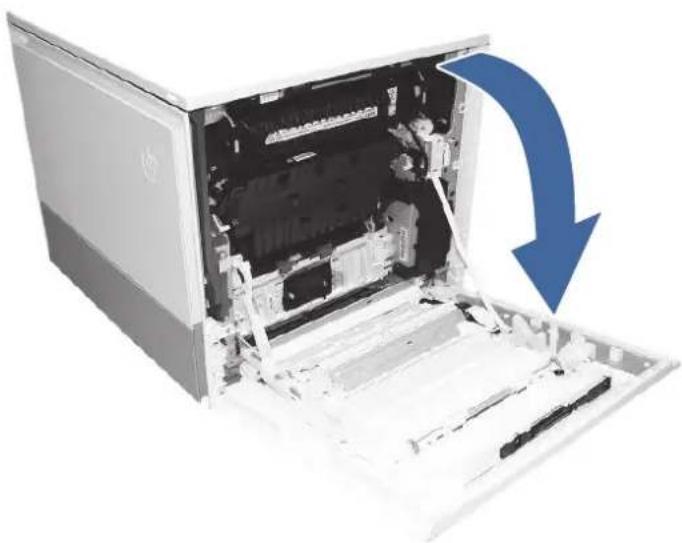
natural_image
Interior view of a computer case showing internal components and a blue arrow indicating a downward motion (no text or symbols present)- Gently remove any jammed paper.
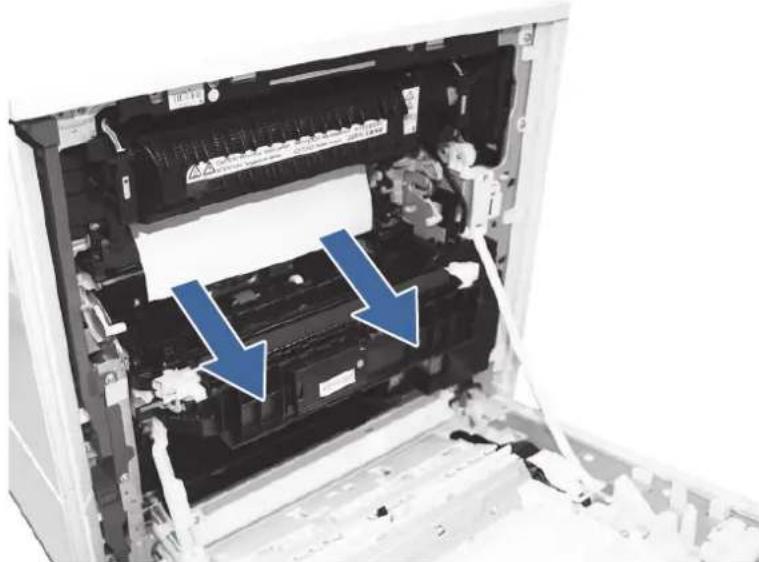
natural_image
Interior view of a computer room showing internal components and a blue arrow indicating a specific area (no text or symbols present)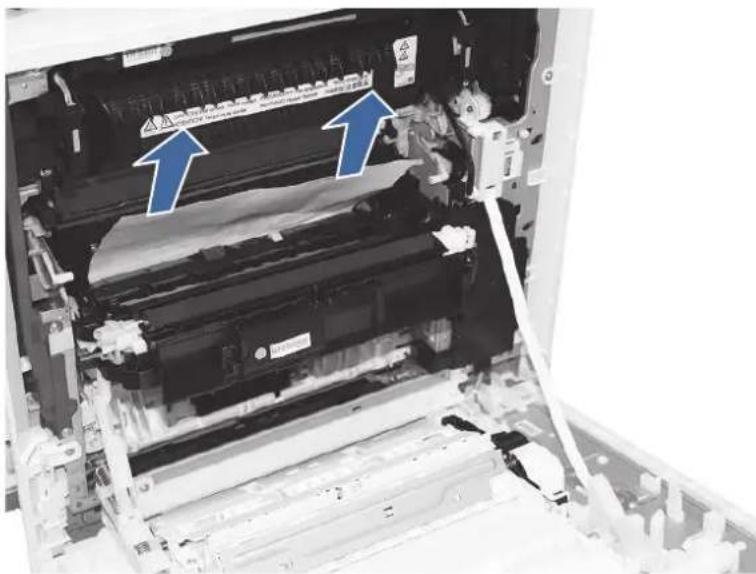
-
Close the right door.
-
Ensure the type and quality of the paper being used meets the HP specifications for the printer.
-
Ensure the paper tray guides are set to the correct size for the paper loaded.
-
If the error persists, contact your HP-authorized service or support provider, or contact customer support at www.hp.com/go/contactHP.
13.B9 jam errors in the fuser
Use the following procedure to clear paper jams in the right door and fuser area. When a jam occurs, the control panel displays an animation that assists in clearing the jam.
Recommended action for customers
When a jam occurs, the control panel displays a message and an animation that assists in clearing the jam.
•13.B9.yz Jam in right door
y = jam type (A or D)
z = Paper tray. This can be 0-5 or "D" for duplex print jobs.
Or
z = Fuser mode. This can be 0-9 or A-F.
• 13.B9.Cz Jam in right door (Fuser wrap jam)
z = Fuser mode. This can be 0-9 or A-F.
• 13.B9.FF Residual paper jam in right door

NOTE: The fuser is hot while the printer is in use. Wait for the fuser to cool before clearing jams.
- Open the right door.
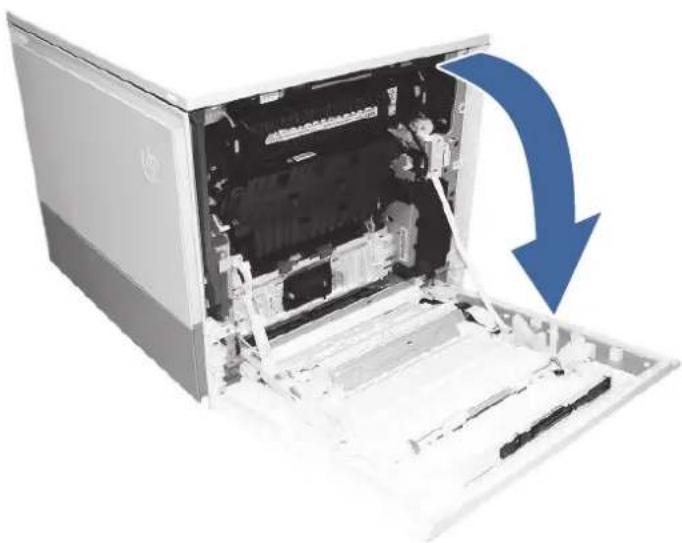
natural_image
Interior view of a computer tower with visible internal components and a blue arrow indicating compression or disassembly (no text or symbols)- Gently remove any jammed paper from the fuser input.
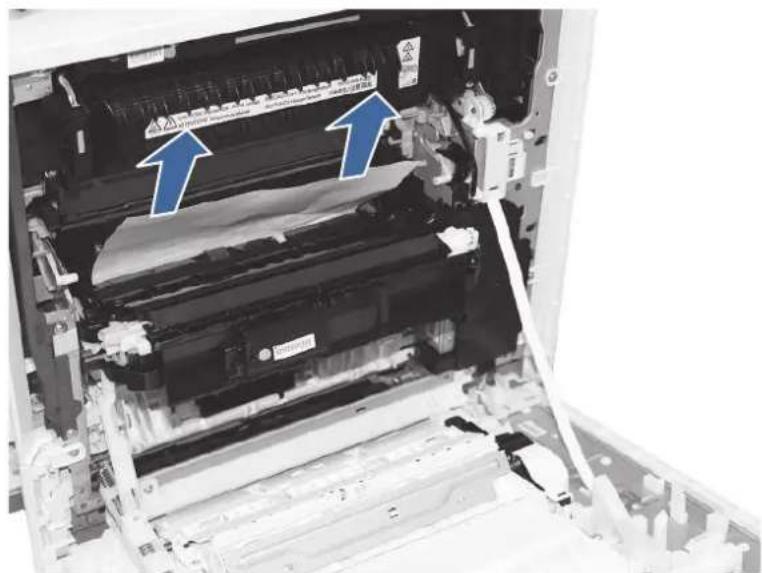
natural_image
Interior view of a printer or printer with visible mechanical components and blue arrows indicating features (no readable text or symbols)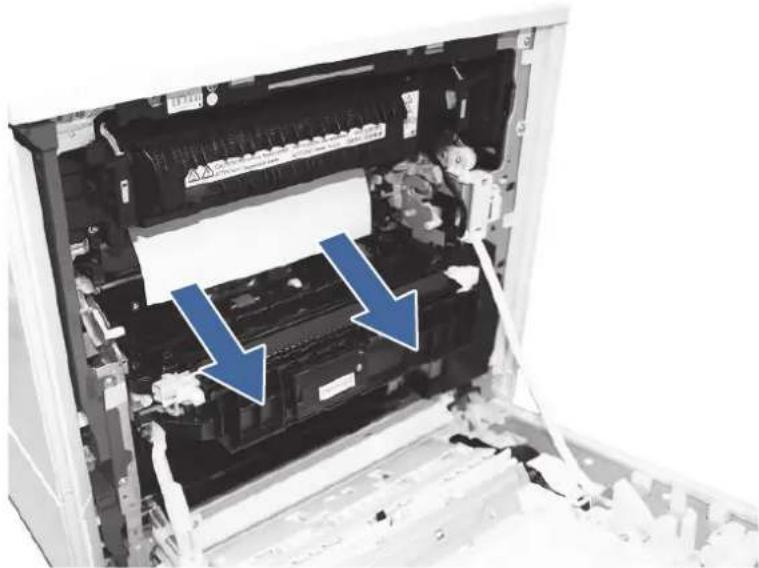
natural_image
Interior view of a computer room showing an open chassis with two blue arrows pointing to internal components (no text or symbols visible)- Remove the fuser and remove any jammed paper found.
a. Squeeze the release levers on the handles (circle call-outs) and then remove the fuser.
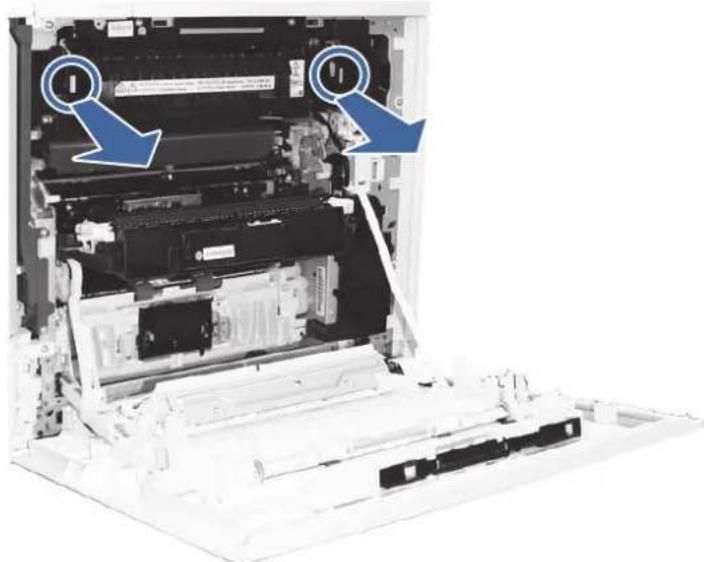
natural_image
Interior view of a computer room showing internal components and a blue arrow indicating direction (no text or symbols present)b. Remove any paper from the exit of the fuser.
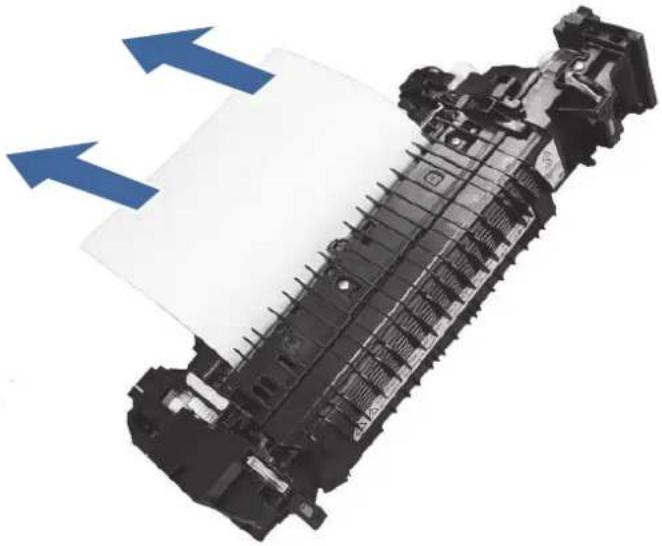
natural_image
Mechanical assembly diagram showing internal components with blue arrows indicating flow direction (no text or symbols)c. Open the fuser access and check for a z-fold paper jam.
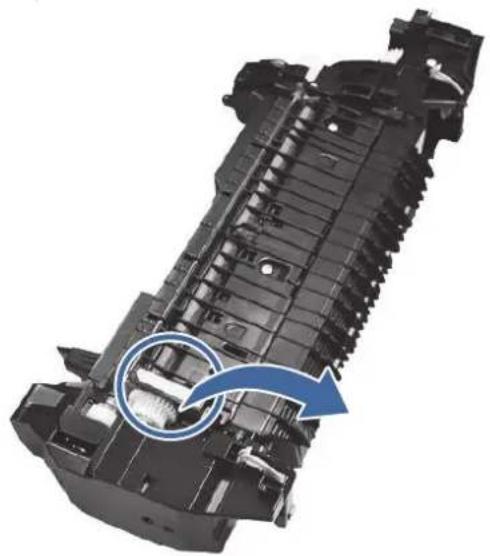
natural_image
Mechanical assembly component with blue circular arrow indicating rotation or motion (no text or symbols)d. Remove jammed paper from fuser.
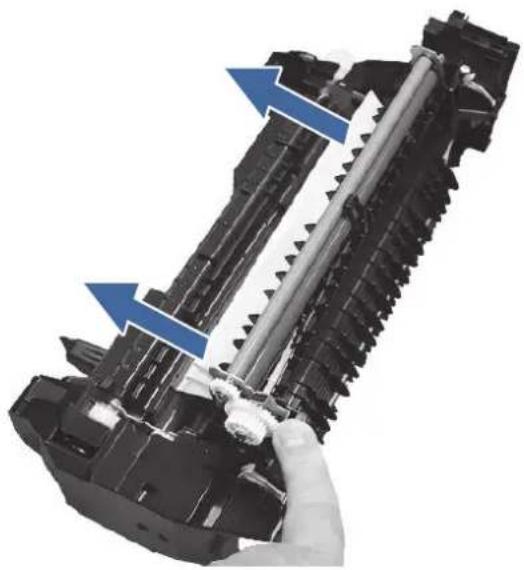
natural_image
Close-up of a mechanical component being inserted into a housing, with blue arrows indicating direction (no text or symbols visible)e. Reinstall the fuser and close the right door.
-
If the error persists, ensure the type and quality of the paper being used meets the HP specifications for the printer.
-
If the error persists, contact your HP-authorized service or support provider, or contact customer support at www.hp.com/go/contactHP.
13.D3 jam errors in the duplexer
Use the following procedure to clear paper jams in the right door and fuser area. When a jam occurs, the control panel displays an animation that assists in clearing the jam.
Recommended action for customers
When a jam occurs, the control panel displays a message and an animation that assists in clearing the jam.
•13.D3.Dz Duplex delivery delay jam
•13.D3.FF Residual paper jam in right door
z = Fuser mode. This can be 0-9 or A-F.

NOTE: The fuser is hot while the printer is in use. Wait for the fuser to cool before clearing jams.
- Open the right door.
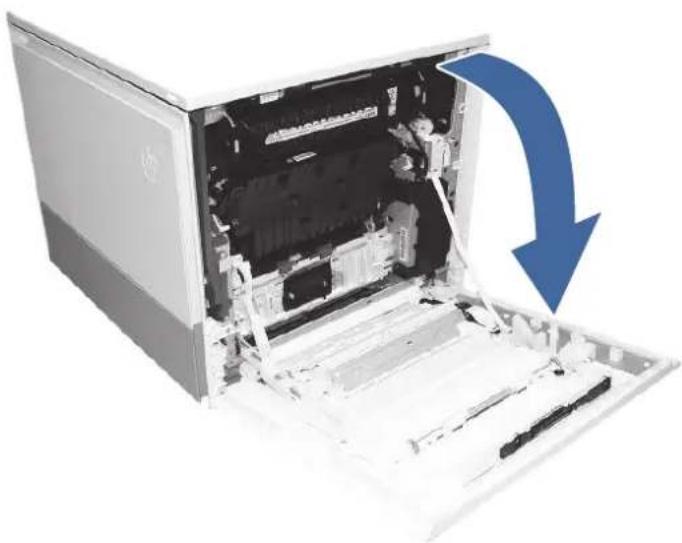
natural_image
Interior view of a computer case showing internal components and a blue arrow indicating a downward motion (no text or symbols present)- Gently remove any jammed paper from the duplexer paper path.
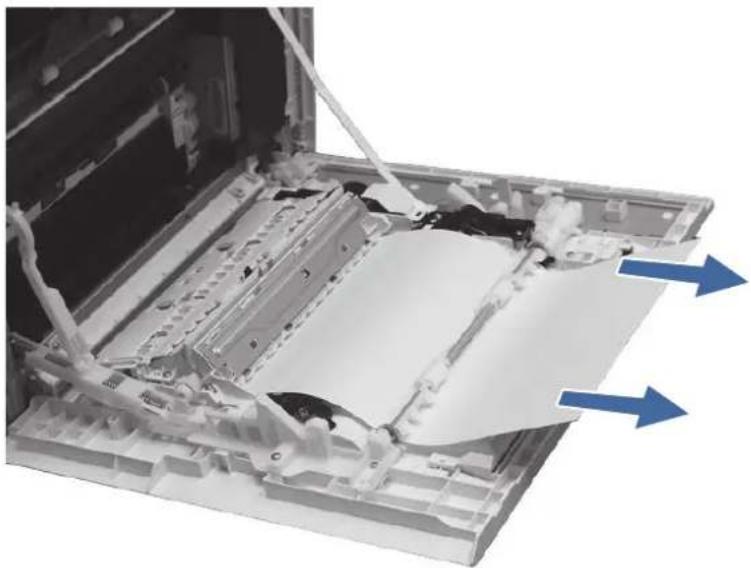
natural_image
Interior view of a computer motherboard showing internal components and wiring (no text or symbols visible)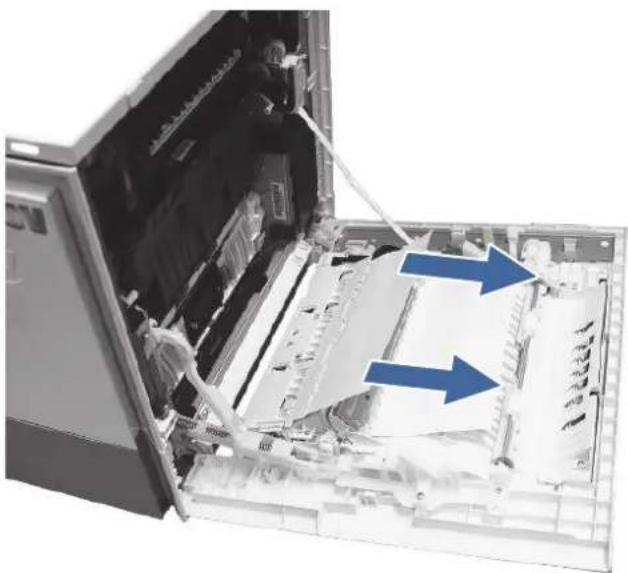
natural_image
Interior view of a computer tower showing internal components and a blue directional arrow indicating movement (no text or symbols present)-
Close the right door.
-
If the error persists, ensure the type and quality of the paper being used meets the HP specifications for the printer.
-
If the error persists, contact your HP-authorized service or support provider, or contact customer support at www.hp.com/go/contactHP.
13.E1 jam error in the output bin
Use the following procedure to check for paper in all possible jam locations in the output bin. When a jam occurs, the control panel displays an animation that assists in clearing the jam.
Recommended action for customers
When a jam occurs, the control panel displays a message and an animation that assists in clearing the jam.
•13.E1.Dz Jam in output bin
•13.E1.FF Residual paper jam in output bin
z = paper type that is being printer on. This can be 0-9 or A-F.
- If paper is visible in the output bin, grasp the leading edge and remove it.
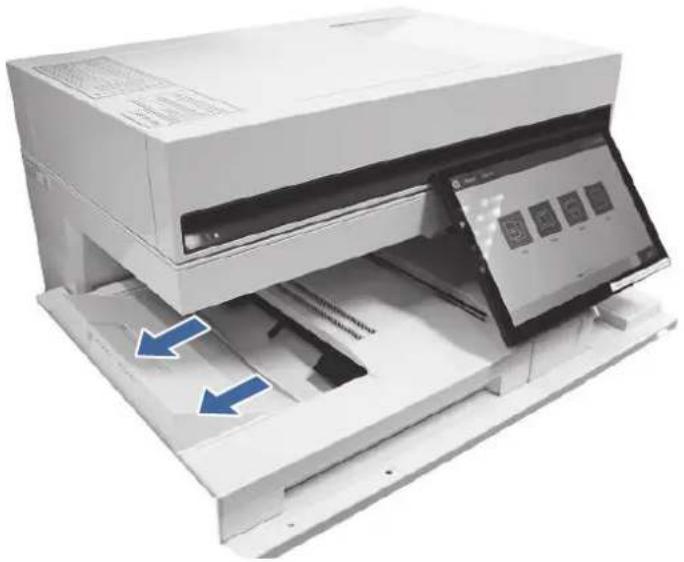
natural_image
White filing paper printer with digital screen and blue arrows indicating left-side motion (no visible text or symbols)- Ensure the type and quality of the paper being used meets the HP specifications for the printer.
- If the error persists, contact your HP-authorized service or support provider, or contact customer support at www.hp.com/go/contactHP.
13.E2 jam error in top cover
Use the following procedure to check for paper in all possible jam locations in the output bin. When a jam occurs, the control panel displays an animation that assists in clearing the jam.
Recommended action for customers
When a jam occurs, the control panel displays a message and an animation that assists in clearing the jam.
•13.E2.yz Jam in Top cover
y = "A" (stay jam) or "D" (delay jam)
z = 1-4 (output bin page is going to)
These jams can only be present if the floor standing finisher is installed
- Open the printer top access cover.
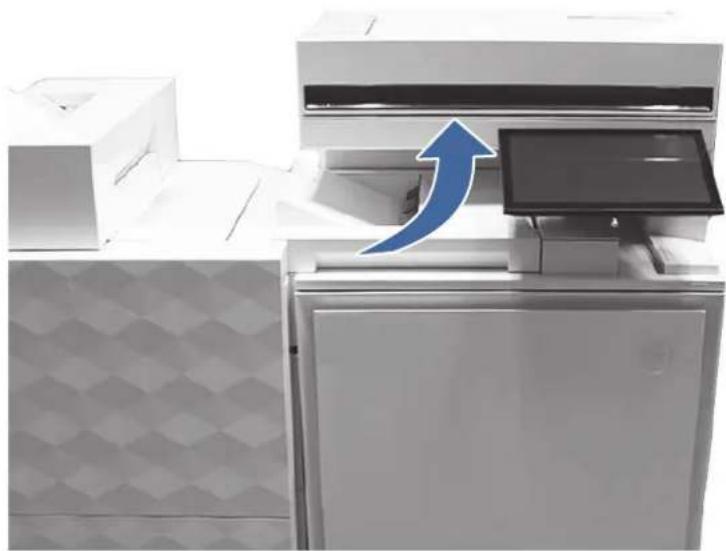
natural_image
Modern kitchen appliance with a blue arrow pointing to a digital display (no visible text or symbols)- Remove all paper from inside the top cover.
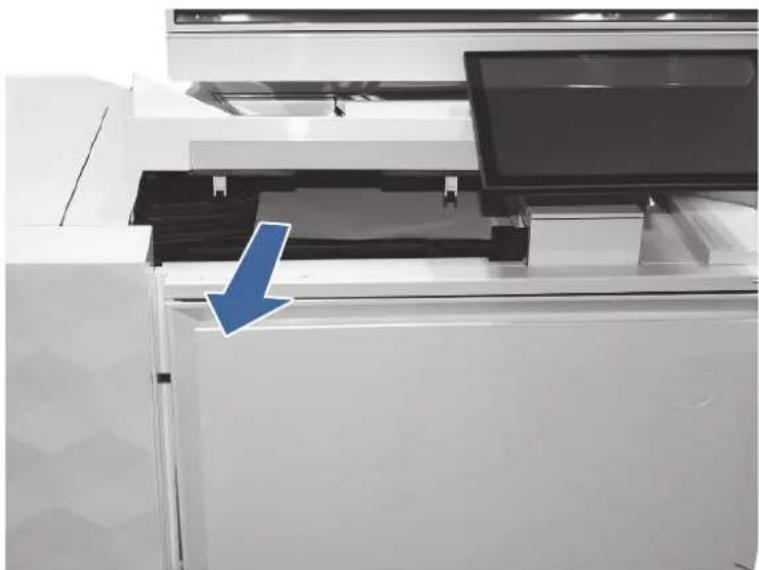
natural_image
Exterior view of a modern office building (no signage)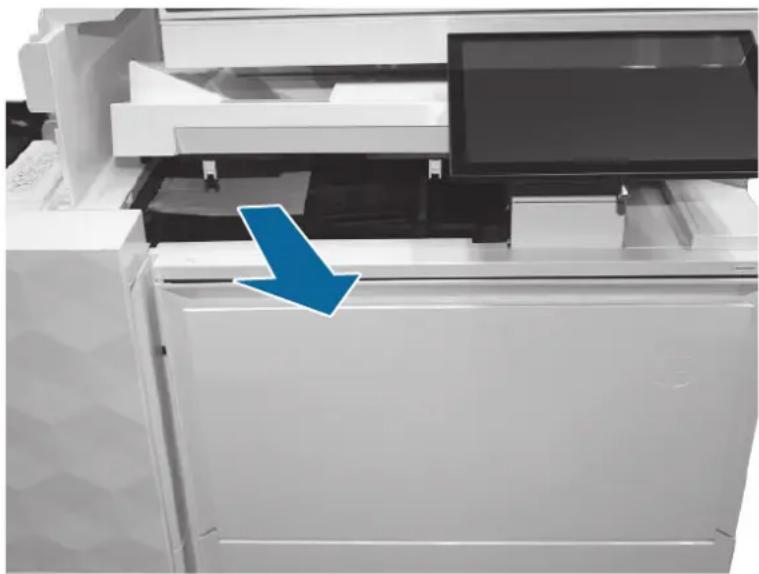
natural_image
Close-up of a white electronic device with a blue arrow pointing to a screen, no visible text or symbols.- Make sure that the floor standing finisher is correctly secured to the printer.
- Make sure the type and quality of the paper being used meets the HP specifications for the printer.
- If the error persists, contact your HP-authorized service or support provider, or contact customer support at www.hp.com/go/contactHP.
13.60 jam errors in the fuser exit area when printing to a stapler/stacker or floor-standing finisher
Use the following procedure to check for paper in all possible jam locations in the output bin. When a jam occurs, the control panel displays an animation that assists in clearing the jam.
Recommended action for customers
When a jam occurs, the control panel displays a message and an animation that assists in clearing the jam.
•13.60.51, 13.60.52 Paper too short jam
•13.60.61, 13.60.62, 13.60.63, 13.60.64 Inter-Page Gap Jam

NOTE: The images provide do not show any accessories or copy module attached to the printer.
- Open the right door.
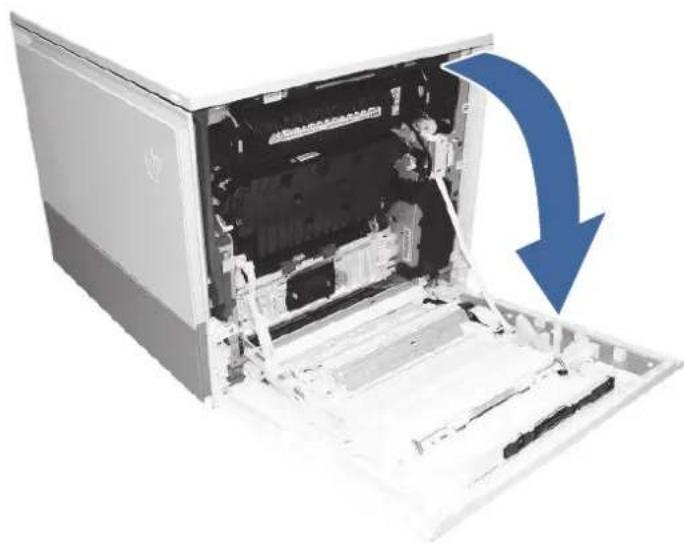
natural_image
Interior view of a computer case showing internal components and a blue downward arrow indicating compression or disassembly (no text or symbols present)- Remove the fuser and remove any jammed paper found.
a. Squeeze the release levers on the handles (circle call-outs) and then remove the fuser.
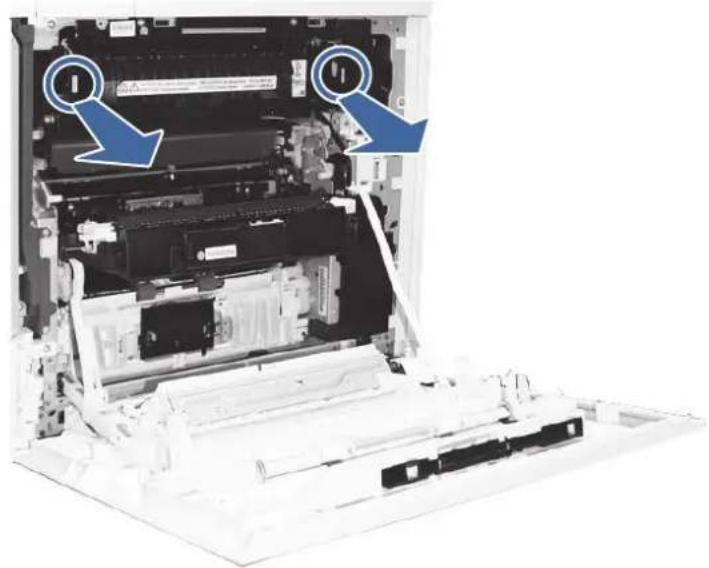
natural_image
Interior view of a printer's internal structure showing mechanical components and a paper sheet (no text or symbols visible)b. Remove any paper jammed in the fuser exit area.
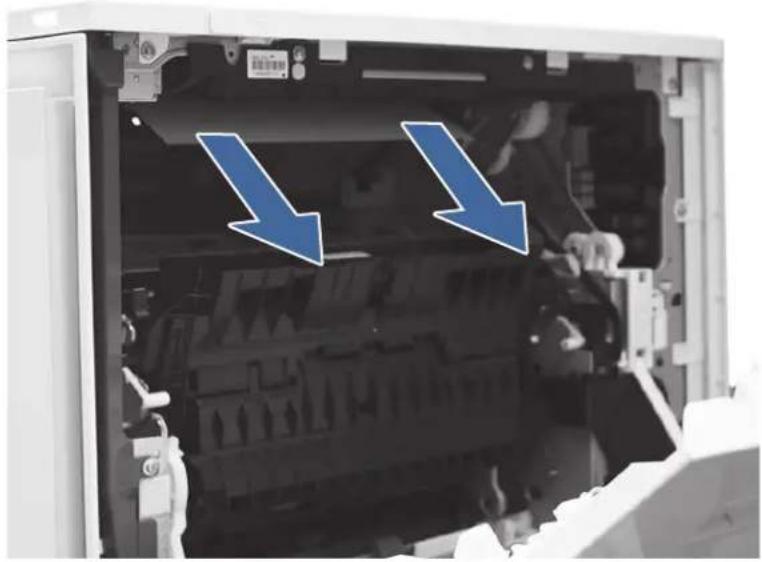
natural_image
Interior view of a computer room with two blue arrows pointing to internal components (no text or symbols visible)c. Reinstall the fuser and close the right door.
- Close right door to allow the printer to clear jam message.
- Ensure the type and quality of the paper being used meets the HP specifications for the printer.
- If the error persists, contact your HP-authorized service or support provider, or contact customer support at www.hp.com/go/contactHP.
13.80, 13.83, or 13.84 jam errors in the 3 Bin Stapler/Stacker
Use the following procedure to check for paper in all possible jam locations in the output bin. When a jam occurs, the control panel displays an animation that assists in clearing the jam.
Recommended action for customers
When a jam occurs, the control panel displays a message and an animation that assists in clearing the jam.
•13.80.yz Jam in 3 Bin stapler/stacker
•13.83.yz Jam in 3 Bin stapler/stacker
•13.84.yz Jam in 3 Bin stapler/stacker
y = "A" (stay jam), "B" (delay jam) "F" (residual jam)
z = Output destination tray 0-4
- Remove any paper from the output bins.
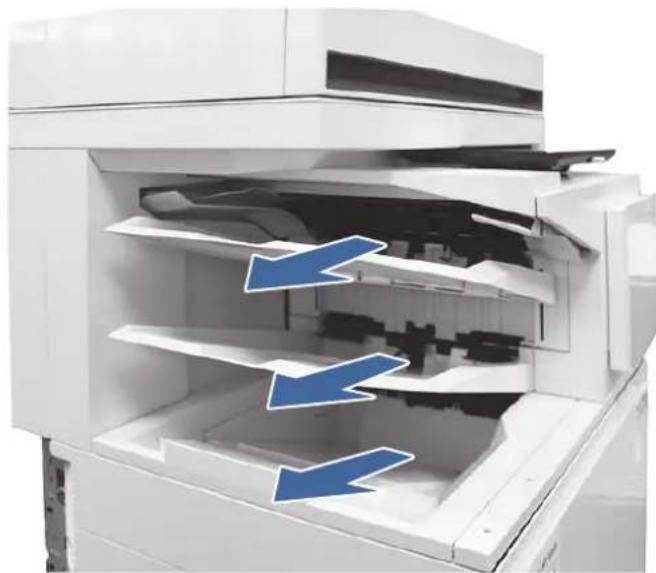
natural_image
Interior view of a white electronic device with blue arrows indicating flow or movement, no visible text or symbols.- Clear all paper from upper right door.
a. Open the upper right door.
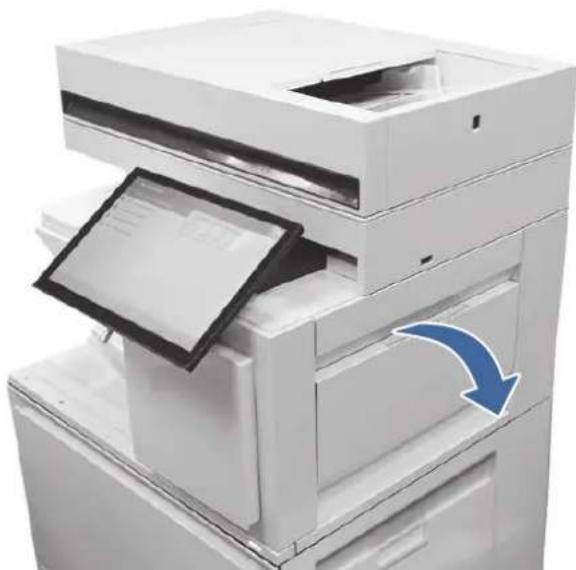
natural_image
Stacked printer with a blue arrow indicating a download or transfer process (no text or symbols visible)b. Remove paper from input area inside the door.
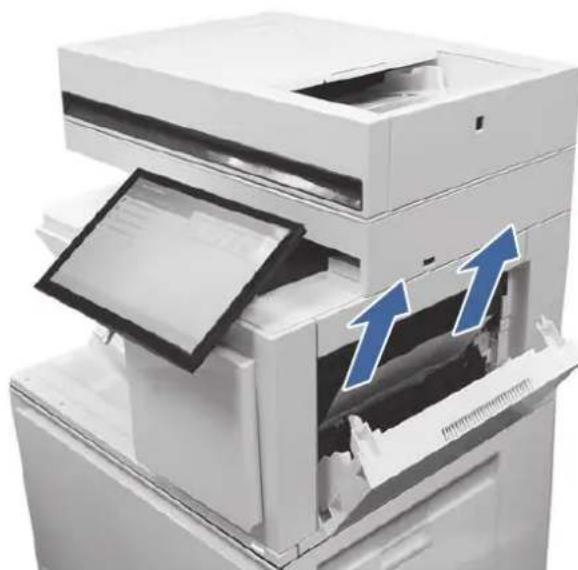
natural_image
Stacked printer with paper sheets and blue arrows indicating orientation (no text or symbols)c. Remove paper from upper output area inside the door.
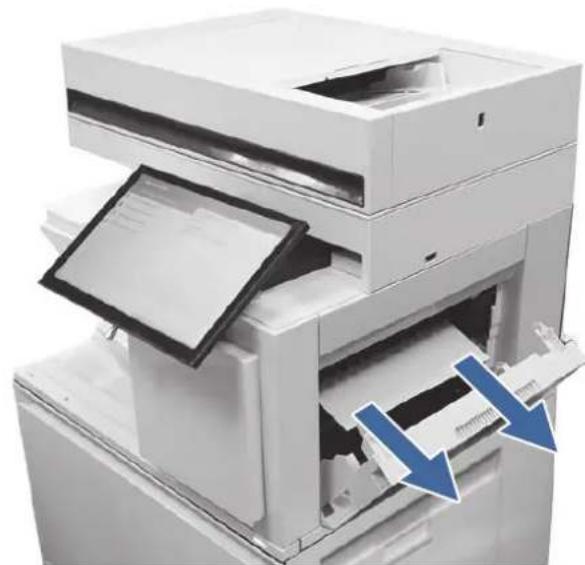
natural_image
Stacked printer with paper feed being inserted, showing paper sheet and blue arrows indicating compression or disassembly (no text or symbols visible)d. Remove paper from upper standard exit area.
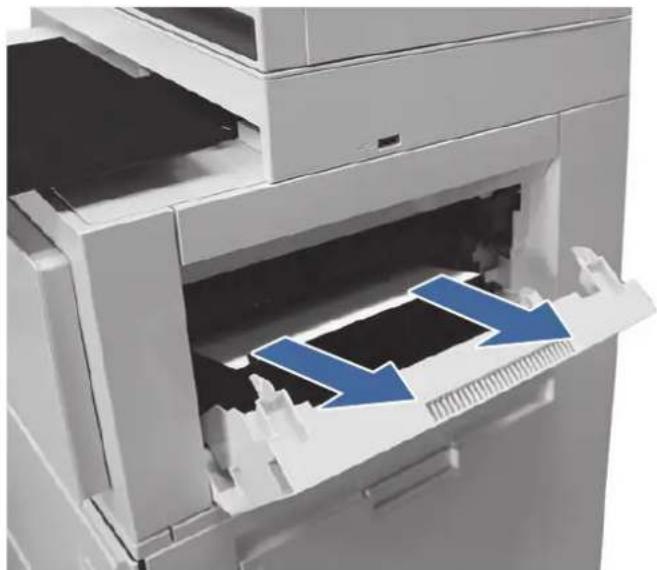
natural_image
Diagram of a printer's internal structure showing paper feeding into a paper holder with blue arrows indicating flow direction (no text or symbols present)e. Close the upper right door.
- Open the right door.
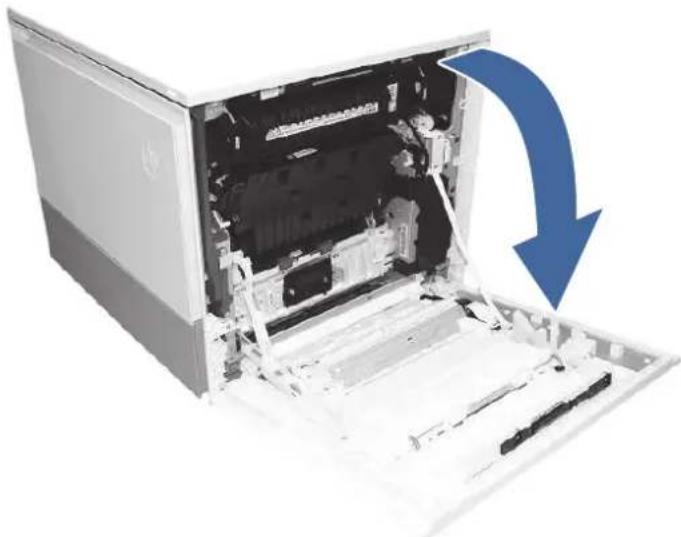
natural_image
Interior view of a computer case showing internal components and a blue arrow indicating a downward motion (no text or symbols present)- Remove the fuser and remove any jammed paper found.
a. Squeeze the release levers on the handles (circle call-outs) and then remove the fuser.
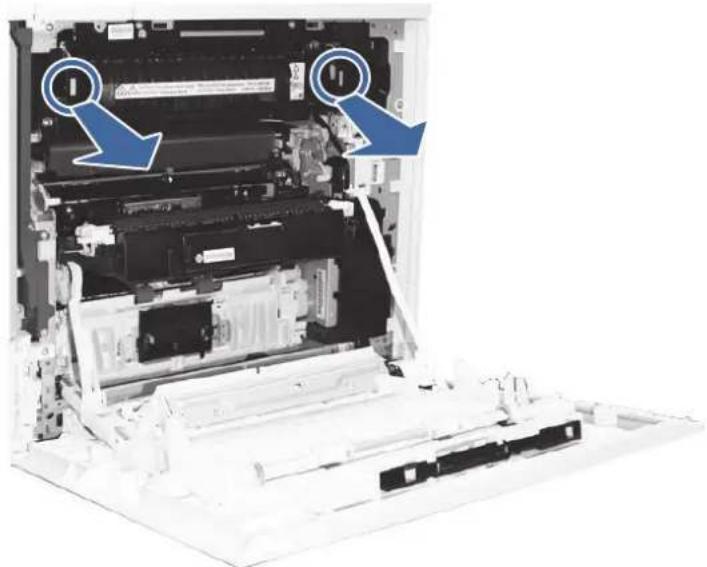
natural_image
Interior view of a computer printer showing internal components and a blue arrow indicating a location (no text or symbols present)b. Remove any paper jammed in the fuser exit area.
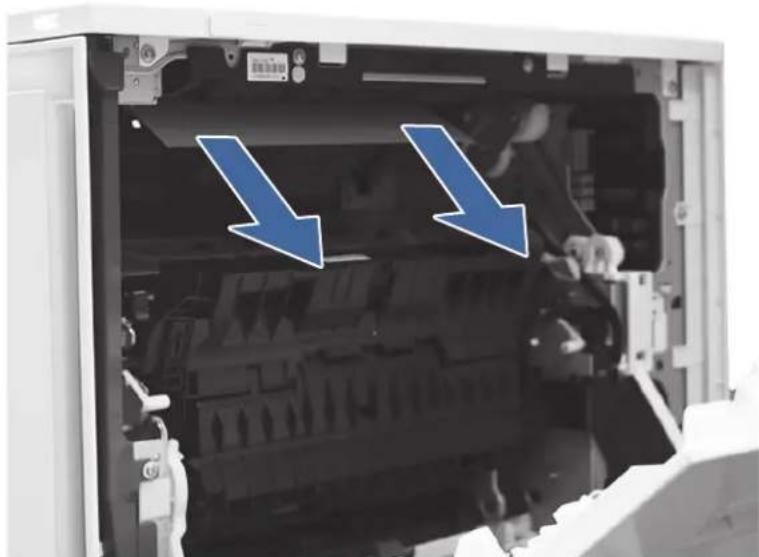
natural_image
Interior view of a computer room with two blue arrows pointing to internal components (no text or symbols visible)c. Reinstall the fuser and close the right door.
- Ensure the type and quality of the paper being used meets the HP specifications for the printer.
- If the error persists, contact your HP-authorized service or support provider, or contact customer support at www.hp.com/go/contactHP.
13.40 or 13.47 Punch jam error in the Floor-standing finisher
Use the following procedure to check for paper in all possible jam locations in the floor-standing finisher punch area. When a jam occurs, the control panel displays an animation that assists in clearing the jam.
Recommended action for customers
When a jam occurs, the control panel displays a message and an animation that assists in clearing the jam.
• 13.40.yz Punch inlet jam
y = "A" (stay jam), "D" (delay jam) or "F" (residual jam)
z = Output destination tray 0, 2-4
•13.47.4z Punch jam
z = Output destination tray 2-4
- Open the top left door.
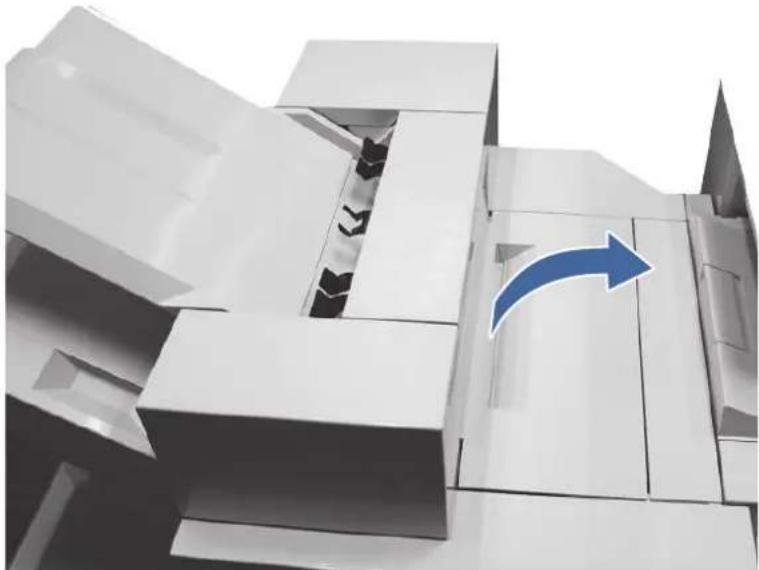
natural_image
Abstract 3D rendering of stacked white geometric blocks with a blue arrow pointing upward (no text or symbols)- Rotate the green dial on the top to the right or left

NOTE: Use the directions on the inside to assist in clearing the jam.
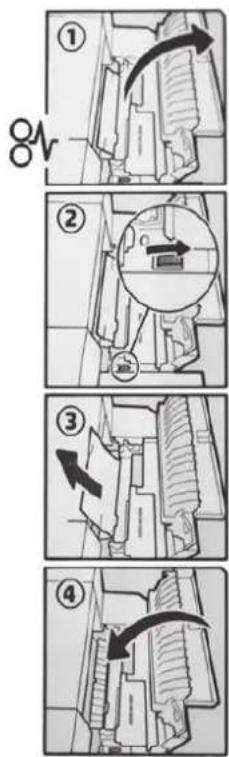
- Remove paper from the top left door.
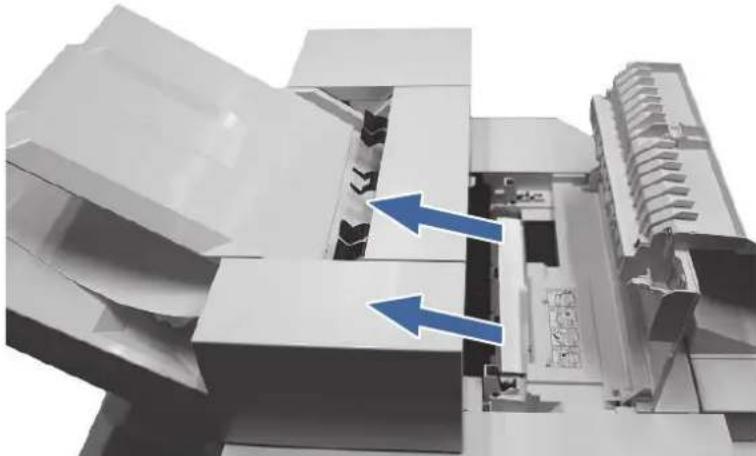
natural_image
3D architectural rendering of a mechanical assembly with blue arrows indicating directional flow or movement (no text or symbols)- Close the top left door.
- Ensure the type and quality of the paper being used meets the HP specifications for the printer.
- If the error persists, contact your HP-authorized service or support provider, or contact customer support at www.hp.com/go/contactHP.
13.6, 13.7, or 13.8 jam error in the Floor-standing finisher
Use the following procedure to check for paper in all possible jam locations in the floor-standing finisher. When a jam occurs, the control panel displays an animation that assists in clearing the jam.
Recommended action for customers
When a jam occurs, the control panel displays a message and an animation that assists in clearing the jam.
•13.6x.yz Jam in Floor standing stapler/stacker
• 13.7x.yz Jam in Floor standing stapler/stacker
•13.8x.yz Jam in Floor standing stapler/stacker
x=0,1,3,4,5
y = "A" (stay jam), "D" (delay jam), "F" (residual jam)
z = Output destination tray 0-4
- Remove any paper jams from the output bins by gently grasp the leading edge and remove it.
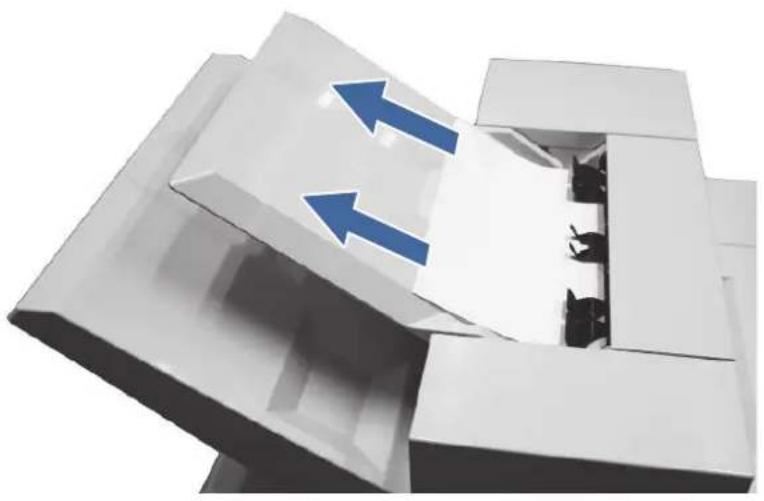
natural_image
Abstract 3D diagram of a mechanical component with two blue arrows indicating directional flow (no text or symbols)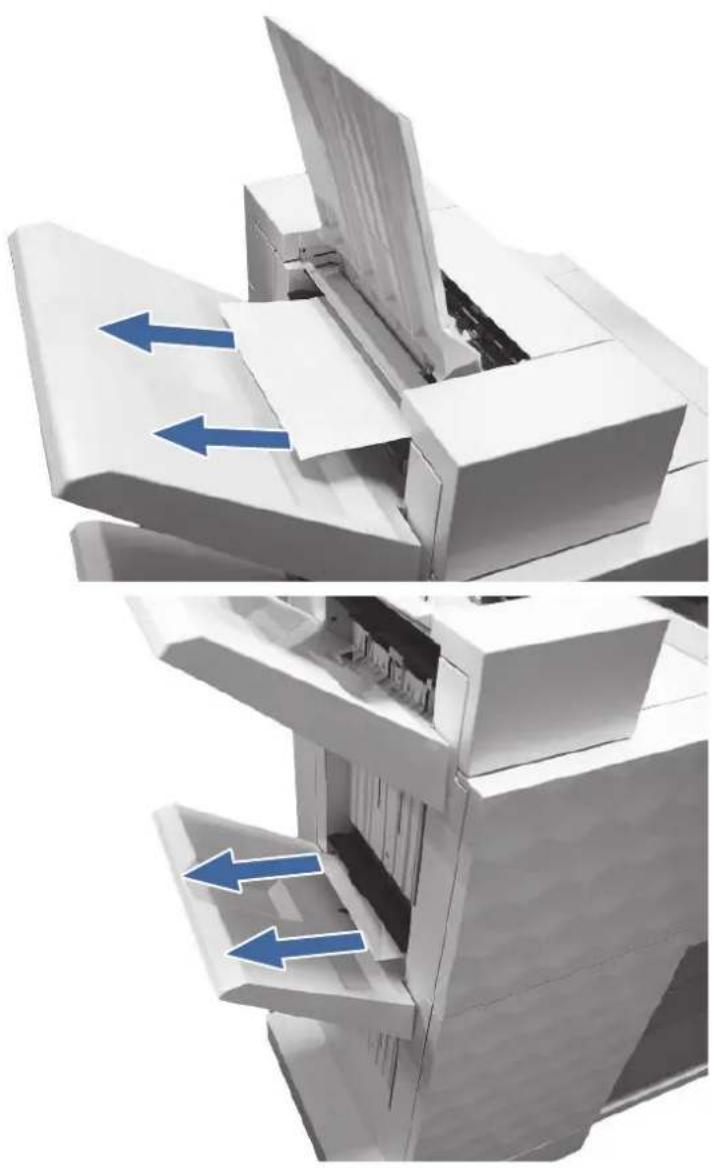
natural_image
Two views of a white paper printer with blue arrows indicating compression or disassembly process (no text or symbols present)- Open the top left door.
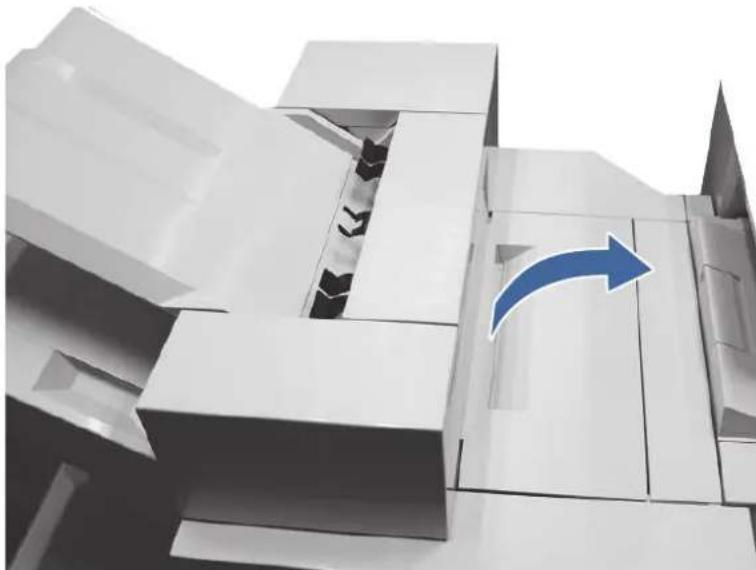
natural_image
Abstract 3D architectural model with a blue arrow pointing upward, no text or symbols present- Remove paper from the top left door.

NOTE: Use the directions on the inside to assist in clearing the jam.
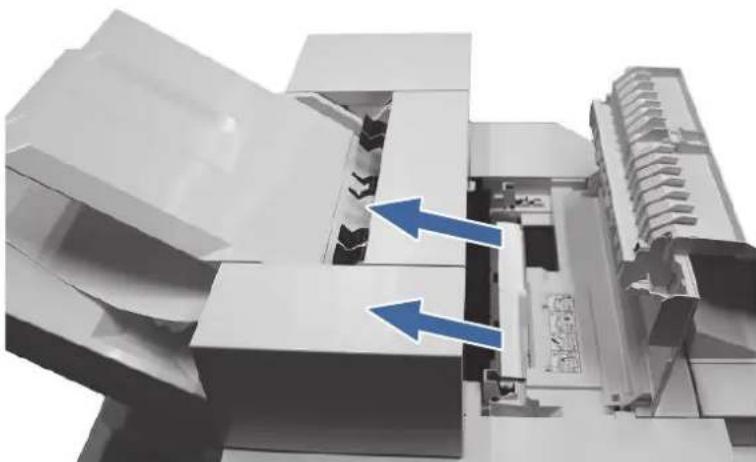
natural_image
3D mechanical assembly diagram showing internal components and directional arrows (no text or symbols)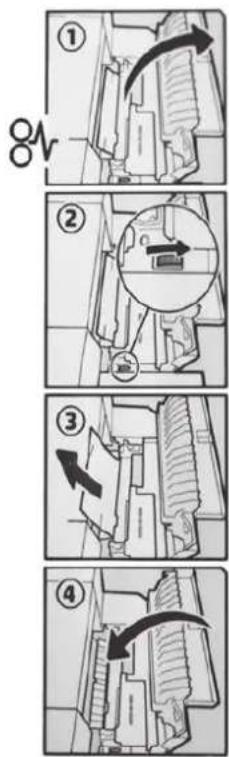
- Open the front access do to clear any jammed paper.
a. Open the front door and check jam access areas.
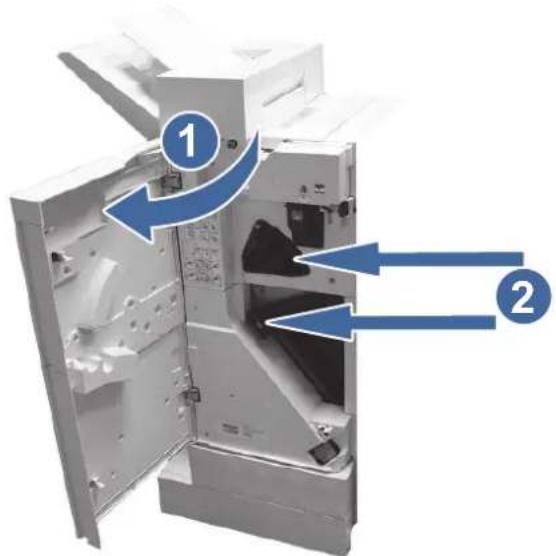
Call-out 2: Check access areas
b. Use the directions inside the front access door to help remove the paper.
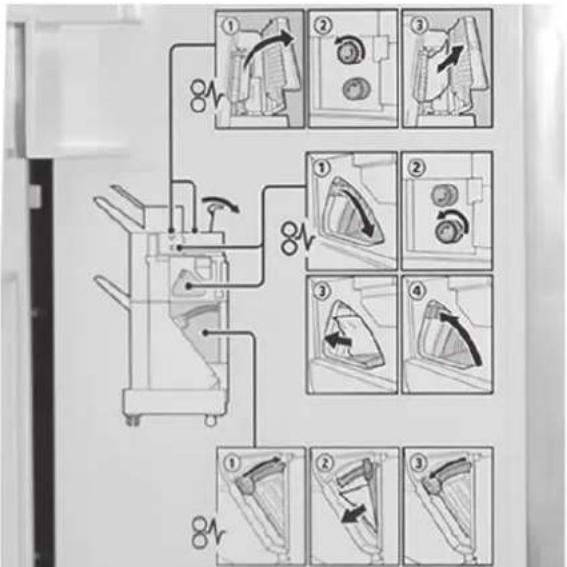
flowchart
graph TD
    A["Step 1: Washer Cutting"] --> B["Step 2: Washer Setting"]
    B --> C["Step 3: Washer Dressing"]
    C --> D["Step 4: Washer Washing"]
    D --> E["Step 5: Washer Covering"]
    E --> F["Step 6: Washer Stopping"]
    F --> G["Step 7: Washer Stopping & Covering"]
    G --> H["Step 8: Washer Stopping & Covering"]
-
Ensure the type and quality of the paper being used meets the HP specifications for the printer.
-
If the error persists, contact your HP-authorized service or support provider, or contact customer support at www.hp.com/go/contactHP.
Resolving color print quality problems
Use the information below to troubleshoot print-quality, color-quality, and image-quality problems on HP Color LaserJet Enterprise printers.
Introduction
The troubleshooting steps can help resolve the following defects:
- Blank pages
- Black pages
- Colors that do not align
- Curled paper
- Dark or light bands
- Dark or light streaks
- Fuzzy print
• Light print - Loose toner
- Missing toner
- Gray background or dark print
•Scattered dots of toner
- Skewed images
•Smears
• Streaks
Troubleshoot print quality
To resolve print-quality issues, try these steps in the order presented.
To troubleshoot specific image defects, see Troubleshoot image defects.
Update the printer firmware
Try upgrading the printer firmware.
For instructions, go to www.hp.com/support.
Print from a different software program
Try printing from a different software program.
If the page prints correctly, the problem is with the software program from which you were printing.
Check the paper-type setting for the print job
Check the paper type setting when printing from a software program and the printed pages have smears, fuzzy or dark print, curled paper, scattered dots of toner, loose toner, or small areas of missing toner.
Check the paper type setting on the control panel
Check the paper type setting on the printer control panel, and change the setting as needed.
- Open and close the paper tray.
- Follow the control panel prompts to confirm or modify the paper type and size settings for the tray.
- Make sure the paper loaded meets specifications.
- Adjust the humidity and resistance setting on the control panel to match the environment.
a. Open the following menus:
i. Settings
ii. Copy/Print
iii. Print quality
iv. Adjust paper type
b. Select the paper type that matches the type loaded in the tray.
c. Use the arrows to increase or decrease the humidity and resistance setting.
- Make sure the driver settings match the control panel settings.

NOTE: The print driver settings will override any control panel settings.
Check the paper type setting (Windows)
Check the paper type setting for Windows, and change the setting as needed.

NOTE: The print driver settings will override any control panel settings.
- From the software program, select the Print option.
- Select the printer, and then click the Properties or Preferences button.
- Click the Paper/Quality tab.
- From the Paper Type drop-down list, click the More... option.
- Expand the list of Type is: options.
- Expand the category of paper types that best describes your paper.
- Select the option for the type of paper you are using, and click the OK button.
- Click the OK button to close the Document Properties dialog box. In the Print dialog box, click the OK button to print the job.
Check the paper type setting (macOS)
Check the paper type setting for macOS, and change the setting as needed.
- Click the File menu, and then click the Print option.
- In the Printer menu, select the printer.
- By default, the print driver displays the Copies & Pages menu. Open the menus drop-down list, and then click the Finishing menu.
- Select a type from the Media Type drop-down list.
- Click the Print button.
Check toner-cartridge status
Follow these steps to check the estimated life remaining in the toner cartridges and if applicable, the status of other replaceable maintenance parts.
Step one: Print the Supplies Status Page
The supplies status page indicates the cartridge status.
- From the Home screen on the printer control panel, select the Reports menu.
- Select the Configuration/Status Pages menu.
- Select Supplies Status Page, and then select Print to print the page.
Step two: Check supplies status
Check the supplies status report as follows.
- Look at the supplies status report to check the percent of life remaining for the toner cartridges and, if applicable, the status of other replaceable maintenance parts.
Print quality problems can occur when using a toner cartridge that is at its estimated end of life. The supplies status page indicates when a supply level is very low. After an HP supply has reached the very low threshold, HP's premium protection warranty on that supply has ended.
The toner cartridge does not need to be replaced now unless the print quality is no longer acceptable. Consider having a replacement available to install when print quality is no longer acceptable.
If you determine that you need to replace a toner cartridge or other replaceable maintenance parts, the supplies status page lists the genuine HP part numbers.
- Check to see if you are using a genuine HP cartridge.
A genuine HP toner cartridge has the word "HP" on it, or has the HP logo on it. For more information on identifying HP cartridges go to www.hp.com/go/learnaboutsupplies.
Print a cleaning page
During the printing process paper, toner, and dust particles can accumulate inside the printer and can cause print-quality issues such as toner specks or spatter, smears, streaks, lines, or repeating marks.
Follow these steps to clean the printer paper path:
-
From the Home screen on the printer control panel, select the Support Tools menu.
-
Select the following menus:
a. Maintenance
b. Calibration/Cleaning
c. Cleaning Page
- Select Print to print the page.
A Cleaning... message displays on the printer control panel. The cleaning process takes a few minutes to complete. Do not turn the printer off until the cleaning process has finished. When it is finished, discard the printed page.
Visually inspect the toner cartridge or cartridges
Follow these steps to inspect each toner cartridge:
- Remove the toner cartridge from the printer, and verify that the sealing tape has been removed.
- Check the memory chip for damage.
- Examine the surface of the green imaging drum.
CAUTION: Do not touch the imaging drum. Fingerprints on the imaging drum can cause print-quality problems.
- If you see any scratches, fingerprints, or other damage on the imaging drum, replace the toner cartridge.
- Reinstall the toner cartridge and print a few pages to see if the problem has resolved.
Check paper and the printing environment
Use the following information to check the paper selection and the printing environment.
Step one: Use paper that meets HP specifications
Some print-quality problems arise from using paper that does not meet HP specifications.
- Always use a paper type and weight that this printer supports.
- Use paper that is of good quality and free of cuts, nicks, tears, spots, loose particles, dust, wrinkles, voids, staples, and curled or bent edges.
- Use paper that has not been previously printed on.
- Use paper that does not contain metallic material, such as glitter.
- Use paper that is designed for use in laser printers. Do not use paper that is designed only for use in Inkjet printers.
- Use paper that is not too rough. Using smoother paper generally results in better print quality.
Step two: Check the environment
The environment can directly affect print quality and is a common cause of print-quality or paper-feeding issues. Try the following solutions:
- Move the printer away from drafty locations, such as open windows or doors, or air-conditioning vents.
• Make sure the printer is not exposed to temperatures or humidity outside of printer specifications. - Do not place the printer in a confined space, such as a cabinet.
- Place the printer on a sturdy, level surface.
- Remove anything that is blocking the vents on the printer. The printer requires good air flow on all sides, including the top.
- Protect the printer from airborne debris, dust, steam, grease, or other elements that can leave residue inside the printer.
Step three: Set the individual tray alignment
Follow these steps when text or images are not centered or aligned correctly on the printed page when printing from specific trays.
-
From the Home screen on the printer control panel, select the Settings menu.
-
Select the following menus:
a. Copy/Print or Print
b. Print Quality
c. Image Registration
-
Select Tray, and then select the tray to adjust.
-
Select Print Test Page, and then follow the instructions on the printed pages.
-
Select Print Test Page again to verify the results, and then make further adjustments if necessary.
- Select Done to save the new settings.
Try a different print driver
Try a different print driver when printing from a software program and the printed pages have unexpected lines in graphics, missing text, missing graphics, incorrect formatting, or substituted fonts.
Download any of the following drivers from the HP Web site: Support for HP Color LaserJet Enterprise MFP 6800 or Support for HP Color LaserJet Enterprise MFP 6801.
Table 9-2 Print drivers
| Driver Description | |
| HP PCL6 driver | If available, this printer-specific print driver supports older operating systems like Windows XP and Windows Vista. For a list of supported operating systems, go to www.hp.com/go/support. |
| HP PCL 6 driver | This printer-specific print driver supports Windows 7 and newer operating systems that support version 3 drivers. For a list of supported operating systems, go to www.hp.com/go/support. |
| HP PCL-6 driver | This product-specific print driver supports Windows 8 and newer operating systems that support version 4 drivers. For a list of supported operating systems, go to www.hp.com/go/support. |
| HP UPD PS driver | Recommended for printing with Adobe software programs or with other highly graphics-intensive software programsProvides support for printing from Postscript emulation needs, or for Postscript flash font support |
| HP UPD PCL 6 | Recommended for printing in all Windows environmentsProvides the overall best speed, print quality, and printer feature support for most usersDeveloped to align with Windows Graphic Device Interface (GDI) for best speed in Windows environmentsMight not be fully compatible with third-party and custom software programs that are based on PCL 5 |
Troubleshoot color quality
Calibrating the printer can help ensure color print quality.
Calibrate the printer to align the colors
Calibration is a printer function that optimizes print quality.
Follow these steps to resolve print-quality problems such as misaligned color, colored shadows, blurry graphics, or other print-quality issues.
- From the Home screen on the printer control panel, select the Support Tools menu.
-
Select the following menus:
-
Maintenance
- Calibration/Cleaning
Full Calibration
- Select Start to start the calibration process.
A Calibrating message will display on the printer control panel. The calibration process takes a few minutes to complete. Do not turn the printer off until the calibration process has finished.
- Wait while the printer calibrates, and then try printing again.
Troubleshoot image defects
Review examples of image defects and steps to resolve these defects.
Table 9-3 Image defects table quick reference
| Defect Defect Defect | ||
| Table 9-11 Light print on page 224 | Table 9-9 Gray background or dark print on page 223 | Table 9-6 Blank page – No print on page 222 |
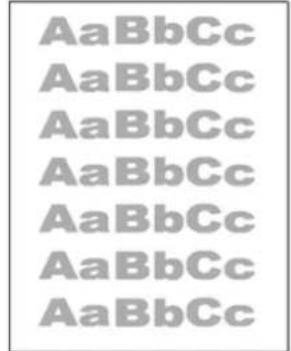 | 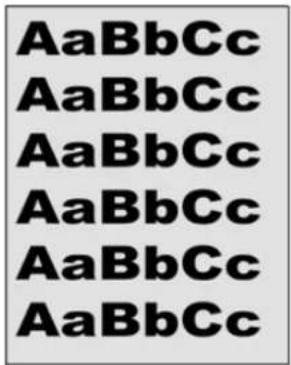 |  |
Table 9-5 Black page on page 221 Table 9-4 Banding defects on page 221 Table 9-13 Streak defects on page 226

natural_image
Three abstract black rectangular panels with white horizontal lines and vertical white lines on a dark background (no text or symbols)
natural_image
Two vertical white lines on a dark background, resembling stylized text or symbols (no readable characters or numbers)Table 9-3 Image defects table quick reference (continued)
| Defect Defect Defect | ||
| Table 9-8 Fixing/fuser defects on page 222 | Table 9-10 Image placement defects on page 224 | Table 9-7 Color plane registrations defects (color models only) on page 222 |
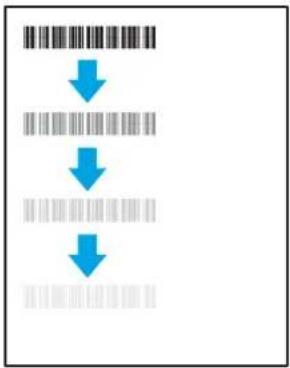 |  |  |
Table 9-12 Output defects on page 225
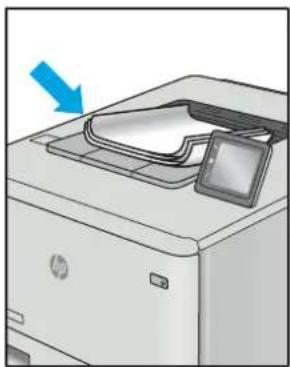
natural_image
Illustration of a printer with a paper lid and arrow indicating compression (no text or symbols)Image defects, no matter the cause, can often be resolved using the same steps. Use the following steps as a starting point for solving image defect issues.
- Reprint the document. Print quality defects can be intermittent in nature or can go away completely with continued printing.
- Check the condition of the cartridge or cartridges. If a cartridge is in a Very Low state (it has passed the rated life), replace the cartridge.
- Make sure that the driver and tray print mode settings match the media that is loaded in the tray. Try using a different ream of media or a different tray. Try using a different print mode.
- Make sure the printer is within the supported operating temperature/humidity range.
- Make sure that the paper type, size, and weight are supported by the printer. See the printer support page at support.hp.com for a list of the supported paper sizes and types for the printer.

NOTE: The term "fusing" refers to the part of the printing process where toner is affixed to paper.
The following examples depict letter-size paper that has passed through the printer with the short edge first.
Table 9-4 Banding defects
| Sample Description Possible solutions | ||
| Dark or light lines which repeat down the length of the page, and are wide-pitch and/or impulse bands. They might be sharp or soft in nature. The defect displays only in areas of fill, not in text or sections with no printed content. | 1. Reprint the document.2. Try printing from another tray.3. Replace the cartridge.4. Use a different paper type.5. Enterprise models only: From the Home screen on the printer control panel, go to the Adjust Paper Types menu, and then choose a print mode that is designed for a slightly heavier media than what you are using. This slows the print speed and might improve the print quality.6. If the issue persists, go tosupport.hp.com. | |
Table 9-5 Black page
| Sample Description Possible solutions | |
| The entire printed page is black. | |
| 1. Visually inspect the cartridge to check for damage. | |
| 2. Make sure that the cartridge is installed correctly. | |
| 3. Replace the cartridge. | |
| 4. If the issue persists, go tosupport.hp.com. | |
Table 9-6 Blank page – No print
| Sample Description Possible solutions | ||
| The page is completely blank and contains no printed content. | 1. Make sure that the cartridges are genuine HP cartridges.2. Make sure that the cartridge is installed correctly.3. Print with a different cartridge.4. Check the paper type in the paper tray and adjust the printer settings to match. If necessary, select a lighter paper type.5. If the issue persists, go tosupport.hp.com. | |
Table 9-7 Color plane registrations defects (color models only)
| Sample Description Possible solutions | ||
 | One or more color plane(s) is not aligned with the other color planes. This registration error will typically occur with yellow. | 1. Reprint the document.2. From the printer control panel, calibrate the printer.3. If a cartridge has reached a Very Low state, or the printed output is severely faded, replace the cartridge.4. From the printer control panel use the Restore Calibration feature to reset the printer's calibration settings to the factory defaults.5. If the issue persists, go to support.hp.com. |
Table 9-8 Fixing/fuser defects
| Sample Description Possible solutions | ||
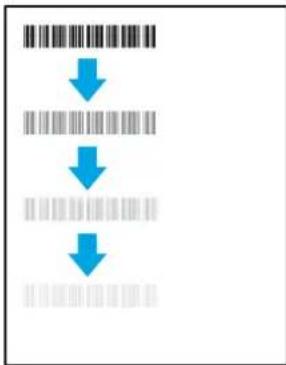 | Slight shadows or offsets of the image are repeated down the page. The repeated image might fade with each recurrence. | 1. Reprint the document.2. Check the paper type in the paper tray and adjust the printer settings to match. If necessary, select a lighter paper type.3. If the issue persists, go tosupport.hp.com. |
Table 9-8 Fixing/fuser defects (continued)
| Sample Description Possible solutions | |
| Toner rubs off along either edge of the page. This defect is more common at the edges of high-coverage jobs, and on light media types, but can occur anywhere on the page. | |
| 1. Reprint the document. | |
| 2. Check the paper type in the paper tray and adjust the printer settings to match. If necessary, select a heavier paper type. | |
| 3. Enterprise models only: From the printer control panel, go to the Edge-to-Edge menu and then select Normal. Reprint the document. | |
| 4. Enterprise models only: From the printer control panel, select Auto Include Margins and then reprint the document. | |
| 5. If the issue persists, go to support.hp.com. | |
Table 9-9 Gray background or dark print
| Sample Description Possible solutions | ||
| The image or text is darker than expected and/or the background is gray. | 1. Make sure that the paper in the trays has not already been run through the printer.2. Use a different paper type.3. Reprint the document.4. Mono models only: From the Home screen on the printer control panel, go to the Adjust Toner Density menu, and then adjust the toner density to a lower level.5. Make sure that the printer is within the supported operating temperature and humidity range.6. Replace the cartridge.7. If the issue persists, go tosupport.hp.com. | |
Table 9-10 Image placement defects
| Sample Description Possible solutions | ||
 | The image is not centered, or is skewed on the page. The defect occurs when the paper is not positioned properly as it is pulled from the tray and moves through the paper path. | 1. Reprint the document.2. Remove the paper and then reload the tray. Make sure that all the paper edges are even on all sides.3. Make sure that the top of the paper stack is below the tray-full indicator. Do not overfill the tray.4. Make sure that the paper guides are adjusted to the correct size for the paper. Do not adjust the paper guides tightly against the paper stack. Adjust them to the indentations or markings in the tray.5. If the issue persists, go tosupport.hp.com. |
Table 9-11 Light print
| Sample Description Possible solutions | ||
| The printed content is light or faded on the entire page. | 1. Reprint the document.2. Remove the cartridge, and then shake it to redistribute the toner. Reinsert the toner cartridges into the printer and close the cover. For a graphical representation of this procedure, seeReplace the toner cartridges.3. Mono models only: Make sure that the EconoMode setting is disabled, both at the printer control panel and in the print driver.4. Make sure that the cartridge is installed correctly.5. Print a Supplies Status Page and check the life and usage of the cartridge.6. Replace the cartridge.7. If the issue persists, go tosupport.hp.com. | |
Table 9-12 Output defects
Sample Description Possible solutions
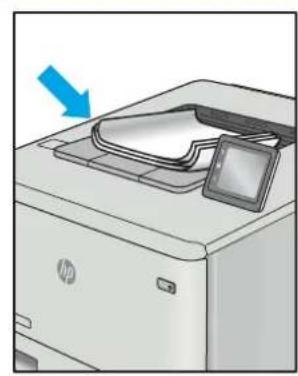
natural_image
Illustration of a HP printer with a paper clip and arrow indicating compression (no text or symbols)Printed pages have curled edges. The curled edge can be along the short or long side of the paper. Two types of curl are possible:
- Positive curl: The paper curls toward the printed side. The defect occurs in dry environments or when printing high-coverage pages.
- Negative curl: The paper curls away from the printed side. The defect occurs in high-humidity environments or when printing low-coverage pages.
-
Reprint the document.
-
Positive curl: From the printer control panel, select a heavier paper type. The heavier paper type creates a higher temperature for printing.
Negative curl: From the printer control panel, select a lighter paper type. The lighter paper type creates a lower temperature for printing. Try storing the paper in a dry environment prior to use, or use freshly opened paper.
-
Print in duplex mode.
-
If the issue persists, go to support.hp.com.
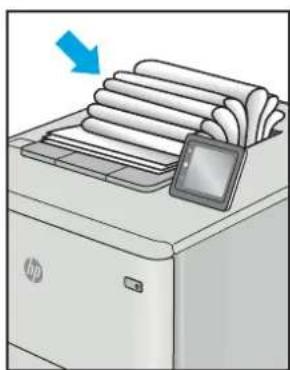
natural_image
Illustration of a HP printer with a scroll stack and a tablet, showing no text or symbols.The paper does not stack well in the output tray. The stack might be uneven, skewed, or the pages might be pushed out of the tray and onto the floor. Any of the following conditions can cause this defect:
• Extreme paper curl
• The paper in the tray is wrinkled or deformed
• The paper is a non-standard paper type, such as envelopes
• The output tray is too full
-
Reprint the document.
-
Extend the output bin extension.
-
If the defect is caused by extreme paper curl, refer to the troubleshooting steps for "Output curl."
-
Use a different paper type.
-
Use freshly opened paper.
-
Remove the paper from the output tray before the tray gets too full.
-
If the issue persists, go to support.hp.com.
Table 9-13 Streak defects
| Sample Description Possible solutions | ||
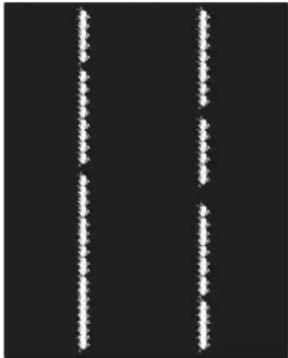 | Light vertical streaks that usually span the length of the page. The defect displays only in areas of fill, not in text or sections with no printed content. | 1. Reprint the document.2. Remove the cartridge, and then shake it to redistribute the toner. Reinsert the toner cartridges into the printer and close the cover. For a graphical representation of this procedure, seeReplace the toner cartridges.3. If the issue persists, go tosupport.hp.com.NOTE: Both light and dark vertical streaks can occur when the printing environment is outside the specified range for temperature or humidity. Refer to your printer's environmental specifications for allowable temperature and humidity levels. |
 | Dark vertical lines which occur down the length of the page. The defect might occur anywhere on the page, in areas of fill or in sections with no printed content. On color models, these lines or streaks will also be visible on the ITB cleaning page. | 1. Reprint the document.2. Remove the cartridge, and then shake it to redistribute the toner. Reinsert the toner cartridges into the printer and close the cover. For a graphical representation of this procedure, seeReplace the toner cartridges.3. Print a cleaning page.4. Check the toner level in the cartridge.5. If the issue persists, go tosupport.hp.com. |
Improve copy image quality
If the printer is having copy quality problems, try the following solutions in the order presented to resolve the issue.
Try these few simple steps first:
- Use the flatbed scanner rather than the document feeder.
- Use high-quality originals.
- When using the document feeder, load the original document into the feeder correctly, using the paper guides, to avoid unclear or skewed images.
If the problem still exists, try these additional solutions. If they do not fix the problem, see "Improve print quality" for further solutions.
Check the scanner glass for dirt and smudges
Learn about solving copy-quality debris problems.
Over time, specks of debris might collect on the scanner glass and document feeder white plastic backing, which might cause print defects. Use the following procedure to clean the scanner if the printed pages have streaks, unwanted lines, black dots, poor print quality, or unclear text.
- Press the power button to turn the printer off, and then disconnect the power cable from the electrical outlet.

- Open the scanner lid.
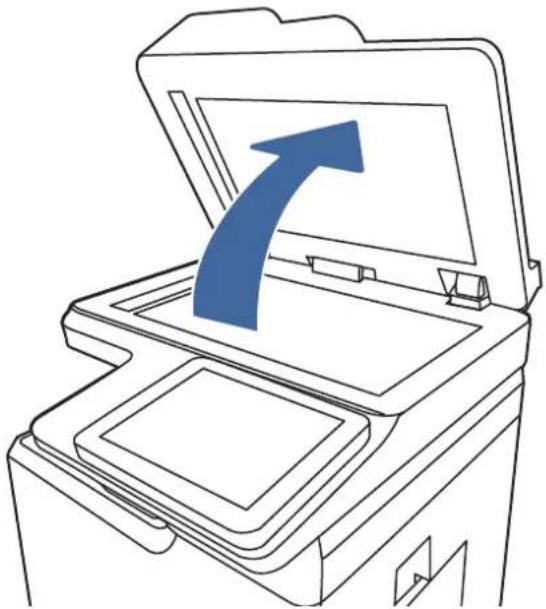
natural_image
Line drawing of an open filing cabinet with a blue upward arrow indicating growth (no text or symbols)- Clean the scanner glass (callout 1) and the document feeder strips (callout 2, callout 3) with a soft cloth or sponge that has been moistened with nonabrasive glass cleaner.
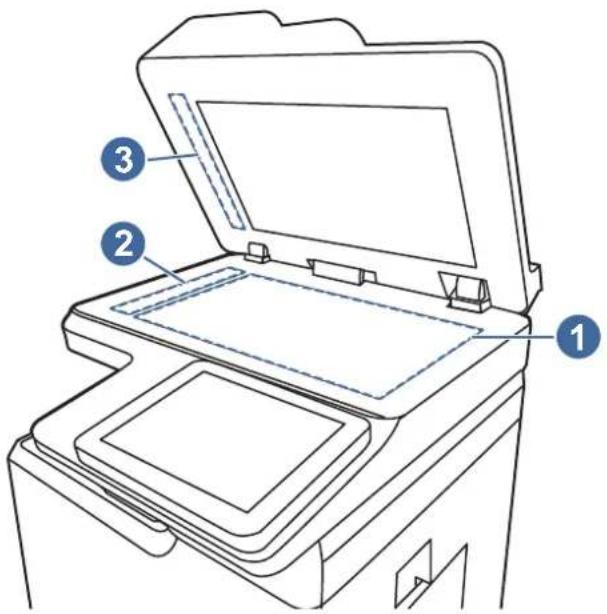
CAUTION: Do not use abrasives, acetone, benzene, ammonia, ethyl alcohol, or carbon tetrachloride on any part of the printer; these can damage the printer. Do not place liquids directly on the glass or platen. They might seep and damage the printer.
NOTE: If you are having trouble with streaks on copies when you are using the document feeder, be sure to clean the small strips of glass on the left side of the scanner (callout 2, callout 3).
-
Dry the glass and white plastic parts with a chamois or a cellulose sponge to prevent spotting.
-
Connect the power cable to an outlet, and then press the power button to turn the printer on.

Calibrate the scanner
Calibration is a process that optimizes scan quality.

NOTE: When using the document feeder, make sure to adjust the guides in the input tray so they are against the original document.
-
From the Home screen on the printer control panel, navigate to the Support Tools application, and then select the Support Tools icon.
-
Open the following menus:
a. Maintenance
b. Calibration/Cleaning
c. Calibrate Scanner
- Touch the Start button to start the calibration process. Follow the on-screen prompts.
- Wait while the printer calibrates, and then try copying again.
Check the paper settings
Follow these steps if copied pages have smears, fuzzy or dark print, curled paper, or areas where pigment has dropped out.
Check the paper selection options
Use the following steps to check the paper selection options.
- From the Home screen on the printer control panel, navigate to the Copy application, and then select the Copy icon.
- Select Options, and then scroll to and select Paper Selection.
- Select Paper size, and then select one of the predefined options.
- Select Paper type, and then select one of the predefined options.
- Select Paper tray, and then select one of the predefined options.
- Select Done to save the paper selection options.
Check the image-adjustment settings
Adjust the settings in the Copy menu to optimize image quality.
- Sharpness: Clarify or soften the image. For example, increasing the sharpness could make text appear crisper, but decreasing it could make photos appear smoother.
- Darkness: Increase or decrease the amount of white and black used in colors in scanned images.
- Contrast: Increase or decrease the difference between the lightest and the darkest color on the page.
- Background Cleanup: Remove faint colors from the background of scanned images. For example, if the original document is printed on colored paper, use this feature to lighten the background without affecting the darkness of the image.
-
Automatic Tone: Available for Flow printers only. The printer automatically adjusts the Darkness, Contrast, and Background Cleanup settings to the most appropriate for the scanned document.
-
From the Home screen on the printer control panel, navigate to the Copy application, and then select the Copy icon.
- Select Options, and then scroll to and select Image Adjustment.
- Adjust the sliders to set the levels, and select Done.
- Select Copy to start the copy job.

NOTE: These settings are temporary. After you have finished the job, the printer returns to the default settings.
Optimize copy quality for text or pictures
Optimize the copy job for the type of image being copied: text, graphics, or photos.
- From the Home screen on the printer control panel, navigate to the Copy application, and then select the Copy icon.
- Select Options, and then select Optimize Text/Picture.
- Select one of the predefined options.
- Select Copy to start the copy job.

NOTE: These settings are temporary. After you have finished the job, the printer returns to the default settings.
Improve scan image quality
Try the following basic solutions to improve scanned image quality.
- Use the flatbed scanner rather than the document feeder.
- Use high-quality originals.
- When using the document feeder, load the original document into the feeder correctly, using the paper guides, to avoid unclear or skewed images.
If the problem still exists, try these additional solutions. If they do not fix the problem, see "Improve print quality" for further solutions.
Check the scanner glass for dirt and smudges
Learn about solving copy-quality debris problems.
Over time, specks of debris might collect on the scanner glass and document feeder white plastic backing, which might cause print defects. Use the following procedure to clean the scanner if the printed pages have streaks, unwanted lines, black dots, poor print quality, or unclear text.
- Press the power button to turn the printer off, and then disconnect the power cable from the electrical outlet.

- Open the scanner lid.
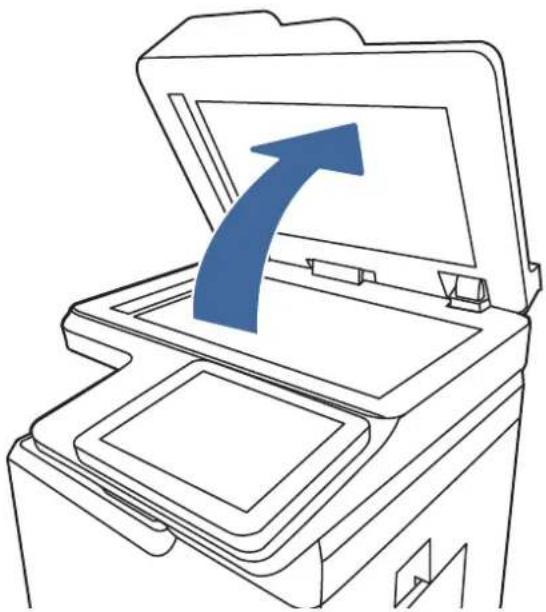
natural_image
Line drawing of an open file organizer with a blue upward arrow indicating growth (no text or symbols)- Clean the scanner glass (callout 1) and the document feeder strips (callout 2, callout 3) with a soft cloth or sponge that has been moistened with nonabrasive glass cleaner.
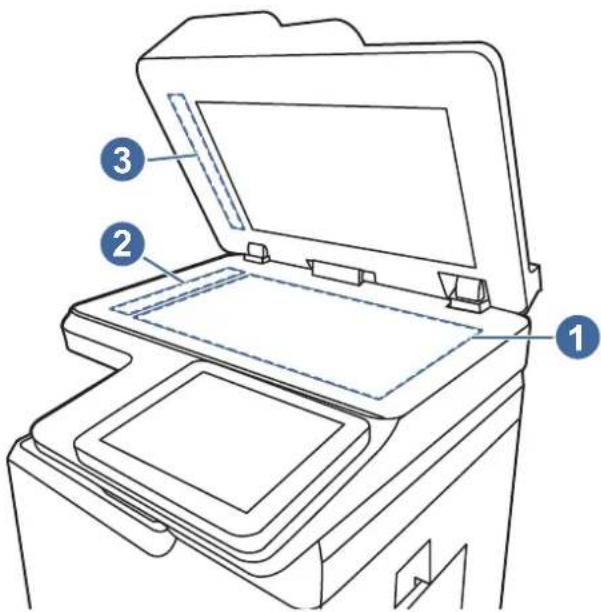
CAUTION: Do not use abrasives, acetone, benzene, ammonia, ethyl alcohol, or carbon tetrachloride on any part of the printer; these can damage the printer. Do not place liquids directly on the glass or platen. They might seep and damage the printer.
NOTE: If you are having trouble with streaks on copies when you are using the document feeder, be sure to clean the small strips of glass on the left side of the scanner (callout 2, callout 3).
-
Dry the glass and white plastic parts with a chamois or a cellulose sponge to prevent spotting.
-
Connect the power cable to an outlet, and then press the power button to turn the printer on.

Check the resolution settings
Follow these steps to adjust the resolution setting. Setting the resolution to a high value increases the file size and the scan time.
- From the Home screen on the printer control panel, navigate to the Scan application, and then select the Scan icon.
-
Select one of the following Scan features:
-
Scan to Email
- Scan to Network Folder
- Scan to USB Drive
-
Scan to SharePoint®
-
Select Options, and then select File Type and Resolution.
- Select one of the predefined Resolution options, and then select Done.
- Select Send or Save to start the scan.
Check the color settings
Follow these steps to adjust the color setting.
- From the Home screen on the printer control panel, navigate to the Scan application, and then select the Scan icon.
-
Select one of the following Scan features:
-
Save to Device Memory
- Scan to Email
- Scan to Network Folder
- Scan to USB
-
Scan to SharePoint ^
-
Touch the Options button.
- In the Options pane, scroll to and select Color/Black.
- Select one of the predefined options.
- Touch the Send button.
Check the image-adjustment settings
Adjust the settings in the Scan menu to optimize image quality.
- Sharpness: Clarify or soften the image. For example, increasing the sharpness could make text appear crisper, but decreasing it could make photos appear smoother.
- Darkness: Increase or decrease the amount of white and black used in colors in scanned images.
- Contrast: Increase or decrease the difference between the lightest and the darkest color on the page.
- Background Cleanup: Remove faint colors from the background of scanned images. For example, if the original document is printed on colored paper, use this feature to lighten the background without affecting the darkness of the image.
-
Automatic Tone: Available for Flow printers only. The printer automatically adjusts the Darkness, Contrast, and Background Cleanup settings to the most appropriate for the scanned document.
-
From the Home screen on the printer control panel, navigate to the Scan application, and then select the Scan icon.
-
Select one of the following Scan features:
-
Scan to Email
- Scan to Network Folder
- Scan to USB Drive
- Scan to Job Storage
-
Scan to SharePoint®
-
Select Options, and then select Image Adjustment.
-
Adjust the sliders to set the levels, and then select Done.
-
Select Send or Save to start the scan.

NOTE: These settings are temporary. After you have finished the job, the printer returns to the default settings.
Optimize scan quality for text or pictures
Optimize the scan job for the type of image being scanned: text, graphics, or photos.
- From the Home screen on the printer control panel, navigate to the Scan application, and then select the Scan icon.
- Select one of the following Scan features:
- Scan to Email
- Scan to Network Folder
- Scan to USB Drive
- Scan to Job Storage
- Scan to SharePoint®
-
Select Options, and then select Optimize Text/Picture.
-
Select one of the predefined options.
- Select Send or Save to start the scan.

NOTE: These settings are temporary. After you have finished the job, the printer returns to the default settings.
Check the output-quality settings
This setting adjusts the level of compression when saving the file. For the highest quality, select the highest setting.
- From the Home screen on the printer control panel, navigate to the Scan application, and then select the Scan icon.
-
Select one of the following Scan features:
-
Scan to Email
- Scan to Network Folder
- Scan to USB Drive
-
Scan to SharePoint ^
-
Select Options, and then select File Type and Resolution.
- Select one of the predefined Quality and File Size options, and then select Done.
- Select Send or Save to start the scan.
Improve fax image quality
If the printer is having fax quality problems, try the following solutions in the order presented to resolve the issue.
Try these few simple steps first:
- Use the flatbed scanner rather than the document feeder.
- Use high-quality originals.
- When using the document feeder, load the original document into the feeder correctly, using the paper guides, to avoid unclear or skewed images.
If the problem still exists, try these additional solutions. If they do not fix the problem, see "Improve print quality" for further solutions.
Check the scanner glass for dirt and smudges
Learn about solving copy-quality debris problems.
Over time, specks of debris might collect on the scanner glass and document feeder white plastic backing, which might cause print defects. Use the following procedure to clean the scanner if the printed pages have streaks, unwanted lines, black dots, poor print quality, or unclear text.
- Press the power button to turn the printer off, and then disconnect the power cable from the electrical outlet.

- Open the scanner lid.
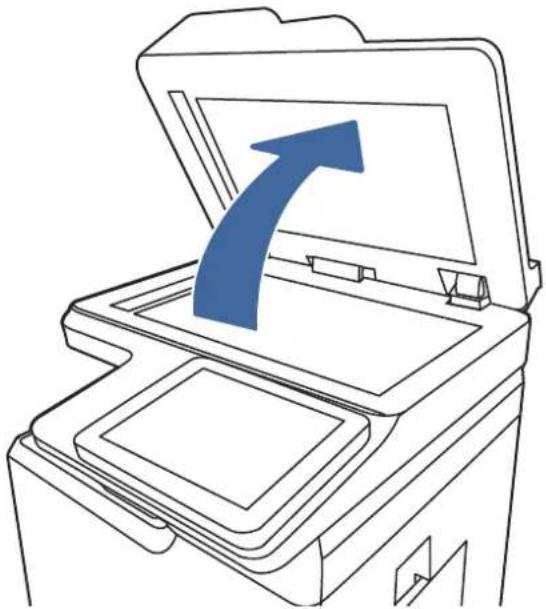
natural_image
Line drawing of an open file organizer with a blue upward arrow indicating growth (no text or symbols)- Clean the scanner glass (callout 1) and the document feeder strips (callout 2, callout 3) with a soft cloth or sponge that has been moistened with nonabrasive glass cleaner.
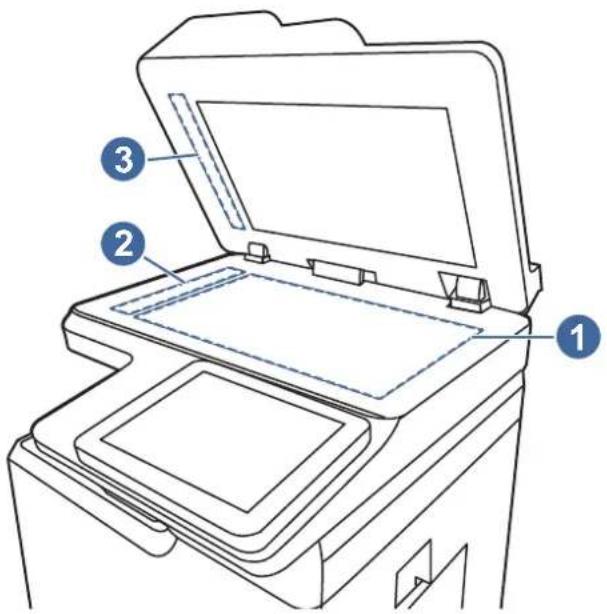
CAUTION: Do not use abrasives, acetone, benzene, ammonia, ethyl alcohol, or carbon tetrachloride on any part of the printer; these can damage the printer. Do not place liquids directly on the glass or platen. They might seep and damage the printer.
NOTE: If you are having trouble with streaks on copies when you are using the document feeder, be sure to clean the small strips of glass on the left side of the scanner (callout 2, callout 3).
-
Dry the glass and white plastic parts with a chamois or a cellulose sponge to prevent spotting.
-
Connect the power cable to an outlet, and then press the power button to turn the printer on.

Check the send-fax resolution settings
Adjust the resolution of outgoing faxes as needed. A higher resolution setting increases the fax size and send time.
- From the Home screen on the printer control panel, navigate to the Fax application, and then select the Fax icon.
- Select Options.
- In the Options pane, scroll to and select Resolution.
- Select one of the predefined options, and then select Send to send the fax.
Check the image-adjustment settings
Adjust the settings in the Fax menu to optimize image quality.
- Sharpness: Clarify or soften the image. For example, increasing the sharpness could make text appear crisper, but decreasing it could make photos appear smoother.
- Darkness: Increase or decrease the amount of white and black used in colors in scanned images.
- Contrast: Increase or decrease the difference between the lightest and the darkest color on the page.
- Background Cleanup: Remove faint colors from the background of scanned images. For example, if the original document is printed on colored paper, use this feature to lighten the background without affecting the darkness of the image.
-
Automatic Tone: Available for Flow printers only. The printer automatically adjusts the Darkness, Contrast, and Background Cleanup settings to the most appropriate for the scanned document.
-
From the Home screen on the printer control panel, navigate to the Fax application, and then select the Fax icon.
- Select Options.
- In the Options pane, scroll to and select Image Adjustment.
- Adjust the sliders to set the levels, and then select Done.
- Select Send to send the fax.

NOTE: These settings are temporary. After you have finished the job, the printer returns to the default settings.
Optimize fax quality for text or pictures
Optimize the fax job for the type of image being scanned: text, graphics, or photos.
- From the Home screen on the printer control panel, navigate to the Fax application, and then select the Fax icon.
- Select Options.
- In the Options pane, scroll to and select Optimize Text/Picture.
- Select one of the predefined options.
- Select Send to send the fax.

NOTE: These settings are temporary. After you have finished the job, the printer returns to the default settings.
Check the error-correction setting
Make sure the Error Correction Mode setting is enabled. This setting can improve image quality.
- From the Home screen on the printer control panel, navigate to the Settings application, and then select the Settings icon.
- Open the following menus:
a. Fax
b. Fax Send Settings
c. General Fax Send Settings
- Select the Error Correction Mode option. Touch the Done button.
Check the fit-to-page setting
If the Fit to Page setting is enabled, and the incoming fax is larger than the default page size, the printer attempts to scale the image to fit the page. If this setting is disabled, larger images split across multiple pages.
- From the Home screen on the printer control panel, navigate to the Settings application, and then select the Settings icon.
- Open the following menus:
a. Fax
b. Fax Receive Settings
c. Default Job Options
d. Fit to Page
- Select the On option to enable the setting, or select the Off option to disable it.
Send to a different fax machine
The problem might be related to fax machine settings or supplies status.
Try sending the fax to a different fax machine. If the fax quality is better, the problem is related to the initial recipient's fax machine settings or supplies status.
Check the sender's fax machine
Try the following to check the sender's fax machine.
Ask the sender to try sending from a different fax machine. If the fax quality is better, the problem is with the sender's fax machine. If a different fax machine is unavailable, ask the sender to consider making the following changes:
- Make sure the original document is on white (not colored) paper.
- Increase the fax resolution, quality level, or contrast settings.
- If possible, send the fax from a computer software program.
Solve wired network problems
Check the following information to resolve wired network issues.
Introduction
Certain types of problems can indicate there is a network communication problem. These problems include the following issues:
Poor physical connection
Check the cable connections.
- Verify that the printer is attached to the correct network port using a cable of the correct length.
- Verify that cable connections are secure.
- Look at the network port connection on the back of the printer, and verify that the amber activity light flashes indicating network traffic, and the green link-status light is continuously lit indicating a network link.
- If the problem continues, try a different cable or port on the hub.
The computer is unable to communicate with the printer
Verify that the printer is communicating with the network and your computer.
- Test network communication by pinging the network.
a. Open a command-line prompt on your computer.
- For Windows, click Start, click Run, type cmd, and then press Enter.
- For macOS, go to Applications, then Utilities, and open Terminal.
b. Type ping followed by the IP address for your printer.
c. If the window displays round-trip times, the network is working.
- If the ping command failed, verify that the network hubs are on, and then verify that the network settings, the printer, and the computer are all configured for the same network (also known as subnet).
- Open the printer properties and click the Ports tab. Verify that the current IP address for the printer is selected. The printer IP address is listed on the printer configuration page.
- If you installed the printer using the HP standard TCP/IP port, select the box labeled Always print to this printer, even if its IP address changes.
- If you installed the printer using a Microsoft standard TCP/IP port, use the printer's hostname instead of the IP address.
- If the IP address is correct, delete the printer and then add it again.
- Reinstall the printer software and driver.
The printer is using incorrect link and duplex settings for the network
HP recommends leaving these settings in automatic mode (the default setting). If you change these settings, you must also change them for your network.
New software programs might be causing compatibility problems
Verify that any new software programs are correctly installed and that they use the correct print driver.
The computer or workstation might be set up incorrectly
An incorrectly configured computer can cause issues with printing.
- Check the network drivers, print drivers, and the network redirection settings.
- Verify that the operating system is configured correctly.
The printer is disabled, or other network settings are incorrect
Check the network settings.
- Review the printer's configuration/networking pages to check the status of the network settings and protocols.
- Reconfigure the network settings if necessary.
Solve wireless network problems
Check the following information to resolve wireless network issues.
Introduction
Use the troubleshooting information to help resolve issues.

NOTE: To determine whether HP NFC, Wi-Fi, BLE, or other wireless printing capabilities are enabled on the printer, print a configuration page from the printer control panel.

NOTE: If you have been experiencing intermittent loss of network connectivity, first update the printer firmware. For instructions on how to update the printer firmware, go to http://support.hp.com, search for your printer, and then search on "update the firmware."
Wireless connectivity checklist
Use the checklist to help resolve wireless connection issues.
- For printers that do not support simultaneous wired and wireless connections, verify that the network cable is not connected.
- Verify that the printer and the wireless router are turned on and have power. Also make sure that the wireless radio in the printer is turned on. (The wireless network indicator is solid when the printer is connected to a wireless network, and blinking when it is searching for a wireless network.)
- Verify that the service set identifier (SSID) is correct:
- For a wireless connection to your network, confirm that your mobile device is connecting to the correct router/access point.
- For a Wi-Fi Direct connection, print a configuration page to determine the printer's SSID.
If you are not sure that the SSID is correct, run the wireless setup again.
- With secured networks, verify that the security information is correct. If the security information is incorrect, run the wireless setup again.
-
If the wireless network is working correctly, try accessing other computers on the wireless network. If the network has Internet access, try connecting to the Internet over a wireless connection.
-
Verify that the encryption method (AES or TKIP) is the same for the printer as it is for the wireless access point (on networks using WPA security).
- Verify that the printer is within the range of the wireless network. For most networks, the printer must be within 30 m (100 ft) of the wireless access point (wireless router).
- Verify that obstacles do not block the wireless signal. Remove any large metal objects between the access point and the printer. Make sure poles, walls, or support columns containing metal or concrete do not separate the printer and wireless access point.
- Verify that the printer is located away from electronic devices that might interfere with the wireless signal. Many devices can interfere with the wireless signal including motors, cordless phones, security system cameras, other wireless networks, and some Bluetooth devices.
- For computers connecting to the wireless printer:
- Verify that the print driver is installed on the computer.
- Verify that you have selected the correct printer port.
- Verify that the computer and printer connect to the same wireless network.
- If your environment has multiple wireless signals and you need the printer to support dual band networks on both 2.4 GHz and 5 GHz, install the HP Jetdirect 2900nw print server accessory.
-For macOS, verify that the wireless router supports Bonjour.
The printer does not print after the wireless configuration completes
Resolve issues between your computer and the printer.
- Make sure that the printer is turned on and in the ready state.
- Turn off any third-party firewalls on your computer.
- Make sure that the wireless network is working correctly.
- Make sure that your computer is working correctly. If necessary, restart the computer.
- Verify that you can open the printer HP Embedded Web Server from a computer on the network.
The printer does not print, and the computer has a third-party firewall installed
Verify that a firewall is not interfering with wireless communication.
- Update the firewall with the most recent update available from the manufacturer.
- If programs request firewall access when you install the printer or try to print, make sure that you allow the programs to run.
- Temporarily turn off the firewall, and then install the wireless printer on the computer. Enable the firewall when you have completed the wireless installation.
The wireless connection does not work after moving the wireless router or printer
Verify that the printer and network settings are correct.
-
Make sure that the router or printer connects to the same network that your computer connects to.
-
Print a configuration page.
- Compare the service set identifier (SSID) on the configuration page to the SSID in the printer configuration for the computer.
- If the numbers are not the same, the devices are not connecting to the same network. Reconfigure the wireless setup for the printer.
Cannot connect more computers to the wireless printer
Complete the following steps to solve connection issues.
- Make sure that the other computers are within the wireless range and that no obstacles block the signal. For most networks, the wireless range is within 30 m (100 ft) of the wireless access point.
- Make sure that the printer is turned on and in the ready state.
- Make sure there are not more than 5 concurrent Wireless Print Direct users.
- Turn off any third-party firewalls on your computer.
- Make sure that the wireless network is working correctly.
- Make sure that your computer is working correctly. If necessary, restart the computer.
The wireless printer loses communication when connected to a VPN
Typically, you cannot connect to a VPN and other networks at the same time.
The network does not appear in the wireless networks list
Follow these steps when the network does not appear in the wireless network list on your computer or mobile device.
- Make sure the wireless router is turned on and has power.
- The network might be hidden. However, you can still connect to a hidden network. Make sure the router/access point is advertising the SSID by checking for its SSID in the available networks seen by your mobile device.
The wireless network is not functioning
Complete the following steps to ensure that the network is functioning correctly.
- For printers that do not support simultaneous wired and wireless connections, make sure that the network cable is disconnected.
- To verify if the network has lost communication, try connecting other devices to the network.
- Test network communication by pinging the network.
a. Open a command-line prompt on your computer.
- For Windows, click Start, click Run, type cmd, and then press Enter.
- For macOS, go to Applications, then Utilities, and open Terminal.
b. Type ping followed by the router IP address.
c. If the window displays round-trip times, the network is working.
- Make sure that the router or printer connects to the same network that the computer connects to.
a. Print a configuration page.
b. Compare the service set identifier (SSID) on the configuration report to the SSID in the printer configuration for the computer.
c. If the numbers are not the same, the devices are not connecting to the same network. Reconfigure the wireless setup for the printer.
Reduce interference on a wireless network
The following tips can reduce interference in a wireless network:
- Keep the wireless devices away from large metal objects, such as filing cabinets, and other electromagnetic devices, such as microwaves and cordless telephones. These objects can disrupt radio signals.
- Keep the wireless devices away from large masonry structures and other building structures. These objects can absorb radio waves and lower signal strength.
- Position the wireless router in a central location in line of sight with the wireless printers on the network.
Solve fax problems
Use the following sections to solve issues involving the printer fax functions.
Checklist for solving fax problems
Use the following checklist to help identify the cause of any fax-related problems you encounter:
- Are you using the fax cable supplied with the fax accessory? This fax accessory has been tested with the supplied fax cable to meet RJ11 and functional specifications. Do not substitute another fax cable; the analog-fax accessory requires an analog-fax cable. It also requires an analog phone connection.
- Is the fax/phone line connector seated in the outlet on the fax accessory? Make sure that the phone jack is correctly seated in the outlet. Insert the connector into the outlet until it "clicks."

NOTE: Verify that the phone jack is connected to the fax port rather than to the network port. The ports are similar.
- Is the phone wall jack working properly? Verify that a dial tone exists by attaching a phone to the wall jack. Can you hear a dial tone, and can you make or receive a phone call?
What type of phone line are you using?
Verify the type of phone line you are using, and review the recommendations for that type of line.
• Dedicated line: A standard analog fax/phone line assigned to receive or send faxes.

NOTE: The phone line should be for printer fax use only and not shared with other types of telephone devices. Examples include alarm systems that use the phone line for notifications to a monitoring company.
- PBX system: A business-environment phone system. Standard home phones and the fax accessory use an analog phone signal. Some PBX systems are digital and might not be compatible with the fax accessory. You might need an interfacing Analog Telephone Adapter (ATA) to connect the fax machine to digital PBX systems.
- Roll-over lines: A phone system feature where a new call "rolls over" to the next available line when the first incoming line is busy. Try attaching the printer to the first incoming phone line. The fax accessory answers the phone after it rings the number of times set in the rings-to-answer setting.
Are you using a surge-protection device?
A surge-protection device can be used between the wall jack and the fax accessory to protect the fax accessory against electrical power passed through the phone lines. These devices can cause some fax communication problems by degrading the quality of the phone signal.
If you are having problems sending or receiving faxes and are using one of these devices, connect the printer directly to the phone jack on the wall to determine whether the problem is with the surge-protection device.
Are you using a phone company voice-messaging service or an answering machine?
If the rings-to-answer setting for the messaging service is lower than the rings-to-answer setting for the fax accessory, the messaging service answers the call, and the fax accessory cannot receive faxes.
If the rings-to-answer setting for the fax accessory is lower than that of the messaging service, the fax accessory answers all calls.
Does your phone line have a call-waiting feature?
If the fax telephone line has an activated call-waiting feature, a call-waiting notice can interrupt a fax call in progress, which causes a communication error.
Ensure that a call-waiting feature is not active on the fax telephone line.
Check fax accessory status
If the analog-fax accessory does not appear to be functioning, print a Configuration Page report to check the status.
- From the Home screen, scroll to and select Reports.
- Open the following menus:
a. Configuration/Status Pages
b. Configuration Page
- Touch the Print button to print the report, or touch the View button to view the report on the screen. The report consists of several pages.

NOTE: The printer IP address or host name is listed on the Jetdirect Page.
- On the Fax Accessory Page of the Configuration Page, under the Hardware Information heading, check the Modem Status. The following table identifies the status conditions and possible solutions.

NOTE: If the Fax Accessory Page does not print, there might be a problem with the analog fax accessory. If you are using LAN fax or Internet fax, those configurations could be disabling the feature.
Table 9-14 Analog-fax accessory troubleshooting
| Status conditions Possible solutions | |
| Operational / Enabled ^1 | The analog-fax accessory is installed and ready. |
| Operational / Disabled ^1 | The fax accessory is installed, but you have not configured the required fax settings yet.The fax accessory is installed and operational; however, the HP Digital Sending utility has either disabled the printer fax feature or has enabled LAN fax. When LAN fax is enabled, the analog-fax feature is disabled. Only one fax feature, either LAN fax or analog fax, can be enabled at a time.NOTE: If LAN fax is enabled, theScan to Faxfeature is unavailable on the printer control panel. |
| Non-Operational / Enabled/Disabled ^1 | The printer has detected a firmware failure. Upgrade the firmware. |
| Damaged / Enabled/Disabled ^1 | The fax accessory has failed. Reseat the fax accessory card and check for bent pins. If the status is still DAMAGED, replace the analog-fax accessory card. |
1 ENABLED indicates that the analog-fax accessory is enabled and turned on; DISABLED indicates that LAN fax is enabled (analog fax is turned off).
General fax problems
Learn about solutions for common fax problems.
The fax failed to send
Verify the fax issue, and try the suggested solution.
JBIG is enabled, and the receiving fax machine does not have JBIG capability.
Turn off the JBIG setting.
No fax address book button displays
Verify the fax issue, and try the suggested solution.
None of the contacts in the selected contacts list have fax information associated with them. Add the necessary fax information.
Not able to locate the Fax settings in HP Web Jetadmin
Verify the fax issue, and try the suggested solution.
Fax settings in HP Web Jetadmin are located under the device's status page drop-down menu.
Select Digital Sending and Fax from the drop-down menu.
The header is appended to the top of the page when the overlay option is enabled
This fax issue is a normal part of operation.
For all forwarded faxes, the printer appends the overlay header to the top of a page.
This is normal operation.
A mix of names and numbers is in the recipients box
This fax issue is a normal part of operation.
Names and numbers can both display, depending on where they are from. The fax address book lists names, and all other databases list numbers.
This is normal operation.
A one-page fax prints as two pages
Verify the fax issue, and try the suggested solution.
The fax header is being appended to the top of the fax, pushing text to a second page.
To print a one page fax on a single page, set the overlay header to overlay mode, or adjust the fit-to-page setting.
A document stops in the document feeder in the middle of faxing
Verify the fax issue, and try the suggested solution.
A jam is in the document feeder.
Clear the jam, and send the fax again.
The volume for sounds coming from the fax accessory is too high or too low
Verify the fax issue, and try the suggested solution.
The volume setting needs to be adjusted.
Adjust the volume in the Fax Send Settings menu and the Fax Receive Settings menu.
Service and supportA
HP limited warranty statement
HP PRODUCT DURATION OF LIMITED WARRANTY*
HP Color LaserJet Enterprise MFP 6800, 6801, HP Color LaserJet Enterprise Flow MFP 6800, 6801 One-year, next-business day, onsite warranty

NOTE: *Warranty and support options vary by product, country, and local legal requirements. Go to support.hp.com to learn about HP award-winning service and support options in your region.
HP warrants to you, the end-user customer, this HP Limited Warranty applies only to HP branded products sold or leased a) from HP Inc., its subsidiaries, affiliates, authorized resellers, authorized distributors, or country distributors; and, b) with this HP Limited Warranty, that HP hardware and accessories will be free from defects in materials and workmanship after the date of purchase, for the period specified above. If HP receives notice of such defects during the warranty period, HP will, at its option, either repair or replace products which prove to be defective. Replacement products may be either new or equivalent in performance to new.
HP warrants to you that HP software will not fail to execute its programming instructions after the date of purchase, for the period specified above, due to defects in material and workmanship when properly installed and used. If HP receives notice of such defects during the warranty period, HP will replace software which does not execute its programming instructions due to such defects.
HP does not warrant that the operation of HP products will be uninterrupted or error free. If HP is unable, within a reasonable time, to repair or replace any product to a condition as warranted, you will be entitled to a refund of the purchase price upon prompt return of the product.
HP products may contain remanufactured parts equivalent to new in performance or may have been subject to incidental use.
Warranty does not apply to defects resulting from (a) improper or inadequate maintenance or calibration, (b) software, interfacing, parts or supplies not supplied by HP, (c) unauthorized modification or misuse, (d) operation outside of the published environmental specifications for the product, or (e) improper site preparation or maintenance.
TO THE EXTENT ALLOWED BY LOCAL LAW, THE ABOVE WARRANTIES ARE EXCLUSIVE AND NO OTHER WARRANTY OR CONDITION, WHETHER WRITTEN OR ORAL, IS EXPRESSED OR IMPLIED AND HP SPECIFICALLY DISCLAIMS ANY IMPLIED WARRANTIES OR CONDITIONS OF MERCHANTABILITY, SATISFACTORY QUALITY, AND FITNESS FOR A PARTICULAR PURPOSE. Some countries/regions, states or provinces do not allow limitations on the duration of an implied warranty, so the above limitation or exclusion might not apply to you. This warranty gives you specific legal rights and you might also have other rights that vary from country/region to country/region, state to state, or province to province.
HP's limited warranty is valid in any country/region or locality where HP has a support presence for this product and where HP has marketed this product. The level of warranty service you receive may vary according to local standards. HP will not alter form, fit or function of the product to make it operate in a country/region for which it was never intended to function for legal or regulatory reasons.
TO THE EXTENT ALLOWED BY LOCAL LAW, THE REMEDIES IN THIS WARRANTY STATEMENT ARE YOUR SOLE AND EXCLUSIVE REMEDIES. EXCEPT AS INDICATED ABOVE, IN NO EVENT WILL HP OR ITS SUPPLIERS BE LIABLE FOR LOSS OF DATA OR FOR DIRECT, SPECIAL, INCIDENTAL, CONSEQUENTIAL (INCLUDING LOST PROFIT OR DATA), OR OTHER DAMAGE, WHETHER BASED IN CONTRACT, TORT, OR OTHERWISE. Some countries/regions, states or provinces do not allow the exclusion or limitation of incidental or consequential damages, so the above limitation or exclusion may not apply to you.
THE WARRANTY TERMS CONTAINED IN THIS STATEMENT, EXCEPT TO THE EXTENT LAWFULLY PERMITTED, DO NOT EXCLUDE, RESTRICT OR MODIFY AND ARE IN ADDITION TO THE MANDATORY STATUTORY RIGHTS APPLICABLE TO THE SALE OF THIS PRODUCT TO YOU.
UK, Ireland, and Malta
The HP Limited Warranty is a commercial guarantee voluntarily provided by HP. The name and address of the HP entity responsible for the performance of the HP Limited Warranty in your country/region is as follows:
UK: HP Inc UK Limited, Cain Road, Amen Corner, Bracknell, Berkshire, RG12 1HN
Ireland: Hewlett-Packard Ireland Limited, Liffey Park Technology Campus, Barnhall Road, Leixlip, Co.Kildare
Malta: Hewlett-Packard Europe B.V., Amsterdam, Meyrin Branch, Route du Nant-d'Avril 150, 1217 Meyrin, Switzerland
United Kingdom: The HP Limited Warranty benefits apply in addition to any legal rights to a guarantee from seller of nonconformity of goods with the contract of sale. These rights expire six years from delivery of goods for products purchased in England or Wales and five years from delivery of goods for products purchased in Scotland. However various factors may impact your eligibility to receive these rights. For further information, please consult the following link: Consumer Legal Guarantee (www.hp.com/go/eu-legal) or you may visit the European Consumer Centers website (http://ec.europa.eu/consumers/solving_consumer_disputes/non-judicial_redress/ecc-net/index_en.htm). Consumers have the right to choose whether to claim service under the HP Limited Warranty or against the seller under the legal guarantee.
Ireland: The HP Limited Warranty benefits apply in addition to any statutory rights from seller in relation to nonconformity of goods with the contract of sale. However various factors may impact your eligibility to receive these rights. Consumer statutory rights are not limited or affected in any manner by HP Care Pack. For further information, please consult the following link: Consumer Legal Guarantee (www.hp.com/go/eu-legal) or you may visit the European Consumer Centers website (http://ec.europa.eu/consumers/solving_consumer_disputes/non-judicial_redress/ecc-net/index_en.htm). Consumers have the right to choose whether to claim service under the HP Limited Warranty or against the seller under the legal guarantee.
Malta: The HP Limited Warranty benefits apply in addition to any legal rights to a two-year guarantee from seller of nonconformity of goods with the contract of sale; however various factors may impact your eligibility to receive these rights. Consumer statutory rights are not limited or affected in any manner by the HP Limited Warranty. For further information, please consult the following link: Consumer Legal Guarantee (www.hp.com/go/eu-legal) or you may visit the European Consumer Centers website (http://ec.europa.eu/consumers/solving_consumer_disputes/non-judicial_redress/ecc-net/index_en.htm). Consumers have the right to choose whether to claim service under the HP Limited Warranty or against the seller under two-year legal guarantee.
Austria, Belgium, Germany, and Luxemburg
Belgium, France, and Luxemburg
România: HP Inc Romania SRL, 5 Fabrica de Glucoza Str., Building F, Ground Floor and Floor 8, 2nd District, Bucureşti
Belgium and the Netherlands
Slovenija: Hewlett-Packard Europe B.V., Amsterdam, Meyrin Branch, Route du Nant-d'Avril 150, 1217 Meyrin, Switzerland
HP's Premium Protection Warranty: LaserJet toner cartridge limited warranty statement
This HP product is warranted to be free from defects in materials and workmanship.
This warranty does not apply to products that (a) have been refilled, refurbished, remanufactured or tampered with in any way, (b) experience problems resulting from misuse, improper storage, or operation outside of the published environmental specifications for the printer product or (c) exhibit wear from ordinary use.
To obtain warranty service, please return the product to place of purchase (with a written description of the problem and print samples) or contact HP customer support. At HP's option, HP will either replace products that prove to be defective or refund your purchase price.
TO THE EXTENT ALLOWED BY LOCAL LAW, THE ABOVE WARRANTY IS EXCLUSIVE AND NO OTHER WARRANTY OR CONDITION, WHETHER WRITTEN OR ORAL, IS EXPRESSED OR IMPLIED AND HP SPECIFICALLY DISCLAIMS ANY IMPLIED WARRANTIES OR CONDITIONS OF MERCHANTABILITY, SATISFACTORY QUALITY, AND FITNESS FOR A PARTICULAR PURPOSE.
TO THE EXTENT ALLOWED BY LOCAL LAW, IN NO EVENT WILL HP OR ITS SUPPLIERS BE LIABLE FOR DIRECT, SPECIAL, INCIDENTAL, CONSEQUENTIAL (INCLUDING LOST PROFIT OR DATA), OR OTHER DAMAGE, WHETHER BASED IN CONTRACT, TORT, OR OTHERWISE.
THE WARRANTY TERMS CONTAINED IN THIS STATEMENT, EXCEPT TO THE EXTENT LAWFULLY PERMITTED, DO NOT EXCLUDE, RESTRICT OR MODIFY AND ARE IN ADDITION TO THE MANDATORY STATUTORY RIGHTS APPLICABLE TO THE SALE OF THIS PRODUCT TO YOU.
Long life consumable and maintenance kit limited warranty statement
This HP product is warranted to be free from defects in materials and workmanship until the earlier of a) the printer providing a low-life indicator on the control panel, or b) the expiration of the warranty period. Replacement Preventative Maintenance kits or LLCs products carry a 90 day parts only limited warranty, from the last purchase date.
This warranty does not apply to products that (a) have been refurbished, remanufactured or tampered with in any way, (b) experience problems resulting from misuse, improper storage, or operation outside of the published environmental specifications for the printer product or (c) exhibit wear from ordinary use.
To obtain warranty service, please return the product to place of purchase (with a written description of the problem) or contact HP customer support. At HP's option, HP will either replace products that prove to be defective or refund your purchase price.
TO THE EXTENT ALLOWED BY LOCAL LAW, THE ABOVE WARRANTY IS EXCLUSIVE AND NO OTHER WARRANTY OR CONDITION, WHETHER WRITTEN OR ORAL, IS EXPRESSED OR IMPLIED.
HP SPECIFICALLY DISCLAIMS ANY IMPLIED WARRANTIES OR CONDITIONS OF MERCHANTABILITY, SATISFACTORY QUALITY, AND FITNESS FOR A PARTICULAR PURPOSE.
TO THE EXTENT ALLOWED BY LOCAL LAW, IN NO EVENT WILL HP OR ITS SUPPLIERS BE LIABLE FOR DIRECT, SPECIAL, INCIDENTAL, CONSEQUENTIAL (INCLUDING LOST PROFIT OR DATA), OR OTHER DAMAGE, WHETHER BASED IN CONTRACT, TORT, OR OTHERWISE.
THE WARRANTY TERMS CONTAINED IN THIS STATEMENT, EXCEPT TO THE EXTENT LAWFULLY PERMITTED, DO NOT EXCLUDE, RESTRICT OR MODIFY AND ARE IN ADDITION TO THE MANDATORY STATUTORY RIGHTS APPLICABLE TO THE SALE OF THE PRODUCT TO YOU.
HP policy on non-HP supplies
HP cannot recommend the use of non-HP toner cartridges, either new or remanufactured.

NOTE: For HP printer products, the use of a non-HP toner cartridge or a refilled toner cartridge does not affect either the warranty to the customer or any HP support contract with the customer. However, if product failure or damage is attributable to the use of a non-HP toner cartridge or refilled toner cartridge, HP will charge its standard time and materials charges to service the product for the particular failure or damage.
HP anticounterfeit Web site
Go to www.hp.com/go/anticounterfeit when you install an HP cartridge and the control-panel message indicates the cartridge is non-HP. HP will help determine if the cartridge is genuine and take steps to resolve the problem.
Your cartridge might not be a genuine HP cartridge if you notice the following:
- The supplies status page indicates that a non-HP supply is installed.
- You are experiencing a high number of problems with the cartridge.
- The cartridge does not look like it usually does (for example, the packaging differs from HP packaging).
Data stored on the toner cartridge
The HP toner cartridges used with this product contain a memory chip that assists in the operation of the product.
In addition, this memory chip collects a limited set of information about the usage of the product, which might include the following: the date when the toner cartridge was first installed, the date when the toner cartridge was last used, the number of pages printed using the toner cartridge, the page coverage, the printing modes used, any printing errors that might have occurred, and the product model. This information helps HP design future products to meet our customers' printing needs.
The data collected from the toner cartridge memory chip does not contain information that can be used to identify a customer or user of the toner cartridge or their product.
HP collects a sampling of the memory chips from toner cartridges returned to HP's free return and recycling program (HP Planet Partners: www.hp.com/hprecycle). The memory chips from this sampling are read and studied in order to improve future HP products. HP partners who assist in recycling this toner cartridge might have access to this data, as well.
Any third party possessing the toner cartridge might have access to the anonymous information on the memory chip.
End User License Agreement
READ CAREFULLY BEFORE USING THIS SOFTWARE EQUIPMENT: This End-User License Agreement ("EULA") is a legal agreement between (a) you (either an individual or a single entity) and (b) HP Inc. ("HP") that governs your use of the Sign-In Once application installed on or made available by HP for use with your printing device (the "Software").
An amendment or addendum to this EULA may accompany the HP Product.
RIGHTS IN THE SOFTWARE ARE OFFERED ONLY ON THE CONDITION THAT YOU AGREE TO ALL TERMS AND CONDITIONS OF THIS EULA. BY INSTALLING, COPYING, DOWNLOADING, OR OTHERWISE USING THE SOFTWARE, YOU AGREE TO BE BOUND BY THE TERMS OF THIS EULA. IF YOU DO NOT ACCEPT THESE LICENSE TERMS, YOUR SOLE REMEDY IS TO IMMEDIATELY STOP USING SOFTWARE AND TO UNINSTALL THE PRODUCT FROM YOUR DEVICE.
THIS EULA IS A GLOBAL AGREEMENT AND IS NOT SPECIFIC TO ANY PARTICULAR COUNTRY, STATE OR TERRITORY. IF YOU ACQUIRED THE SOFTWARE AS A CONSUMER WITHIN THE MEANING OF RELEVANT CONSUMER LEGISLATION IN YOUR COUNTRY, STATE OR TERRITORY, THEN DESPITE ANYTHING TO THE CONTRARY IN THIS EULA, NOTHING IN THIS EULA AFFECTS ANY NON EXCLUDING STATUTORY RIGHTS OR REMEDIES THAT YOU MAY HAVE UNDER SUCH CONSUMER LEGISLATION AND THIS EULA IS SUBJECT TO THOSE RIGHTS AND REMEDIES. REFER TO SECTION 17 FOR FURTHER INFORMATION ON YOUR CONSUMER RIGHTS.
- GRANT OF LICENSE. HP grants you the following rights provided you comply with all terms and conditions of this EULA. In the case you are representing an entity or organization, the same terms and conditions in this Section 1 shall also apply with respect to the use, copying, and storage of the Software on the devices of your respective entity or organization.
a. Use. You may use one copy of the Software on your device for the purpose of accessing and using the Software. You may not separate component parts of the Software for use on more than one device. You do not have the right to distribute the Software, nor do you have the right to modify the Software or disable any licensing or control feature of the Software. You may load the Software into the temporary memory (RAM) of your device for purposes of using the Software.
b. Storage. You may copy the Software into the local memory or storage device of your device.
c. Copying. You may make archival or back-up copies of the Software, provided the copy contains all of the original Software's proprietary notices and that it is used only for back-up purposes.
d. Reservation of Rights. HP and its suppliers reserve all rights not expressly granted to you in this EULA.
e. Freeware. Notwithstanding the terms and conditions of this EULA, all or any portion of the Software which constitutes non-proprietary HP software or software provided under public license by third parties ("Freeware"), is licensed to you subject to the terms and conditions of the software license agreement or other documentation accompanying such Freeware at the time of download, installation, or use of the Freeware. Use of the Freeware by you shall be governed entirely by the terms and conditions of such license.
-
UPGRADES. To use Software identified as an upgrade, you must first be licensed for the original Software identified by HP as eligible for the upgrade. After upgrading, you may no longer use the original Software Product that formed the basis for your upgrade eligibility.
-
ADDITIONAL SOFTWARE. This EULA applies to updates or supplements to the original Software provided by HP unless HP provides other terms along with the update or supplement. In case of a conflict between such terms, the other terms will prevail.
4. TRANSFER.
a. Third Party. The initial user of the Software may make a one-time transfer of the Software to another end user. Any transfer must include all component parts, media, printed materials, this EULA, and if applicable, the Certificate of Authenticity. The transfer may not be an indirect transfer, such as a consignment. Prior to the transfer, the end user receiving the transferred product must agree to all the EULA terms. Upon transfer of the Software, your license is automatically terminated.
b. Restrictions. You may not rent, lease or lend the Software or use the Software for commercial timesharing or bureau use. You may not sublicense, assign or transfer the license or Software except as expressly provided in this EULA.
-
PROPRIETARY RIGHTS. All intellectual property rights in the Software and user documentation are owned by HP or its suppliers and are protected by law, including but not limited to United States copyright, trade secret, and trademark law, as well as other applicable laws and international treaty provisions. You shall not remove any product identification, copyright notices or proprietary restrictions from the Software.
-
LIMITATION ON REVERSE ENGINEERING. You may not reverse engineer, decompile, or disassemble the Software, except and only to the extent that the right to do so is mandated under applicable law notwithstanding this limitation or it is expressly provided for in this EULA.
-
TERM. This EULA is effective unless terminated or rejected. This EULA will also terminate upon conditions set forth elsewhere in this EULA or if you fail to comply with any term or condition of this EULA.
8. ACCOUNT SET-UP.
a. You must register and establish an account on HP ID in order to use the Software. It is your responsibility to obtain and maintain all equipment, services and software needed for access to and use of the HP ID account, any applications linked via this Software, and your device(s), as well as paying any applicable charges.
b. YOU ARE SOLELY AND FULLY RESPONSIBLE FOR MAINTAINING THE CONFIDENTIALITY OF ANY USERNAMES AND PASSWORDS COLLECTED BY THE SOFTWARE. You must notify HP immediately of any unauthorized use of your HP ID account or any other breach of security related to this Software or the device(s) it is installed on.
-
NOTICE OF DATA COLLECTION. HP may collect usernames, passwords, device IP addresses, and/or other authentication information used by you to access HP ID and the various applications connected via this Software. HP may use this data to optimize Software performance based on user preferences, provide support and maintenance, and assure security and software integrity. You can read more about the data collection in the sections titled "What Data We Collect" and "How We Use Data" in the HP Privacy Statement.
-
DISCLAIMER OF WARRANTIES. TO THE MAXIMUM EXTENT PERMITTED BY APPLICABLE LAW, HP AND ITS SUPPLIERS PROVIDE THE SOFTWARE "AS IS" AND WITH ALL FAULTS, AND HEREBY DISCLAIM ALL OTHER WARRANTIES, DUTIES, AND CONDITIONS, EITHER EXPRESS, IMPLIED, OR STATUTORY, INCLUDING, BUT NOT LIMITED TO, WARRANTIES: (i) OF TITLE AND NON-INFRINGEMENT; (ii) OF MERCHANTABILITY; (iii) OF FITNESS FOR A PARTICULAR PURPOSE; (iv) THAT THE SOFTWARE WILL FUNCTION WITH NON-HP SUPPLIES OR ACCESSORIES; AND (v), OF LACK OF VIRUSES ALL WITH REGARD TO THE SOFTWARE. Some states/jurisdictions do not allow exclusion of implied warranties or limitations on the duration of implied warranties, so the above disclaimer may not apply to you in its entirety.
- LIMITATION OF LIABILITY. Subject to local law, notwithstanding any damages that you might incur, the entire liability of HP and any of its suppliers under any provision of this EULA and your exclusive remedy for all of the foregoing shall be limited to the greater of the amount actually paid by you separately for the Software or U.S. \$5.00. TO THE MAXIMUM EXTENT PERMITTED BY APPLICABLE LAW, IN NO EVENT SHALL HP OR ITS SUPPLIERS BE LIABLE FOR ANY SPECIAL, INCIDENTAL, INDIRECT, OR CONSEQUENTIAL DAMAGES WHATSOEVER (INCLUDING, BUT NOT LIMITED TO, DAMAGES FOR LOSS OF PROFITS OR CONFIDENTIAL OR OTHER INFORMATION, FOR BUSINESS INTERRUPTION, FOR PERSONAL INJURY, OR FOR LOSS OF PRIVACY) ARISING OUT OF OR IN ANY WAY RELATED TO THE USE OF OR INABILITY TO USE THE SOFTWARE, OR OTHERWISE IN CONNECTION WITH ANY PROVISION OF THIS EULA, EVEN IF HP OR ANY SUPPLIER HAS BEEN ADVISED OF THE POSSIBILITY OF SUCH DAMAGES AND EVEN IF THE REMEDY FAILS OF ITS ESSENTIAL PURPOSE. Some states/jurisdictions do not allow the exclusion or limitation of incidental or consequential damages, so the above limitation or exclusion may not apply to you.
- U.S. GOVERNMENT CUSTOMERS. Consistent with FAR 12.211 and 12.212, Commercial Computer Software, Computer Software Documentation, and Technical Data for Commercial Items are licensed to the U.S. Government under HP's standard commercial license.
- COMPLIANCE WITH EXPORT LAWS. You shall comply with all laws and regulations of the United States and other countries ("Export Laws") to assure that the Software is not (1) exported, directly or indirectly, in violation of Export Laws, or (2) used for any purpose prohibited by Export Laws, including, without limitation, nuclear, chemical, or biological weapons proliferation.
- CAPACITY AND AUTHORITY TO CONTRACT. You represent that you are of the legal age of majority in your state of residence and, if applicable, you are duly authorized by your employer to enter into this contract.
- APPLICABLE LAW. This EULA is governed by the laws of the State of California, U.S.A.
- ENTIRE AGREEMENT. Unless you have entered into a separate license agreement for the Software, this EULA (including any addendum or amendment to this EULA which is included with the HP Product) is the entire agreement between you and HP relating to the Software and it supersedes all prior or contemporaneous oral or written communications, proposals and representations with respect to the Software or any other subject matter covered by this EULA. To the extent the terms of any HP policies or programs for support services conflict with the terms of this EULA, the terms of this EULA shall control.
- CONSUMER RIGHTS. Consumers in some countries, states or territories may have the benefit of certain statutory rights and remedies under consumer legislation in respect of which HP's liability cannot lawfully be excluded or limited. If you acquired the Software as a consumer within the meaning of relevant consumer legislation in your country, state or territory, the provisions of this EULA (including the disclaimers of warranties, limitations and exclusions of liability) must be read subject to applicable law and apply only to the maximum extent permitted by that applicable law.
Australian Consumers: If you acquired the Software as a consumer within the meaning of the ‘Australian Consumer Law’ under the Australian Competition and Consumer Act 2010 (Cth) then despite any other provision of this EULA:
a. the Software comes with guarantees that cannot be excluded under the Australian Consumer Law, including that goods will be of acceptable quality and services will be supplied with due care and skill. You are entitled to a replacement or refund for a major failure and compensation for any other reasonably foreseeable loss or damage. You are also entitled to have the Software repaired or replaced if it is not of acceptable quality and the failure does not amount to a major failure
b. nothing in this EULA excludes, restricts or modifies any right or remedy, or any guarantee, warranty or other term or condition implied or imposed by the Australian Consumer Law which cannot be lawfully excluded or limited; and
c. the benefits provided to you by the express warranties in this EULA are in addition to other rights and remedies available to you under the Australian Consumer Law. Your rights under the Australian Consumer Law prevail to the extent that they are inconsistent with any limitations contained in the express warranty.
The Software may be capable of retaining user-generated data. HP hereby provides you with notice that if HP repairs your Software, that repair may result in the loss of that data. To the full extent permitted by law, the limitations and exclusions of HP's liability in this EULA apply in respect of any such loss of data.
If you think that you are entitled to any warranty under this agreement or any of the above remedies, please contact HP:
Table A-1
| HP PPS Australia Pty Ltd | |
| Building F, 1 Homebush Bay Drive | |
| Rhodes, NSW 2138 | |
| Australia |
To initiate a support request or warranty claim, please call 13 10 47 (within Australia) or +61 2 8278 1039 (if dialing internationally) or visit www.hp.com.au and select the "Support" tab for the most current customer service options.
If you are a consumer within the meaning of the Australia Consumer Law and you are purchasing the Software or warranty and support services for the Software which are not of a kind ordinarily acquired for personal, domestic or household use or consumption, then despite any other provision of this EULA, HP limits its liability for failure to comply with a consumer guarantee as follows:
a. provision of warranty or support services for the Software: to any one or more of the following: re-supply of the services or payment of the costs of having the services re-supplied;
b. provision of the Software: to any one or more of the following: replacement of the Software or the supply of equivalent software; repair of the Software; payment of the costs of replacing the Software or of acquiring equivalent software; or payment of the costs of having the Software repaired; and
c. otherwise, to the maximum extent permitted by law.
New Zealand Consumers: In New Zealand, the Software comes with guarantees that cannot be excluded under the Consumer Guarantees Act 1993. In New Zealand, Consumer Transaction means a transaction involving a person who is purchasing goods for personal, domestic or household use or consumption and not for the purpose of a business. New Zealand consumers who are purchasing goods for personal, domestic or household use or consumption and not for the purpose of a business ("New Zealand Consumers") are entitled to repair, replacement or refund for a failure and compensation for other reasonably foreseeable loss or damage. A New Zealand Consumer (as defined above) may recover the costs of returning the product to the place of purchase if there is a breach of the New Zealand consumer law; furthermore, if it will be of significant cost to the New Zealand Consumer to return the goods to HP then HP will collect such goods at its own cost. Where any supply of products or services is for business purposes, you agree that the Consumer Guarantees Act 1993 does not apply and that given the nature and value of the transaction, this is fair and reasonable.
© Copyright 2019 HP Development Company, L.P.
The information contained herein is subject to change without notice. All other product names mentioned herein may be trademarks of their respective companies. To the extent permitted by applicable law, the only warranties for HP products and services are set forth in the express warranty statements accompanying such products and services. Nothing herein should be construed as constituting an additional warranty. To the extent permitted by applicable law, HP shall not be liable for technical or editorial errors or omissions contained herein.
Version: April 2019
Customer self-repair warranty service
HP products are designed with many Customer Self Repair (CSR) parts to minimize repair time and allow for greater flexibility in performing defective parts replacement. If during the diagnosis period, HP identifies that the repair can be accomplished by the use of a CSR part, HP will ship that part directly to you for replacement. There are two categories of CSR parts: 1) Parts for which customer self repair is mandatory. If you request HP to replace these parts, you will be charged for the travel and labor costs of this service. 2) Parts for which customer self repair is optional. These parts are also designed for Customer Self Repair. If, however, you require that HP replace them for you, this may be done at no additional charge under the type of warranty service designated for your product.
Based on availability and where geography permits, CSR parts will be shipped for next business day delivery. Same-day or four-hour delivery may be offered at an additional charge where geography permits. If assistance is required, you can call the HP Technical Support Center and a technician will help you over the phone. HP specifies in the materials shipped with a replacement CSR part whether a defective part must be returned to HP. In cases where it is required to return the defective part to HP, you must ship the defective part back to HP within a defined period of time, normally five (5) business days. The defective part must be returned with the associated documentation in the provided shipping material. Failure to return the defective part may result in HP billing you for the replacement. With a customer self repair, HP will pay all shipping and part return costs and determine the courier/carrier to be used.
Customer support
Get telephone support for your country/region
Have the product name, serial number, date of purchase, and problem description ready.
Country/region phone numbers are on the flyer that was in the box with your product or at www.hp.com/support/.
Get 24-hour Internet support, and download software utilities and drivers
Support for HP Color LaserJet Enterprise MFP 6800 or Support for HP Color LaserJet Enterprise MFP 6801
Order additional HP service or maintenance agreements www.hp.com/go/carepack
Register your product www.register.hp.com
B Environmental product stewardship program
Protecting the environment
HP is committed to providing quality products in an environmentally sound manner. This product has been designed with several attributes to minimize impacts on our environment.
Ozone production
The airborne emissions of ozone for this product has been measured according to a standardized protocol* and when these emissions data are applied to an anticipated high-use scenario in an office workspace**, HP has determined there is no appreciable amount of ozone generated during printing and the levels are well within current indoor air quality standards and guidelines.
* Test method for the determination of emissions from hardcopy devices with respect to awarding the environmental label for office devices with printing function; DE-UZ 205 - BAM January, 2018
** Based on ozone concentration when printing 2 hours per day in 30.6 cubic meter room with a ventilation rate of 0.68 air changes per hour with HP printing supplies
Power consumption
Power usage drops significantly while in Ready, Sleep, or Off mode, which saves natural resources and saves money without affecting the high performance of this product. HP printing and imaging equipment marked with the ENERGY STAR logo is qualified to the U.S. Environmental Protection Agency's ENERGY STAR specifications for imaging equipment. The following mark will appear on ENERGY STAR qualified imaging products:

Additional ENERGY STAR qualified imaging product model information is listed at:
www.hp.com/go/energystar
Toner consumption
EconoMode uses less toner, which might extend the life of the print cartridge. HP does not recommend the full-time use of EconoMode. If EconoMode is used full-time, the toner supply might outlast the mechanical parts in the print cartridge. If print quality begins to degrade and is no longer acceptable, consider replacing the print cartridge.
Paper use
This product's duplex feature (manual or automatic) and N-up printing (multiple pages printed on one page) capability can reduce paper usage and the resulting demands on natural resources.
Plastics
Plastic parts over 25 grams are marked according to international standards that enhance the ability to identify plastics for recycling purposes at the end of the product's life.
HP LaserJet print supplies
Original HP Supplies were designed with the environment in mind. HP makes it easy to conserve resources and paper when printing. And when you are done, we make it easy and free to recycle.
All HP cartridges returned to HP Planet Partners go through a multiphase recycling process where materials are separated and refined for use as raw material in new Original HP cartridges and everyday products. No Original HP cartridges returned through HP Planet Partners are ever sent to a landfill, and HP never refills or resells Original HP cartridges.
To participate in the HP Planet Partners return and recycling program, visit www.hp.com/hprecycle. Select your country/region for information on how to return HP printing supplies. Multi-lingual program information and instructions are also included in every new HP LaserJet print cartridge package.
^1 Program availability varies. For more information, visit www.hp.com/hprecycle.
Paper
This product is capable of using recycled paper and lightweight paper (EcoFFICIENT™) when the paper meets the guidelines outlined in the HP LaserJet Printer Family Print Media Guide. This product is suitable for the use of recycled paper and lightweight paper (EcoFFICIENT™) according to EN12281:2002.
Material restrictions
This HP product does not contain added mercury.
Battery information
This product may contain a:
• Poly-carbonmonofluoride lithium (BR type) or
• Manganese dioxide lithium (CR type)
battery that may require special handling at end-of-life.

NOTE: NOTE for CR type only: Perchlorate material - special handling may apply. See http://dtsc.ca.gov/hazardouswaste/perchlorate.
Weight: \~3 g
Location: On motherboard
User Removable: No

廢電池請回收
For recycling information, you can contact http://www.hp.com/recycle or contact your local authorities or the Electronics Industries Alliance: http://www.eiae.org.
Disposal of waste equipment by users (EU, UK, and India)

natural_image
Symbol of a trash bin with crossed lines indicating no waste or discharge, and a solid black rectangle below (no text or labels)This symbol means do not dispose of your product with your other household waste. Instead, you should protect human health and the environment by handing over your waste equipment to a designated collection point for the recycling of waste electrical and electronic equipment. For more information, please contact your household waste disposal service, or go to: www.hp.com/recycle.
Electronic hardware recycling
HP encourages customers to recycle used electronic hardware. For more information about recycling programs go to: www.hp.com/recycle.
Brazil hardware recycling information

HP is committed to providing our customers with information about the chemical substances in our products as needed to comply with legal requirements such as REACH (Regulation EC No 1907/2006 of the European Parliament and the Council). A chemical information report for this product can be found at: www.hp.com/go/reach.
Product Power Data per European Union Commission Regulation 1275/2008 and the UK Relevant Statutory Requirements
For product power data, including the power consumption of the product in networked standby if all wired network ports are connected and all wireless network ports are activated, please refer to section P14 'Additional Information' of the product IT ECO Declaration at www.hp.com/hpinfo/globalcitizenship/environment/productdata/itecodesktop-pc.html.
SEPA Ecolabel User Information (China)
中国环境标识认证产品用户说明
The regulation of the implementation on China energy label for printer, fax, and copier
Restriction on Hazardous Substances statement (India)
This product, as well as its related consumables and spares, complies with the reduction in hazardous substances provisions of the "India E-waste Rule 2016." It does not contain lead, mercury, hexavalent chromium, polybrominated biphenyls or polybrominated diphenyl ethers in concentrations exceeding 0.1 weight % and 0.01 weight % for cadmium, except where allowed pursuant to the exemptions set in Schedule 2 of the Rule.
Substances Table (China)
产品中有害物质或元素的名称及含量
The Table of Hazardous Substances/Elements and their Content
As required by China's Management Methods for Restricted Use of Hazardous Substances in Electrical and Electronic Products

SDoC

| 部件名称Part Name | 有害物质Hazardous Substances | |||||
| 铅Lead(Pb) | 汞Mercury(Hg) | 镉Cadmium(Cd) | 六价铬HexavalentChromium(Cr(VI)) | 多溴联苯Polybrominatedbiphenyls(PBB) | 多溴二苯醚Polybrominateddiphenyl ethers(PBDE) | |
| 打印引擎 | X | O | O | O | O | O |
| 复印机组件 | X | O | O | O | O | O |
| 控制面板 | X | O | O | O | O | O |
| 塑料外壳 | O | O | O | O | O | O |
| 格式化板组件 | X | O | O | O | O | O |
| 碳粉盒 | X | O | O | O | O | O |
This form has been prepared in compliance with the provisions of SJ/T 11364.
O: Indicates that the content of said hazardous substance in all of the homogenous materials in the component is within the limits required by GB/T 26572.
X: Indicates that the content of said hazardous substance exceeds the limits required by GB/T 26572 in at least one homogenous material in the component.
All parts named in this table with an "X" are in compliance with the China RoHS "List of Exceptions to RoHS Compliance Management Catalog (or China RoHS Exemptions)".
All parts named in this table with an "X" are in compliance with the European Union's RoHS Legislation.
Note: The referenced Environmental Protection Use Period Marking was determined according to normal operating use conditions of the product such as temperature and humidity.
Material Safety Data Sheet (MSDS)
Material Safety Data Sheets (MSDS) for supplies containing chemical substances (for example, toner) can be obtained by accessing the HP Web site at www.hp.com/go/msds.
EPEAT
Many HP products are designed to meet EPEAT. EPEAT is a comprehensive environmental rating that helps identify greener electronics equipment. For more information on EPEAT go to www.epeat.net. For information on HP's EPEAT registered products go to www.hp.com/hpinfo/globalcitizenship/environment/pdf/epeat_printers.pdf.
Substances Table (Taiwan)
台灣限用物質含有情況標示聲明書
Taiwan Declaration of the Presence Condition of the Restricted Substances Marking
| 單元Unit | 限用物質及其化學符號Restricted substances and its chemical symbols | |||||
| 鉛Lead(Pb) | 汞Mercury(Hg) | 鎘Cadmium(Cd) | 六價鉻Hexavalent chromium( Cr^+6 ) | 多溴聯苯Polybrominated biphenyls(PBB) | 多溴二苯醚Polybrominated diphenyl ethers(PBDE) | |
| 列印引擎Print engine | - | ○ | ○ | ○ | ○ | ○ |
| 外殼和紙匣External Casing and Trays | ○ | ○ | ○ | ○ | ○ | ○ |
| 電源供應器Power Supply | - | ○ | ○ | ○ | ○ | ○ |
| 電線Cables | ○ | ○ | ○ | ○ | ○ | ○ |
| 印刷電路板Print printed circuit board | - | ○ | ○ | ○ | ○ | ○ |
| 控制面板Control panel | - | ○ | ○ | ○ | ○ | ○ |
| 碳粉匣Cartridge | ○ | ○ | ○ | ○ | ○ | ○ |
| 掃描器組件Scanner assembly | - | ○ | ○ | ○ | ○ | ○ |
| 備考1. “超出0.1 wt %”及“超出0.01 wt %”係指限用物質之百分比含量超出百分比含量基準值。Note 1: “Exceeding 0.1 wt %” and “exceeding 0.01 wt %” indicate that the percentage content of the restricted substance exceeds the reference percentage value of presence condition.備考2. “○”係指該項限用物質之百分比含量未超出百分比含量基準值。Note 2: “○” indicates that the percentage content of the restricted substance does not exceed the percentage of reference value of presence.備考3. “-”係指該項限用物質為排除項目。Note 3: The “-” indicates that the restricted substance corresponds to the exemption. | ||||||
For more information
To obtain information about these environmental topics:
- Product environmental profile sheet for this and many related HP products
- HP's commitment to the environment
- HP's environmental management system
- HP's end-of-life product return and recycling program
• Material Safety Data Sheets
Visit www.hp.com/go/environment.
Also, visit www.hp.com/recycle.
Regulatory informationC
Regulatory statements
Regulatory model identification numbers
For regulatory identification purposes, your product is assigned a regulatory model number. Regulatory model numbers should not be confused with marketing names or product numbers.
Table C-1 Regulatory model identification numbers
| Product model number Regulatory model number | |
| HP Color LaserJet Enterprise MFP 6800 | BOISB-2002-02 |
| HP Color LaserJet Enterprise MFP 6801 | |
| HP Color LaserJet Enterprise MFP 6800dn | |
| HP Color LaserJet Enterprise Flow MFP 6800zf BOISB-2002-03 | |
| HP Color LaserJet Enterprise Flow MFP 6800zfsw | BOISB-2002-04 |
| HP Color LaserJet Enterprise Flow MFP 6801zfsw | |
| HP Color LaserJet Enterprise Flow MFP 6800zfw+ | |
| HP Color LaserJet Enterprise Flow MFP 6801zfw+ | |
European Union & United Kingdom Regulatory Notice
CE UK CA
Products bearing the CE marking and UKCA marking comply with one or more of the following EU Directives and/or equivalent UK Statutory Instruments as may be applicable: Low Voltage Directive 2014/35/EU, EMC Directive 2014/30/EU, Eco Design Directive 2009/125/EC, RED 2014/53/EU, RoHS Directive 2011/65/EU.
Compliance with these directives is assessed using applicable European Harmonized Standards. The full EU and UK Declaration of Conformity can be found at the following website: www.hp.com/go/certificates (Search with the product model name or its Regulatory Model Number (RMN), which may be found on the regulatory label.)
The point of contact for regulatory matters is: Email techregshelp@hp.com
The EU point of contact for regulatory matters is:
HP Deutschland GmbH, HP HQ-TRE, 71025 Boeblingen, Germany
The UK point of contact for regulatory matters is:
HP Inc UK Ltd, Regulatory Enquiries, Earley West, 300 Thames Valley Park Drive, Reading, RG6 1PT
The product meets the requirements of EN 55032 and its equivalent UK/BS EN standard, in which case the following applies: 'Warning - This is a Class A product. In a domestic environment this product may cause radio interference in which case the user may be required to take adequate measures.'
Class 1 consumer laser statement
CLASS 1 LASER PRODUCT
CONSUMER LASER PRODUCT
EN 50689:2021
FCC regulations
This equipment has been tested and found to comply with the limits for a Class A digital device, pursuant to Part 15 of the FCC rules. These limits are designed to provide reasonable protection against harmful interference when the equipment is operated in a commercial environment. This equipment generates, uses, and can radiate radio frequency energy, and if not installed and used in accordance with the instruction manual, may cause harmful interference to radio communications. Operation of this equipment in a residential area is likely to cause harmful interference in which case the user will be required to correct the interference at his own expense.

NOTE: Any changes or modifications to the printer that are not expressly approved by HP could void the user's authority to operate this equipment.
Use of a shielded interface cable is required to comply with the Class A limits of Part 15 of FCC rules.
Canada - Industry Canada ICES-003 Compliance Statement
CAN ICES-003(A)/NMB-003(A)
VCCI statement (Japan)
VCCI 32-1 規定適合の場合
EMC statement (Korea)
EMC statement (China)
Power cord instructions
Make sure your power source is adequate for the product voltage rating. The voltage rating is on the product label. The product uses either 100-127 Vac or 220-240 Vac and 50/60 Hz.
Connect the power cord between the product and a grounded AC outlet.
CAUTION: To prevent damage to the product, use only the power cord that is provided with the product.
Power cord statement (Japan)
The Center for Devices and Radiological Health (CDRH) of the U.S. Food and Drug Administration has implemented regulations for laser products manufactured since August 1, 1976. Compliance is mandatory for products marketed in the United States. The device is certified as a "Class 1" laser product under the U.S. Department of Health and Human Services (DHHS) Radiation Performance Standard according to the Radiation Control for Health and Safety Act of 1968. Since radiation emitted inside the device is completely confined within protective housings and external covers, the laser beam cannot escape during any phase of normal user operation.
WARNING! Using controls, making adjustments, or performing procedures other than those specified in this user guide may result in exposure to hazardous radiation.
For other US/Canada regulatory matters, please contact:
HP Inc.
1501 Page Mill Rd, Palo Alto, CA 94304, USA
Email contact: techregshelp@hp.com or Telephone contact: +1 (650) 857-1501
Laser statement for Finland
Luokan 1 laserlaite
Nordic Statements (Denmark, Finland, Norway, Sweden)
Denmark:
GS statement (Germany)
Eurasian Conformity (Armenia, Belarus, Kazakhstan, Kyrgyzstan, Russia)
EAC
EMC statement (Taiwan)
Taiwan BSMI USB Port (Walk-up) statement
Do not extend more than one paper tray at a time.
Do not use paper tray as a step.
All trays must be closed while relocating/moving product.
Keep hands out of paper tray when closing.
If the printer has a keyboard, close keyboard tray when not in use.
Telecom (fax) statements
Fax Cord Statement
Product may or may not have fax/telephone cord enclosed. If not provided to reduce the risk of fire, use only No. 26 AWG or larger telecommunication line cord.
Europe Statement for Telecom Operation
The printer meets applicable EU Directive & UK Statutory Instruments and carries the CE & UKCA mark accordingly. For details see EU & UK Declaration of Conformity issued by the manufacturer.
For printers with the feature to be connected to the analog Public Switched Telecommunication Networks (PSTN):
Due to differences between individual European national PSTNs the product may not guarantee unconditional assurance of successful operation on every PSTN termination point. Network compatibility depends on the correct setting being selected by the customer in preparation of its connection to the PSTN. Please follow the instructions provided in the user manual. If you experience network compatibility issues, please contact your equipment supplier or HP Inc. help desk in the country of operation. Connecting to a PSTN termination point may be the subject of additional requirements set out by the local PSTN operator.
New Zealand Telecom Statements
The grant of a Telepermit for any item of terminal equipment indicates only that Telecom has accepted that the item complies with minimum conditions for connection to its network. It indicates no endorsement of the product by Telecom, nor does it provide any sort of warranty. Above all, it provides no assurance that any item will work correctly in all respects with another item of Telepermitted equipment of a different make or model, nor does it imply that any product is compatible with all of Telecom's network services.
This equipment may not provide for the effective hand-over of a call to another device connected to the same line.
This equipment shall not be set up to make automatic calls to the Telecom "111" Emergency Service.
This product has not been tested to ensure compatibility with the FaxAbility distinctive ring service for New Zealand.
Additional FCC statement for telecom products (US)
This equipment complies with Part 68 of the FCC rules and the requirements adopted by the ACTA. On the back of this equipment is a label that contains, among other information, a product identifier in the format US:AAAEQ##TXXXX. If requested, this number must be provided to the telephone company.
The REN is used to determine the quantity of devices, which may be connected to the telephone line. Excessive RENs on the telephone line may result in the devices not ringing in response to an incoming call. In most, but not all, areas, the sum of the RENs should not exceed five (5.0). To be certain of the number of devices that may be connected to the line, as determined by the total RENs, contact the telephone company to determine the maximum REN for the calling area.
This equipment uses the following USOC jacks: RJ11C.
FCC-compliant telephone cord, jack and modular plug should be used with this equipment. This equipment is designed to be connected to the telephone network or premises wiring using a compatible modular jack, which is Part 68 compliant. This equipment cannot be used on telephone company-provided coin service. Connection to Party Line Service is subject to state tariffs.
If this equipment causes harm to the telephone network, the telephone company will notify you in advance that temporary discontinuance of service may be required. If advance notice is not practical, the telephone company will notify the customer as soon as possible. Also, you will be advised of your right to file a complaint with the FCC if you believe it is necessary.
The telephone company may make changes in its facilities, equipment, operations, or procedures that could affect the operation of the equipment. If this happens, the telephone company will provide advance notice in order for you to make the necessary modifications in order to maintain uninterrupted service.
If trouble is experienced with this equipment, please see the numbers in this manual for repair and (or) warranty information. If the trouble is causing harm to the telephone network, the telephone company may request you remove the equipment from the network until the problem is resolved.
The customer can do the following repairs: Replace any original equipment that came with the device. This includes the toner cartridge, the supports for trays and bins, the power cord, and the telephone cord. It is recommended that the customer install an AC surge arrestor in the AC outlet to which this device is connected. This is to avoid damage to the equipment caused by local lightning strikes and other electrical surges.
Telephone Consumer Protection Act (US)
The Telephone Consumer Protection Act of 1991 makes it unlawful for any person to use a computer or other electronic device, including fax machines, to send any message unless such message clearly contains, in a margin at the top or bottom of each transmitted page or on the first page of the transmission, the date and time it is sent and an identification of the business, other entity, or individual sending the message and the telephone number of the sending machine or such business, or other entity, or individual. (The telephone number provided cannot be a 900 number or any other number for which charges exceed local or long distance transmission charges).
Industry Canada CS-03 requirements
Notice: The Industry Canada label identifies certified equipment. This certification means the equipment meets certain telecommunications network protective, operational, and safety requirements as prescribed in the appropriate Terminal Equipment Technical Requirement document(s). The Department does not guarantee the equipment will operate to the user's satisfaction. Before installing this equipment, users should ensure that it is permissible for the equipment to be connected to the facilities of the local telecommunications company. The equipment must also be installed using an acceptable
method of connection. The customer should be aware that compliance with the above conditions may not prevent degradation of service in some situations. Repairs to certified equipment should be coordinated by a representative designated by the supplier. Any repairs or alterations made by the user to this equipment, or equipment malfunctions, may give the telecommunications company cause to request the user to disconnect the equipment. Users should ensure for their own protection that the electrical ground connections of the power utility, telephone lines, and internal metallic water pipe system, if present, are connected together. This precaution can be particularly important in rural areas.
CAUTION: Users should not attempt to make such connections themselves, but should contact the appropriate electric inspection authority, or electrician, as appropriate. The Ringer Equivalence Number (REN) of this device is shown on the regulatory chassis label.
This product meets the applicable Innovation, Science and Economic Development Canada technical specifications.
The Ringer Equivalence Number (REN) indicates the maximum number of devices allowed to be connected to a telephone interface. The termination of an interface may consist of any combination of devices subject only to the requirement that the sum of the RENs of all the devices not exceed five (5).
The standard connecting arrangement code (telephone jack type) for equipment with direct connections to the telephone network is CA11A.
European regulatory notice
Wireless functionality in Europe
| For products with 802.11b/g/n or Bluetooth radio | This product operates on radio frequency between 2400 MHz and 2483.5 MHz, with a transmit power of 20 dBm (100 mW) or less. |
| For products with 802.11a/b/g/n radio | CAUTION: IEEE802.11x wireless LAN with 5.15-5.35 GHz frequency band is restricted for indoor use only in all European Union member states, EFTA (Iceland, Norway, Liechtenstein) and most other European countries (i.e.: Switzerland, Turkey, Republic of Serbia). Using this WLAN application outdoors might lead to interference issues with existing radio services.This product operates on radio frequencies between 2400 MHz and 2483.5 MHz, and between 5170 MHz and 5710 MHz, with a transmit power of 20 dBm (100 mW) or less. |
FCC compliance statement—United States
Exposure to radio frequency radiation
CAUTION: The radiated output power of this device is far below the FCC radio frequency exposure limits. Nevertheless, the device shall be used in such a manner that the potential for human contact during normal operation is minimized.
In order to avoid the possibility of exceeding the FCC radio frequency exposure limits, human proximity to the antenna shall not be less than 20 cm (8 in) during normal operation.
This device complies with Part 15 of FCC Rules. Operation is subject to the following two conditions: (1) this device may not cause interference, and (2) this device must accept any interference, including interference that may cause undesired operation of the device.
CAUTION: Based on Section 15.21 of the FCC rules, changes of modifications to the operation of this product without the express approval by HP may invalidate its authorized use.
Australia statement
This device incorporates a radio-transmitting (wireless) device. For protection against radio transmission exposure, it is recommended that this device be operated no less than 20 cm from the head, neck, or body.
Brazil: (Portuguese)
For Indoor Use. This digital apparatus does not exceed the Class B limits for radio noise emissions from digital apparatus as set out in the radio interference regulations of the Canadian Department of Communications. The internal wireless radio complies with RSS 210 of Industry Canada.
Products with 5 GHz Operation Industry of Canada
CAUTION: When using IEEE 802.11a wireless LAN, this product is restricted to indoor use, due to its operation in the 5.15- to 5.25-GHz frequency range. Industry Canada requires this product to be used indoors for the frequency range of 5.15 GHz to 5.25 GHz to reduce the potential for harmful interference to co-channel mobile satellite systems. High-power radar is allocated as the primary user of the 5.25- to 5.35-GHz and 5.65- to 5.85-GHz bands. These radar stations can cause interference with and/or damage to this device.
Exposure to Radio Frequency Radiation (Canada)
WARNING! Exposure to Radio Frequency Radiation The radiated output power of this device is below the Industry Canada radio frequency exposure limits. Nevertheless, the device should be used in such a manner that the potential for human contact is minimized during normal operation.
To avoid the possibility of exceeding the Industry Canada radio frequency exposure limits, human proximity to the antennas should not be less than 20 cm (8 inches).
European Regulatory Notice
The telecommunications functionality of this product may be used in the following European countries/regions:
Austria, Belgium, Bulgaria, Cyprus, Czech Republic, Denmark, Estonia, Finland, France, Germany, Greece, Hungary, Iceland, Ireland, Italy, Latvia, Liechtenstein, Lithuania, Luxembourg, Malta, Netherlands, Norway, Poland, Portugal, Romania, Slovak Republic, Slovenia, Spain, Sweden, Switzerland, and United Kingdom.
China CMIIT Wireless Statement
中国无线电发射设备通告
型号核准代码显示在产品本体的铭牌上。
Notice for use in Japan
Notice for use in Russia
Taiwan NCC statement
應避免影響附近雷達系統之操作。
Thailand Wireless Statement
This radio communication equipment has the electromagnetic field strength in compliance with the Safety Standard for the Use of Radio Communication Equipment on Human Health announced by the National Telecommunications Commission.
RFID/NFC Statement
China Short Range Device Statement
550-sheet paper trays part numbers 32
550-sheet tray jams 154
A
accessories
ordering 32
part numbers 32
acoustic specifications 15
AirPrint 60, 62
alternative letterhead mode 17, 28
Android devices
printing from 60, 63
anticounterfeit supplies 247, 258
B
batteries included 265, 266
bin, output
locating 2
Bonjour
identifying 128
browser requirements
HP Embedded Web
Server 128
C
calibrate
colors 218
scanner 226
cartridge
replacing 40
cartridge policy 35, 36
cartridge protection 35, 38
cartridges
non-HP 247, 258
order numbers 40
recycling 265, 266
warranty 247, 257
ce marking 274
checklist
wireless connectivity 240
China Short Range Device
Statement 285
Class 1 consumer laser 275
cleaning
glass 226, 230, 234
paper path 214
colors
calibrate 218
control panel
help 145
locating 2
locating features 5
copy
optimize for text or
pictures 226
copy settings
HP Embedded Web
Server 128, 130, 132
copying
overview 67
counterfeit supplies 247, 258
customer support
online 247, 263
D
default gateway, setting 139, 140
deleting
stored jobs 57, 59
digital send settings
HP Embedded Web
Server 128, 130, 133
digital sending
folders 111
printer memory 109
sending documents 106
USB 115
dimensions, printer 12
disposal, end-of-life 265, 266
document feeder
jams 154, 156
locating 2
paper-feeding problems 148, 153
double-sided printing
Mac 55
Windows 52
duplex printing
Mac 55
duplex printing (double-sided)
settings (Windows) 52
Windows 52
duplexer
jams 154
duplexing
manually (Mac) 55
manually (Windows) 52
E
easy-access USB port
locating 2
easy-access USB printing 63
edge-to-edge copying 226
electrical specifications 15
electronic hardware
recycling 265, 267
Embedded Web Server
changing network
settings 138
changing printer name 139
opening 138
Embedded Web Server (EWS)
assigning passwords 141
features 128
network connection 128
end-of-life disposal 265, 266
energy use, optimizing 143
envelopes
orientation 17
orientation, loading 29
envelopes, loading 29
environmental stewardship
program 265
Eurasian conformity 274, 278
Explorer, versions supported
HP Embedded Web
Server 128
F
fax
block 126
feeding problems 243, 245
optimize for text or
pictures 234
overview 119
required settings 119
settings 120, 126
setup 119
fax settings
HP Embedded Web
Server 128, 130, 134
required 119
FCC regulations 274, 275
feeding problems 243, 245
Finnish laser safety statement 274, 276
folders
sending to 111
formatter
locating 4
fraud Web site 247, 258
front door
locating 2
fuser
jams 154, 189, 191, 195
G
gateway, setting default 139, 140
general configuration
HP Embedded Web
Server 128, 130, 131
genuine HP cartridges 35, 36
glass, cleaning 226, 230, 234
H
hard disks
encrypted 141, 143
hardware recycling, Brazil 265, 267
Help button
locating 5
help, control panel 145
Home button
locating 5
HP Customer Care 247, 263
HP Embedded Web Server
changing network
settings 138
changing printer name 139
copy settings 128, 130, 132
digital send settings 128, 130, 133
fax settings 128, 130, 134
general configuration 128, 130, 131
HP Web Services 128, 130, 136
information pages 128, 130
network settings 128, 130, 137
opening 138
other links list 128, 130, 132
print settings 128, 130, 132
scan settings 128, 130, 133
security settings 128, 130, 135
supplies 135
troubleshooting tools 128, 130, 135
HP Embedded Web Server (EWS)
features 128
network connection 128
HP ePrint 60
HP ePrint software 60
HP fraud Web site 247, 258
HP JetAdvantage business solutions 117
HP Web Jetadmin 144
HP Web Services enabling 128, 130, 136
|
image quality
check toner-cartridge
status 214, 215
information pages
HP Embedded Web
Server 128, 130
interface ports
locating 4
Internet Explorer, versions
supported
HP Embedded Web
Server 128
IP Security 141, 142
IPsec 141, 142
IPv4 address 139
IPv6 address 140
J
jams
550-sheet tray 154
auto-navigation 155
causes of 155
document feeder 154, 156
duplexer 154
fuser 154, 189, 191, 195
in right door 186
locations 154
output bin 154, 197, 198, 200,
202, 206, 209
Tray 1 154
Tray 2 154, 161
Tray 4 172, 179
Japanese VCCI statement 274, 275
Jetadmin, HP Web 144
JetAdvantage 117
jobs, stored
creating (Windows) 57
deleting 57, 59
Mac settings 57
printing 57, 59
K
Korean EMC statement 274, 275
L
label
orientation 30
labels
orientation, loading 31
printing (Windows) 52
printing on 30
labels, loading 30
laser safety statements 274, 276
license, software 247, 259
loading
paper in Tray 1 17
paper in Tray 2 23
lock
formatter 141, 143
M
Mac driver settings
Job Storage 57
managing network 138
managing the printer
overview 128
manual duplex
Mac 55
Windows 52
margins, small
copying 226
material restrictions 265, 266
Material Safety Data Sheet
(MSDS) 265, 270
memory
included 8
memory chip (toner)
locating 40
memory chip, toner cartridge
description 247, 258
mercury-free product 265, 266
mobile printing
Android devices 60, 63
mobile printing, software
supported 12
multiple pages per sheet
printing (Mac) 55
printing (Windows) 52
N
Near Field Communication printing 60, 61
Netscape Navigator, versions supported
HP Embedded Web Server 128
network
printer name, changing 139
settings, changing 138
settings, viewing 138
network duplex settings, changing 140
Network Folder, scan to 111
network link speed settings, changing 140
network settings
HP Embedded Web Server 128, 130, 137
networks
default gateway 139, 140
HP Web Jetadmin 144
IPv4 address 139
IPv6 address 140
subnet mask 139, 140
supported 8
NFC connect and print 60, 61
non-HP supplies 247, 258
O
on/off button
locating 2
online help, control panel 145
online support 247, 263
operating-environment range printer 15
optimize copy images 226
optimize fax images 234
optimize scanned images 230
ordering
supplies and accessories 32
orientation
envelopes 29
labels 31
other links list
HP Embedded Web Server 128, 130, 132
output bin
clear jams 154, 197, 198, 202, 206, 209
locating 2
P
pages per minute 8
pages per sheet
selecting (Mac) 55
selecting (Windows) 52
paper
jams 154, 155
loading Tray 1 17
loading Tray 2 23
selecting 214, 217
Tray 1 orientation 17, 19
Tray X orientation 25
paper jams
550-sheet tray 154
document feeder 154, 156
duplexer 154
fuser 154, 189, 191, 195
locations 154
output bin 154, 197, 198, 200, 202, 206, 209
right door 186
Stapler stacker 200
Tray 1 154
Tray 2 154, 161
Tray 4 172, 179
paper pickup problems
solving 148, 151
paper trays
overview 17
part numbers 32
paper type
selecting (Windows) 52
paper types
selecting (Mac) 55
paper, ordering 32
part numbers
accessories 32
replacement parts 35
supplies 32
toner cartridges 32
potential shock hazard 2
power
consumption 15
power usage 143
print media
loading in Tray 1 17
print on both sides
Mac 55
manually, Windows 52
Windows 52
print settings
HP Embedded Web
Server 128, 130, 132
printer
operating-environment range 15
overview 1
printer memory
sending to 109
printer memory, scan to 109
printing
from USB storage accessories 63
overview 52
stored jobs 57, 59
printing on both sides
settings (Windows) 52
private printing 57
product number location 4
protect cartridges 35, 38
R
recycling 265, 266
electronic hardware 265, 267
replacement parts
part numbers 35
replacing
staples 46
toner cartridges 40
toner collection unit 44
required settings
fax 119
reset factory settings 146
right door
locating 2
Right door
jams 186
S
safety statements 274, 276
Save to printer memory 109
scan settings
HP Embedded Web Server 128, 130, 133
Scan to Network Folder 111
initial setup 87
Scan to USB Drive 115
enabling 102
scanner
calibrate 226
glass cleaning 226, 230, 234
scanning
optimize for text or pictures 230
overview 72
scanning to email
sending documents 106
scanning to folder 111
scanning to printer folder 109
scanning to printer memory 109
scanning to USB 115
security
encrypted hard disk 141, 143
security settings
HP Embedded Web
Server 128, 130, 135
sending to email
sending documents 106
serial number
locating 4
settings
fax 120, 126
reset to factory (default)
settings 146
Sign In button locating 5
Sign Out button
locating 5
sleep delay
setting 143
small margins 226
software
software license
agreement 247, 259
special paper
printing (Windows) 52
specifications
electrical and acoustic 15
speed, optimizing 143
stapler
locating 2
Stapler stacker
clear jams 200
staples
replacing 46
status, fax accessory page 243
storage, job
Mac settings 57
store print jobs 57
stored jobs
creating (Mac) 57
creating (Windows) 57
deleting 57, 59
printing 57, 59
storing jobs
with Windows 57
subnet mask 139, 140
supplies
counterfeit 247, 258
HP Embedded Web Server 135
low threshold settings 146
non-HP 247, 258
ordering 32
part numbers 32
recycling 265, 266
replacing staples 46
replacing toner cartridges 40
replacing toner collection unit 44
using when low 146
support online 247, 263
system requirements
HP Embedded Web Server 128
T
Taiwan EMI statement 274, 278
TCP/IP manually configuring IPv4 parameters 139 manually configuring IPv6 parameters 140
technical support
online 247, 263
toner cartridge low threshold settings 146 using when low 146
toner cartridges components 40
memory chips 247, 258
non-HP 247, 258
order numbers 40
part numbers 32
recycling 265, 266
replacing 40
Seetoner cartridges
warranty 247, 257
toner collection unit replacing 44
touchscreen locating features 5
transparencies printing (Windows) 52
Tray 1
jams 154
loading envelopes 29
locating 2
paper orientation 17, 19
Tray 2 jams 154, 161 loading 23
locating 2 paper orientation 25
Tray 3 locating 2 paper orientation 25
Tray 4 jams 172, 179 locating 2
trays capacity 8 included 8 locating 2 use alternative letterhead mode 28
troubleshooting check toner-cartridge status 214, 215
jams 154, 155
network problems 238
overview 145
paper feed problems 148
wired network 238
wireless network 240
troubleshooting tools HP Embedded Web Server 128, 130, 135
two-sided printing settings (Windows) 52
U
USB sending to 115
USB port enabling 63, 65
USB storage accessories printing from 63
W
warranty customer self repair 247, 263 license 247, 259 product 247 toner cartridges 247, 257 waste disposal 265, 267 web browser requirements HP Embedded Web Server 128
Web sites customer support 247, 263 fraud reports 247, 258 Material Safety Data Sheet (MSDS) 265, 270
websites
HP Web Jetadmin, downloading 144
weight, printer 12
Wi-Fi Direct Print 12, 60, 61
wireless network
troubleshooting 240
wireless network
interference 240, 243