
PC 1721 BI - Refrigerator Philco - Free user manual and instructions
Find the device manual for free PC 1721 BI Philco in PDF.


| Product Type | Built-in refrigerator |
| Brand | Philco |
| Model | PC 1721 BI |
| Total Gross Capacity | 230 L |
| Refrigerator Capacity | 170 L |
| Freezer Capacity | 60 L |
| Energy Efficiency Class | A+ |
| Annual Energy Consumption | 180 kWh |
| Noise Level | 40 dB |
| Climate Class | N-ST |
| Power Supply | 220-240 V, 50 Hz |
| Power Consumption | 100 W |
| Dimensions (H x W x D) | 177 x 54 x 54 cm |
| Weight | 50 kg |
| Number of Shelves | 4 adjustable glass shelves |
| Salad Crisper | 1 transparent drawer |
| Bottle Rack | Yes |
| Freezer Compartments | 3 drawers |
| Freezing Capacity | 4 kg/24h |
| Storage Time during Power Failure | 15 h |
| Defrosting | Automatic (refrigerator), manual (freezer) |
| Door Reversibility | Yes |
| Refrigerant | R600a |
| Cleaning and Maintenance | Unplug before cleaning; use mild detergent; avoid abrasive materials |
Frequently Asked Questions - PC 1721 BI Philco
User questions about PC 1721 BI Philco
0 question about this device. Answer the ones you know or ask your own.
Ask a new question about this device
Download the instructions for your Refrigerator in PDF format for free! Find your manual PC 1721 BI - Philco and take your electronic device back in hand. On this page are published all the documents necessary for the use of your device. PC 1721 BI by Philco.
USER MANUAL PC 1721 BI Philco
Two Door Refrigerator
USER'S MANUAL
PHILCO

Famous for Quality the World Over
Dear customer,
Thank you for buying a PHILCO brand product. So that your appliance serves you well, please read all the instructions in this user's manual.
CONTENTS
PART 1: BEFORE PUTTING INTO OPERATION....2
- Safety precautions....2
- Safety instructions for gas R600a....4
PART 2: DESCRIPTION OF THE DEVICE ....5
PART 3: INSTALLATION....6
- Transport and unpacking ....6
- Placement....7
- Cleaning before use....8
• Electrical connection....8
PART 4: SETTING THE TEMPERATURE....9
- Setting the temperature control knob....9
• Control panel....10 - Turning on the appliance....10
PART 5: INTERNAL LIGHTING....13
PART 6: ARRANGEMENT OF FOOD ....14
• Advice about refrigerating food....14
Chart on storing food in the refrigerator 14
• Storage of frozen food....15
Chart on storing food in the freezer 16
PART 7: DEFROSTING....17
PART 8: REGULAR MAINTENANCE....18
• Cleaning the appliance....18
PART 9: WHAT SHOULD I DO WHEN....20
PART 10: PERFORMANCE LABEL/TECHNICAL SPECIFICATIONS ......22
EN - 1
PART 1: BEFORE PUTTING INTO OPERATION
Safety notice
Symbols:

General advice for the optimal operation of the appliance

General dangers

Hot surfaces
Before you put the appliance into operation
- Carefully study the user's manual and installation instructions before installing and using the appliance! This user's manual includes important information regarding the installation, operation and maintenance of the appliance. Store the user's manual also for future reference, or for other owners of the appliance if the appliance is sold.

If the appliance is transported in a horizontal position the oil from the compressor may leak into the cooling circuit. For this reason, allow the appliance to rest in a vertical position for 12 hours before turning it on, so that the oil flows back into the compressor.

After unpacking the appliance, carefully inspect that it has in not been damaged in any way. Also check that the power cord is not damaged. If you discover any defects, turn off the appliance and contact the vendor or in the case of a damaged power cord contact the service centre. If the appliance and all its parts are in order, install it according to the instructions in the relevant chapter.
- When installing the appliance in its place, or when moving the appliance, the power cord could be penetrated or damaged. Check that the power cord is not interfering anywhere.
- Before connecting the appliance to the electricity power source check that the capacity of the system corresponds to the specifications on the appliance's rating label.
- Any kinds of home electric wiring necessary for the connection of the appliance must only be carried out by a qualified electrician.

If you move the appliance from its usual position, it is necessary to understand, that although you have disconnected the power cord, the components on the rear side of the appliance may remain very hot for some time.

This appliance is not designed to be built-in. Do not cover or block the air inflow or outflow openings. Insufficient ventilation will cause bad operation and damage to the appliance.
Operating the appliance
- Use the appliance only for the purposes for which it has been designed.
• This appliance is designed only for household use, for storing or freezing food and for preparing ice. - The temperature inside the refrigerator and freezer may rise or fall slightly, and so these appliances are not suitable for storing products (e.g. medicines), which require a stable temperature.

Do not use any other electric appliances (e.g. heating elements, electric ice cream machines, etc.) inside the appliance. There is a danger of explosion!
EN - 2

Do not place food inside the refrigerator containing flammable propulsion gases (e.g. sprays) and no explosives, contaminants or volatile substances. There is a danger of explosion!

Do not store liquids inside bottles and cans (especially beverages containing carbon dioxide) inside the freezer compartment. The bottles and cans could crack!
- Store liquor only with a firmly tightened cap and in a vertical position.
- Do not use the base, drawers, doors of the appliance, etc. as a step or as a support. There is a danger of injury to persons or damage to the appliance.
- Ensure that the plastic parts of the appliance and the door seals are not soiled with oil or grease. The plastic parts and the seals would then become porous.
- Do not consume frozen food immediately after taking it out of the freezer compartment. There is a danger of frost bite!

Avoid prolonged hand contact with frozen food, ice or evaporating pipes. There is a danger of frost bite and freezing to these objects!

We do not recommend placing hot liquids or food inside the refrigerator and filling containers all the way to the rim.

Do not put fragile, heavy or unstable objects on the refrigerator.
Children in the household
- Never leave packaging and its parts with the children. There is a danger of poisoning or suffocation by the cardboard boxes and plastic sheets!
• This appliance is in no way a toy for children! - For appliances with door locks: do not leave keys within the reach of children!
- If you will no longer be using the refrigerator, remove the doors, seals and store it in a safe place. In this way you will prevent the danger of children becoming trapped inside the refrigerator.
Maintenance and cleaning

Before you begin with regular or exceptional maintenance, disconnect the appliance's power cord or turn off the fuse or circuit breaker. Never pull the electric power cord, only pull on the power plug.

Do not use mechanical or any other devices, except for devices recommended by the manufacturer for the purpose of accelerating the defrosting process.
- Do not defrost or clean the appliance using a steam cleaning device! The steam may come into contact with the electric components inside the appliance, where a short circuit could occur. There is a danger of electric shock!
- Do not remove the frozen ice layer and frozen on food using a knife or a sharp object. This could damage the cooling medium pipes. The escape of the cooling medium may cause eye injuries or it may catch on fire.
General instructions
- This appliance must not be used by persons (including children) with physical, sensory or psychological impairments or by inexperienced persons, unless properly trained or schooled in the safe use of the appliance, or unless they have been properly supervised by a person who will be responsible for their safety. Children should be supervised so as not to play with the appliance.
• This appliance has been tested in accordance with the directives in force in the European Union.
• The tightness of the cooling circuit has been verified. - This appliance conforms to the relevant safety provisions for electrical appliances in force in the European Union.
Technical safety

The appliance contains a cooling gas, ISOBUTHAN (R600a). Only transport or move the appliance the utmost care, prevent excessive impacts and shaking to prevent damaging the appliance.
If the cooling circuit becomes damaged and the cooling gas may be escaping, there is a risk of an explosion, which may be ignited by a spark or flame. If the appliance shows signs of damage, it must not be put into operation. In such a case contact the service centre, ventilate the room where the appliance is located and prevent the spreading of flames or other interference with the appliance.
Safety instructions for gas R600a
Measures in case of an unexpected release
If ventilation is possible, allow the material to evaporate.
Characteristics of the gas
The gas is highly flammable, it is necessary to completely prevent contact with an open flame and hot surfaces. Because the R600a gas is heavier than air, it may become very concentrated at the level of the ground, where ventilation is weak.
First aid
Inhalation
Take the affected person from the contaminated area to a warm, well ventilated location. Staying in a contaminated location for a long time may cause suffocation, or potentially loss of consciousness. If necessary, provide mouth-to-mouth resuscitation and in exceptionally serious situations, under expert medical supervision, give oxygen.
Contact with the skin
Random contact with the skin will not endanger health, it is better to thoroughly wash the affected area. The liquid spray or dispersed liquid may cause frost bite, wash the affected area with large amounts of water and contact a medical doctor.
Contact with the eyes
If eyes have been affected, wash out with large amounts of water, while trying to keep the eyes open, and call a specialised doctor as soon as possible.
If contact or inhalation of the R600a gas occurs, contact your medical doctor.
PART 2: DESCRIPTION OF DEVICE

- Light and light cover 8. Bottom freezer drawer
- Shelves 9. Door hinges
- Shelf of the fruit and vegetable drawer 10. Bottle shelf
- Fruit and vegetable drawer 11. Middle shelf
- Control panel 12. Egg compartment
- Top freezer drawer 13. Butter shelf
- Middle freezer drawer 14. Butter shelf cover
NOTE:
Image differences may change without prior notice.
PART 3: INSTALLATION
Transport and unpacking
If the appliance is transported in a horizontal position the oil from the compressor may leak into the cooling circuit. For this reason, allow the appliance to rest in a vertical position for 12 hours before turning it on, so that the oil flows back into the compressor.
Remove the external packaging, remove the protective plastic film from the surface of the appliance (if used) and clean the external parts of the appliance with an agent designed for this purpose. Do not use steel wool or any coarse agents, which could irreparably damage the surface of the appliance. Carefully remove all papers and adhesive tape from the appliance, doors and other parts packed in polystyrene. Remove documents and accessories from inside the appliance.
The packaging material is recyclable and is marked with a recycling symbol. For disposal follow the local regulations. Packaging materials (plastic bags, polystyrene parts, etc.) must be kept out of the reach of children, because they present a possible source of danger.
Carefully inspect the appliance. If you discover any defects, stop the installation and contact the vendor.
Operating conditions
The proper operation of the appliance, the cooling and freezing temperature are guaranteed only when the following conditions are met:
- The temperature in the room where the appliance is located conforms to the climate class stated on the appliance's rating label.
• Maximum ambient relative humidity: 90%. - The appliance must be placed at a sufficient distance from heat sources (e.g. baking ovens, central heating, direct sunlight, etc.).
- The appliance must be located in such a place that it is protected against the effects of weather.
• Regular maintenance is performed according to the instructions in this user's manual. - The ventilation openings in the cover of the appliance must not be covered by anything.
- Correct installation (e.g. levelling, the capacity of the system correspond to the specifications on the rating label of the appliance).
Table – Climatic class
| Climatic class Ambient temperature | |
| SN +10°C to +32°C | |
| N +16°C to +32°C | |
| ST +16°C to +38°C | |
| T +16°C to +43°C | |
Placement
The location for the placement of the appliance must meet the requirements in the paragraph "Operating conditions" and must have a stable floor with a load bearing capacity corresponding to the weight of the appliance.
This appliance is designed to be built-in.
Furthermore you must maintain distances and dimensions of the appliance, so that correct operation is ensured:
- Top part at least 20 cm;
- Rear part at least 10 cm;
- The wall on the side where the door opens at least 30 cm.
Ventilation requirements
The area behind the appliance must provide for sufficient air circulation.

Level the appliance using the adjustable feet, ensure there is a gap between the bottom edge of the appliance and the ground, so that there is sufficient circulation of the cooling air, by which you will ensure the optimal performance of the cooling circuit.
Check whether any cooling circulation pipes have been damaged during the installation.
- Use the appliance only for the purposes for which it has been designed.
- The appliance must be located on a rigid and even surface.
In this way you will ensure free circulation of the coolant and effective operation of your appliance.
- If possible, place the appliance into a cool, well ventilated and dry room.
- Do not locate the appliance in direct sunlight, or in a room with a high temperature, in the vicinity of any sources of direct heat, such as heating, an oven, a stove, etc. – this would mean that the compressor would need to work a lot harder resulting a substantially higher power consumption level.
If it is not possible to prevent the installation in the vicinity of a heat source, we recommend the insertion of an appropriate insulating board (do not use asbestos) between the appliance and the heat source; or at least to maintain the following minimum distances:
• From a gas or electric stove 3 cm;
• From a heater or oven, etc. 30 cm;
• From another cooling appliance 2 cm.
Do not place any appliances on the appliance, which release heat on to the appliance, such as microwave ovens, toasters, etc.
Never cover the ventilation grill. Pull out the power plug by pulling on the plug itself, never pull on the cord when disconnecting the appliance.

Before turning on the appliance allow it to stand in its final location for 12 hours, the coolant circuit will stabilise in this way and no operating problems will occur. Before connecting the appliance to the power grid check that it is perfectly dry inside – especially in the corners.
Danger warning
The coolant may be highly flammable, depending on its composition. The coolant circuit was hermetically closed and sealed and was tested many times for possible leaks. Any unqualified tampering with the product may cause a fire hazard. Check that there is no mechanical interruption or effect on the coolant circulation, namely in the accessible parts around the compressor.
Only professionally qualified persons may work on the cooling system.
Cleaning before use
Check that you have removed from the appliance all adhesive tape used to hold accessories. Then clean all the inside parts using lukewarm water with a neutral cleaning agent, vinegar or sodium carbonate – in this way you will remove the characteristic odour of new parts – then dry carefully. Do not use detergents or aggressive agents, which could damage the surfaces.
Electrical connection
Before connecting the power plug to the power socket, check that:
- Your hands are completely dry.
- The voltage and frequency shown on the performance label of the appliance corresponds to that in the home power grid (permitted tolerance from -6% to +6% for nominal voltage, for use with different voltages, use a voltage changer with the corresponding parameters).
- The cord and the plug are not damaged or caught under heavy objects.
- The power cord is not excessively tensioned, it is not permitted to use an extension cord.

Do not connect the appliance to a voltage rectifier (e.g. solar power plant) or use an extension cord.

The appliance must be connected to a working grounding lead.
The power socket of the home system is not grounded in accordance with the current legal regulations, connect the appliance after consulting a specialised technician to the grounding lead itself.
The manufacturer takes no responsibility for injuries caused as a result of not following these instructions.

If you do not correctly level the refrigerator during the installation, the doors may not close shut and seal properly, which may cause problems with the cooling, ice build up or moisture. Levelling the refrigerator is very important.
Level the refrigerator using the adjustable feet – turn them clockwise to lift the refrigerator and turn them anticlockwise to lower the refrigerator.
EN - 8
Setting the temperature control knob
Combined refrigerator models with a simple compressor
Temperature control knob Alarm Super Firepower
Super
supply
Freeze
button
The refrigerator and freezer temperature control knobs automatically regulate the temperatures inside the individual sections. Turn the temperature control knob to 5 for the lowest temperature. Move the temperature control knob to „0“ to turn off the appliance, which will stop and will not refrigerate.
Setting the freezer temperature control knob
0: The appliance is turned off.
1-2: For short term storage of food in the freezer set the temperature control knob between the minimum and middle values.
3-4: For long term storage of food in the freezer set the temperature control knob to the middle value.
5: To freeze fresh food. The appliance will be set to the lowest value.
Super Freeze Function (SF button): Press the SF button and the appliance will switch to maximum power (the SF indicator light will be lit orange as soon as you press the SF button). The temperature of the freezer will decline to the lowest possible temperature.
Place food inside the freezer, ideally into the top drawer. As soon as the food is frozen, turn off the SF function by pressing the SF button and set the desired temperature using the temperature control knob.
For A+ models
The freezer section marked with the symbol is used for storing frozen food and frozen fresh or cooked food. At the same time the appliance is suitable for making ice cubes. The top freezer compartment marked with the symbol is especially suitable for storing ice cream or frozen food intended for fast consumption.
Control panel
Super Freeze indicator light (SF indicator light): Will be lit orange as soon as you press the SF button.
Power indicator light: Will automatically be lit green as soon as the power cord is connected to the power socket.
Alarm indicator light: Will be lit red when the temperature inside the freezer rises above the critical value.
Super Freeze switch and low ambient temperatures (depending on the model)

0: Off position.
I: On position.
a) Super freezing: If the ambient temperature rises above 18^ C, then this switch will be used as the super freezing switch.
To freeze fresh food or after the red indicator light is turned on, the appliance will run for a longer time. As soon as the ambient temperature falls (or the red indicator light turns off), set the temperature control knob to the initial value.
b) Low ambient temperature: If the ambient temperature falls below 18^ C, then this switch will be used as the low ambient temperature switch.
If the ambient temperature rises above 18^ C and if you do not want to use the super cooling function, it is necessary to turn this function off.
NOTE:
a) To save energy, do not switch to the „I“ position unless it is necessary.
b) If the red indicator light is on for longer than 48 hours, turn off the appliance and contact an authorised service centre.
Turning on the appliance
When you connect the power cord plug to the power socket, check that the power indicator light is lit green. Then turn the refrigerator and freezer temperature control knob to position 2-4. (To achieve the best temperature inside the refrigerator or freezer, set the temperature control knob to positions between 2 and 4.)
• If you just turned on the appliance for the first time, we recommend that you leave the appliance on without inserting food for at least the first 24 hours, so that the ideal refrigeration or freezing temperature is achieved.
• Do not open the door during this time or place food inside the refrigerator or freezer.
- Before turning it on again or reconnecting the power cord plug to the power socket, allow the appliance to rest at least 5 minutes. This is to avoid damaging the compressor.
Accessories
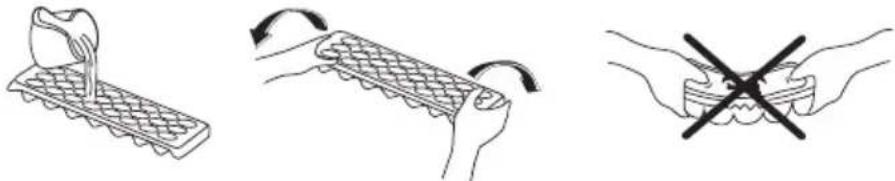
Ice cube tray
• To make ice cubes, fill the ice cube tray with water and place it inside the freezer.
• After the water has frozen, remove the ice cubes from the tray by twisting the tray in the middle (see picture).
natural_image
Illustration showing three hand gestures: a keyboard, a keyboard with rotation arrow, and a hand holding a bowl with a cross (no text or symbols)Bottle holder (depending on the model)
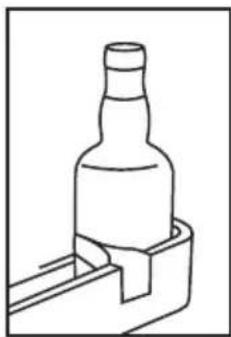
To prevent spilling bottle contents or tipping them over when opening the door, use the bottle holder. At the same time this prevents the undesirable bottle clinking noise that is made when opening or closing the refrigerator door.
natural_image
Line drawing of a bottle mounted on a base (no text or symbols)Defrosting the refrigerator

natural_image
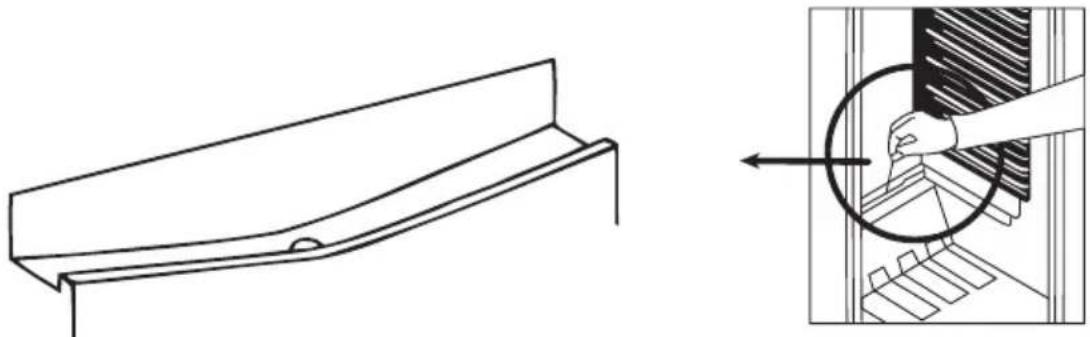
Technical line drawing of a mechanical component with an inset showing a magnified view of a hand holding a circular object (no text or symbols present)- The refrigerator is defrosted automatically during the refrigeration process. Water is drained through an opening in the rear side of the refrigerator into an evaporation container, where it is automatically evaporated.
- To ensure that the automatic defrosting function of the refrigerator works correctly, keep the opening and the area around it clean and unclogged.
- If it becomes soiled, clean out this part without delay, or pour 1/2 glass into the opening if necessary.
Defrosting the freezer

WARNING!
Do not use sharp objects for the removal of frozen food or ice, the wall of the freezer could be scratched.
Ice deposit layers form in the freezer during the normal course of operation. Ice deposit layers need to be removed regularly (e.g. using a plastic scraper).
After exceeding a certain thickness (as a rule 3-5 mm), the ice layer functions as an insulator and interrupts heat transfer.
- Set the temperature control knob to „5“ a day before you plan to defrost the freezer to ensure that food is completely frozen.
- Take out the frozen food and wrap into several newspaper layers. A sudden increase in temperature could shorten its lifetime. If the food partially defrosts then it is necessary to consume such food as soon as possible.
- Set the temperature control knob to „0“, turn off the appliance and pull out the power cord from the power socket.
-
Leave the door open to speed up the defrosting process. Remove the released frost layer from the freezer.
• This appliance is equipped with a special water drainage system. -
Pull out the bottom freezer drawer and place it on the floor so that it is level with the front part of the appliance.
-
Pull out the drain hose located in the rear part of the appliance. Then place it into the channel in the front part and the appliance and allow the water to flow out.

-
If water remains on the bottom of the freezer, use a sponge to remove it.
-
Wipe the inside surface using lukewarm water with a little kitchen dishwashing detergent. Do not use coarse cleaning agents, petrol, thinners or other similar cleaning substances.
- Wipe the inside surface with a dry and clean wiping cloth, connect the power cord plug to the power socket and turn the temperature control knob to position „5“. After 24 hours, set the temperature control knob to the required value.
Changing a light bulb
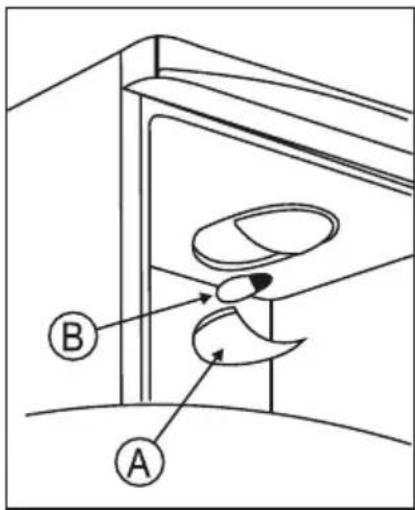
- Disconnect the appliance from the power source.
- Press the hooks on the sides of the top part of the cover and take out the light bulb cover (A).
- Replace the light bulb (B) with a new one (with a power output no greater than 15 W).
- Reattach the lighting element cover and connect the refrigerator to the power source.
PART 5: INSIDE LIGHTING
All appliances equipped with a light have a switch installed. When the refrigerator is turned on using the temperature control knob, the light will automatically come on when the door is opened and automatically turn off when the door is shut.
PART 6: ARRANGEMENT OF FOOD
- Food products, which are susceptible to the absorption of odours or that release odours must always be stored in closed boxes or in appropriate packaging.
- Fruit, vegetables and salad products can be stored unpacked in the vegetable drawers.
- Appropriate wrapping materials for food is plastic wrap, aluminium foil, glass jars, etc.
- The products should not touch the back wall, otherwise they may freeze on.
• Always allow hot dishes to cool down before placing them into the refrigerator. - Open the door only for a short time so that the inside area of the fridge is not heated. This saves energy.
- Never store explosive materials or products with flammable compressed gasses (e.g. whipped cream sprayers with pressurised capsules/cartridges, spray cans) – DANGER OF EXPLOSION!
- Do not place oils intended for the preparation of meals into the removable drawers in the refrigerator door. This may cause cracks caused by the pressure in the plastic on the door.
- Alcoholic beverages must always be stored in the cold zone, in a vertical position and firmly and safely closed.
Advice about refrigerating food
While the air in the refrigerator circulates, areas with various temperatures arise. These areas are especially useful for storing various types of food. Arrange the food in such a way that air can freely flow around the food. The coldest zones (suitable for example for storing meat) are found immediately above the vegetable drawers. On the other hand the zones that are less cold are at the top towards the outside and inside the door (ideal for storing butter and cheese).
Chart on storing food in the refrigerator
| Food Storage method Zone Durability | |||
| Meat and fi sh (various), hard cheeses | Plastic foil, aluminium foil, closed glass containers, plastic containers | Bottom part of the refrigerator | 1-2 days |
| Cooked dishes, cold dishes, confectionery | Closed glass or plastic containers | Any shelf 1-2 days | |
| Fruit and vegetables | Closed packaging or in bulk | Fruit and vegetable drawer | 3-4 days |
| Bananas, potatoes, onion, garlic | Do not store in the refrigerator | - | - |
| Water, wine, beer, milk, fruit juices, fi zzy drinks | Food grade glass or plastic bottles | Tray in the door Depends on expiry date | |
| Pickled or in oil marinated food, sauces, butter, soft cheese, eggs | Original packaging Tray | in the door Depends on expiry date | |
| Yoghurt Original packaging Any shelf Depends on expiry date | |||
Storage of frozen food
If you have turned on the refrigerator for the first time or you have just defrosted it, turn the temperature control knob to the value "7" at least for 2 hours before putting food into the refrigerator or the freezer.
All frozen food must be put into the freezer as soon as possible after being bought, so that it does not defrost and cause potential contamination.
Store frozen products according to the manufacturer's instructions on the packaging.
Pay increased attention to handling the drawer, so that you do not damage the cooling circuit.
Placing fresh food into a freezer
Ensure that the freezer is clean as the freezing process itself does not sterilise food. We recommend freezing food in the original packaging, or in various containers suitable for freezing or in special freezer bags. Never place hot or warm dishes into the freezer. Allow dishes to fully cool down before placing them into the freezer, wrap them in a plastic bag, aluminium foil or put them in a jar. Check the label on the freezer, to check how many kilos of fresh food (at a room temperature of 25^ C) the freezer is able to freeze in 24 hours. Never insert more food than the permitted amount.

Never place bottles with fi zzy drinks into the freezer nor any other bottles.
For better freezing results give the food sufficient room for air circulation.
We recommend a setting between the medium and maximum value for standard use and for long term food storage in the freezer.

ATTENTION!
- Do not store cans and bottles with beverages containing carbon dioxide in the freezer. The contents expand during the freezing process, which may rip the bottle or can apart. Risk of injury and damage!
- Consume ice cream only several minutes after removing it from the freezer – you will avoid injury to your lips and tongue. Do not touch the inside of the freezer if you have wet hands.
Important information
- Place only properly wrapped food into the freezer.
- When storing deep frozen food intended for immediate consumption, note the expiry date marked by the manufacturer.
- Remember that only quality fresh food is suitable for freezing.
- Freeze fresh food in appropriately sized portions.
- Ensure that you use an appropriate wrapping material (plastic wrap, aluminium foil, freezing bays, etc.).
- Push all air out of the packages.
• To close the packages use rubber bands, plastic clips, tie wire or adhesive tape resistant to cold. - Plastic bags and tubes can also be closed using a food sealing appliance.
- On the closed package write down the contents, weight and date of freezing.
- Before placing plastic bags into the freezer check that they are dry so as to prevent them from freezing to each other.
-
To prevent partial defrosting, place the food that is to be frozen in such a way that it is not touching the already frozen food.
-
Do not refreeze fully or partially defrosted food apart from the case where they were heat processed (cooked or fried/baked).
- Do not consume food that has been stored for a period longer than its expiry date. You may cause yourself food poisoning.
Chart on storing food in the freezer
| Food Storage method Zone Durability | |||
| Storing frozen food, ice cubes and ice creams | Original packaging, well sealed | Top part of the freezer | Depends on expiry date |
| Frozen food: meat and fish | Original packaging, well sealed. Food containers suitable for low temperatures, hermetically sealed. | Best in the bottom part of the freezer | Beef: 12 monthsPork: 12 monthsMinced pork: 6 monthsRabbit: 6 monthsVeal: 9 monthsMutton: 9 monthsPoultry: 6 monthsFish: 6 months |
| Frozen food: pasta dishes, fruit, vegetables, confectionery | Food containers suitable for low temperatures, hermetically sealed. | Top part of the freezer | 6-12 months |
PART 7: DEFROSTING
Disconnect the power cord from the power socket. Open the doors and take out all the food and place it in a cool place. Using the plastic scraper remove the ice from the walls of the freezer or allow the ice to naturally melt away. Then wipe out the remaining ice and water, wipe dry and connect the power cord to the power socket.

ATTENTION!
- Do not use sharp objects for the removal of frozen food or ice, the wall of the freezer could be scratched.
- When defrosting a freezer never use electric appliances such as hair fans, hot air fans, steam cleaners, deicing sprays or open flames (e.g. candles). The plastic interior could melt and the resulting foam gas could be ignited from a spark or an open flame. Never use a steam cleaner to melt a layer of ice in the appliance (high risk of injury by electrical shock).
- Remove the frozen food and wrap into several newspaper layers.
- Place the frozen food in a cold place until it is possible to use the freezer again.
- Leave the freezer door open.
- Ice deposit layers form in the freezer during the normal course of operation. After exceeding a certain thickness, they function as insulation and interrupt heat transfer.
- Do not scratch the ice deposit layer because you could damage the evaporation surface.
• Perform the defrosting process as fast as possible to prevent the removed food from defrosting.
• Constantly remove water using a sponge. - You can speed up the defrosting process by placing a bowl with hot water (not boiling) into the freezer. In this case close the freezer door.
- As soon as the freezer has been fully defrosted, empty the water accumulated in the bowl into a kitchen sink.
- Wipe the freezer area until dry and return the food.
- Connect the appliance to the power socket.
Cleaning the appliance
Before commencing to clean the refrigerator disconnect it from the power source.
Use a clean sponge or a soft cloth and a gentle washing detergent dissolved in warm water. Do not use coarse or abrasive cleaning products.
Wash the refrigerator well and wipe dry.
Do not use cleaning waxes, concentrated cleaning agents, bleaches or cleaning products containing kerosene on the plastic or rubber parts.
Never use paper towels or window cleaners on the plastic parts.
Clean the inside of the appliance at regular intervals.
- We recommend that you clean the inside area of the refrigerator at least once per month and the freezer after each defrosting process.
• From both areas take out all the food and place it in a cool place. - Remove all removable parts from the appliance.
- Various parts inside the refrigerator/freezer are generally not suitable for washing in a dishwasher. These parts should be washed in warm water with dish washing detergent. Never use an undiluted cleaning detergent and under no circumstances use abrasive or acidic, i.e. chemical cleaning agents. We recommend a general purpose detergent with a neutral pH.
The use of steam cleaning appliances is extremely dangerous and so is strictly forbidden.
- Wipe the inside area and the accessories with clean water and dry everything using a dry cloth. Then allow the appliance to ventilate for 3 – 4 minutes.
- Do not damage or remove the rating label on the rear side of the appliance – it is important for connection, repairs and subsequent disposal of the appliance.
- Ensure that water does not come into contact with parts inside the appliance that are under live electric current.
- Ensure that the water from the defrosting process can flow away freely through the drainage channel. From time to time clean out the drainage opening using a cotton bud.
- Cleaning water should not run through the drainage channel for defrosted water. This causes the evaporation bowl to overflow and cleaning water flows on to the floor.
TAKING OUT OF OPERATION FOR AN EXTENDED PERIOD
If you are not going to use the refrigerator for an extended period of time, do the following:
Disconnect the refrigerator from the power source by pulling it out of the power socket. Clean out the inside and dry it out as described in the part Cleaning the refrigerator. Leave the door open to prevent an unpleasant odour forming inside.

Please be aware:
Compressor
The compressor is controlled by the thermostat, which is set by the temperature control knob, and turns itself on automatically when temperatures inside the appliance is exceeded and then turns itself off as soon as it again reaches this temperature. When any compressor – cooling system is turned on – noise can be heard. These sounds are made when the motor in the compressor is working and they are also made by the coolant circulating in the circuit of the cooling system. These noises are normal and do not indicate any malfunction in the operation of the appliance.
In unheated rooms or in cold weather conditions condensate may form on the exterior walls of the appliance.
This does not indicate a malfunction and this condensate will disappear as soon as the temperature rises.
Contact the service department only when, after analysing all possible factors of the malfunction you cannot find any cause for the malfunction or you are unable to remedy the malfunction yourself. So, first focus on: "What should I do when...."
PART 9: WHAT SHOULD I DO WHEN...
a) The appliance is not working.
Please check the following:
• Is the power plug in good condition and properly plugged into the power socket?
- Is there electricity flowing into the power cord? (Check this possibility by connecting a small appliance like a hand mixer or hair fan, etc.)
- Is the appliance turned on? (The temperature control knob should not be set to "OFF".)
• Is the mains fuse / circuit breaker in the home turned on or screwed in?
b) The appliance does not cool sufficiently. / the compressor turns on too frequently.
Please check the following:
- Did you leave the refrigerator/freezer off for at least 12 hours before turning it on? If not: Pull out the power plug, with the doors closed tilt the appliance to one side and hold it or place it in a tilted position and then back to the even position. After a period of 12 hours has passed, turn it on again, for this period of time do not open the doors.
- When the doors close properly, the seal on the doors sits firmly and evenly on the frame.
Test: Place a sheet of paper between the seal and the frame, then close the door. It should be difficult to pull out this sheet of paper on all sides.
Call an after-sales service centre if it is possible to pull out the paper without resistance at one or more points.
- Formation of larger ice layers on the inside walls of the freezer.
- Is the appliance exposed to direct sunlight or is it located too close to a heat source (stove, heater, etc.)? Protect the appliance against direct sunlight / check the distance from the heat source / place a sheet of insulation between the appliance and the heat source. (See "Placement").
• The appliance has been filled with too much fresh food. - Is the air circulation and ventilation in order? Check that the ventilation grill is not covered or that the heat exchanger (condenser) on the rear side is not covered in dust.
c) The temperature in the refrigerator is too low.
- Set the temperature to a lower value.
- Check that the freezer section is properly closed.
- Was a larger amount of fresh food frozen - more than 1kg? This causes the freezing unit to run longer and due to this the temperature in the refrigerator automatically goes down.
d) Frozen food are defrosting because the temperature in the freezer is too high.
- Has the room temperature fallen below the temperature for which the appliance is designed? If the room temperature is too low, the freezer unit runs less frequently. For this reason the temperature in the freezer section may be higher. Increase the room temperature.
e) A thick layer of ice formed in the freezer.
- Check that the freezer section is properly closed.
- If the frozen food have frozen on to the freezer, pry them away using a dull object, e.g. with a spoon handle.
- Allow the freezer to defrost and then clean it out (see chapter Defrosting). An excessively thick layer of ice reduces cooling capacity, which increases power consumption.
f) The appliance is too loud.
Please check the following:
- Is the appliance standing firmly on the floor, is the operation of the appliance causing vibrations of nearby furniture or other objects? Check that all the parts mounted on the rear wall can vibrate freely.
- Carefully move the contact part away or increase the distance between the appliance and the obstacle.
- Are the removable parts securely inserted in the appliance?
- Are containers or compartments touching?
NOTE:
The noise of the coolant flowing in the circuit cannot be removed.
Under no circumstances is it possible to make technical type changes or attempts at repairs yourself.
PART 10: RATING LABEL/TECHNICAL SPECIFICATIONS
The rating label with all the technical specifications is located on the side of the inside wall or on the rear side of the appliance.
Technical specifications
| Model PC 1721 BI | |
| Climatic class ST/N | |
| Net volume 264 l | |
| Operating voltage 220 – 240 V~ 50 Hz | |
| Maximum power 190 W | |
| Power consumption 275 kWh/year | 0.754 kWh/day |
| Freezing capacity 4.0 kg/24 hours | |
| Noise level 41 dB (A) | |
| Dimensions h x w x d 177 x 54 x 54 cm | |
| Weight 61 kg |
NOTE: All the here mentioned data is subject to change.
INSTRUCTIONS AND INFORMATION REGARDING THE DISPOSAL OF USED PACKAGING MATERIALS
Dispose of packaging material at a public waste disposal site.
DISPOSAL OF USED ELECTRICAL AND ELECTRONIC APPLIANCES

The meaning of the symbol on the product, its accessory or packaging indicates that this product shall not be treated as household waste. Please, dispose of this product at your applicable collection point for the recycling of electrical & electronic equipment waste. Alternatively in some states of the European Union or other European states you may return your products to your local retailer when buying an equivalent new product. The correct disposal of this product will help save valuable natural resources and help in preventing the potential negative impact on the environment and human health, which could be caused as a result of improper liquidation of waste. Please ask your local authorities or the nearest waste collection centre for further details. The improper disposal of this type of waste may fall subject to national regulations for fines.
For business entities in the European Union
If you wish to dispose of an electrical or electronic device, request the necessary information from your seller or supplier.
Disposal in other countries outside the European Union
If you wish to dispose of this product, request the necessary information about the correct disposal method from local government departments or from your seller.

This product meets all the basic EU regulation requirements that relate to it.
Changes to the text, design and technical specifications may occur without prior notice and we reserve the right to make these changes.
Dvoudveřová
kombinovaná chladnička
NÁVOD K OBSLUZE
PHILCO

Famous for Quality the World Over
Vážený zákazníku
natural_image
Illustration showing three steps of a robotic arm: pressing a piece, moving a tray with rotation arrows, and removing a handle (no text or symbols)natural_image
Line drawing of a bottle mounted on a tray (no text or symbols)natural_image
Technical line drawing of a mechanical component with an inset showing a magnified view of a circular feature (no text or symbols)Famous for Quality the World Over
Vážený zákazník
ČASŤ 4: NASTAVENIE TEPLOTY
Nastavenie termostatu
natural_image
Illustration showing three steps of a robotic arm: pressing a piece, moving a tray with rotation arrows, and removing a handle (no text or symbols)natural_image
Simple line drawing of a bottle mounted on a tray (no text or symbols)Odmrazovanie chladničky
natural_image
Technical line drawing of a mechanical component with an inset showing a magnified view of a circular feature (no text or symbols)- Two Door Refrigerator
- USER'S MANUAL
- PHILCO
- CONTENTS
- PART 1: BEFORE PUTTING INTO OPERATION....2
- PART 2: DESCRIPTION OF THE DEVICE ....5
- PART 3: INSTALLATION....6
- PART 4: SETTING THE TEMPERATURE....9
- PART 5: INTERNAL LIGHTING....13
- PART 6: ARRANGEMENT OF FOOD ....14
- PART 7: DEFROSTING....17
- PART 8: REGULAR MAINTENANCE....18
- PART 9: WHAT SHOULD I DO WHEN....20
- PART 10: PERFORMANCE LABEL/TECHNICAL SPECIFICATIONS ......22
- PART 1: BEFORE PUTTING INTO OPERATION
- Safety notice
- Symbols:
- Before you put the appliance into operation
- Operating the appliance
- EN - 2
- Children in the household
- Maintenance and cleaning
- General instructions
- Technical safety
- Safety instructions for gas R600a
- Measures in case of an unexpected release
- Characteristics of the gas
- First aid
- Inhalation
- Contact with the skin
- Contact with the eyes
- PART 2: DESCRIPTION OF DEVICE
- PART 3: INSTALLATION
- Transport and unpacking
- Operating conditions
- Placement
- This appliance is designed to be built-in.
- Ventilation requirements
- Danger warning
- Cleaning before use
- Electrical connection
- EN - 8
- Setting the temperature control knob
- Setting the freezer temperature control knob
- For A+ models
- Control panel
- NOTE:
- Turning on the appliance
- Accessories
- Ice cube tray
- Bottle holder (depending on the model)
- Defrosting the refrigerator
- Defrosting the freezer
- WARNING!
- Changing a light bulb
- PART 5: INSIDE LIGHTING
- PART 6: ARRANGEMENT OF FOOD
- Advice about refrigerating food
- Storage of frozen food
- Placing fresh food into a freezer
- ATTENTION!
- Important information
- PART 7: DEFROSTING
- Cleaning the appliance
- The use of steam cleaning appliances is extremely dangerous and so is strictly forbidden.
- TAKING OUT OF OPERATION FOR AN EXTENDED PERIOD
- Please be aware:
- Compressor
- PART 9: WHAT SHOULD I DO WHEN...
- a) The appliance is not working.
- Please check the following:
- b) The appliance does not cool sufficiently. / the compressor turns on too frequently.
- Call an after-sales service centre if it is possible to pull out the paper without resistance at one or more points.
- c) The temperature in the refrigerator is too low.
- d) Frozen food are defrosting because the temperature in the freezer is too high.
- e) A thick layer of ice formed in the freezer.
- f) The appliance is too loud.
- PART 10: RATING LABEL/TECHNICAL SPECIFICATIONS
- INSTRUCTIONS AND INFORMATION REGARDING THE DISPOSAL OF USED PACKAGING MATERIALS
- DISPOSAL OF USED ELECTRICAL AND ELECTRONIC APPLIANCES
- For business entities in the European Union
- Disposal in other countries outside the European Union
- Dvoudveřová
- kombinovaná chladnička
- NÁVOD K OBSLUZE
- ČASŤ 4: NASTAVENIE TEPLOTY
- Nastavenie termostatu
- Odmrazovanie chladničky
Brand : Philco
Model : PC 1721 BI
Category : Refrigerator