
FRV-140 - Freezer Milectric - Free user manual and instructions
Find the device manual for free FRV-140 Milectric in PDF.


| Product Type | Freezer |
| Brand | Milectric |
| Model | FRV-140 |
| Dimensions (H x W x D) | 143 x 55 x 60 cm |
| Weight | 45 kg |
| Energy Class | E |
| Annual Energy Consumption | 250 kWh |
| Noise Level | 42 dB |
| Net Capacity | 140 L |
| Star Rating | 4 stars |
| Temperature Range | -18°C to -24°C |
| Control Type | Mechanical thermostat |
| Defrost Type | Manual defrost |
| Fast Freeze Function | Yes |
| Interior Light | No |
| Door Hinge | Reversible |
| Refrigerant | R600a |
| Climate Class | N/ST |
| Included Accessories | Ice cube tray, wire basket |
| Cleaning | Clean interior with mild detergent; defrost regularly |
| Safety Features | Anti-tip bracket, door lock (optional) |
| Repairability Index | 6.5/10 |
| Warranty | 2 years |
Frequently Asked Questions - FRV-140 Milectric
User questions about FRV-140 Milectric
0 question about this device. Answer the ones you know or ask your own.
Ask a new question about this device
Download the instructions for your Freezer in PDF format for free! Find your manual FRV-140 - Milectric and take your electronic device back in hand. On this page are published all the documents necessary for the use of your device. FRV-140 by Milectric.
USER MANUAL FRV-140 Milectric
In the interest of your safety and to ensure the correct use, before installing and first using the appliance, read this user manual carefully, including its hints and warnings. To avoid unnecessary mistakes and accidents, it is important to ensure that all people using the appliance are thoroughly familiar with its operation and safety features. Save these instructions and make sure that they remain with the appliance if it is moved or sold, so that everyone using it through its life will be properly informed on appliance use and safety.
For the safety of life and property keep the precautions of these user's instructions as the manufacturer is not responsible for damages caused by omission.
Children and vulnerable people safety
- This appliance can be used by children aged from 8 years and above and persons with reduced physical, sensory or mental capabilities or lack of experience and knowledge if they have been given super vision or instruction concerning use of the appliance in a safe way and understand the hazards involved.
• Children aged from 3 to 8 years are allowed to load and unload this appliance.
• Children should be supervised to ensure that they do not play with the appliance. - Cleaning and user maintenance shall not be made by children unless they are aged from 8 years and above and supervised.
-
Keep all packaging well away from children. There is risk of suffocation.
-
If you are discarding the appliance pull the plug out of the socket, cut the connection cable (as close to the appliance as you can) and remove the door to prevent playing children to suffer electric shock or to close themselves into it.
- If this appliance featuring magnetic door seals is to replace an older appliance having a spring lock (latch) on the door or lid, be sure to make that spring lack unusable before you discard the old appliance. This will prevent it from becoming a death trap for a child.
General safety
⚠ WARNING! Keep ventilation openings, in the appliance enclosure or in the built-in structure, clear of obstruction.
⚠ WARNING! Do not use mechanical devices or other means to accelerate the defrosting process, other than those recommended by the manufacturer.
⚠ WARNING! Do not damage the refrigerant circuit.
WARNING! Do not use other electrical appliances (such as ice cream makers) inside of refrigerating appliances, unless they are approved for this purpose by the manufacture.
WARNING! Do not touch the light bulb if it has been on for a long period of time because it could be very hot. ^1)
WARNING! When positioning the appliance, ensure the supply cord is not trapped or damaged.
WARNING! Do not locate multiple portable socket-outlets or portable power suppliers at the rear of the appliance.
- Do not store explosive substances such as aerosol cans with a flammable propellant in this appliance.
- The refrigerant isobutane (R-600a) is contained within the refrigerant circuit of the appliance, a natural gas with a high level of environmental compatibility, which is nevertheless flammable.
- During transportation and installation of the appliance, be certain that none of the components of the refrigerant circuit become damaged.
- avoid open flames and sources of ignition
- thoroughly ventilate the room in which the appliance is situated
- It is dangerous to alter the specifications or modify this product in any way. Any damage to the cord may cause a short circuit, fire and/or electric shock.
- This appliance is intended to be used in household and similar applications such as
- staff kitchen areas in shops, offices and other working environments;
- farm houses and by clients in hotels, motels and other residential type environments;
- bed and breakfast type environments;
- catering and similar non-retail applications.
WARNING! Any electrical components (plug, power cord, compressor and etc.) must be replaced by a certified service agent or qualified service personnel.
WARNING! The light bulb supplied with this appliance is a “special use lamp bulb” usable only with the appliance supplied. This “special use lamp” is not usable for domestic lighting ^1 .
• Power cord must not be lengthened.
- Make sure that the power plug is not squashed or damaged by the back of the appliance. A squashed or damaged power plug may overheat and cause a fire.
• Make sure that you can come to the mains plug of the appliance.
- Do not pull the mains cable.
- If the power plug socket is loose, do not insert the power plug. There is a risk of electric shock or fire.
- You must not operate the appliance without the lamp.
- This appliance is heavy. Care should be taken when moving it.
- Do not remove nor touch items from the freezer compartment if you hands are damp/wet, as this could cause skin abrasions or frost/freezer burns.
- Avoid prolonged exposure of the appliance to direct sunlight.
Daily use
- Do not put hot on the plastic parts in the appliance.
- Do not place food products directly against the rear wall.
- Frozen food must not be re-frozen once it has been thawed out. ^1)
- Store pre-packed frozen food in accordance with the frozen foodmanufacture8s instructions ^1 .
- Appliance's manufactures storage recommendations should be strictly adhered to. Refer to relevant instructions.
- Do not place carbonated of fizzy drinks in the freezer compartment as it creates pressure on the container, which may cause it to explode, resulting in damage to the appliance ^1 .
- Ice lollies can cause frost burns if consumed straight from the appliance. ^1)
• To avoid contamination of food, please respect the following instructions
- Opening the door for long periods can cause a significant increase of the temperature in the compartments of the appliance.
- Clean regularly surfaces that can come in contact with food and accessible drainage systems.
- Clean water tanks if they have not been used for 48h; flush the water system connected to a water supply if water has not been drawn for 5 days.
- Store raw meat and fish in suitable containers in the refrigerator, so that it is not in contact with or drip onto other food.
- Two-star frozen-food compartments (if they are presented in the appliance) are suitable for storing pre-frozen food, storing or making ice-cream and making ice cubes.
- One-, two- and three -star compartments (if they are presented in the appliance) are not suitable for the freezing of fresh food.
- If the appliance is left empty for long periods, switch off, defrost, clean, dry and leave the door open to prevent mount developing within the appliance.
Care and cleaning
- Before maintenance, switch off the appliance and disconnect the mains plug from the mains socket.
- Do not clean the appliance with metal objects.
- Do not use sharp objects to remove frost from the appliance. Use a plastic scraper. ^1)
- Regularly examine the drain in the refrigerator for defrosted water. If necessary, clean the drain.
If the drain is blocked, water will collect in to bottom of the appliance. ^2)
Installation
Important! For electrical connection carefully follow the instructions given in specific paragraphs.
- Unpack the appliance and check if there are damages on it. Do not connect the appliance if it is damaged. Report possible damages immediately to the place you bought it. In that case retain packing.
- It is advisable to wait at least four hours before connecting the appliance to allow the oil to flow back in the compressor.
- Adequate air circulation should be around the appliance, lacking this leads to overheating. To achieve sufficient ventilation follow the instructions relevant to installation.
- Wherever possible the spacers of the product should be against a wall to avoid touching or catching warm parts (compressor, con-denser) to prevent possible burn.
- The appliance must not be located close to radiators or cookers.
- Make sure that the mains plug is accessible after the installation of the appliance.
Service
- Any electrical work required to do the servicing of the appliance should be carried out by a qualified electrician or competent person.
- This product must be serviced by an authorized Service Center, and only genuine spare parts must be used.
Energy saving
- Don't put hot food in the appliance;
- Don’t pack food close together as this prevents air circulating;
-
Make sure food don't touch the back of the compartment(s);
-
If electricity goes off, don't open the door(s);
- Don't open the door(s) frequently;
- Don't keep the door(s) open for too long time;
- Don't set the thermostat on exceeding cold temperatures;
- Some accessories, such as drawers, can be removed to get larger storage volume and lower energy consumption.
Environment Protection
This appliance does not contain gasses which could damage the ozone layer, in either its refrigerant circuit or insulation materials. The appliance shall not be discarded together with the urban refuse and rubbish. The insulation foam contains flammable gases: the appliance shall be disposed according to the appliance regulations to obtain from your local authorities. Avoid damaging the cooling unit, especially the heat exchanger.
The materials used on this appliancemarked by the symbol 🌐 a re recyclable.

The symbol on the product or on its packaging indicates that this product may not be treated as household waste. Instead it should be taken to the appropriate collection point for the recycling of electrical and electronic equipment. By ensuring this product is disposed of correctly, you will help prevent potential negative consequences for the environment and human health,
which could otherwise be caused by inappropriate waste handling of this product. For more detailed information about recycling of this product, please contact your local council, your household waste disposal service or the shop where you purchased the product.
Packaging materials
The materials with the symbol are recyclable. Dispose the packaging in a suitable collection containers to recycle it.
Disposal of the appliance
- Disconnect the mains plug from the mains socket.
- Cut off the mains cable and discard it.

WARNING! During using, service and disposal the appliance, please pay attention to symbol similar as left side, which is located on rear of appliance (rear panel or compressor) and with yellow or orange color.
It's risk of fire warning symbol. There are flammable materials in refrigerant pipes and compressor.
Please be far away fire source during using, service and disposal.
INTRODUCTION
Before use
Please read these instructions and the Safety guidelines on page 1 carefully before using your new Freezer. The Freezer is for indoor, domestic use only.
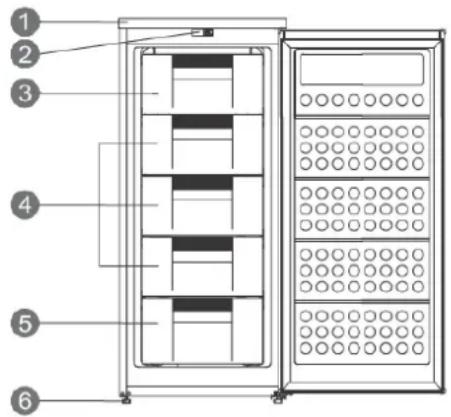
| 1 | Top cover |
| 2 | Display Block |
| 3 | Freezer Flap |
| 4 | Middle Drawer |
| 5 | Low Drawer |
| 6 | Adjustable feet |
INSTALLATION
Location
When selecting a position for your Freezer you should make sure the floor is flat and firm, and the room is well ventilated with an average room temperature of between 16°C and 38°C. Avoid locating your Freezer near a heat source, eg, cooker, boiler or radiator. Also avoid direct sunlight in out-buildings or sun lounges. If you are placing your Freezer in an out-building such as a garage or annex ensure that the Freezer is placed above the damp course, otherwise condensation will occur on the Freezer cabinet. Never place the Freezer in a wall recessed or into fitted cabinets or furniture when your Freezer is working, the grille at the back may become hot and the sides warm. It must therefore be installed so that the back of the Freezer has at least 9cm(31/2") of free space and the sides have 2cm(3/4"). Do not drape the Freezer with any covering.
Leveling the Freezer
If the Freezer is not level, the door and magnetic seal alignment will be affected and may cause you. Freezer to work incorrectly. Once the Freezer is placed in its final location, adjust the leveling feet at the front by turning them.

Cleaning before use
Wipe the inside of the Freezer with a weak solution of bicarbonate of soda. Then rinse with warm water using a damp sponge or cloth. Wash the baskets and shelves in warm soapy water and dry completely before replacing in the Freezer. The external parts of the Freezer can be cleaned with wax polish. See page 6 for more details on cleaning.
Before plugging in YOUMUST
Check that you have a socket which is compatible with the plug supplied with the Freezer. If not see the section called ELECTRICAL INFORMATION on page 8.
Before switching on!
DO NOT SWITCH ON UNTIL FOUR HOURS AFTER MOVING THE FREEZER.
The coolant fluid needs time to settle. If the appliance is switched off at any time, wait 30 minutes before switching back on to allow the coolant fluid to settle.
Before filling your Freezer
Before storing foods in your Freezer, turn the Freezer on and wait for 24 hours, to make sure it is working properly and to allow the Freezer to fail to the correct temperature. See page 5 for more details.
START
Testing
- Clean the freezer with lukewarm water and detergent, and wipe dry.
Note: Electrical components should be cleaned with a dry cloth.
-
Turn the thermostat knob to the "2" position, and plug the freezer into the wall outlet. The compressor will begin to run.
-
Check, after 30 minutes of operation, to ensure that the freezer is cold.
Temperature Control
-
The temperature control (thermostat knob, turned by coin) is located near the top of the unit.
-
Turning the thermostat knob adjusts the temperature of the freezer.
-
The marks on the knob represent different settings. Setting “1” is the warmest and setting “4” is the coolest.
-
The factory recommended setting is "2" for normal operating conditions.

IN USE
-
The appliance might not operate consistently (possibility of defrosting of contents or temperature becoming too warm in the frozen food compartment) when sited for an extended period of time below the cold end of the range of temperatures for which the refrigerating appliance is designed
-
The fact that the climate class is ST, and the room temperature of between 16°C and 38°C.
-
The fact that the internal temperatures could be affected by such factors as the location of the refrigerating appliance, ambient temperature and the frequency of door opening, and, if appropriate, a warning that the setting of any temperature control device might have to be varied to allow for these factors
-
The fact that effervescent drinks should not be stored in food freezer compartments or cabinets or in low-temperature compartments or cabinets, and that some products such as water ices should not be consumed too cold
-
The need to not exceed the storage time(s) recommended by the food manufacturers for any kind of food
-
The fact that a rise in temperature of the frozen food during manual defrosting, maintenance or cleaning could shorten the storage life
-
It is better wrapping the frozen food in several layers of the glass shelves.
-
The care required with regard to frozen food in storage in the event of an extended non-running of the refrigerating appliance (interruption of power supply or failure of the refrigerating system)
-
The door to the evaporator clearance can be used to store food.
Tips and Hints
-
Food should be wrapped in aluminum foil, or some other type of airtight packing.
-
Do not allow frozen food in freezer to touch foods just placed into freezer. It can damage the food.
-
Frozen foods from the store should be placed in the freezer promptly, so they do not thaw.
-
Never place fresh vegetables and fruits into the freezer as they can get freezer burn.
Recommended storage periods
For recommended food storage time, refer to the information given on your food packaging.
Defrosting
-
When the freezer operates for a long period of time, the surface of the evaporator and the drawers may become covered with a layer of white frost. This frost will reduce the energy efficiency of the unit, and make the freezer less effective. When this frost forms, it should be promptly removed.
-
When defrosting, unplug the freezer, and remove all items from the freezer. Either allow the frost to melt naturally from the warm air in the room, or carefully use a plastic scraper. Finally, wipe away any remaining ice and water, plug the freezer in, and return
the food to the freezer.
CAUTION: Never use sharp tools to chip ice away.
Cleaning inside the Fridge/Freezer
After defrosting you should clean the Fridge/Freezer internally with a weak solution of bicarbonate of soda. Then rinse with warm water using a damp sponge or cloth and wipe dry. Wash the baskets in warm soapy water and ensure they are completely dry before replacing in the Fridge/Freezer. Condensation will form on the back wall of the Fridge; however it will normally run down the back wall and into the drain hole behind the salad bin.

The drain hole will have a “cleaning spike” inserted into it. This ensures that small pieces off food can not enter the drain. After you have cleaned the inside of your Fridge and removed any food residues from around the whole, use the “cleaning spike” to make sure that there are no blockages.
Cleaning outside the Freezer
Use standard furniture polish to clean the Freezer exterior. Make sure that the doors are closed to prevent polish getting on the magnetic door seal or inside.
The grille of the condenser at the back of the Freezer and the adjacent components can be vacuumed using a soft brush attachment.
Do not use harsh cleaners, scouring pads or solvents to clean any part of the Freezer.
TROUBLESHOOTING AND MAINTENANCE
Trouble Shooting
Power cut
If the internal temperature of the Freezer compartment is -18^ or less when the power returns, your food is safe. The food in your Freezer will remain frozen for approx 16 hours with the door closed. Do not open the Freezer door more than necessary.
The Freezer is exceptionally cold
You may have accidentally adjusted the thermostat control dial to a higher position.
The Freezer is exceptionally warm
The compressor may not be working. Turn the thermostat control dial to the maximum setting and wait a few minutes. If there is no humming noise, it is not working. Contact the local store where your purchase was made.
The Freezer is not working
Check it is plugged in and switched on. Check that the fuse in the plug has not blown. Plug
In another appliance, such as a lamp, to see if the socket is working. The Freezer should be placed in a well ventilated room with an ambient temperature of between 16°C and 38°C. Leave the Freezer for 30 minutes.
Condensation appears on the outside of the Freezer
This may be due to a change in the room temperature. Wipe off any residue of moisture. If the problem continues contact the local store where your purchase was made.
Noises inside the Freezer
If you have not owned a Freezer before, you may notice that it makes some rather unusual noises. Most noises are perfectly normal; however you should be aware of them!
GURGLING, WHOOSHING
These noises are caused by the circulation of the refrigerant liquid in the cooling system. It has become more pronounced since the introduction of CFC free gases. This is not a fault and will not affect the performance of your Freezer.
HUMMING, PURRING OR PULSATING
This is the compressor motor working, as it pumps the refrigerant around the system.
Moving the Freezer
Location
Do not place your Freezer near a heat source, eg. Cooker, boiler or radiator. Also avoid direct sunlight in out-buildings or sun lounges.
Leveling the Freezer
Make sure the Freezer is level. Use the rotating leveling feet at the front. If the Freezer is not level, the doors and magnetic seal alignments will be affected and may cause your Freezer to work incorrectly.
Do not turn on the Freezer for 4 hours
After the Freezer is in place it needs to be left for 4 hours. This allows time for the coolant to settle.
Installation
Don't cover or block the vents or grilles of your appliance.
Vacation Time
- Turn off the refrigerator first and then unplug the unit from the wall outlet.
- Remove all the food.
- Clean the refrigerator.
- Leave the lid open slightly to avoid possible formation of condensation, mold, or odors.
- Use extreme caution in the case of children. The unit should not be accessible to child's play.
- Short vacations: Leave the refrigerator operating during vacations of less than three weeks.
- Long vacations: If the appliance will not be used for several months, remove all food and unplug the power cord. Clean and dry the interior thoroughly. To prevent odor and mold growth, leave the door open slightly: blocking it open if necessary or have the door removed.
How to save energy
- Install the refrigerator in the coolest part of the room, out of direct sunlight and away from heating ducts or registers. Do not place the refrigerator next to heat-producing appliances such as a range, oven or dishwasher.
• The refrigerator door should remain open only as long as necessary; do not place hot food inside the refrigerator. - Organize the refrigerator to reduce door openings .Remove as many items as needed at one time and close the door as soon as possible.
- The refrigerator door should be properly closed to avoid increased energy consumption, and the formation of excess ice and / or condensation inside.
- Constantly circulating cold air keeps the temperature homogenous inside the refrigerator. For this reason, it is important to properly distribute the food, to facilitate the flow of air.
- Cover foods and wipe containers dry before placing them in the refrigerator. This cuts down on moisture build-up inside the unit.
- Do not overcrowd the refrigerator or block cold airvents. Doing so causes the refrigerator to run longer and use more energy. Shelves should not be lined with aluminum foil, wax paper or paper toweling. Liners interfere with cold air circulation, making the refrigerator less efficient, which could cause food spoilage.
- During prolonged absences (example: vacations), it is advisable to disconnect the refrigerator, remove all the food, and clean it. The door should be left slightly open to avoid mold and unpleasant odors. This will not affect the refrigerator when it is reconnected.
- During short absences (example: holidays), the refrigerator can remain on. However, remember that prolonged power outages may occur while you are gone.
Servicing
This product should be serviced by an authorized engineer and only genuine spare parts should be used.
Under no circumstances should you attempt to repair the appliance yourself.
Repairs carried out by inexperienced persons may cause injury or serious malfunctioning. Contact the local store where your purchase was made.
When the appliance is not in use for long periods, disconnect from the electricity supply, empty all foods and clean the appliance, leaving the door ajar to prevent unpleasant smells.
ELECTRICAL INFORMATION
THIS APPLIANCE MUST BE EARTHED.
This appliance is fitted with a fused three pin plug to BS 1363 which will be suitable for use in all houses fitted with sockets to current specifications.
If the fitted plug is not suitable for your socket outlets, it should be cut off and carefully disposed of. To avoid a possible shock hazard, do not insert the discarded plug into a socket.
This appliance complies with the following EEC Directives:
73 / 23 EEC (Low Voltage Directive)
89 / 336 EEC (EMC Directive).
Correct Disposal of this product

This marking indicates that this product should not be disposed with other household wastes throughout the EU. To prevent possible harm to the environment or human health from uncontrolled waste disposal, recycle it responsibly to promote the sustainable reuse of material resources. To return your used device, please use the return and collection systems or contact the retailer where the product was purchased. They can take this product for environmental safe recycling.
Congelador vertical
MANUAL DE USUARIO
Model No.: FRV-140
| 1 | Cubierta superior |
| 2 | Display |
| 3 | Tapa del congelador |
| 4 | Cajón intermedio |
| 5 | Cajón inferior |
| 6 | Pie ajustable |
INSTALACIÓN
Ubicación
MANUAL DE INSTRUÇÕES
Model No.: FRV-140
natural_image
Empty white rectangle with a thin black border (no text or symbols)- Children and vulnerable people safety
- General safety
- Daily use
- Care and cleaning
- Installation
- Service
- Energy saving
- Environment Protection
- Packaging materials
- Disposal of the appliance
- INTRODUCTION
- Before use
- Location
- Leveling the Freezer
- Cleaning before use
- Before plugging in YOUMUST
- Before switching on!
- Before filling your Freezer
- START
- Testing
- Temperature Control
- IN USE
- Tips and Hints
- Recommended storage periods
- Defrosting
- Cleaning inside the Fridge/Freezer
- Cleaning outside the Freezer
- TROUBLESHOOTING AND MAINTENANCE
- Trouble Shooting
- Power cut
- The Freezer is exceptionally cold
- The Freezer is exceptionally warm
- The Freezer is not working
- Condensation appears on the outside of the Freezer
- Noises inside the Freezer
- GURGLING, WHOOSHING
- HUMMING, PURRING OR PULSATING
- Moving the Freezer
- Do not turn on the Freezer for 4 hours
- Vacation Time
- How to save energy
- Servicing
- ELECTRICAL INFORMATION
- THIS APPLIANCE MUST BE EARTHED.
- Correct Disposal of this product
- Congelador vertical
- INSTALACIÓN
- Ubicación
- MANUAL DE INSTRUÇÕES
Brand : Milectric
Model : FRV-140
Category : Freezer