
Reference RS 6000A - Lautsprecher INFINITY - Kostenlose Bedienungsanleitung
Finden Sie kostenlos die Bedienungsanleitung des Geräts Reference RS 6000A INFINITY als PDF.


| Produkttyp | Passiver Lautsprecher, 2-Wege-Regallautsprecher |
| Modell | Reference RS 6000A |
| Marke | Infinity |
| Abmessungen (H x B x T) | 300 mm x 200 mm x 250 mm |
| Gewicht | 5 kg pro Stück |
| Farben | Schwarz, Walnuss |
| Leistungsaufnahme (empfohlen) | 60–100 Watt RMS pro Kanal |
| Impedanz | 8 Ohm |
| Frequenzgang | 45 Hz – 20 kHz |
| Empfindlichkeit (1W/1m) | 89 dB |
| Anzahl der Wege | 2 (Tieftöner + Hochtöner) |
| Treiber | 192 mm Tieftöner, 25 mm Kalottenhochtöner |
| Anschlüsse | Vergoldete Schraubklemmen (Bi-Wiring-fähig) |
| Entfernung des Schutzgitters | Abnehmbar, magnetisch befestigt |
| Reinigung und Pflege | Mit einem weichen, trockenen Tuch abwischen. Keine aggressiven Reinigungsmittel verwenden. |
| Sicherheitshinweise | Auf stabilem Untergrund aufstellen, vor Feuchtigkeit schützen, nicht überlasten. |
| Ersatzteile und Reparatur | Beim autorisierten Händler oder Service-Center anfragen. |
| Zubehör im Lieferumfang | Bedienungsanleitung, optional: Montageschablonen |
| Garantie | 2 Jahre (abhängig vom Händler) |
Häufig gestellte Fragen - Reference RS 6000A INFINITY
Benutzerfragen zu Reference RS 6000A INFINITY
0 Frage zu diesem Gerät. Beantworten Sie die, die Sie kennen, oder stellen Sie Ihre eigene.
Eine neue Frage zu diesem Gerät stellen
Laden Sie die Anleitung für Ihr Lautsprecher kostenlos im PDF-Format! Finden Sie Ihr Handbuch Reference RS 6000A - INFINITY und nehmen Sie Ihr elektronisches Gerät wieder in die Hand. Auf dieser Seite sind alle Dokumente veröffentlicht, die für die Verwendung Ihres Geräts notwendig sind. Reference RS 6000A von der Marke INFINITY.
BEDIENUNGSANLEITUNG Reference RS 6000A INFINITY
OWNER'S MANUAL
for your
Infinity Speakers
RS 1000 - 3000
RS 4000A - 6000A

Unpacking
Check your speakers carefully. If they have been damaged in transit, call your dealer and/or whomever delivered them immediately. Keep the original cartons in case of future need. They fold flat, and can easily be stored, taking little space.
Be careful that the staples in the cartons do not scratch your speakers.
Associated Components
Your Infinity speakers will reproduce distortion as well as music. The choice of associated components in your system is, therefore, critical and should be made with great care. Here are several suggestions which may be useful.
Employ an amplifier with as much power as you can afford. Higher power generally results not only in cleaner, more open sound but it insures that the speakers will not be harmed by an amplifier which is being overdriven. A smaller, overdriven amplifier (creating damaging distortion products) will create more problems than a more powerful amplifier operated within the power rating of the speaker.
Never operate your system with the bass, treble and loudness controls set to full boost. This always places undue strain on the speaker as well as the amplifier.
The volume control setting is of little or no indication of the power output into the speakers. This is a function of audio gain, which, in itself is unimportant to the user. The only important consideration is the loudness level at which the system can be played regardless of where the volume control is set.
Always turn down the volume control when changing a record or switching inputs to AM or FM operation. Excessively loud transients (clicks or popping sounds) can damage the speakers.
Whenever changing wires, pulling plugs, etc., always turn off all equipment to prevent transients from entering the speakers. It is always worthwhile to discuss proper speaker connection and component selection with your dealer prior to setting up your system.
Positioning
Room acoustics vary widely and even small changes in position will affect the sound. To obtain the best results, it is worthwhile experimenting with different room positions for your speakers and listening to the results.
For the best stereo image, the speakers should be no less than 2 to 3 meters (7 to 10 feet apart). This should be considered a basic starting point. Some experimentation is usually necessary to obtain optimum results.
If your room is larger than average, and your listening position is farther from the opposing wall, a wider placement of the speakers may be desirable: around 4 meters (12-15 feet). Angle the speakers in slightly toward your listening position.
The distance between the speakers and the primary listening area should be slightly greater than the distance between the speakers.
The proximity of your speakers to corners and walls can affect tonal balance in the bass and lower middle frequencies.
To obtain the lower coloration and excellent stereo imaging of which your Infinity speakers are capable, position them at least 2/3 to one meter (two to three feet) from walls and corners. If the sound is bass-light under these conditions, move the speaker slightly closer to one of these boundaries.
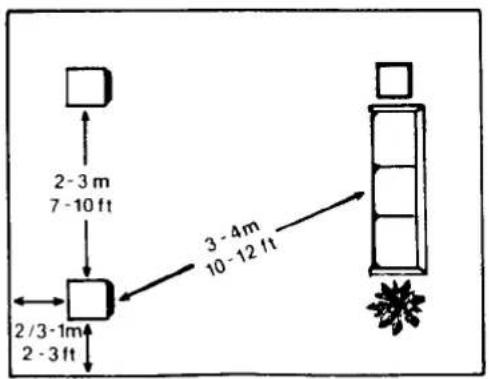
By choice or necessity, you may be placing your Infinity loudspeakers on a shelf directly against the wall. However, this is not optimum as you will sacrifice the depth of image that is characteristic of Infinity speakers. Remember to angle them in slightly, towards your listening position.
Also, if you must mount the speakers higher than ear level, place a shim under the rear of the cabinets, to angle the front plane of the speakers slightly down.
If the speakers are mounted near the floor a shim should be used to tilt the frontal plane of the speaker backwards, with the sound directed slightly upward.
Note that the average living room has a much happier balance of acoustic properties than the typical demonstration room in a store. In most homes, carpets, drapes and furniture generally balance window areas and walls, producing a relatively optimal acoustic environment.
Where extremes exist: i.e., heavily draped and carpeted (dead sound) or wide expanses of glass in mirrored walls, picture windows, sliding glass doors, or metal table surfaces, (hard, bright sound) you can compensate for the room's acoustics by using speakers' tweeter and/or midrange controls or amplifier tone controls.
Connecting The System
Make sure the amplifiers are switched off before making connection.
Connect your amplifiers to the speakers using only 16 gauge (or larger) two-conductor wire with polarity coding. This coding may be by color, or by a thin ridge or stripe on the insulation of one conductor. It is important that the speakers be connected "in phase." Use the polarity coding to make sure that the "+" (red) terminal of each speaker is connected to its amplifier's "+" output. (It is sometimes coded "+" , colored red, or occasionally, marked "hot.")
Before switching on, check carefully to make sure that no stray or frayed strands of wire are touching both the "+" and "-" terminals at either the speaker or amplifier connections, as this will cause a short.
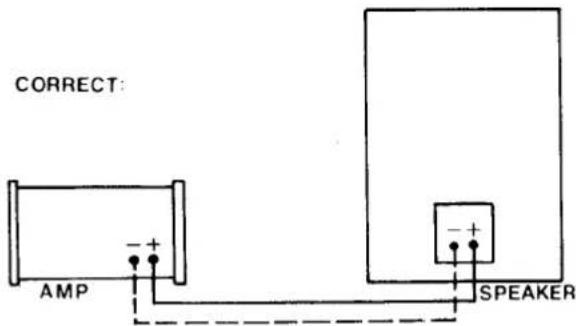
Correct ("in-phase") connection:
Plus (red) goes to plus. (This wire is usually ridged on its side.) Minus (black) goes to minus.
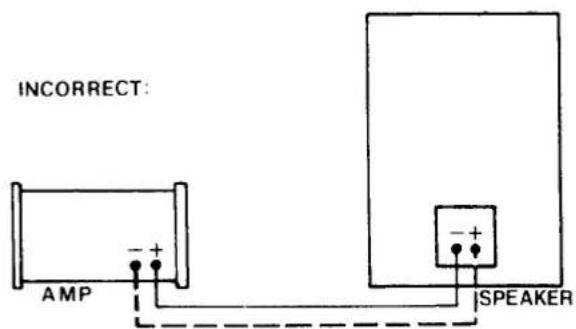
Incorrect ("out-of-phase") connection:
Plus-to-minus, and minus-to-plus. Results in distorted, "out-of-phase" sound.
Stands
No "bookshelf" type loudspeaker should rest flat on the floor surface - especially if that floor is carpeted. Bass will be exaggerated when close to room boundaries.
We advise using speaker stands. Infinity has designed stands (available through Infinity dealers) that create optimum height and angle for your Infinity speakers.
Your speakers will perform best in a vertical position, with the bottom of the cabinet 6" to 24" above the floor. If you use a 6" stand, choose one that angles the speaker slightly backwards so that the front plane of each speaker is directed upward toward your usual listening location. A 12" stand requires less tilt to accomplish the same effect. At 18" to 24" above the floor, the speakers can be mounted parallel to the floor for optimum dispersion.
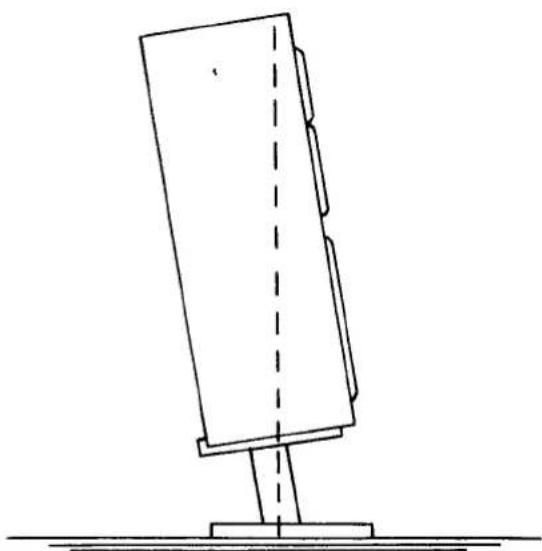
natural_image
Simple line drawing of a vertical panel mounted on a stand, with no text or symbols present.Placement of speakers.
Place speakers on stand, slightly tilted back and 6 to 12 inches off of floor.
Horizontal Mounting
If space or decor consideration require that you mount the speaker horizontally, its EMIT tweeter should be realigned to maintain its exceptional distribution of high frequencies.
Remove the grille and frame by pulling straight out. Remove the four (4) ¼ hexagonal bolts on the outer circle of the EMIT tweeter. (Don't lose them.) Turn the tweeter 90° (one quarter turn - so that the word "EMIT" reads properly.) Then re-insert the tweeter, and replace the hexagonal bolts. Your speaker will now provide proper dispersion at all frequencies.
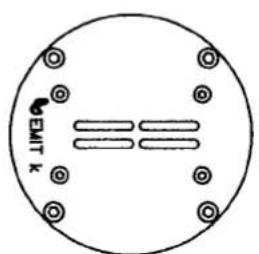
INCORRECT
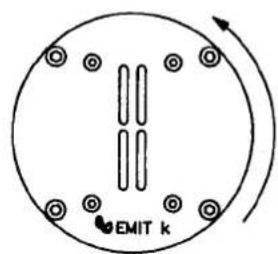
CORRECT
Correct alignment of EMIT tweeter.
When speaker is used horizontally. Realign EMIT 90°, as described in this manual, to maintain proper high frequency dispersion in horizontal use.
NOTE: Since the EMIT is not employed in all Infinity speakers, this information is not applicable to these models. They may be installed in either a vertical or horizontal position without modification.
Setting Controls On The Passive Crossover
Some Infinity speakers employ controls which must be set to balance the tweeter and midrange to match room acoustics. These controls are located on the rear of the speaker cabinet near the input terminals. Both controls should be set by listening to various types of program material and generally, once set, the controls will remain at the chosen settings until the speakers are re-located.
The midrange control varies the energy output of the midrange driver. This affects how "forward" or "distant" the sound image will appear to be. Adjust this control in small increments until you have reached a setting which pleases you.
The tweeter control varies the energy output of the high frequency driver. This affects the "bite" and lucidity of the sound. Adjust this control so high frequencies are present in proper balance and perspective.
Some Infinity speakers now employ an internal, automatic protection circuit (rather than an external fuse) to help protect the EMIT tweeters and/or POLYCELL and POLYDOME midrange drivers. These circuits will help guard against damage by momentarily opening whenever hazardous energy levels are present. Should you hear your tweeters and/or midranges "cutting in and out", chances are you are overdriving the speakers; reduce the level of music in order to avoid any consequent damage to the drivers.
A Word About Tone Controls
The tone controls on your electronic components (preamplifiers, receivers, etc.) should be used with the utmost discretion - like a fine chef uses spices - delicately. This is true in all cases, bass, treble and where available, midrange controls. Excessive boost can create severe power demands on your power amplifier, particularly in the bass. Maximum bass boost can create a demand for literally hundreds of undistorted watts in the bass region, whereas, in the "flat" position, or with the tone controls switched out of the system, your average listening level may be impressively and realistically loud at less than 1 watt. The remaining power capacity required is in reserve for power peaks on sharp transients and powerful crescendos.
Your Infinity speaker will deliver unusually even response in actual home listening environments well in excess of its conservative laboratory specifications.
NOMINAL IMPEDANCE refers to how much current is required, on the average, from an amplifier for a given voltage at its output terminals. A high impedance speaker will require less current than a low impedance speaker. Impedance is not an indication of quality or accuracy in a loudspeaker. Unless you listen to loud sustained organ music or choral works played at concert level, an amplifier rated at 8 ohms will have no difficulty driving a 4 ohm speaker.
Solid state amplifiers, properly designed and constructed will generally put out more power at 4 ohms. Ask your dealer about the actual power and reliability of your prospective amplifier or receiver at this impedance.
Understanding "Min/Max" Power Ratings
A word about power ratings:
The recommended power ratings are arrived at in the Infinity listening room and at the volume which we feel to be appropriate for musical reproduction.
Your needs may be different.
If you intend to use your speakers for background music, or at moderate levels in a small room, an amplifier or receiver with less than the recommended minimum power rating can be used. But it is important to be aware of potential damage to tweeters that exists when a low-powered amplifier or receiver is played at volumes beyond its normal limits.
At some loud, "peak" listening level all amplifiers will "clip" off the peaks of the musical signals. When this happens, the resulting harsh distortion may contain a considerable amount of supersonic energy, which is routed to the tweeters. This high energy can destroy your tweeters.
It is easier to damage any speaker with a low-powered amplifier than with a high-powered one. With a low-powered amplifier, we urge great discretion rather than high volume.
Care Of Your Speaker System
Your Infinity speaker cabinets are finished with a heavy duty, high quality vinyl which requires very little maintenance. Keep the cabinets clean by dusting them occasionally with a damp cloth, or use a good quality cream or spray furniture polish to maintain their original luster. (When using aerosol products, always spray the cleaning cloth, not the speaker, to help prevent some of the product from drifting onto the drivers and/or diaphragms.)
The grille material may be cleaned by gentle vacuuming.
Feedback
If, after taking care in positioning your speakers, you find the bass response is "boomy" or lacking in "tightness," or you hear a rumble when playing records, or you notice excessive movement of the woofer cones, the cause may be acoustic feedback. This means that vibrations from the speakers are reaching the turntable. Because of the exceptionally low frequency response of Infinity speakers, isolating the turntable from these vibrations is an important consideration.
In general, make sure the turntable is placed on a heavy, solid support, as far away as possible from the speakers. Some combinations of turntable, tonearm, and cartridge are much more apt than others to encounter feedback. If you continue to experience difficulties after some experimenting with placement, ask your Infinity dealer for assistance.
In Case Of Trouble In Your Stereo System
Note that you can use your stereo's two channels of information for simple trouble-shooting. If the sound quality is distorted, listen to each speaker separately to check if the fault is present in both. If it is, then the trouble is likely to be elsewhere in your system. If the fault is in one channel only, reverse the outputs from your amplifier to the speakers (right-to-left and left-to-right). If the distortion moves to the other channel, the fault is not in the speaker. (This technique may also be used to locate a fault between signal source and preamp/receiver and between preamp and power amp(s).)
If, however, the distortion does not shift to the other speaker, you may be able to find the source of the problem and correct it. Try, following closely the trouble-shooting procedures.
Then, if you have been unsuccessful in locating the specific sources of trouble, or if you have located it but have been unable to correct it, make these inquiries in the following order:
a. Consult the Infinity dealer from whom you purchased the system. Infinity dealers are audio specialists and can help...
b. Get the name and address of the authorized Infinity service facility nearest you by writing or calling Infinity. You may be instructed to take or send the problem part to a service facility or the factory, for service under the terms of the warranty.
NOTE: DO NOT SHIP ANY PARTS OR WHOLE SPEAKERS FOR SERVICE WITHOUT PRIOR APPROVAL ("RETURN AUTHORIZATION"), AND DO NOT SHIP ANY PARTS OR WHOLE SPEAKERS WITHOUT ENCLOSING A COPY OF YOUR ORIGINAL BILL OF SALE.
If there is no authorized service facility near you, or in the highly unlikely case that the service facility cannot solve the problem ...
c. Write or phone the service department at Infinity Systems (address: Infinity Customer Service, 9409 Owensmouth Avenue, Chatsworth, CA 91311). Describe the difficulty as specifically as possible. The service department will advise you whether to send a part or a speaker to them, prepaid, or what other action you should take.
Trouble-Shooting The Speaker
Before consulting your dealer, Infinity service facility or factory service department, there are tests you can make, to locate and solve possible problems in your Infinity speakers.
If a tweeter is apparently not working:
Step 1. Remove the grille (pull it straight out by grasping the two corners of the grille frame at the top) then visually check the four slots of the EMIT, looking through the four slots to check the etched voice-coil (the thin silver lines on the plastic film diaphragm). Look for punctures, broken lines, or lines coming loose. If you find this damage, call your dealer for instructions. If you find no damage:
Step 2. Remove the tweeter and check to see that the wires are connected. If they are loose, simply re-connect them and put the tweeter back in place. If the connections are tight and the unit is still not operating, go on to step 3.
Step 3. With tape, mark (or "flag") the wire that is hooked to the "+" terminal, then disconnect both wires. Interchange the non-operating tweeter with the one from the other cabinet. If the problem follows the tweeter, then that tweeter is defective; call your dealer for instructions. If the problem stays in the same location, call your dealer and describe the problem.
If a midrange unit is apparently not working:
Step 1. Remove the midrange driver from the enclosure. Check to see if both wires are firmly attached. If not, re-connect them and re-install the unit back into the enclosure. If the connections are tight, go on to...
Step 2. With tape, "flag" or mark the wire that goes to the terminal on the midrange unit marked with a red dot or a "+" . Disconnect the unit, and interchange it with the midrange unit from the other speaker. If the problem follows the unit, then the unit is defective. Call your dealer for instructions. If, however, the problem stays in the same location, call your dealer and describe the problem.
If a woofer is apparently not working:
The Infinity woofer is big and heavy. Use caution. Lay the speaker cabinet on its back on a soft clean cloth before removing the woofer. Be especially careful not to accidentally disconnect any of the wires attached to the voice coils.
Step 1. With tape, "flag" or mark the wires that are attached to the terminal(s) on the woofer that have a red mark (positive).
Step 2. Disable your other speaker by disconnecting it from your amplifier (unless it is a tube amp, in which case leave it hooked up), making sure that the loose ends do not touch, or "short" together. Disconect the amplifier wires from the rear of the affected speaker and connect those wires to the voice coil terminals on the suspect woofer.
With amplifier level (volume) control low, listen to a record with pronounced deep bass. If you hear sound reproduced (not necessarily bass), and that sound is undistorted (without scraping, rattling, or rubbing noises) that voice coil is operating. If there is no sound, or if that sound is distorted, that voice coil may have been damaged.
Report your findings to your Infinity dealer, and follow their instructions.
If the sound from your speaker system still seems to be distorted, but all the drivers seem to be operating properly, and you have ascertained that the problem is not in your stereo amplifier, preamp, or turntable, the problem may lie in the passive crossover inside the affected speaker. Call your dealer for advice.
Infinity strives always to update and improve existing products, as well as create new ones. So the specifications and construction detail in this Infinity publication and others are subject to change without notice.
| RS 1000 | RS 2000 | RS 3000 | |
| Frequency Response | 72 Hz-22 kHz ± 3 db | 57 Hz-22 kHz ± 3 db | 45 Hz-22 kHz ± 3 db |
| Crossover Frequencies | 5500 Hz | 4500 Hz | 4000 Hz |
| Efficiency | 8-50 watts | 15-75 watts | 20-100 watts |
| Nominal Impedence | 89 db @ 1 watt, 1 meter | 89 db @ 1 watt, 1 meter | 89 db @ 1 watt, 1 meter |
| Power Rating | 6 ohms | 6 ohms | 6 ohms |
| Dimensions | 12.75"H × 7.5"W × 6.75"D | 14.75"H × 8.8"W × 7.75"D | 20.75"H × 12"W × 10.25"D |
| RS 4000A | RS 5000A | RS 6000A | |
| Frequency Response | 45 Hz-45 kHz ± 3 db | 42 Hz-45 kHz ± 3 db | 42 Hz-45 kHz ± 3 db |
| Crossover Frequencies | 800 Hz, 3500 Hz | 650 Hz, 5000 Hz | 600 Hz, 5000 Hz |
| Efficiency | 20-125 watts | 20-135 watts | 35-200 watts |
| Nominal Impedence | 89 db @ 1 watt, 1 meter | 89 db @ 1 watt, 1 meter | 89 db @ 1 watt, 1 meter |
| Power Rating | 6 ohms | 6 ohms | 6 ohms |
| Dimensions | 22.5"H × 12.5"W × 10.25"D | 24"H × 15"W × 10.25"D | 36.5"H × 15"W × 10.25"D |
- OWNER'S MANUAL
- for your
- Infinity Speakers
- Unpacking
- Associated Components
- Positioning
- Connecting The System
- Stands
- Horizontal Mounting
- Setting Controls On The Passive Crossover
- A Word About Tone Controls
- Understanding "Min/Max" Power Ratings
- Care Of Your Speaker System
- Feedback
- In Case Of Trouble In Your Stereo System
- Trouble-Shooting The Speaker
Marke : INFINITY
Modell : Reference RS 6000A
Kategorie : Lautsprecher