
Reference 50 - Lautsprecher INFINITY - Kostenlose Bedienungsanleitung
Finden Sie kostenlos die Bedienungsanleitung des Geräts Reference 50 INFINITY als PDF.


| Produkttyp | Regallautsprecher |
| Marke | Infinity |
| Modell | Reference 50 |
| Abmessungen (B x H x T) | 230 x 380 x 280 mm |
| Gewicht | 7,5 kg pro Stück |
| Impedanz | 8 Ohm |
| Empfindlichkeit | 90 dB (2,83 V/1 m) |
| Frequenzbereich | 45 Hz – 22 kHz |
| Empfohlene Verstärkerleistung | 25 – 120 Watt |
| Tieftöner | 165 mm (6,5 Zoll) Polypropylen-Konus |
| Hochtöner | 25 mm (1 Zoll) Gewebe-Kalotte |
| Gehäusetyp | Bassreflex |
| Anschlüsse | Vergoldete Schraubklemmen (Bi-Wiring möglich) |
| Farbe | Schwarz, Echtholzfurnier |
| Stromversorgung | Passiv (keine Netzstromversorgung) |
| Lieferumfang | 2 Lautsprecher, Bedienungsanleitung |
| Reinigung | Mit weichem, trockenem Tuch abwischen; keine aggressiven Reinigungsmittel |
| Sicherheitshinweise | Nicht in der Nähe von Wasser oder Wärmequellen aufstellen; Kinder beaufsichtigen |
| Ersatzteile | Chassis und Ersatzteile über autorisierte Händler erhältlich |
Häufig gestellte Fragen - Reference 50 INFINITY
Benutzerfragen zu Reference 50 INFINITY
0 Frage zu diesem Gerät. Beantworten Sie die, die Sie kennen, oder stellen Sie Ihre eigene.
Eine neue Frage zu diesem Gerät stellen
Laden Sie die Anleitung für Ihr Lautsprecher kostenlos im PDF-Format! Finden Sie Ihr Handbuch Reference 50 - INFINITY und nehmen Sie Ihr elektronisches Gerät wieder in die Hand. Auf dieser Seite sind alle Dokumente veröffentlicht, die für die Verwendung Ihres Geräts notwendig sind. Reference 50 von der Marke INFINITY.
BEDIENUNGSANLEITUNG Reference 50 INFINITY
REFERENCE SERIES Installation and Operation Manual 10-60

UNPACKING
Inspect your speakers carefully after unpacking. If they have been damaged in transit, call your dealer, or trucking firm that delivered them for instructions on how to file a claim.
POSITIONING
Proper positioning of the speakers within the listening room is of primary importance in order to achieve the best possible sound. Room reflections, furniture placement, heavy draperies, window reflections and so on can influence sonic quality, balance and the stereo image. It is essential to experiment with different locations to determine which placement offers the best overall balance and imaging. For the best stereo effect, the speakers should be placed at least 7-10 feet apart (2 to 3 meters). At times, angling the speakers slightly inward toward the listening position will add to overall spaciousness and deliver a more realistic sound stage. Try to avoid placing the speakers directly against the wall, or in corners of the room because this may sacrifice depth of image and create excessive boominess. If you must place the speakers higher than ear level, tilt them downward to direct the tweeters toward your ears. When placing bookshelf speakers on the floor always use a pedestal, or several heavy books to keep the speakers off the floor, or rug. Coupling the speakers to the floor usually creates bass heaviness which may prove to be musically incorrect. Floor standing models do not require an extra pedestal, since these systems have been specifically designed to perform properly resting on a floor, or carpet.
INSTALLATION OF THE SPIKED FEET
All floor standing models come supplied with four (4) spiked feet (tiptoes) to isolate the speaker from floor vibrations. To install the spiked feet follow these directions:
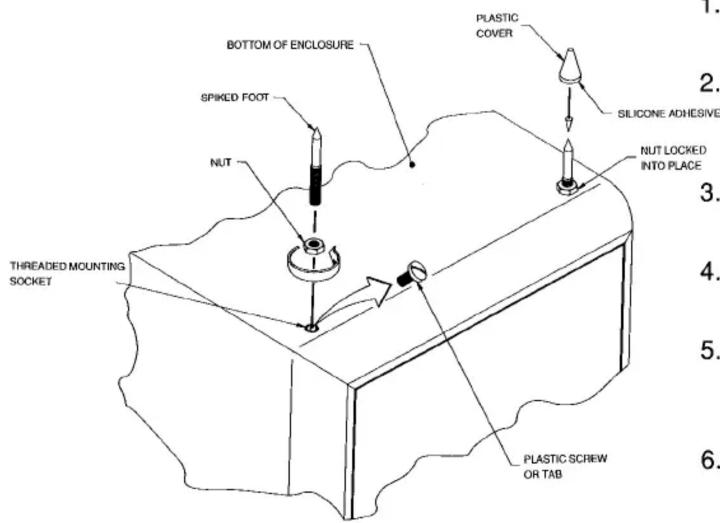
- Turn the speaker upside down with bottom of the enclosure facing upwards.
- Remove the four plastic screws (or tabs) from their mounting sockets. Store them in a safe place for future use.
- Thread a nut onto each spiked foot until the nut reaches the unthreaded section.
- Screw the spiked feet into the four (4) threaded mounting sockets.
- Adjust the spiked feet so they all are at the same height, then tighten the nuts to prevent the spiked feet from changing height, or from rocking side to side.
- If you do not wish the spikes to contact an expensive floor, place a plastic cover over each spiked foot, first inserting a small amount of silicone adhesive into the cavity of the plastic cover. Refer to the diagram at the left for complete graphics details.
CONNECTING THE SYSTEM
Make sure all equipment is turned off before making connections.
Connect your power amplifier to your speakers by using heavy gauge (#16, #14 or heavier) wire with polarity coding. The side of the wire with a ridge or other coding should be considered plus (+). The speakers must be connected in phase (both woofers always moving in the same direction at the same time) and every precaution must be taken to insure proper in-phase hookup (see diagram). If the speakers are out of phase (one speaker moving outward while the other moves inward) the result will be cancellation of bass frequencies.
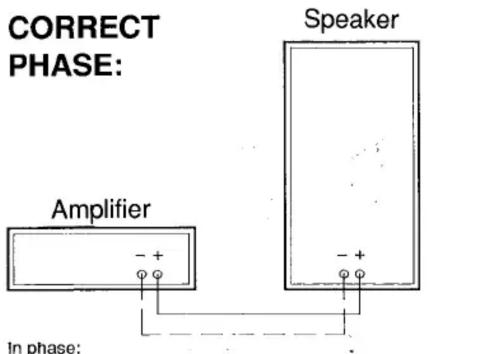
Plus (+) of amplifier goes to plus (+) (red) of speaker.
Minus (-) of amplifier goes to minus (-) (black) of speaker.
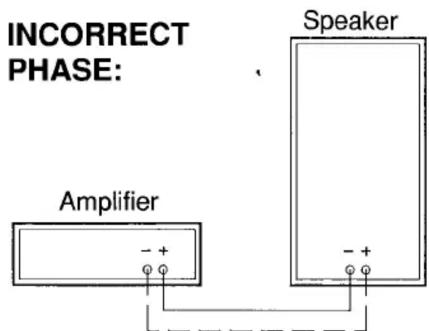
Out of Phase:
Plus (+) of amplifier goes to minus (-) (black) of speaker.
Minus (-) of amplifier goes to plus (+) (red) of speaker.
PROTECTION CIRCUITRY
All models which utilize the new Infinity EMIT-R tweeter employ a special electronic protection circuit which will switch off the tweeter if the power level exceeds the tweeter's power rating. The protection circuit automatically resets after a few seconds, restoring operation of the tweeter. Should you hear the EMIT-R tweeter switch in and out, reduce volume until the protection circuit is no longer activating.
UNDERSTANDING MIN/MAX POWER RATINGS
An amplifier with limited power output can actually cause damage to your speakers. A lower power amplifier when played beyond its power capability will go into clipping. This generates spurious high frequency signals which, when routed to the tweeter, can cause it to overheat and fail. The active protection circuitry in your Infinity speaker will generally safeguard against such failure; however, no protection circuit is foolproof and, therefore, overdriving the power amplifier must be avoided. It is for this reason that choosing an amplifier with more power than you need is always a wise choice.
ACOUSTIC FEEDBACK
Acoustic feedback is created when sound waves from your speakers reach your turntable and are fed back through the phono pickup to the power amplifier. It is a never ending cycle which can cause distortion across the entire audio band. To avoid acoustic feedback problems, place your turntable on a heavy, solid support and as far away from the speakers as possible. At times, isolating the turntable with special rubber mounts may aid in reducing this form of distortion.
CARE OF YOUR SPEAKER SYSTEM
Your Infinity speaker cabinets are covered with a quality vinyl which requires very little maintenance. Dust the enclosures with a damp cloth, or a name brand furniture polish. The grilles may be cleaned by using a vacuum cleaner on the low power setting.
IN CASE OF TROUBLE IN YOUR STEREO SYSTEM
Before consulting your dealer, Infinity service facility or the Infinity distributor in your country, there are tests you can perform to locate and solve possible problems in your speakers. You can use your stereo's two channels of information for simple trouble-shooting. If the sound quality is distorted, listen to each speaker separately to check if the fault is present in both. If it is, then the trouble is likely to be elsewhere in your system. If the fault is in one channel only, reverse the outputs of your amplifier to the speakers. If the distortion moves to the other channel, the fault is not in the speaker.
TROUBLE-SHOOTING THE SPEAKER
If a driver (tweeter, midrange, woofer) in your speaker system is not working, remove the driver from it's enclosure and check to see if the wires are connected firmly on the terminals on the driver. If the wire has come loose, reconnect it and crimp it so it does not loosen again. If all the connections are proper but the speaker does not work properly, disconnect the driver completely and substitute it with the same driver from the other speaker. If this resolves your difficulty, install the suspected defective driver into the enclosure from which you removed the properly operating driver. If the system does not play, then you know for certain that the driver is defective and has to be replaced.
In this case, or if you have been unsuccessful in locating the specific source of trouble, consult the Infinity dealer from which the speakers were purchased. Your dealer will inform you how to resolve your problem.
INFINITY constantly strives to update and improve existing products, as well as create new ones, therefore, the specifications and general information contained in this manual is subject to change without notice. ©1990, Infinity Systems, Inc.
- REFERENCE SERIES Installation and Operation Manual 10-60
- UNPACKING
- POSITIONING
- INSTALLATION OF THE SPIKED FEET
- CONNECTING THE SYSTEM
- PROTECTION CIRCUITRY
- UNDERSTANDING MIN/MAX POWER RATINGS
- ACOUSTIC FEEDBACK
- CARE OF YOUR SPEAKER SYSTEM
- IN CASE OF TROUBLE IN YOUR STEREO SYSTEM
- TROUBLE-SHOOTING THE SPEAKER
Marke : INFINITY
Modell : Reference 50
Kategorie : Lautsprecher