
CAL B 810 - Uhr CITIZEN - Kostenlose Bedienungsanleitung
Finden Sie kostenlos die Bedienungsanleitung des Geräts CAL B 810 CITIZEN als PDF.


Benutzerfragen zu CAL B 810 CITIZEN
0 Frage zu diesem Gerät. Beantworten Sie die, die Sie kennen, oder stellen Sie Ihre eigene.
Eine neue Frage zu diesem Gerät stellen
Laden Sie die Anleitung für Ihr Uhr kostenlos im PDF-Format! Finden Sie Ihr Handbuch CAL B 810 - CITIZEN und nehmen Sie Ihr elektronisches Gerät wieder in die Hand. Auf dieser Seite sind alle Dokumente veröffentlicht, die für die Verwendung Ihres Geräts notwendig sind. CAL B 810 von der Marke CITIZEN.
BEDIENUNGSANLEITUNG CAL B 810 CITIZEN
TECHNICAL INFORMATION INFORMACION TECNICA
CITIZEN QUARTZ
Cal. No. B800
Cal. No. B810
natural_image
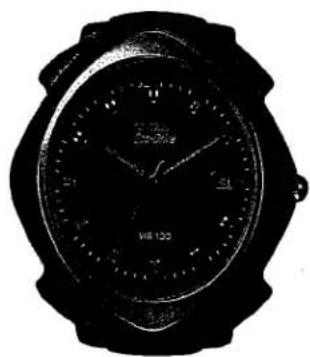
Close-up of a black wristwatch with visible dial and wrist (no text or symbols)(Cal. No. B810)
ENGLISH
Contents
§1. OUTLINE ...... 1
§2. SPECIFICATIONS ......1
§3. HANDLING OF WATCH 2
A. Solar Power Watch....2
B. Setting the Time and Calendar 2
C. Functions of the Sollar Power Watch ....3
D. Time Required for Recharge 4
E. In These Cases ....5
F. Care for handling of Charge 6
G. Replacing the Secondary Battery....6
§4. PRECAUTIONS FOR DISASSEMBLY AND ASSEMBLY .....7
A. How to Pull Out Setting Stem from One-piece Case....7
B. Precautions for Removal and Setting of Solar Cell 8
§5. DISASSEMBLY AND ASSEMBLY OF MOVEMENT (Cal. B800) .....9
§6. DISASSEMBLY AND ASSEMBLY OF MOVEMENT (Cal. B810) .....11
§7. TROUBLESHOOTING AND ADJUSTMENT ....13
ESPAÑOL
Índice
§1. DESCRIPCION GENERAL ......17
§2. ESPECIFICACIONES ....17
§3. MANEJO DEL RELOJ ....18
A. Reloj de energía solar 18
B. Ajuste de la hora....18
C. Función del reloj de energía solar....19
D. Tiempo requerido para la recarga....20
E. En estos casos ....21
F. Cuidados para el manejo de la carga....22
G. Cambio de la pila secundaria....22
§4. PRECAUCIONES PARA EL DESMONTAJE Y MONTAJE .....23
A. Forma de extraer el vástago de ajuste de una caja monopieza....23
B. Precauciones para la extracción y la colocación de la batería solar....24
§5. DESMONTAJE Y MONTAJE DEL MECANISMO (Cal. B800) .....25
§6. DESMONTAJE Y MONTAJE DEL MECANISMO (Cal. B810) .....27
§7. METODO DE INSPECCION Y DE AJUSTE DEL MECANISMO....29
§1. OUTLINE
This watch is a ladie's solar power watch which has a solar cell on its dial that converts the light energy into electrical energy to drive its mechanism.
§2. SPECIFICATIONS
| Caliber NO. | B800 | B810 | ||
| Type | Analog solar power watch (Three hands) | |||
| Movement size (mm) | ø28.2 x 3.8t | ø30.4 x 3.57t | ||
| Accuracy (At normal temperature) | ±15 sec/month (+5°C~+35°C/41°F~104°F) | |||
| IC | 1 unit of C/MOS-LSI | |||
| Operating temperature | -10°C~+60°C (14°F~140°F) | |||
| Converter | Bipolar step motor | |||
| Time adjustment | No adjustment terminal for use in market | |||
| Measurement gate | 10 sec. | |||
| Additional functions | Date (With quick setting mechanism) | Installed | ||
| Day (With quick setting mechanism) | Installed | Not installed | ||
| Quick start | Installed | |||
| Insufficient charge warning | Installed | |||
| Time setting warning | Installed | |||
| Continuous operting time | From full recharge to stop | Approx. 6 month | ||
| From two second interval movement to stop | Approx. 3 days | |||
| Secondary battery | Part NO. | 295-40 | ||
| Remarks | Secondary battery block (With welded lead plate) | |||
§3. HANDLING OF WATCH
A. Solar Power Watch
This watch is powered not by an ordinary battery, but by converting light energy into electrical energy.
A secondary battery is used in this watch to store electrical energy. This secondary battery is a clean energy battery which doesn't use any toxic substances such as mercury. Once fully charged, the watch will continue to run for about 6 months without further charging.
To use this watch comfortably, make sure that the watch is always recharged before it finally stops.
There is no concern for over-charging this watch. (Over-Charging Prevention Function is included)
Explain the user to expose the dial (solar cell) of this watch to light as long as possible.
B. Setting the Time and Calendar
B800
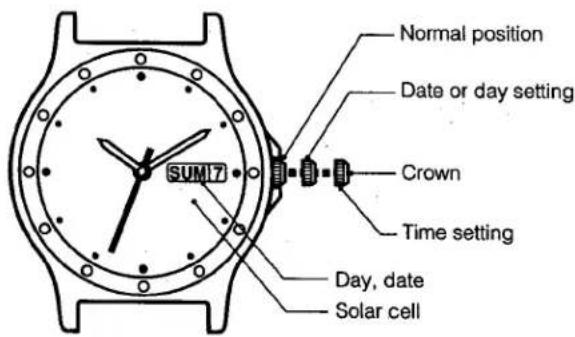
text_image
Normal position Date or day setting Crown Time setting Day, date Solar cell SUM17B810
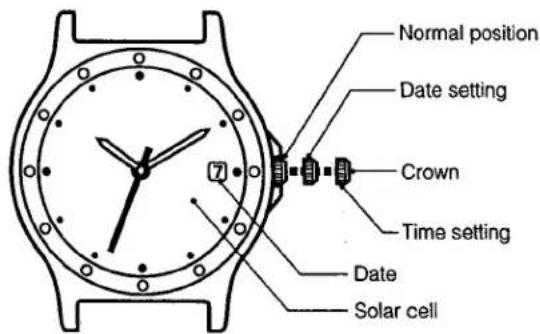
text_image
Normal position Date setting Crown Time setting Date Solar cell■ Setting the time
(1) Stop the second hand at the 0 second position by pulling the crown out to the 2nd click.
(2) Turn the crown to set the time.
(3) After setting the time, firmly push the crown back in to its normal position.
* The date changes about 0:00 a.m. When setting the time, take care of a.m. and p.m.
■ Setting the calendar
(1) Pull the crown out to the 1st click.
(2) Set the desired date by turning the crown to the left (counter clock wise).
(3) Set the desired day by turning the crown to the right (clock wise).
* For watches equipped with date display only, nothing happens when the crown is turned to the right.
(4) After you have set the calendar, be sure to firmly return the crown to its normal position.
* Do not set the calendar while the hands are indicating the following time zones.
- Watches equipped with date display: 9:00 p.m. - 1:00 a.m.
- Watches equipped with date and day display: 9:00 p.m. – About 4:00 a.m.
If the calendar is set in these time zones, it may not change even on the next day.
C. Functions of the Solar Power Watch
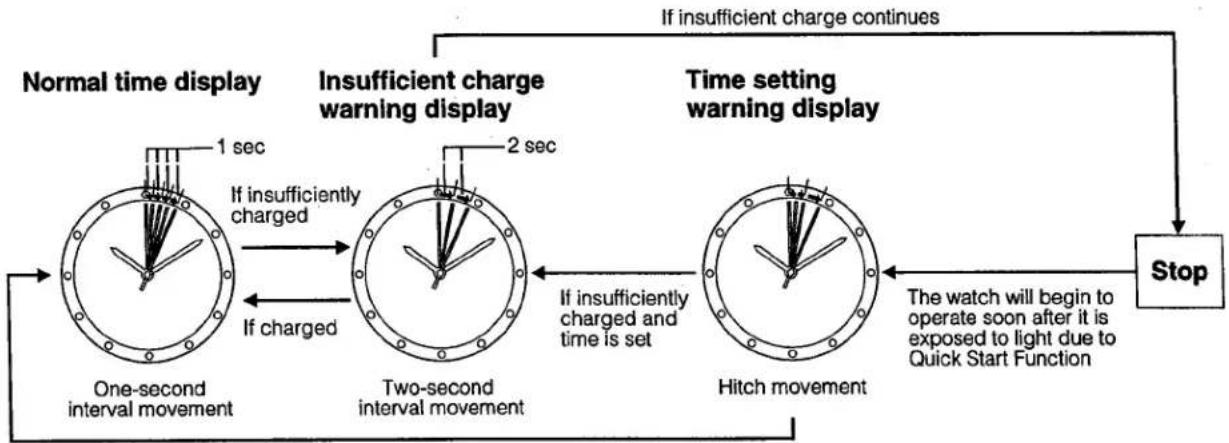
If the charge becomes insufficient, a warning function will operate and the display changes, as below.
flowchart
graph TD
    A["Normal time display"] --> B["One-second interval movement"]
    B --> C["Insufficient charge warning display"]
    C --> D["Two-second interval movement"]
    D --> E["Time setting warning display"]
    E --> F["Hitch movement"]
    F --> G["Stop"]
    style A fill:#f9f,stroke:#333
    style C fill:#f9f,stroke:#333
    style E fill:#f9f,stroke:#333
    linkStyle 0 stroke:#000,stroke-width:2px
    linkStyle 1 stroke:#000,stroke-width:2px
    linkStyle 2 stroke:#000,stroke-width:2px
    linkStyle 3 stroke:#000,stroke-width:2px
    linkStyle 4 stroke:#000,stroke-width:2px
    linkStyle 5 stroke:#000,stroke-width:2px
    linkStyle 6 stroke:#000,stroke-width:2px
    linkStyle 7 stroke:#000,stroke-width:2px
    linkStyle 8 stroke:#000,stroke-width:2px
    linkStyle 9 stroke:#000,stroke-width:2px
    linkStyle 10 stroke:#000,stroke-width:2px
    linkStyle 11 stroke:#000,stroke-width:2px
    linkStyle 12 stroke:#000,stroke-width:2px
    linkStyle 13 stroke:#000,stroke-width:2px
    linkStyle 14 stroke:#000,stroke-width:2px
    linkStyle 15 stroke:#000,stroke-width:2px
    linkStyle 16 stroke:#000,stroke-width:2px
    linkStyle 17 stroke:#000,stroke-width:2px
    linkStyle 18 stroke:#000,stroke-width:2px
    linkStyle 19 stroke:#000,stroke-width:2px
    linkStyle 20 stroke:#000,stroke-width:2px
    linkStyle 21 stroke:#000,stroke-width:2px
    linkStyle 22 stroke:#000,stroke-width:2px
    linkStyle 23 stroke:#000,stroke-width:2px
    linkStyle 24 stroke:#000,stroke-width:2px
    linkStyle 25 stroke:#000,stroke-width:2px
    linkStyle 26 stroke:#000,stroke-width:2px
    linkStyle 27 stroke:#000,stroke-width:2px
    linkStyle 28 stroke:#000,stroke-width:2px
    linkStyle 29 stroke:#000,stroke-width:2px
    linkStyle 30 stroke:#000,stroke-width:2px
    linkStyle 31 stroke:#000,stroke-width:2px
    linkStyle 32 stroke:#000,stroke-width:2px
    linkStyle 33 stroke:#000,stroke-width:2px
    linkStyle 34 stroke:#000,stroke-width:2px
    linkStyle 35 stroke:#000,stroke-width:2px
    linkStyle 36 stroke:#000,stroke-width:2px
    linkStyle 37 stroke:#000,stroke-width:2px
    linkStyle 38 stroke:#000,stroke-width:2px
    linkStyle 39 stroke:#000,stroke-width:2px
    linkStyle 40 stroke:#000,stroke-width:2px
    linkStyle 41 stroke:#000,stroke-width:2px
    linkStyle 42 stroke:#000,stroke-width:2px
    linkStyle 43 stroke:#000,stroke-width:2px
    linkStyle 44 stroke:#f99,stroke-width:2px
    linkStyle 45 stroke:#f99,stroke-width:2px
    linkStyle 46 stroke:#f99,stroke-width:2px
    linkStyle 47 stroke:#f99,stroke-width:2px
    linkStyle 48 stroke:#f99,stroke-width:2px
    linkStyle 49 stroke:#f99,stroke-width:2px
    linkStyle 50 stroke:#f99,stroke-width:2px
    linkStyle 51 stroke:#f99,stroke-width:2px
    linkStyle 52 stroke:#f99,stroke-width:2px
    linkStyle 53 stroke:#f99,stroke-width:2px
    linkStyle 54 stroke:#f99,stroke-width:2px
    linkStyle 55 stroke:#f99,stroke-width:2px
    linkStyle 56 stroke:#f99,stroke-width:2px
    linkStyle 57 stroke:#f99,stroke-width:2px
    linkStyle 58 stroke:#f99,stroke-width:2px
    linkStyle 59 stroke:#f99,stroke-width:2px
    linkStyle 60 stroke:#f99,stroke-width:2px
If sufficiently charged and time is set
■ Insufficient Charge Warning Function
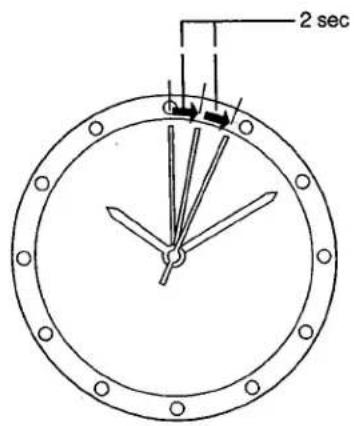
text_image
2 secTwo-second interval movement
The second hand changes to two-second interval movement to indicate insufficient recharging.
Even in such a case, the watch keeps correct time, but about 3 days after two-second interval movement begins, the watch will stop.
After exposing the watch to light, recharging takes place and the watch returns to one-second interval movement.
■ Quick Start Function
The watch will stop if it is completely discharged.
It will begin to operate soon after (within 10 second) it is exposed to light.
(However, the time to start may vary according to the brightness of the light.)
■ Time Setting Warning Function
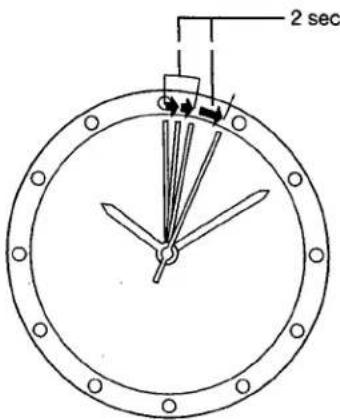
text_image
2 secHitch movement
If the watch stops, subsequent exposure to light allows the 'quick start' function to start again, and the second hand moves with a hitch to indicate that the time incorrect.
In this case, quickly recharge the watch and reset the time.
Even if the secondary battery is fully recharged, the hitch movement will continue, unless the time is reset and the crown is returned to the normal position.
■ Over-charging Prevention Function
Once the secondary battery is fully recharged, the overcharging prevention feature comes into operation and prevents over-charging.
D. Time Required for Recharge
Time required for recharge may vary according to the Caliber number, design (color of the dial, etc.) and operating environment. The following table will serve you as rough reference.
"The recharging time is the time when the watch is continuously exposed to radiation."
| Illuminance (lux) | Environment | Time required | ||
| From the stop state to the one second movement | One day usage | Empty to full | ||
| 500 | Inside an ordinary office | 22 hours | 1 hour30 minutes | 320 hours |
| 1000 | 60-70cm (24-28in.) under a fluorescent light (30W) | 11 hours | 45 minutes | 158 hours |
| 3000 | 20cm (8in.) under a fluorescent light (30W) | 3 hours30 minutes | 15 minutes | 53 hours |
| 10000 | Exterior, cloudy | 1 hour | 5 minutes | 17 hours |
| 100000 | Exterior, summer, sunny | 14 minutes | 2 minutes | 6 hours |
| Illuminance (lux) | Environment | Time required | ||
| From the stop state to the one second movement | One day usage | Empty to full | ||
| 500 | Inside an ordinary office | 22 hours | 1 hour30 minutes | 320 hours |
| 1000 | 60-70cm (24-28in.) under a fluorescent light (30W) | 11 hours | 45 minutes | 160 hours |
| 3000 | 20cm (8in.) under a fluorescent light (30W) | 3 hours30 minutes | 15 minutes | 53 hours |
| 10000 | Exterior, cloudy | 1 hour | 5 minutes | 16 hours |
| 100000 | Exterior, summer, sunny | 8 minutes | 1 minutes | 4 hours |
Full recharging time .....The time for fully recharge from stopped.
(Empty to full)
One day usage ....The time required for the watch to run for one day with one second interval movement.
E. In These Cases
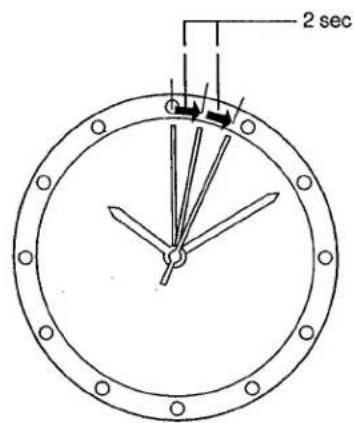
text_image
2 secTwo-second interval movement
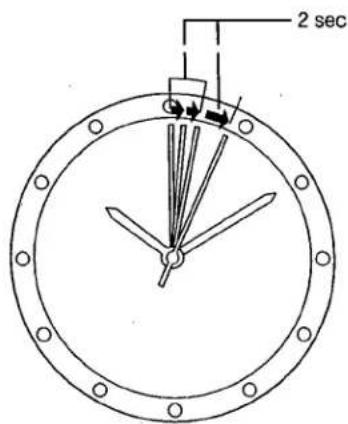
text_image
2 secHitch movement
[if the watch warns that the energy is running short]
The second hand starts moving at two-second increments in order to warn that the watch will stop functioning approximately after 3 days. (Insufficient charge warning function)
In such a case, expose the watch to light for a while to cancel the warning. (The second hand returns to the movement at one-second increments when the energy is recharged.)
If the watch is left short of energy, it will stop functioning after 3 days or so.
[If the watch warns to set the time.]
When the watch that has stopped is exposed to light, the second hands starts hitch movement. (Quick start function)
The time elapsed before the second hand restarts moving depends on the illuminance of the light.
After this also, the second hand keeps hitch movement to show that the watch indicates an incorrect time because it once stopped. (Time setting warning function)
In such a case, set the hands to the correct time.
* If the watch is insufficiently exposed to light, the second hand will soon switch to the movement at two-second increments in order to warn that the energy is running short.
F. Care for Handling of Charge
Notes on Use
Take care to charge during use.
Please note that if the user wears long sleeves, the watch can easily become insufficiently charged because it is hidden and not exposed to light.
- When the user takes off the watch, it should be placed in as bright a place as possible, and it will always continue to run poperly.
■ Notes on Recharge
- Avoid recharging at high temperatures (over about 60°C/140°F), otherwise the watch will be damaged during recharging.
(eg) Charging the watch near a light source that easily becomes hot, such as an incandescent lamp or a halogen lamp. Charging in a place that easily becomes hot, such as a dashboard.
When you charge the watch by an incondescent lamp, take a distance about 50cm (20in.) from the light source to prevent extremely high temperature.
G. Replacing the Secondary Battery
This watch uses the secondary battery, which does not have to be periodically replaced due to repeated charging and discharging, unlike ordinary batteries.
Caution
Never use a battery other than the secondary battery used in this watch.
The watch structure is so designed that a different kind of battery other than the specified cannot be used to operate it. In case a different kind of battery such as a silver battery is used by some chance, there is a danger that the watch will be overcharged to burst, causing damage to the watch and even to the human body.