
HBC84H500W - Mikroaaltouuni BOSCH - Ilmainen käyttöohje ja opas
Löydä laitteen käyttöohje ilmaiseksi HBC84H500W BOSCH PDF-muodossa.


Käyttäjien kysymyksiä aiheesta HBC84H500W BOSCH
0 kysymys tästä laitteesta. Vastaa tuntemiisi tai esitä omasi.
Esitä uusi kysymys tästä laitteesta
Lataa ohjeet laitteellesi Mikroaaltouuni PDF-muodossa ilmaiseksi! Löydä käyttöohjeesi HBC84H500W - BOSCH ja ota elektroninen laitteesi takaisin hallintaan. Tällä sivulla julkaistaan kaikki laitteidesi käyttöön tarvittavat asiakirjat. HBC84H500W merkiltä BOSCH.
KÄYTTÖOHJE HBC84H500W BOSCH

BOSCH
Rekisteröi uusi laitteesi MyBosch-palvelussa ja saat ilmaisia etuja:
Rekisteröi uusi laitteesi MyBosch-palvelussa ja saat ilmaisia etuja:
bosch-home.com/ welcome

Mikroaaltouuni
HRC4H500W
fi
Sisällysluettelo
Tärkeitä turvallisuusohjeita....3
Vaurioiden syyt 5
Asennus ja liitäntä....6
Uusi laitteesi....6
Ohjauspaneeli 6
Painikkeet 6
Toimintovalitsin ....6
Lämpötilan valitsin 6
Jäähdytyspuhallin 7
Varusteet 7
Ennen laitteen ensimmäistä käyttökertaa....7
Kellon asettaminen 7
Uunin kuumentaminen 7
Varusteiden puhdistaminen 7
Uunin asettaminen 8
Lämmitystyypin ja lämpötilan asettaminen 8
Nopea kuumentaminen 8
Automaattinen turvakytkentä....8
Mikroaaltouuni 8
Huomautuksia uunivuokista 8
Mikroaaltotehon asetukset 9
Mikroaaltouunin asettaminen 9
Yhdistetty uuni- ja mikroaaltotoiminto....9
MicroCombi-toiminnon asettaminen 9
Automaattiset ohjelmat 10
Ohjelman asettaminen....10
Sulatusohjelmat....10
Kypsennysohjelmat 11
Yhdistelmäkypsennysohjelmat 11
Aika-asetusten asettaminen 11
Ajastimen asettaminen 11
Kypsennysajan asettaminen 12
Kellon asettaminen 12
Lapsilukko 12
Lapsilukon kytkeminen päälle 12
Lapsilukon kytkeminen pois päältä 12
Lapsilukko automaattisten ohjelmien kanssa ....12
Perusasetusten muuttaminen 13
Perusasetukset ....13
Hoito ja puhdistus 13
Puhdistusaineet 13
Häiriötaulukko....14
Häiriötaulukko 14
Huoltopalvelu 15
E-numero ja FD-numero....15
Tekniset tiedot 15
Akryyliamidi elintarvikkeissa 15
Energia- ja ympäristövinkkejä....16
Energiansäästö 16
Ympäristöystävällinen hävittäminen....16
Testattu puolestasi ruoanlaittostudiossamme....16
Sulatus, kuumentaminen ja kypsentäminen mikroaaltouunilla .....16
Mikroaaltovinkkejä....19
Kakut ja leivonnaiset....19
Leivontavinkkejä....20
Paistaminen ja grillaaminen....20
Vinkkejä paistamiseen ja grillaamiseen 23
Laatikot, gratiinit, leivät täytteillä....23
Valmisruoat, pakasteet....23
Testiruoat....24
Lisätietoja tuotteista, varusteista, varaosista ja palveluista löytyy osoitteesta www.bosch-home.com ja verkkokaupasta www.bosch-eshop.com

Tärkeitä turvallisuusohjeita
Lue nämä ohjeet huolellisesti. Vain siten voit käyttää laitetta turvallisesti ja oikein. Säilytä käyttöohje tulevaa käyttöä tai seuraavia omistajia varten.
Tämä laite on tarkoitettu asennettavaksi kokonaan keittiöön. Noudata erityisiä asennusohjeita.
Tarkista laite vaurioiden varalta purkamisen jälkeen. Älä kytke laitetta, jos se on vaurioitunut kuljetuksessa.
Vain lisensoitu ammattilainen saa kytkeä laitteita, joissa ei ole pistoketta. Virheellisestä kytkennästä aiheutuneet vauriot eivät kuulu takuun piiriin.
Tämä laite on tarkoitettu vain kotitalouskäyttöön. Laitetta saa käyttää vain ruoan ja juomien valmistukseen. Laitetta on valvottava käytön aikana. Käytä tätä laitetta vain sisätiloissa.
Tämä laite on tarkoitettu käytettäväksi enintään 4000 metrin korkeudessa merenpinnan yläpuolella.
Tätä laitetta voivat käyttää yli 8-vuotiaat lapset sekä henkilöt, joiden fyysinen, sensorinen tai henkinen toimintakyky on rajoittunut tai joilla ei ole kokemusta tai tietoa laitteesta, jos heitä valvotaan tai heille on opastettu laitteen turvallinen käyttö ja he ovat ymmärtäneet siihen liittyvät vaarat.
Lapset eivät saa leikkiä laitteella, sen päällä tai sen lähellä. Lapset eivät saa puhdistaa
laitetta tai suorittaa yleisiä huoltotoimenpiteitä, elleivät he ole vähintään 8-vuotiaita ja heitä valvotaan.
Pidä alle 8-vuotiaat lapset turvallisen etäisyyden päässä laitteesta ja virtajohdosta.
Aseta lisävarusteet aina oikein keittoaukkoon. Katso "Lisävarusteiden kuvaus" käyttöohjeesta.
Tulipalovaara!
- Laite kuumenee erittäin kuumaksi. Jos laite on asennettu kalusteyksikköön, jossa on koristeovi, lämpöä kertyy, kun koristeovi on suljettu. Käytä laitetta vain, kun koristeovi on auki. ■ Keittotilaan varastoidut syttyvät esineet voivat syttyä palamaan. Älä koskaan säilytä syttyviä esineitä keittotilassa. Älä koskaan avaa laitteen luukkua, jos sisällä on savua. Kytke laite pois päältä ja irrota se pistorasiasta tai kytke sulake pois päältä.
■ Laitteen käyttö muuhun kuin sen käyttötarkoitukseen on vaarallista ja voi aiheuttaa vahinkoja.
Seuraavat toimet eivät ole sallittuja: ruoan tai vaatteiden kuivaaminen, tohveleiden, vilja- tai yrttityynyjen, sienien, kosteiden siivousliinojen tai vastaavien lämmittäminen.
Esimerkiksi lämmitetyt tohvelit ja vilja- tai yrttityynyt voivat syttyä palamaan, jopa useita tunteja lämmityksen jälkeen. Laitetta saa käyttää vain ruoan ja juomien valmistukseen.
- Ruoan voi syttyä palamaan. Älä koskaan kuumenna ruokaa lämpöä pidättävissä pakkauksissa. Älä jätä ruokaa kuumenemaan ilman valvontaa muovi-, paperi- tai muista syttyvistä materiaaleista valmistetuissa astioissa. Älä valitse mikroaaltotehoa tai -aikaa suuremmaksi kuin on tarpeen. Noudata tässä käyttöohjeessa annettuja ohjeita.
Älä koskaan käytä mikroaaltouunia ruoan kuivaamiseen.
Älä koskaan sulata tai kuumenna vähän vettä sisältävää ruokaa, kuten leipää, liian suurella mikroaaltoteholla tai liian pitkään.
- Ruokaöljy voi syttyä palamaan. Älä koskaan käytä mikroaaltouunia ruokaöljyn kuumentamiseen yksinään.
Räjähdysvaara!
Nesteet ja muut elintarvikkeet voivat räjähtää tiiviisti suljetuissa astioissa. Älä koskaan kuumenna nesteitä tai muita elintarvikkeita tiiviisti suljetuissa astioissa.
Vakavan terveyshaitan vaara!
■ Laitteen pinta voi vaurioitua, jos sitä ei puhdisteta kunnolla. Mikroaaltoenergiaa voi päästä ulos. Puhdista laite säännöllisesti ja poista ruokajäämät välittömästi. Pidä keittotila, luukun tiiviste, luukku ja luukun pysäytin aina puhtaina; katso myös kohta Hoito ja puhdistus.
■ Mikroaaltoenergiaa voi päästä ulos, jos keittotilan luukku tai luukun tiiviste on vaurioitunut. Älä koskaan käytä laitetta, jos keittotilan luukku tai luukun tiiviste on vaurioitunut. Ota yhteyttä huoltopalveluun. ■ Mikroaaltoenergiaa pääsee ulos laitteista, joissa ei ole runkoa. Älä koskaan poista runkoa. Kaikki huolto- ja korjaustyöt on annettava huoltopalvelun tehtäväksi.
Sähköiskun vaara!
■ Virheelliset korjaukset ovat vaarallisia. Korjaukset saa tehdä ja vaurioituneet virtajohdot saa vaihtaa vain koulutettu huoltoteknikko. Jos laite on viallinen, irrota laite verkkovirrasta tai kytke sulake pois päältä sulakekaapista. Ota yhteyttä huoltopalveluun.
■ Sähkölaitteiden johtojen eristys voi sulaa, jos ne koskettavat laitteen kuumia osia. Älä koskaan anna sähkölaitteiden johtojen koskettaa laitteen kuumia osia. - Älä käytä korkeapainepesureita tai höyrypuhdistimia, jotka voivat aiheuttaa sähköiskun. ■ Tunkeutuva kosteus voi aiheuttaa sähköiskun. Älä koskaan altista laitetta voimakkaalle kuumuudelle tai kosteudelle. Käytä laitetta vain sisätiloissa.
Viallinen laite voi aiheuttaa sähköiskun. Älä koskaan kytke viallista laitetta päälle. Irrota laite verkkovirrasta tai kytke sulake pois päältä sulakekaapista. Ota yhteyttä huoltopalveluun.
■ Laite on suurjännitelaite. Älä koskaan poista runkoa.
Palovammojen vaara!
■ Laite kuumenee hyvin kuumaksi. Älä koskaan kosketa keittotilan sisäpintoja tai lämmitysvastuksia.
Anna laitteen aina jäähtyä. Pidä lapset turvallisen etäisyyden päässä.
■ Varusteet ja uunivuoat kuumenevat erittäin kuumiksi. Käytä aina uunikintaita poistaessasi varusteita tai uunivuokia kypsennystilasta. ■ Alkoholihöyryt voivat syttyä palamaan kuumassa kypsennystilassa. Älä koskaan valmista ruokaa, joka sisältää suuria määriä korkea-alkoholisia juomia. Käytä vain pieniä määriä korkea-alkoholisia juomia. Avaa laitteen luukku varovasti. - Ruoat, joissa on kuori tai nahka, voivat räjähtää tai poksahtaa kuumentamisen aikana tai sen jälkeen. Älä koskaan keitä munia kuorineen tai lämmitä kovaksi keitettyjä munia uudelleen. Älä koskaan keitä äyriäisiä tai katkarapuja. Puhkaise aina keltuainen, kun paistat tai haudutat munia. Ruokien, joissa on kuori tai nahka, kuten omenoiden, tomaattien, perunoiden ja makkaroiden, kuori voi poksahtaa. Puhkaise kuori tai nahka ennen kuumentamista. ■ Lämpö ei jakaudu tasaisesti vauvanruoassa. Älä koskaan lämmitä vauvanruokaa suljetuissa astioissa. Poista aina kansi tai tutti. Sekoita tai ravista hyvin kuumentamisen jälkeen. Tarkista ruoan lämpötila ennen kuin annat sen lapselle. ■ Kuumentunut ruoka luovuttaa lämpöä. Uunivuoka voi kuumentua. Käytä aina uunikintaita poistaessasi uunivuokia tai varusteita kypsennystilasta. - Ilmatiiviit pakkaukset voivat poksahtaa, kun ruokaa kuumennetaan. Noudata aina pakkauksen ohjeita. Käytä aina uunikintaita poistaessasi astioita kypsennystilasta.
Palovamman vaara!
- Kun avaat laitteen luukun, kuumaa höyryä voi päästä ulos. Avaa laitteen luukku varovasti. Pidä lapset turvallisen etäisyyden päässä. ■ Vesi kuumassa kypsennystilassa voi muodostaa kuumaa höyryä. Älä koskaan kaada vettä kuumaan kypsennystilaan. Nesteen kuumentamisessa on mahdollista viivästynyt kiehuminen. Tämä tarkoittaa, että neste saavuttaa kiehumislämpötilan ilman, että tavallisia höyrykuplia nousee pintaan. Vaikka astia vain tärähtäisi hieman, kuuma neste voi yhtäkkiä kiehua ja roiskua. Kuumentaessasi aseta aina lusikka astiaan. Tämä estää viivästyneen kiehumisen.
Loukkaantumisvaara!
- Naarmuuntunut lasi laitteen luukussa voi kehittyä halkeamaksi. Älä käytä lasikaavinta, teräviä tai hankaavia puhdistusvälineitä tai pesuaineita.
- Soveltumattomat uunivuoat voivat haljeta. Posliini- tai keramiikkavuoissa voi olla pieniä reikiä kahvoissa tai kansissa. Näiden reikien alla on ontelo. Jos kosteutta pääsee tähän onteloon, se voi aiheuttaa vuoan halkeamisen. Käytä vain mikroaaltouuninkestäviä uunivuokia. Jos käytät laitetta vain mikroaaltotilassa, metallisten keittoastioiden ja säilytysastioiden asettaminen laitteen sisään voi aiheuttaa kipinöitä laitteen toimiessa. Tämä vahingoittaa laitetta. Älä koskaan käytä metalliastioita, kun käytät laitetta vain mikroaaltotilassa. Käytä vain mikroaaltouuninkestäviä keittoastioita tai vaihtoehtoisesti mikroaaltouunia yhdistettynä johonkin lämmitystapaan.
Vaurioiden syyt
Varoitus!
■ Kipinöiden syntyminen: Metallia – esim. lusikka lasissa – on pidettävä vähintään 2 cm:n etäisyydellä uunin seinistä ja luukun sisäpuolesta. Kipinät voivat vahingoittaa luukun sisäpuolen lasia korjauskelvottomasti. ■ Vesi kuumassa keittoastiassa: Älä koskaan kaada vettä kuumaan keittoastiaan. Tästä aiheutuu höyryä. Lämpötilan muutos voi aiheuttaa vaurioita. ■ Kosteat elintarvikkeet: Älä säilytä kosteita elintarvikkeita suljetussa keittoastiassa pitkiä aikoja. Älä käytä laitetta elintarvikkeiden säilytykseen. Tämä voi aiheuttaa korroosiota. ■ Jäähdytys luukku auki: Anna keittoastian jäähtyä vain luukku suljettuna. Älä jätä mitään laitteen luukun väliin. Vaikka luukku olisi vain hieman raollaan, viereisten kaapistojen etuosat voivat vaurioitua ajan myötä. ■ Hyvin likainen tiiviste: Jos tiiviste on hyvin likainen, laitteen luukku ei sulkeudu kunnolla käytön aikana. Viereisten kaapistojen etuosat voivat vaurioitua. Pidä tiiviste aina puhtaana. - Mikroaaltouunin käyttö ilman ruokaa: Laitteen käyttö ilman ruokaa keittoastiassa voi johtaa ylikuormitukseen. Älä koskaan kytke laitetta päälle, ellei keittoastiassa ole ruokaa. Poikkeuksena on lyhyt astiatesti (katso kohta "Mikroaaltouuni, sopivat astiat"). Laitteen luukun käyttäminen seisomiseen tai esineiden asettamiseen: Älä seiso tai aseta mitään avoimen luukun päälle. Älä aseta uunivuokia tai lisävarusteita luukun päälle. Laitteen kuljettaminen: Älä kanna tai pidä laitetta kiinni luukun kahvasta. Kahva ei kestä laitteen painoa ja voi katketa. Mikroaaltopopcorn: Älä koskaan aseta mikroaaltotehoa liian korkealle. Käytä enintään 600 watin tehoasetusta. Aseta popcorn-pussi aina lasialustalle. Levy voi hypähtää ylikuormitettuna. - Ylikiehunut neste ei saa päästä kiertoalustan käytön kautta laitteen sisäosaan. Valvo kypsennysprosessia. Valitse aluksi lyhyempi kypsennysaika ja pidennä sitä tarvittaessa. ■ Älä koskaan käytä mikroaaltouunia ilman kiertoalustaa.
Asennus ja liitäntä
Noudata erityisiä asennusohjeita.
Laite on varustettu pistokkeella, ja se on liitettävä vain asianmukaisesti asennettuun suojamaadoitettuun pistorasiaan. Sulakkeen on oltava vähintään 16 ampeeria (L- tai B-tyypin katkaisijat). Verkkojännitteen on vastattava arvokilvessä ilmoitettua jännitettä.
Pistorasian asennuksen ja virtajohdon vaihdon saa suorittaa vain valtuutettu sähköasentaja. Jos pistoke ei ole enää saatavilla asennuksen jälkeen, asennuspuolella on oltava kaikkinapainen erotuskytkin, jonka kosketusväli on vähintään 3 mm.
Monitoimipistorasioita, jatkojohtoja ja jatkojohtoja ei saa käyttää. Ylikuormitus voi aiheuttaa tulipalovaaran.
Uusi laitteesi
Tutustu tämän osion avulla uuteen laitteeseesi. Ohjauspaneeli ja yksittäiset käyttösäätimet ovat
Tässä on tietoa kypsennystilasta ja lisävarusteista.
Ohjauspaneeli
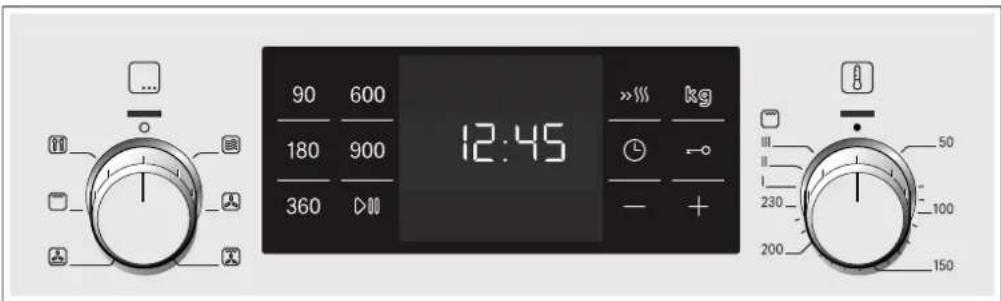
Kiertokytkin
Kiertokytkimet voidaan painaa esiin. Painaaksesi ne sisään tai ulos, aseta kiertokytkin pois päältä -asentoon ja paina sitä.
Painikkeet
Anturit sijaitsevat yksittäisten painikkeiden alla. Niitä ei saa painaa liian lujaa. Kosketa vain vastaavaa symbolia.
Painikkeet
Painikkeilla voit asettaa erilaisia toimintoja. Näytöstä voit lukea asettamasi arvot.
Symboli Painikkeen toiminto
| 90 Selects 90 watt microwave power | |
| 180 Selects 180 watt microwave power | |
| 360 Selects 360 watt microwave power | |
| 600 Selects 600 watt microwave power | |
| 900 Selects 900 watt microwave power | |
| »»Selects rapid heating | |
| kg Selects the weight | |
| ○ Opens and closes the time-setting options menu | |
| ←○ Selects childproof lock | |
| -Minus Decreases the adjustment values | |
| +Plus Increases the adjustment values | |
| ▷III Press briefly: starts/stops operationPress and hold: cancels operation |
Toiminnonvalitsin
Toiminnonvalitsimella asetat lämmitystyypin.
Asetus Käyttö
0 Pois päältä -asento Uuni on kytketty pois päältä.
| Setting Use | |
| Microwave Selects microwave operation. | |
| Hot air For baking sponge cakes in baking tins, flans and cheesecakes as well as cakes, pizza and small baked items on the baking tray. | |
| Hot air grilling Poultry goes brown and crispy.Baked casseroles and grilled dishes work out best using this setting. | |
| Pizza setting For frozen convenience products and dishes which require a lot of heat from underneath. | |
| Grill Select between the levels high, medium or low. This is ideal if you wish to grill several steaks, sausages, pieces of fish or slices of bread. | |
Ohjelmat 4 sulatusohjelmaa
11 kypsennysohjelmaa
Lämmitys- ja kypsennysaika asetetaan painon mukaan.
Huomautuksia
■ Kun teet asetuksia, toiminnonvalitsimen yläpuolella oleva merkkivalo syttyy. ■ Kun painat ▷-painiketta, uunin valo syttyy kypsennystilassa.
Lämpötilanvalitsin
Lämpötilanvalitsinta käytetään lämpötilan tai grillausasetuksen asettamiseen.
| Setting | Use |
| ● | Off position The oven does not heat up. |
Asetus Käyttö
50, 100-230=Lämpötila-alue=Lämpötila °C
I, II, III=Grillausasetukset=I = alhainen
II = keskitaso
III = korkea
Jäähdytyspuhallin
Laitteessasi on jäähdytyspuhallin. Jäähdytyspuhallin kytkeytyy päälle käytön aikana. Kuuma ilma poistuu oven yläpuolelta.
Jäähdytyspuhallin jatkaa toimintaansa jonkin aikaa käytön jälkeen.
Varusteet
Varoitus!
Kun poistat astioita, varmista, että kääntölautanen ei liiku. Varmista, että kääntölautanen on kunnolla lukittu. Kääntölautanen voi kääntyä vasemmalle tai oikealle.
Varoitus!
Älä peitä ilmanvaihtoaukkoja. Muuten laite ylikuumenee.
Huomautuksia
Laite pysyy viileänä mikroaaltotoiminnon aikana. Jäähdytystuuletin käynnistyy silti. Tuuletin voi käydä vielä mikroaaltotoiminnon päätyttyä. ■ Luukun lasiin, sisäseiniin ja pohjaan voi muodostua kondenssivettä. Tämä on normaalia eikä vaikuta haitallisesti mikroaaltotoimintoon. Pyyhi kondenssivesi pois kypsennyksen jälkeen.
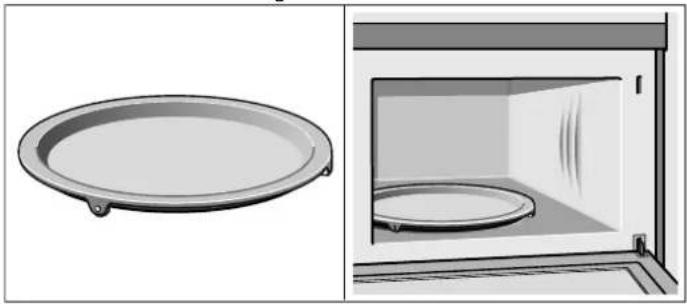
Kääntölautanen
Alustana ritilälle.
Ruoat, jotka vaativat erityisen paljon lämpöä alapuolelta, voidaan valmistaa suoraan kääntölautasella.
Kääntölautanen voi kääntyä myötä- tai vastapäivään, ja se on leikkauskestävä. Voit leikata pizzan viipaleiksi suoraan kääntölautasella.
Aseta kääntölautanen käyttötilan keskellä olevaan vetimeen. Varmista, että se on kunnolla paikallaan.
■ Älä koskaan käytä mikroaaltouunia ilman kääntölautasta. ■ Kääntölautanen kestää enintään 5 kg. ■ Kääntölautasen on pyörittävä kaikkia lämmitystapoja käytettäessä.
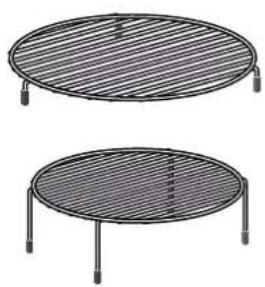
Alempi ritilä
Mikroaaltouunille sekä leivontaan ja paistamiseen uunissa.
Ylempi ritilä
Grillaukseen, esim. pihveille, makkaroille ja leivän paahtamiseen.
Matallisten matalien astioiden tukemiseen.
Ennen laitteen ensimmäistä käyttökertaa
Täältä löydät kaiken, mitä sinun on tehtävä ennen kuin käytät uunia ensimmäistä kertaa ruoan valmistukseen. Lue ensin turvallisuutta koskeva osio.
Kellon asettaminen
Kun laite on kytketty verkkovirtaan, näytössä näkyvät kolme nollaa ja
▶ -symboli. Aseta kello.
- Paina + tai = - -painiketta.
Oletusarvo +: 12:00
Oletusarvo -: 23:59
- Aseta kello + tai = - -painikkeella.
- Paina Ⓛ -painiketta.
Kello on asetettu.
Huomautus: Voit vähentää laitteen virrankulutusta valmiustilassa piilottamalla kellon. Lue tästä kohdasta Perusasetusten muuttaminen.
Uunin esikuumennus
Poistaaksesi uuden uunin hajun, kuumenna uuni tyhjänä ja suljettuna. Tunti kiertoilmalla 180 °C:ssa on ihanteellinen.
Varmista, että pakkausjäämiä ei ole jäänyt ruoanlaittotilaan.
- Aseta toimintovalitsimella Kiertoilma.
- Aseta lämpötila 180 °C:seen lämpötilanvalitsimella.
- Paina ▷|| -painiketta.
Uuni alkaa lämmetä.
Tunnin kuluttua sammuta uuni. Sammuta kääntämällä toimintovalitsin pois päältä.
Varusteiden puhdistus
Ennen kuin käytät varusteita ensimmäistä kertaa, puhdista ne huolellisesti kuumalla saippuavedellä ja pehmeällä astialiinalla.
Uunin asettaminen
Uunin asettamiseen on useita tapoja. Tässä selitämme, kuinka valitset haluamasi lämmitystavan ja lämpötilan tai grilliasetuksen. Voit myös valita ruoan kypsennysajan. Katso kohtaa Aika-asetukset.
Lämmitystavan ja lämpötilan asettaminen
Esimerkki kuvassa: Kiertoilma 200 °C.
- Aseta toimintovalitsimella lämmitystapa.
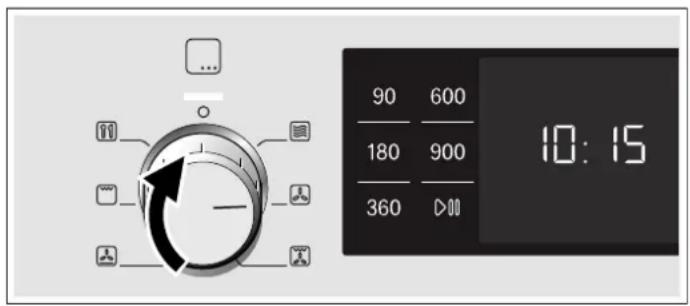
- Käytä lämpötilanvalitsinta asettaaksesi lämpötilan tai grillausasetuksen.
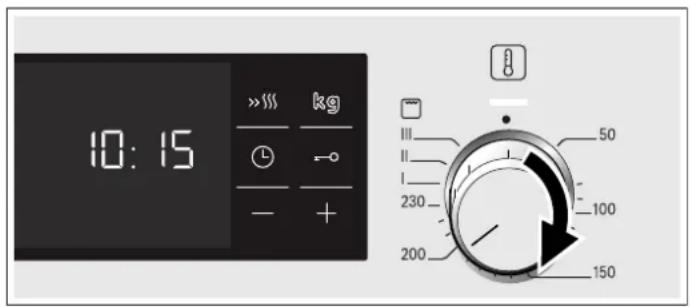
- Paina ▷□□-painiketta.
Uuni alkaa lämmetä.
Uunin luukun avaaminen käytön aikana
Toiminta keskeytyy. Kun olet sulkenut luukun, paina ▷□□-painiketta. Toiminta jatkuu.
Toiminnan keskeyttäminen
Paina ▷□□-painiketta keskeyttääksesi toiminnan. Paina ▷□□-painiketta jatkaaksesi toimintaa.
Uunin sammuttaminen
Käännä toimintovalitsin pois päältä.
Asetusten muuttaminen
Lämmitystyyppiä ja lämpötilaa tai grillausasetusta voidaan muuttaa milloin tahansa vastaavilla valitsimilla.
Nopea kuumeneminen
Nopealla kuumenemisella uuni saavuttaa asetetun lämpötilan erityisen nopeasti.
Käytä nopeaa kuumenemistoimintoa, kun asetettu lämpötila on yli 100 °C. Nopea kuumeneminen on käytettävissä seuraavilla lämmitystyypeillä:
Kiertoilma
Pizza-asetus
Kiertoilma grillaaminen
Varmistaaksesi tasaisen kypsymistuloksen, laita ruoka kypsennystilaan vasta, kun nopea esikuumennusvaihe on päättynyt.
- Lämmitystyypin ja lämpötilan asettaminen.
- Kosketa »\\\$-painiketta.
»§§-symboli syttyy näyttöön.
- Kosketa ▷□-painiketta.
Uuni alkaa lämmetä.
Nopea esikuumennus on valmis.
Äänimerkki kuuluu. Symboli sammuu näytöstä. Laita ruoka uuniin.
Nopean esikuumennuksen peruuttaminen
Kosketa lyhyesti »\\\-painiketta. »\\\-symboli sammuu näytöstä.
Automaattinen turvakatkaisu
Automaattinen turvakatkaisu aktivoituu, jos laite on toiminnassa pitkään ilman asetettua kypsennysaikaa. Aika, jonka kuluttua laite kytkeytyy itsestään pois, riippuu asetetusta toimintatilasta ja lämpötilasta.
Esimerkki: Jos uunisi toimii kiertoilmalla 160 °C:ssa, se kytkeytyy automaattisesti pois noin 5 tunnin kuluttua.
Näytössä näkyy E2. Laite kytkeytyy pois päältä. Kuittaa painamalla D III -painiketta.
Mikroaaltouuni
Mikroaallot muuttuvat lämmöksi elintarvikkeissa. Mikroaaltouunia voidaan käyttää yksinään tai yhdessä jonkin lämmitystavan kanssa. Löydät tietoa astioista ja mikroaaltouunin asetuksista.
Huomautus:
Osastosta Testattu sinulle ruoanlaittostudiossamme löydät esimerkkejä sulattamisesta, lämmittämisestä ja kypsentämisestä mikroaaltouunilla.
Huomautuksia astioista
Sopivat astiat
Sopivia astioita ovat lämmönkestävät lasista, lasikeraamisesta, posliinista, keramiikasta tai lämmönkestävästä muovista valmistetut astiat. Nämä materiaalit päästävät mikroaallot läpi.
Voit käyttää myös tarjoiluastioita. Näin sinun ei tarvitse siirtää ruokaa astiasta toiseen. Käytä vain koristeellisia kulta- tai hopeareunaisia astioita, jos valmistaja takaa, että ne soveltuvat mikroaaltouuniin.
Sopimattomat astiat
Metalliset astiat eivät sovellu. Metalli ei päästä mikroaaltoja läpi. Peitetyssä metalliastiassa oleva ruoka pysyy kylmänä.
Varoitus!
Kipinöiden muodostuminen: metallin – esim. lusikan lasissa – on oltava vähintään 2 cm:n päässä uunin seinistä ja luukun sisäpuolelta.
Kipinät voivat rikkoa luukun sisäpuolen lasin.
Astiatesti
Älä kytke mikroaaltouunia päälle, ellei sisällä ole ruokaa. Seuraava uuninkestävyystesti on ainoa poikkeus tähän sääntöön.
Suorita seuraava testi, jos olet epävarma siitä, sopiiko astiasi mikroaaltouuniin:
- Kuumenna tyhjä astia täydellä teholla 1/2–1 minuutin ajan.
- Tarkista lämpötila silloin tällöin tänä aikana.
Astian tulisi olla vielä kylmä tai haalea kosketettaessa.
Astia ei sovellu, jos se kuumenee tai siitä syntyy kipinöitä.
Mikroaaltotehon asetukset
Aseta haluamasi mikroaaltoteho painikkeella.
90 W herkkien ruokien sulattamiseen
180 W sulattamiseen ja kypsennyksen jatkamiseen
360 W lihan kypsentämiseen ja herkkien ruokien lämmittämiseen
600 W ruoan lämmittämiseen ja kypsentämiseen
900 W nesteiden lämmittämiseen
Huomautukset
■ Kun painat painiketta, valittu teho syttyy. Mikroaaltoteho voidaan asettaa 900 wattiin enintään 30 minuutiksi. Kaikilla muilla tehoasetuksilla enimmäiskypsennysaika on 1 tunti 30 minuuttia.
Mikroaallon asettaminen
Esimerkki: Mikroaaltoteho 600 W, kypsennysaika 17 minuuttia.
- Aseta toimintovalitsin asentoon ≈.
- Paina haluamaasi mikroaaltotehopainiketta.
600 W:n tehotaso syttyy ja ehdotettu kypsennysaika tulee näyttöön.
- Aseta kypsennysaika +- tai --painikkeella.
- Paina ▷□□-painiketta.
Toiminta alkaa. Kypsennysaika alkaa laskea näytössä.
Kypsennysaika on kulunut
Äänimerkki kuuluu. Mikroaaltotoiminto on päättynyt. Käännä toimintovalitsin nolla-asentoon. Voit pysäyttää äänimerkin painamalla ⏻-painiketta.
Uunin luukun avaaminen kypsennyksen aikana
Toiminta keskeytyy. Sulje luukku ja paina lyhyesti ▷□-painiketta. Toiminta jatkuu.
Kypsennysajan muuttaminen
Tämän voi tehdä milloin tahansa. Käytä +- tai --painiketta muuttaaksesi kypsennysaikaa.
Mikroaaltotehon asetuksen muuttaminen
Kosketa uuden mikroaaltotehon asetuksen painiketta. Käytä +- tai --painiketta asettaaksesi kypsennysajan ja käynnistä mikroaaltouuni uudelleen.
Toiminnan keskeyttäminen
Kosketa ▷■-painiketta keskeyttääksesi toiminnan. Kosketa ▷■-painiketta jatkaaksesi toimintaa.
Toiminnan peruuttaminen
Pidä ▷□□-painiketta painettuna noin 4 sekunnin ajan ja käännä toimintovalitsin pois päältä.
Huomautuksia
■ Kun asetat toimintovalitsimen asentoon ≈, suurin mikroaaltotehoasetus syttyy aina ehdotetuksi asetukseksi. ■ Jos avaat laitteen luukun kypsennyksen aikana, tuuletin voi jatkaa toimintaansa.
Yhdistetty uuni- ja mikroaaltotoiminto
Käytä mikroaaltouunia samanaikaisesti uunin toimintatilan kanssa. Keskeytä toiminta
Ruoka rapeutuu ja ruskistuu kuten uunissa, mutta nopeammin. Kosketa ▷□-painiketta keskeyttääksesi toiminnan. Kosketa ▷□-painiketta jatkaaksesi toimintaa.
Voit yhdistää kaikki mikroaaltotehoasetukset enintään 600 W uunin toimintatiloihin.
Noudata uunivuokia koskevia ohjeita Mikroaallot-osiossa.
MicroCombi-toiminnon asettaminen
Esimerkki: Mikroaaltoteho 360 W, 17 minuuttia ja 🔍 Kiertoilma 190 °C.
- Aseta lämmitystyyppi toimintovalitsimella ja lämpötila lämpötilanvalitsimella.
- Kosketa mikroaaltotehon asetuspainiketta, jonka haluat. Näyttöön tulee ehdotettu kypsennysaika.
- Aseta kypsennysaika +- tai --painikkeella.
- Kosketa ▷□□-painiketta.
Toiminta alkaa. Kypsennysaika alkaa laskea näytössä.
Kypsennysaika on kulunut
Äänimerkki kuuluu. Yhdistelmätoiminto on päättynyt. Voit pysäyttää äänimerkin painamalla ⏻-painiketta.
Uunin luukun avaaminen kypsennyksen aikana
Toiminta keskeytyy. Kun luukku on suljettu, kosketa lyhyesti ▷□-painiketta. Toiminta jatkuu.
Toiminnan keskeyttäminen
Lisää Kosketa ▷-painiketta keskeyttääksesi toiminnan. Kosketa ▷-painiketta jatkaaksesi toimintaa.
Kypsennysajan muuttaminen
Tämä voidaan tehdä milloin tahansa. Muuta kypsennysaikaa +- tai --painikkeella.
Mikroaaltotehon asetuksen muuttaminen
Paina uuden mikroaaltotehon asetuksen painiketta. Käytä + tai - painiketta asettaaksesi kypsennysajan ja käynnistä mikroaaltouuni uudelleen.
Toiminnon peruuttaminen
Pidä ▷□□ painiketta painettuna noin 4 sekunnin ajan ja käännä toimintovalitsin takaisin pois päältä -asentoon.
Automaattiohjelmat
Automaattiohjelmien avulla voit valmistaa ruokaa erittäin helposti. Valitset ohjelman ja syötät ruoan painon. Automaattiohjelma tekee optimaalisen asetuksen, ja voit valita 15 ohjelmasta.
Aseta ruoka aina kylmään kypsennystilaan.
Ohjelman asettaminen
Kun olet valinnut ohjelman, aseta uuni. Lämpötilanvalitsimen on oltava pois päältä -asennossa.
Esimerkki kuvassa: Ohjelma 2 painolla 1 kilogramma
- Käännä toimintovalitsin automaattiohjelmat ☐ -asentoon.
Ensimmäinen ohjelmanumero tulee näyttöön.
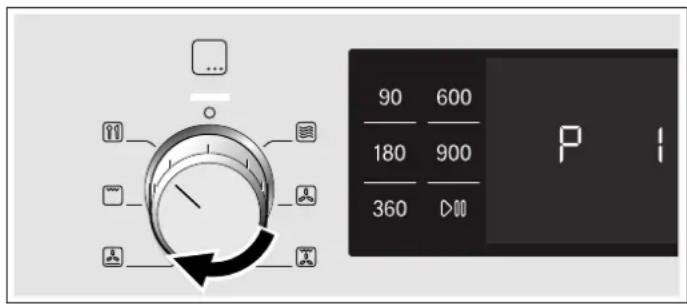
- Valitse ohjelmanumero + tai - painikkeella.
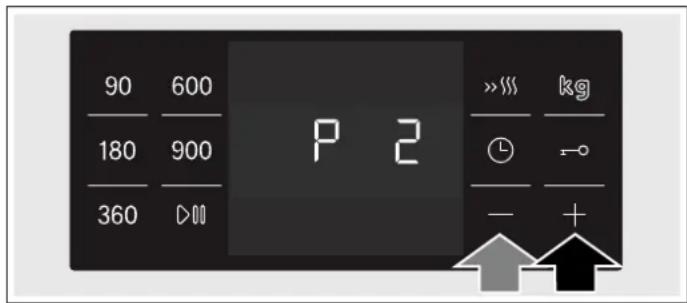
- Paina kg-painiketta. Näyttöön tulee painosuositus 0.50 kg.
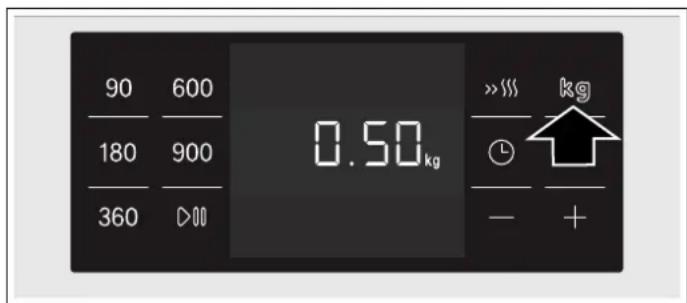
- Aseta paino + tai - painikkeella.
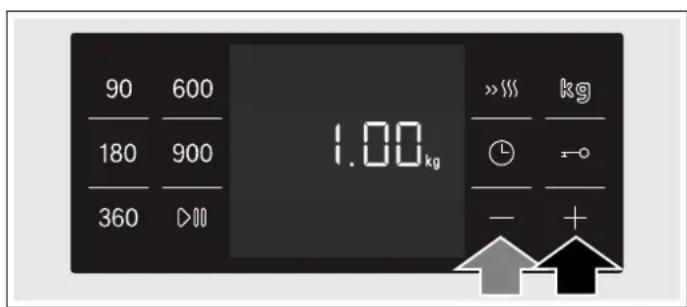
- Paina ▷□ painiketta. Ohjelma käynnistyy. Näet kypsennysajan laskevan ja ▷ ja I→I symbolit tulevat näkyviin.
Ohjelma on päättynyt
Äänimerkki kuuluu. Ohjelma on päättynyt ja uuni lopettaa kuumentamisen.
Kosketa ▷□-painiketta ja käännä toimintovalitsin pois päältä -asentoon.
Ohjelman vaihtaminen
Kun olet käynnistänyt ohjelman, ohjelman numeroa ja painoa ei voi muuttaa.
Äänimerkin sammuttaminen aikaisin
Kosketa ⏻-painiketta.
Uunin luukun avaaminen kypsennyksen aikana
Toiminta keskeytyy. Kun olet sulkenut luukun, kosketa lyhyesti ▷□-painiketta. Toiminta jatkuu.
Toiminnan keskeyttäminen
Kosketa ▷□□-painiketta keskeyttääksesi toiminnan. Kosketa ▷□□-painiketta jatkaaksesi toimintaa.
Ohjelman peruuttaminen
Pidä ▷□-painiketta painettuna noin 4 sekunnin ajan ja käännä toimintovalitsin pois päältä -asentoon. Uuni sammuu.
Kypsennysajan ja päättymisajan muuttaminen
Jos käytät automaattisia ohjelmia, et voi muuttaa kypsennysaikaa tai päättymisaikaa.
Sulatusohjelmat
Voit käyttää 4 sulatusohjelmaa lihan, siipikarjan ja leivän sulattamiseen.
Huomautuksia
■ Ruoan valmistelu Käytä ruokaa, joka on pakastettu -18 °C:ssa ja säilytetty mahdollisimman ohuina annospaloina. Ota sulatettava ruoka pois kaikista pakkauksista ja punnitse se. Tarvitset painon ohjelman asettamiseen. - Lihaa tai siipikarjaa sulatettaessa syntyy nestettä. Valuta neste pois, kun käännät lihaa ja siipikarjaa, äläkä missään tapauksessa käytä sitä muihin tarkoituksiin tai anna sen joutua kosketuksiin muiden elintarvikkeiden kanssa. Uunivuoka Aseta ruoka mikroaaltouuninkestävään matalaan astiaan, esim. posliini- tai lasilautaselle, mutta älä peitä. - Kun sulatat kanaa ja kananpalasia (P03), kuuluu äänimerkki kahdesti, mikä osoittaa, että ruoka on käännettävä. Lepoaika
Sulatetun ruoan annetaan seistä vielä 10–30 minuuttia, kunnes se saavuttaa tasaisen lämpötilan. Suuret lihapalat vaativat pidemmän seisonta-ajan kuin pienemmät palat. Litteät lihapalat ja jauhelihasta tehdyt tuotteet tulee erottaa toisistaan ennen seisottamista.
Tämän jälkeen voit jatkaa ruoan valmistamista, vaikka paksut lihapalat saattavat olla vielä jäässä keskeltä. Siipikarjan sisäelimet voidaan poistaa tässä vaiheessa.
| Programme no. | Weight range in kg |
| Defrost | |
| P 01 | Minced meat 0.20 - 1.00 |
| P 02 | Pieces of meat 0.20 - 1.00 |
| Programme no. | Weight range in kg | |
| P 03 | Chicken, chicken pieces | 0.40 - 1.80 |
| P 04 | Bread=0.20 - 1.00 | |
Kypsennysohjelmat
Kolmen kypsennysohjelman avulla voit kypsentää riisiä, perunoita tai vihanneksia.
Huomautuksia
■ Ruoan valmistelu
Punnitse ruoka. Tarvitset painon ohjelman asettamiseen.
■ Uunivuoka
Yleensä ruoka on kypsennettävä mikroaaltouuninkestävässä astiassa, jossa on kansi. Riisille tulee käyttää suurta, syvää astiaa. Aseta astia alemmalle ritilätasolle.
Riisi (P05)
Huomautus: Älä käytä keittopussiriisiä. Riisi vaahtoaa paljon kypsennyksen aikana. Syötä kypsentämätön paino (ilman nestettä). Lisää riisiin kaksi tai kaksi ja puoli kertaa nestemäärä.
Perunat (P06)
Huomautus: Keitetyt perunat:
Leikkaa samankokoisiksi paloiksi. Lisää hieman suolaa ja 1 ruokalusikallinen vettä jokaista 100 grammaa perunoita kohden.
Vihannekset (P07)
Huomautukset
■ Tuoreet vihannekset:
Leikkaa samankokoisiksi paloiksi. Lisää 1 ruokalusikallinen vettä jokaista 100 grammaa vihanneksia kohden.
Lepoaika
Kun ohjelma on päättynyt, sekoita ruokaa uudelleen. Anna sen seistä vielä 5-10 minuuttia, kunnes se on tasalämpöistä.
Kypsennystulos riippuu ruoan laadusta ja koostumuksesta.
| Programme no. | Weight range in kg |
| Cooking | |
| 05 | Rice=0.05=-0.20 |
| 06 | Potato=0.15=-1.00 |
| 07 | Vegetables=0.15=-1.00 |
Yhdistelmäkypsennysohjelmat
Huomautukset
Ota ruoka pois pakkauksestaan ja punnitse se. Jos tarkkaa painoa ei voi syöttää, pyöristä se ylös- tai alaspäin. ■ Uunivuoka
Kypsennä ruoka uunivuoassa, joka ei ole liian suuri ja on lämmönkestävä sekä mikroaaltouuninkestävä. Aseta uunivuoka alemmalle ritilätasolle.
Lammas, medium (P12)
Sopiva olkapäälle tai luuttomalle lampaanreidelle.
Lihamureke (P13)
Ohjelma sopii lihamurekkeille, joiden korkeus on enintään 7 cm.
Kala, kokonainen (P14)
Suomusta kala etukäteen. Aseta kala uunivuokaan uintiasentoon.
Riisipata (P15)
Syötä vain riisin paino. Sopii riisipadoille, joissa on vihanneksia, kalaa tai siipikarjaa. Käytä vain tuoreita raaka-aineita. Käytä korkeareunaista vuokaa, jossa on kansi.
Lepoaika
Kun ohjelma on päättynyt, ruoan annetaan levätä vielä noin 5-10 minuuttia, jotta se saavuttaa tasaisen lämpötilan.
| Programme no. | Weight range in kg | ||
| Combi-cooking | |||
| 08 | Bake, frozen* (up to 3=cm in height) | 0.40=-1.20 | |
| 09 | Chicken, whole*=0.50=-2.00 | ||
| ches | 10 | Sirloin, medium*=0.50=-1.50 | |
| 11 | Pork neck joint=0.50=-2.00 | ||
| =of | 12 | Lamb, medium=0.80=-2.00 | |
| 13 | Meat loaf*=0.50=-1.50 | ||
| 14 | Fish, whole=0.30=-1.00 | ||
| 15 | Rice stew using fresh ingredients | 0.05=-0.20 | |
* Käytä uunivuokaa ilman kantta
Aika-asetusten asettaminen
Uunissasi on useita aika-asetuksia. Voit käyttää ⏻-painiketta avataksesi valikon ja vaihtaaksesi toimintojen välillä. Niin kauan kuin symbolit ovat valaistuina, voit tehdä asetuksia. ▶-nuoli näyttää aktiivisen aika-asetuksen. Jo asetettua aika-asetusta voi muuttaa suoraan +- tai --painikkeella, kun ▶-nuoli on kyseisen aikasymbolin kohdalla.
Ajastimen asettaminen
Voit käyttää ajastinta keittiöajastimena. Se toimii itsenäisesti uunista riippumatta. Ajastimella on oma äänimerkki. Näin voit erottaa, onko kyseessä ajastin vai kypsennysaika, joka on kulunut loppuun.
- Paina ⏻-painiketta kerran.
Ajan symbolit syttyvät näyttöön ja ajastin on ♠-merkin vieressä.
- Aseta ajastimen kesto +- tai --painikkeella.
+-painikkeen oletusarvo = 10 minuuttia
—-painikkeen oletusarvo = 5 minuuttia
Muutaman sekunnin kuluttua aika-asetus otetaan käyttöön. Ajastin käynnistyy. ▶-symboli syttyy näyttöön ja ajastimen kesto laskee. Muut aikamerkit sammuvat.
Ajastimen kesto on kulunut
Äänimerkki kuuluu. Näytössä näkyy 0:00. Kytke ajastin pois päältä ⏻-painikkeella.
Ajastimen keston muuttaminen
Muuta ajastimen kestoa +- tai --painikkeella. Muutaman sekunnin kuluttua muutos otetaan käyttöön.
Ajastimen keston peruuttaminen
Nollaa ajastimen kesto 0:00:ksi --painikkeella. Muutos otetaan käyttöön muutaman sekunnin kuluttua. Ajastin kytkeytyy pois päältä.
Aika-asetusten tarkistaminen
Jos useita aika-asetuksia on asetettu, vastaavat symbolit ovat valaistuina näytössä. Ajastin laskee taustalla. ⬆-symbolin edellä on ▶-nuoli ja ajastimen voi nähdä laskevan.
Tarkistaaksesi 🔒-ajastimen, I→I-keittoajan tai ⏻-kellon, kosketa ⏻-painiketta toistuvasti, kunnes nuoli osoittaa asianmukaista symbolia. Arvo näkyy muutaman sekunnin ajan näytössä.
Keittoajan asettaminen
Ruuan kypsennysaika voidaan asettaa uuniin. Kun kypsennysaika on kulunut, uuni sammuu automaattisesti. Tämä tarkoittaa, että sinun ei tarvitse keskeyttää muita töitä uunin sammuttamiseksi. Kypsennysaikaa ei voi vahingossa ylittää.
Esimerkki kuvassa: Kypsennysaika 45 minuuttia.
- Käytä toimintovalitsinta lämmitystyypin asettamiseen.
- Lämpötilavalitsinta käytetään lämpötilan tai grillausasetuksen asettamiseen.
- Kosketa ⏻-painiketta kahdesti.
Näytössä näkyy 20:00. Aikasymbolit syttyvät. Nuoli ▶ on -merkin vieressä.
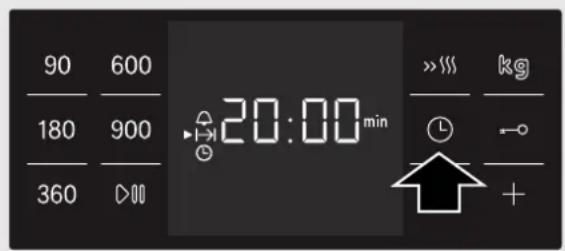
- Aseta kypsennysaika +- tai --painikkeella.
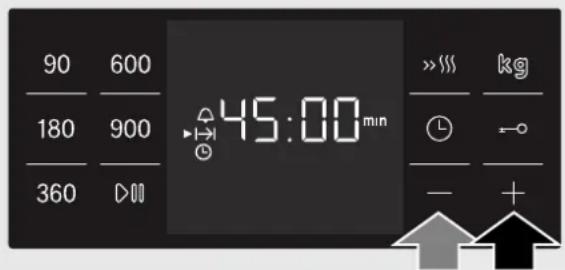
- Kosketa ▷□-painiketta.
Uuni käynnistyy. Kypsennysaika laskee näytössä, ja ▶l→l-symboli syttyy. Muut aikasymbolit sammuvat.
Kypsennysaika on kulunut.
Äänimerkki kuuluu. Uuni lopettaa kuumentamisen. Näytössä näkyy 0:00. Kosketa ⏻-painiketta. Äänimerkki lakkaa. Käännä toimintovalitsin pois päältä. Uuni on kytketty pois päältä.
Kypsennysajan muuttaminen
Muuta kypsennysaikaa +- tai --painikkeella. Muutos otetaan käyttöön muutaman sekunnin kuluttua. Jos ajastin on asetettu, kosketa ⏻-painiketta ensin.
Kypsennysajan peruuttaminen
Aseta kypsennysaika takaisin 0:00:ksi --painikkeella. Muutos otetaan käyttöön muutaman sekunnin kuluttua. Kypsennysaika peruuntuu. Jos ajastin on asetettu, kosketa ⏻-painiketta ensin.
Aika-asetusten tarkistaminen
Jos useita aika-asetuksia on asetettu, vastaavat symbolit syttyvät näyttöön. ▶-nuoli on sen aikatoiminnon symbolin vieressä, joka on tällä hetkellä näkyvissä näytössä.
Voit tarkistaa 🔒 ajastimen, I→I kypsennysajan tai ⏱ kellon koskettamalla ⏱-painiketta toistuvasti, kunnes ▶-nuoli osoittaa sopivaan
symboliin. Näyttö näyttää arvon muutaman sekunnin ajan.
Kellon asettaminen
Kun laite on kytketty sähköverkkoon tai sähkökatkoksen jälkeen, ▶-symbolit ja kolme nollaa syttyvät näyttöön. Aseta kello.
- Kosketa +- tai --painiketta.
Oletusarvo +: 12:00
Oletusarvo -: 23:59
- Aseta kello +- tai --painikkeella.
- Kosketa Ⓛ-painiketta. Aika on asetettu.
Kellon vaihtaminen
Edellytys: Laitteen on oltava sammutettuna.
- Koske Ⓛ-painiketta kahdesti.
Aikasymbolit syttyvät näytössä, ▶-nuoli on ⏻-symbolin vieressä.
- Muuta kelloa +- tai --painikkeella.
Muutaman sekunnin kuluttua asetettu aika otetaan käyttöön.
Kellon piilottaminen
Voit piilottaa kellon. Lisätietoja on kohdassa Perusasetusten muuttaminen.
Lapsilukko
Uunissa on lapsilukko, joka estää lapsia kytkemästä sitä vahingossa päälle.
Uuni ei reagoi mihinkään asetuksiin. Ajastin ja kello voidaan asettaa myös silloin, kun lapsilukko on kytketty päälle.
Lapsilukon kytkeminen päälle
Edellytys: Ruoanlaittoaikaa ei saa olla asetettu ja toimintovalitsin on pois päältä.
Pidä —O-painiketta painettuna noin neljä sekuntia.
Näyttöön ilmestyy —○-symboli. Lapsilukko on aktivoitu.
Lapsilukon kytkeminen pois päältä
Pidä —O-painiketta painettuna noin neljä sekuntia.
Näytössä oleva -O-symboli sammuu. Lapsilukko on poistettu käytöstä.
Lapsilukko automaattiohjelmissa
Kun automaattiohjelmat on asetettu, lapsilukko ei ole toiminnassa.
Perusasetusten muuttaminen
Laitteessasi on useita perusasetuksia, joita voit muuttaa milloin tahansa.
Perusasetukset
Taulukosta löydät kaikki perusasetukset ja vaihtoehdot niiden muuttamiseen.
| Basic setting | Options | Explanation | |
| c1Clock display 1 = on | Clock display 2 = off | Displays the clock | |
| c2Signal duration 2 = medium = 2 minutes | 1 = short = 10 seconds 3 = long = 5 minutes | Audible signal after the cooking time has elapsed | |
| c3Signal volume 2 = medium | 1 = low 3 = high | Volume of the signal | |
| c4Waiting time 2 = medium = 5 seconds | 1 = short = 2 seconds 3 = long = 10 seconds | Waiting time between two separate steps, after setting | |
Edellytys: Laite on kytketty pois päältä.
- Pidä ⏻-painiketta painettuna useita sekunteja.
Ensimmäinen perusasetus tulee näkyviin näyttöön.
- Muuta perusasetusta +- tai =-painikkeella.
- Vahvista painamalla ⏻-painiketta.
Seuraava perusasetus tulee näkyviin näyttöön. Voit käydä läpi kaikki perusasetukset ⏻-painikkeella ja tehdä muutoksia +- tai =-painikkeella.
- Kun olet valmis, paina ja pidä painettuna ⏻-painiketta useita sekunteja.
Kaikki asetukset otetaan käyttöön.
Voit muuttaa asetuksia milloin tahansa.
Hoito ja puhdistus
Huolellisella hoidolla ja puhdistuksella mikroaaltouunisi säilyttää hyvän ulkonäön ja pysyy hyvässä kunnossa. Kerromme tässä, miten hoidat ja puhdistat laitetta oikein.

Sähköiskun vaara!
Älä käytä korkeapainepesureita tai höyrypuhdistimia, jotka voivat aiheuttaa sähköiskun.

Palovamman vaara!
Älä koskaan puhdista laitetta heti sammuttamisen jälkeen. Anna laitteen jäähtyä. Älä käytä kovia hankauslevyjä tai -sieniä.
Anna laitteen jäähtyä.

Vakava terveyshaitta!
Mikroaaltoenergiaa voi päästä ulos, jos kypsennystilan luukku tai sen tiiviste on vaurioitunut. Älä koskaan käytä laitetta, jos kypsennystilan luukku tai tiiviste on vaurioitunut. Ota yhteyttä huoltopalveluun.
Huomautuksia
Pienet värierot laitteen etuosassa johtuvat eri materiaalien, kuten lasin, muovin ja metallin, käytöstä.
Luukun paneelissa näkyvät varjot, jotka näyttävät juovilta, johtuvat uunin valon heijastuksista.
Epämiellyttävät hajut, esim. kalan käsittelyn jälkeen, voidaan poistaa helposti. Lisää muutama tippa sitruunamehua vesilasiin. Laita myös lusikka astiaan, jotta neste ei kiehu viiveellä. Kuumenna vettä 1-2 minuuttia täydellä mikroaaltoteholla.
Puhdistusaineet
Varmistaaksesi, että eri pinnat eivät vaurioidu väärän puhdistusaineen käytöstä, noudata taulukon tietoja. Älä käytä:
■ Voimakkaita tai hankaavia puhdistusaineita. ■ Metalli- tai lasikaapimia laitteen luukun lasin puhdistamiseen. ■ Metalli- tai lasikaapimia luukun tiivisteen puhdistamiseen.
Kovat hankauslevyt tai -sienet.
■ Puhdistusaineita, joissa on korkea alkoholipitoisuus.
Pese uudet puhdistusliinat huolellisesti ennen käyttöä.
Anna pintojen kuivua huolellisesti ennen laitteen käynnistämistä uudelleen.
Alue Puhdistusaineet
| Appliance front=Hot soapy water: | |
| Clean with a dish cloth and then dry with a soft cloth. Do not use glass cleaners or metal or glass scrapers for cleaning. | |
| Appliance front with steel stainless steel | Hot soapy water: Clean with a dish cloth and then dry with a soft cloth. Remove flecks of limescale, grease, starch and albumin (e.g. egg white) immediately. Corrosion can form under=such=flecks.=Special=stainless-steel cleaning agents are available from the after-sales service or from specialist retailers. Do not use glass cleaners or metal or glass scrapers for cleaning. |
| Area Cleaning agents | Area Cleaning agents | ||
| Cooking compartment | Hot soapy water or a vinegar solution:Clean with a dish cloth and then dry with a soft cloth.For stubborn dirt: Do not use oven spray or any other aggressive oven cleaners or abrasive=materials.=Scouring=pads,=rough sponges and pan cleaners are also unsuitable. These items scratch the surface. Allow the interior surfaces to dry thoroughly. | Indentation in the cooking compartment | Damp cloth:Water must not penetrate the appliance through the turntable drive. |
| Wire racks=Hot soapy water:Clean using stainless-steel cleaner or clean in the dishwasher. | |||
| Door panels=Glass cleaner:Clean with a dish cloth. Do not use a glass scraper. | |||
| Cleaning aids for the cooking compartment | Cup=filled=with=washing-up=liquid=solution:Add=a=few=drops=of=washing-up=liquid=to=a cup of water. Place a spoon into the container as well to prevent delayed boiling.Heat=the=water=for=2=minutes=at=maximum microwave output.Switch off the appliance and leave the container=to=stand=in=the=cooking=compartment with the door closed for another 5 minutes.Then wipe around the cooking compartment using a soft cloth and allow it to dry thoroughly. | Seal=Hot soapy water:Clean with a dish cloth and do not scour.Do not use metal or glass scrapers for cleaning. | |
Vikataulukko
Viat johtuvat usein yksinkertaisista syistä. Tutustu vikataulukkoon ennen huoltopalveluun ottamista.
Jos ruoka ei onnistu haluamallasi tavalla, katso 'Testattu sinulle -keittiössämme' -osiota, josta löydät runsaasti ruoanlaittovinkkejä ja -temppuja.

Sähköiskun vaara!
Virheelliset korjaukset ovat vaarallisia. Korjaukset saa suorittaa vain koulutettu huoltohenkilökuntamme.
Vikataulukko
| Problem Possible cause Remedy/information | ||
| The appliance does not work.=Faulty circuit breaker.=Look=in=the=fuse=box=and=check=that=the=circuit breaker for the appliance is in working order. | ||
| Plug not plugged in.=Plug in the plug. | ||
| Power cut=Check whether the kitchen light works. | ||
| The appliance does not work. =O appears in the display panel. | Childproof lock is active.=Deactivate the childproof lock (see section: Childproof lock). | |
| 0:00 and ➊ are in the display panel. | Power cut | Reset the clock. |
| The microwave does not switch on.=Door not fully closed.=Check whether food residue or debris is trapped in the door. | ||
| It=takes=longer=than=before=for=the=for selected microwave power level is too low.=Select a higher power level. | ||
| to heat up in the microwave | A larger amount than usual has been placed in the appliance. | Double the amount = almost double the cooking time. |
| The food was colder than usual. | Stir or turn the food during cooking. | |
| Turntable grates or grinds. | Dirt or debris in the area around the turntable drive. | Clean the rollers under the turntable and the recess in the oven floor thoroughly. |
| A particular operating mode or power level cannot be set. | The temperature, power level or combined setting is not possible for this operating mode. | Choose permitted settings. |
| E1 appears in the display panel. | The thermal safety switch-off function has been activated. | Call the after-sales service. |
| E2 appears in the display panel. | The automatic safety switch-off function has been activated. | Touch any button or turn the rotary selector. |
| E3 appears in the display panel. | The oven is malfunctioning. | Call the after-sales service. |
| E4 appears in the display panel. | The thermal safety switch-off function has been activated. | Call the after-sales service. |
| E 11 appears in the display panel. | Moisture in the control panel. | Allow the control panel to dry. |
| E 17 appears in the display panel. | Rapid heating has failed. | Call the after-sales service. |
| The appliance can be set, but does not heat up. The colon is flashing. | The demo mode has been activated. | Disconnect the appliance from the mains power supply, then reconnect it. Press and hold the → O button until the → O symbol appears in the display and the colon stops flashing. Confirm within 4 seconds using the → O button. |
Huoltopalvelu
Huoltopalvelumme on käytettävissäsi, jos laitteesi tarvitsee korjausta. Löydämme aina oikean ratkaisun, jotta vältytään tarpeettomilta huoltoteknikon käynneiltä.
E-numero ja FD-numero
Kun soitat meille, ilmoita tuotenumero (E-nro) ja valmistusnumero (FD-nro), jotta voimme antaa sinulle oikeat neuvot. Arvokilpi, jossa nämä numerot ovat, sijaitsee uunin luukun sivussa. Voit merkitä laitteesi numerot ja huoltopalvelun puhelinnumeron alla olevaan tilaan säästääksesi aikaa tarvittaessa.
E-nro FD-nro
Huoltopalvelu
Huomaa, että huoltoteknikon käynnistä peritään maksu toimintahäiriön sattuessa myös takuuaikana.
Kaikkien maiden yhteystiedot löydät oheisesta asiakaspalveluluettelosta.
Varaa teknikon käynti ja tuoteneuvonta
agid 0344 892 8979
Puhelut veloitetaan paikallisen tai matkapuhelinmaksun mukaan.
IE 01450 2655
0,03 €/min ruuhka-aikana. Ruuhka-ajan ulkopuolella 0,0088 €/min.
Luota valmistajan ammattitaitoon. Voit siis olla varma, että korjauksen suorittavat koulutetut huoltoteknikot, joilla on alkuperäiset varaosat laitteisiisi.
Tekniset tiedot
| Power supply 220-230 V, 50 Hz | |
| Total connected load 3,600 W | |
| Microwave power 900 W | |
| Microwave frequency 2,450 MHz | |
| Grill 1,750 W | |
| Hot air | 1,750 W |
| Fuse | 16 A |
| VDE approved | Yes |
| CE mark | Yes |
Tämä laite täyttää standardien EN 55011 ja CISPR 11 vaatimukset. Se on ryhmän 2, luokan B tuote.
Ryhmä 2 tarkoittaa, että mikroaallot tuotetaan elintarvikkeiden lämmittämistä varten. Luokka B ilmaisee, että laite soveltuu yksityisiin kotitalouksiin.
Akryyliamidi elintarvikkeissa
Mihin elintarvikkeisiin se vaikuttaa?
Akryyliamidia muodostuu pääasiassa vilja- ja perunatuotteissa, joita kuumennetaan korkeisiin lämpötiloihin, kuten perunalastuissa, ranskanperunoissa,
paahtoleivässä, sämpylöissä, leivässä, hienoissa leivonnaisissa (kekseissä, piparkakuissa, pikkuleivissä).
| Tips for keeping acrylamide to a minimum when preparing food | |
| General | Keep cooking times to a minimum. Cook meals until they are golden brown, but not too dark. Large, thick pieces of food contain less acrylamide. |
| Baking biscuits | Max. 200 °C in Top/bottom heating or max. 180 °C in 3D hot air or hot air mode. Max. 190°C in Top/bottom heating or max. 170 °C in 3D hot air or hot air mode. Egg white and egg yolk reduce the formation of acrylamide. |
| Oven chips | Distribute thinly and evenly over the baking tray. Cook at least 400 g at once on a baking tray so that the chips do not dry out. |
Energia- ja ympäristövinkkejä
Täältä löydät vinkkejä energian säästämiseen leivonnassa ja paistamisessa sekä laitteen asianmukaiseen hävittämiseen.
Energiansäästö
- Esikuumenna uuni vain, jos reseptissä tai käyttöohjeen taulukoissa niin mainitaan. ■ Käytä tummia, mustaksi lakattuja tai emaloituja leivinvuokia. Ne imevät lämpöä erityisen hyvin.
- Avaa uunin luukkua mahdollisimman harvoin kypsennyksen, leivonnan tai paistamisen aikana. On parasta leipoa useita kakkuja peräkkäin. Uuni on vielä lämmin. Tämä lyhentää toisen kakun paistoaikaa. Voit myös asettaa kaksi leipävuokaa vierekkäin.
Pitkien kypsennysaikojen kohdalla voit sammuttaa uunin 10 minuuttia ennen kypsennysajan päättymistä ja käyttää jälkilämpöä kypsennyksen loppuun saattamiseen.
Ympäristöystävällinen hävittäminen
Hävitä pakkaus ympäristöystävällisellä tavalla.
Tämä laite on merkitty Euroopan parlamentin ja neuvoston direktiivin 2012/19/EU mukaisesti käytetyistä sähkö- ja elektroniikkalaitteista (sähkö- ja elektroniikkalaiteromu - WEEE). Direktiivi määrittelee käytettyjen laitteiden palauttamisen ja kierrätyksen puitteet EU:n laajuisesti.
Testattu puolestasi ruoanlaittostudiossamme
Täältä löydät valikoiman reseptejä ja niille sopivat asetukset. Näytämme, mikä lämmitystapa ja mikä lämpötila tai mikroaaltoteho sopii parhaiten ateriallesi. Löydät tietoa sopivista lisävarusteista ja siitä, mille korkeudelle ne tulee asettaa. Mukana on myös vinkkejä uunivuokien ja valmistusmenetelmien käyttöön.
Huomautuksia
Taulukoiden arvot koskevat aina ruokaa, joka asetetaan kylmään ja tyhjään uunintilaan. Esikuumenna laite vain, jos taulukko niin kehottaa. Poista laitetta käyttäessäsi kaikki lisävarusteet uunintilasta, joita et aio käyttää. Älä vuoraa lisävarusteita leivinpaperilla ennen kuin ne on esikuumennettu. Taulukoiden ajat ovat vain suuntaa antavia. Ne riippuvat ruoan laadusta ja koostumuksesta. Käytä mukana toimitettuja lisävarusteita. Muita lisävarusteita saat jälleenmyyjiltä tai huoltopalvelusta. Käytä aina uunikinnasta tai patakinnasta, kun otat lisävarusteita tai uunivuokia uunintilasta.
Sulatus, kuumentaminen ja kypsentäminen mikroaaltouunilla
Seuraavissa taulukoissa on lukuisia vaihtoehtoja ja asetuksia mikroaaltouunille.
Taulukoiden ajat ovat vain suuntaa antavia. Ne voivat vaihdella käytetyn uunivuoan, ruoan laadun, lämpötilan ja koostumuksen mukaan.
Taulukoissa on usein aikavälejä. Aseta ensin lyhin aika ja pidennä sitä tarvittaessa.
On mahdollista, että sinulla on eri määrä kuin taulukoissa on ilmoitettu. Nyrkkisääntönä voidaan käyttää: kaksinkertainen määrä - hieman alle kaksinkertainen kypsennysaika, puolikas määrä - puolet kypsennysajasta.
Ennen Aseta uunivuoka alemman ritilän keskelle. Näin ruoka imee mikroaallot joka puolelta.
Sulatus
Huomautuksia
- Aseta pakastettu ruoka avoimeen astiaan ritilälle. Herkät osat, kuten kanan koivet ja siivet tai paistien rasvaiset ulkokerrokset, voidaan peittää pienillä alumiinifolion paloilla. Folio ei saa koskettaa uunintilan seiniä. Voit poistaa folion puolivälissä sulatusaikaa. Käännä tai sekoita ruokaa kerran tai kahdesti sulatuksen aikana. Suuret ruokapalat tulee kääntää useita kertoja. Käännettäessä poista sulatuksesta syntynyt neste. Anna sulatettujen tuotteiden seistä huoneenlämmössä vielä 10-60 minuuttia, jotta lämpötila tasaantuu. Siipikarjan sisäelimet voidaan poistaa tässä vaiheessa.
| Defrost Weight Microwave power setting in watts, cooking time in minutes | Notes | ||
| Whole pieces of meat (beef, veal or pork - on the bone or boned) | 800 g | 180 W, 15 mins + 90 W, 10-20 mins | Turn several times |
| 1 kg | 180 W, 20 mins + 90 W, 15-25 mins | ||
| 1.5 kg | 180 W, 30 mins + 90 W, 20-30 mins | ||
| Meat in pieces or slices of beef, veal or pork | 200 g | 180 W, 3 mins + 90 W, 10-15 mins | Separate any defrosted parts when turning |
| 500 g | 180 W, 5 mins + 90 W, 15-20 mins | ||
| 800 g | 180 W, 8 mins + 90 W, 15-20 mins | ||
| Minced meat, mixed 200 g 90 W, 10-15 mins Freeze food flat if possible | Turn several times, remove any defrosted meat | ||
| Poultry or poultry portions 600 g 180 W, 8 mins + 90 W, 10-15 mins Turn during cooking. | |||
| Duck 2 kg 180 W, 20 mins + 90 W, 30-40 mins Turn several times | |||
Kalafilee, kalapihvi tai viipaleet 400 g 180 W, 5 min + 90 W, 10-15 min Erottele sulaneet osat
| Defrost Weight Microwave power setting in watts, cooking time in minutes | Notes | ||
| Whole fish 300 g 180 W, 3 mins + 90 W, 10-15 mins - | |||
| 600 g 180 W, 8 mins + 90 W, 10-15 mins | |||
| Vegetables, e.g. peas 300 g 180 W, 10-15 mins Stir carefully during defrosting. | |||
| 600 g 180 W, 10 mins + 90 W, 10-15 mins | |||
| Fruit, e.g. raspberries 300 g 180 W, 7-10 mins Stir carefully during defrosting and sep- | arate any defrosted parts | ||
| 500 g 180 W, 8 mins + 90 W, 5-10 mins | |||
| Butter, defrosting 125 g 180 W, 1 mins + 90 W, 2-4 mins Remove all packaging | |||
| 250 g 360 W, 1 min + 90 W, 2-4 mins | |||
| Loaf of bread 500 g 180 W, 6 mins + 90 W, 5-10 mins Turn during cooking. | |||
| 1 kg 180 W, 12 mins + 90 W, 15-25 mins | |||
| Cakes, dry, e.g. sponge cake 500 g | 90 W, 15-20 mins Only for cakes without icing, cream or | ||
| 750 g 180 W, 5 mins + 90 W, 10-15 mins | crème pâtissière, separate the pieces of cake. | ||
| Cakes, moist, e.g. fruit flan, cheese- cake | 500 g 180 W, 5 mins + 90 W, 10-15 mins Only for cakes without icing, cream or | ||
| 750 g 180 W, 7 mins + 90 W, 10-15 mins | gelatine | ||
Pakastetun ruoan sulatus, kuumentaminen tai kypsentäminen
Huomautuksia
Ota valmisruoat pois pakkauksesta. Ne kuumenevat nopeasti ja tasaisesti mikroaaltouunin kestävässä astiassa. Aterian eri osat eivät välttämättä tarvitse yhtä paljon aikaa kuumentuakseen. - Ruoka, joka on levitetty litteäksi, kypsyy nopeammin kuin ruoka, joka on kasattu korkeaksi. Levitä ruoka siksi mahdollisimman litteäksi astiaan. Eri ruoka-aineita ei saa pinota kerroksittain päällekkäin.
■ Peitä ruoka aina. Jos sinulla ei ole sopivaa kantta astialle, käytä lautasen tai erityistä mikroaaltokalvoa. ■ Sekoita tai käännä ruokaa 2–3 kertaa kypsennyksen aikana. ■ Kuumentamisen jälkeen anna ruoan seistä vielä 2–5 minuuttia, jotta se saavuttaa tasaisen lämpötilan. ■ Käytä aina uunikinnasta tai patalappua, kun otat lautasia uunista. Tämä auttaa säilyttämään ruoan oman maun, joten mausteita tarvitaan vähemmän.
| Defrosting, heating up or cooking frozen food | Weight | Microwave power setting in watts, cooking time in minutes | Notes |
| Menu, plated meal, ready meal | 300-400 g | 600 W, 10-15 mins | Take meal out of packaging; cover food to heat |
| Soup | 400-500 g | 600 W, 8-10 mins | Ovenware with lid |
| Stews | 500 g | 600 W, 10-15 mins | Ovenware with lid |
| 1 kg | 600 W, 20-25 mins | ||
| Slices or pieces of meat in sauce, e.g. goulash | 500 g | 600 W, 15-20 mins | Ovenware with lid |
| 1 kg | 600 W, 25-30 mins | ||
| Fish, e.g. fillet steaks | 400 g | 600 W, 10-15 mins | Covered |
| 800 g | 600 W, 18-20 mins | ||
| Side dishes, e.g. rice, pasta | 250 g | 600 W, 2-5 mins | Ovenware with lid; add liquid |
| 500 g | 600 W, 8-10 mins | ||
| Vegetables, e.g. peas, broccoli, carrots | 300 g | 600 W, 8-10 mins | Ovenware with lid; add 1 tbsp of water |
| 600 g | 600 W, 15-20 mins | ||
| Creamed spinach | 450 g | 600 W, 11-16 mins | Cook without additional water |
Ruoan kuumentaminen
Palovamman vaara!
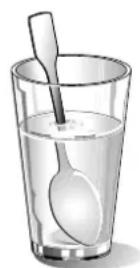
Nesteen kuumentamisessa on mahdollista viivästynyt kiehahtaminen. Tämä tarkoittaa, että neste saavuttaa kiehumispisteen ilman, että tavallisia höyrykuplia nousee pintaan. Vaikka astia liikkuisi vain vähän, kuuma neste voi yhtäkkiä kiehahtaa yli ja roiskua. Kun kuumentat nesteitä, aseta aina lusikka astiaan. Tämä estää viivästyneen kiehahtamisen.
Varoitus!
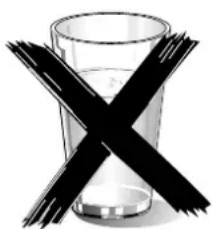
Metalli – esim. lusikka lasissa – on pidettävä vähintään 2 cm:n etäisyydellä uunin seinistä ja luukun sisäpinnasta. Kipinät voivat vahingoittaa pysyvästi luukun sisäpuolen lasia.
Huomautuksia
Ota valmisruoat pois pakkauksesta. Ne kuumenevat nopeasti ja tasaisesti mikroaaltouunin kestävässä astiassa. Aterian eri osat eivät välttämättä tarvitse yhtä paljon aikaa kuumentuakseen.
■ Peitä ruoka aina. Jos sinulla ei ole sopivaa kantta astialle, käytä lautasen tai erityistä mikroaaltokalvoa.
■ Sekoita tai käännä ruokaa useita kertoja kuumentamisen aikana. Tarkista lämpötila.
■ Kuumentamisen jälkeen anna ruoan seistä vielä 2–5 minuuttia, jotta se saavuttaa tasaisen lämpötilan.
■ Käytä aina uunikinnasta tai patalappua, kun otat lautasen uunista.
| Heating food Weight Microwave power setting in watts, cooking time in minutes | Notes | ||
| Menu, plated meal, ready meal 350-500 g 600 W, 5-10 mins Take meal out of packaging, cover food to heat | |||
| Drinks 150 ml 900 W, 1-2 mins Caution! | |||
| 300 ml 900 W, 2-3 mins | Place a spoon in the glass. Do not over-heat alcoholic drinks. Check during heating | ||
| 500 ml 900 W, 3-4 mins | |||
| Baby food, e.g. baby bottle 50 ml 360 W, approx. 1 min Place baby bottles on the cooking compartment floor without the teat or lid.Shake or stir well after heating. You must check the temperature | |||
| 100 ml 360 W, 1-2 mins | |||
| 200 ml 360 W, 2-3 mins | |||
| Soup1 cup 175 g 900 W, 2-3 mins | - | ||
| 2 cups | 175 g each | 900 W, 4-5 mins | |
| 4 cups | 175 g each | 900 W, 5-6 mins | |
| Slices or pieces of meat in sauce,e.g. goulash | 500 g 600 W, 10-15 mins Covered | ||
| Stew | 400 g 600 W, 5-10 mins Ovenware with lid | ||
| 800 g 600 W, 10-15 mins | |||
| Vegetables | 150 g 600 W, 2-3 mins Add a little liquid | ||
| 300 g 600 W, 3-5 mins | |||
Ruoan kypsentäminen
Huomautuksia
- Ruoka, joka on levitetty tasaisesti, kypsyy nopeammin kuin ruoka, joka on kasattu korkeaksi. Levitä ruoka siis mahdollisimman tasaiseksi uunivuokaan. Eri ruoka-aineita ei saa pinota kerroksittain päällekkäin.
- Kypsennä ruoka kannellisessa uunivuokassa. Jos sinulla ei ole sopivaa kantta vuokaasi, käytä lautasen tai erityistä mikroaaltokalvoa.
Tämä auttaa ruokaa säilyttämään oman makunsa, joten mausteita tarvitaan vähemmän.
■ Kypsennyksen jälkeen anna ruoan vetäytyä 2–5 minuuttia, jotta se saavuttaa tasaisen lämpötilan.
■ Käytä aina uunikinnasta tai patalappua, kun otat lautasen uunista.
| Cooking food | Weight | Microwave power in watts, Cooking time in minutes | Notes |
| Whole chicken, fresh, no gib-lets | 1.5 kg | 600 W, 30-35 mins | Turn halfway through the cooking time |
| Fish fillet, fresh | 400 g | 600 W, 5-10 mins | - |
| Fresh vegetables | 250 g | 600 W, 5-10 mins | Cut into equal-sized pieces; add 1 to 2 tbsp water per 100 g; stir during cooking |
| 500 g | 600 W, 10-15 mins | ||
| Potatoes | 250 g | 600 W, 8-10 mins | Cut into equal-sized pieces; add 1 to 2 tbsp water per 100 g; stir during cooking |
| 500 g | 600 W, 11-14 mins | ||
| 750 g | 600 W, 15-22 mins | ||
| Rice | 125 g | 600 W, 7-9 mins+ 180 W, 15-20 mins | Add double the quantity of liquid and use deep ovenware with a lid |
| 250 g | 600 W, 10-12 mins + 180 W, 20-25 mins | ||
| Sweet foods, e.g. blancmange (instant) | 500 ml | 600 W, 7-9 mins | Stir 2 to 3 times with an egg whisk while heat-ing |
| Fruit, compote | 500 g | 600 W, 9-12 mins | - |
Popcorn mikroaaltouunissa
Huomautuksia
■ Käytä lämmönkestävää, tasaista lasivuokaa, esim. uuninkestävän vuoan kantta, lasilautasta tai lasista tarjotinta (Pyrex). Aseta vuoka aina ritilälle.
- Älä käytä posliini- tai liian kaarevia lautasen.
■ Noudata taulukon asetuksia. Voit säätää aikoja tuotteen ja määrän mukaan. Jotta popcorn ei pala, ota popcorn-pussi uunista hetkeksi 1 minuutin ja 30 sekunnin jälkeen ja ravista sitä. Ole varovainen, sillä pussi on kuuma!
Palovamman vaara!
- Avaa popcorn-pussi varovasti, sillä kuumaa höyryä voi vapautua. ■ Älä koskaan aseta mikroaaltouunia täydelle teholle.
| Weight | Accessories | Microwave power in watts, | Cooking time in minutes | |
| Popcorn for the microwave=1 bag, 100=g=Ovenware, wire rack=600 W, 3-5 mins | ||||
Mikroaaltovinkkejä
| You cannot find any information about the settings for the quantity of food you have prepared. | Increase or reduce the cooking times using the following rule of thumb:Double the amount = almost double the cooking timeHalf the amount = half the cooking time |
| The food has become too dry.=Next time, set a shorter cooking time or select a lower microwave power setting. Cover the food and add more liquid. | |
| When the time has elapsed, the food is not defrosted, hot or cooked. | Set a longer time. Large quantities and food which is piled high require longer times. |
| When the time has elapsed, the food is overheated at the edge but not done in the middle. | Stir=it=during=the=cooking=time=and=next=time,=select=a=lower=microwave power setting and a longer cooking time. |
| After defrosting, the poultry or meat is defrosted on the outside but not defrosted in the middle. | Next time, select a lower microwave power setting. If you are defrost-ing a large quantity, turn it several times. |
Kakut ja leivonnaiset
Tietoja taulukoista
Huomautuksia
■ Ilmoitetut ajat koskevat ruokaa, joka laitetaan kylmään uuniin. Lämpötila ja paistoaika riippuvat taikinan koostumuksesta ja määrästä. Siksi taulukoissa on annettu lämpötila-alueet. Aloita alemmasta lämpötilasta ja, jos
tarpeen, käytä seuraavalla kerralla korkeampaa asetusta, koska alempi lämpötila takaa tasaisemman ruskistumisen.
■ Lisätietoja on taulukoiden jälkeisessä Paistovinkit-osiossa. ■ Aseta kakkuvuoka aina alemman ritilätason keskelle.
Kakkuvuoat Huomautus: On parasta käyttää tummia metallisia kakkuvuokia.
| Baking in tins | Accessories | Type of | heating | Temperature °C | Microwave power in watts | Cooking time in minutes |
| Sponge cake, simple=Ring tin/cake tin | 170-180=90=40-50 | |||||
| Sponge cake, delicate=(e.g.=sandcake)* | Ring tin/cake tin | 150-170=-70-90 | ||||
| Sponge flan base | Flan-base cake tin | 160-180=-30-40 | ||||
| Delicate fruit flan, sponge | Springform/ring tin | 170-180=90=35-45 | ||||
| Sponge base, 2=eggs | Flan-base cake tin | 160-170=-20-25 | ||||
| Sponge flan, 6=eggs | Dark springform cake tin | 170-180=-35-45 | ||||
| Shortcrust pastry base with crust | Dark springform cake tin | 170-190=-30-40 | ||||
| Fruit tart/cheesecake with pastry base* | Dark springform cake tin | 170-190=180 | 35-45 | |||
| Swiss flan** | Dark springform cake tin | 190-200=-45-55 | ||||
| Ring cake | Ring cake tin | 170-180 | 40-50 | |||
| Pizza, thin base, light topping** | Round pizza tray | 220-230=-15-25 | ||||
| Savoury cakes** | Dark springform cake tin | 200-220=-50-60 | ||||
| Nut cake | Dark springform cake tin | 170-180=90=35-45 | ||||
| Yeast dough with dry topping | Round pizza tray | 160-180=-50-60 | ||||
| Yeast dough with moist topping | Round pizza tray | 170-190=-55-65 | ||||
| Plaited loaf with 500 g flour | Round pizza tray | 170-190=-35-45 | ||||
| Stollen with 500 g flour | Round pizza tray | 160-180 | - | 60-70 | ||
| Strudel, sweet | Round pizza tray | 190-210=180 | 35-45 | |||
* Anna kakun jäähtyä uunissa noin 20 minuuttia. ** Aseta yleispannulle
| Small baked items | Accessories | Type of heat- | ing | Temperature in °C | Cooking time in min-utes |
| Biscuits | Round pizza tray | 150-170 | 25-35 | ||
| Macaroons | Round pizza tray | 110-130 | 35-45 | ||
| Meringue | Round pizza tray | 100 | 80-100 | ||
| Muffins | Muffin tray on wire rack | 160-180 | 35-40 | ||
| Choux pastry | Round pizza tray | 200-220 | 35-45 | ||
| Puff pastry | Round pizza tray | 190-200 | 35-45 | ||
| Leavened cake | Round pizza tray | 200-220 | 25-35 |
| Bread and bread rolls | Accessories | Type of | heating | Temperature in °C | Cooking time in minutes |
| Sourdough bread with 1.2 kg flour | Round pizza tray | 210-230 | 50-60 | ||
| Flatbread* | Round pizza tray | 220-230 | 25-35 | ||
| Bread rolls | Round pizza tray | 210-230 | 25-35 | ||
| Rolls made with sweet yeast dough | Round pizza tray | 200-220 | 15-25 | ||
* Aseta vuoka suoraan kääntölautaselle.
Paistovinkkejä
| You want to bake according to your own recipe. | Use similar items in the baking tables as a guide. |
| Use baking tins made of silicone, glass, ptic or ceramic materials. | pThe baking tin must be heat-resistant up to 250 °C. Cakes in these baking tins will be less brown. When using the microwave, the cooking time will be shorter than the time shown in the table. |
| How to establish whether sponge cake is baked through. | Approximately 10 minutes before the end of the baking time specified in the recipe, pthe cake with a cocktail stick at its highest point. If the cocktail stick comes out clear cake is ready. |
| The cake collapses. | Use less liquid next time or set the oven temperature 10 degrees lower and extend the baking time. Observe the specified mixing times in the recipe. |
| The cake has risen in the middle but is around the edge. | Only grease the base of the springform cake tin. After baking, loosen the cake carefully with a knife. |
| The cake is too dark. | Select a lower temperature and bake the cake for a little longer. |
| The cake is too dry. | When it is done, make small holes in the cake using a toothpick. Then drizzle fruit juice or an alcoholic beverage over it. Next time, select a temperature 10 degrees higher and reduce the baking time. |
| The bread or cake (e.g. cheesecake) looks good, but is soggy on the inside (sticky, streaked with water). | Use slightly less fluid next time and bake for slightly longer at a lower temperature. V baking cakes with a moist topping, bake the base first, cover with almonds or bread crumbs and then add the topping. Please follow the recipe and follow the baking times. |
| The cake cannot be turned out of the dish when it is turned upside down. | After baking, allow the cake to cool for a further 5 to 10 minutes, then it will be easier to turn out of the tin. If it still sticks, carefully loosen the cake around the edges using a knife. Turn the cake tin upside down again and cover it several times with a cold, wet cloth. Next time, grease the tin well and sprinkle some bread crumbs into it. |
| You have measured the temperature of the oven using your own meat thermometer and found there is a discrepancy. | The oven temperature is measured by the manufacturer after a specified period of time using a test rack in the centre of the cooking compartment. Ovenware and accessories affect the temperature measurement, so there will always be some discrepancy when you measure the temperature yourself. |
| Sparks are generated between the tin and the wire rack. | Check that the tin is clean on the outside. Change the position of the tin in the cooking compartment. If this does not help, continue baking but without the microwave. The baking time will then be longer. |
Paistaminen ja grillaaminen
Tietoja taulukoista
Lämpötila ja paistoaika riippuvat ruoan tyypistä ja määrästä. Siksi taulukoissa on annettu lämpötila-alueet. Aloita alemmasta lämpötilasta ja, jos tarpeen, käytä seuraavalla kerralla korkeampaa asetusta.
Lisätietoja on osiossa Vinkkejä grillaamiseen ja paistamiseen, joka seuraa taulukoita.
Uunivuoat
Voit käyttää mitä tahansa lämmönkestävää uunivuokaa, joka soveltuu mikroaaltouuniin. Metalliset paistovuoat eivät sovellu mikroaaltopaistoon.
Uunivuoka voi kuumentua hyvin kuumaksi. Käytä uunikintaita ottaessasi uunivuoan uunista.
Aseta kuuma lasinen uunivuoka kuivan keittiöpyyhkeen päälle, kun olet ottanut sen uunista. Lasi voi haljeta, jos se asetetaan kylmälle tai märälle pinnalle.
Vinkkejä paistamiseen
Huomautuksia
■ Käytä syvää uunivuokaa lihan ja siipikarjan paistamiseen. - Tarkista, että uunivuoka mahtuu kypsennystilaan. Sen ei tulisi olla liian suuri. ■ Liha: Peitä noin kaksi kolmasosaa uunivuuan pohjasta nesteellä. Lisää
Naudanliha
Huomautuksia
■ Käännä patapaisti 1/3 ja 2/3 kypsennysajasta. Anna lopuksi vetäytyä noin 10 minuuttia.
hieman enemmän nestettä patapaistille. Käännä lihapalat kypsennyksen puolivälissä. Kun paisti on valmis, sammuta uuni ja anna sen vetäytyä vielä 10 minuuttia. Tämä mahdollistaa lihasnesteiden paremman jakautumisen.
■ Siipikarja: Käännä lihapalat, kun 2/3 kypsennysajasta on kulunut.
■ Käännä sisäfileet ja ulkofileet kypsennyksen puolivälissä. Anna lopuksi vetäytyä noin 10 minuuttia. ■ Käännä pihvit, kun 2/3 kypsennysajasta on kulunut.
| Beef | Accessories | Type of | heating | Temperature in °C, grill setting | Microwave power in watts | Cooking time in minutes |
| Pot-roasted beef, approx. 1 kg | Ovenware with lid | 180-200 - 120-143 | ||||
| Fillet of beef, medium, approx. 1 kg | Ovenware without lid | 180-200 90 30-40 | ||||
| Sirloin, medium, approx. 1 kg | Ovenware without lid | 210-230 180 30-40 | ||||
| Steak, medium, 3 cm thick | Higher wire rack | 3 - each side: 10-15 | ||||
Vasikanliha
Huomautus: Käännä paistit ja vasikanpotkat kypsennyksen puolivälissä. Anna lopuksi vetäytyä noin 10 minuuttia.
| Veal | Accessories | Type of heating | Temperature °C | Microwave power in watts | Cooking time in minutes |
| Joint of veal, approx. | 1 kg | Ovenware with lid | 180-200 | - 110-130 | |
| Knuckle of veal, approx. | 1.5 kg | Ovenware with lid | 200-220 | - 120-130 |
Sianliha
Huomautuksia
Käännä vähärasvaiset sianlihapalat ja ruodottomat palat kypsennyksen puolivälissä. Anna lopuksi vetäytyä noin 10 minuuttia.
- Aseta pala uunivuokaan nahkapuoli ylöspäin. Viillä nahkaa. Älä käännä palaa. Anna lopuksi vetäytyä noin 10 minuuttia.
- Älä käännä porsaan sisäfileitä tai porsaankyljyksiä. Anna lopuksi vetäytyä noin 5 minuuttia. Käännä porsaan niska 2/3 kypsennysajasta.
| Pork | Accessories | Type of heating | Temperature in °C, grill setting | Microwave power in watts | Cooking time in minutes |
| Joint without rind (e.g. neck), approx. 750 g* | Ovenware with lid | 220-230 | 180 | 40-50 | |
| Joint with rind (e.g. shoulder) approx. 1.5 kg* | Ovenware without lid | 190-210 | - | 130-150 | |
| Fillet of pork, approx. 500 g* | Ovenware with lid | 220-230 | 90 25-30 | ||
| Joint of pork, lean, approx. 1 kg* | Ovenware with lid | 210-230 | 90 60-80 | ||
| Smoked pork on the bone, approx. 1 kg* | Ovenware without lid | - | - | 360 | 45-45 |
| Neck of pork, 2 cm thick** | 3 | - | 1st side: approx. 15-202nd side: approx. 10-15 |
* Alempi ritilä ** Ylempi ritilä
* Alempi ritilä ** Ylempi ritilä
Lammas Huomautus: Käännä lampaanpaisti kypsennyksen puolivälissä.
| Lamb | Accessories | Type of | heating | Temperature °C | Microwave power in watts | Cooking time in minutes | |
| Saddle of lamb on the bone, approx. 1 kg | Ovenware without lid | 210-230 - 40-50 | |||||
| Leg of lamb, boned, medium, approx. 1.5 kg | Ovenware with lid | 190-210 - 90-95 | |||||
Sekalaisia huomautuksia Käännä makkarat 2/3 kypsennysajasta.
Anna lihamurekkeen lopuksi vetäytyä noin 10 minuuttia.
| Miscellaneous | Accessories | Type of | Temperature in heating °C, grill setting | Microwave power in watts | Cooking time in minutes |
| Meat loaf, approx. | 1 kg* | Ovenware without lid | 180-200 600 W + 180 W | - | |
| 4 to 6 sausages for grilling approx. | 150 g each** | - | 3 - each side: 10-15 |
* alempi ritilä ** ylempi ritilä
Siipikarja
Huomautukset
- Aseta kokonaiset kanat ja kananrinnat rintapuoli alaspäin. Käännä 2/3 kypsennysajasta.
- Aseta poulard rintapuoli alaspäin. Käännä 30 minuutin kuluttua ja aseta mikroaaltoteho 180 wattiin.
Aseta puolikkaat kanat ja kananpalat nahkapuoli ylöspäin. Älä käännä. Käännä ankka ja hanhenrinta nahkapuoli ylöspäin. Älä käännä. Käännä hanhenkoivet kypsennyksen puolivälissä. Pistä nahkaa. Aseta kalkkunanrinta ja -koivet nahkapuoli alaspäin. Käännä 2/3 kypsennysajasta.
| Poultry | Accessories | Type of heating | Temperature in °C, grill setting | Microwave power in watts | Cooking time in minutes |
| Chicken, whole, approx. 1.2 kg | Ovenware with lid | 220-230 | 360 | 35-45 | |
| Poulard, whole, approx. 1.6 kg | Ovenware with lid | 220-230 | 360 | 30 | |
| 180 | 20-30 | ||||
| Chicken, halves, 500 g each | Ovenware without lid | 180-200 | 360 | 30-35 | |
| Chicken portions, approx. 800 g | Ovenware without lid | 210-230 | 360 | 20-30 | |
| Chicken breast with skin and bones, 2 pieces, approx. 350-450 g | Ovenware without lid | 190-210 | 180 | 30-40 | |
| Duck breast with skin, 2 pieces, 300-400 g each | Ovenware without lid | 3 | 90 | 20-30 | |
| Goose breast, 2 pieces, 500 g each | Ovenware without lid | 210-230 | 90 | 25-30 | |
| Goose legs, 4 pieces, approx. 1.5 kg | Ovenware without lid | 210-230 | 180 | 30-40 | |
| Turkey breast, approx. 1 kg | Ovenware with lid | 200-220 | - 90-100 | ||
| Turkey drumsticks, approx. 1.3 kg | Ovenware with lid | 200-220 | 180 | 50-60 |
Kala
Voitele ritilä öljyllä etukäteen.
Huomautuksia
Grillatessa aseta kokonainen kala, esim. taimen, ylemmän ritilän keskelle.
| Fish | Accessories | Type of heating | Temperature °C | Cooking time in minutes |
| Fish steak, e.g. salmon, 3 cm thick, grilled | Higher wire rack | 3 | 20-25 | |
| Whole fish, 2-3 pieces, 300 g each, grilled | Higher wire rack | 3 | 20-30 |
Vinkkejä paistamiseen ja grillaamiseen
| The table does not contain information for the weight of the joint. | For small roasts, select a higher temperature and a shorter cooking time. For larger roasts, select a lower temperature and a longer cooking time. |
| How to tell when the roast is ready. | Use a meat thermometer (available from specialist shops) or carry out a “spoon test”. Press down on the roast with a spoon. If it feels firm, it is ready. If the spoon can be pressed in, it needs to be cooked for a little longer. |
| The roast looks good but the juices are burnt. Next time, use a smaller roasting dish or add more liquid. | |
| The roast looks good but the juices are too next time, use a larger roasting dish and add less liquid. and watery. | |
| The roast is not well-done enough. | Carve the roast. Prepare the gravy in the roasting dish and place the slices of roast meat in the gravy. Finish cooking the meat using the microwave only. |
Laatikot, gratongit, leivät juustolla
Huomautuksia
Taulukon arvot koskevat ruokaa, joka asetetaan kylmään uuniin. Laatikoita, perunagratonkeja ja lasagnea varten käytä mikroaaltouuninkestävää, lämmönkestävää uunivuokaa, jonka syvyys on 4-5 cm.
Aseta laatikko alemmalle ritilälle. Anna laatikoiden ja gratiinien kypsyä uunissa vielä 5 minuuttia sammuttamisen jälkeen. - Juustoleivät: Esipaahda leipäviipaleet.
| Bakes, gratins, toasts | Accessories | Type of | heating | Temperature in °C, grill setting | Microwave power in watts | Cooking minutes | time in |
| Bake, sweet, approx. 1.5 kg | Ovenware without lid | 140-160 | 360 25-35 | ||||
| Savoury bake, made with cooked ingredients, approx. 1 kg | Ovenware without lid | 150-170 | 600 20-25 | ||||
| Lasagne, fresh | Ovenware without lid | 200-220 | 360 25-35 | ||||
| Potato gratin made from raw ingredients, approx. 1.1 kg | Ovenware without lid | 180-200 | 600 25-30 | ||||
| Toast with topping, 4 slices* | 3 - 8-10 | ||||||
* Ylempi ritilä
Valmisruoat, pakasteet
Huomautuksia
- Noudata pakkauksen ohjeita.
Taulukon arvot koskevat ruokaa, joka asetetaan kylmään uuniin. - Älä aseta ranskalaisia, kroketetteja tai perunarieskoja päällekkäin. Käännä puolivälissä kypsennysaikaa. Aseta ruoka suoraan kääntölautaselle.
| Convenience products | Accessories | Type of | heating | Temperature °C | Microwave power in watts | Cooking time in minutes |
| Pizza with thin base* | Turntable | 220-230 | - | 10-15 | ||
| Pizza with deep-pan base | Turntable | - | 600 | 3 | ||
| 220-230 | - | 13-18 | ||||
| Mini pizza* | Turntable | 220-230 | - | 10-15 | ||
| Pizza baguette* | Turntable | - | 600 | 2 | ||
| 220-230 | - | 13-18 | ||||
| Chips | Turntable | 220-230 | - | 8-13 | ||
| Croquettes* | Turntable | 210-220 | - | 13-18 | ||
| Rösti, stuffed potato pockets | Turntable | 200-220 | - | 25-30 | ||
| Part-cooked rolls or baguette | Lower wire rack | 170-180 | - | 13-18 | ||
| Fish fingers | Turntable | 210-230 | - | 10-20 | ||
| Chicken goujons, nuggets | Turntable | 200-220 | - | 15-20 | ||
| Strudel | Turntable | 210-220 | 180 | 20-30 | ||
| Lasagne, approx. 400 g** | Lower wire rack | 220-230 | 600 | 12-17 |
* Esikuumenna kypsennystilaa 5 minuuttia, aseta sitten ruoka kuumalle kääntölautaselle. ** Aseta ruoka sopivaan, lämmönkestävään uunivuokaan.
* Esikuumenna kypsennystilaa 5 minuuttia, aseta sitten ruoka kuumalle kääntölautaselle. ** Aseta ruoka sopivaan, lämmönkestävään uunivuokaan.
Testiruuat
Mikroaaltoyhdistelmälaitteiden laatu ja toiminta ovat standardien EN 60705, IEC 60705 mukaisia tai testauslaitosten testaamia seuraavilla astioilla. DIN 44547 ja EN 60350 (2009)
Sulatus mikroaaltouunilla
| Dish | Microwave power setting in watts, cooking time in minutes | Note |
| Meat | 180 W, 5 mins + 90 W, 10-15 mins Place the Pyrex dish with a 22 cm diameter on the lower wire rack. After approx. 13 minutes, remove the defrosted meat. | |
Kypsennys mikroaaltouunilla
| Dish Microwave power setting in watts, cooking time in minutes | Note |
| Custard 600 W, 10-13 mins + 180 W, 25-30 mins Place the Pyrex dish with dimensions 24 x 19 cm on the lower wire rack. | |
| Sponge flan 600 W, 9-10 mins Place the Pyrex dish with a 22 cm diameter on the lower wire rack. | |
| Meat loaf 600 W, 18-23 mins Place the 28 cm Pyrex dish on the lower wire rack. | |
Yhdistelmäkypsennys mikroaaltouunilla
| Dish Microwave power setting in watts, cooking time in minutes | Type of heating | Temperature °C | Note | |
| Potato gratin 600 W, 25-30 mins | 210-220 | Place the Pyrex dish with a 22 cm diameter on the lower wire rack. | ||
| Cake | 180 W, 15-20 mins | 180-200 | Place the Pyrex dish with a 22 cm diameter on the lower wire rack. | |
| Chicken | 360 W, 35-40 mins | 200-220 | Turn after 2/3 of the cooking time. | |
Paistaminen Huomautus: Taulukon arvot koskevat ruokia, jotka asetetaan kylmään uuniin.
| Dish | Ovenware | Type of heating | Temperature °C | Baking time in minutes | ||||
| Hot water sponge cake | Springform rack | cake | tin, dia. | 26 cm, lower | 160-180 | 30-40 | ||
| German apple pie | Springform rack | cake | tin, dia. | 20 cm, lower | 190-210 | 50-60 | ||
Grillaus
| Dish | Accessories | Type of heating | Grill setting | Cooking time in minutes |
| Browning toast | Higher wire rack | 3 4-5 | ||
| Beefburgers, x 9 | Higher wire rack | 3 30-35 |
zh Sisällysluettelo
Tärkeät turvallisuustiedot....25
Vaurioiden syyt 27
Asennus ja liitäntä 27
Uusi laitteesi 27
Ohjauspaneeli 27
Painikkeet 27
Toiminnonvalintasäädin....28
Lämpötilan valintakytkin....28
Jäähdytystuuletin 28
Lisävarusteet 28
Ennen laitteen ensimmäistä käyttöä 29
Kellon asettaminen 29
Mikron kuumentaminen 29
Lisävarusteiden puhdistaminen 29
Uunin asettaminen 29
Lämmitystyypin ja lämpötilan asettaminen 29
Nopea esikuumennus 29
Automaattinen turvakatkaisu....29
Mikroaaltouuni 30
Huomioita keittoastioista....30
Mikroaaltotehon asetukset....30
Mikron asettaminen 30
Uunin ja mikroaaltouunin yhdistelmätoiminta 30
Yhdistelmätoiminnan asettaminen....30
Automaattiset kypsennysohjelmat....31
Ohjelman asettaminen 31
Sulatusohjelma 31
Kypsennysohjelma 32
Yhdistelmäkypsennysohjelma....32
Ajan asettaminen Asetusvaihtoehdot....32
Ajastimen asettaminen 32
Kypsennysajan asettaminen....32
Kellon asettaminen 33
Lapsilukko 33
Lapsilukon käyttöönotto 33
Lapsilukon poistaminen käytöstä 33
Automaattiset kypsennysohjelmat ja lapsilukko 33
Perusasetusten muuttaminen....33
Tehdasasetukset 33
Hoito ja puhdistus 34
Puhdistusaineet....34
Vikataulukko....34
Vikataulukko....35
Huoltopalvelu 35
E-numero ja FD-numero 35
Tekniset tiedot 35
Akryyliamidi elintarvikkeissa....36
Energia- ja ympäristövihjeet 36
Energiansäästö 36
Ympäristönsuojelu ja hävittäminen 36
Meidän keittiöstämme testatut reseptit ……36
Sulatus, kuumentaminen ja kypsentäminen mikroaaltouunilla 36
Mikroaaltouunin käyttövinkkejä....39
Leivonnaiset 39
Leivontavinkkejä 40
Paistaminen ja grillaaminen 40
Grillausvinkkejä 42
Keksit, rapeat leivät ja paahtoleivät täytteillä 42
Pakastevalmisruoat....42
Testireseptit 43
Lisätietoja tuotteista, lisävarusteista, varaosista ja huollosta saat osoitteesta
www.bosch-home.fi
⚠ Tärkeitä turvallisuusohjeita
Lue tämä käyttöohje huolellisesti. Vain siten voit käyttää laitetta turvallisesti ja oikein. Säilytä tämä käyttöohje tulevaa käyttöä varten tai seuraavalle omistajalle.
Tämä laite on tarkoitettu asennettavaksi kokonaan keittiökalusteeseen. Noudata asennusohjeita.
Tarkista laite pakkauksesta purkamisen jälkeen vaurioiden varalta. Jos laite on vaurioitunut kuljetuksen aikana, älä kytke sitä sähköverkkoon.
Vain valtuutettu ammattihenkilö saa kytkeä laitteen, jossa ei ole pistoketta. Vaurioita, jotka johtuvat virheellisestä kytkennästä, ei korvata takuun puitteissa.
Tämä laite on tarkoitettu vain kotitalouskäyttöön. Laitetta saa käyttää ainoastaan ruoan ja juomien valmistukseen. Laitetta ei saa jättää ilman valvontaa sen ollessa käynnissä. Laite on tarkoitettu käytettäväksi vain sisätiloissa.
Laitetta saa käyttää enintään 4000 metrin korkeudessa.
Yli 8-vuotiaat lapset sekä henkilöt, joilla on rajoittunut fyysinen, sensorinen tai henkinen toimintakyky tai joilla ei ole kokemusta tai tietoa laitteesta, saavat käyttää laitetta vain, jos heitä valvotaan tai heille on annettu ohjeet laitteen turvallisesta käytöstä ja he ymmärtävät siihen liittyvät vaarat.
Laitetta saavat käyttää vain henkilöt, jotka ovat saaneet opastuksen laitteen turvalliseen käyttöön ja ymmärtävät siihen liittyvät vaarat, tai joita valvotaan käytön aikana.
Lapset eivät saa leikkiä laitteella tai sen lähellä. Lapset eivät saa puhdistaa laitetta tai suorittaa yleisiä huoltotoimenpiteitä, elleivät he ole vähintään 8-vuotiaita ja valvottuja.
Alle 8-vuotiaat lapset on pidettävä etäällä laitteesta ja sen virtajohdosta.
Lisävarusteet on asetettava oikein keittotilaan. Katso tämän käyttöohjeen kohta ”Lisävarusteiden kuvaus”.
Tulipalovaara!
■ Laite kuumenee erittäin kuumaksi. Jos laite on asennettu kiinteään kaappiin, jossa on koristeovi, koristeoven sulkeutuessa lämpöä kertyy. Laitetta saa käyttää vain, kun koristeovi on auki.
Syttyvien materiaalien säilyttäminen keittotilassa voi aiheuttaa tulipalovaaran. Älä koskaan säilytä syttyviä materiaaleja keittotilassa. Älä
avaa laitteen luukkua, jos sisällä on savua. Kytke laite pois päältä, irrota pistoke pistorasiasta tai kytke virta pois päältä sulakekaapista.
■ Laitteen käyttäminen muuhun kuin sen aiottuun käyttötarkoitukseen on erittäin vaarallista ja voi aiheuttaa vahinkoja.
Seuraavat toimet eivät ole sallittuja: ruoan tai vaatteiden kuivaaminen, tossujen tai viljatyynyjen, sienien, märkien siivousliinojen tai vastaavien esineiden lämmittäminen.
Esimerkiksi lämmitetyt tossut ja vilja- tai tattarityynyt voivat syttyä palamaan, ja tulipalo voi syttyä jopa tuntien kuluttua. Laitetta saa käyttää vain ruoan ja juomien valmistukseen.
- Ruoka voi syttyä palamaan. Älä koskaan lämmitä ruokaa lämpöä eristävässä pakkauksessa.
Älä jätä ruokaa valvomatta, kun sitä kuumennetaan muovi-, paperi- tai muista syttyvistä materiaaleista valmistetuissa astioissa. Älä valitse korkeampaa mikroaaltotehoa tai pidempää aikaa kuin on tarpeen. Noudata tässä käyttöoppaassa annettuja ohjeita. Älä koskaan käytä mikroaaltouunia ruoan kuivaamiseen.
Sulata tai lämmitä vähän vettä sisältäviä ruokia, kuten leipää, älä koskaan valitse liian korkeaa tehoa tai liian pitkää aikaa.
- Ruokaöljyllä on syttymisvaara. Älä koskaan kuumenna ruokaöljyä yksinään mikroaaltouunissa.
Räjähdysvaara!
Nesteiden tai muiden elintarvikkeiden kuumentaminen suljetuissa astioissa on räjähdysvaarallista. Älä koskaan kuumenna juomia tai muita elintarvikkeita suljetuissa astioissa.
Vakava terveyshaitta!
■ Jos laitetta ei puhdisteta asianmukaisesti, sen pinnat voivat vaurioitua. Mikroaaltoenergiaa voi päästä ulos. Puhdista laite säännöllisesti ja poista ruokajäämät välittömästi. Pidä keittoaukko, oven tiiviste, ovi ja oven kosketuspinnat aina puhtaina; katso myös luku Hoito ja puhdistus.
■ Jos keittoaukon ovi tai oven tiiviste on vaurioitunut, mikroaaltoenergiaa voi päästä ulos. Älä käytä laitetta, jos keittoaukon ovi tai oven tiiviste on vaurioitunut. Ota yhteyttä huoltopalveluun.
Jos laitteessa ei ole koteloa, mikroaaltoenergiaa pääsee ulos. Älä koskaan poista koteloa. Ota yhteyttä huoltopalveluun huolto- tai korjaustöitä varten.
Sähköiskuvaara!
■ Virheellinen korjaus on vaarallista. Vain koulutettu huoltohenkilökuntamme saa korjata laitteen ja vaihtaa vaurioituneen virtajohdon. Jos laitteessa on vika, irrota laite verkkovirrasta
tai kytke sulake pois päältä sulakekaapista. Ota yhteyttä huoltopalveluun.
■ Jos sähköjohto joutuu kosketuksiin laitteen kuumien osien kanssa, sen eristys voi sulaa. Älä koskaan anna laitteen virtajohdon koskettaa laitteen kuumia osia.
■ Älä käytä korkeapainepesuria tai höyrypesuria sähköiskuvaaran vuoksi.
Kosteuden tunkeutuminen voi aiheuttaa sähköiskuvaaran. Älä altista laitetta liialliselle kuumuudelle tai kosteudelle. Tämä laite on tarkoitettu vain sisäkäyttöön.
Viallinen sähkölaite aiheuttaa sähköiskuvaaran. Älä koskaan kytke viallista sähkölaitetta. Irrota laitteen pistoke tai katkaise virta sulakekaapista. Ota yhteyttä huoltopalveluun.
■ Tämä laite on korkeajännitelaite. Älä koskaan poista koteloa.
■ Laite on varustettu eurooppalaisella pistokkeella. Suojamaadoituksen varmistamiseksi tanskalaisessa pistorasiassa laite on liitettävä sopivaan sovittimeen. Tämä sovitin (sallittu enimmäisvirta 13 ampeeria) on saatavissa huoltopalvelusta (varaosanumero: 623333).
Palovammavaara!
■ Laite kuumenee erittäin kuumaksi. Älä kosketa kypsennystilan sisäpintoja tai lämmityselementtejä. Anna laitteen jäähtyä. Pidä lapset turvallisen etäisyyden päässä.
■ Lisävarusteet ja kypsennysastiat kuumenevat erittäin kuumiksi. Käytä uunikintaita, kun otat lisävarusteita tai kypsennysastioita kypsennystilasta.
■ Alkoholihöyryt voivat syttyä kuumassa kypsennystilassa. Älä koskaan kypsennä ruokia, joihin on sekoitettu suuria määriä väkevää alkoholia. Käytä vain pieniä määriä väkevää alkoholia. Avaa laitteen luukku varovasti.
■ Kuorelliset tai kuorilliset ruoat voivat räjähtää kuumentamisen aikana tai jopa sen jälkeen. Älä koskaan kuumenna kuorellisia munia tai lämmitä uudelleen keitettyjä munia. Älä koskaan kypsennä simpukoita tai äyriäisiä. Puhkaise aina munankeltuainen paistettuja tai keitettyjä munia valmistaessasi. Kuorellisten tai kuorillisten ruokien, kuten omenoiden, tomaattien, perunoiden ja makkaroiden, kuori voi räjähtää. Puhkaise kuori tai kuori ennen kuumentamista.
■ Vauvanruoassa lämpö jakautuu epätasaisesti. Älä koskaan kuumenna vauvanruokaa suljetussa astiassa. Poista aina kansi tai tuttipullo. Sekoita tai ravista ruokaa kuumentamisen jälkeen. Tarkista ruoan lämpötila ennen kuin annat sen lapselle.
■ Kuumentunut ruoka luovuttaa lämpöä. Kypsennysastiat kuumenevat. Käytä uunikintaita, kun otat kypsennysastioita tai lisävarusteita kypsennystilasta.
■ Suljetut pakkaukset voivat räjähtää ruokaa kuumentaessa. Noudata pakkauksen ohjeita. Käytä aina uunikintaita, kun otat astioita kypsennystilasta.
Palovammavaara!
Luukkua avattaessa voi päästä kuumaa höyryä. Avaa laitteen luukku varovasti. Pidä lapset turvallisen etäisyyden päässä. ■ Kuuman kypsennystilan täyttäminen vedellä tuottaa kuumaa höyryä. Älä koskaan kaada vettä kuumaan kypsennystilaan. ■ Kuumennetut nesteet voivat kiehua viiveellä. Tämä tarkoittaa, että neste saavuttaa kiehumispisteen ilman tavallisia höyrykuplia pinnalla. Jopa astian lievä tärähdys voi aiheuttaa nesteen äkillisen kiehumisen, ylivuodon ja roiskumisen. Laita aina lusikka astiaan kuumentamisen ajaksi. Tämä estää viivästyneen kiehumisen.
Loukkaantumisvaara!
■ Laitteen luukun lasi voi särkyä, jos se naarmuuntuu. Älä käytä lasikaapimia, voimakkaita tai syövyttäviä puhdistusaineita tai pesuaineita. ■ Sopimattomat kypsennysastiat voivat haljeta. Posliini- tai keramiikka-astioissa voi olla pieniä reikiä kahvoissa tai kansissa. Näiden reikien alla on onteloita. Näihin onteloihin päässyt neste voi aiheuttaa astian rikkoutumisen. Käytä vain mikroaaltouuniin soveltuvia kypsennysastioita. Jos laitetta käytetään vain mikroaaltotilassa, metalliset keittiövälineet ja astiat laitteen sisällä voivat aiheuttaa kipinöitä laitteen toimiessa. Tämä voi vahingoittaa laitetta. Jos laitetta käytetään vain mikroaaltotilassa
Älä koskaan käytä metalliastioita. Käytä vain mikroaaltouunin kestäviä astioita tai jotakin lämmitystapaa.
Vaurioiden syyt
Huomio!
■ Kipinöinti: Metalliesineet (esim. lusikka lasissa) on pidettävä vähintään 2 cm:n etäisyydellä keitto tilan seinistä ja luukun sisäpuolelta. Muuten kipinät voivat vahingoittaa luukun lasia. ■ Veden kaataminen kuumaan keittotilaan: Älä koskaan kaada vettä kuumaan keittotilaan. Se aiheuttaa höyryä. Lämpötilan vaihtelut voivat vahingoittaa laitetta. ■ Kosteat elintarvikkeet: Älä säilytä kosteita elintarvikkeita pitkään suljetussa keittotilassa. Älä käytä laitetta elintarvikkeiden säilytykseen. Tämä voi aiheuttaa korroosiota. ■ Luukun avaaminen jäähdytystä varten: Anna keittotilan jäähtyä vain luukku suljettuna. Älä purista mitään luukun väliin. Muuten, vaikka luukku olisi vain hieman raollaan, lähellä olevien huonekalujen pinnat voivat ajan myötä vahingoittua. ■ Likainen luukun tiiviste: Jos luukun tiiviste on hyvin likainen, laitteen luukku ei sulkeudu kunnolla käytön aikana. Lähellä olevien kaappien pinnat voivat vahingoittua. Pidä luukun tiiviste aina puhtaana. ■ Mikroaaltouunin käyttö ilman ruokaa: Laitteen käyttäminen ilman ruokaa keittotilassa voi aiheuttaa ylikuormituksen. Älä kytke laitetta päälle, jos keittotilassa ei ole ruokaa. Poikkeuksena on lyhyt astiatesti (katso 'Mikroaaltouunin kestävät astiat'). ■ Seisominen luukun päällä tai esineiden asettaminen luukun päälle: Älä seiso avoimen luukun päällä äläkä aseta mitään avoimen luukun päälle. Älä aseta keittoastioita tai lisävarusteita luukun päälle. ■ Laitteen kantaminen: Älä kanna laitetta luukun kahvasta. Kahva ei kestä laitteen painoa ja voi katketa. ■ Mikroaaltopopcorn: Älä koskaan aseta mikroaaltotehoa liian korkeaksi. Teho ei saa ylittää 600 W. Popcorn-pussi on asetettava lasilevylle. Jos levy on ylikuormitettu, se voi hyppiä. ■ Varmista, että ylikiehuva neste ei pääse levykäytön kautta laitteen sisään. Valvo
Asennus ja liitäntä
Noudata erityisiä asennusohjeita.
Tämä laite on varustettu pistokkeella, ja se voidaan liittää vain pistorasiaan, jossa on asianmukainen suojamaadoitus. Sulakkeen nimellisvirran on oltava 16 ampeeria (L- tai B-tyypin katkaisija). Syöttöjännitteen on vastattava arvokilvessä ilmoitettua jännitettä.

Pistorasian asennuksen ja virtajohdon vaihdon saa suorittaa vain sähköalan ammattilainen. Jos pistoke on vaikea kytkeä asennuksen jälkeen, asennuspuolelle on asennettava täysin erottava kytkin, jonka kosketusväli on vähintään 3 mm.
Älä käytä moninkertaisia pistokkeita, jatkojohtoja tai jatkopistorasioita. Ylikuormitus voi aiheuttaa tulipalovaaran.
Uusi laitteesi
Tutustu uuteen laitteeseesi tässä luvussa. Luku esittelee ohjauspaneelin ja eri säätimet. Saat tietoa keittotilasta ja lisävarusteista.
Ohjauspaneeli
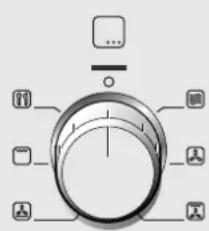
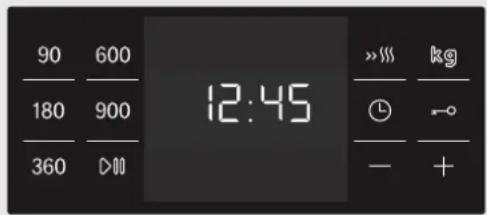
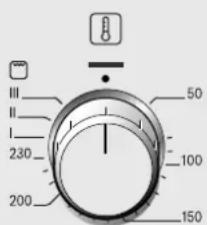
Kiertokytkin
Kiertokytkin voidaan vetää ulos. Aseta kiertokytkin pois päältä -asentoon ja paina se sisään lukitaksesi sen sisään tai ulos vedettyyn asentoon.
Painikkeet
Anturit sijaitsevat näppäinten alla. Älä paina näppäimiä liian voimakkaasti. Kosketa vain vastaavia symboleja.
Näppäimet
Voit asettaa eri toimintoja näppäimillä. Voit lukea asetetut arvot näytöstä.
Symboli Näppäimen toiminto
90 Valitse mikroaaltoteho 90 W
180 Valitse mikroaaltoteho 180 W
Symboli Näppäimen toiminto
| 360=选择微波功率 360 W |
| 600=选择微波功率 600 W |
| 900=选择微波功率 900 W |
| >> | 选择快速加热 |
kg Valitse paino
| 5 | 打开和关闭时间设置选项菜单 |
Valitse lapsilukko
| 一 | 负=减小调整值 |
- Plus = suurenna asetusarvoa
| D00 短暂按一下:开始=/=停止操作按下并按住:取消操作 |
Toiminnonvalintasäädin
Aseta lämmitystyyppi toiminnonvalintasäätimellä.
Asetus Käyttötarkoitus
| 0 | 关断位置=微波炉电源关断。 |
Mikroaalto = valitse mikroaaltotoiminto.
| 热风=用于烘焙装在烤模内的海绵蛋糕、各种果馅饼和奶酪蛋糕,以及用于烘焙装在烤盘内的蛋糕、匹萨和小点心。 |
| 热风烧烤=家禽上色、变脆。该设置非常适合制作煲仔饭和烧烤菜式。 |
| 0 | 匹萨设置=用于烹饪需要从下方大量加热的冷冻熟食和菜式。 |
| 烧烤=选择高火、中火或低火。这非常适合 烧烤多层肉排、香肠、鱼片或面包 片。 |
Asetus Käyttötarkoitus
| 程序=4个解冻程序 |
11 ruoanlaitto-ohjelmaa
Lämmitystyyppi ja kypsennysaika asetetaan painon mukaan.
Vihje
- Kun teet asetuksia, toiminnonvalintakytkimen yläpuolella oleva merkkivalo syttyy. Paina =▷□□-painiketta, niin kypsennystilan valo syttyy.
Lämpötilanvalintakytkin
Lämpötilanvalintakytkimellä asetetaan lämpötila tai grillausasetus.
Asetus Käyttötarkoitus
| ● | 关断位置=烤箱不加热。 |
| 50, 100-230 | 温度范围=温度(°C) |
| I, II, III | 烧烤设置=I=低火 |
II = keskilämpö
III = korkea lämpö
Jäähdytystuuletin
Laitteessasi on jäähdytystuuletin. Jäähdytystuuletin on toiminnassa käytön aikana. Kuuma ilma poistuu oven yläosasta.
Käytön jälkeen jäähdytystuuletin jatkaa toimintaansa jonkin aikaa.
Huomio!
Älä peitä ilmanvaihtoaukkoja. Muuten laite ylikuumenee.
Vihje
Mikroaaltotoiminnon aikana laite pysyy viileänä. Jäähdytyspuhallin käynnistyy kuitenkin. Mikroaaltotoiminnon päätyttyä puhallin jatkaa toimintaansa vielä jonkin aikaa. ■ Oviin, sisäseiniin ja pohjalevyyn voi muodostua kondenssivettä. Tämä on normaalia eikä vaikuta mikroaaltotoimintaan. Pyyhi kondenssivesi pois kypsennyksen jälkeen.
Lisävarusteet
Huomio!
Kun otat lautasen pois, varmista, että kääntölautanen ei liiku. Varmista, että kääntölautanen on lukittunut oikein. Kääntölautanen voi kääntyä vasemmalle tai oikealle.
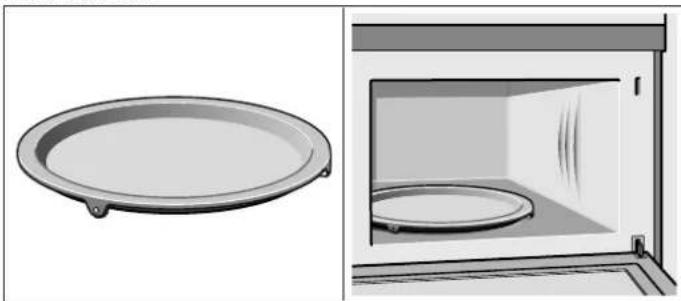
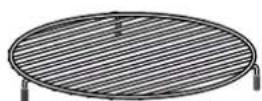
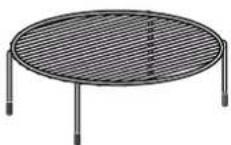
Kääntölautanen
Käytetään grillitukipintana.
Ruoat, jotka tarvitsevat erityisen voimakasta alhaalta tulevaa kuumennusta, voidaan kypsentää suoraan kääntölautasella.
Kääntölautanen voi pyöriä myötä- tai vastapäivään, eikä se naarmuunnu helposti. Kääntölautasella voi leikata pizzan.
Aseta kääntölautanen kypsennystilan keskellä olevaan käyttöakseliin. Varmista, että se on asetettu oikein.
Älä koskaan käytä mikroaaltouunia ilman kääntölautasta. ■ Kääntölautasen enimmäiskantavuus on 5 kg. Kääntölautasen on pystyttävä pyörimään kaikilla lämmitystyypeillä.
Matala grilli
Käytetään leivontaan ja grillaamiseen mikroaaltouunissa.
Korkea grilli
Käytetään pihvien, makkaroiden, kalapalojen ja leivän grillaamiseen.
Voidaan käyttää matalan uunivuoan tukena.
Ennen laitteen ensimmäistä käyttöä
Tässä luvussa kerrotaan kaikista töistä, jotka on tehtävä ennen ruoan valmistamista mikroaaltouunissa ensimmäistä kertaa. Lue ensin turvallisuustietoja käsittelevä luku.
Kellon asettaminen
Kun laite on liitetty verkkovirtaan, näytössä syttyvät kolme nollaa ja ▶-symboli. Aseta kello.
- Kosketa + tai - -painiketta.
Oletusarvo +: 12:00
Oletusarvo -: 23:59
- Aseta kello + tai - -painikkeilla.
3. Kosketa Ⓛ-painiketta.
Kellon asetus on valmis.
Vihje: Voit piilottaa kellon vähentääksesi laitteen virrankulutusta valmiustilassa. Lue aihetta käsittelevä osio Perusasetusten muuttaminen -luvusta.
Mikroaaltouunin kuumentaminen
Poistaaksesi uuden laitteen hajun, tyhjennä ja sulje mikroaaltouuni ja kuumenna se. On parasta käyttää kiertoilmaa 180 °C:ssa tunnin ajan. Älä jätä pakkausmateriaaleja ruoanlaittotilaan.
- Aseta toiminnonvalitsimella kiertoilma 📁.
2. Aseta lämpötilaksi 180° C lämpötilanvalitsimella.
3. Kosketa ▷□□ -painiketta.
Mikroaaltouuni alkaa kuumentaa.
Tunnin kuluttua sammuta uuni. Katkaistaksesi virran, käännä toimintovalitsin katkaisuasentoon.
Lisävarusteiden puhdistus
Puhdista lisävarusteet huolellisesti ennen ensimmäistä käyttökertaa kuumalla saippuavedellä ja pehmeällä tiskiharjalla.
Uunin asetukset
Uunissa on useita asetustapoja. Selitämme tässä, miten valitset haluamasi lämmitystyypin sekä lämpötilan tai grilliasetuksen. Voit myös valita ruoan kypsennysajan. Katso kohta Ajan asettaminen.
Lämmitystyypin ja lämpötilan asettaminen
Kuvan esimerkki: kiertoilma, 200 °C.
- Aseta lämmitystyyppi toimintovalitsimella.
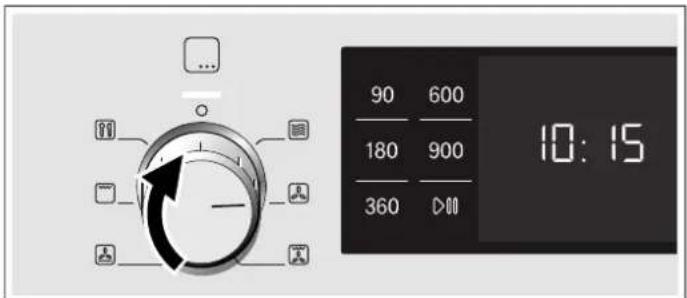
- Aseta lämpötila tai grilliasetus lämpötilavalitsimella.
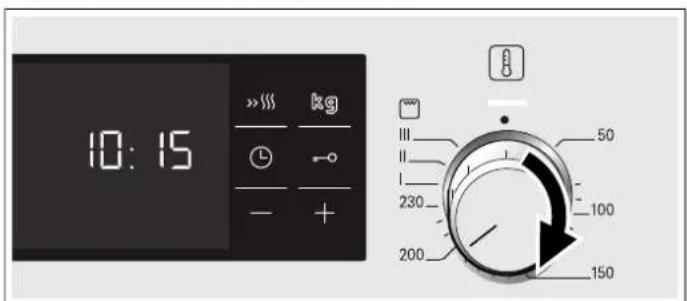
3. Kosketa ▷□□ -painiketta.
Mikroaaltouuni alkaa kuumentaa.
Uunin luukun avaaminen käytön aikana
Toiminta keskeytyy. Kun olet sulkenut luukun, paina ▷□□ -painiketta. Toiminta jatkuu.
Keskeytä toiminto
Keskeytä toiminto painamalla D00-näppäintä. Jatka toimintoa painamalla D00-näppäintä.
Kytke mikroaaltouuni pois päältä
Käännä toiminnonvalintasäädin pois päältä -asentoon.
Muuta asetuksia
Voit muuttaa lämmitystyyppiä sekä lämpötilaa tai grilliasetusta milloin tahansa vastaavilla valintasäätimillä.
Nopea esikuumennus
Nopeaa esikuumennusta käytettäessä mikroaaltouuni saavuttaa asetetun lämpötilan erityisen nopeasti.
Käytä nopeaa esikuumennusta, kun asetettu lämpötila on yli 100° C. Nopeaa esikuumennusta voidaan käyttää seuraavilla lämmitystyypeillä:
Kiertoilma
Pizza-asetus
Kiertoilma + grilli
Varmistaaksesi tasaisen kypsymistuloksen, aseta ruoka kypsennystilaan vasta, kun ”Nopea esikuumennus” -vaihe on päättynyt.
- Aseta lämmitystyyppi ja lämpötila.
2. Kosketa >> -näppäintä.
Näytössä palaa >> -symboli.
3. Kosketa ▷00 -painiketta.
Mikroaaltouuni alkaa kuumentaa.
Pikakuumennus on valmis.
Äänimerkki kuuluu. Näytön >> -symboli sammuu. Aseta ruoka uuniin.
Pikakuumennuksen peruuttaminen
Kosketa lyhyesti >> -painiketta. Näytön >> -symboli sammuu.
Automaattinen turvakytkentä
Jos laitetta käytetään pitkään ilman kypsennysajan asetusta, automaattinen turvakytkentä aktivoituu. Laitteen automaattisen sammumisen ajankohta riippuu asetetusta käyttötilasta ja lämpötilasta.
Esimerkki: Jos mikroaaltouunia käytetään kiertoilmatilassa 160° C:ssa, se sammuu automaattisesti noin 5 tunnin kuluttua.
Näytössä näkyy E2. Laite sammuu. Vahvista koskettamalla ▷00 -painiketta.
Mikroaalto
Mikroaallot muuttuvat ruoassa lämmöksi. Mikroaaltoja voidaan käyttää yksinään tai yhdistettynä muihin lämmitystapoihin. Tässä osiossa kerrotaan kypsennysastioista ja mikroaaltouunin asetuksista.
Vihje:
Testatut reseptit -osiossa, jonka on testannut keittiömme, on esimerkkejä mikroaaltouunin käytöstä sulatukseen, kuumentamiseen ja kypsentämiseen.
Huomautuksia keittoastioista
Soveltuvat keittoastiat
Lämmönkestävät keittoastiat, jotka on valmistettu lasista, lasikeraamisesta, keramiikasta tai lämmönkestävästä muovista, soveltuvat. Nämä materiaalit päästävät mikroaallot läpi.
Myös ruokalautasia voidaan käyttää. Silloin ruokaa ei tarvitse siirtää lautaselta toiselle. Jos keittoastiassa on kulta- tai hopeakoristeita, niitä saa käyttää vain, jos valmistaja takaa niiden soveltuvuuden mikroaaltouuniin.
Soveltumattomat keittoastiat
Metalliastiat eivät sovellu. Metalli ei päästä mikroaaltoja läpi. Metallisessa astiassa oleva ruoka pysyy kylmänä.
Huomio!
Kipinöintiä: metallin (esim. lusikka lasissa) on oltava vähintään 2 cm:n etäisyydellä kypsennystilan seinistä ja oven sisäpinnasta. Muuten kipinät voivat vahingoittaa oven sisäpinnan lasia.
Keittoastiatesti
Mikroaaltouuni voidaan kytkeä päälle vain, jos kypsennystilassa on ruokaa. Ainoa poikkeus on seuraava keittoastiatesti.
Jos et ole varma, soveltuuko keittoastiasi mikroaaltouuniin, suorita seuraava testi:
- Kuumenna tyhjää keittoastiaa suurimmalla teholla 1/2–1 minuutin ajan.
- Tarkista lämpötila ajoittain kuumentamisen aikana.
Keittoastian tulee tuntua edelleen kylmältä tai haalealta.
Jos keittoastia kuumenee tai siitä lähtee kipinöitä, laite ei sovellu käyttöön.
Mikroaaltotehon asetukset
Aseta haluamasi mikroaaltoteho painikkeella.
90 W: herkkien ruokien sulatukseen
180 W: sulatukseen ja jatkuvaan kypsennykseen
360 W: lihan kypsennykseen ja herkkien ruokien lämmitykseen
600 W: ruokien lämmitykseen ja kypsennykseen
900 W: nesteiden lämmitykseen
Vihje
Kun painiketta painetaan, valittu teho syttyy. ■ Mikroaaltoteho voidaan asettaa 900 W:iin enintään 30 minuutiksi. Muilla tehoasetuksilla kypsennysaika voi olla enintään 1 tunti 30 minuuttia.
Mikroaallon asettaminen
Esimerkki: mikroaaltoteho 600 W, kypsennysaika 17 minuuttia
- Aseta toimintovalitsin asentoon ≅.
- Kosketa tarvittavaa mikroaaltotehoasetuspainiketta. 600 W tehotaso syttyy, ja näytössä näkyy ehdotettu kypsennysaika.
- Aseta kypsennysaika + tai - -painikkeilla.
- Kosketa ▷□□ -painiketta.
Toiminto alkaa. Näytön kypsennysaika alkaa laskea.
Kun kypsennysaika on kulunut
Äänimerkki kuuluu. Mikroaaltotoiminto päättyy. Käännä toiminnonvalitsin nolla-asentoon. Paina ⏻ -painiketta äänimerkin pysäyttämiseksi.
Mikroaaltouunin luukun avaaminen kypsennyksen aikana
Toiminto keskeytyy. Sulje luukku ja paina lyhyesti D-painiketta. Toiminto jatkuu.
Kypsennysajan muuttaminen
Tämä on mahdollista milloin tahansa. Muuta kypsennysaikaa + tai - -painikkeilla.
Mikroaaltotehoasetuksen muuttaminen
Kosketa uutta mikroaaltotehoasetuspainiketta. Aseta kypsennysaika + tai - -painikkeilla ja käynnistä mikroaaltouuni uudelleen.
Keskeytä toiminto
Koskettaaksesi ▷00-painiketta toiminto keskeytyy. Kosketa ▷00 jatkaaksesi.
Peruuta toiminto
Pidä D-painiketta painettuna noin 4 sekuntia ja käännä toiminnonvalitsin OFF-asentoon.
Vihje
Kun toiminnonvalitsin on asetettu 📋-asentoon, korkein mikroaaltotehoasetus palaa aina suositeltuna asetuksena. ■ Jos laitteen ovi avataan kypsennyksen aikana, tuuletin voi jatkaa toimintaansa.
Uuni- ja mikroaaltoyhdistelmätoiminto
Käytä uunin toimintatilaa ja mikroaaltouunia samanaikaisesti. Kuten uunia käytettäessä, ruoasta tulee rapea ja kullanruskea, mutta nopeammin.
Uunin toimintatilassa voidaan yhdistää kaikki mikroaaltotehoasetukset aina 600 W asti.
Noudata mikroaaltoluvun ruoanlaittoastioita koskevia ohjeita.
Mikroaaltoyhdistelmätoiminnon asettaminen
Esimerkki: mikroaalto 360 W, 17 minuuttia, kiertoilma 190 °C.
- Aseta lämmitystyyppi toiminnonvalitsimella ja lämpötila lämpötilanvalitsimella.
- Kosketa haluamaasi mikroaaltotehopainiketta. Suositeltu kypsennysaika tulee näkyviin.
- Aseta kypsennysaika +- tai --näppäimellä.
- Kosketa ▷00-näppäintä.
Toiminta alkaa. Kypsennysaika alkaa laskea näytössä.
Kun kypsennysaika on kulunut
Äänimerkki kuuluu. Yhdistelmätoiminto on valmis. Paina ⏻-näppäintä pysäyttääksesi äänimerkin.
Mikroaaltouunin luukun avaaminen kypsennyksen aikana
Toiminta keskeytyy. Sulje luukku ja paina lyhyesti ▷□□-näppäintä. Toiminta jatkuu.
Toiminnan keskeyttäminen
Kosketa ▷00-näppäintä keskeyttääksesi toiminnan. Kosketa ▷00 jatkaaksesi.
Kypsennysajan muuttaminen
Tämä on mahdollista milloin tahansa. Muuta kypsennysaikaa +- tai --näppäimellä.
Mikroaaltotehon asetuksen muuttaminen
Koske uutta mikroaaltotehoasetuspainiketta. Aseta kypsennysaika +- tai --painikkeilla ja käynnistä mikroaaltouuni uudelleen.
Peruuta toiminto
Koske ja pidä ▷□□ -painiketta painettuna noin 4 sekunnin ajan ja käännä toimintovalitsin takaisin pois päältä -asentoon.
Automaattiset kypsennysohjelmat
Automaattiset kypsennysohjelmat helpottavat ruoan valmistamista. Valitse ohjelma ja syötä ruoan paino. Automaattiset kypsennysohjelmat käyttävät parhaita asetuksia. Valittavana on 15 ohjelmaa.
Ruoan tulee olla kylmässä kypsennystilassa.
Aseta ohjelma
Kun olet valinnut ohjelman, aseta mikroaaltouuni. Lämpötilan valintasäätimen on oltava pois päältä -asennossa.
Kuvan esimerkki: ohjelma 2, paino 1 kg.
- Käännä toimintovalitsin automaattiohjelma ☐ -asentoon.
Ensimmäinen ohjelmanumero tulee näyttöön.
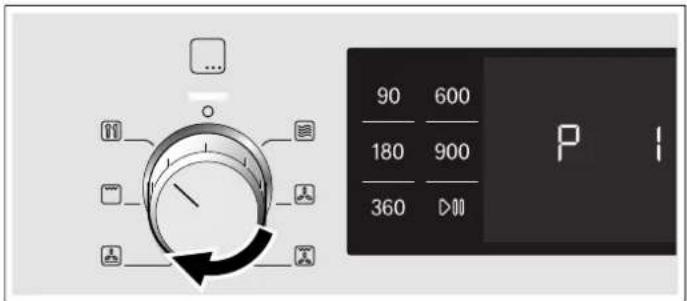
- Valitse ohjelmanumero +- tai --painikkeilla.
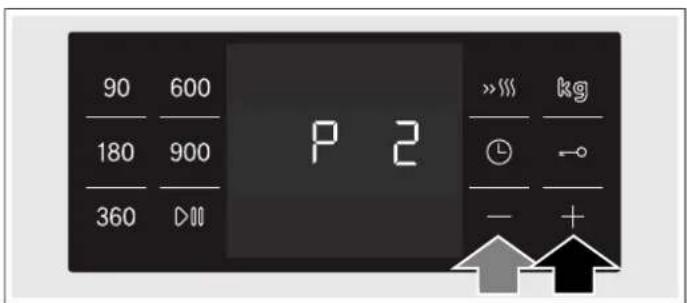
3. Koske kg-painiketta. Painosuositus 0.50 kg tulee näyttöön.
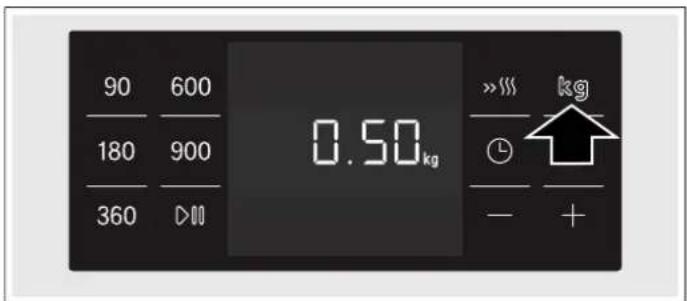
- Aseta paino +- tai --painikkeilla.
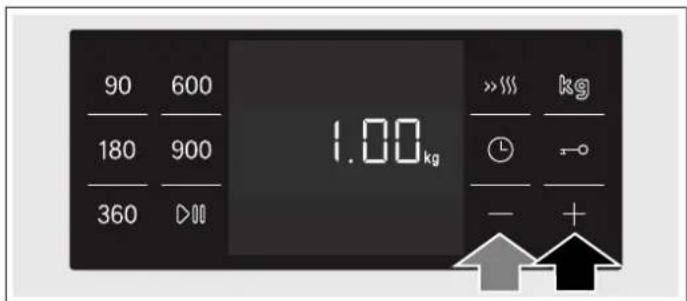
5. Koske ▷▶▶ -painiketta. Ohjelma käynnistyy. Näet kypsennysajan laskennan ja ▶- ja ▶▶ -symbolit tulevat näkyviin.
Ohjelma päättyy
Äänimerkki kuuluu. Ohjelma on päättynyt ja mikroaaltouuni lopettaa kuumentamisen.
Kosketa ▷□□ -painiketta ja käännä toiminnonvalitsin OFF-asentoon.
Ohjelman muuttaminen
Kun ohjelma on käynnistetty, ohjelman numeroa ja painoa ei voi muuttaa.
Äänimerkin ennenaikainen sammutus
Kosketa ⏱ -painiketta.
Mikroaaltouunin luukun avaaminen kypsennyksen aikana
Toiminta keskeytyy. Luukun sulkemisen jälkeen paina lyhyesti D00-painiketta. Toiminta jatkuu.
Toiminnan keskeyttäminen
Kosketa ▷00 -painiketta toiminnan keskeyttämiseksi. Kosketa ▷00 jatkaaksesi toimintaa.
Ohjelman peruuttaminen
Pidä ▷□□ -painiketta painettuna noin 4 sekuntia ja käännä toiminnonvalitsin OFF-asentoon. Mikroaaltouunin virta katkeaa.
Kypsennysajan ja päättymisajan muuttaminen
Jos käytät automaattista kypsennysohjelmaa, kypsennysaikaa tai päättymisaikaa ei voi muuttaa.
Sulatusohjelmat
Voit käyttää 4 sulatusohjelmaa lihan, siipikarjan ja leivän sulattamiseen.
Vihje
Ruoan valmistelu
Käytä pakastettua ruokaa, joka on pakastettu -18 °C:ssa, ja leikkaa se mahdollisimman ohuiksi paloiksi.
Ota sulatettava ruoka pois pakkauksesta ja punnitse se. Sinun on tiedettävä paino ohjelman asettamista varten.
Lihaa ja siipikarjaa sulatettaessa syntyy nestettä. Valuta neste pois, kun käännät lihaa ja siipikarjaa; älä käytä tätä nestettä muihin tarkoituksiin tai anna sen joutua kosketuksiin muiden elintarvikkeiden kanssa.
■ Keittoastia
Aseta ruoka matalaan mikroaaltouunin kestävään astiaan, esimerkiksi posliini- tai lasilautaselle, mutta älä peitä sitä.
Kun sulatat kanaa ja kananpaloja (P03), äänimerkki kuuluu kahdesti, mikä osoittaa, että ruoka on käännettävä.
Lepoaika
Sulatuksen jälkeen ruoan annetaan levätä 10–30 minuuttia, kunnes lämpötila on tasainen. Suuret lihapalat tarvitsevat pidemmän lepoajan kuin pienet. Jauhelihasta tehdyt palat ja ruoat on erotettava toisistaan ennen lepoa.
Lepoajan jälkeen, vaikka paksumpien palojen keskusta ei olisi vielä sulanut, ruokaa voidaan kypsentää edelleen. Tällöin siipikarjan sisäelimet voidaan poistaa.
Ohjelman numero Painoalue (kg)
| 解冻 | |
| P 01 | 肉糜=.20 - 1.00 |
| P 02 | 肉块=.20 - 1.00 |
| P 03 | 鸡,鸡块=.40 - 1.80 |
| P 04 | 面包=.20 - 1.00 |
Kypsennysohjelmat
Voit käyttää 3 keitto-ohjelmaa riisin, perunoiden tai vihannesten kypsentämiseen.
Vihje
Ruoan valmistaminen
Punnitse ruoka. Sinun on tiedettävä paino, jotta voit asettaa ohjelman.
Keittoastia
Yleensä ruoka on kypsennettävä mikroaaltouunin kestävissä, kannellisissa astioissa. Käytä suurta ja syvää astiaa riisin kypsentämiseen. Aseta keittoastia matalalle ritilälle.
Riisi (P05)
Vihje: Älä käytä keitettäviä pussiriisejä. Kypsennyksen aikana syntyy paljon vaahtoa. Syötä paino ennen kypsennystä (= ilman nestettä). Lisää riisiin 2–2,5 kertaa nestemäärä.
Perunat (P06)
Vihje: Keitä perunat:
Leikkaa samankokoisiksi paloiksi. Lisää 1 ruokalusikallinen vettä ja ripaus suolaa jokaista 100 g perunaa kohti.
Vihannekset (P07)
Vihje
Tuoreet vihannekset:
Leikkaa samankokoisiksi paloiksi. Lisää 1 ruokalusikallinen vettä jokaista 100 g vihanneksia kohti.
■ Lepoaika
Ohjelman päätyttyä sekoita ruokaa uudelleen. Anna ruoan levätä vielä 5-10 minuuttia, kunnes lämpötila on tasainen.
Kypsennystulos riippuu ruoan laadusta ja tasaisuudesta.
Ohjelmanumero Painoalue (kg)
| 烹饪 | |
| 05 | 米饭=.05=-=.20 |
| 06 | 土豆=.15=-=1.00 |
Ohjelmanumero Painoalue (kg)
| 07 | 蔬菜=.15=-=1.00 |
Yhdistelmäkypsennysohjelmat
Vihje
■ Ota ruoka pois pakkauksesta ja punnitse se. Jos tarkkaa painoa ei voi syöttää, pyöristä se. Kypsennysastia
Kypsennä ruoka mikronkestävissä, ei liian suurissa astioissa. Aseta kypsennysastia matalalle ritilälle.
Lammas, medium (P12)
Sopii suurille etujalan lihapaloille tai luuttomalle lampaanreidelle.
Lihamureke (P13)
Tämä ohjelma sopii enintään 7 cm paksuille lihamurekkeille.
Kala, kokonainen (P14)
Poista kalasta suomut etukäteen. Aseta kala lautaselle ”uintiasentoon”.
Riisiruoka (P15)
Syötä vain riisin paino. Ohjelma sopii riisiruokiin, joissa on vihanneksia, kalaa tai siipikarjaa. Käytä vain tuoreita aineksia. Käytä kannellista saviastiaa tai vastaavaa syvää astiaa.
Haudutusaika
Kun ohjelma on päättynyt, anna ruoan hautua vielä 5-10 minuuttia, kunnes lämpötila on tasainen.
Ohjelman numero Painoalue (kg)
| 组合烹饪 | ||
| 08 | 烘焙速冻食品=*(=最高高度为3cm) | .40=-1.20 |
| 09 | 整鸡=*0.50=-2.00 | |
| 10 | 上腰肉,五分熟=*0.50=-1.50 | |
| 11 | 猪脖肉=0.50=-2.00 | |
| 12 | 羊肉,五分熟=0.80=-2.00 | |
| 13 | 肉糕=*0.50=-1.50 | |
| 14 | 全鱼 | .30=-1.00 |
| 15 | 煲饭,使用新鲜材料 | .05=-2.20 |
* Käytä kannetonta astiaa
Ajan asetukset Asetusvaihtoehdot
Uunissasi on useita ajan asetusvaihtoehtoja. Voit kutsua valikon esiin =①-painikkeella ja vaihtaa eri toimintojen välillä. Asetukset ovat mahdollisia niin kauan kuin symboli palaa. ▶-nuoli osoittaa voimassa olevan ajan asetusvaihtoehdon. Kun ▶-nuoli on asianomaisen aikasymbolin vieressä, voit muuttaa asetettua aikaa suoraan +- tai =-painikkeilla.
Ajastimen asettaminen
Voit käyttää ajastinta keittiöajastimena, joka toimii uunista riippumatta. Ajastimella on oma äänimerkki. Sen avulla voit päätellä, onko kyseessä ajastinaika vai kypsennysaika.
- Kosketa ⏱-painiketta.
Näytön aikasymboli syttyy ja ▶-nuoli ilmestyy =△-merkin viereen.
- Aseta ajastimen kesto +- tai =-painikkeilla.
+-painikkeen oletusarvo = 10 minuuttia
--painikkeen oletusarvo = 5 minuuttia
Muutaman sekunnin kuluttua aika-asetus otetaan käyttöön. Ajastin käynnistyy. ▶-symboli syttyy ja ajastimen keston lähtölaskenta alkaa. Muut aikasymbolit sammuvat.
Ajastimen kesto päättyy
Äänimerkki kuuluu. Näytössä näkyy 0:00. Kytke ajastin pois päältä ⏻-painikkeella.
Ajastimen keston muuttaminen
Muuta ajastimen kestoa +- tai =-painikkeella. Muutaman sekunnin kuluttua muutettu aika otetaan käyttöön.
Ajastimen keston peruuttaminen
Aseta ajastimen kesto takaisin =0:00 yhdellä painikkeella. Muutos otetaan käyttöön muutaman sekunnin kuluttua. Ajastin kytkeytyy pois päältä.
Aika-asetusten tarkistaminen
Jos useita aika-asetusvaihtoehtoja on asetettu, vastaavat symbolit syttyvät näytössä. Ajastimen aika laskee taustalla. Symbolin edessä oleva osoitinnuoli =▶ näyttää ajastimen lähtölaskennan.
Voit tarkistaa ajastimen △, kypsennysajan |→| tai kellon ⏱ koskettamalla toistuvasti ⏱-painiketta, kunnes nuoli osoittaa sopivaan symboliin. Asetettu arvo näkyy näytössä muutaman sekunnin ajan.
Kypsennysajan asettaminen
Mikroaaltouuniin voidaan asettaa ruoan kypsennysaika. Kun asetettu kypsennysaika päättyy, uuni kytkeytyy automaattisesti pois päältä. Sinun ei siis tarvitse keskeyttää muita töitä uunin sammuttamiseksi. Kypsennysaika ei vahingossa ylity.
Kuvan esimerkki: kypsennysaika 45 minuuttia.
- Aseta lämmitystyyppi toimintovalitsimella.
- Lämpötilan valintakiekolla asetetaan lämpötila tai grilliasetus. 3. Kosketa ⏱-painiketta kahdesti.
Näytössä näkyy 20:00. Aikasymboli palaa, ja ▶-nuoli ilmestyy =|→|-merkin viereen.
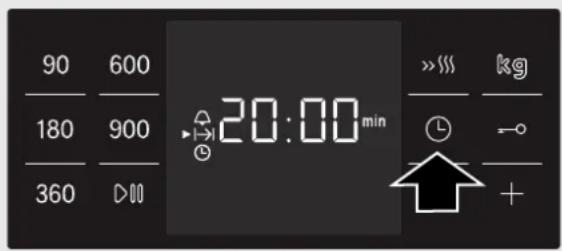
- Aseta kypsennysaika +- tai =-painikkeella.
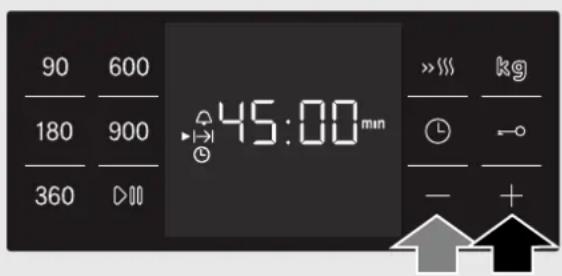
5. Kosketa ▷□□-painiketta.
Uuni käynnistyy. Kypsennysaika laskee näytössä, ja ▶I→I-symboli palaa. Muut aikasymbolit sammuvat.
Kun kypsennysaika on kulunut loppuun
Äänimerkki kuuluu. Uuni lopettaa kuumentamisen. Näytössä näkyy 0:00. Kosketa ⏻-painiketta. Äänimerkki lakkaa. Käännä toiminnonvalitsin pois päältä -asentoon. Mikroaaltouunin virta katkeaa.
Kypsennysajan muuttaminen
Aseta kypsennysaika +- tai =-painikkeella. Muutaman sekunnin kuluttua muutettu aika otetaan käyttöön. Jos ajastin on asetettu, kosketa ensin ⏻-painiketta.
Kypsennysajan peruuttaminen
Aseta kypsennysaika takaisin 0:00-painikkeella. Muutaman sekunnin kuluttua muutettu aika otetaan käyttöön. Kypsennysaika on peruutettu. Jos ajastin on asetettu, kosketa ensin painiketta.
Aika-asetusten tarkistaminen
Jos useita aika-asetuksia on asetettu, vastaavat symbolit palavat näytössä. ▶-nuoli näkyy näytössä tällä hetkellä näkyvän aikatoiminnon symbolin vieressä.
Voit tarkistaa ajastimen ♀, kypsennysajan I→I tai kellon ⏱ koskettamalla toistuvasti ⏱-painiketta, kunnes ▶-nuoli osoittaa sopivaan symboliin. Näyttö näyttää arvon muutaman sekunnin ajan.
Kellon asettaminen
Kun laite on kytketty sähköverkkoon tai sähkökatkoksen jälkeen, ▶①-symboli ja kolme nollaa syttyvät näytössä. Aseta kello.
- Kosketuspainikkeet + tai = -.
Oletusarvo +: 12:00
Oletusarvo -: 23:59
- Aseta kello + tai = - -painikkeilla. 3. Kosketa ⏻ -painiketta. Kellon asetus on valmis.
Kellon vaihtaminen
Edellytys: laitteen on oltava kytkettynä pois päältä.
- Kosketa ⏱ -painiketta kahdesti. Näytön aikasymboli syttyy, ja ▶-nuoli ilmestyy symbolin =① viereen.
- Muuta kelloa + tai = - -painikkeilla. Muutaman sekunnin kuluttua asetettu aika otetaan käyttöön.
Kellon piilottaminen
Voit piilottaa kellon. Lisätietoja on kohdassa Perusasetusten muuttaminen.
Lapsilukko
Mikroaaltouunissa on lapsilukko, joka estää lapsia käynnistämästä mikroaaltouunia vahingossa.
Mikroaaltouuni ei reagoi mihinkään asetuksiin. Kun lapsilukko on käytössä, ajastinta ja kelloa voi silti asettaa.
Lapsilukon käyttöönotto
Vaatimus: ruoanlaittoaikaa ei saa olla asetettuna, toimintovalitsimen on oltava pois päältä. Pidä →0 -painiketta painettuna noin 4 sekunnin ajan.
Näytössä näkyy ——symboli. Lapsilukko on käytössä.
Lapsilukon poistaminen käytöstä
Pidä = → O -painiketta painettuna noin 4 sekunnin ajan.
Näytön —○ -symboli sammuu. Lapsilukko on poistettu käytöstä.
Automaattiset kypsennysohjelmat ja lapsilukko
Kun automaattinen kypsennysohjelma on asetettu, lapsilukko ei toimi.
Perusasetusten muuttaminen
Tässä laitteessa on useita perusasetuksia, joita voit muuttaa milloin tahansa.
Tehdasasetukset
Tässä taulukossa on lueteltu kaikki perusasetukset ja vaihtoehdot niiden muuttamiseen.
| 基本设置 选项 说明 | ||
| c1时钟显示i=开启 | 时钟显示2=关断 | 显示时钟 |
| c2信号持续时间2=中=2分钟 | i=短=10秒3=长=5分钟 | 烹饪时间到时后的信号声 |
| 基本设置 | 选项 | 说明 | |
| c3 | 信号音音量 2 = 中等 | 1 = 低 3 = 高 | 信号音量 |
| c4 | 等待时间 2 = 中=5秒 | 1 = 短=2秒 3 = 长=10秒 | 设置后,两个独立步骤之间的等待时间 |
Edellytys: laite on kytketty pois päältä.
- Pidä ⏱ -painiketta painettuna muutaman sekunnin ajan.
Ensimmäinen perusasetus tulee näkyviin näyttöön.
- Muuta perusasetusta + tai = - -painikkeella.
- Vahvista painamalla Ⓛ-painiketta.
Ensimmäinen perusasetus tulee näkyviin näyttöön. Voit selata kaikkia perusasetuksia ⏻-painikkeella ja muuttaa niitä =+ tai =- painikkeilla.
- Kun olet valmis, paina ja pidä ⏱-painiketta painettuna muutaman sekunnin ajan.
Kaikki asetukset otetaan käyttöön.
Voit muuttaa asetuksia milloin tahansa.
Hoito ja puhdistus
Huoltamalla ja puhdistamalla mikroaaltouuniasi huolellisesti voit säilyttää sen ulkonäön ja toiminnan. Seuraavat ohjeet kertovat, miten laite tulee puhdistaa ja huoltaa oikein.
Sähköiskuvaara!
Älä käytä korkeapainepesuria tai höyrypesuria sähköiskun välttämiseksi.
Palovammavaara!
Älä koskaan puhdista laitetta heti sen sammuttamisen jälkeen.
Vakava terveyshaitta!
Jos keittoaukon luukku tai sen tiiviste on vaurioitunut, mikroaaltosäteilyä voi päästä ulos. Älä käytä laitetta, jos keittoaukon luukku tai tiiviste on vaurioitunut. Ota yhteyttä huoltopalveluun.
Vihje
Käytettävistä materiaaleista, kuten lasista, muovista ja metallista, johtuen laitteen etupuolen väri voi hieman poiketa. Oven paneelissa näkyvät raidat johtuvat uunin valon heijastumisesta. Mikroaaltouunin haju, esimerkiksi kalan kypsennyksen jälkeen, on helppo poistaa. Laita muutama tippa sitruunamehua lasilliseen vettä. Laita myös ruokalusikallinen lasiin, jotta vesi ei kiehu yli. Kuumenna vettä täydellä mikroaaltoteholla 1–2 minuuttia.
Puhdistusaineet
Jotta eri pinnat eivät vaurioituisi väärän puhdistusaineen käytön vuoksi, noudata alla olevan taulukon tietoja. Älä käytä:
Voimakkaita tai syövyttäviä puhdistusaineita. Metallisia tai lasisia kaapimia uunin luukun lasin puhdistamiseen. Metallisia tai lasisia kaapimia luukun tiivisteen puhdistamiseen. Kovia puhdistuslevyjä tai -sieniä. Korkean alkoholipitoisuuden omaavia puhdistusaineita.
Pese uudet sieniliinat huolellisesti ennen käyttöä.
Anna kaikkien pintojen kuivua perusteellisesti ennen laitteen uudelleen käyttöä.
| 区域 清洁剂 | |
| 电器前面板=热肥皂水:用洗碗布清洁,然后用软布擦干。请勿使用玻璃清洁器、金属或玻璃刮刀进行清洁。 | |
| 不锈钢前面板=热肥皂水:用洗碗布清洁,然后用软布擦干。立即清除水垢、油脂、淀粉和蛋白(=例如蛋清=)形成的斑点。这类污渍可能会形成斑点。不锈钢用清洁用品可从我们的售后服务部门或业零售商处获取。请勿使用玻璃清洁器、金属或玻璃刮刀进行清洁。 | |
| 烹饪箱=热肥皂水或醋溶液:用洗碗布清洁,然后用软布擦干。对于顽固污渍:请勿使用烤箱喷雾剂或任何其他腐蚀性烤箱清洁剂或磨蚀性材料。擦洗片、粗糙的海绵和平底锅清洗物品均不适用。这些物品会刮伤表面。让内部表面彻底干燥。 | |
| 用于清洁烹饪箱的清洁辅助工具 | 装有洗涤液的杯子喷几滴清洁液在水里。同时将一把汤匙放入杯中,以防延时沸腾。以最大微波功率将水加热2分钟。关闭电器,在电器门关闭状态下,让烹饪箱中的容器再放置5分钟。然后使用软布擦拭烹饪箱,让表面彻底干燥。 |
| 烹饪箱压痕=湿布: | 请确保水不会经过转盘驱动装置渗入电器内部。 |
| 烤架=热肥皂水: | 使用不锈钢清洁剂或放入洗碗机中清洗。 |
| 门面板=玻璃清洁剂: | 用洗碗布清洁。不要使用玻璃刮刀。 |
| 门封圈=热肥皂水: | 用洗碗布清洁,不要刷洗。不要用金属或玻璃刮刀进行清洁。 |
Vikataulukko
Vioilla on usein yksinkertainen selitys. Lue vikataulukko ennen kuin soitat huoltopalveluun.
Jos leivonnaiset eivät onnistu odotetusti, katso kohtaa "=Meidän keittiömme testaamia reseptejä=", josta löydät paljon leivontavinkkejä.
Sähköiskuvaara!
Virheellinen korjaus on vaarallista. Vain koulutetut huoltoinsinöörimme saavat korjata laitteen.
Vikataulukko
| 故障 可能的原因 纠正措施/信息 | ||
| 电器不工作。=断路器故障。=查看保险丝盒,检查电器断路器是否正常工作。 | ||
| 电器不工作。=○显示在显示屏中。=儿童锁开启。=停用儿童锁(=参见章节:儿童锁=)。 | ||
| 0:00和1出现在显示屏中。 | 断电 | 复位时钟。 |
| 微波不启动。=门没有完全关闭。=检查门内是否有食物残余物或碎屑。 | ||
| 食物在微波中的加热时间比以前长=选择的微波功率等级太低。=选择的微波功率等级太低。 | ||
| 转盘发生摩擦或磨动。 | 转盘驱动装置周围有污物或碎屑。 | 彻底清洁转盘下方的滚子和微波炉底板中的凹口。 |
| 无法设置特定操作模式或功率等级。=在该操作模式下,不能进行温度设置、功率等级设置或组合设置。 | 选择允许的设置。 | |
| E1显示在显示屏中。 | 过热安全关断功能已经启动。 | 致电售后服务部门。 |
| E2显示在显示屏中。 | 自动安全关机功能已经启动。 | 触摸任一按键或转动选择旋钮。 |
| E3显示在显示屏中。 | 微波炉有故障。=致电售后服务部门。 | |
| E4显示在显示屏中。 | 过热安全关断功能已经启动。 | 致电售后服务部门。 |
| E11显示在显示屏中。 | 控制面板中有湿气。 | 让控制面板干燥。 |
| E17显示在显示屏中。 | 快速加热失败。=致电售后服务部门。 | |
| 电器可以设置,但是不能加热。冒号闪烁。 | 演示模式已经启动。 | 断开电器电源,然后再重新连接。按下并按住=○按键,直至=○符号出现在显示屏中,且冒号停止闪烁。使用=○按键在4秒内确认。 |
Asiakaspalvelu
Jos laitteesi tarvitsee korjausta, tarjoamme sinulle huoltopalvelua. Pyrimme jatkuvasti löytämään sopivia ratkaisuja välttääksemme turhat huoltokäynnit.
E-numero ja FD-numero
Ota yhteyttä soittaessasi esiin tuotenumero (E-numero) ja valmistusnumero (FD-numero), jotta voimme antaa sinulle oikeat neuvot. Näillä numeroilla varustettu tyyppikilpi sijaitsee mikroaaltouunin oven sivussa. Voit kirjoittaa alla olevaan tyhjään tilaan laitteen numerot ja huoltopalvelun puhelinnumeron, jotta sinun ei tarvitse etsiä niitä silloin, kun tarvitset niitä.
| E 编号 | FD 编号 |
| 售后服务 |
Huomaa, että vian sattuessa, jos laite ei ole takuun alainen, huoltoteknikon käynti veloitetaan.
Etsi kaikkien maiden yhteystiedot laitteen mukana toimitetusta asiakaspalveluluettelosta.
Varaa teknikon käynti ja tuoteneuvonta
CN 400 885 5888
Puhelun hinta riippuu käytetystä verkosta.
Valmistajan ammattitaitoon voit luottaa. Siksi huollon suorittavat ammattikoulutetut huoltoteknikot käyttäen alkuperäisiä varaosia.
Tekniset tiedot
| 电源 | 220-230 V, 50 Hz |
| 总功率 | 3,600=W |
| 微波功率 | 900 W |
| 微波频率 | 2,450 MHz |
| 烧烤 | 1,750 W |
| 热风 | 1,750 W |
| 保险丝 | 16 A |
| VDE 认证 | 是 |
| CE 标记 | 是 |
Tämä laite täyttää standardit EN 55011 ja CISPR 11. Se kuuluu ryhmän 2 luokkaan B.
Ryhmä 2 tarkoittaa, että mikroaaltouuni on valmistettu ruoan lämmittämiseen. Luokka B tarkoittaa, että laite soveltuu yksityiseen kotikäyttöön.
Akryyliamidi elintarvikkeissa
Mihin elintarvikkeisiin se vaikuttaa?
Akryyliamidia muodostuu pääasiassa korkeassa lämpötilassa käsitellyistä vilja- ja perunatuotteista, kuten ranskalaisista perunoista,
Perunalastut, paahtoleipä, sämpylät, leipä, hienot leivonnaiset (keksejä, piparkakkuja, pikkuleipiä).
C
Vinkkejä akryyliamidin vähentämiseen ruoanlaitossa
| 概述 尽可能减少烹饪时间。烹饪时食物颜色变为金黄褐色即可,颜色不要太深。又大又厚的食品包含的丙烯酰胺较少。 |
| 烤饼干 上 / 下加热模式最高 200 °C,或,3D 热风或热风模式最高 180 °C。顶部 / 底部加热模式最高 190 °C,或,3D 热风或热风模式最高 170 °C。蛋清和蛋黄减少丙烯酰胺形成。 |
| 烤薯片 将其在烤盘上均匀摊开,摊薄。每个烤盘上至少烤 400 g,这样不会烤干。 |
Energia- ja ympäristövinkkejä
Tästä luvusta löydät vinkkejä energian säästämiseen leivonnassa ja grillaamisessa sekä vanhan laitteen oikeaan hävittämiseen.
Energiansäästö
Esilämmitä uuni vain, jos resepti tai käyttötaulukko niin vaatii. ■ Käytä mustaksi maalattuja tai emaloituja vuokia. Ne imevät lämpöä erityisen hyvin. Avaa uunin luukkua mahdollisimman vähän kypsennyksen, leivonnan tai grillaamisen aikana. ■ Kun leivot useita piirakoita, leivo ne mieluiten peräkkäin. Uuni on vielä lämmin. Tämä lyhentää toisen piirakan paistoaikaa. Voit myös asettaa kaksi suorakaiteen muotoista vuokaa vierekkäin.
Pitkissä kypsennyksissä voit sammuttaa uunin 10 minuuttia ennen kypsennysajan päättymistä ja hyödyntää jälkilämmön.
Ympäristöystävällinen hävittäminen
Hävitä pakkausmateriaalit ympäristöystävällisesti.

Tämä laite on merkitty EU:n direktiivin 2012/19/EU (WEEE) mukaisesti. Direktiivi määrittelee puitteet vanhojen sähkölaitteiden tehokkaalle kierrätykselle ja uudelleenkäytölle EU:n alueella.
Reseptejä, jotka on testattu meidän keittiössämme
Täältä löydät erilaisia reseptivaihtoehtoja ja niiden ihanteelliset asetukset. Näytämme sinulle, mikä lämmitystapa ja mikä lämpötila tai mikroaaltotehoasetus sopii parhaiten ruoallesi. Löydät tietoa sopivista lisävarusteista ja niiden asetuskorkeuksista sekä vinkkejä keittoastioista ja valmistusmenetelmistä.
Vinkkejä
Taulukon arvot koskevat aina ruokia, jotka asetetaan kylmään, tyhjään uuniin. Esilämmitä laite vain, jos taulukko niin vaatii. Poista kaikki tarpeettomat lisävarusteet uunista ennen käyttöä. Älä aseta leivinpaperia lisävarusteiden päälle ennen esilämmitystä. Taulukossa annetut ajat ovat vain suuntaa antavia. Tarkka aika riippuu ruoan laadusta ja koostumuksesta. ■ Käytä mukana toimitettuja lisävarusteita. Voit ostaa lisävarusteita huoltopalvelusta tai erikoisliikkeistä. Käytä aina uunikintaita tai patakintaita, kun otat lisävarusteita tai keittoastioita uunista.
Käytä mikroaaltouunia sulatukseen, lämmitykseen ja kypsennykseen.
Seuraava taulukko antaa sinulle erilaisia mikroaaltouunin vaihtoehtoja ja asetuksia.
Taulukossa annetut ajat ovat vain viitteellisiä. Ajat voivat vaihdella käytetyn keittoastian sekä ruoan laadun, lämpötilan ja tasaisuuden mukaan.
Taulukossa on yleensä annettu aikaväli. Aseta ensin lyhin aika ja pidennä aikaa tarvittaessa.
On mahdollista, että ruoan määrä poikkeaa taulukossa annetusta. Kokemusperäinen sääntö: kaksinkertainen määrä - lähes kaksinkertainen kypsennysaika, puolet määrästä - puolet kypsennysajasta.
Aseta uunipannu matalan ritilän keskelle. Näin ruoka imee mikroaallot joka puolelta.
Sulatus
Vinkkejä
■ Laita pakastettu ruoka kannettomaan astiaan ja aseta se ritilälle. ■ Ohuet osat, kuten kanan koivet ja siivet, tai rasvaiset ulkokerrokset paistissa voidaan kääriä pieniin alumiinifolion paloihin. Älä anna folion koskettaa uunin seinämiä. Kun sulatusajasta on kulunut puolet, folio voidaan poistaa. Käännä tai sekoita ruokaa kerran tai kahdesti sulatuksen aikana. Suuret ruokapalat tulee kääntää useammin. Käännön yhteydessä poista sulatuksesta syntynyt neste. ■ Anna sulatetun ruoan seistä huoneenlämmössä 10–60 minuuttia, jotta lämpötila tasaantuu. Tällöin siipikarjan sisäelimet voidaan poistaa.
Sulatus, paino, mikroaaltoteho (W), kypsennysaika (min), huomautus
| 整块肉(带骨或去骨的牛肉、小牛肉或猪肉) | 800 g 180 W, 15分钟 + 90 W, 10-20分钟 翻转几次 |
| 1 kg 180 W, 20分钟 + 90 W, 15-25分钟 | |
| 1.5 kg 180 W, 30分钟 + 90 W, 20-30分钟 | |
| 肉块或肉片(牛肉、小牛肉或猪肉) | 200 g 180 W, 3分钟 + 90 W, 10-15分钟 翻转时将已解冻的部分分开 |
| 500 g 180 W, 5分钟 + 90 W, 15-20分钟 | |
| 800 g 180 W, 8分钟 + 90 W, 15-20分钟 |
| 解冻 重量 微波功率设置 (W), 烹饪时间 ( 分钟 ) 注意 | ||
| 五花肉糜 200 g 90 W, 10-15 分钟 | 尽量平放冷冻食品 | |
| 500 g 180 W, 5 分钟 + 90 W, 10-15 分钟 | 翻转数次,取出所有解冻的菜肴 | |
| 800 g 180 W, 8 分钟 + 90 W, 15-20 分钟 | ||
| 家禽或家禽块 600 g 180 W, 8 分钟 | + 90 W, 10-15 分钟 在烹饪过程中翻转。 | |
| 1.2 kg 180 W, 15 分钟 + 90 W, 25-30 分钟 | ||
| 鸭 2 kg 180 W, 20 分钟 + 90 W, 30-40 分钟 翻转几次 | ||
| 鱼块、鱼排或鱼片 400 g 180 W, 5 分钟 + 90 W, 10-15 分钟 将已解冻的部分分开 | ||
| 全鱼 300 g 180 W, 3 分钟 + 90 W, | 10-15 分钟 - | |
| 600 g 180 W, 8 分钟 + 90 W, 10-15 分钟 | ||
| 蔬菜,例如豌豆 300 g 180 W, 10-15 分钟 在解冻期间认真搅拌。 | ||
| 600 g 180 W, 10 分钟 + 90 W, 10-15 分钟 | ||
| 水果,例如覆盆子 300 g 180 W, 7-10 分钟 在解冻期间小心地搅拌,将已解冻的部分分开 | ||
| 500 g 180 W, 8 分钟 + 90 W, 5-10 分钟 | ||
| 黄油,解冻 125 g 180 W, 1 分钟 + 90 W, 2-4 分钟 去除所有包装 | ||
| 250 g 360 W, 1 分钟 + 90 W, 2-4 分钟 | ||
| 条形面包 500 g 180 W, 6 分钟 + 90 W, 5-10 分钟 在烹饪过程中翻转。 | ||
| 1 kg 180 W, 12 分钟 + 90 W, 15-25 分钟 | ||
| 干蛋糕,例如海绵蛋糕 | 500 g 90 W, 15-20 分钟 仅用于不加糖衣、奶油或奶黄酱的蛋糕,分离蛋糕块。 | |
| 750 g 180 W, 5 分钟 + 90 W, 10-15 分钟 | ||
| 湿蛋糕,例如水果馅饼、干酪蛋糕 | 500 g 180 W, 5 分钟 + 90 W, 10-15 分钟 仅适用于不加糖衣、奶油或白明胶的蛋糕 | |
| 750 g 180 W, 7 分钟 + 90 W, 10-15 分钟 | ||
Pakastetun ruoan sulatus, lämmitys tai kypsennys
Vinkkejä
Ota valmisruoka pois pakkauksesta. Laita se mikroaaltouunin kestävään astiaan, jolloin lämmitys on nopeampaa ja tasaisempaa. Ruoan eri osat saattavat tarvita eri lämmitysajat. Levitetty ruoka kypsyy nopeammin kuin kasattu ruoka. Siksi levitä ruoka niin, että se on mahdollisimman tasaisesti astiassa. Älä aseta eri ruokia päällekkäin.
Ammattilainen
Muista peittää ruoka. Jos astiassa ei ole sopivaa kantta, peitä lautasella tai mikroaaltokalvolla. Sekoita tai käännä ruokaa 2–3 kertaa kypsennyksen aikana. Anna ruoan levätä 2–5 minuuttia lämmityksen jälkeen, jotta lämpötila tasaantuu. Kun otat lautasen mikroaaltouunista, käytä aina uunikintaita tai patalappua. ■ Tämä auttaa ruokaa säilyttämään oman ainutlaatuisen makunsa, jolloin mausteita tarvitaan vähemmän.
| 解冻、加热或烹饪冷冻食品 | 重量 | 微波功率设置(W),烹饪时间(分注意钟) | |
| 套餐、点餐、即食餐 | 300-400 g | 600 W, 10-15 分钟 | 将食物从包装中取出,盖上食物加热 |
| 汤 | 400-500 g | 600 W, 8-10 分钟 | 带盖烹饪容器 |
| 炖肉 | 500 g | 600 W, 10-15 分钟 | 带盖烹饪容器 |
| 1 kg | 600 W, 20-25 分钟 | ||
| 带调味料的肉条或肉片,例如菜炖牛肉 | 500 g | 600 W, 15-20 分钟 | 带盖烹饪容器 |
| 1 kg | 600 W, 25-30 分钟 | ||
| 鱼,如鱼排 | 400 g | 600 W, 10-15 分钟 | 盖盖子 |
| 800 g | 600 W, 18-20 分钟 | ||
| 配菜,例如米饭、意大利面 | 250 g | 600 W, 2-5 分钟 | 带盖烹饪容器;添加汁液 |
| 500 g | 600 W, 8-10 分钟 | ||
| 蔬菜,如豌豆、椰菜、胡萝卜 | 300 g | 600 W, 8-10 分钟 | 带盖烹饪容器;添加一大勺水 |
| 600 g | 600 W, 15-20 分钟 | ||
| 菠菜奶油沙司 | 450 g | 600 W, 11-16 分钟 | 烹饪时不另外加水 |
Ruoan lämmittäminen
Palovamman vaara!
Kuumennetut nesteet voivat kiehua viiveellä. Tämä tarkoittaa, että neste on saavuttanut kiehumispisteen, mutta siinä ei näy tavallisia höyrykuplia. Vaikka astiaa vain hieman täräytetään, kuuma neste voi yhtäkkiä kiehua yli ja roiskua. Kun kuumennat nestettä, laita aina lusikka astiaan. Tämä estää viivästyneen kiehumisen.
Huomio!
Metallin (esimerkiksi lusikan lasissa) on oltava vähintään 2 cm:n etäisyydellä keittotilan seinistä ja luukun sisäpinnasta. Muuten kipinät voivat vahingoittaa luukun sisälasia.
Vihje
Ota valmisruoka pois pakkauksesta. Laita se mikroaaltouunin kestävään astiaan, niin kuumeneminen on nopeampaa ja tasaisempaa. Ruoan eri osat voivat vaatia erilaisen kuumenemisajan. Peitä ruoka aina. Jos astiassa ei ole sopivaa kantta, käytä lautasta tai mikroaaltouunin kestävää kalvoa.
Sekoita tai käännä ruokaa muutaman kerran kuumentamisen aikana. Tarkista lämpötila.
■ Anna ruoan seistä 2–5 minuuttia kuumentamisen jälkeen, jotta lämpötila tasaantuu. Kun otat lautasen mikroaaltouunista, käytä aina uunikintaita tai patalappua.
| 加热食物 重量 微波功率设置 (W),烹饪时间( 分钟) | 注意 | ||
| 套餐、点餐、即食餐 350-500 g 600 W,5-10 分钟 将食物从包装中取出,盖上食物加热 | |||
| 饮品 150 mL 900 W,1-2 分钟 注意 ! | |||
| 300 ml 900 W,2-3 分钟 | |||
| 500 ml 900 W,3-4 分钟 | |||
| 婴儿食品,如奶瓶 50 ml 360 W,约 1 分钟 将奶瓶放在烹饪箱箱底上,不要盖奶嘴或 | 盖子。加热后摇动或搅拌均匀。必须检查温度 | ||
| 100 ml 360 W,1-2 分钟 | |||
| 200 ml 360 W,2-3 分钟 | |||
| 汤 | - | ||
| 1 杯 175 g | 900 W,2-3 分钟 | ||
| 2 杯 每杯 175 g | 900 W,4-5 分钟 | ||
| 4 杯 每杯 175 g | 900 W,5-6 分钟 | ||
| 带调味料的肉条或肉片,例如菜炖牛肉 500 g | 600 W,10-15 分钟 | 盖盖子 | |
| 炖肉 400 g | 600 W,5-10 分钟 带盖烹饪容器 | ||
| 800 g | 600 W,10-15 分钟 | ||
| 蔬菜 150 g | 600 W,2-3 分钟 加一些汁液 | ||
| 300 g | 600 W,3-5 分钟 | ||
Ruoan kypsentäminen
Vihje
Tasaisesti levitetty ruoka kypsyy paljon nopeammin kuin kasattu ruoka. Levitä ruoka siksi mahdollisimman tasaiseksi astiaan. Älä aseta eri ruokia päällekkäin.
Kypsennä ruoka kannellisessa astiassa. Jos astiassa ei ole sopivaa kantta, käytä lautasta tai mikroaaltouunin kestävää kalvoa. ■ Näin ruoka säilyttää oman makunsa ja tarvitsee vähemmän mausteita. ■ Kypsennyksen jälkeen anna ruoan seistä 2–5 minuuttia, jotta lämpötila tasaantuu. Kun otat lautasen mikroaaltouunista, käytä aina uunikintaita tai patalappua.
| 烹饪食物 | 重量 | 微波功率 (W) 烹饪时间(分钟) | 注意 |
| 去掉内脏杂碎的新鲜整鸡 | 1.5 kg | 600 W, 30-35 分钟 | 在烹饪中途翻转 |
| 新鲜鱼块 | 400 g | 600 W, 5-10 分钟 | - |
| 新鲜蔬菜 | 250 g | 600 W, 5-10 分钟 | 切成大小均匀的小块。每 100 g 加入 1 到 2 汤匙水。在烹饪过程中搅拌 |
| 500 g | 600 W, 10-15 分钟 | ||
| 土豆 | 250 g | 600 W, 8-10 分钟 | 切成大小均匀的小块。每 100 g 加入 1 到 2 汤匙水。在烹饪过程中搅拌 |
| 500 g | 600 W, 11-14 分钟 | ||
| 750 g | 600 W, 15-22 分钟 | ||
| 米饭 | 125 g | 600 W, 7-9 分钟 + 180 W, 15-20 分钟 | 加入双倍的汁液,使用带盖的深型烹饪容器 |
| 250 g | 600 W, 10-12 分钟 + 180 W, 20-25 分钟 | ||
| 甜食,如牛奶冻(即食) | 500 ml | 600 W, 7-9 分钟 | 在加热过程中用搅蛋器搅拌 2-3 次 |
| 水果,蜜饯 | 500 g | 600 W, 9-12 分钟 | - |
Mikroaaltouunissa valmistettava popcorn
Vihje
■ Käytä kuumuutta kestäviä litteitä lasiastioita, kuten kannellisia uunivuokia, lasivuokia tai lasisia uunivuokia (kestävää lasia). Aseta vuoka aina ritilälle. ■ Älä käytä posliiniastioita tai hyvin kaarevia vuokia.
Aseta asetukset taulukon ohjeiden mukaan. Säädä aikaa ruokalajin ja annoskoon mukaan. ■ Jotta popcornit eivät pala, ota popcornipussi pois mikroaaltouunista 1 minuutin 30 sekunnin kuluttua ja ravista sitä. Ole varovainen, popcornipussi on kuuma!
Palovamman vaara!
■ Kun avaat popcornipussin, kuumaa höyryä pääsee ulos, joten ole varovainen. ■ Älä koskaan aseta mikroaaltouunia suurimmalle teholle.
| 重量 | 附件 | 微波功率 (W)烹饪时间(分钟) | |
| 用微波加工的爆玉米花 | 1袋,100g | 烹饪容器,烤架 | 600 W,3-5分钟 |
Mikroaaltouunin käyttövinkkejä
| 您无法找到准备烹饪的食物量的相应设置信息。=依据下面的经验,酌情增加或减少烹饪时间:双倍的食物量 = 几乎双倍的烹饪时间一半的量 = 一半的烹饪时间 |
| 食物变得太干。=下一次,缩短烹饪时间或选择较低的微波功率设置。给食物盖上盖子,并加入更多的汁液。 |
| 在到达时间后,食物没解冻、没热或没熟。=设置更长的时间。量大、堆放的食物需要更长的时间。 |
| 在到达时间后,食物的边缘过热,但中部没熟。=在烹饪过程中搅拌,下次选择一个较低的微波功率设置和较长的烹饪时间。 |
| 在解冻之后,家禽或肉外部已解冻,但中部没解冻。=下一次,选择一个较低的微波功率设置。如果需要解冻的食物量大,要翻转几次。 |
Leivonnaiset
Taulukoista
Vinkkejä
Annetut ajat koskevat kylmään mikroaaltouuniin asetettuja ruokia. Lämpötila ja paistoaika riippuvat seoksen määrästä ja tasaisuudesta. Siksi taulukossa annetaan lämpötila-alueita. Aloita matalammasta lämpötilasta ja käytä tarvittaessa seuraavalla kerralla korkeampaa asetusta, koska matalampi lämpötila antaa tasaisemman ruskistuksen.
Lisätietoja on taulukoiden jälkeisessä leivontavinkit-osiossa. Aseta kakkuvuoka aina matalan ritilän keskelle.
Vuoat
Vinkki: Käytä mieluiten tummia metallivuokia.
| 烤模 附件 加热类型 温度(°C) 微波功率 (W) 烹饪时间(分钟) | |||
| 海绵蛋糕,原味=环状/=蛋糕模 | 170-180=90=40-50 | ||
| 美味海绵蛋糕 (=如松蛋糕=)* 环状/=蛋糕模 | 150-170=- | 70-90 | |
| 弹性果馅饼 果馅饼蛋糕模 | 160-180=- | 30-40 | |
| 鲜美水果馅饼 弹性/=环形模 | 170-180=90=35-45 | ||
| 松软蛋糕底,2只蛋 果馅饼蛋糕模 | 160-170=- | 20-25 | |
| 松软果馅饼,6只蛋 黑色弹性蛋糕模 | 170-180=- | 35-45 | |
| 硬壳酥皮糕点胚=黑色弹性蛋糕模 | 170-190=- | 30-40 | |
| 果馅饼/干酪蛋糕,酥皮糕点胚=* 黑色弹性蛋糕模 | 170-190=180 | 35-45 | |
| 瑞士果馅饼=** 黑色弹性蛋糕模 | 190-200=- | 45-55 | |
| 环形蛋糕 环状蛋糕模 | 170-180 | 40-50 | |
| 匹萨、薄坯、少量浇头** 圆形匹萨盘 | 220-230 | - | 15-25 |
| 调味蛋糕=** 黑色弹性蛋糕模 | 200-220=- | 50-60 | |
| 坚果蛋糕 黑色弹性蛋糕模 | 170-180=90=35-45 | ||
| 带干配料的发酵生面团 圆形匹萨盘 | 160-180=- | 50-60 | |
| 带湿配料的酵母生面团 圆形匹萨盘 | 170-190=- | 55-65 | |
| 500g面粉制作的辫子面包 圆形匹萨盘 | 170-190=- | 35-45 | |
| 果子甜面包,500g面粉=圆形匹萨盘 | 160-180=- | 60-70 | |
| 果馅奶酥卷,甜味 圆形匹萨盘 | 190-210=180 | 35-45 | |
* Anna kakun jäähtyä mikroaaltouunissa noin 20 minuuttia. **= Aseta tavalliselle uunipellille.
| 小的烘焙食品 | 附件 | 加热类型 | 温度(°C) | 烹饪时间(分钟) |
| 饼干 | 圆形匹萨盘 | 150-170 | 25-35 | |
| 蛋白杏仁饼干 | 圆形匹萨盘 | 110-130 | 35-45 | |
| 蛋白甜饼 | 圆形匹萨盘 | 100 | 80-100 | |
| 松饼 | 松饼烤盘,放在烤架上 | 160-180 | 35-40 | |
| 泡芙 | 圆形匹萨盘 | 200-220 | 35-45 | |
| 千层酥 | 圆形匹萨盘 | 190-200 | 35-45 | |
| 发酵蛋糕 | 圆形匹萨盘 | 200-220 | 25-35 |
| 面包和面包卷 附件 加热类型 温度(°C) 烹饪时间(分钟) | |
| 1.2 kg 面粉制作酸面包 圆形匹萨盘 | 210-230 50-60 |
| 平面包 * 圆形匹萨盘 | 220-230 25-35 |
| 面包卷 圆形匹萨盘 | 210-230 25-35 |
| 甜发酵生面团面包卷 圆形匹萨盘 200-220 15-25 | |
* Aseta astia suoraan kääntölevylle.
Leivontavinkkejä
| 您想按照自己的配方烘焙。使用烘焙表内的相似配方作为参考。 | |
| 使用由硅、玻璃、塑料或陶瓷材料制成的烤模。 | 烤罐必须能够承受高达250°C的高温。这些烤模中的蛋糕颜色更浅一些。当使用微波时,烹饪时间将比表中所示时间更短。 |
| 如何确定海绵蛋糕已经烤透。 | 在配方规定的烘焙结束时间前大约10分钟,将取食签插入蛋糕的最高点。如果拿出后的取食签是干净的,说明蛋糕已经烤熟。 |
| 蛋糕坍陷。 | 下次用更少的液体或将微波炉温度设低10度,并烹饪更长的时间。遵守配方中规定的搅拌时间。 |
| 蛋糕中间已经膨起,但边缘塌陷。 | 仅在弹性蛋糕模底部涂油脂。烘焙后,用小刀小心地松开蛋糕。 |
| 蛋糕颜色太深。 | 选择更低的温度并将蛋糕烘焙时间稍微加长一些。 |
| 蛋糕太干。 | 如果蛋糕已熟,用牙签在蛋糕上扎一些小孔。然后在上面洒一些果汁或酒类。下次,将温度调高10度,并缩短烘焙时间。 |
| 面包或蛋糕(如干酪蛋糕)表面看起来很好,但里面未烤透(粘连,有水纹)。 | 下次稍微少放点液体,并在较低的温度下稍微烤久一点。当烘焙带有湿配料的蛋糕时,首先烘焙底部,用杏仁或面包屑覆盖,然后添加配料。请遵循配方和烘焙时间。 |
| 将蛋糕翻转后,不能将其翻出蛋糕模。且 | 在烘焙之后,让蛋糕进一步冷却5至10分钟,这样将更易于将其翻转出烤罐。如果仍然粘连,可用刀子小心切开蛋糕边缘。再次翻转蛋糕模,并用冷的湿布将其覆盖几次。下次,更好地用油脂润滑蛋糕模,并在其中撒些面包屑。 |
| 您已经用自己的肉温度计测量了温度,并发现存在差异。 | 制造商在规定时间之后使用试验台在烹饪箱中央测量微波炉温度。烹饪容器和附件会影响温度测量,所以当您自己测量温度时总是存在某些差异。 |
| 烤模和烤架之间产生火花。检查烤模外部是否干净。改变烹饪箱中烤模的位置。如果这没有帮助,继续烘焙,但是不要使用微波。这样的话,烘焙时间将更长。 | |
Paistaminen ja grillaaminen
Taulukosta
Lämpötila ja paistoaika riippuvat kypsennettävän ruoan tyypistä ja määrästä. Siksi taulukossa on lämpötila-alueita. Aloita alhaisemmasta lämpötilasta ja käytä tarvittaessa seuraavalla kerralla korkeampaa asetusta. Yksityiskohdat grillaus- ja paistovihjeissä taulukon jälkeen.
Kypsennysastiat
Voit käyttää mitä tahansa mikroaaltouuniin sopivaa lämmönkestävää vuokaa. Metallivuoat eivät sovellu mikroaaltogrillaukseen.
Vuoka kuumenee hyvin kuumaksi. Käytä uunikintaita, kun otat vuoan mikroaaltouunista.
Kun otat kuuman lasisen ruokalautasen mikroaaltouunista, aseta se kuivalle keittiöpyyhkeelle. Jos asetat sen kylmälle tai märälle pinnalle, lasi voi särkyä.
Naudanliha
Vihje
Haudutetun naudanlihan kohdalla käännä pala, kun kypsennysajasta on kulunut 1/3 ja 2/3. Anna lopuksi vetäytyä noin 10 minuuttia.
Paistovihjeitä
Vihje
■ Käytä syvempää vuokaa lihan ja siipikarjan grillaamiseen. - Tarkista, että kypsennysastian koko sopii kypsennystilaan. Astia ei saa olla liian suuri. Liha:
Peitä liemellä noin kaksi kolmasosaa vuoan pohjasta. Jos kypsennät hauduttamalla, lisää lientä hieman enemmän. Käännä lihapala, kun kypsennysajasta on kulunut puolet. Kun grillaat, katkaise mikroaaltouunista virta ja anna ruoan vetäytyä vielä 10 minuuttia. Näin lihasnesteet jakautuvat paremmin.
Siipikarja:
Kun 2/3 kypsennysajasta on kulunut, käännä lihapalat.
Käännä sisä- ja ulkofilee kypsennyksen puolivälissä. Anna lopuksi vetäytyä noin 10 minuuttia. Pihvien kohdalla käännä, kun 2/3 kypsennysajasta on kulunut.
| 牛肉 | 附件 | 加热类型 | 温度(°C),烧烤设置 | 微波功率(W) | 烹饪时间(分钟) |
| 炖牛肉,约1kg | 带盖烹饪容器 | 180-200 | - | 120-143 | |
| 牛肉片,五分熟,约1kg | 无盖容器 | 180-200 | 90 | 30-40 | |
| 上腰肉,五分熟,约为1kg | 无盖容器 | 210-230 | 180 30-40 | ||
| 牛排,五分熟,3cm厚 | 高烤架 | 3 | - | 每一面10-15分钟 |
Vasikanliha
Vihje: Käännä vasikanpotkat ja lihapalat kypsennyksen puolivälissä. Anna lopuksi vetäytyä noin 10 minuuttia.
Vasikanliha, lisäke, lämmitystyyppi, lämpötila (°C), mikroaaltoteho (W), kypsennysaika (min)
| 小牛肉块,约1kg带盖烹饪容器 | 180-200 - 110-130 |
| 小牛肘子,约为1.5kg带盖烹饪容器 | 200-220 - 120-130 |
Sianliha
Vihje
Käännä vähärasvaiset sianlihapalat ja nahattomat suuret lihapalat kypsennyksen puolivälissä. Anna lopuksi vetäytyä noin 10 minuuttia.
Aseta suuret lihapalat keittoastiaan nahkapuoli ylöspäin. Viillä nahkaa. Älä käännä suuria lihapaloja. Anna lopuksi vetäytyä noin 10 minuuttia. ■ Älä käännä porsaan sisäfileetä tai sianlihapaloja. Anna lopuksi vetäytyä noin 5 minuuttia. Käännä porsaan niska, kun 2/3 kypsennysajasta on kulunut.
| 猪肉 附件 加热类型 温度(°C),烧烤 | 微波功率 (W) | 烹饪时间( 分钟 ) | |||
| 设置 | |||||
| 去皮大肉块( 如猪颈 )约750 g* | 带盖烹饪容器 | 220-230 | 180 | 40-50 | |
| 带皮大肉块( 如果前腿肉 )约1.5 kg | 无盖容器 | 190-210 | - | 130-150 | |
| 猪肉片,约为500 g* | 带盖烹饪容器 | 220-230 | 90 | 25-30 | |
| 瘦猪肉块,约1 kg* | 带盖烹饪容器 | 210-230 | 90 | 60-80 | |
| 连骨熏肉,约1 kg* | 无盖容器 | - | - | 360 | 45-45 |
| 猪颈肉,2 cm 厚 ** | 3 | - | 第1面:约15-20第2面:约10-15 | ||
* Matala ritilä **Korkea ritilä
Lammas
Vihje: Käännä lampaanreisi kypsennyksen puolivälissä.
| 羊肉 | 附件 | 加热类型 | 温度(°C) | 微波功率(W) | 烹饪时间(分钟) |
| 带骨羊脊肉,约为1kg | 无盖容器 | 210-230 | - | 40-50 | |
| 剔骨羊腿,五分熟,约为1.5kg | 带盖烹饪容器 | 190-210 | - | 90-95 |
Sekalaiset
Vihje
■ Anna lihamurekkeen vetäytyä lopuksi noin 10 minuuttia. Käännä makkarat, kun 2/3 kypsennysajasta on kulunut.
| 其他 | 附件 | 加热类型 | 温度(°C),烧烤设置 | 微波功率(W) | 烹饪时间(分钟) |
| 肉馅糕,约1kg*无盖容器 | 180-200 | 600 W + 180 W | - | ||
| 烧烤香肠4到6个,每个约为150g** | - | 3 | - | 每一面10-15分钟 | |
* Alhainen ritilä **Korkea ritilä
Siipikarja
Vinkkejä
■ Kun grillaat kokonaista kanaa tai pieniä broilerin rintoja, aseta ne rintapuoli alaspäin. Käännä ne, kun 2/3 kypsennysajasta on kulunut. Aseta kana rintapuoli alaspäin. Käännä 30 minuutin kuluttua ja aseta mikroaaltoteho 180 W:iin.
■ Aseta puolikas pieni kana ja kananpalat nahkapuoli ylöspäin. Älä käännä. ■ Kun grillaat ankkaa ja hanhea, aseta ne nahkapuoli ylöspäin. Älä käännä. Käännä hanhen koivet kypsennyksen puolivälissä. Pistä hanhen nahka. ■ Aseta kalkkunan rinta ja koivet nahkapuoli alaspäin. Käännä ne, kun 2/3 kypsennysajasta on kulunut.
| 家禽 | 附件 | 加热类型 | 温度(°C), 烧烤设置 | 微波功率 (W) | 烹饪时间(分钟) |
| 整鸡,约1.2kg | 带盖烹饪容器 | 220-230 | 360 | 35-45 | |
| 整只母鸡,约1.6kg | 带盖烹饪容器 | 220-230 | 360 | 30 | |
| 180 | 20-30 | ||||
| 半鸡,每份500g | 无盖容器 | 180-200 | 360 | 30-35 | |
| 小鸡块,约为800g | 无盖容器 | 210-230 | 360 | 20-30 | |
| 连皮带骨小鸡胸肉,2片,约350-450g无盖容器 | 190-210 180 30-40 | ||||
| 带皮鸭胸肉,2份,每块300-400g无盖容器 | 3 90 20-30 | ||||
| 鹅胸肉,2片,每片500g无盖容器 | 210-230 90 25-30 | ||||
| 鹅腿,4条,约为1.5kg无盖容器 | 210-230 180 30-40 | ||||
| 火鸡胸肉,约为1kg带盖烹饪容器 | 200-220 - 90-100 | ||||
| 火鸡腿,约为1.3kg | 带盖烹饪容器 | 200-220 180 50-60 | |||
Kala
Vinkkejä
■ Grillatessasi aseta kokonainen kala (esim. taimen) korkean ritilän keskelle. Voitele ritilä ensin öljyllä.
| 鱼 | 附件 加热类型 温度(°C) | 烹饪时间(分钟) | |
| 鱼排,例如鲑鱼,3cm厚,烧烤 | 高烤架 | 3 | 20-25 |
| 全鱼,2-3条,每条300g,烧烤 | 高烤架 | 3 | 20-30 |
Grillausvinkkejä
| 表中没有提供肉块重量信息。 | 对于小块烤肉,选择更高的温度和更短的烹饪时间。对于大块烤肉,选择更低的温度和更长的烹饪时间。 |
| 如何判断肉已烤好。 | 用肉温度计(专卖店有售)或进行“汤匙测试”。用一把汤匙在烤肉上按压。感觉硬实说明已烤好。如果能将汤匙按入,则还需要多烹制一些时间。 |
| 烤肉看上去很好,但肉汁烧干了。 | 下次用一个小一些的烤肉盘,或多加汁液。 |
| 烤肉看上去很好,但肉汁太清,水淋淋的。 | 下次用大一些的烤肉盘,少加汁液。 |
| 烤肉没有充分熟透。 | 切开烧烤。在烤肉盘中准备肉汁,将烤肉片放在肉汁中。仅用微波完成肉的烹饪。 |
Keksit, leivät ja paahtoleivät täytteillä
Vinkkejä
Taulukon arvot koskevat ruokia, jotka laitetaan kylmään mikroaaltouuniin. - Käytä 4-5 cm syviä mikroaaltouuninkestäviä vuokia pataruokien, gratiinien ja lasagnen valmistukseen.
■ Aseta leivonnaiset alhaiselle ritilälle. Anna leivonnaisten ja gratiinien vetäytyä mikroaaltouunissa vielä 5 minuuttia virran katkaisun jälkeen. ■ Juustoleivät: esipaahda leipäviipaleet.
| 饼干、脆皮、吐司 | 附件 | 加热类型 | 温度(°C),烧烤设置 | 微波功率(W) | 烹饪时间(分钟) |
| 烘烤甜食,约为1.5kg | 无盖容器 | 140-160 | 360 | 25-35 | |
| 烘烤开胃品,带有熟配料,约为1kg | 无盖容器 | 150-170 | 600 | 20-25 | |
| 新鲜意式烤宽面 无盖容器 | 200-220 | 360 | 25-35 | ||
| 法式焗烤土豆,约为1.1kg | 无盖容器 | 180-200 | 600 | 25-30 | |
| 带配料的吐司,4片* | 3 | - | 8-10 |
* Korkea ritilä
Pakastevalmisruoat
Vihje
Noudata tuotteen pakkauksessa olevia ohjeita.
Taulukon arvot koskevat ruokia, jotka asetetaan kylmään mikroaaltouuniin. ■ Älä aseta perunalastuja, kroketetteja tai perunakuutioita päällekkäin. Käännä kypsennyksen puolivälissä. - Aseta ruoka suoraan kääntölevylle.
| 方便食品 | 附件 | 加热类型 | 温度(°C) | 微波功率(W) | 烹饪时间(分钟) |
| 薄底匹萨* | 转盘 | 220-230 | - | 10-15 | |
| 深底匹萨 | 转盘 | - | 600 | 3 | |
| 220-230 | - | 13-18 | |||
| 迷你匹萨* | 转盘 | 220-230 | - | 10-15 |
* Esikuumenna kypsennystilaa 5 minuuttia ja aseta ruoka sitten kuumalle kääntölevylle. ** Aseta ruoka sopivaan lämmönkestävään astiaan.
| 方便食品 | 附件 | 加热类型 温度(°C) | 微波功率(W) | 烹饪时间(分钟) |
| 匹萨法棍 * 转盘 | - | 600 | 2 | |
| 220-230 | - | 13-18 | ||
| 薯片 转盘 | 220-230 - 8-13 | |||
| 炸丸子 * 转盘 | 210-220 - 13-18 | |||
| Rösti ( 炸土豆丝饼 ) 转盘 200-220 - 25-30 | ||||
| 部分烹饪的卷或棍子面包 矮烤架 | 170-180 - 13-18 | |||
| 鱼条 转盘 | 210-230 - 10-20 | |||
| 鸡肉串,鸡肉块 转盘 | 200-220 - 15-20 | |||
| 果馅奶酥卷 转盘 | 210-220 180 20-30 | |||
| 意式烤宽面,约400 g** 矮烤架 | 220-230 600 12-17 | |||
* Esikuumenna kypsennystilaa 5 minuuttia ja aseta ruoka sitten kuumalle kääntölevylle. ** Aseta ruoka sopivaan lämmönkestävään astiaan.
Testireseptit
Testausyhdistys käyttää seuraavia ruokalajeja mikroaaltoyhdistelmälaitteiden laadun ja toiminnan testaamiseen. Standardien EN 60705, IEC 60705 tai DIN 44547 ja EN 60350 (2009) mukaisesti.
Sulatus mikroaaltouunissa
| 餐点 | 微波功率设置 (W),烹饪时间(分钟) | 说明 |
| 肉 | 180 W,5 分钟 + 90 W,10-15 分钟 | 将一个 22 cm 直径耐热玻璃器皿放置在矮烤架上。在大约 13 分钟之后,取出解冻的肉。 |
Kypsennys mikroaaltouunissa
| 餐点 | 微波功率设置 (W),烹饪时间(分钟) | 说明 |
| 奶油蛋羹 | 600 W, 10-13 分钟 + 180 W, 25-30 分钟 | 将一个 24 x 19 cm 的耐热玻璃器皿放置在矮烤架上。 |
| 海绵果馅饼 | 600 W, 9-10 分钟 | 将一个 22 cm 直径耐热玻璃器皿放置在矮烤架上。 |
| 肉糕 | 600 W, 18-23 分钟 | 将一个 28 cm 直径的耐热玻璃器皿放置在矮烤架上。 |
Yhdistelmäkypsennys mikroaaltouunissa
| 餐点 | 微波功率设置 (W),烹饪时间(分钟) | 加热类型 | 温度(°C) | 说明 |
| 法式焗烤土豆 | 600 W,25-30 分钟 | 210-220 | 将一个 22 cm 直径耐热玻璃器皿放置在矮烤架上。 | |
| 蛋糕 | 180 W,15-20 分钟 | 180-200 | 将一个 22 cm 直径耐热玻璃器皿放置在矮烤架上。 | |
| 鸡肉 | 360 W,35-40 分钟 | 200-220 | 在烹饪时间经过 2/3 后翻转。 |
Paistaminen Vihje: Taulukon arvot koskevat ruokia, jotka asetetaan kylmään mikroaaltouuniin.
| 餐点 | 烹饪容器 | 加热类型 | 温度(°C) | 烘焙时间(分钟) |
| 热水海绵蛋糕 | 弹性蛋糕模,直径 26 cm,矮烤架 | 160-180 | 30-40 | |
| 德国苹果派 | 弹性蛋糕模,直径 20 cm,矮烤架 | 190-210 | 50-60 |
Grillaus
| 餐点 | 附件 | 加热类型 | 烧烤设置 | 烹饪时间(分钟) |
| 深色烘烤 | 高烤架 | 3 | 4-5 | |
| 德式牛排,9份 | 高烤架 | 3 | 30-35 |
Tuotteessa olevien haitallisten aineiden nimet ja pitoisuudet
| 部件名称 | 有害物质 | |||||
| 铅(Pb) | 汞(Hg) | 镉(Cd) | 六价铬(Cr(VI)) | 多溴联苯(PBB) | 多溴二苯醚(PBDE) | |
| 印制电路组件 | × | ○ | ○ | ○ | ○ | ○ |
| 显示单元 | × | ○ | ○ | ○ | ○ | ○ |
| 电源线及连接线 | × | ○ | ○ | ○ | ○ | ○ |
| 电机、驱动部件及风扇 | × | ○ | ○ | ○ | ○ | ○ |
| 外壳组件 | × | ○ | ○ | ○ | ○ | ○ |
| 隔热组件 | ○ | ○ | ○ | ○ | ○ | ○ |
| 加热腔体组件 | × | ○ | ○ | ○ | ○ | ○ |
| 照明组件 | × | ○ | ○ | ○ | ○ | ○ |
| 门体组件 | × | ○ | ○ | ○ | ○ | ○ |
| 微波发生部件 | ○ | ○ | ○ | ○ | ○ | ○ |
| 本表格依据SJ/T 11364的规定编制。○:表示该有害物质在该部件所有均质材料中的含量均在GB/T 26572规定的限量要求以下。×:表示该有害物质至少在该部件的某一均质材料中的含量超出GB/T 26572规定的限量要求。 | ||||||
Huomautus: Yllä oleva taulukko sisältää kaikki tämän yrityksen valmistaman tämän tyyppisen tuotteen osat. Tämän tuotteen osat riippuvat todellisesta kokoonpanosta. Jos sinulla on kysyttävää, soita tämän tuotteen mukana toimitettuun yrityksen asiakaspalvelunumeroon.
Tuotteen ympäristötietojen ilmoitus
Noudata tämän tuotteen käyttö- ja huolto-ohjeita. Tuotteen virheellinen käyttö tai hävittäminen voi aiheuttaa haittaa ympäristölle ja ihmisten terveydelle.
Noudata valtion säädöksiä sähkö- ja elektroniikkaromun keräyksestä ja käsittelystä. Kun aiot hävittää tämän tuotteen, toimita se valtuutettuun käsittelylaitokseen. Tuotteen vaarallisten aineiden pitoisuudet on esitetty yllä olevassa taulukossa.
Elintarvikekosketusmateriaalit ja -tuotteet
Seuraavat materiaalit ja tuotteet, jotka on tarkoitettu tai voivat joutua kosketuksiin elintarvikkeiden kanssa, täyttävät GB 4806.1-2016 -standardin ja vastaavien elintarvikekosketusmateriaalien kansallisten turvallisuusstandardien vaatimukset.
| 食品接触用材料 | 用途 | 执行标准 | 备注 |
| 冷轧钢板SPP基材搪瓷表面 烤盘等 | GB 4806.3-2016GB 4806.9-2016 | 不得长时间接触酸性食品 | |
| 云母 波导盖等 | GB 4806.4-2016 --- | ||
| 玻璃 门中窗,玻璃转盘等 | GB 4806.5-2016 --- | ||
| 聚对苯二甲酸乙二醇酯树脂PET | 门贴等 | GB 4806.7-2016 | 只接触水性食品和油脂及表面含油脂食品 |
| 不锈钢 06Cr19Ni10 | 金属发热管等 | GB 4806.9-2016 --- | |
| 不锈钢 10Cr17 | 内胆,发热管罩等 | GB 4806.9-2016 --- | |
| 钢 Q195 镀铬/镍/铜 烤架等 | GB 4806.9-2016 | 不得接触酸性食品 | |
| 冷轧钢板 SPCC\SPCD/缩水甘油封端双酚A环氧丙烷共聚物涂层 | 门体,内胆等 | GB 4806.9-2016GB 4806.10-2016 | 只接触水性食品和油脂及表面含油脂食品 |
| 硅橡胶 门体胶滴,密封圈等 | GB 4806.11-2016 | 只接触水性食品 |
Huomautus 1: Yllä oleva taulukko sisältää kaikki tämän tuotteen osat, jotka on tarkoitettu tai voivat joutua kosketuksiin elintarvikkeiden kanssa. Tuotteen todellinen kokoonpano voi vaihdella. Huomautus 2: Käytä tuotetta ohjeiden mukaisesti. Käyttörajoitukset on mainittu taulukon huomautuksissa. Jos tuotetta ei käytetä ohjeiden mukaisesti, käyttäjä on vastuussa mahdollisista elintarvikkeiden saastumisesta ja henkilövahingoista. Jos sinulla on kysyttävää, ota yhteyttä tuotteen mukana toimitettuun asiakaspalveluun.

Kiitos, että ostit Bosch-kodinkoneen!
Rekisteröi uusi laitteesi MyBosch-palvelussa ja hyödynnä seuraavat edut:
- Asiantuntijavinkit laitteellesi • Takuun pidentäminen • Alennukset lisävarusteista ja varaosista • Digitaalinen käyttöohje ja kaikki laitetiedot käden ulottuvilla
- Helppo pääsy Bosch-kodinkoneiden huoltopalveluun
Ilmainen ja helppo rekisteröinti – myös mobiililaitteilla:
www.bosch-home.com/welcome
BOSCH-KODINKONEIDEN HUOLTOPALVELU
Tarvitsetko apua?
Löydät sen täältä.
Asiantuntija-apua Bosch-kodinkoneisiin, apua ongelmiin tai korjauksiin Bosch-asiantuntijoilta.
Opi kaikista tavoista, joilla Bosch voi tukea sinua:
www.bosch-home.com/service
Kaikkien maiden yhteystiedot on lueteltu oheisessa huoltohakemistossa.
Robert Bosch Hausgeräte GmbH
Carl-Wery-Straße 34
81739 München
Saksa
www.bosch-home.com
Bosch-kodinkoneiden virallinen WeChat-tili

9000725038
971212


- BOSCH
- MIKROAALTOUUNI
- FI
- SISÄLLYSLUETTELO
- TÄRKEITÄ TURVALLISUUSOHJEITA
- TULIPALOVAARA
- RÄJÄHDYSVAARA
- VAKAVAN TERVEYSHAITAN VAARA
- SÄHKÖISKUN VAARA
- PALOVAMMOJEN VAARA
- PALOVAMMAN VAARA
- LOUKKAANTUMISVAARA
- VAURIOIDEN SYYT
- VAROITUS
- ASENNUS JA LIITÄNTÄ
- UUSI LAITTEESI
- OHJAUSPANEELI
- KIERTOKYTKIN
- PAINIKKEET
- TOIMINNONVALITSIN
- ASETUS KÄYTTÖ
- HUOMAUTUKSIA
- LÄMPÖTILANVALITSIN
- JÄÄHDYTYSPUHALLIN
- VARUSTEET
- KÄÄNTÖLAUTANEN
- ALEMPI RITILÄ
- YLEMPI RITILÄ
- ENNEN LAITTEEN ENSIMMÄISTÄ KÄYTTÖKERTAA
- KELLON ASETTAMINEN
- UUNIN ESIKUUMENNUS
- VARUSTEIDEN PUHDISTUS
- UUNIN ASETTAMINEN
- LÄMMITYSTAVAN JA LÄMPÖTILAN ASETTAMINEN
- UUNIN LUUKUN AVAAMINEN KÄYTÖN AIKANA
- TOIMINNAN KESKEYTTÄMINEN
- UUNIN SAMMUTTAMINEN
- ASETUSTEN MUUTTAMINEN
- NOPEA KUUMENEMINEN
- NOPEA ESIKUUMENNUS ON VALMIS
- NOPEAN ESIKUUMENNUKSEN PERUUTTAMINEN
- AUTOMAATTINEN TURVAKATKAISU
- HUOMAUTUS
- HUOMAUTUKSIA ASTIOISTA
- SOPIVAT ASTIAT
- SOPIMATTOMAT ASTIAT
- ASTIATESTI
- MIKROAALTOTEHON ASETUKSET
- HUOMAUTUKSET
- MIKROAALLON ASETTAMINEN
- KYPSENNYSAIKA ON KULUNUT
- UUNIN LUUKUN AVAAMINEN KYPSENNYKSEN AIKANA
- KYPSENNYSAJAN MUUTTAMINEN
- MIKROAALTOTEHON ASETUKSEN MUUTTAMINEN
- TOIMINNAN PERUUTTAMINEN
- YHDISTETTY UUNI- JA MIKROAALTOTOIMINTO
- MICROCOMBI-TOIMINNON ASETTAMINEN
- TOIMINNON PERUUTTAMINEN
- AUTOMAATTIOHJELMAT
- OHJELMAN ASETTAMINEN
- OHJELMA ON PÄÄTTYNYT
- OHJELMAN VAIHTAMINEN
- ÄÄNIMERKIN SAMMUTTAMINEN AIKAISIN
- OHJELMAN PERUUTTAMINEN
- KYPSENNYSAJAN JA PÄÄTTYMISAJAN MUUTTAMINEN
- SULATUSOHJELMAT
- KYPSENNYSOHJELMAT
- RUOAN VALMISTELU
- UUNIVUOKA
- RIISI (P05)
- PERUNAT (P06)
- VIHANNEKSET (P07)
- YHDISTELMÄKYPSENNYSOHJELMAT
- LAMMAS, MEDIUM (P12)
- LIHAMUREKE (P13)
- KALA, KOKONAINEN (P14)
- RIISIPATA (P15)
- LEPOAIKA
- AIKA-ASETUSTEN ASETTAMINEN
- AJASTIMEN ASETTAMINEN
- AJASTIMEN KESTO ON KULUNUT
- AJASTIMEN KESTON MUUTTAMINEN
- AJASTIMEN KESTON PERUUTTAMINEN
- AIKA-ASETUSTEN TARKISTAMINEN
- KEITTOAJAN ASETTAMINEN
- KYPSENNYSAJAN PERUUTTAMINEN
- KELLON VAIHTAMINEN
- KELLON PIILOTTAMINEN
- LAPSILUKKO
- LAPSILUKON KYTKEMINEN PÄÄLLE
- LAPSILUKON KYTKEMINEN POIS PÄÄLTÄ
- LAPSILUKKO AUTOMAATTIOHJELMISSA
- PERUSASETUSTEN MUUTTAMINEN
- PERUSASETUKSET
- HOITO JA PUHDISTUS
- VAKAVA TERVEYSHAITTA
- PUHDISTUSAINEET
- VIKATAULUKKO
- HUOLTOPALVELU
- E-NUMERO JA FD-NUMERO
- VARAA TEKNIKON KÄYNTI JA TUOTENEUVONTA
- AKRYYLIAMIDI ELINTARVIKKEISSA
- MIHIN ELINTARVIKKEISIIN SE VAIKUTTAA
- ENERGIA- JA YMPÄRISTÖVINKKEJÄ
- ENERGIANSÄÄSTÖ
- YMPÄRISTÖYSTÄVÄLLINEN HÄVITTÄMINEN
- TESTATTU PUOLESTASI RUOANLAITTOSTUDIOSSAMME
- SULATUS, KUUMENTAMINEN JA KYPSENTÄMINEN MIKROAALTOUUNILLA
- SULATUS
- PAKASTETUN RUOAN SULATUS, KUUMENTAMINEN TAI KYPSENTÄMINEN
- RUOAN KUUMENTAMINEN
- RUOAN KYPSENTÄMINEN
- POPCORN MIKROAALTOUUNISSA
- KAKUT JA LEIVONNAISET
- TIETOJA TAULUKOISTA
- PAISTAMINEN JA GRILLAAMINEN
- UUNIVUOAT
- VINKKEJÄ PAISTAMISEEN
- NAUDANLIHA
- VASIKANLIHA
- SIANLIHA
- SIIPIKARJA
- KALA
- LAATIKOT, GRATONGIT, LEIVÄT JUUSTOLLA
- VALMISRUOAT, PAKASTEET
- TESTIRUUAT
- ZH SISÄLLYSLUETTELO
- ⚠ TÄRKEITÄ TURVALLISUUSOHJEITA
- SÄHKÖISKUVAARA
- PALOVAMMAVAARA
- HUOMIO
- NÄPPÄIMET
- SYMBOLI NÄPPÄIMEN TOIMINTO
- TOIMINNONVALINTASÄÄDIN
- VIHJE
- LÄMPÖTILANVALINTAKYTKIN
- JÄÄHDYTYSTUULETIN
- LISÄVARUSTEET
- MATALA GRILLI
- KORKEA GRILLI
- ENNEN LAITTEEN ENSIMMÄISTÄ KÄYTTÖÄ
- MIKROAALTOUUNIN KUUMENTAMINEN
- LISÄVARUSTEIDEN PUHDISTUS
- UUNIN ASETUKSET
- LÄMMITYSTYYPIN JA LÄMPÖTILAN ASETTAMINEN
- KESKEYTÄ TOIMINTO
- KYTKE MIKROAALTOUUNI POIS PÄÄLTÄ
- MUUTA ASETUKSIA
- NOPEA ESIKUUMENNUS
- PIKAKUUMENNUS ON VALMIS
- PIKAKUUMENNUKSEN PERUUTTAMINEN
- AUTOMAATTINEN TURVAKYTKENTÄ
- MIKROAALTO
- HUOMAUTUKSIA KEITTOASTIOISTA
- SOVELTUVAT KEITTOASTIAT
- SOVELTUMATTOMAT KEITTOASTIAT
- KEITTOASTIATESTI
- KUN KYPSENNYSAIKA ON KULUNUT
- MIKROAALTOUUNIN LUUKUN AVAAMINEN KYPSENNYKSEN AIKANA
- MIKROAALTOTEHOASETUKSEN MUUTTAMINEN
- PERUUTA TOIMINTO
- UUNI- JA MIKROAALTOYHDISTELMÄTOIMINTO
- MIKROAALTOYHDISTELMÄTOIMINNON ASETTAMINEN
- AUTOMAATTISET KYPSENNYSOHJELMAT
- ASETA OHJELMA
- OHJELMA PÄÄTTYY
- OHJELMAN MUUTTAMINEN
- ÄÄNIMERKIN ENNENAIKAINEN SAMMUTUS
- RUOAN VALMISTAMINEN
- KEITTOASTIA
- AJAN ASETUKSET ASETUSVAIHTOEHDOT
- AJASTIMEN KESTO PÄÄTTYY
- KYPSENNYSAJAN ASETTAMINEN
- KUN KYPSENNYSAIKA ON KULUNUT LOPPUUN
- LAPSILUKON KÄYTTÖÖNOTTO
- LAPSILUKON POISTAMINEN KÄYTÖSTÄ
- AUTOMAATTISET KYPSENNYSOHJELMAT JA LAPSILUKKO
- TEHDASASETUKSET
- ASIAKASPALVELU
- C
- RESEPTEJÄ, JOTKA ON TESTATTU MEIDÄN KEITTIÖSSÄMME
- VINKKEJÄ
- KÄYTÄ MIKROAALTOUUNIA SULATUKSEEN, LÄMMITYKSEEN JA KYPSENNYKSEEN
- PAKASTETUN RUOAN SULATUS, LÄMMITYS TAI KYPSENNYS
- RUOAN LÄMMITTÄMINEN
- MIKROAALTOUUNISSA VALMISTETTAVA POPCORN
- LEIVONNAISET
- TAULUKOISTA
- VUOAT
- TAULUKOSTA
- KYPSENNYSASTIAT
- PAISTOVIHJEITÄ
- LAMMAS
- SEKALAISET
- KEKSIT, LEIVÄT JA PAAHTOLEIVÄT TÄYTTEILLÄ
- PAKASTEVALMISRUOAT
- TESTIRESEPTIT
- TUOTTEEN YMPÄRISTÖTIETOJEN ILMOITUS
- ELINTARVIKEKOSKETUSMATERIAALIT JA -TUOTTEET
- KIITOS, ETTÄ OSTIT BOSCH-KODINKONEEN
- TARVITSETKO APUA
- LÖYDÄT SEN TÄÄLTÄ
Merkki : BOSCH
Malli : HBC84H500W
Kategoria : Mikroaaltouuni