0070-10403 - Videomagnetofon Ernitec - Tasuta kasutusjuhend
Leidke seadme juhend tasuta 0070-10403 Ernitec PDF-formaadis.


Kasutajate küsimused teemal 0070-10403 Ernitec
0 küsimus selle seadme kohta. Vastake nendele, mida teate, või esitage oma.
Esita uus küsimus selle seadme kohta
Laadige alla juhend oma Videomagnetofon PDF-formaadis tasuta! Leidke oma juhend 0070-10403 - Ernitec ja võtke oma elektrooniline seade uuesti kätte. Sellel lehel on avaldatud kõik teie seadme kasutamiseks vajalikud dokumendid. 0070-10403 kaubamärgi Ernitec.
KASUTUSJUHEND 0070-10403 Ernitec
ernitec
natural_image
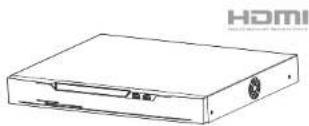
Line drawing of a rectangular electronic device with a label '盒面' (box cover) and 'HDMI' logo in the corner (no readable text or symbols on the device itself)PoE NVR
16CH
Quick Setup Guide
licenat:007012403
Precautions
Fully understand this document before using this device, and strictly observe rules in this document when using this device. If you install this device in public places, provide the tip "You have entered the area of electronic surveillance" in an eye-catching place. Failure to correctly use electrical products may cause fire and severe injuries.
| WARNING | It alerts you for moderate dangers which, if not avoided, may cause minor or moderate injuries. |
| CAUTION | It alerts you about risks. Neglect of these risks may cause device damage, data loss, device performance deterioration, or unpredictable results. |
| NOTE | It provides additional information. |
WARNING
vStrictly observe installation requirements when installing the device. The manufacturer shall not be held responsible for device damage caused by users' non-conformance to these requirements.
vStrictly conform to local electrical safety standards and use power adapters that are marked with the LPS standard when installing and using this device. Otherwise, this device may be damaged.
VUse accessories delivered with this device. The voltage must meet input voltage requirements for this device. If this device is installed in places with unsteady voltage, ground this device to discharge high energy such as electrical surges in order to prevent the power supply from burning out.
When this device is in use, ensure that no water or any liquid flows into the device. If water or liquid unexpectedly flows into the device, immediately power off the device and disconnect all cables (such as power cables and network cables) from this device.
If this device is installed in places where thunder and lightning frequently occur, ground the device nearby to discharge high energy such as thunder strikes in order to prevent device damage.
CAUTION
Avoid heavy loads, intensive shakes, and soaking to prevent damages during transportation and storage. The warranty does not cover any device damage that is caused during secondary packaging and transportation after the original packaging is taken apart.
Protect this device from fall-down and intensive strikes, keep the device away from magnetic field interference, and do not install the device in places with shaking surfaces or under shocks.
√Clean the device with a soft dry cloth. For stubborn dirt, dig the cloth into slight neutral cleanser, gently wipe the dirt with the cloth, and then dry the device.
Do not jam the ventilation opening. Follow the installation instructions provided in this document when installing the device.
Keep the device away from heat sources such as radiators, electric heaters, or other heat equipment.
Keep the device away from moist, dusty, extremely hot or cold places.
If the device is installed outdoors, take insect- and moisture-proof measures to avoid circuit board corrosion that can affect monitor ing.
γRemove the power plug if the device is idle for a long time.
Special Announcement
vAll complete products sold by the manufacturer are delivered along with nameplates, quick setup guide and accessories after strict inspection. The manufacturer shall not be held responsible for counterfeit products.
The manufacturer will update this manual according to product function enhancement or changes and regularly update the software and hardware described in this manual. Update information will be added to new versions of this manual without prior notice.
This manual may contain misprints, technology information that is not accurate enough, or product function and operation description that is slightly inconsistent with the actual product, the final interpretation of company is as a standard.
This manual is only for reference and does not ensure that the information is totally consistent with the actual product. For consistency, see the actual product.
NOTE
For more information, please refer to website.
1 Open Package Examination
Open the package, check the appearance of product for no obvious damage, and confirm the item list for table 1-1 is consistent.
Table 1-1 Packing list
| Component | Quantity | Remark |
| Network Video Recorder | 1 | |
| Quick Setup Guide | 1 | |
| Mouse | 1 | |
| Power adapter | 1 | Optional |
| Power cord | 1 | |
| Phillips head screw | 12 | |
| Terminal block | 2 | Optional |
2 Device Structures
2.1 Device Ports
NOTE
Different devices may have different ports and multi-head cables: Please refer to the actual product.
Figure 2-1 Front panel
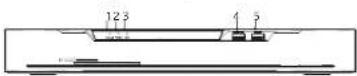
Front panel description of device, please refer to table 2-1.
Table 2-1 Front panel description
| Port Name | Description |
| 1 POWER Indicator | When the XVR is operating, the POWER indicator is steady on. When the XVR is shut down, the POWER indicator is turned off. |
| 2 REC Indicator | Hard disk status indicator. This indicator flashes when data is transmitted. |
| 3 NET Indicator | The network status indicator. This indicator flashes when network is working. |
| 4 MOUSE | Support connecting to a USB mouse. |
| 5 BACKUP | Support connecting to a USB flash drive or USB removable hard disk. |
Rear panel description of device, please refer to table 2-2.
Table 2-2 Rear panel description
| Name Description | |
| VIDEO IN Port Plug in analog camera by coaxial line. | |
| CVBS OUT Output analog video signal | |
| AUDIO OUT/ AUDIO IN | Audio output / Audio input. |
| LAN1/LAN2 | RJ 45 100/1000 Mbps adaptive Ethernet interface LAN1 is deployed default gateway and used for external network. LAN2 is used for internal network. |
| HDMI/VGA | Video output interface. |
| USB USB 2.3 port, Connect USB flash or mouse. | |
| Alarm I/O | Alarm input/Alarm output. |
| [ ] | Power switch. |
| [IMAGE] | DC12V. |
| [IMAGE] | Ground. |
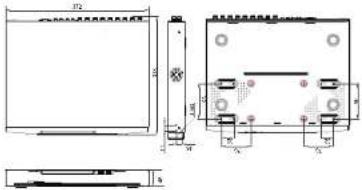
2.2 Device Dimensions
NOTE
Different devices may have different dimensions. Please refer to the actual product.
Figure 2-2 Dimensions (Unit: mm)
3 Device Installation
The hard disk of the XVR must be provided by the user. Take the following steps to install the hard disks:
Step 1 Remove the screws for fixing the cover and take down the cover.
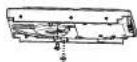
Step 2 Take out the screws and mount two of them to the s crew holes of hard disk, as shown in figure 3-1.
Figure 3-1 Installing the hard disk screws
NOTE
Just screw the screws about 1 to 2 turns instead to the end.
Step 3 Route the screws through the gourd holes on the base: push the hard disk to the appropriate position on the left, as shown in figure 3-2.
Figure 3-2 Installing hard disk
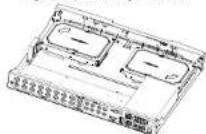
Step 4 Turn the device over, and mount other two screws to the holes, as shown in figure 3-3. Then fasten all the screws.
Figure 3-3 Fixing hard disk
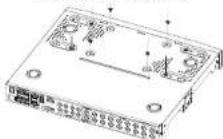
Step 5 Install other hard disks following step 2, step 3 and step 4, and insert the hard disk data cable and power cable, then replace the upper cover and fasten the fixing screws.
Device Operation
4.1 Startup
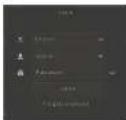
Before starting XVR, ensure that the XVR is connected to a power supply properly and a monitor is connected to the HDMI or VGA interface of the XVR correctly. After starting the XVR, there is a login window located in the center, as shown in figure 4-1 and 4-2.
CAUTION In some environments, if the power supply is abnormal, the XVR may not work properly. In severe cases, the XVR may be damaged. In these environments, it's advised to use regulated power supply.
Figure 4-1 Activation interface
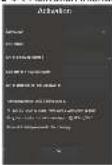
Figure 4-2 Login interface
VOTE
F User needs to create a new password to activate the device, when
logging into for first time.
User can also set patient shock to quickly login. Set security questions which are used for password recovery.
- Change the language in log in interface.
4.2 Topology of the XVR
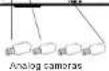
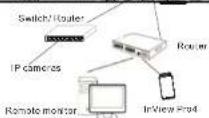
XVR can access analog cameras immediately when analog cameras are plugged into XVR's VIDEO IN ports. Then the XVR will assign an IP address for each camera automatically. For the topology refer to figure 4-3.
Figure 4-3 Topology of the XVR

4.3 Special Function
Click the AI Recognition icon, Human Face, or Thermal Temperature at the bottom of local UI to enter the AI interface. User can set and view the AI cameras' parameters, including human face, vehicle license plate.
4.4 Power off
Enter the path Main Menu >System >Maintenance >Shutdown to power off the XVR.
NOTE
? Before replacing the hard disk, the power must be turned off. ? The special function is only carried by some devices, if the current device does not have the function, please ignore it
5 Quick Configuration
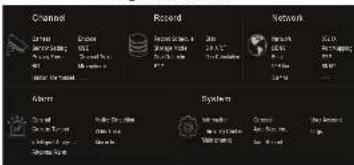
Plug in power to access the XVR user page, the wizard window would show at first time, user can configure quickly or close it immediately. For details configuration please refer to main menu. Use the mouse to right-click any where on the main interface to access the main menu. Main menu comprises Channel, Record, Alarm, Network and System settings, as shown in figure 5-1.
5.1 Channel
Channel settings contain Cameras, Encode, Sensor Setting, OSD, Privacy Zone, ROI, Microphone, Human Thermal, Smart, Intelligent Tracking.
?Camera: User can add cameras automatically by clicking Click to Add, and add manually by clicking Add. Tick cameras then click Delete to delete cameras. User can batch update software.
Figure 5-1 Main menu
flowchart
graph TD
    A["Channel"] --> B["Record"]
    B --> C["Network"]
    C --> D["Server"]
    D --> E["System"]
    E --> F["Other"]
    style A fill:#f9f,stroke:#333
    style B fill:#ccf,stroke:#333
    style C fill:#cfc,stroke:#333
    style D fill:#fcc,stroke:#333
    style E fill:#cff,stroke:#333
    style F fill:#ffc,stroke:#333
vSensor Setting: Set the sensor parameter of channels' cameras Y OSD /Privacy Zone/ROI: Set on live video screen yChannel Type: set the analog channels' type, user can set AUTO/AUD/TW/C/WUR
?Microphone: Adjust and set the microphone of channels.
?Human thermometer/ Smart/ Intelligent Tracking: These functions are used for special function cameras, configur e the parameters of cameras.
?All these settings can be copied to other channels by clicking Copy button.
5.2 Record
Record settings contain Record Schedule, Disk. Storage, Disk Calculation, SMART, Disk Detection, Disk Calculation and FTP. Set record schedule and storage strategic. User can calculate the disk's using lime at Disk Calculation interface.
Enter S.M.A.R.T interface to view the state of disks.
Disk Detection can detect the disks.
FTP: set the parameters of FTP upload. the alarm video can be sent to FTP path.
5.3 Alarm
Alarm settings contain General, Motion detection, Camera Tamper, Video loss. Intelligent analysis, Alarm in, Abnormal alarm, Alarm out, Local Intelligent Analysis, as shown in figure 5-2
Figure 5-2 Alarm
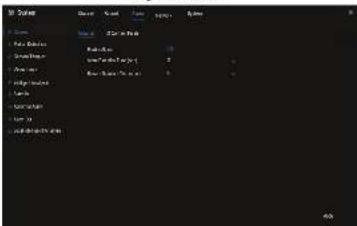
General: Enable or disable alarm and set duration time of alarm.
Motion Detection: Enable this function, if detection the motion actions, it will alarm.
-
Event actions: Contain buzzer, alarm out, push message to App, pop-up message to monitor, send E-mail and post recording (after enabling, choose the recording time from drop list.)
-
Area: set motion detection area. Press left but ton and drag the cursor to add a detection area, and double-click an area to delete
-
Schedule: Set schedule to enable or disable motion detection alarm. There are three methods to set, click the double arrows button to choose all day. The second, click and drag the cursor to select periods. The third, click one by one.
?Video Loss, Intelligent Analysis are same settings as motion detection.
√ Alarm In/Alarm Out: settings for I/O alarming. √Abnormal Alarm can tick disk error, IP conflict, network disconnected.
Local Intelligent Analysis: set up to 4 channels intelligent analysis alarm, choose the channel and apply, the XVR will reboot, then set the parameters of intelligent analysis.
5.4 Network
Network settings contain Network, 902.1X, DDNS, E-mail, Port Mapping, P2P, IP Filter - SNMP, 3G/4G, PPPoE. Network Traffic and Platform Access, as shown in figure 5-3. Maybe some models have more functions, please refer to actual products.
Figure 5-3 Network
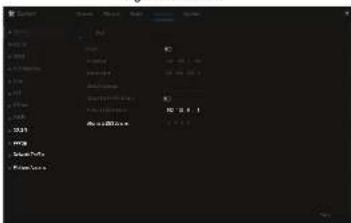
? Network,802.1X, DDNS, and SNMP Interface to set network parameters.
Y Email: Set Emails for sending and receiving alarm messages and password retrieval message.
YPort Mapping: set the ports for remote accessing.
?P2P: Add XVR into device list of App by accessing the QR code.
VIP Filter. Settings for creating black list or white list
- SG4G. Use SG4G mode to plug to XVR provide the v. PPPoE: Point to point network to access XVR directly.
Network Traffic, view the speed of transiting and receiving
data, view the status of LAN
Platform Acc ess: Enable to set the parameters of platform
access, so that the XVR can be connected to platform system.
5.5 System
System settings contain Information, General, User, Security Center, Auto Sequence, Logs, Maintenance and Auto Reboot, as shown in Figure 5-4.
Figure 5-4 System
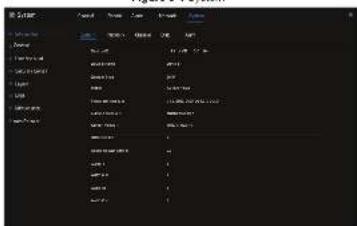
General: include system, date and time, lime zone, DST, sync camera time.
Y User Account: add user, set advance selling (auto login, password double authentication, boot wizard) and App
Verification(add whitelist to be allowed which are added to App). ?Security Center: modify the password, pattern unlock, secure Email: Secure question
?Layout: set new layout to view live videos of channels. Set CVBS offset
?Logs: shows operating and alarm log, user can export logs if an USB disk is plugged in.
Maintenance: include shutdown, reboot, exit system, reset, import configuration, export configuration and update
Import configuration, export configuration and update. vAuto Reboot: enable this function to make device restart periodically.
5.6 Live Video
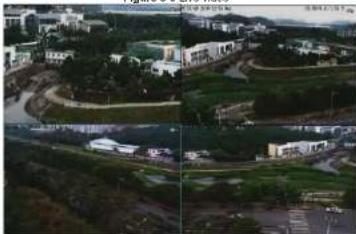
Live video page is displayed after starting the XVR by default, as shown in figure 5-5.
Figure 5-5 Live video
natural_image
Aerial view of a rural landscape with buildings, roads, and green spaces (no visible text or symbols)6 Mobile Client
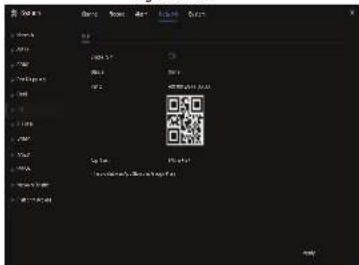
Search for "InView Pro4" in App Store or Google Play to download and install the mobile client. Use the App to scan the QR code on the back board of XVR, or in P2P settings page in XVR user interface. Then input the password of the XVR to add the XVR into the device list of the App. User can manage the device through mobile client.
Figure 6-1 P2P
7 Web Accessing
The XVR also can be accessed in a Web browser. Open a web browser like Chrome 45 and enter the IP address of device (The default IP address is 192.168.0.121) in the address box, and press Enter. The login page is displayed as shown in figure 7-1.
Figure 7-1 Login

NOTE
NOTE
the user name and password are same as in the UI interface.