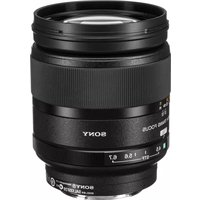
135mm f2.8 STF - Lens SONY - Free user manual and instructions
Find the device manual for free 135mm f2.8 STF SONY in PDF.


| Product Type | Lens |
| Brand | Sony |
| Model | 135mm F2.8 [T4.5] STF (SAL135F28) |
| Lens Mount | Sony α (A-mount) |
| Focal Length | 135mm |
| Equivalent Focal Length (APS-C) | 202.5mm |
| Maximum Aperture | f/2.8 (T/4.5) |
| Minimum Aperture | f/31 (T/32) |
| Lens Construction | 6-8 groups/elements (including apodization element) |
| Angle of View (35mm) | 18° |
| Angle of View (APS-C) | 12° |
| Minimum Focus Distance | 0.87 m (2.85 ft) |
| Maximum Magnification | 0.25× |
| Filter Diameter | 72 mm |
| Dimensions (Diameter × Length) | Approx. 80 × 99 mm (3 1/8 × 3 7/8 in.) |
| Weight | Approx. 730 g (25 3/4 oz.) |
| Focus Type | Manual focus |
| Aperture Control | Stepless ring (T/4.5–T/6.7) and A position for camera control |
| Special Features | Apodization element for smooth bokeh; T-number exposure |
| Included Accessories | Front lens cap, rear lens cap, lens hood, exclusive case, printed documentation |
| Safety Warnings | Do not directly look at the sun; keep out of reach of children; avoid rain and moisture |
| Cleaning Instructions | Brush off dust with lens blower; wipe with soft, clean cloth; do not use organic solvents |
| Storage | Keep in dry place, avoid direct sunlight, always attach lens cap |
| Compatibility | Designed for Sony α cameras |
Frequently Asked Questions - 135mm f2.8 STF SONY
User questions about 135mm f2.8 STF SONY
0 question about this device. Answer the ones you know or ask your own.
Ask a new question about this device
Download the instructions for your Lens in PDF format for free! Find your manual 135mm f2.8 STF - SONY and take your electronic device back in hand. On this page are published all the documents necessary for the use of your device. 135mm f2.8 STF by SONY.
USER MANUAL 135mm f2.8 STF SONY
Operating Instructions
135mm F2.8 [T4.5] STF
SAL135F28
©2006 Sony Corporation Printed in Japan


http://www.sony.net/
This lens is a manual focus lens with a highly developed defocusing design. A special apodization element gives defocused areas a smooth and attractive appearance. This lens is equipped with the aperture ring that enables a stepless aperture setting between F No.2.8-5.7 (T No.4.5-6.7 * ), and makes the most of the defocusing effect in the foreground and background areas. Enjoy this unique image-expression, which cannot be duplicated on traditional lenses.
T No. (T-Numbers): the T No. is a practical value that indicates how much light is in the lens, allowing for the lens's transmission rate. Although this lens's wide-open aperture is f2.8 , the special apodization system provides the light amount of T/4.5, which is the same as that of f4.5 on a normal lens. The aperture value on the lens, the value indicated on a camera, and the value used when determining the exposure are all indicated by T No. Use the T No. as a normal aperture value.
This lens is designed for Sony Cameras.
WARNING
To reduce fire or shock hazard, do not expose the unit to rain or moisture. Do not directly look at the sun through this lens.
Doing so might harm your eyes or cause loss of eyesight.
Keep the lens out of reach of small children.
There is danger of accident or injury.
Disposal of Old Electrical & Electronic Equipment (Applicable in the European Union and other European countries with separate collection systems)
This symbol on the product or on its packaging indicates that this product shall not be treated as household waste. Instead it
shall be handed over to the applicable collection point for the recycling of electrical and electronic equipment. By ensuring this product is disposed of correctly, you will help prevent potential negative consequences for the environment and human health, which could otherwise be caused by inappropriate waste handling of this product. The recycling of materials will help to conserve natural resources. For more detailed information about recycling of this product, please contact your local Civic Office, your household waste disposal service or the shop where you purchased the product.
For the customers in the U.S.A.
THIS DEVICE COMPLIES WITH PART 15 OF THE FCC RULES. OPERATION IS SUBJECT TO THE FOLLOWING TWO CONDITIONS: (1) THIS DEVICE MAY NOT CAUSE HARMFUL INTERFERENCE, AND (2) THIS DEVICE MUST ACCEPT ANY INTERFERENCE RECEIVED, INCLUDING INTERFERENCE THAT MAY CAUSE UNDESIRED OPERATION.
CAUTION
You are cautioned that any changes or modifications not expressly approved in this manual could void your authority to operate this equipment.
NOTE:
This equipment has been tested and found to comply with the limits for a Class B digital device, pursuant to Part 15 of the FCC Rules. These limits are designed to provide reasonable protection against harmful interference in a residential installation. This equipment generates, uses, and can radiate radio frequency energy and, if not installed and used in accordance with the instructions, may cause harmful interference to radio communications.
However, there is no guarantee that interference will not occur in a particular installation. If this equipment does cause harmful interference to radio or television reception, which can be determined by turning the equipment off and on, the user is encouraged to try to correct the interference by one or more of the following measures:
– Reorient or relocate the receiving antenna.
Increase the separation between the equipment and receiver.
- Connect the equipment into an outlet on a circuit different from that to which the receiver is connected.
- Consult the dealer or an experienced radio/TV technician for help.
For the customers in Canada
This Class B digital apparatus complies with Canadian ICES-003.
Notes on use
- Do not leave the lens in direct sunlight. If sunlight is focused onto a nearby object, it may cause a fire. If circumstances necessitate leaving the lens in direct sunlight, be sure to attach the lens cap.
- Be careful not to subject the lens to mechanical shock while attaching it.
• Always place the lens caps on the lens when storing. - Do not keep the lens in a very humid place for a long period of time to prevent mold.
- Do not hold the camera by the lens part extended for focusing, etc.
- Do not touch the lens contacts. If dirt, etc., gets on the lens contacts, it may interfere or prevent the sending and receiving of signals between the lens and the camera, resulting in operational malfunction.
Condensation
If your lens is brought directly from a cold place to a warm place, condensation may appear on the lens. To avoid this, place the lens in a plastic bag or something similar. When the air temperature inside the bag reaches the surrounding temperature, take the lens out.
Cleaning the lens
- Do not touch the surface of the lens directly.
- If the lens gets dirty, brush off dust with a lens blower and wipe with a soft, clean cloth (Cleaning Cloth KK-CA (optional) is recommended).
- Do not use any organic solvent, such as thinner or benzene, to clean the lens or the camera cone.
A Names of parts
1...Focusing ring 2...Distance scale 3...Stepless aperture range 4...Lens contacts 5...Mounting Index 6...A position 7...Aperture ring 8...Distance index 9...Depth-of-field scale

B Attaching/detaching the lens
To attach the lens
1 Remove the rear and front lens caps and the camera body cap.
- You can attach/detach the front lens cap in two ways, (1) and (2). When you attach/detach the lens cap with the lens hood attached, use method (2).

(1) (2)


natural_image
Diagram showing three stages of a camera lens assembly (no text or labels)
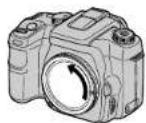
2 Align the orange index on the lens barrel with the orange index on the camera (mounting index), then insert the lens into the camera mount and rotate it clockwise until it locks.
- Do not press the lens release button on the camera when mounting the lens.
- Do not mount the lens at an angle.
To remove the lens
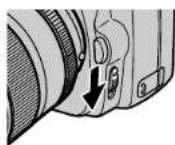
While pressing and holding the lens release button on the camera, rotate the lens counterclockwise until it stops, then detach the lens.
C Attaching the lens hood
It is recommended that you use a lens hood to reduce flare and ensure maximum image quality.
Align the lens hood with the tip of the lens and rotate it clockwise.
- When using a built-in camera flash, make sure to remove the lens hood to avoid blockage of the flash light.
- When storing, turn over the lens hood and place it onto the lens backwards.

D Focusing
This lens is a manual-focus lens.
1 Select manual-focus mode on your camera.
• Refer to the camera manual for details.
- This lens can be used in manual-focus mode, even if your camera is set to autofocus mode.
2 Turn the focusing ring until the image appears sharp.
• The focus signal found in the viewfinder does not work.

E Aperture
This lens has two aperture settings; A position and a stepless aperture control. Use the aperture ring to switch between the two settings. T No. is used in both notation and control on the camera and lens.
To use the stepless aperture setting
This setting allows stepless control of the aperture between T/4.5 - T/6.7. Turn the aperture ring to set the desired aperture.
- This stepless range is recommended when a large aperture is desired.
- Set your camera to A mode or M mode when using this setting. (In P mode or scene-selection setting, the settings will be the same as A mode. In S mode, the settings will be the same as M mode.)
- A slight click can be felt at the T/4.5, T/5.6, and T/6.7 marks.
- The index marks between T/4.5 and T/5.6 represent 1/3 aperture values.
- Stop-down metering is used when the stepless aperture is selected.
- When shooting, the aperture values set by the aperture ring are used. Those values are not accurately reflected in the values displayed or recorded by the camera.
To use the A position
This setting (A position) allows the lens to be used the same way as traditional manual-focus lenses. Set the aperture on your camera.
- All exposure modes (P, A, S, M) can be used on the camera.
Aperture Information
This lens has two apertures; the stepless aperture, manually controlled with the aperture ring, and the automatic aperture (A position), controlled by the camera. In the stepless aperture setting, emphasis is put on the aperture shape, which is rounder than the automatic aperture. For large aperture settings, selecting the stepless aperture is recommended.

F Depth of field (in meters)
When focus is set on a subject, anything at that same distance will appear sharp, and anything within a certain range before and beyond the subject will also appear in focus; this is called depth of field. Depth of field depends on the subject distance and aperture you choose.
| T/4.5 | T/5.6 | T/6.7 | T/8 | T/11 | T/16 | T/22 | T/32 | |
| ∞ | ∞114.8 | ∞97.8 | ∞82.3 | ∞69.2 | ∞49.0 | ∞34.7 | ∞24.6 | ∞17.4 |
| 10m | 10.919.23 | 11.089.11 | 11.328.96 | 11.618.79 | 12.448.37 | 13.847.84 | 16.487.20 | 22.586.46 |
| 5m | 5.214.81 | 5.244.78 | 5.294.74 | 5.354.69 | 5.514.58 | 5.764.42 | 6.154.22 | 6.803.97 |
| 3m | 3.0682.935 | 3.0802.924 | 3.0962.910 | 3.1152.894 | 3.1652.852 | 3.2392.795 | 3.3502.719 | 3.5222.618 |
| 2m | 2.0271.974 | 2.0321.969 | 2.0381.963 | 2.0461.956 | 2.0651.939 | 2.0941.915 | 2.1351.882 | 2.1981.837 |
| 1.5m | 1.5141.478 | 1.1561.484 | 1.5191.481 | 1.5231.478 | 1.5331.469 | 1.5471.456 | 1.5671.439 | 1.5971.415 |
| 1.2m | 1.0281.192 | 1.2091.191 | 1.2111.189 | 1.2131.187 | 1.2191.182 | 1.2261.175 | 1.2381.165 | 1.2541.151 |
| 1.0m | 1.0050.995 | 1.0060.994 | 1.0070.993 | 1.0080.992 | 1.0110.989 | 1.0160.985 | 1.0230.978 | 1.0330.970 |
| 0.87m | 0.8730.867 | 0.8740.866 | 0.8740.866 | 0.8750.865 | 0.8770.863 | 0.8810.860 | 0.8850.856 | 0.8910.850 |
The depth-of-field scale and depth-of-field table are for 35mm-format cameras. The depth of field is shallower when you use Digital Single Lens Reflex Cameras equipped with an APS-C sized image sensor.

Specifications
| Name(Model name) | Equivalent35mm-formatfocal length*(mm) | Lens groups-elements | Angle of view 1*3 | Angle of view 2*3 | Minimum focus**(m (feet)) | Maximum magnification(×) | Minimum f-stop | Filter diameter(mm) | Dimensions(maximum diameter × height)(mm (in.) ) | Mass(g (oz.)) |
| 135mmF2.8 [T4.5] STF(SAL135F28) | 202.5 6-8* | 2 | 18" 12" | 0.87 (2.85) | 0.25 | F31(1/32) | 72 | Approx. 80×99(3 1/8×3 7/8) | Approx. 730(25 3/4) |
*1 The value for equivalent 35mm-format focal length is based on Digital Single Lens Reflex Cameras equipped with an APS-C sized image sensor.
*2 Including apodization element (1-2)
*3 The value of angle of view 1 is based on 35mm-format cameras, and that of angle of view 2 is based on Digital Single Lens Reflex Cameras equipped with an APS-C sized image sensor.
“ Minimum focus is the shortest distance from the image sensor to the subject.
Included items: Lens (1), Front lens cap (1), Rear lens cap (1), Lens hood (1), Exclusive case (1), Set of printed documentation Designs and specifications are subject to change without notice.
α is a trademark of Sony Corporation.
G Exposure compensation
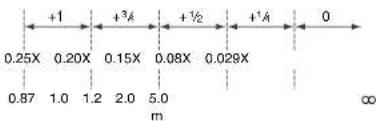
As the magnification increases, the amount of light reaching the image sensor decreases. This is automatically compensated in all autoexposure modes, or in the manual exposure mode as long as the exposure is adjusted according to the camera's meter index. If your camera is set to the manual exposure mode and you are using a hand-held exposure meter, or if your camera is set to the manual exposure mode and you are using the Manual Flash Control function available on some external flash units, adjust exposure accordingly. (E.g., when adjusting by the aperture, +1 means opening the aperture 1 more stop.)
Exposure correction
Magnification ratios
Distance
About Apodization
A special "apodization element" is situated near the aperture of the lens optical system. This special optical element is a type of ND filter which gradually becomes thicker (darker) towards the perimeter, thereby reducing the amount of light that passes through around the outer perimeter. The aperture of this lens is indicated and controlled by the T No., which compensates for the reduction imposed by the special apodization element. The T No. can be used as the F No. on a normal lens when the exposure is determined.
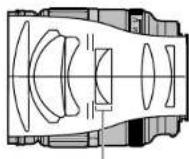
Apodization element
Principle of defocusing effect improvement
Defocusing of a dot
This lens

Intensity decreases gradually toward the perimeter
Defocusing of a line

Gradually diffused without losing shape

Intensity stays the same Line becomes thicker

Defocused images appear as blurred clusters of dots. A lens with well compensated aberration reproduces the image shape accurately, but cannot produce smooth blurs in a defocused area. There may be unpleasant blurs, which for example, make one line appear to be doubled, depending on the way of compensation. This lens adopts a special apodization element that provides a gradually diffused image toward the perimeter without losing the core shape. In other words, it provides soft and natural defocusing without transforming the original shape unnaturally.
- WARNING
- Disposal of Old Electrical & Electronic Equipment (Applicable in the European Union and other European countries with separate collection systems)
- For the customers in the U.S.A.
- CAUTION
- NOTE:
- For the customers in Canada
- Notes on use
- Condensation
- Cleaning the lens
- A Names of parts
- B Attaching/detaching the lens
- To attach the lens
- To remove the lens
- C Attaching the lens hood
- D Focusing
- E Aperture
- To use the stepless aperture setting
- To use the A position
- Aperture Information
- F Depth of field (in meters)
- G Exposure compensation
- About Apodization
- Principle of defocusing effect improvement
Brand : SONY
Model : 135mm f2.8 STF
Category : Lens