
929 - Réducteur de bruit audio DBX - Free user manual and instructions
Find the device manual for free 929 DBX in PDF.


| Product Type | Compressor/Limiter |
| Brand | DBX |
| Model | 929 |
| Form Factor | 1U Rackmount |
| Dimensions (H x W x D) | 1.75 x 19 x 9 inches |
| Weight | 4.5 lb (2.04 kg) |
| Power Requirement | 120V AC, 50/60 Hz, 20W |
| Input/Output | Balanced XLR, 1/4" TRS |
| Controls | Threshold, Ratio, Attack, Release, Output Gain, Bypass |
| Indicators | LED gain reduction meter, power LED |
| Compression Ratio | 2:1 to ∞:1 (limiter) |
| Threshold Range | -40 dBu to +20 dBu |
| Attack Time | 0.1 ms to 200 ms |
| Release Time | 0.1 s to 3 s |
| Frequency Response | 20 Hz - 20 kHz (+/- 0.5 dB) |
| Signal-to-Noise Ratio | > 105 dB |
| Total Harmonic Distortion | < 0.01% |
| Intended Use | Professional audio studio, live sound |
| Maintenance | Wipe with dry cloth; keep away from moisture |
| Safety | Do not expose to liquids; unplug when not in use |
| Spare Parts & Repairability | Contact DBX support or authorized service centers |
Frequently Asked Questions - 929 DBX
User questions about 929 DBX
0 question about this device. Answer the ones you know or ask your own.
Ask a new question about this device
Download the instructions for your Réducteur de bruit audio in PDF format for free! Find your manual 929 - DBX and take your electronic device back in hand. On this page are published all the documents necessary for the use of your device. 929 by DBX.
USER MANUAL 929 DBX
Your new 900 series module was carefully packed at the factory in a protective carton. Nonetheless, examine both carton and contents for signs of shipping damage. If there is such evidence, don't destroy the carton or packing materials and notify your dealer immediately. In any case it's a good idea to save the carton and packing.
All dbx products are covered by a limited warranty; warranties for products purchased outside the USA are valid only in the country of purchase and the USA. For details consult your warranty/registration card or your dealer/distributor.
dbx Customer Service will help you use your new product. For answers to questions and information beyond what's in this manual, write us at 71 Chapel St., PO 100C, Newton, Mass. 02195 USA, or call 617 964-3210 USA Eastern time. The telex is 92-2522.
Should problems arise, consult your dealer or distributor. If it becomes necessary to have your equipment serviced at the factory, repack the unit, including a note with a description of the problem, your name, address and phone, and the date of purchase, and send the unit freight prepaid to the above street address, marking it Attn: Repairs.
"dbx" is a registered trademark of dbx, Newton, Mass. USA, a division of BSR North America Ltd.
SPECIFICATIONS
| Filter | 2nd-order, minimum-phase, operates from 1.3 kHz to 38 kHz depending on setting |
| Frequency response | 20 Hz-20 kHz ±1 dB |
| THD | 0.03% |
| IMD | 0.1% |
| Equivalent input noise | -85 dBv |
| Input impedances | 30 k-ohms differential ("balanced"), 18.8 k-ohms unbalanced |
| Output impedance | 22 ohms, for driving 600 ohms or greater |
| Maximum input | +24 dBv |
| Maximum outputs | +24 dBv differential, +23 dBv unbalanced |
| Power | 75 mA @ ±15 V regulated, 65 mA @ ±24 V unregulated; 3 W |
Notes
1) All specifications are subject to change.
2) Voltages are rms (root-mean-square). 0 dBv is 0.775 V regardless of load impedance; subtract 2.2 to convert to dBV (i.e., referred to 1 volt).
When the load is 600 ohms this particular dBv is also known as "dBm."
3) Noise figures are for 20 Hz-20 kHz unweighted.
4) Frequency response is for high-level pink noise.
5) IMD is SMPTE, 60 and 7k Hz mixed 4:1; output 1 V.
6) Inputs and outputs have identical polarity.
APPLICATIONS
The dbx 929 module contains two channels of single-ended, one-step noise reduction for sources that have a continuous, unchanging hiss "floor" beneath desired signal. With such program material this very fast sliding-filter design is remarkably effective and unobtrusive, whether the hiss is a little or a lot. Properly set, the 929 reduces or eliminates the hiss with little or no sacrifice of musical high frequencies and treble overtones. The multi-function Quieting knob on the 929 governs the total amount of hiss removal by setting a frequency-sensitivity threshold and gauging the overall level of noise reduction.
Please realize that the design is NOT intended to remove hum, ticks and pops, or to track modulated or changing hiss, nor to quiet noisy material that has been dynamically processed. For example, a film or video source with many scene changes (and consequent audio changes) will require diligence to process effectively. But the results will usually be worth it!
Constant audio- and videotape and optical-soundtrack hiss is the main target. Older tapes of valuable material may be cleaned up to the point where successful release in a digital format is commercially feasible. Of course there are also applications for equipment and broadcasting/reception cleanup.
In your single-ended noise-reduction projects, use your ears -- always. Specifically, in your enthusiastic reaction to hearing the hiss disappear without the musical highs also disappearing, be sure not to overdo it. Listen closely for breathing and noise modulation, especially if you're dehissing something for posterity. Allow a little residual hiss for the sake of natural, unprocessed sound. The 929 is extremely effective but it's not a perfect solution for everything; it's a signal-processing tool. We know how well it can clean up a wide variety of problematic sound sources. Just be sure that your pleasure at finally having a single-ended NR system that does a precise, thorough job doesn't cloud your critical judgment.
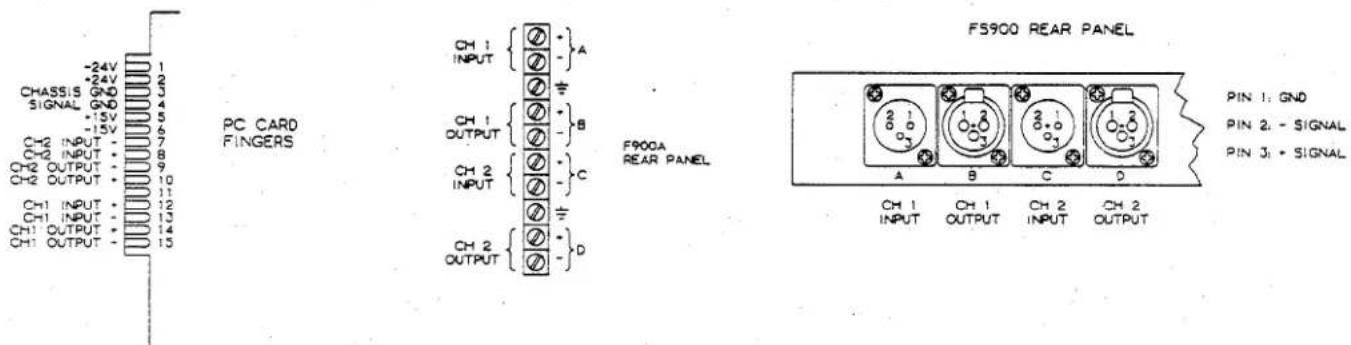
929 inputs are balanced. Outputs are unbalanced from the factory; moving two jumpers (see last page) changes the outputs to their balanced setting. Each module contains two independent channels that may be strapped to preserve channel balance and image stability while improving noisy stereo sources.
CONTROLS
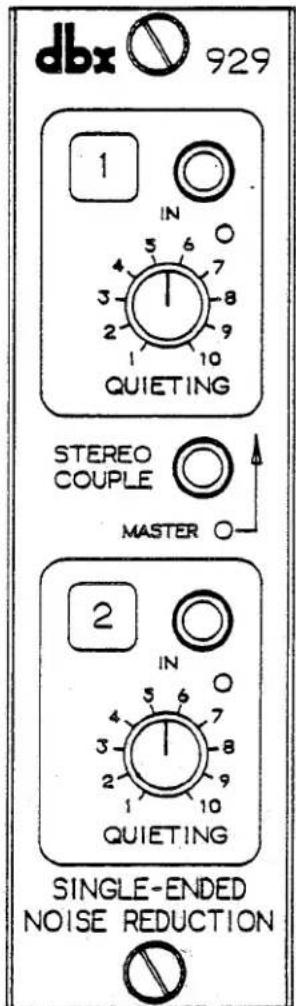
IN button, channel 1 and/or 2. Pushing this in lets you 'dehiss' using the QUIETING knob. Out is a balanced hardwire bypass.
QUIETING knob. Adjust this until you have a minimum of hiss along with little or no loss of highs. If source levels change and background hiss levels change, you will have to readjust each time. The knob is calibrated so you can jot down the best setting for a given program or situation.
STEREO COUPLE and Master LED. Pushing this button in makes the no. 1 quieting knob govern the two channels at the same time, strapped together. This preserves imaging and sonic balances in a stereo program. The no. 2 knob is inactivated.
Leaving it out keeps the channels independent.
HOOKUPS
CHANGING FROM UNBALANCED TO BALANCED
The dbx 929 module contains two channels of single-ended, one-step noise reduction for sources that have a continuous, unchanging hiss "floor" beneath desired signal. With such program material this very fast sliding-filter design is remarkably effective and unobtrusive, whether the hiss is a little or a lot. Properly set, the 929 reduces or eliminates the hiss with little or no sacrifice of musical high frequencies and treble overtones. The multi-function Quieting knob on the 929 governs the total amount of hiss removal by setting a frequency-sensitivity threshold and gauging the overall level of noise reduction.
The design is not intended to remove hum, ticks and pops, or to track modulated or changing hiss, nor to quiet noisy material that has been dynamically processed.
Constant audio- and videotape and optical-sound-track hiss is the main target. Older tapes of valuable material may be cleaned up to the point where successful release in a digital format is commercially feasible. Of course there are also applications for equipment and broadcasting/reception cleanup.
Inputs are balanced. Outputs are unbalanced from the factory; moving two jumpers changes the outputs to their balanced setting. Each module contains two independent channels that may be strapped to preserve channel balance and image stability while improving noisy stereo sources.
929 Single-Ended Noise Reduction Module
Features
• Sharply reduces constant hiss in a variety of applications
- Adjustable for maximum effectiveness and flexibility
• No encoding required
• Balanced inputs & outputs
- Two channels; stereo-strappable

SPECIFICATIONS
| Filter | 2nd-order, minimum-phase, operates from 1.3 kHz to 38 kHz depending on setting |
| Frequency response | 20 Hz-20 kHz ±1 dB |
| THD | 0.03% |
| IMD | 0.1% |
| Equivalent input noise | -85 dBv |
| Input impedances | 30 k-ohms differential ("balanced"), 18.8 k-ohms unbalanced |
| Output impedance | 22 ohms, for driving 600 ohms or greater |
| Maximum input | +24 dBv |
| Maximum outputs | +24 dBv differential, +23 dBv unbalanced |
| Power | 75 mA @ ±15 V regulated, 65 mA @ ±24 V unregulated; 3 W |
Notes
1) All specifications are subject to change.
2) Voltages are rms (root-mean-square). 0 dBv is 0.775 V regardless of load impedance; subtract 2.2 to convert to dBv (i.e., referred to 1 volt). When the load is 600 ohms, this particular dBv is also known as "dBm."
. 3) Noise figures are for 20 Hz-20 kHz unweighted.
4) Frequency response is for high-level pink noise.
5) IMD is SMPTE, 60 and 7k Hz mixed 4:1; output 1 V.
6) Inputs and outputs have identical polarity.
Professional Products division
dbx
71 Chapel St.
PO 100C
Newton, Massachusetts USA 02195
617 964-3210
A division of BSR North America Ltd.
Brand : DBX
Model : 929
Category : Réducteur de bruit audio