KI260UF - Freezer KELVINATOR - Free user manual and instructions
Find the device manual for free KI260UF KELVINATOR in PDF.


| Product Type | Chest Freezer |
| Brand | Kelvinator |
| Model | KI260UF |
| Total Capacity | 260 Liters |
| Energy Efficiency Class | A+ |
| Annual Energy Consumption | 280 kWh |
| Dimensions (H x W x D) | 85 x 90 x 65 cm |
| Net Weight | 38 kg |
| Power Supply | 220-240 V, 50 Hz |
| Rated Current | 0.8 A |
| Climate Class | SN-T |
| Temperature Range | -18°C to -24°C |
| Freezing Capacity | 18 kg/24h |
| Storage Time During Power Failure | 12 hours |
| Noise Level | 42 dB |
| Refrigerant Type | R600a |
| Control Type | Mechanical Thermostat |
| Interior Light | No |
| Door Lock | Yes |
| Defrost Method | Manual Defrost |
| Shelves/Baskets | 2 Wire Baskets |
| Adjustable Feet | Yes |
| Spare Parts Availability | 7 years after production |
| Repairability Index | 8.0 / 10 |
Frequently Asked Questions - KI260UF KELVINATOR
User questions about KI260UF KELVINATOR
0 question about this device. Answer the ones you know or ask your own.
Ask a new question about this device
Download the instructions for your Freezer in PDF format for free! Find your manual KI260UF - KELVINATOR and take your electronic device back in hand. On this page are published all the documents necessary for the use of your device. KI260UF by KELVINATOR.
USER MANUAL KI260UF KELVINATOR
-
Top cover
-
Display Block
-
Freezer Flap
-
Middle Drawer
-
Low Drawer
-
Adjustable feet
Thermostat is located behind the cabinet.
TRANSPORTATION AND HANDLING
When moving the unit, always hold the base, and lift carefully while keeping the unit upright. The unit should never be tilted beyond 45 degrees, placed upside down, or laid on its side, back, or front. Never hold onto the door for support while moving the unit. It may damage the hinges.
INSTALLATION
- Place the refrigerator on a flat, firm surface and using a spirit-level, level it by turning the two front "feet" clockwise or anti-clockwise. This will help eliminate noise caused by vibration.
-
Choose a properly ventilated area. There should be at least 10cm open space along the sides, top and back of the refrigerator.
-
Select a location away from heating sources, direct sunlight, ovens etc. Also, the area should be dry and free of damp, stale air.
TESTING
- Clean the parts of the refrigerator with lukewarm water and detergent and wipe dry.
Notes: Electric parts of the refrigerator can only be wiped by dry cloth.
- Turn the temperature control selector, located near the top of the freezer, to the "2.5" position and switch on the electricity. (Use a coin or a similar blunt object to turn the selector).
The compressor will start and the light must be on.
-
Close the door for at least 30 minutes. After this time, the temperature of the back wall should have decreased noticeably, if this is the case, it indicates that the refrigerator operates correctly.
-
Allow the refrigerator to run for twelve hours before packing anything into it. This will ensure quicker cooling of food and this will in turn lead to food staying fresher for longer.
TEMPERATURE CONTROL
-
A temperature control selector controls the temperature inside the freezer, and this is located towards the top of the freezer when the door us opened.
-
By turning the temperature control selector right or left, one can regulate the temperature inside the freezer.
-
The numbers on the selector are temperature grades and should not be mistaken for temperature indications measured in degrees. "0" indicates the OFF position, while "4" indicates the coldest position. The temperature control selector should be set according to the user's individual requirements.
-
The recommended position for normal use is "2.5".

TIPS AND HINTS
-
Fresh foods such as fish and meat can be frozen to maintain freshness and preserve the nutrients on the food.
-
Food should be wrapped in polyurethane bags, plastic wrap, aluminum foil or some type of suitable airtight container.
-
Do not allow frozen food in freezer to touch foods just placed into freezer as this can lead to damage the fresh food.
-
Frozen foods from the store should be placed in the freezer promptly, so they do not thaw.
-
Never place fresh vegetables and fruits into the freezer without cooking them first, as this will lead to freezer burn.
FAST FREEZING
- Fast freezing is to protect food from damage by large ice crystals that form when food is frozen at a slow rate. When fast freeze is used, smaller ice crystals form, which do not penetrate the “cell membranes” of the food. This helps to preserve the nutrients and freshness of the food
a) This is recommended in particular for fresh fish and meat products that will be stored for a long period of time.
- To operate fast freeze, set the temperature to "4". Once the food is frozen, return the temperature selector to the regular position.
DEFROSTING
-
When the freezer operates for a long period of time, the surface of the evaporators and the drawers may become covered with a layer of white frost. This frost will reduce the energy efficiency of the unit, and make the freezer less effective. When this frost forms, it should be promptly removed.
-
When defrosting, unplug the freezer, and remove all items from the freezer.
-
Allow the frost to melt naturally from the warm air in the room, or
b) Place a bowl of boiling water inside the freezer, the steam will assist in melting the ice.
c) Use a plastic scraper to carefully scrape ice away
- Finally, wipe away any remaining ice and water, plug in the freezer and allow to cool down before replacing food.
CAUTION: Never use sharp tools to chip ice away.
Notes
- This appliance should only be used in-doors and must not be exposed to rain or direct sun.
- Do not store ether, methanol, gasoline or similar substances that evaporates, burn or explode easily inside.
- Do not place any heavy items on top of the refrigerator.
- Do not pour water over the appliance.
- This appliance must be earthed and should be connected to an independent electrical socket. The voltage must be limited within the 220V to 240V range to avoid damage to the main motor.
- Wait 5 minutes before turning the freezer on after a power failure or disconnecting the unit from electricity. Failing to adhere to this will result in failure of the compressor.
- Good air circulation is essential and will reduce energy consumption.
- Keep the electrical cord away from the compressor and condenser to prevent it from melting and causing an electrical hazard.
- To save on energy consumption and to ensure the correct operation of your freezer, reduce the frequency as well as duration of opening the door.
- It is not recommended to use any extension cords.
- Clean freezer after each defrosting.
12.Do not touch frozen food with wet hands, as you can suffer frostbite.
WARNINGS
- Keep ventilation openings of the appliance clear of obstruction.
- Do not damage the refrigerant circuit.
- Do not use electrical appliances inside the unit.
- Please release the refrigerant in open air and away from open fire before disposing of the appliance.
- The appliance must be positioned in such a way that the plug is accessible.
- If the power supply cord is damaged, the manufacturer must replace it or it's service agent or a similarly qualified person in order to avoid a hazard.
- Do not use mechanical devices or other means to accelerate the defrosting process, other than those recommended by the manufacturer.
GENERAL INSTRUCTIONS FOR CARE AND MAINTENANCE
The freezer should be cleaned every second month.
- Disconnect the refrigerator from the electric power supply.
- Wipe the inside and outside of the refrigerator with a soft, wet cloth. If it is too dirty, use clean water with a non-abrasive detergent and wipe with a dry cloth.
If you are going away on holiday or wish to leave the freezer idle for any period of time, proceed as follows:
- Disconnect the freezer from the electric power supply.
- Remove all food
- Clean and dry the inside as instructed for cleaning.
- Leave the door open to prevent any unpleasant smells from building up while the freezer is not used.
WORKING DEFECTS AND FAILURES
Symptom:
Appliance does not switch on at all.
Cause:
The power supply plug is not inserted in the wall socket or the plug and the outlet is loose. Due to some defect in the household electric supply circuit no power is reaching the freezer supply socket. Test this by trying to plug a light or another appliance into the same socket.
The voltage supplied could also be too low.
Symptom:
Noisy running.
Cause:
The appliance has not been properly leveled.
The refrigerator is in contact with the wall.
The accessories in the refrigerator are placed in the wrong position.
Symptom:
Appliance does not cool sufficiently.
Cause:
Door has been opened frequently or it has been left open.
The refrigerator is to close to the wall.
There is too much food in the refrigerator.
Temperature control selector is set in the wrong position.
Symptom:
Smell inside the appliance.
Cause:
Some of the food is not properly wrapped or covered.
The inside of the fridge needs cleaning.
Call the service department if your refrigerator shows other symptoms from those described above, or if you have checked all the items listed above and the symptom persists.
THE FOLLOWING IS NORMAL AND SHOULD NOT BE CONSIDERED AS MALFUNCTION OF THE REFRIGERATOR.
- The sound of water running.
- Refrigerant running in pipes gives forth a gentle sound of water running in pipes.
- Outer surface of refrigerator is covered with moisture.
- It is normal for moisture to form on the outside during high-humidity seasons in certain regions, simply wipe away with a dry cloth.
-
During summer the compressor and rear condenser get heated to the extent that it could scald when touched.
-
Heat around the door frame is normal.
Diagram of Circuit Principles
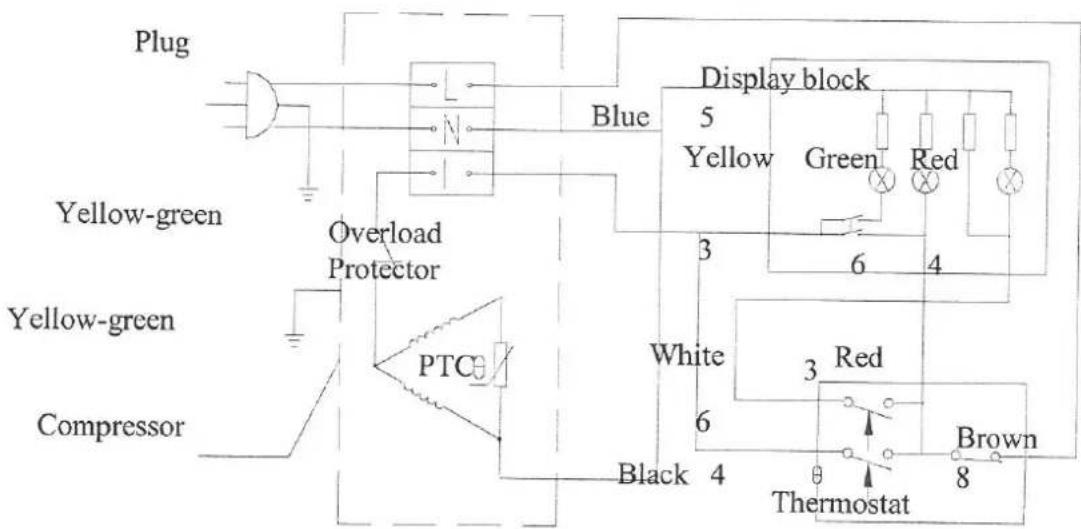
flowchart
graph TD
    A["Plug"] --> B["Yellow-green"]
    B --> C["Compressor"]
    C --> D["Overload Protector"]
    D --> E["PTC"]
    E --> F["Black 4"]
    F --> G["Display block 5"]
    G --> H["Green 6"]
    G --> I["Red 4"]
    H --> J["Thermostat 8"]
    I --> J
    K["Blue"] --> L["White 6"]
    K --> M["Red 3"]
    N["Black 4"] --> O["Thermostat 8"]
Specifications and operation are subject to change without notice.


- TRANSPORTATION AND HANDLING
- INSTALLATION
- TESTING
- TEMPERATURE CONTROL
- TIPS AND HINTS
- FAST FREEZING
- DEFROSTING
- CAUTION: Never use sharp tools to chip ice away.
- Notes
- WARNINGS
- GENERAL INSTRUCTIONS FOR CARE AND MAINTENANCE
- WORKING DEFECTS AND FAILURES
- Symptom:
- Cause:
- THE FOLLOWING IS NORMAL AND SHOULD NOT BE CONSIDERED AS MALFUNCTION OF THE REFRIGERATOR.
Brand : KELVINATOR
Model : KI260UF
Category : Freezer