
The Stylos - Loudspeaker Martin Logan - Free user manual and instructions
Find the device manual for free The Stylos Martin Logan in PDF.


| Product Type | Hybrid electrostatic loudspeaker (curvilinear electrostatic panel + dynamic woofer) |
| Dimensions (H x W x D) | 63.5 x 10.5 x 4.5 inches |
| Weight | 40 lbs each |
| Frequency Response | 55–20,000 Hz ±3 dB |
| Sensitivity | 88 dB (2.83 volts/1 meter) |
| Nominal Impedance | 4 ohms (minimum 2 ohms at 20 kHz) |
| Crossover Frequency | 700 Hz, 12 dB per octave |
| Woofer Type | 6.5" high-rigidity cone with extended throw driver assembly, sealed enclosure |
| Power Handling | 200 watts per channel |
| Recommended Amplifier Power | 60–200 watts per channel |
| Dispersion (Horizontal) | 30 degrees (controlled cylindrical wavefront) |
| Dispersion (Vertical) | 38" line source |
| AC Power Consumption | Less than 5 watts (continuous operation) |
| AC Power Connection | IEC standard power cord, three-prong outlet |
| Installation Options | On-wall, side-wall, on-stand, in-wall (optional kits required for side, stand, in-wall) |
| Electrostatic Panel Type | Curvilinear line source, full-range operation above 700 Hz without crossover in critical band |
| Diaphragm Material | Vapor deposited conductive polymer membrane (optically transparent) |
| Stator Construction | High-grade cold rolled steel, perforated, with proprietary high-dielectric insulation coating |
| Cabinet Material | High-density hardwood powderboard with durable matte finish |
| Speaker Cable Connection | 5-way binding posts (spade connectors recommended) |
| Warranty | Limited 90 days automatic; optional Limited 3 years with registration within 30 days of purchase |
| Cleaning Instructions | Vacuum dust with brush attachment; do not spray any liquid near electrostatic element |
| Safety Notes | High voltage with low current (not dangerous); unplug during thunderstorms; keep away from TV due to woofer magnet |
Frequently Asked Questions - The Stylos Martin Logan
User questions about The Stylos Martin Logan
0 question about this device. Answer the ones you know or ask your own.
Ask a new question about this device
Download the instructions for your Loudspeaker in PDF format for free! Find your manual The Stylos - Martin Logan and take your electronic device back in hand. On this page are published all the documents necessary for the use of your device. The Stylos by Martin Logan.
USER MANUAL The Stylos Martin Logan
The Stylos Speaker System

Your Stylos speakers are provided with an automatic Limited 90 Day Warranty coverage.
You have the option, at no additional charge, to receive Limited 3 Year Warranty coverage. To obtain Limited 3 Year Warranty coverage you need only complete and return the Certificate of Registration that was included with your speakers along with a copy of your invoice to Martin-Logan, within 30 days of purchase.
Martin-Logan may not honor warranty service claims unless we have a completed Warranty Registration card on file!
Should you be using your Martin-Logan product in a country other than the one in which it was originally purchased, we ask that you note the following:
1) The appointed Martin-Logan distributor for any given country is responsible for warranty servicing only on units distributed by or through it in that country in accordance with its applicable warranty.
2) Should a Martin-Logan product require servicing in a country other than the one in which it was originally purchased, the end user may seek to have repairs performed by the nearest Martin-Logan distributor, subject to that distributor's local servicing policies, but all cost of repairs (parts, labor, transportation) must be born by the owner of the Martin-Logan product.
3) If you relocate to a country, other than where you purchased your Martin-Logan's, after owning your speakers for 6 months your warranty may be transferable. Contact Martin-Logan for details.
If you did not receive a Certificate of Registration with your Stylos speakers you cannot be assured of having received new units. If this is the case, please contact your Authorized Martin-Logan dealer.
Introduction 4
The Electrostatic Concept 5
History 6
Martin-Logan Exclusives 8
Installation Options 10
Operation 11
Placement/Listening Position 12
On-Wall Installation 13
Room Acoustics 16
Home Theatre 20
Questions 21
Troubleshooting 22
Recommended Music 23
Glossary 24
Stylos Specifications 26
Congratulations, you have invested in one of the world's premier loudspeaker systems!
The result of 3 years of research and more than 40 fully functional prototypes, the Stylos represents the latest advancements in electrostatic technology and speaker placement flexibility.
Combining our proprietary curvilinear electrostatic transducer with a compact, but powerful woofer, we have designed a product, in one package, that reproduces music with uncompromised electrostatic clarity and extended bass, yet can be mounted on or in a wall requiring no floor space.
All materials in your new Stylos speakers are of the highest quality to provide years of enduring enjoyment and deepening respect. The cabinetry is constructed from a special high-density hardwood powderboard for structural integrity and is finished with a durable and attractive matte surface finish.
Through rigorous testing, the curvilinear electrostatic panel has proven itself to be one of the most durable and reliable transducers available today. Fabricated from a
specially tooled, high-grade steel, the panel is then coated with a special high dielectric compound that is applied via a proprietary electrostatic deposition process. This panel assembly houses a membrane 0.0005 of an inch thick! Ruggedly constructed and insulated, as much as 200 watts of continuous power has driven the Stylos energized diaphragm into massive excursions with no deleterious effects.
Please read and follow these instructions as you initially install the Stylos speakers into your system. These instructions are important and will prevent you from experiencing any delay, frustration, or system damage which might occur in a trial-and-error procedure.
The other sections of your User's Manual User explainual detail the operation of your Stylos speakers and the philosophy applied to their design. A clear understanding of your speakers will insure that you obtain maximum performance and pleasure from this most exacting transducer.
Happy Listening!
How can sound be reproduced by something that you are able to see through? Electrostatic energy makes this possible.
Where the world of traditional loudspeaker technology deals with cones, domes, diaphragms and ribbons that are moved with magnetism, the world of electrostatic loudspeakers deals with charged electrons attracting and repelling each other.
To fully understand the electrostatic concept, some background information will be helpful. Remember when you learned, in a science or physics class, that like charges repel each other and opposite charges attract each other? Well, this principle is the foundation of the electrostatic concept.
An electrostatic transducer consists of three pieces: the stators, the diaphragm and the spacers. See Figure 1. The diaphragm is what actually moves to excite the air and create music. The stator's job is to remain stationary, hence the word stator, to provide a reference point for the moving diaphragm. The spacers provide the diaphragm with a fixed distance in which to move between the stators.
As your amplifier sends music signals to an electrostatic speaker, these signals are changed into two high-voltage signals that are equal in strength but opposite in polarity. These high voltage signals are then applied to the stators. The resulting electrostatic field, created by the opposing high voltage on the stators, works simultaneously with and against the diaphragm, consequently moving it back and forth, producing music. This technique is known as push-pull operation and is a major contributor to the sonic purity of the electrostatic concept due to its exceptional linearity and low distortion.
Since the diaphragm of an electrostatic speaker is uniformly driven over its entire area, it can be extremely light and flexible. This allows it to be very responsive to transients, thus perfectly tracing the music signal. As a result, great delicacy, nuance and clarity is possible. When you look at the problems of traditional electromagnetic drivers, you can easily see why this is so beneficial. The cones and domes which are used in traditional electromagnetic drivers cannot be driven uniformly
because of their design.
Cones are driven only at the electrostatic Transducer
their perimeter. As a result, the rest of the cone or dome is just "along for the ride". The very concept of these drivers require that the cone or dome be perfectly rigid, damped and massless. Unfortunately these conditions are not available in our world today.
To make these cones and domes move, all electromagnetic drivers must use voice coils wound on formers, spider assemblies, and surrounds to keep the cone or dome in position. See Electromagnetic Transducer
combined with the high mass of the cone or dome materials used, make it an extremely complex unit with many weaknesses and potential for failure. These faults contribute to the high distortion products found in these drivers and is a tremendous disadvantage when you are trying to change motion as quickly and as accurately as a loudspeaker must (40,000 times per second!).
An Electrostatic TransducerAn

Figure 1 Figure a way view of an electrostatic transducer. Notice the simplicity due to minimal parts usage.
An Electromagnetic TransducerAn

Figure 2. Figure 2ay view of a typical moving coil driver. Notice the complexity due to the high number of parts.
In the late 1800's, any loudspeaker was considered exotic. Today, most of us take the wonders of sound reproduction for granted.
It was 1880 before Thomas Edison had invented the first phonograph. This was a horn-loaded diaphragm that was excited by a playback stylus. In 1898, Sir Oliver Lodge invented a cone loudspeaker, which he referred to as a "bellowing telephone", that was very similar to the conventional cone loudspeaker drivers that we know today. However, Lodge had no intention for his device to reproduce music, because in 1898 there was no way to amplify an electrical signal! As a result, his speaker had nothing to offer over the acoustical gramophones of the period. It was not until 1906 that Dr. Lee DeForrest invented the triode vacuum tube. Before this, an electrical signal could not be amplified. The loudspeaker, as we know it today, should have ensued then, but it did not. Amazingly, it was almost twenty years before this would occur.
In 1921, the electrically cut phonograph record became a reality. This method of recording was far superior to the mechanically cut record and possessed almost 30 dB of dynamic range. The acoustical gramophone couldn't begin to reproduce all of the information on this new disc. As a result, further developments in loudspeakers were needed to cope with this amazing new recording medium.
By 1923, Bell Telephone Laboratories made the decision to develop a complete musical playback system consisting of an electronic phonograph and loudspeaker to take advantage of the new recording medium. Bell Labs assigned the project to two young engineers, C.W. Rice and E.W. Kellogg.
Rice and Kellogg had a well equipped laboratory at their disposal. This lab possessed a vacuum tube amplifier with an unheard of 200 watts, a large selection of the new electrically cut phonograph records and a variety of loudspeaker prototypes that Bell Labs had been collecting over the past decade. Among these were Lodge's cone, a speaker that used compressed air, a corona discharge (plasma) speaker, and an electrostatic speaker.
After a short time, Rice and Kellogg had narrowed the field of "contestants" down to the cone and the electrostat. The outcome would dictate the way that future generations would refer to loudspeakers as being either "conventional", or "exotic".
Bell Laboratory's electrostat was something to behold. This enormous bipolar speaker was as big as a door. The diaphragm, which was beginning to rot, was made of the membrane of a pigs intestine that was covered with fine gold leaf to conduct the audio signal.
When Rice and Kellogg began playing the new electrically cut records through the electrostat, they were shocked and impressed. The electrostat performed splendidly. They had never heard instrumental timbres reproduced with such realism. This system sounded like real music rather than the honking, squawking rendition of the acoustic gramophone. Immediately, they knew they were on to something big. The acoustic gramophone was destined to become obsolete.
Due to Rice and Kellogg's enthusiasm, they devoted a considerable amount of time researching the electrostatic design. However, they soon encountered the same difficulties that even present designers face; planar speakers require a very large surface area to reproduce the lower frequencies of the audio spectrum. Because the management at Bell Labs considered large speakers unacceptable, Rice and Kellogg's work on electrostatics would never be put to use for a commercial product. Reluctantly, they advised the Bell management to go with the cone. For the next thirty years the electrostatic design lay dormant.
During the Great Depression of the 1930's, consumer audio almost died. The new electrically amplified loudspeaker never gained acceptance, as most people continued to use their old Victrola-style acoustic gramophones. Prior to the end of World War II, consumer audio saw little, if any, progress. However, during the late 1940's, audio experienced a great rebirth. Suddenly there was tremendous interest in audio products and with that, a great demand for improved audio components. No sooner had the cone become established than it was challenged by products developed during this new rebirth.
In 1947, Arthur Janszen, a young Naval engineer, took part in a research project for the Navy. The Navy was interested in developing a better instrument for testing
microphone arrays. The test instrument needed an extremely accurate speaker, but Janszen found that the cone speakers of the period were too nonlinear in phase and amplitude response to meet his criteria. Janszen believed that electrostats were inherently more linear than cones, so he built a model using a thin plastic diaphragm treated with a conductive coating. This model confirmed Janszen's beliefs, for it exhibited remarkable phase and amplitude linearity.
Janszen was so excited with the results that he continued research on the electrostatic speaker on his own time. He soon thought of insulating the stators to prevent the destructive effects of arcing. By 1952 he had an electrostatic tweeter element ready for commercial production. This new tweeter soon created a sensation among American audio hobbyists. Since Janszen's tweeter element was limited to high frequency reproduction, it often found itself used in conjunction with woofers, most notably, woofers from Acoustic Research. These systems were highly regarded by all audio enthusiasts.
As good as these systems were, they would soon be surpassed by another electrostatic speaker.
In 1955, Peter Walker published three articles on electrostatic loudspeaker design in Wireless World, a British electronics magazine. In these articles Walker demonstrated the benefits of the electrostatic loudspeaker. He explained that electrostatics permit the use of diaphragms that are low in mass, large in area, and uniformly driven over their surfaces by electrostatic forces. Due to these characteristics, electrostats have the inherent ability to produce a wide bandwidth, flat frequency response with distortion products being no greater than the electronics driving them.
By 1956 Walker backed up his articles by introducing a consumer product, the now famous Quad ESL. This speaker immediately set a standard of performance for the audio industry due to its incredible accuracy. However, in actual use the Quad had a few problems. It could not play very loud, it had poor bass performance, it presented a difficult load that some amplifiers did not like, its dispersion was very directional, and its power handling was limited to around 70 watts. As a result, many
people continued to use box speakers with cones. In the early 1960's Arthur Janszen joined forces with the KLH loudspeaker company and together they introduced the KLH 9. Due to the large size of the KLH 9, it did not have as many limitations as the Quad. The KLH 9 could play markedly louder and lower in frequency than the Quad ESL. Thus a rivalry was born.
Janszen continued to develop electrostatic designs. He was instrumental in the design of the Koss Model One, the Acoustech, and the Dennesen speakers. Roger West, the chief designer of the JansZen Corporation became the president of Sound Lab. When JansZen Corporation was sold, the RTR loudspeaker company bought half of the production tooling. This tooling was used to make the electrostatic panels for the Servostatic, a hybrid electrostatic system that was Infinity's first speaker product. Other companies soon followed; each with their own unique applications of the technology. These include Acoustat, Audiostatic, Beverage, Dayton Wright, Sound Lab, and Stax to name a few.
Electrostatic speakers have progressed and prospered because they actually do what Peter Walker claimed they would. The limitations and problems experienced in the past were not inherent to the electrostatic concept. They were related to the applications of these concepts.
Today, these limitations have been addressed. Advancements in materials due to the U.S. space program give designers the ability to harness the superiority of the electrostatic principle. Today's electrostats use advanced insulation techniques or provide protection circuitry. The poor dispersion properties of early models have been addressed by using delay lines, acoustical lenses, multiple panel arrays or, as in our own products, by curving the diaphragm. Power handling and sensitivity have been increased.
These developments allow the consumer the opportunity to own the highest performance loudspeaker products ever built. It's too bad Rice and Kellogg were never able to see just how far the technology would be taken.
Full Range Operation Full Range Operation
The most significant advantage of Martin-Logan's exclusive transducer technology reveals itself when you compare it to examples of other loudspeaker products on the market today.
The Stylos uses no crossover networks above 700 Hz because they are not needed. It consists of a single, seamless electrostatic membrane reproducing all frequencies above 700 Hz simultaneously. How is this possible?
First, it is important to understand that music is not composed of separate high, mid and low frequency pieces. In fact, music is comprised of a single complex waveform with all frequencies interacting simultaneously.
equals the total signal. While this sounds nice in theory, a different story unfolds in real-world conditions.
In order to use multiple drivers, a crossover network is enlisted to divide the complex musical signal into the separate parts (usually highs, mids, and lows) that each specific driver was designed to handle. Unfortunately, due to the phase relationships that occur within all crossover networks and during the acoustical recombination process, nonlinearities and severe degradation of the music signal takes place in the ear's most "critical zone", the crossover between the tweeter and midrange. See Figure 1.
So, music in the "critical zone" becomes delayed in time.
These delays can be picked-up by your ear and result in poor imaging and ambience cues. Voices lose their complex harmonies and sound less like the vocalist and more like a stereo speaker.
The electrostatic transducer of the Stylos essentially acts as an exact opposite of the microphones used to record the original event. A microphone, which is a single working element, transforms acoustic energy into an electrical signal that can be amplified or preserved by some type of storage media. The Stylos electrostatic transducer transforms electrical energy from your amplifier into acoustical energy with a single membrane.
Upon looking carefully at a traditional magnetic driver (i.e. dynamic, ribbon, induction), no single unit can reproduce the full range of frequencies.
Instead, these drivers must be designed to operate within narrow areas of music and then combined electrically so that the sum of the parts

Figure 1. Illustrates how a conventional speaker system must use a crossover network that has negative affects on the musical performance, unlike the Stylos which needs no crossover networks in the "critical zone".
The Stylos electrostatic The Stylos el transducer can single-transducer car handedly reproduce allhandedly repr audio frequencies aboveaudio freque 700 Hz simultaneous,700 Hz slmul
The crossover phase discontinuities that are associated with traditional tweeter, Pmidrange/woofer systems are eliminated in the Stylos. This results in a dramaticdramatic improvement in imagingimprovement and staging performanceand staging due to the minutelydue to the minute accurate phase relation-accurate pha ship of the full-rangeship of the full- panel wave launch.panel wave launc
Vapor Deposited Film Vapor Deposited Film
The diaphragm material used in all Martin-Logan speakers employs an extremely sophisticated vapor deposited conductive polymer membrane. A proprietary conductive compound is vaporized then electrostatically driven into the surface of the polymer film in a vacuum chamber. This process allows an optically transparent membrane, adds no mass to the diaphragm and is extremely uniform in its surface resistivity characteristics. This uniform surface resistivity controls the electrostatic charge on the diaphragm surface and regulates its migration. As a result, no discharging or “arcing” can occur.
Transducer IntegrityTransducer Integrity
All Martin-Logan transducers begin with two pieces of high grade, cold rolled steel. These steel pieces are then custom perforated and insulated with an exotic composite coating. This proprietary coating insulates the stator to 3 times its actual needed working voltage and gives the Stylos a wide margin of safe operation. In addition to the electrical insulation properties, this coating also provides the Stylos with a durable, attractive finish that dampens the steel to prevent ringing. The finished metal plates are curved into a 30 degree arc. Placed between them is our exclusive vapor deposited diaphragm and spacers. This assembly is then bonded together with aerospace adhesives whose strength is so great that it is commonly used as an alternative to welding.
The result of these advanced technologies is a transducer that is attractive, durable, highly rigid, well dampened, and neutral.
Mechanical/AcousticalMechanical/Al Tone ShapingTone Shaping
The clear Lexan ® panels on the back of the Stylos stator are the key elements of an innovative pressure compensation technology. Martin-Logan is able to tone-shape the
diaphragm + or - 6dB without the use of an insertion loss crossover. The advantage of this system is a high efficiency driver with wide bandwidth capabilities of dimensions which are easily integrated into a domestic environment.
Curvilinear Line SourceCurvilinear Line S
Since the beginning of audio, achieving smooth full range dispersion has long been a problem for all loudspeaker designers. Large panel transducers present even more of a challenge because the larger the panel, the more directional the dispersion pattern becomes.
Full range electrostatics have always been one of the most complex transducers because they attain their full range capabilities via a large surface area. It looked as if they were in direct conflict to smooth dispersion and almost every attempt to correct this resulted in either poor dispersion or a serious compromise in sound quality.
After extensive research, Martin-Logan engineers discovered an elegantly simple solution to achieve a smooth pattern of dispersion without degrading sound quality. By curving the horizontal plane of the electrostatic transducer, a controlled horizontal dispersion pattern could be achieved, yet the purity of the almost massless electrostatic diaphragm remained uncompromised. After creating this technology, we developed the production capability to bring this technology out of the laboratory and into the market place.
You will find this proprietary Martin-Logan technology used in all of our products. It is one of the many reasons behind our reputation for high quality sound with practical coustrialization is also why you see the unique "see through" cylindrical shape of all Martin-Logan products.
Installation Options
The most difficult part of installing your Stylos is deciding which of the available installation options will best integrate into your home. Here are some examples of how each of the 4 Stylos installation kits can be used. The only thing to add is your imagination.

On WallOn Wall
- When the wall in front of you is ideal for speaker placement but floor space is not available
- To flank a projection screen, window or fireplace
- Fit inside a cabinet
Hardware required: Standard wall-mount kit included with all Stylos

On A Side Wall On A Side Wall
- The front wall is a window or book case
- The room is long and narrow
- A dipole side channel for home theatre
Hardware required: Optional Stylos side-mount kit

On a StandOn a Stand
- When the wall behind the speaker will not allow speaker mounting, i.e. book case or window
- If there is a high possibility the speakers will be frequently moved
- As a dipole side channel for a home theatre system Hardware required: Optional Stylos stand kit

In WallIn Wall
- When not being seen is as important as sounding great
- Allows finishing the Stylos grill to match the wall color
- Most complicated installation
Hardware required: Optional Stylos in-wall kit, certified electrician to provide in-wall A.C. in accordance to code, in-wall speaker cable accessibility
AC Power ConnectionAC Power ConnectionSignal Connection
Because your Martin-Logan Stylos use an internal power supply to energize their electrostatic cells with high-voltage DC, they must be connected to an AC power source. For this reason they are provided with the proper IEC standard power cords. These cords should be firmly inserted into any convenient AC wall outlet. Extension cords may be used, if necessary, since the AC power requirement of the speaker is extremely small (less than 5 watts). The Stylos have been designed to remain on continuously and should remain connected to a continuous AC power source. As mentioned earlier, power consumption of the Stylos is very small and the life expectancy of its components will not be reduced by continuous operation.
The power cord should not be installed, re-The power cord is affected under installance should a wire of moved, or left detached from the speaker while moved, organized between them the speaker and the general, the other end is connected to an AC powerthe other end being the lengthed through, AC greater the necessity of a source.source. lower gauge, and the lower the gauge, the better the
Your Stylos speakers are wired for the power service supplied in the country of original consumer sale unless manufactured on special order. The AC power rating applicable to a particular unit is specified both on the packing carton and on the serial number plate attached to the speaker.
If you remove your Stylos speakers from the country of original sale, be certain that AC power supplied in any subsequent location is suitable before connecting and operating the speakers. Substantially impaired performance or severe damage may occur to a Stylos speaker if operation is attempted from an incorrect AC power source.
If your home is not equipped with three-prong wall outlets, you may use “cheater” plugs to connect the speakers to AC power. These may be obtained at your dealer or any hardware department.
Connections are done at the Signal Input Signal Input the bottom electronics panel of the Stylos. Use spade connectors for optimum contact and ease of installation. Make certain that all of your connections are tight.
Be consistent when connecting the speaker cables to the Signal Input SignalInputtake care to assign the same color cable lead to the (+) terminal on both the left and right channel speakers. If bass is nonexistent and you cannot discern a tight, coherent image, you may need to reverse the (+) and (-) leads on one speaker to bring the system into proper polarity.
Use the best speaker cables you can! The length and type of speaker cable used in your system will have an oddish effect under instance should a wire of gauge height from that #speaker else general, the longer the length used, A@ greater the necessity of a lower gauge, and the lower the gauge, the better the sound, with diminishing returns setting in around #8 to #12.
A variety of speaker cables are now available whose manufacturers claim better performance than with standard heavy gauge wire. We have verified this in some cases, and the improvements available are often more noticeable than the differences between wires of different gauge.
We would also recommend, if possible, that short runs of speaker cable connect the power amplifier(s) and speakers and that high quality long interconnect cables be used to connect the preamplifier and power amplifier. This results in the power amplifiers being close to the speakers, which may be practically or cosmetically difficult, but if the length of the speaker cables can be reduced to a few meters, sonic advantages may be obtained. The effects of cables may be masked if the equipment is not of high quality.
Distance from Distance from the Side With BallSide W
For the most even bass response, we recommend that the center of the Stylos be greater than 16" from the side-wall. Locating the Stylos closer to the corner may reinforce certain bass notes.

Distance from the Distance from the FloorFloor
Using ergometric data of the 95th% male (6'1") and the 5th% female (4'11) placed on the average height seat of living room furniture, we recommend a floor to speaker distance of 7" inches. This will provide excellent frequency response if you are sitting or standing. However, if this is not practical, the speaker can be tipped in the brackets to compensate for a 3 inch variation in mounting height.

Installation Procedure Installation Procedure
After determining the best location for your speakers, based on your room requirements and our recommendations, you are ready to begin installation.
Tools required:
1 - M-L Wall Mount Kit:
4 - wall brackets
1 - Stylos template
16 - zip anchors
16 - #8X3/4" screws
1 - plumb line
2 - 1/2" screws with knobs
2 - 1/2" allen head cap screws
4 - metal washers
4 - nylon washers
1 - 3/16 allen wrench
1 - pencil or scratch awl
1 - screw driver
1 - power drill
1 - #2 phillips bit for drill
1 - tape measure 6ft or longer
1 - roll of masking tape

Figure 1 Figure1 Template

Figure 2 Figure 2 Zip Anchor Locations
1 - bullet level (optional)
STEP 1 STEP1)
Unroll the template and mount it to the wall pushing the plumb line's pin through the bull's-eye (making sure the line tied to the push-pin falls directly from the bottom of the pin). We recommend locating the bull's-eye 66 inches from the floor. This distance will place the Stylos the recommended 7" from the floor. See Placement/Listening Position section for seating and speaker placement, information and suggestions.
Step 2 Steps 1 & 2)
Shift the bottom of the template side to side until the plumb line matches the vertical center line on the template; then tape each of the four corners of the template to the wall. After taping make sure the template is still aligned.
STEP 3 (Figures 2 & 3)
Using the pencil or awl, poke through the template at the 8 bracket mounting marks and mark the wall for anchor attachment. You will notice that the anchor mounting cross-hairs fall in different locations in the upper and lower bracket slots (see Figure 3). This was designed-in so that the bottom bracket rests securely on top of the screw shafts, preventing it from inadvertently slipping down the wall; conversely, the upper bracket cross-hairs fall in the center of the slot allowing maximum up or down travel to correct for any misalignment. Do not poke large holes in the template cross-hairs. Remove the template from the wall and save it for the other speaker or a future installation.
STEP 4 (Figure 4)
We have supplied plastic Zip-It anchors designed for easy installation on drywall only*. If you have drywall, insert the provided Zip-It anchors** at the 8 previously marked locations, until flush. DO NOT OVERDRIVE. If you hit a wall stud, back the anchor out and use a 1-1/2" drywall screw (not supplied) instead of the Zip-It anchor when attaching the bracket.
*If you have a masonry, paneled, plaster or other type of wall, you should consult a local hardware store for proper anchors for your wall type. You will need 16 anchors that will accept a #8 screw for the total installation.
** To insert Zip-It anchor, insert #2 Phillips driver bit into the recess of the Zip-It anchor head. Use manual screw driver or electric drill. Push the Zip-It anchor into the surface of the wall board until the two cutting blades penetrate the surface. Rotate the Zip-It into the drywall until the collar sets flush to the surface. DO NOT OVER-DRIVE.
STEP 5S(F) 5)
Install the lower bracket first, using any of the 4 brackets. Place the bracket over the four lower anchors, with the protruding arm of the bracket located towards the bottom; insert all four screws, do not tighten. Place a level on the top of the bracket. With the bracket resting on the screws, level and tighten the screws.
Install the top bracket, with the protruding arm located above the anchors. The distance between the top surface of the lower bracket arm and the bottom surface of the upper bracket arm should be approximately 62.5". Level and tighten.


Figure 3 Figure Anchor Locations
![graph TD A["bracket mounting marks"] --> B C["zip anchors(4)"] --> D B --> E D --> F E --> G F --> H](/content/2026/05/984468/images/e674b0a87ad0e1f2c641d788ae5c743cc4d18e7007c8e7732c61a62f0f5f7f7b.jpg)
![graph TD A["bracket mounting marks"] --> B C["zip anchors(4)"] --> D B --> E D --> F](/content/2026/05/984468/images/0201430a226d94dc49c6e5ddc4f45f7df8d4cc3e257172ed6dc7ec876355a482.jpg)
Figure 4Figurert4Zip Anchors into Wall

Mounting the StylosMounting the Stylos
Remove the Stylos from the packing bag, spread the bag on the floor and lay the Stylos face down. If possible, attach the speaker cable and A.C. cord to the Stylos now, as the A.C. receptacle and 5-way binding posts are more accessible before mounting to the wall.
Parts required for each Stylos:
1 - additional human
2 - metal washers
2 - nylon washers
1 - cap screw
1 - cap screw with knob
1 - allen wrench
STEP 6 (Figure 6)
This step requires 2 people. Place the speaker between the brackets, attachattach
the top first. The top by replacing a nylon washer between the Stylos and the bracket. Then, using the metal washer and the bolt with the knob, loosely attach the Stylos to the bracket. To attach the bottom, use the same procedure as above except mount with the 1/2" allen head cap screw, do not tighten at this time. Adjust the Stylos for your listening position. After fine tuning the speaker position (see Step 7), tighten both bolts. Do not over-tighten. Do that top knob strips from the bolt, pop off the knob and use the supplied allen wrench to tighten. Replace the knob to complete the design cosmetics.
STEP 7S(Figure 7)
For optimum performance, both speakers should be positioned so that they mirror each other. We recommend aiming the inside 1/3 of the electrostatic panel to your main listening area. Take the time to measure the distance from the wall to the outward edge of each speaker to ensure mirrored placement.

Figure 6 Figures6 Assembly Parts Sequence

Figure 7Fig40s7 Position
Your Room Your Room
This is one of those areas that requires both a little background to understand and some time and experimentation to obtain the best performance from your system.
Your room is actually a component and an important part of your system. This component is a very large variable and can dramatically add to, or subtract from, a great musical experience.
All sound is composed of waves. Each note has its own wave size, with the lower bass notes literally encompassing from 10' to as much as 40'! Your room participates in
this wave experience like a 3 dimensional pool with waves reflecting and becoming enhanced depending on the size of the room and the types of surfaces in the room.
Remember, your audio system can literally generate all of the information required to recreate a musical event in time, space, and tonal balance. The purpose of your room, ideally, is to not contribute to that information. However, every room does contribute to the sound and the better speaker manufacturers have designed their systems to accommodate this phenomenon.
Let's talk about a few important terms before we begin.
Terminology Terminology
Standing Waves: Theelpark Waves walls in your room will reinforce certain notes to the point that they will sound louder than the rest of the audio spectrum and cause "one note bass", "boomy bass", or "tubby bass". For instance, 100Hz represents a 10' wavelength. Your room will reinforce that specific frequency if one of the dominant dimensions is 10'. Large objects in the room such as cabinetry or furniture can help to minimize this potential problem. Some serious "audiophiles" will literally build a special room with no parallel walls just to get away from this phenomenon.
Reflective Surfaces (near-field reflections) Reflective Surfaces hard surfaces of your room, particularly if close to your speaker system, will reflect those waves back into the room over and over again, confusing the clarity and imaging of your system. The smaller sound waves are mostly effected here and occur in the mid and high frequencies. This is where voice and frequencies as high as the cymbals can occur.
Resonant Surfaces and Objects Reobrant Surfaces and objects in your room are subject to the frequencies generated by your system. Much like an instrument, they will vibrate and "carry on" in syncopation with the music and contribute in a negative way to the music. Ringing, boominess, and even brightness can occur simply because they are "singing along" with your music.
Resonant Cavities Resonantal Cavities closet type areas in your room can be chambers that create their own "standing waves" and can drum their own "one note" sounds.
Object@lap your hands. Can you hear an instant echo respond back? You've got near-field reflections. Stomp your foot on the floor. Can you hear a "boom"? You've got standing waves or large panel resonances such as a poorly supported wall. Put your head in a small cavity area and talk loudly. Can you hear a booming? You've just experienced a cavity resonance.
Rules of ThumbRules of Thumb
Hard vs. Soft Surfaces Hard vs. Soft Spedew wall of your listening room is soft, it may benefit you to have a hard or reflective wall in opposition. As well, the ceiling and floor should follow the same basic guideline. However, the side walls should be roughly the same in order to deliver a focused image.
This rule suggests that a little reflection is good. As a matter of fact, some rooms can be so “over damped” with carpeting, drapes and sound absorbers that the music system can sound dull and lifeless. On the other hand, rooms can be so hard that the system can sound like a gymnasium with too much reflection and brightness. The point is that balance is the optimum environment.
Break-up Objects Objects Oiljects complex shapes, such as bookshelves, cabinetry, and multiple shaped walls can help break up those sonic gremlins and diffuse any dominant frequencies.
Solid CouplingSofouCouplingspeaker system generates frequency vibrations or waves into the room. This is how it creates sound. Those vibrations will vary from 20 per second to 20,000 per second. If your speaker system is not securely planted on the floor or solid surface, it can shake as it produces sound and, consequently, the sound can be compromised. If your speaker is sitting on the carpet and only foot gliders are used, the bass can be ill defined and even boomy. The use of spikes is recommended to insure secured footing for your speakers.
Room Acoustics and Dispersion Interactions
Three Major Types of Dispersion Three Major Types of Dispersion
In the field of loudspeaker design, it is a known fact that as the sound wave becomes progressively smaller than the transducer producing it, the dispersion of that wave becomes more and more narrow, or directional. This fact occurs as long as the transducer is a flat surface. Large flat panel speakers exhibit venetian blindvefletian blando this phenomenon. This is why most manufacturers opt for small drivers (i.e. tweeters and midrange) to approximate what is known as a point source point testaureh.
Historically, most attempts to achieve smooth dispersion from large flat panel transducers resulted in trade-offs. After exhaustive testing of these different solution attempts, we found an elegantly simple, yet very difficult to execute solution. By curving the radiating surface, we create the effect of a horizontal arc. This allows the engineers at Martin-Logan to control the high frequency dispersion pattern of our transducers. That is why you see the gentle curve on our products.

Multiple Large Panel Dispersion Multiple Large Panel Dispersion
Even though they suffer from "vene-vene-tian blindtiaffbndangled multiple panel speakers can deliver good imaging, but only to specific spots in the listening area.


Traditional Point Source Dis-Traditional Point Source Dispersionpersion
As can be seen, point sourcepointcepts invite a great deal of room interaction. While delivering good frequency response to a large listening audience, imaging is consequently confused and blurred.


Curvilinear Line Source Disper- Curvilinear Line Source Dispers- sionsion
A controlled 30-degree cylindrical wave-front, which is a Martin-Logan exclusive vegan exclusive sound distribution with minimal room interaction. The result is solid imaging with a wide listening area.

Controlled Horizontal DispersionControlled Horizontal DispersionControlled
Your Stylos launch a 30 degree dispersion pattern when viewed from above. This horizontal dispersion field gives you a choice of good seats for the performance while minimizing interaction with side walls. See Figure 1.
Make sure both speakers stand exactly at the same vertical angle, otherwise the image can be skewed or poorly defined. The wave launch of both speakers is extremely accurate in both the time and spectral domain and, consequently, small refined adjustments can result in noticeable sonic improvements.

Figure 1 Fig.101: Logan Stylos deliver a 30 degree wave launch dispersion pattern distributed horizontally.
As you can see from the illustrations, your Stylos speakers project a controlled dispersion pattern. Each Stylos is a 38" line source. See Figure 2. This vertical dispersion profile minimizes interactions with the floor and the ceiling.

Figure 2 Figure Stylos speaker system is a 38" line source when viewed vertically.
It has long been the practice of stereo buffs to connect their television to the stereo system. The advantage was the use of the larger speakers and more powerful amplifier of the stereo system. Even though the sound was greatly improved, it was still mono and limited by the broadcast signal.
In the late 1970's and early '80's two new home movie formats became widely available to the public; VCR and laser disc.
By 1985, both formats had developed into very high quality audio/video sources. In fact, the sonic performance of some video formats exceeded audio-only formats. Now, with theatre quality sound available at home, the only element missing was the "surround sound" presentation found in movie houses.
Fortunately, "Dolby" encoded movies (which includes almost all movies) have the same surround sound information encoded on home releases as the theatre films. All that is required to retrieve this information is a decoder and additional speakers to reproduce it.
As home theatre is a complex purchase, we recommend that you consult your local Martin-Logan dealer as he is well versed in home theatre. The following list and descriptions will only give you a brief outline as to the responsibilities and demands placed on each speaker.
Front Left and Right. Front Left speakers Right the same two used for audio only and should be of very good quality. The front speakers need to be able to play loud (over 102 dB) and reproduce bass below 80 Hz.
Center Channel.CBiteris channel most important speaker in a video system as almost all of the dialogue is reproduced through it. Also, a large portion of the information that is reproduced by the front channel speakers is reinforced by the center speaker. It is important that the center speaker be designed by the same manufacturer as the front speakers and is recommended for use as a center speaker. This is not the place to cut corners.

Surround Speakers. We rounded speakers that the surround speakers play down to 80 Hz or below. The surround speakers contain the information that makes it appear that planes are flying over your head. Some may suggest that this is the place to save money and purchase a small inexpensive speaker. If you choose to do so, be prepared to upgrade in the future as discrete six channel digital encoding becomes available and the demands on the surround speakers increase.
Subwoofer.SMowoervie soundtracks contain large amounts of bass information as part of the special effects. A good subwoofer will provide a foundation for the rest of the system. Good subwoofers are very complex and expensive to manufacture. We recommend a subwoofer with a built in amplifier.
Each piece of a surround system can be purchased separately. Take your time and buy quality. No one has ever complained that the movie was too real.
What size of an amplifier should I use with the What size Stylos? Stylos?
We recommend an amplifier with 80 to 200 watts per channel for most applications. The Stylos will perform well with either a tube or transistorized amplifier, and will reveal the sonic character of either type. However, it is important that the amplifier be stable operating into varying impedance loads: a stable amplifier will be able to deliver twice its rated wattage into 4 Ohms and should maintain or increase power into 2 Ohms.
Should I unplug my Stylos during a thunder-Should I un storm?storm?
Yes. Or before. It's a good idea to disconnect all of your audio/video components during stormy weather.
Is there likely to be any interaction between thels there Stylos and the television in my Audio/VideoStylos and the system?system?
Actually, there is less interaction between a television and an electrostatic speaker than between a television and a conventional system. The magnets in conventional speakers do interact with televisions tubes. However, we do recommend that you keep your speakers at least one foot away from the television because of the dynamic woofer they employ.
Could my children, pets, or myself be shocked Could my by the high-voltage present in the electrostatic by the high panel?panel?
No. High voltage with low current is not dangerous. As a matter of fact, the voltage in our speakers is 10 times 10 times less than the static electricity that builds up on the surface of your television screen.
If my child punctured the diaphragm with alf my child put the diaphragm with a pencil, stick, or similar item., how extensive pencil, stick, or similar item., how extensive would the damage to the speaker be? would the damage to the speaker be?
of an amplifier should I use with the
Our research department has literally punctured hundreds of holes in a diaphragm, neither affecting the quality of the sound nor causing the diaphragm to rip. However, you will be able to see the actual puncture and it can be a physical nuisance. If this is the case, replacing the electrostatic transducer will be the only solution.
Will my electric bill go 'sky high' by leaving my Will my electric speakers plugged in all the time?speakers plugged in all the
Your Stylos are equipped with a device we call the signal stepping city to lead its work. The signal automatically diminishes the bias voltage of the ESL cell to conserve energy and prolong the life of the system. If you like, you can think of it as an attendant who turns off the lights when you aren't using them. Your ESL's don't use much energy anyway (they may cost you about as much like open states any 15 week holiday before your further five minutes of the absence of any Apogian/Industrial, the circuit will turn them off.
Will exposure to sunlight affect the life or performance of the Stylos?
We recommend that you not place any loudspeaker in direct sunlight as the ultraviolet (UV) rays from the sun can cause deterioration of grill cloth, speaker cones, etc.. Exposures through glass will not cause a problem, however the heat generated by the sun will age the finish of children's speakers as it would be fine-funkitude. Martin-ganit speakers are not the harvested fast outdoor use.
Will excessive smoke or dust cause any problems?
Exposure to excessive contaminants, such as smoke or dust, may potentially effect the performance of the electrostatic membrane and may cause discoloration of
No Output No Output
☐ Check that all your system components are turned on.
☐ Check your speaker wires and connections.
☐ Check all interconnecting cables.
Low Frequency (60Hz) HumLow Frequency (60Hz) Hum
If the Stylos hum when the amplifier is turned on, but not playing music, the cause may be a ground loop. A ground loop is caused by a difference in the ground potential in the A.C. line. To eliminate this loop, use a ground lift adaptor on the Stylos A.C. cord.
Weak Output, Loss of HighsWeak Output, Loss of HighPopping and Ticking Sounds, Funny NoisesPopping and
☐ Check the power cord. Is it properly connected to the speaker?
Exaggerated Highs, Brightness Exaggerated Highs, Brightness
Check the toe-in of the speakers. Read Room Acous-Room Acous-collecting on the speaker, by high humidity or by AC line tics for more information. fluctuations that may occur in your area.
Lack of BassLack of Bass
☐ Check your speaker wires. Is the polarity correct?
Poor ImagingPoor Imaging
☐ Check placement. Are both speakers the same distance from the walls? Do they have the same amount of toe-in?
☐ Check the polarity of the speaker wires. Are they connected properly?
These occasional noises are harmless and will not hurt your audio system or your speakers. All electrostatic speakers are guilty of making odd noises at one time or another.
These noises may be caused by dirt and dust particles cous-collecting on the speaker, by high humidity or by AC line fluctuations that may occur in your area.
☐ Dirt and dust may be vacuumed off with a brush attachment connected to your vacuum cleaner or you may blow them off with compressed air.
DO NOT SPRAY ANY KIND OF CLEANING DO NOT S AGENT ON OR IN CLOSE PROXIMITY TO THE AGENT ON ELECTROSTATIC ELEMENT.ELECTROSTATIC ELEMENT
Compact DiscsCompact Discs
ClassicalClassical
Cantate Domino Proprius PRCD 7762
Copland:
Appalachian Spring, Rodeo, Fanfare Telarc CD-80078
Dorian Sampler Vol. 1 ....Dorian DOR-90001
Nojima Plays Liszt ...... Reference Recordings RR-25CD
Pachelbel Canon:
Acadamy of Ancient Music .... L'Oiseau-Lyre 410 553-2
Round-Up Telarc CD-80141
Sainte-Saens: Symphony No. 3 ....Philips 412 619-2
Ein Straussfest ..... Telarc CD-80098
Tchaikovsky:
Piano Concerto No. 1 ....Chesky Records CD-13
Violin Concerto ....Chesky Records CD-12
Jazz and Big Band Jazz and Big Band
Count Basie & His Orchestra:
88 Basie Street ....Pablo 3112-42
David Benoit:
Every Step of the Way ...... GRP Records GRD-9558
This Side Up ......En Pointe ENP 0001
Ray Brown Trio: Summer Wind ....Concord Jazz CCD-4426
Country ...... Windham Hill Records WD-1039
Dafos ...... Reference Recordings RR-12 CD
Todd Garfinkle:
The Immigrant's Dilemma ...... MA Recordings M017A
Shirley Horn: You Won't Forget Me ...... Verve 847-482-2
Freddie Hubbard:
Ride Like the Wind ......En Pointe ENP 0002
Bob James & Earl Klugh: One On One ...... CBS CK 36241
Rob McConnell and the Boss Brass:
Present Perfect ....MPS 823 543-2
Diane Schuur and the
Count Basie Orchestra .... GRP Records GRD-9550
Vollenweider: Caverna Magica...... CBS MK 37827
Yellowjackets: Shades .... MCA Records MCAD-5752
Rock and PopRock and Pop
Greg Brown: Dream Cafe .. Red House Records RHRCD47
Dire Straits: Brothers in Arms ...... Warner Bros. 9 25264-2
Sara Hickman: Short Stop ...... Elektra 9 60964-2
Billy Idol: Charmed Life ....Chrysalis F2 21735
Ricky Lee Jones: Flying Cowboys ...... Geffen 9 24246-2
Lyle Lovett: And His Large Band.....MCA MCAD-42263
Linda Ronstadt: Round Midnight ......Asylum 9 60489-2
Paul Simon: Graceland ...... Warner Bros. 9 25447-2
Steve Winwood: Back in the High Life ..... Island 9 25548-2
Yellow: Baby ...... Phonogram 848 791-2
Along with the introduction of CD came the record label samplers. These compilations are an excellent way to become familiar with a wide variety of artists and genres of music. Ask the "expert" at your favorite store for the names of artists or record lables that produce the type of music which interests you.
AC. Abbreviation for alternating current.
Active crossoverAdives crossover devices (transistors, IC's, tubes) and some form of power supply to operate.
AmplitudeAmpitextreme range of a signal. Usually measured from the average to the extreme.
ArcAThe visible sparks generated by an electrical discharge.
BassBase lowest frequencies of sound.
Bi-Amplification Bi-Amplification Electronic crossover or line-level passive crossover and separate power amplifiers for the high and low frequency loudspeaker drivers.
CapacitanceCapacitproperty of a capacitor which determines how much charge can be stored in it for a given potential difference between its terminals, measured in farads, by the ratio of the charge stored to the potential difference.
Capacitor Capacitor consisting of two or more conducting plates separated from one another by an insulating material and used for storing an electrical charge. Sometimes called a condenser.
Clipping Clipping of a signal by its being chopped off. An overload problem caused by pushing an amplifier beyond its capabilities. The flat-topped signal has high levels of harmonic distortion which creates heat in a loudspeaker and is the major cause of loudspeaker component failure.
Crossover/Asselectrical circuit that divides a full bandwidth signal into the desired frequency bands for the loudspeaker components.
dB (decibel)dBA (denibetal expression of the relative loudness of a sound. The difference in decibels between two sounds is ten times the common logarithm of the ratio of their power levels.
DC. Abbreviation for direct current.
Diffraction Diffract breaking up of a sound wave caused by some type of mechanical interference such as a cabinet edge, grill frame, or other similar object.
DiaphragmDiaphragm flexible membrane or cone that vibrates in response to electrical signals to produce sound waves.
Distortion Distortion referred to in terms of total harmonic distortion (THD) which is the percentage of unwanted harmonics of the drive signal present with the wanted signal. Generally used to mean any unwanted change introduced by the device under question.
DriverDscr transducer.
Dynamic Range. The range between the quietest and the loudest sounds a device can handle (often quoted in dB).
Efficiency. The acoustic power delivered for a given electrical input. Often expressed as decibels/watt/meter (dB/w/m).
ESL. Abbreviation for electrostatic loudspeaker.
Headroom. The difference, in decibels, between the peak and RMS levels in program material.
Hybrid. A product created by the marriage of two different technologies. Meant here as the combination of a dynamic woofer with an electrostatic transducer.
Hz (Hertz). Unit of frequency equivalent to the number of cycles per second.
Imaging. To make a representation or imitation of the original sonic event.
Impedance. The total opposition offered by an electric circuit to the flow of an alternating current of a single frequency. It is a combination of resistance and reactance and is measured in ohms. Remember that a speaker's impedance changes with frequency, it is not a constant value.
Inductance Inductance property of an electric circuit by which a varying current in it produces a varying magnetic field that introduces voltages in the same circuit or in a nearby circuit. It is measured in henrys.
InductorInductive designed primarily to introduce inductance into an electric circuit. Sometimes called a choke or coil.
Linearity. The extent to which any signal handling process is accomplished without amplitude distortion.
MidrangeMidrange middle frequencies where the ear is the most sensitive.
Passive crossover Passive crossover components (transistors, IC's, tubes) and needs no power supply (AC, DC, battery) to operate. The crossover in a typical loudspeaker is of the passive variety. Passive crossovers consist of capacitors, inductors and resistors.
PhasePhaseamount by which one sine wave leads or lags a second wave of the same frequency. The difference is described by the term phase angle. Sine waves in phase reinforce each other; those out of phase cancel.
Pink noise PiAkranoiden noise used in measurements, as it has the same amount of energy in each octave.
PolarityPdIbeitycondition of being positive or negative with respect to some reference point or object.
RMS RMS previation for root mean square. The effective value of a given waveform is its RMS value. Acoustic power is proportional to the square of the RMS sound pressure.
Resistance Resistance property of a conductor by which it opposes the flow of electric current, resulting in the generation of heat in the conducting material, usually expressed in ohms.
ResistorResistance used in a circuit primarily to provide resistance.
ResonanceResonance effect produced when the natural vibration frequency of a body is greatly amplified by reinforcing vibrations at the same or nearly the same frequency from another body.
Sensitivity Sensitivity of sound delivered for a given electrical input.
StatorStetter fixed part forming the reference for the moving diaphragm in a planar speaker.
THD.TWAbbreviation for total harmonic distortion. (See Distortion.)
TIM.TAbbreviation for transient intermodulation distortion. (See Distortion.)
Transducer Transducer various devices that transmit energy from one system to another, sometimes one that converts the energy in form. Loudspeaker transducers convert electrical energy into mechanical motion.
Transient Transient to that which lasts or stays but a short time. A change from one steady-state condition to another.
Tweeter.Tweestall drive unit designed to produce only high frequencies.
Wavelength. The distance measured in the direction of progression of a wave, from any given point characterized by the same phase.
White noise. A random noise used in measurements, as it has the same amount of energy at each frequency.
Woofer. A drive unit operating in the bass frequencies only. Drive units in two-way systems are not true woofers but are more accurately described as being mid/bass drivers.
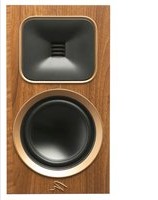
The Stylos hybrid speaker system consists of a broad-range single element electrostatic transducer integrated with a quick-response woofer. This approach takes advantage of the benefits that both technologies have to offer.
Dispersion is a controlled 30 degrees. This was achieved by curving the electrostatic transducer element itself, an elegantly simple solution.
Frequency Response Frequency Response 55-20,000 Hz +/- 3dB
Dispersion Dispersion Horizontal: 30 degrees; Vertical 38" Line Source
Sensitivity Sensitivity 88dB 2.83 volts/1 meter
Impedance Impedance Nominal: 4 ohms; Minimum: 2 ohms at 20,000 Hz
Crossover Frequency Crossover Frequency 700 Hz, 12dB per octave
Woofer TypeWoofer Type 6.5" high rigidity cone with extended throw driver assembly, sealed enclosure
Power Handling Power Handling 200 watts/channel
Recommended Amplifier Power Recommended Amplifier Power 60 - 200 watts/channel
WeightWeight 40 lbs. each
SizeSize 63.5 H x 10.5 W x 4.5 D
Notes
MARTIN·LOGAN.LTD.
THE ELECTROSTATIC TECHNOLOGY
2001 delaware street
p.o. box 707
lawrence, kansas 66044
ph:913.749.0133

- MARTIN-LOGAN MAY NOT HONOR WARRANTY SERVICE CLAIMS UNLESS WE HAVE A COMPLETED WARRANTY REGISTRATION CARD ON FILE
- FULL RANGE OPERATION FULL RANGE OPERATION
- VAPOR DEPOSITED FILM VAPOR DEPOSITED FILM
- TRANSDUCER INTEGRITYTRANSDUCER INTEGRITY
- MECHANICAL/ACOUSTICALMECHANICAL/AL TONE SHAPINGTONE SHAPING
- CURVILINEAR LINE SOURCECURVILINEAR LINE S
- INSTALLATION OPTIONS
- ON WALLON WALL
- ON A SIDE WALL ON A SIDE WALL
- ON A STANDON A STAND
- IN WALLIN WALL
- AC POWER CONNECTIONAC POWER CONNECTIONSIGNAL CONNECTION
- DISTANCE FROM DISTANCE FROM THE SIDE WITH BALLSIDE W
- DISTANCE FROM THE DISTANCE FROM THE FLOORFLOOR
- INSTALLATION PROCEDURE INSTALLATION PROCEDURE
- TOOLS REQUIRED
- BULLET LEVEL (OPTIONAL)
- STEP 1 STEP1)
- STEP 2 STEPS 1 & 2)
- STEP 3 (FIGURES 2 & 3)
- STEP 4 (FIGURE 4)
- STEP 5S(F) 5)
- MOUNTING THE STYLOSMOUNTING THE STYLOS
- STEP 6 (FIGURE 6)
- STEP 7S(FIGURE 7)
- YOUR ROOM YOUR ROOM
- TERMINOLOGY TERMINOLOGY
- RULES OF THUMBRULES OF THUMB
- ROOM ACOUSTICS AND DISPERSION INTERACTIONS
- THREE MAJOR TYPES OF DISPERSION THREE MAJOR TYPES OF DISPERSION
- CONTROLLED HORIZONTAL DISPERSIONCONTROLLED HORIZONTAL DISPERSIONCONTROLLED
- NO OUTPUT NO OUTPUT
- LOW FREQUENCY (60HZ) HUMLOW FREQUENCY (60HZ) HUM
- WEAK OUTPUT, LOSS OF HIGHSWEAK OUTPUT, LOSS OF HIGHPOPPING AND TICKING SOUNDS, FUNNY NOISESPOPPING AND
- EXAGGERATED HIGHS, BRIGHTNESS EXAGGERATED HIGHS, BRIGHTNESS
- LACK OF BASSLACK OF BASS
- POOR IMAGINGPOOR IMAGING
- COMPACT DISCSCOMPACT DISCS
- CLASSICALCLASSICAL
- JAZZ AND BIG BAND JAZZ AND BIG BAND
- ROCK AND POPROCK AND POP
- NOTES
Brand : Martin Logan
Model : The Stylos
Category : Loudspeaker