PXCPPS-018U - Cordless Telescopic Hedge Trimmer Ozito - Free user manual and instructions
Find the device manual for free PXCPPS-018U Ozito in PDF.


| Product Type | Cordless Telescopic Hedge Trimmer |
| Brand | Ozito |
| Model | PXCPPS-018U |
| Power Source | 18V Lithium-Ion Battery (Ozito PX Platform) |
| Blade Length | 500 mm |
| Cutting Capacity | 25 mm |
| Telescopic Shaft Range | 1.5 - 2.0 m |
| Weight | 3.5 kg |
| Overall Length (Retracted) | 1.0 m |
| Overall Length (Extended) | 1.5 m |
| Battery Charge Time | Approx. 5 hours |
| Blade Material | High-Carbon Steel |
| Safety Features | Two-hand operation, blade guard, lock-off switch |
| Maintenance | Clean blades after use, lubricate regularly, store in dry place |
| Warranty | 5 years (limited) |
| Compatible Accessories | Spare battery, charger, blade cover |
Frequently Asked Questions - PXCPPS-018U Ozito
User questions about PXCPPS-018U Ozito
0 question about this device. Answer the ones you know or ask your own.
Ask a new question about this device
Download the instructions for your Cordless Telescopic Hedge Trimmer in PDF format for free! Find your manual PXCPPS-018U - Ozito and take your electronic device back in hand. On this page are published all the documents necessary for the use of your device. PXCPPS-018U by Ozito.
USER MANUAL PXCPPS-018U Ozito
18V LITHIUM ION
CORDLESS POLE PRUNER
SAFETY WARNINGS
BATTERY AND CHARGER SAFETY WARNINGS
Information about the battery
- The battery pack supplied with your cordless tool is not charged. The battery pack has to be charged before you use the tool for the first time.
- For optimum battery performance avoid low discharge cycles. Charge the battery park frequently.
- Store the battery pack in a cool plate, ideally at 15°C and charged to at least 40%.
- Lithium-ion batteries are subject to a natural ageing process. The battery pack must be replaced at the latest when its capacity fails to just 80% of its capacity when new. Weakened sales in an aged battery pack are no longer capable of making the high power requirements and therefore pose a safety risk.
- Do not throw battery packs into an open film. There is a risk of explosion!
- Do not ignite the battery pack or expose it to fire.
- Do not exhaustively discharge batteries. Exhaustive discharge will damage the battery cells. The most common cause of exhaustive discharge is lengthy storage or non-use of partly discharged batteries. Stop working as soon as the performance of the battery fails noticeably or the electronic protection system triggers. Place the battery pack in storage only after it has been fully charged.
- Protect batteries and the tool from overloads. Overloads will quickly result in crossheating and cold damage inside the battery housing without this crossheating actually being apparent externally.
- Avoid damage and shocks. Replace batteries which have been dropped from a height of more than one motor or which have been exposed to violent shocks without delay, seen if the housing of the battery pack appears to be undamaged. The battery calls inside the battery may have suffered serious damage. In this respect, please also read the waste disposal information.
- If the battery pack stills overfacing and overheating, the integrated protective cut-off will switch off the equipment for safety reasons. Important. Do not press the ON/OFF switch any more if the protective cut-off has actuated. This may damage the battery pack.
- Use only original battery packs. The use of other batteries may result in injuries, explosion and a fire risk.
Information on chargers and the charging process
- Please check the data marked on the rating plate of the battery charger. Be sure to connect the battery charger to a power supply with the voltage marked on the rating plate. Never connect it to a different means voltage.
- Protect the battery charger and its cable from damage and sharp edges. Have damaged cables repaired without delay by a qualified electrician.
- Keep the battery charger, batteries and the condens tool out of children's reach.
- Do not use damaged battery chargers.
- Do not use the supplied battery charger to charge other cordless tools.
- In heavy use the battery pack will become warm. Allow the battery pack to cool to room temperature before commencing with the charging.
- Do not over-charge batteries. Do not exceed the maximum charging times. These charging times may apply to discharged batteries. Frequent insertion of a charged or partly charged battery pack will result in over-charging and cell damage. Do not leave batteries in the charger for days on end.
- Never use or charge batteries if you suspect that the last time they were charged was more than 12 months previously. There is a high probability that the battery pack has already suffered dangerous damage (exhausted discharge).
- Changing batteries at a temperature are below 10°C will cause chemical damage to the cell and may cause a fire.
- Do not use batteries which have heated during the changing process, so the battery cells may have suffered dangerous damage.
-
Do not use batteries which have suffered curvature or deformation during the changing process or which show other non-typical symptoms (passing, hissing, cracking...)
-
Never fully discharge the battery pack (recommended depth of discharge max 90%). A complete discharge of the battery pack will lead to premature ageing of the battery cells.
-
Never charge the batteries unsupervised.
Protection from environmental influences
-
Wear suitable work clothes. Wear safety goes like.
-
Protect your cordless tool and the battery charger from moisture and rain. Moisture and rain can cause dangerous cell damage.
-
Do not use the cordless tool or the battery charger near vapore and inflammatory liquids.
-
Use the battery charger and cordless tools only in dry conditions and an ambient temperature of 10-40°C.
-
Do not keep the battery charger in places where the temperature is liable to reach over 40°C. In particular, do not leave the battery charger in a car that is parked in the sunshine.
-
Protect batteries from overheating. Over-loads, over-charging and exposure to direct sunlight will result in overheating and sell damage. More charge or work with batteries which have been overheated – replace from immediately if possible.
-
Storage of batteries, battery chargers and cordless tools. Store the charger and your cordless tool only in dry places with an ambient temperature of 10-40°C. Store your lithium-ion battery pack in a cool, dry place at a temperature of 10-20°C. Protect them from humidity and direct sunlight. Only place fully charged batteries in storage (charged at least 40%).
-
Prevent the lithium-ion battery pack from freeze-zing. Battery packs which were stored below 0°C far more than 60 minutes must be disposed of.
-
When handling batteries beware of electrostatic charge: Electrostatic discharges cause damage of the electronic protection system and the battery cells. Avoid electrostatic charging and never touch the battery poles.
flowchart
graph TD
    A["Warning"] --> B["Warning Box"]
    B --> C["Email"]
    C --> D["ISC"]
    D --> E["Error/Warning"]
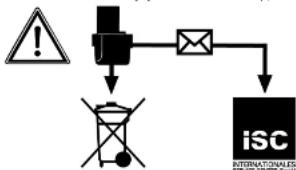
Rechargeable batteries and cordless electromachines and tools contain materials that are potentially harmful to the environment. However, planteery cordless electric machines or tabs in your household refuse. When cordless electric machines or tabs become defective or worn, remove the rechargeable batteries and return them to SIC GmbH (address: Eschreuzhauer 8, D-04405, Germany). If the rechargeable batteries cannot be removed, return the complete cordless machine or bus. You can then be sure that the equipment will be correctly disposed of by the most manufacturers.
When shipping or disposing of batteries and cordless tools, always ensure that they are packed individually in plastic bags to prevent short circuits and fires.
Residual risks Even when the tool is used as prescribed it is not possible to minimize all residual risk factors. The following hazards may arise in connection with the tool's construction and design:
- Damage to lungs if an effective dust mask is not worn.
- Damage to hearing if effective hearing protection is not worn.
- Health defects resulting from vibration erosion if the appliance is being used over longer period of time or not adequately managed and properly maintained. WARNING! This machine produces an electromagnetic field during operation. This field may under some circumstances interfere with active or passive medical implants. To reduce the risk of serious or fatal injury, we recommend persons with medical implants to consult their physician and the medical implant manufacturer before operating this machine.
Page 2 Page 3
▲ SPECIAL SAFETY INSTRUCTIONS FOR PRUNER
- When the chainsaw is running make sure that you keep all parts of your body away from the chainsaw. Before starting up the chainsaw make sure that it is not touching anything. When you are working with a chainsaw, a single moment of carlessness is all it takes for clothing or parts of your body to get caught by the chainsaw.
• Always hold the chainsaw securely with your right hand on the rear handle and your left hand on the front handle. Holding the chainsaw with your hands in other positions increases the risk of injury and is therefore not allowed. - Wear safety goggles and ear protection. Other safety equipment for the head, hands, legs and feet is recommended. Correct protective clothing reduces the risk of injury caused by calapulated chips or in the event of accidental contact with the obesity.
- Never use the chainsaw up a tree. You risk injuring yourself if you use the chainsaw up a tree.
Always maintain a steady standing position and only use the chainsaw when you are standing on a solid, safe and flat surface. Slippery or unsafe surfaces in combination with a ladder can cause you to lose your balance and control over the chainsaw. - When cutting through a branch which is under tension, take into account how it will spring back once the cut has been made. Once the tension in the wood floors is released, the tensioned branch could hit the operator and/or seize control of the chainsaw.
Take special care when cutting undergrowth and young trees. The thin malaria can become caught in the raw chain and whip back towards you or make you lose your balance. - Carry the chainsaw by the front handle with the chainsaw switched off and the chain facing away from the body. Always fit the protective cover when transporting the chainsaw or putting it into storage. Careful handling of the chainsaw reduces the feedhead of accidental contact with the saw chain while it is running.
- Follow the instructions for lubrication, chain tension and replacement of accessories. A chain which is not properly tensioned or lubricated can either break or increase the risk of kickback.
- Keep the handles dry, clean and free from oil and grease. Groovy or oily handles are slippery and will result in loss of control.
- Only use the chainsaw to cut wood. The chain must only be used to perform the work for which it is intended. For example: Never use the chainsaw to cut plastic or brickwork or building materials which are not made of wood. Use of the chainsaw for non-intended or non-approved work can create dangerous situations.
- Held the equipment only by the insulated handles when carrying out work during which the cutting tool could strike concealed power cables. Contact with a live cable will also make the metal parts of the tool live and will cause an electric shock.
Сищая of and ways to avoid recoil.
Recoll can occur if the lip of the chain bar touches an item or if the wood bends and jams the raw chain in the cut, in many cases contact with the bar lip can result in an unexpected reaction aimed backwards in which the chain bar is catapulted upwards towards the operator.
Jamming the new chain on the top of the chain her can catapult the her towards the operator at high speed.
Any of these reactions can result in you losing control over the east and possibly suffering serious injuries. You should therefore not rely solely on the safety equipment filled to the chestbox. When using a chestbox you should take various precautions to enable you to work without suffering accidents or injuries.
Recall is the result of incorrect or wrong use of the electric tool. It can be prevented by suitable precautions, as described below:
Hold the saw firmly with both hands, with fingers and thumbs gripped around the handles. Steady yourself with your body and arms in a position In which you can control the kickback forces. Provided appropriate measures are taken, an operator should be capable of controlling the kickback forces. Never tell go of the chain saw.
Avoid abnormal working pastures. Never cut above shoulder height. This prevents accidental contact with the tip of the rail and offers better control over the chainsaw in unexpected situations.
- Always use the correct replacement rails and saw chains recommended by the manufacturer. The use of incorrect replacement rails or saw chains may result in breakage of the chain and/or kickback.
- Follow the manufacturer's Instructions for sharpening and maintaining the saw chain. The risk of kickback is increased if the depth limber is set too low.
More important information: - Before you start falling branches: Make sure that there is nobody within a range of at least two and a half times the length of the branch.
Take the weather conditions into account when falling trees. Do not fall trees in strong or gusting wind. Do not fall trees in frost conditions or on frozen, icy ground. Do not fall trees in rain or if visibility is poor. - Comply with local regulations
- Plan an escape route from felling trees or branches in advance. Make sure that this escape route is free of obstacles which could restrict or prevent tree movement. Keep in mind that freshly cut grass or bark is slippery.
- Ensure that somebody is in the vicinity (but at a safe distance) in case of an accident.
- When the chain is moving, do not let the tip of the chain bar come into contact with any objects.
• Start sewing only after the chain has reached full speed.
• Never try to target a previous cut. Always start a new cut. - Watch out for moving branches or other forces which could interfere with a cut and impact with the chain.
- Never try to cut a branch with a larger diameter than the cutting length of the equipment.
- Contact your local government offices for information regarding minimum age requirements for operating the equipment.
- Nose the equipment at a minimum distance from overhead power cables.
- Before you begin your work, make yourself well acquainted with all the control elements. Practice handling the equipment and have an expert explain its functions, mode of operation and sewing techniques.
- Never use the equipment if you see it, find or under the influence of alcohol or medication. Always take timely breaks from your work. Change your working position regularly.
Warning!
If the equipment is used for a lengthy period, the vibrations it causes in the hands of the user may result in circulation problems (while finger syndrome). White finger syndrome is a vascular disease that involves seizure-like spasms of the fingers and soos. The aft oedo areas are no longer sufficiently supplied with blood and therefore appear extremely able. The frequent use of vibrating equipment may trigger nerve damage in people with an impaired circulation (for example smokers, diabetes).
Should you observe any unusual impairments, interrupt your work immediately and consult a doctor.
Follow these instructions in order to recuse the cancers:
- Keep your body and in particular your hands warm when working in the cold. - Take regular breaks and move your hands to stimulate the blood circulation during the breaks.
- Ensure that the equipment makes the least possible vibration through regular maintenance and solid parts on the equipment.
Do not lose this safety information.

DANGER!
Read all safety regulations and instructions.
Any errors made in following the safety regulations and instructions may result in an electric shock, fire and/or serious injury.
Keep all safety regulations and instructions in a safe place for future use.
The term "electric tool" used in the safety instructions refers to electric tools operated from the mains power supply (with a power cable) and to battery operated electric tools (without a power cable).

GENERAL SAFETY INSTRUCTIONS FOR ELECTRIC TOOLS
1. Workplace safety
a) Keep your work area clean and well illuminated. Untidy or unlit work areas can result in accidents.
b) Do not operate the electric tool in an environment where there is a risk of explosions and where there are infl ammable liquids, gases or dust. Electric tools produce sparks which could set the dust or vapours alight.
c) Keep the electric tool out of the reach of children and other persons. If there is a distraction, you may lose control of the appliance.
2. Electrical safety
a) The connector plug from this electric tool must fit into the socket. The plug should never be altered in any way. Never use adapter plugs together with earthed electric tools. Unaltered plugs and correct sockets reduce the risk of an electric shock.
b) Avoid bodily contact with earthed surfaces such as pipes, heating, ovens and fridges. The risk of electric shock is increased if your body is earthed.
c) Keep the tool out of the rain and away from moisture. The ingress of water into an electric tool increases the risk of an electric shock.
d) Do not use the cable to carry the electric tool, to hang it up or to pull it out of the socket. Keep the cable away from heat, oil, sharp edges and moving parts of the appliance. Damaged or entangled cables increase the risk of an electric shock.
e) If you are working outdoors with an electric tool, only use extension cables which are designed specifically for this purpose. Using specially designed outdoor extension cables, the risk of electric shock is reduced.
f) If operation of the electric tool in a damp environment can not be avoided, use a earth-leakage circuit-breaker. The earthleakage circuit-breaker reduces the risk of an electric shock.
3. Safety of persons
a) Be careful, watch what you are doing and use an electric tool sensibly. Do not use the tool if you are tired or under the influence of drugs, alcohol or medication. A moment of inattention when using the electric tool can result in serious injuries.
b) Wear personal protection equipment and always wear safety goggles. Wearing personal protection (such as dust masks, non-slip safety shoes, safety helmet or ear protection, depending upon the type and use of the electric tool) reduces the risk of injury.
c) Make sure that the appliance cannot start up accidentally. Ensure that the electric tool is switched off before you connect it to the power supply and/or insert the battery, or pick up or carry the tool. If your fi nger is on the switch whilst carrying the electric tool or if you connect the appliance to the mains when it is switched on, this can lead to accidents.
d) Remove keys and wrenches before switching on the electric tool. A tool or key which comes into contact with rotating parts of the appliance can lead to injuries.
e) Avoid abnormal working postures. Make sure you stand squarely and keep your balance at all times. In this way, you can control the electric tool better in unexpected circumstances.
f) Wear suitable work clothes. Do not wear loose clothing or jewellery. Keep hair, clothes and gloves away from moving parts. Loose clothing, jewellery or long hair can get trapped in moving parts.
g) If vacuuming devices and draining devices can be fitted, make sure that these are correctly attached and correctly used. The use of a dust extraction system can reduce the danger posed by dust
4. Usage and treatment of electrical tool
a) Do not overload the appliance. Use the correct tool for your work. You will be able to work better and more safely within the given performance boundaries.
b) Do not use an electric tool with a defective switch. An electric tool that cannot be switched on or off is dangerous and must be repaired.
c) Pull the plug out of the socket and/or remove the battery before making any adjustments to the appliance, changing accessories or put the appliance down. This safety measure prevents starting the electric tool unintentionally.
d) Keep unused electric tools out of the reach of children. Do not allow people who are not familiar with the appliance or who have not read these instructions to use the appliance. Electric tools are dangerous if they are used by inexperienced people.
e) Clean your electric tool carefully. Check whether moving parts are functioning properly and not jamming, whether parts are broken or damaged enough that the functioning of this electric tool is affected. Have damaged parts repaired before using the appliance. Many accidents are caused by badly maintained electric tools.
f) Keep your cutting tools sharp and clean. Carefully maintained cutting tools with sharp cutting edges will jam less and are easier to control.
g) Make sure to use electric tools, accessories, attachments, etc. in accordance with these instructions. Take the conditions in your work area and the job in hand into account. Using electric tools for any purpose other than the one for which they are intended can lead to dangerous situations.
5) Battery tool use and care
a) Recharge only with the charger specified by the manufacturer. A charger that is suitable for one type of battery pack may create a risk of fire when used with another battery pack.
b) Use power tools only with specifically designated battery packs. Use of any other battery packs may create a risk of injury and fire.
c) When battery pack is not in use, keep it away from other metal objects, like paper clips, coins, keys, nails, screws or other small metal objects, that can make a connection from one terminal to another. Shorting the battery terminals together may cause burns or a fire.
d) Under abusive conditions, liquid may be ejected from the battery; avoid contact. If contact accidentally occurs, flush with water. If liquid contacts eyes, additionally seek medical help. Liquid ejected from the battery may cause irritation or burns.
6. Service
a) Have your electric tool repaired only by trained personnel using only genuine spare parts. This will ensure that your electric tool remains safe to use.
- CORDLESS POLE PRUNER
- BATTERY AND CHARGER SAFETY WARNINGS
- ▲ SPECIAL SAFETY INSTRUCTIONS FOR PRUNER
- DANGER!
- Read all safety regulations and instructions.
- Keep all safety regulations and instructions in a safe place for future use.
- GENERAL SAFETY INSTRUCTIONS FOR ELECTRIC TOOLS
- Workplace safety
- Electrical safety
- Safety of persons
- Usage and treatment of electrical tool
- 5) Battery tool use and care
- Service
Brand : Ozito
Model : PXCPPS-018U
Category : Cordless Telescopic Hedge Trimmer