
COD-831 - Detector Mercury - Free user manual and instructions
Find the device manual for free COD-831 Mercury in PDF.


| Product Type | Metal Detector |
| Brand | Mercury |
| Model | COD-831 |
| Dimensions (Approx.) | 200 x 100 x 50 mm |
| Weight | 500 g |
| Power Supply | 2 x 9V battery (not included) |
| Operating Frequency | 6.5 kHz |
| Detection Depth | Up to 15 cm for small objects, 30 cm for larger objects |
| Discrimination Modes | All metal, Ferrous/Non-ferrous, Notch |
| Sensitivity Adjustment | Adjustable via knob (1-10) |
| Audio Indication | Tone discrimination for ferrous/non-ferrous |
| Visual Indication | LED target strength indicator |
| Search Coil | Waterproof, 20 cm diameter |
| Ground Balance | Automatic |
| Operating Temperature | -10°C to 50°C |
| Maintenance | Wipe with damp cloth; store in dry place |
| Safety | Not for use by children under 8; avoid contact with open water |
| Spare Parts Available | Battery cover, search coil |
| Repair Service | Contact your local dealer or Mercury support |
| Manual Language | English (PDF available for download) |
Frequently Asked Questions - COD-831 Mercury
User questions about COD-831 Mercury
0 question about this device. Answer the ones you know or ask your own.
Ask a new question about this device
Download the instructions for your Detector in PDF format for free! Find your manual COD-831 - Mercury and take your electronic device back in hand. On this page are published all the documents necessary for the use of your device. COD-831 by Mercury.
USER MANUAL COD-831 Mercury
natural_image
White electronic device with a digital display showing '0000' and control buttons (no readable text beyond labels)Carbon Monoxide Alarm with 10 Year Sealed Battery
Order ref: 350.149UK
User Manual
Electromechanical alarm with LCD display and integrated 10 Year battery that saves lives by detecting carbon monoxide gas and giving a loud acoustic warning when triggered. This unit needs no battery maintenance, simply engage the internal battery by releasing the button on the base of the unit, fix to your desired surface and test on a regular basis. Once the detector nears the end of its 10-year life, a low battery indication alerts you to replace the unit. An essential life saver needed in every household with gas or solid fuel heating. Recommended positioning, in all rooms with boilers, stoves or open fires.
Product Specifications:
| Apparatus | Type B |
| Batteries | DC3V 2pcs lithium battery (internal) |
| Alarm level | 85dB @ 3m |
| Sensor | Electromechanical |
| Operating temperature | -10°C to +50° |
| Humidity | 10% - 95%RH |
| Lifetime | 10 years |
| Dimensions | 130 x 75 x 35mm |
| Weight | 130g |
Product layout:
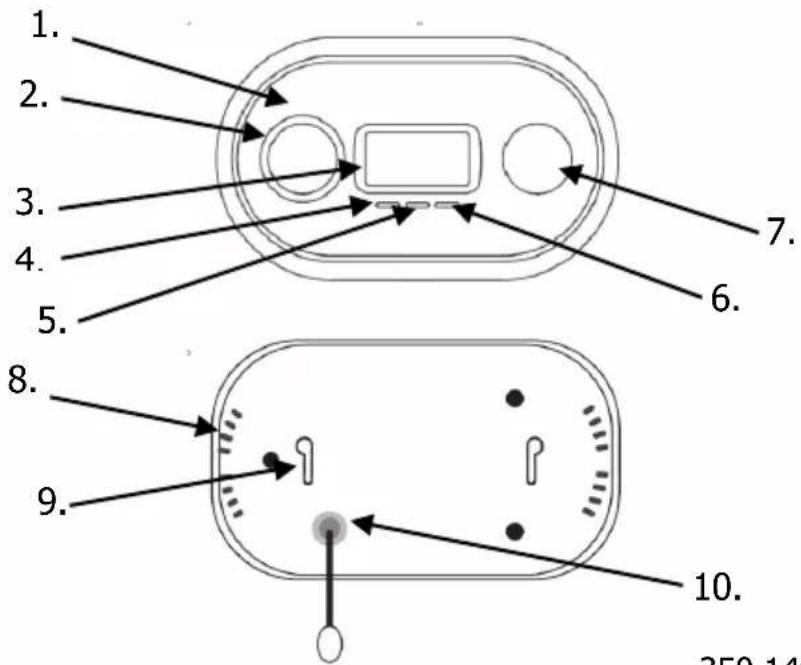
- Alarm casing
- Speaker
- LCD display
- Normal mode indicator
- Fault indicator
- Alarm indicator
- Test/Hush button
- Sensor inlets
- Mounting plate lugs
- Power switch
Start up:
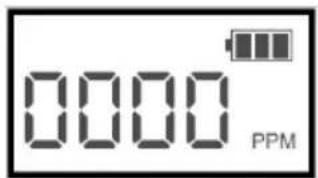
Remove the alarm from the packaging and slide the back cover down to reveal the back of the unit. On the bottom left corner, you will see the power switch (10.) To enable the alarm's 10-year battery press and hold the button until a loud beep can be heard, and the digital display begins to count down from 0060 seconds. Use the small tool provided if you are struggling to press and hold the button hard enough. Once the 60 second self-test has completed the unit will display 0000 and the Normal mode indicator (4.) will flash green intermittently, this means the unit is now in full working mode (see below).
Location:
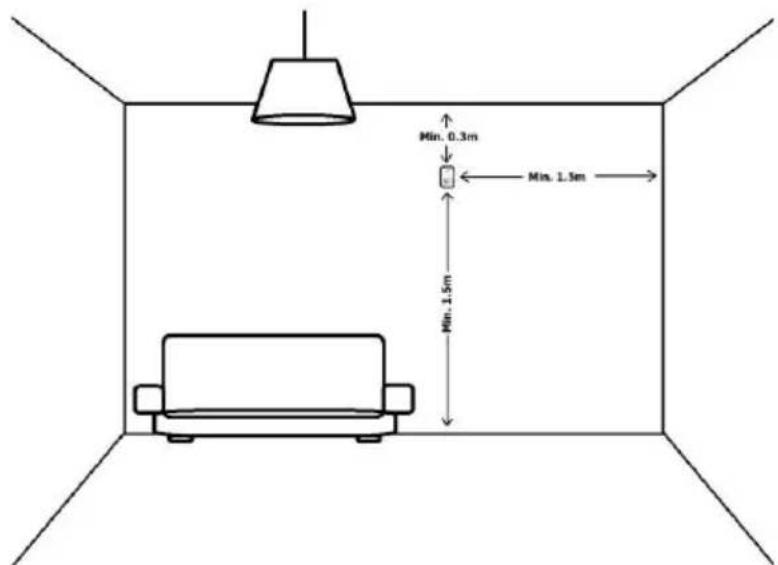
For houses and buildings with multiple rooms, it is recommended to install one alarm per room. If not possible then at least one alarm per level. It is advised to locate the alarm near the potential source of CO, such as rooms with a boiler, fireplace or gas oven. For optimum detection, the alarm needs to be installed at least 1.5m above the ground, 0.3m below the ceiling and 1.5m from the corner of the room.
DO NOT locate alarm:
• Next to a window or a door.
- On the floor where the unit may get kicked or damaged.
• Behind fans, air-con units or any sort of ventilation.
- Confined spaces such as inside a cupboard.
- Behind furniture or curtains, alarms must not be obstructed.
- Cold or hot environments. (no less than 0^ or no more than 45^ )
- Too close to an open flame, this can leave carbon deposits on the sensor, reduce its sensitivity and give false readings.
• Dusty areas, this may block the sensor.
- Directly above a heater or cooking appliance.
• Where a lot of moisture is present, e.g. bathroom or kitchen above a sink or hob. - Outdoors, this alarm is designed for indoor use only.
Installation:
After finding an appropriate location, the wall bracket can be screwed onto the wall using the supplied hardware. Alternatively, it can be stuck on using a self-adhesive pad (not supplied). To mount the bracket using hardware, use the mounting plate as a guide to mark the two holes. Drill these holes 6mm∅, 30mm deep. Insert the plugs into the hole and screw the bracket on, ensuring the raised side is facing outward. Finally, push the back of the alarm against the bracket and slide down until it clicks to lock in place.
Operation:
The LCD screen and LEDs on the front of the alarm give vital information of the working condition of the alarm and important ambient readings of the surroundings.
| Function | Unit response |
| Start up | Green LED flashes continuously, LCD display counts down from 60 seconds |
| Normal | Green LED flashes every 60 seconds, LCD display reads “0000” |
| Alarm | Red LED flashes continuously, alarm sounds |
| Mute/hush | Red LED flashes every 10 seconds, alarm is silent for 10 minutes unless levels of carbon monoxide are detected |
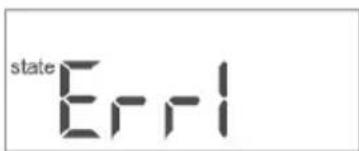
| Fault | Yellow LED flashes every 30 seconds accompanied by 2 beeps; LCD displays “Errl” see below |
| Low voltage | Yellow LED flashes every 20 seconds accompanied by 3 beeps |
| Test (every week recommended) | Press test button for 1 second, Red LED will flash accompanied by 4 beeps |
A fault can be caused by either loose connections on the circuitry, short circuit or sensor contaminated by other strong chemical fumes. Please leave the alarm in clean open air for 24hr and see if the error disappears. If it remains, please replace the alarm immediately to remain protected from carbon monoxide.
The red alarm LED will only flash when the carbon monoxide count reaches an alert level and activates the alarm. Under normal conditions the carbon monoxide count should be below 50ppm. Therefore, when the count is below 50 the LCD will only display 0000ppm.

Indicates batteries are at full capacity and alarm is working with sufficient power.
Indicates batteries have sufficient capacity and alarm is working with sufficient power.
Indicates batteries capacity is getting low but alarm still has sufficient power.
Indicates batteries are critically low and alarm is working on the minimum required
power and requires replacement as soon as possible to keep the alarm functional.
To meet BS EN 50291-1:2018 standards, the alarm will activate within the following time limits when different critical CO level is met.
| CO count (parts per million) | Alarm response time | Indicator before reaching alarm value |
| <50ppm | No Alarm | N/A |
| 50-100ppm | After around 80 mins | Red LED flashes every 2 mins |
| 100-300ppm | After around 30 mins | Red LED flashes every 2 mins and alarm beeps |
| Over 300ppm | After around 50 secs | Alarm sounds continuously |
When the concentration of the carbon monoxide reaches above 300ppm the alarm will sound continuously, this indicates a dangerously high concentration of carbon monoxide is present and all persons must evacuate the building IMMEDIATELY.
When the alarm is activated it can be temporarily silenced by pressing the TEST button, the alarm LED will remain flashing to indicate the presence of high concentration of carbon monoxide. ONLY silence the alarm when you are 100% sure that the source of the carbon monoxide has been dealt with.
Maintenance:
To maintain the sensitivity of the alarm, dust needs to be removed from the surface on a regular basis. To dust use a slightly damp cloth, a brush or brush attachment of a vacuum cleaner. Do not use any solvent based cleaners as the unit is sensitive to all active gas including chemical cleaners. Always perform a manual test after cleaning to ensure the alarm is working normally.
End of Life:
After around 10 years when the battery level indicator reaches a critically low level, the yellow fault indicator (5) will flash 3 times every 60 seconds and the alarm beeps, this indicates the unit must be replaced as soon as possible. After replacement, please ensure you dispose of the old unit according to local waste disposal guidelines.
Avoid below action to prevent the alarm from damage:
- Do not allow the alarm to meet any coloured or heavy smelling gas as this will contaminate the sensor and false readings will occur.
- Do not spray aerosols near the alarm, such as: air freshener, insect killer, perfume, hair spray etc. as this will result in false readings or contamination of the sensor.
- Do not paint over the alarm, always remove it from the bracket before painting and wait for the paint to be fully dry before reinstalling the alarm.
- Avoid shock or impact on the alarm, if accidentally dropped check if the battery connection is still intact and perform a manual test to ensure the alarm is working correctly.
- Do not attempt to repair or modify the alarm. Any modification may cause the alarm to malfunction and fail to operate in a life-threatening situation, therefore modification and repair is strictly restricted.
- In the event of contamination, leave the alarm in fresh air for a minimum of 30 mins to up to a week to see if it recovers. If readings are still false replace the alarm immediately.
What is carbon monoxide?
Carbon monoxide (CO) is a highly poisonous gas that has no taste, colour or smell.
Carbon monoxide is a cumulative poison meaning long-term exposure to low levels may cause symptoms. This alarm is time-weighted – the higher the level of CO, the sooner it will alarm.
What produces CO in the home?
Many appliances can produce deadly CO levels if they are not in full working order. Items such as wood burning stoves, gas boilers, gas fires, gas hobs and ovens, oil and coal burning units, portable gas heaters, blocked flues and chimneys, car fumes from an integral garage and even barbeques. This alarm is not a substitute for proper maintenance of your appliances.
What should I do if the CO alarm sounds?
- IMMEDIATELY open all doors & windows for ventilation & turn off all combustion appliances.
- Evacuate everyone outdoors or to an open door or window for fresh air. Perform a head count to check all persons are accounted for.
- DO NOT re-enter the premises or move away from the door/window until the alarm has stopped.
- Call the UK Emergency Gas Services: 0800 111 999
- Seek medical help immediately for those suffering with CO poisoning.
- DO NOT use appliances again until they have been checked by qualified personnel and the fault has been clearly identified and rectified.
How to identify symptoms of carbon monoxide poisoning:
Carbon monoxide poisoning accounts for up to 50 deaths on average per year in the UK, long period exposure will lead to brain damage and can be lethal if ignored or unnoticed. Therefore it is very important to identify the symptoms at an early stage.
| Symptoms | |
| Mild | Headache, nausea, fatigue (often misdiagnosed as flu or food poisoning) |
| Moderate | As above but more obvious, also tiredness, dizziness, lack of concentration, shortness of breath or chest pains |
| Severe | Severe headaches, convulsions, seizures, loss of consciousness, vital organ failure. Possible death within 2 - 3 hours |
Carbon monoxide poisoning action and treatment:
In the event of carbon monoxide poisoning, switch off/put out the source of carbon monoxide immediately if known. Open all doors and windows to allow fresh air to flow in and evacuate
all persons from room or building. Seek medical support immediately. Contact the emergency gas service and allow them to inspect the building to ensure it is safe before re-entering. Mild carbon monoxide poisoning will clear on its own after the person is removed from the source of carbon monoxide. For moderate level poisoning seek medical advice as they will need to be treated with pure oxygen. Severe cases of poisoning will require immediate medical assistance so call 999 immediately.
Prevention of carbon monoxide poisoning:
- Do not use domestic fueled appliances in enclosed spaces.
- Do not use fuel generators in enclosed space.
- Paraffin/flueless heaters should not be used in a bedroom or an enclosed space.
- Ensure all flues, chimneys or other ventilation is clear from obstruction.
• Ventilate your home on a regular basis.
- Do not service, repair, install or modify appliances yourself. Always ensure any work is carried out by licensed, reputable, and qualified engineer only.
- Learn how to recognise CO poisoning symptoms. If mild symptoms reduce or go away when you are away from the room or building, then it is highly likely you are open to chronic carbon monoxide exposure. Seek help from a licensed engineer to perform checks on all fuel running appliances within the household.

This alarm conforms to BS EN 50291-1:2018

This product is classed as Electrical or Electronic equipment and should not be disposed with other household or commercial waste at the end of its useful life. The goods must be disposed of according to your local council guidelines.
Errors and omissions excepted.
Copyright© 2023 AVSL Group Ltd, Unit 2 Bridgewater Park,
Taylor Road, Trafford Park, Manchester. M41 7JQ.
AVSL (Europe) Ltd, Unit 3D North Point House,
North Point Bus. Park, New Mallow Road, Cork, Ireland.

- Carbon Monoxide Alarm with 10 Year Sealed Battery
- Product layout:
- Start up:
- Location:
- DO NOT locate alarm:
- Installation:
- Operation:
- Maintenance:
- End of Life:
- Avoid below action to prevent the alarm from damage:
- What is carbon monoxide?
- What produces CO in the home?
- What should I do if the CO alarm sounds?
- How to identify symptoms of carbon monoxide poisoning:
- Carbon monoxide poisoning action and treatment:
- Prevention of carbon monoxide poisoning:
- Errors and omissions excepted.
Brand : Mercury
Model : COD-831
Category : Detector