
One+ R18HF - Household Fan RYOBI - Free user manual and instructions
Find the device manual for free One+ R18HF RYOBI in PDF.


| Product Type | Portable Fan |
| Brand | RYOBI |
| Model | One+ R18HF |
| Power Source | Hybrid: AC (220-240V~50Hz) or DC (18V battery pack) |
| Wattage | 15 W |
| Speed Settings | Two-speed: Low (I) and High (II) |
| No-Load Speed | 1400 / 2100 min⁻¹ |
| Weight (without battery) | 1.3 kg |
| Battery Compatibility (not included) | Lithium-Ion: RB18L13, RB18L15, RB18L26, RB18L40; NiCd: RB18N15 |
| Charger Compatibility (not included) | BCS618G, BCL14181H, BCL14183H, BCL1418IV |
| Adjustable Head | Yes, multi-position tilt |
| J Hook for Hanging | Yes, integrated J hook |
| Mounting Holes | Yes, for screw mounting |
| Cord Retainer | Yes, for security |
| Intended Use | General ventilation of most household spaces |
| Safety Certification | RCM (Regulatory Compliance Mark) |
| Environmental Protection | Recycle materials; do not dispose with household waste |
| Maintenance | Clean with dry cloth; avoid solvents; remove battery before maintenance |
| Recommended Charging Temperature | 10°C to 38°C (50°F to 100°F) |
| Warranty | Refer to operator's manual or manufacturer |
Frequently Asked Questions - One+ R18HF RYOBI
User questions about One+ R18HF RYOBI
0 question about this device. Answer the ones you know or ask your own.
Ask a new question about this device
Download the instructions for your Household Fan in PDF format for free! Find your manual One+ R18HF - RYOBI and take your electronic device back in hand. On this page are published all the documents necessary for the use of your device. One+ R18HF by RYOBI.
USER MANUAL One+ R18HF RYOBI
natural_image
Exterior view of a modern office building (no signage)Important!
This appliance can be used by children aged from 8 years and above and persons with reduced physical, sensory or mental capabilities or lack of experience and knowledge if they have been given supervision or instruction concerning use of the appliance in a safe way and understand the hazards involved. Children shall not play with the appliance.
It is essential that you read the instructions in this manual before operating this machine.
Subject to technical modifications.
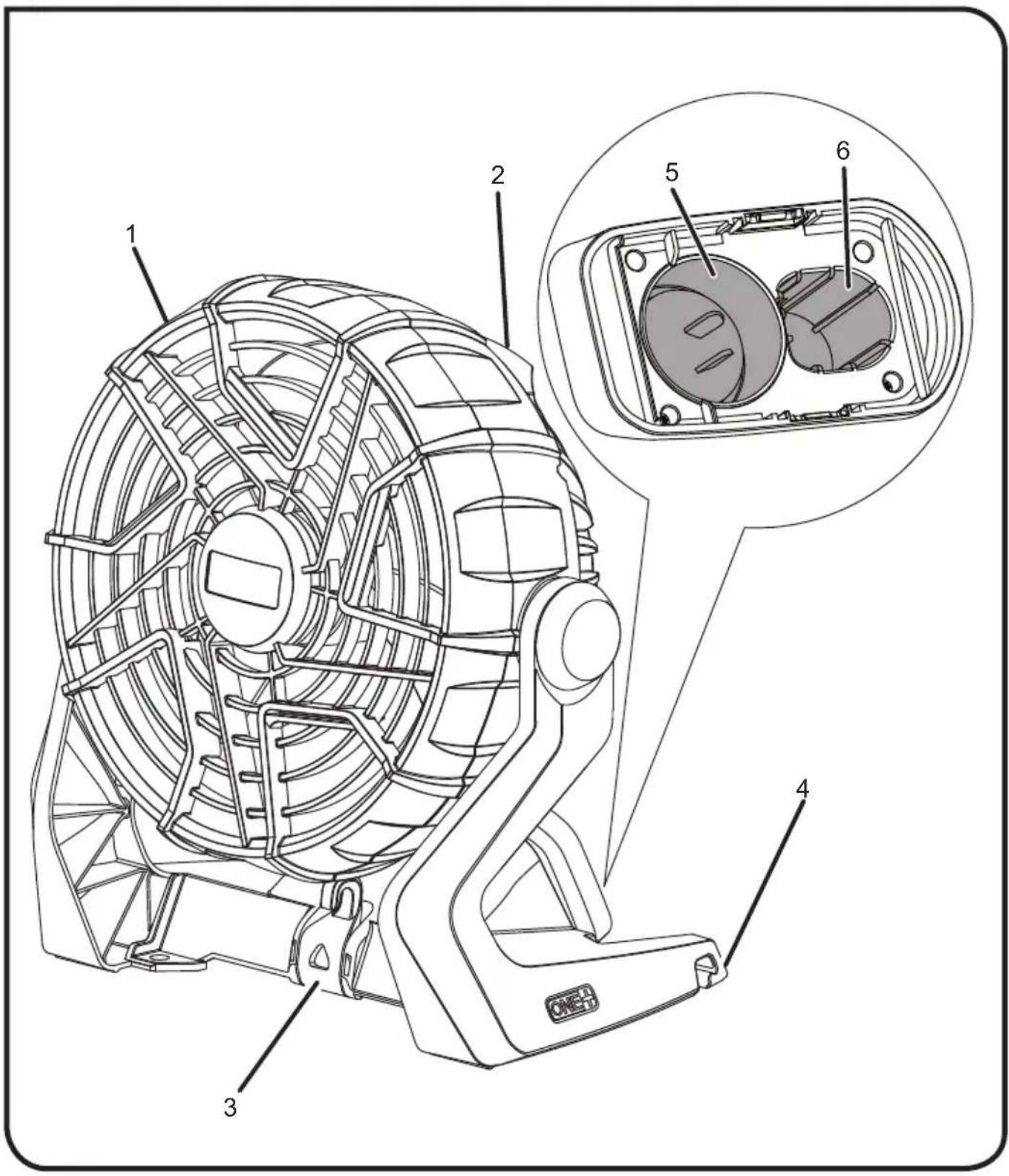
Fig. 1
GENERAL POWER TOOL SAFETY WARNINGS
WARNING
Read all safety warnings and all instructions. Failure to follow the warnings and instructions may result in electric shock, fire and/or serious injury.
Save all warnings and instructions for future reference.
The term "power tool" in the warnings refers to your mains-operated (corded) power tool or battery-operated (cordless) power tool.
1) WORK AREA SAFETY
a) Keep work area clean and well lit. Cluttered or dark areas invite accidents.
b) Do not operate power tools in explosive atmospheres, such as in the presence of flammable liquids, gases or dust. Power tools create sparks which may ignite the dust or fumes.
c) Keep children and bystanders away while operating a power tool. Distractions can cause you to lose control.
2) ELECTRICAL SAFETY
a) Power tool plugs must match the outlet. Never modify the plug in any way. Do not use any adapter plugs with earthed (grounded) power tools. Unmodified plugs and matching outlets will reduce risk of electric shock.
b) Avoid body contact with earthed or grounded surfaces, such as pipes, radiators, ranges and refrigerators. There is an increased risk of electric shock if your body is earthed or grounded.
c) Do not expose power tools to rain or wet conditions. Water entering a power tool will increase the risk of electric shock.
d) Do not abuse the cord. Never use the cord for carrying, pulling or unplugging the power tool. Keep cord away from heat, oil, sharp edges or moving parts. Damaged or entangled cords increase the risk of electric shock.
e) When operating a power tool outdoors, use an extension cord suitable for outdoor use. Use of a cord suitable for outdoor use reduces the risk of electric shock.
f) If operating a power tool in a damp location is unavoidable, use a residual current device (RCD) protected supply. Use of an RCD reduces the risk of electric shock.
3) PERSONAL SAFETY
a) Stay alert, watch what you are doing and use common sense when operating a power
tool. Do not use a power tool while you are tired or under the influence of drugs, alcohol or medication. A moment of inattention while operating power tools may result in serious personal injury.
b) Use personal protective equipment. Always wear eye protection. Protective equipment such as dust mask, non-skid safety shoes, hard hat or hearing protection used for appropriate conditions will reduce personal injuries.
c) Prevent unintentional starting. Ensure the switch is in the off-position before connecting to power source and/or battery pack, picking up or carrying the tool. Carrying power tools with your finger on the switch or energising power tools that have the switch on invites accidents.
d) Remove any adjusting key or wrench before turning the power tool on. A wrench or a key left attached to a rotating part of the power tool may result in personal injury.
e) Do not overreach. Keep proper footing and balance at all times. This enables better control of the power tool in unexpected situations.
f) Dress properly. Do not wear loose clothing or jewellery. Keep your hair, clothing and gloves away from moving parts. Loose clothes, jewellery or long hair can be caught in moving parts.
g) If devices are provided for the connection of dust extraction and collection facilities, ensure these are connected and properly used. Use of dust collection can reduce dust-related hazards.
4) POWER TOOL USE AND CARE
a) Do not force the power tool. Use the correct power tool for your application. The correct power tool will do the job better and safer at the rate for which it was designed.
b) Do not use the power tool if the switch does not turn it on and off. Any power tool that cannot be controlled with the switch is dangerous and must be repaired.
c) Disconnect the plug from the power source and/or the battery pack from the power tool before making any adjustments, changing accessories or storing power tools. Such preventive safety measures reduce the risk of starting the power tool accidentally.
d) Store idle power tools out of the reach of children and do not allow persons unfamiliar with the power tool or these instructions to operate the power tool. Power tools are dangerous in the hands of untrained users.
e) Maintain power tools. Check for misalignment or binding of moving parts, breakage of parts and any other condition that may affect the power tool's operation. If damaged, have the
power tool repaired before use. Many accidents are caused by poorly maintained power tools.
f) Keep cutting tools sharp and clean. Properly maintained cutting tools with sharp cutting edges are less likely to bind and are easier to control.
g) Use the power tool, accessories and tool bits etc, in accordance with these instructions, taking into account the working conditions and the work to be performed. Use of the power tool for operations different from those intended could result in a hazardous situation.
5) BATTERY TOOL USE AND CARE
a) Recharge only with the charger specified by the manufacturer. A charger that is suitable for one type of battery pack may create a risk of fire when used with another battery pack.
b) Use power tools only with specifically designated battery packs. Use of any other battery packs may create a risk of injury and fire.
c) When battery pack is not in use, keep it away from other metal objects, like paper clips, coins, keys, nails, screws, or other small metal objects that can make a connection from one terminal to another. Shorting the battery terminals together may cause burns or a fire.
d) Under abusive conditions, liquid may be ejected from the battery; avoid contact. If contact accidentally occurs, flush with water. If liquid contacts eyes, additionally seek medical help. Liquid ejected from the battery may cause irritation or burns.
6) SERVICE
a) Have your power tool serviced by a qualified repair person using only identical replacement parts. This will ensure that the safety of the power tool is maintained.
SPECIFIC SAFETY RULES
- Know your tool. Read operator's manual carefully. Learn its applications and limitations, as well as the specific potential hazards related to this tool. Following this rule will reduce the risk of electric shock, fire, or serious injury.
■ Do not disassemble the product.
■ Do not attempt to modify this product or create accessories not recommended for use with this product. Any such alteration or modification is misuse and could result in a hazardous condition leading to possible serious personal injury.
- Do not use this product if it is not completely assembled or if any parts appear to be missing or damaged. Use of a product that is not properly and completely assembled could result in serious personal
injury.
■ This appliance is not intended for use in kitchens.
■ Do not use this product to exhaust hazardous or explosive materials and vapors. It is intended for general ventilating use only.
- Do not use this portable fan with any solid-state speed control device. Following this rule will reduce the risk of electric shock or fire.
■ Do not leave the product unattended while in the On position.
■ Battery tools do not have to be plugged into an electrical outlet; therefore, they are always in operating condition. Be aware of possible hazards when not using your battery tool or when changing accessories. Following this rule will reduce the risk of electric shock, fire, or serious personal injury.
■ Do not place battery tools or their batteries near fire or heat. Following this rule will reduce the risk of explosion and possibly injury.
■ Never use a battery that has been dropped or received a sharp blow. A damaged battery is subject to explosion. Properly dispose of a dropped or damaged battery immediately.
■ Batteries can explode in the presence of a source of ignition, such as a pilot light. To reduce the risk of serious personal injury, never use any cordless product in the presence of open flame. An exploded battery can propel debris and chemicals. If exposed, flush with water immediately.
■ Do not charge battery tool in a damp or wet location. Following this rule will reduce the risk of electric shock.
- Do not expose the product to rain. Water entering the product will increase the risk of electric shock or malfunction.
■ For best results, your battery tool should be charged in a location where the temperature is more than 10^ C ( 50^ F) but less than 38^ C ( 100^ F). Do not store outside or in vehicles.
■ Under extreme usage or temperature conditions, battery leakage may occur. If liquid comes in contact with your skin, wash immediately with soap and water, then neutralize with lemon juice or vinegar. If liquid gets into your eyes, flush them with clean water for at least 10 minutes, then seek immediate medical attention. Following this rule will reduce the risk of serious personal injury.
- Keep the product dry, clean and free from oil and grease. Always use a clean cloth when cleaning.
■ Save these instructions. Refer to them frequently and use them to instruct others who may use this tool. If you loan someone this tool, loan them these instructions also to prevent misuse of the product and possible injury.
INTENDED USE
Use the product for the purposes listed below:
■ General ventilation of most household spaces
DESCRIPTION
- Adjustable head
- Switch
- J hook
- Cord retainer
- Receptacle
- Battery port
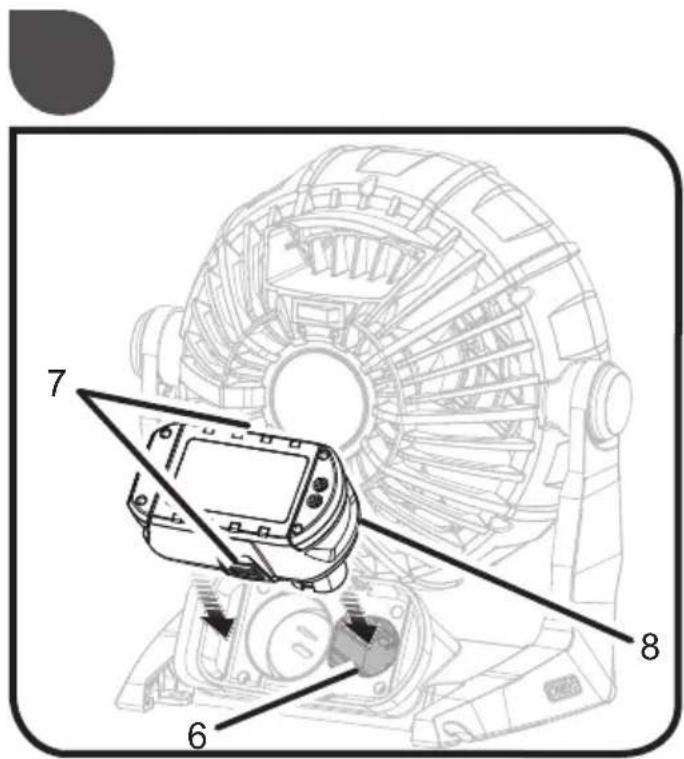
- Latches
- Battery pack
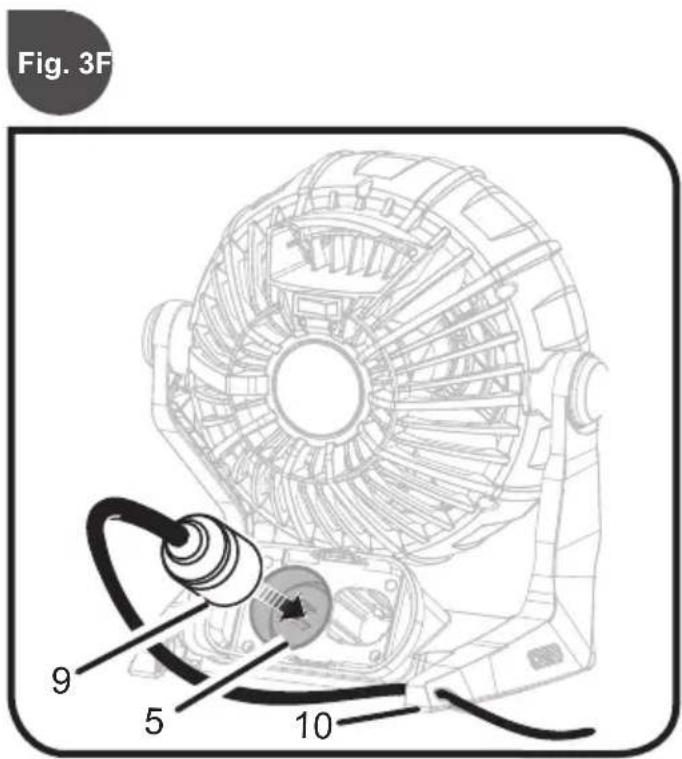
- Power cord
- Cord retainer
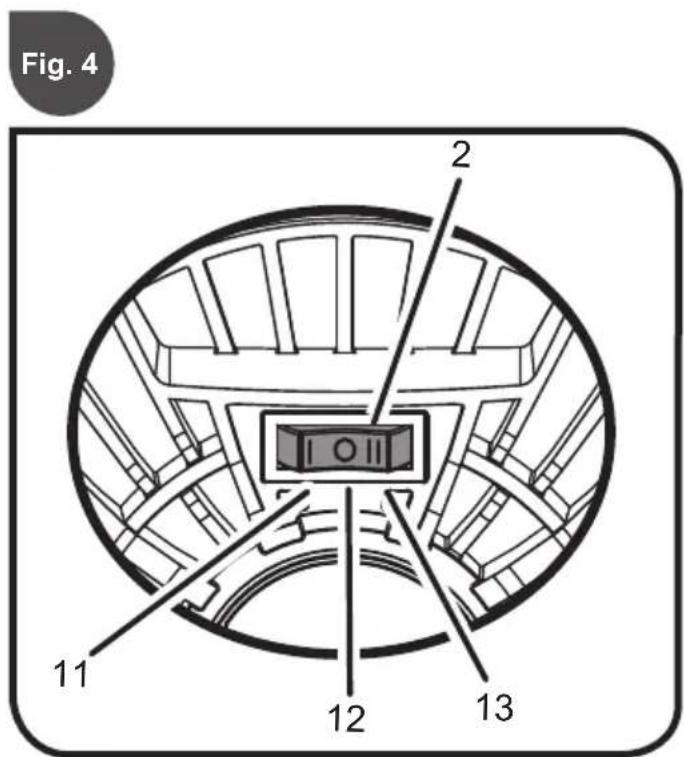
- Low (I)
- Off (O)
- High (II)
- Screw
- Mounting holes
- Adjust head
FEATURES
KNOW YOUR PORTABLE FAN
See figure 1.
The safe use of this product requires an understanding of the information on the tool and in this operator's manual as well as knowledge of the project you are attempting. Before use of this product, familiarise yourself with all operating features and safety rules.
ADJUSTABLE HEAD
The head of the portable fan can be set in a variety of positions.
J HOOK
The portable fan can be hung in a variety of places with use of the J hook.
TWO SPEEDS
The portable fan has a setting for a high and a low speed.
ASSEMBLY
UNPACKING
The product has been shipped completely assembled.
- Carefully remove the tool and any accessories from the box. Make sure that all items listed in the packing list are included.
Packing list
- Portable fan
- Operator's manual
WARNING
Do not use this product if it is not completely assembled or if any parts appear to be missing or damaged. Use of a product that is not properly and completely assembled could result in serious personal injury.
■ Inspect the tool carefully to make sure no breakage or damage occurred during shipping.
■ Do not discard the packing material until you have carefully inspected and satisfactorily operated the tool.
WARNING
If any parts are damaged or missing do not operate this product until the parts are replaced. Use of this product with damaged or missing parts could result in serious personal injury.
WARNING
Do not attempt to modify this tool or create accessories not recommended for use with this tool. Any such alteration or modification is misuse and could result in a hazardous condition leading to possible serious personal injury.
WARNING
To prevent accidental starting that could cause serious personal injury, always remove the battery pack from the product when assembling parts.
OPERATION
WARNING
Do not allow familiarity with tools to make you careless. Remember that a careless fraction of a second is sufficient to inflict serious injury.
WARNING
Do not use any attachments or accessories not recommended by the manufacturer of this tool. The use of attachments or accessories not recommended can result in serious personal injury.
NOTICE:
This product is designed to be powered by either a Ryobi One+ 18V battery pack (DC mode) or by electric power (AC mode). Either power source can be used by installing an approved battery pack or power cord into the product as described in this manual.
INSTALLING/REMOVING BATTERY PACK
See Figure 2.
■ Make sure the switch is in OFF (O) position.
- Place the battery pack in the tool. Align the raised rib on the battery pack with the groove in the portable fan's battery port.
■ Make sure the latches on the battery pack snap in place and the battery pack is secured in the portable fan before operation begins.
■ Depress the latches to remove the battery pack.

WARNING
Always remove battery pack or unplug extension cord from your product when you are assembling parts, making adjustments, cleaning, or when not in use. Removing battery pack or unplugging extension cord will prevent accidental starting that could cause serious personal injury.
NOTE: The battery pack should be recharged after approximately 5 hours of use to reduce the possibility of damage. Repeated deep discharge of the battery may decrease storage capacity and battery life.
INSTALLING/REMOVING POWER CORD
See Figure 3.
■ Make sure the switch is in OFF (O) position.
■ Route the power cord through the cord retainer.
■ Insert the female end of the power cord into the product.
■ Connect the male end of the power cord to the power source.
■ Make sure the power cord is secured before beginning operation.
STARTING/STOPPING THE PORTABLE FAN
See Figure 4.
■ Connect the portable fan to an AC or DC power supply.
■ To start the portable fan, move the power switch to the left or right.
■ To stop the portable fan, place the switch in the center, or OFF (O) position.

WARNING
Hybrid tools are always in operating condition. Therefore, switch should always be in the center, or OFF (O) position, when not in use.
CHANGING PORTABLE FAN SPEED
See Figure 4.
■ For low speed, depress the power switch to the LOW
(I) position.
■ For high speed, depress the power switch to the HIGH (II) position.
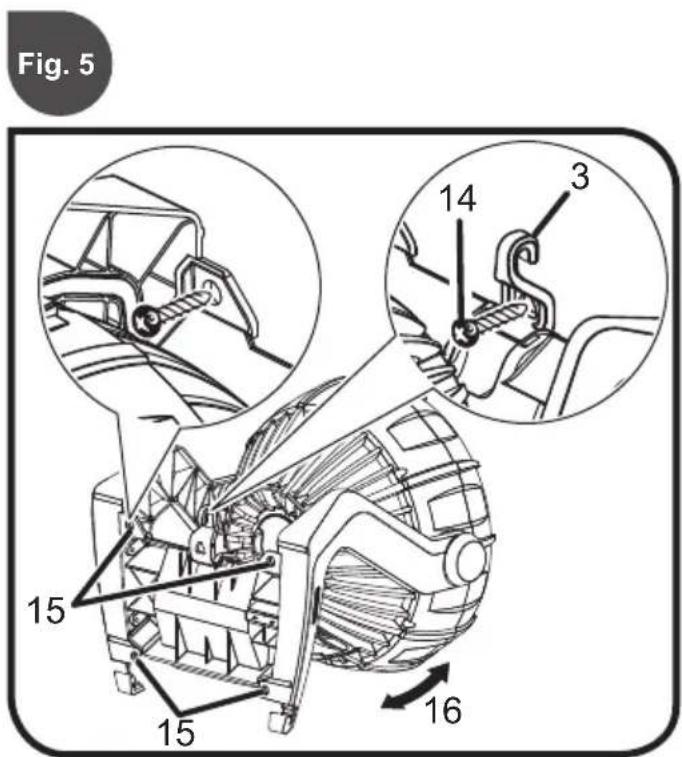
TO HANG THE PORTABLE FAN
See Figure 5.
Using the J Hook to hang the fan:
■ Lift the J hook from the slot.
■ Use the J hook to hang the portable fan. You may use a screw to secure the fan in place. Do not overtighten.
NOTE: Be careful not to hang the fan in such a way that it prevents normal fan operation or damages the cord.
Using the mounting holes to hang the fan:
■ Hang portable fan from sturdy location using screws in mounting holes to secure in place. Do not overtighten. NOTE: Be careful not to hang the fan in such a way that it prevents normal fan operation or damages the cord.
ADJUSTABLE HEAD
See Figure 5.
The portable fan head can be set in a variety of positions. To switch base positions, adjust base to desired position.
MAINTENANCE

WARNING
When servicing, use only identical replacement parts. Use of any other part may create a hazard or cause product damage.

WARNING
Always remove the battery pack from the tool when cleaning or performing any maintenance.

WARNING
Avoid using solvents when cleaning plastic parts. Most plastics are susceptible to damage from various types of commercial solvents and may be damaged by their use. Use clean cloths to remove dirt, dust, oil, grease, etc.

WARNING
Do not at any time let brake fluids, gasoline, petroleum-based products, penetrating oils, etc. come in contact with plastic parts. They contain chemicals that can damage, weaken or destroy plastic.
ENVIRONMENTAL PROTECTION
Recycle raw materials instead of disposing of as waste. The machine, accessories and packaging should be sorted for environmental-friendly recycling.
SYMBOLS

Safety alert

Regulatory Compliance Mark (RCM). Product meets applicable regulatory requirements.
n_o
T

No-load speed
The product can be used in a tropical climate.

Read operator's manual
Class II, double insulated
Waste electrical products should not be disposed of with household waste. Please recycle where facilities exist. Check with your local authority or retailer for recycling advice.
PRODUCT SPECIFICATIONS
| Voltage 18 V / 220 - 240 V 50Hz | --- | ~ |
| Wattage 15 watts | ||
| Switch Two speed | ||
| No-load speed 1400 / 2100 min | -1 | |
| Weight - excluding battery pack 1.3 kg |
BATTERY AND CHARGER
| Model Compatible battery pack (not included) | Compatible charger (not included) | |
| Lithium-Ion RB18L13 | BCS618G | |
| RB18L15 | BCL14181H | |
| RB18L26 | BCL14183H | |
| RB18L40 | BCL1418IV* | |
| Nickel Cadmium | RB18N15 ACR1800G | |
| BCS618G | ||
| BCL14181H | ||
| BCL14183H | ||
| BCL1418IV* | ||
* for vehicles with 12V DC outlets

Techtronic Industries (Australia) Pty. Ltd.
Level 1, 660 Doncaster Road
Doncaster, VIC 3108, Australia
Techtronic Industries New Zealand Ltd.
18-26 Amelia Earhart Avenue
Mangere, Auckland 2022, New Zealand
- Important!
- GENERAL POWER TOOL SAFETY WARNINGS
- WARNING
- Save all warnings and instructions for future reference.
- 1) WORK AREA SAFETY
- 2) ELECTRICAL SAFETY
- 3) PERSONAL SAFETY
- 4) POWER TOOL USE AND CARE
- 5) BATTERY TOOL USE AND CARE
- 6) SERVICE
- SPECIFIC SAFETY RULES
- INTENDED USE
- DESCRIPTION
- FEATURES
- KNOW YOUR PORTABLE FAN
- ADJUSTABLE HEAD
- J HOOK
- TWO SPEEDS
- ASSEMBLY
- UNPACKING
- Packing list
- OPERATION
- NOTICE:
- INSTALLING/REMOVING BATTERY PACK
- See Figure 2.
- INSTALLING/REMOVING POWER CORD
- See Figure 3.
- STARTING/STOPPING THE PORTABLE FAN
- See Figure 4.
- CHANGING PORTABLE FAN SPEED
- TO HANG THE PORTABLE FAN
- See Figure 5.
- Using the J Hook to hang the fan:
- Using the mounting holes to hang the fan:
- MAINTENANCE
- ENVIRONMENTAL PROTECTION
- SYMBOLS
Brand : RYOBI
Model : One+ R18HF
Category : Household Fan