31793 - Food Dehydrator Lakeland - Free user manual and instructions
Find the device manual for free 31793 Lakeland in PDF.


| Product Type | Food Dehydrator |
| Brand | Lakeland |
| Model | 31793 |
| Dimensions (approx.) | 30 x 30 x 25 cm (12 x 12 x 10 in) |
| Weight (approx.) | 3.5 kg (7.7 lbs) |
| Power Supply | 120V ~ 60Hz (US) / 220-240V ~ 50Hz (EU) |
| Power Consumption | 500 W |
| Temperature Range | 35°C to 70°C (95°F to 158°F) |
| Timer | Up to 24 hours with auto shut-off |
| Number of Trays | 5 stackable trays |
| Tray Material | BPA-free plastic mesh |
| Control Type | Digital touch panel |
| Functions | Drying fruits, vegetables, herbs, meats; includes fruit roll sheet |
| Safety Features | Overheat protection, auto shut-off, cool-touch handle |
| Cleaning and Maintenance | Trays dishwasher safe; wipe exterior with damp cloth |
| Spare Parts Availability | Replacement trays, mesh sheets, and fruit roll sheets available from Lakeland |
| Repairability | Modular design; user-replaceable fuse and power cord |
| Energy Efficiency | Energy Star certified |
Frequently Asked Questions - 31793 Lakeland
User questions about 31793 Lakeland
0 question about this device. Answer the ones you know or ask your own.
Ask a new question about this device
Download the instructions for your Food Dehydrator in PDF format for free! Find your manual 31793 - Lakeland and take your electronic device back in hand. On this page are published all the documents necessary for the use of your device. 31793 by Lakeland.
USER MANUAL 31793 Lakeland
natural_image
White portable food heater with clear glass lid and digital temperature control panel (no visible text or symbols)Model: 31793
LAKELAND FOOD DEHYDRATOR
Thank you for choosing the Lakeland Food Dehydrator.
Please take a little time to read this booklet before getting started and keep it in a safe place for future reference.
You can create your own healthy dried fruit, vegetable and meat snacks with the Lakeland Food Dehydrator. Make delicious beef jerky, candied peel and 'sun-dried' tomatoes, which are 100% natural with no artificial sweeteners, additives or preservatives.
Create tasty ingredients for cooking like dried mushrooms, tomatoes and herbs to enhance soups, stews, casseroles and sauces; and dried fruits can be added to home baking.
Dehydrating is great for preserving and storing seasonal fruit and vegetables all year round to use in your homemade marmalades, jams and salsas. It preserves and concentrates natural flavours and aromas, retains nutrients, and gives food a longer shelf life than fresh produce.
Here at Lakeland, our award-winning family-owned business still offers the same excellent quality, value for money and exceptional customer service as when we founded the company back in the 1960s.
Our products are hand-picked and thoroughly tested so you can be sure that everything you purchase will be a pleasure to use for many years to come.
CONTENTS
Product features....3
Safety cautions....4-5
Using your Food Dehydrator for the first time 6
Instructions for use 7
A guide to ingredients....8
Hints and tips....9-11
A guide to temperatures and timings 12-14
Frequently asked questions....15
Care and cleaning 16
Electrical connections.... 17
Recycling your electricals....17
PRODUCT FEATURES
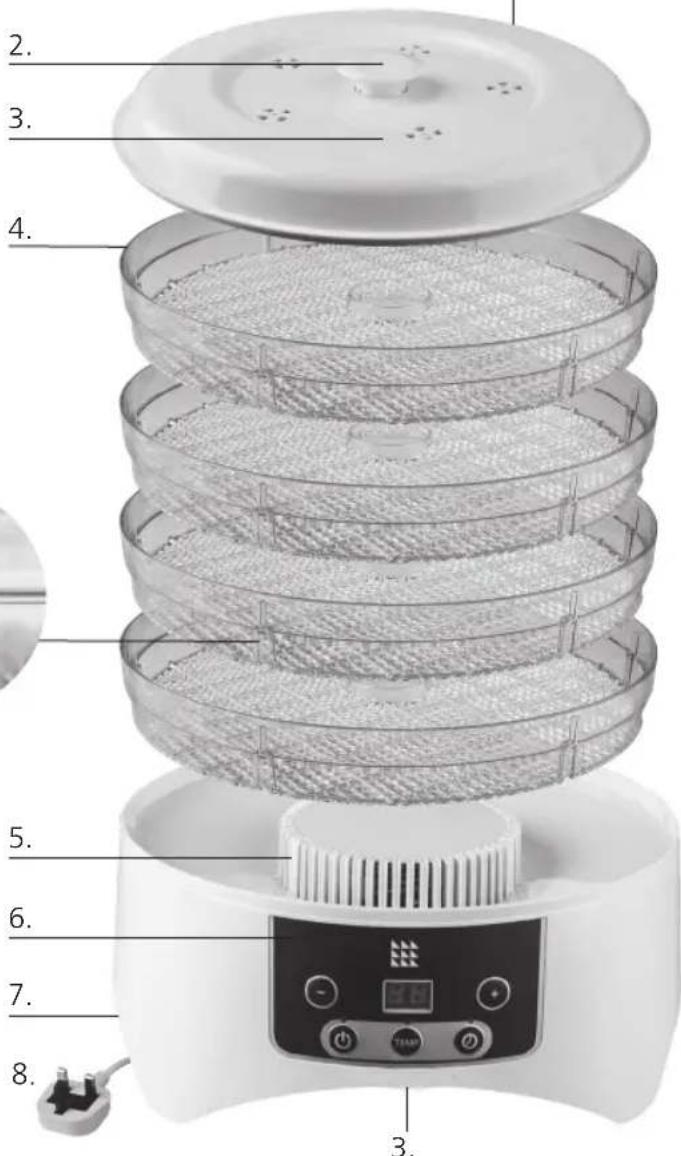
- Lid
- Lid handle
- Air vents
- Trays
- Motor
- Control panel
- Base unit
- Cord and plug
CONTROL PANEL
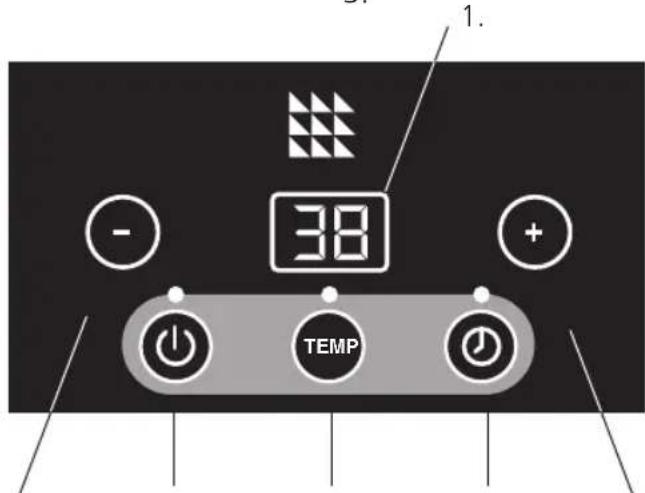
- Display
- Increase button
- Time button and light
- Temperature button and light
- Power button and light
- Decrease button
-
-
-
- 6.
-
-
SAFETY CAUTIONS
Carefully read all the instructions before using the appliance and keep in a safe place for future reference. Always follow these safety cautions when using the appliance to avoid personal injury or damage to the appliance. This appliance should be used only as described in this instruction book.
This appliance can be used by children aged from 8 years and above and persons with reduced physical, sensory or mental capabilities or lack of experience and knowledge if they have been given supervision or instruction concerning use of the appliance in a safe way and understand the hazards involved. Children shall not play with the appliance. Cleaning and user maintenance shall not be done by children unless they are older than 8 and supervised.
Make sure your electricity supply matches the voltage shown on the appliance.
Ensure all packaging materials and any promotional labels or stickers are removed from the appliance before the first use.
Always inspect the appliance before use for noticeable signs of damage. Do not use if damaged or has been dropped. In the event of damage, or if the appliance develops a fault contact the Lakeland customer care team on 015394 88100.
Do not use this appliance if the lead is damaged. If the lead is damaged it must be replaced with a special lead. Contact the Lakeland customer care team on 01539488100.
Always use the appliance on a dry, level, heat resistant surface.
Unplug from the mains when not in use and before cleaning. To disconnect, turn the socket to "off" and remove the plug from the mains socket.
Do not use any accessories or attachments with this appliance other than those recommended by Lakeland.
To protect against fire, electric shock or personal injury, do not immerse cord, plug or lid in water or other liquids.
Do not leave the lead hanging over the edge of a kitchen table or worktop. Avoid contact between the lead and hot surfaces.
For indoor use only.
For domestic use only.
This appliance should be used for preparation of food as described within the instructions for use that accompany it.
Always ensure that your hands are dry before removing the plug from the mains socket. Never pull the plug out of the mains socket by its lead.
To avoid injury or possible fire, do not cover the appliance when in use.
Do not connect this appliance to an external timer or remote control system.
An extension cable may be used with care. The electrical rating of the cable should be at least as great as the appliance. Do not allow the cable to hang over the edge of the worktop or touch any hot surfaces.
This appliance complies with the basic requirements of Directives 2014/30/EU (Electromagnetic Compatibility) and 2014/35/EU (Low Voltage Directive).
WARNING: A cut off plug inserted into a 13 amp socket is a serious safety (shock) hazard. Ensure the cut off plug is disposed of safely.

JPTION: The plastic bags used to wrap this appliance or the packaging may be dangerous. To avoid risk of suffocation, keep these bags out of reach of babies and children. These bags are not toys.
Keep the dehydrator, plug and lead away from hot ovens, flames and other hot surfaces.
Do not cover this appliance when in use. The Dehydrator should only be used in a well ventilated area, at least 30cm away from walls and other surfaces to allow sufficient airflow.
Do not use the dehydrator for more than 40 hours. If you have been using the Food Dehydrator for more than 40 hours, switch off and unplug at the socket. and allow the appliance to cool down.
USING YOUR FOOD DEHYDRATOR FOR THE FIRST TIME
Unpack the Food Dehydrator, remove all the packaging materials.
Before first use, wipe the base with a clean damp cloth.
Wash the trays and lid in warm soapy water, rinse and dry thoroughly.
Make sure that all parts are clean and dry before assembling the product.
Warning: Do not insert the plug into an electrical outlet, or turn on the appliance before you have fully assembled it.
Place the base unit on a flat heatproof surface near a socket. It should only be used in a well ventilated area, at least 30cm away from walls and other surfaces to allow sufficient airflow.
natural_image
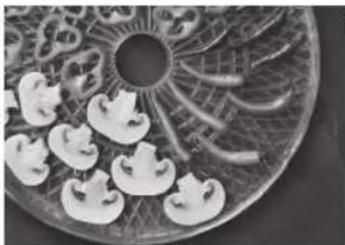
Close-up of sliced mushrooms arranged in a circular pattern on a metal tray (no text or symbols visible)Prepare your food (see A Guide To Temperatures And Timings on page 11-13), then arrange the food evenly on the trays in a single layer. Leave the central hole uncovered. There should be space around the food to allow air to circulate, do not overload the trays or overlap the food.
Stacked down
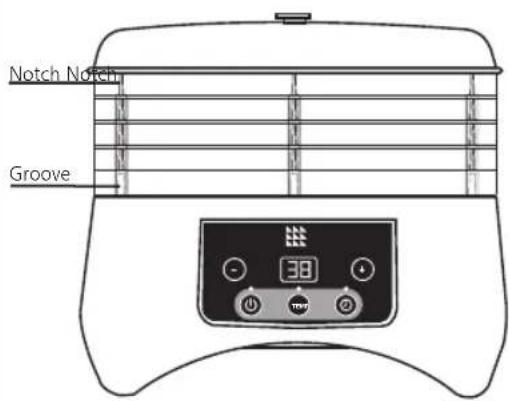
The Food Dehydrator is packed in the box with the trays stacked down to 20mm high, you can use them like this when dehydrating thinner slices of food.
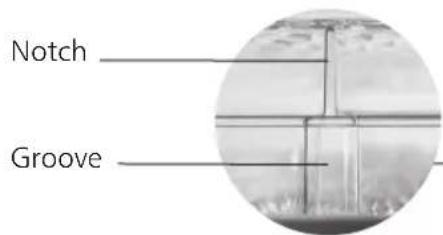
As you stack the trays back onto the base unit, slot the grooves around the edge of the tray into the notches on the tray below.
Stacked up
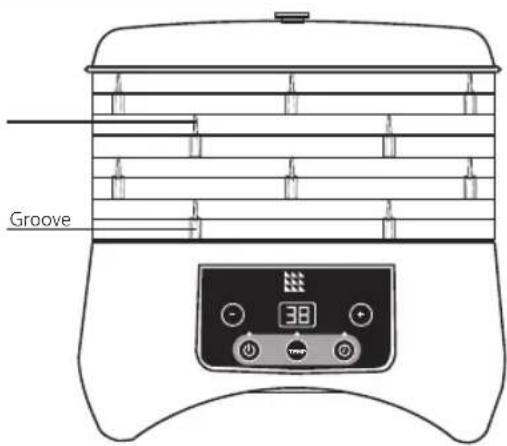
The trays can be stacked up to 36mm high, for drying thicker pieces of food.
As you stack the trays back onto the base unit, twist the tray around so they sit on top of each other and the grooves do not slot into the notches on the tray below.
The trays can be stacked in any combination. Always add your food to the top trays and stack empty trays at the bottom.
Place the lid on the top tray.
PLEASE NOTE: All the trays and the lid must be used with the Food Dehydrator for it to work correctly, even if the trays are empty.
The Food Dehydrator is now ready to use.
INSTRUCTIONS FOR USE
Plug in and switch on the Food Dehydrator at the socket.
The appliance will beep, the button lights and display will flash briefly and go out.
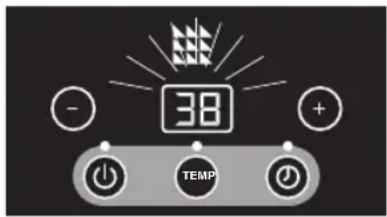
- Press the POWER button ⏻. The fan will start and the display will show '38°C'. Press the TEMPERATURE button Temp, the display will flash '38°C'. Adjust the temperature from 38°C to 68°C, using the + and - buttons, it will go up in 10°C increments. When your temperature is displayed, press the TEMPERATURE button Temp again to set, the temperature will stop flashing.
If no buttons are pressed for 5 seconds, the display will go back to the last temperature setting.
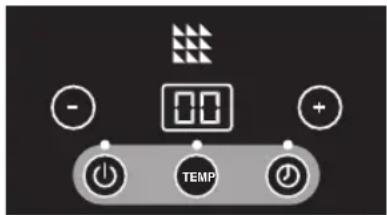
- Press the TIME button Ⓞ. The display will show '00'. Adjust the time needed to dry your ingredients from 1 – 12 hours by using the + and – buttons, it will go up in 1 hour increments. Press the TIME button again to set.
The fan will circulate, heated air through the trays and draw moisture from your food without cooking.
The display will show your set time and temperature and alternate between the two, counting down the hours.
If you notice some pieces of food drying faster than others, remove and place in an airtight container while you continue drying.
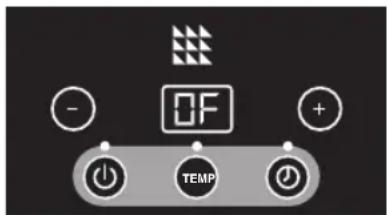
- When the drying cycle has finished and your food is dehydrated, the display will show '00'. To turn off the dehydrator, press the POWER button, the display will show 'OF' and the fan will continue for approximately 1 minute. Then switch off and unplug at the socket.
Do not turn off your dehydrator mid cycle, or leave partially dried food on the trays as it may spoil or develop bacteria.
-
Allow the Food Dehydrator to cool completely before removing the trays and food. WARNING: Take care when handling the trays and food as they may still be hot.
-
Once your food has cooled completely, store it in airtight containers, labelling and dating the contents. Store in a cool, dark, dry place and check regularly. Do not eat if the food shows any signs of spoiling.
A GUIDE TO INGREDIENTS
FRUIT
Dried fruit can be added to breakfast cereal, muesli, natural yoghurt and home baking such as flapjack and crumbles.
You can soak the food to rehydrate, to make compotes, fruit sauces, pies or crumbles.
Eat dehydrated fruit plain as a snack, like apple rings and banana chips.
Place a cup of dried apple slices in the blender with a cup of water for instant apple sauce.
Strawberries are perfect for shakes and sundaes.
Melon and watermelon slices can become candy-like when dried.
Dehydrate lemon and orange zest, and powder for use in recipes for grated rind.
Dehydrate grapes to make raisins that taste and plump in recipes better than store-bought raisins.
Dry bananas 5mm thick and dip into a glaze of 100ml honey mixed with 50ml water.
Drain then place on trays and dry. For variety, add a pinch of cinnamon to the glaze before dipping the bananas.
VEGETABLES
Dried vegetables such as mushrooms and tomatoes make tasty ingredients in stews, soups, casseroles and sauces. You can soak them in water first to rehydrate them.
You can also make vegetable crisps from wafer-thin slices of parsnip, courgette, sweet potato and aubergine. Dry until brittle, allow to cool then sprinkle with seasoning.
Prepared vegetables can be dipped in lemon juice for 2 minutes to add a hint of lemon flavour. This works well for green beans and asparagus.
Mix dried grated carrot, parsnips, onion, celery, chives and sweet peppers with turmeric powder and sea salt to make a delicious vegan stock. This makes a delicious base for soups.
Dry carrots and parsnips for salads, carrot cake or coleslaw.
Green beans and peas are best when used in soups, stews or casseroles.
Make onion powder by drying then either powder or chop in a blender.
Tomato slices can be used for colour and crunch when crumbled over a salad.
Alternatively, rehydrate them for soups, stews and casseroles. Tomato skins can be powdered and used as instant soup, sauces and pastes.
HINTS AND TIPS
Drying time is influenced by room temperature, humidity, food type, food size and quantity. Check your food every hour until it passes the dryness test in 'A Guide to Temperature and Timings'.
For the best flavour and colour, begin with fresh, ripe fruit, vegetables and herbs.
Use kitchen roll to absorb excess moisture from food before adding it to the Food Dehydrator.
The size of the food will affect the drying time. Ensure food is cut into pieces of a similar size and thickness. Use a food processor for fast, even slicing.
Dry the same type of foods at the same time – do not mix fruit and vegetables, or vegetables and meat etc. Stronger flavours can taint other food.
During the drying process, you can rotate the position of the trays if you find food is drying unevenly, just keep any empty trays at the bottom.
Fruit and vegetables with the skin left on will take longer to dry, as the skin prevents moisture drying out.
Fruit and vegetables should be dried at 48-58°C to minimise the loss of heat-sensitive vitamins A and C. The temperature can be set at 58-68°C for the first couple of hours of drying as the temperature of the food will remain lower at the start of the cycle. Then reduce the temperature.
FRUIT
Wash fruit thoroughly before drying.
Remove any bruised or damaged parts, de-seed and peel if needed.
Slice across the core or chop into equal sizes and place onto the trays.
To help preserve natural sweetness, vitamins, shelf-life, flavour and colour you can pretreat fruit before drying. Soak your fruit for around 2-5 minutes in 480ml of water and 60ml of fruit juice e.g. pineapple, orange, lemon or lime. Where possible, use the same fruit juice as the fruit you are soaking e.g. apple juice for apples. Before adding to the Food Dehydrator, drain the fruit juice and use kitchen roll to absorb any excess moisture.
Apples, pears, peaches and apricots are better when pre-treated.
Fruit can be coated in lemon juice to help keep colour of the fruit, for example, bananas.
To check fruit for dryness, tear in half, pinch and watch for moisture drops along the tear. If there is no moisture, it is ready to store.
Some fruits have a natural protective coating, such as figs, prunes, grapes, blueberries and cranberries. To dry whole, dip in boiling water first for 1-2 minutes to speed up the drying process.
If fruit has been artificially waxed it must be peeled first.
VEGETABLES
Wash vegetables thoroughly before drying.
Remove any bruised or damaged parts, de-seed and peel if needed.
Vegetables have a low acid and sugar content which means they have a shorter shelf-life than dried fruit.
Choose fresh, crisp, ripe vegetables and dehydrate them straightaway.
Chop into equal sizes and place onto the trays.
You can pre-treat vegetables before drying for better results, this will also help them keep their natural colour while speeding up drying time. Blanch your sliced vegetables in a covered pan with 2-3cm of boiling water for 3-5 minutes. Steam until vegetables are heated through and crunchy but not cooked (about a third of the normal cooking time). Drain and dip in cold water for 3-5 minutes. Before adding to the Food Dehydrator, drain and use kitchen roll to absorb any excess moisture. We recommend this for vegetables which are not normally eaten raw, for example asparagus and potatoes.
MEAT
For making beef jerky, we recommend using lean topside or silverside cuts.
Trim all visible fat from the meat and place in freezer for an hour or two to partially freeze. Fat will shorten the shelf life.
While the meat is in the freezer, prepare the marinade recipe of your choice in a bowl or ziplock bag, mix well.
Remove the meat from the freezer and slice 5-8mm strips against the grain for an easy chew. Cut with the grain for more chew.
Add the meat to your chosen marinade recipe and leave for 8-24 hours in the refrigerator.
When finished, remove from fridge and strain off any excess, pat dry the beef strips with paper towels before adding to the trays.
When dehydrated, wrap in kitchen towel to absorb excess fat and extend the shelf life.
Meat should always be dehydrated at 68^ C to prevent bacterial growth and must always be cured, marinated or pre-cooked first.
Once dehydrated, wrap the jerky in kitchen towel to absorb excess fat to extend its shelf-life.
Store in ziplock bags, vacuum sealed bags or jars for 7-10 days.
HERBS
Make your own dried herbs by gently rinsing very fresh herbs and shaking off any excess water. They should be picked before the plant begins to flower.
Remove dead or discoloured leaves and leave leaves on the stem to dry.
Lay the herbs loosely on the tray and dry for 2-10 hours. The drying time will vary according to size and type.
Herbs should be dried at 38°C to protect sensitive aromatic oils.
Once dried, let them cool completely, remove the leaves from the stem and store in an airtight container, paper bag or glass jar and keep out of sunlight.
To dry large leafed herbs, such as basil and sage, strip leaves, cut in half across the leaf to allow air inside the stem and shorten drying time.
Herbs are dry when they snap and crumble easily. Stems should be brittle and break when bent.
To check herbs are dry, place in an airtight container, if condensation appears after a couple of days, they need more drying.
STORING
It is better for food to be over-dry than under-dry as moist food is more likely to spoil during storage.
Store foods in an airtight, moisture proof container to prevent stickiness and rehydration caused by humidity.
Vacuum packing food will extend the shelf-life. Then store in an airtight container which stops light penetrating.
Do not store fruit and vegetables in the same container as flavour and moisture may transfer.
Do not crush or grind herbs until they are ready to use, as this exposes more surface to the air allowing loss of flavour. If stored well, they should last up to 12-18 months. Dried herbs are stronger than fresh, so use conservatively and label clearly so they are easy to recognise.
A GUIDE TO TEMPERATURES AND TIMINGS
These timings are only a guide. While dehydrating, check your food every few hours to check the dryness. Adjust the time according to your own personal preferences.
Drying times vary greatly according to the kind of food, the thickness and size of the pieces and even the temperature of your kitchen. You will find it helpful to keep your own record of how long different types of food take to dry.
Do not use the Dehydrator continuously for more than 40 hours. If you have, switch off and unplug at the socket and allow to cool completely.
FRUIT
| FRUIT PREPARATION | TEMP | °C | APPROX. DRYING TIME (HOURS) | DRYNESS TEST |
| Apples Peel, core and slice into rings 48-58 5-7 Pliable | ||||
| Apricots Chop, remove seeds then slice 48-58 12-38 Pliable | ||||
| Bananas Peel and cut into 5mm thick slices 48-58 8-38 Crispy | ||||
| Blueberries Wash and remove stems 48-58 | 10-18 Pliable | |||
| Cherries Leave whole (stones can be removed halfway through drying) | 48-58 8-26 Leathery | |||
| Lemons, limes Peel if desired. Slice 5mm thick | 48-58 6-12 Pliable | |||
| Cranberries Wash and remove stems, chop or leave whole | 48-58 10-18 Pliable | |||
| Dates De-stone and slice | 48-58 2-26 Leathery | |||
| Figs Slice | 48-58 6-26 Leathery | |||
| Grapes Leave whole | 48-58 8-38 Pliable | |||
| Kiwis Cut into 1cm slices | 48-58 8-26 Dry | |||
| Mangos Skinned, slice 5mm thick from seed 48-58 8-20 Pliable | ||||
| Melons Remove skin and seeds, slice 10mm thick | 48-58 | 8-20 | Pliable | |
| Peaches Peel, slice and remove the stone 48-58 | 10-34 Pliable | |||
| Pears Peel, core and cut into slices | 48-58 8-30 Pliable | |||
| Pineapples Peel & remove core. Slice or chop into chunks | 48-58 6-36 Leathery | |||
| Plums Halve or quarter and remove pit | 48-58 8-16 Pliable | |||
| Rhubarb Slice in 25mm lengths. Steam until slightly tender | 48-58 6-14 Pliable | |||
| Strawberries Cut into 10mm slices | 48-58 8-26 No moisture |
VEGETABLES
| VEGETABLE PREPARATION TEMP | °C | APPROX. DRYING TIME (HOURS) | DRYNESS TEST | |
| Artichoke | Cut into thin strips 5mm and blanch for 5-8 minutes in water with a little lemon juice | 58 5-13 | Brittle | |
| Asparagus Blanch | and cut into 2cm slices 58 6-14 Brittle | |||
| Aubergine Cut into | 1cm slices and blanch 58 6-18 Brittle | |||
| Beans Remove ends, slice and blanch 58 8-26 Brittle | ||||
| Beetroot Steam until tender, cool, peel and slice 58 8-26 Brittle | ||||
| Broccoli Trim and cut into florets and steam until tender | 58 6-20 | Brittle | ||
| Brussel Sprouts Trim, chop in half and blanch until tender | 58 8-30 | Brittle | ||
| Cabbage | Trim and cut leaves into 5mm strips 48 6-14 Leathery | |||
| Carrots | Peel, cut into 1cm slices. Blanch | 58 | 6-18 | Leathery |
| Cauliflower | Trim and cut into florets. Put in 1 litre of lightly salted water and boil until tender | 58 6-18 | Leathery | |
| Celery | Trim, chop into 5mm pieces | 48 | 6-14 | Brittle |
| Chilli | Wash, slice in half or keep whole | 58 8-14 | Brittle | |
| Courgette | Wash, remove ends and slice 5mm thick or grate. Steam if you plan to rehydrate | 58 5-10 | Pliable | |
| Cucumber | Slice into 1cm pieces | 58 | 6-18 | Leathery |
| Garlic | Peel clove and slice thinly | 58 6-16 | Brittle | |
| Mushrooms Clean with a soft brush, slice, quarter or leave whole | 58 2-3 | Leathery | ||
| Onions | Chop or slice thinly | 58 8-14 | Brittle | |
| Peas | Shell, wash and blanch | 58 5-14 | Brittle | |
| Peppers Remove stem and seeds then cut into 5mm strips or rings | 58 4-14 | Brittle | ||
| Potatoes | Slice or dice then steam or blanch for 8-10 minutes | 58 6-30 | Brittle | |
| Pumpkin | Core and cut into 5mm slices | 58 6-18 | Brittle | |
| Spinach Blanch then dry on kitchen towel 48 6-16 Brittle | ||||
| Squash | Wash, remove ends and slice 5mm thick or grate | 58 5-10 | Pliable | |
| Tomato Boil, peel skin and segment 58 8-24 Leathery | ||||
MEAT
| MEAT PREPARATION TEMP | °C | APPROX. DRYING TIME (HOURS) | DRYNESS TEST | |
| Beef Jerky Marinace | overnight and pat dry before drying | 68 5 Bends and | cracks but does not break in half | |
HERBS
| HERBS PREPARATION | TEMP | °C | APPROX. DRYING TIME (HOURS) | DRYNESS TEST |
| Fresh herbs Lay leaves or sprigs on trays 38 2-10 Brittle | ||||
| Basil leaves break veins and stems to aid drying | Clip leaves 8-10cm from top of plant as first buds appear, pat dry | 38 20-24 | Brittle | |
| Chilli peppers Rinse, dice and pat dry 38 5-12 Brittle | ||||
| Chives Chop, rinse in cold water, pat dry 38 20-24 Brittle | ||||
| Corriander | Clip with stems, rinse in cold water, pat dry | 38 15-18 | Brittle | |
| Fennel | Rinse in cold water, pat dry | 38 | 1-3 | Brittle |
| Ginger root | Rinse, slice 5mm thick or grate, pat dry | 38 | 2-5 | Brittle |
| Mint leaves | Rinse in cold water, pat dry | 38 | 20-24 | Brittle |
| Oregano leaves | Rinse in cold water, pat dry | 38 | 15-18 | Brittle |
| Parsley leaves | Rinse in cold water, pat dry | 38 | 20-24 | Brittle |
| Rosemary leaves | Rinse in cold water, pat dry | 38 | 20-24 | Brittle |
| Sage leaves Rinse in cold water, pat dry 38 20-24 Brittle | ||||
| Thyme leaves Rinse in cold water, pat dry 38 1-3 | Brittle | |||
FREQUENTLY ASKED QUESTIONS
Question: Why will the Food Dehydrator not switch on when I press the power button?
Answer: Check that is plugged in and switched on at the socket.
Question: Why are my ingredients not drying?
Answer: Allow plenty of space round the ingredients so the pieces are not touching. For food to dehydrate there needs to be plenty of space around it for hot air to circulate.
Place ingredients which take longer to dry at the top of the food dehydrator and any empty trays at the bottom of the stack, hot air rises so it will be warmest closest to the lid.
CARE AND CLEANING
Unplug the Food Dehydrator and let it cool down completely before cleaning.
Clean thoroughly before using for the first time and after every use.
Check the parts for wear or damage after every few uses.
Do not use abrasive cleaners, or steel wool.
Never immerse the base in water or any other liquid.
To clean the outer surfaces, wipe with a clean damp cloth and dry thoroughly before storing.
To clean the trays and lid, wash in warm soapy water and dry thoroughly. Do not put any parts in the dishwasher.
Wipe any crumbs from the base unit with a clean damp cloth.
Store the Food Dehydrator with the power cable loosely coiled. Never wrap it tightly around the product.
For compact storage, stack the food trays down at their lowest height and store on top of the base unit.
ELECTRICAL CONNECTIONS
THIS APPLIANCE MUST BE EARTHED
The appliance is fitted with a fused three-pin plug to BS1363 which is suitable for use in all homes fitted with sockets to current specifications.
CHANGING THE 3 AMP FUSE
Use a 3 amp BS1362 fuse. Only BSI or ASTA approved fuses should be used. If you are unsure which plug or fuse to use, always refer to a qualified electrician.
Note: After replacing or changing a fuse on a moulded plug which has a fuse cover, the cover must be refitted to the plug; the appliance must not be used without a fuse cover. If lost, replacement fuse covers can be obtained from an electrical shop. This appliance complies with the following EU Directives: 2014/35/EU (Low Voltage Directive) and 2014/30/EU (EMC Directive).
RECYCLING YOUR ELECTRICALS
Along with many other high street retailers, Lakeland has joined a scheme whereby customers can take their unwanted electricals to recycling points set up around the country.
Visit www.recycle-more.co.uk to find your nearest recycling point.








Lakeland
Alexandra Buildings, Windermere, Cumbria, UK LA23 1BQ
Tel: +44(0)15394 88100 www.lakeland.co.uk
- LAKELAND FOOD DEHYDRATOR
- CONTENTS
- PRODUCT FEATURES
- CONTROL PANEL
- SAFETY CAUTIONS
- USING YOUR FOOD DEHYDRATOR FOR THE FIRST TIME
- INSTRUCTIONS FOR USE
- A GUIDE TO INGREDIENTS
- FRUIT
- VEGETABLES
- HINTS AND TIPS
- MEAT
- HERBS
- STORING
- A GUIDE TO TEMPERATURES AND TIMINGS
- FREQUENTLY ASKED QUESTIONS
- CARE AND CLEANING
- ELECTRICAL CONNECTIONS
- THIS APPLIANCE MUST BE EARTHED
- CHANGING THE 3 AMP FUSE
- RECYCLING YOUR ELECTRICALS
- Lakeland
Brand : Lakeland
Model : 31793
Category : Food Dehydrator