
942A - Compressor DBX - Free user manual and instructions
Find the device manual for free 942A DBX in PDF.


| Type | Compressor / Noise Reduction Module (Type II) |
| Brand | DBX |
| Model | 942A |
| Number of Channels | 2 |
| Noise Reduction | 40 dB or more (depending on medium) |
| Frequency Response | ±0.5 dB 40 Hz – 20 kHz |
| Dynamic Range | >115 dB |
| Equivalent Input Noise | -93 dBv |
| Total Harmonic Distortion (THD) | 0.1% (100 Hz – 20 kHz), <0.5% (30 – 100 Hz) |
| Intermodulation Distortion (IMD) | 0.2% (IHF or SMPTE) |
| Maximum Input Level | +23 dBv (11 V rms) |
| Input Impedance | 75 k-ohms, differential |
| Output | Low-impedance, single-ended (drives ≥600 ohms) |
| Level Adjust Range | 200 mV to 4.9 V (-12 to +16 dBv) |
| Power Requirements | ±15 V regulated at 50 mA; ±24 V unregulated at 26 mA |
| Compander Type | 2:1 compression / 1:2 expansion (linear over 100 dB) |
| Detection | RMS level (Blackmer detector) |
| Compatible Frames | F900 / 900A |
| Warranty | Limited warranty (see registration card) |
| Intended Use | Professional recording, broadcast, and transmission |
Frequently Asked Questions - 942A DBX
User questions about 942A DBX
0 question about this device. Answer the ones you know or ask your own.
Ask a new question about this device
Download the instructions for your Compressor in PDF format for free! Find your manual 942A - DBX and take your electronic device back in hand. On this page are published all the documents necessary for the use of your device. 942A by DBX.
USER MANUAL 942A DBX
Your new noise-reduction module was carefully packed at the factory in a protective carton. Nonetheless, be sure to examine the unit and the carton for any signs of damage that may have occurred during shipping. If there is such evidence, don't destroy the carton or packing material, and notify your dealer immediately.
It's a good idea in any case to save the carton and packing should you ever need to ship the module.
In the event of initial problems, first contact your dealer; your unit was thoroughly inspected and tested at the factory.
In addition to a module and this owner's manual, the carton should contain a warranty/registration card. Please fill it out and send it to us.
When choosing an installation location, try to keep the 900 frame away from heat sources (e.g., power amps), and at least be sure there's some space (1-1/2 to 2") above and below. If enclosed space is the only choice, put a fan on the mainframe. Avoid water, of course, and high humidity.


CONTENTS
Connections (hookup).... facing page
Front panel (operation).... 2
About dbx noise reduction, types I and II. 3
Application notes (including advice on levels)....4
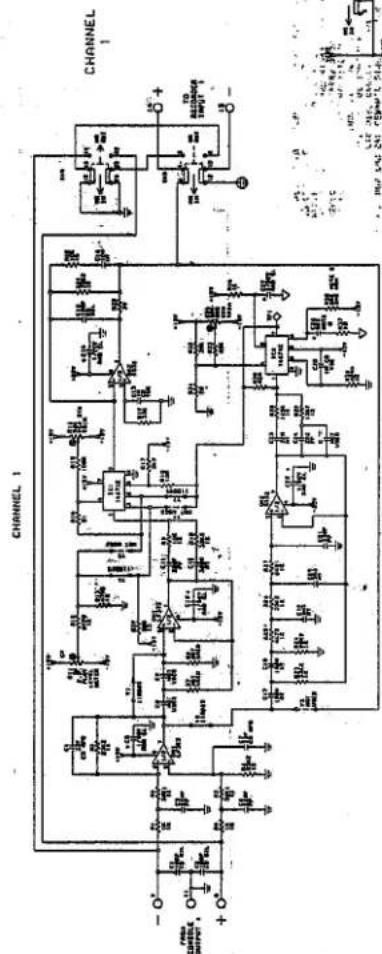
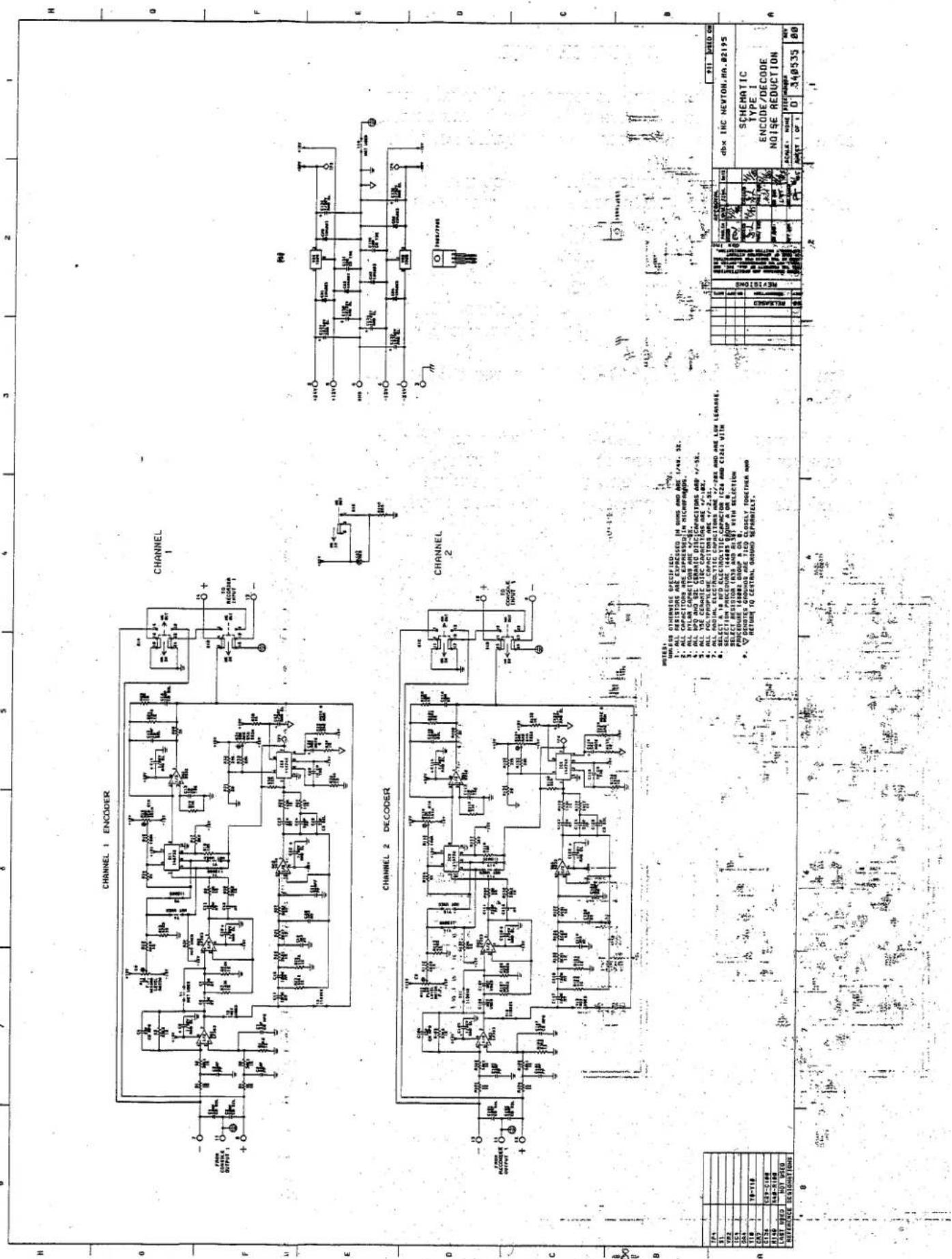
Schematics. 7
Warranty and factory service....10
SPECIFICATIONS
| Effective noise reduction | 40 dB or more, depending on transmission medium (doubles dynamic range of medium) |
| Frequency response | |
| 941/2A. | ± 0.5 dB 40 Hz-20 kHz, ± 1 dB at 39 Hz, -2 dB at 30 Hz |
| 911 | ± 0.5 dB 30 Hz-20 kHz, ± 1 dB at 20 Hz |
| Dynamic range | Greater than 115 dB |
| Equivalent input noise | -93 dBv |
| Total harmonic distortion (THD) | 0.1% 100 Hz-20 kHz, less than 0.5% 30-100 Hz |
| Intermodulation distortion (IMD) IHF or SMPTE | 0.2% |
| Maximum input and output levels. | +23 dBv (11 V) |
| Input | 75 k-ohms, differential |
| Output | Low-impedance, single-ended, designed to drive 600 ohms or greater |
| Level range for unity gain (level match) | Set at 1 V; adjustable from 200 mV to 4.9 V (-12 to +16 dBv) |
| Power requirements | ± 15 V regulated at 50 mA; ± 24 V unregulated at 26 mA |
Notes
1) Specifications are subject to change.
2) All voltages are rms (root-mean-square).
3) 0 dBv is defined as 0.775 V regardless of load impedance. Subtract 2.2 from the dBv figure to convert to dBV (i.e., referred to 1 V). When the load impedance is 600 ohms, this particular dBv is also known as "dBm."
4) Dynamic range is defined as the difference between the maximum rms signal and unweighted noise. Other noise figures are for 20 Hz-20 kHz, also unweighted.
5) Frequency-response figures are for pink noise.
6) THD and IMD measurements are for total encode/decode processing. SMPTE IMD is measured with 60 Hz and 7 kHz mixed 4:1; IHF (difference-tone) IMD is measured with 19 kHz and 20 kHz mixed 1:1; output 1 V.


HOOKUP INFORMATION
(See the F900/900A manual as well)
PC CARD
EDGE CONNECTIONS
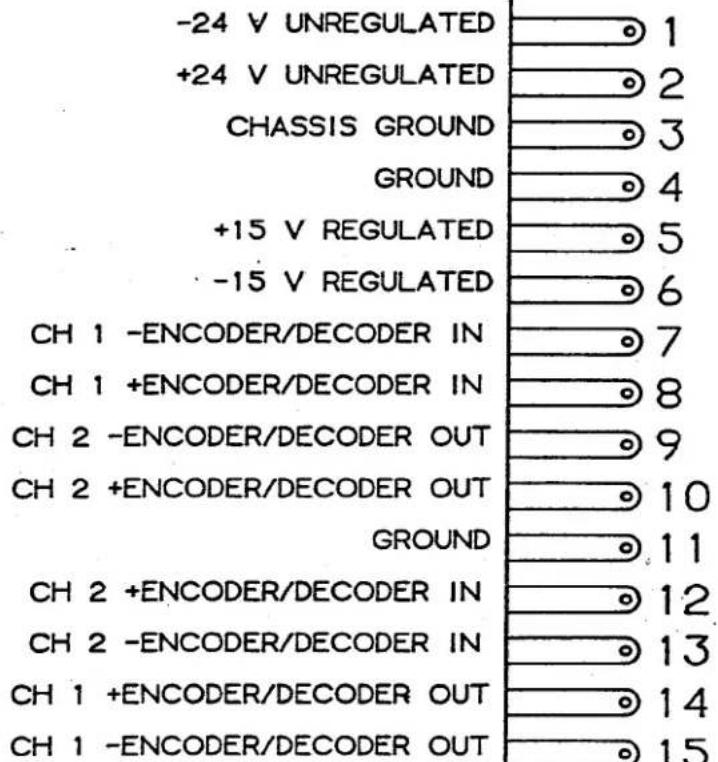
bar
| Category | Value | |---|---| | -24 V UNREGULATED | 1 | | +24 V UNREGULATED | 2 | | CHASSIS GROUND | 3 | | GROUND | 4 | | +15 V REGULATED | 5 | | -15 V REGULATED | 6 | | CH 1 -ENCODER/DECODER IN | 7 | | CH 1 +ENCODER/DECODER IN | 8 | | CH 2 -ENCODER/DECODER OUT | 9 | | CH 2 +ENCODER/DECODER OUT | 10 | | GROUND | 11 | | CH 2 +ENCODER/DECODER IN | 12 | | CH 2 -ENCODER/DECODER IN | 13 | | CH 1 +ENCODER/DECODER OUT | 14 | | CH 1 -ENCODER/DECODER OUT | 15 |941A
F900/900A
FRAME CONNECTIONS

942A
F900/900A
FRAME CONNECTIONS

Pushing the button In engages the circuit for all channels. Out is a hardwire bypass.

LEVEL ADJUST
These screwdriver trims control the overall, full-bandwidth gain of the circuit, permitting unity (0-dB) gain throughout the record/play (encode/decode) process. The settings aren't critical, and need to be done usually only once in a given installation. See the discussion on p. 4.
ABOUT YOUR UNIT AND dbx NOISE REDUCTION
The Model 911 is a 1-channel record/play (encode/decode) professional component using dbx Type I noise reduction for professional-quality tape recorders. The 2-channel Model 941/2A combination is identical -- including the amount of noise reduction -- except that those units use dbx Type II noise reduction and thus (as we shall explain) are suited for tape decks of non-linear frequency response, broadcast cartridge machines, video recorders, microwave links or land lines, and other frequently noisy consumer-grade or broadcast/transmission media.
Each system doubles the dynamic range of the transmission medium to greater than 115 dB. Depending on the individual channel noise of the medium, each therefore can reduce the noise of the medium 40 dB or more. This is achieved by compressing (encoding) the signal by a 2:1 ratio and applying a carefully tailored frequency-response pre-emphasis during record, and then expanding (decoding) the signal 1:2 with a precisely complementary deemphasis during playback. The companding is linear over a 100-dB range and requires no pilot tones or special calibration.
Type I is to be used only with tape machines with flat frequency response (+1 dB 20 Hz-20 kHz) and running at 15 ips or greater,* with full headroom maintained at high frequencies. Type II was developed for media where the high-frequency response is not as flat and headroom is reduced because of tape saturation, 75-us preemphasis, or other reasons. The two systems are incompatible because the filters and preemphases used in the rms detectors are different (although the signal preemphases are virtually the same). For example, Type I's detectors respond from about 22 Hz to 21 kHz, whereas Type II's respond from around 30 Hz to 10 kHz. Type II's filters prevent mistracking due to the frequency-response errors (head bumps, rumble, high-frequency rolloff, and the like) at the ends of the audio band that are common in consumer and broadcast equipment. Additionally, the detector preemphasis in Type II is more severe than in Type I, which causes the Type II compressor to reduce gain more when high-frequency energy is large; this too makes Type II more tolerant of high-frequency-headroom limitations. Note in the performance specifications that the frequency response of the processing circuitry hardly restricts the bandwidth of the audio signal itself.
The benefit of the 2:1 compression, of course, is that the signal becomes easier for any medium to handle. Its dynamic range has been cut in half, with the hottest levels considerably reduced and the softest passages boosted. On decoding, the signal is precisely expanded back, and the original dynamic range of the program is retrieved without hiss, saturation distortion, or degradation of frequency response. There is none of the noise buildup normally encountered in transferring information from one recorded medium to another. Noise present in the original, naturally, is not reduced in this process.
Although simple in theory, classic 2:1:2-compander noise reduction could not be achieved before the development by dbx in the early 1970s of two patented circuits, the Blackmer rms detector and voltage-controlled amplifier (VCA). The former enables optimum decode tracking and transient response despite the phase shifts typically induced by tape recorders. The latter affords precise gain control over an extremely wide dynamic
range while maintaining very low noise and distortion. In quietness and dynamic range, in fact, dbx NR is markedly superior to any 16-bit PCM digital audio system.
-It's occasionally claimed that other (non-dbx) 2:1:2-compansion systems with similar pre/deemphasis but with average, peak, or peak/average detection are compatible (or "compatible enough") with Type I or II. These claims are false. While such detectors may, with steady-state (sine-wave) measurements, yield performance that looks identical, they will mistrack with transient/dynamic material. The success of the dbx systems in coping with various imperfections in the storage and transmission media is due largely to our (relatively expensive) rms-level detectors; don't be fooled into thinking otherwise.
APPLICATION NOTES (including advice on levels)
The Level-Adjust controls
For convenience in listening and in matching levels of other equipment, there are screwdriver-adjustable trim controls accessible through holes in the front panel, as noted earlier. These allow you to keep the Record and the Play levels about the same (achieving unity gain through the unit's processing), as well as to keep levels about the same with and without noise reduction.
→(18)
Since these trims adjust only gain for the full bandwidth, please note that their settings are not critical to proper performance. Linearity and frequency response, for example, are completely unaffected.
Record
1) With the dbx unit in Bypass, feed a 1-kHz tone at your "0" reference level to the module's Encoder input terminals; go through your console if you wish. Set the tape deck's recording-level meters to their nominal calibration point (0 or whatever). Then switch the dbx unit to Noise Reduction/Encode In and turn the Rec/Level Adjust trim as necessary to achieve 0 again on the tape-deck meters. Don't expect to read the same levels on the deck's meters at frequencies other than 1 kHz, owing to the preemphasis in the dbx unit. If you normally use 400 Hz or some other mid-frequency tone for lining up your studio, you can continue to do so, but use the same-frequency tone throughout.
Play
Again with the dbx unit in Bypass, send a 1-kHz reference-level tone (from an alignment tape or other source) into the Decoder input terminals and monitor the level on the console's meters; presumably they'll read 0. Push in the Noise Reduction/Decode button and adjust the Play/Level Adjust trim until the console reads 0. That's all there is to it.
Recording Levels
With today's hotter tapes and faster meters, there are no longer any hard and fast numbers about maximum recording levels with dbx noise reduction. Generally, with decks of modern manufacture and good tape, recording levels should always be as high as is consistent with clean sound. This means that peaks almost invariably should go well above your deck's nominal 0 -- indeed, above its +3, the end of the meter range for many decks -- depending on the dynamic range and, especially, the spectrum of the program material. Synthesizer, female chorus, brass, percussion -- music with considerable high-frequency energy, transients, and the greatest peak-to-average ratios -- naturally will require close attention to the meters and more prudent settings. But electric guitar, chamber music and small-ensemble jazz, piano, strings, male vocals, and any material that has been limited or compressed beforehand may usually be put on the tape at healthy, high levels. Since so many decks' meters stop at +3 (and have different 0 levels) and since meter time constants vary so much, we can't even suggest a number -- +6? +8? +10? Keen monitoring is the key (and your only choice, really). As mentioned, the program's spectral content will govern success in choosing levels more than any other factor. Note that as fast, "peak"-reading
meters become more common on consoles, decks, etc., your recording-level numbers will change; dbx-encoded peaks on such meters shouldn't exceed the medium's headroom.
The reason for recording at the hottest level possible (or, in broadcasting, maintaining high signal levels short of overmodulation) is that doing so keeps the signal as far as possible above the noise floor of the transmission medium. This in turn minimizes the only potential drawback of aggressive, full-bandwidth companding that produces as extremely quiet results as dbx: audible noise modulation in the absence of masking. This phenomenon, sometimes a faint "sshhh" sound accompanying a low-level sound with little high-frequency content (e.g., male speech, or solo, dryly miked bass or piano), is most likely to occur when the transmission medium is very noisy and/or the noise is close to the signal. Transmission lines, audio cassette decks, and VCRs (including U-Matics) are considerably more likely to exhibit such problems than open-reel recorders because their inherent dynamic-range figures are often so poor -- 45-55 dB, for example. (Note that C-type VTRs, using open reels of 1-inch tape and usually having considerable headroom above a relatively low-set 0, are much less prone to noise modulation if recording levels are kept good and high.)
Fortunately, the vast majority of the material that might otherwise present noise-modulation problems can be recorded at healthy high levels without saturating the tape, and if the deck is quiet enough, there'll be no audible noise modulation on any material. Finally, most of the musical material recorded and broadcast today -- ensemble pop/rock, for one example -- can be recorded perfectly cleanly on a wide variety of decks without a trace of noise added.
The point of all this, again, is to use your ears in setting recording levels. How a recording or a broadcast sounds is more important than any specific level figures — in fact, it's the only important criterion. Just try starting out hotter than you may have been accustomed to in the past, with other noise-reduction systems (or none) — and back off only if you hear something you don't like, not as a matter of "policy." Do note that your meters will deflect less than you are used to, because the signal hitting the tape is compressed 2:1.
Don't forget to mark your tapes "Encoded with dbx I [or II]," since undecoded playback of encoded tapes or decoded playback of unencoded tapes is not much fun.
Alignment tones
Any tones you customarily use at the head of a tape (for HF or LF EQ, azimuth adjustment, levels, etc.) should not be encoded.
Mixing
All mixing must be done with decoded tracks only. Never mix encoded channels together — the decoder will not track them properly.
Applications other than recording and broadcasting
dbx Type II often is well-suited to reducing the noise of echo/delay/reverberation lines (bucket-brigade, digital, "ambience" systems, etc.). Experimentation is called for; frequently the result is a startling improvement in quietness.


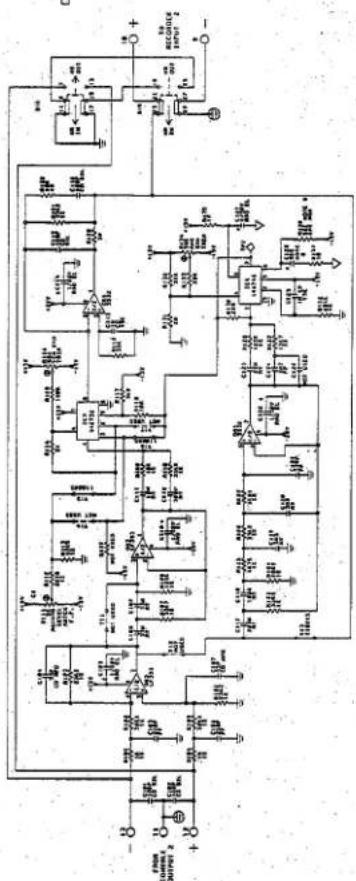
CHANNEL
1
CHANNEL 2
NOTES NOTES OTHERWISE SPECIFIED: 1. ALL RESISTORS ARE EXPRESSED IN ONHS AND ARE 1/4V. SZ. 2. ALL CAPACITORS ARE EXPRESSED IN RICHOWARDS. 3. ALL CHEESE CAPACITORS ARE 1/2" 4. ALL NPD AND S2L CERAM DISC CAPACITORS ARE +/- SZ. 5. ALL VSE CERAM DISC CAPACITORS ARE +/-10Z. 6. ALL POLPROPYLENE CAPACITORS ARE +/-2. SZ. 7. ALL MAGAL ELECTROLYTIC CAPACITORS ARE +/-292 AND ARE 8. SELECT A 10 NPD ELECTROLYTIC CAPACITOR CC26 AND E1241 N PROCEDURE 14680 GROUP A OR B. SELECT RESISTOR IR30 AND IR31 WITH SELECTION PROCEDURE 14680 GROUP B. ▽ GENOTES GROUNDING ITEMS DLYSLY TOGETHER AND RETURN TO CENTRAL GROUND SEPARATELY.
| APPROVAL | ||||||||||||||||||||||||||||||||||||||||||||||||||||||||||||||||||||||||||||||||||||||||||||||||||||||||||||||||||||||||||||||||||||||||||||||||||||||||||||||||||||||||||||||||||||||||||||||||||||||||||||||||||||||||||
| FIRE TO BHAO | ||||||||||||||||||||||||||||||||||||||||||||||||||||||||||||||||||||||||||||||||||||||||||||||||||||||||||||||||||||||||||||||||||||||||||||||||||||||||||||||||||||||||||||||||||||||||||||||||||||||||||||||||||||||||||
| EDV | ||||||||||||||||||||||||||||||||||||||||||||||||||||||||||||||||||||||||||||||||||||||||||||||||||||||||||||||||||||||||||||||||||||||||||||||||||||||||||||||||||||||||||||||||||||||||||||||||||||||||||||||||||||||||||
| FIRE TO BHAO | ||||||||||||||||||||||||||||||||||||||||||||||||||||||||||||||||||||||||||||||||||||||||||||||||||||||||||||||||||||||||||||||||||||||||||||||||||||||||||||||||||||||||||||||||||||||||||||||||||||||||||||||||||||||||||
| FIRE TO BHAO REVISIONS | ||||||||||||||||||||||||||||||||||||||||||||||||||||||||||||||||||||||||||||||||||||||||||||||||||||||||||||||||||||||||||||||||||||||||||||||||||||||||||||||||||||||||||||||||||||||||||||||||||||||||||||||||||||||||||
| RELEADED | ||||||||||||||||||||||||||||||||||||||||||||||||||||||||||||||||||||||||||||||||||||||||||||||||||||||||||||||||||||||||||||||||||||||||||||||||||||||||||||||||||||||||||||||||||||||||||||||||||||||||||||||||||||||||||
| RELEADED | ||||||||||||||||||||||||||||||||||||||||||||||||||||||||||||||||||||||||||||||||||||||||||||||||||||||||||||||||||||||||||||||||||||||||||||||||||||||||||||||||||||||||||||||||||||||||||||||||||||||||||||||||||||||||||
| RELEADED | RELEADED REVISIONS | |||||||||||||||||||||||||||||||||||||||||||||||||||||||||||||||||||||||||||||||||||||||||||||||||||||||||||||||||||||||||||||||||||||||||||||||||||||||||||||||||||||||||||||||||||||||||||||||||||||||||||||||||||||||||
| RELEADED REVISIONS | RELEADED REVISIONS | |||||||||||||||||||||||||||||||||||||||||||||||||||||||||||||||||||||||||||||||||||||||||||||||||||||||||||||||||||||||||||||||||||||||||||||||||||||||||||||||||||||||||||||||||||||||||||||||||||||||||||||||||||||||||
| RELEADED REVISIONS | ||||||||||||||||||||||||||||||||||||||||||||||||||||||||||||||||||||||||||||||||||||||||||||||||||||||||||||||||||||||||||||||||||||||||||||||||||||||||||||||||||||||||||||||||||||||||||||||||||||||||||||||||||||||||||
| RELEADED REVISIONS | ||||||||||||||||||||||||||||||||||||||||||||||||||||||||||||||||||||||||||||||||||||||||||||||||||||||||||||||||||||||||||||||||||||||||||||||||||||||||||||||||||||||||||||||||||||||||||||||||||||||||||||||||||||||||||
| RELEADED REVISIONS | RELEADED REVISIONS | |||||||||||||||||||||||||||||||||||||||||||||||||||||||||||||||||||||||||||||||||||||||||||||||||||||||||||||||||||||||||||||||||||||||||||||||||||||||||||||||||||||||||||||||||||||||||||||||||||||||||||||||||||||||||
| RELEADED REVISIONS | RELEADED REVISIONS | RELEADED REVISIONS RELEADED REVISIONS RELEADED REVISIONS RELEADED REVISIONS RELEADED REVISIONS RELEADED REVISIONS RELEADED REVISIONS RELEADED REVISIONS RELEADED REVISIONS RELEADED REVISIONS RELEADED REVISIONS RELEADED REVISIONS RELEADED REVISIONS RELEADED REVISIONS RELEADED REVISIONS RELEADED REVISIONS RELEADED REVISIONS RELEADED RESSIONS RELEADED REVISIONS RELEADED REVISIONS RELEADED REVISIONS RELEADED REVISIONS RELEADED REVISIONS RELEADED REVISIONS RELEADED REVISIONS RELEADED REVISIONS RELEADED REVISIONS RELEADED REVISIONS RELEADED REVISIONS RELEADED REVISIONS RELEADED REVISIONS RELEADED REVISIONS RELEADED REVISIONS RELEADED REVISIONS RELEDED REVISIONS RELEADED REVISIONS RELEADED REVISIONS RELEADED REVISIONS RELEADED REVISIONS RELEADED REVISIONS RELEADED REVISIONS RELEADED REVISIONS RELEADED REVISIONS RELEADED REVISIONS RELEADED REVISIONS RELEADED REVISIONS RELEADED REVISIONS RELEADED REVISIONS RELEADED REVISIONS RELEADED REVISIONS RELEADED REVISIONSRELEADED REVISIONS RELEADED REVISIONS RELEADED REVISIONS RELEADED REVISIONS RELEADED REVISIONS RELEADED REVISIONS RELEADED REVISIONS RELEADED REVISIONS RELEADED REVISIONS RELEADED REVISIONS RELEADED REVISIONS RELEADED REVISIONS RELEADED REVISIONS RELEADED REVISIONS RELEADED REVISIONS RELEADED REVISIONS RELEADEDREVISIONSRELEADED REVISIONSRELEADED REVISIONSRELEADED REVISIONSRELEADED REVISIONSRELEADED REVISIONSRELEADED REVISIONSRELEADED REVISIONSRELEADED REVISIONSRELEADED REVISIONSRELEADED REVISIONSRELEADED REVISIONSRELEADED REVISIONSRELEADED REVISIONSRELEADED REVISIONSRELEADED REVISIONSRELEADED REVISIONSRELEADED REVISIONSRELREADED REVISIONSRELEADED REVISIONSRELEADED REVISIONSRELEADED REVISIONSRELEADED REVISIONSRELEADED REVISIONSRELEADED REVISIONSRELEADED REVISIONSRELEADED REVISIONSRELEADED REVISIONSRELEADED REVISIONSRELEADED REVISIONSRELEADED REVISIONSRELEADED REVISIONSRELEADED REVISIONSRELEADED REVISIONSRELEADED REVISION SRELEADED REVISIONSRELEADED REVISIONSRELEADED REVISIONSRELEADED REVISIONSRELEADED REVISIONSRELEADED REVISIONSRELEADED REVISIONSRELEADED REVISIONSRELEADED REVISIONSRELEADED REVISIONSRELEADED REVISIONSRELEADED REVISIONSRELEADED REVISIONSRELEADED REVISIONSRELEADED REVISIONSRELEADED REVISIONSRELEADEDREVISIONSRELEADEDREVISIONSRELEADEDREVISIONSRELEADEDREVISIONSRELEADEDREVISIONSRELEADEDREVISIONSRELEADEDREVISIONSRELEADEDREVISIONSRELEADEDREVISIONSRELEADEDREVISIONSRELEADEDREVISIONSRELEADEDREVISIONSRELEADEDREVISIONSRELEADEDREVISIONSRELEADEDREVISIONSRELEADEDREVISIONSRELEADEDREVISIONSRELREADEDREVISIONSRELEADEDREVISIONSRELEADEDREVISIONSRELEADEDREVISIONSRELEADEDREVISIONSRELEADEDREVISIONSRELEADEDREVISIONSRELEADEDREVISIONSRELEADEDREVISIONSRELEADEDREVISIONSRELEADEDREVISIONSRELEADEDREVISIONSRELEADEDREVISIONSRELEADEDREVISIONSRELEADEDREVISIONSRELEADEDREVISIONSRELEADEDREVISION SRELEADEDREVISIONSRELEADEDREVISIONSRELEADEDREVISIONSRELEADEDREVISIONSRELEADEDREVISIONSRELEADEDREVISIONSRELEADEDREVISIONSRELEADEDREVISIONSRELEADEDREVISIONSRELEADEDREVISIONSRELEADEDREVISIONSRELEADEDREVISIONSRELEADEDREVISIONSRELEADEDREVISIONSRELEADEDREVISIONSRELEADEDREVISIONSRELEADEDRREVISIONSRELEADEDREVISIONSRELEADEDREVISIONSRELEADEDREVISIONSRELEADEDREVISIONSRELEADEDREVISIONSRELEADEDREVISIONSRELEADEDREVISIONSRELEADEDREVISIONSRELEADEDREVISIONSRELEADEDREVISIONSRELEADEDREVISIONSRELEADEDREVISIONSRELEADEDREVISIONSRELEADEDREVISIONSRELEADEDREVISIONSRELEADEDREVISIONSRESLEADEDREVISIONSRESLEADEDREVISIONSRESLEADEDREVISIONSRESLEADEDREVISIONSRESLEADEDREVISIONSRESLEADEDREVISIONSRESLEADEDREVISIONSRESLEADEDREVISIONSRESLEADEDREVISIONSRESLEADEDREVISIONSRESLEADEDREVISIONSRESLEADEDREVISIONSRESLEADEDREVISIONSRESLEADEDREVISIONSRESLEADEDREVISIONSRESLEADEDREVISIONSRESLEADEDREDITIONSRESLEADEDREVISIONSRESLEADEDREVISIONSRESLEADEDREVISIONSRESLEADEDREVISIONSRESLEADEDREVISIONSRESLEADEDREVISIONSRESLEADEDREVISIONSRESLEADEDREVISIONSRESLEADEDREVISIONSRESLEADEDREVISIONSRESLEADEDREVISIONSRESLEADEDREVISIONSRESLEADEDREVISIONSRESLEADEDREVISIONSRESLEADEDREVISIONSRESLEADEDREVISIONSRESLE EndedREVISIONSRESLEADEDREVISIONSRESLEADEDREVISIONSRESLEADEDREVISIONSRESLEADEDREVISIONSRESLEADEDREVISIONSRESLEADEDREVISIONSRESLEADEDREVISIONSRESLEADEDREVISIONSRESLEADEDREVISIONSRESLEADEDREVISIONSRESLEADEDREVISIONSRESLEADEDREVISIONSRESLEADEDREVISIONSRESLEADEDREVISIONSRESLEADEDREVISIONSRESLEADEDREVISIONSRELEADEDREVISIONSRESLEADEDREVISIONSRESLEADEDREVISIONSRESLEADEDREVISIONSRESLEADEDREVISIONSRESLEADEDREVISIONSRESLEADEDREVISIONSRESLEADEDREVISIONSRESLEADEDREVISIONSRESLEADEDREVISIONSRESLEADEDREVISIONSRESLEADEDREVISIONSRESLEADEDREVISIONSRESLEADEDREVISIONSRESLEADEDREVISIONSRESLEADEDRESCRIPTIONREVISIONSRESLEADEDREVISIONSRESLEADEDREVISIONSRESLEADEDREVISIONSRESLEADEDREVISIONSRESLEADEDREVISIONSRESLEADEDREVISIONSRESLEADEDREVISIONSRESLEADEDREVISIONSRESLEADEDREVISIONSRESLEADEDREVISIONSRESLEADEDREVISIONSRESLEADEDREVISIONSRESLEADEDREVISIONSRESLEADEDREVISIONSRESLEADEDREVISIONSRESLEADEDREVISIONSRSLEADEDREVISIONSRESLEADEDREVISIONSRESLEADEDREVISIONSRESLEADEDREVISIONSRESLEADEDREVISIONSRESLEADEDREVISIONSRESLEADEDREVISIONSRESLEADEDREVISIONSRESLEADEDREVISIONSRESLEADEDREVISIONSRESLEADEDREVISIONSRESLEADEDREVISIONSRESLEADEDREVISIONSRESLEADEDREVISIONSRESLEADEDREVISIONSRESLEADEDREVISIONSRESLEADEDRESCRIPTIONREVISIONSRESLE EndedREVISIONSRESLE EndedREVISIONSRESLE EndedREVISIONSRESLE EndedREVISIONSRESLE EndedREVISIONSRESLE EndedREVISIONSRESLE EndedREVISIONSRESLE EndedREVISIONSRESLE EndedREVISIONSRESLE EndedREVISIONSRESLE EndedREVISIONSRESLE EndedREVISIONSRESLE EndedREVISIONSRESLE EndedREVISIONSRESLE EndedREVISIONSRESLE EndedREVISIONSRESLE EndedREVISIONSRSLE EndedREVISIONSRSLE EndedREVISIONSRSLE EndedREVISIONSRSLE EndedREVISIONSRSLE EndedREVISIONSRSLE EndedREVISIONSRSLE EndedREVISIONSRSLE EndedREVISIONSRSLE EndedREVISIONSRSLE EndedREVISIONSRSLE EndedREVISIONSRSLE EndedREVISIONSRSLE EndedREVISIONSRSLE EndedREVISIONSRSLE EndedREVISIONSRSLE EndedREVISIONSRSLE EndedRESCRIPTIONSRSLE EndedRESCRIPTIONSRSLE EndedRESCRIPTIONSRSLE EndedRESCRIPTIONSRSLE EndedRESCRIPTIONSRSLE EndedRESCRIPTIONSRSLE EndedRESCRIPTIONSRSLE EndedRESCRIPTIONSRSLE EndedRESCRIPTIONSRSLE EndedRESCRIPTIONSRSLE EndedRESCRIPTIONSRSLE EndedRESCRIPTIONSRSLE EndedRESCRIPTIONSRSLE EndedRESCRIPTIONSRSLE EndedRESCRIPTIONSRSLE EndedRESCRIPTIONSRSLE EndedRESCRIPTIONSRSLEEndedRESCRIPTIONSRSLE EndedRESCRIPTIONSRSLE EndedRESCRIPTIONSRSLE EndedRESCRIPTIONSRSLE EndedRESCRIPTIONSRSLE EndedRESCRIPTIONSRSLE EndedRESCRIPTIONSRSLE EndedRESCRIPTIONSRSLE EndedRESCRIPTIONSRSLE EndedRESCRIPTIONSRSLE EndedRESCRIPTIONSRSLE EndedRESCRIPTIONSRSLE EndedRESCRIPTIONSRSLE EndedRESCRIPTIONSRSLE EndedRESCRIPTIONSRSLE EndedRESCRIPTIONSRSLE EndedRESCRIPTIONS RSLE EndedRESCRIPTIONSRSLE EndedRESCRIPTIONSRSLE EndedRESCRIPTIONSRSLE EndedRESCRIPTIONSRSLE EndedRESCRIPTIONSRSLE EndedRESCRIPTIONSRSLE EndedRESCRIPTIONSRSLE EndedRESCRIPTIONSRSLE EndedRESCRIPTIONSRSLE EndedRESCRIPTIONSRSLE EndedRESCRIPTIONSRSLE EndedRESCRIPTIONSRSLE EndedRESCRIPTIONSRSLE EndedRESCRIPTIONSRSLE EndedRESCRIPTIONSRSLE EndedRESCRIPTIONSRSLE EndedREcriptionSRSLE EndedREcriptionSRSLE EndedREcriptionSRSLE EndedREcriptionSRSLE EndedREcriptionSRSLE EndedREcriptionSRSLE EndedREcriptionSRSLE EndedREcriptionSRSLE EndedREcriptionSRSLE EndedREcriptionSRSLE EndedREcriptionSRSLE EndedREcriptionSRSLE EndedREcriptionSRSLE EndedREcriptionSRSLE EndedREcriptionSRSLE EndedREcriptionSRSLE EndedREcriptionSRSLEEndedREcriptionSRSLE EndedREcriptionSRSLE EndedREcriptionSRSLE EndedREcriptionSRSLE EndedREcriptionSRSLE EndedREcriptionSRSLE EndedREcriptionSRSLE EndedREcriptionSRSLE EndedREcriptionSRSLE EndedREcriptionSRSLE EndedREcriptionSRSLE EndedREcriptionSRSLE EndedREcriptionSRSLE EndedREcriptionSRSLE EndedREcriptionSRSLE EndedREcriptionSRSLE EndedREcriptionSSRLE EndedREcriptionSRSLE EndedREcriptionSRSLE EndedREcriptionSRSLE EndedREcriptionSRSLE EndedREcriptionSRSLE EndedREcriptionSRSLE EndedREcriptionSRSLE EndedREcriptionSRSLE EndedREcriptionSRSLE EndedREcriptionSRSLE EndedREcriptionSRSLE EndedREcriptionSRSLE EndedREcriptionSRSLE EndedREcriptionSRSLE EndedREcriptionSRSLE EndedREcriptionSRSLE EndedRESCRIPTIONSRSLE EndedREcriptionSRSLE EndedREcriptionSRSLE EndedREcriptionSRSLE EndedREcriptionSRSLE EndedREcriptionSRSLE EndedREcriptionSRSLE EndedREcriptionSRSLE EndedREcriptionSRSLE EndedREcriptionSRSLE EndedREcriptionSRSLE EndedREcriptionSRSLE EndedREcriptionSRSLE EndedREcriptionSRSLE EndedREcriptionSRSLE EndedREcriptionSRSLEEndedREcriptionSRSLEEndedREcriptionSRSLEEndedREcriptionSRSLEEndedREcriptionSRSLEEndedREcriptionSRSLEEndedREcriptionSRSLEEndedREcriptionSRSLEEndedREcriptionSRSLEEndedREcriptionSRSLEEndedREcriptionSRSLEEndedREcriptionSRSLEEndedREcriptionSRSLEEndedREcriptionSRSLEEndedREcriptionSRSLEEndedREcriptionSRSLEEndedREcriptionSRSLEEndedREcriptionSRTSA EndedREcriptionSRSLE EndedREcriptionSRSLE EndedREcriptionSRSLE EndedREcriptionSRSLE EndedREcriptionSRSLE EndedREcriptionSRSLE EndedREcriptionSRSLE EndedREcriptionSRSLE EndedREcriptionSRSLE EndedREcriptionSRSLE EndedREcriptionSRSLE EndedREcriptionSRSLE EndedREcriptionSRSLE EndedREcriptionSRSLE EndedREcriptionSRSLE EndedREcriptionSRSLE EndedREcriptionTASLESERESLESERESLESERESLESERESLESERESLESERESLESERESLESERESLESERESLESERESLESERESLESERESLESERESLESERESLESERESLESERESLESERESLESERESLESERESLESERESLESERESLESERESLESERESLESERESLESERESLESERESLESERESLESERESLESERESLESERESLESERESLESERESLESERESLESERESLSLESERSLESERSLESERSLESERSLESERSLESERSLESERSLESERSLESERSLESERSLESERSLESERSLESERSLESERSLESERSLESERSLESERSLESERSLESERSLESERSLESERSLESERSLESERSLESERSLESERSLESERSLESERSLESERSLESERSLESERSLESERSLESERSLESERSLESERSLESERSLESERSLESERSLESERSLESERSLESERSLESERSLESERSLESERSLESERSLESERSLESERSLESERSLESERSLESERSLESERSLESERESLESERSLESERSLESERSLESERSLESERSLESERSLESERSLESERSLESERSLESERSLESERSLESERSLESERSLESERSLESERSLESERSLESERSLESERSLESERSLESERSLESERSLESERSLESERSLESERSLESERSLESERSLESERSLESERSLESERSLESERSLESERSLESERSLESERSLESERSLESERSLESERSLESERSLESERSLESERSLESERSLESERSLESERSLESERSLESERSLESERSLESERSLESERSLESERSLESERSLESersLESERSLESERSLESERSLESERSLESERSLESERSLESERSLESERSLESERSLESERSLESERSLESERSLESERSLESERSLESERSLESERSLESERSLESERSLESERSLESERSLESERSLESERSLESERSLESERSLESERSLESERSLESERSLESERSLESERSLESERSLESERSLESERSLESERSLESERSLESERSLESERSLESERSLESERSLESERSLESERSLESERSLESERSLESERSLESERSLESERSLESERSLESERSLESERSLESERSLESERCESLESERSLESERSLESERSLESERSLESERSLESERSLESERSLESERSLESERSLESERSLESERSLESERSLESERSLESERSLESERSLESERSLESERSLESERSLESERSLESERSLESERSLESERSLESERSLESERSLESERSLESERSLESERSLESERSLESERSLESERSLESERSLESERSLESERSLESERSLESERSLESERSLESERSLESERSLESERSLESERSLESERSLESERSLESERSLESERSLESERSLESERSLESERSLESERSLESERSLRESERESLESERSLESERSLESERSLESERSLESERSLESERSLESERSLESERSLESERSLESERSLESERSLESERSLESERSLESERSLESERSLESERSLESERSLESERSLESERSLESERSLESERSLESERSLESERSLESERSLESERSLESERSLESERSLESERSLESERSLESERSLESERSLESERSLESERSLESERSLESERSLESERSLESERSLESERSLESERSLESERSLESERSLESERSLESERSLESERSLESERSLESERSLESERSLESERSLESERESLSLESERSLESERSLESERSLESERSLESERSLESERSLESERSLESERSLESERSLESERSLESERSLESERSLESERSLESERSLESERSLESERSLESERSLESERSLESERSLESERSLESERSLESERSLESERSLESERSLESERSLESERSLESERSLESERSLESERSLESERSLESERSLESERSLESERSLESERSLESERSLESERSLESERSLESERSLESERSLESERSLESERSLESERSLESERSLESERSLESERSLESERSLESERSLESERESLSLESERESLSLESERSLESERSLESERSLESERSLESERSLESERSLESERSLESERSLESERSLESERSLESERSLESERSLESERSLESERSLESERSLESERSLESERSLESERSLESERSLESERSLESERSLESERSLESERSLESERSLESERSLESERSLESERSLESERSLESERSLESERSLESERSLESERSLESERSLESERSLESERSLESERSLESERSLESERSLESERSLESERSLESERSLESERSLESERSLESERSLESERSLESERSLESERSLESORSLESERSLESERSLESERSLESERSLESERSLESERSLESERSLESERSLESERSLESERSLESERSLESERSLESERSLESERSLESERSLESERSLESERSLESERSLESERSLESERSLESERSLESERSLESERSLESERSLESERSLESERSLESERSLESERSLESERSLESERSLESERSLESERSLESERSLESERSLESERSLESERSLESERSLESERSLESERSLESERSLESERSLESERSLESERSLESERSLESERSLESERSLESERSLESERSLESERSLESALSLESERSLESERSLESERSLESERSLESERSLESERSLESERSLESERSLESERSLESERSLESERSLESERSLESERSLESERSLESERSLESERSLESERSLESERSLESERSLESERSLESERSLESERSLESERSLESERSLESERSLESERSLESERSLESERSLESERSLESERSLESERSLESERSLESERSLESERSLESERSLESERSLESERSLESERSLESERSLESERSLESERSLESERSLESERSLESERSLESERSLESERSLESERSLESERSLESERSLESERMESERESLSLESERSLESERSLESERSLESERSLESERSLESERSLESERSLESERSLESERSLESERSLESERSLESERSLESERSLESERSLESERSLESERSLESERSLESERSLESERSLESERSLESERSLESERSLESERSLESERSLESERSLESERSLESERSLESERSLESERSLESERSLESERSLESERSLESERSLESERSLESERSLESERSLESERSLESERSLESERSLESERSLESERSLESERSLESERSLESERSLESERSLESERSLESERSLESERSLRESERETESLRESERETESLRESERETESLRESERETESLRESERETESLRESERETESLRESERETESLRESERETESLRESERETESLRESERETESLRESERETESLRESERETESLRESERETESLRESERETESLRESERETESLRESERETESLRESERETESLRESERETESLRESERETESLRESERETESLRESERETETESLRESERETETESLRESERETETETESLRESERETETETETETETETETETETETETETETETETETETETETETETETETETETETETETETETETETETETETETETETETETETETETETETETETETETETETETETETETETETETETETETETETETETETETETETETETETETETETETETETETETETETETETETETETETETETETETETETETETETETETETYETETETETETETETETETETETETETETETETETETETETETETETETETETETETETETETETETETETETETETETETETETETETETETETETETETETETETETETETETETETETETETETETETETETETETETETETETETETETETETETETETETETETETETETETETETETETETETETETETETETETOETETETETETETETETETETETETETETETETETETETETETETETETETETETETETETETETETETETETETETETETETETETETETETETETETETETETETETETETETETETETETETETETETETETETETETETETETETETETETETETETETETETETETETETETETETETETETETETETETETETETERETETETETETETETETETETETETETETETETETETETETETETETETETETETETETETETETETETETETETETETETETETETETETETETETETETETETETETETETETETETETETETETETETETETETETETETETETETETETETETETETETETETETETETETETETETETETETETETETETETETETAETETETETETETETETETETETETETETETETETETETETETETETETETETETETETETETETETETETETETETETETETETETETETETETETETETETETETETETETETETETETETETETETETETETETETETETETETETETETETETETETETETETETETETETETETETETETETETETETETETETEETETETETETETETETETETETETETETETETETETETETETETETETETETETETETETETETETETETETETETETETETETETETETETETETETETETETETETETETETETETETETETETETETETETETETETETETETETETETETETETETETETETETETETETETETETETETETETETETETETETETFETETETETETETETETETETETETETETETETETETETETETETETETETETETETETETETETETETETETETETETETETETETETETETETETETETETETETETETETETETETETETETETETETETETETETETETETETETETETETETETETETETETETETETETETETETETETETETETETETETETATETETETETETETETETETETETETETETETETETETETETETETETETETETETETETETETETETETETETETETETETETETETETETETETETETETETETETETETETETETETETETETETETETETETETETETETETETETETETETETETETETETETETETETETETETETETETETETETETETETETEXTRAVESTRAVESTRAVESTRAVESTRAVESTRAVESTRAVESTRAVESTRAVESTRAVESTRAVESTRAVESTRAVESTRAVESTRAVESTRAVESTRAVESTRAVESTRAVESTRAVESTRAVESTRAVESTRAVESTRAVESTRAVESTRAVESTRAVESTRAVESTRAVESTRAVESTRAVESTRAVESTRAVESTRAVESSTRAVE STRAVE STRAVE STRAVE STRAVE STRAVE STRAVE STRAVE STRAVE STRAVE STRAVE STRAVE STRAVE STRAVE STRAVE STRAVE STRAVE STRAVE STRAVE STRAVE STRAVE STRAVE STRAVE STRAVE STRAVE STRAVE STRAVE STRAVE STRAVE STRAVE STRAVE STRAVE STRAVE STRAVE STARVE STRAVE STRAVE STRAVE STRAVE STRAVE STRAVE STRAVE STRAVE STRAVE STRAVE STRAVE STRAVE STRAVE STRAVE STRAVE STRAVE STRAVE STRAVE STRAVE STRAVE STRAVE STRAVE STRAVE STRAVE STRAVE STRAVE STRAVE STRAVE STRAVE STRAVE STRAVE STRAVE STRAVSTRAVE STRAVE STRAVE STRAVE STRAVE STRAVE STRAVE STRAVE STRAVE STRAVE STRAVE STRAVE STRAVE STRAVE STRAVE STRAVE STRAVE STRAVE STRAVE STRAVE STRAVE STRAVE STRAVE STRAVE STRAVE STRAVE STRAVE STRAVE STRAVE STRAVE STRAVE STRAVE STRAVESTRAVE STRAVE STRAVE STRAVE STRAVE STRAVE STRAVE STRAVE STRAVE STRAVE STRAVE STRAVE STRAVE STRAVE STRAVE STRAVE STRAVE STRAVE STRAVE STRAVE STRAVE STRAVE STRAVE STRAVE STRAVE STRAVE STRAVE STRAVE STRAVE STRAVE STRAVE STRAVE STRAVE TRESERSTRAVE STRAVE STRAVE STRAVE STRAVE STRAVE STRAVE STRAVE STRAVE STRAVE STRAVE STRAVE STRAVE STRAVE STRAVE STRAVE STRAVE STRAVE STRAVE STRAVE STRAVE STRAVE STRAVE STRAVE STRAVE STRAVE STRAVE STRAVE STRAVE STRAVE STRAVE STRAVE STRAVE | DBX | DBX | DBX | DBX | DBX | DBX | DBX | DBX | DBX | DBX | DBX | DBX | DBX | DBX | DBX | DBX | DBX | DBX | DBX | DBX | DBX | DBX | DBX | DBX | DBX | DBX | DBX | DBX | DBX | DBX | DBX | DBX | DBX | DBX | ||||||||||||||||||||||||||||||||||||||||||||||||||||||||||||||||||||||||||||||||||||||||||||||||||||||||||||||||||||||||||||||||||||||||||||||||||||||||||||||||||||||||||||||||||||||
| TP4 | |
| 5> | |
| VR2 | |
| ICA | |
| OAD | |
| Y18 | 78-718 |
| CA7 | |
| C136 | C29-C189 |
| R149 | R48-R189 |
| LAST USED | NOT USED |
| REFERENCE USSTIMATIONS | |
| TP4 | |
| 5> | |
| VR2 | |
| ICA | |
| OAD | |
| Y18 | 78-718 |
| CA7 | |
| C136 | C29-C189 |
| R149 | R48-R189 |
| LAST USED | NOT USED |
| REFERENCE USSTIMATIONS | |
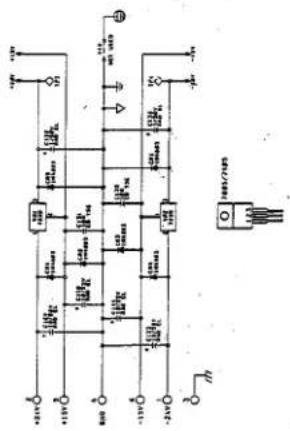
CHANNEL 2

NOTES NOTES OTHERWISE SPECIFIED: 1. ALL RESISTORS ARE EXPRESSED IN DHG AND ARE 1/4W, SR. 2. ALL CAPACITORS ARE EXPRESSED IN MICROFABROS. 3. TOTAL DUM OF CAPACITORS ARE 4. ALL NPD AND SQL CERAMIC DISC CAPACITORS ARE +/-SE. 5. ALL V3E CERAMIC DISC CAPACITORS ARE +/-18E. 6. ALL POLYPROPYLENE CAPACITORS ARE +/-2.5E. 7. ALL ANIONAL ELECTROLYTIC CAPACITORS ARE +/-28X AND ARE 1/2" 8. SELECT A 10 NPD ELECTROLYTIC CAPACITOR (1/26 and CL24) VI 9. SELECTION PROCEDURE 16488 GROUP A OR B. 10. SELECT RESISTOR 1938 AND R1361 WITH SELECTION PROCEDURE 16488 AND R1361 11. ▼ DENOTES GROUND ARE TIED CLOSELY TOGETHER AND RETURN TO CENTRAL GROUND SEPARATELY.
| TP4 | |
| 31 | |
| YRZ | |
| 104 | |
| 094 | |
| T18 | Y8-Y18 |
| CR7 | |
| C134 | C29-C188 |
| R148 | R46-R188 |
| LAST USED | NOT USED |
| REFERENCE | DESIGNATIONS |

| 942A USED ON | ||||||||||
| OFFPROVAL | dbx INC NEWTON.HA.02195 | |||||||||
| PLOW | HIGH | LOW | SHEMATIC TYPE II.TWO CHANNEL DECODENOISE REDUCTION | |||||||
| CPV | CPV | CPV | SCALE: NONE | SIZE D 340537 N/A | ||||||
| RST | RST | RST | ||||||||
| RST CM | RST CM | RST | ||||||||
| CM | CM | CM | ||||||||
| RST CM | RST CM | RST | ||||||||
| RST CM | RST CM | RST | ||||||||
| RST CM | RST CM | RST | ||||||||
| RST CM | RST CM | RST | ||||||||
| RST CM | RST CM | RST | ||||||||
| RST CM | CST | CST | ||||||||
| RST CM | RST CM | RST | ||||||||
| RST CM | RST CM | RST | ||||||||
| RST CM | RST CM | RST | ||||||||
| RST CM | RST CM | RST | ||||||||
| RST CM | RST | |||||||||
| RST CM | RST CM | RST | ||||||||
| RST CM | RST CM | RST | ||||||||
| RST CM | RST CM | RST | ||||||||
| RST CM | RST CM | RST | ||||||||
| R ST CM | R ST CM | R ST | ||||||||
| R ST CM | R ST CM | R ST | ||||||||
| R ST CM | R ST CM | R ST | ||||||||
| R ST CM | R ST CM | R ST | ||||||||
| R ST CM | R ST CM | R ST | ||||||||
| R ST CM | N O C M | N O C M | ||||||||
| R ST CM | R ST CM | R ST | ||||||||
| R ST CM | R ST CM | R ST | ||||||||
| R ST CM | R ST CM | R ST | ||||||||
| R ST CM | R ST CM | R ST | ||||||||
| R ST CM | CST | CST | ||||||||
| R ST CM | R ST CM | R ST | ||||||||
| R ST CM | R ST CM | R ST | ||||||||
| R ST CM | R ST CM | R ST | ||||||||
| R ST CM | R ST CM | R ST | ||||||||
| R ST CM | R ST | |||||||||
WARRANTY and FACTORY SERVICE
All dbx products are covered by a limited warranty (warranties for products purchased outside the USA are valid only in the country of purchase and the USA). For details, consult your warranty/registration card or your dealer/distributor.
dbx Customer Service will help you use your new products. For answers to questions and information beyond what's in this manual, write to:
dbx
71 Chapel St.
PO100C
Newton, Mass. 02195 USA
Attn: Customer Service
You also may call 617/964-3210 between 9:30 and 4:30 Eastern time (USA). The Telex is 92-2522.
Should problems arise, consult your dealer or distributor. If it becomes necessary to have your equipment serviced at the factory, repack the unit, including a note with a description of the problem, your name, address, and phone, and the date of purchase, and send the unit freight prepaid to the above street address, marking it Attn: Repairs.
Brand : DBX
Model : 942A
Category : Compressor