
Fifty - Pregnant HARMAN KARDON - Free user manual and instructions
Find the device manual for free Fifty HARMAN KARDON in PDF.


User questions about Fifty HARMAN KARDON
0 question about this device. Answer the ones you know or ask your own.
Ask a new question about this device
Download the instructions for your Pregnant in PDF format for free! Find your manual Fifty - HARMAN KARDON and take your electronic device back in hand. On this page are published all the documents necessary for the use of your device. Fifty by HARMAN KARDON.
USER MANUAL Fifty HARMAN KARDON
As is the case with all fine, precision crafted components, your harman/kardon loudspeakers must be played for a time, “warmed up”, in order to provide maximum performance and fidelity. When you first unpack your speakers, please play them for a minimum of three hours, at a medium level with a wide-ranging signal, before any critical listening is attempted. By doing so, you’ll ensure that future performance will meet your highest expectations.
Congratulations on your purchase of the harman/kardon Sixty/ Fifty loudspeaker system
Your choice of the harman/kardon Sixty or Fifty loudspeaker indicates that you demand the highest possible quality of music reproduction. Please take a few moments to read this manual thoroughly to ensure that you get true and lasting value from your investment.
This manual will assist you in setup and placement, care and maintenance, as well as make suggestions regarding wiring, bi-wiring, and bi-amping.
Should you have any additional questions or require advice regarding the use of your loudspeakers, please feel free to contact your dealer. harman/kardon dealers have been chosen for their knowledgeability and their dedication to service. Use your dealer as a resource to get the most from your system.
INDEX
| Unpacking | 3 |
| Room Placement | 3 |
| Connections | 5 |
| Bi-Wiring | 6 |
| Bi-Amping | 7 |
| Accompanying Equipment | 7 |
| Maintenance Suggestions | 8 |
| Power Handling | 8 |
| Advice and Warnings | 9 |
| Design Considerations | 10 |
| Warranty | 11 |
DO NOT discard any packaging materials. This is a large and heavy loudspeaker. Improperly packaged, it will suffer irreparable damage during shipment. Should you move, or should your loudspeaker require service, the original packing materials will prove indispensable.
If the loudspeaker is still in the carton, you may take this opportunity to install the spiked feet to the bottom of the loudspeakers base. Included is a small packet with 4 spiked feet and 4 nuts. On the bottom of the speaker, in the four corners, you will find steel inserts installed. Thread the nuts onto the spikes and thread these into the inserts as evenly as possible.
Lower the carton onto one of its wide faces. Move the bag away from the spikes and lift the carton and speaker up onto its feet. Make sure your ceiling is at least 10 ft. (3m) high or you may want to do this while the speaker is laying down.
Do this for both loudspeakers. You are ready to place them in your listening room.
These are heavy loudspeakers so please get some help if you require it. Furthermore, when moving your loudspeaker, be sure to lift it vertically until the spikes are clear of the floor. Deep scratches, broken bases, and torn carpets can result from a failure to do this. Also, be very careful to KEEP FEET CLEAR when putting it back down. Serious injury could result if a spike lands on your foot. The spikes are intended to keep the speaker stable regardless of the type of floor it is standing on. Stability is essential to bass performance. They will not damage the carpet (leaving them off will flatten the pile) and will stabilize the speaker even with thick underpadding. A hardwood floor will exhibit only the smallest surface blemish, virtually invisible. A rubber foot will eventually mar the surface or leave a depression.
Your loudspeaker is not finicky about placement. Its ultra wide dispersion throughout the audio range ensures a wide "listening window"...However, it is capable of generating a great deal of low frequency energy and depends on consistent reflections from the listening room walls to develop a stable and accurate image. For optimum performance, a few basic rules need to be followed.
It is best to keep your speaker at least 2 ft. (60cm) from the back wall. More is better in this case. Otherwise, bass frequencies will be unduly reinforced, causing a "boomy" sound.
For the most accurate stereo imaging, it is important that both loudspeakers "see" similar boundaries. Coloration from room boundaries is inevitable. Acoustically, the walls-of your room act as flawed mirrors. Having one mirror closer to one speaker will make that speaker sound louder but will also "color" that speaker's output more strongly. Avoid placing one speaker much closer to a side wall than the other. Neither speaker should be closer than 3 ft. (1 m) and, again, the further the better. If possible the two side walls should be similar in nature. A blank concrete wall reflects sound very differently than a plasterboard or glass wall. This will tend to skew the image.
The speakers should be no less than 6 ft. (2m) apart. If they are more than 12 ft. (4m) apart or if they are closer than 4.5 ft. (1.46m) from a side wall, they should be toed in slightly to focus the musical stage. Remember that the optimum listening area will be equidistant from the two loudspeakers.
Sometimes it is inconvenient to follow the above advice. If so, some experimentation will be necessary to achieve the best results. Some general guidelines are illustrated below.
In a symmetrical, rectangular room it is generally best to place the speakers facing the long dimension if one of the sidewalls is grossly different from the other, best results will usually be gained from placing the speakers facing away from the dissimilar wall.
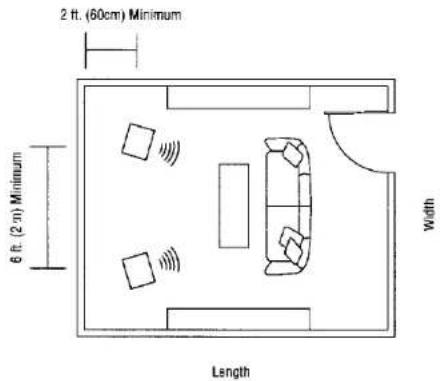
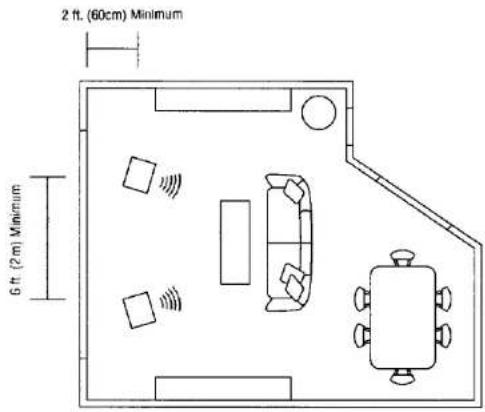
These guidelines are just that. The sound you achieve will also depend on room furnishings, drapery, carpets, and type of construction. Feel free to break these rules if doing so sounds better. Experiment. It is important to us that you be fully satisfied with the performance of your loudspeakers.
Turn off your amplifier to prevent short circuits which can damage your system. You should never change any connections without turning your system off.
It is important to choose a quality speaker wire to ensure top performance. This is especially true for long wire runs. Specialty speaker cables are available from your dealer for this purpose.
Should these be unavailable the chart below should be followed in selecting the minimum, gauge:
| up to 15 ft (5m) | 16 ga. (1.3mm) |
| 15-30 ft (5-10m) | 14 ga. (1.6mm) |
| over 30 ft (10m+) | 12 ga. (2.0mm) |
In an asymmetrical room, it is generally best to place the speakers facing the asymmetry. Try to keep the walls closest to the speakers at a similar distance.
On the back of the speaker, near the bottom, you will see two pairs of terminals. Each pair has 1 red terminal (+) and 1 black terminal (-). These will accept a number of different connection configurations. "Spade" lugs or "Banana" plugs are preferred but they will accept bared wire up to 4mm. If you are using bared wire, use the hole in the post rather than wrapping it around and tightening.
WARNING: MAKE CERTAIN THAT ALL STRANDS ARE NEATLY TUCKED INTO THE HOLE TO AVOID SHORT CIRCUITS.
If you are not bi-wiring or bi-amping, either the upper or lower pair of terminals may be used. Of course, the connecting strips between the terminals must be left in place. Connect the red (+) terminal on the speaker with the red (+) terminal on the back of your amplifier and similarly with the black. If these connections are reversed on one of the loudspeakers, bass output will drop dramatically. In this condition, the speakers are out of phase. If both are reversed, bass output is unaffected but absolute phase is lost. This will not be noticed on most recordings but you might as well have it right.
WARNING: IF YOU ARE BI-WIRING OR BI-AMPING AND ARE UNCLEAR ABOUT ANY ASPECT OF THE FOLLOWING SECTIONS, CONSULT YOUR DEALER. DON'T GUESS, YOU CAN DO SERIOUS DAMAGE TO YOUR SYSTEM.
BI-WIRING
Remove and save the connecting strips between the two pairs of terminals. The two terminals are now completely isolated from each other. The upper pair of terminals connects to the tweeter and midrange crossovers and the lower to the woofer crossover in the Sixty. In the Fifty the lower terminal connects to the woofer crossovers and the upper to the tweeter. Connect the appropriate wires to the appropriate terminals and your amplifier. Pay extra attention to maintaining correct phase as above. Errors in this case can introduce frequency response anomalies and prevent accurate imaging.
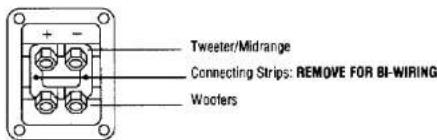
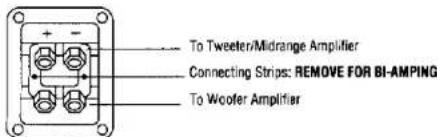
Bi-amping can have very beneficial effects. However, if you are bi-amping, there are number of points you must keep in mind in addition to those mentioned in the Bi-WIRING section.
WARNING: YOU MUST REMOVE THE CONNECTING STRIPS BETWEEN THE TERMINALS. FAILURE TO DD THIS CAN DESTRDY YOUR AMPLIFIERS AND MAYBE SPEAKERS AS WELL. DD SO NOW.
If the amplifiers you are using are not identical, ascertain the following...
- That the amplifiers have the same polarity. Some amplifiers invert phase and this condition will have the same effect as miswiring in the bi-wiring mode. If one of your amplifiers inverts phase, be sure to invert its connection to its corresponding speaker terminal. That is, connect its red (+) terminal to the black (-) terminal on the speaker.
- That the amplifiers have the same sensitivity. That is, that they achieve their respective rated power at the same input voltage. A better alternative is to use power amplifiers that have input attenuators. Care must be taken to adjust the output of the amplifiers so that the speakers sound as balanced as possible. Otherwise, the woofers or the midrange / tweeter will be playing too loud or soft. Naturally, this will have deleterious effects on fidelity.
It is generally recommended that the more powerful amplifier be used for low frequencies.
The equipment you choose to complement your loudspeakers will have a direct bearing on the quality of sound you will achieve. As your loudspeaker is very efficient, it is not necessary to use high powered amplifiers to drive them to realistic levels. Your money is better spent on quality rather than high "spec" power. Your loudspeakers are capable of the highest possible performance and will do justice to the best electronics.
MAINTENANCE SUGGESTIONS
Once your system is set-up and performing to your satisfaction, a few simple maintenance routines are suggested for long term satisfaction.
The surfaces of your loudspeaker are designed to keep looking like new with a minimum of maintenance. Gloss surfaces are of aircraft grade and will maintain their appearance indefinitely. Clean these surfaces with a soft cloth and a glass cleaner. NEVER use abrasive or corrosive cleaners such as powders or bathroom cleaners as these may mar the surface. Hard to remove stains such as adhesives or uncured paint can be removed with a little mild solvent such as turpentine and gentle rubbing with a soft cloth. NEVER use strong solvents like acetone as these can dull the finish.
Cloth surfaces are also resistant to abuse. However they can be permanently stained by liquids such as coffee, paint, food and some liquid cleaners. Do not place containers which can leak on top of the speakers. Shiny spots may develop on the cloth during shipment. These are easily removed by brushing briskly with a clean stiff brush. Occasional vacuuming will remove any dust that might accumulate.
In general, avoid placing the speakers close to sources of high heat. Continuous sunshine will bleach the cloth surfaces and excessive dampness will damage the wood components.
The terminals and connecting strips are gold plated and should never tarnish. However, unless the connectors used on the ends of your wire are also gold plated, they will require periodic cleaning to prevent signal degradation.
POWER HANDLING
There are no accepted industry standards for determining loudspeaker power handling. No standard could readily account for all the complexities music presents.
The power handling of your loudspeaker depends as much on the accompanying equipment and the type of music you listen to, as it does on the components of the speaker system. For instance, a 25 watt amplifier driven beyond its rated output is capable of causing damage to a speaker that would be comfortable at-that listening level with a 200 watt amplifier.
Any speaker, even in a well balanced system, has a finite power limit. Speakers give audible indications when they are approaching those limits. A speaker close to its power limit will sound distorted, strained and harsh. When your speakers begin to sound like that, TURN THE VOLUME DOWN to avoid damage. Failure to do so constitutes abuse and will result in damage that will not be covered by your warranty.
If you wish, "in-line" fuses can be purchased to protect the speaker from the most violent abuses. However, fuses are not foolproof and can degrade the signal.
NEVER, EVER even think about touching the dome of the alloy tweeter. It is FRAGILE and easily dented. This unit depends on the integrity of its shape for its superb performance. Any alteration to that shape will result in a degradation of its fidelity.
The speaker is tall and heavy. Be certain that pets and children cannot knock it over. Serious personal injury can result. The damage to the speaker will be the least of your concerns in such cases.
Should there appear to be a malfunction, please look through the checklist below before phoning your dealer or bringing your speaker to him.
No/Weak Sound: System not powered, check all fuses, circuit breakers etc. Partial short circuit, check connections.
Dull Sound: For NORMAL wiring check that connecting strips are firmly attached. If bi-wiring / bi-amping check the connections to the tweeter / midrange.
Lack of Bass: Check Polarity. For NORMAL wiring check that connecting strips are firmly attached. If bi-wiring / bi-amping check the connections to the woofers.
If the above checklist fails to reveal the problem, contact your dealer. He will help you get the speaker sounding right and arrange repairs if necessary.
ADVICE & WARNINGS
DESIGN CONSIDERATIONS
For the technically minded. The harman/kardon Sixty and Fifty represent harman/kardon's most ambitious loudspeakers to date. The design objectives and engineering parameters were the result of a careful consideration of the technical functions a loudspeaker has to perform in a listening room, as well as the impact those have on the psycho-acoustic processes that interpret those functions.
The design objectives for the Sixty & Fifty included:
■ "Flat" amplitude response across the audio band, both on and off axis for tonal accuracy.
■ Maximally wide and smooth dispersion with a minimum of discontinuity for accurate imaging and a wide choice of listening positions.
■ Undetectable levels of coloration for fine resolution of musical detail.
■ High sensitivity and power handling for accurate capture of musical dynamics, even with modest power amplifiers.
The sound radiated directly forward from the loudspeaker is known as the 0° or "on-axis" response. The Sixty's 0° axis coincides with the midrange which has been placed at ear level for the "average" seated listener, the Fifty's with the tweeter. The 0° signal reaches the listener first, and with more intensity, than any of the additional, reflected signals so it is critically important that the 0° response be "flat". Sound radiating at various angles from the loudspeaker also reaches the ear, at reduced amplitude, as it reflects from room boundaries. If this, "off- axis" sound is not also tonally balanced, the speakers will prove problematic in set up and restrict the listener's seating options.
"Coloration" is the result of poorly controlled resonances in the drivers, in the cabinet panels, or even electrical resonances in the crossover. By carefully designing the drivers, a maximally wide non-resonant range has been achieved. By utilizing steep, 4th order cut-off slopes, the crossover ensures that out-of-band driver resonances are highly attenuated. The latest digital data acquisition and analysis techniques have been utilized to design out any likely electrical resonance-problems.
The reduction of cabinet colorations has also received an unusual amount of attention. The best materials and scientific panel studies ensure that the structure is extraordinarily rigid and resonance free.
The fact that efficiency and power handling translates to wide dynamic range in speakers has not been overlooked. You will notice that your harman/kardons capture musical dynamics with power and grace absent in other systems.
YOUR HARMAN/KARDON SPEAKER SYSTEM IS WARRANTED FOR A PERIOD OF 5 YEARS FROM THE DATE OF ORIGINAL PURCHASE.
WHO IS PROTECTED BY THIS WARRANTY
Your harman/kardan warranty protects the original owner and all subsequent owners, so long as the original bill of sale is presented when warranty service is required
WHAT IS COVERED BY THE HARMAN/KARDON WARRANTY
Your harm/kardon warranty covers all defects in material and workmanship with the following specified exceptions. These are: (1) damage caused by accident, unreasonable use or neglect (including the lack of reasonable and necessary maintenance); (2) damage occurring during shipment claims must be presented to the carrier); (3) damage to or deterioration of any accessory or decorative wooden surface; (4) damage resulting from failure to follow instructions contained in your owner's manual; (5) damage resulting from the performance of repairs by someone other than harm/kardon or an authorized harm/kardon warranty station; (6) any harm/kardon and on which the serial number has been effaced, modified or removed; (7) units used as demonstration or display models prior to purchase by the original consumer owner, and; (8) units used for the purpose other than home use.
HOW TO OBTAIN WARRANTY PERFORMANCE
If your harman/kardon product ever needs service, write to us at harman/kardon, Incorporated, 8360 Balboa Boulevard Northridge CA 91325 (Afternoon Customer Relations Department). We may direct you to send your unit to the factory for repair in which case we'll also supply a Service Return Authorization and complete shipping instructions. Either way, you'll need to present the original bill of sale to establish the date of purchase. Please do not ship your harman/kardon product to the Northridge address without our prior written authorization.
If service under this warranty is not necessary but you have questions regarding the installation or operation of the unit, please write to our Customer Relations Department at the address above.
WHO PAYS FOR WHAT
Hamman/kardon will be happy to pay all labor and material expenses for all repairs covered by this warranty. If necessary repairs are not covered by this warranty, or if a unit is examined which is not in need of repair, you will be charged for the repairs or the examination.
Although you must pay any shipping charges incurred in getting your human/kardon product to a her-man/kardon Authorized Warranty Station or to the factory, we will pay return shipping charges if the repairs are covered by the warranty. Please be sure to save the original shipping cartons because a nominal charge will be made for additional cartons.
LIMITATION ON IMPLIED WARRANTIES
Implied warranties of merchantability and fitness for particular purpose are limited in duration to the length of this warranty, unless otherwise provided by state law.
EXCLUSION OF CERTAIN DAMAGES
HARMAN/KARDON'S LIABILITY IS LIMITED TO THE REPAIR OR REPLACEMENT AT OUR OPTION. OF ANY DEFECTIVE PRODUCT AND SHALL IN NO EVENT INCLUDE INCIDENTAL OR CONSEQUENTIAL COMMERCIAL DAMAGES OF ANY KIND
SOME STATES DO NOT ALLOW LIMITATIONS ON HOW LONG AN IMPLIED WARRANTY LASTS AND/OR DO NOT ALLOW THE EXCLUSION OF INCIDENTAL OR CONSEQUENTIAL DAMAGES, SO THE ABOVE LIMITATIONS AND EXCLUSIONS MAY NOT APPLY TO YOU.
This warranty gives you specific legal rights, and you may also have other rights which vary from state to state. We sincerely thank you for your expression of confidence in hammandardon products. This equipment has been painstakingly assembled by highly trained craftspeople. It should give you many years of musical enjoyment.
LIMITED VARRANTY
- Congratulations on your purchase of the harman/kardon Sixty/ Fifty loudspeaker system
- WARNING: MAKE CERTAIN THAT ALL STRANDS ARE NEATLY TUCKED INTO THE HOLE TO AVOID SHORT CIRCUITS.
- BI-WIRING
- WARNING: YOU MUST REMOVE THE CONNECTING STRIPS BETWEEN THE TERMINALS. FAILURE TO DD THIS CAN DESTRDY YOUR AMPLIFIERS AND MAYBE SPEAKERS AS WELL. DD SO NOW.
- MAINTENANCE SUGGESTIONS
- POWER HANDLING
- ADVICE & WARNINGS
- DESIGN CONSIDERATIONS
- YOUR HARMAN/KARDON SPEAKER SYSTEM IS WARRANTED FOR A PERIOD OF 5 YEARS FROM THE DATE OF ORIGINAL PURCHASE.
- WHO IS PROTECTED BY THIS WARRANTY
- WHAT IS COVERED BY THE HARMAN/KARDON WARRANTY
- HOW TO OBTAIN WARRANTY PERFORMANCE
- WHO PAYS FOR WHAT
- LIMITATION ON IMPLIED WARRANTIES
- EXCLUSION OF CERTAIN DAMAGES
- LIMITED VARRANTY
Brand : HARMAN KARDON
Model : Fifty
Category : Pregnant