
DD-RN42 - Audio Interface RDL - Free user manual and instructions
Find the device manual for free DD-RN42 RDL in PDF.


| Product Type | Wall-Mounted Bi-Directional Mic/Line Dante Interface 4x2 |
| Brand | RDL |
| Model | DD-RN42 |
| Network Protocol | Dante |
| Audio Conversion | 24-bit A/D and D/A |
| Sample Rates | 44.1 kHz, 48 kHz (default) |
| Mic Inputs | 2 x XLR (female) with software-selectable gain: 35 dB (LOW), 42 dB (MED), 59 dB (HIGH); phantom power 48V selectable |
| Line Inputs (Front) | 2 x XLR (female) with gain: Unity (NORM), 12 dB (HIGH) |
| Line Inputs (Rear) | 2 x balanced, detachable terminal block with gain: Unity (NORM), 12 dB (HIGH) |
| Line Outputs | 2 x XLR (male), balanced, +4 dBu nominal, software attenuator 0 to 62 dB plus OFF |
| Frequency Response | 20 Hz to 20 kHz (±0.5 dB) |
| Power Requirement | PoE Class 0 (IEEE 802.3af) |
| Dimensions (W x H x D) | 3.52" x 4.11" x 2.09" (8.94 x 10.44 x 5.31 cm) |
| Shipping Weight | 0.878 lbs (398 g) |
| Mounting | Fits US dual-gang electrical box or RDL WB-2 back box |
| Front Panel Finish | Dual powder-coated or stainless steel Decora |
| Indicators | Ethernet Link/Speed (rear), Sync/Power (front) green LEDs |
| Operating Temperature | 0°C to 40°C; 30°C max recommended |
| Country of Origin | USA |
| Software Control | RDL CONSOLE or other Dante network control software |
| Audio Performance | THD+N < 0.1%, CMRR 65 dB, EIN < -128 dBu (59 dB gain) |
| Input Impedance | > 1.2 kΩ |
| Compliance | Declaration of conformity available from rdlnet.com |
| Maintenance | Clean with a dry cloth; avoid moisture and solvents |
| Safety | Use only PoE power; do not expose to liquids; install in ventilated area |
| Spare Parts / Reparability | No user-serviceable parts; contact RDL for service |
Frequently Asked Questions - DD-RN42 RDL
User questions about DD-RN42 RDL
0 question about this device. Answer the ones you know or ask your own.
Ask a new question about this device
Download the instructions for your Audio Interface in PDF format for free! Find your manual DD-RN42 - RDL and take your electronic device back in hand. On this page are published all the documents necessary for the use of your device. DD-RN42 by RDL.
USER MANUAL DD-RN42 RDL
Model DD SERIES-RN42 Wall-Mounted Bi-Directional Mic/Line Dante Interface 4x2
• Dante Network Interface for Four Audio Inputs and Two Audio Outputs
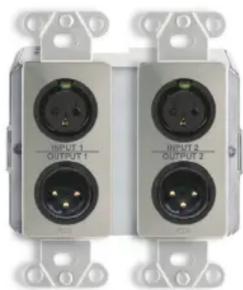
• Two Inputs and Outputs on XLR Jacks on Front Panels
- Two Inputs on Rear Panel Detachable Terminal Block
- Module is Configured and Adjusted Using Network Control Software
- Converts Two Standard Mic or Line Audio Sources to Dante Network Channels
• Each Input Gain is Selected by Software
• Mic Gain: 35 dB, 42 dB or 59 dB
• Line Gain: Unity or 12 dB
• 48 V Mic Phantom (P48) Selected by Software
• Converts Two Dante Network Audio Signals to Line Level
• Each Output Equipped with Software Controlled Attenuator in 1 dB Steps
• Studio Quality, Low-Noise Performance
- High Resolution 24 Bit Analog to Digital and Digital to Analog Conversion
• Legendary RDL Analog Filtering Enhances Superb Audio Performance

natural_image
Exterior view of two identical electrical connectors labeled INPUT 1 and INPUT 2, with no visible text or symbols beyond component labels.DD-RN42


natural_image
Two identical black electrical output terminals labeled INPUT 1 and INPUT 2, each with a small indicator light (no additional text or symbols visible)DDB-RN42 DDS-RN42
natural_image
Four identical gray electrical input/output terminals with four circular ports, no visible text or symbolsAPPLICATION: The DD-RN42 is a complete wall-mounted Dante audio network interface. It features two XLR mic or line inputs on the front panels, two balanced line inputs on a rear-panel detachable terminal block and two balanced line outputs on front-panel XLR jacks. The module is configured and adjusted using RDL CONSOLE or other network control software. The DD-RN42 fits a standard US dual-gang electrical box or an RDL WB-2 back box for installations in thinner European or equivalent walls. The DD-RN42 is PoE powered, and is available in multiple finishes with optional customized graphics.
Mic/Line to network section
The two XLR inputs are each converted to a separate Dante network transmit channel. Three gain settings are software-selectable for both the mic and line input ranges to match condenser or dynamic mic levels and standard line levels. P48 phantom voltage may be software enabled when an input is set for mic level.
Line to network section
The two rear-panel balanced or unbalanced inputs are each converted to a separate Dante network transmit channel. Control software sets the gain for an input level of either +4 dBu or -10 dBV. RDL Decora®-style jack plates matching the appearance of the DD-RN42 are optionally available for connection of various audio sources to the rear-panel inputs. An input plate may be located together with the DD-RN42 in a triple gang box or may be mounted remotely in a single box.
Network to line section
Two Dante audio channels are converted to balanced line level feeding front-panel XLR jacks. Each output provides +4 dBu balanced for a network digital audio level of -18 dBFS. Each output is equipped with a software controlled attenuator adjustable in 1 dB steps to a maximum attenuation of 62 dB then OFF. The outputs are connected through a detachable terminal block.
Valid PoE power and synchronization to the Dante network are indicated by green LEDs visible from the front of the unit.
The DD-RN42 is a professional grade product with RDL mic preamplifiers for studio quality fidelity and low noise performance, coupled through XLR jacks housed in a steel chassis with dual powder-coated or stainless steel Decora front plates.
The DD-RN42's superior performance specifications make it ideally suited to installations requiring network control and exceptional value in commercial networked audio systems. This full-featured product is engineered and manufactured in the U.S.A for continuous duty in demanding installations. Designed to outperform. Built to last.
Model DD SERIES-RN42
Wall-Mounted Bi-Directional
Mic/Line Dante Interface 4x2
Installation/Operation

Declaration of Conformity available from rdlnet.com. Sole EMC specifications provided on product package. Specifications are subject to change without notice.

This product is not specified to provide basic insulation from network cabling not installed wholly within the same building structure or terminated on equipment earthed to a different earthing network.
Model DD SERIES-RN42 Wall-Mounted Bi-Directional Mic/Line Dante Interface 4x2
This product is not specified to provide basic insulation from network cabling not installed wholly within the same building structure or terminated on equipment earthed to a different earthing network.
TYPICAL PERFORMANCE
Network Connector: RJ45 with Link and Speed indicators
Digital Audio Ethernet Protocol: Dante
Transmission Rate: 100 Mbps
Sample Rates Supported: 44.1 kHz, 48 kHz (default)
Bit Depth Supported: 24 bits
Audio Operating Level: -18 dBFS = +4 dBu
Reference Level: 0 dBFS = +22 dBu
Mic/Line Inputs to Network Interface
Inputs (2): XLR (female)
Gain: Mic: 35 dB (LOW), 42 dB (MED), 59 dB (HIGH);
Line: Unity (NORM), 12 dB (HIGH)
Input Level (for +4 dBu/-18 dBFS): Mic: -31 dBu (LOW), -38 dBu (MED), -55 dBu (HIGH);
Line: +4 dBu (LOW), -8 dBu (HIGH)
Input Level (maximum): Mic: -14 dBu (LOW), -21 dBu (MED), -38 dBu (HIGH);
Line: +23 dBu (LOW), +10 dBu (HIGH)
Input Impedance: > 1.2 kΩ
Phantom Power: P48, 48 Vdc, software-selectable
Standard for Phantom: IEC 61938: 2013
Selectors per input (2): Phantom, Gain, software-selectable
Frequency Response: 20 Hz to 20 kHz (± 0.5 dB)
Equivalent Input Noise: < -128 dBu (59 dB gain); < -130 dBu A-Weighted
Noise below -18 dBFS (20 to 20 kHz): Mic: < -88 dB (LOW), < -82 dB (MED),
<-68 dB (HIGH); Line: < -88 dB (NORM),
< -88 dB (HIGH)
THD+N:
< 0.1% (20 Hz to 20 kHz, +4 dBu/-18 dBFS)
CMRR:
65 dB (50 Hz to 120 Hz)
Crosstalk:
Below Noise Floor (20 Hz to 20 kHz at operating level,
any input to any input, max. mic gain)
Line Inputs to Network Interface
Inputs (2): Balanced, detachable terminal block
Gain: Unity (NORM), 12 dB (HIGH)
Input Level (for +4 dBu/-18 dBFS): +4 dBu (NORM), -8 dBu (HIGH)
Input Level (maximum): +23 dBu (NORM), +10 dBu (HI)
Input Impedance: > 1.2 kΩ
Selector per input:
Gain, software-selectable
Frequency Response: 20 Hz to 20 kHz (± 0.5 dB)
Noise below -18 dBFS (20 to 20 kHz):
< 0.1% (20 Hz to 20 kHz, +4 dBu/-18 dBFS)
THD+N:
65 dB (50 Hz to 120 Hz)
CMRR:
Network to Line Outputs
Outputs (2):
XLR (male)
Output Level (operating):
+4 dBu (nominal) balanced,
software adjustable in 1 dB steps
Output Level (maximum):
+22 dBu balanced
Output Attenuation:
0 to 62 dB plus OFF (each output)
Output Impedance:
150 Ω balanced
Frequency Response: 20 Hz to 20 kHz (± 0.5 dB)
THD+N:
< 0.1%
THD:
< 0.01% (1 kHz)
Noise:
< -80 dB (below +4 dBu or -10 dBV)
Crosstalk:
Below Noise Floor (20 Hz to 20 kHz at
operating level, output to output)
Headroom above +4 dBu or -10 dBV
20 dB
Indicators (4):
Ethernet Link and Speed (2, rear panel);
Sync and Power (2, front panel)
Ambient Operating Environment:
0°C to 40°C; 30°C maximum recommended
Power Requirement:
PoE Class 0, IEEE 802.3af
Specification Conditions:
Gain/Level: ± 1 dB; Source termination: 150 Ω;
A to D values measured in digital domain
Dimensions:
3.52" (8.94 cm) W; 4.11" (10.44 cm) H;
2.09" (5.31 cm) D
Cardboard Box
Package Type:
Package Dimensions: 3.625 x 4.625 x 2.125 in.
Shipping Weight:
0.878 lbs.
WEEE weight:
0.723 lbs.
Tariff code:
8543.70.9100
Equivalent Gain Settings for Dante Products
Digital signal levels in a Dante network are measured in dBFS (dB referenced to the maximum output or clipping level). The nominal standard reference levels used in professional audio products are: 0 dBFS = +22 dBu to +24 dBu. Some OEM industry products do not specify their reference and use a non-standard reference such as 0 dBFS = +2 dBu. The following table shows the most closely equivalent gain settings that equate to the gain settings of products using a 0 dBFS = +2 dBu reference:
Software Settings for MIC/LINE balanced inputs
| Non-Standard Reference (OEM) | RDL DD-R Products | ||
| Gain Setting | Gain Setting | MIC/LINE Setting | |
| -18 dB | Unity | Line | |
| -3 dB | 12 dB | Line | |
| ---- | (condenser mics) | 35 dB | Mic |
| 25 dB | 42 dB | Mic | |
| 40 dB | 59 dB | Mic | |

- Model DD SERIES-RN42 Wall-Mounted Bi-Directional Mic/Line Dante Interface 4x2
- Mic/Line to network section
- Line to network section
- Network to line section
- Model DD SERIES-RN42
- Wall-Mounted Bi-Directional
- Mic/Line Dante Interface 4x2
- Installation/Operation
- TYPICAL PERFORMANCE
- Mic/Line Inputs to Network Interface
- Line Inputs to Network Interface
- Network to Line Outputs
- Equivalent Gain Settings for Dante Products
Brand : RDL
Model : DD-RN42
Category : Audio Interface