
ER-9000 - Uncategorized SEIKO - Free user manual and instructions
Find the device manual for free ER-9000 SEIKO in PDF.


| Product Type | Label Printer |
| Brand | Seiko |
| Model | ER-9000 |
| Display | Backlit LCD, 2-line |
| Print Technology | Thermal Transfer |
| Print Resolution | 203 dpi |
| Print Speed | Up to 4 inches/second |
| Connectivity | USB 2.0, RS-232 Serial |
| Power Supply | AC Adapter 100-240V, 50/60Hz |
| Dimensions (W x D x H) | 200 x 150 x 100 mm |
| Weight | 1.5 kg |
| Paper Width | Up to 60 mm |
| Automatic Cutter | Yes |
| Barcode Support | Code 39, Code 128, EAN-13, UPC-A |
| Language Support | Multiple languages via software |
| Memory | 1 MB Flash, 256 KB RAM |
| Operating Temperature | 5°C to 40°C |
| Cleaning | Clean print head with isopropyl alcohol after every 5 rolls |
| Warranty | 1 Year Limited |
Frequently Asked Questions - ER-9000 SEIKO
User questions about ER-9000 SEIKO
0 question about this device. Answer the ones you know or ask your own.
Ask a new question about this device
Download the instructions for your Uncategorized in PDF format for free! Find your manual ER-9000 - SEIKO and take your electronic device back in hand. On this page are published all the documents necessary for the use of your device. ER-9000 by SEIKO.
USER MANUAL ER-9000 SEIKO
Thank you for purchasing the ER9000.
Please read this operation manual carefully before using the product.
This unit contains six dictionaries and reference works: the Britannica Concise Encyclopedia, Oxford Dictionary of English, Oxford Thesaurus of English, Oxford Dictionary of Quotations, Fowler's Modern English Usage, Oxford Dictionary of Modern Slang and Oxford Dictionary of Abbreviations.
You can expand your English vocabulary further through use of the Spellchecker, the 14 Solvers, the 15 Word Games, and the Easy Learn function.
Oxford Dictionary of English, Second Edition revised © Oxford University Press 2005 Oxford Thesaurus of English, Second Edition revised © Oxford University Press 2006 Oxford Dictionary of Quotations, Sixth Edition © Oxford University Press 2004 Fowler's Modem English Usage, Third Edition revised © Oxford University Press 2004 Oxford Dictionary of Modern Slang, First Edition reissue © Oxford University Press 2005 Oxford Dictionary of Abbreviations, Second Edition © Market House Books 1998 New British English Word List v 2.0 © Oxford University Press 2007
CE CN681
EC DECLARATION OF CONFORMITY
This is to certify that this equipment fully conforms to the protection requirements of the following EC Council Directives on the approximation of the laws of the member states relating to:-
89/336/EEC Electromagnetic Compatibility
Applicable Standards
EN55022: 1998 Electromagnetic Compatibility - Emissions (Radiated)
EN55024: 1998 Electromagnetic Compatibility - Immunity (Radiated Susceptibility. ESD) SEIKO UK Limited SC House, Vanwall Road, Maidenhead, Berks. SL6 4UW U.K.
This equipment has been tested and found to comply with the limits for a Class B digital device, pursuant to Part 15 of the FCC Rules. These limits are designed to provide reasonable protection against harmful interference in a residential installation. This equipment generates, uses and can radiate radio frequency energy and, if not installed and used in accordance with the instructions, may cause harmful interference to radio communications. However, there is no guarantee that interference will not occur in a particular installation. If this equipment does cause harmful interference to radio or television reception, which can be determined by turning the equipment off and on, the user is encouraged to try to correct the interference by one or more of the following measures: - Reorient or relocate the receiving antenna. - Increase the separation between the equipment and receiver. - Connect the equipment into an outlet on a circuit different from that to which the receiver is connected. - Consult the dealer or an experienced radio/TV technician for help.

Note: this device should be disposed of through your local electronic product recycling system - do not throw away in your domestic rubbish.
The display screen can be switched to Large, Middle or Small. (See page 97.)
The screen display examples used in this manual are shown in the "Middle" format.
Since this unit contains the most recent publishers' updates, there will be some minor differences between the data displayed here and that in the print books.
The unit does not contain book-edition photographs, diagrams and tables, boxed items and some appendices.
CONTENTS
Preparation for using the unit ..... 4
-
Install the Batteries. 4
-
Reset the unit.... 4
-
Adjust the LCD contrast.....4
-
Set the key sound ..... 5
-
Delete the Easy Learn memory.....5
Demo function 5
Changing Batteries 6
Resetting....7
Functions and Features .....8
The Keys and their Functions..... 12
Help function ......14
Entering and Correcting Letters ..... 15
Encyclopedia......16
Headword Search 16
Category Search 18
Jump function.... 20
Dictionary 22
Headword Search 22
Subject Search 24
Words by Category 26
Names by Category ...... 28
Jump function.... 30
Smart Jump function ...... 31
Thesaurus 32
Headword Search 32
Word List.... 34
Confusable Words ...... 37
Jump function 38
Smart Jump function 39
Dictionary of Quotations....40
Author Name Search 40
Jump function 41
Keyword Search 42
Theme Search...... 44
Dictionary of English Usage ..... 46
Headword Search 46
Jump function 47
Appendix.... 47
Dictionary of Slang......48
Headword Search 48
Jump function 49
Appendix.... 49
Solvers ....50
Selecting Spellchecker or the solver ..... 50
Spellchecker 51
Crossword Solver 54
Anagram Solver 55
Word Viewer.... 56
Word Maker 57
Phrase Search 58
Definition Search 59
Encyclopedic Search ...... 60
Dictionary of Abbreviations ..... 61
Letter Changer 63
Slang Search 64
Homophones and Homographs..... 65
Cryptic Clue Assistant ...... 66
Games 70
Selecting a game 70
Hangman 70
User Hangman.... 72
Jumble 73
User Jumble.... 74
Crossword Quiz 75
Time and Balance 76
General Knowledge ..... 77
Definitions 78
Synonyms 79
Slang Words 80
Shakespeare 81
Word Building 82
User Word Building 83
Word Challenge 84
Against the Clock 85
Easy Learn......86
Building your word list: ..... 86
Viewing the word list...... 87
Deleting a word.... 88
Deleting all words 89
Calculator / Converters..... 90
Converters 91
Setting function / Character size..... 94
Selecting the menu 94
Changing the Demo mode .... 94
Setting the Game Level ..... 94
Game Scores 95
Setting the frequency for the Easy Learn list 95
Changing the sorting for
the Easy Learn list 96
Setting the Auto Power Off Timer ..... 96
Setting the Key Sound...... 96
Setting the LCD Contrast ..... 97
Variant Spelling 97
Character size.... 97
Appendix 98
Pronunciations in the Oxford
Dictionary of English.... 98
Pronunciations and Abbreviations in
Fowler's Modern English Usage ..... 102
Pronunciations and Abbreviations in the
Oxford Dictionary of Modern Slang ..... 108
Using a power adapter ..... 110
Precautions / Specifications..... 112
FAQ's Generic....114
ONE YEAR LIMITED WARRANTY ..... 115
Preparation for using the unit
1. Install the Batteries.
After purchase and before using the unit for the first time, install the two AAA alkaline batteries packed with the unit in accordance with the following procedure.
- Slide the lock button to the right and release the lock on the battery lid.
- Remove the battery cover by depressing it lightly with both thumbs and sliding it in the indicated direction.
- Insert the batteries as illustrated, making sure not to mistake the polarities (+, -).
- After closing the battery lid securely, slide the lock button to the left and lock the battery cover.
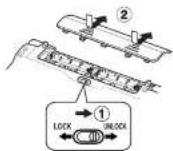
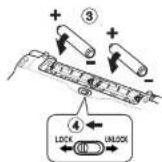
2. Reset the unit.
When using the unit for the first time after installing the batteries, always first reset it by pressing the Reset switch on the back of the unit with a narrow-tipped object after turning off the power.
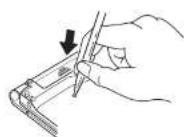
3. Adjust the LCD contrast.
Use Page to adjust the contrast of the display and then press ENTER
The LCD contrast can also be adjusted using the "Setting" function. (See page 97.)
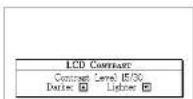
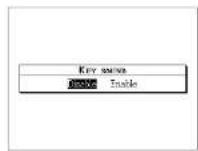
4. Set the key sound.
You can turn the key touch sound on and off by using Sense or Sense and then press ENTER.
The "Key sound" can also be set using the "Setting" function. (See page 96.)
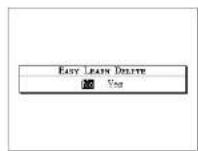
5. Delete the Easy Learn memory.
When using the unit for the first time, select "Yes" and then press ENTER
A demonstration display will appear.
* If you select "Yes" and then press a EITER having used the unit before, the Easy Learn List in the memory will be deleted.
Demo function
When you turn on the power, a demonstration display will begin to explain the contents of the unit.
You can stop the demonstration by pressing any of the keys.
* If you want to turn off the demonstration display, press SET and select "Demo Message".
Select "Disable" and press ENTER (See page 94.)
■ Changing Batteries
The battery mark (☐) will appear at the right of the screen when the batteries are almost exhausted, meaning that it is time to replace them.
• The unit is powered by two AAA alkaline batteries.
- Do not use a previously used battery together with a new battery.
- Make sure that power is switched off before replacing batteries.
- Press the "RESET" button on the bottom of the unit after battery replacement.
- Changing batteries and Resetting erase the calculator memory and initialize settings.
- C are is needed since if you remove the batteries or press the RESET switch within three seconds of turning the power off, all the data stored in the memory will be deleted except for the Easy Learn memory.
The Easy Learn memory can be kept by selecting "No" at the Easy Learn Delete selection after the RESET.
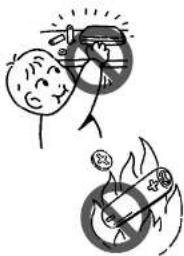
CAUTION
• The batteries may pose a choking hazard to small children.
- Keep the batteries and product away from small children.
- Do not expose the batteries to open flame or intense heat.
- Rechargeable batteries cannot be used.
• D o not try to recharge batteries.
- Never use batteries other than those specified.
- Remove the batteries from the unit if you do
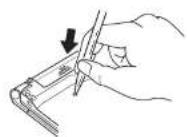
Resetting
If the unit does not operate properly after the batteries have been replaced, or if at any time the unit fails to operate properly, gently press the "RESET" button on the bottom of the unit.
NOTE:
Resetting product deletes all the data stored in the memory except for the Easy Learn memory.
The Easy Learn memory can be kept by selecting "No" at the Easy Learn Delete selection after the RESET.
Functions and Features
1 Dictionaries and Encyclopedia
Oxford Dictionary of English
The foremost single-volume authority on the English language - revised and updated to include the very latest vocabulary. The Oxford Dictionary of English is at the forefront of language research, focusing on English as it is used today, informed by the most up-to-date evidence from the largest language research programme in the world, including the 800-million-word Oxford English Corpus. Ideal for anyone who needs a comprehensive and authoritative dictionary of current English; for professionals, students, academics, and for use at work or at home. Unique semantic linking between the dictionary and thesaurus enables you to jump directly to synonyms of the correct sense.
Oxford Thesaurus of English
Authoritative coverage of more synonyms and antonyms than any other A-Z thesaurus. It is accessible and easy to use, listing synonyms in order of usefulness, and giving thousands of examples of words in use to help you choose the right synonym. There are over 300 word lists which have been fully revised and reorganized and include topics from clothes and food, to medicine and music, with new lists of foreign words and phrases, archaic words, imitative words, British and American equivalents, and more. It is an invaluable resource to help broaden your vocabulary and provide quick answers to word puzzles and crossword clues.
Oxford Dictionary of Quotations
For over 60 years, the favourite guide to the wit and wisdom of past and present. The text is a browser's paradise, covering people and events from Cleopatra to J.K.Rowling, and the battle of Marathon to the Hutton Inquiry. Search by Author, Keyword or Theme to trace that half-remembered quote. Identify the quotations that give us key phrases such as 'state of the Union' and 'dodgy dossier'. Special sections bring together categories such as Misquotations and Film Lines.
Fowler's Modern English Usage
Fowler's Modern English Usage is the world-famous guide to English usage, loved and used by writers of all kinds. In keeping with its long tradition, Fowler's gives comprehensive and practical advice on grammar, syntax, style, and choice of words. It gives in-depth coverage of both British and American English with reference to the English of Australia, Canada, New Zealand, and South Africa. Based on the evidence and research of the Oxford Dictionaries Programme, this is the most comprehensive and authoritative guide to usage available.
Oxford Dictionary of Modern Slang
From ambulance chaser to zoot suit, this is the most authoritative and up-to-date dictionary of modern slang. Drawing on the resources of the Oxford English Dictionary, and packed with illustrative quotations from John Lennon to Woody Allen, it is a comprehensive and entertaining collection of over 5,000 slang words and phrases. Providing full details of origins and dates of first printed use, the text contains expressions from all around the English-speaking world.
Oxford Dictionary of Abbreviations
This is the most comprehensive dictionary of abbreviations available. In a world of rapidly proliferating abbreviations and acronyms, it is indispensable at home and in the office. It covers the most important business, scientific, and technical abbreviations, as well as those in everyday use. In addition to abbreviations used in English-speaking countries, the dictionary includes some non-English terms.
Britannica Concise Encyclopedia
Expanded with new and updated entries, the Britannica Concise Encyclopedia is the perfect reference resource for home, school, or office. With more than 25,000 entries prepared by the editors of Encyclopedia Britannica, it covers nearly every field of human knowledge: history, geography, world affairs, the sciences, religion, sports, entertainment, technology, and the arts.
2 Spellchecker
Instant phonetic spelling correction for over 225,000 words ensures you will always have the answer at your fingertips.
3 Solvers
The 14 indispensable solvers to help you with word games:
Crossword, Anagram, Word Viewer, Word Maker, Phrase Search, Definition Search, Encyclopedic Search, Dictionary of Abbreviations, Abbreviation Search, Letter Changer, Slang Search, Homophones and Homographs and Cryptic Clue Assistant
4 Word Games
You can take on the challenge of 15 different word games set to any one of three levels of difficulty.
Hangman, User Hangman, Jumble, User Jumble, Crossword Quiz, Time and Balance, General Knowledge, Definitions, Synonyms, Slang Words, Shakespeare, Word Building, User Word Building, Word Challenge and Against the Clock
5 Easy Learn
The Easy Learn function allows you to create your own word list from the Encyclopedia, Dictionaries, Spellchecker, Solvers and Games.
6 Calculator
A full function calculator including memory and % functions.
12 digits, 1 Memory
7 Converters
The conversion function enables you to convert foreign currencies and metric/imperial units of length, area, volume, weight, capacity, power, and temperature.
You can also convert foreign clothing sizes of shirts, shoes, hats etc. for men, women and children.
8 Setting function
You can customize the following operating conditions: Demo Message, Game Level, Game Scores, Easy Learn Word, Easy Learn Sorting, Auto Power Off Timer, Key sound, LCD Contrast and Variant Spelling
9 Other Features
Jump function
This function enables you to look up a word displayed on the explanation screen in any dictionary of your choosing, and to register it in the Easy Learn word list.
Help function
A simple explanation of how to operate the various functions can be displayed on the screen at each operational stage in each mode.
Character size function
The size of the character display can be expanded or reduced.
Demo function
A demonstration display explains the contents of the unit.
Real-time search
A headword search occurs after entry of each individual character, enabling immediate display of a list of corresponding headwords. This makes it possible to find the desired headword rapidly.
Preview function
The screen is divided into two parts when a word is searched for.
The upper part of the screen displays not only the search item but also a list. The lower screen shows a preview of an explanation and the meaning of the headword chosen in the upper screen, thereby enabling faster viewing and expanding the range of vocabulary.
The Keys and their Functions
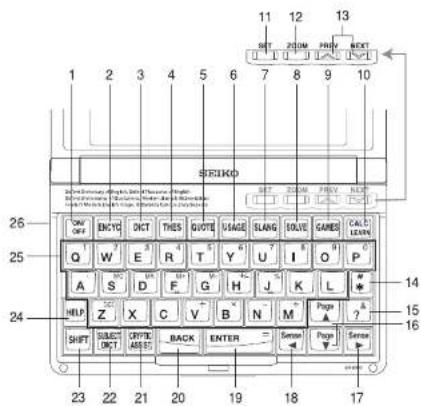
- ON/OFF Tums the power ON and OFF.
- BICYC Selects Encyclopedia mode.
- DICT Selects Dictionary mode.
- THES Selects Thesaurus mode.
- QUOTE Selects Dictionary of Quotations mode.
- USAGE Selects Dictionary of English Usage mode.
- SLANG Selects Dictionary of Slang mode.
- SOLVE Selects Solver mode.
- GAMES Selects Game mode.
- CALC LEARN Selects Easy Learn mode.

- For scrolling through the entries. / Changes the input area.
- [ * ] Used instead of one or more letters if you don't know how to spell a word (including spaces or symbols). [ # ] (With SHIFT key) Used instead of one or more letters if you don't know how to spell a word (without spaces or symbols).
- [?] Substitutes for a single letter when you are uncertain of a spelling. [&] (With SHIFT key) Connects two or more words.
- Page Cursor moves up and down. / Screen moves one line at a time. (With SHIFT key) Screen moves one page at a time.
- Enters space. / Cursor moves to right. / Jump key (With SHIFT key) Screen moves one sense at a time.
- Cursor moves to left. / Jump key (With SHIFT key) Screen moves one sense at a time.
- ENTER Determines the headword and displays the explanation or translation. / Executes after the functions has been determined.
- BACK For deleting the last input character. (With SHIFT key) Clears all input character. Returns to the previous screen or mode.
- CRYPTIC ASSET Activates directly "Cryptic Clue Assistant" function.
- SUBJECT ACTIVATES DIRECTLY "Subject search" in the Dictionary mode.
- SHIFT Shift Key
- HELP Activates Help function.
- Letter and numeral input keys
- DC plug opening
- When the power is turned back on using ON/OFF, the unit will show the display used before the power was last turned off.
The wait can also be turned ON with the mode here.
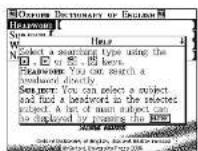
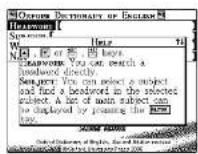
Help function
An explanation of how to operate the various functions is simply explained on the screen at each operational stage in each mode.
Example:
1 P r e ^DIST .
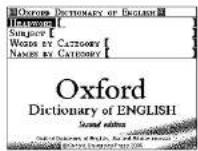
2 P r e ^HSP .
3 Press to see the rest of the explanation.
Press 📄 to scroll up.
-Scrolling the screen -
4 You can clear the help message by pressing any key.

Entering and Correcting Letters
• U se ▶ to enter a space.
- If there is no headword corresponding to the sequence of letters you have entered, the words with the closest spelling will be displayed.
- Corrections can be made by using BACK
- All input characters can be cleared by using SHIFT and then BACK
- Use Sense or Sense to move the cursor.
- The entire display can be cleared by pressing the mode key once or twice.
* When switching the dictionary mode in the character entry state, the previously entered sequence of letters will be taken over unchanged into the "Switched Dictionary Mode".
* Pressing or the character entry state results in the previously entered sequence of letters being taken over unchanged to the "Other Search Method in the Same Dictionary".
Looking up words whose spelling you aren't sure of
When entering the letters, you can enter “?”, “*” or “#” in place of any letters you aren’t sure of.
Use ?& to enter “?”.
This is used in place of a single character.
Use * to enter “*”
This is used in place of one or more characters (including spaces or symbols).
Use SHIFT and then *to enter “#”.
This is used in place of one or more characters (without spaces or symbols).
Encyclopedia
Encyclopedia entry words and articles all come from the Britannica Concise Encyclopedia.

Headword Search
You can search a headword directly.


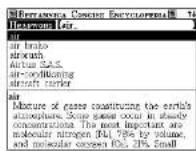
T ype a word.
Example: air
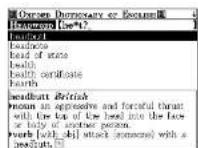
Every time you enter a letter, the corresponding headword list will change.


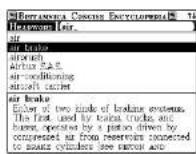
to select the
as necessary.
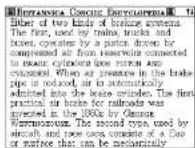
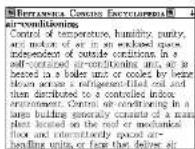
Example: air brake
The preview screen will change in accordance with the selected headword.
-Scrolling the list -


: by line


An explanation screen of the selected

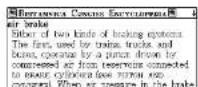


to see the rest of an entry.
Press

to so
- Scrolling the screen -


: by line

+ Page by Page
* Press

to advance to the next
screen.


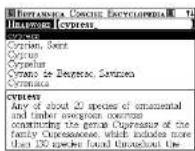
T o clear the display and search for another word, simply enter your new word.
Example: cypress




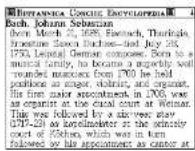
Category Search
You can select a category and find a headword in the selected category.
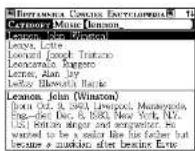
1 P r ess and then to select "CATEGORY".
2 T ype a category name.
Example: music
Every time you enter a letter, the closest match(es) will be displayed.
Use Page or Page to select the category as necessary.
3 P r esser.
4 T ype a word.
Example: bach
Every time you enter a letter, the corresponding headword list in the category will change.
5 Use or to select the headword as necessary
Example: Bach, Johann Sebastian
The preview screen will change in accordance with the selected headword.
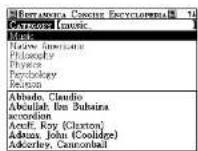
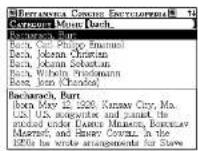
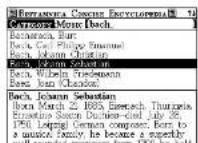
6 P r esser.
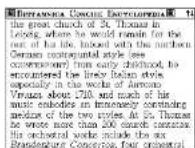
An explanation screen of the selected headword will be displayed.
* Press BACK to return to the headword selection screen.
7 P r ess to see the rest of an entry. Press Page to scroll up.
- Scrolling the screen -
* Press ENTER to advance to the next screen.
8 T o clear the display and search for another word in the same category, simply enter your new word.
Example: lennon

Jump function
This function enables you to look up a word displayed on the explanation screen in any dictionary of your choosing, and to register it in the Easy Learn word list.
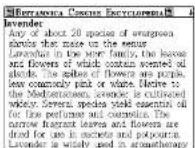
1 P r essc and type a word.
Example: lavender
2 P r OBSER.
3 P r ess to select the first word you can look up.
Press Sando to select the last word.
Selected word will begin to flash on and off.
* Press BACK to return to the previous screen or to disable the cursor.
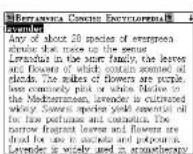
4 Select another word using the cursor keys.
Example: species
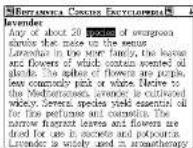
5 P r esser.
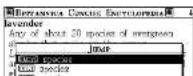
6 Select Encyclopedia, Dictionary, Thesaurus, English Usage or Easy Learn List by using Page▼ or Page▲
ENCYC Britannica Concise Encyclopedia
DICT Oxford Dictionary of English
THES Oxford Thesaurus of English
QUOTE Oxford Dictionary of Quotations
SLANG Oxford Dictionary of Modern Slang
USAGE Fowler's Modern English Usage
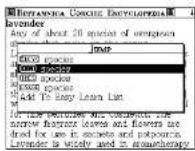
Add To Easy Learn List: Add the selected word to the Easy Learn List.
Example: DICT
7 P r esser.
* Press return to the previous screen.
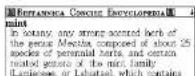
* Words displayed in small capitals on the explanatory screen jump directly to the explanatory screen for that particular word in the Encyclopedia.
Example: MINT
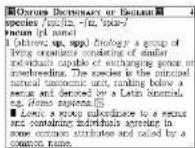
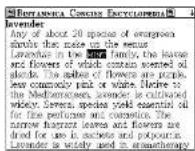
↓ ENTER BACK ↑
Dictionary
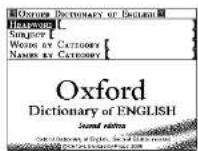
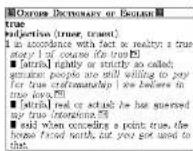
Dictionary entry words, definitions and grammatical information all come from the Oxford Dictionary of English.
Headword Search
You can search for a headword directly.
1 Press.
2 T ype a word.
Example: unique
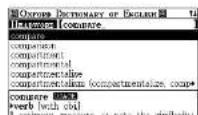
Every time you enter a letter, the corresponding headword list will change.
Use ▼ or ▶ to select the headword as necessary.
The preview screen will change in accordance with the selected headword.
- Scrolling the list -
Page : by line
SHIFT + Page by page
3 P r esser.
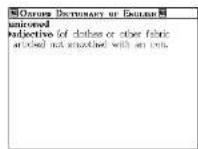
The unit shows headwords, parts of speech, inflected forms and definitions.
* Press BACK to return to the headword selection screen.
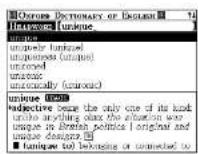
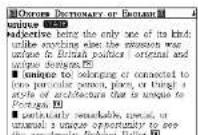
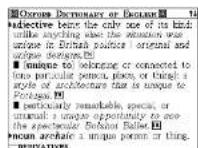
4 P r ess to see the rest of an entry.
Press Page to scroll up.
-Scrolling the screen -
Page : by line
SHIFT + Page by page
SHIFT + by sense number
* Press ENTER to advance to the next screen.
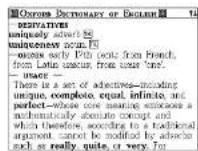
* When there are phrases, phrasal verbs, derivatives or origins, they will be displayed after the last headword definition.
* If the USAGE marker is displayed after the headword, there is a usage note in an entry.
5 T o scroll alphabetically up or down through the headword list, press OR
6 T o clear the display and search for another word, simply enter your new word.
Example: compare
↓ Page ↓ Page ↑
:
NEXT PREV
■ Subject Search
You can select a subject and find headwords in the selected subject.
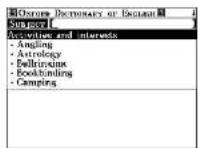
1 Press and then to select "SUBJECT".
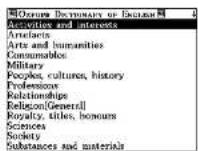
* If you press the list of the main subjects will be displayed.
Use Page Page or NEXT PREV to select the main subject and then press ENTER.
The selected main subject and the minor subjects are displayed.

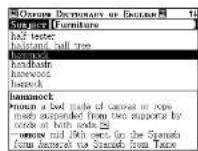
2 T ype a subject name.
Example: furniture
Every time you enter a letter, the closest match(es) will be displayed.
Use Page or Page to select the subject as necessary.
* Further subjects starting with the same letters can be selected by pressing SHIFT and then Page . Page
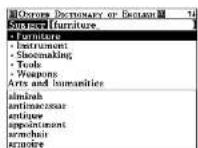
3 P r essER.
The unit shows the list of headwords which is related with the selected subject.
4 T ype the first letter of a word.
Example: h
The words starting with the entered letter will be displayed.
5 Use Page Page NDT PREV or to select the headword as necessary.
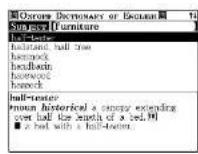
Example: hammock
The preview screen will change in accordance with the selected headword.
-Scrolling the list -
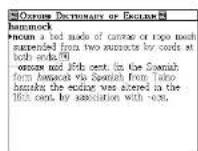
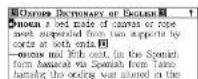
6 P r össer.
After displaying the lead screen of the headword for about one second, the unit scrolls the screen to the appropriate sense starts with ▶ mark.
* Press BACK to return to the headword selection screen.
Words by Category
You can select a lexical category and find headwords in the selected category.
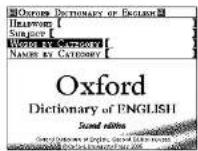
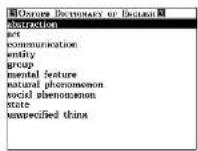
1 P r eSST and then Post to select "WORDS BY CATEGORY".
* If you press the list of the main categories will be displayed.
Use Page or Page to select the main category and then press ENTER.
The selected main category and the minor categories are displayed.
2 T ype a category name.
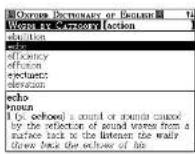
Example: action
Every time you enter a letter, the closest match(es) will be displayed.
Use Pnps or Pb to select the category as necessary.
* Further categories starting with the same letters can be selected by pressing SHIFT and then - Page
The preview screen will show the headwords which is related with the selected category.
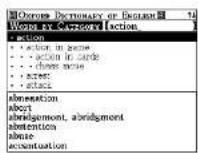
3 P r essER.
The unit shows the list of headwords which is related with the selected category.
4 T ype the first letter of a word.
Example: e
The words starting with the entered letter will be displayed.
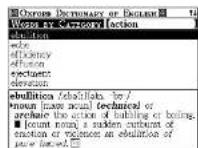
5 Use of to select the headword as necessary.
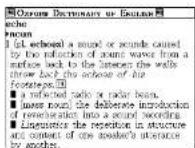
Example: echo
The preview screen will change in accordance with the selected headword.
-Scrolling the list -
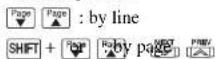
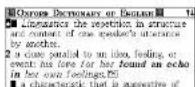
6 P r esser.
After displaying the lead screen of the headword for about one second, the unit scrolls the screen to the appropriate sense starts with □ mark.
* Press BACK to return to the headword selection screen.
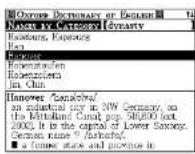
■ Names by Category
You can select an encyclopedic category and find headwords in the selected category.
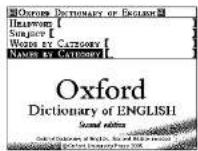
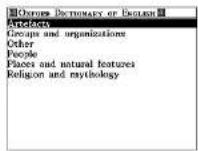
1 Pr eist and then Post to select "NAMES BY CATEGORY".
* If you press the list of the main categories will be displayed.
Use Page or Page to select the main category and then press ENTER.
The selected main category and the minor categories are displayed.
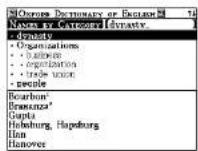
2 T ype a category name.
Example: dynasty
Every time you enter a letter, the closest match(es) will be displayed.
Use Pnps or Pb to select the category as necessary.
* Further categories starting with the same letters can be selected by pressing SHIFT and then
The preview screen will show the headwords which is related with the selected category.
3 P r essER.
The unit shows the list of headwords which is related with the selected category.
4 T ype the first letter of a word.
Example: h
The words starting with the entered letter will be displayed.
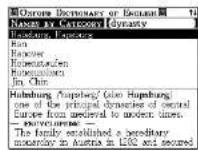
5 Use of to select the headword as necessary.
Example: Hanover
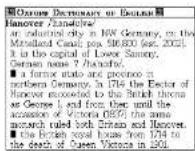
The preview screen will change in accordance with the selected headword.
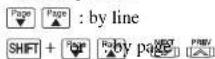
-Scrolling the list -
6 P r össer.
After displaying the lead screen of the headword for about one second, the unit scrolls the screen to the appropriate sense starts with □ mark.
* Press BACK to return to the headword selection screen.
Jump function
This function enables you to look up a word displayed on the definition screen in any dictionary of your choosing, and to register it in the Easy Learn word list. (See page 20.)
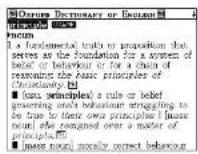
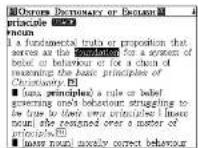
1 P r e ^BBS T and type a word.
Example: principle
2 P r esser.
3 P r ess to select the first word you can look up.
Press 📄 to select the last word.
Selected word will begin to flash on and off.
* Press BACK to return to the previous screen or to disable the cursor.
4 Select another word using the cursor keys.
Example: foundation
5 P r esser.
6 Select Encyclopedia, Dictionary, Thesaurus, English Usage or Easy Learn List by using Page or Page
ENCYC Britannica Concise Encyclopedia DICT Oxford Dictionary of English THES Oxford Thesaurus of English QUOTE Oxford Dictionary of Quotations SLANG Oxford Dictionary of Modern Slang
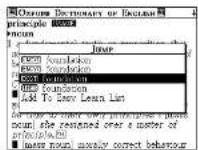
7 P r esser.
* Press □□□□ turn to the previous screen.
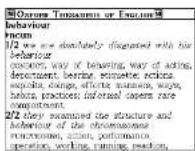
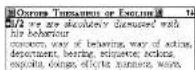
Smart Jump function
By selecting the TH symbol on the definition screen, you can jump to the screen for synonym groups in the Oxford Thesaurus of English sharing the same meaning.
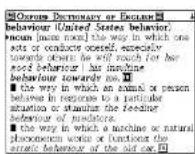
1 P r e E ST and type a word.
Example: behaviour
2 P r esser.
3 P r ess and use the cursor keys to select the TH. symbol.
* Press to return to the previous screen or to disable the cursor.
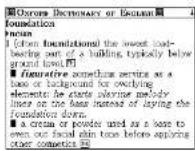
4 P r esser.
After displaying the lead screen of the headword in the Oxford Thesaurus of English for about one second, the unit scrolls the screen to the appropriate synonym groups starts with □ mark.
Thesaurus
The thesaurus entries, including examples, sense groupings, and all alternative and opposite words, are taken from the Oxford Thesaurus of English.
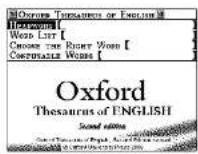
Headword Search
You can search for a headword directly.
1 P r e ^TMES .
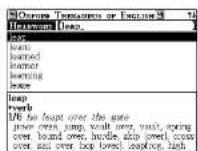
2 T ype a word.
Example: leap
Every time you enter a letter, the corresponding headword list will change.
Use Page or Page to select the headword as necessary.
The preview screen will change in accordance with the selected headword.
- Scrolling the list -
Page : by line
SHIFT + Page by page
3 P r eSSER.
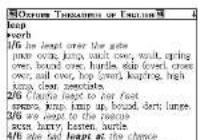
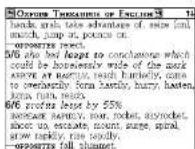
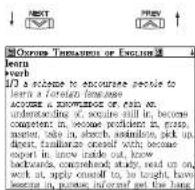
The unit shows a list of synonyms along with any example sentences.
* T he synonyms in each set that are closest in meaning to the entry word are given
4 P r ess to see other synonyms.
Press Page to scroll up.
- Scrolling the screen -
Page : by line
SHIFT + Page by page
SHIFT + Sosb by sense number
* Press ENTER to advance to the next
screen.
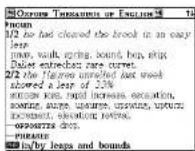
* Any opposites are listed at the end of the relevant synonym set.
* When there are phrases, they will be displayed after the main senses for each part of speech.
5 T o scroll alphabetically up or down
through the headword list, press or
6 T o clear the display and search for another word, simply enter your new word.
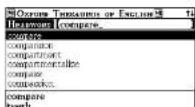
Example: compare
↓ ENTER
↓ ENTER
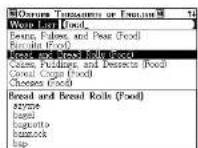
Word List
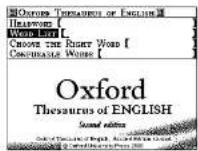
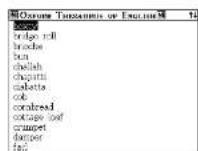
You can search for thematic word lists using keywords to find headwords in these lists.
1 Press and then to select "WORD LIST".
2 T ype a word list name.
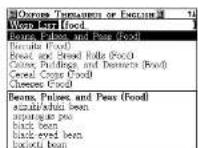
Example: food
3 Use Page or Page to select the word list as necessary. Example: Bread and Bread Rolls
The preview screen will change in accordance with the selected word list.
- Scrolling the list -
4 P r essER.
The list of the words will be displayed.
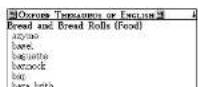
5 P r ess to see the rest of an entry.
Press ▲ to scroll up.
- Scrolling the screen -
* Press ENTER to advance to the next
screen. * Press BACK to return to the previous screen.
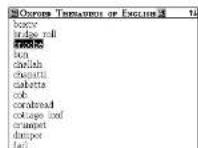
6 P r ess to select the first word you can look up.
Press ☐ to select the last word.
Selected word will begin to flash on and off.
* Press BACK to return to the previous screen or to disable the cursor.
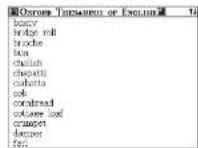
7 Select another word using the cursor keys.
Example: brioche
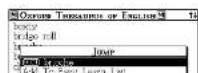
8 P r esser.
(See "Jump function" at page 38.)

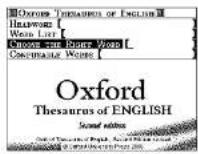
■ Choose the Right Word
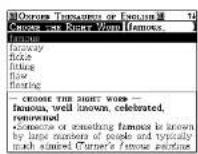
You can search a headword which has a note on how to "Choose the right word".
1 Press and then to select "CHOOSE THE RIGHT WORD".
2 T ype a word.
Example: famous
Every time you enter a letter, the corresponding headword list will change.
Use Page or Page to select the headword as necessary.
The preview screen will change in accordance with the selected headword.
-Scrolling the list -


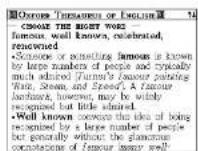
3 P r esser.
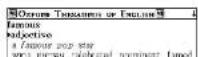
The note on how to "Choose the right word" in this case will be displayed.
4 P r ess to scroll up.
- Scrolling the screen -
:
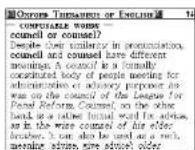
Confusable Words
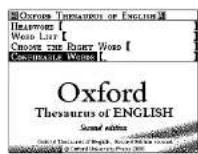
You can search a headword which has a note on "Confusable words".
1 P r ees and then to select "CONFUSABLE WORDS".
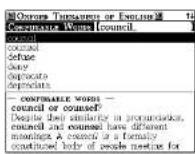
2 T ype a word.
Example: council
Every time you enter a letter, the corresponding headword list will change.
Use Page or Page to select the headword as necessary.
The preview screen will change in accordance with the selected headword.
- Scrolling the list -

3 P r eSSER.
The note on "Confusable words" for the word will be displayed.
4 P r ess to scroll up.
- Scrolling the screen -
:
Jump function
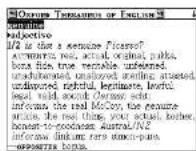
This function enables you to look up a word displayed on the synonym screen in any dictionary of your choosing, and to register it in the Easy Learn word list. (See page 20 or 30.)
1 P r ess and type a word.
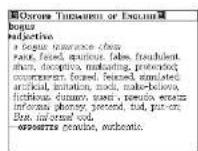
Example: genuine
2 P r esser.
3 P r ess to select the first word you can look up.
Press 📄 to select the last word.
Selected word will begin to flash on and off.
* Press BACK to return to the previous screen or to disable the cursor.
4 Select another word using the cursor keys.
Example: bogus
5 P r essER.
6 Select Encyclopedia, Dictionary, Thesaurus, English Usage or Easy Learn List by using Page or Page
ENCYC Britannica Concise Encyclopedia DICT Oxford Dictionary of English THES Oxford Thesaurus of English QUOTE Oxford Dictionary of Quotations SLANG Oxford Dictionary of Modern Slang
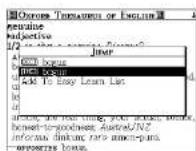
7 P r esser.
* Press to return to the previous screen.
Smart Jump function
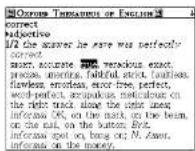
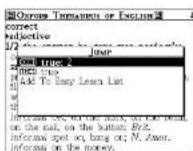
You can jump to the definition screen for the appropriate definition number in the Oxford Dictionary of English if you select a synonym on the screen.
1 P r e ^THES and type a word.
Example: correct
2 P r eSSER.
3 Press or to select a synonym.
* Press BACK return to the previous screen or to disable the cursor.
4 P r EISER.
The selected word which can use the Smart Jump function will be displayed in bold style.
5 P r essER.
After displaying the lead screen of the headword in the Oxford Dictionary of
Dictionary of Quotations
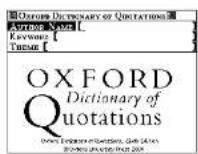
Quotations, keywords, and thematic groupings all come from the Oxford Dictionary of Quotations.
■ Author Name Search
You can search for quotations on the basis of a specific author's name.

2 T ype in the author's last name.
Example: churchill
Every time you enter a letter, the closest match(es) will be displayed.
Use Page or to select the author name required.
The preview screen will change in accordance with the selected author name.
-Scrolling the list -


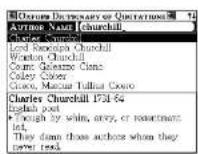
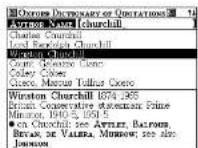

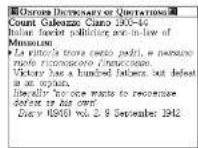
The quotations from the selected author will be displaved.
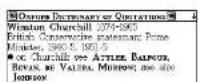
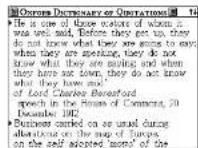
4 P r ess to see the rest of an entry.
Press ☐ to scroll up.
- Scrolling the screen -

* Press ENTER to advance to the next screen.
5 T o scroll alphabetically up or down through the author name list, press

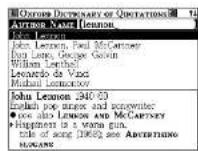
6 T o clear the display and search for another author name, simply enter new author name.
Example: lennon


Jump function
This function enables you to look up a word displayed on the quotation screen in any dictionary of your choosing, and to register it in the Easy Learn word list. (See page 20, 30 or 38.)
Keyword Search
You can search for quotations on the basis of one or more words contained in the quotation.
1 P r esse and then to select "KEYWORD".
2 T ype a keyword.
Example: silence
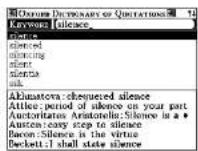
Every time you enter a letter, the closest match(es) will be displayed.
* When you enter more than one word, enter “&” between words.
If you enter a few letters of the head of keyword and then enter “&”, the unit enter the hole spelling of the selected keyword.
Press SHIFT and then ?b enter “&”.
Use Page or Page to select the keyword as necessary.
The preview screen will change in accordance with the selected keyword.
3 P r esser.
A small part of the matching quotations will be displayed, along with the author name.
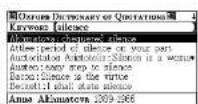
4 Use or to select the quotation required.
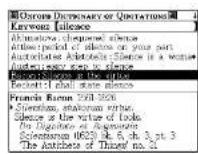
Example: Bacon: Silence is the virtue
The preview screen will change in accordance with the selected quotation.
-Scrolling the list -
Pages : by line
SHIFT + Page Page by Page NEXT PREV
5 P r esser.
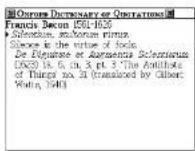
The requested quotation will be displayed in full.
* Return to the list by pressing BACK .
NEXT PREV
6 T o scroll up or down through the author names in the list, press NEXT or Review
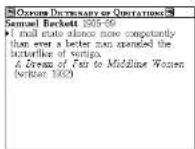
7 T o clear the display and search for another keyword, simply enter new keyword.
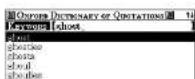
Theme Search
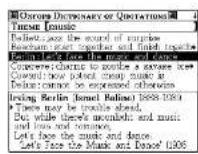
You can search a selection of the best quotations on a specific theme.
1 P r esse and then Part to select "THEME".
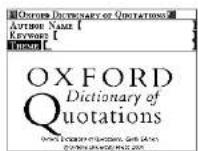
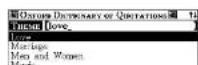
2 T ype a theme.
Example: music
Every time you enter a letter, the closest match(es) will be displayed.
Use ▼ or ▶ to select the theme as necessary.
The preview screen will change in accordance with the selected theme.
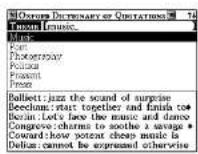
3 P r .
A small part of the matching quotations will be displayed, along with the author name.
* Press BACK to return to the theme selection screen.
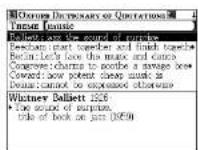
4 U se▼ or □ select the quotation required.
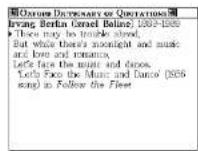
Example: Berlin: Let's face the music and dance
The preview screen will change in accordance with the selected quotation.
- Scrolling the list -
Page : by line
SHIFT + Page by page
The requested quotation will be displayed in full.
* Return to the list by pressing BACK.
NEXT PRBV
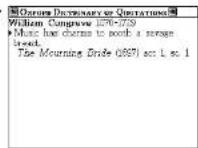
6 T o scroll up or down through the author names in the results list, press 📄 or 📄.
7 T o clear the display and search for another theme, simply enter new theme.
Dictionary of English Usage
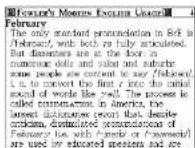
Dictionary entries all come from the Oxford 'Fowler's Modern English Usage'.
Headword Search
You can search a headword directly.
1 P r eSSE .
2 T ype a word.
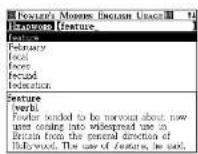
Example: feature
Every time you enter a letter, the corresponding headword list will change.
Use Page or Page to select the headword as necessary.
The preview screen will change in accordance with the selected headword.
-Scrolling the list -
Page : by line
SHIFT + Page by page
3 P r esser.
An explanation screen of the selected headword will be displayed.
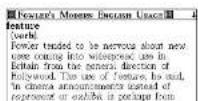
4 P r e\$ to see the rest of an entry.
Press Page to scroll up.
- Scrolling the screen -
Page : by line
SHIFT + Page by Page
* Press ENTER to advance to the next screen.
5 T o scroll alphabetically up or down through the headword list, press OR. or .


Jump function
This function enables you to look up a word displayed on the explanation screen in any dictionary of your choosing, and to register it in the Easy Learn word list. (See page 20, 30 or 38.)
Appendix
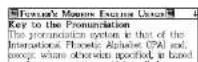
You can see the pronunciations or abbreviations chart. (See page 102.)
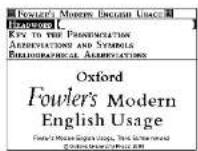
1 P r eESE and then Page to select
"KEY TO THE PRONUNCIATION",
"ABBREVIATIONS AND SYMBOLS" or
"BIBLIOGRAPHICAL ABBREVIATIONS".
2 Press ENTER.
Dictionary of Slang
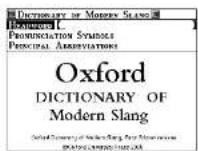
Dictionary entries all come from the Oxford Dictionary of Modern Slang.
Headword Search
You can search a headword directly.
1 P r eSLANS.
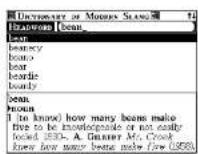
2 T ype a word.
Example: bean
Every time you enter a letter, the corresponding headword list will change.
Use Page or Page to select the headword as necessary.
The preview screen will change in accordance with the selected headword.
- Scrolling the list -


3 P r CENTBS.
An explanation screen of the selected headword will be displayed.
-
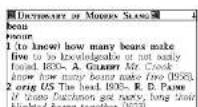
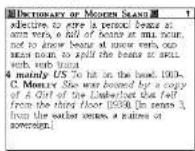
4 P r ess to see the rest of an entry.
Press Page to scroll up.
- Scrolling the screen -


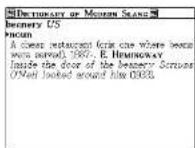
* Press ENTER to advance to the next screen.
5 T o scroll alphabetically up or down



Jump function
This function enables you to look up a word displayed on the explanation screen in any dictionary of your choosing, and to register it in the Easy Learn word list. (See page 20, 30 or 38.)
Appendix
You can see the pronunciations or abbreviations chart. (See page 108.)
1 P r and then ▼ to select
"PRONUNCIATION SYMBOLS" or "PRINCIPAL ABBREVIATIONS".
2 Press ENTER.
Solvers
The unit provides Spellchecker and 14 solvers that can help you to solve word games.
■ Selecting Spellchecker or the solver
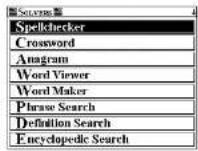
1 P r e ^3567E .
The unit selects the last solver used each time you select the solver mode.
2 Select Spellchecker or the solver you wish to use by using Page or Page
-Scrolling the list -


: by line


* By pressing the first letter of a solver name, you can directly select the desired solver.
Further solvers starting with the same letter can be selected by pressing the same letter again.
3 P r e6sER.
↓ A'
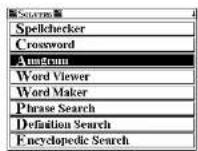
14 solvers:
Crossword Anagram Word Viewer Word Maker Dhrase Search
Spellchecker
The Spellchecker function conducts a phonetic search using over 225,000 words from the Oxford New British English Word List.
1 Select "Spellchecker" and then press ENTER.
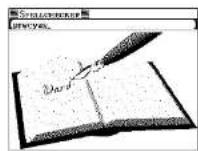
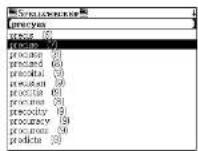
2 T ype a word to be checked. Example: precyas
3 P r esser.
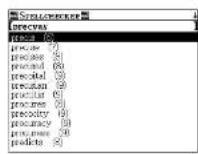
If the spelling of a word you enter is incorrect:
The message "Correction List" will be displayed for about one second.
A list of words that are phonetically similar to the entered word will then be displayed.
If the spelling of a word you enter is correct:
The message "Correctly Spelt" will be displayed for about one second.
The entered word will then be displayed in bold characters.
Phonetically similar words may also be displayed.
* If you select "Enable" at the setting of the "Variant Spelling", a variant spelling word will be displayed in the word list. (See page 97.)
* T o clear the display and spellcheck another word, simply enter your new word.
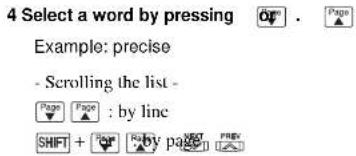
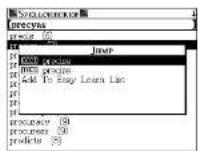
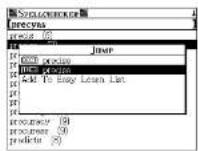
5 P r esser to activate the jump function.
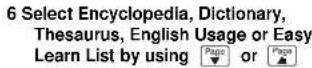
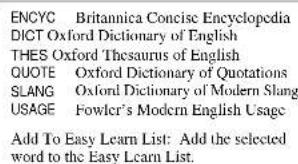
Example: THES
7 P r essER.
* After you've looked up the definition or synonyms, you can return to the previous display by pressing BACK.
Using the Wildcard function
If you are unsure of part of the spelling of a word, enter the word using “?”, “*” or “#” for the letter(s) of which you are unsure.
Use ?& to enter “?”. This is used in place of a single character.
Use ☐ to enter “*”. This is used in place of one or more characters (including spaces or symbols).
Use SHIFT and then *do enter “#”. This is used in place of one or more characters (without spaces or symbols)
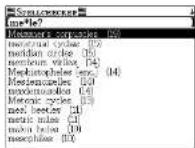
1 T ype a word. Example: me* le?
2 P r ESSER. The corresponding word list will be displayed.
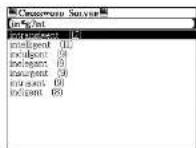
Crossword Solver
To solve a crossword, type the known letters and insert “?”, “*” or “#” for any unknown letters.
Use ?& to enter “?”.
This is used in place of a single character.
Use * to enter “*”.
This is used in place of one or more characters (including spaces or symbols).
Use SHIFT and then #o enter “#”.
This is used in place of one or more characters (without spaces or symbols).
1 Select "Crossword" and then press ENTER.
2 Enter letters.
Example: in*g?nt
3 P r esser.
The corresponding word list will be displayed.
Anagram Solver
Look for anagrams using the same letters or words that you entered. You can enter actual words, or jumbled letters.
1 Select "Anagram" and then press ENTER.
2 Enter letters.
Example: treatise
3 P r esser.
The corresponding word list will be displayed.
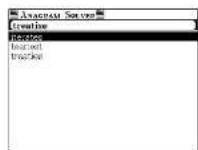
* [var.]: Variant Spelling word [enc.]: Encyclopedic word [Am.]: American spelling word [rare]: Rare using word
* U se the jump function as described on Page 52.
* P lease note that not every word returned by the Solvers is included in the Encyclopedia, Dictionary, Thesaurus or English Usage.
* [var.]: Variant Spelling word [enc.]: Encyclopedic word [Am.]: American spelling word [rare]: Rare using word
* U se the jump function as described on Page 52.
Word Viewer
Search for an entered word across the Oxford New British EnglishWord List.
1 Select "Word Viewer" and then press ENTER.
2 T ype a word.
Example: moon
Every time you enter a letter, the corresponding word list will change.
Use Page or Page to select the word as necessary.
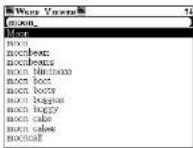
-Scrolling the list -
* [var.]: Variant Spelling word [enc.]: Encyclopedic word
[Am.]: American spelling word [rare]: Rare using word
* U se the jump function as described on Page 52.
* P lease note that not every word returned by the Solvers is included in the Encyclopedia, Dictionary, Thesaurus or English Usage.
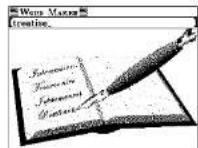
Word Maker
Look for anagrams using some or all of the letters entered. You can enter actual words, or jumbled letters.
1 Select "Word Maker" and then press ENTER.
2 Enter letters.
Example: treatise
3 P r esser.
The corresponding word list will be displayed.
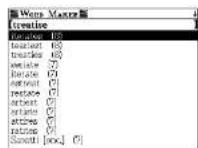
* [var.]: Variant Spelling word [enc.]: Encyclopedic word [Am.]: American spelling word [rare]: Rare using word
* U se the jump function as described on Page 52.
* P lease note that not every word returned by the Solvers is included in the Encyclopedia, Dictionary, Thesaurus or English Usage.
* If the letters entered do not have any corresponding words, the message "No matches found" will be displayed.
■ Phrase Search
Search for phrases in the Oxford Dictionary of English including one or more entered words.
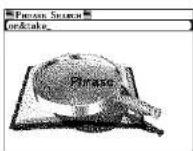
1 Select "Phrase Search" and then press ENTER.
2 T ype word(s).
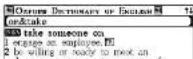
Example: on&take
* Y ou can enter up to seven words.
* When you enter more than one word, enter “&” between words.
Press SHIFT and then ?b enter “&”.
3 P r esser.
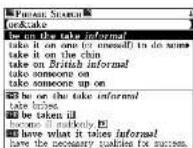
The corresponding phrase list will be displayed.
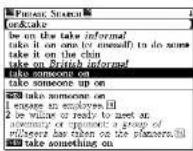
4 Select a phrase using

Example: take someone on
The preview screen will change in accordance with the selected phrase.
- Scrolling the list -

5 P r eBSE.
The selected phrase and its definition will
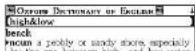
■ Definition Search
The unit will find the Oxford Dictionary of English entries whose definitions contain the word(s) you enter.
1 Select "Definition Search" and then press ENTER.
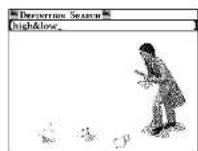
2 T ype word(s).
Example: high&low
* Y ou can enter up to seven words.
* When you enter more than one word, enter “&” between words.
Press SHIFT and then ?the enter “&”.
* A single word containing a wildcard (“?”, “*” or “#”) can be input.
A word containing a wildcard will be searched as a headword.
3 P r esser.
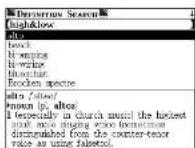
The corresponding headword list will be displayed.
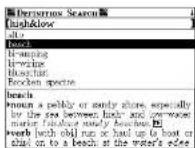
4 Select a headword using
Example: beach
The preview screen will change in accordance with the selected headword.
- Scrolling the list -


■ Encyclopedic Search
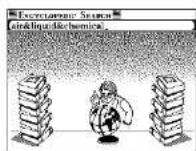
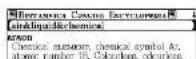
The unit will find the Encyclopedia articles which contain the word(s) you enter in the Britannica Concise Encyclopedia.
1 Select "Encyclopedic Search" and then press ENTER.
2 T ype word(s).
Example: air&liquid&chemical
* Y ou can enter up to seven words.
* When you enter more than one word, enter “&” between words.
Press SHIFT and then ?to enter “&”.
* A single word containing a wildcard (“?”, “*” or “#”) can be input.
A word containing a wildcard will be searched as an article.
3 P r esser.
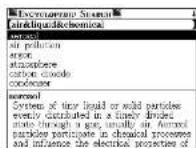
The corresponding article list will be displayed.
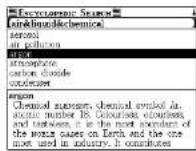
4 Select an article using

Example: argon
The preview screen will change in accordance with the selected article.
-Scrolling the list -

■ Dictionary of Abbreviations
Display the search screen for the Oxford Dictionary of Abbreviations.
1 Select "Dictionary of Abbreviations" and then press ENTER.
2 T ype an abbreviations.
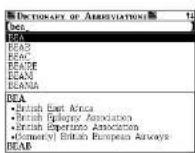
Example: bea
Every time you enter a letter, the corresponding abbreviation list will change.
Use Page or Page to select the abbreviation as necessary.
The preview screen will change in accordance with the selected abbreviation.
-Scrolling the list -
Page : by line

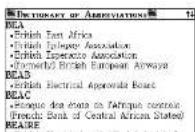
3 P r esser.
An explanation screen which starts from the entered abbreviation will be displayed.
- Scrolling the screen -
Page : by line
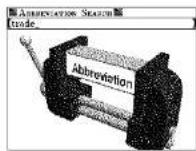
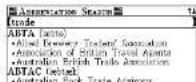
Abbreviation Search
Search for abbreviations for which one or more entered words are included in the explanation from the headwords in the Oxford Dictionary of Abbreviations.
1 Select "Abbreviation Search" and then press ENTER.
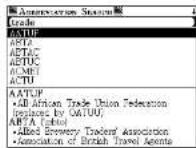
2 T ype word(s).
Example: trade
* Y ou can enter up to seven words.
* When you enter more than one word, enter “&” between words.
Press SHIFT and then ?to enter “&”.
* A single word containing a wildcard (“?”, “*” or “#”) can be input.
A word containing a wildcard will be searched as an abbreviation.
3 P r esser.
The corresponding abbreviation list will be displayed.
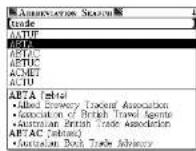
4 Select an abbreviation using


Example: ABTA
The preview screen will change in accordance with the selected abbreviation.
- Scrolling the list -
quiet ± Page Page or NEXT PREV by page
Letter Changer
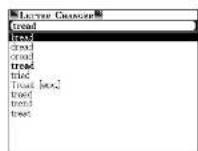
The unit will allow you to view possible alternative words by changing one letter at a time.
1 Select "Letter Changer" and then press ENTER.
2 T ype a word.
Example: tread
3 P r eBSER.
The corresponding headword list will be displayed.

* [var.]: Variant Spelling word [enc.]: Encyclopedic word [Am.]: American spelling word [rare]: Rare using word
* U se the jump function as described on Page 52.
* P lease note that not every word returned by the Solvers is included in the Encyclopedia, Dictionary, Thesaurus or English Usage.
* If the letters entered do not have any corresponding words, the message "No matches found" will be displayed.
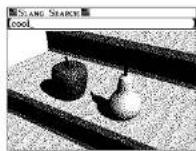
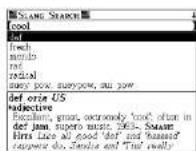
Slang Search
The unit will find the Oxford Dictionary of Modern Slang entries whose definitions contain the word(s) you enter.
1 Select "Slang Search" and then press ENTER.
2 T ype word(s).
Example: cool
* Y ou can enter up to seven words.
* When you enter more than one word, enter “&” between words.
Press SHIFT and then ?b enter “&”.
A single word containing a wildcard (“?”, “*” or “#”) can be input.
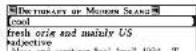
A word containing a wildcard will be searched as a headword.
3 P r esser.
The corresponding headword list will be displayed.
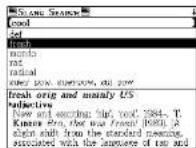
4 Select a headword using
Example: fresh
The preview screen will change in accordance with the selected headword.
- Scrolling the list -

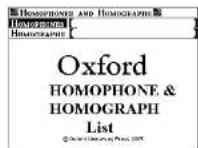
■ Homophones and Homographs
Search for homophones (words sounding the same) or homographs (words spelled the same) from the Oxford Dictionary of English.
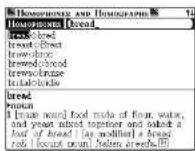
1 Select "Homophones and
Homographs" and then press ENTER.
2 Select H OMOPHONES or HOMOGRAPHS using

Example: HOMOPHONES
3 T ype a word.
Example: bread
Every time you enter a letter, the corresponding homophones or homographs list will change.
Use Page or Page to select the homophone or homograph as necessary.
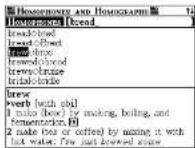
The preview screen will change in accordance with the selected homophone or homograph word.
-Scrolling the list


Example: brew
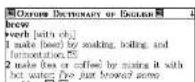
4 P r eBSSER.
The definition screen of the selected word
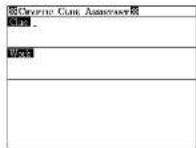
Cryptic Clue Assistant
This function assists you to solve Cryptic Crossword.
Preparation:
1 Select "Cryptic Clue Assistant" and then press ENTER.

2 T ype word(s) as your clue and then press ENTER.
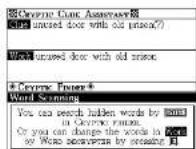
Example: unused door with old prison
3 Enter answer length and then press ENTER.
Example: 7
* Y ou can enter more than one number for a compound by using a space between numbers.
Example: 2 3
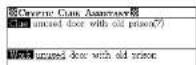
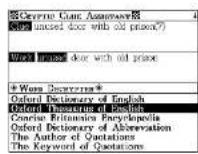
Word Decrypter:
This function will replace a word in the Work window by your guessing about cryptic clue.
1 P r ess to start the searching.
A cursor will appear in the Work window.
2 P r esser and select a function by using Page or Page
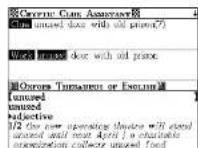
Example: Oxford Thesaurus of English
3 P r eSSER twice.
Usage of the each functions are same as the other main functions and solver functions.
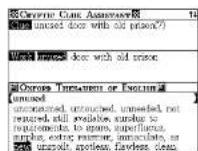
4 P r ees or and then select a word by using cursor keys.
Example: new
The selected word can be searched by all function menu in the Word Decrypter.
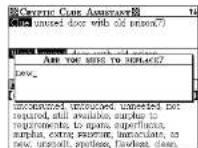
5 P r esser to decide replacing.
Then a window of replace word will be displayed.
You can edit the word in this window if it needs to be adjusted or changed.
6 P r esser to decide replacing.
The selected word in the Word window
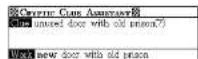
7 Select a word by using


Example: door
8 P r eSSER and select a function by using Page or Page
Example: Oxford Dictionary of English
9 P r esser twice.
Usage of the each functions are same as the other main functions and solver functions.
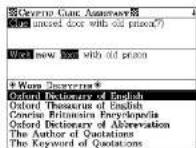
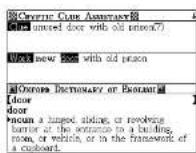
10 Press or and then select a word by using cursor keys.
The selected word can be searched by all function menu in the Word Decrypter.
Example: gate
11 Press ENTER to decide replacing.
Then a window of replace word will be displayed.
You can edit the word in this window if it needs to be adjusted or changed.
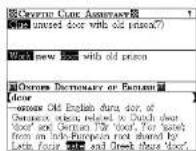
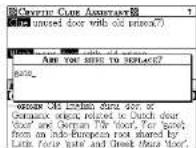
12 Press to decide replacing.
The selected word in the Word window
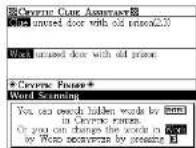
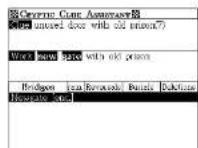
Cryptic Finder:
This function will find Bridges, Anagrams, Reversals, Burials, and Deletions.
1 P r esser to start the "Word Scanning".
2 Select a category by using 🧿 or 🧿.
Example: Bridges
Use Page or to select the headword as necessary.
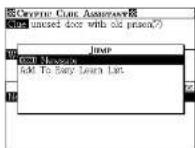
3 P r esser to activate the jump function.
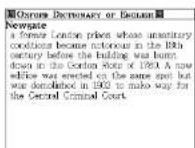
4 Select Encyclopedia, Dictionary, Thesaurus, English Usage or Easy Learn List by using Page or Page
Example: DICT
* Use the jump function as described on Page 52.
5 P r esser.
Games
There are 15 great word games that will help you to improve your spelling and vocabulary.
■ Selecting a game
1 Press.
The unit selects the last game used each time you select the game mode.
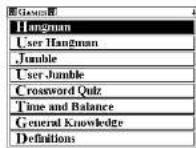
↓ C
2 Select the game you wish to play by pressing Page or Page
* By pressing the first letter of a game name, you can directly select the desired game. Further games starting with the same letter can be selected by pressing the same letter again.
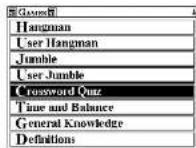
15 word games:
Hangman, User Hangman, Jumble, User Jumble, Crossword Quiz, Time and Balance, General Knowledge, Definitions, Synonyms, Slang Words, Shakespeare, Word Building, User Word Building, Word Challenge, Against the Clock
* T he Game Levels can be changed from the SET menu. (See page 94.)
Hangman
This is a game in which you have to find a mystery word whose spelling is unknown to you with a limited number of allowed tries.
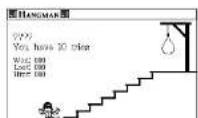
1 Select "Hangman" and then press ENTER.
2 W hen you enter one of the letters used in the mystery word, the question mark will be replaced by the letter.
Example: Enter "a".
* In some cases, the same letter is used two or more times in the same word: When you enter the letter, all the corresponding question marks will be replaced by the letter simultaneously.
* The number of tries you are allowed will decrease progressively every time you enter an incorrect letter. Example: Enter "i".
* One letter will be displayed in turn as a "Hint" every time you press ?^8 . The number of times a "Hint" can be used is determined on the basis of the set game level. (Beginner: 5, Intermediate: 3, Advanced: 2)
* A ll the letters will be displayed if you press ENTER.
3 If all the letters in the word are displayed before you have used up all the tries, a congratulatory message will be displayed and counted in the "Won" column.
The answer will then be displayed.
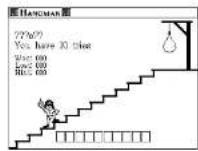
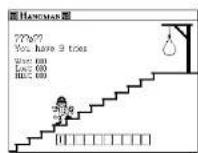
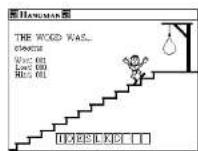
* P press any alphabet key to display the next question.
* Y ou can use jump function by pressingENTER ^-1 . (See page 52.)
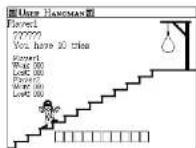
User Hangman
This is the Hangman game for 2 players using words that you can select.
1 Select "User Hangman" and then press ENTER.
2 Select the player you want by pressing Page or Page
3 Enter a word.
You can use up to 12 letters. Example: people
4 P r esser.
5 An opponent has to guess the mystery word.
* The ensuing procedure is the same as that used in the Hangman Game.
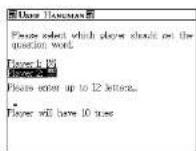
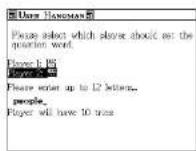
*** Tip for Parents ***
This game is a fun way for you to help your children to learn new words from a list or as part of their homework. Select a suitable
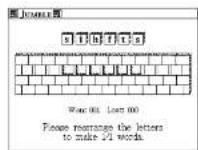
Jumble
Using letters displayed at random, you attempt to find a specified number of words.
1 Select "Jumble" and then press .ENTER The selected letters and the number of answers will be displayed. Example: sinfts
* T o shuffle the letters, press?
2 Enter a try using all the selected letters. Press BACK return.
* If your answer is incorrect, the message "Try again" will appear and the selected letters will be displayed again.
* T o give up entering letters, presENTER ^= .
3 P r esser.
* Y ou need to answer all the mystery words.
* Y ou can use ▼ or □ to redisplay correct words already accepted. Press BACK to return.
* If you enter all the answers and press ENTER, a congratulatory message will be displayed and counted in the "Won" column.
* P ress any alphabet key to display the next question.
* Y ou can use jump function by pressing ENTER. (See page 52.)
User Jumble
This is a Jumble game using words that you can select.
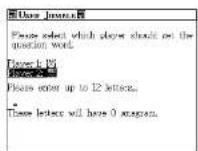
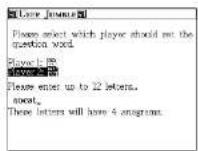
1 Select "User Jumble" and then press ENTER.
2 Select the player you want by pressing Page or Page
3 Enter a word.
You can use up to 12 letters. Example: socat
4 P r esser.
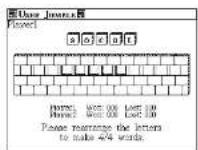
5 An opponent has to enter a try.
* The ensuing procedure is the same as that used in the Jumble Game.
*** Tip for Parents ***
This game is a fun way for you to help your children to learn new words. Simply enter your chosen word and then work with them to find the correct answer.
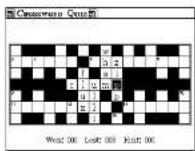
Crossword Quiz
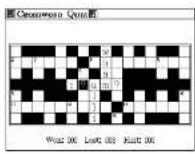
Enter a letter or letters to replace the question marks.
1 Select "Crossword Quiz" and then press ENTER. The question will be displayed.
2 Enter letters to replace the question marks.
Example: I, p
* The entered letter can be changed. Press 📋 or 📋 to select the letter and then enter the new letter.
* One letter will be displayed in turn as a "Hint" every time you press ?&.
* T o give up entering letters, presENTER
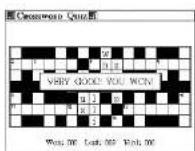
3 P r eBSTER.
If your answer is correct, a congratulatory message will be displayed and counted in the "Won" column.
The answer will then be displayed.
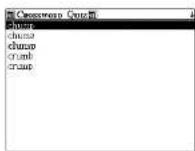
* If you press ▼ or ▶ the display of the answer, the list of the possible will be displayed.
* Press any alphabet key to display the next question.
* Y ou can use jump function by pressing ENTER ^TM . (See page 52.)
■ Time and Balance
This is a game in which you have to find a mystery word with a limited number of tries, in a limited time.
1 Select "Time and Balance" and then press ENTER.
The number of letters in the mystery word is indicated by question marks.
The number of times you can try is indicated by boxes.
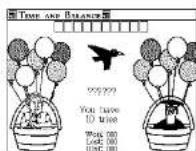
2 W hen you enter one of the letters used in the mystery word, the question mark will be replaced by the letter.
Example: Enter "i".
If the entered letters are correct, the balloon on the right, and if the entered letters are incorrect, the balloon on the left will be pecked by the crow and burst.
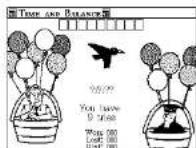
* One letter will be displayed in turn as a "Hint" every time you press ? ^4 . The number of times a "Hint" can be used is determined on the basis of the set game level. (Beginner: 5, Intermediate: 3, Advanced: 2)
* All the letters will be displayed if you press ENTER
3 If the complete spelling of the mystery word is entered within the allocated time or before all the balloons on the left are burst, a congratulatory message will be displayed and counted in the "Won" column.
* P press any alphabet key to display the next question.
* Y ou can use jump function by pressing ENTER . (See page 52.)
* If your time is up, if all the balloons on the left burst before you have entered the complete snelling or if you press ^2 in the middle of a
General Knowledge
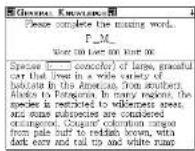
Guess the article in the Encyclopedia based on the contents of the article, with some of the letters already supplied.
1 Select "General Knowledge" and then press ENTER.
The question will be displayed.
Example: P_M_
* Press o to see the rest of the explanation.
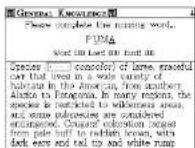
2 Enter letters to replace the underline marks.
Example: U, A
* The entered letter can be changed. Press Sense or Sense select the letter and then enter the new letter.
* One letter will be displayed in turn as a "Hint" every time you press ?& . The number of times a "Hint" can be used is determined on the basis of the set game level.
* T o give up entering letters, presENTER.
3 P r eBSER.
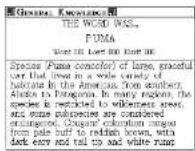
If your answer is correct, a congratulatory message will be displayed and counted in the "Won" column.
The answer will then be displayed.
Definitions
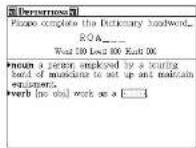
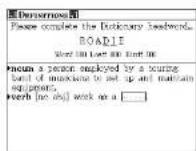
Guess the headword in the “Oxford Dictionary of English” based on its definitions, with some of the letters already supplied.
1 Select "Definitions" and then press ENTER.
The question will be displayed. Example: ROA__
* Press of to see the rest of the definitions.
2 Enter letters to replace the underline marks.
Example: D, I, E
* The entered letter can be changed. Press ▶ or ▶ to select the letter and then enter the new letter.
* One letter will be displayed in turn as a "Hint" every time you press ?& . The number of times a "Hint" can be used is determined on the basis of the set game level.
* T o give up entering letters, present
3 P r esser.
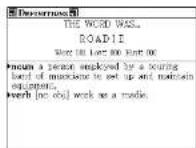
If your answer is correct, a congratulatory message will be displayed and counted in the "Won" column.
The answer will then be displayed.
Synonyms
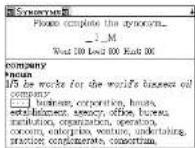
Guessing from the displayed "Oxford Thesaurus English" screen, you complete the synonym for which some of the letters are already supplied.
1 Select "Synonyms" and then press ENTER.
The question will be displayed. Example: _I_M
* Press ☐ to see the rest of the synonym screen.
2 Enter letters to replace the underline marks.
Example: F, R
* The entered letter can be changed. Press 🧿 or 🧿 select the letter and then enter the new letter.
* One letter will be displayed in turn as a "Hint" every time you press ?^\& . The number of times a "Hint" can be used is determined on the basis of the set game level.
* T o give up entering letters, presENTER ^= .
3 P r eSSER.
If your answer is correct, a congratulatory message will be displayed and counted in the "Won" column.
The answer will then be displayed.
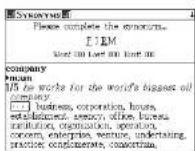

- 17.
Slang Words
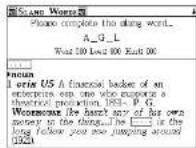
Guess the headword in the "Oxford Dictionary of Modern Slang" based on its definitions, with some of the letters already supplied.
1 Select "Slang Words" and then press

The question will be displayed.
Example: A_G_L
* Press of to see the rest of the definitions.
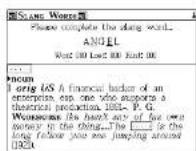
2 Enter letters to replace the underline marks.
Example: N, E
* The entered letter can be changed. Press ▶ or ▶ to select the letter and then enter the new letter.
* One letter will be displayed in turn as a "Hint" every time you press ?*. The number of times a "Hint" can be used is determined on the basis of the set game level.
* T o give up entering letters, present
3 P r esser.
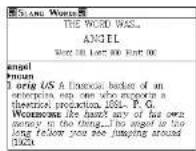
If your answer is correct, a congratulatory message will be displayed and counted in the "Won" column.
The answer will then be displayed.
Shakespeare
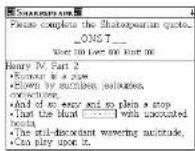
You guess a keyword for which some of the letters are already supplied that fits in the screen featuring quotations from Shakespeare.
1 Select "Shakespeare" and then press ENTER.
The question will be displayed.
Example: _ONST_
* Press ☐ to see the rest of the quotations.
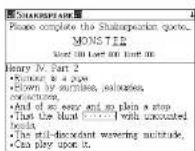
2 Enter letters to replace the underline marks.
Example: M, E, R
* The entered letter can be changed. Press ▶ or ▶ to select the letter and then enter the new letter.
* One letter will be displayed in turn as a "Hint" every time you press ?^. The number of times a "Hint" can be used is determined on the basis of the set game level.
* T o give up entering letters, presENTER.
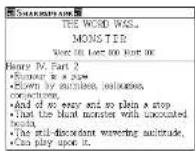
3 P r esser.
If your answer is correct, a congratulatory message will be displayed and counted in the "Won" column.
The answer will then be displayed.
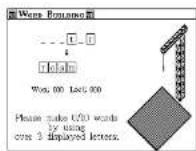
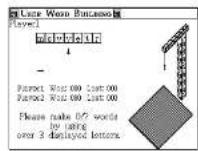
Word Building
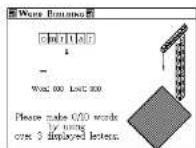
Use some or all of the letters displayed to make new words.
You'll win if you succeed in creating the number of words specified in the screen.
1 Select "Word Building" and then press ENTER.
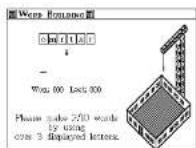
The selected letters and the number of answers will be displayed.
* T o shuffle the letters, press?
2 Enter a word using over 3 displayed letters.
Press BACK return.
3 P r eSSER.
If your answer is correct, you can enter the next word.
* Y ou can use ▼ or ▲ to redisplay correct words already accepted. Press BACK to return.
* T o give up entering letters, presENTER.
* If your answer is incorrect, the message "Try again" will appear and the selected letters will be displayed again.
* If you enter all the answers and press ENTER, a congratulatory message will be displayed and counted in the "Won" column.
:
User Word Building
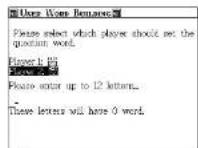
This is a Word Building game using words that you can select.
1 Select "User Word Building" and then press ENTER.
2 Select the player you want by pressing Page or Page
3 Enter a word.
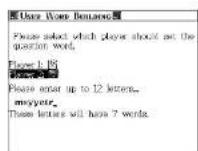
You can use up to 12 letters. Example: msyyetr
4 P r eSSEER.
5 An opponent has to enter a try.
* The ensuing procedure is the same as that used in the Word Building Game.
*** Tip for Parents ***
This game is a fun way for you to help your children to learn new words. Simply enter your chosen word and then work with them to find the correct programs.
Word Challenge
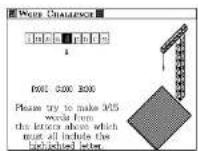
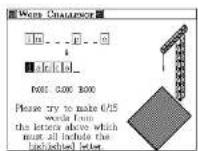
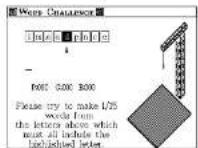
Use some or all of the letters displayed to make new words.
This is a word building game in which you have to use the prescribed letter.
1 Select "Word Challenge" and then press ENTER.
The selected letters and the number of answers will be displayed.
* T o shuffle the letters, press?
2 Enter a word using over 3 displayed letters.
Press BACK return.
Be sure always to use the reversed letter.
3 P r eSSER.
If your answer is correct, you can enter the next word.
Y ou can use▼ or ▲O redisplay correct words already accepted.
Press BACK to return.
* T o give up entering letters, presenter.
* If your answer is incorrect, the message "Try again" will appear and the selected letters will be displayed again.
* If your answer is correct word, the following messages will be displayed and counted in the appropriate column by the number of the answers.
"Poor" column (P) Under 60% of all the answers
"Good" column (G) 60% to 90% of all the answers
"Brilliant" column (B) Over 90% of all the answers
:
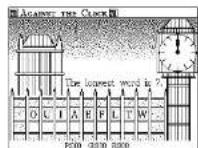
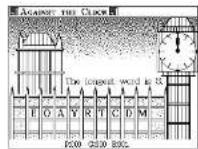
Against the Clock
This is a game in which you have to find a mystery words in a limited time.
1 Select "Against the Clock" and then press ENTER.
The selected letters will be displayed.
The clock will also begin to count down.
* T o shuffle the letters, press?
2 Enter a word.
Press BACK return.
Be sure always to use the reversed letter.
3 P r eBSER.
* If your answer is correct word, the following messages will be displayed and counted in the appropriate column by the number of the letters.
"Poor" column (P) Under 5 letters
"Good" column (G) 5 or 6 letters
"Brilliant" column (B) Over 7 letters
The answer will then be displayed.
* Press any alphabet key to proceed to the next round.
* T o give up entering letters, presENTER.
* If your answer is incorrect, the message "Try again" will appear and the selected letters will be displayed again.
* If your time is up, if your answer is less than 5 letters, or if you press ENTER in the middle of a game, "Poor" will be displayed and counted in
Easy Learn
The Easy Learn function allows you to create your own word list from the Encyclopedia, Dictionaries, Thesaurus, Spellchecker, Solvers and Games, which can then be used in the games.
■ Building your word list:
Example: Encyclopedia
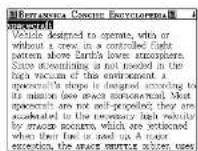
1 Select the word you wish to add to your word list using the cursor keys. (See page 20.)
2 P r e\$S.
(Using the Jump Function)
1 P r esser and then select "Add To Easy Learn List" by using Page ▼.
2 P r ester to confirm.
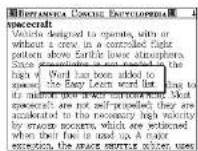
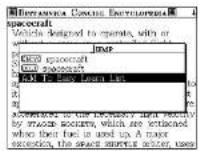
* The unit can store words between 4 and 12 letters. The words must not contain letters or symbols other than lower case alphabetic letters.
Viewing the word list
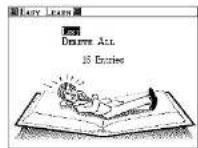
1 P r eSSC LEARN .
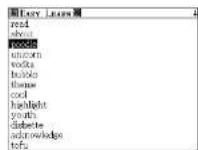
2 P r eBSER to select "List". The word list will be displayed.
3 P r ess or Page to scroll the list.
- Scrolling the list - Page Page : by line NEXT PREV : by page
4 P r eSSER to use jump function. (See page 20, 30 or 38.)
* Press to return to the previous screen.
* Please note that not every word returned by Spellchecker or Solvers is included in the Encyclopedia, Dictionaries, Thesaurus or English Usage.
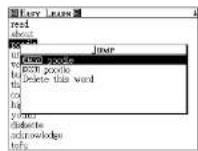
*** Tip for Parents ***
This is a fun way to help your children learn new words from a list as part of their homework. Enter the words into the list as described
■ Deleting a word
1 Press.
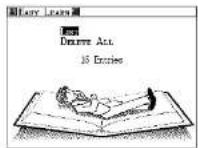
2 P r ESSER to select "List". The word list will be displayed.
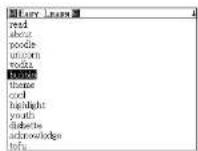
3 Select the word you wish to delete from your word list.
- Scrolling the list -

4 P r esser and then select "Delete this word" by using Page .
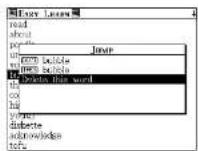
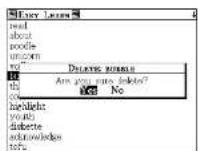
5 P r esser to confirm.
* If you decide not to delete the word, select "No" then press ENTER
* Press BACK to return to the previous screen.
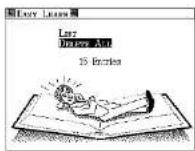
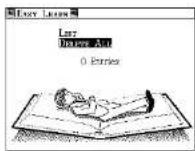
■ Deleting all words
1 P r eSSC LEARN .
2 P r ess to select "DELETE ALL". The word list will be displayed.
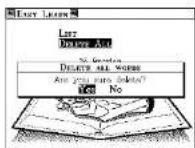
3 P r esser.
4 P r esser again to confirm.
* If you decide not to delete all the word, select "No" then press ENTER
* Press BACK to return to the previous screen.
Calculator / Converters
Calculator
Keys and their Functions
-
- Selects Calculator and Unit Converters.
- z^CDE Clears last entry
- 1\~0 Number input keys.
- +,-,x, | Mathematical function keys.
- MC Clears memory.
- MR Recalls number from memory.
- M+ Adds number into memory.
- M- Removes number from memory.
- +/- Changes sign of number.
- % Percentage key.
* The number stored in the memory is held when the calculation is changed, the mode is switched or the power is turned off.
Correcting and Clearing Entries
If you enter an incorrect number, press Zte clear the entire display, then re-enter the correct number.
If you press an incorrect mathematical function key, simply press the correct function key afterwards.
If “E” appears in display:
• The answer to a calculation is more than 12 digits.
• The memory is full.
Converters
Entering or Changing a Conversion Rate
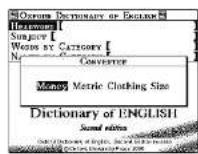
1 P r e885T and then CALC LEARN
2 Press or to display the conversion menu.
3 P r esser to select "Money".
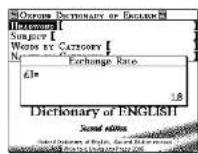
4 Select "Exchange Rate" by using cursor keys.
5 P r esser.
6 Enter the new rate and then press ENTER.
Example: £1 = \$ 1.8
Currency Conversion
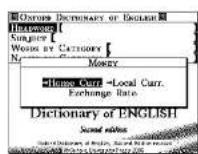
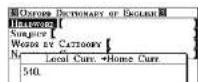
Example: 540 US Dollar to £ (£1 = \$ 1.8)
1 Select “->Home Curr.” by using cursor keys.
2 P r esser.
3 Enter the amount you wish to convert and then press ENTER.
(\$540=£300)
Metric / Imperial Conversion
Example: Kilometres to Miles
1 P r e\$BT and then CALC LEARN
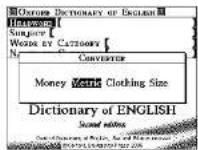
2 Press or to display the conversion menu.
3 P r ess to select "Metric" and then ENTER.
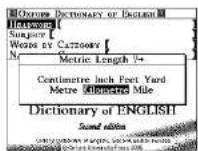
4 Press to select "Length" and then ENTER.
5 Select "Kilometre" by using cursor keys.
6 P r eBSTER.
7 Select "Mile" by using cursor keys.
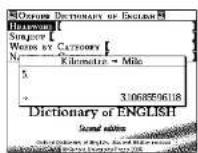
8 P r eBSTER . Enter the number you wish to convert.
9 P r esser. (5 Kilometres = 3.10685596118 miles.)
Clothing Size Chart
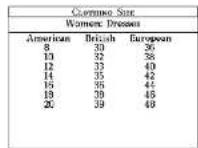
You can easily check foreign clothing sizes: shirts, shoes, hats etc. for men, women and children.
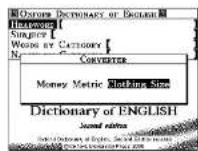
1 P r eSIFT and then CALC LEAMN
2 Press or Page to display the conversion menu.
3 Press to select "Clothing Size" and then ENTER.
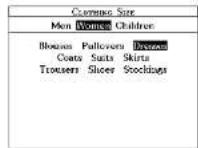
4 P r ess to select "Women".
5 P r ess or ENTER
6 Select "Dresses" by using
* After pressing Page you can reselect "Men". "Women" and "Children" using Sense or Sense
7 P r esser.
Categories of Metric Conversion
Temperature: °C, °F
Length: Centimetre, Inch, Feet, Yard, Metre, Kilometre, Mile
Area: Centimetre ^2 , Inch ^2 , Feet ^2 , Yard ^2 , Metre ^2 , Acre, Kilometre ^2 , Mile ^2
Volume: Centimetre ^3 , Inch ^3 , Feet ^3 , Yard ^3 , Metre ^3
Categories of Clothing Size Chart
Men: Suits, Trousers, Overcoats, Pullovers, Socks, Shoes, Shirts, Hats Women: Blouses, Pullovers, Dresses, Coats, Suits, Skirts, Trousers, Shoes, Stockings
Children: Desert, Oats, Oats, Oats, Tongsens, Oats, Meat Oats
Setting function / Character size
You can customize the operating conditions.
■ Selecting the menu
1 P r SET eSS.
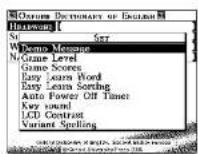
2 Select the function you want to change by pressing Page . Page
* B y pressing the first letter of a menu item, you can directly select the desired function. Further menu starting with the same letter can be selected by pressing the same letter again.
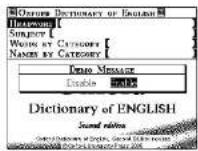
■ Changing the Demo mode
1 Select "Demo Message" and then press ENTER.
2 Select "Disable" or "Enable" by using Sense or Sense
3 P r easer to accept changes. (See page 5.)
Setting the Game Level
The unit provides three skill levels for playing games (Beginner, Intermediate and Advanced). The level can be changed as required.
1 Select "Game Level" and then press ENTER.
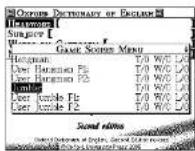
Game Scores
The unit can display the score of the games.
1 S elect "Game Scores" and then press ENTER.
2 Select one of the games by using the cursor keys.
* Scroll to the end of the list to reset all game scores.
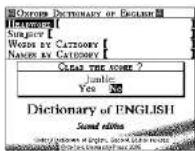
3 P r eBSER.
"Clear the score?" will be displayed.
4 Select "Yes" or "No" by using 🧑 and then press ENTER
* The Game Score limit is 999 for the total number of games played. You should clear the game score if you exceed the 999 limit.
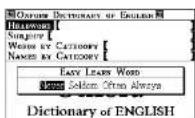
■ Setting the frequency for the Easy Learn list
The unit provides four frequency levels to use your user word list for playing games.
1 Select "Easy Learn Word" and then press ENTER.
2 Select a frequency level by using or Sense

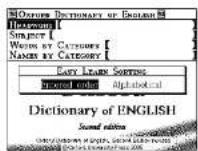
■ Changing the sorting for the Easy Learn list
The unit can change the sorting of your user word list.
1 Select "Easy Learn Sorting" and then press ENTER.
2 Select "Entered order" or "Alphabetical" by using 🧑 or 🖱
3 P r esser to set it.
■ Setting the Auto Power Off Timer
The unit automatically turns off after a period of time. This amount of time can be customized. (Default 3 min)
1 Select "Auto Power Off Timer" and then press ENTER.
2 Select one of the preset durations by using Sense or Sense
3 P r esser to set it.
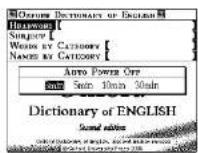
Setting the Key Sound
1 Select "Key sound" and then press ENTER.
2 Select "Disable" or "Enable" by using Sense or Sense
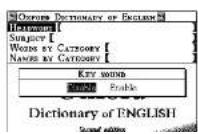
■ Setting the LCD Contrast
1 Select "LCD Contrast" and then press ENTER".
2 Change the contrast level by using Page or Page
3 P r esser to accept changes. (See page 4.)
Variant Spelling
1 Select "Variant Spelling" and then press ENTER.
2 Select "Disable" or "Enable" by using Sense or Sense
3 P r esser to accept changes.
■ Character size
The display screen can be switched to Large, Middle or Small by pressing ☐.
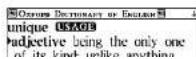
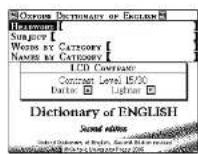
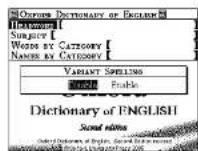
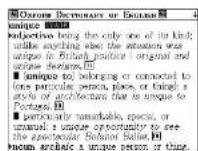
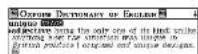
Appendix
■ Pronunciations in the Oxford Dictionary of English
Pronunciations
Generally speaking, native speakers of English do not need information about the pronunciation for ordinary, everyday words such as bake, baby, beach, bewilder, boastful, or budget. For this reason, no pronunciations are given for such words (or their compounds and derivatives) in the Oxford Dictionary of English. Words such as baba ganoush, baccalaureate, beatific, bijouterie, bucolic, and buddleia, on the other hand, are less familiar and may give problems. Similarly, difficulties are often encountered in pronouncing names of people and places, especially foreign ones, such as Dehra, Dun, Kieslowski, and Althusser.
In the Oxford Dictionary of English, the principle followed is that pronunciations are given where they are likely to cause problems for the native speaker of English, in particular for foreign words, foreign names, scientific and other specialist terms, rare words, words with unusual stress patterns, and words where there are alternative pronunciations or where there is a dispute about the standard pronunciation.
The Oxford Dictionary of English uses the International Phonetic Alphabet (IPA) to represent the standard accent of English as spoken in the south of England (sometimes called Received Pronunciation or RP). The transcriptions reflect pronunciation as it actually is in modern English, unlike some longer-established systems, which reflect the standard pronunciation of broadcasters and public schools in the 1930s. It is recognized that, although the English of southern England is the pronunciation given, many variations are heard in standard speech in other parts of the English-speaking world.
The symbols used for English words, with their values, are given below. In multi-syllable words the symbol ' is used to show that the following syllable is stressed (as in ke'bal);, indicates a secondary stress (as in kale'bri:s).
Consonants: b, d, f, h, k, l, m, n, p, r, s, t, v, w, and z have their usual English values. Other symbols are used as follows:
| g | gel | x | loch | ð | this | j | yes |
| tʃ | chip | ŋ | ring | ʃ | she | ||
| dʒ | jar | θ | thin | ʒ | decision |
| Vowels | |||||||
| SHORT VOWELS | LONG VOWELS (Indicates length) | DIPHTHONGS | TRIPHTHONGS | ||||
| a | cat | a: | arm | ar | my | are | fire |
| ε | bed | ε: | hair | au | how | aue | sour |
| e | ago | e: | her | er | day | ||
| r | sit | i: | see | ou | no | ||
| i | cosy | ɔ: | saw | re | near | ||
| ɒ | hot | u: | too | or | boy | ||
| ʌ | run | ue | poor | ||||
| ʊ | put | ||||||
(ə) before /l/, /m/, or /n/ indicates that the syllable may be realized with a syllabic l, m, or n, rather than with a vowel and a consonant, e.g. /'bʌt(ə)n/ rather than /'bʌten/.
(r) indicates an r that is sometimes sounded when a vowel follows, as in drawer, cha-chaing.
Foreign pronunciations
Foreign words and phrases, whether naturalized or not, are always given an anglicized pronunciation. The anglicized pronunciation represents the normal pronunciation used by native speakers of standard English (who may not be speakers of other languages) when using the word in an English context. A foreign pronunciation is also given for words taken from other languages (principally French, Dutch, German, Italian, Russian, and Spanish) where this is appreciably different from the anglicized form and where the other language is familiar to a reasonable number of English speakers.
Where the native form of a foreign place name is given in addition to the anglicized form, only the foreign pronunciation of this form is given, e.g.
Wisła /'viswa/
Polish name for VISTULA.
Foreign-language transcriptions are based on current national standards. Regional variations have not been given, except in the case of Spanish transcriptions, where both Castilian and American Spanish variants are given (if distinct). Transcriptions are broad, and many symbols, identical to those used for transcribing English, have similar values to those of RP. In a few cases, where there is no English equivalent to a foreign sound, a symbol has been added to the inventory. The additional symbols used to represent foreign pronunciations are given below.
Consonants
| (German) | Ehrlich, gemütlich | |
| (French)(Italian)(Portuguese)(Spanish) | Monseigneur, Auvergne, DaubignyEmilia-RomagnaMinhoEspaña, Buñuel | |
| (Spanish) | Bilbao | |
| (Spanish) | Burgos | |
| (Italian) | Cagliari | |
| z | (Hungarian) | Magyarország |
| “ | French’s” | Anurea Arlos |
Vowels
| SHORT VOWELS | LONG VOWELS(:indicates length) | |||
| (German) | Abitur | a: (Dutch)(German) | Den HaagAachen | |
| (Dutch) | Nederland | |||
| e | (French)(Italian)(Spanish) | abbéCroceAlbacete | e: (German)(Dutch)(Irish) | WehrmachtNederlandGaeltacht |
| (French)(Italian)(Spanish) | aubergePalioCortes | o: (German)(Hungarian) | verbolenBrassó | |
| (French)(German)(Greek)(Hungarian)(Italian) | BonnarddurchkomponiertDhilosBrassóBorgia | |||
| (French) | Pasteur | |||
| (French) | Jussieu | : (German) | Gastháfe | |
| u | (French)(Italian)(Spanish) | AnjouDuccioAsunción | ||
| y | (French) | cru | y: (German) | gemütlich |
| (German) | München | |||
| (Irish)(Russian) | DàilArkhangelsk | |||
| (French) | Horta | |||
NASALIZED VOWELS
| ( indicates nasality) | ||
| a | pincette | word forangliziert Frenchpromunschaften |
| b | cordon bleu | |
| c | (French) | Danlon, Lac Leman |
| d | (French) | Amiens, Rodin |
| e | (French) | Verdun |
| f | (French) | arrondissement |
■ Pronunciations and Abbreviations in Fowler's Modern English Usage
Key to the Pronunciation
The pronunciation system is that of the International Phonetic Alphabet (IPA) and, except where otherwise specified, is based on the pronunciation, widely called 'Received Pronunciation' or RP, of educated people in southern England. The necessary adjustments have been made when standard American English pronunciations are given.
The symbols used, with typical examples, are as follows:
Consonants
b, d, f, h, k, l, m, n, p, r, s, t, v, w, and z have their usual English values. Other symbols are used as follows:
| g | (get) | η | (ring) | 3 | (decision) |
| ∫ | (chip) | θ | (thin) | j | (yes) |
| dʒ | (jar) | ð | (this) | ||
| x | (loch) | ∫ | (she) |
Vowels
| Short vowels | Long vowels | Dipithongs | |||
| æ | (cat) | ɑ: | (arm) | ei | (day) |
| e | (bed) | i: | (sec) | ai | (my) |
| ə | (ago) | ɔ: | (saw) | ɔi | (boy) |
| ɪ | (sit) | ɜ: | (her) | əʊ | (no) |
| ʊ | (hot) | u: | (too) | ac | (how) |
| ʌ | (run) | ie | (near) | ||
| ʊ | (put) | ee | (hatr) | ||
| ou | (poor) | ||||
| aiə | (fire) | ||||
| aoə | (sour) | ||||
The main or primary stress of a word is shown by a superior ' placed immediately before the relevant syllable. When a secondary stress is called for this is indicated by an inferior , placed immediately before the relevant syllable.
The mark \~ (called a tilde) indicates a nasalized sound. as in the following
Abbreviations and Symbols
† obsolete
→ becomes * unacceptable construction, spelling, etc.
* precedes a reconstructed etymological formation \~ varies freely with; by comparison with
(in the OED) catachrestic and erroneous uses
SMALL CAPITALS refer the reader to the article so indicated, for further information.
| a. ante | before, not later than | EC | European Community |
| abbrev. | abbreviation, abbreviated as | e.g. | exempligrutia, 'for example' |
| abl. | ablative | ELT | English Language Teaching |
| acc. | accusative | ||
| adj. | adjective | Eng. | English |
| adv. | adverb | esp. | especially |
| advl | adverbial | et al. | et alif, 'and others' |
| advt | advertisement | exc. | except |
| AmE | American English | ||
| arch. | archaic | f. | from |
| attrib. | attributively) | fem. | feminine |
| Aust. | Australian | fig. | figuratively |
| aux. | auxiliary | Fr. | French |
| AV | Authorized Version (of the Bible) | Ger. | German |
| gen. | genitive | ||
| BEV | Black English Vernacular (US) | Gk | Greek |
| BrE | British English | hist. | historical, with historical reference |
| c. | circa | ||
| c. | century, centuries | ibid. | ibidem, 'in the same book or passage' |
| Canad. | Canadian | ||
| cf. | compare | idem | 'the same' |
| colloq. | colloquial | i.e. | id est, 'that is' |
| compar. | comparative | IE | Indo-European |
| conj. | conjunction | indic. | indicative |
| const. | construed (with) | infin. | infinitive |
| intr. | intransitive | ||
| L. lat. | Latin | pple | participle |
| lit. | literally | prec. | preceding(word or article) |
| masc. | masculine | pref. | prefix |
| math. | mathematical | prep. | preposition, prepositional |
| MDu. | Middle Dutch | ||
| ME | Middle English | pres. | present |
| medl. | medieval Latin | prob. | probably |
| MLG | Middle Low German | pron. | pronoun |
| mod. | modern | pronunc. | pronunciation |
| modE | modern English | ||
| modF | modern French | quot. | quotation |
| modL | modern Latin | ||
| mus. | music | RC | Roman Catholic |
| refl. | reflexive | ||
| n., n.pl. | noun, plural noun | RP | Received Pronunciation (in Brf) |
| N/Amer. | North American | ||
| naut. | nautical | ||
| neut. | neuter | SAfr. | South African |
| NEXIS | proprietary name of a large electronic database | SAmer. | South American substantive |
| sb. | Scottish | ||
| Sc. | scilice, 'understand' or 'supply' | ||
| Nr. | Northern Irish | sc. | singular |
| nom. | nominative | ||
| NT | New Testament | sing. | Spanish |
| NZ(E) | New Zealand (English) | Sp. | Society for Pure English |
| SPE | |||
| obs. | obsolete | spec. | specifically |
| obsolesc. | obsolescent | superl. | superlative |
| occas. | occasionally(ly) | s.v. | sub vice, 'under the word' |
| OE | Old English | ||
| OF | Old French | ||
| OFris. | Old Frisian | t. | tense |
| ON | Old Norse | theol. | theological |
| OProvençal | Old Provençal | tr. | translation (of) |
| orig. | originally | trans. | transitive |
| OUP | Oxford University Press | ||
| UK | United Kingdom | ||
| p.a.t. | past tense | ult. | ultimately |
| p.a.pple | past participle | UN | United Nations |
| perh. | perhaps | US | United States |
| pers. | person | usu. | usually |
| Pg. | Portuguese | ||
| phr. | phrase | v., vs. | verb, verbs |
| nl. | plural | vbl. | verbal |
Bibliographical Abbreviations
| Alford | Henry Alford, The Queen's English, 1864 |
| Amer. N. & Q. | American Notes & Queries |
| Amer. Speech | American Speech |
| Ann. | Annual |
| Baldick | C. Baldick, The Concise Oxford Dictionary of Literary Terms. 1990 |
| BMJ | British Medical Journal |
| Bodl. Libr. Rec. | Bodleian Library Record |
| Bull. Amer. Acad. | Bulletin of the American Academy of Arts and Sciences |
| Arts & Sci. | |
| Burchfield | R. Burchfield, The Spoken Word: a BBC Guide, 1981 |
| CGEL | A Comprehensive Grammar of the English Language, ed. R. Quirk et al., 1985 |
| Chr. Sci. Monitor | Christian Science Monitor |
| Chroni. | Chronicle |
| COD | The Concise Oxford Dictionary, 8th edn., 1990; 9th edn., 1995 |
| Conc. Scots Dict. | Concise Scots Dictionary |
| Crystal | D. Crystal, A First Dictionary of Linguistics and Phonetics, 1980 |
| IARE | Dictionary of American Regional English, ed. F. G. Cassidy et al., 2 vols. (A-H), 1985, 1991 |
| Dict. | Dictionary (of) |
| Dict. Eng. Usage | Dictionary of English Usage |
| Eccles. Hist. | Ecclesiastical History |
| Encyd. | Encycloptajedia |
| European Sociol. Rev. | European Sociological Review |
| Fowler | H. W. and F. G. Fowler, The King's English, 1906 |
| Garner | Bryan A. Garner, A Dictionary of Modern Legal Usage, 1987 |
| Gaz. | Gazette |
| Gimson | A. C. Gimson, An Introduction to the Pronunciation of English, 3rd edn., 1980 |
| Hartmann and Stork | R. R. K. Hartmann and F. C. Stork. Dictionary of Language and Linguistics, 1973 |
| Hart's Rules | Hart's Rules for Compositors and Readers at the University Press, Oxford, 39th edn., 1983 |
| Internat. | International |
| London Rev. Bks | London Review of Books | Wales | Katie Wales, A Dictionary of Stylistics, 1989 |
| Lyons | J. Lyons, Semantics, 2 vols., 1977 | Walker | John Walker, A Critical Pronouncing Dictionary and Expositor of the English Language, 1791; 4th edn 1806 |
| Mag. | Magazine | WDEU | Webster's Dictionary of English Usage, 1989 |
| Mitchell | Bruce Mitchell, Old English Syntax, 2 vols., 1985 | Webster's Third Wells | Webster's Third New International Dictionary, 1961 J. C. Wells, Longman Pronunciation Dictionary, 1990 |
| N&Q | Notes & Queries | ||
| NEB | New English Bible | ||
| New SOED | The New Shorter Oxford English Dictionary, 2 vols., 1993 | For convenience, the dates assigned to the works of Shakespeare are those given in the Bibliography of the OED. The texts of the individual works are cited from the original-spelling edition of Stanley Wells and Gary Taylor, OUP, 1986. | |
| NY Rev. Bks | New York Review of Books | ||
| OCELang. | The Oxford Companion to the English Language, ed. Tom McArthur, 1992 | ||
| OCELit. | The Oxford Companion to English Literature, ed. Margaret Drabble, 5th edn, 1985 | All examples from the Bible are cited from the Authorized Version of 1611 (quoted from the 'exact reprint' with an introduction by Alfred W. Pollard, OUP, 1985). | |
| ODCIE | Oxford Dictionary of Current Idiomatic English, ed. A. P. Cowie et al., 2 vols, 1975, 1983 | ||
| ODEE | Oxford Dictionary of English Etymology, 1966 | ||
| ODWE | Oxford Dictionary for Writers and Editors, 1981 | ||
| OED | The Oxford English Dictionary, issued in parts 1884-1928; as 12 vols., 1933 | ||
| OED 2 | Oxford English Dictionary, 2nd edn, 20 vols., 1989 | ||
| OEDS | A Supplement to the Oxford English Dictionary, 4 vols., 1972-86 | ||
| OGEU | The Oxford Guide to English Usage, 2nd edn, 1993 | ||
| OMEU | The Oxford Miniguide to English Usage, 1983 | ||
| Oxf. Dict. Eng. Gramm. | The Oxford Dictionary of English Grammar, 1994 | ||
| Purl. Aff. | Parliamentary Affairs | ||
| POD | The Pocket Oxford Dictionary | ||
| Poutsma | Hendrik Poutsma, A Grammar of Late Modern English, 5 vols., 1926-9 | ||
| Publ. Amer. Dial. Soc. | Publications of the American Dialect Society | ||
| Q | Quarterly | ||
| Quirk | R. Quirk et al., A Grammar of Contemporary English, 1972 | ||
| Reg. | Register | ||
| Rep. | Report | ||
| Rev. | Review (of) | ||
| Sci. Amer. | Scientific American | ||
| Smith | Egerton Smith, The Principles of English Metre, 1923 | ||
| Tel. | Telegraph | ||
| TES | The Times Educational Supplement | ||
| THYS | The Times Higher Educational Supplement | ||
■ Pronunciations and Abbreviations in the Oxford Dictionary of Modern Slang
Pronunciation Symbols
| Consonants | |||||||
| b | but | l | leg | t | top | thin | |
| d | dog | m | man | v | voice | this | |
| f | few | n | no | w | we | ring | |
| g | get | p | pen | z | zoo | x | loch |
| h | he | r | red | ʃ | she | tʃ | chip |
| j | yes | s | sit | ʒ | decision | d_3 | jar |
| k | cat | ||||||
| Vowels | |||||||
| æ | cat | ʊ | hot | aɪ | my | ɪə | near |
| a: | arm | ɔ: | saw | aʊ | how | əɪ | boy |
| e | bed | ʌ | run | eɪ | day | ʊə | poor |
| ɜ: | her | ʊ | put | əʊ | no | aɪə | fire |
| ɪ | sit | u: | too | eə | hair | aʊə | sour |
| ɪ: | see | ə | ago | ||||
(3) signifies the indeterminate sound as in garden, carnal, and rhythm.
(r) at the end of a word indicates an r that is sounded when a word beginning with a vowel follows, as in clutter up and an acre of land.
The main or primary stress of a word is shown by preceding the relevant syllable; any secondary stress in words of three or more syllables is shown by, preceding the relevant syllable.
Principal Abbreviations
| a. (in dates) | before |
| Austral | Australian (English) |
| attrib | attributive |
| Brit | British (English) |
| c. (in dates) | about |
| cent. | century |
| cf. | compare |
| compar. | comparative |
| conj | conjunction |
| derog | derogatory |
| esp. | especially |
| fig. | figurative |
| int | interjection |
| intr. | intransitive |
| N Amer | North American (English) |
| NZ | New Zealand (English) |
| obs. | obsolete |
| OE | Old English |
| orig | originally |
| perh. | perhaps |
| phr. | phrase |
| pl. | plural |
| prep | preposition |
| prob. | probably |
| pron | pronoun |
| S Afr | South African (English) |
| sing. | singular |
| spec. | specifically |
| superl. | superlative |
| trans. | transitive |
| transf. | in transferred sense |
| US | United States (English) |
| usu. | usually |
Using a power adapter
Since the battery life for this product is approximately 100 hours, it is not envisaged that an AC adaptor would generally be required. However the following guidance is given should use of one be required.
DC 3V IN
◇-●+

CAUTION
The batteries should be removed if you intend to use the unit for a long period with the specified AC adapter. Battery leakage may damage the unit or cause it to malfunction.

When batteries are not inserted into the unit (when using for the first time after purchase, etc.)
- Insert the DC plug ( 12 of the AC adaptor into the power jack of the unit.
- Insert the AC adapter into an AC 240V (50Hz) power socket.
- Press the Reset switch on the back of the unit.
- Turn on the power.
If you have been using the unit for a long period of time without batteries inserted but wish to remove the adapter and use the batteries while preserving the previous settings and memory, remove the AC adapter after firmly inserting batteries into the unit.
Care is needed since if the batteries are not firmly inserted when the AC adapter is removed, the previous memory content will be lost.
In the event of a disruption in the power, when using the mains adapter, the unit may take up to 30 seconds to recover.

When batteries are inserted into the unit or are already present in the unit (when batteries are inserted in accordance with the operating instructions or are already in use).
- Turn off the power.
- Insert the DC plug 1 of the AC adaptor into the power inok of the unit
Use for a long period of time with the batteries inserted may result in damage and malfunctioning due to the leakage of battery fluid. The batteries should therefore be removed from the unit.
When removing the AC adapter, if you wish to preserve the previous settings and memory, remove the AC adapter after firmly inserting batteries into the unit.

CAUTION
If you intend to use the AC adapter with the batteries removed, removing the AC adaptor as it is will result in loss of memory.
Be sure to remove the AC adapter after firmly switching the unit OFF. In this case, the previous settings, will be lost.
- C are is needed since if you remove the AC adapter within three seconds of turning the power off, all the data stored in the memory will be deleted.
If you wish to preserve your previous settings and memory content, remove the AC adaptor only after making sure that the batteries are firmly inserted into the unit.

SAFETY PRECAUTIONS
- Be sure to only use a compatible adapter of the specified input/output voltages. Use of any other adapter may damage the unit and invalidate the warranty.
- Do not touch the tip of the DC plug or the power jack.
- When removing the AC adapter, turn off the power of the unit and detach in the order of AC adapter and DC plug.
- The unit can be used only with a household power source of AC 240V.
- Under no circumstances use in places in the vicinity of water. Doing so may result in electric shock and accidents.
- Do not use with a blanket or cushion placed on top of the adapter or in the vicinity of heating equipment. Doing so may result in heat emission, deformation and malfunctioning.
- Stop using the unit as soon if you notice that there might be something wrong with it.
Precautions / Specifications
Under no circumstances should the unit be subjected to the following treatment, which is likely to damage or deform it. (indicates a prohibited action.)
- Do not use, store or leave the unit in any of the following places:
Places subject to direct sunlight and places where the temperature is likely to reach high levels such as inside a car during the summer months and by the side of heating devices
(especially on the seat or dashboard of a car with all the windows closed during the summer).
Places liable to accumulation of dust; bathrooms and other humid places where drops of water may come into contact with the unit; places where the influence of magnetism may be felt such as in the vicinity of magnets, speakers and TVs. - Do not place anything heavy on top of the unit. Do not press hard on the surface of the display unit or place heavy items such as books on top of it.
- Do not bend, twist, drop or apply a strong shock to the unit.
- Do not operate the keys with a hard, pointed instrument or apply more pressure to them than is necessary.
• Take care not to spill drinks on the unit. Take care especially when using the unit while drinking coffee, soft drinks, etc. - Do not alter the unit in any way or attempt to repair it by yourself.
- Do not use for a long time or store in close contact with synthetic leather products, rubber products, etc. Chemical changes, etc. may resulting in melting, discoloration and damage to the surface of the unit.
- When removing dirt from the surface of the unit. do






- Do not replace the batteries with the power on.
• Always reset the unit after replacing the batteries. - Clean with a clean, soft cloth. If the unit is particularly dirty, wipe with a thoroughly wrung cloth soaked in water.
- Condensation (droplets of water) may form on the display section immediately after turning on the heating in a cold place. In this case, use after wiping gently with a dry, clean, soft cloth.
Specifications
Display: 240 x 320 dot matrix, high contrast FSTN Liquid crystal Keys: 52 plastic keys
Temperature range: 0°C to +40°C (32°F to 104°F)
Batteries: Two AAA alkaline batteries
Battery life: approx. 100 hours for continuous display
Size: 137(W) x 88 (H) x 15.4 (D) mm
Weight: approx. 210g (including batteries)
* Specifications may change without notice in order to make product improvements.
* The life of the batteries will vary depending on how the unit is used.
FAQ's Generic
Q. Most display problems or malfunctions.
A. Press RESET button (Use a paperclip, not a pen tip as this may be too wide to operate the button properly).
Q. Display too light/Dark.
A. Adjust contrast/replace batteries.
Q. Same letter keeps appearing on screen.
A. Check if button has become jammed under case.
Q. The unit keeps using the same words in games.
A. Change Easy Learn settings-it's probably set to use the User Word List either "always" or "very often".
Q. Can I use rechargeable batteries?
A. The unit has been designed only to work with normal non-rechargeable batteries.
Rechargeable batteries have a lower voltage than normal non-rechargeable batteries so the unit may not function correctly if rechargeable batteries are used.
Q. Problems after changing the batteries.
A. Always press the reset button after changing the batteries.
Customer Services Telephone No. 01628-770988
ONE YEAR LIMITED WARRANTY
- This product is warranted to be free from defects in material or workmanship for one year from date of purchase.
- Repair (or at our option, replacement) will be made on any unit which proves to be defective during this period. Carefully pack the unit along with proof of purchase and a completed copy of the Warranty Record you will find in this manual. Postage, insurance and shipping costs incurred in returning the product for warranty service are your responsibility.
- This warranty does not extend to units which have been subjected to misuse, abuse, neglect, accidents or to units that have been used in violation of the operation instructions. If in our judgement, the unit shows evidence of having been altered, modified or serviced without our authorisation, it will be ineligible for service under this warranty.
- In Europe, this warranty does not affect your statutory rights.
- Battery replacement and broken Liquid Crystal Displays are not covered under this warranty.
Seiko Instruments Inc. shall not be liable for any direct, consequential or incidental damages arising out of use of this product. Seiko Instruments Inc. shall not be responsible for damages to this unit as a result of a natural or unnatural disaster, except to the extent prohibited by applicable law. Any implied warranty of merchantability or fitness for a particular purpose on this product is limited in duration to the duration of the warranty.
| WARRANTY RECORD ER9000 |
| Warranty Period: One year from the date of purchasePurchase Date : |
| Customer Name: |
| Address: |
| Phone No.: |
| Retailer Name: |
| Address : |
SEIKO UK Limited
Seiko Instruments Inc. Personal Instruments Division
- CE CN681
- EC DECLARATION OF CONFORMITY
- CONTENTS
- Preparation for using the unit
- Install the Batteries.
- Reset the unit.
- Adjust the LCD contrast.
- Set the key sound.
- Delete the Easy Learn memory.
- Demo function
- ■ Changing Batteries
- CAUTION
- Resetting
- NOTE:
- Functions and Features
- Dictionaries and Encyclopedia
- Oxford Dictionary of English
- Oxford Thesaurus of English
- Oxford Dictionary of Quotations
- Fowler's Modern English Usage
- Oxford Dictionary of Modern Slang
- Oxford Dictionary of Abbreviations
- Britannica Concise Encyclopedia
- Spellchecker
- Solvers
- Word Games
- Easy Learn
- Calculator
- Converters
- Setting function
- Other Features
- Jump function
- Help function
- Character size function
- Real-time search
- Preview function
- The Keys and their Functions
- Entering and Correcting Letters
- Looking up words whose spelling you aren't sure of
- Encyclopedia
- Headword Search
- to select the
- Category Search
- Dictionary
- T ype a word.
- ■ Subject Search
- T ype a subject name.
- T ype the first letter of a word.
- Words by Category
- P r eSST and then Post to select "WORDS BY CATEGORY".
- T ype a category name.
- P r essER.
- Use of to select the headword as necessary.
- P r esser.
- ■ Names by Category
- Pr eist and then Post to select "NAMES BY CATEGORY".
- P r össer.
- Smart Jump function
- Thesaurus
- P r e TMES .
- ↓ ENTER
- Word List
- ■ Choose the Right Word
- Confusable Words
- Dictionary of Quotations
- ■ Author Name Search
- T ype in the author's last name.
- Use Page or to select the author name required.
- P r ess to see the rest of an entry.
- T o scroll alphabetically up or down through the author name list, press
- T o clear the display and search for another author name, simply enter new author name.
- Keyword Search
- Theme Search
- T ype a theme.
- P r ENTSS .
- U se▼ or □ select the quotation required.
- Dictionary of English Usage
- Appendix
- Dictionary of Slang
- P r eSLANS.
- P r CENTBS.
- T o scroll alphabetically up or down
- P r and then ▼ to select
- Press ENTER.
- Solvers
- ■ Selecting Spellchecker or the solver
- Spellchecker
- P r essER.
- Using the Wildcard function
- Crossword Solver
- Anagram Solver
- Word Viewer
- Word Maker
- ■ Phrase Search
- ■ Definition Search
- ■ Encyclopedic Search
- ■ Dictionary of Abbreviations
- Abbreviation Search
- Letter Changer
- Slang Search
- ■ Homophones and Homographs
- Cryptic Clue Assistant
- Preparation:
- Word Decrypter:
- Cryptic Finder:
- Games
- ■ Selecting a game
- Select the game you wish to play by pressing Page or Page
- Hangman
- Select "Hangman" and then press ENTER.
- W hen you enter one of the letters used in the mystery word, the question mark will be replaced by the letter.
- If all the letters in the word are displayed before you have used up all the tries, a congratulatory message will be displayed and counted in the "Won" column.
- User Hangman
- Jumble
- User Jumble
- Crossword Quiz
- ■ Time and Balance
- General Knowledge
- Definitions
- Synonyms
- Slang Words
- Select "Slang Words" and then press
- Enter letters to replace the underline marks.
- Shakespeare
- Select "Shakespeare" and then press ENTER.
- Word Building
- User Word Building
- Word Challenge
- Against the Clock
- Easy Learn
- ■ Building your word list:
- Viewing the word list
- ■ Deleting a word
- ■ Deleting all words
- Calculator / Converters
- Calculator
- Keys and their Functions
- Correcting and Clearing Entries
- Converters
- Entering or Changing a Conversion Rate
- Currency Conversion
- Metric / Imperial Conversion
- Clothing Size Chart
- Categories of Metric Conversion
- Categories of Clothing Size Chart
- Setting function / Character size
- ■ Selecting the menu
- ■ Changing the Demo mode
- Setting the Game Level
- Game Scores
- ■ Setting the frequency for the Easy Learn list
- ■ Changing the sorting for the Easy Learn list
- ■ Setting the Auto Power Off Timer
- Setting the Key Sound
- ■ Setting the LCD Contrast
- Variant Spelling
- ■ Character size
- Pronunciations
- Foreign pronunciations
- Wisła /'viswa/
- Polish name for VISTULA.
- ■ Pronunciations and Abbreviations in Fowler's Modern English Usage
- Key to the Pronunciation
- Abbreviations and Symbols
- ■ Pronunciations and Abbreviations in the Oxford Dictionary of Modern Slang
- Using a power adapter
- SAFETY PRECAUTIONS
- Precautions / Specifications
- Specifications
- FAQ's Generic
- ONE YEAR LIMITED WARRANTY
Brand : SEIKO
Model : ER-9000
Category : Uncategorized