Bottle - Microphone Blue - Free user manual and instructions
Find the device manual for free Bottle Blue in PDF.


| Product Type | Condenser Microphone with Vacuum Tube Amplifier |
| Model | Bottle |
| Brand | Blue Microphones |
| Capsule Included | B6 Cardioid |
| Interchangeable Capsules | Yes (bayonet mount) |
| Vacuum Tube | EF86 Pentode (triode mode) |
| Circuit Type | Class A, fully discrete, no ICs in signal path |
| Output Impedance | 110 ohms (typical) |
| Transformer Ratio | 13:1 balanced |
| Polarization Voltage Range | 30.1 V to 95.1 V (9-step switch) |
| Power Supply | Power Stream (external) |
| Soft Start Feature | Yes (heater voltage first, then plate voltage after ~80 s) |
| Input Voltage | 110 V or 240 V (selectable) |
| Tube Heating Time | Approximately 3 minutes |
| Cable Included | Champagne Tube Microphone Cable (7 conductors) |
| Case Included | Blue velvet-lined ATA flight case |
| Mounting | Threaded mic stand socket (recessed) |
| Finish | Luxurious blue lacquer paint |
| Internal Wiring | Oxygen-free copper, Teflon insulated |
| Capacitors | Polypropylene and polystyrene (Russian MIL spec) |
| Resistors | Metal-film, low-noise 400 MOhm |
| Transport Screws | 3 brass transit screws for capsule |
| Warranty | 3 years (excluding tubes, 90 days) |
Frequently Asked Questions - Bottle Blue
User questions about Bottle Blue
0 question about this device. Answer the ones you know or ask your own.
Ask a new question about this device
Download the instructions for your Microphone in PDF format for free! Find your manual Bottle - Blue and take your electronic device back in hand. On this page are published all the documents necessary for the use of your device. Bottle by Blue.
USER MANUAL Bottle Blue
Pour it on.

natural_image
Man in checkered shirt holding a bottle, smiling at the camera (no visible text or symbols)
natural_image
Blue studio microphone with gold bezel and silver head, set against a solid blue background (no text or symbols visible)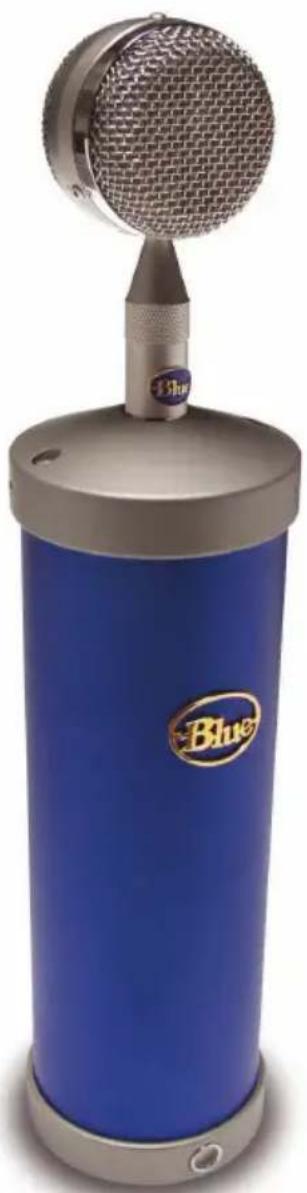
natural_image
Blue studio microphone with metallic grille and blue base (no visible text or symbols)Absolute Sound Perfection
Congratulations on your purchase of the Blue Bottle, a classic modern vacuum tube microphone made the old-fashioned way, without compromise. In every industry – cameras, automobiles, audio, and more – there are a handful of small companies reputed for a rare blend of scientific precision and artistic passion. You know who these artisans are; their trademarks are synonymous with the ultimate in handcrafted perfection. Our flagship “The Bottle” microphone parallels this vision, representing Blue’s highest achievement in quality and innovation. The Bottle is a precision recording tool, combining the low noise and superb transient response of top-grade electronics with the sonic magic of legendary vintage vocal microphones.
The Bottle is not simply a microphone, but a fully featured microphone system with optional interchangeable capsules. In an instant, these bayonet-mount capsules can be exchanged to provide different tonal characteristics and pickup patterns – while the power supply is still turned on!
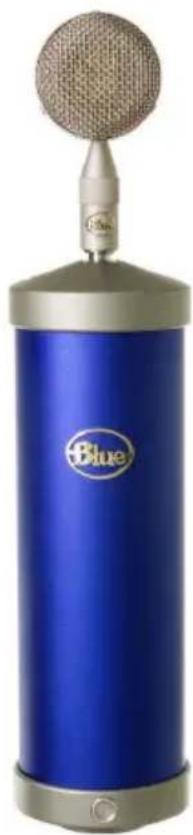
The basic Bottle system includes a B6 cardioid capsule, Champagne tube microphone cable, and the Power Stream Tube Mic power supply, shipped in a blue velvet-lined ATA flight case approved for the utmost protection. The Bottle is finished in a luxurious blue lacquer paint. Additional capsules are available from your pro audio dealer, and you'll find a complete list of capsules detailed herein. In order to familiarize yourself with the Bottle's specialized and unique features, please take the time to read this manual, and be sure to try the suggested recording tips.
natural_image
Blue studio microphone with metallic grille and silver casing (no visible text or symbols)The Bottle
One of the questions most commonly asked of Blue Bottle microphone owners is, "What's in that thing?" The Bottle is unquestionably an impressive sight, with its imposing size and nostalgic resemblance to the earliest European tube microphones. Like the mics of yesteryear, the Bottle canister is not just for looks, but also holds a small fortune in precision electronics.
The internal circuitry of the Bottle is thoroughly modern, of course, with an amplifier design utilizing a single hand-selected vacuum tube pentode EF86 in triode mode. The tube circuit is Class A and fully discrete, meaning that the sound which arrives at the dia-phragm of the Blue capsule is transduced (converted to electrical energy) as accurately as possible, with no integrated circuits (a.k.a "IC's") in the signal path. To this end, the Bottle utilizes electronic components of the highest quality (such as expensive metal-film resistors and large custom-built transformer), and there are no pad or low-cut filter switches in the microphone circuit. In short, this is a signal path of the highest possible quality, allowing you to get the
maximum benefit out of the unprecedented capsule selection created by Blue.
In order to get the most out of this, or any quality microphone, it is essential to pair it with a good microphone pre-amplifier. Most professional recordists prefer to have outboard preamps on hand, and will choose solid-state or vacuum tube models based on their unique characteristics. And unlike many tube microphones, the Bottle can be run through a variety of tube preamps without excess coloration, noise, loss of detail or tube compression.
To maintain the integrity of your signal, use the Blue Quad mic cable going into the mic preamp. It is not necessary or advisable to connect the Bottle mic Power Stream power supply to a 48V phantom power source. And, whenever possible, connect the mic preamp output directly to your recorder or A/D converter, bypassing the mixing board and any unnecessary components.
A recessed, threaded mic stand socket is built into the bottom of the Bottle canister, next to the multi-pin output jack. To put the Bottle on a stand, you may find it easiest to 1) loosen the boom stand arm or threaded end of the mic stand, 2) grasp the Bottle in one hand, and 3) screw the mic stand threads into the threaded mount. This procedure will eliminate any possibility of handling damage to the mic.
SAFETY NOTE
Do not attach a capsule or the multi-pin Champagne cable to the Bottle until it has first been attached to a stand. Once the microphone body is secure, connect the Champagne cable to the Bottle and the Power Stream power supply, and then turn on the Power Stream to start the warm-up process. At the end of a session, be sure to turn off the Power Stream power supply before disconnecting the Champagne cable.
natural_image
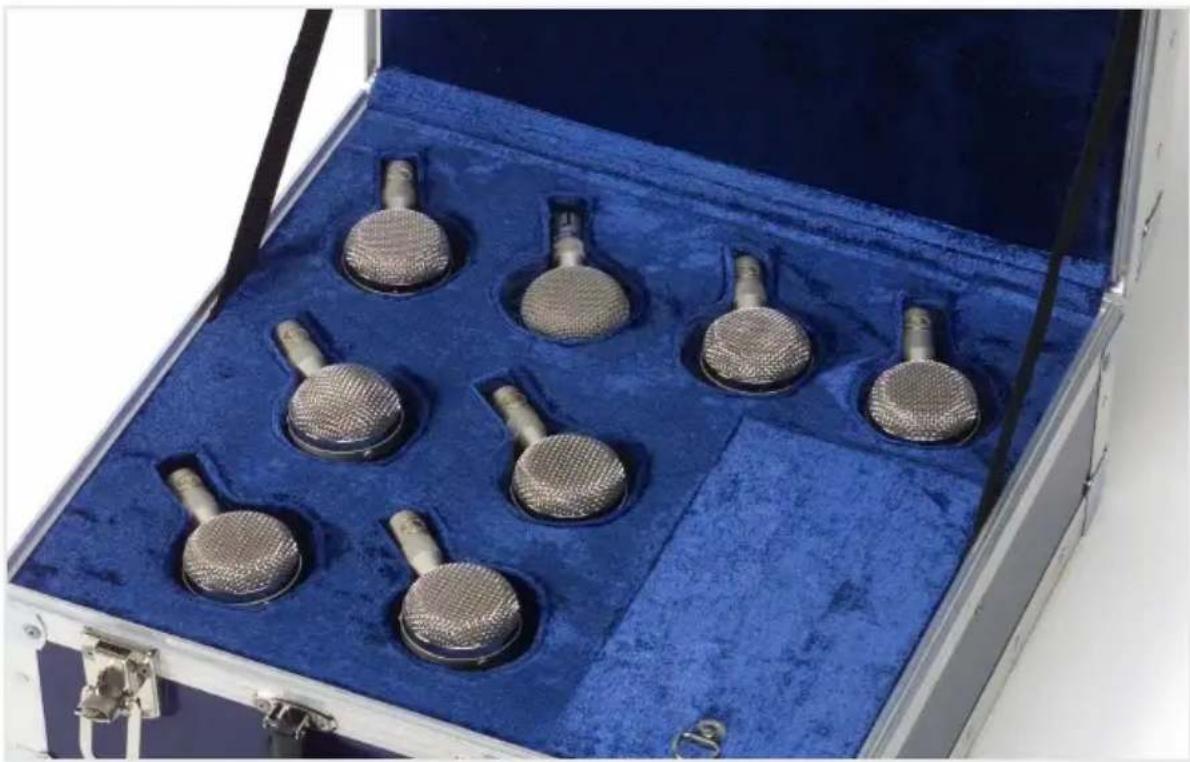
Open aluminum toolbox containing eight metallic microphones arranged in a blue cushioned case (no text or symbols visible)Capsule Exchange
When you're used to dealing with an assortment of tube microphones (each with its own mounting system and power supply, not to mention additional voltage transformers, fragile parts, and other quirks), you'll really appreciate the simplicity and ease of the Bottle capsule system. Switching capsules is a painless 30-second operation which eliminates downtime and warm-up time, and will never interrupt the flow of a session.
To secure the delicate capsule during transport and storage, three brass transit screws are provided (located around the outer ring of the spherical grille). The capsules will perform better with these screws removed and it is not necessary to reinsert them after every session, only when shipping the capsules.
Installing a capsule is a simple, three-step operation. First, position the capsule over the metal stem at the top of the Bottle, aligning the J-shaped slot at the back of the capsule socket with the protruding pin on the stem. Second, push the capsule down onto the stem until the pin stops at the end of the long leg of the slot. There is a strong spring inside the capsule socket, so a little extra effort may be required at this stage. Third, give the capsule a clockwise twist on the stem, so that the pin locks into the short leg of the slot and holds the capsule securely. You will notice that the stem pivots back and forth over a range of about 45 degrees to aid in placement and angling of the capsule.
When exchanging capsules, there is no need to turn off the Power Stream power supply. A low-level audio signal is present whenever a capsule is removed, so it is good engineering practice to mute or turn down the microphone preamp gain and monitors before changing capsules.
The Bottle vacuum tube amplifier consists of a classic common cathode circuit using a current source for the plate load, rather than the more commonly used simple resistor. The amplified signal is taken from the plate and fed through a high-quality polypropylene capacitor, bypassed by a smaller value polystyrene capacitor (Russian MIL spec), and output to our Blue custom hand-built transformer. Both of these capacitors have a low dielectric absorption coefficient and a low equivalent series resistance. These parameters are essential to high end audio and are not present in lower priced microphones.
D.A. (dielectric absorption) is reluctance on the part of the capacitor to give up stored electrons when the capacitor is discharged. E.S.R. (equivalent series resistance) is the resistance composed of the capacitor plate, lead, and termination resistances. If the capacitors used in the audio path possess high values of D.A. and E.S.R., the result is a loss of accuracy and dynamic structure when reproducing the finer details of the recorded source. Under these conditions, a definite "grunge" or hashy distortion is added to the reproduced signal.*
The Blue hand-built Bottle microphone transformer is balanced, using a symmetrical two-bobbin design (i.e. humbucking), with a transforming ratio of 13:1. With this ratio, the microphone achieves a low output impedance, typically 110 ohms. The primary transformer windings are connected in series. The transformer's secondary windings are connected in parallel, and connect directly to the XLR output pins. The transformer lamination has a high relative permeability, which is one of the factors contributing to low distortion and higher dynamic range. A permalloy circular housing covers the transformer, thus providing additional isolation from external magnetic fields.
The Bottle microphone employs an EF86 pentode vacuum tube connected in a triode mode. The third grid of the EF86 is connected with a cathode and is grounded. The plate voltage is at 65.0 VDC, and the plate is 0.6 mA. The heater voltage is kept at an optimum 6V to ensure the longevity of the tube. Each EF86 is tested by Blue engineers for self noise level, AC amplification factor, and THD distortion. Measurements are taken twice on each tube—first after a 24-hour burn-in period. The tube is mounted on custom made dampers to minimize microphonics. A custom rubber string is applied for dampening and holding the tube firmly in its socket.
A Wilson current mirror, the most accurate solution for a current source circuit, uses four thermocoupled solid state devices. These discrete devices are separate from the signal path.
A precise servo system is used to maintain the DC plate voltage at a constant level. This keeps the tube in peak condition, despite its natural aging. If a new tube is installed, this servo circuit keeps the tube working optimally. This unique circuitry, at the time of this writing, has not been used in any commercially available microphone. The servo system uses an integrated circuit with high time constant value, and is external to the signal path.
The amplifier input is separated from the microphone capsule with a capacitance consisting of two styroflex caps (one ten times the value of the other) mounted on special Teflon isolators. Both the tube grid and the microphone capsule are controlled through high-quality, low-noise 0.5W 400Mohm resistors. The capsule's polarization voltage is fed through two low-pass filters to enable voltage is adjustable by a multi-position switch on the power supply, with ranges from 30.1V (-6dB) up to 95.1V (+4dB), with a mid-point of 60V (0dB).
All of the Bottle's internal wiring is oxygen-free copper Teflon-insulated.
Power Stream Power Supply
No other commercially available tube mic power supply offers the unique features of the Blue Power Stream. To assure the longevity of the vacuum tube and the stability of the tube microphone circuitry, Blue has developed the Power Stream power supply with the new SOFT START feature.
In the past, power supplies have been designed to use both heater and plate voltages applied simultaneously once power has been switched on. In this case, the high voltage potential on the plate
forcefully attracts electrons from the not yet heated cathode, a process known as “cathode stripping”. In practicality, this means that each time the power supply is switched on, the microphone tube changes its electrical properties. To put it simply, the tube begins to wear and gets noisier.
To avoid this problem the Power Stream SOFT START feature delivers the tube's heater voltage first. The Power Stream's circuitry also prevents the heater current from exceeding the limits for which the tube was designed. Without this feature the cold heater would draw more current than specified, and begin to deteriorate the valuable microphone tube. After approximately 80 seconds—when the cathode is fully heated—the plate voltage is gradually applied starting from 10V to 120V (or other voltage depending on the microphone circuitry). During this time the output of the microphone is muted.
After about three minutes the tube is settled in its correct operating mode, the muting is disabled, and audio is present. Both the heater and the plate voltages are ultra stable and non-dependent on AC main changes of fluctuations. For AC rectification, the Power Stream uses the only high frequency diodes to obtain the purest DC possible. And most importantly, the plate voltage supply is of low impedance, which improves sonics and clarity.
All the potentiometer switches on the Power Stream are discrete military type with enclosed contacts. The nine-position switch allows you to determine precisely the right polarization voltage (the Bottle) or pattern selection (the Cactus) on your microphone capsule.
Polarization switch
The Power Stream offers a nine step polarization switch for sensitivity selections. Set at the top (zero) the microphone capsule is set at 60 volts for the suggested performance. When the switch is tuned counter fully clockwise, the polarization voltage is reduced to deliver a 6dB lower output for louder signal sources. When turned fully clockwise, the polarization voltages are increased delivering up to 4dB more output providing more sensitivity for quieter sound sources. Selections in between the maximum settings, allows the end user a variety of choices. Note: when the switch is fully increased, be careful not to overload the capsule with loud signal sources.
Voltage Changes
The Power Stream operates at either 110 or 240 voltages. Your power supply has been shipped for the proper voltages required in your country. If a voltage change is needed, remove the fuse holder located above the AC receptacle. Reinsert the specified fuse (AC 110V 500mA or AC 220V 250mA) and select the correct voltage (110 or 220) using the voltage selector switch.
Champagne Tube Microphone Cable
All microphone cables are reactive, energy storing devices with independent voltage and current components. The subtlest aspects of recorded sound are dependent on the physical construction of these cables, as well as size, material, and wire placement. To realize the perfect blend of the best materials, the Champagne tube microphone cable was designed collaboratively by Blue and an engineer with over thirty years of experience in the audio cable industry.
This top-quality cable uses only the finest available proprietary materials, including two-conductor pair is twisted to totally eliminate noise, and covered with the finest tinned copper braid for additional protection. To guarantee voltages and power, the Champagne cable incorporates five additional 24-gauge conductors. The result is a tube microphone cable that unveils every nuance captured in the Bottle, to tickle the finest taste buds as well as warm the coldest critic.

Microphones
Blue Microphones
5706 Corsa Avenue, Suite 102
Westlake Village, CA 91362
www.bluemic.com
Warranty
This Microphone or related part is warranted under the conditions outlined below to its original, registered owner, provided the purchase was made from an authorized Baltic Latvian Universal Electronics (BLUE) dealer. This Microphone or related part is guaranteed to remain free from operating defects for three years from the date of purchase. In the event that service is required, all necessary parts and labor will be furnished free of charge during this period except for tubes, which are guaranteed for 90 days against defects. This warranty is void if the serial number has been altered, removed or defaced. The warranty is void if the equipment is altered, misused, mishandled, maladjusted, or is serviced by any parties not authorized by Baltic Latvian Universal Electronics (BLUE). The warranty does not include transportation costs incurred because of the need for service unless arranged for in advance. Baltic Latvian Universal Electronics (BLUE) reserves the right to make changes in design and improve upon its products without obligation to install these improvements in any of its products previously manufactured. This warranty is in lieu of any or all expressed or implied.
In keeping with our policy of continued product improvement, Baltic Latvian Universal Electronics (BLUE) reserves the right to alter specifications without prior notice.
©2013 Blue Microphones. All rights reserved. Blue Logo Oval, Bottle, Bottle Caps, Power Stream, Series 2 Shock, The Pop, and Quad Cable are trademarks or registered trademarks of Blue Microphones, Inc. All other trademarks contained herein are the property of their respective owners.

natural_image
Close-up of a blue studio microphone with a metallic grille and 'Blue' logo (no text or symbols on the device itself)Brand : Blue
Model : Bottle
Category : Microphone