
HandiSawm CHS600 - Jigsaw BLACK & DECKER - Free user manual and instructions
Find the device manual for free HandiSawm CHS600 BLACK & DECKER in PDF.


| Product Type | Corded Jigsaw |
| Brand | Black & Decker |
| Model | HandiSaw CHS600 |
| Power Input | 600 W |
| Stroke Length | 20 mm |
| Max Cutting Depth (Wood) | 65 mm |
| Max Cutting Depth (Metal) | 10 mm |
| Variable Speed | Yes, 500 - 3000 spm |
| Bevel Capacity | 0° - 45° |
| Dust Blower | Yes |
| Blade Change System | Tool-free |
| Power Cord Length | 2 m |
| Weight | 2.1 kg |
| Dimensions (L x W x H) | 260 x 80 x 200 mm |
| Voltage | 230 V / 50 Hz |
| Safety Features | Lock-off switch, dust port, anti-slip grip |
| Maintenance | Clean with dry cloth; lubricate blade guide periodically |
| Spare Parts Availability | Blades, shoe plate, dust blower nozzle, carbon brushes |
| Repairability | User-replaceable carbon brushes; professional repair recommended for motor |
Frequently Asked Questions - HandiSawm CHS600 BLACK & DECKER
User questions about HandiSawm CHS600 BLACK & DECKER
0 question about this device. Answer the ones you know or ask your own.
Ask a new question about this device
Download the instructions for your Jigsaw in PDF format for free! Find your manual HandiSawm CHS600 - BLACK & DECKER and take your electronic device back in hand. On this page are published all the documents necessary for the use of your device. HandiSawm CHS600 by BLACK & DECKER.
USER MANUAL HandiSawm CHS600 BLACK & DECKER
UK
Ireland
Australia
New Zealand
natural_image
Line drawing of hands using a tool to adjust or install a black and copper component on a wooden workbench (no text or symbols)Intended use
Your Black & Decker Saw has been designed for sawing wood, plastics and metal.
This tool is intended for consumer use only.
General safety rules
Warning! Read all instructions. Failure to follow all instructions listed below may result in electric shock, fire and/or serious injury. The term "power tool" in all of the warnings listed below refers to your mains operated (corded) power tool or battery operated (cordless) power tool.
SAVE THESE INSTRUCTIONS.
1. Work area
a. Keep work area clean and well lit. Cluttered and dark areas invite accidents.
b. Do not operate power tools in explosive atmospheres, such as in the presence of flammable liquids, gases or dust. Power tools create sparks which may ignite the dust or fumes.
c. Keep children and bystanders away while operating a power tool. Distractions can cause you to lose control.
2. Electrical safety
a. Power tool plugs must match the outlet. Never modify the plug in any way. Do not use any adapter plugs with earthed (grounded) power tools. Unmodified plugs and matching outlets will reduce risk of electric shock.
b. Avoid body contact with earthed or grounded surfaces such as pipes, radiators, ranges and refrigerators. There is an increased risk of electric shock if your body is earthed or grounded.
c. Do not expose power tools to rain or wet conditions. Water entering a power tool will increase the risk of electric shock.
d. Do not abuse the cord. Never use the cord for carrying, pulling or unplugging the power tool. Keep cord away from heat, oil, sharp edges or moving parts. Damaged or entangled cords increase the risk of electric shock.
e. When operating a power tool outdoors, use an extension cord suitable for outdoor use. Use of a cord suitable for outdoor use reduces the risk of electric shock.
3. Personal safety
a. Stay alert, watch what you are doing and use common sense when operating a power tool. Do not use a power tool while you are tired or under the influence of drugs, alcohol or medication. A moment of inattention while operating power tools may result in serious personal injury.
b. Use safety equipment. Always wear eye protection. Safety equipment such as dust mask, non-skid safety shoes,
hard hat, or hearing protection used for appropriate conditions will reduce personal injuries.
c. Avoid accidental starting. Ensure the switch is in the off position before plugging in. Carrying power tools with your finger on the switch or plugging in power tools that have the switch on invites accidents.
d. Remove any adjusting key or wrench before turning the power tool on. A wrench or a key left attached to a rotating part of the power tool may result in personal injury.
e. Do not overreach. Keep proper footing and balance at all times. This enables better control of the power tool in unexpected situations.
f. Dress properly. Do not wear loose clothing or jewellery. Keep your hair, clothing and gloves away from moving parts. Loose clothes, jewellery or long hair can be caught in moving parts.
g. If devices are provided for the connection of dust extraction and collection facilities, ensure these are connected and properly used. Use of these devices can reduce dust related hazards
4. Power tool use and care
a. Do not force the power tool. Use the correct power tool for your application. The correct power tool will do the job better and safer at the rate for which it was designed.
b. Do not use the power tool if the switch does not turn it on and off. Any power tool that cannot be controlled with the switch is dangerous and must be repaired.
c. Disconnect the plug from the power source before making any adjustments, changing accessories, or storing power tools. Such preventive safety measures reduce the risk of starting the power tool accidentally.
d. Store idle power tools out of the reach of children and do not allow persons unfamiliar with the power tool or these instructions to operate the power tool. Power tools are dangerous in the hands of untrained users.
e. Maintain power tools. Check for misalignment or binding of moving parts, breakage of parts and any other condition that may affect the power tools operation. If damaged, have the power tool repaired before use. Many accidents are caused by poorly maintained power tools.
f. Keep cutting tools sharp and clean. Properly maintained cutting tools with sharp cutting edges are less likely to bind and are easier to control.
g. Use the power tool, accessories and tool bits etc., in accordance with these instructions and in the manner intended for the particular type of power tool, taking into account the working conditions and the work to be performed. Use of the power tool for operations different from those intended could result in a hazardous situation.
5. Battery tool use and care
a. Ensure the switch is in the off position before inserting battery pack. Inserting the battery pack into power tools that have the switch on invites accidents.
b. Recharge only with the charger specified by the manufacturer. A charger that is suitable for one type of battery pack may create a risk of fire when used with another battery pack.
c. Use power tools only with specifically designated battery packs. Use of any other battery packs may create a risk of injury and fire.
d. When battery pack is not in use, keep it away from other metal objects like paper clips, coins, keys, nails, screws, or other small metal objects that can make a connection from one terminal to another. Shorting the battery terminals together may cause burns or a fire.
e. Under abusive conditions, liquid may be ejected from the battery; avoid contact. If contact accidentally occurs, flush with water. If liquid contacts eyes, additionally seek medical help. Liquid ejected from the battery may cause irritation or burns.
6. Service
Have your power tool serviced by a qualified repair person using only identical replacement parts. This will ensure that the safety of the power tool is maintained.
Specific safety instructions for Saws.
Hold the tool by the insulated gripping surfaces when performing an operation where the cutting tool may contact hidden wiring or its own cord. Contact with a "live" wire will make exposed metal parts of the tool "live" and shock the operator.
- Use clamps or another practical way to secure and support the workpiece to a stable platform. Holding the work by hand or against your body leaves it unstable and may lead to loss of control. - Keep hands away from the cutting area. Never reach underneath the material for any reason. Hold front of saw by grasping the contoured gripping area. Do not insert fingers or thumb into the vicinity of the reciprocating blade and blade clamp. Do not stabilize the saw by gripping the shoe.
- Keep blades sharp. Dull or damaged blades may cause the saw to swerve or stall under pressure. Always use the appropriate type of saw blade for the workpiece material and type of cut.
- When cutting pipe or conduit ensure that they are free from water, electrical wiring, etc.
Do not touch the workpiece or the blade immediately after operating the tool. They can become very hot.
◆ Do not use in rain or wet conditions.
- Be aware of hidden hazards, before drilling into walls, floors or ceilings, check for the location of wiring and pipes.
The blade will continue to move after releasing the switch. Always switch the tool off and wait for the saw blade to come to a complete standstill before putting the tool down.
Warning! Contact with or inhalation of dusts arising from cutting applications may endanger the health of the operator and possible bystanders. Wear a dust mask specifically designed for protection against dust and fumes and ensure that persons within or entering the work area are also protected.
Additional safety instructions for batteries and chargers
Batteries
◆ Never attempt to open for any reason.
◆ Do not expose the battery to water.
◆ Do not store in locations where the temperature may exceed 40 °C.
◆ Charge only at ambient temperatures between 4 °C and 40 °C.
◆ Charge only using the charger provided with the tool.
When disposing of batteries, follow the instructions given in the section "Protecting the environment".
Chargers
◆ Use your Black & Decker charger only to charge the battery in the tool with which it was supplied. Other batteries could burst, causing personal injury and damage.
◆ Never attempt to charge non-rechargeable batteries.
◆ Have defective cords replaced immediately.
◆ Do not expose the charger to water.
◆ Do not open the charger.
◆ Do not probe the charger.
The charger is intended for indoor use only.
Electrical safety
Your charger has been designed for a specific voltage.
Always check that the mains voltage corresponds to the voltage on the rating plate.
Warning! Never attempt to replace the charger unit with a regular mains plug.
Symbols on the Charger

Your charging base is double insulated; therefore no earth wire is required.

Fail-safe isolating transformer. The mains supply is electrically separated from the transformer output.
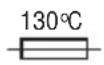
The charger automatically shuts off if the ambient temperature becomes too high. As a consequence the charger will be inoperable. The charging base must be disconnected from the mains supply and taken to an authorised service centre for repair.

The charging base is intended for indoor use only.
- This appliance is not intended for use by young or infirm persons without supervision. Children must be supervised to ensure they do not play with the appliance.
If the supply cord is damaged, it must be replaced by the manufacturer or an authorised Black & Decker Service Centre in order to avoid a hazard.
Features
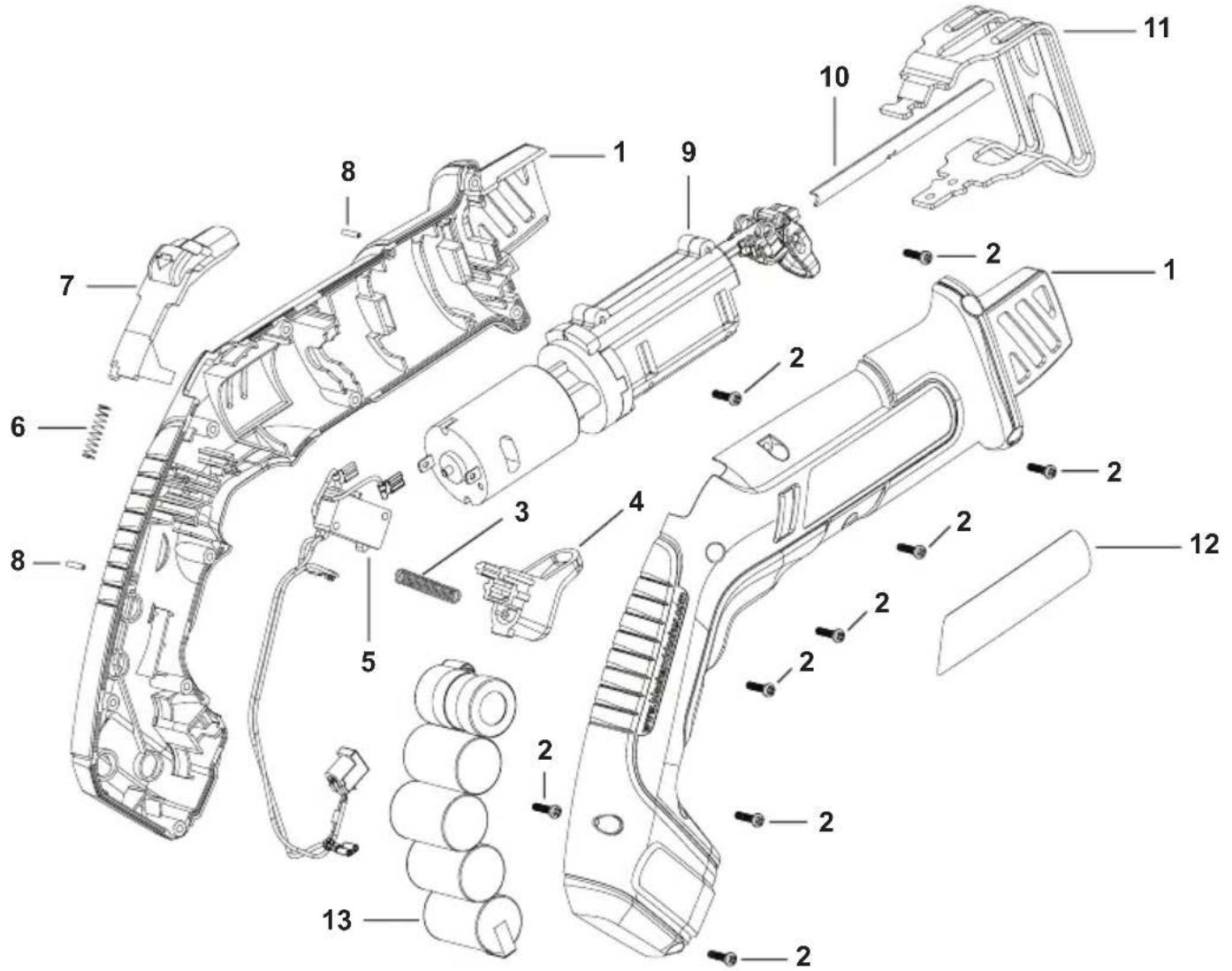
- Shoe
- Lock-off button
- Charging socket
- On/Off switch
- Blade clamp release lever
- Charger plug
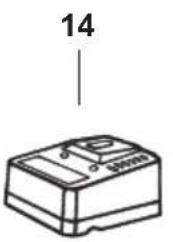
- Charger
Assembly
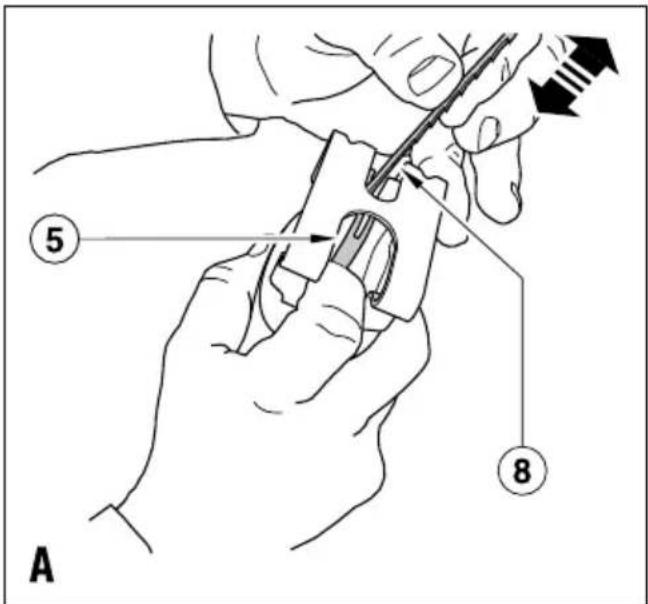
Fitting and removing a saw blade (fig. A)
The tool accepts both T-shank and universal shank jig saw blades.
Fitting:
◆ Push down on the blade clamp release lever (5) to its fully open position.
◆ Insert the blade shank (8) from the front.
◆ Release the blade clamp release lever (5).
Removing:
◆ Push down on the blade clamp release lever (5) to its fully open position.
◆ Remove the blade.
◆ Release the blade clamp release lever (5).
Use
Warning! Let the tool work at its own pace. Do not overload.
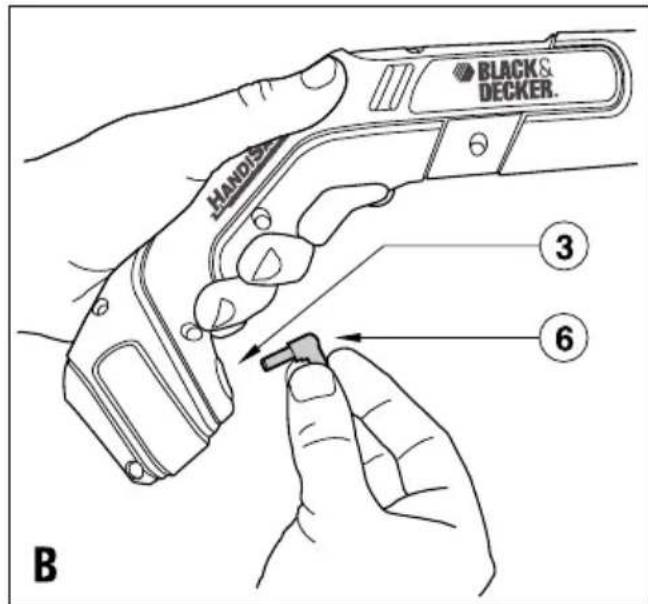
Charging the battery (fig. B)
The battery needs to be charged before first use and whenever it fails to produce sufficient power on jobs that were easily done before. When charging the battery for the first time, or after prolonged storage, it will only accept an 80% charge. After several charge and discharge cycles, the battery will attain full capacity. The battery may become warm while charging; this is normal and does not indicate a problem.
Warning! Do not charge the battery at ambient temperatures below 4 °C or above 40 °C. Recommended charging temperature is approximately 24 °C.
◆ To charge the battery, insert the charger plug (6) into the charging socket (3).
◆ Plug in the charger (7) and switch on at the mains.
- Leave the tool connected to the charger for 6-8 hours.
◆ The charger may hum and become warm while charging; this is normal and does not indicate a problem.
Generally, a charging time of 6 hours will enable the tool to operate at an effective power level for most tasks. However, further charging for up to 8 hours could significantly increase the run time, depending on the battery and the charging conditions.
◆ Before using the tool, unplug the charger (7) and disconnect the tool from the charger.
- Do not use the tool while it is connected to the charger.
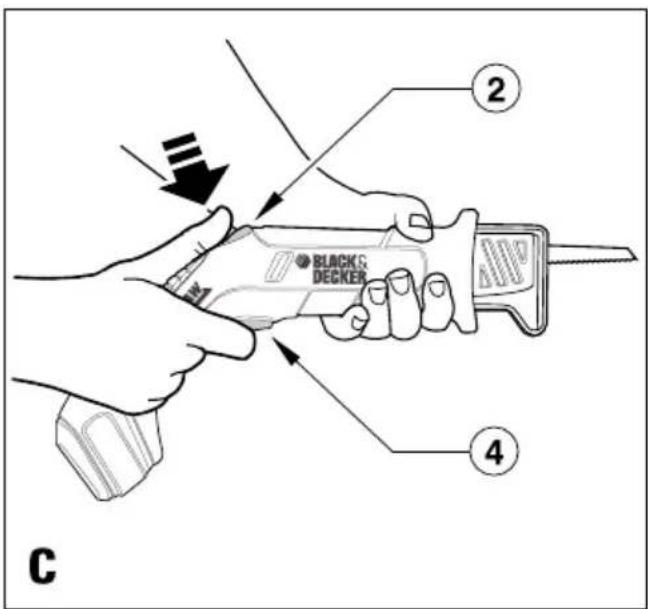
Switching on and off (fig. C)
To switch the tool on, push the lock-off button (2) to the unlock position and squeeze the on/off switch (4).
◆ To switch the tool off, release the on/off switch (2).
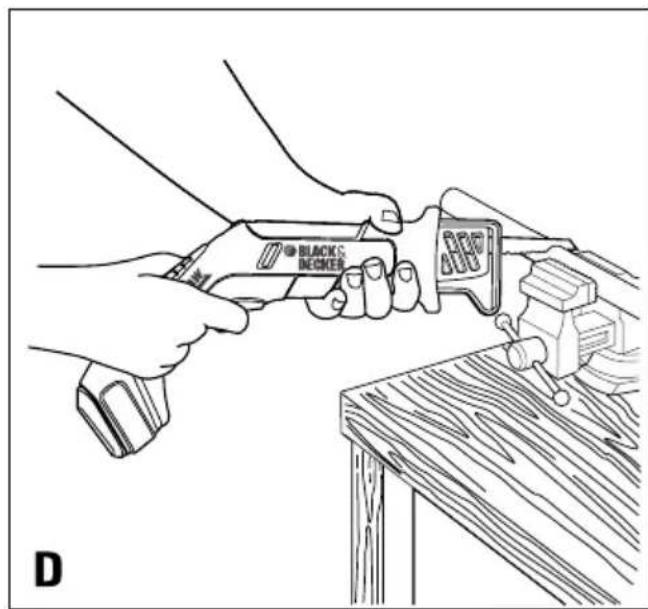
Sawing (fig. D)
Hold the tool firmly with both hands while cutting.
The shoe (1) should be held firmly against the material being cut. This will help to prevent the saw from jumping, reduce vibration and minimise blade breakage.
- Let the blade run freely for a few seconds before starting the cut.
- Apply only a gentle pressure to the tool while performing the cut.
Hints for optimum use
Sawing laminates
Because the saw blade cuts on the upward stroke, splintering may occur on the surface closest to the shoe plate.
◆ Use a fine-tooth saw blade.
◆ Saw from the back surface of the workpiece.
- To minimise splintering, clamp a piece of scrap wood or hardboard to both sides of the workpiece and saw through this sandwich.
Sawing Metal
-
Be aware that sawing metal takes much more time than sawing wood.
◆ Use a saw blade suitable for sawing metal. -
When cutting thin sheet metal, clamp a piece of scrap wood to the back surface of the workpiece and cut through this sandwich.
- When cutting metal piping, do not cut directly through the pipe as you would saw a wooden dowel. Instead, cut around the circumference of the pipe to avoid pinching the blade. Only one section of the blade should be in contact with the pipe.
◆ Spread a film of oil along the intended line of cut.
Maintenance
Your Black & Decker tool has been designed to operate over a long period of time with a minimum of maintenance.
Continuous satisfactory operation depends upon proper tool care and regular cleaning.
Your charger does not require any maintenance apart from regular cleaning.
Warning! Before performing any maintenance on the tool, unplug the charger before cleaning it.
◆ Regularly clean the ventilation slots in your tool and charger using a soft brush or dry cloth.
- Regularly clean the motor housing using a damp cloth. Do not use any abrasive or solvent-based cleaner. Never let any liquid get inside the tool and never immerse any part of the tool into liquid.
Protecting the environment

Should you find one day that your appliance needs replacement, or if it is of no further use to you, think of the protection of the environment. Black & Decker repair agents will accept old Black & Decker tools and ensure that they are disposed of in an environmentally safe way.

Separate collection of used products and packaging allows materials to be recycled and used again. Re-use of recycled materials helps prevent environmental pollution and reduces the demand for raw materials.
Local regulations may provide for separate collection of electrical products from the household, at municipal waste sites or by the retailer when you purchase a new product.
Black & Decker provides a facility for the collection and recycling of Black & Decker products once they have reached the end of their working life. To take advantage of this service please return your product to any authorised repair agent who will collect them on our behalf.
You can check the location of your nearest authorised repair agent by contacting your local Black & Decker office at the address indicated in this manual. Alternatively, a list of authorised Black & Decker repair agents and full details of
our after-sales service and contacts are available on the Internet at: www.2helpU.com.
Batteries

Black & Decker batteries can be recharged many times. At the end of their useful life, discard batteries with due care for our environment:
Run the battery down completely, then remove it from the tool.
NiCd and NiMH batteries are recyclable. Take them to any authorised repair agent or a local recycling station.
Technical data
| CHS6000 | ||
| Voltage Vdc 6 | ||
| No-load speed min-1 1850 | ||
| Stroke length mm 13 | ||
| Max. Depth of cut | ||
| Wood mm 25 | ||
| Steel mm 2 | ||
| Plastic pipe mm ∅ 12 | ||
| Weight kg 0.825 | ||
| Charger | ||
| Input voltage Vac | 230 | |
| Approx. charging time | h | 6-8 |
| Weight kg 0.19 | ||
EC declaration of conformity
CHS6000
Black & Decker declares that these products conform to: Standards & Legislation.
98/37/EC, 89/336/EEC, 73/23/EC, EN60745, EN60335, EN55014, EN50336
LpA (sound pressure) 70.1 dB(A),
LWA (acoustic power) 80.1 dB(A),
hand/arm weighted vibration 1.4 m/s2
KpA (sound pressure uncertainty) 3 dB(A),
KWA (acoustic power uncertainty) 3 dB(A)
Kevin Hewitt
Director of Consumer Engineering
Spennymoor, County Durham
DL16 6JG,
United Kingdom
31-09-2006
Guarantee
Black & Decker is confident of the quality of its products and offers an outstanding guarantee. This guarantee statement is in addition to and in no way prejudices your statutory rights. The guarantee is valid within the territories of the Member States of the European Union and the European Free Trade Area.
If a Black & Decker product becomes defective due to faulty materials, workmanship or lack of conformity, within 24 months from the date of purchase, Black & Decker guarantees to replace defective parts, repair products subjected to fair wear and tear or replace such products to make sure of the minimum inconvenience to the customer unless:
- The product has been used for trade, professional or hire purposes.
◆ The product has been subjected to misuse or neglect. - The product has sustained damage through foreign objects, substances or accidents.
◆ Repairs have been attempted by persons other than authorised repair agents or Black & Decker service staff.
To claim on the guarantee, you will need to submit proof of purchase to the seller or an authorised repair agent. You can check the location of your nearest authorised repair agent by contacting your local Black & Decker office at the address indicated in this manual. Alternatively, a list of authorised Black & Decker repair agents and full details of our after-sales service and contacts are available on the Internet at:
www.2helpU.com
Please visit our website www.blackanddecker.co.uk to register your new Black & Decker product and to be kept up to date on new products and special offers. Further information on the Black & Decker brand and our range of products is available at www.blackanddecker.co.uk.
 | CHS6000 | TYP.1 | |
  © © | |||
| E14870 | www.2helpU.com | 05 - 10 - 06 | |
CHS6000
TYP. 1
05 - 10 - 06
www.2helpU.com
Australia
Black & Decker (Australia) Pty. Ltd. Tel. 03-8720 5100
20 Fletcher Road, Mooroolbark, Fax 03-9727 5940
Victoria, 3138
New Zealand
Black & Decker Tel. 09 579 7600
81 Hugo Johnston Drive Fax 09 579 8200
Penrose, Auckland, New Zealand
United Kingdom
Black & Decker Tel. 01753 511234
210 Bath Road Fax 01753 551155
Slough, Berkshire SL1 3YD Helpline 01753 574277
- Intended use
- General safety rules
- Work area
- Electrical safety
- Personal safety
- Power tool use and care
- Battery tool use and care
- Service
- Specific safety instructions for Saws.
- Additional safety instructions for batteries and chargers
- Batteries
- Chargers
- Electrical safety
- Symbols on the Charger
- Features
- Assembly
- Fitting and removing a saw blade (fig. A)
- Fitting:
- Removing:
- Use
- Charging the battery (fig. B)
- Switching on and off (fig. C)
- Sawing (fig. D)
- Hints for optimum use
- Sawing laminates
- Sawing Metal
- Maintenance
- Protecting the environment
- EC declaration of conformity
- Guarantee
- www.2helpU.com
- Australia
- New Zealand
- United Kingdom
Brand : BLACK & DECKER
Model : HandiSawm CHS600
Category : Jigsaw