
Bohnanza - Board game Amigo - Free user manual and instructions
Find the device manual for free Bohnanza Amigo in PDF.


| Product Type | Board Game |
| Brand | Amigo |
| Model | Bohnanza |
| Designer | Uwe Rosenberg |
| Illustrator | Björn Pertoft |
| Number of Players | 3–7 (base 3–5, variant 3–7) |
| Age Recommendation | 12 and up |
| Play Time | Approximately 45 minutes |
| Contents | 104 bean cards, 8 double-sided beanfield mats, 2 starting player cards, and rulebook |
| Language | English (manual available in multiple languages upon request) |
| Box Dimensions | Approximately 27.5 x 27.5 x 5.5 cm (10.8 x 10.8 x 2.2 in) |
| Weight | Approximately 400 g (0.9 lbs) |
| Game Type | Card game, trading, farming, family strategy |
| Mechanics | Hand management, set collection, trading, set collection |
| Safety Warnings | Contains small parts. Choking hazard. Not for children under 3 years. |
| Care Instructions | Keep the box in a dry place away from direct sunlight. |
| Reparability / Replacement Parts | Lost or damaged cards can be replaced via customer support; components are non-repairable. |
| Customer Support | Phone: 770-349-6309 (Mon-Fri, 9:00–18:00 Central Time) or email: info@amigo.games |
Frequently Asked Questions - Bohnanza Amigo
User questions about Bohnanza Amigo
0 question about this device. Answer the ones you know or ask your own.
Ask a new question about this device
Download the instructions for your Board game in PDF format for free! Find your manual Bohnanza - Amigo and take your electronic device back in hand. On this page are published all the documents necessary for the use of your device. Bohnanza by Amigo.
USER MANUAL Bohnanza Amigo
by Uwe Rosenberg, with illustrations by Björn Pertoft
Players: 3–7 • Ages: 12 and up • Duration: approx. 45 minutes


THE IDEA OF THE GAME
Bohnanza is all about planting, trading, and harvesting beans. Trade beans with the other players and plant them in your fields. That's great fun! And the more beans you have in your fields, the more bean dollars you get when you harvest them. If you have the most bean dollars at the end of the game, you win!
The following rules describe the original Base Game for 3-5 players, with the original kinds of beans.
The three additional kinds of beans – Cocoa Bean, Wax Bean and Coffee Bean – are only used in the variant for up to 7 players (see page 7).
CONTENTS & SETUP
Give one of the bean field mats to each player. These mats have one side showing three bean fields and one side showing two fields:
If there are three players, use the mats with the three bean fields side up.
If there are four or five players, start with two bean fields each.
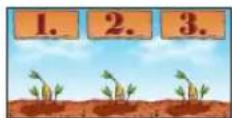
For 3 players

For 4-5 players
The player who ate beans most recently is the starting player; give him or her the Starting Player Card. (The second Starting Player Card is a replacement card if you need it—you can keep it in the box.) Unless you are playing with 6 or 7 players, leave the Cocoa Beans, Wax Beans, and Coffee Beans in the box.

Starting Player Card
There are 104 cards showing 8 different kinds of beans. The large number printed on each card tells you how many cards with this kind of bean are in the game.


Shuffle all the cards and deal five cards to each player.

Attention! This is the most important rule of the whole game!
You cannot change the order of the cards in your hand at any point during the game! The first card you are dealt is the first card in your hand. It's completely visible to you. Put all other cards you receive behind it, in the order drawn. You may never sort your cards by bean or for any other reason.
Put the remaining cards in the center of the table as a draw pile, dollar side up. During the game, you will create a discard pile next to it and a dollar pile in front of each player (see the illustration at the top of the next page).
The layout at the start of a four-player game
![graph TD A["Keno"] --> B["Dollar Pile"] B --> C["Draw Pile"] C --> D["Nina"] D --> E["Dollar Pile"] E --> F["Draw Pile"] F --> G["Decord Pile"] G --> H["Discard Pile"] H --> I["Draw Pile"] I --> J["Decord Pile"]](/content/2026/05/871872/images/79dd0a439899f2dc0c92b47b2d5f0d6fb6e6373b12959fc26e49281641e9ed4a.jpg)
PLAYING THE GAME
The starting player is the first active player. After that, players take turns going to the left. Note: Don't pass the Starting Player Card. It stays with the starting player for the whole game (see "The End of the Game"). When it is your turn, you play through these four phases in order:
- Plant Bean Cards from Your Hand
- Turn Over and Trade Bean Cards
- Plant Turned-over and Traded Bean Cards
- Draw Bean Cards

Important Rules for Planting Beans:
You can only plant one kind of bean in each field at a time. You are allowed to plant the same kind of bean in two different fields at the same time, but not two kinds of bean in the same field. Put the bean cards in your field on top of each other, as shown to the left. You may only plant in your own fields.
Phase 1: Plant Bean Cards from Your Hand
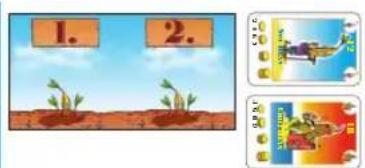
You must plant the first card in your hand (i.e., the one that is completely visible) in one of your fields (see both illustrations to the right).
After that, you may choose to plant one more card from your hand – the one that is now completely visible – in one of your fields (see both illustrations to the right). You can't plant a third bean.

When planting, you start or extend the column of cards in the field.

If you have to plant a kind of bean you don't have space for, you must harvest a field first (see "Harvesting Beans" on page 5).

If you don't have any cards in your hand at the start of phase 1, skip it and go straight to phase 2.
Phase 2: Turn Over and Trade Bean Cards
Turn over the top two cards from the draw pile and put them next to it face-up for all players to see.
The turned-over cards belong to you: You can plant them in your fields or use them to trade with the other players.
Example #1: Timon has turned over a Soy Bean and a Blue Bean. He keeps the Blue Bean, but there is no space for the Soy Bean in his bean fields, so he offers it up for trade to the other players. He asks: "Would anyone like this Soy Bean? I'd like to trade it for a Red Bean."


Rules for Trading Beans:
Only the active player is allowed to trade with the other players. The other players can't trade with each other.
You may all trade using your hand cards, no matter where they are in your hands.
The active player can use the two turned-over cards for trading in addition to the cards in his/her hand.
You cannot trade cards you've received in a trade.
You cannot trade the cards in your fields.
You are allowed to trade any number of beans for any number of other beans (e.g., two Blue Beans for one Green Bean).
Example #2: No-one wants to trade with Timon, so he ups his offer: "I'll give you the turned-over Soy Bean and a Chili Bean from my hand for a Red Bean."
![graph TD A["Hand Hand"] --> B["Sonic Bay"] B --> C["Son Gate"] C --> D["Buening"] D --> E["Final Product"] style A fill:#f9f,stroke:#333 style B fill:#ccf,stroke:#333 style C fill:#cfc,stroke:#333 style D fill:#fcc,stroke:#333 style E fill:#cff,stroke:#333](/content/2026/05/871872/images/835cd1088beb70eb5e03fc47531e5fa2ec1b5b3faed415e55b39f3c815daa16f.jpg)

Note: Only remove beans from your hand once a trade has been agreed on. Both players have to agree to the trade. This way, you can avoid discussions about where a card was in your hand if a trade does not go through.
Put any bean cards you receive in trade next to your bean fields horizontally for now. Do not add them to your hand!
Example #3: Nina accepts Timon's offer of the Soy Bean and the Chili Bean and gives him the desired Red Bean. Timon puts it next to his bean fields horizontally. Nina does the same with the Soy Bean and the Chili Bean.


Timon's Bean Fields
Nina's Bean Fields

Note: As a special form of trade, you can also give another player bean cards. Players receiving gifts have to agree to take them, though. If they refuse, you cannot give them the cards.
You may continue trading for as long as you like, even after the turned-over cards are gone. When you want to stop, tell the other players. This ends phase 2.
Phase 3: Plant Turned-over and Traded Bean Cards
All players who have horizontal cards next to their bean fields now have to plant them. As the active player, you'll also have to plant any turned-over cards you have not traded away. You can plant your new bean cards in any order you choose.
Example #4: Timon plants the Red Bean he received in trade and the Blue Bean he turned over in his two fields. Nina plants the Soy Bean and the Chili Bean in her two fields.
![graph TD A["1. Player Position 20"] --> B["2. Team Position 8"] B --> C["3. Team Position 1"] C --> D["4. Team Position 1"] D --> E["5. Team Position 1"] E --> F["6. Team Position 1"] F --> G["7. Team Position 1"] G --> H["8. Team Position 1"] H --> I["9. Team Position 1"] I --> J["10. Team Position…](/content/2026/05/871872/images/aab023585117c5c8824358b007b2b8f1635cabc9f2021cddea11ba26998584dd.jpg)
Timon's Bean Fields Nina's Bean Fields

If you have to plant a kind of bean that doesn't match the beans you already have in your fields, you'll have to harvest a field before you can plant your new beans (see "Harvesting Beans").
Phase 4: Draw Bean Cards
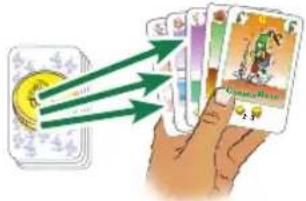
End your turn by drawing three cards, one after the other, from the draw pile. Put them in the back of your hand, behind the last card, in the order you draw them. Then, the player to your left becomes the new active player.

HARVESTING BEANS
You may harvest beans from your fields at any time during the game, even when you're not the active player.
Each kind of bean has its own "beanometer." This tells you how many bean dollars you get for a given number of beans you harvest.
Note: Some harvests may not earn you any bean dollars!
For example, if you harvest 1 or 2 Stink Beans, you don't get any bean dollars. For 3 or 4 Stink Beans, you earn one bean dollar. 5 or 6 Stink Beans earn you two bean dollars, for 7 Stink Beans you get three bean dollars, and 8 or more Stink Beans pay out four bean dollars.
![graph TD A["Beanometer"] --> B["Number of Bean Cards"] B --> C["3"] B --> D["5"] B --> E["7"] B --> F["8"] style A fill:#f9f,stroke:#333 style B fill:#bbf,stroke:#333 style C fill:#dfd,stroke:#333 style D fill:#dfd,stroke:#333 style E fill:#dfd,stroke:#333 style F fill:#dfd,stroke:#333](/content/2026/05/871872/images/ce8b4163b12120e3314c3508159b0b9402ce83eacf75a7b880f67ad241b742fa.jpg)
When you harvest beans, follow these steps:
① Count the number of cards in the bean field you want to harvest. ② Check the top card's beanometer. ③ Turn over as many cards as you earn in bean dollars (according to the beanometer) so that their dollar sides show. ④ Put these cards on your dollar pile. ⑤ Put the remaining cards from your field face-up on the discard pile. ⑥ After you harvest, the field must be empty—you cannot harvest only part of a field.
Example #5: Keno has 3 Chili Beans in one of his fields. The Chili Bean's beanometer tells him that these three beans are worth 1 bean dollar. Keno turns one card over to its dollar side and puts it on his dollar pile. Then, he puts the remaining two Chili Beans on the discard pile.
![graph TD A["Dollar Pile"] --> B["1."] B --> C["2."] C --> D["Discard Pile"] D --> E["Draw Pile"] E --> F["9"] style A fill:#f9f,stroke:#333 style B fill:#ccf,stroke:#333 style C fill:#cfc,stroke:#333 style D fill:#fcc,stroke:#333 style E fill:#cff,stroke:#333 style F fill:#ffc,stroke:#333](/content/2026/05/871872/images/15b2d14764f148f4bb0ba4ddcf9066b939cbb3f33848775fe8faad506d7d136a.jpg)
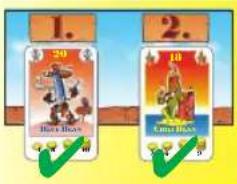

The Bean Protection Rule
If there is only one bean card in one of your fields, you cannot harvest it as long as you have another field containing more than one bean card.
IF THE DRAW PILE IS EMPTY
When you draw the last card from the draw pile, re-shuffle the discard pile. Turn it over and put it back in the center of the table as the new draw pile.
THE END OF THE GAME
The game ends when the draw pile runs out for the third time. If this happens during phase 2 ("Turn Over and Trade Bean Cards"), complete phases 2 and 3 of your turn (even if you could only turn over one card instead of two), then the game ends.
At the end of the game, harvest all of your bean fields and give yourself the appropriate number of bean dollars. Cards in your hand do not count towards your total.
Count the cards in your dollar pile. Each card is worth one dollar. The player with the most dollars wins the game!
If there is a tie, the tied player who sits the furthest away from the starting player (going around the table clockwise) wins the game.


VARIANT: THREE NEW TYPES OF BEANS (FOR 3-7 PLAYER GAMES)
COMPONENTS & SETUP
Add the Cocoa, Wax, and Coffee Beans to the deck.

Depending on the number of players, you will need to remove certain types of beans from the deck. The number of available bean fields also depends on the number of players.
Beans in Play
Based on the number of players, remove the following types of beans and put the cards back into the box:
3 players : Cocoa Beans
4-5 players : Coffee Beans
6-7 players : Cocoa and Garden Beans
Number of Bean Fields
If there are three players, turn over your bean field mats so the side with three bean fields shows. If there are four to seven players, use the side of the bean field mats showing two bean fields.
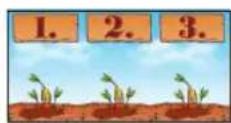
3 players

4-7 players
PLAYING THE GAME
Play the game just like regular Bohnanza: Players start with five cards in their hands. On your turn, play through the usual four phases. Only the rules for phase 4 ("Draw Bean Cards") and the end of the game change when you play with extra types of beans.
Phase 4: Draw Bean Cards
Unlike in the base game, every player draws one card from the draw pile, adding them to their hands behind their last card. Start with the active player and draw cards in a clockwise direction.
The End of the Game
If there are three players, the game ends when the draw pile runs out for the second time. If there are four or more players, the game ends when the draw pile runs out for the third time, as usual.
If you have questions on these rules or on any of our products, please call us at
770-349-6309
M-F 9:00 - 6:00
CENTRAL TIME
We'll do our best to help you.
GAME DESIGN COUNCIL
From time to time, we ask customers to review games for us and provide comments on the gameplay, packaging styles, and other attributes in return for free games. If you're interested in helping us, please visit www.amigo.games/contactus to sign up or send an email to info@amigo.games with "Game Design Council" in the subject line.
OUR NEWSLETTER
If you'd like to sign up for our email newsletter so you can learn about our other games, please visit www.amigo.games/newsletter.
If you loved Bohnanza (or even if you only enjoyed it immensely), we hope you'll consider a few other great games from AMIGO:

None of a Kind The No-Match Brainteaser Game

What the Heck? Can you get inside of your opponents' heads and figure out what they'll play before they do?

X-Code Work together with the other players to crack a code and save the world ... all in 3 minutes! Includes 10 levels of challenges.


- THE IDEA OF THE GAME
- CONTENTS & SETUP
- ATTENTION! THIS IS THE MOST IMPORTANT RULE OF THE WHOLE GAME
- PLAYING THE GAME
- IMPORTANT RULES FOR PLANTING BEANS
- PHASE 2: TURN OVER AND TRADE BEAN CARDS
- RULES FOR TRADING BEANS
- PHASE 3: PLANT TURNED-OVER AND TRADED BEAN CARDS
- PHASE 4: DRAW BEAN CARDS
- HARVESTING BEANS
- THE BEAN PROTECTION RULE
- IF THE DRAW PILE IS EMPTY
- THE END OF THE GAME
- VARIANT: THREE NEW TYPES OF BEANS (FOR 3-7 PLAYER GAMES)
- COMPONENTS & SETUP
- BEANS IN PLAY
- NUMBER OF BEAN FIELDS
- GAME DESIGN COUNCIL
- OUR NEWSLETTER
Brand : Amigo
Model : Bohnanza
Category : Board game