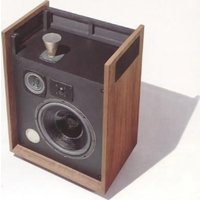
2000 II - Loudspeaker INFINITY - Free user manual and instructions
Find the device manual for free 2000 II INFINITY in PDF.


| Product Type | Bookshelf Speaker |
| Brand | Infinity |
| Model | 2000 II |
| Speaker Type | 2-way bass reflex |
| Woofer | 6.5 inch polypropylene cone |
| Tweeter | 1 inch soft dome |
| Frequency Response | 50 Hz - 22 kHz ±3 dB |
| Impedance | 8 ohms |
| Sensitivity | 90 dB (2.83V/1m) |
| Recommended Amplifier Power | 20 - 150 watts RMS |
| Dimensions (H x W x D) | 14.2 x 8.3 x 9.8 inches (360 x 210 x 250 mm) |
| Weight | 14.3 lbs (6.5 kg) each |
| Cabinet Material | Medium-density fiberboard (MDF) with wood veneer |
| Grille | Removable black cloth grille |
| Binding Posts | Gold-plated 5-way binding posts |
| Magnetic Shielding | Not magnetically shielded |
| Placement | Bookshelf or stand mount |
| Cleaning | Dust with a soft, dry cloth; avoid liquids |
| Safety | Do not expose to moisture or extreme temperatures |
Frequently Asked Questions - 2000 II INFINITY
User questions about 2000 II INFINITY
0 question about this device. Answer the ones you know or ask your own.
Ask a new question about this device
Download the instructions for your Loudspeaker in PDF format for free! Find your manual 2000 II - INFINITY and take your electronic device back in hand. On this page are published all the documents necessary for the use of your device. 2000 II by INFINITY.
USER MANUAL 2000 II INFINITY
Instruction Manual for your new Infinity speaker system
COLUMN1 WTHC
MONITOR II
POS 11
1001A
2000 11
natural_image
Concentric circular lines forming a wave pattern (no text or symbols)Introduction
Congratulations. With the purchase of your new Infinity speaker you have joined an ever-increasing family of devoted music and sound perfectionists. We at Infinity have put years of experience and many hundreds of hours of work into your speaker so that we might be able to bring you the finest sound your money can buy. In order to take full advantage of your new Infinity speaker, some attention must be given to proper installation. With this manual, we are not attempting to answer all the questions of speaker theory and design, but to encourage thought and provide a few basic facts to assist you in setting up your Infinitys. (For the experienced audiophile: Due to the diversity of Infinity customers, portions of this information may seem overly simplified.)
Suggestions
After opening your carton, make a careful examination of your speaker by checking for any possible freight damage. If there is damage, contact your dealer immediately.
The connection to your amplifier or receiver should be made with a two conductor coded wire. Common lamp cord (zip cord) is very good for this purpose. The coding may consist of a ridge or stripe on the insulation of one wire, or anything that may help you to identify one of the two conductors. This coding is important to insure that speakers in a stereo pair operate in phase with each other. Basically, this means that when one woofer is moving outward, the woofer in the other speaker is also moving outward. It's for this reason that the speaker terminals are coded red and black.
Your Infinity speaker is equipped with banana plug terminals. These allow for two methods of connecting the wire to the speaker. One, unscrew the terminal revealing a hole in which to insert the wire; two, purchase two male twin banana plugs which will enable you to “plug the system in.” When connecting the speaker to the amplifier, take note of the coded wire so that you can determine which speaker terminal (red or black) is connected to which amplifier terminal (hot or ground, sometimes marked + or -). If you have connected the black speaker terminal to the negative ground of the amplifier on one channel, be sure to connect the black terminal to the negative amplifier output of the other.
In setting up your Infinitys, it is helpful to understand the “whys” and “hows” of the basic functionings of your speaker. We begin with the low or bass frequencies which are usually the most difficult to optimize in a room. Typically, to enhance frequencies below 100 Hz it’s possible to get several db relative bass boost by placing the speaker against a wall or in a corner. Most loudspeaker systems require this kind of placement (or loading) to get any response below 60 Hz. Because the Infinity is already flat to below 40 Hz, this kind of placement is not usually necessary and sometimes is detrimental to the overall sound of the speaker. The key word, as always, is “experimentation,” in order to locate the best position with regard to bass response. Remember that the closer to the wall or corner, the more low bass you will get; the further away from the wall or corner, the less low bass you will get.
Something to watch out for is acoustic feedback through the turntable at loud levels. While this is not an unusual problem and occurs to a certain degree in almost all audio systems, the
Infinity, because of its phenomenal bass response can and does propagate a large amount of subsonic energy resulting in a different kind of feedback. This feedback is most often described as a “thumping” or “rumbling” sound from the speaker. If you should happen to experience this phenomenon, a sure test is to make a recording on tape (reel to reel preferably, taking advantage of its superior bass response, but cassette will do). Don’t listen to your speakers at loud levels while you are recording because you may “record” the problem you’re trying to isolate!! Then play the tape back through the system at the same level as the record was played and see if the problem still exists. If it does, chances are your problem is not feedback, and the rest of your system should be checked. If the problem ceases to exist, then it’s usually a simple matter to physically isolate your turntable, referring to your turntable instructions.
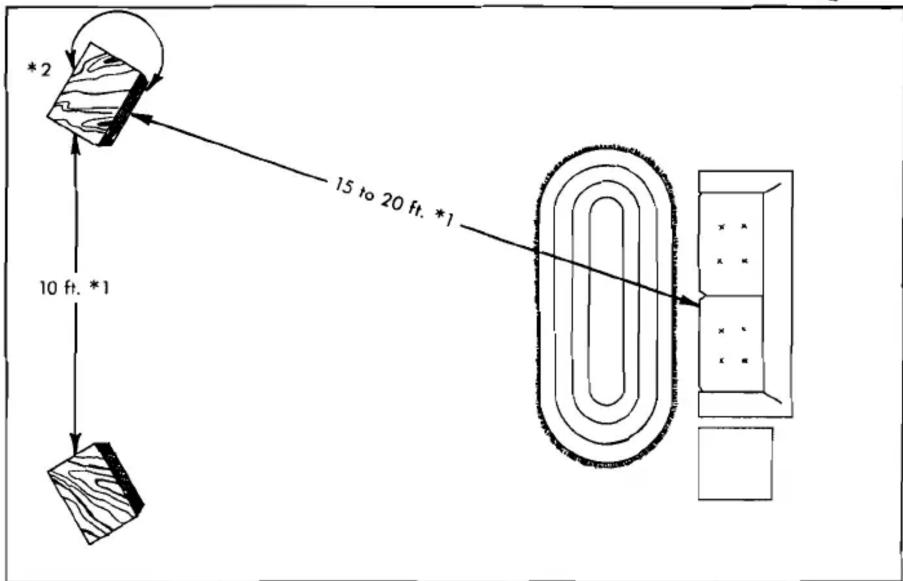
This brings us to the question of placement for best dispersion and stereo effect. You will find after extensive listening to other speakers that what may be good for the bass isn't always the best for dispersion or stereo effect. Hence it's necessary to strike a compromise best suited to all three areas. Because of the linear response of the Infinity, this area of compromise is considerably lessened and in some room situations eliminated altogether. So, for the best results the two speakers should be placed symmetrically in the room with the front plane of the speaker being perpendicular to your listening area (see Figure I). Infinity speakers (except the POS II) feature some form of rear or omnidirectional dispersion which requires a certain amount of speaker-to-wall clearance (usually between three to six inches). Putting the
speaker right against the wall will completely negate any value of the rear (or ambient) propagating speaker of the 1001A or Column and will seriously impede the Walsh drivers of the Column, 2000 II and Monitor II. Again, the word here is “experimentation.” It should be borne in mind that heavy rugs, drapes and furniture, or a room full of people, will absorb some of the energy propagated into a room, affecting mostly the highs. Conversely, a speaker placed in an environment consisting of hard walls, large glass windows, etc., will sound bright, sometimes harsh and a little bit louder because of more reflected sound (or energy).
Enter the speaker level controls. The 1001A and POS II have only a tweeter control. The Column has a mid tweeter control and the 2000 II and Monitor II have midrange and midtweeter controls. These controls allow adjustment of the high and mids relative to the rest of the speaker. You will notice a position on the knob marked “flat.” This setting was arrived at by Infinity to be the average of most home listening rooms. However, in order that you have the ability to compensate for the extremes (a very hard or “bright” room as opposed to the room with heavy drapes, carpet, etc. or “dull” sounding room), these controls can be adjusted up or down according to your taste. EXPERIMENT!
With the extremely linear response of your Infinity speakers, any defect or weak link in your system will be ruthlessly revealed. Because of this, we highly recommend the use of equipment of the highest quality. You will also find it very difficult to “outgrow” your Infinitys. With each improvement in the associated gear you will notice a marked improvement in the sound.
flowchart
graph TD
    A["Wooden Block with dimension annotations: *2, 10 ft., *1"] --> B["Structure with horizontal lines and grid pattern"]
    B --> C["Vertical panel with grid pattern and dimension labels 15 to 20 ft. *1"]
Figure I
This is a representation of an optimum symmetric room with suggested speaker placements and seating arrangements. Of course, this situation never seems to materialize in real life but the basic ideas should be observed and should assist in placement of your speakers.
*1 These measurements are for
Your Infinity speakers have been designed to give you years of trouble-free listening enjoyment. However, a few precautionary notes are worthy of mention here.
Great care must be practiced when you first operate your system. Avoid playing your system at extreme volume levels until you become familiar with its capabilities. Driving your amplifier beyond its limits can cause severe damage to your speakers (not covered by your warranty). Damage may also result to your amplifier by prolonged high-power use. Most receivers begin to distort (subtly) between 1 and 2 o'clock on the volume dial, getting more severe as it increases. The level at which the amplifier will begin to distort (or "clip"—see following paragraphs), is dependent on two factors. One, the level of the program material (e.g. "loud" records vs. "soft" with the same volume level on the knob); two; the amount of bass or treble (or equalization) examples only, distance from speaker to listening area should be roughly 1.5 to 2 times the distance that the speakers are separated.
*2 The amount of rotation necessary for accurate dispersion of rear wave is dependent primarily on composition of reflecting wall and room position.
fed the system. You will find that the volume at which your amplifier begins to distort will be lower with each successive increase in the bass or loudness control. Full gain or full power does not mean turning the knob as far as it will go!! Listen carefully and you will find no increase in harshness or shrillness until the level of clipping is reached. Your system should never sound painfully loud. If it does, you are overdriving your amplifier.
This brings us to the question of power handling and the use of fuses for protection. Power handling for the POS II is 100 watts RMS. Power handling for the 1001A, Column, 2000 II and Monitor II is 200 watts RMS. This means that the speakers will handle 200 watt amplifiers, provided that the amplifier is kept within its limits. But it should be noted that a 50 watt amplifier driven beyond its limits is quite capable of seriously damaging the speaker.
Use of a fuse for speaker protection from short duration transient is difficult as no fuse can react fast enough to protect from extreme transients and still pass enough “steady state” or music power to play the program material. Therefore, it is necessary to find a compromise fuse value, one that will react fast enough to protect from the extremes and not be blowing all the time. A high-powered amplifier can generate between 200 and 350 watts RMS per channel, but seldom does the music require as much as 30 to 35 watts of actual RMS power. So, when calculating the fuse value we want one that will pass something like 40-50 watts continuous (for long duration), but on short duration will pass whatever the particular speaker in question can handle. If we use the formula P=I²R or I=√P/R to calculate the amount of current (I=amps) we can allow past the fuse, we can come up with the fuse size required for the continuous power:
$$ \begin{array}{r l} \mathrm{P} & = \text { Power in watts from Amp } \ & = 5 0 \text { Watts } \end{array} $$
$$ \begin{array}{c} \mathrm{R=Impedance~of~Speaker=} \ 8 \text { ohms } \end{array} $$
$$ \begin{array}{r l} \mathrm{I} = \sqrt {5 0 / 8} & = \ \sqrt {6 . 2 5} & \quad \mathrm{I} = 2. 5 \end{array} $$
All that's left is to use a fuse with the ability to pass the short duration power. Most, if not all high power short duration power "spikes" fall into the 1 to 10 millisecond duration range. It just so happens that a fast blow 2 12 amp fuse will pass up to 10 amps for 10 milliseconds and up to 20 amps for 1 millisecond. As you can see, the amount of current that the fuse will pass is proportional to the length of the transient duration.
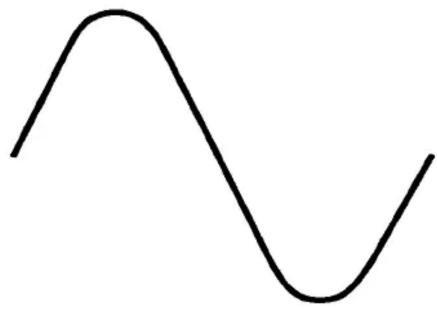
Because of their smaller output and often less sophisticated design, lower-powered amplifiers, when driven hard, will use up their headroom (reach full output) much sooner than higher-powered amps. Technically, we call this transient clipping. This occurs when the output voltage of the preamp requires the power amp to provide more power than it is capable of producing. An unclipped sine wave looks like:
natural_image
Simple wavy line drawing with no text or symbolsA clipped sine wave looks like:
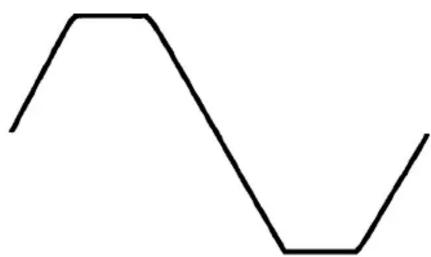
natural_image
Simple zigzag line drawing without any text, numbers, or symbolsTransient clipping in its early stages results in a very subtle increase in distortion, causing the sound to become slightly harsh. Unfortunately, as the volume is increased and clipping becomes more severe, the amplifier comes much closer to that 50 watt level and the duration of the transients are dramatically increased, causing the fuse to blow earlier than it would with a high-powered amplifier.
In case you have problems
Please refer to your warranty card for full details on your warranty. Should you suspect trouble in your speaker, please make sure the problem does not lie in your tape deck, receiver, wiring, etc. The best test to isolate the problem is to reverse the wires on the speakers, replacing the one in question with one known to be good. If the problem exists in the good speaker, the trouble must be elsewhere in the system. Thoroughly check your wiring for possible bad connections. If there is still a question in your mind as to the proper functioning of your speakers, have them checked by your dealer.
If it becomes necessary to return a speaker to the factory, follow the instructions on the warranty card. It should be packed in the original packing material. If it is no longer available, write directly to Infinity for packing. Please expect an average of two weeks repair time from the day of receipt at the factory.
DO NOT ship by bus, Parcel Post or Railway Express Agency (REA). We recommend that individual speakers be returned by truck or United Parcel Service (UPS) and addressed to:
Canoga Park, CA 91304
Phone: (213) 883-4800

We get you back to what it's all about. Music.
Brand : INFINITY
Model : 2000 II
Category : Loudspeaker