
IO-20 - Heating Orava - Free user manual and instructions
Find the device manual for free IO-20 Orava in PDF.


| Product Type | Electric infrared heater |
| Model | Orava IO-20 |
| Power Supply | 220–240 V ~ 50/60 Hz |
| Power Consumption | 750 W / 1500 W / 2000 W (selectable) |
| Dimensions (W × D × H) | 63 × 1 × 10.5 cm |
| Weight | 2.25 kg |
| Ingress Protection | IP55 (dust protected and resistant to water jets) |
| Heating Element | Infrared emitter with reflector |
| Control Type | Remote control + main switch on unit |
| Power Settings | 750 W, 1500 W, 2000 W |
| Overheat Protection | Automatic thermal switch (fuse) |
| Mounting Options | Portable (floor standing) or wall-mounted |
| Intended Use | Heating enclosed living spaces (domestic and similar) |
| Operating Environment Temperature | +5 °C to +40 °C |
| Safety Class | I (requires earthing) |
| Cleaning | Wipe with damp cloth; vacuum ventilation grilles |
| Maintenance | Monthly inspection of reflector and IR emitter |
| Warranty | Refer to manufacturer's terms |
Frequently Asked Questions - IO-20 Orava
User questions about IO-20 Orava
0 question about this device. Answer the ones you know or ask your own.
Ask a new question about this device
Download the instructions for your Heating in PDF format for free! Find your manual IO-20 - Orava and take your electronic device back in hand. On this page are published all the documents necessary for the use of your device. IO-20 by Orava.
USER MANUAL IO-20 Orava
natural_image
Exterior view of a modern outdoor heater with ventilation grilles and a label 'orava' on the right side (no other text or symbols visible)CE
IO-20
Intended use of the device
The device is designed exclusively for temperature control and distribution of hot air in enclosed living spaces, to the extent specified by technical and operational parameters and functions, safety and user instructions and external influences of the operating environment.
Warning!
Installation and use of an electrothermal appliance or electric infrared heater intended for heating is only possible if all technical conditions and requirements for fire safety laid down in applicable legislation, technical safety standards and these operating and operating instructions are observed.
Do not use the appliance to heat rooms with precision instruments, food, plants, works of art or animals, as this could affect the performance, quality and durability of the items concerned and animal health.
ORAVA electrical appliances are manufactured in accordance with the state of the art and recognized safety regulations.
Nevertheless, incorrect and unprofessional use or use contrary to the intended purpose may create a risk of injury or endanger the life of the user or a third party, resp. damage to equipment and other property.
1. GENERAL SAFETY INSTRUCTIONS AND WARNINGS
- This document contains important safety instructions and warnings for safe, correct and economical operation of the electrical equipment. Its compliance helps the user avoid risks, increase reliability and product life.
- In this document, the general term product is used in text parts such as: electrical equipment - any device used for the production, conversion, transmission, distribution or use of electricity.
- From the point of view of the purpose of using electricity, the concept of electrical equipment in the strict sense of the word will include the following categories:
- household electric appliances,
- information and communication equipment,
- consumer electronics,
- lighting equipment,
- electrical and electronic tools,
- toys and equipment for sporting and recreational purposes,
- medical devices (aids),
- monitoring and control devices,
- vending machines.
1.1 General safety instructions
- Before operating the unit, we recommend that you carefully read the instruction manual and operate the equipment in accordance with the instructions!
- The safety instructions and warnings in this manual do not cover all the possible conditions and situations that may arise when using the device. The user must understand that a factor that cannot be incorporated into any of the products is personal responsibility and caution. These factors must therefore be ensured by users serving this device.
- Failure to follow the safety instructions and warnings is forbidden by the manufacturer for any damage to health or property!
- Keep the instruction manual as close to the device as possible throughout its service life. Always keep the instruction manual together with the appliance for future use and use by new users.
- Use the appliance only for the intended purpose and in the manner specified by the manufacturer.
- The appliance is intended for home and similar indoor use without special focus.
- This appliance is intended, in addition to domestic use, for the following uses:
- in shops, offices and other similar work environments;
- in economic buildings;
- in hotels, motels and other residential environments;
- in bed and breakfast establishments.
- It is not a professional device for commercial use.
- Do not change the technical parameters and features of the device by unauthorized modification or modification of any part of the device.
- The manufacturer is not responsible for damages caused during transportation, misuse, damage or destruction of the equipment due to adverse weather conditions.
1.2 Safety of the operating environment
- Do not use the device in an industrial environment or outside environment!
- Do not expose the appliance to:
- sources of excessive heat or open flame,
- dripping or splashing water,
- vibration and excessive mechanical stress,
- insects, animals and plants,
- aggressive and chemical substances.
- The operating environment of the device must always be in accordance with the basic characteristics set out.
- Features of the operating environment:
- Ambient temperature: +5 ÷ +40 °C
- Humidity: 5 ÷ 85%
- Altitude: ≤ 2 000 m
- Occurrence of water: intermittent condensation of water or occurrence of water vapor
- Occurrence of foreign bodies: quantity and type of dust are insignificant
- Protection degree: min. IP20 (device protected from touching dangerous parts by hand and non-waterproof)
- This degree of protection is not indicated on the product and on the technical parameters in the operating instructions.
- If the protection class of the product is different from IPX0, this information is then displayed on the label of the appliance or in the technical data of the operating instructions.
- Other characteristics of the domestic operating environment (mechanical stress - vibrations and vibrations, occurrence of plant, animals, weather effects ...) are negligible in terms of effect on the correct and safe use of electrical equipment.
1.3 Electrical safety
- Before connecting the appliance to the power supply for the first time, make sure that the voltage on the appliance label corresponds to that of the household electrical outlet.
- The electric appliance is designed to power from 1 / N / PE \~ 230 V 50 Hz.
- The electrical safety of the appliance is guaranteed only if it is properly connected to the mains.
- Electrical protection class I equipment is equipped with a protection against electric shock by means of protective earthing of inanimate parts, which can become dangerous when the device is malfunctioning. Always connect such devices to properly installed mains sockets that are equipped with earthing conductors and have a properly grounded earthing conductor.
All electrical equipment is equipped with a three-wire power supply.
- Class II electrical equipment is protected against electric shock by double insulation or by enhanced insulation of hazardous live electrical parts. Device of protection class II it must not be equipped with means to connect protective earthing.
All electrical equipment is equipped with two-wire power supply.
- Class III electrical equipment is a device that is powered by a small safe voltage source (battery or accumulator) and does not present any danger to the user from electrical shock.
- In order to provide increased safety against the risk of electric shock due to the use of electrical appliances by laypersons, it is recommended to install the power supply circuit for sockets with a rated current not exceeding 20 A RCD with a rated operating current not exceeding 30 mA.
To ensure the safety and correctness of the electrical installation, consult a qualified electrician.
- Only use a power cord with a plug (mains lead) supplied with the device and compatible with a wall socket. Using another cable may result in fire or electric shock.
- Always connect an electrical appliance to an easily accessible mains socket. In the event of an operating fault, the appliance must be switched off as soon as possible and disconnected from mains supply.
- The power cord and mains plug must always be easily accessible for safe disconnection of the electrical appliance from the power supply.
- Do not pull off the power cord by pulling the cable. Disconnect the power cord by pulling the plug behind the power cord plug.
- If you use an extension cord, make sure that the total rated power of all devices connected to the extension cord does not exceed the max. current load on the extension cable.
- If you need to use an extension cord or power supply block, make sure that the extension cord or power pack is plugged into a power socket, and not to another extension cord or power supply. The extension power cord or power supply block must be designed for grounded electrical plugs and connected to a properly grounded electrical socket.
- The power plug of the appliance must be compatible with the mains socket. Never use any adapters or modify the socket in any other way. Do not use inappropriate or damaged drawers!
- To avoid electrical shock, plug the power cables into properly grounded electrical sockets. If the device is equipped with a 3-pole plug, do not use adapters that do not have a grounding element or remove the grounding element from the plug or adapter.
- Do not bend, crush or otherwise expose the power cord of the appliance to mechanical stress or external heat sources. Damage to the power cord may result in electric shock.
- When the power cord is damaged, disconnect the appliance from the mains and do not use it again.
- If the power cord is damaged, it must be replaced by the manufacturer, its service department or a similarly qualified person to avoid the risk of electric shock.
- Regularly check and maintain the electrical appliance as well as the power cord and power socket. Disconnect the power plug regularly and clean it if necessary. Pollution by dust or other substances may cause disruption of the insulating state and consequently fire.
- Do not expose the appliance to water or moisture. The ingress of water into the appliance increases the risk of electric shock.
If the power cord is wet or the water has penetrated the water, disconnect it immediately from the mains. If the appliance is plugged into a mains socket and if possible, turn off the power circuit before attempting unplug the power. If you are pulling wet wires from a live power source, be very careful.
- If the electrical equipment is installed (connecting) the protective covers are dismantled, the electrical parts must not be accessible to the user when the installation is finished.
1.4 Safety of persons
- This appliance is intended for use and operation by persons without electrotechnical qualification - lay people, according to the instructions specified by the manufacturer.
• Device operation includes activities such as switching on and off, user manipulation and setting of operating parameters, visual or auditory inspection of the equipment, and user cleaning and maintenance.
- This appliance can be used by children under the age of 8 and persons with reduced physical, sensory or mental capabilities or lack of experience or knowledge when supervised or instructed to use the appliance safely and understand the dangers involved.
• Children may not play with the appliance.
- Cleaning and maintenance for users may not be performed by children unattended.
- Always keep the appliance out of reach of children during use and operation. Be sure to download the appliance even for a freely accessible power cord.
- Always be careful when operating the electric appliance! Do not use an electric appliance if you are overly tired, under the influence of medication or narcotic drugs that reduce attention and focus.
- Inattention during operation may result in serious injury.
1.5 Cleaning, maintenance and repairs
- Observe the normal user cleaning and maintenance of the appliance in the recommended way. Do not use solvents or harsh cleaners for cleaning. Pollution and visible stains from finger contact, respectively. The hands can be cleaned using detergent detergents specially designed to clean household appliances.
- If you do not use the appliance, clean it or disconnect the appliance from the power supply when the appliance is faulty.
- Electrical appliances that are cleaned after use and are not intended to be completely or partly immersed in water or other liquid, protect against the effects of dripping and / or splashing water and before immersion.
- Electric household appliances, like all other technical devices, are subject to the surrounding environment and natural wear. Since the legal framework of regular maintenance is not laid down for lay-in electrical household appliances, the manufacturer recommends that the user have the appliance checked and cleaned at least once a year by a specialist workshop.
- By doing so, it is possible to achieve safety, operational reliability and increased service life.
-
Do not disassemble the electric appliance! The appliance works with a dangerous voltage. For this reason, always switch off the appliance and disconnect it from the mains supply during user maintenance. In the event of a fault, please have the repair serviced by an authorized service center.
• Before calling a service: -
Turn the appliance off and on to make sure the fault reappears.
-
If the malfunction of the appliance still persists after these operations, call the nearest specialist service center.
- Never repair the electric appliance yourself!
- Unauthorized, unqualified and improper use of an electric appliance may result in electric shock or other serious injury.
- Only carry out the warranty or post-warranty repair of an electrical appliance to an authorized qualified person ^* .
2. Special safety instructions. Read carefully!
- The electrical equipment is designed and manufactured in such a way as to allow safe operation and use by persons without professional qualifications. Despite all the measures taken by the manufacturer for safe use, operation and use carry certain residual risks and the possible dangers associated with them. The following symbols and their meanings have been used on the device and in the accompanying documentation to warn of possible dangers:
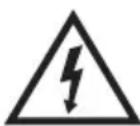
This symbol alerts users to the fact that the device operates on hazardous electrical voltage. Do not remove the protective covers of the device.
Failure to observe the safety instructions for the use and operation of the device may result in:
Danger of electric shock! Danger of serious injury or death!
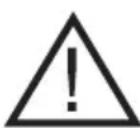
This symbol alerts users to the fact that if the safety instructions for use and operation of the device are not observed, there is a risk of:
Danger of serious injury or death! Danger of equipment damage or other property damage!
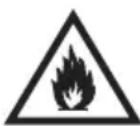
This symbol alerts users to the risk of failure to observe the safety instructions when using and operating the equipment:
Danger of fire!

This symbol used on the product replaces the sentence: WARNING! Do not cover.
IP55
This marking of the electrical equipment means that the equipment is made with an outer cover with partial protection against the ingress of dust (in front of any device) and resistant to water jets from all directions from the nozzle 6,3 mm at a flow rate of 12,5 l/min. for 3 minutes from a distance of 3m.
Transport/Transfer
- When transporting and carrying, be careful when moving to avoid tipping the device over and damaging it.
- Only transport / transfer the device after a thorough inspection of the area and the route, which must be unobstructed.
- Do not carry the device until all cable connections have been disconnected. Never carry the device while it is in operation.
- Carry the device by firmly grasping the handles with both hands or the lower edge of the base and the fixed parts of the covers.
- When carrying, make sure that your hands and the device are not wet or slippery.
Danger of serious injury or death!
Danger of damaging the device!
Unpacking/Packaging
- Before putting the device into operation, unpack the device and dispose of all its parts and accessories with residues of packaging materials, labels and tags. Keep all packaging materials in a safe place or keep them out of the reach of children and vulnerable people. Danger of serious injuries!
Danger of suffocation!
Inspection / Commissioning Warning!
- Use only electrothermal heating equipment that is in good technical condition and under the conditions specified by the applicable legislative requirements, fire safety regulations and in this manual.
- We recommend performing initial and subsequent regular inspections of the device. Prior to installation and initial commissioning, make sure that the device is complete and shows no visible signs of damage.
- Do not use the device if it is incomplete, damaged or any part of it has been damaged during transport or use. In this case, have the device repaired by a specialist garage.
- Do not attempt to interfere in any way with the construction or adjustment of the components of the device.
- Before commissioning, clean the device according to the instructions in the section “Commissioning”, resp. “Before first use”.
- Never clean the device (body with electrical parts and control panel) and the power cord with plug in a way that could allow liquid to flow into the device. Clean these parts only with a damp cloth and wipe dry or allow to dry.
- Only clean the appliance when it is switched off and unplugged. Danger of serious injuries!
There is a risk of electric shock! There is a risk of fire!
Location/Installation
- The device is intended for use as a portable or with the possibility of mounting on a wall (depending on the model). Equipment fasten to the building parts of the living space - on the walls only in accordance with the requirements for the technical properties of the building parts, fire safety measures and installation instructions.
- Use the device only in the working position (in a vertical position and with a correctly mounted stand or legs) and on a flat surface where there is no risk of it tipping over.
Warning! Read carefully.
- An electric thermal appliance or electric infrared radiator intended for heating can be installed on a floor made of fire reaction class material A1fl or A2fl. These technical building materials are classified as non-combustible according to the uniform European classification system (where index fl means “floor”). From selected materials we present e.g. stone paving, ceramic paving, concrete, etc.
- The appliance may only be installed on a floor made of materials of reaction to fire class Bfl, Cfl, Dfl, Efl or Ffl using an insulating pad. From selected materials we present e.g. decking, OSB boards, beech parquets, PVC, laminate floating floor, linoleum, polyamide carpets, etc. The insulating pad must be made of a material of reaction to fire class A1 or A2 with a thickness of at least 1 mm, in normal operation resistant to the mechanical effects of the load. The insulation pad must extend beyond the floor plan of the appliance by at least 150 mm on each side.
- An electrothermal appliance or electric infrared heater intended for heating may be placed and installed close to building structures and materials of reaction to fire class B, C, D, E or F only with the use of a protective screen. The protective screen must be made of materials of reaction to fire class A1 or A2 with a thickness of at least 3 mm. The protective screen must be at a distance of at least 30 mm from building structures, protected objects or material.
The protective screen must extend beyond the outline of the appliance by at least 300 mm above its upper edge and at least 150 mm from the side edges.
- If a protective screen is placed between the appliance and building structures or protected objects, the specified safety distance can be reduced by a maximum of half.
- Only place an electric heating appliance intended for heating without the use of a protective screen at a safe distance from building structures made of materials of reaction to fire class B, C, D, E or F and flammable objects and flammable substances. Keep a safe distance of at least 200 mm in all directions.
- Only place the electric infrared heater intended for heating without the use of a protective screen at a safe distance from building structures made of materials of reaction to fire class B, C, D, E or F and flammable objects and flammable substances. Keep a safe distance of at least 800 mm in the direction of heat radiation, at least 400 mm from the top edge and at least 200 mm in other directions.
From selected materials we present e.g. untreated wood, etc.
- Do not place or install an electric heating appliance or electric infrared radiator intended for heating in areas of the bathroom, washroom and shower unless the requirements for the safety of electrical equipment and electrical installations in these areas are met.
- If the bathroom in the living space is sufficiently structurally spacious and meets the requirements for zoning, the location and use of electrical equipment is only possible with regard to the safety requirements set for these spaces.
- The electrothermal appliance or electric infrared heater can only be placed in the bathroom outside the 0-1-2 zone.
- The appliance must be installed in such a way that the switches and other controls are not within human reach of the bath or shower.
- Consult a qualified electrician for more detailed information on the requirements for the installation and use of electrical equipment in washrooms.
- The device must be installed in accordance with national and local safety regulations applicable to the connection of electrical equipment with protective earthing. To ensure additional protection against the risk of electric shock, it is recommended to install a residual current device (RCD) in the electrical supply circuit of the device with a rated tripping current not exceeding 30 mA.
- If you have any questions regarding electrical installation, consult a qualified electrician.
- Do not place or use the device in places where there is a risk of it tipping over.
-
Do not place the device:
-
on unstable floors or mats.
- on unstable tables or parts of furniture,
- on uneven and dirty surfaces,
- near containers with water or other liquids.
- Only place the device on level, firm and stable surfaces - on floors and floor coverings that have a stable and solid structure (eg ceramic tiles, wooden floor, etc.). Do not place the device on floors that have an unstable structure, such as carpets or other decorative floor coverings with long fibers.
- Do not place or use the device on "soft" surfaces, such as bed mattresses, seats for upholstered sofas and armchairs, etc.
- Always make sure that the place where you want to place the device has sufficient space and stability.
There is a risk of damage to the device or other property damage!
- Do not place or use the device in the immediate vicinity of a bath, shower or swimming pool.
Warning!
The device must not be placed directly under an electrical outlet.
Operation/Supervision
Warning!
- The appliance may only be operated if it is in good technical condition and under the conditions laid down by the generally binding regulations on technical conditions and fire safety requirements during installation and in these operating and operating instructions.
- The device is intended for use in smaller living and working areas.
- The device must not be used in areas where there is a risk of fire or explosion, in the presence of solid or liquid flammable substances and their vapors, mists or dusts and in atmospheric conditions where, after ignition of the flue gas, it spreads easily through the air, unless all technical conditions and requirements for fire safety during its installation and operation are met.
- To avoid a hazardous situation, do not expose the device to rain or other sources of moisture, water or other liquids.
There is a risk of fire!
There is a risk of electric shock!
There is a risk of damage to the device or other property damage!
Warning! Avoid overheating, do not cover the heater.
- Do not partially cover the device. Do not place any objects on the device. Do not insert or allow foreign bodies to enter the openings of the device covers.
- Do not cover the air vents of the covers.
- Air ventilation ensures safe and reliable operation of the device.
- Leave sufficient free space around the device to ensure the required air circulation and safe operation.
There is a risk of electric shock! There is a risk of fire!
- Do not use the appliance to dry textiles, clothing, footwear or any other objects!
There is a risk of fire!
Warning!
- Be extremely careful when operating the appliance.
- Some surfaces of the device become very hot during operation. Do not touch the heated surfaces of the device. Use only handles and grips to handle the device.
- Parts of the appliance that become hot during operation remain hot for some time even after the appliance has been switched off and disconnected from the mains.
There is a risk of burns from a hot surface!
Danger of very serious injuries!
- Always keep the device under supervision during use and operation!
- This appliance is not intended to be operated by means of an external programmer, automatic timer and remote control, as there is a risk of fire if the appliance is covered or incorrectly positioned.
- Do not leave the device unattended during operation, especially if there are children, incompetent persons or animals near it.
- Use only the device's own controls and, if applicable, the supplied remote control to operate the device.
- Do not place any objects on the device, do not allow foreign bodies to enter the openings. Do not use the device near freely moving textiles - curtains, draperies, etc. Make sure that no dirt from the environment, such as clumps of dust, fibers, etc.
- Take extra care during the use and operation of the device to avoid contact with rotating parts of your fingers, hair, loose decorative chains, or loose clothing.
- Do not place any containers of water or other liquids on the device to prevent spillage and ingress of liquid into the interior of the device.
- To avoid a dangerous situation, do not touch the device with wet or damp hands.
- Do not use the appliance near bathtubs, showers, washbasins or other vessels containing water, including swimming pools. Do not remove the device if it falls into the water. First pull the mains plug out of the mains socket and only then remove the appliance from the water. In such cases take the device to a specialist garage for verification that it is safe and working properly.
There is a risk of electric shock!
There is a risk of damage to the device or other property damage!
Warning!
- Do not allow children to handle the device. The device can tip over and cause serious injury. Mechanical damage (cracking or breaking of parts and covers) of the device can cause serious injuries.
Danger of serious injuries!
There is a risk of damage to the device or other property damage!
- Before each connection of the device to the mains, make sure that the main switch (control knob) is in the “0” “OFF” position.
- Do not turn the machine on or off by plugging or unplugging the power cord.
- For normal use, always connect the appliance to the mains first and then switch it on with the main switch.
- When you have finished using the appliance, switch it off with the main switch and then pull the mains plug out of the mains socket.
- Do not use the device if the main power switch does not work on the device.
- The device is under dangerous voltage when the mains supply is connected.
There is a risk of electric shock!
- The electrical outlet and power cord must remain easily accessible for safe disconnection of the device from the mains.
- Take extra care not to damage the power cord running loose on the floor.
- Never leave the device unattended and freely accessible with a loose power cord. Children, incompetent persons, or animals could pull or tip the device by the power cord.
- Unplug the power cord from the electrical outlet when not in use. Store the device with the power cord attached to the solid parts of its covers. Danger of serious injuries!
- Never overload the device beyond the limits set by the technical parameters!
- Observe the operating mode of the device according to the operating and operating instructions.
- If you notice any abnormalities (sounds, smells, smoke...), switch off the device immediately and disconnect it from the mains. Have the device checked by a specialist garage.
- Never attempt to repair, disassemble, or otherwise modify the device yourself, as this may result in electric shock or fire.
- Before performing user maintenance and cleaning of the machine, always turn off the machine with the main power switch and unplug the power cord from the electrical outlet.
- Always make sure that the appliance is switched off and unplugged.
- If any safety part/component (mechanical, electrical) is part of the device, never deactivate this part/component! Do not use the device if the safety part/component is damaged or non-functional!
- Children under 3 years of age must be prevented from accessing the appliance unless they are under the supervision.
- Children between 3 years and under 8 years of age may not connect the appliance to a power socket, nor regulate or clean it or service users.
CAUTION!
- Some parts of this product may become very hot and may cause burns. Take special care when vulnerable persons or children are present.
- Never underestimate the potential hazards and take extreme caution!!!
Wall mounting before use
Mounting accessories
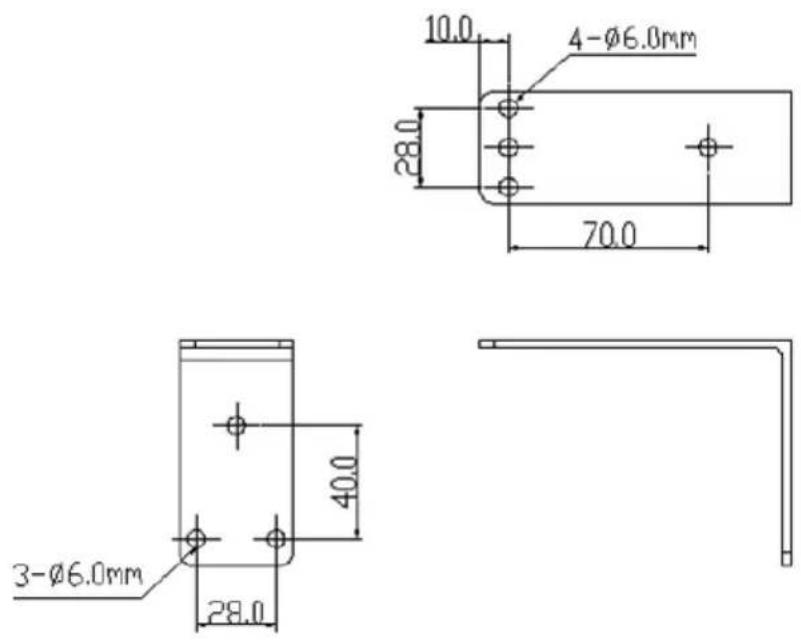
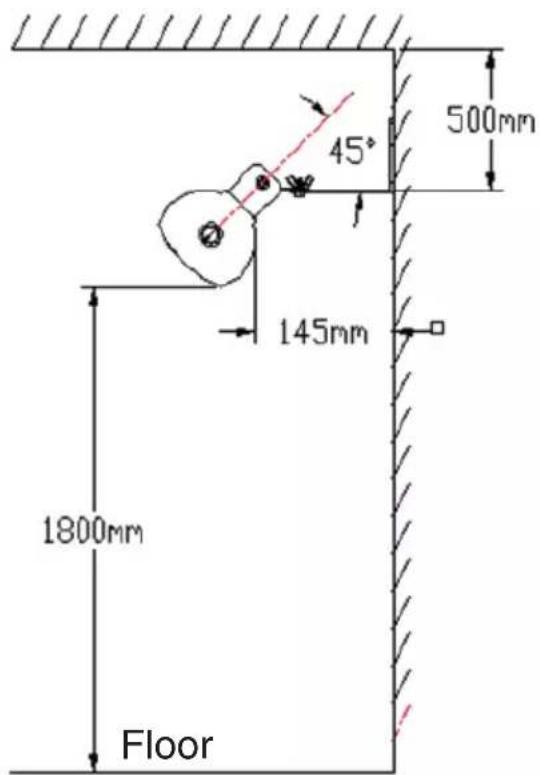
1 Drill 3 holes for 3 dowels at the top of the wall under the ceiling 8 × 35 ~mm on a fl at surface.
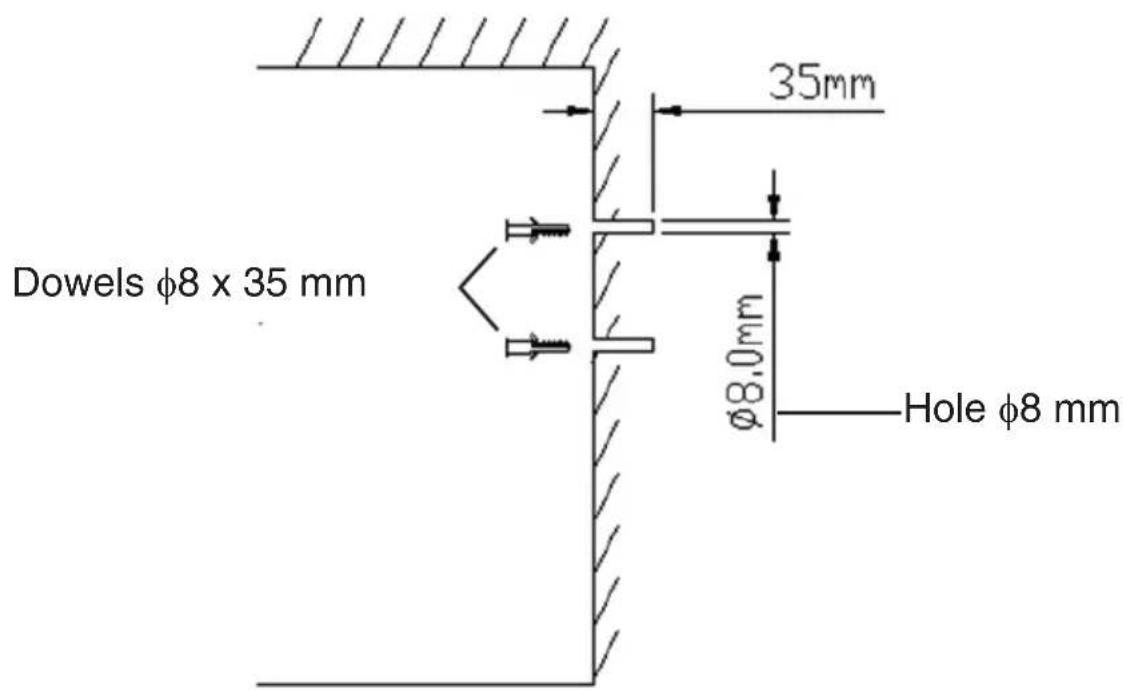
2 Fasten the supplied bracket (mounting accessory) to the wall with 3 screws 3 x 32 mm and dowels inserted in the drilled holes.
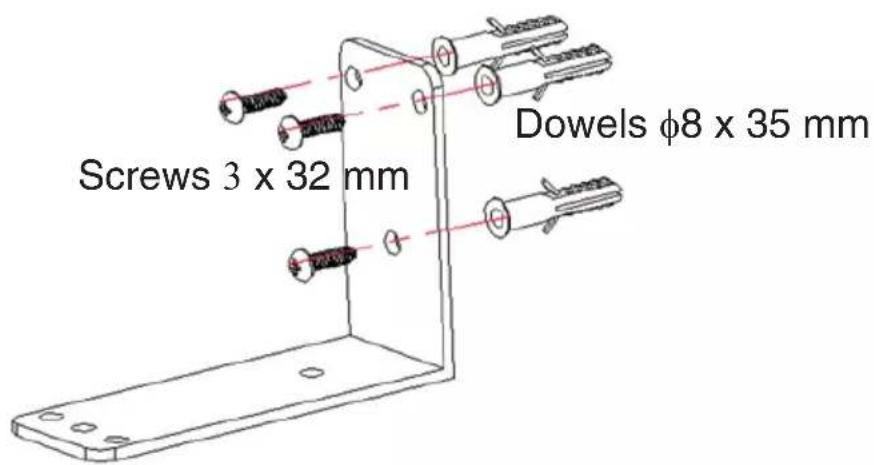
3 Mount the unit using the positioning bracket on the unit, on the supplied wall mount bracket.
Mount the device firmly on the wall bracket using 2 M6 threaded screws and 2 wing nuts.
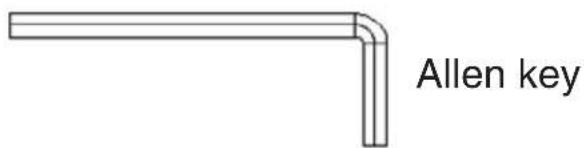
After mounting, use an Allen key to adjust the device to the desired angle.
Loosen the Allen screw, turn the desired angle of the device and retighten the Allen screw to lock the device in the desired position
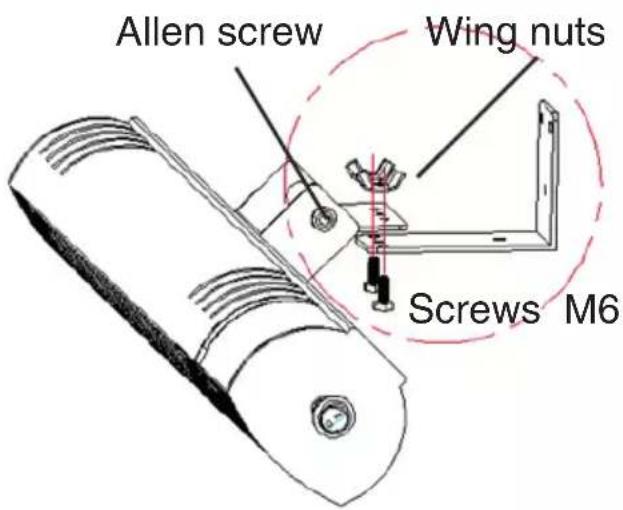
The device is mounted using a single mounting bracket mounted on the wall and using a positioning bracket on the device.
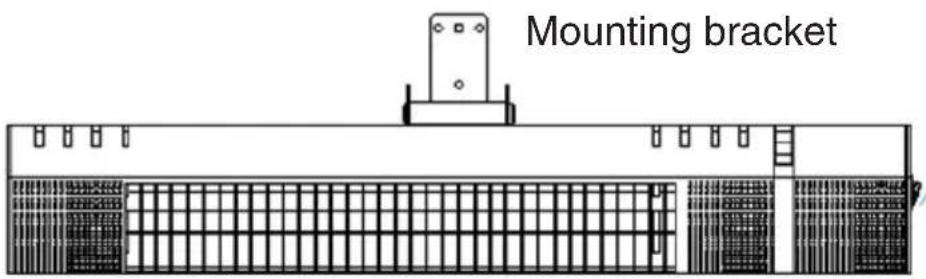
Assembly drawing
Parts description
Remote control
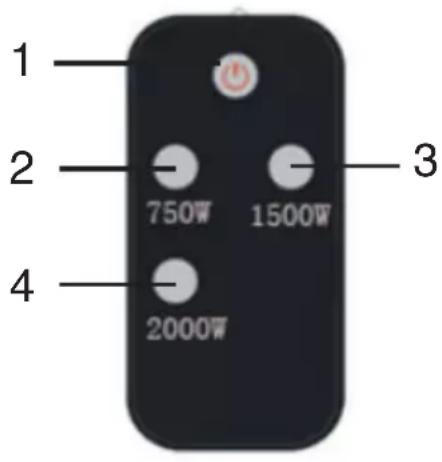
1 Switch ⏻
2 Power switch 750 W
3 Power switch 1500 W
4 Power switch 2000 W
Operation, preparation
Before the first operation, connect the device to the mains and switch it on with the main switch on the side of the device from position 0 to position I. The power LED lights up red. From now it is possible to control the device using the remote control.
Operation
1 Switch on the appliance with switch ⏻ (1) on the remote control. The red power LED turns green.
2 Use the power switches (2, 3, 4) to set the required power to 750 W, 1 500 W or 2 000 W.
Note
- Observe the safety instructions in the introduction to this manual during operation
After operation
1 When finished, turn off the unit with the power switch ⏻ (1) on the remote control.
The green power LED turns red and the infrared light turns off.
2 Switch off the appliance with the main switch on the side of the appliance from position I to position 0.
The power LED turns off.
3 Unplug the appliance.
Overheat protection
The device is equipped with a thermal switch (fuse), which protects the device from overheating and switches off the device automatically in case of risk of overheating. If the device is switched off by the thermal switch, proceed as follows:
1 Switch off the appliance and disconnect it from the mains.
2 If the overheating was caused by an overlap of the device or an obstacle near it, correct the cause of the problem.
3 Leave the appliance switched off for a few minutes until it has cooled down completely.
4 After it has cooled down, you can plug it in, switch it on and use it again.
Cleaning and maintenance
- Before each cleaning, unplug the appliance and let it cool down.
- Use only a slightly damp cloth to clean the surface of the device itself.
- Do not use any solvents or harsh cleaners.
- If dirt is visible in the appliance, you can vacuum it through the ventilation grilles.
Maintenance
Warning!
Careful and regular maintenance of the infrared heater is required to achieve long-term and efficient operation of your device.
1 Check the reflector and IR emitter at least once a month.
2 The number of inspections may increase due to the amount of dust and dirt in the operating environment.
3 When cleaning the device, visually inspect the reflector, wire and frame for deformation. In case of any deformation, consult a qualified technician.
4 Visually inspect the power cord (mains lead) and plug while cleaning the appliance. In case of any deformation, consult with a qualified technician.
Technical specifications
Power supply: 220 - 240 V\~ 50/60 Hz
Power consumption: 750 W/1 500 W/2 000 W
Dimensions (wxdxh): 63 x 1 x 10,5 cm
Weight: 2,25 kg
Ingress protection: IP 55
We reserve the right to make changes!
Producer:
ORAVA retail 1, a.s.
Seberíniho 2
821 03 Bratislava
Slovenská republika
Importer:
ORAVA retail 1, a.s.
Seberíniho 2
821 03 Bratislava
Slovenská republika
ORAVA distribution CZ, s.r.o.
Ostravská 494
739 25 Sviadnov
Česká republika
INSTRUCTIONS AND INFORMATION REGARDING THE DISPOSAL OF USED PACKAGING
Dispose of used packaging material at a municipal waste disposal site.
DISPOSAL OF USED ELECTRICAL AND ELECTRONIC EQUIPMENT
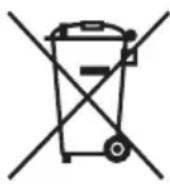

This symbol on the products or in the accompanying documents means that used electrical and electronic products should not be mixed with general household waste.
For proper disposal, recovery and recycling, please return these products to designated collection points. Alternatively, in some countries of the European Union or other
European countries, you may return your products to your local retailer when purchasing an equivalent new product. By ensuring this product is disposed of correctly, you will help prevent potential negative consequences for the environment natural resources and help prevent potential negative effects on environment and human health, which could be the consequences of improper disposal waste. Contact your local authority or nearest office for more details collection point. Improper disposal of this type of waste may result in penalties in accordance with national regulations.
For business entities in the countries of the European Union
If you wish to discard electrical and electronic equipment, please request the necessary information from your seller or supplier.
Disposal in other countries outside the European Union
This symbol is valid in the European Union. If you wish to discard this product, please request obtain the necessary information on the correct method of disposal from the local authorities or from the your supplier.

This product complies with all the essential requirements of the EU directives that apply to it.

- Intended use of the device
- Warning!
- GENERAL SAFETY INSTRUCTIONS AND WARNINGS
- General safety instructions
- Safety of the operating environment
- Electrical safety
- Safety of persons
- Cleaning, maintenance and repairs
- Special safety instructions. Read carefully!
- IP55
- Transport/Transfer
- Unpacking/Packaging
- Inspection / Commissioning Warning!
- Location/Installation
- Warning! Read carefully.
- Operation/Supervision
- Warning! Avoid overheating, do not cover the heater.
- CAUTION!
- Wall mounting before use
- Mounting accessories
- Assembly drawing
- Parts description
- Remote control
- Operation, preparation
- Operation
- Note
- After operation
- Overheat protection
- Cleaning and maintenance
- Maintenance
- Technical specifications
- Producer:
- Importer:
- INSTRUCTIONS AND INFORMATION REGARDING THE DISPOSAL OF USED PACKAGING
- DISPOSAL OF USED ELECTRICAL AND ELECTRONIC EQUIPMENT
- For business entities in the countries of the European Union
- Disposal in other countries outside the European Union
Brand : Orava
Model : IO-20
Category : Heating