
ERT 10 - Multimeter PCE Instruments - Free user manual and instructions
Find the device manual for free ERT 10 PCE Instruments in PDF.


| Product Type | Earth Resistance Tester (Multimeter) |
| Model | PCE-ERT 10 |
| Brand | PCE Instruments |
| Measurement Ranges - Earth Resistance | 20 Ω / 200 Ω / 2000 Ω |
| Measurement Ranges - Earth Voltage | 200 V |
| Measurement Ranges - DC Voltage | 1000 V |
| Measurement Ranges - AC Voltage | 750 V (40 Hz - 400 Hz) |
| Measurement Ranges - Resistance | 200 kΩ |
| Resolution - Earth Resistance | 0.01 Ω / 0.1 Ω / 1 Ω |
| Resolution - Earth Voltage | 0.1 V |
| Resolution - DC Voltage | 1 V |
| Resolution - AC Voltage | 1 V |
| Resolution - Resistance | 0.1 kΩ |
| Accuracy - Earth Resistance | ±(2% + 10 dgt) / ±(2%+3 dgt) / ±(2%+3 dgt) |
| Accuracy - Earth Voltage | ±(3% + 3 dgt) |
| Accuracy - DC Voltage | ±(0.8% + 3 dgt) |
| Accuracy - AC Voltage | ±(1.2% + 10 dgt) |
| Accuracy - Resistance | ±(1% + 2 dgt) |
| Sampling Rate | 2.5 readings/second |
| Display | LCD with backlight |
| Power Supply | 6 x 1.5 V AA batteries |
| Environmental Conditions | 0 ... +40 °C / <80% RH |
| Dimensions | 200 x 92 x 50 mm |
| Weight | 700 g |
| Standards | IEC10101, CAT III 1000V |
| Safety Features | Overvoltage protection, double insulation, warning symbols |
| Accessories Included | Test leads (15m), 4 ground spikes, 6 AA batteries, carrying case, manual |
| Functions | Earth resistance, earth voltage, DC/AC voltage, resistance, HOLD, backlight, zero adjustment |
| Maintenance | Battery replacement, cleaning with dry cloth |
Frequently Asked Questions - ERT 10 PCE Instruments
User questions about ERT 10 PCE Instruments
0 question about this device. Answer the ones you know or ask your own.
Ask a new question about this device
Download the instructions for your Multimeter in PDF format for free! Find your manual ERT 10 - PCE Instruments and take your electronic device back in hand. On this page are published all the documents necessary for the use of your device. ERT 10 by PCE Instruments.
USER MANUAL ERT 10 PCE Instruments
User manuals in various languages (français, italiano, español, português, nederlands, türk, polski, русский, 中文) can be found by using our product search on: www.pce-instruments.com
Last change: 29 August 2022
v1.0
Contents
1 Safety notes....1
1.1 Safety symbols....2
2 Delivery contents 3
3 Technical specifications .... 3
4 Device description .... 4
5 Operating instructions .... 4
6 Maintenance and cleaning 6
6.1 Battery replacement....6
6.2 Cleaning....6
7 Contact....7
8 Disposal 7
1 Safety notes
Please read this manual carefully and completely before you use the device for the first time. The device may only be used by qualified personnel and repaired by PCE Instruments personnel.
Damage or injuries caused by non-observance of the manual are excluded from our liability and not covered by our warranty.
- The device must only be used as described in this instruction manual. If used otherwise, this can cause dangerous situations for the user and damage to the meter.
- The instrument may only be used if the environmental conditions (temperature, relative humidity, ...) are within the ranges stated in the technical specifications. Do not expose the device to extreme temperatures, direct sunlight, extreme humidity or moisture.
- Do not expose the device to shocks or strong vibrations.
- The case should only be opened by qualified PCE Instruments personnel.
- Never use the instrument when your hands are wet.
- You must not make any technical changes to the device.
- The appliance should only be cleaned with a damp cloth. Use only pH-neutral cleaner, no abrasives or solvents.
- The device must only be used with accessories from PCE Instruments or equivalent.
- Before each use, inspect the case and test leads for visible damage. If any damage is visible, do not use the device.
- Do not use the instrument in explosive atmospheres.
- The measurement range as stated in the specifications must not be exceeded under any circumstances.
- If the battery is flat (e.g. indicated by the battery indicator), the meter must no longer be used as incorrect measured values can cause life-threatening situations. When full batteries are used again, the measuring operation may be continued.
- Before each use, check the meter by measuring a known quantity.
- This meter is suitable for measurements in circuits with an overvoltage category CAT III up to a voltage of 1000 V.
- To ensure safe operation before starting the measurement, always check whether the correct measurement range is selected and whether the test leads are plugged into the sockets intended for the respective measurement.
- Measurements of resistance, capacitance and temperature as well as diode tests may only be carried out in voltage-free state.
- The bare measuring tips must never be touched because there is a risk of electric shock.
- Be extra careful when measuring high voltages.
- Before opening the housing to replace the battery or fuse, remove all test leads, otherwise there is a risk of electric shock.
- If you do not want the meter to be used for a long time, remove the batteries to avoid damage caused by battery leakage.
- Non-observance of the safety notes can cause damage to the device and injuries to the user.
We do not assume liability for printing errors or any other mistakes in this manual.
We expressly point to our general guarantee terms which can be found in our general terms of business.
1.1 Safety symbols
 | General warning.Consult the documentation |
 | Warning of dangerous electrical voltage |
 | Continuous double insulation or reinforced insulation |
 | Earth (ground) |
 | DC (direct current) |
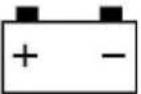 | Operating voltage below targetReplace batteries, otherwise incorrect measurements can occur |
2 Delivery contents
1 x earth resistance tester PCE-ERT 10
1 x set of test leads (approx. 15m)
4 x ground spikes
6 x batteries
1 x carrying case
1 x instruction manual
3 Technical specifications
| Measurement ranges | |
| Earth resistance | 20 Ω / 200 Ω / 2000 Ω |
| Earth voltage | 200 V |
| DC voltage | 1000 V |
| AC voltage | 750 V (40 Hz - 400 Hz) |
| Resistance | 200 kΩ |
| Resolution | |
| Earth resistance | 0.01 Ω / 0.1 Ω / 1 Ω |
| Earth voltage | 0.1 V |
| DC voltage | 1 V |
| AC voltage | 1 V |
| Resistance | 0.1 kΩ |
| Accuracy | |
| Earth resistance | ±(2 % + 10 dgt) / ±(2 %+3 dgt) / ±(2 %+3dgt) |
| Earth voltage | ±(3 % + 3 dgt) |
| DC voltage | ±(0.8 % + 3 dgt) |
| AC voltage | ±(1.2 % + 10 dgt) |
| Resistance | ±(1 % + 2 dgt) |
| Sampling rate | 2.5 / second |
| Display | LCD with backlight |
| Power supply | 6 x 1.5 V AA batteries |
| Environmental conditions | 0 ... +40 °C / <80 % RH |
| Dimensions | 200 x 92 x 50 mm |
| Weight | 700 g |
| Standards | IEC10101, CAT III 1000V |
4 Device description
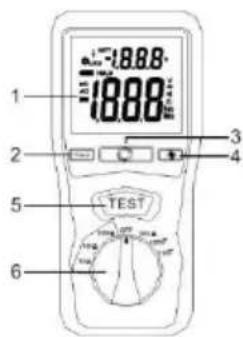
- Display
- „HOLD“ key
- Zero adjustment wheel
- Backlight key
- „TEST“ key
- Measuring function selector
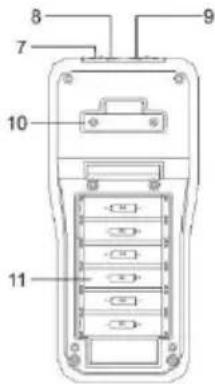
- V/Ω/C socket
- P socket
- COM socket
- Holder for carrying strap
- Battery compartment cover
5 Operating instructions
Measurement of the effective resistance of earth electrodes

Warning: Before you start the measurement, read the safety instructions above.
Note: Low batteries can falsify the measurement results. Therefore, pay attention to the battery level and replace the batteries before starting the measurement if necessary.
-
Short-circuit the test leads and press the "TEST" key. Use the zero adjustment wheel to set the value to 0 Ω.
-
Move the measuring function selector to the "EARTH VOLTAGE" position and press the "TEST" key. The ground voltage is shown on the display. If the voltage is more than 10 V, this can lead to an incorrect measurement of the earth resistance.
-
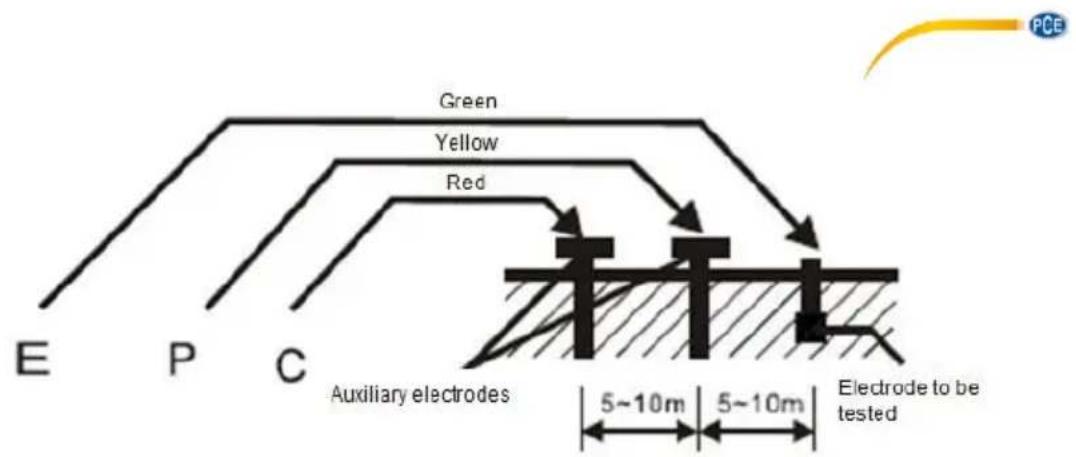
To make a precise measurement of the earth resistance:
(1) Connect the green, yellow and red test leads to the device connections E, P and C.
(2) Connect the crocodile clips of the test leads to the earth electrodes (according to the figure below). The auxiliary electrodes attached to P and C must form a straight line with the electrode to be tested (attached to E).
(3) Set the measuring function selector to a suitable measurement range, press the "TEST" key and read the measured value.
- To use a simplified measurement procedure, proceed as follows:
(1) This method is recommended where the earth resistance is higher than 10 and where it is not possible to drive auxiliary electrodes into the ground. An approximate value can be determined by the two-wire system which can be seen in the figure below.
(2) Move the measuring function selector to the "EARTH VOLTAGE" position and press the "TEST" key. Make sure that the ground voltage is below 10 V.
(3) First, move the measuring function selector to the measurement range 200 Ω, press the "TEST" key and read the measured value. If the display shows "1" (measurement range exceeded), switch to the range 2000 Ω and read the value.
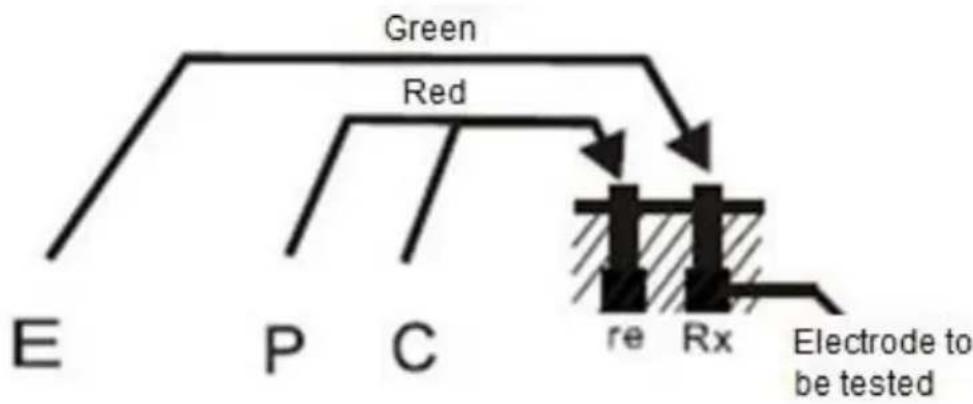
(4) The read value (Re) is an approximate earth resistance value. In this measurement, the test leads P and C do not have to be shot-circuited before the start of the measurement as the special included test lead is used. Tis test lead already has a connection between the two sockets (red test line, see figure).
(5) Actual grounding resistance = read value - earth resistance of earth electrode RX = Re - re
DC/AC voltage measurement
- Set the measuring function selector to DC/AC (1000 V DC or 750 V AC).
- Plug the black test lead into the negative COM port.
- Plug the red test lead into the positive port V.
- Contact the tip of the black test lead with the negative side of the circuit.
- Contact the tip of the red test lead with the positive side of the circuit.
- Read the voltage value in the display.
Note: If the polarity is reversed, there is a minus sign in front of the measured value.
Resistance measurement

Warning: To avoid electric shock, check that the circuit or electrical component is voltage-free before starting the measurement.
- Set the measuring function selector to 200 kΩ.
- Plug the black test lead into the negative COM port.
- Plug the red test lead into the positive port .
- Contact the tips of the test leads with the component/circuit to be tested.
- Read the resistance value in the display.
„HOLD“ function
The "HOLD" function "freezes" the measured value on the display. Press the "HOLD" key at the desired moment to capture a displayed reading. Pressing again terminates the function.
Backlight

Press to enable the display backlight. The backlight will switch off automatically after 15 seconds.
6 Maintenance and cleaning
6.1 Battery replacement
A low battery level is indicated by the icon in the display.

Warning: Before opening the earth resistance tester, disconnect it from the measuring circuit, remove the test leads from the meter and carefully remove the fold-down device stand.
To insert the batteries when restarting or to replace the batteries with insufficient voltage, loosen the four screws of the battery compartment cover on the back of the device, remove the lid, insert the batteries or remove the old batteries, replace them with new ones, insert the lid and screw it back in.
6.2 Cleaning
Clean the device with a dry cloth. Do not use any abrasives or solvents.
7 Contact
If you have any questions, suggestions or technical problems, please do not hesitate to contact us. You will find the relevant contact information at the end of this user manual.
8 Disposal
For the disposal of batteries in the EU, the 2006/66/EC directive of the European Parliament applies. Due to the contained pollutants, batteries must not be disposed of as household waste. They must be given to collection points designed for that purpose.
In order to comply with the EU directive 2012/19/EU we take our devices back. We either re-use them or give them to a recycling company which disposes of the devices in line with law.
For countries outside the EU, batteries and devices should be disposed of in accordance with your local waste regulations.
If you have any questions, please contact PCE Instruments.


PCE Instruments contact information
Germany France Spain
PCE Deutschland GmbH PCE Instruments France EURL PCE Ibérica S.L.
Im Langel 26 23, rue de Strasbourg Calle Mayor, 53
D-59872 Meschede 67250 Soultz-Sous-Forets 02500 Tobarra (Albacete)
Unit 11 Southpoint Business Park
Ensign Way, Southampton
Hampshire
United Kingdom, SO31 4RF
Tel: +44 (0) 2380 98703 0
Fax: +44 (0) 2380 98703 9
info@pce-instruments.co.uk
www.pce-instruments.com/english
Italy
PCE Italia s.r.l.
Via Pesciatina 878 / B-Interno 6
55010 Loc. Gragnano Pehlivan Sok. No.6/C
Capannori (Lucca)
Italia
www.pce-instruments.com/turkish
The Netherlands
PCE Brookhuis B.V.
Institutenweg 15
7521 PH Enschede
Nederland
Telefoon: +31 (0)53 737 01 92
info@pcebenelux.nl
www.pce-instruments.com/dutch
info@pce-americas.com
www.pce-instruments.com/us
United States of America
PCE Americas Inc.
1201 Jupiter Park Drive, Suite 8
Jupiter / Palm Beach
33458 FL
USA
Tel: +1 (561) 320-9162
Fax: +1 (561) 320-9176
Denmark
PCE Instruments Denmark ApS
Birk Centerpark 40
7400 Herning
Denmark
- Contents
- Safety notes
- Safety symbols
- Delivery contents
- Device description
- Operating instructions
- Measurement of the effective resistance of earth electrodes
- DC/AC voltage measurement
- Resistance measurement
- „HOLD“ function
- Backlight
- Maintenance and cleaning
- Battery replacement
- Cleaning
- Contact
- Disposal
- PCE Instruments contact information
- Germany France Spain
- Italy
- The Netherlands
- United States of America
- Denmark
Brand : PCE Instruments
Model : ERT 10
Category : Multimeter