
FFD540R02T - Refrigerator CHANGHONG - Free user manual and instructions
Find the device manual for free FFD540R02T CHANGHONG in PDF.


| Brand | Changhong |
| Model | FFD540R02T |
| Type | Frost Free Refrigerator (Fridge-Freezer) |
| Total Capacity | 540 liters (estimated from model number) |
| Refrigerant | R600a (flammable, 0.060 kg) |
| Refrigerator Compartment Temperature Range | 2°C to 8°C (adjustable) |
| Freezer Compartment Temperature Range | -16°C to -24°C (adjustable) |
| Defrost Type | Frost Free (auto defrost) |
| Functions | Fast Freezing, Auto Temperature Set, Vacation Mode, Refrigeration OFF |
| Alarms | Door open alarm (after 3 min), Over-temperature alarm |
| Lighting | LED interior light (user non-replaceable) |
| Adjustable Leveling Feet | Yes |
| Power Supply | 220-240V, 50Hz (typical, verify rating plate) |
| Energy Saving | Keep door closed, avoid hot food, ensure ventilation |
| Cleaning | Warm water with mild detergent; avoid abrasives |
| Safety Features | R600a flammable refrigerant warnings, child entrapment prevention |
| Noise Level | Normal operating noises: clicking, screeching, pulsing |
| Installation Clearances | Top: 10 cm, Sides: 10 cm, Back: 10 cm, Door side: 10 cm |
| Warranty | Contact authorized service (see manual) |
| Country of Origin | China (brand origin) |
Frequently Asked Questions - FFD540R02T CHANGHONG
User questions about FFD540R02T CHANGHONG
0 question about this device. Answer the ones you know or ask your own.
Ask a new question about this device
Download the instructions for your Refrigerator in PDF format for free! Find your manual FFD540R02T - CHANGHONG and take your electronic device back in hand. On this page are published all the documents necessary for the use of your device. FFD540R02T by CHANGHONG.
USER MANUAL FFD540R02T CHANGHONG
—Creating Easy Life—
FROST FREE REFRIGERATOR
USER'SSMMANUAL
FFD540R02T
Please read the manual carefully before operation and keep it for reference.
Contents
Safety 02
For Children 02
For the User / Installer 02
Proper Disposal of your Refrigerator 03
Before you Throw Away your Old Refrigerator....04
R600A WARNINGS....04
R600A Refrigerant Warning 05
WARNING 05
Refrigerator Description 06
Refrigerator Parts 06
Installation....07
Choosing the Location 07
Leveling the Refrigerator....08
Electrical Installation....08
Grounding....09
Usage Instructions....10
How to Turn on the Refrigerator 10
Filling the Refrigerator....10
Refrigerator compartment....11
Placement of food....11
Freezer compartment....11
Making and Removing ice cubes 12
Function Instruction....12
How to disconnect the refrigerator 16
How to save energy 16
Transportation 17
Hints and Suggestions 17
Cleaning and Maintenance 18
Inside 18
Electrical Parts 18
Outside....19
Door Seals 19
Notes 19
Solutions to Problems....20
Condensation Outside the Refrigerator....20
Door Seals 20
Normal Operating Noises 20
Warmth Near the Doors 21
Warmth Near the Back....21
Normal Operation....22
Before Calling Your Service Representative....22
Notes....25
User Manual
Safety
Welcome
Thank you for choosing our products. This manual contains all the information you will need to safely and correctly use your refrigerator. Please read all the instructions prior to using the appliance, and keep this manual in a secure place for future reference. Do not remove the attached adhesive identification label containing code, model number, manufacturer and other information from the refrigerator. This label will be used by the company authorized service representative in the event that your refrigerator needs servicing.
Environmental Advice
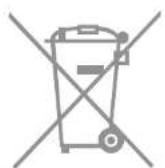
The packaging material used is recyclable; we recommend that you separate plastic, paper and cardboard and give them to recycling companies. To help preserve the environment, the refrigerant used in this product is R600a (Hydrofluorocarbon-HFC), which does not affect the ozone layer and has little impact on the greenhouse effect. According to WEEE (Waste of Electrical and Electronic Equipment) guidelines, waste from electrical and electronic devices should be collected separately. If you need to dispose of this appliance in the future, do NOT throw it away with the rest of your domestic garbage. Instead, please take the appliance to the nearest WEEE collection point, where available.



The refrigerator you have just purchased may be slightly different from the known in the drawings in this manual, but its overall design is the same.
Please read the information referring to its operation. This refrigerator is intended for domestic use only.
The plug on the refrigerator you have purchased may be different from the one shown in the manual, as the plug that accompanies the product meets your country's electrical specifications.
01
For Children
- Avoid accidents. After unpacking the refrigerator, keep packaging materials out of reach, especially from children. Do not allow children to handle the refrigerator, even when it is disconnected.
- Destroy carton, plastic bags, and any exterior refrigerating
is unpacked. Children should never use these items to play. Cartons covered with rugs, bedspreads, plastic sheets or stretch wrap may become airlight chambers, and can quickly cause suffocation.
- Remove all staples from the carton. Staples can cause severe cuts, and destroy finishes if they come in contact with other appliances or furniture.
• An empty, discarded ice box, refrigerator, or freezer is a very dangerous attraction to children.
For the User / Installer
- Disconnect the refrigerator before cleaning or doing maintenance.
- Do not leave the refrigerator unused for long periods of time. If this becomes necessary, clean it, open the doors, and leave them open. We recommend that the refrigerator be turned on several times during the period it is not in normal use. Do not install the refrigerator outside.
- The following items should not be placed on top of the refrigerator: heavy and unstable objects, and heat-producing devices like regulators.
- Wait at least 5 minutes after unplugging the refrigerator before plugging it in again to protect the compressor from excessive pressure.
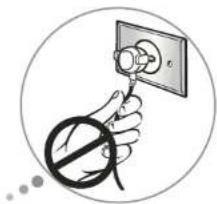
- Never unplug the refrigerator by pulling on the power cord. Use the plug.
- Do not compress, fold or tie up the power cord. Do not change your refrigerator's plug. If the cord becomes damaged, it must be replaced by a service technician indicated by the manufacturer or distributor.
natural_image
Illustration of a hand using a power plug to install an electrical socket (no text or symbols present)02
- Do not store medication, toxic or chemical products in the refrigerator, as they may contaminate the food.
- Flammable aerosols and combustible products (gas for lighters, banana oil, alcohol, gasoline, propane, etc.) or products that bear a small flame symbol should not be stored in refrigerators or freezers, nor come close to the refrigerator, as they may cause explosions.
- Never lean on the refrigerator door, as this may cause the hinges to become misaligned, allowing the cold air to escape and the refrigerator to operate poorly.
- Avoid contact with the cold plate / internal walls of the freezer compartment when your hands are wet or damp. The low temperatures may injure your skin.
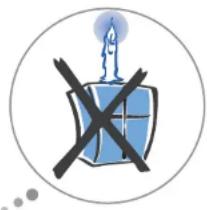
- Do not sprinkle water on top or along the sides of the refrigerator, as this can cause a malfunction or electric discharge and may cause the metallic parts of the refrigerator to rust. To avoid the risk of fire, never place lit candles on top of the refrigerator. In the event of a gas leak, do not unplug or touch the refrigerator until the gas valve has been closed, and the room has been aired out. If you use the potentiometer immediately afterward, it may give off sparks that could start a fire. When moving the refrigerator, do not incline it at more than a 45 angle.
- Keep the cord away from the compressor, as the compressor heats up when it is operating, and may damage the cord, which could cause a short circuit.
natural_image
Symbolic illustration of a person standing on a blue box with a cross, enclosed in a circle (no text or symbols)Proper Disposal of Your Refrigerator
- Risk of child entrapment.
- Child entrapment and suffocation are not problems of the past. Junked or abandoned
refrigerators are still dangerous — even if they will sit for "just a few days." If you are getting rid of your old refrigerator, please follow the instructions below to help prevent accidents.
Before You Throw Away Your Old Refrigerator:
- Remove doors.
- Leave shelves in place so children may not easily climb inside.
Remove the door(s) of any appliance that is not in use, even if it is being discarded.
NOTE:
Children should be supervised to ensure that they do not play with the appliance.
This appliance is not intended for use by persons (including children) with reduced physical, sensory or mental capabilities, or lack of experience and knowledge, unless they have been given supervision or instruction concerning use of the appliance by a person responsible for their safety. This appliance is intended to be used in household and similar applications such as Staff kitchen areas in shops, offices and other working environments; Farm houses and by clients in hotels, motels and other residential type environments;
Bed and breakfast type environments;
Catering and similar non-retail applications.
R600A WARNINGS
NOTE: This model uses 0.060Kg of R600A flammable refrigerant in its sealed system.
The following must be observed for your safety:
Refrigerator Description
R600A Refrigerant Warning
- This appliance contains a small quantity of R600A refrigerant which is environmentally friendly, but flammable. It does not damage the ozone layer, nor does it increase the greenhouse effect.
- During transportation and installation, ensure that the tubing of the refrigerant circuit is not damaged.
- Leaking refrigerant can ignite and may damage the eyes.
- In the event any damage does occur, avoid exposure to open fires and any device which creates a spark. Disconnect the appliance from the mains power.
- Thoroughly ventilate the room in which the appliance is located for several minutes.
- Notify Customer Service for necessary action and advice.
- The room for installing the appliance must be at least 1 cubic metre per 8 grams of refrigerant. The refrigerant quantity contained in this appliance is listed above in grams; it is also noted on the Rating Plate of the appliance.
It is hazardous for anyone other than an Authorised Service Person to carry out servicing or repairs to this appliance. In Queensland the authorized person must hold a Gas Work Authorisation for hydrocarbon refrigerants, before carrying out servicing or repairs which involve the removal of covers.
WARNING
- Keep ventilation openings, in the appliance enclosure or in the built-in structure, clear of obstruction.
- Do not use mechanical devices or other means to accelerate the defrosting process, other than those recommended by the manufacturer.
- Do not damage the refrigerant circuit.
- Do not use electrical appliances inside the food storage compartments of the appliance, unless they are of the type recommended by the manufacturer.
- Do not store explosive substances such as aerosol cans with a flammable propellant in the appliance.
- If the supply cord is damaged, it must be replaced by the manufacturer, its service agent or similarly qualified persons in order to avoid a hazard.
The environment and personal safety must be considered when disposing of this appliance. Please ensure the appliance is taken to a recycle center for safe recycling. DO NOT dispose of the appliance in land fill as the insulation and refrigerant gas contained in these appliances are flammable.
Refrigerator Parts
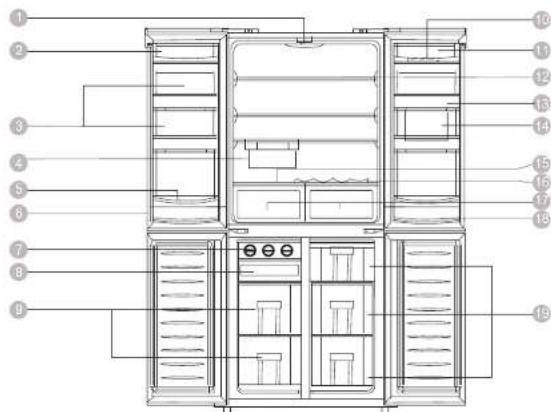
1 Interior Light
2 Left Upper Storage Shelf
3 Storage Shelf
4 Storage Box
5 Left Lower Storage Shelf
6 Rotational Girder
7 Ice Cube Tray
8 Ice Storage Box
9 Left Freezer Drawer
10 Egg Rack
11 Right Upper Storage Shelf
12 Refrigerator Glass Shelf
13 Storage Box
14 Storage Box Cover
15 Crisper Cover
16 Bottle Shelf
17 Crisper
18 Right Lower Storage Shelf
19 Right Freezer Drawer
NOTE: Since we are constantly working to improve our products, your refrigerator may be slightly different from the description contained in this manual, however, the functions and operation of the procedure remain the same.
Installation
Choosing the Location
In order to ensure that heat dissipates rapidly and that the refrigerator operates efficiently, with low energy consumption, we recommend leaving the following minimum distances between the refrigerator and the walls and ceiling:
Top: 10cm
Sides: 10cm
Door side: 10cm
Back: 10cm
Check to be sure that there is enough space in front of the refrigerator to open the door (160).

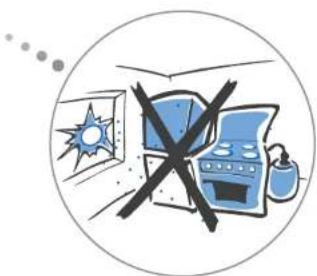
Install the refrigerator in a well-ventilated area, away from direct sunlight and from heat sources, such as ovens and burners, from inflammable materials, and from areas where water is frequently used, such as sinks.
Do not install the refrigerator outdoors.
This appliance is intended to be used in household and similar applications such as
- staff kitchen areas in shops, offices and other working environments;
- farm houses and by clients in hotels, motels and other residential type environments;
3.bed and breakfast type environments;
- catering and similar non-retail applications.
natural_image
Illustration of a blue kitchen appliance with a crossed-out window and sun symbol (no text or labels)Leveling the Refrigerator
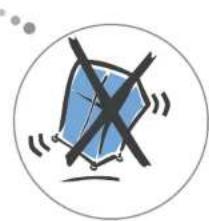
Install the refrigerator on a completely level
and solid surface. The door must be closed when
leveling the refrigerator.
If the refrigerator needs to be adjusted, carefully
lean it and turn the front adjustable leveling feet
until it is firmly installed.
Proper leveling prevents movement, vibration and other problems.
Do not substitute the original refrigerator
leveling legs.
natural_image
Symbolic illustration of a blue object with a black X-shaped cross and motion lines, enclosed in a circle (no text or symbols)Electrical Installation
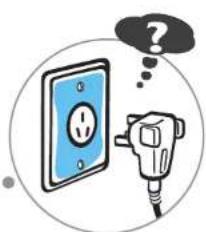
Before turning on the refrigerator, check to see if the voltage of the outlet to be used is the same as that indicated on the tag located close to the plug (along the power cord) or on the refrigerator's identification label.
Check to see that the refrigerator's plug is not connected on top of the power cord.
Connect the refrigerator to its own outlet. Do not use an extension cord or adaptor plug.
For your safety, ask an electrician to verify the condition of the electric wiring in the area where the refrigerator will be installed.
The wires leading to the outlet into which the
natural_image
Illustration of a plug plugged into a wall socket with a question mark above it (no text or symbols)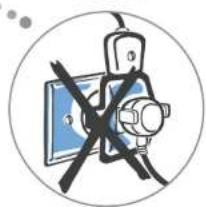
natural_image
Symbolic illustration of a camera with a blue screen and black diagonal lines crossing through it, enclosed in a circle (no text or symbols)Usage Instructions
refrigerator will be plugged should be made of copper and be at least 2.5 mm wide. For greater safety, consult the legislation on electrical installations in your country.
Notes: Turning the temperature control to any position, the power to the light bulb or other electrical components will not be disconnected;
If connected to a circuit protected by fuses, use time delay fuse.
Grounding
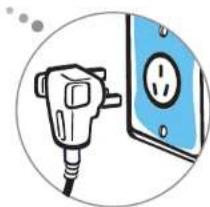
The power cord has a three-pronged grounded plug for your personal safety. It must be connected to a grounding type wall receptacle, in accordance with the legislation governing electric installations in your country, as well as any local regulations. Do not remove the grounding prong, do not use a two pronged adaptor, and never make a connection to the schematic. Use the cord supplied with the equipment (do not change it). If the cord is damaged, it must be immediately replaced by specialized personnel.
ATTENTION: For your safety, installation must be grounded. If it is not grounded, it must be adapted for this by specialized personnel.
natural_image
Illustration of a plug and a blue electrical outlet (no text or symbols)How to Turn on the Refrigerator
- Clean the parts of the refrigerator with warm water containing a little neutral detergent and with clear water, and wipe them dry. Notes: Electric parts of the refrigerator can only be wiped by dry cloth.
- Press the "+" or "-" to reach the needed temperature (see "Function Introduction"), turn on electricity. The compressor and the light inside the refrigerator begin to work.
- The refrigerator works after 30 minutes later, if the temperature in the refrigerator decreased obviously, it means that the refrigerator system works well.
Filling the Refrigerator
Follow these instructions the first time you fill the refrigerator.
- Turn the refrigerator on and let it run for two hours prior to putting food inside.
- If the food is fresh, put it in the refrigerator little by little, in one hour intervals.
- After filling the refrigerator, Press the "+ "or to" reach the needed temperature, following the instructions under item "Function Introduction".
natural_image
Simple line drawing of two blocks inside a circle (no text or symbols)Refrigerator Compartment
- To maintain the characteristics of food and/or liquids, keep them in closed containers.
- Avoid placing foods prepared with a large amount of water (soups and broths) in containers without lids, as they may freeze.
- Foods with high water content, such as tofu and vegetables, should be stored in the lower front part of the refrigerator to keep them from freezing.
- To keep fruits and vegetables fresh longer, they should be washed, dried and packed before being placed in the refrigerator.
- When keeping eggs in the egg compartment, check that they are fresh. Keep them in a vertical position to remain fresh longer.
- Leafy greens should be kept in plastic bags in the crisper.
- Dry all foods before placing them in the refrigerator.
- Do not lean food or objects against the internal back wall of the refrigerator.
- Food should be well wrapped to keep it from drying out or giving off odors
- Hot foods should be cooled to room temperature before being placed in the compartments; otherwise they will raise the internal temperature of the compartments, as well as the appliance's energy consumption.
Placement of Food
- Proper place should be left instead of too crowded during food storage.
- Food to be stored should be wrapped with clean plastic film or fresh keeping paper, then distributed to several frames even to avoid contamination and the loss of water and smell mixture.
- Cool hot food down to the room temperature before storing or consumption of electricity will increase and would lead to frost forming inside.
- Never place vegetables and fruits into ice room in order to prevent them from being frostbitten.
Freezer Compartment
- Freezing fresh meat helps to conserve the nutritional value.
- Products that will be frozen should be fresh and clean.
-
Wrap the food in small portions, according to the size of your family, so that it can be consumed as it is defrosted. Never refreeze the same food.
04.Do not place hot food inside the freezer. Let it cool first before freezing. -
Small portions of food freeze more rapidly and in a more uniform manner.
- Fatty foods freeze faster. Salt reduces the amount of time food can be stored.
- Wrap the food carefully.
- Never place food to be frozen in contact with already frozen food, as it may cause the temperature of the frozen food to rise.
Making and Removing Ice Cubes
Fill the ice tray with water to just below the line and place it in the evaporator. The ice cubes will form after approximately 2 to 3 hours. To make ice faster, set the temperature control at a lower temperature.
Twist the ice tray gently with both hands in opposite directions to loosen the ice cubes. Do not twist it from top to bottom, it could break.
Function Introduction
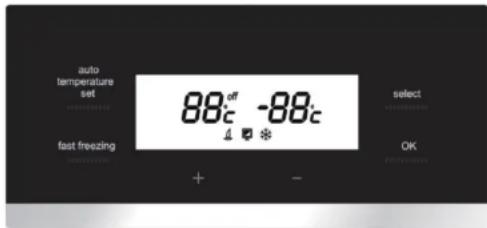
LED Displayer Menu Single-Button Operation
01. Select
This button is for the selects of functions. With the action of each button pressing, the flashing will be in response to the different functions' shift in sequence. The pre-set sequence will be "temperature of refrigeration room setting"→ "temperature of freezer room setting"→ "vacation mode setting"→ "refrigeration OFF and rounding back to the very beginning select ("temperature of refrigeration room setting")
02. “+”、“-”
When the LED displayer showing the 2-digital number flashing, it is allowed to press the button of "+"(or "-") each time to get the response to the number plus (or minus) by 1 accordingly. It refers to the setting for the temperature of 1 Celsius Degree change.
03.OK
When the character or number is flashing, to press the button of "OK", the flashing will stop when the setting of new functions/specifications come in use.
In the condition of the number flashing, in case of no further operation including the button of "OK" were not pressed, the flashing will stop automatically in 5 seconds in response to the temperature setting is confirmed. In the condition of the character flashing(": vacation mode or refrigeration"off"), in case of no further operations including the button of "OK" were not pressed, the flashing will stop automatically in 5 seconds in response to the function setting is failed.
04.Fast Freezing
Provided the condition of no other setting operation were undergoing and the fast-freezing function is not in use, to press the button of "Fast Freezing" will make the fast-freezing function available. In the condition of fast-freezing function is in use, to press the button of "Fast Freezing" will make the fast-freezing function stop.
In the condition of other setting operation is undergoing (namely: there are characters or numbers flashing), there is no response to any action of pressing this button.
05 . Auto temperature set
Provided the condition of no other setting operation were undergoing and the intelligence function is not in use, to press the button of "auto temperature set" will make the intelligent function available. In the condition of intelligence function is in use, to press the button of "auto temperature set" will make the intelligent function stop. In the condition of other setting operation is undergoing (namely: there are characters or numbers flashing), there is no response to any action of pressing this button.
06 .Function of "Fast Freezing"
- The setting of Fast-Freezing ON: Please refer to the operation guidance in 04. - The setting of Fast-Freezing OFF: Please refer to the operation guidance in 04. When the fast-freezing period lasting 26 hours, it is set to change the Fast Freezing function from ON to OFF automatically. When "Auto temperature set" condition is set, the Fast Freezing function is OFF.
- When the Fast Freezing function is OFF, the temperature of freezer will resume back to the original temperature pre-set.
07. "Auto temperature set" function
- "Auto temperature set" ON:Please refer to the operation guidance in 05. - "Auto temperature set" OFF:Please refer to the operation guidance in 05. When "Fast-Freezing", "Vacation mode" or refrigeration "OFF" is in working, "Auto temperature set" function is automatically OFF.. - When the auto temperature set function is OFF, the temperature of all rooms will resume back to the original temperature pre-set. - In the condition of "Auto temperature set" function is ON, the temperature of refrigeration room and freezer room is pre-set by 4 Celsius Degree and -18 Celsius Degree individually.
08. "refrigeration OFF" function
When the refrigeration is in the condition of "ON", press the button of "SELECT" and shift the selects till the refrigeration "OFF" is flashing, then to press "OK" button to make the refrigeration function OFF. When the refrigeration is in the condition of "OFF", press the button of "SELECT" and shift the selects till the refrigeration "OFF" is flashing, then to press "OK" button to make the refrigeration function OFF. In the condition of "Auto temperature set" or "Vacation Mode", the refrigeration function is pre-set to be OFF. When the "refrigeration OFF" is confirmed, the temperature of refrigeration room will resume back to the original temperature pre-set.
09. "Vacation Mode" function
When the Vacation Mode is in the condition of OFF, press the button of "SELECT" and shift the selects till the refrigeration "4" is flashing, then to press "OK" button to enter Vacation Mode. When the Vacation Mode is in the condition of ON, press the button of "SELECT" and shift the selects till the refrigeration "4" is flashing, then to press "OK" button to quit Vacation Mode. In the condition of "Auto temperature set" or "refrigeration OFF", Vacation Mode is pre-set to quit In the condition of Vacation Mode, the temperature of refrigeration room is pre-set by 14 Celsius Degree in operation. When the Vacation mode is quit, the temperatures will resume to the original one pre-set.

During the freezing process, the freezer compartment setting can be set and control at any time.
10. Shut down of displayer panel
when the power is ON, the LED displayer will show in full lighting condition. In case of no further operation action, the LED displayer will resume to the no-lighting condition in 3 minutes automatically.
The Setting Of Temperature
-
To press the button of "SELECT" and shift the flashing to temperature of refrigeration room setting, use the button of "+" or "-" to set the temperature adjustment for refrigeration room. The adjustment range of temperature is: 8°C\~2°C.
-
To press the button of "SELECT" and shift the flashing to temperature of freezer room setting, use the button of "+" or "-" to set the temperature adjustment for freezer room. The adjustment range of temperature is: -16°C \~ -24°C.
Alarm
Door opening alarm: If the door opening time is over 3 minutes, the buzzing device will buzz to remind you to close the door. The device stops buzzing after you close the door. If the door is opening all the time, the buzzing device will buzz and press any button can disarm the alarm for three minutes. If the door opening time is over ten minutes, the lamp will turn off automatically.
Over-temperature Alarm
When the power is ON, if the temperature detected by the sensor of freezer is read higher than -10 Celsius Degree, the number of freezer temperature on the displayer will become flashing. To press any button, it will show the original temperature room when power is ON, re-press the button or 5 seconds later, it will resume to the normal display condition.
Guidance of Malfunctions
01 Please refer to the information for matching between the malfunction types and showing on the displayer
| No. | Malfunction Type | Displayer Showing |
| 1 | Malfunction on the sensor of refrigeration room | Showing: “E0” in the “temperature of refrigeration room setting” zone |
| 2 | Malfunction on the sensor of freezer room | howing: “E0” in the “temperature of freezer room setting” zone |
| 3 | Malfunction on the sensor of evaporator in refrigerator | Showing: “E1” in the “temperature of refrigeration room setting” zone |
| 4 | Malfunction on the sensor of evaporator in freezer | Showing: “E1” in the “temperature of freezer room setting” zone |
| 5 | Malfunction on the sensor of environment temperature | N/A |
| 6 | Malfunction on the communication | Showing: “EC” in the “temperature of freezer room setting” zone |
- In case of the multiple malfunctions happening to require "E0" and "E1" showing at the same time, it will show "E2" in the displayer.
How to Disconnect the Refrigerator
Pull the plug out. Remove the ice trays and food.
Leave the door slightly open for air to circulate and to dehumidify both sections.
Whenever you disconnect the refrigerator, wait at least 10 minutes before turning it on again.
If you intend to disconnect the refrigerator for a long period of time, you should unplug it and then clean it thoroughly. Be sure to leave the door slightly open and leave it in a well ventilated place to avoid unpleasant odors.
How to Save Energy
- Install the refrigerator in the coolest part of the room, out of direct sunlight and away from heating ducts or registers. Do not place the refrigerator next to heat-producing appliances such as a range, oven or dishwasher.
- The refrigerator door should remain open only as long as necessary; do not place hot food inside the refrigerator.
- Organize the refrigerator to reduce door openings. Remove as many items as needed at one time and close the door as soon as possible.
- The refrigerator door should be properly closed to avoid increased energy consumption, and the formation of excess ice and/or condensation inside.
- Constantly circulating cold air keeps the temperature homogenous inside the refrigerator. For this reason, it is important to properly distribute the food, to facilitate the flow of air.
- Cover foods and wipe containers dry before placing them in the refrigerator. This cuts down on moisture build-up inside the unit.
- Do not overcrowd the refrigerator or block cold airvents. Doing so causes the refrigerator to run longer and use more energy. Shelves should not be lined with aluminum foil, wax paper or paper toweling. Liners interfere with cold air circulation, making the refrigerator less efficient, which could cause food spoilage.
- During prolonged absences (example: vacations) it is advisable to disconnect the refrigerator, remove all the food, and clean it. The door should be left slightly open to avoid mold and unpleasant odors. This will not affect the refrigerator when it is reconnected.
- During short absences (ex.: holidays), the refrigerator can remain on. However, remember that prolonged power outages may occur while you are gone.
Transportation
When transportation, hold the base and lift the refrigerator carefully with the angle no more than 45 degree. Never hold the door handle as support. Never place it upside down horizontalwise.
Hints and Suggestions
- The appliance should be so positioned that the plug is easily accessible.
- If the supply cord is damaged, it must be replaced by a special cord or assembly available from the manufacturer or its service agent.
- The appliance shall not be used in open air and shall not be exposed to rain.
- Don't store something like ether, methanol, gasoline etc., which is easy to evaporate, burn or explode.
- Don't set something too heavy on the top of refrigerator and do not pour water on it.
- Do connect your refrigerator to an independent electrical socket and use a safe ground wire. The voltage should be limited within the ranges from 220V to 240V, or the main motor will be damaged.
- Turn on electricity only 5 minutes later after electricity goes off. Otherwise, the compressor may be damaged.
- In order to save electricity consumption, keep air circulation during operation and the package base should be taken away.
- Sure to keep electrical wire away from compressor and condenser, or its insulation function will be spoiled by high temperature.
- To save the energy, you should reduce the frequency and duration of the opening of the door.
- Do not touch the food in the freezer room or container (especially metal container) with wet hand, or it may be frostbited.
- Do not use the prolonged power cord.
- If your refrigerator is with lock, to avoid children shut into the refrigerator, do not leave the key near the refrigerator or other place easy to be touched by children.
- Warning-Keep ventilation openings in the appliance enclosure or in the structure for building in, clear of obstruction.
- Warning-Do not damage the refrigerant circuit.
- Warning-Do not use electrical appliances inside the food storage of the appliance unless they are of the type recommended by the manufacturer.
- If the appliance can not be used any more, please release the refrigerant before abandon at a place exposed to the air and away from tinderbox.
Cleaning and Maintenance
Unplug the refrigerator before starting to clean it. Never clean the refrigerator with flammable fluids such as alcohol, kerosene, gasoline, thinner, solvents or chemical / abrasive products like detergents, acids or vinegar. Cleaning products such as powdered detergents, abrasive cleansers, alkaline cleansers, chemically treated cloths, solvents, alcohol and even hot water should also not be used to clean the refrigerator, as they can damage the paint and the plastic parts.
If you are not going to use the refrigerator for an extended period of time, unplug it, clean and dry the inside, and then close it properly.
Do not clean the Refrigerator by throwing water directly on it, neither on the outside, nor on the inside.
Inside
Before cleaning, remember that humid objects adhere easily to extremely cold surfaces. For this reason, do not touch these surfaces with damp cloths, objects or hands. Clean the inside of the refrigerator with a cloth dampened in a solution of warm water and baking soda (one spoonful of baking soda for each liter of water). Never use metallic objects, brushes, abrasive or alkaline products to clean the plastic surfaces inside the refrigerator. Plastic parts should not be washed in hot water.
Electrical Parts
Use a dry cloth to clean the electrical parts to avoid short circuits.
Changing The LED Light
NOTE: This product is used in the LED lamp, the user should not replace it. If the
natural_image
Symbolic illustration of plastic bottles crossed out by a diagonal line, no text or symbols presentLED lamp can not work properly, please come to our local or in nearby special repair service department to replace.
Outside
Clean the outside of the refrigerator with a damp cloth dipped in warm water and mild soap.
Once every 6 months, clean the back of the refrigerator with a vacuum cleaner or a duster. The dust that accumulates there interferes with proper functioning of the condenser, and therefore of the refrigerator, leading to higher energy consumption. Disconnect the refrigerator before cleaning and do not touch the condenser or the compressor, as they may be hot.
The drainage tray should be cleaned at least once a year.
Water will enter the refrigerator if the drainpipe becomes blocked; if this happens, disassemble the light protector and wash out the drain pipe.
Door Seals
The rubber door seals should be carefully cleaned with a damp cloth. Rinse and dry them carefully to avoid damage.
Notes
After cleaning the refrigerator, check the following:
- Check to be sure the cord is not damaged.
- Check to see if the plug is properly connected to the outlet.
- Check to see if the grounding cable is installed.
- Check to see if the drain is clogged.

natural_image
Illustration of a blue bucket with a handle inside a circular frame (no text or symbols)Solutions to Problems
Condensation Outside the Refrigerator
According to international standard ISO 8187, domestic refrigerators, freezers and refrigerator/freezers should not present condensation outside.
However, when installed in areas with relative humidity above 80% and room temperatures above 32°C (89.6°F), it is normal for the refrigerator to have some outside condensation (moisture).
Door Seals
When the door(s) are closed, an internal vacuum forms. This can make it difficult to open the door. We recommend waiting a few seconds before reopening it/them.
Normal Operating Noises
When the refrigerator is turned on and off, it may make a clicking noise that is perfectly normal. While the refrigerator is running, it may make a "screech", especially when the door is open.
This noise is due to the expansion of the cooling fluid inside the refrigerator. It does not mean there is a problem with the appliance.
Due to the door's sealing system, noises and clicks may be heard when closing the door. This is the result of the sudden cooling of inside air.
The compressor may make a noise or a pulsing sound. This is a characteristic of modern compressors that operate at higher speeds than older models.
Contraction and dilatation of inside components, due to temperature variations, can cause soft clicking noises in the refrigerator.

natural_image
Simple illustration of a blue shield with raindrops inside a circle (no text or symbols)
natural_image
Simple icon of a blue window with musical notes and dots inside a circle (no text or symbols)Warmth Near the Doors
It is normal for the area near the door and sides to present higher temperatures. The warmth prevents moisture formation.
Warmth Near the Back
It is normal for this area to present higher temperatures, since this is where the cooling fluid circulates at higher temperatures. Avoid contact with this part of the refrigerator.

natural_image
Simple icon of a blue window with a handle, enclosed in a circle (no text or symbols)
natural_image
Simple line drawing of a refrigerator inside a circle (no text or symbols)Normal Operation
- It takes a few minutes for the refrigerator compartments to cool when the unit is turned on: If the temperature of one of the compartments is higher, when the unit is turned on, it will take a few moments for it to drop.
- The compressor surface is heating up: It is normal for the compressor surface to heat up when it is operating properly. You should not touch it.
Before Calling Your Service Representative:
Check the following items
Water is entering the refrigerator compartment
Weather is hot and humid.
Door may not be seating properly.
Door is kept open too long, or is opened too frequently.
Is there food inside the appliance that may be dripping?
Appliance is not cooling
Check to see if there is a power failure.
Check to see if the power cord is properly plugged into the outlet.
Check to see if a fuse has blown (or the switch).
Measure the voltage in the outlet. If it is low, reconnect it.
Use another circuit. If you are unsure about the outlet, have it checked by a certified technician.
See "Setting the Temperature Control" section.
Excess noise
The refrigerator is not properly leveled.
The refrigerator is touching the wall.
Modern refrigerators have increased storage capacity and more stable temperatures. They require a high efficiency compressor.
Refrigerator operates at higher pressures during the start of the ON cicle.
Refrigerant (used to cool refrigerator) is circulating throughout the system.
The outside refrigeration pipes are touching each other or the refrigeration pipes are touching the cover.
The food is too tightly packed together, and this is blocking the flow of air.
Hot food or too much food was place inside the refrigerator.
The temperature control was not properly adjusted.
Condensation inside the refrigerator
Room temperature is very high or the door has been left open too long.
Liquid foods inside the refrigerator are not in a properly sealed container.
Refrigerator not cooling enough
The door is not properly closed.
The door packaging is damaged.
The refrigerator is not well ventilated.
There is insufficient space between the refrigerator and the surfaces next to it, and on top.
The refrigerator is under direct sunlight or near a source of heat.
The plug is not properly plugged in.
The room temperature is below 10^ C and the temperature compensation switch is turned off.
The door rubber seals are broken or folded.
Temperature control is set too low.
Refrigerator has recently been disconnected for a period of time.
Large amounts of warm or hot food may have been stored recently.
Refrigerator is warmer than normal
Has the door been opened frequently or for a long time?
Is the refrigerator so full that the air cannot properly circulate?
Were hot things place in the refrigerator without first being allowed to cool?
Is there sufficient space between the refrigerator and the wall?
Food stored in refrigerator compartment freezes
Are the temperature controls in the refrigerator compartments and extra cold compartment set to the coldest position?
Is the room temperature below 5^ C?
Is the food close to the cold air exits?
Odors in refrigerator
Interior needs to be cleaned.
Foods with strong odors are in the refrigerator.
Notes
The compressor does not stop automatically
Room or outside weather is hot.
Refrigerator has recently been disconnected for a period of time.
Is too much food being stored?
Large amounts of warm or hot food have been stored recently.
Are the doors being opened too frequently or kept open too long?
Are the refrigerator temperature controls set in the coldest position?
Refrigerator gasket is dirty, worn, cracked, or poorly fitted.
Snapping Sound
Cold Control turning the refrigerator ON and OFF.
Door will not close
Refrigerator is not level. It rocks on the floor when it is moved slightly.
LED Light is not On
LED Light is burned out.
No electric current is reaching the refrigerator.
Any other enquiry, please call our service centre as: 1300 796 688.

natural_image
Abstract curved orange gradient shape with white contour lines, no text or symbols present


- Contents
- User Manual
- Safety
- Welcome
- Environmental Advice
- For Children
- For the User / Installer
- Proper Disposal of Your Refrigerator
- Before You Throw Away Your Old Refrigerator:
- NOTE:
- R600A WARNINGS
- Refrigerator Description
- R600A Refrigerant Warning
- It is hazardous for anyone other than an Authorised Service Person to carry out servicing or repairs to this appliance. In Queensland the authorized person must hold a Gas Work Authorisation for hydrocarbon refrigerants, before carrying out servicing or repairs which involve the removal of covers.
- WARNING
- Installation
- Choosing the Location
- Leveling the Refrigerator
- Electrical Installation
- Usage Instructions
- Grounding
- How to Turn on the Refrigerator
- Filling the Refrigerator
- Refrigerator Compartment
- Placement of Food
- Freezer Compartment
- Making and Removing Ice Cubes
- Function Introduction
- LED Displayer Menu Single-Button Operation
- Select
- “+”、“-”
- 03.OK
- 04.Fast Freezing
- . Auto temperature set
- .Function of "Fast Freezing"
- "Auto temperature set" function
- "refrigeration OFF" function
- "Vacation Mode" function
- Shut down of displayer panel
- The Setting Of Temperature
- Alarm
- Over-temperature Alarm
- Guidance of Malfunctions
- How to Disconnect the Refrigerator
- Whenever you disconnect the refrigerator, wait at least 10 minutes before turning it on again.
- How to Save Energy
- Transportation
- Hints and Suggestions
- Cleaning and Maintenance
- Inside
- Electrical Parts
- Changing The LED Light
- Outside
- Door Seals
- Notes
- Solutions to Problems
- Condensation Outside the Refrigerator
- Normal Operating Noises
- Warmth Near the Doors
- Warmth Near the Back
- Normal Operation
- Before Calling Your Service Representative:
- Water is entering the refrigerator compartment
- Appliance is not cooling
- Excess noise
- Condensation inside the refrigerator
- Refrigerator not cooling enough
- Refrigerator is warmer than normal
- Food stored in refrigerator compartment freezes
- Odors in refrigerator
Brand : CHANGHONG
Model : FFD540R02T
Category : Refrigerator