
7 Wonders Leaders - Board game Asmodee - Free user manual and instructions
Find the device manual for free 7 Wonders Leaders Asmodee in PDF.


| Product Type | Board Game Expansion |
| Brand | Asmodee |
| Model | 7 Wonders Leaders |
| Category | Board Game |
| Language | English |
| Manual Pages | 12 |
| Number of Leader Cards | 36 |
| Number of Guild Cards | 4 |
| Number of Coin Tokens (value 6) | 17 |
| Wonder Board Included | 1 (Rome/Colosseum) |
| Courtesan Token | 1 |
| Blank Leader Card | 1 (Semiramis) |
| Score Booklet | 1 |
| Rulebook | 1 |
| Recommended Players | 2–7 |
| Recommended Age | 10+ |
| Playing Time | Approx. 30–60 minutes |
| Difficulty | Medium |
| Expansion For | 7 Wonders (Base Game) |
| Release Year | 2011 |
| Game Phase Additions | Leader Phase, Recruitment Phase |
| Victory Conditions | Same as base game (most points after Age III) |
Frequently Asked Questions - 7 Wonders Leaders Asmodee
User questions about 7 Wonders Leaders Asmodee
0 question about this device. Answer the ones you know or ask your own.
Ask a new question about this device
Download the instructions for your Board game in PDF format for free! Find your manual 7 Wonders Leaders - Asmodee and take your electronic device back in hand. On this page are published all the documents necessary for the use of your device. 7 Wonders Leaders by Asmodee.
USER MANUAL 7 Wonders Leaders Asmodee
« One of the penalties for refusing to participate in politics is that you end up being governed by your inferiors. »
(Plato)
Contents
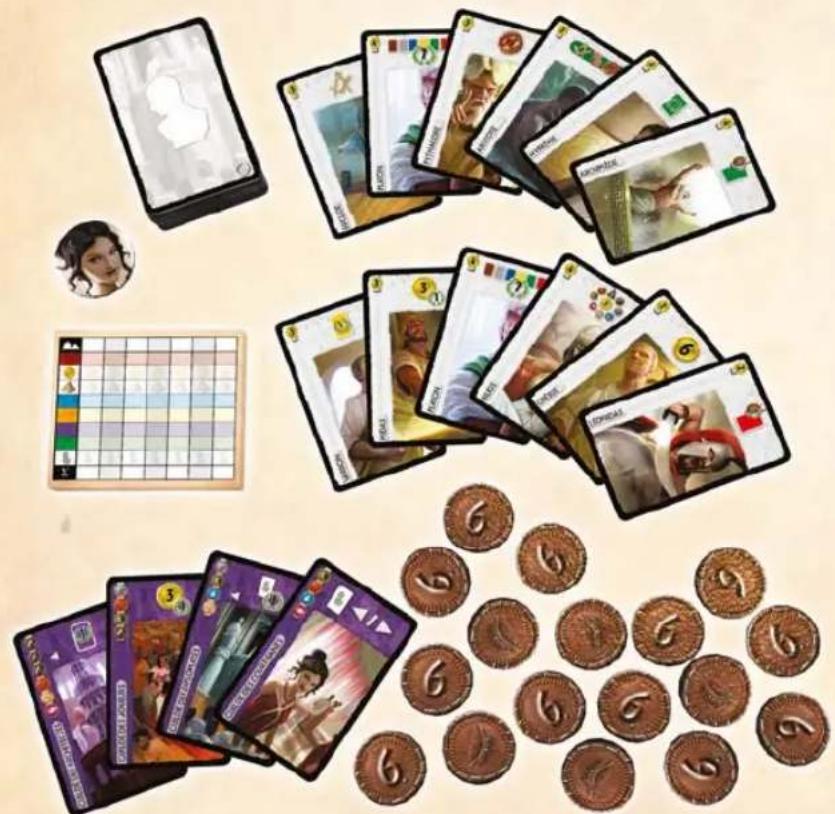
-1 Wonder board -1 Courtesan token
-1 Wonder card -1 rulebook
- 36 Leader cards - 1 score booklet
- 4 Guild cards - 1 blank Leader card
- 17 value 6 coins
natural_image
Assorted cards and coins arranged on a table, including playing cards, a grid, and scattered coins (no text or symbols visible)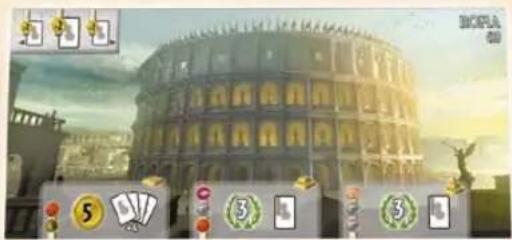
Overview
This expansion for 7 Wonders offers you the opportunity to put leaders at the head of your civilization.
Represented by 36 new cards, these leaders will influence the growth of your city, each in their own way.
The game play is slightly changed, but the victory conditions remain the same as those in the basic 7 Wonders game.
Contents Description
Wonder Board
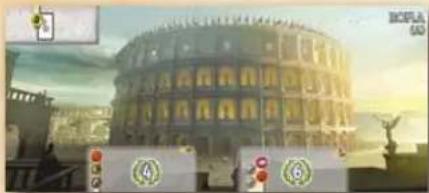
Rome and its Colosseum constitute a new board, the effects of which are explained on the last page of this rulebook. This new board can only be used with the Leaders expansion.
Leader Cards
The Leaders (white cards) are a new card category. They are not added to the Age cards and have a different back to set them apart. Their cost, in the upper left corner of each card, is in coins only.
Blank Leader Card (Semiramis)
A blank Leader card is present in your box. It will give you the chance to create a personality by yourself and add it to your games.

Guild Cards
4 new Guilds (purple cards) are to be added to those available in the basic game. Take care though, as some of them can only be used with the Leaders expansion.
Coins
The 17 coins of value 6 should be added to the coins of the base game.
Courtesan Token
A special token which is used with one of the new Guilds, the Courtesan's Guild.
Score Booklet
A new score booklet is found in this box: it will allow you to add victory points earned by some Leaders.
Set-up
- The new Guilds (purple cards) for Age III are added to those of the basic game. The rules for the Age III deck remain unchanged (meaning that the number of Guilds to be kept is still the same).
- Each player starts with 6 coins (instead of 3 as in the base game).
Game Overview
The game now starts with a Leader Phase.
In addition, a new game phase, the Recruitment Phase, takes place at the beginning of each Age.
Leader Phase
Each player is dealt a hand of 4 Leader cards, randomly distributed (to be kept hidden). The Leaders that are not dealt out are returned to the box.
- Each player must secretly choose one card from their 4 and places it in front of himself or herself, face down. The 3 remaining cards are then handed to the player to their right.
- Each player secretly chooses one card from the 3 received from the player to their left. The 2 remaining cards are then given to the player to their right.
- Each player then secretly chooses one card from the 2 received from the player to their left. The remaining card is given to the player to their right.
- Each player keeps the card from the player to their left and adds it to the 3 cards previously chosen.
At the end of this phase, each player has thus created a hand of 4 Leaders for him or herself. Age I can now start.
Overview of an Age
Each Age now starts with a Recruitment phase.
OVERVIEW OF AN AGE
- Recruitment Phase
- Play the Age
- Conflict Resolution
Recruitment Phase
During this phase, each player will play one of their Leader cards. The cards are chosen secretly by each player, then revealed simultaneously to be played.
The Leader cards can be played in 3 ways:
a. Recruit the Leader
b. Build a stage of a Wonder
c. Discard the card to gain 3 coins
a. Recruit the Leader
The player pays the coin cost of the Leader (the coins are returned to the bank) and places the Leader card next to his or her Wonder board, face up.
PLAY FAIR!
To help your opponents read your board, we recommend that Hannibal and Caesar be placed in the same place as your red cards so that all your Shield symbols be displayed at the same place. In the same way, place Euclid, Ptolemy and Pythagoras with the green cards of the corresponding symbol.
b. Build a stage of a Wonder
To build a stage of a Wonder, the player uses the Leader card selected as a construction marker (face down). To do that, the cost indicated on the Wonder board must be paid, and not the one on the Leader card.
Note: this action will rarely be possible during the first Recruitment Phase, as the cities will generally not yet have the resources required for the construction of the first stage of their Wonder.
c. Discard the card to gain 3 coins
The player can decide to discard the card to take 3 coins from the bank and add them to the treasury of his or her city. The Leader cards discarded in this fashion are returned to the box (face down).
The remaining Leader cards in each player's hand will be used later in the game: they are placed, face down, under the recruited Leader.
Once this phase finished, the Age is played normally by the normal 7 Wonders rules.
Special case: during the Recruitment phase before Age III, each player is in possession of 2 Leader cards. The first is played in one of the 3 ways described above (a, b, or c) and the second is returned to the box, face-down.
End of Game
As in the base game, the game ends at the end of Age III, after the distribution of Conflict Tokens. Each player totals the points of his or her civilization and the player with the highest total is declared the winner.
"Expert" Variant for 2 Players
The 2 player game uses the rules adjustment to the 7 Wonders game. The Recruitment phases follow the regular rules, only the Leaders phase is slightly modified:
Each player gets 4 Leader cards face down. No Leader is given to the Free City.
The players choose a first card in their hand of 4 cards and give the 3 remaining cards to their opponent.
They choose a second card in this hand of 3 cards, then exchange their hand again, and so on. At the end of this phase, each player thus has a hand of 4 Leaders to play the game.
The game is played according to the rules for 2 players in the base game with the Recruitment phases described in these rules.
AMYTIS
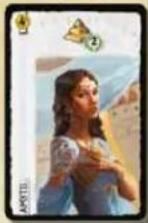
At the end of the game, Amytis is worth 2 victory points (VP) for each Wonder stage built by the player.
ALEXANDER
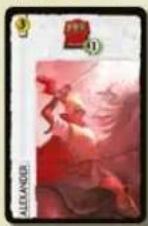
At the end of the game, Alexander adds 1 VP to each Victory token (the value of the Victory tokens therefore goes from 1, 3 and 5 VP to 2, 4 and 6 VP).
ARISTOTLE
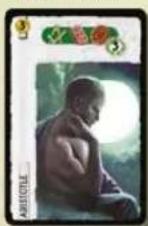
At the end of the game, Aristotle adds 3 VP to each set of different scientific symbols (meaning that the bonus goes from 7 VP to 10 VP per set).
JUSTINIAN

At the end of the game, Justinian is worth 3 victory points for each set of 3 Age cards (red, blue, green) in the player's city.
PLATO
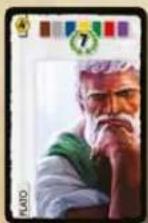
At the end of the game, Plato is worth 7 victory points for each set of 7 Age cards (brown, gray, blue, yellow, green, red, purple) in the player's city.
Description of
MIDAS
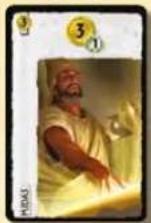
At the end of the game, Midas is worth 1 victory point per every 3 coins in the player's treasury. Clarification: These points are added to those normally given for coins (the player therefore scores 2 VP for each set of 3 coins).
BILKIS
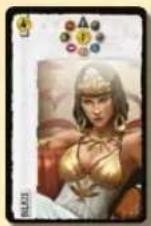
Once she enters play, Bilkis allows the player to purchase any resource by paying 1 coin to the bank once per turn.
MAECENAS
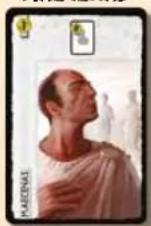
As soon as Maecenas enters play, his controlling player can recruit all of his or her future Leaders for free (during the Recruitment Phase), without having to pay their coin cost.
RAMSES
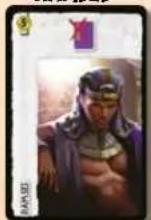
As soon as Ramses enters play, the player can build all of his or her Guilds for free, without having to pay their resource costs.
f the Leaders
TOMYRIS HANNIBAL CAESAR

Once Tomyris enters play, during conflict resolution, the Defeat tokens of this player are given to the victorious neighboring city.
Note: Tomyris has no effect if the player's city is victorious during conflicts or for Conflicts which took place before she entered play.

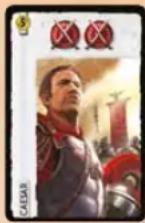
As soon as they enter play, these Leaders grant the amount of shields printed on their respective cards.
HATSHEPSUT
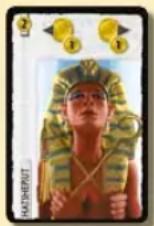
Once she enters play, each purchase of one or more resources from a neighbor grants 1 coin from the bank. Note that this gain is limited to 1 coin per neighbor per turn.
Clarification: the player takes this gain from the bank immediately AFTER having paid for his or her purchase.
NERO
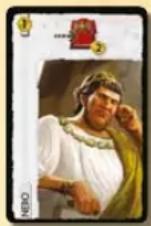
Nero grants 2 coins for each Victory token earned by the player from this point forward.
These coins are taken from the bank when the Victory tokens are gained.
Clarification: Nero has no effect on Victory tokens won before he enters play.
XENOPHON
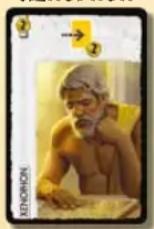
Xenophon grants 2 coins for each commercial structure (yellow card) that the player builds from this point forward. The coins are taken from the bank, at the moment when the structures are built.
Clarification: Xenophon has no effect on commercial structures built before he enters play.
VITRUVIUS
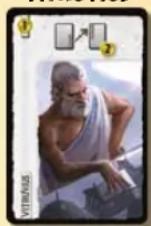
Once he enters play, Vitruvius grants 2 coins whenever the player builds a structure for free, through building chains. The coins are taken from the bank when the structures are built.
Clarification: Vitruvius has no effect on constructions built through construction chains before he enters play.
SOLOMON
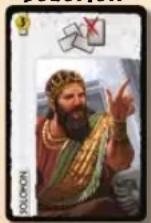
Once Solomon enters play, the player can choose an Age card from the discard pile and put it in play for free.
CROESUS
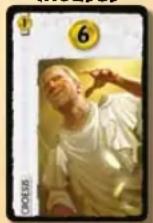
When he enters play, Croesus immediately grants 6 coins, taken from the bank.
HYPATIA VA##UCHADNEZZAR PHIDIAS

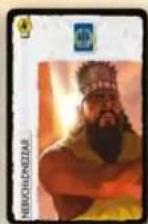
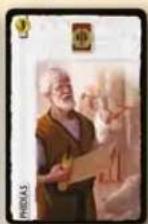
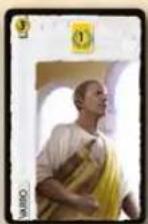
At the end of the game, these Leaders are worth 1 victory point (VP) per card of the corresponding color present in the player's city.
PERICLES PRAXITELES HIRAM
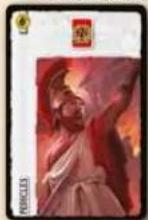
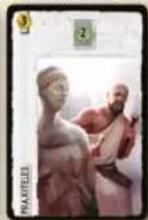
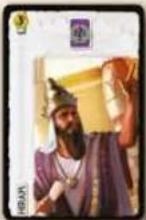
At the end of the game, these Leaders are worth 2 victory points per card of the corresponding color present in the player's city.
SAPPHO

ZENOBIA
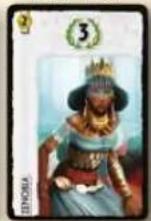
NEFERTITI
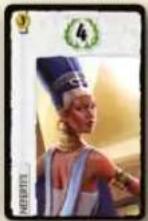
CLEOPATRA
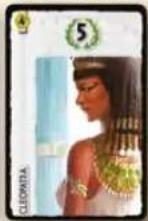
At the end of the game, these Leaders are worth the number of victory points printed on their card.
ARCHIMEDES LEONIDAS HAMMURABI IMHOTEP

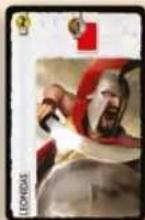

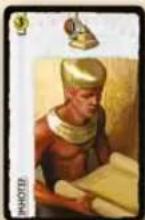
From the moment they enter play, these Leaders allow the player to build Structures of the corresponding color (Wonder stages for Imhotep) for one resource less than their written cost.
Clarification: the resource removed from the cost is left to the player's choice. This can be a raw material (brown) or a manufactured good (gray).
EUCLID PTOLEMY PYTHAGORAS
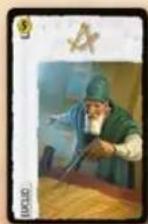
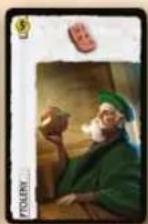
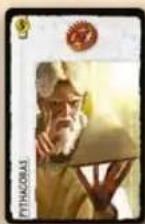
These Leaders grant the scientific symbol printed on their respective cards. This symbol is added to those of scientific structures (green cards) in the player's city.
Description of the Guilds
GAMER'S GUILD
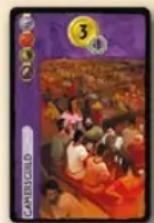
1 victory point for each complete set of 3 coins present in the player's treasury.
Note: this gain is added to the one already granted by the coins.
COURTESAN'S GUILD

When the Courtesan's Guild is built, the player must immediately place the "Courtesan" Token on one of the Leaders present in one neighboring city. The player then gains the benefits of that Leader and his or her associated effect.
Note: this Guild has no consequence for the player whose Leader is given the "Courtesan" Token.
DIPLOMAT'S GUILD
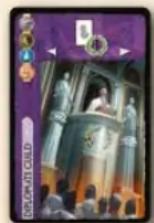
I victory point for each Leader (white card) present in the neighboring cities.
Note: only the recruited leaders count, those used to build stages of a Wonder are not counted.
ARCHITECT'S GUILD
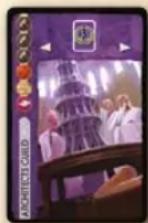
3 victory points for each purple card present in the neighboring cities.
FAQ
Leader: Solomon
Q: What happens if Solomon enters play in the same turn in which Halicarnassus builds a Wonder stage?
A: Halicarnassus chooses its card from the discard pile before Solomon.
Leader: Hiram
Q: Does Hiram grant 2 victory points for the third stage of the Statue of Zeus in Olympia B board (copy of a neighboring guild)?
A: No, this Wonder stage is not considered to be a Guild.
Leader: Plato
Q: Does Plato grant me 14 victory points if I have 2 Age cards of each color at the end of the game?
A:Yes!
Leader: Hatshepsut
Q: Can the effect of a Trading Post (or of the Marketplace) be stacked with Hatshepsut's?
A: Yes, it's possible to pay 1 coin for a resource and then gain 1 coin from the bank.
Courtesan's Guild
Q: Does the "copied" Leader count for points with the Diplomat's Guild?
A: No, it's not considered to be a Leader.
Scientific Symbols
Q: Do the scientific symbols given by leaders also count in the composition of the sets?
A: Yes, each scientific symbol, no matter where it comes from (green cards, guilds, Wonders, Leaders), counts for both scores (identical symbols and sets of 3 different symbols).
Biographies of the Leaders
ALEXANDER
King of Macedonia, conqueror, founder of the ancient Greek empire. The only monarch in History to have forged an empire uniting both Orient and Occident.
AMYTIS
Wife of Nebuchadnezzar, for whom the Hanging Gardens of Babylon are said to have been built.
ARCHIMEDES
Greek mathematician, scientist, physicist and engineer, the number Pi is associated to him as well as the calculation of bodies' volume mass by immersion in water.
ARISTOTE
Greek philosopher, long considered to be the ultimate embodiment of antique wisdom in the Occident due to his encyclopedic knowledge of arts and sciences.
BILKIS
Queen of the Kingdom of Saba. Sublime, impressive by her wisdom and her intelligence, she's mainly known through the tales of King Solomon, which tell of her prosperity.
CAESAR
Roman general, politician and writer. Rome's early days owe their thanks to him and his military acumen.
CLEOPATRA
The most well known of the Egyptian monarchs, her charm and subterfuge allowed her country to shine despite the Roman conquest.
CROESUS
Last king of Lydia, famous for his immense fortune, which notably served to finance the construction of one of the wonders of the ancient world, the Temple of Artemis.
EUCLID
Greek mathematician, geometry specialist, and the author of an important text on modern mathematics: The Elements.
HAMMURABI
King of Babylon at an age where the oldest known code of law known to History was written.
HANNIBAL
Carthaginian general. One of the greatest military tacticians of History, famous for having seriously threatened Rome after crossing the Pyrenees with his elephants.
HATSHEPSUT
Pharaoh-Queen of the Eighteenth Dynasty. Economic prosperity is attributed to her rule as the trade networks of Egypt were considerably strong.
HIRAM
A smelting and blacksmith artisan, he helped King Solomon considerably when building his temple.
HYPATIA
Philosopher and mathematician, daughter of the last director of the Museum of Alexandria. Known as much for her grace and beauty as for her intelligence and her eloquence.
IMHOTEP
Founder of Egyptian medicine, religious reformer and Egyptian builder. He is the architect of the most ancient angled pyramid in the world.
JUSTINIAN
Byzantine emperor. The most well known figure of late Antiquity, mainly for his restoration, albeit partially successful, of the Roman Empire.
LEONIDAS
Agiad king of Sparta who met a heroic death with 300 of his soldiers during the battle of Thermopylae while resisting the Persian invasion.
MAECENAS
Roman politician who used his influence and his fortune to promote arts and literature.
MIDAS
King of Phrygia. Known mainly for his wealth and the myth stemming from it which said that everything he touched turned to gold.
NEBUCHADNEZZAR
King of Babylon. Known for the many works and monuments he had erected throughout his kingdom and the cultural aspect due to them.
NEFERTITI
Great royal wife of the Pharaoh Akhenaten, dearly beloved by her people, the artistic representations of her were more numerous than those of her husband.
NERO
Roman emperor. Known for his bellicose and easily riled personality, his rule brought military success to the Empire, as well as a monetary reform revaluing the denarius.
PERICLES
Exceptional Athenian orator and politician as well as brilliant strategist. He was very influential among his troops and feared by his foes during the Peloponnesian war.
PHIDIAS
Sculptor of the first Greek classic style, main architect of the Athenian Parthenon.
PLATO
Greek philosopher, considered to be among the most important and omniscient. His work attest to the polyvalence of his knowledge: politics, justice, science, culture, arts...
PRAXITELES
Sculptor of the second Greek classic style. First artist to have represented female nude in Greek sculpture.
PTOLEMY
Greek astronomer and astrologer, author of the Amalgest, an important text on astronomy which deeply influenced Occidental thought until the Renaissance.
PYTHAGORAS
First self-proclaimed philosopher and Greek mathematician specialized in the laws of numbers, leading to the development of arithmetic, music, and geometry.
RAMSES
Third Pharaoh of the Twenty-Ninth Dynasty. One of the monarchs who ruled the longest in Egypt and to whom is linked the greatest number of cultural remnants.
SOLOMON
King of Israel whose wisdom and incorruptible sense of justice are legendary. He ordered Jerusalem's first temple built and gave his kingdom a highly structured administration.
SAPPHO
Greek poet who lived in Lesbos. Known to have been fiercely feminist at an age where misogyny was the norm.
SEMIRAMIS
Queen of Assyria. The military expeditions she successfully led against the Medes have created many myths about her.
TOMYRIS
Legendary queen of the Massagetae, who, according to myth, cut off the head of the King of Persia, Cyrus the Great, to avenge her son.
VARRO
Roman soldier, scientist and writer. His Rerum Rusticarum is a collection of texts describing one of the most complete pictures of agricultural management during the Antiquity.
VITRUVIUS
Roman architect. His writings have strongly influenced the arts of the Renaissance and his treatise, De Architectura, remains a major work of classic Antiquity.
XENOPHON
Greek philosopher, historian and soldier. Author of the first agronomy treatise known to History: the Oeconomicus.
ZENOBIA
Queen of the Palmyrene Empire in the third century. She shaped her city into a prosperous cultural center, attracting many notable personalities of the time.
Credits
Author: Antoine Bauza
Adaptation and development:
«The Belgians in Sombreros»
aka Cédrick Caumont & Thomas Provoost
Artwork: Miguel Coimbra
Layout: Alexis Vanmeerbeeck
Rules editing: Matthieu Bonin
Translation: Éric Harlaux
Revision: Éric Franklin
7 WONDERS LEADERS IS A GAME REPOS PRODUCTION. ÉL. + 32 (0) 477 254 518 • 7, RUE LAMBERT VANDERVELDE • 1170 BRUXELLES - BELGIQUE WWW.RPROD.COM
© REPOS PRODUCTION 2011. ALL RIGHTS RESERVED.
THIS MATERIAL MAY ONLY BE USED
FOR PRIVATE ENTERTAINMENT.

Playtesting: Françoise Sengissen, Geneviève Sengissen, Mikael Bach, Michaël Bertrand, Mathieu Houssais, Jenny Godard, Julie Politano, Bruno Goube, Mathias Guillaud, Émilie Pautrot, Frédéric Vuillet, Corentin Lebrat, Fanny Zerbib, Cyril Sandelion, Matthieu Bonin, Olivier Reix, the players from the game-cafe "Moi j'm'en fous je triche", those from the "Repaire" in Annecy and those from the "Maison des Jeux" in Grenoble, Murielle, Brigitte, Éric, Camille, Alexis, Nadèle Miaou, Ben, Isabelle, Papytrick, Alice, John, François, Nicolas, Laure, Dimitri Perrier, John -je coupe-Berny, Cécile Gruhier, Yann.
The author would also like to deeply thank Nathalie Martin and Pierre Poissant Marquis for their contribution in historic matters.
Description of the Wonder
natural_image
Exterior view of the Colosseum in Rome, Italy (no signage)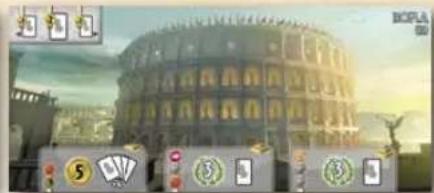
natural_image
Exterior view of the Colosseum in Rome, Italy, with surrounding game interface icons (no readable text or symbols)Rome produces no resource, but its player recruits his or her Leaders for free (cost: 0 coin).
• The first stage is worth 4 victory points.
• The second stage is worth 6 victory points.
Rome produces no resource, but its player benefits from a 2 coin reduction to the recruitment of all its Leaders (some Leaders are thus free). Neighboring cities benefit from a reduction of 1 coin on the recruitment of their Leaders.
- The first stage is worth 5 coins. Moreover, the player immediately draws 4 Leader cards from those in the box and adds them to his or her hand of Leader cards.
- The second stage is worth 3 victory points and the player can immediately put in play an extra Leader (by paying 2 coins less than its printed cost).
- The third stage is worth 3 victory points and the player can immediately put in play an extra Leader (by paying 2 coins less than its printed cost).
Note: Rome B gives the player the chance to put up to 5 Leaders into play instead of the usual 3.
natural_image
Fantasy female character in ornate armor and crown, seated with coins and gold accents (no text or symbols)- Contents
- Overview
- Contents Description
- Wonder Board
- Leader Cards
- Blank Leader Card (Semiramis)
- Guild Cards
- Coins
- Courtesan Token
- Score Booklet
- Set-up
- Game Overview
- Leader Phase
- Overview of an Age
- Recruitment Phase
- a. Recruit the Leader
- PLAY FAIR!
- b. Build a stage of a Wonder
- c. Discard the card to gain 3 coins
- End of Game
- "Expert" Variant for 2 Players
- Description of
- f the Leaders
- Description of the Guilds
- FAQ
- Leader: Solomon
- Leader: Hiram
- Leader: Plato
- Leader: Hatshepsut
- Courtesan's Guild
- Scientific Symbols
- Biographies of the Leaders
- ALEXANDER
- AMYTIS
- ARCHIMEDES
- ARISTOTE
- BILKIS
- CAESAR
- CLEOPATRA
- CROESUS
- EUCLID
- HAMMURABI
- HANNIBAL
- HATSHEPSUT
- HIRAM
- HYPATIA
- IMHOTEP
- JUSTINIAN
- LEONIDAS
- MAECENAS
- MIDAS
- NEBUCHADNEZZAR
- NEFERTITI
- NERO
- PERICLES
- PHIDIAS
- PLATO
- PRAXITELES
- PTOLEMY
- PYTHAGORAS
- RAMSES
- SOLOMON
- SAPPHO
- SEMIRAMIS
- TOMYRIS
- VARRO
- VITRUVIUS
- XENOPHON
- ZENOBIA
- Credits
- Description of the Wonder
Brand : Asmodee
Model : 7 Wonders Leaders
Category : Board game