ManualGo.com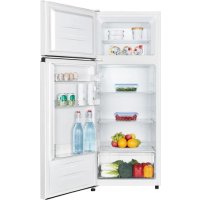
KV1431W - Fridge INVENTUM - Free user manual and instructions
Find the device manual for free KV1431W INVENTUM in PDF.



Download the instructions for your Fridge in PDF format for free! Find your manual KV1431W - INVENTUM and take your electronic device back in hand. On this page are published all the documents necessary for the use of your device. KV1431W by INVENTUM.
USER MANUAL KV1431W INVENTUM
reversing the door openings
26-2-2020 14:10:54KV1431 instructions.indd 60 WThe doors of the appliance can be opened on the right or left side. In order to reverse the door openings, please observe the instructions below. It would be best to do this with two people. Attention: switch off the thermostat and remove the plug from the socket. Remove all items from the refrigerator, including the shelves and drawers, before reversing the door opening.
1. Use a putty knife or thin-blade screwdriver to remove the screw hole cap (left) a, then remove the upper hinge cover
2. Unscrew the special self-tapping screws a and remove the upper hinge.
Remark: During this step, hold the upper door with your hand to prevent it from falling.
3. Remove the upper hinge axis, transfer it to the reversed side and tighten securely. Put it down for late use.
4. Remove the upper door from the middle hinge by carefully lifting the door straight up.
Remark: when removing the door, watch for the washer(s) between the center hinge and the bottom of the upper door that may stick to the door. Do not loose.
5. Place the upper door on a smooth surface with its panel upwards. Loosen screw a and remove the stop block b.
6. Install these 2 parts a and b to the left side and tighten securely.
7. Unscrew the two special self-tapping screws which are used for fixing the middle hinge part, then remove the middle
hinge part that hold the lower door in place. Remark: when removing the door, watch for the washer(s) between the center hinge and the bottom of the upper door that may stick to the door. Do not loose.
8. Place the lower door on a smooth surface with its panel upwards. Loosen the screw a and remove the stop block b.
9. Install these 2 parts a and b to the left side and tighten securely.
10. Change the screw hole caps on the middle cover plate from the left to the right (as shown in the figure).
11. Lay the refrigerator backwards on soft foam packaging or similar material to prevent damages. Remove both adjustable
bottom feet b, and remove the lower hinge c by unscrewing the special self-tapping screws a. 12. Replace the lower hinge to the left side and fixate it with the special self-tapping screws. Replace the adjustable bottom feet to the other side and fixate them. Carefully place the refrigerator upright.
13. Place the lower door on the bottom hinge and support it. Make sure the door is aligned.
14. Flip over the middle hinge a 180 degrees and fix it on the other side of the appliance. Place the middle hinge axis into the upper hole of the lower door and tighten the screws b of the hinge.
15. Place the upper door on the middle hinge. Make sure the door is aligned.
16. Place the upper hinge a. Make sure the upper hinge axis fits in the upper hole of the upper door. Remark: please support the upper door with your hand when doing this. Fixate the upper hinge with the self-tapping screws.
17. Place the screw hole cap a and place the other hinge cover b (which is in the plastic bag).
Place the shelves and drawers back in the refrigerator. Allow the appliance to rest for 2 to 3 hours before inserting the plug in the socket. reversing the door openings
wit• Please read these instructions before operating the appliance and retain for future use.
- Only use this appliance for the purposes described in the instruction. The appliance is suitable for storing food. It is possible to freeze fresh food in the freezer section.
- Only connect the appliance to alternate current, to an earthed wall socket, with a mains voltage that corresponds with the information provided on the information plate of the appliance.
- Do not use single/multiple adapters or extension cords.
- Do not use the appliance if the plug, cord or appliance are damaged, or if the appliance no longer functions properly or if it is damaged in any other way. If this is the case, consult the shop or our technical service. Never replace the plug or cord yourself.
- The appliance must be moved and installed by two or more persons.
- Be careful when moving the appliance to prevent the floor from getting damaged.
- During installation, do make sure the power cable is not damaged.
- Check that the appliance is not placed too close to a heat source.
- In order to ensure proper ventilation, a free space of 10 cm should be maintained around the appliance and 30 cm from the top.
- Do not place anything on top of the appliance, such a an oven or microwave.
- Never cover the ventilation openings.
- Make sure the cooling pipes do not get damaged.
- Install the appliance on a sturdy, flat and stable surface.
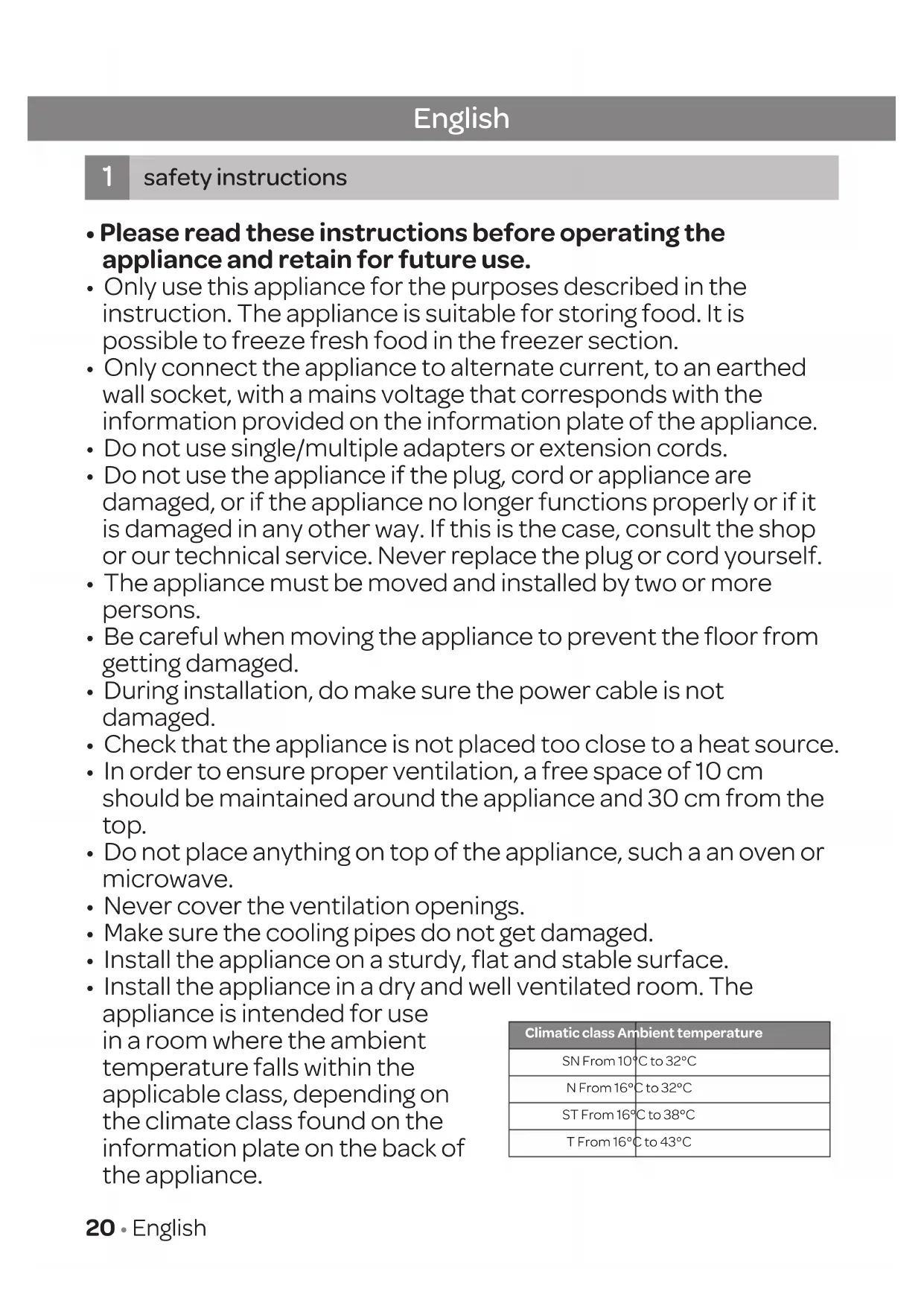
- Install the appliance in a dry and well ventilated room. The appliance is intended for use in a room where the ambient temperature falls within the applicable class, depending on the climate class found on the information plate on the back of the appliance. English safety instructions
20 • English Climatic class Ambient temperature SN From 10°C to 32°C N From 16°C to 32°C ST From 16°C to 38°C T From 16°C to 43°C 26-2-2020 14:10:56KV1431 instructions.indd 60 W• Do not store explosive or highly flammable substances in the appliance. The vapours could cause a fire hazard or an explosion.
- Do not store glass bottles or jars with liquids in the freezer, as they could break when frozen.
- Do not use mechanical, electrical or chemical agents to speed up the defrosting process.
- Make sure that children are unable to play with the appliance, such as hide in it. This is dangerous.
- Keep the appliance out of reach of children. Children do not see the dangers when handling electrical appliances. Therefore, never allow children to work with electrical appliances without supervision. Keep the appliance and cord out of reach of children younger than 8 years of age. Note: Children aged from 3 to 8 years are allowed to load and unload refrigerating appliances.
- The appliance can be used by children of 8 years and older and persons with a limited physical, sensory or mental capacity or lack of experience or knowledge, provided they use the appliance under supervision or have been instructed about its safe use and understand the hazards involved.
- The appliance may not be cleaned or maintained by children, unless this is done under supervision.
- Repairs to electrical appliances should only be performed by skilled persons. It is dangerous to perform a repair whereby the base unit of the appliance must be opened.
- Only use and store the appliance indoors.
- Never bend the power cord sharply or allow it to run across hot parts.
- Always remove the plug from the socket when the appliance must be cleaned or repaired.
- Never use the appliance with parts that are not recommended or supplied by the manufacturer.
- Do not pull the cord and/or appliance to remove the plug from the wall socket. Never touch the plug with wet or moist hands.
- Be careful with ice cubes and ice pops. If these are consumed directly out of the freezer, there is a risk of frostbite.
- Never submerge the appliance, cord or plug in water.
- The appliance cannot be used with a timer or separate remote control. English • 21 26-2-2020 14:10:56KV1431 instructions.indd 60 W• This appliance is only suitable for household use. If the appliance is not used as intended, no compensation can be claimed in case of defects or accidents and the warranty will be invalidated.
- If you decide not to use the appliance any more due to a defect, we recommend cutting off the cord after removing the plug from the wall socket. Household appliances are not normal waste. Take the appliance to the waste processing department concerned of your municipality. Refrigerant The refrigerant isobutene (R600a) is contained within the refrigerant circuit of the appliance, a natural gas with a high level of environmental compatibility, which is nevertheless flammable. During transportation and installation of the appliance, ensure that none of the components of the refrigerant circuit becomes damaged. The refrigerant (R600a) is flammable.
WARNING: Refrigerators contain refrigerant and gases in
the insulation. Refrigerant and gases must be disposed of professionally as they may cause eye injuries or ignition. Ensure that tubing of the refrigerant circuit is not damage prior to proper disposal.
WARNING: Risk of fire/ flammable materials
If the refrigerant circuit should be damaged: - Avoid open flames and sources of ignition. - Thoroughly ventilate the room in which the appliance is situated. It is dangerous to alter the specifications or modify this product in any way. Any damage to the cord may cause a shortcircuit, fire, and/or electric shock. 22 • English 26-2-2020 14:10:56KV1431 instructions.indd 60 Wappliance description
1. Freezer section with rack
2. Thermostat with internal lighting
6. Bottle compartment
7. Door compartments
Before using the appliance for the first time, you should proceed as follows: carefully unpack the appliance and remove all packaging material and any promotional stickers. Keep the packaging (plastic bags, polystyrene and cardboard) out of the reach of children. After unpacking the appliance, check it for external damage that may have occurred during transport. Place the appliance on a sturdy, flat surface and make sure there is enough space all around for sufficient ventilation. A minimum space of 10 cm is required between the appliance and the surrounding walls and keep 30 cm clear above the appliance. In this way the appliance is able to release heat properly, cool well and function in an energy efficient way. You can use the adjustable feet to level the appliance. Do not place the appliance near heat sources such as central heating or a stove. Do take note of the climate class of the appliance. When placed in a room that is too cold, the refrigerator will not function properly. After placing the appliance, leave it for at least 3 hours before inserting the plug in the socket. First clean the interior of the appliance. Use warm soapy water with, for instance, washing-up liquid, all-purpose cleaner or soda. Wipe the inside of the appliance after cleaning with clean water and properly wipe everything dry. Leave the appliance to dry for 1 to 2 hours.
The control unit of the appliance is located on the inside. Check that the thermostat is off in position 0. Check that the voltage corresponds with what is stated on the information plate and insert the plug in the socket. Adjusting the temperature By means of the thermostat you are able to change the temperature in the refrigerator. The possible positions of the thermostat: Switch off appliance – position 0 Maximum temperature – position 1 (least cold) Optimum temperature – positions 2-5 Minimum temperature – position 7 (coldest) Set the temperature with the thermostat and select a position between 1 and 7. We recommend setting the appliance to position 4. The appliance will now cool continuously until the set temperature has been reached. Allow the appliance to reach the required temperature with no food. Usually this will take 2 to 3 hours. After that, you can set the thermostat to the required position and fill the appliance with food. Only use highest position 7 for making ice cubes, or at the beginning when placing new frozen products in the freezer section. Internal temperature of the refrigerator Adjusting the temperature to the changing seasons is not recommended. The increase in ambient temperature is detected by the sensor and the compressor will automatically work longer to maintain the required internal temperature. Minor changes in temperature Minor changes in temperature are normal and can be caused by storing a large number of fresh products in the freezer, or by leaving the door open for a longer period of time. The food is not affected, and the temperature quickly returns to the normal value. Set the thermostat to position 0 to switch off the appliance. Attention: The ambient temperature, the frequency of opening the door and the position of the appliance have an effect on the temperature in the appliance. Take this into account when setting the thermostat.
- Do not place hot food in the appliance.
- You should never place hazardous, highly flammable or explosive substances such as alcohol, acetone or petrol in the appliance, because there will be a hazard of explosion.
- Carefully package meat and fish to prevent unpleasant smells.
- Leave sufficient space between the different foods, to allow the air to circulate properly.
- Do not place food against the rear wall of the appliance. The shelves have a stopper to prevent this.
- Do not leave the door open for longer than necessary. 24 • English tips
- High ambient temperatures have a negative effect on energy use. Keep the appliance in a position away from direct sunlight or other sources of heat.
- Keep ventilation openings free. Clogged openings lead to higher use of energy.
- Try not to open the door too often, especially when the weather is wet and hot. Once you open the door, mind to close it as soon as possible.
- The space between the shelves and the rear wall of the refrigerator compartment must be unobstructed to allow the cool air to circulate. Therefore don’t place any food items against the back.
- Turn the thermostat to a lower setting when the circumstances allow it.
- Before storing fresh cooked food, make sure the food has cooled at least to room temperature.
- Ice and frost layer increase energy consumption, so clean the appliance as soon as the layer is 3 to 5 mm thick.
- If the gasket is damaged or if it turns out that the sealing is poor, the energy consumption is substantially higher. To restore efficiency, replace the gasket.
- Always consider the instructions, otherwise the energyconsumption is substantially higher. 26-2-2020 14:10:56KV1431 instructions.indd 60 WEnglish • 25 To avoid contamination of food, please respect the following instructions - Opening the door for long periods can cause a significatn increase of the temperature in the compartments of the appliance. - Clean regularly surfaces that can come in contact with food and accessible drainage systems. - Store raw meat and fish in suitable containers in the refrigerator, so that it is not in contact with or drip onto other food. - Two-star frozen-food compartments are suitable for storing pre-frozen food, storing or making icecream and making ice cubes. - One-, two- and three-start compartments are not suitable for the freezing of fresh food. Order Compartments TYPE Target storage temp. [°C] Appropriate food 1 Fridge +2 ~ +8 Eggs, cooked food, packaged food, fruits and vegetables, dairy products, cakes, drinks and other foods are not suitable for freezing. 2 (***)*-Freezer ≤-18 Seafood (fish, shrimp, shellfish), freshwater aquatic products and meat products (recommended for 3 months, the longer the storage time, the worse the taste and nutrition), suitable for frozen fresh food. 3 ***-Freezer ≤-18 Seafood (fish, shrimp, shellfish), freshwater aquatic products and meat products (recommended for 3 months, the longer the storage time, the worse the taste and nutrition), suitable for frozen fresh food. 4 **-Freezer ≤-12 Seafood (fish, shrimp, shellfish), freshwater aquatic products and meat products (recommended for 3 months, the longer the storage time, the worse the taste and nutrition), suitable for frozen fresh food. 5 *-Freezer ≤-6 Seafood (fish, shrimp, shellfish), freshwater aquatic products and meat products (recommended for 3 months, the longer the storage time, the worse the taste and nutrition), suitable for frozen fresh food. 6 0-star -6 ~ 0 Fresh pork, beef, fish, chicken, some packaged processed foods, etc. (Recommended to eat within the same day, preferably no more than 3 days). Partially encapsulated processed foods (non-freezable foods). 7 Chill -2 ~ +3 Fresh/ frozen pork, beef, chicken, freshwater aquatic products, etc. (7 days below 0°C and above 0°C is recommended for consumption within that day, preferably no more than 2 days). Seafood (less than 0 for 15 days, it is not recommended to store above 0°C. 8 Fresh food 0 ~ +4 Fresh pork, beef, fish, chicken, cooked food, etc. (Recommended to eat within the same day, preferably no more than 3 days) 9 Wine +5 ~ +20 Red wine, white wine, sparkling wine, etc. Note: please store different foods according to the compartments or target storage temperature of your purchased products. - If the refrigerating appliance is left empty for long periods, switch off, defrost, clean, dry, and leave the door open to prevent mould developing within the appliance. Water dispenser cleaning (special for water dispenser products): - Clean water tanks if they have not been used for 48 h; flush the water system connected to a water supply if water has not been drawn for 5 days. WARNING -Food needs to be packed in bags before putting into the refrigerator, and liquids need to be packed in bottles or capped containers to avoid the problem that the product design structure is not easy to clean. 26-2-2020 14:10:56KV1431 instructions.indd 60 Wcleaning & maintenance
Before cleaning the appliance, switch it off by removing the plug from the socket. The cooler section of the refrigerator defrosts automatically. Defrost the appliance when the layer of ice in the freezer section has reached a thickness of 3 to 5 mm. Use this opportunity to clean the appliance. When there is white frost on the rear wall of the cooler section, it will defrost automatically. The defrost water runs downwards and is discharged via the defrost water drain. The opening of the defrost water drain can become clogged. Clean the opening by means of the skewer. For areas that are difficult to clean in the refrigerator, such as narrow gaps or corners, it is recommended to wipe them regularly with a soft rag, soft brush, etc. When necessary use some auxiliary tools, such as thin sticks (tooth picks), to ensure no contamination can accumulate in these areas. Clean the outside of the refrigerator and the door gasket with mild soap and water. Use a soft moist cloth. We recommend that you dust the back of the appliance and on the floor with a cloth or vacuum cleaner once a year in order to maintain a good output and low energy consumption. Do not use hard brushes, cleaning steel wire balls, wire brushes, abrasives, such as toothpastes, organic solvents (such as alcohol, acetone, oils, etc.), boiling water, acid or alkaline items to clean the refrigerator considering that this may damage the fridge surface and interior. Boiling water and benzene may deform or damage plastic parts.
DEFROSTING AND CLEANING THE REFRIGERATOR
- Switch off the thermostat [0] and remove the plug from the socket.
- Open the door and remove the products. Store the products on a cool location, packed in newspapers and blankets.
- Leave the door open, this will accelerate the defrosting process.
- Place a receptacle under the freezer section and wait for the ice to defrost. You can also place a dish with hot water (not boiling) in the freezer section. Remove loose ice using a plastic scraper. Warning Never remove ice with sharp objects, defrosting sprays, a hair dryer, a heater or something similar. This could lead to unsafe situations and cause irreparable damage to the appliance.
- Clean the interior of the appliance. Use warm soapy water with, for instance, washing-up liquid, all-purpose cleaner or soda in order to prevent nasty smells. Wipe the inside of the appliance after cleaning with clean water and properly wipe everything dry.
- Leave the appliance to dry for 1 to 2 hours. The shelves and drawers can be removed from the appliance easily and washed by hand. These components may never be cleaned in the dishwasher.
- Clean the outside of the appliance and the door rubbers with a soft damp cloth.
- Switch on the appliance in accordance with the user instruction. INSTRUCTIONS
- A large amount of ice on the freezer surfaces disrupts the operation of the appliance and increases the energy consumption.
- Defrost the appliance at least once or twice per year. When too much ice is formed, you must defrost the appliance more often.
- Place the frozen products in a large tray, wrapped in newspapers and a blanket and store them on a cool location.
- Defrosting the refrigerator should be done as quickly as possible. Storing the products at room temperature for a time period that is too long reduces their shelf life.
REPLACING THE LED LAMP
This appliance has been provided with a LED lamp. This lamp lasts for a longer period of time. When the LED lamp in the appliance is broken, you are not able to replace it yourself. Contact the Inventum service department. 26 • English 26-2-2020 14:10:56KV1431 instructions.indd 60 Wtroubleshooting
Breakdown Cause Solution The appliance no longer works There is an interruption in the power supply. - check that the plug is properly inserted in the socket - check that the power cable is not damaged - check that there is voltage on the socket by connecting a different appliance, such as a night lamp - check that the appliance is on by setting the thermostat higher than 0 The interior lighting does not work. The lamp is defective or the plug is not in the socket. Check the solutions above or have the lamp replaced. Temperature in the refrigerator is too high or too low Wrong setting of the thermostat. - turn the thermostat to a different position The ambient temperature is higher or lower than the temperature indicated in the table with technical data. The appliance is intended for operation in an ambient temperature indicated in the table with technical data supplied with the appliance. The appliance is located in direct sunlight or near a heat source. Change the location of the appliance according to the information in the instruction manual. A too large amount of hot food has been placed in the appliance at once. Wait 72 hours until the products are frozen. The temperature in the appliance will return to the required level. The ventilation at the rear of the appliance is hindered. Keep the appliance 10 cm away from the walls, for sufficient ventilation. The door of the refrigerator is opened too frequently or remains open for too long. Open the door less often and/or reduce the time that the door remains open. The door is not closed properly. Make sure the foods are placed in such a way that they do not hinder the door when it is being closed. The compressor does not work often enough. Check that the ambient temperature is not lower than the range of the climate class. The door rubber is loose. Fasten the door rubber or have it replaced. The appliance is working continuously. Wrong setting of the thermostat. - turn the thermostat to a higher position There is water in the lower section of the refrigerator. The opening of the defrost water drain is clogged. Clean the opening of the defrost water drain by means of the skewer. The ventilation within the cooler section is hindered. Check that the food does not make contact with the rear wall of the refrigerator. Unusual or loud noises The appliance is not level and stable. Level the appliance with the adjustable feet. The appliance is standing against something. Place the appliance in such a way that it is not standing against anything. During normal use of the cooling appliance, different types of noises can occur that do not have any effect on the correct operation of the freezer. Noises that can be easily remedied:
- Noise due to the fact that the appliance is not level – position the appliance using the front adjustable feet. If necessary, place soft material under the rear wheels, particular in case of a tiled floor.
- Friction against other furniture – move the appliance.
- Grinding of drawers or shelves – remove the shelf or drawer and then place it back.
- Noise of colliding bottles – place the bottles apart. Noises that can be heard during normal use of the appliance are caused by the operation of the thermostat, compressor (activation), cooling system (shrinkage and expansion of the material under the influence of temperature differences and flow of cooling liquid). English • 27 26-2-2020 14:10:56KV1431 instructions.indd 60 Wproduct fiche
Energy-efficiency class Annual energy consumption [Aec] 176 kWh Nett capacity - total 206 litres Nett capacity - cooling compartment 165 litres Nett capacity - freezer compartment **** 41 litres Max. storage time in case of power failure 12 hours
Climate class N/ST Noise level dB(A) 40 dB Type of appliance freestanding Execution Color Number of doors
Ice cube holder included
Number of glass shelves
Total amount of door compartments/ bottle racks
Number of crisper drawers
CFK/HFK free free Type of cooling agent R600a Number of compressors
Technical specifications Dimensions (wxdxh) in cm 55 x 54,2 x 143,4 Nett weight in kg 41 kg Gross weight in kg 44 kg Power consumption [W] 75 w Rated voltage [V] / frequency [Hz] 220-240V~ 50Hz Lenght of power cord [m] 1,7 Type of plug VDE plug 90° Note: On the rating label - which you can find on the left inside the appliance - you can also find the technical specifications. 28 • English 26-2-2020 14:10:56
Freezing capacity (kg/12 hour)
berecht door de bevoegde Nederlandse rechter. Nederlands • 51 26-2-2020 14:10:58KV1431 instructions.indd 60 WWe do not need to remind you of the importance of service. After all, we develop our products to a standard so that you can enjoy them for many years, without any concerns. If, nevertheless, there is a problem, we believe you are entitled to a solution straight away. Hence our products come with an exchange service, on top of the rights and claims you are entitled to by law. By exchanging a product or part, we save you time, effort and costs. 2-year full manufacturer’s warranty
1. Customers enjoy a 2-year full manufacturer’s warranty on all Inventum products. Within this period, a faulty product
or part will always be exchanged for a new model, free of charge. In order to claim under the 2-year full manufacturer’s warranty, you can either return the product to the shop you bought it from or contact the Inventum costumer service department via the form at www.inventum.eu/service-aanvraag.
2. The 2-year warranty period starts from the date the product is bought.
3. In order to claim under the warranty, you must produce a copy of the original receipt.
4. The warranty applies only to normal domestic use of Inventum products within the Netherlands.
5-year Inventum warranty
1. Inventum offers a 5-year warranty on most large domestic appliances and a selection of small domestic appliances.
This 5-year Inventum warranty consists of a 2-year full manufacturer’s warranty, extended by a further 3-year warranty. The only thing you need to do to qualify for the 3-year extended warranty is to register the product within 45 days of purchase. You can read more about registering the product in the following paragraph. 2. In accordance with the 5-year Inventum warranty provisions, a faulty product or part will always be exchanged for a new model during the first 2 years under the warranty. During the 3rd to 5th year under the warranty, you will only pay the costs of exchange. The current costs of exchange are listed at www.inventum.eu/omruilkosten. 3. In order to claim under the 5-year Inventum warranty, you can either return the product to the shop you bought it from or contact the Inventum costumer service department via the form at www.inventum.eu/service-aanvraag.
4. The 5-year warranty period starts from the date the product is bought.
5. In order to claim under the warranty, you must produce a copy of the original receipt.
6. The warranty applies only to normal domestic use of Inventum products within the Netherlands.
Product registration 1. The 3-year extended warranty is easy to obtain, free of charge, by registering the product within 45 days of purchase, via the website www.inventum.eu/garantie- registratie. If you did not register the product within 45 days of purchase, you can still do so up to 2 years after the purchase date. However, there will be a charge. The one-off registration charge is € 89 for each separate product. Registration is possible only for products that are subject to the 5-year Inventum warranty. Whether the product qualifies for the 5-year Inventum warranty is stated in the product user manual and in the product information sheet, on Inventum’s website.
2. The warranty period always starts from the date the product is bought. If the product is registered for the extended
warranty at a later date, the warranty period still starts from the original date of purchase. 3. The 3-year extended warranty can only be applied for if you are in the possession of a copy of the original receipt and the Inventum 5-year warranty certificate. Large domestic appliances 1. Breakdowns or faults in large domestic appliances (separate and built-in white goods) can be registered via the form at www.inventum.eu/service-aanvraag, by calling the Inventum costumer service department or in the store where you bought the device. The telephone number of the costumer service department can be found at www.inventum.eu.
2. In the event of breakdowns or faults in large domestic appliances, Inventum will have the option to have a service
engineer inspect the faulty device onsite at the customer in the Netherlands and to carry out repairs, there and then. The Inventum customer service department can also decide to have the device exchanged.
3. If you suffer a breakdown or fault in a large domestic appliance during the first 2 years from the date of purchase,
Inventum will not charge any costs for the exchange, call-out or for parts and labour.
4. If you registered the product as described before at www.inventum.eu/garantie-registratie and you subsequently report
a breakdown of a large domestic appliance in the 3rd to 5th year of the date of purchase, the 5-year Inventum warranty applies and the device will be repaired or exchanged, free of charge. In the event of a repair or exchange of the device, you only pay the costs of exchange. The current costs of exchange are listed at www.inventum.eu/omruilkosten. If you did not register the product, the 3-year extended warranty does not apply. 5. When reporting a breakdown or fault, a service engineer will contact the customer within 1 working day in order to make an appointment. When the report is made in a weekend or during a public holiday, this will be the next working day.
6. If you report a breakdown or fault via the form at www.inventum.eu/service-aanvraag, you will be kept informed of the
progress via mobile messages and e-mail.
7. The warranty period starts from the date the product is bought.
general terms and conditions of service and warranty 52 • English 26-2-2020 14:10:58KV1431 instructions.indd 60 W8. In order to claim under the warranty, you must produce a copy of the original receipt and the Inventum 5-year warranty certificate.
9. The warranty applies only to normal domestic use of Inventum products within the Netherlands.
Breakdowns or faults outside the warranty period 1. Breakdowns or faults in small or large domestic appliances outside the warranty period, can be reported to the costumer services department via the form at www.inventum.eu/service-aanvraag or by calling the costumer services department.
2. The costumer services department may ask you to send the product for inspection or repair. The costs of dispatch will
be at your expense. 3. The inspection to establish whether repair is possible involves a charge. You need to grant your permission for this, in advance. 4. In the event of a large domestic appliance, Inventum, at your request, can send out a service engineer. In that case, you will be charged the call-out costs, as well as parts and labour. 5. In the event of an instruction to repair, the repair costs must be paid in advance. In the event of a repair by a service engineer, the costs of the repair must be settled with the engineer onsite, preferably by means of PIN payment. Warranty exclusions
1. The following is excluded from the aforesaid warranties:
- normal wear and tear;
- failure to comply with the operating and maintenance instructions;
- unprofessional installation or repairs by third parties or the customer himself;
- non-original parts used by the customer;
- use for commercial or business purposes;
- removal of the serial number and/or rating label.
2. In addition, the warranty does not apply to normal consumer goods, such as:
- external connection cables;
- glass accessories and glass parts such as oven doors;
- and similar items. 3. Transport damage not caused by Inventum is also excluded. Therefore, inspect your new device before starting to use it. If you detect any damage, you must report this to the store where you purchased the product within 5 working days, or to the Inventum customer service department via the form at www.inventum.eu/service-aanvraag. If transport damage is not reported within this period, Inventum does not accept any liability in this respect. 4. The following are excluded from warranty and/or replacement: faults, loss of and damage to the device as a result of an event that is normally insured under the home contents insurance. Important to know 1. The replacement or repair of a faulty product, or a part thereof, does not lead to an extension of the original warranty period.
2. Parts that have been replaced, packaging material and exchanged devices are taken back by the service engineer and
become the property of Inventum.
3. If a complaint is unfounded, all costs arising from it will be at the customer’s expense.
4. Following expiry of the warranty period, all costs of repair or replacement, including administration costs, dispatch and call-out charges, will be charged to the customer.