ManualGo.com
Performance 463376519 - Barbecue CHAR-BROIL - Free user manual and instructions
Find the device manual for free Performance 463376519 CHAR-BROIL in PDF.



Download the instructions for your Barbecue in PDF format for free! Find your manual Performance 463376519 - CHAR-BROIL and take your electronic device back in hand. On this page are published all the documents necessary for the use of your device. Performance 463376519 by CHAR-BROIL.
USER MANUAL Performance 463376519 CHAR-BROIL
- This grill is designed for use with LP gas only.
- Adjustable wrench (not provided)• Screwdriver (not provided)• 7/16” Combination wrench (not provided) OUTILS REQUIS POUR L’ASSEMBLAGE:
- Clé réglable (non comprise)• Tournevis (non comprise)• Clé mixte de 7/16 po (non comprise) HERRAMIENTAS NECESARIAS PARA EL MONTAJE:
- Llave ajustable (no incluido)• Destornillador (no incluido)• 7 / 16” Combinación llave (no incluido)Pag e 2If during operation the flames go out (You smell gas or cannot see the flame)1. Turn the burner controls OFF2. Open lid.3. Wait 5 minutes and repeat the lighting procedure. If the burner goes out, gas will continue to flow out of the burner and could accidently ignite with risk of injury. DANGER DANGER: Indicates an imminently hazardous situation which, if not avoided, will result in death or serious injury.WARNING: Indicates a potentially hazardous situation which, if not avoided, could result in death or serious injury. CAUTION CAUTION: Indicates a potentially hazardous situation or unsafe practice which, if not avoided, may result in minor or moderate injury.SAFETY SYMBOLSThe symbols and boxes shown below explain what each heading means. Read and follow all of the messages found throughout the manual.
THIS GRILL IS FOR OUTDOOR USE
ONLY. INSTALLER/ASSEMBLER:Leave this manual with consumer.CONSUMER:Keep this manual for future reference.For residential use only. Do not use for commercial cooking. WARNING DANGER If you smell gas:1. Shut off gas to the appliance2. Extinguish any open flame.3. Open lid.4. If odor continues, keep away from the appliance and immediately call your gas supplier or your fire department. WARNING 1. Do not store or use gasoline or other flammable liquids or vapors in the vicinity of this or any other appliance.2. An LP cylinder not connected for use shall not be stored in the vicinity of this or any other appliance. CAUTION WARNING Do not attempt to repair or alter the hose/valve/regulator for any “assumed” defect. Any modification to this assembly will void your warranty and create the risk of a gas leak and fire. Use only authorized replacement parts supplied by manufacturer. DANGER WARNING Do not cover grates with aluminum foil or any other material. This will block burner ventilation and create a potentially dangerous condition resulting in property damage and/or personal injury.
- For Your Safety p. 2
- -4 Use and Care p. 4
- -10 Limited Warranty p. 11
- Parts Diagram p. 32
- Parts List p. 33
- Hardware List p. 36
- Assembly p. 37
- -49 Grilling Guide p. 50
- -53 Troubleshooting p. 62
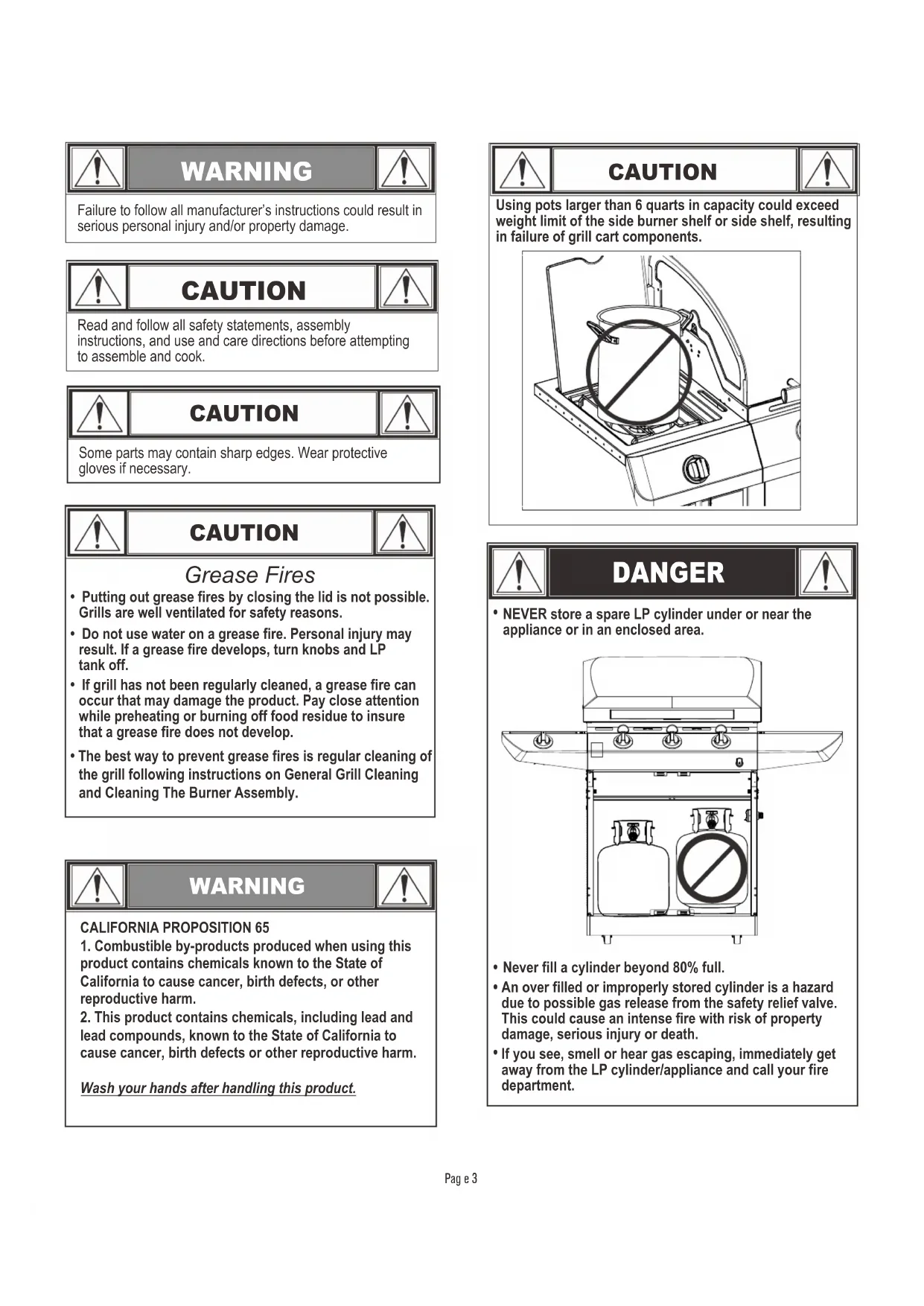
- -63 Registration Card Pag e 3Failure to follow all manufacturer’s instructions could result in serious personal injury and/or property damage. WARNING Read and follow all safety statements, assembly instructions, and use and care directions before attempting to assemble and cook. CAUTION CAUTION Some parts may contain sharp edges. Wear protective gloves if necessary. CAUTION Grease Fires p. 71
- Putting out grease fires by closing the lid is not possible. Grills are well ventilated for safety reasons. • Do not use water on a grease fire. Personal injury may result. If a grease fire develops, turn knobs and LP tank off. • If grill has not been regularly cleaned, a grease fire can occur that may damage the product. Pay close attention while preheating or burning off food residue to insure that a grease fire does not develop. • The best way to prevent grease fires is regular cleaning of the grill following instructions on General Grill Cleaning and Cleaning The Burner Assembly. CAUTION Using pots larger than 6 quarts in capacity could exceed weight limit of the side burner shelf or side shelf, resulting in failure of grill cart components. DANGER
NEVER store a spare LP cylinder under or near the appliance or in an enclosed area. Never fill a cylinder beyond 80% full.If you see, smell or hear gas escaping, immediately get away from the LP cylinder/appliance and call your fire department. An over filled or improperly stored cylinder is a hazard due to possible gas release from the safety relief valve. This could cause an intense fire with risk of property damage, serious injury or death.
WARNING CALIFORNIA PROPOSITION 651. Combustible by-products produced when using this product contains chemicals known to the State of California to cause cancer, birth defects, or other reproductive harm.2. This product contains chemicals, including lead and lead compounds, known to the State of California to cause cancer, birth defects or other reproductive harm.Wash your hands after handling this product.Pag e 4 Installation Safety Precautions
- Use grill, as purchased, only with LP (propane) gas and the regulator/valve assembly supplied. If your grill is Dual Fuel ready, a conversion kit must be purchased for use with natural gas.
- Grill installation must conform with local codes, or in their absence of local codes, with either the National Fuel Gas Code, ANSI Z223.1/ NFPA 54, Natural Gas and Propane Installation Code, CSA B149.1, or Propane Storage and Handling Code, B149.2.
- All electrical accessories (such as rotisserie) must be electrically grounded in accordance with local codes, or National Electrical Code, ANSI / NFPA 70 or Canadian Electrical Code, CSA C22.1. Keep any electrical cords and/or fuel supply hoses away from any hot surfaces.
- This grill is safety certified for use in the United States and/or Canada only. Do not modify for use in any other location. Modification will result in a safety hazard.
LP Cylinder Removal, Transport and Storage
- Turn OFF all control knobs and LP cylinder valve. Turn coupling nut counterclockwise by hand only - do not use tools to disconnect. Loosen cylinder screw beneath bottom shelf or disconnect other retention means, then lift LP cylinder up and and out of cart. Install safety cap onto LP cylinder valve. Always use cap and strap supplied with valve. Failure to use safety cap as directed may result in serious personal injury and/or property damage.
- A disconnected LP cylinder in storage or being transported must have a safety cap installed (as shown). Do not store an LP cylinder in enclosed spaces such as a carport, garage, porch, covered patio or other building. Never leave an LP cylinder inside a vehicle which may become overheated by the sun.
- Do not store an LP cylinder in an area where children play. LP Cylinder Valve Retainer Strap Safety Cap LP Cylinder
- The LP cylinder used with your grill must meet the following requirements:
- Use LP cylinders only with these required measurements: 12" (30.5cm) (diameter) x 18" (45.7 cm) (tall) with 20 lb. (9 kg.) capacity maximum.
- LP cylinders must be constructed and marked in accordance with specifications for LP cylinders of the U.S. Department of Transportation (DOT) or for Canada, CAN/CSA-B339, cylinders, spheres and tubes for transportation of dangerous goods, Transport Canada (TC). See LP cylinder collar for marking.
- LP cylinder valve must have:
- Type 1 outlet compatible with regulator or grill.
- Safety relief valve.
- UL listed Overfill Protection Device (OPD). This OPD safety feature is identified by a unique triangular hand wheel. Use only LP cylinders equipped with this type of valve. OPD Hand Wheel
- LP cylinder must be upright for vapor withdrawal and include collar to protect LP cylinder valve. Always keep LP cylinders in upright position during use, transit or storage. LP cylinder in upright position for vapor withdrawal LP (Liquefied Petroleum Gas)
- LP gas is nontoxic, odorless and colorless when produced. For Your Safety, LP gas has been given an odor (similar to rotten cabbage) so that it can be smelled.
- LP gas is highly flammable and may ignite unexpectedly when mixed with air. LP Cylinder Filling
- Use only licensed and experienced dealers.
- LP dealer must purge new cylinder before filling.
- Dealer should NEVER fill LP cylinder more than 80% of LP cylinder volume. Volume of propane in cylinder will vary by temperature.
- A frosty regulator indicates gas overfill. Immediately close LP cylinder valve and call local LP gas dealer for assistance.
- Do not release liquid propane (LP) gas into the atmosphere. This is a hazardous practice.
- To remove gas from LP cylinder, contact an LP dealer or call a local fire department for assistance. Check the telephone directory under “Gas Companies” for nearest certified LP dealers.Pag e 5 WARNING If “growing” bubbles appear, do not use or move the LP cylinder. Contact an LP gas supplier or your fire department! 2.Turn all control knobs to the OFF position.
Do not use a POL transport plug (plastic part with external threads)! It will defeat the safety feature of the valve. 6.Turn the coupling nut clockwise and tighten to a full stop. The regulator will seal on the back-check feature in the LP cylinder valve, resulting in some resistance. An additional one-half to three-quarters turn is required to complete the connection. Tighten by hand only – do not use tools. NOTE: If you cannot complete the connection, disconnect regulator and repeat steps 5 and 6. If you are still unable to complete the connection, do not use this regulator! DANGER
- Do not insert any tool or foreign object into the valve outlet or safety relief valve. You may damage the valve and cause a leak. Leaking propane may result in explosion, fire, severe personal injury, or death. LP Cylinder Exchange LP Cylinder Leak Test For your safety
- Many retailers that sell grills offer you the option of replacing your empty LP cylinder through an exchange service. Use only those reputable exchange companies that inspect, precision fill, test and certify their cylinders. Exchange your cylinder only for an OPD safety feature-equipped cylinder as described in the "LP Cylinder" section of this manual.
- Always keep new and exchanged LP cylinders in upright position during use, transit or storage.
- Leak test new and exchanged LP cylinders BEFORE connecting to grill.
- Place safety cap on cylinder valve outlet whenever the cylinder is not in use. Only install the type of safety cap on the cylinder valve outlet that is provided with the cylinder valve. Other types of caps or plugs may result in leakage of propane.
- Leak test must be repeated each time LP cylinder is exchanged or refilled.
- Do not smoke during leak test.
- Do not use an open flame to check for gas leaks.
- Grill must be leak tested outdoors in a well-ventilated area, away from ignition sources such as gas fired or electrical appliances. During leak test, keep grill away from open flames or sparks.
- Use a clean paintbrush and a 50/50 mild soap and water solution. Brush soapy solution onto areas indicated by arrows in figure below.
- Do not use household cleaning agents. Damage to gas train components can result. 5.Hold regulator and insert nipple into LP cylinder valve. Hand-tighten the coupling nut, holding regulator in a straight line with LP cylinder valve so as not to cross-thread the connection. 4.Remove the safety cap from LP cylinder valve. Always use cap and strap if supplied with valve. 3.Turn LP cylinder OFF by turning hand-wheel clockwise to a full stop. 1.LP cylinder must be properly secured onto grill. (Refer to assembly section.) Connecting Regulator to the LP Cylinder Straig
Hold coupling nut and regulator as shown for proper connection to LP cylinder valve. Coupling nut Nipple has to be centered into the LP cylinder valve. Safety Relief Valve OPD Hand Wheel Type 1 outlet with thread on outside Strap and CapPag e 6 Leak Testing Valves, Hose and Regulator 1.Turn all grill control knobs to OFF. 2.Be sure regulator is tightly connected to LP cylinder. 3.Completely open LP cylinder valve by turning hand wheel counterclockwise. If you hear a rushing sound, turn gas off immediately. There is a major leak at the connection. Correct before proceeding. 4.Brush soapy solution onto areas circled below, or other similar fittings on your grill. 5.If “growing” bubbles appear, there is a leak. Close LP cylinder valve immediately and retighten connections. If leaks cannot be stopped do not try to repair. Call for replacement parts. 6.Always close LP cylinder valve after performing leak test by turning hand wheel clockwise. NOTE: Sideburner shelf fascia and other parts not shown for clarity. NOTE: Your grill may NOT be equipped with a sideburner.
- Do not use grill until leak-tested.
- If a leak is detected at any time, STOP! Turn off gas at source and correct leak.
- If you cannot stop a gas leak by closing the LP cylinder valve leave area and call your fire department! WARNING
- Outdoor gas appliance is not intended to be installed in or on a boat.
- Outdoor gas appliance is not intended to be installed in or on an RV.
- Never attempt to attach this grill to the self-contained LP gas system of a camper trailer or motor home. WARNING Safety Tips
- Before opening LP cylinder valve, check the coupling nut for tightness.
- When grill is not in use, turn off all control knobs and LP cylinder valve.
- Never move grill while in operation or still hot.
- Some surfaces will be hot during use. Use long-handled barbecue utensils and oven mitts to avoid burns and splatters.
- Maximum load for sideburner and side shelf is 10 lbs.
- The grease tray or cup must be installed during use and emptied after each use. Do not remove grease tray or cup until grill has completely cooled.
- Clean grill often, preferably after each cookout. If a bristle brush is used to clean any of the grill cooking surfaces, ensure no loose bristles remain on cooking surfaces prior to grilling. It is not recommended to clean cooking surfaces while grill is hot.
- If you notice grease or other hot material dripping from grill onto valve, hose or regulator, turn off gas supply at once. Determine the cause, correct it, then clean and inspect valve, hose and regulator before continuing. Perform a leak test.
- Keep ventilation openings in cylinder enclosure (grill cart) free and clear of debris.
- Do not store objects or materials inside the grill cart enclosure that would block the flow of combustion air to the underside of either the control panel or the firebox bowl.
- The regulator may make a humming or whistling noise during operation. This will not affect safety or use of grill.
- If you have a grill problem see the "Troubleshooting” Section.
- If the regulator frosts, turn off grill and LP cylinder valve immediately. This indicates a problem with the cylinder and it should not be used on any product. Return to supplier! CHOKING HAZARD-Small parts. Not for children under 3 years. WARNING Battery a. Size of battery/ type/ designation: AAA b. Nominal Voltage: 1.5v c. Number of battery required: 1PC d. Battery included or not: Yes Non-rechargeable batteries are not to be recharged. Batteries are to be inserted with the correct polarity. Exhausted batteries are to be removed from the product. Do not dispose of the batteries in fire. Batteries may explode or leak.Pag e 7 Example of good rubber seal.Example of damaged rubber seal. WARNING
LP GAS CYLINDER RUBBER SEAL INSPECTION. Ÿ Inspect the LP gas cylinder valve rubber seal for cracks, wear or deterioration prior to each use. A damaged rubber seal can cause a gas leak, possibly resulting in an explosion, fire, or severe bodily harm. Ÿ It is recommended that you inspect the rubber seal each time the LP gas cylinder is connected to the appliance, each time it has been refilled, or if it has not been used for more than 60 days. Ÿ DO NOT use a LP gas cylinder with a damaged rubber seal. The rubber seal CANNOT be repaired or replaced. Purchase a new cylinder or exchange the cylinder. You should inspect the seal before accepting a new or exchanged cylinder. DO NOT insert tools or foreign objects into the cylinder valve opening as this could damage the rubber seal. Ÿ The leak check procedure outlined in the product guide/assembly manual MUST be followed each time the LP gas cylinder is connected to the appliance. Consult the product guide/assembly manual for the proper procedure and locations for leak checking. STOP!Pag e 8
5. Light adjacent burners in sequence by pushing knobs in and
turning to the HIGH position.
- Do not lean over grill while lighting.
1. Turn gas burner control valves to (off).
2. Open lid during lighting or re-lighting.
3. Turn ON gas at LP cylinder.
WARNING For Safe Use of Your Grill and to Avoid Serious Injury:
- Do not let children operate or play near grill.
- Keep grill area clear and free from materials that burn.
- Do not block holes in sides or back of grill.
- Check burner flames regularly.
- Do not use charcoal or ceramic briquets in a gas grill.
- Use grill only in well-ventilated space. NEVER use in enclosed space such as carport, garage, porch, covered patio, or under an overhead combustible structure of any kind.
- Do not cover grates with aluminum foil or any other material. This will block burner ventilation and create a potentially dangerous condition resulting in property damage and/or personal injury.
- Use grill at least 3 ft. from any wall or surface. Maintain 10 ft. clearance to objects that can catch fire or sources of ignition such as pilot lights on water heaters, live electrical appliances, etc.
- Apartment Dwellers: Check with management to learn the requirements and fire codes for using an LP gas grill in your apartment complex. If allowed, use outside on the ground floor with a three (3) foot clearance from walls or rails. Do not use on or under balconies.
- NEVER attempt to light or re-light burner with lid closed. A buildup of non-ignited gas inside a closed grill is hazardous.
- Never operate grill with LP cylinder out of correct position specified in assembly instructions.
- Always close LP cylinder valve and remove coupling nut before moving LP cylinder from specified operation position. 3 ft. 3 ft. Ignitor Lighting Match-Lighting If ignition does NOT occur in 5 seconds, turn the burner controls off, wait 5 minutes and repeat the lighting procedure. If the burner does not ignite with the valve open, gas will continue to flow out of the burner and could accidently ignite with risk of injury. Turn controls and gas source or tank OFF when not in use.
4. Place match into match holder (hanging from side panel of
grill). Light match; then light burner by placing match through the match light hole on side of grill. Immediately push in and turn burner knob to the HIGH position. Be sure burner lights and stays lit. CAUTION WARNING
- Do not lean over grill while lighting.
1. Turn gas burner control valves to (off).
2. Open lid during lighting or re-lighting.
3. Turn ON gas at LP cylinder.
4. To ignite, push and turn IGNITION BURNER knob to HIGH.
Immediately, push and hold ELECTRONIC IGNITOR button until the burner lights.
5. If ignition does NOT occur in 5 seconds, turn the burner
controls off , wait 5 minutes and repeat the lighting procedure.
6. To ignite remaining burners, push and turn knob to the HIGH
position starting with the burners closest to the IGNITION BURNER first.Pag e 9
- Before each use, check to see if hoses are cut or worn or kinked. Replace damaged hoses before using grill. Use only valve/hose/regulator specified by manufacturer. Hose Check
- Important: Make sure gas is off at LP cylinder before checking valves. Knobs lock in off position. To check valves, first push in knobs and release, knobs should spring back. If knobs do not spring back, replace valve assembly before using grill. Turn knobs to LOW position then turn back to off position. Valves should turn smoothly. Valve Check
- Turn gas off at LP cylinder. Press and hold electronic ignitor button. "Click" should be heard and spark seen each time in each collector box or between burner and electrode. See "Troubleshooting" if no click or spark. Ignitor Check
- Turn all knobs to the off position. Turn LP cylinder off by turning hand-wheel clockwise to a full stop. Turning Grill Off
- Remove cooking grates and heat tents. Light burners, rotate knobs from HIGH to LOW. You should see a smaller flame in LOW position than seen on HIGH. Perform burner flame check on side burner, also. Always check flame prior to each use. If only low flame is seen refer to "Sudden drop or low flame" in the Troubleshooting Section. HIGH LOW Burner Flame Check Sideburner Ignitor Lighting
- Do not lean over grill while lighting.
4. Turn sideburner knob to the HIGH position, push and hold
ELECTRONIC IGNITOR button.
5. If sideburner does NOT light within 5 seconds, turn knob
to off, wait 5 minutes, then repeat lighting procedure. Sideburner Match Lighting
4. Place lit match near burner. Immediately turn sideburner
knob to the HIGH position. Be sure burner lights and stays lit. NOTE: Your grill may NOT be equipped with a Sideburner! Storing Your Grill
- Clean cooking grates.
- Store in dry location.
- When LP cylinder is connected to grill, store outdoors in a well-ventilated space and out of reach of children.
- Cover grill if stored outdoors. Choose from a variety of grill covers offered by Char-Broil at charbroil.com.
- Store grill indoors ONLY if LP cylinder is turned off and disconnected, removed from grill and stored outdoors.
- When removing grill from storage, follow “Cleaning the Burner Assembly” instructions before starting grill.
2. Open lid during lighting or re-lighting.
- Do not lean over grill while lighting.
3. Turn ON gas at LP cylinder.
1. Turn gas burner control valves to (off).
2. Open lid during lighting or re-lighting.
3. Turn ON gas at LP cylinder.
1. Turn gas burner control valves to (off).
- Putting out grease fires by closing the lid is not possible. Grills are well ventilated for safety reasons.
- Do not use water on a grease fire. Personal injury may result. If a grease fire develops, turn knobs and LP cylinder off.
- Do not leave grill unattended while preheating or burning off food residue on HI. If grill has not been regularly cleaned, a grease fire can occur that may damage the product.Pag e 10 General Grill Cleaning
- Do not mistake brown or black accumulation of grease and smoke for paint. Interiors of gas grills are not painted at the factory (and should never be painted). Apply a strong solution of detergent and water or use a grill cleaner with scrub brush on insides of grill lid and bottom. Rinse and allow to completely air dry. Do not apply a caustic grill/oven cleaner to painted surfaces.
- Plastic parts: Wash with warm soapy water and wipe dry.
- Do not use citrisol, abrasive cleaners, degreasers or a concentrated grill cleaner on plastic parts. Damage to and failure of parts can result.
- Porcelain surfaces: Because of glass-like composition, most residue can be wiped away with baking soda/water solution or specially formulated cleaner. Use nonabrasive scouring powder for stubborn stains.
- Painted surfaces: Wash with mild detergent or nonabrasive cleaner and warm soapy water. Wipe dry with a soft nonabrasive cloth.
- Stainless steel surfaces: To maintain your grill’s high quality appearance, wash with mild detergent and warm soapy water and wipe dry with a soft cloth after each use. Baked-on grease deposits may require the use of an abrasive plastic cleaning pad. Use only in direction of brushed finish to avoid damage. Do not use abrasive pad on areas with graphics.
- Cooking surfaces: If a bristle brush is used to clean any of the grill cooking surfaces, ensure no loose bristles remain on cooking surfaces prior to grilling. It is NOT recommended to clean cooking surfaces while grill is hot. SPIDER ALERT! CAUTION INSIDE BURNER
If your grill is getting hard to light or the flame is weak, check and clean the venturis and burners. Spiders or small insects are known to create “flashback” problems by building nests and laying eggs in the grill’s venturi or burner, obstructing the flow of gas. The back- up gas can ignite behind the control panel. This flashback can damage your grill and cause injury. To prevent flashbacks and ensure good performance the burner and venturi tube assembly should be removed and cleaned when ever the grill has been idle for an extended period of time. Cleaning the Burner Assembly Follow these instructions to clean and/or replace parts of burner assembly or if you have trouble igniting grill.
1. Turn gas off at control knobs and LP cylinder.
2. Remove cooking grates and heat tents.
3. Remove carryover tubes and hardware securing burners.
4. Detach electrode from burner.
NOTE: Removal/Detachment method will depend on the burner configuration. See different configurations in illustrations below.
5. Carefully lift each burner up and away from valve openings.
We suggest three ways to clean the burner tubes. Use the one easiest for you. (A) Bend a stiff wire (a light weight coat hanger works well) into a small hook. Run the hook through each burner tube several times. (B) Use a narrow bottle brush with a flexible handle (do not use a brass wire brush). Run the brush through each burner tube several times. (C) Wear eye protection: Use an air hose to force air into the burner tube and out the burner ports. Check each port to make sure air comes out each hole.
6. Wire brush entire outer surface of burner to remove food
7. Clean any blocked ports with a stiff wire such as an open
8. Check burner for damage due to normal wear and corrosion,
some holes may become enlarged. If any large cracks or holes are found, replace burner. VERY IMPORTANT: Burner tubes must reengage valve openings. See illustrations at right. Correct burner-to- valve engagement
9. Attach electrode to burner.
10. Carefully replace burners.
11. Attach burners to brackets on firebox.
12. Reposition carryover tubes and attach to burners. Replace
heat tents and cooking grates.
13. Before cooking again on grill, perform a “Leak Test” and
“Burner Flame Check”. Your burner might be different ElectrodePry off electrode with a flate blade screwdriverElectrodeFireboxCarryover tubeCarryover tubeFirebox Burner SupportRemove screwsFireboxFirebox Burner SupportPag e 11 This warranty only applies to units purchased from an authorized retailer. Manufacturer warrants to the original consumer-purchaser only that this product shall be free from defects in workmanship and materials after correct assembly and under normal and reasonable home use for the periods indicated below beginning on the date of purchase*. The manufacturer reserves the right to require that defective parts be returned, postage and or freight pre-paid by the consumer for review and examination. *Note: A dated sales receipt WILL be required for warranty service. The original consumer-purchaser will be responsible for all shipping charges for parts replaced under the terms of this limited warranty. This limited warranty is applicable in the United States and Canada only, is only available to the original owner of the product and is not transferable. Manufacturer requires proof of your date of purchase. Therefore, you should retain your sales slip or invoice. Registering your product is not a substitute for proof of purchase and the manufacturer is not responsible for or required to retain proof of purchase records. This limited warranty applies to the functionality of the product ONLY and does not cover cosmetic issues such as scratches, dents, corrosions or discoloring by heat, abrasive and chemical cleaners or any tools used in the assembly or installation of the appliance, surface rust, or the discoloration of stainless steel surfaces. Paint is not warranted and will require touch up. RUST is not considered a manufacturing or materials defect. This limited warranty will not reimburse you for the cost of any inconvenience, food, personal injury or property damage. ITEMS MANUFACTURER WILL NOT PAY FOR:
1. Shipping cost, standard or expedited, for warranty and replacement parts
2. Service calls to your home.
3. Repairs when your product is used for other than normal, single-family household or residential use.
acts of God, improper installation or maintenance, installation not in accordance with electrical or plumbing codes, or use of products not approved by the manufacturer.
5. Any food loss due to product failures or operating difficulties.
6. Replacement parts or repair labor costs for units operated outside the United States or Canada.
7. Pickup and delivery of your product.
8. Repairs to parts or systems resulting from unauthorized modifications made to the product.
9. The removal and/or reinstallation of your product.
DISCLAIMER OF IMPLIED WARRANTIES and LIMITATION OF REMEDIES Repair or replacement of defective parts is your exclusive remedy under the terms of this limited warranty. In the event of parts availability issues, Manufacturer will not be responsible for any consequential or incidental damages arising from the breach of either this limited warranty or any applicable implied warranty, or for failure or damage resulting from acts of God, improper care and maintenance, grease fire, accident, alteration, replacement of parts by anyone other than Manufacturer, misuse, transportation, commercial use, abuse, hostile environments (inclement weather, acts of nature, animal tampering), improper installation or installation not in accordance with local codes or printed manufacturer instructions. THIS LIMITED WARRANTY IS THE SOLE EXPRESS WARRANTY GIVEN BY THE MANUFACTURER. NO PRODUCT PERFORMANCE SPECIFICATION OR DESCRIPTION WHEREVER APPEARING IS WARRANTED BY MANUFACTURER EXCEPT TO THE EXTENT SET FORTH IN THIS LIMITED WARRANTY. ANY IMPLIED WARRANTY PROTECTION ARISING UNDER THE LAWS OF ANY STATE, INCLUDING IMPLIED WARRANTY OF MERCHANTABILITY OR FITNESS FOR A PARTICULAR PURPOSE OR USE, IS HEREBY LIMITED IN DURATION TO THE DURATION OF THIS LIMITED WARRANTY. Neither dealers nor the retail establishment selling this product has any authority to make any additional warranties or to promise remedies in addition to or inconsistent with those stated above. Manufacturer's maximum liability, in any event, shall not exceed the purchase price of the product paid by the original consumer. NOTE: Some states do not allow an exclusion or limitation of incidental or consequential damages, so some of the above limitations or exclusions may not apply to you. This limited warranty gives you specific legal rights as set foth herein. You may also have other rights which vary from state to state. In the state of California only, if refinishing or replacement of the product is not commercially practicable, the retailer selling this product or the Manufacturer will refund the purchase price paid for the product, less the amount directly attributable to use by the original consumer-purchaser prior to discovery of the nonconformity. In addition, in the state of California only, you may take the product to the retail establishment selling this product in order to obtain performance under this limited warranty. If you wish to obtain performance of any obligation under this limited warranty, you should write to: Consumer Relations P. O. Box 1240 Columbus, GA 31902-1240 Consumer returns will not be accepted unless a valid Return Authorization is first acquired. Authorized returns are clearly marked on the outside of the package with an RA number and the package is shipped freight/postage pre-paid. Consumer returns that do not meet these standards will be refused. LIMITED WARRANTY 4. Damage, failures, or operating difficulties resulting from accident, alteration, careless handling, misuse, abuse, fire, flood, the manufacturer reserves the right to substitute like or similar parts that are equally functional. SCOPE OF COVERAGE PERIOD OF COVERAGE TYPE OF FAILURE COVERAGE PERFORATION, MANUFACTURING,
NOTE: Some grill parts shown in the assembly steps may differ slightly in appearance from those on your particular grill model. However, the method of assembly remains the same.ASSEMBLY / ASSEMBLAGE / ASAMBLEA CHARBROIL.COM Page 34
17 4 BUTOIR DU COUVERCLE, AVEC TROU
2ND 3RD 4TH 1ST #24 #27
Cylinder valve must face to front of cart once tank is attached. Failure to install cylinder correctly may allow gas hose to be damaged in operation, resulting in the risk of fire. Le robinet du réservoir doit être orienté vers le devant du chariot une fois le réservoir fixé en position. Une mauvaise installation du reservoir pourrait endommager le tuyau à gaz, créant un risque d'incendie. Una vez que el tanque haya quedado instalado, la válvula del tanque debe quedar orientada hacia la parte delantera del carrito. Si no se instala correctamente el tanque, se puede dañar la manguera de gas durante el suministro, lo que puede ocasionar el riesgo de incendio. !Pag e 50 First Time Use Read your Assembly Manual and ensure the grill is put together properly. Remove all Point-of-Purchase advertising material from all grill surfaces before first use. We recommend operating your grill on its highest setting for 15-20 minutes prior to your first use. This aids in removing the oils used during manufacturing. Lava Rock / Briquettes This gas grill has been designed, engineered, and tested to be used with heat tents to provide more even heating, improve the cleaning process, and reduce flare-ups. The addition of after market lava rocks, charcoal, or briquettes of any type will cause poor combustion and increase the likelihood of a grease fire, and is not recommended. Using briquettes, lava rock, or charcoal in this grill will void your warranty. For extra smoke flavor, we recommend using a smoker box with wood chips. Temperature The temperature gauge in the hood of your new grill is calibrated to give a close indication of the grate temperature. Note: Since 1995, all regulators (the part that attaches to the gas tank to regulate the flow of gas) have included a safety feature that restricts gas flow in the event of a gas leak. You can inadvertently activate this safety feature without having a gas leak. This typically occurs when you turn on the gas using the grill control knob before you turn on the LP tank valve. If the gas regulator safety feature activates, the grill will only reach temperatures between 250°F and 300°F even with all burners on the high setting. Regulator Coupling Nut If your grill is not getting hotter than 250°F to 300°F these steps should be taken first to reset the gas regulator safety device:
1. Open the grill lid.
2. Turn off all knobs on the control panel in front.
3. Turn off the tank knob.
4. Disconnect the regulator from the LP tank.
6. Reconnect the regulator to the LP tank.
7. Slowly open the LP tank knob all the way. Do not put
excessive force on the valve at the full open position to avoid damaging the valve.
8. Turn on the appropriate control knob and light the grill per the
instructions. An illustration of this process is included in this Product Guide. See Troubleshooting section for additional information. GRILLING GUIDE – Getting Started Pre-Heating Your Grill Just like your home oven, your grill should be pre-heated to provide optimum performance. Pre-heat the grill on high for 10- 15 minutes – longer if weather conditions require. Please refer to the lighting instructions inside the Product Guide if you have questions about how to light your grill. A match-light chain and hole is provided for your convenience. Outdoor grilling is really quite simple. You'll succeed with burgers, dogs, or steaks usually on your very first try. With experience, you will learn how to work with your grill, creating more imaginative meals all the time. This knowledge makes up the art of grilling. Before you start grilling, organize your food according to cooking technique and required cooking time, and optimize the use of your grilling area. Direct Cooking Direct cooking involves grilling your meat directly over high heat. It is perfect for searing steaks, chops, and other smaller pieces of meat and vegetables that quickly make their way to the table.Pag e 51 Rotisserie Cooking Rotisserie cooking is best for 'round' meat, such as large roasts, whole poultry, and pork. It generally requires an accessory motor and spit rod that allows the meat to be turned at a constant speed. Rotisserie cooking is best done in front of a special rotisserie burner, or utilizing an indirect cooking burner arrangement. A pan can be placed underneath the meat to catch grease and food drippings, and helps minimize clean-up. Indirect Cooking Indirect cooking utilizes select burners to circulate heat throughout the grill, without direct contact between the meat and the flame. The meat is placed over the burner that is 'off'. This method is generally used to slow cook large cuts of meat and poultry. A pan can be placed underneath the meat to catch grease and food drippings, and helps minimize clean-up. Food Safety Food safety is a very important part of enjoying the outdoor cooking experience. To keep food safe from harmful bacteria, follow these four basic steps: Clean: Wash hands, utensils, and surfaces with hot soapy water before and after handling raw meat. Separate: Separate raw meats from ready-to-eat foods to avoid cross contamination. Use a clean platter and utensils when removing cooked foods. Cook: Cook meat and poultry thoroughly to kill bacteria. Use a thermometer to ensure proper internal food temperatures. Chill: Refrigerate prepared foods and leftovers promptly. Cooking on your new grill is a hands-on experience, and it is recommended to remain outside with your grill while cooking. Grilling can be affected by many external conditions. In cold weather, you will need more heat to reach an ideal cooking temperature, and grilling may take longer. The meat's internal temperature and thickness can also affect cooking times. Cold and thicker meats will take longer to cook. Internal Meat Temperatures Meat cooked on a grill often browns very fast on the outside. Therefore, use a meat thermometer to ensure it has reached safe internal temperatures. Please refer to the USDA for complete, up-to-date information. Our internal temperature chart is based on USDA standards for meat doneness. Check it out at www.isitdoneyet.gov USDA Recommended Safe Minimum Internal Temperatures 145° F Fish (with a 3 minute rest time) 145° F Beef, Veal, Lamb, and Pork - Ground 160° F Egg Dishes 160° F Turkey, Chicken & Duck Whole, Pieces & Ground 165° F Beef, Veal, Lamb, Steak, Roasts, & Whole PorkPag e 52 Sauces Sauces containing sugars and fats can cause flare-ups, and your food may burn. In general, apply these sauces during the final 5 minutes of cooking. Keep in mind, use of excessive sauces or glazes will also require extra cleaning afterwards. Marinades and Rubs To enhance the flavor of grilled foods, a liquid marinade or dry rub can be used prior to cooking. Meat can be either soaked or injected with liquid marinade up to 24 hours prior to grilling. Dry rubs can be applied directly to the meat immediately before grilling. Wood Chips For extra smoke flavor when grilling, try adding wood chips. Place smoke box or pan on top of the cooking grate above the flame. Turn grill on high until the wood starts to smoke. Reduce heat to desired temperature for cooking, and place food on cooking grate as desired. Close lid to retain more smoke. Hardwood varieties that work particularly well with grilled foods include Alder, Apple, Cherry, Hickory, Mesquite, and Pecan. Skewers Metal skewers should be flat, with long handles. Round skewers allow food to roll when turned, so it may not cook as evenly. Use metal skewers when cooking meat kabobs. Wooden skewers should be soaked in water for an hour before use, and are best used for quick cooking foods such as vegetables and fruits. Utensils Use tongs or a spatula to handle the food instead of a fork, and don't turn the food too often. Piercing the food with a fork will release juices that you want in the meat, and may cause flare- ups. GRILLING GUIDE – Tips & TricksPag e 53 The Char-Broil® grill is equipped with Gear Trax™, which allow for the easy mounting of our unique line of Gear Trax accessories. Please visit charbroil.com for a complete list of Gear Trax accessories. *Available on most models.
- Clean cooking grates.
- Store grill in dry location.
- When LP cylinder is connected to grill, store outdoors in a well ventilated space and out of reach of children.
- Cover grill if stored outdoors. Choose from a variety of grill covers offered by Char-Broil at charbroil.com.
- Store grill indoors ONLY if LP cylinder is turned off, disconnected, and removed from grill. Never store LP cylinder indoors.
- Mechanical failure due to rusting or mishandling.
- Failure of cylinder valve from mishandling or mechanical failure.
- Fire in burner tube section of burner due to blockage.
- Too much grease buildup in burner area. GAS ISSUES:
- Trying to light wrong burner.
- Burner not engaged with control valve.
- Obstruction in burner.
- Coupling nut and LP cylinder valve not fully connected. ELECTRICAL ISSUES:
- Electrode cracked or broken; “sparks at crack.”
- Electrode tip not in proper position. (Does not apply to SUREFIRE.)
- Wire and/or electrode covered with cooking residue.
- Wires are loose or disconnected.
- Wires are shorting (sparking) between ignitor and electrode.
- Dead battery. Prevention/Solution Prevention/Solution
- Replace LP cylinder.
- Turn off LP cylinder valve. Return LP cylinder to gas supplier.
- Turn off control knobs and LP cylinder valve. Leave lid open to allow flames to die down. After fire is out and grill is cold, remove burner and inspect for spider nests or rust. See Natural Hazard and Cleaning the Burner Assembly pages.
- Turn off control knobs and LP cylinder valve. Leave lid open to allow flames to die down. After cooling, clean food particles and excess grease from inside firebox area, grease tray, and other surfaces.
- See instructions on control panel and in Use and Care section.
- Make sure valves are positioned inside of burner tubes.
- Ensure burner tubes are not obstructed with spider webs or other matter. See cleaning section of Use and Care.
- Make sure LP cylinder is not empty. If LP cylinder is not empty, refer to “Sudden drop in gas flow.”
- Turn the coupling nut approximately one-half to three-quarters additional turn until solid stop. Tighten by hand only - do not use tools.
- Replace electrode(s). Main Burners:
- Tip of electrode should be pointing toward gas port opening on burner. The distance should be 1/8” to 1/4”. Adjust if necessary. Sideburner:
- Tip of electrode should be pointing toward gas port opening on burner. the distance should be 1/8” to 3/16”. Adjust if necessary.
- Clean wire and/or electrode with rubbing alcohol and clean swab.
- Reconnect wires or replace electrode/wire assembly.
- Replace ignitor wire/electrode assembly.
- Replace with a new alkaline battery. Troubleshooting Burner(s) will not match light. ELECTRONIC IGNITION:
- No spark, no ignition noise.
- No spark, some ignition noise.
- Sparks, but not at electrode or at full strength.
- Match will not reach.
- Improper method of match-lighting.
- See Section I of Electronic Ignition System.
- See “Match-Lighting” section of Use and Care.
- Turn off gas at LP cylinder or at source on natural gas systems. Discontinue use of product and replace valve/hose/regulator. Once valve/hose/regulator replaced conduct complete leak check per manual.
- Improper installation, connection not tight, and/or failure of rubber seal in clyinder valve.
- Turn off LP cylinder valve. Remove regulator from cylinder and visually inspect rubber seal in cylinder valve for damage. If damage or cannot correct leak replace cylinder. See LP Cylinder Leak Test and Connecting Regulator to the LP Cylinder.Pag e 63 Troubleshooting (continued) Problem Sudden drop in gas flow or low flame. Flames blow out. Flare-up. Persistent grease fire. Flashback (fire in burner tube(s)). One burner does not light from other burner(s). Possible Cause
- Excess flow valve tripped.
- Vapor lock at coupling nut/LP cylinder connection.
- High or gusting winds.
- Excess flow valve tripped.
- Excessive fat in meat.
- Excessive cooking temperature.
- Grease trapped by food buildup around burner system.
- Burner and/or burner tubes are blocked.
- Grease buildup or food particles in end(s) of carryover tube(s). Prevention/Solution
- Check for gas in LP cylinder.
- Turn off knobs, wait 30 seconds and light grill. If flames are still low, turn off knobs and LP cylinder valve. Disconnect regulator. Reconnect regulator and leak-test. Turn on LP cylinder valve, wait 30 seconds and then light grill.
- Turn off knobs and LP cylinder valve. Disconnect coupling nut from cylinder. Reconnect and retry.
- Refer to “Sudden drop in gas flow” above.
- Clean burners and inside of grill/firebox.
- Trim fat from meat before grilling.
- Adjust (lower) temperature accordingly.
- Turn knobs to OFF. Turn gas off at LP cylinder. Leave lid in position and let fire burn out. After grill cools, remove and clean all parts.
- Turn knobs to OFF. Clean burner and/or burner tubes. See burner cleaning section of Use and Care.
- Clean carry-over tube(s) with wire brush. Troubleshooting - Electronic Ignition Problem (Ignition) SECTION I No sparks appear at any electrodes when Electronic Ignition Button is pressed; no noise can be heard from spark module. SECTION II SECTION III Sparks are present but not at all electrodes and/or not at full strength Possible Cause
- Battery not installed properly.
- Button assembly not installed properly.
- Faulty spark module.
- Output lead connections not connected.
- Output lead connections not connected.
- Arcing to grill away from burner(s).
- Electrodes cracked or broken “sparks at crack”. Check Procedure
- Check battery orientation.
- Has battery been used previously?
- Check to insure threads are properly engaged. Button should travel up and down without binding.
- If no sparks are generated with new battery and good wire connections, module is faulty.
- Are output connections on and tight?
- Are output connections on and tight?
- If possible, observe grill in dark location. Operate ignition system and look for arcing between output wires and grill frame.
- All sparks present but weak or at slow rate.
- Has moisture accumulated on electrode and/or in burner ports?
- Inspect electrodes for cracks. Prevention/Solution
- Install battery (make sure that “+” and “–” connectors are oriented correctly, with “+” on cap end.)
- Replace battery with new alkaline battery.
- Unscrew button cap assembly and reinstall, making sure threads are aligned and engaged fully.
- Replace spark module assembly.
- Remove and reconnect all output connections at module and electrodes.
- Remove and reconnect all output connections at module and electrodes.
- If sparks are observed other than from burner(s), wire insulation may be damaged. Replace wires.
- Replace battery with a new alkaline battery.
- Use paper towel to remove moisture.
- Replace cracked or broken electrodes. No sparks appear at any electrodes when Electronic Ignition Button is pressed; noise can be heard from spark module.
2018 Assembly instructions.