ManualGo.com
Architect KURS24RSBS - Fridge KITCHENAID - Free user manual and instructions
Find the device manual for free Architect KURS24RSBS KITCHENAID in PDF.



Frequently Asked Questions - Architect KURS24RSBS KITCHENAID
Download the instructions for your Fridge in PDF format for free! Find your manual Architect KURS24RSBS - KITCHENAID and take your electronic device back in hand. On this page are published all the documents necessary for the use of your device. Architect KURS24RSBS by KITCHENAID.
USER MANUAL Architect KURS24RSBS KITCHENAID
- Aux États-Unis p. 30
- Au Canada p. 30
- Accessoires p. 30
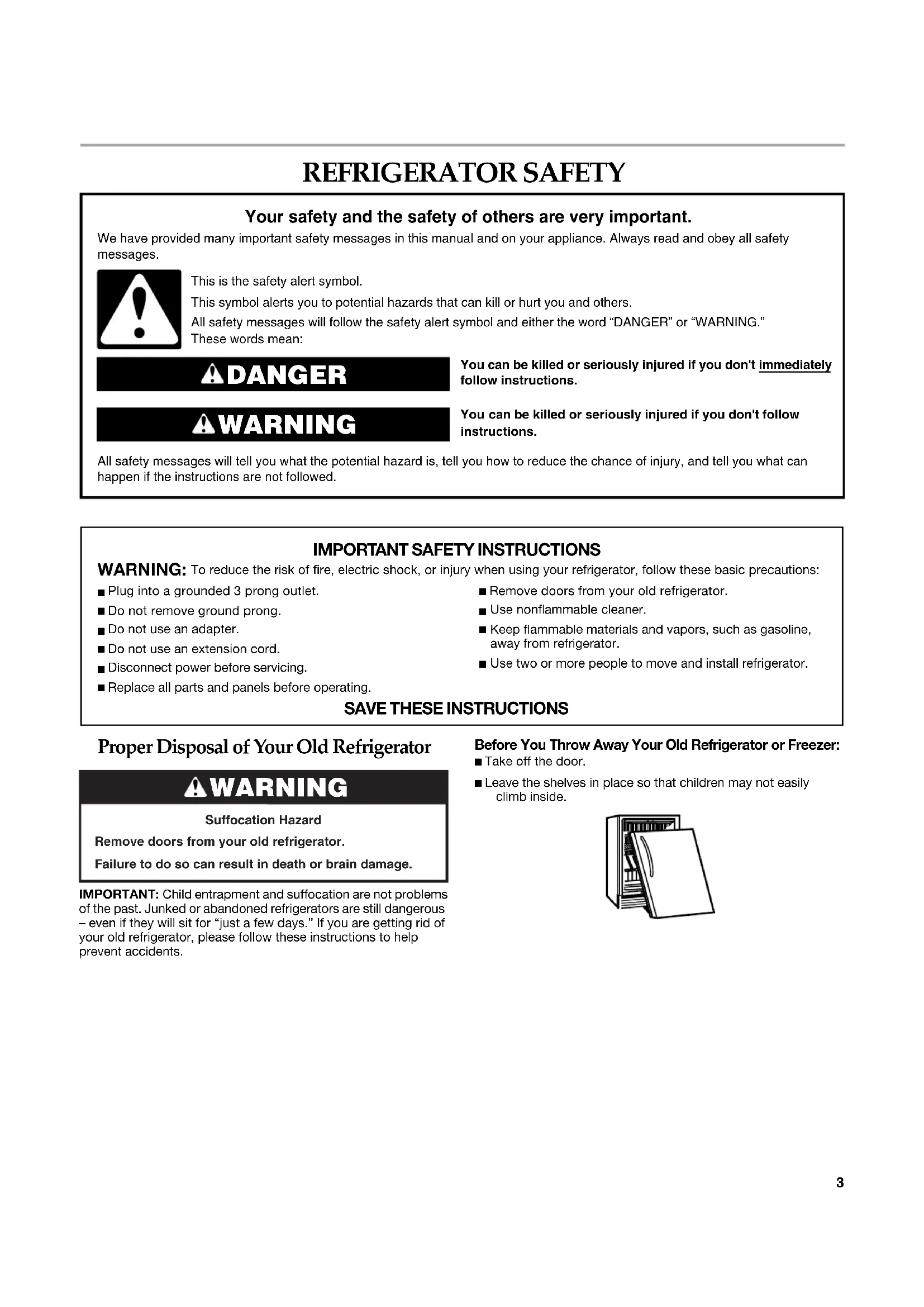
- GARANTIE REFRIGERATOR SAFETY Proper Disposal of Your Old Refrigerator IMPORTANT: Child entrapment and suffocation are not problems of the past. Junked or abandoned refrigerators are still dangerous – even if they will sit for “just a few days.” If you are getting rid of your old refrigerator, please follow these instructions to help prevent accidents.Before You Throw Away Your Old Refrigerator or Freezer:■ Take off the door.■ Leave the shelves in place so that children may not easily climb inside.You can be killed or seriously injured if you don't immediately You can be killed or seriously injured if you don'tfollow All safety messages will tell you what the potential hazard is, tell you how to reduce the chance of injury, and tell you what can happen if the instructions are not followed. Your safety and the safety of others are very important. We have provided many important safety messages in this manual and on your appliance. Always read and obey all safety messages.This is the safety alert symbol.This symbol alerts you to potential hazards that can kill or hurt you and others.All safety messages will follow the safety alert symbol and either the word “DANGER” or “WARNING.”These words mean:follow instructions.instructions. DANGER WARNING p. 313
To reduce the risk of fire, electric shock, or injury when using your refrigerator, follow these basic precautions:
SAVE THESE INSTRUCTIONS
Plug into a grounded 3 prong outlet. Do not remove ground prong. Do not use an adapter. Do not use an extension cord. Disconnect power before servicing. Replace all parts and panels before operating. Remove doors from your old refrigerator. Use nonflammable cleaner. Keep flammable materials and vapors, such as gasoline, away from refrigerator. Use two or more people to move and install refrigerator. WARNING Suffocation HazardRemove doors from your old refrigerator. Failure to do so can result in death or brain damage.4 INSTALLATION INSTRUCTIONS Tools and Parts TOOLS NEEDED: Gather the required tools and parts before starting installation. Location Requirements To ensure proper ventilation for your refrigerator, allow for a ¹/₄" (6.35 mm) space on each side and at the top. When installing your refrigerator next to a fixed wall, leave 2¹⁄₂" (6.35 cm) minimum clearance on the hinge side to allow for the door to swing open.NOTE: It is recommended that you do not install the refrigerator near an oven, radiator, or other heat source. Do not install in a location where the temperature will fall below 55°F (13°C). For best performance, do not install the refrigerator behind a cabinet door or block the base grille. Electrical Requirements Before you move your refrigerator into its final location, it is important to make sure you have the proper electrical connection. Recommended grounding method A 115 Volt, 60 Hz., AC only, 15– or 20–amp fused, grounded electrical supply is required. It is recommended that a separate circuit serving only your refrigerator be provided. Use an outlet that cannot be turned off by a switch. Do not use an extension cord.NOTE: Before performing any type of installation, cleaning, or removing a light bulb, unplug refrigerator or disconnect power. Unpack the Refrigerator Remove the Packaging ■ Remove tape and glue residue from surfaces before turning on the refrigerator. Rub a small amount of liquid dish soap over the adhesive with your fingers. Wipe with warm water and dry.■ Do not use sharp instruments, rubbing alcohol, flammable fluids, or abrasive cleaners to remove tape or glue. These products can damage the surface of your refrigerator. For more information, see “Refrigerator Safety.”■ Phillips screwdriver WARNING Explosion HazardKeep flammable materials and vapors, such as gasoline, away from refrigerator.Failure to do so can result in death, explosion, or fire. ¹⁄₄" (6.35 mm)2¹⁄₂" (6.35 cm)Electrical Shock HazardPlug into a grounded 3 prong outlet.Do not remove ground prong.Do not use an adapter.Do not use an extension cord.Failure to follow these instructions can result in death, fire, or electrical shock. WARNING WARNING Excessive Weight Hazard Use two or more people to move and install refrigerator. Failure to do so can result in back or other injury.5 ■ Dispose of/recycle all packaging materials. Clean Before Using After you remove all of the package materials, clean the inside of your refrigerator before using it. See the cleaning instructions in “Refrigerator Care.” Door Closing Door Closing Your refrigerator has four leveling legs. If your refrigerator seems unsteady or you want the door to close more easily, adjust the refrigerator’s tilt using the instructions below.1. Plug into a grounded 3 prong outlet.2. Move the refrigerator into its final location. 3. Turn the leveling legs to the right to lower the refrigerator or turn the leveling legs to the left to raise it. It may take several turns of the leveling legs to adjust the tilt of the refrigerator. NOTE: Having someone push against the top of the refrigerator takes some weight off the leveling legs. This makes it easier to adjust the leveling legs.4. Open the door and check to make sure that it closes as easily as you like. If not, tilt the refrigerator slightly more to the rear by turning both front leveling screws to the right. It may take several more turns, and you should turn both leveling legs the same amount. Base Grille Remove the Base Grille 1. Open the refrigerator door.2. Using a Phillips screwdriver, remove the two screws. Push both tabs in toward the center to release the base grille from the refrigerator.3. Remove the base grille. Replace the Base Grille 1. Open the refrigerator door.2. Position the base grille so that both tabs align and the base grille snaps into place. Replace the two screws. Tighten the screws. When Moving Your Refrigerator: Your refrigerator is heavy. When moving the refrigerator for cleaning or service, be sure to protect the floor. Always pull the refrigerator straight out when moving it. Do not wiggle or “walk” the refrigerator when trying to move it, as floor damage could occur. Important information to know about glass shelves and covers: Do not clean glass shelves or covers with warm water when they are cold. Shelves and covers may break if exposed to sudden temperature changes or impact, such as bumping. For your protection, tempered glass is designed to shatter into many small, pebble-size pieces. This is normal. Glass shelves and covers are heavy. Use special care when removing them to avoid impact from dropping. Electrical Shock HazardPlug into a grounded 3 prong outlet.Do not remove ground prong.Do not use an adapter.Do not use an extension cord.Failure to follow these instructions can result in death, fire, or electrical shock. WARNING A. TabsB. Screws WARNING Excessive Weight Hazard Use two or more people to move and install refrigerator. Failure to do so can result in back or other injury. BAA6 REFRIGERATOR USE Normal Sounds Your new refrigerator may make sounds that your old one didn’t make. Because the sounds are new to you, you might be concerned about them. Most of the new sounds are normal. Hard surfaces, such as the flooring and surrounding structures, can make the sounds seem louder. The following describes the kinds of sounds and what may be making them. ■ Your refrigerator is designed to run more efficiently to keep your food items at the desired temperatures and to minimize energy usage. The high efficiency compressor and fans may cause your refrigerator to run longer than your old one. You may also hear a pulsating or high-pitched sound from the compressor or fans adjusting to optimize performance. ■ Rattling noises may come from the flow of refrigerant or items stored inside the refrigerator. ■ As each cycle ends, you may hear a gurgling sound due to the refrigerant flowing in your refrigerator. ■ You may hear water running into the drain pan when the refrigerator is defrosting. ■ You may hear clicking sounds when the refrigerator starts or stops running. Using the Control For your convenience, your refrigerator control is preset at the factory. When you first install your refrigerator, make sure that the control is still preset to the mid-setting as shown. Adjusting Controls The mid-setting indicated in the previous section should be correct for normal usage. The control is set correctly when beverages are as cold as you like. If you need to adjust the temperature, wait at least 24 hours between adjustments and then recheck the temperature. To make the refrigerator colder, adjust the control to the next higher setting. To make the refrigerator less cold, adjust the control to the next lower setting. REFRIGERATOR FEATURES Split-level Shelf Your refrigerator has an adjustable split-level shelf for maximum storage capability. To Remove and Replace Shelf:
1. Remove the shelf by lifting it up and out of the shelf brackets.
2. Replace the shelf by inserting it into the shelf brackets.
NOTE: Be sure that the shelf is level. Lower Shelf To Remove and Replace Lower Shelf:
1. Remove the shelf by lifting it up and pulling it forward.
2. Replace the shelf by lowering it on the guides.
Important information to know about glass shelves and covers: Do not clean glass shelves or covers with warm water when they are cold. Shelves and covers may break if exposed to sudden temperature changes or impact, such as bumping. For your protection, tempered glass is designed to shatter into many small, pebble-size pieces. This is normal. Glass shelves and covers are heavy. Use special care when removing them to avoid impact from dropping.7 Wire Storage Bin To Remove and Replace Wire Storage Bin:
1. Remove the bin by pulling it forward.2. Replace the bin by sliding it back into place.
DOOR FEATURES Can Rack To Remove and Replace Can Rack: 1. Remove the can rack by tilting it forward and pulling it out.2. Replace the rack by placing the rear of the rack under the support on the door and sliding into place. Door Bin The door bin can be positioned either on the upper door or the lower door. To Reposition the Door Bin: 1. Remove the door bin by tilting it forward and pulling it out.2. Replace the bin by placing the rear of the bin under the support on the door and sliding into place. REFRIGERATOR CARE Cleaning Clean the refrigerator about once a month to avoid build-up of odors. Wipe up spills immediately. To clean your refrigerator: 1. Unplug refrigerator or disconnect power. 2. Remove all removable parts from inside, such as shelves, etc.3. Hand wash, rinse, and dry removable parts and interior surfaces thoroughly. Use a clean sponge or soft cloth and a mild detergent in warm water.■ Do not use abrasive or harsh cleaners such as window sprays, scouring cleansers, flammable fluids, cleaning waxes, concentrated detergents, bleaches or cleansers containing petroleum products on plastic parts, interior and door liners or gaskets. Do not use paper towels, scouring pads, or other harsh cleaning tools. These can scratch or damage materials. ■ To help remove odors, you can wash interior walls with a mixture of warm water and baking soda (2 tbs to 1 qt [26 g to 0.95 L] of water).4. Wash stainless steel and painted metal exteriors with a clean sponge or soft cloth and a mild detergent in warm water. Do not use abrasive or harsh cleaners, or cleaners containing chlorine. These can scratch or damage materials. Dry thoroughly with a soft cloth. For additional protection against damage to painted metal exteriors, apply appliance wax (or auto paste wax) with a clean, soft cloth. Do not wax plastic parts. NOTE: To keep your stainless steel refrigerator looking like new and to remove minor scuffs or marks, it is suggested that you use the manufacturer’s approved Stainless Steel Cleaner & Polish. To order the cleaner, see “Accessories.”IMPORTANT: This cleaner is for stainless steel parts only! Do not allow the Stainless Steel Cleaner & Polish to come into contact with any plastic parts such as the trim pieces, dispenser covers or door gaskets. If accidental contact does occur, clean plastic part with a sponge and mild detergent in warm water. Dry thoroughly with a soft cloth.5. Replace the removable parts. 6. Clean the condenser coils regularly. They are located behind the base grille. Coils may need to be cleaned as often as every other month. This may help save energy.■ Remove the base grille. See “Base Grille.”■ Use a vacuum cleaner with an extended attachment to clean the condenser coils when they are dusty or dirty. ■ Replace the base grille.7. Plug in refrigerator or reconnect power. WARNING Explosion Hazard Use nonflammable cleaner. Failure to do so can result in death, explosion, or fire.8 Changing the Light Bulb NOTE: Not all appliance bulbs will fit your refrigerator. Be sure to replace the bulb with one of the same size, shape, and wattage. To change the light bulb: 1. Unplug refrigerator or disconnect power.2. Using a Phillips screwdriver, remove the screw located at the back of the light shield. Pull the light shield back to remove the tabs from the appliance. Remove the light shield. 3. Replace the bulb.4. Reinstall the light shield by inserting the tabs. Align the holes and insert the screw. Tighten the screw.5. Plug in refrigerator or reconnect power. Vacation and Moving Care Vacations If you choose to leave the refrigerator on while you’re away, use up any perishables and freeze other items.If you choose to turn the refrigerator off before you leave, follow these steps.1. Remove all food from the refrigerator.2. Unplug the refrigerator. 3. Clean the refrigerator. See “Cleaning.”4. Tape a rubber or wood block to the top of the door to prop it open far enough for air to get in. This stops odor and mold from building up. Moving When you are moving your refrigerator to a new home, follow these steps to prepare it for the move.1. Remove all food from the refrigerator.2. Unplug the refrigerator.3. Clean, wipe, and dry it thoroughly.4. Take out all removable parts, wrap them well, and tape them together so they don’t shift and rattle during the move.5. Tape the doors shut and tape the power cord to the back of the refrigerator.When you get to your new home, put everything back and refer to the “Installation Instructions” section for preparation instructions. TROUBLESHOOTING Try the solutions suggested here first in order to avoid the cost of an unnecessary service call. Your refrigerator will not operate ■ Is the power supply cord unplugged? Plug into a grounded 3 prong outlet.■ Has a household fuse blown, or has a circuit breaker tripped? Replace the fuse or reset the circuit.■ Is the Refrigerator Control turned to the OFF position? See “Using the Control.” The lights do not work ■ Is the power supply cord unplugged? Plug into a grounded 3 prong outlet. ■ Is a light bulb loose in the socket or burned out? See “Changing the Light Bulb.”A. Light shieldB. Tabs C. Screw
Electrical Shock Hazard Plug into a grounded 3 prong outlet. Do not remove ground prong. Do not use an adapter. Do not use an extension cord. Failure to follow these instructions can result in death, fire, or electrical shock. WARNING9 The motor seems to run too much ■ Is the temperature outside hotter than normal? Expect the motor to run longer under warm conditions. At normal outdoor temperatures, expect your motor to run about 40% to 80% of the time. Under warmer conditions, expect it to run even more of the time. ■ Has a large amount of food just been added to the refrigerator? Adding a large amount of food warms the refrigerator. It is normal for the motor to run longer in order to cool the refrigerator back down. ■ Is the door opened often? Expect the motor to run longer when this occurs. In order to conserve energy, try to get everything you need out of the refrigerator at once, keep food organized so it is easy to find, and close the door as soon as the food is removed. ■ Is the control set correctly for the surrounding conditions? See “Using the Control.” ■ Is the door closed completely? Push the door firmly shut. If it will not shut all the way, see “The door will not close completely” later in this section. ■ Are the condenser coils dirty? This obstructs air transfer and makes the motor work harder. Clean the condenser coils. See “Cleaning.” Temperature is too warm ■ Is the door opened often? Be aware that the refrigerator will warm when this occurs. In order to keep the refrigerator cool, try to get everything you need out of the refrigerator at once, keep food organized so it is easy to find, and close the door as soon as the food is removed. ■ Has a large amount of food just been added to the refrigerator? Adding a large amount of food warms the refrigerator. It can take several hours for the refrigerator to return to the normal temperature. ■ Is the control set correctly for the surrounding conditions? See “Using the Control.” ■ Is the base grille blocked? For best performance, do not install the refrigerator behind a cabinet door or block the base grille. There is interior moisture buildup ■ Is the door opened often? To avoid humidity buildup, try to get everything you need out of the refrigerator at once, keep food organized so it is easy to find, and close the door as soon as the food is removed. When the door is opened, humidity from the room air enters the refrigerator. The more often the door is opened, the faster humidity builds up, especially when the room itself is very humid. ■ Is it humid? It is normal for moisture to build up inside the refrigerator when the air is humid. ■ Is the food packaged correctly? Check that all food is securely wrapped. Wipe off damp food containers before placing in the refrigerator. ■ Is the control set correctly for the surrounding conditions? See “Using the Control.” The door is difficult to open ■ Is the gasket dirty or sticky? Clean the gasket and the surface that it touches. Rub a thin coat of paraffin wax on the gasket following cleaning. The door will not close completely ■ Are food packages blocking the door open? Rearrange containers so that they fit more tightly and take up less space. ■ Are the shelves out of position? Put the shelves back into their correct positions. See “Refrigerator Use” for more information. ■ Is the gasket sticking? Clean the gasket and the surface that it touches. Rub a thin coat of paraffin wax on the gasket following cleaning. WARNING Explosion Hazard Use nonflammable cleaner. Failure to do so can result in death, explosion, or fire. WARNING Explosion Hazard Use nonflammable cleaner. Failure to do so can result in death, explosion, or fire.10
ASSISTANCE OR SERVICE
Before calling for assistance or service, please check “Troubleshooting.” It may save you the cost of a service call. If you still need help, follow the instructions below. When calling, please know the purchase date and the complete model and serial number of your appliance. This information will help us to better respond to your request. If you need replacement parts If you need to order replacement parts, we recommend that you only use factory specified replacement parts. Factory specified replacement parts will fit right and work right because they are made with the same precision used to build every new KITCHENAID
appliance. To locate factory specified replacement parts in your area, call us or your nearest designated service center. In the U.S.A. Call the KitchenAid Customer eXperience Center toll free: 1-800-422-1230. Our consultants provide assistance with: ■ Features and specifications on our full line of appliances. ■ Installation information. ■ Use and maintenance procedures. ■ Accessory and repair parts sales. ■ Specialized customer assistance (Spanish speaking, hearing impaired, limited vision, etc.). ■ Referrals to local dealers, repair parts distributors, and service companies. KitchenAid designated service technicians are trained to fulfill the product warranty and provide after-warranty service, anywhere in the United States. To locate the KitchenAid designated service company in your area, you can also look in your telephone directory Yellow Pages. For further assistance If you need further assistance, you can write to KitchenAid with any questions or concerns at: KitchenAid Brand Home Appliances Customer eXperience Center 553 Benson Road Benton Harbor, MI 49022-2692 Please include a daytime phone number in your correspondence. In Canada Call the KitchenAid Canada Customer Interaction Centre toll free: 1-800-807-6777. Our consultants provide assistance with: ■ Features and specifications on our full line of appliances. ■ Use and maintenance procedures. ■ Accessory and repair parts sales. ■ Referrals to local dealers, repair parts distributors, and services companies. KitchenAid Canada designated service technicians are trained to fulfill the product warranty and provide after-warranty service, anywhere in Canada. For further assistance If you need further assistance, you can write to KitchenAid Canada with any questions or concerns at: KitchenAid Canada Customer Interaction Centre 1901 Minnesota Court Mississauga, Ontario L5N 3A7 Please include a daytime phone number in your correspondence. Accessories To order accessories, call 1-800-442-9991 and ask for the appropriate part number listed below or contact your authorized KitchenAid dealer. In Canada, call 1-800-807-6777. Stainless Steel Cleaner & Polish Order Part #4396095 Can Rack Order Part #434475111 KITCHENAID
For one year from the date of purchase, when this major appliance is operated and maintained according to instructions attached to or furnished with the product, KitchenAid or KitchenAid Canada (hereafter “KitchenAid”) will pay for factory specified parts and repair labor to correct defects in materials or workmanship. Service must be provided by a KitchenAid designated service company. SECOND THROUGH FIFTH YEAR LIMITED WARRANTY ON CAVITY LINER AND
SEALED REFRIGERATION SYSTEM PARTS AS LISTED
In the second through fifth years from the date of purchase, when this refrigerator is operated and maintained according to instructions attached to or furnished with the product, KitchenAid will pay for replacement or repair of the refrigerator/freezer cavity liner (including labor costs) if the part cracks due to defective materials or workmanship. Also, in the second through fifth years from the date of purchase, KitchenAid will pay for factory specified parts and labor to correct defects in materials or workmanship in the sealed refrigeration system. These parts are: compressor, evaporator, condenser, dryer, and connecting tubing. Service must be provided by a KitchenAid designated service company.
ITEMS KITCHENAID WILL NOT PAY FOR
1. Service calls to correct the installation of your major appliance, to instruct you how to use your major appliance, to replace or repair house fuses or to correct house wiring or plumbing. 2. Service calls to repair or replace appliance light bulbs, air filters or water filters. Those consumable parts are excluded from warranty coverage.
3. Repairs when your major appliance is used for other than normal, single-family household use.
4. Damage resulting from accident, alteration, misuse, abuse, fire, flood, acts of God, improper installation, installation not in accordance with electrical or plumbing codes, or use of products not approved by KitchenAid.
5. Any food loss due to refrigerator or freezer product failures.
6. Replacement parts or repair labor costs for units operated outside the United States or Canada.
7. Pickup and delivery. This major appliance is designed to be repaired in the home.
8. Repairs to parts or systems resulting from unauthorized modifications made to the appliance.
9. Expenses for travel and transportation for product service in remote locations.
10. The removal and reinstallation of your appliance if it is installed in an inaccessible location or is not installed in accordance with published installation instructions. DISCLAIMER OF IMPLIED WARRANTIES; LIMITATION OF REMEDIES CUSTOMER'S SOLE AND EXCLUSIVE REMEDY UNDER THIS LIMITED WARRANTY SHALL BE PRODUCT REPAIR AS PROVIDED HEREIN. IMPLIED WARRANTIES, INCLUDING WARRANTIES OF MERCHANTABILITY OR FITNESS FOR A PARTICULAR PURPOSE, ARE LIMITED TO ONE YEAR OR THE SHORTEST PERIOD ALLOWED BY LAW. KITCHENAID SHALL NOT BE LIABLE FOR INCIDENTAL OR CONSEQUENTIAL DAMAGES. SOME STATES AND PROVINCES DO NOT ALLOW THE EXCLUSION OR LIMITATION OF INCIDENTAL OR CONSEQUENTIAL DAMAGES, OR LIMITATIONS ON THE DURATION OF IMPLIED WARRANTIES OF MERCHANTABILITY OR FITNESS, SO THESE EXCLUSIONS OR LIMITATIONS MAY NOT APPLY TO YOU. THIS WARRANTY GIVES YOU SPECIFIC LEGAL RIGHTS AND YOU MAY ALSO HAVE OTHER RIGHTS, WHICH VARY FROM STATE TO STATE OR PROVINCE TO PROVINCE. Outside the 50 United States and Canada, this warranty does not apply. Contact your authorized KitchenAid dealer to determine if another warranty applies. If you need service, first see the “Troubleshooting” section of the Use & Care Guide. After checking “Troubleshooting,” additional help can be found by checking the “Assistance or Service” section or by calling KitchenAid. In the U.S.A., call 1-800-422-1230. In Canada, call 1-800-807-6777. 1/06 Keep this book and your sales slip together for future reference. You must provide proof of purchase or installation date for in-warranty service. Write down the following information about your major appliance to better help you obtain assistance or service if you ever need it. You will need to know your complete model number and serial number. You can find this information on the model and serial number label located on the product. Dealer name____________________________________________________ Address ________________________________________________________ Phone number__________________________________________________ Model number __________________________________________________ Serial number __________________________________________________ Purchase date __________________________________________________12