 ManualGo.com
LE40B653T5WXXN - TV SAMSUNG - Free user manual and instructions
Find the device manual for free LE40B653T5WXXN SAMSUNG in PDF.



Download the instructions for your TV in PDF format for free! Find your manual LE40B653T5WXXN - SAMSUNG and take your electronic device back in hand. On this page are published all the documents necessary for the use of your device. LE40B653T5WXXN by SAMSUNG.
USER MANUAL LE40B653T5WXXN SAMSUNG
Although this TV set meets the latest DVB-T and DVB-C standards, as of [August, 2008], the compatibility with future DVB-T digital terrestrial and DVB-C digital cable broadcasts cannot be guaranteed.
Depending on the countries/areas where this TV set is used some cable-TV providers may charge an additional fee for such a service and you may be required to agree to terms and conditions of their business.
Some Digital TV functions might be unavailable in some countries or regions and DVB-C might not work correctly with some cable service providers.
For more information, please contact your local Samsung customer care centre. Precautions When Displaying a Still Image A still image may cause permanent damage to the TV screen Do not display still image and partially still on the LCD panel for more than 2 hours as it can cause screen image retention. This image retention is also known as screen burn. To avoid such image retention, reduce the degree of brightness and contrast of the screen when displaying a still image. Watching the LCD TV in 4:3 format for a long period of time may leave traces of borders displayed on the left, right and centre of the screen caused by the difference of light emission on the screen. Playing a DVD or a game console may cause a similar effect to the screen. Damages caused by the above effect are not covered by the Warranty. Displaying still images from Video games and PC for longer than a certain period of time may produce partial after-images. To prevent this effect, reduce the ‘brightness’ and ‘contrast’ when displaying still images. © 2009 Samsung Electronics Co., Ltd. All rights reserved.
ABOUT DIVX VIDEO: DivX® is a digital video format created by DivX,Inc. This is an official DivX Certified device that plays DivX video. Visit www.divx.com for more information and software tools to convert your files into DivX video. ABOUT DIVX VIDEO-ON-DEMAND: This DivX Certified® device must be registered in order to play DivX Video-on-Demand (VOD) content. To generate the registration code, locate the DivX VOD section in the device setup menu. Go to vod.divx.com with this code to complete the registration process and learn more about DivX VOD. License TruSurround HD, SRS and symbol are trademarks of SRS Labs, Inc. TruSurround HD technology is incorporated under license from SRS Labs, Inc. Manufactured under license from Dolby Laboratories. Dolby and the double-D symbol are trademarks of Dolby Laboratories. DivX® Certified to play DivX® video, including premium content.
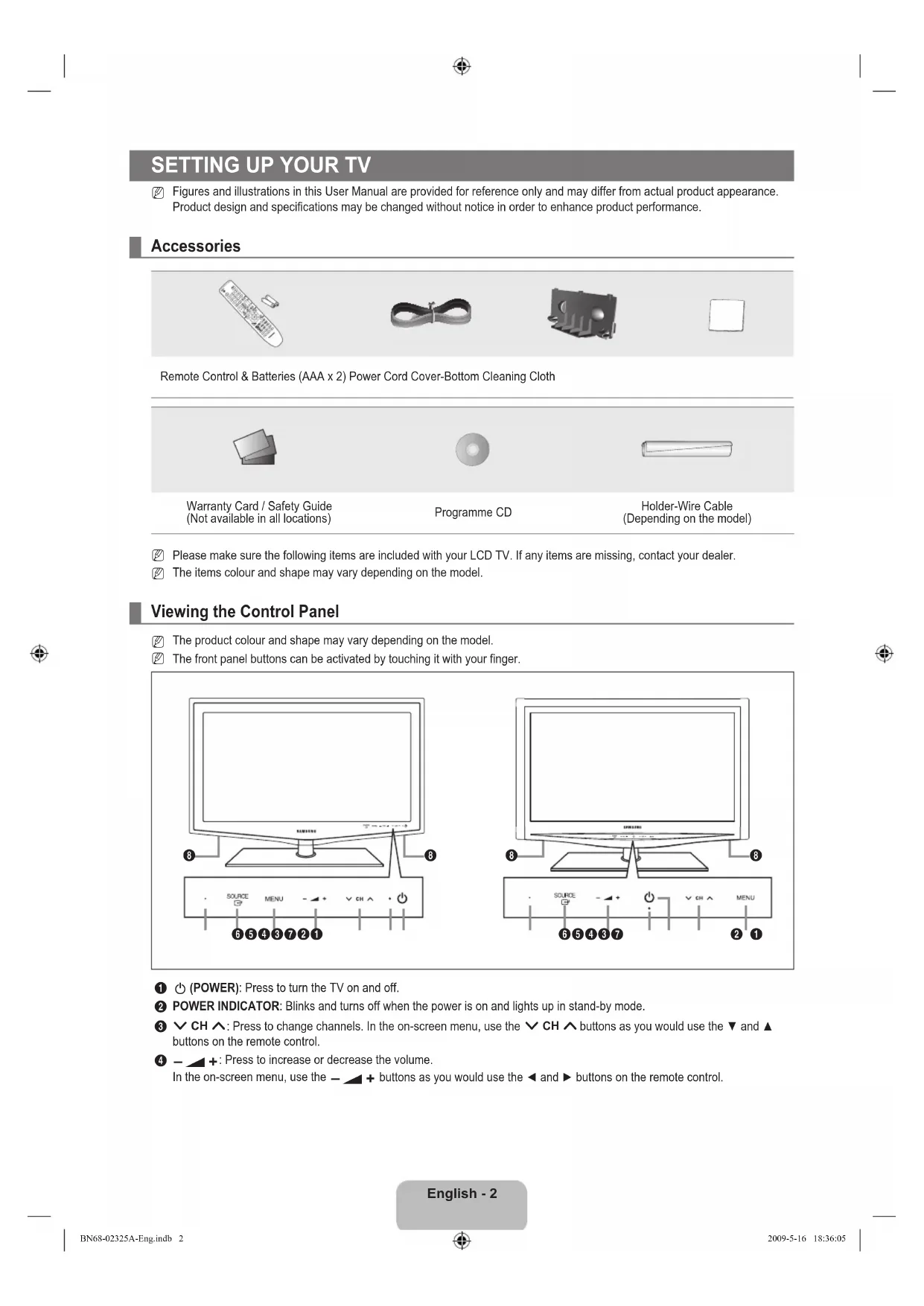
Figures and illustrations in this User Manual are provided for reference only and may differ from actual product appearance. Product design and specifications may be changed without notice in order to enhance product performance. Accessories Remote Control & Batteries (AAA x 2) Power Cord Cover-Bottom Cleaning Cloth Warranty Card / Safety Guide (Not available in all locations) Programme CD Holder-Wire Cable (Depending on the model) Please make sure the following items are included with your LCD TV. If any items are missing, contact your dealer. The items colour and shape may vary depending on the model. Viewing the Control Panel The product colour and shape may vary depending on the model. The front panel buttons can be activated by touching it with your finger.
(POWER): Press to turn the TV on and off.
POWER INDICATOR: Blinks and turns off when the power is on and lights up in stand-by mode.
: Press to change channels. In the on-screen menu, use the
buttons as you would use the ▼ and ▲ buttons on the remote control.
buttons as you would use the ◄ and ► buttons on the remote control.
MENU: Press to see an on-screen menu of your TV’s features.
: Toggles between all the available input sources. In the on-screen menu, use this button as you would use the ENTER
button on the remote control.
REMOTE CONTROL SENSOR: Aim the remote control towards this spot on the TV.
SPEAKERS Viewing the Connection Panel The product colour and shape may vary depending on the model. 1 COMPONENT IN Connects Component video / audio.
2 HDMI IN 1, 2, 3(DVI), 4 / DVI AUDIO IN
Connects to the HDMI jack of a device with an HDMI output. No sound connection is needed for an HDMI to HDMI connection. What is HDMI? HDMI (High-Definition Multimedia Interface), is an interface that enables the transmission of digital audio and video signals using a single cable. The difference between HDMI and DVI is that the HDMI device is smaller than DVI’s one. The TV may not output sound and pictures may be displayed with abnormal colour when DVD / Blu-ray player / Cable Box / Satellite receiver (Set-Top Box) supporting HDMI versions older than 1.3 are connected. When connecting an older HDMI cable and there is no sound, connect the HDMI cable to the HDMI IN 3(DVI) jack and the audio cables to the DVI AUDIO IN jacks on the back of the TV. If this happens, contact the company that provided the DVD / Blu-ray player / Cable Box / Satellite receiver (Set-Top Box) to confirm the HDMI version, then request an upgrade. Use the HDMI IN 3(DVI) jack for DVI connection to an external device. Use a DVI to HDMI cable or DVI-HDMI adapter (DVI to HDMI) for video connection and the DVI AUDIO IN jacks for audio. When using an HDMI / DVI cable connection, you must use the HDMI IN 3(DVI) jack. HDMI cables that are not 1.3 may cause annoying flicker or no screen display.
3 PC IN [PC] / [AUDIO]
Connects to the video and audio output jacks on your PC. If your PC supports an HDMI connection, you can connect this to the HDMI IN 1, 2, 3(DVI) or 4 terminal. If your PC supports a DVI connection, you can connect this to the HDMI IN 3(DVI) / DVI AUDIO IN terminal. 4 ANT IN Connects to an antenna or cable TV system.
[TV Side Panel] [TV Rear Panel] Power Input BN68-02325A-Eng.indb 3 2009-5-16 18:36:06English - 4 5 LAN Connect a LAN cable to this port to connect to the Network. 6 KENSINGTON LOCK (depending on the model) The Kensington Lock (optional) is a device used to physically fix the system when used in a public place. If you want to use a locking device, contact the dealer where you purchased the TV. The location of the Kensington Lock may be different depending on its model.
(HEADPHONE) Headphone may be connected to the headphone output on your set. While the head phone is connected, the sound from the built-in speakers will be disabled. Using the sound function is restricted when connecting headphones to the TV. Prolonged use of headphones at a high volume may damage your hearing. You will not hear sound from the speakers when you connect headphones to the TV. The headphone volume and TV volume are adjusted separately. 8 DIGITAL AUDIO OUT (OPTICAL) Connects to a Digital Audio component such as a Home theatre receiver. When a Digital Audio System is connected to the DIGITAL AUDIO OUT (OPTICAL) jack: Decrease the volume of the TV and adjust the volume level with the system’s volume control. 5.1CH audio is possible when the TV is connected to an external device supporting 5.1CH. When the receiver (home theatre) is set to On, you can hear sound output from the TV’s Optical jack. When the TV is displaying a DTV(air) signal, the TV will send out 5.1 channel sound to the Home theatre receiver. When the source is a digital component such as a DVD / Blu-ray player / Cable Box / Satellite receiver (Set-Top Box) and is connected to the TV via HDMI, only 2 channel sound will be heard from the Home Theatre receiver. If you want to hear 5.1 channel audio, connect the digital audio out jack on DVD / Blu-ray player / Cable Box / Satellite receiver (Set-Top Box) directly to an Amplifier or Home Theatre, not the TV. 9 SERVICE Connector for service only.
0 AUDIO OUT [R-AUDIO-L]
Connects to the audio input jacks on your Amplifier/Home theatre. When an audio amplifier is connected to the AUDIO OUT [R-AUDIO-L] jacks: Decrease the volume of the TV and adjust the volume level with the Amplifier’s volume control. ! EXT1, 2 Inputs or outputs for external devices, such as VCR, DVD, video game device or video disc players. In EXT Mode, DTV Out supports MPEG SD Video and Audio only. Input/Output Specification Connector Input Output Video Audio (L / R) RGB Video + Audio (L / R) EXT 1 O O O Only TV or DTV output is available. EXT 2 O O X Output you can choose.
@ AV IN [VIDEO] / [R-AUDIO-L]
Video and audio inputs for external devices, such as a camcorder or VCR.
Connector for software upgrades and Media Play, etc. You can connect to Samsung’s network wirelessly using the ‘Samsung Wireless LAN Adapter’ (Sold separately). For USB HDD, use the USB1 (HDD) port. $ COMMON INTERFACE Slot When not inserting ‘CI(CI+) CARD’ in some channels, ‘Scrambled Signal’ is displayed on the screen. The pairing information containing a telephone number, ‘CI(CI+) CARD’ ID, Host ID and other information will be displayed in about 2~3 minutes. If an error message is displayed, please contact your service provider. When the channel information configuration has finished, the message ‘Updating Completed’ is displayed, indicating that the channel list is now updated. You must obtain a ‘CI(CI+) CARD’ from a local cable service provider. Remove the ‘CI(CI+) CARD’ by carefully pulling it out with your hands since dropping the ‘CI(CI+) CARD’ may cause damage to it. Insert the ‘CI(CI+) CARD’ in the direction marked on it. The place of the COMMON INTERFACE Slot may be different depending on its model. ‘CI(CI+) CARD’ is not supported in some countries and regions, check with your authorized dealer. The CI+ function is only applicable to LE********P model. If you have some problems, please contact to service provider.
BN68-02325A-Eng.indb 4 2009-5-16 18:36:06English - 5 Viewing the Remote Control You can use the remote control up to a distance of about 23 feet from the TV. The performance of the remote control may be affected by bright light. The product colour and shape may vary depending on the model.
POWER: Turns the TV on and off.
TV: Selects the TV mode directly.
NUMERIC BUTTONS: Press to change the channel.
FAV.CH: Used to display Favourites Channel Lists on the screen.
SOURCE: Press to display and select the available video sources.
TOOLS: Use to quickly select frequently used functions.
INTERNET@: Press to use various internet services to view useful information and entertaining content.
CH LIST: Used to display Channel Lists on the screen.
Use these buttons in the Media Play and Anynet
: This remote can be used to control recording on Samsung recorders with the Anynet
light button toggles between on and off. When the remote control is on, and a button is pressed on the remote control, the remote control buttons will be lit for a moment. (Using the remote control with the ON/OFF
light button set to On will reduce the battery usage time.)
PRE-CH: Enables you to return to the previous channel you were watching.
: Press to temporarily cut off the sound.
: Press to change channels.
RETURN: Returns to the previous menu
CONTENT: This function enables you to view the Content Library.
MEDIA.P: Allows you to play music files, pictures, and movies.
AD: Audio Description selection. Teletext Functions
: Exit from the Teletext display
: Teletext mode selection (LIST / FLOF)
: Teletext size selection
Fastext topic selection
: Alternately select Teletext, Double or Mix.
: Teletext next page
: Teletext previous page
1. Lift the cover at the back of the remote control upward as shown in the figure.
2. Install two AAA size batteries.
Make sure to match the ‘+’ and ‘–’ ends of the batteries with the diagram inside the compartment.
3. Replace the cover.
Remove the batteries and store them in a cool, dry place if you won’t be using the remote control for a long time. If the remote control doesn’t work, check the following: Is the TV power on? Are the plus and minus ends of the batteries reversed? Are the batteries drained? Is there a power outage or is the power cord unplugged? Is there a special fluorescent light or neon sign nearby? OPERATION Viewing the menus Before using the TV, follow the steps below to learn how to navigate the menu in order to select and adjust different functions. How to operate the OSD (On Screen Display) The access step may differ depending on the selected menu.
1. Press the MENU button.
2. The main menu appears on the screen. The menu’s left side has icons : Picture, Sound,
Channel, Setup, Input, Application, Support.
3. Press the ▲ or ▼ button to select one of the icons.
adjustment OSD may differ depending on the selected menu.
button to complete the configuration. Press the EXIT button to exit.
Move Adjust Enter Return▲Backlight▼ Help icon BN68-02325A-Eng.indb 6 2009-5-16 18:36:07English - 7 Placing Your Television in Standby Mode Your set can be placed in standby mode in order to reduce the power consumption. The standby mode can be useful when you wish to interrupt viewing temporarily (during a meal, for example).
button on the remote control. The screen is turned off and a standby indicator appears on your set.
button again. Do not leave your set in standby mode for long periods of time (when you are away on holiday, for example). It is best to unplug the set from the mains and aerial. Plug & Play Feature When the TV is initially powered on, basic settings proceed automatically and subsequently.
1. Press the POWER button on the remote control.
You can also use the POWER
button on the TV. The message Select the OSD Language. is displayed.
button. Select the appropriate language by pressing the ▲ or ▼ button. Press the ENTER
button to confirm your choice.
button. We recommend setting the TV to Home Use mode for the best picture in your home environment. Store Demo mode is only intended for use in retail environments. If the unit is accidentally set to Store Demo mode and you want to return to Home Use (Standard): Press the volume button on the TV. When the volume OSD is displayed, press and hold the MENU button on the TV for 5 seconds.
button to confirm your choice.
6. Press the ▲ or ▼ button to select the channel source to memorize. Press the ENTER
button to select Start. When setting the antenna source to Cable, a step appears allowing you to set a value for the digital channel search. For more information, refer to Channel→AutoStore. Digital & Analogue: Digital and Analogue channels. / Digital: Digital channels. / Analogue: Analogue channels. The channel search will start and end automatically. Press the ENTER
button at any time to interrupt the memorization process. After all the available channels are stored, the message Set the Clock Mode. is displayed.
button. If you select Manual, Set current date and time is displayed. If you have received a digital signal, the time will be set automatically. If not, select Manual to set the clock. 8. The description for the connection method providing the best HD screen quality is displayed. Check the description and press the ENTER
button. See Product Guide: You are moved to the Product Guide where you can view the introduction to the main functions of your new HDTV. Watch TV: You can watch the memorized channels. If you want to reset this feature...
button again to select Plug & Play.
3. Enter your 4 digit PIN number. The default PIN number of a new TV set is ‘0-0-0-0’.
If you want to change PIN number, use the Change PIN function. The Plug & Play feature is only available in the TV mode.
Plug&Play ▶ MenuLanguage :English Time BroadcastSecurityNetworkGeneralSetupSelecttheOSDLanguage.MenuLanguage :English ▶ EnterPlug&Play BN68-02325A-Eng.indb 7 2009-5-16 18:36:07English - 8 Viewing the Display The display identifies the current channel and the status of certain audio-video settings. Press the INFO button to viewing the information. Press the INFO button on the remote control. The TV will display the channel, the type of sound, and the status of certain picture and sound settings. ▲, ▼: You can view other channel’s information. If you want to move to the currently selected channel, press ENTER
button. ◄, ►: You can view the desired program’s information at the current channel. Press the INFO button once more or wait approximately 10 seconds and the display disappears automatically. CHANNEL Channel Menu Country Analogue Channel You can change the country for analogue channels. Digital Channel You can change the country for digital channels. The PIN number input screen appears. Enter your 4 digit PIN number. Auto Store You can scan for the frequency ranges available to you (and availability depends on your country). Automatically allocated programme numbers may not correspond to actual or desired programme numbers. If a channel is locked using the Child Lock function, the PIN input window appears. Air / Cable Antenna source to memorize. Digital & Analogue: Digital and Analogue channels. Digital: Digital channels. Analogue: Analogue channels. When selecting Cable→Digital&Analogue or Cable→Digital: Provide a value to scan for cable channels. SearchMode→Full/Network/Quick Quick Network ID: Displays the network identification code. Frequency: Displays the frequency for the channel. (Differs in each country) Modulation: Displays available modulation values. Symbol Rate: Displays available symbol rates. Scans for all channels with active broadcast stations and stores them in the TV’s memory. If you want to stop Auto Store, press the ENTER
abc1 18:00 ~ 6:00 18:11 Thu 6 Jan Life On Venus Avenue Unclassified No Detaild Information E Watch ' Information BN68-02325A-Eng.indb 8 2009-5-16 18:36:07English - 9 Manual Store Scans for a channel manually and stores it in the TV’s memory. If a channel is locked using the Child Lock function, the PIN input window appears. Digital Channel Manual store for digital channels. Digital Channel is only available in DTV mode. Channel: Set the Channel number using the ▲, ▼ or number (0~9) buttons. Frequency: Set the frequency using the number buttons. Bandwidth: Set the bandwidth using the ▲, ▼ or number (0~9) buttons. When it has finished, channels are updated in the channel list. Analogue Channel Manual store for analogue channel. Programme (Programme number to be assigned to a channel): Sets the programme number using the ▲, ▼ or number (0~9) buttons. ColourSystem→Auto/PAL/SECAM/NTSC4.43: Sets the colour system value using the ▲ or ▼ button. SoundSystem→BG/DK/I/L: Sets the sound system value using the ▲ or ▼ button. Channel (When you know the number of the channel to be stored): Press the ▲ or ▼ button to select C (Air channel) or S (Cable channel). Press the ► button, then press the ▲, ▼ or number (0~9) buttons to select the required number. You can also select the channel number directly by pressing the number (0~9) buttons. If there is abnormal sound or no sound, reselect the sound standard required. Search (When you do not know the channel numbers): Press the ▲ or ▼ button to start the search. The tuner scans the frequency range until the first channel or the channel that you selected is received on the screen. Store (When you store the channel and associated programme number): Set to OK by pressing the ENTER
button. Channel mode P (Programme mode): When completing tuning, the broadcasting stations in your area have been assigned to position numbers from P00 to P99. You can select a channel by entering the position number in this mode. C (Air channel mode): You can select a channel by entering the assigned number to each air broadcasting station in this mode. S (Cable channel mode): You can select a channel by entering the assigned number for each cable channel in this mode. Cable Search Option (depending on the country) Sets additional search options such as the frequency and symbol rate for cable network searches. Freq.Start (Frequency Start): Set the start frequency (Differs in each country) Freq.Stop (Frequency Stop): Set the stop frequency (Differs in each country) Modulation: Displays available modulation values. Symbol Rate: Displays available symbol rates. Full Guide / Mini Guide The EPG (Electronic Programme Guide) information is provided by the broadcasters. Programme entries may appear blank or out of date as a result of the information broadcast on a given channel. The display will dynamically update as soon as new information becomes available. You can also display the guide menu simply by pressing the GUIDE button. (To configure the Default Guide, refer to the descriptions.) Full Guide Displays the programme information as time ordered One hour segments. Two hours of programme information is displayed which may be scrolled forwards or backwards in time. Mini Guide The information of each programme is displayed by each line on the current channel Mini Guide screen from the current programme onwards according to the programme starting time order.
BN68-02325A-Eng.indb 9 2009-5-16 18:36:07English - 10 DefaultGuide→FullGuide/MiniGuide You can decide whether to display either the Full Guide or the Mini Guide when the GUIDE button on the remote control is pressed. Channel List For detailed procedures on using the Channel List, refer to the Managing Channels instructions. You can select these options by simply pressing the CH LIST button on the remote control. Channel Mode When press the P
button, Channels will be switched within the selected channel list. Added Ch. Channels will be switched within the memorized channel list. Favourite Ch. Channels will be switched within the favourite channel list. Fine Tune If the reception is clear, you do not have to fine tune the channel, as this is done automatically during the search and store operation. If the signal is weak or distorted, you may have to fine tune the channel manually. Fine tuned channels that have been saved are marked with an asterisk ‘*’ on the right-hand side of the channel number in the channel banner. To reset the fine-tuning, select Reset by pressing the ▲ or ▼ button and then press the ENTER
button. Only Analogue TV channels can be fine tuned. Using the Full / Mini Guide To... Then... Watch a programme in the EPG list Select a programme by pressing the ▲, ▼, ◄, ► button. Exit the guide Press the blue button. If the next programme is selected, it is scheduled with the clock icon displayed. If the ENTER
button is pressed again, press the ◄, ► button to select Cancel Schedules, the scheduling is cancelled with the clock icon gone. View programme information Select a programme of your choice by pressing the ▲, ▼, ◄, ► button. Then press the INFO button when the programme of your choice is highlighted. The programme title is on the upper part of the screen centre. Please click on INFO button for the detailed information. Channel Number, Running Time, Status Bar, Parental Level, Video Quality Information (HD / SD), Sound Modes, Subtitle or Teletext, languages of Subtitle or Teletext and brief summary of the highlighted programme are included on the detailed information. ‘...’ will be appeared if the summary is long. Toggle between the Mini Guide and Full Guide Press the red button repeatedly. In Full Guide Scrolls backwards quickly (24 hours). Scrolls forwards quickly (24 hours). Press the Green button repeatedly. Press the Yellow button repeatedly.
BN68-02325A-Eng.indb 10 2009-5-16 18:36:08English - 11 Managing Channels Using this menu, you can add / delete or set favourites channels and use the programme guide for digital broadcasts. All Channels Shows all currently available channels. Added Channels Shows all added channels. Favourites Shows all favourite channels. To select the favourites channels you have set up, press the FAV.CH button on the remote control. Programmed Shows all current reserved programmes. Select a channel in the All Channels, Added Channels or Favourites screen by pressing the ▲ / ▼ buttons, and pressing the ENTER
button. Then you can watch the selected channel. Using the Colour buttons with the Channel List Red (Channel Type): Toggle between your TV, Radio, Data / Other and All. Green (Zoom): Enlarges or shrinks a channel number. Yellow (Select): Selects multiple channel lists. You can perform the add/delete or add to favourites/delete from favourites function for multiple channels at the same time. Select the required channels and press the Yellow button to set all the selected channels at the same time. The
mark appears to the left of the selected channels. TOOLS (Tools): Displays the Delete (or Add), Add to Favourite (or Delete from Favourite), Lock (or Unlock), Timer Viewing, Edit Channel Name, Edit Channel Number, Sort, Select All (or Deselect All) and Auto Store menu. (The Options menus may differ depending on the situation.) Channel Status Display Icons
: A channel selected by pressing the Yellow button.
: A channel set as a Favourite.
: A programme currently being broadcast.
: A reserved programme Channel List Option Menu (in All Channels / Added Channels / Favourites) Press the TOOLS button to use the option menu. Option menu items may differ depending on the channel status. Add / Delete You can delete or add a channel to display the channels you want. All deleted channels will be shown on All Channels menu. A gray-coloured channel indicates the channel has been deleted. The Add menu only appears for deleted channels. You can also delete a channel to the Added Channels or Favourites menu in the same manner. Add to Favourite / Delete from Favourite You can set channels you watch frequently as favourites. Press the TOOLS button to display the Tools menu. You can also set the add to (or delete from) Favourite by selecting Tools
- AddtoFavourite (or Delete from Favourite). The “
” symbol will be displayed and the channel will be set as a favourite. All favourite channels will be shown on Favourites menu.
BN68-02325A-Eng.indb 11 2009-5-16 18:36:08English - 12 Lock / Unlock You can lock a channel so that the channel cannot be selected and viewed. This function is available only when the Child Lock is set to On. The PIN number input screen appears. Enter your 4 digit PIN number. The default PIN number of a new TV set is “0-0-0-0”. You can change the PIN, by selecting Change PIN from the menu. The “
” symbol will be displayed and the channel will be locked. Timer Viewing If you reserve a programme you want to watch, the channel is automatically switched to the reserved channel in the Channel List; even when you are watching another channel. To reserve a programme, set the current time first. Only memorized channels can be reserved. You can set the channel, day, month, year, hour and minute directly by pressing the number buttons on the remote control. Reserving a programme will be shown in the Programmed menu. Digital Programme Guide and Viewing Reservation When a digital channel is selected, and you press the ► button, the Programme Guide for the channel appears. You can reserve a programme according to the procedures described above. Edit Channel Name (analogue channels only) Channels can labelled so that their call letters appear whenever the channel is selected. The names of digital broadcasting channels are automatically assigned and cannot be renamed. Edit Channel Number (digital channels only) You can also edit the channel number by pressing the number buttons on the remote control. Sort (analogue channels only) This operation allows you to change the programme numbers of the stored channels. This operation may be necessary after using the auto store. Select All / Deselect All Select All: You can select all the channels in the channel list. Deselect All: You can deselect all the selected channels. You can only select Deselect All when there is a selected channel. Auto Store For detailed procedures on setting up options, refer to the ‘Channel Menu’ instructions. If a channel is locked using the Child Lock function, the PIN input window appears. Channel List Option Menu (in Programmed) You can view, modify or delete a reservation. Press the TOOLS button to use the option menu. Change Info Select to change a viewing reservation. Cancel Schedules Select to cancel a viewin`g reservation. Information Select to view a viewing reservation. (You can also change the reservation information.) Select All Select all reserved programmes.
18:592TV3 TheEqualizer20:592TV3 McMillan&Wife21:592TV3 M.Spillane’smikeAll Zoom Select Tools InformationChangeInfoCancelSchedulesInformationSelectAll BN68-02325A-Eng.indb 12 2009-5-16 18:36:08English - 13 PICTURE Configuring the Picture Menu Mode You can select the type of picture which best corresponds to your viewing requirements. Press the TOOLS button to display the Tools menu. You can also set the picture mode by selecting Tools→PictureMode. Dynamic Selects the picture for increased definition in a bright room. Standard Selects the picture for the optimum display in a normal environment. Natural Selects the picture for an optimum and eye-comfortable display. This function is not available in PC mode. Movie Selects the picture for viewing movies in a dark room. Backlight / Contrast / Brightness / Sharpness / Colour / Tint(G/R) Your television has several setting options that allow you to control the picture quality. Backlight: Adjusts the brightness of LCD back light. Contrast: Adjusts the contrast level of the picture. Brightness: Adjusts the brightness level of the picture Sharpness: Adjusts the edge definition of the picture. Colour: Adjusts colour saturation of the picture. Tint(G/R): Adjusts the colour tint of the picture. In analogue TV, Ext., AV modes of the PAL system, you cannot use the Tint(G/R) Function. When you make changes to Backlight, Contrast, Brightness, Sharpness, Colour or Tint(G/R) the OSD will be adjusted accordingly. In PC mode, you can only make changes to Backlight, Contrast and Brightness. Settings can be adjusted and stored for each external device you have connected to an input of the TV. The energy consumed during use can be signicantly reduced if the brightness level of the picture is lowered, which will reduce the overall running cost. Advanced Settings Samsung’s new TVs allow you to make even more precise picture settings than previous models. Advanced Settings is available in Standard or Movie mode. In PC mode, you can only make changes to Dynamic Contrast, Gamma and White Balance from among the Advanced Settings items. BlackTone→Off/Dark/Darker/Darkest You can select the black level on the screen to adjust the screen depth. DynamicContrast→Off/Low/Medium/High You can adjust the screen contrast so that the optimal contrast is provided. Gamma You can adjust the primary colour (red, green, blue) intensity.
Mode :Standard ▶Backlight :7Contrast :95Brightness :45Sharpness :50Colour :50Tint(G/R) :G50/R50AdvancedSettingsPicture
Return AdvancedSettings BN68-02325A-Eng.indb 13 2009-5-16 18:36:08English - 14 Colour Space Colour space is a colour matrix composed of red, green and blue colours. Select your favourites colour space to experience the most natural colour. Auto: Auto Colour Space automatically adjusts to the most natural colour tone based on program sources. Native: Native Colour Space offers deep and rich colour tone. Custom: Adjusts the colour range to suit your preference. Changing the adjustment value will refresh the adjusted screen. Settings can be adjusted and stored for each external device you have connected to an input of the TV. For example, if you have a DVD player connected to HDMI 1 and it is currently selected, settings and adjustments will be saved for the DVD player. Colour: Red, Green, Blue, Yellow, Cyan or Magenta Colour is available when Colour Space is set to Custom. In Colour, you can adjust the RGB values for the selected colour. To reset the adjusted RGB value, select Reset. Red: Adjusts the red saturation level of the selected colour. Green: Adjusts the green saturation level of the selected colour. Blue: Adjusts the blue saturation level of the selected colour. Reset: Resets the colour space to the default values. White Balance You can adjust the colour temperature for more natural picture colours. R-Offset: Adjusts the red colour darkness. G-Offset: Adjusts the green colour darkness. B-Offset: Adjusts the blue colour darkness. R-Gain: Adjusts the red colour brightness. G-Gain: Adjusts the green colour brightness. B-Gain: Adjusts the blue colour brightness. Reset: The previously adjusted white balance will be reset to the factory defaults. Flesh Tone You can emphasize the pink ‘flesh tone’ in the picture. Changing the adjustment value will refresh the adjusted screen. EdgeEnhancement→Off/On You can emphasize object boundaries in the picture. xvYCC→Off/On Setting the xvYCC mode to on increases detail and colour space when watching movies from an external device (ie. DVD player) connected to the HDMI or Component IN jacks. xvYCC is available when the picture mode is set to Movie, and the external input is set to HDMI or Component mode. This function may not be supported depending on your external device. Picture Options In PC mode, you can only make changes to the Colour Tone and Size from among the items in Picture Options. ColourTone→Cool/Normal/Warm1/Warm2/Warm3 Warm1, Warm2 or Warm3 is only activated when the picture mode is Movie. Settings can be adjusted and stored for each external device you have connected to an input of the TV.
Move Enter Return PictureOptions BN68-02325A-Eng.indb 14 2009-5-16 18:36:09English - 15 Size Occasionally, you may want to change the size of the image on your screen. Your TV comes with several screen size options, each designed to work best with specific types of video input. Your cable box/satellite receiver may have its own set of screen sizes as well. In general, though, you should view the TV in 16:9 mode as much as possible. Press the TOOLS button to display the Tools menu. You can also set the size by selecting Tools→PictureSize. Auto Wide: Automatically adjusts the picture size to the 16:9 aspect ratio. 16:9: Adjusts the picture size to 16:9 appropriate for DVDs or wide broadcasting. Wide Zoom: Magnify the size of the picture more than 4:3. Zoom: Magnifies the 16:9 wide picture (in the vertical direction) to fit the screen size. 4:3: This is the default setting for a video movie or normal broadcasting. Screen Fit: Use the function to see the full image without any cut-off when HDMI (720p / 1080i / 1080p) or Component (1080i / 1080p) signals are input. Depending on the input source, the picture size options may vary. The items available may differ depending on the selected mode. In PC Mode, only 16:9 and 4:3 mode can be adjusted. Settings can be adjusted and stored for each external device you have connected to an input of the TV. Temporary image retention may occur when viewing a static image on the set for more than two hours. Wide Zoom: Press the ► button to Select Position, then press the ENTER
button. Press the ▲ or ▼ button to move the picture up and down. Then press the ENTER
button. You can initialize the setting. If you use the Screen Fit function with HDMI 720p input, 1 line will be cut at the top, bottom, left and right as in the Overscan function. When Double (
) mode has been set in PIP, the Picture Size cannot be set. ScreenMode→16:9/WideZoom/Zoom/4:3 When setting the picture size to Auto Wide in a 16:9 wide TV, you can determine the picture size you want to see the 4:3 WSS (Wide Screen Service) image or nothing. Each individual European country requires different picture size so this function is intended for users to select it. 16:9: Sets the picture to 16:9 wide mode. Wide Zoom: Magnify the size of the picture more than 4:3. Zoom: Magnify the size of the picture vertically on screen. 4:3: Sets the picture to 4:3 normal mode. This function is available in Auto Wide mode. This function is not available in PC, Component or HDMI mode. DigitalNR→Off/Low/Medium/High/Auto If the broadcast signal received by your TV is weak, you can activate the Digital Noise Reduction feature to help reduce any static and ghosting that may appear on the screen. When the signal is weak, select one of the other options until the best picture is displayed. HDMIBlackLevel→Normal/Low You can select the black level on the screen to adjust the screen depth. This function is active only when an external device is connected to the TV via HDMI (RGB signals). FilmMode→Off/Auto1/Auto2 The TV can be set to automatically sense and process film signals from all sources and adjust the picture for optimum quality. Film Mode is supported in TV, AV, COMPONENT(480i / 1080i) and HDMI(480i / 1080i). Off: Turn the Film Mode function off. Auto1: Automatically adjusts the picture for the best quality when watching a film. Auto2: Automatically optimizes the video text on the screen (not including closed captions) when watching a film.
BN68-02325A-Eng.indb 15 2009-5-16 18:36:09English - 16 100HzMotionPlus→Off/Clear/Standard/Smooth/Custom/Demo Removes drag from fast scenes with a lot of movement to provide a clearer picture. If you enable 100 Hz Motion Plus, noise may appear on the screen. If this occurs, set 100Hz Motion Plus to Off. Off: Switches 100Hz Motion Plus off. Clear: Sets 100Hz Motion Plus to minimum. Standard: Sets 100Hz Motion Plus to medium. Smooth: Sets 100Hz Motion Plus to maximum. Custom: Adjusts the blur and judder reduction level to suit your preference. Blur Reduction: Adjusts the blur reduction level from video sources. Judder Reduction: Adjusts the judder reduction level from video sources when playing films. Reset: Reset the custom settings. Demo: Displays the difference between 100Hz Motion Plus on and off modes. BlueOnlyMode→Off/On This function is for AV device measurement experts. This function displays the blue signal only by removing the red and green signals from the video signal so as to provide a Blue Filter effect that is used to adjust the Colour and Tint of video equipment such as DVD players, Home Theatres, etc. Using this function, you can adjust the Colour and Tint to preferred values appropriate to the signal level of each video device using the Red / Green / Blue / Cyan / Magenta / Yellow Colour Bar Patterns, without using an additional Blue Filter. Blue Only Mode is available when the picture mode is set to Movie or Standard. PictureReset→ResetPictureMode/Cancel Resets all picture settings to the default values. Reset Picture Mode: Current picture values return to default settings. Viewing Picture-in-Picture You can use the PIP feature to simultaneously watch the TV tuner and one external video source. This product has one built-in tuner, which does not allow PIP to function in the same mode. Please see ‘PIP Settings’ below for details. Press the TOOLS button to display the Tools menu. You can also configure PIP related settings by selecting Tools→PIP. If you select the PIP picture sound, refer to the ‘Configuring the Sound Menu’ instructions. PIP Settings Main picture Sub picture Component
If you turn the TV off while watching in PIP mode and turn it on again, the PIP window will disappear. You may notice that the picture in the PIP window becomes slightly unnatural when you use the main screen to view a game or karaoke. While Internet@TV is in operation, the PIP function cannot be used. PIP→Off/On You can activate or deactivate the PIP function. Size→
You can select a size of the sub-picture. Position→
You can select a position of the sub-picture. In Double (
) mode, Position cannot be selected. Channel You can select the channel for the sub-screen.
Melody :MediumEnergySaving :Off PIP ▶ CommonInterfaceSetupPIP :On ▶Size : Position : Channel :ATV4 Move Enter Return PIP BN68-02325A-Eng.indb 16 2009-5-16 18:36:09English - 17 Using Your TV as a Computer (PC) Display Setting Up Your PC Software (Based on Windows XP) The Windows display-settings for a typical computer are shown below. The actual screens on your PC will probably be different, depending upon your particular version of Windows and your particular video card. However, even if your actual screens look different, the same basic set-up information will apply in almost all cases. (If not, contact your computer manufacturer or Samsung Dealer.)
1. First, click on ‘Control Panel’ on the Windows start menu.
2. When the control panel window appears, click on ‘Appearance and Themes’ and a display
dialog-box will appear.
3. When the control panel window appears, click on ‘Display’ and a display dialogbox will
BN68-02325A-Eng.indb 17 2009-5-16 18:36:09English - 18 Setting up the TV with your PC Preset: Press the SOURCE button to select PC mode. Auto Adjustment Use the Auto Adjust function to have the TV automatically adjust the video signals it receives. The function also automatically fine-tunes the settings and adjusts the frequency values and positions. Press the TOOLS button to display the Tools menu. You can also set the Auto Adjustment by selecting Tools→AutoAdjustment. This function does not work in DVI-HDMI mode. Screen Coarse / Fine The purpose of picture quality adjustment is to remove or reduce picture noise. If the noise is not removed by Fine-tuning alone, then adjust the frequency as best as possible (Coarse) and Fine-tune again. After the noise has been reduced, readjust the picture so that it is aligned on the centre of screen. PC Position Adjust the PC’s screen positioning if it does not fit the TV screen. Press the ▲ or ▼ button to adjusting the Vertical-Position. Press the ◄ or ► button to adjust the Horizontal-Position. Image Reset You can replace all image settings with the factory default values.
SOUND Configuring the Sound Menu Mode→Standard/Music/Movie/ClearVoice/Custom Press the TOOLS button to display the Tools menu. You can also set the sound mode by selecting Tools→SoundMode. Standard: Selects the normal sound mode. Music: Emphasizes music over voices. Movie: Provides the best sound for movies. Clear Voice: Emphasizes voice over other sounds. Custom: Recalls your customized sound settings. Equalizer The sound settings can be adjusted to suit your personal preferences. Mode: Selects the sound mode among the predefined settings. Balance L/R: Adjusts the balance between the right and left speaker. 100Hz / 300Hz / 1KHz / 3KHz / 10KHz (Bandwidth Adjustment): To adjust the level of different bandwidth frequencies. Reset: Resets the equalizer settings to the default values. SRSTruSurroundHD→Off/On SRS TruSurround HD is a patented SRS technology that solves the problem of playing 5.1 multichannel content over two speakers. TruSurround delivers a compelling, virtual surround sound experience through any two-speaker playback system, including internal television speakers. It is fully compatible with all multichannel formats. Press the TOOLS button to display the Tools menu. You can also set the SRS TruSurround HD by selecting Tools→SRSTS HD.
Brightness :45Sharpness :50AutoAdjustment ▶ScreenAdvancedSettingsPictureOptionsPictureResetPictureCoarse 50Fine 0PCPositionImageReset Move Enter Return Screen Mode :Custom ▶ Equalizer SRSTruSurroundHD :Off AudioLanguage :---- AudioFormat :---- AudioDescription AutoVolume :Off SpeakerSelect :TVSpeaker Sound BN68-02325A-Eng.indb 18 2009-5-16 18:36:09English - 19 Audio Language You can change the default value for audio languages. Displays the language information for the incoming stream. While viewing a digital channel, this function can be selected. You can only select the language among the actual languages being broadcast. AudioFormat→MPEG/DolbyDigital When sound is emitted from both the main speaker and the audio receiver, a sound echo may occur due to the decoding speed difference between the main speaker and the audio receiver. In this case, use the TV Speaker function. While viewing a digital channel, this function can be selected. The Audio Format appears according to the broadcasting signal. Audio Description This is an auxiliary audio function that provides an additional audio track for visually challenged persons. This function handles the Audio Stream for the AD (Audio Description), when it is sent along with the Main audio from the broadcaster. Users can turn the Audio Description On or Off and control the volume. Press the AD button on the remote control to select Off or On. AudioDescription→Off/On Turn the audio description function on or off. Volume You can adjust the audio description volume. Volume is active when Audio Description is set to On. While viewing a Digital channel, this function can be selected. AutoVolume→Off/On Each broadcasting station has its own signal conditions, and so it is not easy to adjust the volume every time the channel is changed. This feature lets you automatically adjust the volume of the desired channel by lowering the sound output when the modulation signal is high or by raising the sound output when the modulation signal is low. Speaker Select When you watch TV with it connecting to a Home theatre, turn the TV speakers off so you can listen to sound from the Home theatre’s (external) speakers. External Speaker: Used to listen to the sound of the External (Home Theatre) Speakers. TV Speaker: Used to listen to the sound of the TV Speakers. The volume and MUTE buttons do not operate when the Speaker Select is set to External Speaker. If you select External Speaker in the Speaker Select menu, the sound settings will be limited TV’s Internal Speakers Audio Out (Optical, L/R Out) to Sound System RF / AV / Component / PC / HDMI RF / AV / Component / PC / HDMI TV Speaker Sound Output Sound Output External Speaker Mute Sound Output Video No Signal Mute Mute SoundSelect→Main/Sub When the PIP feature is activated, you can listen to the sound of the sub (PIP) picture. You can select this option when PIP is set to On. Press the TOOLS button to display the Tools menu. You can also set the sound of the sub picture by selecting Tools→PIP
SETUP Configuring the Setup Menu Menu Language You can set the menu language. Time For detailed procedures on setting up options, refer to the ‘Setting the Time’ instructions. Broadcast Subtitle You can activate and deactivate the subtitles. Use this menu to set the Subtitle Mode. Normal under the menu is the basic subtitle and Hard of hearing is the subtitle for a hearing-impaired person. Subtitle→Off/On Switches subtitles on or off. Mode→Normal/Hardofhearing Sets the subtitle mode. Subtitle Language Set the subtitle language. If the programme you are watching does not support the Hard of hearing function, Normal automatically is activated even though Hard of hearing mode is selected. English is the default in cases where the selected language is unavailable in the broadcast. You can select these options simply by pressing the SUBT. button on the remote control. DigitalText→Disable/Enable (UK only) If the programme broadcasts with digital text, this feature is enabled. MHEG (Multimedia and Hypermedia Information Coding Experts Group) An International standard for data encoding systems used in multimedia and hypermedia. This is at a higher level than the MPEG system which includes data-linking hypermedia such as still images, character service, animation, graphic and video files as well as multimedia data. MHEG is user runtime interaction technology and is being applied to various fields including VOD (Video-On-Demand), ITV (Interactive TV), EC (Electronic Commerce), tele-education, tele-conferencing, digital libraries and network games.
Plug&PlayMenuLanguage :English ▶ Time BroadcastSecurityNetworkGeneralSetup BN68-02325A-Eng.indb 20 2009-5-16 18:36:10English - 21 Teletext Language You can set the Teletext language by selecting the language type. English is the default in cases where the selected language is unavailable in the broadcast. Preference Primary Audio Language / Secondary Audio Language / Primary Subtitle Language / Secondary Subtitle Language / Primary Teletext Language / Secondary Teletext Language Using this feature, users can select one of the languages. The language selected here is the default when the user selects a channel. If you change the language setting, the Subtitle Language, Audio Language, and the Teletext Language of the Language menu are automatically changed to the selected language. The Subtitle Language, Audio Language, and the Teletext Language of the Language menu show a list of languages supported by the current channel and the selection is highlighted. If you change this language setting, the new selection is only valid for the current channel. The changed setting does not change the setting of the Primary Subtitle Language, Primary Audio Language, or the Primary Teletext Language of the Preference menu. Common Interface CI Menu This enables the user to select from the CAM-provided menu. Select the CI Menu based on the menu PC Card. Application Info. This contains information on CAM inserted in the CI slot and displays it. The Application Info inserting is about the ‘CI(CI+) CARD’. You can install the CAM anytime whether the TV is ON or OFF.
1. Purchase the CI CAM module by visiting your nearest dealer or by phone.
2. Insert the ‘CI(CI+) CARD’ into the CAM in the direction of the arrow until it fits.
3. Insert the CAM with the ‘CI(CI+) CARD’ installed into the common interface slot. (Insert the CAM in the direction of the arrow, right up to the end so that it is parallel with the slot.)
4. Check if you can see a picture on a scrambled signal channel.
Security ChildLock→Off/On This feature allows you to prevent unauthorized users, such as children, from watching unsuitable programme by muting out video and audio. Before the setup screen appears, the PIN number input screen appears. Enter your 4 digit PIN number. The default PIN number of a new TV set is 0-0-0-0. You can change the PIN by selecting Change PIN from the menu. You can lock some channels in Channel List. Child Lock is available only in TV mode. ParentalLock→ParentalRating This feature allows you to prevent unauthorized users, such as children, from watching unsuitable programme by a 4-digit PIN (Personal Identification Number) code that is defined by the user. The Parental Rating item differs depending on the country. Before the setup screen appears, the PIN number input screen appears. Enter your 4 digit PIN number. The default PIN number of a new TV set is ‘0-0-0-0’. You can change the PIN by selecting Change PIN from the menu. When the parental ratings are set, the ‘
’ symbol is displayed. Allow All: Press to unlock all TV ratings. Block All: Press to lock all TV ratings. Change PIN You can change your personal ID number that is required to set up the TV. Before the setup screen appears, the PIN number input screen appears. Enter your 4 digit PIN number. The default PIN number of a new TV set is 0-0-0-0. If you forget the PIN code, press the remote control buttons in the following sequence, which resets the PIN to 0-0-0-0: POWER (Off) →MUTE→8→2→4→POWER (On).
BN68-02325A-Eng.indb 21 2009-5-16 18:36:10English - 22 Network→NetworkType/NetworkSetup For detailed procedures on setting up options, refer to the ‘Setting the Network’ instructions. General GameMode→Off/On When connecting to a game console such as PlayStation™ or Xbox™, you can enjoy a more realistic gaming experience by selecting game menu. Restrictions on game mode (Caution) To disconnect the game console and connect another external device, set Game Mode to Off in the setup menu. If you display the TV menu in Game Mode, the screen shakes slightly. Game Mode is not available in regular TV, PC and Ext mode. While PIP is in operation, the Game Mode function cannot be used. If the picture is poor when external device is connected to TV, check if Game Mode is On. Set Game Mode to Off and connect external devices. If Game Mode is On: Picture mode is automatically changed to Standard and cannot be changed. Sound mode is automatically changed to Custom and cannot be changed. Adjust the sound using the equalizer. The Reset Sound function is activated. Selecting the Reset function after setting the equalizer resets the equalizer settings to the factory defaults. BDWise→Off/On Provides the optimal picture quality for SAMSUNG DVD, Blu-ray and Home Theatre products which support BD Wise. You can enjoy a richer picture when using them connected to this Samsung TV. Connect SAMSUNG products that have BD Wise using an HDMI cable. When the BD Wise set to On, the picture mode is automatically changed to the optimal resolution. BD Wise is available in HDMI mode. EnergySaving→Off/Low/Medium/High/PictureOff/Auto This feature adjusts the brightness of the TV in order to reduce power consumption. When watching TV at night, set the Energy Saving mode option to High to reduce eye fatigue as well as power consumption. If you select Picture Off, the screen is turned off and you can only hear the sound. Press any button to get out of Picture Off. In the Tools menu, Picture Off function is not supported. Press the TOOLS button to display the Tools menu. You can also set the Energy Saving option by selecting Tools→Energy Saving. MenuTransparency→Bright/Dark You can set the Transparency of the menu. Melody→Off/Low/Medium/High A melody sound can be set to come on when the TV is powered On or Off. The Melody does not play When no sound is output from the TV because the MUTE button has been pressed. When no sound is output from the TV because the volume has been reduced to minimum with the volum (-) button. When the TV is turned off by Sleep Timer function. PIP For detailed procedures on setting up options, refer to the ‘Viewing Picture-in- Picture’ instructions.
BN68-02325A-Eng.indb 22 2009-5-16 18:36:10English - 23 Setting the Time Clock Setting the clock is necessary in order to use the various timer features of the TV. The current time will appear every time you press the INFO button. If you disconnect the power cord, you have to set the clock again. Clock Mode You can set up the current time manually or automatically. Auto: Set the current time automatically using the time from the digital broadcast. Manual: Set the current time to a manually specified time. Depending on the broadcast station and signal, the auto time may not be set correctly. If this occurs, set the time manually. The Antenna or cable must be connected in order to set the time automatically. Clock Set You can set the current time manually. This function is only available when Clock Mode is set to Manual. You can set the day, month, year, hour and minute directly by pressing the number buttons on the remote control. Sleep Timer The sleep timer automatically shuts off the TV after a preset time (30, 60, 90, 120, 150 and 180 minutes). Press the TOOLS button to display the Tools menu. You can also set the sleep timer by selecting Tools→SleepTimer. To cancel the Sleep Timer function, select Off. Timer 1 / Timer 2 / Timer 3 Three different on / off timer settings can be made. You must set the clock first. On Time: Set the hour, minute, and activate / inactivate. (To activate timer with the setting you’ve chosen, set to Activate.) Off Time: Set the hour, minute, and activate / inactivate. (To activate timer with the setting you’ve chosen, set to Activate.) Volume: Set the desired volume level. Source: You can select the TV or USB device content to be played when the TV is turned on automatically. Select TV or USB. (Make sure that an USB device is connected to your TV.) When there is only one photo file in the USB, the Slide Show will not play. Antenna (when Source is set to TV): Select ATV or DTV. Channel (when Source is set to TV): Select the desired channel. Contents (when Source is set to USB): You can select a folder on the USB Device with music or photo files to be played when the TV turns on automatically. If the folder name is too long, the folder can not be selected. If you are using two of the same type USB device, be sure the folder names are different so the correct USB is read. Repeat: Select Once, Everyday, Mon~Fri, Mon~Sat, Sat~Sun or Manual. When Manual is selected, press the ► button to select the desired day of the week. Press the ENTER
button over the desired day and the
mark will appear. You can set the hour, minute and channel by pressing the number buttons on the remote control. Auto Power Off: When you set the timer on, the TV will be eventually turned off, if no controls are operated for 3 hours after the TV was turned on by the timer. This function is only available in timer on mode and prevents overheating, which may occur if a TV is on for too long time.
Clock :--:-- ▶SleepTimer :OffTimer1 :InactivatedTimer2 :InactivatedTimer3 :Inactivated Move Enter Return Time Plug&PlayMenuLanguage :English Time ▶ BroadcastSecurityNetworkGeneralSetupOnTime Move Adjust Enter Return Timer1 OffTimeVolume00 00 Inactivate00 00 Inactivate Source Antenna ChannelTV ATV 0Repeat Once Sun Mon Tue Wed Thu Fri Sat BN68-02325A-Eng.indb 23 2009-5-16 18:36:10English - 24 Network Connection You can set up the Internet Protocol so that you can communicate with various connected networks. Network Connection - Cable LAN Connection for a DHCP Environment The procedures to set up the network using Dynamic Host Configuration Protocol (DHCP) are described below. Since an IP address, subnet mask, gateway, and DNS are automatically allocated when DHCP is selected, you do not have to enter them manually.
1. Connect the LAN port on the rear panel of the TV and the external modem with a LAN Cable.
2. Connect the Modem port on the wall and the external modem with a Modem Cable.
You can connect the LAN via a Sharer (Router). You can connect the LAN port and the TV directly depending on your network status. The terminals (the position of the port and the type) of the external device may differ depending on the manufacturer. If the IP address allocation by the DHCP server has failed, turn the external modem off, turn it on again after at least 10 seconds and then try again. For the connections between the external modem and the Sharer (Router), refer to the owner’s manual of the corresponding product. You can connect the TV to the LAN directly without connecting it through a Sharer (Router) You cannot use a manual-connection-type ADSL modem because it does not support DHCP. You have to use an automatic- connection-type ADSL modem.
TV Rear Panel The Modem Port on the Wall External Modem (ADSL / VDSL / Cable TV) 1 LAN Cable2 Modem Cable TV Rear Panel The Modem Port on the Wall External Modem (ADSL / VDSL / Cable TV) LAN CableModem Cable LAN Cable IP Sharer TV Rear Panel The LAN Port on the Wall LAN Cable BN68-02325A-Eng.indb 24 2009-5-16 18:36:11English - 25 LAN Connection for Static IP Environment The procedures to set up the network using a static IP address are described below. You have to manually enter the IP address, subnet mask, gateway, and DNS that are provided by your Internet Service Provider (ISP).
1. Connect the LAN port on the rear panel of the TV and the LAN port on the wall using the LAN cable.
You can connect the LAN via a Sharer (Router). The terminals (the position of the port and the type) of the external device may differ depending on the manufacturer. If you are using a static IP address, your ISP will inform you of the IP address, subnet mask, gateway, and DNS. You must enter these values to complete the network settings. If you do not know the values, ask your network administrator. For the information on how to configure and connect a Sharer (Router), refer to the owner’s manual for the corresponding product. You can connect the TV to the LAN directly without connecting it through a Sharer (Router). If you use an IP Sharer (IP Router) that supports DHCP, you can set up the device as either DHCP or static IP. For the procedures to use a static IP address, ask your Internet Service Provider. Network Connection - Wireless You can connect to the network wirelessly through a wireless IP sharer.
1. Connect the ‘Samsung Wireless LAN Adapter’ into the USB1(HDD) or USB2 terminal of the TV.
You must use the ‘Samsung Wireless LAN Adapter’(WIS09ABGN) to use a wireless network. Samsung’s Wireless LAN adapter is sold separately. The WIS09ABGN Wireless LAN adapter is offered by select retailers, Ecommerce sites and Samsungparts.com. To use a wireless network, your TV must be connected to a wireless IP sharer. If the wireless IP sharer supports DHCP, your TV can use a DHCP or static IP address to connect to the wireless network. Samsung’s Wireless LAN adapter supports IEEE 802.11A, IEEE 802.11B, IEEE 802.11G, IEEE 802.11N. When you play DLNA video over IEEE 802.11B/G connection, the video may not be played smoothly. If the wireless IP sharer allows you to turn the Ping connection function on/off, turn it on.
TV Rear Panel The LAN Port on the Wall IP Sharer LAN CableLAN Cable TV Rear Panel The LAN Port on the Wall 1 LAN Cable TV Side Panel The LAN Port on the Wall Wireless IP sharer Samsung Wireless LAN Adapter LAN Cable
BN68-02325A-Eng.indb 25 2009-5-16 18:36:12English - 26 Select a channel for the wireless IP sharer that is not currently being used. If the channel set for the wireless IP sharer is currently being used by another device nearby, this will result in interference and communications may fail. If you apply a security system other than the systems listed blow, it will not work with the TV. When applying the security key for the AP (wireless IP sharer), only the following is supported.
When applying the security key for the Ad-hoc mode, only the following is supported.
If your AP supports WPS(Wi-Fi Protected Setup), you can connect to the network via PBC (Push Button Configuration) or PIN (Personal Indentification Number). WPS will automatically configure the SSID and WPA key in either mode. If the device isn’t certified, it may not connect to the TV via the ‘Samsung Wireless LAN Adapter’. Setting the Network Network Type Select Cable or Wireless as the method to connect to the network. The menu is activated only if the ‘Samsung Wireless LAN Adapter’ is connected. Cable Connect to the network using a cable. Wireless Connect to the network wirelessly. Network Setup Cable Network Setup (when Network Type is set to Cable) Please check if the LAN cable is connected. InternetProtocolSetup→Auto/Manual Network Test: You can test or confirm the network connection status after setting up the network. When unable to connect to a wired network If your Internet service provider has registered the MAC address of the device used to connect to the Internet for the first time and authenticates the MAC address each time you connect to the Internet, your TV may not be able to connect to the Internet as the MAC address differs from that of the device (PC). In this case, ask your Internet service provider about the procedures to connect devices other than your PC (such as your TV) to the Internet. If your Internet service provider requires an ID or password to connect to the Internet (network), your TV may not be able to connect to the Internet. In this case, you have to enter your ID or password when connecting to the Internet using an Internet Sharer (Router). The internet connection may fail due to a firewall problem. In this case, contact your Internet service provider. If you cannot connect to the Internet even if you have followed the procedures of your Internet service provider, please contact Samsung Electronics. Cable Network Setup-Auto If you connect the LAN cable and it supports DHCP, the Internet Protocol (IP) Settings are automatically configured.
1. Set Network Type to Cable.
The Internet Protocol is set automatically.
4. Select Network Test to check the network connectivity.
1. Set Network Type to Cable.
4. Set up IP Address, Subnet Mask, Gateway and DNS Server.
Press the number buttons on the remote control when you set the Network manually.
5. Select Network Test to check the network connectivity.
Wireless Network Setup The menu is activated only if the ‘Samsung Wireless LAN Adapter’ is connected. InternetProtocolSetup→Auto/Manual Network Test: You can test or confirm the network connection status after setting up the network. When unable to connect to an AP(Access Point) Your TV may fail to locate an AP(Access Point) that is configured as a private SSID type. In this case, please change the AP settings and try again. If your Internet service provider has registered the MAC address of the device used to connect to the Internet for the first time and authenticates the MAC address each time you connect to the Internet, your TV may not be able to connect to the Internet as the MAC address differs from that of the device (PC). In this case, ask your Internet service provider about the procedures to connect devices other than your PC (such as your TV) to the Internet. If you cannot connect to the Internet even if you have followed the procedures of your Internet service provider, please contact a Samsung Electronics. Select a network Access Point: You can select the IP sharer to use when using a wireless network. If a wireless Access Point is not in the Access Point list, press the Red button. When the connection is made, you will be returned to the screen automatically. If you have selected an Access Point with a security authentication: The Security Key input screen appears. Enter the security key and press the Blue button on the remote control. If security encryption type is WEP, 0~9, A~F will be available when you input security key. Connecting WPS (Wi-Fi Protected Setup) If Security Key is already set: In access point list, select WPS. You can select PBC, PIN, Security Key. Connecting by using PBC: Select a PBC (Push Button Configuration). Press the PBC button on the AP (access point) within 2minutes, and wait for connection. Connecting by using PIN: Select a PIN (Personal Identification Number). The message showing the PIN Code is displayed. Input the PIN Code at AP device within 2minutes. Select OK and wait for connection. Try again if connecting operation doesn’t work When the connection is not established although tried again, reset the access point. Please refer to a manual of each access point. Connecting by using Security Key: When selecting Security Key, the input window is displayed. Input the security key and press Blue button. Try again if connecting operation doesn’t work.
BN68-02325A-Eng.indb 27 2009-5-16 18:36:13English - 28 If Security Key is not set: When the security setting of AP that supports WPS is NONE, you can select PBC, PIN, None Security. None Security is capable of connecting to AP directly without using WPS function. Process of PBC, PIN is same as above. Refer to if Security Key is already set. Try again if connecting operation doesn’t work. Ad-hoc: You can connect to a mobile device without an access point through the ‘Samsung Wireless LAN Adapter’ by using a peer to peer network. How to connect to new Ad-hoc
1. Choose Select a network, then a device list is displayed.
2. While in the device list, press the Blue button on the remote or select Ad-
hoc. The message The existing network system may have limited functionality. Do you want to change the network connection? is displayed.
3. Input the generated Network Name(SSID) and Security Key into the
device you want to connect.
How to connect an existing Ad-hoc device
1. Choose Select a network, the device list is displayed.
2. Select the device you want in the Device list.
3. If security key was applied, input the security key again.
If network doesn’t operate normally, please check the Network Name(SSID) and Security Key again. If the Security Key is incorrect, it may be the reason for the malfunction.
Wireless Network Setup-Auto If you want to connect AP, AP should support DHCP. Only devices which support Ad-hoc mode can be connected without DHCP.
1. Set Network Type to Wireless.
2. Select Wireless Network Setup.
3. Set Internet Protocol Setup to Auto.
The Internet Protocol is set automatically.
4. Select a network through Select a network.
5. Select Network Test to check the network connectivity.
Wireless Network Setup-Manual
1. Set Network Type to Wireless.
2. Select Wireless Network Setup.
3. Set Internet Protocol Setup to Manual.
4. Set up IP Address, Subnet Mask, Gateway and DNS Server.
Press the number buttons on the remote control when you set the Network manually.
5. Select a network through Select a network.
6. Select Network Test to check the network connectivity.
Theexistingnetworksystemmayhavelimited functionality.Doyouwanttochangethenetwork connection? Yes No BN68-02325A-Eng.indb 28 2009-5-16 18:36:14English - 29 INPUT / SUPPORT Input Menu Source List Use to select TV or other external input sources such as DVD / Blu-ray players / Cable Box / Satellite receivers (Set-Top Box) connected to the TV. Use to select the input source of your choice. Press the SOURCE button on the remote control to view an external signal source. TV mode can be selected by pressing the TV button. TV / Ext.1 / Ext.2 / AV / Component / PC / HDMI1 / HDMI2 / HDMI3/DVI / HDMI4 You can choose only those external devices that are connected to the TV. In the Source List, connected inputs will be highlighted and sorted to the top. Inputs that are not connected will be sorted to the bottom. If USB devices are connected to the USB1(HDD) and USB2 jacks, they are displayed as USB1 and USB2 in order. Ext. and PC Always stays activated. Using the Colour buttons on the remote with the Source list Red (Refresh): Refreshes the connected external devices. Press this if your Source is on and connected, but does not appear in the list. TOOLS (Tools): Displays the Edit Name and Information menus. Edit Name VCR / DVD / Cable STB / Satellite STB / PVR STB / AV Receiver / Game / Camcorder / PC / DVI / DVI PC / TV / IPTV / Blu-ray
Name the device connected to the input jacks to make your input source selection easier. When a PC with a resolution of 1920 x 1080@60Hz is connected to the HDMI IN 3(DVI) port, you should set the HDMI3/DVI mode to DVI PC in the Edit Name of the Input mode. When connecting an HDMI/DVI cable to the HDMI IN 3(DVI) port, you should set the HDMI3/DVI mode to DVI or DVI PC in the Edit Name of the Input mode. In this case, a separate sound connection is required. Support Menu Legal Notice View the Legal Notice and General Disclaimer regarding Third Party Contents and Service. The General Disclaimer may differ depending on the country. Product Guide The Product Guide gives you information on the most important features of this TV. The descriptions provided by this function are in English only. Picture Quality Full HD 1080p 100Hz Motion Plus Picture Mode Medi@2.0 Internet@ TV - Content Service Content Library Flash USB2.0 Movie DLNA Wireless Eco-Friendly Energy Saving Mode
Legal Notice ▶Product GuideSelf DiagnosisSoftware UpgradeHD Connection GuideContact SamsungSupportSource List Edit NameInput Refresh
Select the currently selected item. RETURN Return to the previous menu. EXIT Stop the current function and return to the Product Guide main menu. Self Diagnosis Picture Test If you think you have a picture problem, perform the picture test. Check the colour pattern on the screen to see if the problem still exists. Yes: If the test pattern does not appear or there is noise in the test pattern, select Yes. There may be a problem with the TV. Therefore, contact Samsung’s call centre for assistance. No: If the test pattern is properly displayed, select No. There may be a problem with your external equipment. Please check your connections. If the problem still persists, refer to the external device’s user manual. Sound Test If you think you have a sound problem, please perform the sound test. You can check the sound by playing a built-in melody sound through the TV. If you hear no sound from the TV’s speakers, before performing the sound test, make sure Speaker Select is set to TV speaker in the Sound menu. The melody will be heard during the test even if Speaker Select is set to External Speaker or the sound is muted by pressing the MUTE button. Yes: If during the sound test you can hear sound only from one speaker or not at all, select Yes. There may be a problem with the TV. Therefore, contact Samsung’s call centre for assistance. No: If you can hear sound from the speakers, select No. There may be a problem with your external equipment. Please check your connections. If the problem still persists, refer to the external device’s user manual. Signal Information (digital channels only) Unlike analogue channels, which can vary in reception quality from ‘snowy’ to clear, digital (HDTV) channels have either perfect reception quality or you will not receive them at all. So, unlike analogue channels, you cannot fine tune a digital channel. You can, however, adjust your antenna to improve the reception of available digital channels. If the signal strength meter indicates that the signal is weak, physically adjust your antenna to increase the signal strength. Continue to adjust the antenna until you find the best position with the strongest signal.
Move Enter ReturnPictureTest ▶SoundTestSignalInformation BN68-02325A-Eng.indb 30 2009-5-16 18:36:14English - 31 Software Upgrade Samsung may offer upgrades for the TV’s firmware in the future. These upgrades can be performed via the TV when it is connected to the Internet, or by downloading the new firmware from samsung.com to a USB memory device. Current Version is the software already installed in the TV. Alternative Software (Backup) shows the previous version that will be replaced. Software is represented as ‘Year/Month/Day_Version’. The more recent the date, the newer the software version. Installing the latest version is recommended. By USB Insert a USB drive containing the firmware upgrade downloaded from samsung.com into the TV. Please be careful to not disconnect the power or remove the USB drive while upgrades are being applied. The TV will turn off and turn on automatically after completing the firmware upgrade. Please check the firmware version after the upgrades are complete (the new version will have a higher number than the older version). When software is upgraded, video and audio settings you have made will return to their default (factory) settings. We recommend you write down your settings so that you can easily reset them after the upgrade. By Channel Upgrades the software using the broadcasting signal. If the function is selected during the software transmission period, this function searches for available software and downloads the software. The time required to download the software is determined by the signal status. Standby Mode Upgrade To continue software upgrade with master power on, Select On by pressing the ▲ or ▼ button. 45 minutes after entering standby mode, a manual upgrade is automatically conducted. Since the power of the unit is turned on internally, the screen may be on slightly for the LCD product. This phenomenon may continue for more than 1 hour until the software upgrade is completed. Alternative Software (Backup) If there is an issue with the new firmware and it is affecting operation, you can change the software to the previous version. If software was changed, existing software is displayed. You can change current software to alternative software by ‘Alternative Software’. HD Connection Guide This menu presents the connection method that provides the optimal quality for the HDTV. Refer to this information when connecting external devices to the TV. Contact Samsung View this information when your TV does not work properly or when you want to upgrade the software. You can view the information regarding the call centre, product and software file download method.
1. Press the POWER button to turn the TV on.
2. Connect a USB device containing photo, music and/or movie files to the USB1(HDD) or USB2
jack on the side of the TV.
3. When the Application selection screen is displayed, press the ENTER
button to select Media Play (USB & DLNA). MTP (Media Transfer Protocol) is not supported. The file system supports FAT16, FAT32 and NTFS. Certain types of USB Digital camera and audio devices may not be compatible with this TV. Media Play only supports USB Mass Storage Class devices (MSC). MSC is a Mass Storage Class Bulk-Only Transport device. Examples of MSC are Thumb drives, Flash Card Readers and USB HDD (USB HUB are not supported.). Please connect directly to the USB port of your TV. If you are using a separate cable connection, there may be a USB compatibility problem. Before connecting your device to the TV, please back up your files to prevent them from damage or loss of data. SAMSUNG is not responsible for any data file damage or data loss. Connect a USB HDD to the dedicated port, USB1 (HDD) port. However, if the connected device requires high power, the USB1 (HDD) may fail to support the device. Do not disconnect the USB device while it is loading. MSC supports MP3 and JPEG files, while a PTP device supports JPEG files only. The higher the resolution of the image, the longer it takes to display on the screen. The maximum supported JPEG resolution is 15360X8640 pixels. For unsupported or corrupted files, the ‘Not Supported File Format’ message is displayed. If sort key is set to Basic View, up to 1000 files can be displayed in each folder. The other sort key can display up to 10000 files. MP3 files with DRM that have been downloaded from a non-free site cannot be played. Digital Rights Management (DRM) is a technology that supports the creation of content, the distribution and management of the content in an integrated and comprehensive way, including the protection of the rights and interests of the content providers, the prevention of the illegal copying of contents, as well as managing billings and settlements. When moving to a photo, loading may take a few seconds. At this point, the loading icon will appear at the screen. If more than 2 PTP devices are connected, you can only use one at a time. If more than one MSC device is connected, some of them may not be recognized. If a device requires high power (more than 500mA or 5V), the USB device may not be supported. If an over-power (Fail add new device USB1/USB2 Power Overload) warning message is displayed while you are connecting or using a USB device, the device may not be recognized or may malfunction. Using the Remote Control Button in Media Play Menu Button Operations ▲/▼/◄/► Move the cursor and select an item. ENTER
Select the currently selected item. While playing a slide show, movie, or music file: - Pressing the ENTER
button during play pauses the play. - Pressing the ENTER
button during pause resumes the play.
Play or pause the Slide Show, music or movie. RETURN Return to the previous menu. TOOLS Run various functions from the Photo, Music and Movie menus.
Jump to previous group/Jump to next group. INFO Show file information. MEDIA.P Exit Media Play mode.
Return Music Movie Setup BN68-02325A-Eng.indb 32 2009-5-16 18:36:15English - 33 Media Play Function This function enables you to view and listen to photo, music and/or movie files saved on a USB Mass Storage Class (MSC) device. It might not work properly with unlicensed multimedia files. Entering the Media Play (USB & DLNA) Menu
button. The Media Play (USB & DLNA) menu is displayed. Press the MEDIA.P button on the remote control to display the Media Play menu. Press the SOURCE button on the remote control to view the source list. Then Press the ▲ or ▼ button to select USB.
button. This function differs depending on the USB Memory Device / DLNA device. The selected USB device name appears at the bottom left of the screen.
button. To exit Media Play mode, press the MEDIA.P button on the remote control. Removing a USB Memory Device Safely You can remove the device safely from the TV.
1. Press the TOOLS button in the Media Play file list screen, or while a Slide Show,
music or movie is being played.
3. Remove the USB device from the TV.
Screen Display Move to either ‘Sort key List Section’, ‘Group List Section’ or ‘File List Section’ using the Up and Down buttons. After selecting a section, press the ◄ or ► buttons to select an item. 1 Current Sort key: This field shows the current standard for sorting files. Press the ◄ or ► button to change the standard for sorting files. 2 View Groups: Shows the detailed groups of the files sorted according the selected Sort key. The sort group where the currently selected file is contained is highlighted. 3 Currently selected file: The selected file is the file you can now control. Photo and movie files are displayed as thumbnail images. 4 Current Device: Shows the currently selected device name. Press the Red button to select a device. Red (Device) button: Selects a connected device.
Sort key List Section Group List Section File List Section
BN68-02325A-Eng.indb 33 2009-5-16 18:36:18English - 34 5 Help Items Green (Favourites Settings) button: Changes the Favourites Settings for the selected file. Press this button repeatedly until the desired value appears. Yellow (Select) button: Selects file from the file list. Selected files are marked with a symbol
. Press the Yellow button again to cancel a file selection. TOOLS (Tools) button: Displays the option menus. (The option menu changes according to the current status.) 6 Item Selection Information: Shows the number of files that are selected by pressing the Yellow button. Sorting the Photo / Music / Movie List Basic View Shows the folders on the USB memory device. If you select a folder and press the ENTER
button, corresponding files (Photo / Music / Movie) contained in the selected folder are displayed. When sorted according to the Basic View, you cannot set Favourites files. Folder Sorts the files by folder. If there are many folders in USB, the photos files are shown in order in each folder. The file in the Root folder is shown first and the others are shown in alphabetical order by name. Preference→ FFF
FFF Sorts the files by preference (Favourites). Changing the Favourites Settings Select the desired photo in the file list, then press the Green button repeatedly until the desired setting appears. The stars are for grouping purposes only. For example, the 3 star setting does not have any priority over the one star setting. Timeline (Photo / Movie) Sorts and displays the music or movie titles in symbol/number/alphabet/special order. Title (Music / Movie) Sorts the music titles in symbol/number/alphabet/special order, and shows the music file. Photo Colour→Red/Yellow/Green/Blue/Magenta/Black/Gray/Unclassified Sorts photos by colour. You can change the photo colour information. You should set the Use Colour View to on in the Setup menu before sorting photos by colour. Music Artist Sorts the music file by artist in symbol/number/alphabet/special order. Mood→Energetic/Rhythmical/Sad/Exciting/Calm/Unclassified Sorts music files by the mood. You can change the music mood information. Genre Sorts music files by the genre.
appears to the selected file.
4. Press the TOOLS button.
The option menu changes according to the current status. Play Current Group Using this menu, you can play a SlideShow using only the photo files in the currently selected sorting group. Deselect All (When at least one file is selected) You can deselect all files. The
mark indicating the corresponding file is selected is hidden. Information The photo/ music/ movie file information is displayed. You can view the information of files during a SlideShow using the same procedures. Press the INFO button to viewing the information. Remove Safely You can remove the device safely from the TV. Photo Slide Show Using this menu, you can play a SlideShow using the photo files on the USB memory device. Change Group (When the Sort key is the Colour) You can change a selected photo file’s (or group of files) colour information in order to move it from one colour group to another. This does not change the actual colour of the photo. The group information of the current file is updated and the photos are moved to the new colour group. To change the information of multiple files, select the files you want by pressing the Yellow button. Music Change Group (When the Sort key is Mood) You can change the mood information of music files. The group information of the current file is updated and the file is moved to the new group. To change the information of multiple files, select files by pressing the Yellow button.
1. During a slide show (or when viewing a photo) or playing a music or movie, press the TOOLS button to set the option.
button. Picture Setting / Sound Setting You can select the picture and sound settings. Information The file information is displayed. Remove Safely You can remove the device safely from the TV. Slide Show Option Menu Stop Slide Show / Start Slide Show You can start or stop a SlideShow. SlideShowSpeed→Slow/Normal/Fast You can select the slide show speed. This function is available only during a slide show. You can also change the speed of the Slide Show by pressing the
(FF) button during the Slide Show. Slide Show Effect You can select the screen transition effect used in the slideshow. None / Fade1 / Fade2 / Blind / Spiral / Checker / Linear / Stairs / Wipe / Random This function is available only during a slide show. Rotate You can rotate photos saved on a USB memory device. Whenever you press the ◄ button, it rotates by 270˚, 180˚, 90˚, and 0˚. Whenever you press the ► button, it rotates by 90˚, 180˚, 270˚, and 0˚. The rotated file is not saved. Zoom You can magnify photos saved on a USB memory device. (x1 → x2 → x4) To move the enlarged photo image, press the ENTER
button, then press the ▲/▼/◄/► buttons. Note that when the enlarged picture is smaller than the original screen size, the location change function doesn’t work. The enlarged file is not saved. Background Music You can select background music when watching a Slide Show. To use this feature, there must be music and photo files stored on the USB device. Loading music files is needed to change BGM mode. Play music files in music category to load. Music Play Option Menu RepeatMode→On/Off You can play music files repeatedly. Movie Play Option Menu PictureSize→Fit/Original Play video at the screen size or original size. Caption Setting You can set the captions for the movie.
Move Enter Exit Tools RepeatMode ◀On▶PictureSettingSoundSettingInformationRemoveSafely Move Adjust ExitToolsPictureSettingSoundSettingPictureSize : FitCaptionSettingInformationRemoveSafely Move Enter Exit Tools BN68-02325A-Eng.indb 36 2009-5-16 18:36:24English - 37 Viewing a Photo or Slide Show Viewing a Slide Show All files in the File List Section will be used for the Slide Show. During the slide show, files are displayed in order from the currently shown file. The Slide Show progresses in the order sorted in the File List Section. Music files can be automatically played during the Slide Show if the Background Music is set to On. While a photo list is displayed, press the
button on the remote control to start slide show. SlideShow Control Buttons Button Operations ENTER
Play/Pause the Slide Show.
Play the Slide Show.
Pause the Slide Show.
Exit Slide Show and return to the photo list.
Change the SlideShow playing speed. TOOLS Run various functions from the Photo menus. Playing current group
1. Press the ▲ button to move to the Sort key Section.
2. Press the ◄ or ► button to select a sorting standard.
3. Press the ▼ button to move to the Group List Section.
(Play) button. A slideshow begins with the files of the selected group. Alternatively
1. Select a Sort key and then in the File List Section, select the photos contained in
the desired group. To move to the previous/next group, press the
button. Only the photos in the sorting group including the selected files will be used for the Slide Show. ToperformaSlideShowwithonlytheselectedles
1. Press the ▼ button to select the File List Section.
2. Press the ◄ or ► button to select the desired photo in the File List Section.
3. Press the Yellow button.
4. Repeat the above operation to select multiple photos.
mark appears to the left of the selected photo. If you select one file, the Slide Show will not be performed. To deselect all selected files, press the TOOLS button and select Deselect All.
button. The selected files will be used for the Slide Show. Alternatively
1. In the File List Section, press the Yellow buttons to select the desired photos.
button. The selected files will be used for the Slide Show.
1. Press the ▼ button to select the File List Section.
2. Press the ◄ or ► button to select a music file to be played.
button. This menu only shows files with the MP3 file extension. Files with other file extensions are not displayed, even if they are saved on the same USB device. The selected file is displayed at the top with its playing time. To adjust the music volume, press the volume button on the remote control. To mute the sound, press the MUTE button on the remote control. If the sound is odd when playing MP3 files, adjust the Equalizer and SRS TruSurround HD in the Sound menu. (An over-modulated MP3 file may cause a sound problem.) The playing duration of a music file may be displayed as ‘00:00:00’ if its playing time information is not found at the start of the file.
(FF) buttons do not function during play. Music Play Control Buttons Button Operations ENTER
Play/Pause the music file.
Pause the music file
Exit play mode and return to the music list. TOOLS Run various functions from the Music menus. Music function information icon
When all music files in the folder (or the selected file) are repeated. Repeat Mode is On.
When all music files in the folder (or the selected file) are played once. Repeat Mode is Off. Playing the music group
1. Press the ▲ button to move to the Sort key Section.
button to move to the Group List Section.
(Play) button. The files of the selected group will start playing. Alternatively
1. Select a sort key and then in the File List Section, select the files contained in the desired group.
To move to the previous/next group, press the
button. The music files in the sorting group including the selected file are played. Playingtheselectedmusicles
1. Press the ▼ button to select the File List Section.
4. Repeat the above operation to select multiple music files.
appears to the left of the selected music file. To deselect all selected files, press the TOOLS button and select Deselect All.
button. The selected files will be played.
1. Press the ▼ button to select the File List Section.
2. Pressing the ◄ or ► button to select a movie file to be played.
button. The selected file is played. The selected file is displayed at the top with its playing time. The playing duration of a movie file may be displayed as ‘00:00:00’ if its playing time information is not found at the start of the file. You can watch exciting gaming multimedia files, but the gaming function is not supported. Supported Subtitle Formats Name File extension Format MPEG-4 time-based text .ttxt XML SAMI .smi HTML SubRip .srt string-based SubViewer .sub string-based Micro DVD .sub or .txt string-based Supported Video Formats File extension Container Video Decoder Audio codec
MP3, AC3, LPCM, ADPCM (MULAW
MP3, AC3, LPCM, ADPCM (MULAW
WMA, MP3, AC3, LPCM, ADPCM, (MULAW
others (ts) MPEG2 (Transport Stream), H.264 (Transport Stream), VC1 (Transport Stream)
Play/Pause the movie file
Pause the movie file TOOLS Run various functions from the Movie menus.
Exit play mode and return to the movie list. ◄ / ► Skip forwards or backwards through the movie file. ▲ / ▼ Move to the first/last of the file.
Play the file at double speed. This function may not be supported depending on the codec. Playing the movie group
1. Press the ▲ button to move to the Sort key Section.
button to move to the Group List Section.
(Play) button. Only the files of the selected group will start playing. Alternatively
1. Select a Sort key and then in the File List Section, select the files contained in the desired group.
To move to the previous/next group, press the
button. The movie files in the sorting group including the selected file are played. Playingtheselectedmovieles
1. Press the ▼ button to select the File List Section.
mark appears to the left of the selected movie file. To deselect all selected files, press the TOOLS button and select Deselect All.
4. Repeat the above operation to select multiple movie files.
button. Only the selected file is played. Playing movie continuously (Resume Play) If you exit the playing movie function, the movie can be played later from the point where it was stopped. 1. Select the movie file you want to play continuously by pressing the ◄ or ► button to select it from the File List Section.
3. Select Play Continuously (Resume Play) by pressing the Blue button.
The Movie will begin to play from where it was stopped. If Cont. Movie Play Help function is set On in the Setup menu, a pop-up message will appear when you resume play a movie file.
To exit Media Play mode, press the MEDIA.P button on the remote control. UseColourView→On/Off You can select sorting photos by colour. If this option is set to On, the loading time may be increased to collect colour information from the photos. MusicRepeatMode→On/Off Select to repeatedly play music files. Cont.movieplayhelp→On/Off Select to display the help pop-up message for continuous movie playback. Get the DivX® VOD registration code Shows the registration code authorized for the TV. If you connect to the DivX web site and register the registration code with a personal account, you can download VOD registration file. If you play the VOD registration using Media Play, the registration is completed. For more information on DivX® VOD, visit www.DivX.com. Get the DivX® VOD deactivation code When DivX® VOD is not registered, the registration deactivation code is displayed. If you execute this function when DivX® VOD is registered, the current DivX® VOD registration is deactivated. ScreenSaverRunTime→2hours/4hours/8hours Select to set the waiting time before the screen saver appears. Information Select to viewing the information of the connected device. Remove Safely You can remove the device safely from the TV.
ExitMusic Movie SetupUseColourView ◀Off ▶MusicRepeatMode OnCont.movieplayhelp OnGettheDivX®VODregistrationcodeGettheDivX®VODdeactivationcodeScreenSaverRunTime 4hoursInformationRemoveSafely Move Adjust ReturnIfthisissettoON,theloadingtimeincreasesforcollectingthecolourinformation.SUM Device BN68-02325A-Eng.indb 41 2009-5-16 18:36:29English - 42 MEDIA PLAY-DLNA Setting the DLNA Network DLNA allows you to watch pictures, musics and videos saved on your PC or on your TV through a network connection in Media Play mode. This removes the need to copy them to a USB storage device and then connect the device to your TV. To use DLNA, the TV must be connected to the network and the DLNA application must be installed on your PC. Network Connection Diagram-Cable Network Connection Diagram-Wireless
1. For more information on how to configure your network, refer to ‘Setting the Network’.
You are recommended to locate both TV and PC in same subnet. The first 3 parts of the subnet address of the TV and the PC IP addresses should be the same and only the last part (the host address) should be changed. (e.g. IP Address:
2. Connect the PC to which the Samsung PC Share Manager program will be installed and the external modem using a LAN
cable. You can connect the TV to the PC directly without connecting it through a Sharer (Router). Installing the DLNA Application To play content on the PC on the TV, you have to first install the application. To use the DLNA function smoothly, use the program in the CD-ROM supplied with the TV or use the Samsung PC Share Manager program corresponding to the TV model that can be downloaded from the Samsung web site.
1. Insert the Programme CD supplied with this TV into your PC.
2. 30MB of free hard disk space is needed for the programme installation.
If you share files, up to 30MB of hard disk drive space is required for each 100 files. If you cancel file sharing, the hard disk drive space used for the thumbnail information is also freed. Supported Formats Image: JPEG/ Audio: MP3/ Video: AVI, MKV, ASF, MP4, 3GPP, PS, TS container. For detailed supported video formats, refer to the ‘Playing a Movie File’ instructions. Install the application
1. Run the Setup.exe file on the Programme CD supplied with the product.
Alternatively, you can download the file from www.samsung.com.
2. Install the SAMSUNG PC Share Manager as shown in the figures.
3. When the installation is complete, the PC Share Manager icon appears on your Desktop.
1. Menus: The following application menus are
provided : File, Share, Server, and Help.
2. Click to share the selected PC server folder.
3. Click to cancel sharing.
4. Click to refresh the PC folder and files.
5. Click to synchronize the share status.
6. The folders and files of the PC to be shared are
7. Folders shared by the user are listed.
BN68-02325A-Eng.indb 43 2009-5-16 18:36:31English - 44 Share Sharing a Folder You can share a folder from your PC to the TV. Cancelling a Shared Folder You can cancel a shared folder on your PC. Select a folder from the Shared Folder pane and select Unshare Folder. Applying the Current Settings Perform this when synchronization is necessary due to a new shared folder or cancelling a shared folder. The Set Changed State menu applies changes to shared folders to the data saved with the PC share programme. Since applying changes to the internal data is a time-consuming process, this function enables users to apply changes to the data only when required. Until the Set Changed State menu is selected, the changed state of the shared folder is not applied to the server. Changes to the shared folders are not applied to your PC until you select the Set Changed State menu. Setting the Access Permission To enable the TV to find your PC, the TV must be set to Set Device Policy in the Access Permission Settings window. In addition, the PC server and the TV must be on the same subnet. Method: Select the Share menu and select Set Device Policy. Rejected items are represented in gray. You can change the access permissions by using the Allow Accept / Deny button. To delete an item, select the item and select Delete Item. Server Server You can run or stop using your PC as a server. Run DLNA Digital Media Server when Windows Starts You can determine whether to start the PC server automatically when Windows starts. Change server name You can rename the PC server. Using the DLNA Function Using the DLNA Menu DLNA (Digital Living Network Alliance) enables content saved on a DLNA server (usually your PC) connected to your TV or over a network to be played. Media Play enables playing content saved on a USB memory device connected to the TV, while DLNA enables playing content saved on a DLNA server (your PC) connected to your TV or over the network. The procedures to use the content are the same as those for Media Play (USB & DLNA).
button. To exit DLNA mode, press the MEDIA.P button on the remote control. DLNA does not support the following functions. The Background Music and Background Music Setting functions. Sorting files by preference in the Photo, Music, and Movie folders. The Change Group function. The Copy / Delete function. The Remove Safely function. The REW/FF (
) key functions while a movie is playing. Playing Movie Continuously (Resume Play) function. The Skip function may not work with some container such as asf and mkv. The Divx DRM, Multi-audio, embedded caption does not supported. Samsung PC Share manager should be permitted by the firewall program on your PC. The Skip (◄/► keys) or Pause function may not work while a movie is playing for the DLNA of other manufacturers, depending on the corresponding content information. The playing time may not be displayed while a movie is playing.
Devices What is Anynet
is a function that enables you to control all connected Samsung devices that support Anynet+ with your Samsung TV’s remote. The Anynet
system can be used only with Samsung devices that have the Anynet
feature. To be sure your Samsung device has this feature, check if there is an Anynet
logo on it. To connect to a TV
device using an HDMI cable. To connect to Home Theatre
2. Connect the HDMI IN jack of the home theatre and the HDMI OUT jack of the corresponding Anynet
device using an HDMI cable. Connect the Optical cable between the DIGITAL AUDIO OUT (OPTICAL) jack on your TV and the Digital Audio Input on the Home Theatre. When following the connection above, the Optical jack only outputs 2 channel audio. You will only hear sound from the Home Theatre’s Front Left and Right speakers and the subwoofer. If you want to hear 5.1 channel audio, connect the DIGITAL AUDIO OUT (OPTICAL) jack on the DVD / Satellite Box (ie Anynet Device 1 or 2) directly to the Amplifier or Home Theatre, not the TV. Connect only one Home Theatre. You can connect an Anynet
works when the AV device supporting Anynet
is in the Standby or On status. Anynet
supports up to 12 AV devices in total. Note that you can connect up to 3 devices of the same type.
menu by selecting Tools→Anynet
(HDMI-CEC) must be set to On. When the Anynet
(HDMI-CEC) function is disabled, all the Anynet+ related operations are deactivated. AutoTurnOff→No/Yes Setting an Anynet
Device to turn Off automatically when the TV is turned Off. The active source on the TV remote must be set to TV to use the Anynet
function. If you set Auto Turn Off to Yes, connected external devices are also turned off when the TV is turned off. If an external device is still recording, it may or may not turn off. Switching between Anynet
devices connected to the TV are listed. If you cannot find a device you want, press the red button to scan for devices.
button. It is switched to the selected device. Only when you set Anynet
(HDMI-CEC) to On in the Application menu, the Device List menu appears. Switching to the selected devices may take up to 2 minutes. You cannot cancel the operation during the switching operation. The time required to scan for devices is determined by the number of connected devices. When the device scan is complete, the number of devices found are not displayed. Although the TV automatically searches the device list when the TV is turned on via the power button, devices connected to the TV may not always be automatically displayed in the device list. Press the red button to search for the connected device. If you have selected external input mode by pressing the SOURCE button, you cannot use the Anynet
function. Make sure to switch to an Anynet
device by using the Device List. Anynet
menu changes depending on the type and status of the Anynet
devices connected to the TV. Anynet
mode changes to TV broadcast mode. Device List Shows the Anynet
device list. (device_name) MENU Shows the connected device menus. E.g. If a DVD recorder is connected, the disc menu of the DVD recorder will appear. (device_name) INFO Shows the play menu of the connected device. E.g. If a DVD recorder is connected, the play menu of the DVD recorder will appear. Recording: (*recorder) Starts recording immediately using the recorder. (This is only available for devices that support the recording function.) Stop Recording: (*recorder) Stops recording. Receiver Sound is played through the receiver. If more than one recording device is connected, they are displayed as (*recorder) and if only one recording device is connected, it will be represented as (*device_name).
Device After switching to the device, when the menu of the corresponding device is displayed on the screen. Numeric buttons ▲/▼/◄/►/ ENTER
buttons Colour buttons / EXIT button After switching to the device, while playing a file
(Pause) Device with built-in Tuner After switching to the device, when you are watching a TV program
button Audio Device When Receiver is activated
function only works when the active source on the TV remote control is set to TV. The
button works only while in the recordable state. You cannot control Anynet
devices using the buttons on the TV. You can control Anynet
devices only using the TV remote control. The TV remote control may not work under certain conditions. If this occurs, reselect the Anynet
functions do not operate with other manufacturers’ products. The
operations may differ depending on the device. Recording You can make a recording of a TV program using a Samsung recorder.
2. Press the ▲ or ▼ button to select Recording Immediately and press the ENTER
button. Recording begins. When there is more than one recording device When multiple recording devices are connected, the recording devices are listed. Press the ▲ or ▼ button to select a recording device and press the ENTER
button. Recording begins. When the recording device is not displayed select Device List and press the Red button to search devices
3. Press the EXIT button to exit.
You can record the source streams by selecting Recording: (device_name). Pressing the
button will record whatever you are currently watching. If you are watching video from another device, the video from the device is recorded. Before recording, check whether the antenna jack is properly connected to the recording device. To properly connect an antenna to a recording device, refer to the recording device’s users manual. Listening through a Receiver (Home theatre) You can listen to sound through a receiver instead of the TV speaker.
2. Press the ▲ or ▼ button to select Receiver. Press the ◄ or ► button to select On or Off.
3. Press the EXIT button to exit.
If your receiver supports audio only, it may not appear in the device list. The receiver will work when you have properly connected the optical in jack of the receiver to the DIGITAL AUDIO OUT (OPTICAL) jack of the TV. When the receiver (home theatre) is set to On, you can hear sound output from the TV’s Optical jack. When the TV is displaying a DTV(air) signal, the TV will send out 5.1 channel sound to the Home Theatre receiver. When the source is a digital component such as a DVD and is connected to the TV via HDMI, only 2 channel sound will be heard from the Home Theatre receiver. If there is a power interruption to the TV when the Receiver is set to On (by disconnecting the power cord or a power failure), the Speaker Select may be set to External Speaker when you turn the TV on again.
does not work. Check if the device is an Anynet
system supports Anynet
devices only. Connect only one receiver (home theatre). Check if the Anynet
device power cord is properly connected. Check the Anynet
(HDMI-CEC) is set to On in the Anynet
doesn’t work in certain situations. (Searching channels, Operating Media Play, Plug & Play, etc.) When connecting or removing the HDMI 1.3 cable, please make sure to search devices again or turn your TV off and on again. Check if the Anynet
I want to start Anynet
. Check if the Anynet+ device is properly connected to the TV and check if the Anynet
(HDMI- CEC) is set to On in the Anynet
menu and select a menu you want.
I want to exit Anynet
. Select View TV in the Anynet
menu. Press the SOURCE button on the TV remote control and select a device other than Anynet
, PRE-CH, and FAV.CH to change the TV mode. (Note that the channel button operates only when a tuner-embedded Anynet
device is not connected.)
The message ‘Connecting to Anynet+ device...’ appears on the screen. You cannot use the remote control when you are configuring Anynet
or switching to a view mode. Use the remote control when the Anynet
setting or switching to view mode is complete.
device does not play. You cannot use the play function when Plug & Play is in progress.
The connected device is not displayed. Check whether or not the device supports Anynet
(HDMI-CEC) is set to On in the Anynet
devices again. You can connect an Anynet
device using the HDMI 1.3 cable only. Some HDMI cables may not support Anynet
functions. If it is terminated by an abnormal situation such as disconnecting the HDMI cable or power cord or a power failure, please repeat the device scan.
The TV program cannot be recorded. Check whether the antenna jack on the recording device is properly connected.
The TV sound is not output through the receiver. Connect the optical cable between TV and the receiver.
BN68-02325A-Eng.indb 48 2009-5-16 18:36:32English - 49 CONTENT LIBRARY Using the Content Library The Content Library allows you to enjoy various content on your TV. You can use the default content stored in the TV memory or you can enjoy new content using a USB device. Using the Remote Control Button in Content Library Menu Button Operations ▲/▼/◄/► Move the cursor and select an item. ENTER
Select the currently selected item. RETURN Return to the previous menu. EXIT Stop the current function and return to the Content Library main menu.
Stop Content Library mode and Returns to TV mode. Colour button Keys that provide functions are described on the corresponding page.
/ MUTE You can control the volume of the played content. CONTENT LIBRARY CONTAINS TEXT, GRAPHICS, IMAGES, MULTIMEDIA, AND OTHER MATERIALS FOR INFORMATIONAL AND PROMOTIONAL PURPOSES ONLY. MATERIALS IN CONTENT LIBRARY HAS BEEN MODIFIED AND KEEPS BEING REVISED AND UPDATED. THE MATERIALS IN THE CONTENT LIBRARY MAY NOT BE SUITABLE FOR ALL AUDIENCES. INFORMATION IN THE CONTENT LIBRARY IS PROVIDED ‘AS IS.’ ALTHOUGH THE INFORMATION PROVIDED TO YOU IN THE CONTENT LIBRARY IS OBTAINED OR COMPLIED FROM SOURCES WE BELIEVE TO BE RELIABLE, SAMSUNG CANNOT AND DOES NOT GUARANTEE THE ACCURACY, VALIDITY, TIMELINESS OR COMPLETENESS OF ANY INFORMATION OR DATA MADE AVAILABLE TO YOU FOR ANY PARTICULAR PURPOSE. UNDER NO CIRCUMSTANCES, INCLUDING NEGLIGENCE, SHALL SAMSUNG BE HELD LIABLE, WHETHER IN CONTRACT OR TORT, FOR ANY DIRECT, INDIRECT, INCIDENTAL, SPECIAL OR CONSEQUENTIAL DAMAGES, ATTORNEY FEES, EXPENSES, OR ANY OTHER DAMAGES WHATSOEVER ARISING OUT OF, OR IN CONNECTION WITH, ANY INFORMATION CONTAINED IN, OR THE USE OF, THE CONTENT LIBRARY, EVEN IF ADVISED OF THE POSSIBILITY OF SUCH DAMAGES. Using the Contents You can use enjoy content stored in the TV memory. To return to Content Library main menu, press the EXIT button. Gallery This function plays a SlideShow with high resolution images and background music and produces various atmospheres. Using the Gallery function of the TV, you can change your home atmosphere. The copyrights of the Gallery contents and all issues related to them are reserved by TimeSpace, Inc. Press the ENTER
button to pause the SlideShow, and also press the ENTER
button to resume the SlideShow. Press the INFO button to display information on the selected photo. (This is not displayed if the photo has no information.) Cooking You can view various recipes and then easily follow them step by step. Enjoy these contents which will give you great ideas for meals. The recipes introduced in the Cooking contents on the Samsung TV are based on recipes published by Anness Publishing. The copyrights of the Cooking contents and all issues related to them are reserved by Practical Pictures.
Return ExitGalleryGallery Cooking Game Children Wellness Return ExitGalleryGallery Cooking Game Children Wellness BN68-02325A-Eng.indb 49 2009-5-16 18:36:33English - 50 Game This category provides entertainment games for the whole family. For the buttons used in the games, refer to the directions on the screen. Colour Buttons for Games Button Operations Red Press to move to the game home screen Green Press to pause the game Yellow Option Key Blue Press to exit the game Children This is educational and interactive content that children can watch repeatedly. The copyrights of the Children contents and issues related to them reserved by UpToTen. Wellness This is beneficial health management content that can be enjoyed by the whole family. Using the Content Management Content Management You can select multiple content items by selecting content items repeatedly and pressing the Yellow button. My Contents You can check the content saved in the TV memory for each subitem of the Content Library. Select a content item and press the ENTER
button. You can play or delete the selected content item. USB You can check the content saved on the USB device for each subitem of the Content Library. Select a content item and press the ENTER
button. You can play the selected content item. Content Library only supports USB Mass Storage Class devices (MSC). MSC is a Mass Storage Class Bulk-Only Transport device. Examples of MSC are Thumb drives and Flash Card Readers. Playing a game using an external USB memory device will allow you to save your game (depending on the game). Take care as removing the USB memory device while saving data to the USB memory device may cause the data to be lost. Downloading New Contents New content other than the built-in content will be provided via the Samsung.com website free of charge. When you download the paid contents, you need UDN number to download contents. Check the UDN number before downloading a new content item. Downloading Content
3. Download the contents onto the USB memory device.
4. Go to Content Library main menu by pressing CONTENT button or choosing Content Library (MENU →
Application→ContentLibrary).
5. Plug the USB memory into USB port on the side of the TV.
6. You can see the content sub item which you downloaded.
Setup Screen Saver Run Time: Select to set the waiting time before the screen saver appears. Save UDN: Saves the UDN number to a USB device. An NTFS format USB storage device does not support saving UDN. We recommend using a FAT format USB storage device.
MyContents USB Setup TVMemory17.16GB/189.00MBAvailable Gallery Cooking Game Children Wellness ContentManagement>MyContents BN68-02325A-Eng.indb 50 2009-5-16 18:36:33English - 51 INTERNET@TV If you have some problems while using a widget service, please contact to content provider. In the widget, press the green button and get information of contact or refer to help website for widget provider information. English may be only supported in widget service depending on region. This function may not be supported depending on your country. (Not available in all locations) Getting Started with Internet@TV Internet@TV provides an integrated Internet and television experience powered by the Yahoo!® Widget Engine. You can monitor financial stocks, share photos with friends and family, and track news and weather all through the Internet@TV service on your television. If Network condition is unstable, this function may not work. Then, TV would be turned off automatically. Otherwise turn off the TV using power button. You may experience slow operation or hesitation when using this function due to network conditions. When running Internet@TV for the first time, the basic settings proceed automatically. The first step is to set up your network. For more information on how to configure your network, refer to ‘Setting the Network’. After your network is operational, the Internet@TV software guides you through a step-by-step setup wizard.
3. The General Disclaimer is displayed on the screen. Select I accept or I do not accept.
For more information on the General Disclaimer, refer to the ‘Legal Notice’.
4. The ‘welcome screen’ is the starting point of the Internet@TV guided setup.
If you select Exit Setup, this step is resumed when you press the INTERNET@ button. Select Let’s get started!
5. Choosing your location allows TV Widgets to use localized content.
Select your country from the list provided.
6. Accepting the Yahoo!® TV Widget Engine Privacy Policy is required to use
Internet@TV. Select OK, I Accept.
7. Accepting the Yahoo!® TV Widget System Terms of Service is required to use Internet@TV.
Select OK, I Accept.
8. Enter your name to setup your profile. Each profile has its own list of widgets. You
can create a profile for each person who uses Internet@TV. Enter your name and select Save this name. For more information, refer to Using the Profile Widget’.
9. Internet@TV tests the network connection.
If the test fails, configure your network again. For more information, refer to ‘Setting the Network’.
10. The guided setup is complete. A tutorial on how to use Internet@TV is next.
Select Continue to view the tutorial. Select Exit setup to start using Internet@TV now. To run the tutorial again, select ProfileWidget→SystemSetting→RepeatTutorial.
11. Press the INTERNET@ button on the remote control to display the Internet@TV user interface.
WelcometoYahoo!®TVWidgets!Yahoo!TVWidgetsbringthebestoftheinternettoyourTV!Youcangetupdatedweatherconditionsorsportsscores,getupdatedinformationonstocks,orevenviewfull-screenphotosandvideo!Wejustneedtogetafewthingssetup,andyou’llbeonyourway!Let’sgetstarted! Exitsetup What’syourname?EachpersoninthehousewhousestheTVcanhavetheirownpersonalizedsetofwidgets.We’llkeeptrackoftheseindividualwidgetprofilesbythenameyouenter,EnterthenameYOUwanttousenow.Savethisname Skipthisstep Exitsetup BN68-02325A-Eng.indb 51 2009-5-16 18:36:33English - 52 Screen display Dock mode 1 A welcome banner is shown with your profile name in the top right corner. This banner disappears after a short delay. 2 The banner highlights two remote control shortcuts. If you press the blue button (Viewport) on your remote control, the display is toggled between ‘Viewport mode’ and ‘Overlay mode’. In Viewport mode, the TV or video plays in a scaled-down area with graphics outside. In overlay mode, the graphics are displayed on top of the TV or video. If you press the yellow button (Edit Snippet) on your remote control, a help window is displayed and the snippet with focus can be edited. 3 Press the INTERNET@ button on the remote control to begin. The horizontal list at the bottom of your TV screen is called ‘the dock’. The items in the list are called ‘snippets’. A snippet is a shortcut which launches a TV Widget. A TV Widget is an Internet application designed to run on your TV. Move between snippets by pressing the ◄ or ► buttons on the remote control. Focus is located in the left most region (highlighted in blue). The dock slides snippets under that focal point. Launch a TV Widget by pressing the ENTER
button on the remote control when its snippet is in focus. When you add snippets, they form a stack which you can navigate by pressing the ▲ or ▼ buttons. Two special TV Widgets appear in the dock: the Profile Widget and the Gallery Widget. These cannot be deleted. The dock will slide off screen after a timeout period. Sidebar mode 1 Focus on a snippet and press the ENTER
button to launch the TV Widget sidebar. The TV Widget logo and Home are at the top of the sidebar. 2 Current menu is displayed under the TV Widget logo. To return to a previous screen, select it and press the ENTER
button. You can also press the RETURN button on the remote control. 3 Current selection is always highlighted in blue. The highlighted button has focus and is activated when you press the ENTER
button. 4 When there is a lot of data, a page control is used. Current page and total pages are displayed. Move between pages by pressing ◄ or ► buttons. 5 The bottom toolbar includes color buttons that correspond to the red, green, yellow and blue buttons on the remote control. Red button: Close the widget. Green button: Manage your snippets. Yellow button: Change the widget’s setting. Blue button: Size video to fit, or make it full screen. Some buttons may not be available depending on widget.
WEATHER WidgetGallery FINANCESignedinas John HelloJohn!5:15AMMonJanuary19th Viewport EditSnippet
1. Edit a snippet by focusing on it in the dock and pressing the yellow button.
2. The snippet moves to the Second position and its tile slides up to show the following help text:
Delete (red button): Remove this TV Widget. Deleted widgets can be re-installed using the Widget Gallery. Move (blue button): Re-order the snippet. Press the ◄ or ► button to scroll. Press the yellow button to drop into the new position. Done (yellow button): Exit the Edit Snippet menu. Using the Profile Widget The Profile Widget configures your user profile. You can set up multiple profiles, and each profile maintains its own list of widgets. The Switch Profile menu allows you to switch to a different user profile. At least two profiles must be registered. If you want to add a profile, refer to ‘Administrative Controls’.
All content and services accessible through this device belong to third parties and are protected by copyright, patent, trademark and/or other intellectual property laws. Such content and services are provided solely for your personal noncommercial use. You may not use any content or services in a manner that has not been authorized by the content owner or service provider. Without limiting the foregoing, unless expressly authorized by the applicable content owner or service provider, you may not modify, copy, republish, upload, post, transmit, translate, sell, create derivative works, exploit, or distribute in any manner or medium any content or services displayed through this device. YOU EXPRESSLY ACKNOWLEDGE AND AGREE THAT USE OF THE DEVICE IS AT YOUR SOLE RISK AND THAT THE ENTIRE RISK AS TO SATISFACTORY QUALITY, PERFORMANCE AND ACCURACY IS WITH YOU. THE DEVICE AND ALL THIRD PARTY CONTENT AND SERVICES ARE PROVIDED “AS IS” WITHOUT WARRANTY OF ANY KIND, EITHER EXPRESS OR IMPLIED. SAMSUNG EXPRESSLY DISCLAIMS ALL WARRANTIES AND CONDITIONS WITH RESPECT TO THE DEVICE AND ANY CONTENT AND SERVICES, EITHER EXPRESS OR, IMPLIED, INCLUDING BUT NOT LIMITED TO, WARRANTIES OF MERCHANTABILITY, OF SATISFACTORY QUALITY, FITNESS FOR A PARTICULAR PURPOSE, OF ACCURACY, OF QUIET ENJOYMENT, AND NON-INFRINGEMENT OF THIRD PARTY RIGHTS. SAMSUNG DOES NOT GUARANTEE THE ACCURACY, VALIDITY, TIMELINESS, LEGALITY, OR COMPLETENESS OF ANY CONTENT OR SERVICE MADE AVAILABLE THROUGH THIS DEVICE AND DOES NOT WARRANT THAT THE DEVICE, CONTENT OR SERVICES WILL MEET YOUR REQUIREMENTS, OR THAT OPERATION OF THE DEVICE OR SERVICES WILL BE UNINTERRUPTED OR ERROR-FREE. UNDER NO CIRCUMSTANCES, INCLUDING NEGLIGENCE, SHALL SAMSUNG BE LIABLE, WHETHER IN CONTRACT OR TORT, FOR ANY DIRECT, INDIRECT, INCIDENTAL, SPECIAL OR CONSEQUENTIAL DAMAGES, ATTORNEY FEES, EXPENSES, OR ANY OTHER DAMAGES ARISING OUT OF, OR IN CONNECTION WITH, ANY INFORMATION CONTAINED IN, OR AS A RESULT OF THE USE OF THE DEVICE, OR ANY CONTENT OR SERVICE ACCESSED BY YOU OR ANY THIRD PARTY, EVEN IF ADVISED OF THE POSSIBILITY OF SUCH DAMAGES. Third party services may be changed, suspended, removed, terminated or interrupted, or access may be disabled at any time, without notice, and Samsung makes no representation or warranty that any content or service will remain available for any period of time. Content and services are transmitted by third parties by means of networks and transmission facilities over which Samsung has no control. Without limiting the generality of this disclaimer, Samsung expressly disclaims any responsibility or liability for any change, interruption, disabling, removal of or suspension of any content or service made available through this device. Samsung may impose limits on the use of or access to certain services or content, in any case and without notice or liability. Samsung is neither responsible nor liable for customer service related to the content and services. Any question or request for service relating to the content or services should be made directly to the respective content and service providers. Signedinas John SwitchProfile SignoutofYahoo! AdministrativeControls SystemSettings ProfileSettings PROFILE BN68-02325A-Eng.indb 53 2009-5-16 18:36:34English - 54 The Profile Settings menu allows you to customize and protect your profile. User profiles can be customized with a unique Name and an Avatar (a picture used to represent your profile). Your profile’s Name and Avatar are displayed in the profile snippet in the dock. Profiles can be protected by Create Profile PIN. When setting the PIN for the first time, you can set a Security Question. The Profile Settings menu can limit access to widgets. If you forget your Profile PIN you can answer a SecurityQuestion that is associated with your profile. A profile that has the Limit Profile indicator turned on will not allow new widgets to be installed. The Owner PIN must be set to use this function. To set the Owner PIN, refer to ‘Administrative Controls’ The System Settings menu allows you to: Change your Location and set your Zip Code (US only) to tailor the content to your region. Repeat the Tutorial that was shown during guided setup. Restore Factory Settings to delete all widget configurations and information. In the Administrative Controls menu you can: Set the Screen Saver timeout to avoid screen burn in. Create Owner PIN and set a SecurityQuestion to control other profiles. Create a new Profile which can be configured with a different set of widgets. Delete an existing profile. From the Profile Widget you can Sign in to Yahoo!® using your Yahoo! ID. If you have a Yahoo! ID, you can access your personalized content using the Yahoo! TV Widgets. All Yahoo! TV Widgets that are installed are automatically signed-in with your profile’s Yahoo! ID. If you have no Yahoo! account, visit www.yahoo.com and create an account. You may fail to log in with an ID created on the Yahoo website in a country that does not support Internet@TV. About Profile widget Press the green button. You can view a brief description of the Profile Widget, Copyright Policy, Terms of Service, and Privacy Policy. Using the Yahoo!® Widget Gallery Use the Yahoo!® Widget Gallery to add more widgets to your TV. View available TV Widgets in the following categories: Latest Widgets: Displays recently updated widgets. Yahoo!® Widgets: Displays widgets provided by Yahoo!®. Samsung Widgets: Displays widgets provided by Samsung. More Categories: Displays all widgets by category. To install a widget, navigate to the detail screen and select Add Widget to My Profile and press the ENTER
button. The widget is installed and becomes available in the dock. Widget Gallery Settings Press the Green button. About Yahoo! Widget Gallery... You can view brief information for the Widget Gallery, Copyright Policy, Terms of Service, and Privacy Policy. In the Developer Settings menu You can make your own widget. For more information on creating your own widget, visit our developer site at http://connectedtv.yahoo.com/
TopStories Business Potics Sports Technology MoreCategories BN68-02325A-Eng.indb 54 2009-5-16 18:36:34English - 55 Using the Yahoo!® Weather Widget The Yahoo!® Weather Widget provides updates on your local and favorite weather locations. This content dynamically changes with weather conditions. Press the green button on the remote control to display the Yahoo!® Weather Widget Settings menu. From the Settings menu you can add or remove a city for which you want to view weather information. From the Settings menu: Add New City by entering the name of the city. Once the search results are displayed, select the city you want and press the ENTER
button. Delete City by selecting the city you want to delete from the city list. Press the ENTER
button and confirm the deletion. Changing the Temperature Indication Mode You can change the temperature indication mode to Imperial or Metric. For example, Imperial will show temperatures in Fahrenheit and Metric in Celsius. Create a snippet for a favorite city Select the city from the Yahoo!® Weather Widget’s home page and view the detailed weather information. Press the yellow button. Select the Add Snippet menu and press ENTER
to add the city as a snippet. Delete a snippet for a city Launch the snippet. Press the yellow button. Select the Delete Snippet menu and press ENTER
to remove the snippet. Using the Yahoo!® News Widget The Yahoo!® News Widget provides the latest headline news for business, entertainment, politics, sports, top stories, and many other categories. Select a category, select a headline within the category, and view a dynamically updated news summary.
51° SanFrancisco,CASunnyvale,CAParis,FranceLondon,EnglandNewYork,NYSunnyvaleCloudyWEATHER World NEWS BN68-02325A-Eng.indb 55 2009-5-16 18:36:35English - 56 Using the Yahoo!® Flickr Widget The Flickr Widget can provide you access to your favorite photos from friends and family while watching TV. Share your photos with your family on your big screen TV through a slideshow. Personalize the Flickr Widget by logging in with your Yahoo! ID. For detailed procedures on log in, refer to the ‘Using the Profile Widget’ instructions. For more information on Flickr, visit http://www.flickr.com. Your Photos shows photos you have registered with Flickr website. To view Flickr photos in a slideshow: Select a thumbnail of a photo and press the ENTER
button to view the photo’s details. Select Start Slideshow and press the ENTER
button during a slideshow. The thumbnails of photos are displayed on the bottom of the screen. When the slideshow control is displayed, you can Pause, Play and Stop the slideshow. If you select the menu and press ENTER
, you can view information for the selected photo. The Your Sets menu allows you to view photos you have classified in Flickr. The Explore menu allows you to explore photos featured by the Flickr website. You can view the photos updated daily. The Mark as Favorite or Remove From Favorite menu moves photos to your Favorite Photos set or removes photos from it. The Favorite Photos menu allows you to see the photos you have classified as favorites. The Your Contacts menu allows you to see updates from family and friends. The Your Groups menu allows you to select your favorite groups from the Flickr website to share and enjoy photos with the Flickr community of users. To configure the Yahoo!® Flickr Widget Settings press the green button on the remote control. The Time Per Slide menu controls the speed of the slideshow. The Repeat menu will restart the slideshow at the beginning after the last photo is shown. Using the Yahoo!® Finance Widget View stock information and the latest stock news with the Yahoo!® Finance Widget. Press the green button to set up your stocks. Use the Add New Symbol menu to enter the name of a new stock. Select the stock you want to add from the search results and select the Add Symbol menu and press the ENTER
button. The selected stock is added to the My Stocks list. Use the Import Symbols From Yahoo!® menu to retrieve your Yahoo!® Finance portfolio. The Merge Symbols menu merges the symbols in the Yahoo!® Finance Widget with the symbols from your portfolio. The Replace Symbols menu deletes the symbols in the Yahoo!® Finance Widget and replaces them with the symbols from your portfolio. Use the Display Format menu to change the stock-price fluctuation transition to Value or Percentage. Create a snippet for a favorite stock. Select the stock symbol from the Yahoo!® Finance Widget’s home page and view the detailed finance information. Press the yellow button. Select the Add Snippet menu and press ENTER
to add the stock as a snippet. Delete a snippet Launch the snippet from the dock Press the yellow button. Select the Delete Snippet menu and press ENTER
to remove the snippet.
YourPhotos YourSets Explore FavoritePhotos YourContacts YourGroups MyStocksToremoveastockssymbol,plaseselectitfromthelistbelow.DisplayFormat ValueAboutYahoo!Finance...FINANCE PAGE1OF2 ^DJI ^IXIC YHOO AAPL INTC AMZN AddNewSymbol...ImportSymbolsFromYahoo!... BN68-02325A-Eng.indb 56 2009-5-16 18:36:35English - 57 Troubleshooting for internet@TV Problem Possible Solution Some widget services do not work. Check with that service provider. In the widget, press the green button and get contact information or refer to help website for widget service provider information. Refer to Help website page. Some widget contents only have English. How can I change the language? Widget content language may be different from widget user interface language. It depends on service provider. After factory reset, Yahoo Widget service doesn’t work and warning message is displayed. After factory reset, turn off and on your TV. Then restart Internet@TV. At the Flickr widget, I logged in my account. But, I can’t view my picture. Visit Yahoo Web site, and activate your Flickr account at your Yahoo! ID. At the Profile widget, I did change location, but the previous setting still remains. Turn off and on your TV. Then restart Internet@TV. Now, you can enjoy widget services supported in changed location. Help Website Approaching step may be changed later on. It can be different links for special countries.
3. The ‘User Agreement’ is displayed. Select Agree to accept the agreement.
4. The ‘Statistics & Analysis’ is displayed. Select Agree to accept the agreement.
Setting up Internet@TV You can check and use the menus regarding Single Sign On (SSO), system management and properties. Press the ▲ or ▼ button to select Setup, then press the ENTER
button. Single Sign On You can use this menu when creating, deleting the account. Using the Single Sign On, you can control your account including contents site’s account information. You don’t need additional log in. Account is only for internet@TV. Create Account You can create account and be linked with desired service site. Account will be made less than 10. Character of Account should be limited to 10. If there is no service that needs log in, you can not create account. Account Management Service Site: You can register log in information of service site (such as YouTube). Change Password: Change the password of your account. Delete: Delete the account. If you forget the password of account, press the remote control buttons in the following sequence, which resets the Internet@ TV: POWER (off)→MUTE→9→4→8→POWER (on). If you use this function, all accounts will be deleted.
BN68-02325A-Eng.indb 58 2009-5-16 18:36:36English - 59 System Setup Ticker Autorun, Ticker Duration may not be supported depending on country. Change the Service Lock password The default password number of a new TV set is 0-0-0-0. If you forget the password, press the remote control buttons in the following sequence, which resets the password to 0-0-0-0: POWER (off) →MUTE→8→2→4→POWER (on). Service Duration Select to set the service duration time before the screen saver appears. TickerAutorun→Off/On Select to set ticker to run automatically or not when turning on the TV. Ticker Duration Select to set the service duration time before the screen saver appears. Properties Display information of Internet@TV. You can measure the speed of your Internet TV service using Measuring the speed of the Internet TV service. Using the Internet@TV service In a widget that provides multiple category menus, you can view the contents of the category menus using the ◄ and ► buttons. Account Login
When login succeeds, User account will be displayed on the screen. Before login, at least one and more account should be registered. If you want to create account, refer to ‘Setting up Internet@TV’. Using the Widget Gallery You can use Run Service, Lock, Install Service at the existing widget and you can see description of the widget service that isn’t installed. On the Internet@TV, you can add and use various widgets provided by service provider. It may vary according to contents provider. Run Service: Runs the widget service. Lock: Set the service lock Install Service (or Delete Service): Install or delete widget service. Using the YouTube Widget You can watch the movie provided by YouTube. If you have the account in YouTube, Register account information using Account management. Then, you can use My Favourites category. The menu can be changed by web service. There may be inappropriate contents for child. In this case, use Lock function in Widget Gallery.
ReturnToday 1/7SeekingJusticeDecadesLaterViews:819,252Rating: 2009-02-070:01:30BreakingNewsAlertsbyE-MailViews:819,252Rating: 2009-02-070:00:45TheworldreactstoU.S.bailoutplanViews:819,252Rating: 2009-02-070:01:30BooHoointheBoardroomViews:819,252Rating: 2009-02-070:03:26 BN68-02325A-Eng.indb 59 2009-5-16 18:36:36English - 60 Troubleshooting for internet@TV Problem Possible Solution Some widget services do not work. Check with that service provider. In the widget, press the green button and get contact information or refer to help website for widget service provider information. Refer to Help website page. What is the advantage of single sign on? If you create account and register your login information of desired service, you can access personalized content without additional login. When a network error occurred, I can’t use other menus except setting menu. If network connection doesn’t work, your service might be limited. Because all of function except setting menu are needed to connect internet. Is there any possibility to show adult movies on YouTube? Basically, at the list on the menu it is filtered out. But by using search function, It can be shown. In this case, using the Widget Gallery lock the widget service. Help Website Approaching step may be changed later on. It can be different links for special countries.
Home Network Centre About the Home Network Centre The Home Network Centre connects the TV and mobile phones through a network. You can view call arrivals, text message contents, and schedules set on the mobile phone on the TV using the Home Network Centre. In addition, you can play the media contents saved on the mobile phones such as videos, photos and music by controlling them onto the TV via the network. If the device supports DLNA DMC (Digital Media Controller) function, Home Network Centre function is available. This function is for compatibility with Samsung mobile phone which will be released later on. For more information, visit www. samsung.com or contact Samsung call center. The mobile device may need additional software installation. For details, refer to each user’s guide. Connecting to the Home Network Centre For more information about the network settings, refer to ‘Configuring the Network’. Connecting to a Wi-Fi Ad-hoc network
1. Connect the ‘Samsung Wireless LAN Adapter’ to the USB1(HDD) or USB2 port of the TV.
2. For more information on how to configure Ad-hoc network, refer to ‘Setting the Network’.
For information on configuring the mobile phone’s network settings, refer to the mobile phone manual.
3. Set up the IP address, SSID and password for the mobile phone in the Ad-hoc Settings of the mobile phone using the
Network Name (SSID) and Security Key (password) displayed on the TV. Connecting through a wire / wireless IP sharer
1. Connect the LAN port of the TV and the Wired/Wireless IP sharer using the LAN cable or connect the USB1(HDD) or USB2
port of the TV and the ‘Samsung Wireless LAN Adapter’. For the procedures to set up the wire/wireless sharer and the mobile phone, refer to the manual of the corresponding device.
Mobile phone Wired/Wireless IP sharer LAN Cable
Mobile phone Wired/Wireless IP sharer LAN Cable Samsung Wireless LAN Adapter TV Side Panel BN68-02325A-Eng.indb 61 2009-5-16 18:36:38English - 62 Setting Up the Home Network Centre Message / Media Shows a list of mobile phones which have been set up with this TV to use the Message or Media function. Media function is available in other mobile devices which support DLNA DMC. Allowed Allows the mobile phone. Denied Blocks the mobile phone. Delete Deletes the mobile phone from the list. This function just deletes the name from the list. If the deleted mobile device turns on or tries to connect to the TV, it may be shown on the list. Setup Message→On/Off You can determine whether to use the message function (the call arrivals, text message contents, and schedules set on the mobile phone). Media→On/Off You can select whether to use the Media function that plays the contents (videos, photos, music) from the mobile phone. TV name You can set the TV name so as to find it easily on the mobile device. If you selects User Input, you can type the TV name by OSK(On Screen Keyboard). Using the Message Function Using this function, you can view the call arrivals, text message contents and schedules set on the mobile phone through the alarm window while watching TV. To disable this Message alarm window, set Message to Off in Setup of the Home Network Centre. The alarm window appears for 20 seconds. If no key is pressed or if Cancel is selected, it appears up to three times at 5 minute intervals. If OK is selected, or if OK is not selected while the message is displayed three times, the message will be deleted. The message is not deleted from the mobile phone. The simple alarm window can be displayed, while using some applications such as Media Play, Content Library, etc. In this case, to view the contents of the message, switch to TV viewing mode. When the message of an unknown mobile phone is displayed, select the mobile phone in the Message item of the Home Network Centre and select Denied to block the phone.
Exit BN68-02325A-Eng.indb 62 2009-5-16 18:36:38English - 63 Message View If a new text message (SMS) arrives while you are watching TV, the alarm window appears. If you click the OK button, the contents of the message are displayed. You can configure the viewing settings for the text message (SMS) contents on the mobile phone. For the procedures, refer to the mobile phone manual. Some special characters may be displayed as blank or broken characters. Call Arrival Alarm If a call arrives while you are watching TV, the alarm window appears. Schedule Alarm While you are watching TV, the alarm window appears to display the registered schedule. You can configure the viewing settings for the schedule contents on the mobile phone. For the procedures, refer to the mobile phone manual. Some special characters may be displayed as blank or broken characters. Using the Media Function An alarm window appears informing the user that the media contents (videos, photos, music) sent from the mobile phone will be displayed on the TV. The contents are played automatically 3 seconds after the alarm window appears. If you press the RETURN or EXIT button when the alarm window appears, the Media Contents are not played. To turn off the media contents transmission from the mobile phone, set Media to Off in Setup of the Home Network Centre. The contents may not be played on the TV depending on their resolution and format. \Media play control buttons Button Operations
Move the cursor and select an item. While playing a movie file: Skip forwards or backwards through the movie file. ENTER
button during play pauses the play. Pressing the ENTER
button during pause resumes the play. RETURN Return to the previous menu. TOOLS Run various functions from the Photo, Music and Movie menus. INFO Show file information. EXIT Stop Media Play mode and Returns to TV mode. The ENTER
and ◄/► buttons may not work depending on the type of media content. Using the mobile device, you can control playing media. For details, refer to each user’s guide.
Mediawillbeplayedfrom“111-1234-5671” BN68-02325A-Eng.indb 63 2009-5-16 18:36:39English - 64 RECOMMENDATIONS Teletext Feature Most television stations provide written information services via Teletext. The index page of the Teletext service gives you information on how to use the service. In addition, you can select various options to suit your requirements by using the remote control buttons. For Teletext information to be displayed correctly, channel reception must be stable. Otherwise, information may be missing or some pages may not be displayed.
(exit) Exit from the Teletext display.
(mode) Press to select the Teletext mode (LIST/ FLOF). If you press it in the LIST mode, it switches into the List save mode. In the List save mode, you can save Teletext page into list using the
(reveal) Used to display the hidden text (answers to quiz games, for example). To display normal screen, press it again.
(size) Press to display the double-size letters in the upper half of the screen. For lower half of the screen, press it again. To display normal screen, press it once again. 5 Colour buttons (red/green/yellow/ blue) If the FASTEXT system is used by a broadcasting company, the different topics covered on a Teletext page are colour-coded and can be selected by pressing the coloured buttons. Press one of them corresponding to the required. The page is displayed with other coloured information that can be selected in the same way. To display the previous or next page, press the corresponding coloured button.
(Teletext on/mix) Press to activate Teletext mode after selecting the channel providing the Teletext service. Press it twice to overlap the Teletext with the current broadcasting screen.
(store) Used to store the Teletext pages.
(hold) Used to hold the display on a given page if the selected page is linked with several secondary pages which follow on automatically. To resume, press it again.
(index) Used to display the index (contents) page at any time while you are viewing Teletext.
(cancel) Used to display the broadcast when searching for a page. You can change Teletext pages by pressing the numeric buttons on the remote control.
BN68-02325A-Eng.indb 64 2009-5-16 18:36:39English - 65 The Teletext pages are organized according to six categories: Part Contents A Selected page number. B Broadcasting channel identity. C Current page number or search indications. D Date and time. E Text. F Status information. FASTEXT information. Teletext information is often divided between several pages displayed in sequence, which can be accessed by: Entering the page number Selecting a title in a list Selecting a coloured heading (FASTEXT system) Teletext level supported by the TV is version 2.5 which is capable of displaying additional graphics or text. Depending upon the transmission, blank side panels can occur when displaying Teletext. In these cases, additional graphics or text is not transmitted. Older TV’s which do not support version 2.5 are not capable of displaying any additional graphics or text, regardless of the Teletext transmission. Press the TV button to exit from the Teletext display. Installing the Stand Preset: Place the Guide Stand and Cover Neck onto the stand and fasten it using the screws.
1. Attach your LCD TV to the stand.
Two or more people should carry the TV. Make sure to distinguish between the front and back of the stand when assembling them. To make sure the TV is installed on the stand at a proper level, do not apply excess downward pressure to the upper left of right sides of the TV.
2. Fasten screws at position
and then fasten screws at position
Stand the product up and fasten the screws. If you fasten the screws with the LCD TV placed down, it may lean to one side.
1. Remove screws from the back of the TV.
2. Separate the stand from the TV.
Two or more people should carry the TV.
3. Cover the bottom hole with the cover.
Installing the Wall Mount Kit Wall mount items (sold separately) allow you to mount the TV on the wall. For detailed information on installing the wall mount, see the instructions provided with the Wall Mount items. Contact a technician for assistance when installing the wall mounted bracket. Samsung Electronics is not responsible for any damage to the product or injury to yourself or others if you elect to install the TV on your own. Do not install your Wall Mount Kit while your TV is turned on. It may result in personal injury due to electric shock. Assembling the Cables Enclose the cables in the Holder-Wire Cable so that the cables are not visible through the transparent stand. Anti-Theft Kensington Lock The Kensington Lock is a device used to physically fix the system when using it in a public place. The appearance and locking method may differ from the illustration depending on the manufacturer. Refer to the manual provided with the Kensington Lock for proper use. The locking device has to be purchased separately. The location of the Kensington Lock may be different depending on its model.
1. Insert the locking device into the Kensington slot on the LCD TV (1) and turn it in the
3. Fix the Kensington Lock to a desk or a heavy stationary object.
<Optional> BN68-02325A-Eng.indb 66 2009-5-16 18:36:41English - 67 Securing the Installation Space Keep the required distances between the product and other objects (e.g. walls) to ensure proper ventilation. Failing to do so may result in fire or a problem with the product due to an increase in the internal temperature of the product. Install the product so the required distances shown in the figure are kept. When using a stand or wall-mount, use parts provided by Samsung Electronics only. If you use parts provided by another manufacturer, it may result in a problem with the product or an injury due to the product falling. If you use parts provided by another manufacturer, it may result in a problem with the product or fire due to an increase in the internal temperature of the product due to poor ventilation. The appearance may differ depending on the product. When installing the product with a stand When installing the product with a wall-mount 10 cm 10 cm 10 cm 10 cm 10 cm 10 cm 10 cm Securing the TV to the Wall Caution: Pulling, pushing, or climbing on the TV may cause the TV to fall. In particular, ensure your children do not hang over or destabilize the TV; doing so may cause the TV to tip over, causing serious injuries or death. Follow all safety precautions provided on the included Safety Flyer. For added stability, install the anti-fall device for safety purposes, as follows. To avoid the TV from falling:
1. Put the screws into the clamps and firmly fasten them onto the wall. Confirm that the
screws have been firmly installed onto the wall. You may need additional material such as an anchor depending on the type of wall. Since the necessary clamps, screws, and string are not supplied, please purchase these additionally.
2. Remove the screws from the centre back of the TV, put the screws into the clamps,
and then fasten the screws onto the TV again. Screws may not be supplied with the product. In this case, please purchase the screws of the following specifications. Screw Specifications For a 17 ~ 29 Inch LCD TV: M4 X L15 / For a 32 ~ 40 Inch LCD TV: M6 X L15
3. Connect the clamps fixed onto the TV and the clamps fixed onto the wall with a strong
string and then tie the string tightly. Install the TV near to the wall so that it does not fall backwards. It is safe to connect the string so that the clamps fixed on the wall are equal to or lower than the clamps fixed on the TV. Untie the string before moving the TV.
4. Verify all connections are properly secured. Periodically check connections for any
sign of fatigue for failure. If you have any doubt about the security of your connections, contact a professional installer.
Wall Wall BN68-02325A-Eng.indb 67 2009-5-16 18:36:42English - 68 Troubleshooting: Before Contacting Service Personnel No sound or picture Check that the mains lead has been connected to a wall socket. Check that you have pressed the button on your set. Check the picture contrast and brightness settings. Check the volume. Normal picture but no sound Check the volume. Check whether the MUTE
button has been pressed on the remote control. Check the Speaker Select settings. Screen is black and power indicator light blinks steadily On your computer check; Power, Signal Cable. The TV is using its power management system. Move the computer’s mouse or press any key on the keyboard. No picture or black and white picture Adjust the colour settings. Check that the broadcast system selected is correct. Sound and picture interference Try to identify the electrical appliance that is affecting the set and move it further away. Plug your set into a different mains socket. Blurred or snowy picture, distorted sound Check the direction, location and connections of your aerial. This interference is often due to the use of an indoor aerial. Remote control malfunctions Replace the remote control batteries. Clean the upper edge of the remote control (transmission window). Check the battery terminals. ‘Check signal cable.’ message is displayed Check that the signal cable is rmly connected to the PC or video sources. Check that the PC or video sources are turned on. On PC mode, ‘Not Supported Mode.’ message is displayed Check the maximum resolution and the frequency of the video adaptor. Compare these values with the data in the Display Modes. The damaged picture appears in the corner of the screen If Screen Fit is selected in some external devices, the damaged picture may appear in the corner of the screen. This symptom is caused by external devices, not TV. The ‘Resets all settings to the default values.’ message appears. This appears when you press and hold the EXIT button for a while. The product settings are reset to the factory defaults. You may see small particles if you look closely at the edge of the bezel surrounding the TV screen. This is part of the product’s design and is not a defect. This TFT LCD panel uses a panel consisting of sub pixels (6 220 800) which require sophisticated technology to produce. However, there may be few bright or dark pixels on the screen. These pixels will have no impact on the performance of the product.
BN68-02325A-Eng.indb 68 2009-5-16 18:36:42English - 69 Specifications Model Name LE32B650, LE32B651 LE32B652, LE32B653 LE37B650, LE37B651 LE37B652, LE37B653 Screen Size (Diagonal) 32 inches 37 inches PC Resolution (Optimum) 1920 x 1080 @ 60 Hz 1920 x 1080 @ 60 Hz Sound (Output) 10W X 2 10W X 2 Dimensions (WxDxH) Body With stand 803 X 77 X 545 mm 803 X 239 X 601 mm 927 X 78 X 608 mm 927 X 255 X 668 mm Weight With Stand 14 kg 17 kg Environmental Considerations Operating Temperature Operating Humidity Storage Temperature Storage Humidity 10°C to 40°C (50°F to 104°F) 10% to 80%, non-condensing -20°C to 45°C (-4°F to 113°F) 5% to 95%, non-condensing Stand Swivel (Left / Right) -20˚ ~ 20˚ Model Name LE40B650, LE40B651 LE40B652, LE40B653 LE46B650, LE46B651 LE46B652, LE46B653 Screen Size (Diagonal) 40 inches 46 inches PC Resolution (Optimum) 1920 x 1080 @ 60 Hz 1920 x 1080 @ 60 Hz Sound (Output) 10W X 2 10W X 2 Dimensions (WxDxH) Body With stand 995 X 79 X 650 mm 995 X 255 X 706 mm 1126 X 79 X 730 mm 1126 X 277 X 783 mm Weight With Stand 19 kg 25 kg Environmental Considerations Operating Temperature Operating Humidity Storage Temperature Storage Humidity 10°C to 40°C (50°F to 104°F) 10% to 80%, non-condensing -20°C to 45°C (-4°F to 113°F) 5% to 95%, non-condensing Stand Swivel (Left / Right) -20˚ ~ 20˚ Model Name LE55B650, LE55B651, LE55B652, LE55B653 Screen Size (Diagonal) 55 inches PC Resolution (Optimum) 1920 x 1080 @ 60 Hz Sound (Output) 15W X 2 Dimensions (WxDxH) Body With stand 1311 X 80 X 842 mm 1311 X 305 X 895 mm Weight With Stand 34 kg Environmental Considerations Operating Temperature Operating Humidity Storage Temperature Storage Humidity 10°C to 40°C (50°F to 104°F) 10% to 80%, non-condensing -20°C to 45°C (-4°F to 113°F) 5% to 95%, non-condensing Stand Swivel (Left / Right) -20˚ ~ 20˚ Design and specifications are subject to change without prior notice. This device is a Class B digital apparatus. For the power supply and Power Consumption, refer to the label attached to the product.
BN68-02325A-Eng.indb 69 2009-5-16 18:36:42This product uses parts of the software from the Independent JPEG Group. This product uses parts of the software owned by the Freetype Project (www.freetype.org). This product uses some software programs which are distributed under the GPL/LGPL license. Accordingly, the following GPL and LGPL software source codes that have been used in this product can be provided after asking to vdswmanager@ samsung.com. GPL software: Linux Kernel, Busybox, Binutils LGPL software: Glibc, ffmpeg, smpeg, libgphoto, libusb, SDL
GNU GENERAL PUBLIC LICENSE
Version 3, 29 June 2007 Copyright (C) 2007 Free Software Foundation, Inc. <http://fsf.org/> Everyone is permitted to copy and distribute verbatim copies of this license document, but changing it is not allowed. Preamble The GNU General Public License is a free, copyleft license for software and other kinds of works. The licenses for most software and other practical works are designed to take away your freedom to share and change the works. By contrast, the GNU General Public License is intended to guarantee your freedom to share and change all versions of a program--to make sure it remains free software for all its users. We, the Free Software Foundation, use the GNU General Public License for most of our software; it applies also to any other work released this way by its authors. You can apply it to your programs, too. When we speak of free software, we are referring to freedom, not price. Our General Public Licenses are designed to make sure that you have the freedom to distribute copies of free software (and charge for them if you wish), that you receive source code or can get it if you want it, that you can change the software or use pieces of it in new free programs, and that you know you can do these things. To protect your rights, we need to prevent others from denying you these rights or asking you to surrender the rights. Therefore, you have certain responsibilities if you distribute copies of the software, or if you modify it: responsibilities to respect the freedom of others. For example, if you distribute copies of such a program, whether gratis or for a fee, you must pass on to the recipients the same freedoms that you received. You must make sure that they, too, receive or can get the source code. And you must show them these terms so they know their rights. Developers that use the GNU GPL protect your rights with two steps: (1) assert copyright on the software, and (2) offer you this License giving you legal permission to copy, distribute and/or modify it. For the developers’ and authors’ protection, the GPL clearly explains that there is no warranty for this free software. For both users’ and authors’ sake, the GPL requires that modified versions be marked as changed, so that their problems will not be attributed erroneously to authors of previous versions. Some devices are designed to deny users access to install or run modified versions of the software inside them, although the manufacturer can do so. This is fundamentally incompatible with the aim of protecting users’ freedom to change the software. The systematic pattern of such abuse occurs in the area of products for individuals to use, which is precisely where it is most unacceptable. Therefore, we have designed this version of the GPL to prohibit the practice for those products. If such problems arise substantially in other domains, we stand ready to extend this provision to those domains in future versions of the GPL, as needed to protect the freedom of users. Finally, every program is threatened constantly by software patents. States should not allow patents to restrict development and use of software on general-purpose computers, but in those that do, we wish to avoid the special danger that patents applied to a free program could make it effectively proprietary. To prevent this, the GPL assures that patents cannot be used to render the program non-free. The precise terms and conditions for copying, distribution and modification follow.
TERMS AND CONDITIONS
“This License” refers to version 3 of the GNU General Public License. “Copyright” also means copyright-like laws that apply to other kinds of works, such as semiconductor masks. “The Program” refers to any copyrightable work licensed under this License. Each licensee is addressed as “you”. “Licensees” and “recipients” may be individuals or organizations. To “modify” a work means to copy from or adapt all or part of the work in a fashion requiring copyright permission, other than the making of an exact copy. The resulting work is called a “modified version” of the earlier work or a work “based on” the earlier work.
BN68-02325A-Eng.indb 70 2009-5-16 18:36:42A “covered work” means either the unmodified Program or a work based on the Program. To “propagate” a work means to do anything with it that, without permission, would make you directly or secondarily liable for infringement under applicable copyright law, except executing it on a computer or modifying a private copy. Propagation includes copying, distribution (with or without modification), making available to the public, and in some countries other activities as well. To “convey” a work means any kind of propagation that enables other parties to make or receive copies. Mere interaction with a user through a computer network, with no transfer of a copy, is not conveying. An interactive user interface displays “Appropriate Legal Notices” to the extent that it includes a convenient and prominently visible feature that (1) displays an appropriate copyright notice, and (2) tells the user that there is no warranty for the work (except to the extent that warranties are provided), that licensees may convey the work under this License, and how to view a copy of this License. If the interface presents a list of user commands or options, such as a menu, a prominent item in the list meets this criterion.
The “source code” for a work means the preferred form of the work for making modifications to it. “Object code” means any non-source form of a work. A “Standard Interface” means an interface that either is an official standard defined by a recognized standards body, or, in the case of interfaces specified for a particular programming language, one that is widely used among developers working in that language. The “System Libraries” of an executable work include anything, other than the work as a whole, that (a) is included in the normal form of packaging a Major Component, but which is not part of that Major Component, and (b) serves only to enable use of the work with that Major Component, or to implement a Standard Interface for which an implementation is available to the public in source code form. A “Major Component”, in this context, means a major essential component (kernel, window system, and so on) of the specific operating system (if any) on which the executable work runs, or a compiler used to produce the work, or an object code interpreter used to run it. The “Corresponding Source” for a work in object code form means all the source code needed to generate, install, and (for an executable work) run the object code and to modify the work, including scripts to control those activities. However, it does not include the work’s System Libraries, or general-purpose tools or generally available free programs which are used unmodified in performing those activities but which are not part of the work. For example, Corresponding Source includes interface definition files associated with source files for the work, and the source code for shared libraries and dynamically linked subprograms that the work is specifically designed to require, such as by intimate data communication or control flow between those subprograms and other parts of the work. The Corresponding Source need not include anything that users can regenerate automatically from other parts of the Corresponding Source. The Corresponding Source for a work in source code form is that same work.
2. Basic Permissions.
All rights granted under this License are granted for the term of copyright on the Program, and are irrevocable provided the stated conditions are met. This License explicitly affirms your unlimited permission to run the unmodified Program. The output from running a covered work is covered by this License only if the output, given its content, constitutes a covered work. This License acknowledges your rights of fair use or other equivalent, as provided by copyright law. You may make, run and propagate covered works that you do not convey, without conditions so long as your license otherwise remains in force. You may convey covered works to others for the sole purpose of having them make modifications exclusively for you, or provide you with facilities for running those works, provided that you comply with the terms of this License in conveying all material for which you do not control copyright. Those thus making or running the covered works for you must do so exclusively on your behalf, under your direction and control, on terms that prohibit them from making any copies of your copyrighted material outside their relationship with you. Conveying under any other circumstances is permitted solely under the conditions stated below. Sublicensing is not allowed;
section 10 makes it unnecessary.
3. Protecting Users’ Legal Rights From Anti-Circumvention Law.
No covered work shall be deemed part of an effective technological measure under any applicable law fulfilling obligations under article 11 of the WIPO copyright treaty adopted on 20 December 1996, or similar laws prohibiting or restricting circumvention of such measures. When you convey a covered work, you waive any legal power to forbid circumvention of technological measures to the extent such circumvention is effected by exercising rights under this License with respect to the covered work, and you disclaim any intention to limit operation or modification of the work as a means of enforcing, against the work’s users, your or third parties’ legal rights to forbid circumvention of technological measures.
4. Conveying Verbatim Copies.
You may convey verbatim copies of the Program’s source code as you receive it, in any medium, provided that you conspicuously and appropriately publish on each copy an appropriate copyright notice; keep intact all notices stating that this License and any non-permissive terms added in accord with section 7 apply to the code; keep intact all notices of the absence of any warranty; and give all recipients a copy of this License along with the Program. You may charge any price or no price for each copy that you convey, and you may offer support or warranty protection for a fee. BN68-02325A-Eng.indb 71 2009-5-16 18:36:425. Conveying Modified Source Versions. You may convey a work based on the Program, or the modifications to produce it from the Program, in the form of source code under the terms of section 4, provided that you also meet all of these conditions: a) The work must carry prominent notices stating that you modified it, and giving a relevant date. b) The work must carry prominent notices stating that it is released under this License and any conditions added under
section 7. This requirement modifies the requirement in section 4 to “keep intact all notices”.
c) You must license the entire work, as a whole, under this License to anyone who comes into possession of a copy. This License will therefore apply, along with any applicable section 7 additional terms, to the whole of the work, and all its parts, regardless of how they are packaged. This License gives no permission to license the work in any other way, but it does not invalidate such permission if you have separately received it. d) If the work has interactive user interfaces, each must display Appropriate Legal Notices; however, if the Program has interactive interfaces that do not display Appropriate Legal Notices, your work need not make them do so. A compilation of a covered work with other separate and independent works, which are not by their nature extensions of the covered work, and which are not combined with it such as to form a larger program, in or on a volume of a storage or distribution medium, is called an “aggregate” if the compilation and its resulting copyright are not used to limit the access or legal rights of the compilation’s users beyond what the individual works permit. Inclusion of a covered work in an aggregate does not cause this License to apply to the other parts of the aggregate.
6. Conveying Non-Source Forms.
You may convey a covered work in object code form under the terms of sections 4 and 5, provided that you also convey the machine-readable Corresponding Source under the terms of this License, in one of these ways: a) Convey the object code in, or embodied in, a physical product (including a physical distribution medium), accompanied by the Corresponding Source fixed on a durable physical medium customarily used for software interchange. b) Convey the object code in, or embodied in, a physical product (including a physical distribution medium), accompanied by a written offer, valid for at least three years and valid for as long as you offer spare parts or customer support for that product model, to give anyone who possesses the object code either (1) a copy of the Corresponding Source for all the software in the product that is covered by this License, on a durable physical medium customarily used for software interchange, for a price no more than your reasonable cost of physically performing this conveying of source, or (2) access to copy the Corresponding Source from a network server at no charge. c) Convey individual copies of the object code with a copy of the written offer to provide the Corresponding Source. This alternative is allowed only occasionally and noncommercially, and only if you received the object code with such an offer, in accord with subsection 6b. d) Convey the object code by offering access from a designated place (gratis or for a charge), and offer equivalent access to the Corresponding Source in the same way through the same place at no further charge. You need not require recipients to copy the Corresponding Source along with the object code. If the place to copy the object code is a network server, the Corresponding Source may be on a different server (operated by you or a third party) that supports equivalent copying facilities, provided you maintain clear directions next to the object code saying where to find the Corresponding Source. Regardless of what server hosts the Corresponding Source, you remain obligated to ensure that it is available for as long as needed to satisfy these requirements. e) Convey the object code using peer-to-peer transmission, provided you inform other peers where the object code and Corresponding Source of the work are being offered to the general public at no charge under subsection 6d. A separable portion of the object code, whose source code is excluded from the Corresponding Source as a System Library, need not be included in conveying the object code work. A “User Product” is either (1) a “consumer product”, which means any tangible personal property which is normally used for personal, family, or household purposes, or (2) anything designed or sold for incorporation into a dwelling. In determining whether a product is a consumer product, doubtful cases shall be resolved in favor of coverage. For a particular product received by a particular user, “normally used” refers to a typical or common use of that class of product, regardless of the status of the particular user or of the way in which the particular user actually uses, or expects or is expected to use, the product. A product is a consumer product regardless of whether the product has substantial commercial, industrial or non- consumer uses, unless such uses represent the only significant mode of use of the product. “Installation Information” for a User Product means any methods, procedures, authorization keys, or other information required to install and execute modified versions of a covered work in that User Product from a modified version of its Corresponding Source. The information must suffice to ensure that the continued functioning of the modified object code is in no case prevented or interfered with solely because modification has been made. If you convey an object code work under this section in, or with, or specifically for use in, a User Product, and the conveying occurs as part of a transaction in which the right of possession and use of the User Product is transferred to the recipient in perpetuity or for a fixed term (regardless of how the transaction is characterized), the Corresponding Source conveyed under this section must be accompanied by the Installation Information. But this requirement does not apply if neither you nor any third party retains the ability to install modified object code on the User Product (for example, the work has been installed in ROM).
BN68-02325A-Eng.indb 72 2009-5-16 18:36:42The requirement to provide Installation Information does not include a requirement to continue to provide support service, warranty, or updates for a work that has been modified or installed by the recipient, or for the User Product in which it has been modified or installed. Access to a network may be denied when the modification itself materially and adversely affects the operation of the network or violates the rules and protocols for communication across the network. Corresponding Source conveyed, and Installation Information provided, in accord with this section must be in a format that is publicly documented (and with an implementation available to the public in source code form), and must require no special password or key for unpacking, reading or copying.
7. Additional Terms.
“Additional permissions” are terms that supplement the terms of this License by making exceptions from one or more of its conditions. Additional permissions that are applicable to the entire Program shall be treated as though they were included in this License, to the extent that they are valid under applicable law. If additional permissions apply only to part of the Program, that part may be used separately under those permissions, but the entire Program remains governed by this License without regard to the additional permissions. When you convey a copy of a covered work, you may at your option remove any additional permissions from that copy, or from any part of it. (Additional permissions may be written to require their own removal in certain cases when you modify the work.) You may place additional permissions on material, added by you to a covered work, for which you have or can give appropriate copyright permission. Notwithstanding any other provision of this License, for material you add to a covered work, you may (if authorized by the copyright holders of that material) supplement the terms of this License with terms: a) Disclaiming warranty or limiting liability differently from the terms of sections 15 and 16 of this License; or b) Requiring preservation of specified reasonable legal notices or author attributions in that material or in the Appropriate Legal Notices displayed by works containing it; or c) Prohibiting misrepresentation of the origin of that material, or requiring that modified versions of such material be marked in reasonable ways as different from the original version; or d) Limiting the use for publicity purposes of names of licensors or authors of the material; or e) Declining to grant rights under trademark law for use of some trade names, trademarks, or service marks; or f) Requiring indemnification of licensors and authors of that material by anyone who conveys the material (or modified versions of it) with contractual assumptions of liability to the recipient, for any liability that these contractual assumptions directly impose on those licensors and authors. All other non-permissive additional terms are considered “further restrictions” within the meaning of section 10. If the Program as you received it, or any part of it, contains a notice stating that it is governed by this License along with a term that is a further restriction, you may remove that term. If a license document contains a further restriction but permits relicensing or conveying under this License, you may add to a covered work material governed by the terms of that license document, provided that the further restriction does not survive such relicensing or conveying. If you add terms to a covered work in accord with this section, you must place, in the relevant source files, a statement of the additional terms that apply to those files, or a notice indicating where to find the applicable terms. Additional terms, permissive or non-permissive, may be stated in the form of a separately written license, or stated as exceptions; the above requirements apply either way.
You may not propagate or modify a covered work except as expressly provided under this License. Any attempt otherwise to propagate or modify it is void, and will automatically terminate your rights under this License (including any patent licenses granted under the third paragraph of section 11). However, if you cease all violation of this License, then your license from a particular copyright holder is reinstated (a) provisionally, unless and until the copyright holder explicitly and finally terminates your license, and (b) permanently, if the copyright holder fails to notify you of the violation by some reasonable means prior to 60 days after the cessation. Moreover, your license from a particular copyright holder is reinstated permanently if the copyright holder notifies you of the violation by some reasonable means, this is the first time you have received notice of violation of this License (for any work) from that copyright holder, and you cure the violation prior to 30 days after your receipt of the notice. Termination of your rights under this section does not terminate the licenses of parties who have received copies or rights from you under this License. If your rights have been terminated and not permanently reinstated, you do not qualify to receive new licenses for the same material under section 10.
9. Acceptance Not Required for Having Copies.
You are not required to accept this License in order to receive or run a copy of the Program. Ancillary propagation of a covered work occurring solely as a consequence of using peer-to-peer transmission to receive a copy likewise does not require acceptance. However, nothing other than this License grants you permission to propagate or modify any covered work. These actions infringe copyright if you do not accept this License. Therefore, by modifying or propagating a covered work, you indicate your acceptance of this License to do so.
BN68-02325A-Eng.indb 73 2009-5-16 18:36:4310. Automatic Licensing of Downstream Recipients. Each time you convey a covered work, the recipient automatically receives a license from the original licensors, to run, modify and propagate that work, subject to this License. You are not responsible for enforcing compliance by third parties with this License. An “entity transaction” is a transaction transferring control of an organization, or substantially all assets of one, or subdividing an organization, or merging organizations. If propagation of a covered work results from an entity transaction, each party to that transaction who receives a copy of the work also receives whatever licenses to the work the party’s predecessor in interest had or could give under the previous paragraph, plus a right to possession of the Corresponding Source of the work from the predecessor in interest, if the predecessor has it or can get it with reasonable efforts. You may not impose any further restrictions on the exercise of the rights granted or affirmed under this License. For example, you may not impose a license fee, royalty, or other charge for exercise of rights granted under this License, and you may not initiate litigation (including a cross-claim or counterclaim in a lawsuit) alleging that any patent claim is infringed by making, using, selling, offering for sale, or importing the Program or any portion of it.
A “contributor” is a copyright holder who authorizes use under this License of the Program or a work on which the Program is based. The work thus licensed is called the contributor’s “contributor version”. A contributor’s “essential patent claims” are all patent claims owned or controlled by the contributor, whether already acquired or hereafter acquired, that would be infringed by some manner, permitted by this License, of making, using, or selling its contributor version, but do not include claims that would be infringed only as a consequence of further modification of the contributor version. For purposes of this definition, “control” includes the right to grant patent sublicenses in a manner consistent with the requirements of this License. Each contributor grants you a non-exclusive, worldwide, royalty-free patent license under the contributor’s essential patent claims, to make, use, sell, offer for sale, import and otherwise run, modify and propagate the contents of its contributor version. In the following three paragraphs, a “patent license” is any express agreement or commitment, however denominated, not to enforce a patent (such as an express permission to practice a patent or covenant not to sue for patent infringement). To “grant” such a patent license to a party means to make such an agreement or commitment not to enforce a patent against the party. If you convey a covered work, knowingly relying on a patent license, and the Corresponding Source of the work is not available for anyone to copy, free of charge and under the terms of this License, through a publicly available network server or other readily accessible means, then you must either (1) cause the Corresponding Source to be so available, or (2) arrange to deprive yourself of the benefit of the patent license for this particular work, or (3) arrange, in a manner consistent with the requirements of this License, to extend the patent license to downstream recipients. “Knowingly relying” means you have actual knowledge that, but for the patent license, your conveying the covered work in a country, or your recipient’s use of the covered work in a country, would infringe one or more identifiable patents in that country that you have reason to believe are valid. If, pursuant to or in connection with a single transaction or arrangement, you convey, or propagate by procuring conveyance of, a covered work, and grant a patent license to some of the parties receiving the covered work authorizing them to use, propagate, modify or convey a specific copy of the covered work, then the patent license you grant is automatically extended to all recipients of the covered work and works based on it. A patent license is “discriminatory” if it does not include within the scope of its coverage, prohibits the exercise of, or is conditioned on the non-exercise of one or more of the rights that are specifically granted under this License. You may not convey a covered work if you are a party to an arrangement with a third party that is in the business of distributing software, under which you make payment to the third party based on the extent of your activity of conveying the work, and under which the third party grants, to any of the parties who would receive the covered work from you, a discriminatory patent license (a) in connection with copies of the covered work conveyed by you (or copies made from those copies), or (b) primarily for and in connection with specific products or compilations that contain the covered work, unless you entered into that arrangement, or that patent license was granted, prior to 28 March 2007. Nothing in this License shall be construed as excluding or limiting any implied license or other defenses to infringement that may otherwise be available to you under applicable patent law.
12. No Surrender of Others’ Freedom.
If conditions are imposed on you (whether by court order, agreement or otherwise) that contradict the conditions of this License, they do not excuse you from the conditions of this License. If you cannot convey a covered work so as to satisfy simultaneously your obligations under this License and any other pertinent obligations, then as a consequence you may not convey it at all. For example, if you agree to terms that obligate you to collect a royalty for further conveying from those to whom you convey the Program, the only way you could satisfy both those terms and this License would be to refrain entirely from conveying the Program.
13. Use with the GNU Affero General Public License.
Notwithstanding any other provision of this License, you have permission to link or combine any covered work with a work licensed under version 3 of the GNU Affero General Public License into a single combined work, and to convey the resulting work. The terms of this License will continue to apply to the part which is the covered work, but the special requirements of the GNU Affero General Public License, section 13, concerning interaction through a network will apply to the combination as such. BN68-02325A-Eng.indb 74 2009-5-16 18:36:4314. Revised Versions of this License. The Free Software Foundation may publish revised and/or new versions of the GNU General Public License from time to time. Such new versions will be similar in spirit to the present version, but may differ in detail to address new problems or concerns. Each version is given a distinguishing version number. If the Program specifies that a certain numbered version of the GNU General Public License “or any later version” applies to it, you have the option of following the terms and conditions either of that numbered version or of any later version published by the Free Software Foundation. If the Program does not specify a version number of the GNU General Public License, you may choose any version ever published by the Free Software Foundation. If the Program specifies that a proxy can decide which future versions of the GNU General Public License can be used, that proxy’s public statement of acceptance of a version permanently authorizes you to choose that version for the Program. Later license versions may give you additional or different permissions. However, no additional obligations are imposed on any author or copyright holder as a result of your choosing to follow a later version.
15. Disclaimer of Warranty.
THERE IS NO WARRANTY FOR THE PROGRAM, TO THE EXTENT PERMITTED BY APPLICABLE LAW. EXCEPT WHEN OTHERWISE STATED IN WRITING THE COPYRIGHT HOLDERS AND/OR OTHER PARTIES PROVIDE THE PROGRAM “AS IS” WITHOUT WARRANTY OF ANY KIND, EITHER EXPRESSED OR IMPLIED, INCLUDING, BUT NOT LIMITED TO, THE IMPLIED WARRANTIES OF MERCHANTABILITY AND FITNESS FOR A PARTICULAR PURPOSE. THE ENTIRE RISK AS TO THE QUALITY AND PERFORMANCE OF THE PROGRAM IS WITH YOU. SHOULD THE PROGRAM PROVE DEFECTIVE, YOU ASSUME THE COST OF ALL NECESSARY SERVICING, REPAIR OR CORRECTION.
16. Limitation of Liability.
If the disclaimer of warranty and limitation of liability provided above cannot be given local legal effect according to their terms, reviewing courts shall apply local law that most closely approximates an absolute waiver of all civil liability in connection with the Program, unless a warranty or assumption of liability accompanies a copy of the Program in return for a fee.
END OF TERMS AND CONDITIONS
How to Apply These Terms to Your New Programs If you develop a new program, and you want it to be of the greatest possible use to the public, the best way to achieve this is to make it free software which everyone can redistribute and change under these terms. To do so, attach the following notices to the program. It is safest to attach them to the start of each source file to most effectively state the exclusion of warranty; and each file should have at least the “copyright” line and a pointer to where the full notice is found. <one line to give the program’s name and a brief idea of what it does.> Copyright (C) <year> <name of author> This program is free software: you can redistribute it and/or modify it under the terms of the GNU General Public License as published by the Free Software Foundation, either version 3 of the License, or (at your option) any later version. This program is distributed in the hope that it will be useful, but WITHOUT ANY WARRANTY; without even the implied warranty of MERCHANTABILITY or FITNESS FOR A PARTICULAR PURPOSE. See the GNU General Public License for more details. You should have received a copy of the GNU General Public License along with this program. If not, see <http://www.gnu. org/licenses/>. Also add information on how to contact you by electronic and paper mail. If the program does terminal interaction, make it output a short notice like this when it starts in an interactive mode: <program> Copyright (C) <year> <name of author> This program comes with ABSOLUTELY NO WARRANTY; for details type `show w’. This is free software, and you are welcome to redistribute it under certain conditions; type `show c’ for details. The hypothetical commands `show w’ and `show c’ should show the appropriate parts of the General Public License. Of course, your program’s commands might be different; for a GUI interface, you would use an “about box”. You should also get your employer (if you work as a programmer) or school, if any, to sign a “copyright disclaimer” for the program, if necessary. For more information on this, and how to apply and follow the GNU GPL, see <http://www.gnu.org/licenses/>. The GNU General Public License does not permit incorporating your program into proprietary programs. If your program is a subroutine library, you may consider it more useful to permit linking proprietary applications with the library. If this is what you want to do, use the GNU Lesser General Public License instead of this License. But first, please read <http://www.gnu.org/philosophy/ why-not-lgpl.html>.
BN68-02325A-Eng.indb 75 2009-5-16 18:36:43GNU Lesser General Public License (LGPL) Version 3, 29 June 2007 Copyright (C) 2007 Free Software Foundation, Inc. <http://fsf.org/> Everyone is permitted to copy and distribute verbatim copies of this license document, but changing it is not allowed. Preamble The GNU General Public License is a free, copyleft license for software and other kinds of works. The licenses for most software and other practical works are designed to take away your freedom to share and change the works. By contrast, the GNU General Public License is intended to guarantee your freedom to share and change all versions of a program--to make sure it remains free software for all its users. We, the Free Software Foundation, use the GNU General Public License for most of our software; it applies also to any other work released this way by its authors. You can apply it to your programs, too. When we speak of free software, we are referring to freedom, not price. Our General Public Licenses are designed to make sure that you have the freedom to distribute copies of free software (and charge for them if you wish), that you receive source code or can get it if you want it, that you can change the software or use pieces of it in new free programs, and that you know you can do these things. To protect your rights, we need to prevent others from denying you these rights or asking you to surrender the rights. Therefore, you have certain responsibilities if you distribute copies of the software, or if you modify it: responsibilities to respect the freedom of others. For example, if you distribute copies of such a program, whether gratis or for a fee, you must pass on to the recipients the same freedoms that you received. You must make sure that they, too, receive or can get the source code. And you must show them these terms so they know their rights. Developers that use the GNU GPL protect your rights with two steps: (1) assert copyright on the software, and (2) offer you this License giving you legal permission to copy, distribute and/or modify it. For the developers’ and authors’ protection, the GPL clearly explains that there is no warranty for this free software. For both users’ and authors’ sake, the GPL requires that modified versions be marked as changed, so that their problems will not be attributed erroneously to authors of previous versions. Some devices are designed to deny users access to install or run modified versions of the software inside them, although the manufacturer can do so. This is fundamentally incompatible with the aim of protecting users’ freedom to change the software. The systematic pattern of such abuse occurs in the area of products for individuals to use, which is precisely where it is most unacceptable. Therefore, we have designed this version of the GPL to prohibit the practice for those products. If such problems arise substantially in other domains, we stand ready to extend this provision to those domains in future versions of the GPL, as needed to protect the freedom of users. Finally, every program is threatened constantly by software patents. States should not allow patents to restrict development and use of software on general-purpose computers, but in those that do, we wish to avoid the special danger that patents applied to a free program could make it effectively proprietary. To prevent this, the GPL assures that patents cannot be used to render the program non-free. The precise terms and conditions for copying, distribution and modification follow.
TERMS AND CONDITIONS
“This License” refers to version 3 of the GNU General Public License. “Copyright” also means copyright-like laws that apply to other kinds of works, such as semiconductor masks. “The Program” refers to any copyrightable work licensed under this License. Each licensee is addressed as “you”. “Licensees” and “recipients” may be individuals or organizations. To “modify” a work means to copy from or adapt all or part of the work in a fashion requiring copyright permission, other than the making of an exact copy. The resulting work is called a “modified version” of the earlier work or a work “based on” the earlier work. A “covered work” means either the unmodified Program or a work based on the Program. To “propagate” a work means to do anything with it that, without permission, would make you directly or secondarily liable for infringement under applicable copyright law, except executing it on a computer or modifying a private copy. Propagation includes copying, distribution (with or without modification), making available to the public, and in some countries other activities as well. To “convey” a work means any kind of propagation that enables other parties to make or receive copies. Mere interaction with a user through a computer network, with no transfer of a copy, is not conveying. An interactive user interface displays “Appropriate Legal Notices” to the extent that it includes a convenient and prominently visible feature that (1) displays an appropriate copyright notice, and (2) tells the user that there is no warranty for the work (except to the extent that warranties are provided), that licensees may convey the work under this License, and how to view a copy of this License. If the interface presents a list of user commands or options, such as a menu, a prominent item in the list meets this criterion.
BN68-02325A-Eng.indb 76 2009-5-16 18:36:431. Source Code. The “source code” for a work means the preferred form of the work for making modifications to it. “Object code” means any non-source form of a work. A “Standard Interface” means an interface that either is an official standard defined by a recognized standards body, or, in the case of interfaces specified for a particular programming language, one that is widely used among developers working in that language. The “System Libraries” of an executable work include anything, other than the work as a whole, that (a) is included in the normal form of packaging a Major Component, but which is not part of that Major Component, and (b) serves only to enable use of the work with that Major Component, or to implement a Standard Interface for which an implementation is available to the public in source code form. A “Major Component”, in this context, means a major essential component (kernel, window system, and so on) of the specific operating system (if any) on which the executable work runs, or a compiler used to produce the work, or an object code interpreter used to run it. The “Corresponding Source” for a work in object code form means all the source code needed to generate, install, and (for an executable work) run the object code and to modify the work, including scripts to control those activities. However, it does not include the work’s System Libraries, or general-purpose tools or generally available free programs which are used unmodified in performing those activities but which are not part of the work. For example, Corresponding Source includes interface definition files associated with source files for the work, and the source code for shared libraries and dynamically linked subprograms that the work is specifically designed to require, such as by intimate data communication or control flow between those subprograms and other parts of the work. The Corresponding Source need not include anything that users can regenerate automatically from other parts of the Corresponding Source. The Corresponding Source for a work in source code form is that same work.
2. Basic Permissions.
All rights granted under this License are granted for the term of copyright on the Program, and are irrevocable provided the stated conditions are met. This License explicitly affirms your unlimited permission to run the unmodified Program. The output from running a covered work is covered by this License only if the output, given its content, constitutes a covered work. This License acknowledges your rights of fair use or other equivalent, as provided by copyright law. You may make, run and propagate covered works that you do not convey, without conditions so long as your license otherwise remains in force. You may convey covered works to others for the sole purpose of having them make modifications exclusively for you, or provide you with facilities for running those works, provided that you comply with the terms of this License in conveying all material for which you do not control copyright. Those thus making or running the covered works for you must do so exclusively on your behalf, under your direction and control, on terms that prohibit them from making any copies of your copyrighted material outside their relationship with you. Conveying under any other circumstances is permitted solely under the conditions stated below. Sublicensing is not allowed;
section 10 makes it unnecessary.
3. Protecting Users’ Legal Rights From Anti-Circumvention Law.
No covered work shall be deemed part of an effective technological measure under any applicable law fulfilling obligations under article 11 of the WIPO copyright treaty adopted on 20 December 1996, or similar laws prohibiting or restricting circumvention of such measures. When you convey a covered work, you waive any legal power to forbid circumvention of technological measures to the extent such circumvention is effected by exercising rights under this License with respect to the covered work, and you disclaim any intention to limit operation or modification of the work as a means of enforcing, against the work’s users, your or third parties’ legal rights to forbid circumvention of technological measures.
4. Conveying Verbatim Copies.
You may convey verbatim copies of the Program’s source code as you receive it, in any medium, provided that you conspicuously and appropriately publish on each copy an appropriate copyright notice; keep intact all notices stating that this License and any non-permissive terms added in accord with section 7 apply to the code; keep intact all notices of the absence of any warranty; and give all recipients a copy of this License along with the Program. You may charge any price or no price for each copy that you convey, and you may offer support or warranty protection for a fee.
5. Conveying Modified Source Versions.
You may convey a work based on the Program, or the modifications to produce it from the Program, in the form of source code under the terms of section 4, provided that you also meet all of these conditions: a) The work must carry prominent notices stating that you modified it, and giving a relevant date. b) The work must carry prominent notices stating that it is released under this License and any conditions added under
section 7. This requirement modifies the requirement in section 4 to “keep intact all notices”.
c) You must license the entire work, as a whole, under this License to anyone who comes into possession of a copy. This License will therefore apply, along with any applicable section 7 additional terms, to the whole of the work, and all its parts, regardless of how they are packaged. This License gives no permission to license the work in any other way, but it does not invalidate such permission if you have separately received it. d) If the work has interactive user interfaces, each must display Appropriate Legal Notices; however, if the Program has interactive interfaces that do not display Appropriate Legal Notices, your work need not make them do so.
BN68-02325A-Eng.indb 77 2009-5-16 18:36:43A compilation of a covered work with other separate and independent works, which are not by their nature extensions of the covered work, and which are not combined with it such as to form a larger program, in or on a volume of a storage or distribution medium, is called an “aggregate” if the compilation and its resulting copyright are not used to limit the access or legal rights of the compilation’s users beyond what the individual works permit. Inclusion of a covered work in an aggregate does not cause this License to apply to the other parts of the aggregate.
6. Conveying Non-Source Forms.
You may convey a covered work in object code form under the terms of sections 4 and 5, provided that you also convey the machine-readable Corresponding Source under the terms of this License, in one of these ways: a) Convey the object code in, or embodied in, a physical product (including a physical distribution medium), accompanied by the Corresponding Source fixed on a durable physical medium customarily used for software interchange. b) Convey the object code in, or embodied in, a physical product (including a physical distribution medium), accompanied by a written offer, valid for at least three years and valid for as long as you offer spare parts or customer support for that product model, to give anyone who possesses the object code either (1) a copy of the Corresponding Source for all the software in the product that is covered by this License, on a durable physical medium customarily used for software interchange, for a price no more than your reasonable cost of physically performing this conveying of source, or (2) access to copy the Corresponding Source from a network server at no charge. c) Convey individual copies of the object code with a copy of the written offer to provide the Corresponding Source. This alternative is allowed only occasionally and noncommercially, and only if you received the object code with such an offer, in accord with subsection 6b. d) Convey the object code by offering access from a designated place (gratis or for a charge), and offer equivalent access to the Corresponding Source in the same way through the same place at no further charge. You need not require recipients to copy the Corresponding Source along with the object code. If the place to copy the object code is a network server, the Corresponding Source may be on a different server (operated by you or a third party) that supports equivalent copying facilities, provided you maintain clear directions next to the object code saying where to find the Corresponding Source. Regardless of what server hosts the Corresponding Source, you remain obligated to ensure that it is available for as long as needed to satisfy these requirements. e) Convey the object code using peer-to-peer transmission, provided you inform other peers where the object code and Corresponding Source of the work are being offered to the general public at no charge under subsection 6d. A separable portion of the object code, whose source code is excluded from the Corresponding Source as a System Library, need not be included in conveying the object code work. A “User Product” is either (1) a “consumer product”, which means any tangible personal property which is normally used for personal, family, or household purposes, or (2) anything designed or sold for incorporation into a dwelling. In determining whether a product is a consumer product, doubtful cases shall be resolved in favor of coverage. For a particular product received by a particular user, “normally used” refers to a typical or common use of that class of product, regardless of the status of the particular user or of the way in which the particular user actually uses, or expects or is expected to use, the product. A product is a consumer product regardless of whether the product has substantial commercial, industrial or non- consumer uses, unless such uses represent the only significant mode of use of the product. “Installation Information” for a User Product means any methods, procedures, authorization keys, or other information required to install and execute modified versions of a covered work in that User Product from a modified version of its Corresponding Source. The information must suffice to ensure that the continued functioning of the modified object code is in no case prevented or interfered with solely because modification has been made. If you convey an object code work under this section in, or with, or specifically for use in, a User Product, and the conveying occurs as part of a transaction in which the right of possession and use of the User Product is transferred to the recipient in perpetuity or for a fixed term (regardless of how the transaction is characterized), the Corresponding Source conveyed under this section must be accompanied by the Installation Information. But this requirement does not apply if neither you nor any third party retains the ability to install modified object code on the User Product (for example, the work has been installed in ROM). The requirement to provide Installation Information does not include a requirement to continue to provide support service, warranty, or updates for a work that has been modified or installed by the recipient, or for the User Product in which it has been modified or installed. Access to a network may be denied when the modification itself materially and adversely affects the operation of the network or violates the rules and protocols for communication across the network. Corresponding Source conveyed, and Installation Information provided, in accord with this section must be in a format that is publicly documented (and with an implementation available to the public in source code form), and must require no special password or key for unpacking, reading or copying.
7. Additional Terms.
“Additional permissions” are terms that supplement the terms of this License by making exceptions from one or more of its conditions. Additional permissions that are applicable to the entire Program shall be treated as though they were included in this License, to the extent that they are valid under applicable law. If additional permissions apply only to part of the Program, that part may be used separately under those permissions, but the entire Program remains governed by this License without regard to the additional permissions.
BN68-02325A-Eng.indb 78 2009-5-16 18:36:43When you convey a copy of a covered work, you may at your option remove any additional permissions from that copy, or from any part of it. (Additional permissions may be written to require their own removal in certain cases when you modify the work.) You may place additional permissions on material, added by you to a covered work, for which you have or can give appropriate copyright permission. Notwithstanding any other provision of this License, for material you add to a covered work, you may (if authorized by the copyright holders of that material) supplement the terms of this License with terms: a) Disclaiming warranty or limiting liability differently from the terms of sections 15 and 16 of this License; or b) Requiring preservation of specified reasonable legal notices or author attributions in that material or in the Appropriate Legal Notices displayed by works containing it; or c) Prohibiting misrepresentation of the origin of that material, or requiring that modified versions of such material be marked in reasonable ways as different from the original version; or d) Limiting the use for publicity purposes of names of licensors or authors of the material; or e) Declining to grant rights under trademark law for use of some trade names, trademarks, or service marks; or f) Requiring indemnification of licensors and authors of that material by anyone who conveys the material (or modified versions of it) with contractual assumptions of liability to the recipient, for any liability that these contractual assumptions directly impose on those licensors and authors. All other non-permissive additional terms are considered “further restrictions” within the meaning of section 10. If the Program as you received it, or any part of it, contains a notice stating that it is governed by this License along with a term that is a further restriction, you may remove that term. If a license document contains a further restriction but permits relicensing or conveying under this License, you may add to a covered work material governed by the terms of that license document, provided that the further restriction does not survive such relicensing or conveying. If you add terms to a covered work in accord with this section, you must place, in the relevant source files, a statement of the additional terms that apply to those files, or a notice indicating where to find the applicable terms. Additional terms, permissive or non-permissive, may be stated in the form of a separately written license, or stated as exceptions; the above requirements apply either way.
You may not propagate or modify a covered work except as expressly provided under this License. Any attempt otherwise to propagate or modify it is void, and will automatically terminate your rights under this License (including any patent licenses granted under the third paragraph of section 11). However, if you cease all violation of this License, then your license from a particular copyright holder is reinstated (a) provisionally, unless and until the copyright holder explicitly and finally terminates your license, and (b) permanently, if the copyright holder fails to notify you of the violation by some reasonable means prior to 60 days after the cessation. Moreover, your license from a particular copyright holder is reinstated permanently if the copyright holder notifies you of the violation by some reasonable means, this is the first time you have received notice of violation of this License (for any work) from that copyright holder, and you cure the violation prior to 30 days after your receipt of the notice. Termination of your rights under this section does not terminate the licenses of parties who have received copies or rights from you under this License. If your rights have been terminated and not permanently reinstated, you do not qualify to receive new licenses for the same material under section 10.
9. Acceptance Not Required for Having Copies.
You are not required to accept this License in order to receive or run a copy of the Program. Ancillary propagation of a covered work occurring solely as a consequence of using peer-to-peer transmission to receive a copy likewise does not require acceptance. However, nothing other than this License grants you permission to propagate or modify any covered work. These actions infringe copyright if you do not accept this License. Therefore, by modifying or propagating a covered work, you indicate your acceptance of this License to do so.
10. Automatic Licensing of Downstream Recipients.
Each time you convey a covered work, the recipient automatically receives a license from the original licensors, to run, modify and propagate that work, subject to this License. You are not responsible for enforcing compliance by third parties with this License. An “entity transaction” is a transaction transferring control of an organization, or substantially all assets of one, or subdividing an organization, or merging organizations. If propagation of a covered work results from an entity transaction, each party to that transaction who receives a copy of the work also receives whatever licenses to the work the party’s predecessor in interest had or could give under the previous paragraph, plus a right to possession of the Corresponding Source of the work from the predecessor in interest, if the predecessor has it or can get it with reasonable efforts. You may not impose any further restrictions on the exercise of the rights granted or affirmed under this License. For example, you may not impose a license fee, royalty, or other charge for exercise of rights granted under this License, and you may not initiate litigation (including a cross-claim or counterclaim in a lawsuit) alleging that any patent claim is infringed by making, using, selling, offering for sale, or importing the Program or any portion of it.
BN68-02325A-Eng.indb 79 2009-5-16 18:36:4311. Patents. A “contributor” is a copyright holder who authorizes use under this License of the Program or a work on which the Program is based. The work thus licensed is called the contributor’s “contributor version”. A contributor’s “essential patent claims” are all patent claims owned or controlled by the contributor, whether already acquired or hereafter acquired, that would be infringed by some manner, permitted by this License, of making, using, or selling its contributor version, but do not include claims that would be infringed only as a consequence of further modification of the contributor version. For purposes of this definition, “control” includes the right to grant patent sublicenses in a manner consistent with the requirements of this License. Each contributor grants you a non-exclusive, worldwide, royalty-free patent license under the contributor’s essential patent claims, to make, use, sell, offer for sale, import and otherwise run, modify and propagate the contents of its contributor version. In the following three paragraphs, a “patent license” is any express agreement or commitment, however denominated, not to enforce a patent (such as an express permission to practice a patent or covenant not to sue for patent infringement). To “grant” such a patent license to a party means to make such an agreement or commitment not to enforce a patent against the party. If you convey a covered work, knowingly relying on a patent license, and the Corresponding Source of the work is not available for anyone to copy, free of charge and under the terms of this License, through a publicly available network server or other readily accessible means, then you must either (1) cause the Corresponding Source to be so available, or (2) arrange to deprive yourself of the benefit of the patent license for this particular work, or (3) arrange, in a manner consistent with the requirements of this License, to extend the patent license to downstream recipients. “Knowingly relying” means you have actual knowledge that, but for the patent license, your conveying the covered work in a country, or your recipient’s use of the covered work in a country, would infringe one or more identifiable patents in that country that you have reason to believe are valid. If, pursuant to or in connection with a single transaction or arrangement, you convey, or propagate by procuring conveyance of, a covered work, and grant a patent license to some of the parties receiving the covered work authorizing them to use, propagate, modify or convey a specific copy of the covered work, then the patent license you grant is automatically extended to all recipients of the covered work and works based on it. A patent license is “discriminatory” if it does not include within the scope of its coverage, prohibits the exercise of, or is conditioned on the non-exercise of one or more of the rights that are specifically granted under this License. You may not convey a covered work if you are a party to an arrangement with a third party that is in the business of distributing software, under which you make payment to the third party based on the extent of your activity of conveying the work, and under which the third party grants, to any of the parties who would receive the covered work from you, a discriminatory patent license (a) in connection with copies of the covered work conveyed by you (or copies made from those copies), or (b) primarily for and in connection with specific products or compilations that contain the covered work, unless you entered into that arrangement, or that patent license was granted, prior to 28 March 2007. Nothing in this License shall be construed as excluding or limiting any implied license or other defenses to infringement that may otherwise be available to you under applicable patent law.
12. No Surrender of Others’ Freedom.
If conditions are imposed on you (whether by court order, agreement or otherwise) that contradict the conditions of this License, they do not excuse you from the conditions of this License. If you cannot convey a covered work so as to satisfy simultaneously your obligations under this License and any other pertinent obligations, then as a consequence you may not convey it at all. For example, if you agree to terms that obligate you to collect a royalty for further conveying from those to whom you convey the Program, the only way you could satisfy both those terms and this License would be to refrain entirely from conveying the Program.
13. Use with the GNU Affero General Public License.
Notwithstanding any other provision of this License, you have permission to link or combine any covered work with a work licensed under version 3 of the GNU Affero General Public License into a single combined work, and to convey the resulting work. The terms of this License will continue to apply to the part which is the covered work, but the special requirements of the GNU Affero General Public License, section 13, concerning interaction through a network will apply to the combination as such.
14. Revised Versions of this License.
The Free Software Foundation may publish revised and/or new versions of the GNU General Public License from time to time. Such new versions will be similar in spirit to the present version, but may differ in detail to address new problems or concerns. Each version is given a distinguishing version number. If the Program specifies that a certain numbered version of the GNU General Public License “or any later version” applies to it, you have the option of following the terms and conditions either of that numbered version or of any later version published by the Free Software Foundation. If the Program does not specify a version number of the GNU General Public License, you may choose any version ever published by the Free Software Foundation. If the Program specifies that a proxy can decide which future versions of the GNU General Public License can be used, that proxy’s public statement of acceptance of a version permanently authorizes you to choose that version for the Program. Later license versions may give you additional or different permissions. However, no additional obligations are imposed on any author or copyright holder as a result of your choosing to follow a later version. BN68-02325A-Eng.indb 80 2009-5-16 18:36:4315. Disclaimer of Warranty. THERE IS NO WARRANTY FOR THE PROGRAM, TO THE EXTENT PERMITTED BY APPLICABLE LAW. EXCEPT WHEN OTHERWISE STATED IN WRITING THE COPYRIGHT HOLDERS AND/OR OTHER PARTIES PROVIDE THE PROGRAM “AS IS” WITHOUT WARRANTY OF ANY KIND, EITHER EXPRESSED OR IMPLIED, INCLUDING, BUT NOT LIMITED TO, THE IMPLIED WARRANTIES OF MERCHANTABILITY AND FITNESS FOR A PARTICULAR PURPOSE. THE ENTIRE RISK AS TO THE QUALITY AND PERFORMANCE OF THE PROGRAM IS WITH YOU. SHOULD THE PROGRAM PROVE DEFECTIVE, YOU ASSUME THE COST OF ALL NECESSARY SERVICING, REPAIR OR CORRECTION.
16. Limitation of Liability.
If the disclaimer of warranty and limitation of liability provided above cannot be given local legal effect according to their terms, reviewing courts shall apply local law that most closely approximates an absolute waiver of all civil liability in connection with the Program, unless a warranty or assumption of liability accompanies a copy of the Program in return for a fee.
END OF TERMS AND CONDITIONS
How to Apply These Terms to Your New Programs If you develop a new program, and you want it to be of the greatest possible use to the public, the best way to achieve this is to make it free software which everyone can redistribute and change under these terms. To do so, attach the following notices to the program. It is safest to attach them to the start of each source file to most effectively state the exclusion of warranty; and each file should have at least the “copyright” line and a pointer to where the full notice is found. <one line to give the program’s name and a brief idea of what it does.> Copyright (C) <year> <name of author> This program is free software: you can redistribute it and/or modify it under the terms of the GNU General Public License as published by the Free Software Foundation, either version 3 of the License, or (at your option) any later version. This program is distributed in the hope that it will be useful, but WITHOUT ANY WARRANTY; without even the implied warranty of MERCHANTABILITY or FITNESS FOR A PARTICULAR PURPOSE. See the GNU General Public License for more details. You should have received a copy of the GNU General Public License along with this program. If not, see <http://www.gnu. org/licenses/>. Also add information on how to contact you by electronic and paper mail. If the program does terminal interaction, make it output a short notice like this when it starts in an interactive mode: <program> Copyright (C) <year> <name of author> This program comes with ABSOLUTELY NO WARRANTY; for details type `show w’. This is free software, and you are welcome to redistribute it under certain conditions; type `show c’ for details. The hypothetical commands `show w’ and `show c’ should show the appropriate parts of the General Public License. Of course, your program’s commands might be different; for a GUI interface, you would use an “about box”. You should also get your employer (if you work as a programmer) or school, if any, to sign a “copyright disclaimer” for the program, if necessary. For more information on this, and how to apply and follow the GNU GPL, see <http://www.gnu.org/licenses/>. The GNU General Public License does not permit incorporating your program into proprietary programs. If your program is a subroutine library, you may consider it more useful to permit linking proprietary applications with the library. If this is what you want to do, use the GNU Lesser General Public License instead of this License. But first, please read <http://www.gnu.org/philosophy/ why-not-lgpl.html>.
BN68-02325A-Eng.indb 81 2009-5-16 18:36:43LICENSE ISSuES The OpenSSL toolkit stays under a dual license, i.e. both the conditions of the OpenSSL License and the original SSLeay license apply to the toolkit. See below for the actual license texts. Actually both licenses are BSD-style Open Source licenses. In case of any license issues related to OpenSSL please contact openssl-core@openssl.org. openSSL License Copyright (c) 1998-2007 The OpenSSL Project. All rights reserved. Redistribution and use in source and binary forms, with or without modification, are permitted provided that the following conditions are met: 1. Redistributions of source code must retain the above copyright notice, this list of conditions and the following disclaimer. 2. Redistributions in binary form must reproduce the above copyright notice, this list of conditions and the following disclaimer in the documentation and/or other materials provided with the distribution. 3. All advertising materials mentioning features or use of this software must display the following acknowledgment: “This product includes software developed by the OpenSSL Project for use in the OpenSSL Toolkit. (http://www.openssl.org/)”
4. The names “OpenSSL Toolkit” and “OpenSSL Project” must not be used to endorse or promote products derived from this
software without prior written permission. For written permission, please contact openssl-core@openssl.org.
5. Products derived from this software may not be called “OpenSSL nor may “OpenSSL” appear in their names without prior
written permission of the OpenSSL Project. 6. Redistributions of any form whatsoever must retain the following acknowledgment: “This product includes software developed by the OpenSSL Project for use in the OpenSSL Toolkit (http://www.openssl.org/)” THIS SOFTWARE IS PROVIDED BY THE OpenSSL PROJECT ``AS IS’’ AND ANY EXPRESSED OR IMPLIED WARRANTIES, INCLUDING, BUT NOT LIMITED TO, THE IMPLIED WARRANTIES OF MERCHANTABILITY AND FITNESS FOR A PARTICULAR PURPOSE ARE DISCLAIMED. IN NO EVENT SHALL THE OpenSSL PROJECT OR ITS CONTRIBUTORS BE LIABLE FOR ANY DIRECT, INDIRECT, INCIDENTAL, SPECIAL, EXEMPLARY, OR CONSEQUENTIAL DAMAGES (INCLUDING, BUT NOT LIMITED TO, PROCUREMENT OF SUBSTITUTE GOODS OR SERVICES; LOSS OF USE, DATA, OR PROFITS; OR BUSINESS INTERRUPTION) HOWEVER CAUSED AND ON ANY THEORY OF LIABILITY, WHETHER IN CONTRACT, STRICT LIABILITY, OR TORT (INCLUDING NEGLIGENCE OR OTHERWISE) ARISING IN ANY WAY OUT OF THE USE OF THIS SOFTWARE, EVEN IF ADVISED OF THE POSSIBILITY OF SUCH DAMAGE. This product includes cryptographic software written by Eric Young (eay@cryptsoft.com). This product includes software written by Tim Hudson (tjh@cryptsoft.com). original SSLeay License Copyright (C) 1995-1998 Eric Young (eay@cryptsoft.com) All rights reserved. This package is an SSL implementation written by Eric Young (eay@cryptsoft.com). The implementation was written so as to conform with Netscapes SSL. This library is free for commercial and non-commercial use as long as the following conditions are aheared to. The following conditions apply to all code found in this distribution, be it the RC4, RSA, lhash, DES, etc., code; not just the SSL code. The SSL documentation included with this distribution is covered by the same copyright terms except that the holder is Tim Hudson (tjh@ cryptsoft.com). Copyright remains Eric Young’s, and as such any Copyright notices in the code are not to be removed. If this package is used in a product, Eric Young should be given attribution as the author of the parts of the library used. This can be in the form of a textual message at program startup or in documentation (online or textual) provided with the package. Redistribution and use in source and binary forms, with or without modification, are permitted provided that the following conditions are met: 1. Redistributions of source code must retain the copyright notice, this list of conditions and the following disclaimer. 2. Redistributions in binary form must reproduce the above copyright notice, this list of conditions and the following disclaimer in the documentation and/or other materials provided with the distribution. 3. All advertising materials mentioning features or use of this software must display the following acknowledgement: “This product includes cryptographic software written by Eric Young (eay@cryptsoft.com)” The word ‘cryptographic’ can be left out if the rouines from the library being used are not cryptographic related :-). 4. If you include any Windows specific code (or a derivative thereof) from the apps directory (application code) you must include an acknowledgement: “This product includes software written by Tim Hudson (tjh@cryptsoft.com)” THIS SOFTWARE IS PROVIDED BY ERIC YOUNG ``AS IS’’ AND ANY EXPRESS OR IMPLIED WARRANTIES, INCLUDING, BUT NOT LIMITED TO, THE IMPLIED WARRANTIES OF MERCHANTABILITY AND FITNESS FOR A PARTICULAR PURPOSE ARE DISCLAIMED. IN NO EVENT SHALL THE AUTHOR OR CONTRIBUTORS BE LIABLE FOR ANY DIRECT, INDIRECT, INCIDENTAL, SPECIAL, EXEMPLARY, OR CONSEQUENTIAL DAMAGES (INCLUDING, BUT NOT LIMITED TO, PROCUREMENT OF SUBSTITUTE GOODS OR SERVICES; LOSS OF USE, DATA, OR PROFITS; OR BUSINESS INTERRUPTION) HOWEVER CAUSED AND ON ANY THEORY OF LIABILITY, WHETHER IN CONTRACT, STRICT LIABILITY, OR TORT (INCLUDING NEGLIGENCE OR OTHERWISE) ARISING IN ANY WAY OUT OF THE USE OF THIS SOFTWARE, EVEN IF ADVISED OF THE POSSIBILITY OF SUCH DAMAGE. The licence and distribution terms for any publically available version or derivative of this code cannot be changed. i.e. this code cannot simply be copied and put under another distribution licence [including the GNU Public Licence.]
ABOUT DIVX VIDEO: DivX® is a digital video format created by DivX,Inc. This is an official DivX Certified device that plays DivX video. Visit www.divx.com for more information and software tools to convert your files into DivX video. ABOUT DIVX VIDEO-ON-DEMAND: This DivX Certified® device must be registered in order to play DivX Video-on-Demand (VOD) content. To generate the registration code, locate the DivX VOD section in the device setup menu. Go to vod.divx.com with this code to complete the registration process and learn more about DivX VOD. BN68-02325A-Fre_1.indd 1 2009-6-2 13:10:09Français - 1 Symboles N O T Remarque Bouton tactile Bouton TOOLS Appuyez sur
0 AUDIO OUT [R-AUDIO-L]
MP3, AC3, LPCM, ADPCM (MULAW
MP3, AC3, LPCM, ADPCM (MULAW
WMA, MP3, AC3, LPCM, ADPCM, (MULAW
ABOUT DIVX VIDEO: DivX® is a digital video format created by DivX,Inc. This is an official DivX Certified device that plays DivX video. Visit www.divx.com for more information and software tools to convert your files into DivX video. ABOUT DIVX VIDEO-ON-DEMAND: This DivX Certified® device must be registered in order to play DivX Video-on-Demand (VOD) content. To generate the registration code, locate the DivX VOD section in the device setup menu. Go to vod.divx.com with this code to complete the registration process and learn more about DivX VOD. BN68-02325A-Ger_1.indd 1 2009-6-2 13:10:42Deutsch - 1 Symbole N O T Hinweis Zielwahltaste TOOLS-Taste Drücken
0 AUDIO OUT [R-AUDIO-L]
MP3, AC3, LPCM, ADPCM (MULAW
MP3, AC3, LPCM, ADPCM (MULAW
Andere (ts) MPEG2 (Transportstream), H.264 (Transportstream), VC1 (Transportstream)
ABOUT DIVX VIDEO: DivX® is a digital video format created by DivX,Inc. This is an official DivX Certified device that plays DivX video. Visit www.divx.com for more information and software tools to convert your files into DivX video. ABOUT DIVX VIDEO-ON-DEMAND: This DivX Certified® device must be registered in order to play DivX Video-on-Demand (VOD) content. To generate the registration code, locate the DivX VOD section in the device setup menu. Go to vod.divx.com with this code to complete the registration process and learn more about DivX VOD. BN68-02325A-Dut_1.indd 1 2009-6-2 13:11:12Nederlands - 1 Symbool N O T Opmerking Knop Eenmaal drukken De toets TOOLS Indrukken
0 AUDIO OUT [R-AUDIO-L]
MP3, AC3, LPCM, ADPCM (MULAW
ALAW), AAC *.asf ASF Divx 3.11, Divx 4.x, Divx 5.1 Divx 6.0, XviD, H.264 BP, H.264 MP, H.264 HP, MPEG-4 SP, MPEG-4 ASP,
WMA, MP3, AC3, LPCM, ADPCM, (MULAW
overige (ts) MPEG2 (Transport Stream), H.264 (Transport Stream), VC1 (Transport Stream)
Service. Selecteer OK, I Accept.
WEATHER WidgetGalerie Finance...Signedinas John HelloJohn!5:15AMMaJanuary19th Viewport EditSnippet
ABOUT DIVX VIDEO: DivX® is a digital video format created by DivX,Inc. This is an official DivX Certified device that plays DivX video. Visit www.divx.com for more information and software tools to convert your files into DivX video. ABOUT DIVX VIDEO-ON-DEMAND: This DivX Certified® device must be registered in order to play DivX Video-on-Demand (VOD) content. To generate the registration code, locate the DivX VOD section in the device setup menu. Go to vod.divx.com with this code to complete the registration process and learn more about DivX VOD. BN68-02325A-Ita_1.indd 1 2009-6-2 13:21:56Italiano - 1 Simbolo N O T Nota Tasto One-Touch Tasto TOOLS Premere
0 AUDIO OUT [R-AUDIO-L]
MP3, AC3, LPCM, ADPCM (MULAW
MP3, AC3, LPCM, ADPCM (MULAW
WMA, MP3, AC3, LPCM, ADPCM, (MULAW
Altro (ts) MPEG2 (Transport Stream), H.264 (Transport Stream), VC1 (Transport Stream)
METEO Galleriawidget Finance...Iscrittocome John CiaoJohn!5:15AMMonJanuary19th Viewport Modificasnippet
ABOUT DIVX VIDEO: DivX® is a digital video format created by DivX,Inc. This is an official DivX Certified device that plays DivX video. Visit www.divx.com for more information and software tools to convert your files into DivX video. ABOUT DIVX VIDEO-ON-DEMAND: This DivX Certified® device must be registered in order to play DivX Video-on-Demand (VOD) content. To generate the registration code, locate the DivX VOD section in the device setup menu. Go to vod.divx.com with this code to complete the registration process and learn more about DivX VOD. BN68-02325A-Spa_1.indd 1 2009-6-2 13:12:06Español - 1 Símbolo N O T Nota Botón de una pulsación Botón TOOLS Pulsar
0 AUDIO OUT [R-AUDIO-L]
MP3, AC3, LPCM, ADPCM (MULAW
MP3, AC3, LPCM, ADPCM (MULAW
WMA, MP3, AC3, LPCM, ADPCM, (MULAW
ABOUT DIVX VIDEO: DivX® is a digital video format created by DivX,Inc. This is an official DivX Certified device that plays DivX video. Visit www.divx.com for more information and software tools to convert your files into DivX video. ABOUT DIVX VIDEO-ON-DEMAND: This DivX Certified® device must be registered in order to play DivX Video-on-Demand (VOD) content. To generate the registration code, locate the DivX VOD section in the device setup menu. Go to vod.divx.com with this code to complete the registration process and learn more about DivX VOD. Licença TruSurround HD, SRS e símbolo são marcas comerciais da SRS Labs, Inc. A tecnologia TruSurround HD está incorporada na licença da SRS Labs, Inc. Fabricado sob a licença da Dolby Laboratories. Dolby e o símbolo de duplo D são marcas comerciais da Dolby Laboratories. DivX® Certified to play DivX® video, including premium content.
0 AUDIO OUT [R-AUDIO-L]
MP3, AC3, LPCM, ADPCM (MULAW
MP3, AC3, LPCM, ADPCM (MULAW
ALAW), AAC *.asf ASF Divx 3.11, Divx 4.x, Divx 5.1, Divx 6.0, XviD, H.264 BP, H.264 MP, H.264 HP, MPEG-4 SP, MPEG-4 ASP,
WMA, MP3, AC3, LPCM, ADPCM, (MULAW
WEATHER WidgetGallery FINANCESignedinas John HelloJohn!5:15AMMonJanuary19th Viewport EditSnippet
ABOUT DIVX VIDEO: DivX® is a digital video format created by DivX,Inc. This is an official DivX Certified device that plays DivX video. Visit www.divx.com for more information and software tools to convert your files into DivX video. ABOUT DIVX VIDEO-ON-DEMAND: This DivX Certified® device must be registered in order to play DivX Video-on-Demand (VOD) content. To generate the registration code, locate the DivX VOD section in the device setup menu. Go to vod.divx.com with this code to complete the registration process and learn more about DivX VOD. BN68-02325A-Sln_1.indd 1 2009-6-2 13:14:49 Simbol N O T Opomba Gumb na dotik Gumb TOOLS Pritisnite
Channel, Setup, Input, Application, Support.
Mode :Standard ▶Backlight :7Contrast :95Brightness :45Sharpness :50Colour :50Tint(G/R) :G50/R50AdvancedSettingsPictureMode :StandardBacklight :7 ▶Contrast :95Brightness :45Sharpness :50Colour :50Tint(G/R) :G50/R50AdvancedSettingsPictureOptionsPicture
Mode :Standard ▶Backlight :7Contrast :95Brightness :45Sharpness :50Colour :50Tint(G/R) :G50/R50AdvancedSettingsPicture
Melody :MediumEnergySaving :Off PIP ▶ CommonInterfaceSetupPIP :On ▶Size : Position : Channel :ATV4 Move Enter Return PIP BN68-02325A-Sln.indb 16 2009-5-16 18:57:09
Legal Notice ▶Product GuideSelf DiagnosisSoftware UpgradeHD Connection GuideContact SamsungSupportSource List Edit NameInput Refresh
MP3, AC3, LPCM, ADPCM (MULAW
MP3, AC3, LPCM, ADPCM (MULAW
WMA, MP3, AC3, LPCM, ADPCM, (MULAW
File, Share, Server in Help.
WEATHER WidgetGallery FINANCESignedinas John HelloJohn!5:15AMMonJanuary19th Viewport EditSnippet
Message / Media Shows a list of mobile phones which have been set up with this TV to use the Message or Media function. Media function is available in other mobile devices which support DLNA DMC.
ABOUT DIVX VIDEO: DivX® is a digital video format created by DivX,Inc. This is an official DivX Certified device that plays DivX video. Visit www.divx.com for more information and software tools to convert your files into DivX video. ABOUT DIVX VIDEO-ON-DEMAND: This DivX Certified® device must be registered in order to play DivX Video-on-Demand (VOD) content. To generate the registration code, locate the DivX VOD section in the device setup menu. Go to vod.divx.com with this code to complete the registration process and learn more about DivX VOD. BN68-02325A-Tur_1.indd 1 2009-6-2 13:15:18Türkçe - 1 Sembol N O T Not Tek Basmalı Düğme TOOLS Düğmesi Basın
[TV Yan Paneli] [TV Arka Paneli]
0 AUDIO OUT [R-AUDIO-L]
MP3, AC3, LPCM, ADPCM (MULAW
MP3, AC3, LPCM, ADPCM (MULAW
ALAW), AAC *.asf ASF Divx 3.11, Divx 4.x, Divx 5.1, Divx 6.0, XviD, H.264 BP, H.264 MP, H.264 HP, MPEG-4 SP, MPEG-4 ASP,
WMA, MP3, AC3, LPCM, ADPCM, (MULAW
WEATHER WidgetGallery FINANCESignedinas John HelloJohn!5:15AMMonJanuary19th Viewport EditSnippet