ManualGo.com
 HSA 47520 - Freezer BEKO - Free user manual and instructions
Find the device manual for free HSA 47520 BEKO in PDF.


Download the instructions for your Freezer in PDF format for free! Find your manual HSA 47520 - BEKO and take your electronic device back in hand. On this page are published all the documents necessary for the use of your device. HSA 47520 by BEKO.
USER MANUAL HSA 47520 BEKO
Please read this manual before using the product! Dear Customer, We'd like you to make the best use of our product, which has been manufactured in modern facilities with care and meticulous quality controls. Thus, we advice you to read the entire user manual before you use the product. In case the product changes hands, do not forget to hand the guide to its new owner along with the product. This guide will help you use the product quickly and safely. • Please read the user guide carefully before installing and operating the product. • Always observe the applicable safety instructions. • Keep the user guide within easy reach for future use. • Please read any other documents provided with the product. Keep in mind that this user guide may apply to several product models. The guide clearly indicates any variations of different models.
C A B Important information and useful tips. Risk of life and property.
Risk of electric shock. The product’s packaging is made of recyclable materials, in accordance with the National Environment Legislation.
This product was manufactured using the latest technology in environmentally friendly conditions.
1 Safety and environment instructions
6 Maintenance and cleaning 18
Avoiding bad odours 18 Protecting the plastic surfaces 18
General safety 4 1.1.1 HC warning 6 1.1.2 For models with water fountain7 Intended use7 Child safety7 Compliance with WEEE Directive and Disposing of the Waste Product 8 Compliance with RoHS Directive 8 Package information 8
Appropriate installation location 10 Installing the plastic wedges 10 Adjusting the feet11 Electrical connection11 Reversing the doors 12
5 Using your refrigerator
Setting the operating temperature 14 Freezing 15 Freezing fresh food 16 Recommendations for preservation of frozen food 16 Placing the food 17 Deep-freeze information 17
Refrigerator/User Manual
1 Safety and environment instructions
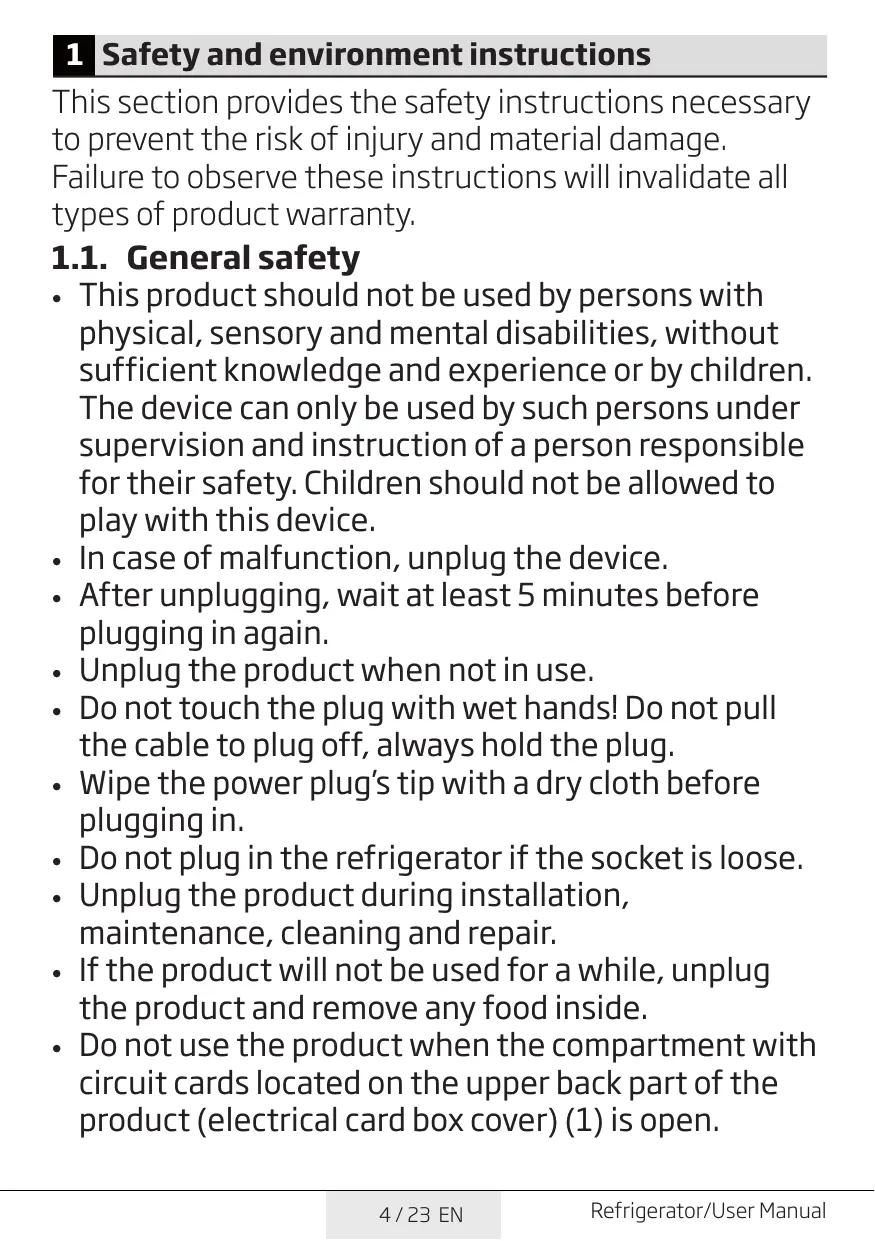
This section provides the safety instructions necessary to prevent the risk of injury and material damage. Failure to observe these instructions will invalidate all types of product warranty. 1.1. General safety • This product should not be used by persons with physical, sensory and mental disabilities, without sufficient knowledge and experience or by children. The device can only be used by such persons under supervision and instruction of a person responsible for their safety. Children should not be allowed to play with this device. • In case of malfunction, unplug the device. • After unplugging, wait at least 5 minutes before plugging in again. • Unplug the product when not in use. • Do not touch the plug with wet hands! Do not pull the cable to plug off, always hold the plug. • Wipe the power plug’s tip with a dry cloth before plugging in. • Do not plug in the refrigerator if the socket is loose. • Unplug the product during installation, maintenance, cleaning and repair. • If the product will not be used for a while, unplug the product and remove any food inside. • Do not use the product when the compartment with circuit cards located on the upper back part of the product (electrical card box cover) (1) is open.
4 / 23 EN Refrigerator/User Manual
Safety and environment instructions 1
Do not use steam or steamed cleaning materials for cleaning the refrigerator and melting the ice inside. Steam may contact the electrified areas and cause short circuit or electric shock! Do not wash the product by spraying or pouring water on it! Danger of electric shock! In case of malfunction, do not use the product, as it may cause electric shock. Contact the authorized service before doing anything. Plug the product into an earthed socket. Earthing must be done by a qualified electrician. If the product has LED type lighting, contact the authorized service for replacing or in case of any problem. Do not touch frozen food with wet hands! It may adhere to your hands! Do not place liquids in bottles and cans into the freezer compartment. They may burst out! Place liquids in upright position after tightly closing the lid. Do not spray flammable substances near the product, as it may burn or explode.
Refrigerator/User Manual
5 / 23 EN Safety and environment instructions • Do not keep flammable materials and products with flammable gas (sprays, etc.) in the refrigerator. • Do not place containers holding liquids on top of the product. Splashing water on an electrified part may cause electric shock and risk of fire. • Exposing the product to rain, snow, sunlight and wind will cause electrical danger. When relocating the product, do not pull by holding the door handle. The handle may come off. • Take care to avoid trapping any part of your hands or body in any of the moving parts inside the product. • Do not step or lean on the door, drawers and similar parts of the refrigerator. This will cause the product to fall down and cause damage to the parts. • Take care not to trap the power cable.
1.1.1 HC warning If the product comprises a cooling system using R600a gas, take care to avoid damaging the cooling system and its pipe while using and moving the product. This gas is flammable. If the cooling system is damaged, keep the product away from sources of fire and ventilate the room immediately.
C The label on the inner left side indicates the type of gas used in the product.
6 / 23 EN Refrigerator/User Manual
Safety and environment instructions 1.1.2 For models with water fountain • In order for the water system inside the refrigerator to operate properly, pressure in the water mains must be between 1-8 bars. A pressure regulator must be used if the pressure in the water mains is higher than 5 bars. If the pressure in the mains is higher than 8 bars, the refrigerator must not be connected to the mains. If you are not sure about how to measure the water pressure, ask for professional help. • Use drinking water only. 1.2. Intended use • This product is designed for home use. It is not intended for commercial use. • The product should be used to store food and beverages only. • Do not keep sensitive products requiring controlled temperatures (vaccines, heat sensitive medication, medical supplies, etc.) in the refrigerator. • The manufacturer assumes no responsibility for any damage due to misuse or mishandling. • The product’s bench life is 10 years. The spare parts necessary for the product to function will be available for this period. 1.3. Child safety • Keep packaging materials out of children’s reach. • Do not allow the children to play with the product. • If the product’s door comprises a lock, keep the key out of children’s reach. Refrigerator/User Manual
7 / 23 EN Safety and environment instructions 1.4. Compliance with WEEE Directive and Disposing of the Waste Product
This product complies with EU WEEE Directive (2012/19/EU). This product bears a classification symbol for waste electrical and electronic equipment (WEEE). This product has been manufactured with high quality parts and materials which can be reused and are suitable for recycling. Do not dispose of the waste product with normal domestic and other wastes at the end of its service life. Take it to the collection center for the recycling of electrical and electronic equipment. Please consult your local authorities to learn about these collection centers.
1.5. Compliance with RoHS Directive
• This product complies with EU WEEE Directive (2011/65/EU). It does not contain harmful and prohibited materials specified in the Directive.
1.6. Package information
• Packaging materials of the product are manufactured from recyclable materials in accordance with our National Environment Regulations. Do not dispose of the packaging materials together with the domestic or other wastes. Take them to the packaging material collection points designated by the local authorities.
8 / 23 EN Refrigerator/User Manual
C Control Panel Flap Drawers Adjustable front feet
Figures that take place in this instruction manual are schematic and may not correspond exactly with your product. If the subject parts are not included in the product you have purchased, then it is valid for other models.
Refrigerator/User Manual
3.1. Appropriate installation location
Appropriate air ventilation must be provided around your product in order to achieve an efficient operation. If the product is to be placed in a recess in the wall, pay attention to leave at least 5 cm distance with the ceiling and side walls.
Contact an Authorized Service for the installation of the product. In order to prepare the product for use, refer the information in the user manual and • ensure that electrical installation and 3.2. Installing the water installation are appropriate. If not, plastic wedges call a qualified electrician and technician to have any necessary arrangements carried out. Plastic wedges supplied with the product are used to create the distance WARNING: Manufacturer shall for the air circulation between the not be held liable for damages that may arise from procedures product and the rear wall. 1. To install the wedges, remove the carried out by unauthorized screws on the product and use the persons. screws supplied together with the WARNING: Product must wedges. not be plugged in during 2. Insert the 2 plastic wedges onto the installation. Otherwise, there rear ventilation cover as illustrated in is the risk of death or serious the figure. injury! WARNING: If the door clearance of the room where the product shall be place is so tight to prevent passing of the product, remove the door of the room and pass the product through the door by turning it to its side; if this does not work, contact the authorized service.
Place the product on an even floor surface to prevent jolts. Install the product at least 30 cm away from heat sources such as hobs, heater cores and stoves and at least 5 cm away from electrical ovens. Product must not be subjected to direct sun light and kept in humid places.
10 / 23 EN Refrigerator/User Manual
Installation 3.3. Adjusting the feet If the product stands unbalanced after installation, adjust the feet on the front by rotating them to the right or left.
3.4. Electrical connection
• Our company shall not be liable for any damages that will arise when the product is used without grounding and electrical connection in accordance with the national regulations. • Power cable plug must be within easy reach after installation. • Connect your refrigerator to a grounded outlet rated for a voltage value of 220-240V /50 Hz. Outlet shall have 10 to 16A fuse. • Do not extension cords or cordless multiple outlets between your product and the wall outlet.
WARNING: Do not make connections via extension cables or multi-plugs. WARNING: Damaged power cable must be replaced by the Authorized Service Agent. If two coolers are to be installed side by side, there should be at least 4 cm distance between them.
Refrigerator/User Manual
11 / 23 EN Installation Reversing the doors Proceed in numerical order .
12 / 23 EN Refrigerator/User Manual
4 Preparation • Your cooler/freezer should be installed at least 30 cm away from heat sources such as hobs, ovens, central heater and stoves and at least 5 cm away from electrical ovens and should not be located under direct sunlight. • Please make sure that the interior of your cooler/freezer is cleaned thoroughly. • If two coolers are to be installed side by side, there should be at least 2 cm distance between them. • When you operate your cooler/freezer for the first time, please observe the following instructions during the initial six hours. • Its door should not be opened frequently. • It must be operated empty without placing any food in it. • Do not unplug your cooler/freezer. If a power failure occurs out of your control, please see the warnings in the “Recommended solutions for the problems” section. • The baskets/drawers that are provided with the chill compartment must always be in use for low energy consumption and for better storage conditions. • Food contact with the temperature sensor in the freezer compartment may increase energy consumption of the appliance. Thus any contact with the sensor(s) must be avoided.
Refrigerator/User Manual
• This product has been designed to function at ambient temperatures up to 43 °C (90 SDgrF). Even if the ambient temperature falls to -15 °C, frozen food in the freezer does not thaw thanks to its Advanced Electronic Temperature Control System. For the first installation, the product should NOT be placed under low ambient temperatures. This is because the freezer cannot go down to standard operation temperature. When reaching continuous operation, the product can be moved to another place. Thus, later you can place your product in the garage or an unheated room without the concern of causing frozen food to get rotten. However, it is likely that above mentioned low temperatures may cause the freezing of the food in the fridge compartment; thus, please consume the food items in the fridge in a controlled way as needed. When ambient temperature goes back to normal, you may change button setting according to your need. • If the ambient temperature is below 0°C, the food in fridge compartment will freeze. Therefore, we recommend not using the fridge compartment in such low ambient temperatures. You may continue to use the freezer compartment as usual. • In some models, the instrument panel automatically turns off 5 minutes after the door has closed. It will be reactivated when the door has opened or pressed on any key. • Due to temperature change as a result of opening/closing the product door during operation, condensation on the door/body shelves and the glass containers is normal.
5 Using your refrigerator 5.1.
Setting the operating temperature Cold
Warm The operating temperature is regulated by the temperature control. 1 = Lowest cooling setting (Warmest setting) MAX. = Highest cooling setting (Coldest setting) * Additionaly activities quıck fridge function .
We recommend checking the temperature with a thermometer to ensure that the storage compartments are kept to the desired temperature. Remember to take the reading immediately since the thermometer temperature will rise very rapidly after you remove it from the freezer.
Please choose the setting according to the desired temperature. The interior temperature also depends on ambient temperature, the frequency with which the door is opened and the amount of foods kept inside. Frequently opening the door causes the interior temperature to rise. For this reason, it is recommended to close the door again as soon as possible after use. The normal storage temperature of your appliance should be -18 °C (0 °F). Lower temperatures can be obtained by adjusting the thermostat knob towards Position MAX.
C Figures in this user manual are schematic and may not match the product exactly. If the subject parts are not included in the product you have purchased, then those parts are valid for other models.
14 / 23 EN Refrigerator/User Manual
Operating the product
In order to maintain the quality of the Thermostat knob The thermostat knob is located on the food, the freezing must be effected as rapidly as possible. top trim. Thus, the freezing capacity will not be exceeded, and the temperature inside Important: When you press the fast-freeze switch the freezer will not rise. or adjust the set temperature, there may • Attention Keep the already deep-frozen food be a short delay before the compressor starts to operate. This is normal and not always separated with freshly placed food. a compressor fault.
When deep-freezing hot food, the cooling compressor will work until the Freezing food food is completely frozen. This can You can use the appliance for freezing temporarily cause excessive cooling of fresh food as well as for storing pre- the refrigeration compartment. frozen food. Please refer to the recommendations If you find the freezer door difficult given on the packaging of your food. to open just after you have closed it,
don’t worry. This is due to the pressure • Attention difference which will equalize and allow Do not freeze fizzy drinks, as the bottle the door to open normally after a few may burst when the liquid in it is frozen. minutes. You will hear a vacuum sound just after Be careful with frozen products such as closing the door. This is quite normal. coloured ice-cubes. Do not exceed the freezing capacity of your appliance in 24 hours. See the rating label.
Refrigerator/User Manual
15 / 23 EN Operating the product Fast freeze If large amounts of fresh food are going to be frozen, adjust the control knob to max. 24 hours before putting the fresh food in the fast freeze compartment. It is strongly recommended to keep the knob at MAX. position at least 24 hours to freeze maximum amount of fresh food declared as freezing capacity. Take special care not to mix frozen food and fresh food. Remember to turn the thermostat knob back to its previous position once food has frozen.
• It must be preferred to wrap or cover the food before placing them in the refrigerator. • Hot food must cool down to the room temperature before putting them in the refrigerator. • The foodstuff that you want to freeze must be fresh and in good quality. • Foodstuff must be divided into portions according to the family’s daily or meal based consumption needs. • The foodstuff must be packaged in an airtight manner to prevent them from drying even if they are going to be kept for a short time. • Materials to be used for packaging must be tear-proof and resistant to cold, humidity, odor, oils and acids and they must also be airtight. Moreover, they must be well closed and they must be made from easy-to-use materials that are suitable for deep freeze usage.
• Frozen food must be used immediately after they are thawed and they should never be re-frozen. • Please observe the following instructions to obtain the best results. 1. Do not freeze too large quantities of food at one time. The quality of the food is best preserved when it is frozen right through to the core as quickly as possible. 2. Placing warm food into the freezer compartment causes the cooling system to operate continuously until the food is frozen solid. 3. Take special care not to mix already frozen food and fresh food.
5.4. Recommendations for preservation of frozen food
• Prepacked commercially frozen food should be stored in accordance with the frozen food manufacturer's instructions for a ( 4 star) frozen food storage compartment. • To ensure that the high quality achieved by the frozen food manufacturer and the food retailer is maintained, the following should be remembered: 1. Put packages in the freezer as quickly as possible after purchase. 2. Ensure that contents are labeled and dated. 3. Do not exceed "Use By", "Best Before" dates on the packaging. Defrosting The freezer compartment defrosts automatically.
16 / 23 EN Refrigerator/User Manual
Operating the product 5.5.
A Placing the food Freezer compartment shelves
Various frozen food such as meat, fish, ice cream, vegetables and etc.
Fridge compartment shelves
Food in pans, covered plates and closed containers
Fridge compartment door shelves
Small and packaged food or drinks (such as milk, fruit juice and beer)
Freshzone compartment
Vegetables and fruits
Delicatessen products (cheese, butter, salami and etc.)
5.6. Deep-freeze information
Food must be frozen as rapidly as possible when they are put in a refrigerator in order to keep them in good quality. It is possible to keep the food for a long time only at -18°C or lower temperatures. You can keep the freshness of food for many months (at -18°C or lower temperatures in the deep freeze).
Refrigerator/User Manual
WARNING! • Foodstuff must be divided into portions according to the family’s daily or meal based consumption needs. • Foodstuff must be packaged in an airtight manner to prevent them from drying even if they are going to be kept for a short time. • Materials necessary for packaging: • Cold resistant adhesive tape • Self adhesive label • Rubber rings • Pen Materials to be used for packaging the foodstuff must be tear-proof and resistant to cold, humidity, odor, oils and acids. Foodstuff to be frozen should not be allowed to come in contact with the previously frozen items to prevent their partial thawing. Frozen food must be used immediately after they are thawed and they should never be re-frozen.
Maintenance and cleaning
Cleaning your fridge at regular intervals will extend the service life of the product.
B WARNING: Unplug the product before cleaning it.
• Never use gasoline, benzene or similar substances for cleaning purposes. • Never use any sharp and abrasive tools, soap, household cleaners, detergent and wax polish for cleaning. • Dissolve one teaspoon of bicarbonate in half litre of water. Soak a cloth with the solution and wrung it thoroughly. Wipe the interior of the refrigerator with this cloth and the dry thoroughly. • Make sure that no water enters the lamp housing and other electrical items. • If you will not use the refrigerator for a long period of time, unplug it, remove all food inside, clean it and leave the door ajar. • Check regularly that the door gaskets are clean. If not, clean them. • To remove door and body shelves, remove all of its contents. • Remove the door shelves by pulling them up. After cleaning, slide them from top to bottom to install. • Never use cleaning agents or water that contain chlorine to clean the outer surfaces and chromium coated parts of the product. Chlorine causes corrosion on such metal surfaces.
6.1. Avoiding bad odours
Materials that may cause odour are not used in the production of our refrigerators. However, due to inappropriate food preserving conditions and not cleaning the inner surface of the refrigerator as required can bring forth the problem of odour. Pay attention to following to avoid this problem: • Keeping the refrigerator clean is important. Food residuals, stains, etc. can cause odour. Therefore, clean the refrigerator with bi-carbonate dissolved in water every few months. Never use detergents or soap. • Keep the food in closed containers. Microorganisms spreading out from uncovered containers can cause unpleasant odours. • Never keep the food that have passed best before dates and spoiled in the refrigerator.
6.2. Protecting the plastic surfaces
Do not put liquid oils or oil-cooked meals in your refrigerator in unsealed containers as they damage the plastic surfaces of the refrigerator. If oil is spilled or smeared onto the plastic surfaces, clean and rinse the relevant part of the surface at once with warm water.
18 / 23 EN Refrigerator/User Manual
Check this list before contacting the service. Doing so will save you time and money. This list includes frequent complaints that are not related to faulty workmanship or materials. Certain features mentioned herein may not apply to your product. The refrigerator is not working. • The power plug is not fully settled. >>> Plug it in to settle completely into the socket. • The fuse connected to the socket powering the product or the main fuse is blown. >>> Check the fuses. Condensation on the side wall of the cooler compartment (MULTI ZONE, COOL, CONTROL and FLEXI ZONE). • The door is opened too frequently >>> Take care not to open the product’s door too frequently. • The environment is too humid. >>> Do not install the product in humid environments. • Foods containing liquids are kept in unsealed holders. >>> Keep the foods containing liquids in sealed holders. • The product’s door is left open. >>> Do not keep the product’s door open for long periods. • The thermostat is set to too low temperature. >>> Set the thermostat to appropriate temperature. Compressor is not working.
• In case of sudden power failure or pulling the power plug off and putting back on, the gas pressure in the product’s cooling system is not balanced, which triggers the compressor thermic safeguard. The product will restart after approximately 6 minutes. If the product does not restart after this period, contact the service. • Defrosting is active. >>> This is normal for a fully-automatic defrosting product. The defrosting is carried out periodically. • The product is not plugged in. >>> Make sure the power cord is plugged in. • The temperature setting is incorrect. >>> Select the appropriate temperature setting. • The power is out. >>> The product will continue to operate normally once the power is restored. The refrigerator's operating noise is increasing while in use.
• The product’s operating performance may vary depending on the ambient temperature variations. This is normal and not a malfunction.
Refrigerator/User Manual
19 / 23 EN Troubleshooting The refrigerator runs too often or for too long.
• The new product may be larger than the previous one. Larger products will run for longer periods. • The room temperature may be high. >>> The product will normally run for long periods in higher room temperature. • The product may have been recently plugged in or a new food item is placed inside. >>> The product will take longer to reach the set temperature when recently plugged in or a new food item is placed inside. This is normal • Large quantities of hot food may have been recently placed into the product. >>> Do not place hot food into the product. • The doors were opened frequently or kept open for long periods. >>> The warm air moving inside will cause the product to run longer. Do not open the doors too frequently. • The freezer or cooler door may be ajar. >>> Check that the doors are fully closed. • The product may be set to temperature too low. >>> Set the temperature to a higher degree and wait for the product to reach the adjusted temperature. • The cooler or freezer door washer may be dirty, worn out, broken or not properly settled. >>> Clean or replace the washer. Damaged / torn door washer will cause the product to run for longer periods to preserve the current temperature. The freezer temperature is very low, but the cooler temperature is adequate.
• The freezer compartment temperature is set to a very low degree. >>> Set the freezer compartment temperature to a higher degree and check again. The cooler temperature is very low, but the freezer temperature is adequate.
• The cooler compartment temperature is set to a very low degree. >>> Set the freezer compartment temperature to a higher degree and check again. The food items kept in cooler compartment drawers are frozen.
• The cooler compartment temperature is set to a very low degree. >>> Set the freezer compartment temperature to a higher degree and check again.
20 / 23 EN Refrigerator/User Manual
Troubleshooting The temperature in the cooler or the freezer is too high.
• The cooler compartment temperature is set to a very high degree. >>> Cooler compartment temperature setting has an effect on the freezer compartment temperature. Change the temperature of the cooler or freezer compartment and wait until the temperature of the related compartments come to the adequate level. • The doors were opened frequently or kept open for long periods. >>> Do not open the doors too frequently. • The door may be ajar. >>> Fully close the door. • The product may have been recently plugged in or a new food item is placed inside. >>> This is normal. The product will take longer to reach the set temperature when recently plugged in or a new food item is placed inside. • Large quantities of hot food may have been recently placed into the product. >>> Do not place hot food into the product. Shaking or noise.
• The ground is not level or durable. >>> If the product is shaking when moved slowly, adjust the stands to balance the product. Also make sure the ground is sufficiently durable to bear the product. • Any items placed on the product may cause noise. >>> Remove any items placed on the product. The product is making noise of liquid flowing, spraying etc.
• The product’s operating principles involve liquid and gas flows. >>> This is normal and not a malfunction. There is sound of wind blowing coming from the product.
• The product uses a fan for the cooling process. This is normal and not a malfunction. There is condensation on the product's internal walls.
• Hot or humid weather will increase icing and condensation. This is normal and not a malfunction. • The doors were opened frequently or kept open for long periods. >>> Do not open the doors too frequently; if open, close the door. • The door may be ajar. >>> Fully close the door. There is condensation on the product's exterior or between the doors.
• The ambient weather may be humid, this is quite normal in humid weather. >>> The condensation will dissipate when the humidity is reduced.
Refrigerator/User Manual
21 / 23 EN Troubleshooting The interior smells bad.
• The product is not cleaned regularly. >>> Clean the interior regularly using sponge, warm water and carbonated water. • Certain holders and packaging materials may cause odour. >>> Use holders and packaging materials without free of odour. • The foods were placed in unsealed holders. >>> Keep the foods in sealed holders. Microorganisms may spread out of unsealed food items and cause malodour. • Remove any expired or spoilt foods from the product. The door is not closing.
• Food packages may be blocking the door. >>> Relocate any items blocking the doors. • The product is not standing in full upright position on the ground. >>> Adjust the stands to balance the product. • The ground is not level or durable. >>> Make sure the ground is level and sufficiently durable to bear the product. The vegetable bin is jammed.
• The food items may be in contact with the upper section of the drawer. >>> Reorganize the food items in the drawer.
A WARNING: If the problem persists after following the instructions in this section, contact your vendor or an Authorized Service. Do not try to repair the product.
22 / 23 EN Refrigerator/User Manual
Veuillez d’abord lire ce manuel d’utilisation ! Chère cliente, cher client, Nous aimerions que vous soyez entièrement satisfait de notre appareil, fabriqué dans des infrastructures modernes et ayant fait l'objet d'un contrôle de qualité minutieux. À cet effet, veuillez lire en intégralité le manuel d'utilisation avant d'utiliser cet appareil, et conservez-le pour références ultérieures. Si vous offrez cet appareil à une autre personne, remettez-lui également le manuel d'utilisation. Le manuel d'utilisation garantit l'utilisation rapide et sécurisée du réfrigérateur. • Veuillez lire le manuel d'utilisation avant d'installer et d'utiliser le réfrigérateur, • Respectez toujours les instructions de sécurité en vigueur, • Tenez le manuel d'utilisation à portée pour références ultérieures, • Veuillez lire tous les autres documents fournis avec l'appareil, Veuillez noter que ce manuel d'utilisation peut se rapporter à plusieurs modèles de cet appareil. Le manuel indique clairement toutes les différences entre les modèles. Symboles et commentaires Les symboles suivants sont utilisés dans le manuel d'utilisation :