 ManualGo.com
 SJ-SC31CHXW1 - Fridge SHARP - Free user manual and instructions
Find the device manual for free SJ-SC31CHXW1 SHARP in PDF.


Download the instructions for your Fridge in PDF format for free! Find your manual SJ-SC31CHXW1 - SHARP and take your electronic device back in hand. On this page are published all the documents necessary for the use of your device. SJ-SC31CHXW1 by SHARP.
USER MANUAL SJ-SC31CHXW1 SHARP
Your freezer conforms to current safety requirements. Inappropriate use can lead to personal injury and damage to property. To avoid the risk of damage read this manual carefully before using your freezer for the first time. It contains important safety information on the installation, safety, use and maintenance of your Freezer. Retain this manual for future use. EN -1-
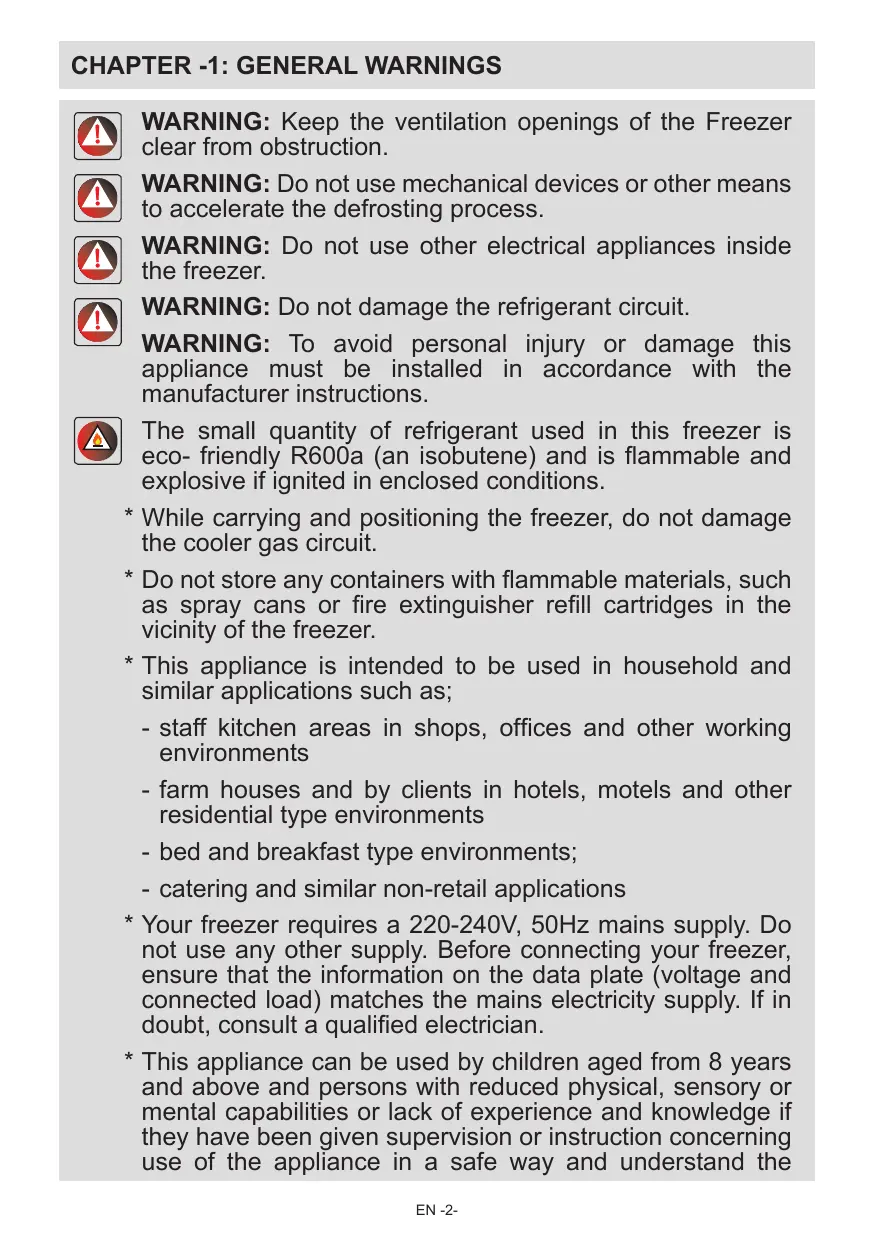
WARNING: Keep the ventilation openings of the Freezer clear from obstruction.
WARNING: Do not use mechanical devices or other means to accelerate the defrosting process. WARNING: Do not use other electrical appliances inside the freezer. WARNING: Do not damage the refrigerant circuit. WARNING: To avoid personal injury or damage this appliance must be installed in accordance with the manufacturer instructions. The small quantity of refrigerant used in this freezer is eco- friendly R600a (an isobutene) and is flammable and explosive if ignited in enclosed conditions. While carrying and positioning the freezer, do not damage the cooler gas circuit. Do not store any containers with flammable materials, such as spray cans or fire extinguisher refill cartridges in the vicinity of the freezer. This appliance is intended to be used in household and similar applications such as; -- staff kitchen areas in shops, offices and other working environments -- farm houses and by clients in hotels, motels and other residential type environments -- bed and breakfast type environments; -- catering and similar non-retail applications Your freezer requires a 220-240V, 50Hz mains supply. Do not use any other supply. Before connecting your freezer, ensure that the information on the data plate (voltage and connected load) matches the mains electricity supply. If in doubt, consult a qualified electrician. This appliance can be used by children aged from 8 years and above and persons with reduced physical, sensory or mental capabilities or lack of experience and knowledge if they have been given supervision or instruction concerning use of the appliance in a safe way and understand the EN -2-
CHAPTER -1: GENERAL WARNINGS hazard involved. Children shall not play with the appliance.
Cleaning and user maintenance, shall not be made by children without supervision. * A damaged power cord / plug can cause fire or give you an electric shock. When damaged it must be replaced, this should only be done by qualified personnel. * This appliance is not intended for use at altitudes exceeding 2000 m.
CHAPTER -1: GENERAL WARNINGS Disposal
• All packaging and materials used are environmentally friendly and recyclable. Please dispose of any packaging in an environmentally friendly manner. Consult your local council for further details.
• When the appliance is to be scrapped, cut off the electrical supply cable and destroy the plug and cable. Disable the door catch in order to prevent children becoming trapped inside. • A cut off plug inserted into a 16 amp socket is a serious safety (shock) hazard. Please ensure the cut off plug is disposed of safely.
Disposal of your old appliance
This symbol on the product or package implies that the product should not be treated as domestic waste.
Instead, it should be delivered to applicable waste collection places recycling electrical and electronic equipment. Recycling materials will help natural resources be preserved. For more detailed information regarding recycling of this product, please contact local authority, domestic waste disposal service or the shop you have purchased the product from. Please ask your local authority about the disposal of the WEEE for the reuse, recycle and recovery purposes.
• Please read the instruction manual carefully before installing and using your appliance. We are not responsible for the damage occurred due to misuse. • Follow all instructions on your appliance and instruction manual, and keep this manual in a safe place to resolve the problems that may occur in the future. • This appliance is produced to be used in homes and it can only be used in domestic environments and for the specified purposes. It is not suitable for commercial or common use. Such use will cause the guarantee of the appliance to be cancelled and our company will not be responsible for the losses to be occurred. • This appliance is produced to be used in houses and it is only suitable for cooling / storing foods. It is not suitable for commercial or common use and/or for storing substances except for food. Our company is not responsible for the losses to be occurred in the contrary case.
• Do not connect your Freezer to the mains electricity supply using an extension lead.
• A damaged power cord / plug can cause fire or give you and electric shock. When damaged it must be replaced, this should only be dine by qualified personnel. Never bend the power cord excessively. Never touch the power cord / plug with wet hands as this could cause a short circuit electric shock. Do not place glass bottles or beverage cans in the freezer. Bottles or cans may explode. When taking ice made in the freezer, do not touch it, ice may cause ice burns and/or cuts. Do not remove items from the freezer if your hands are damp or wet. Tis could cause skin abrasions or frost / freezer burns. Do not refreeze food once it has thawed out.
Installation Information
Before unpacking and manoeuvering your freezer please take some time to familiarise yourself with the following points.
• Position away from direct sunlight and away from any heat source such as a radiator. • Your appliance should be at least 50 cm away from stoves, Gas ovens and heater cores, and should be at least 5 cm away from electrical ovens. • Do not expose your freezer to moisture or rain. • Your freezer should be positioned at least 20mm away from another freezer. • Clearance of at least 150 mm is required at the top and back of your freezer. Do not place anything on top of your freezer. • For safe operation it is important that your freezer is safe and balanced. The adjustable feet are used to level your freezer. Make sure that your appliance is level before placing any foodstuffs inside it. • We recommend that you wipe all shelving and trays with a cloth soaked in warm water mixed with a teaspoon of bicarbonate of soda before use. After cleaning rinse with warm water and dry. • Install using the plastic distance guides, which can be found at the rear of the appliance. Turn 90 degrees (as shown in the diagram). This will keep the condenser from touching the wall. • Freezer should be placed against a wall with a free distance not exceeding 75 mm.
Before using your freezer
• Before setting up your freezer, check for any visible damage. Do not install or use your freezer if it is damaged.
• When using your freezer for the first time, keep it in an upright position for at least 3 hours before plugging into the mains. This will allow efficient operation and prevents damage to the compressor. • You may notice a light odour when using your freezer for the first time. This is perfectly normal and will fade away as the freezer starts to cool.
Freezer bottom drawer
This figure has been drawn for information purposes to show the various parts and accessories in the appliance.
Parts may vary according to the model of the appliance.
Freezer thermostat automatically regulates the inside temperature of the compartments.
By rotating the knob from position “1” to “5”, colder temperatures can be obtained. Important note: Do not try to rotate knob beyond 1 position it will stop your appliance.
Freezer thermostat setting;
1 – 2 : For short-term storage of food in the freezer compartment, you can set the knob between minimum and medium position. 3 – 4 : For long-term storage of food in the freezer compartment, you can set knob medium position. 5 : For freezing the fresh food. The appliance will run for colder temperatures. Note that; the ambient temperature, temperature of the freshly stored food and how often the door is opened, affects the temperature in the freezer compartment. If required, change the temperature setting.
Warnings for temperature settings
• Your temperature adjustments will not be deleted when an energy breakdown occur.
• Do not pass to another adjustment before completing an adjustment. • The ambient temperature, temperature of the freshly stored food and how often the door is opened, affects the temperature in the freezer. If required,change the temperature setting. • It is not recommended that you operate your freezer in environments colder than 10°C . • The temperature setting should be set by taking into consideration how often the freezer door is opened and closed, how much food is stored in the freezer and the environment in which and the positioning of the appliance. • We recommend that when first using the freezer it should be left running for 24 hours uninterrupted to ensure it is completely cooled. Do not open the freezer door, or put food inside for this period. • Your freezer has a 5 minute built in delay function, designed to prevent damage to the compressor. When power is applied to your freezer, it will begin to operate normally after 5 minutes. • Your freezer is designed to operate in the ambient temperature intervals stated in the standards, according to the climate class stated in the information label. It is not recommended that your freezer is operated in the environments which are out of the stated temperature intervals in terms of cooling efficiency.
CHAPTER -3: USING YOUR FREEZER
• This appliance is designed for use at an ambient temperature within the 16°C - 38°C range.
Ambient Temperature oC T Before cleaning your freezer, turn your mains supply off and remove the plug from the socket.
Do not wash your freezer by pouring water on to it. Use a warm, soapy cloth or sponge to wipe the interior and exterior of your freezer. Carefully remove all baskets by sliding upwards or outwards and clean with soapy water. Do not wash in a washing machine or dishwasher. • Do not use solvents, abrasive cleaners, glass cleaners or all purpose cleaning agents to clean your freezer. This may cause damage to the plastic surfaces and other components with the chemicals they contain. • Clean the condenser at the back of your freezer at least once a year with a soft brush or vacuum cleaner. Make sure that your freezer is unplugged while cleaning.
Defrosting the Freezer
WARNING: Never use sharp metal tools, unless recommended by manufacturer, for this operation as they can damage the refrigeration circuit.
After a period of time, frost will build up in certain areas in the freezer. The frost, accumulated in the freezer, should be removed periodically (use the plastic scraper if available). Complete defrosting will become necessary if the frost layer exceeds 3-5 mm to maintain the efficiency of the freezer. • The day before you defrost, set the thermostat dial to position “5” to freeze the foods completely. (Recommendation) • During defrosting, frozen foods should be wrapped in several layers of paper and kept in a cool place. The inevitable rise in temperature will shorten their storage life. Remember to use these foods within a relatively short period of time. • Set the thermostat knob to position “•” and switch off the appliance. • Leave the door open to accelerate defrosting. Remove the defrost water from the compartment. • This appliance is provided with a special drain system.
1. Pull out the bottom drawerA of the freezer and put it on the floor aligning it to the cabinet front.
2. Pull out the drain pipeB placed on the back wall of the freezer. Then place it in the groove on the front side of the floor of the appliance. 3. If there Is still water on the freezer floor, you can clear it away by using a sponge. • Clean the interior by hand with lukewarm water and a little detergent. Never use abrasive products or aggressive cleaning agents. • Dry the inside of the unit, plug on the mains, and set the thermostat knob to position “5”. After 24 hours, reset the thermostat to the desired position.
The use of freezer is, storing of deep-frozen or frozen food for long periods of time and making ice cubes.
Do not put fresh and warm food with frozen food side by side as it can thaw the frozen food. While freezing fresh food (i.e. meat, fish and mincemeat) divide them in parts in order to use in one time. Maximum load; if you want to load large quantities and use the maximum net capacity, you can remove the drawers (Except the bottom one).You can store bulky items directly on the shelves • For storing the frozen food; the instructions shown on frozen food packages should always be followed carefully and if no information is provided, food should not be stored for more than 3 months from the purchased date. • When buying frozen food ensure that these have been frozen at suitable temperatures and that the packing is intact. EN -6-
CHAPTER -4: FOOD STORAGE GUIDANCE
• Frozen food should be transported in appropriate containers to maintain the quality of the food and should be returned to the freezing surfaces of the unit in the shortest possible time. • If a package of frozen food shows the sign of humidity and abnormal swelling it is probable that it has been previously stored at an unsuitable temperature and that the contents have deteriorated. • The storage life of frozen food depends on the room temperature, thermostat setting, how often the door is opened, the type of food and the length of time required to transport the product from the shop to your home. Always follow the instructions printed on the package and never exceed the maximum storage life indicated. • While freezing food ; Maximum amount of fresh food (in kg) that can be frozen in 24 hours is indicated on the appliance label. For optimum appliance performance to reach maximum freezing capacity, turn the thermostat knob to position “5” / 24 hours before placing fresh food in the freezer. 24 hours, position “5” would generally be sufficient after placing fresh food in the freezer. After 24 hours, reset the thermostat to the desired position. • Attention; In order to save energy, when freezing small amounts of food, reset the thermostat to the desired position.
CHAPTER -5: TROUBLESHOOTING If your freezer is not working properly, it may be a minor problem, therefore check the following, before calling an electrician to save time and money.
What to do if your appliance does not operate; Check that; • There is no power, • The general switch in your home is disconnected , • The thermostat setting is on “•” position , • The socket is not sufficient. To check this, plug in another appliance that you know which is working into the same socket. What to do if your appliance performs poorly; Check that; • You have not overloaded the appliance, • The freezer thermostat settings is “1” position (if so set the thermostat dial suitable value) • The doors are closed perfectly, • There is no dust on the condenser, • There is enough place at the rear and side walls. If there is noise; The freezing gas which circulates in the freezer circuit may make a slight noise (bubbling sound) even when the compressor is not running. Do not worry this is quite normal. If these sounds are different check that; • The appliance is well levelled • Nothing is touching the rear. • The stuffs on the appliance are vibrating. If your freezer is not cooling enough; Your freezer is designed to operate in the ambient temperature intervals stated in the standards, according to the climate class stated in the information label. We do not recommend operating your freezer out of stated temperatures value limits in terms of cooling effectiveness. Recommendations • If the appliance is not used for long time (for example during the summer holidays) unplug or set the thermostat dial to “•” position and clean the appliance and leave the door open to prevent the formation of mildew and smell. • To stop the appliance completely, unplug from main socket (for cleaning and when the doors are left open)
CHAPTER -6: TIPS FOR SAVING ENERGY
1. Always allow foodstuffs to cool before storing in the appliance. 2. Thaw food in the freezer, this helps save energy.