
Super Capacitor FCJJ-35 - Uncategorized Horizon - Free user manual and instructions
Find the device manual for free Super Capacitor FCJJ-35 Horizon in PDF.


| Product Type | Supercapacitor Educational Kit |
| Brand | Horizon |
| Model | FCJJ-35 |
| Capacitance | Approx. 1 F |
| Rated Voltage | 5.5 V DC |
| Energy Storage | Rapid charge/discharge cycle demonstrator |
| Dimensions | Approx. 110 x 70 x 30 mm |
| Weight | Approx. 180 g |
| Power Supply | 2 AA batteries or 3V solar panel (not included) |
| Charging Time | Approx. 1 minute at 3V |
| Discharge Time | Powers a small LED for several minutes |
| Included Components | Supercapacitor module, motor, LED, connection leads, manual |
| Main Function | Demonstrate supercapacitor energy storage and discharge |
| Educational Use | STEM and renewable energy experiments |
| Recommended Age | 12+ with adult supervision |
| Maintenance | Wipe with a dry cloth after use |
| Cleaning | Do not immerse in water or use solvents |
| Safety Warning | Avoid short-circuiting the terminals |
| Spare Parts | Replacement supercapacitor modules available separately |
| Repairability | Modular design; replaceable components |
Frequently Asked Questions - Super Capacitor FCJJ-35 Horizon
User questions about Super Capacitor FCJJ-35 Horizon
0 question about this device. Answer the ones you know or ask your own.
Ask a new question about this device
Download the instructions for your Uncategorized in PDF format for free! Find your manual Super Capacitor FCJJ-35 - Horizon and take your electronic device back in hand. On this page are published all the documents necessary for the use of your device. Super Capacitor FCJJ-35 by Horizon.
USER MANUAL Super Capacitor FCJJ-35 Horizon
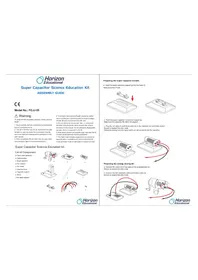
Super Capacitor Science Education Kit
ASSEMBLY GUIDE
CE
Model No.: FCJJ-35

Warning
To avoid the risk of property damage, serious injury or death:
- Read carefully and fully understand the instructions before assembling this kit.
- This kit is intended only for use by persons 14 years old and up, and only under the supervision of adults who have read and understood the instructions in this user manual.
-
When assembling this kit, tools may be used. Extra care should be taken to avoid personal injury.
-
Some parts are small and fragile: please be careful when handling and connecting parts to avoid breakage. Handle all parts and components with care.
- Do not attempt to use any part, item, or component provided in this kit for any other purpose than what is instructed in this manual. Do not attempt to disassemble any part, item or component in this kit.
- Keep small children and animals away, because this kit contains small parts that could be swallowed.
- The hand crank is highly suggested to be cranked at approximately 2 revolutions per second otherwise the crank generator could be damaged by cranking too fast.
Super Capacitor Science Education kit
List of Component
a. Hand crank generator
b. Potentiometer
c. Super capacitor
d. Fan module
e. Fan blade
f. Capacitor base
g. Capacitor support
h. Wires
i. Fan blade adapter


Horizon
Educational
Preparing the super capacitor module
a. Insert the super capacitor support (g) into the base (f). Make sure they fit well.


b. Place the super capacitor (c) onto its support (g).
Make sure the capacitor fits well in its support.
c. Plug the red cable (h) and black cable (h) in the capacitor red and black socket.
Ensure to respect the color code.
Otherwise energy from the hand crank can not be stored into the capacitor.


Preparing the energy storing kit
a. Connect the other end of the cable to the potentiometer (b). Ensure to respect the color code.
b. Connect the red and black cable to the hand crank (a). Ensure to respect the color code.


Horizon
Educational
c. Connect the other end of the cable from the hand crank generator to the potentiometer. Ensure to respect the color code.

Energy generating and storing
a. Firmly grasp the rotary handle of the hand crank generator with one hand and grip the main handle with the other hand.
b. Rotate the arm clockwise to generate power for charging the capacitor. You should crank the arm to reach a speed of two revolutions per second. Initially you will feel some resistance, which will become smaller after a few seconds. If you feel the resistance increase again, it means you've slowed down and need to speed back up.
Note: At the same time you can notice the potentiometer is moving towards green part, which means you are generating energy and the energy is being stored in the super capacitor.
WARNING: You are not allowed to rotate the arm anti-clockwise to charge the super capacitor. Otherwise the super capacitor will be damaged by the countercurrent.

Power the electrical fan with the energy stored in the capacitor
a. Connect the adapter (i) to the motor axis. Put the fan blade (e) onto the adapter. Make sure the fan blade is connected tightly to the motor shaft.
b. Use a cable to connect the fan module to the capacitor module. Ensure to respect the color code.
Once they are connected, the fan moves fast immediately.


Horizon Educational
Power the electrical fan directly with the hand crank generator
After connecting the wires, rotate the arm in a circular motion to generate power. You should crank the arm to reach a speed of two revolutions per second, fast is better. Initially you will feel some resistance, which will become smaller after a few seconds. If you feel the resistance increase again, it means you've slowed down and need to speed back up.
WARNING: DO NOT crank the arm too fast otherwise the hand crank generator could be easily broken by the strong force.

Note:
Finding the appropriate speed and technique will take a little practice. After you have spent a little time acclimating yourself to the hand crank generator, you should develop an easy rhythm that is not strenuous to sustain.
Although the generator is easy to crank, you may eventually tire. When you find yourself slowing down, stop and take a rest, cranking slower is harder and may not generate enough power to charge the capacitor or power the load.
The generator can be cranked in either direction, with either hand.
Try to rotate your hands around each other instead of trying to hold the generator still and moving one hand in a circle. This prevents one arm from tiring faster than the other. Experiment with what works best for you. As long as the handle is cranked at approximately 2 revolutions per second the generator it will produce enough power to power the device provided.
ADVANTAGES of a Hand Crank Generator:
- Does not require solar, wind, or fuel to charge. Charge it anytime, anywhere!
- Does not require additional purchases of fuel during an emergency, when gasoline is scarce.
- Can be operated indoors without deadly fumes or threat of theft while outdoors.
- Easy to operate. Even children can safely operate the hand crank generator.
- Silent operation. No loud generator noise!
- Easy to set up. No confusing mounting or home alterations needed.

Horizon Educational
Conduct dozens of exciting, hands-on experiments with the science kit
Ideal as a battery replacement for a wide variety of basic electricity experiments, the hand crank generator is a low voltage power source that lets you create electrical current by simply turning a crank. This ingenious device generates student interest producing electrical energy through hands-on student effort. Student's enthusiasm is immediate, whether they are third graders lighting a bulb or college students reviewing sophisticated principles such as Ohm's Law or the electromagnetic properties of light.
Made from a sturdy, see-through ABS resin with nylon-plastic gears and handle, the kit is designed to shrug off use and abuse. It produces approximately 200mA of usable current. It is capable of producing up to 6 volts. You can reverse polarity by simply cranking the handle in the opposite direction. And, when powered by another kit or low voltage power source, it acts as a motor.
Activities and uses
Some of the activities require accessories sold separately. You can study electron flow, parallel and series circuits, Ohm's Law, motors and generators, energy transformations, and more.
Below is an activity for the kit:
Using a cellophane tap, wrap two wires onto a compass. Ensure you wrap the wires in the compass needle axis. Connect the other end of the wires to the hand crank generator. Turn the handle clockwise with different velocities. Do the same counter-clockwise. Does the deflection angle is linked to the handle angular velocity? Does the deflection angle is linked with the handle sense of rotation? Explain.
Repeat the above experiment exactly, but rotate the generator counterclockwise. What is the result?
Elementary and Middle School
Electricity in circuits can produce light, heat, sound, and magnetic effects. Electrical circuits require a complete loop through which current can pass.
Students know the role of electromagnets in the construction of electric motors, electric generators, and simple devices, such as doorbells and earphones.
Describe electron flow in simple circuits.
Students know how to design and build simple series and parallel circuits by using components such as wires, batteries, and bulbs.
High School
Energy is a property of many substances and is associated with heat, light, electricity, mechanical motion, sound, nuclei, and the nature of a chemical. Energy is transferred in many ways. The total energy of the universe is constant. Energy can be transferred by collisions in chemical and nuclear reactions, by light waves and other radiations, and in many other ways. however, it can never be destroyed. As these transfers occur, the matter involved becomes steadily less ordered.
Electricity and magnetism are two aspects of a single electromagnetic force. Moving electric charges produce magnetic forces, and moving magnets produce electric forces. These effects help students to understand electric motors and generators. Measure the thermal and electrical conductivity of various materials and explain results.
Analyze the relationship between an electric current and the strength of its magnetic field using simple electromagnets. Investigate and compare series and parallel circuits.
FAQ
What is a capacitor, how does it work?
A capacitor is an electrical component which is composed of two plates separated by an electrical insulation. This component could function in two modes, the charge and the discharge. The charge occurs when there is a difference of potential across the conductors. It permit to store energy inside the generated electric field. In general, this kind of component is used for blocking the direct current and for letting pass the alternative one. They could be used to stabilize the voltage and the power flow in an electric power transmission.
What is a hand crank generator:
A hand crank generator is an engine which is used as a generator. It turns a mechanical energy into an electrical current. It is composed of three principal components which are the stator, the rotor and a rotary handle. The user will turn the rotary handle which will make turn a magnet inside a coil. Due to the rotation of the magnet, the electrical field turn and an electrical current will appear in the coil.
What will happen if I turn the hand crank handle in the wrong sense.
The hand crank generator could function in both senses as a lot of engine. The sense of rotation will just impact the sense of the current which is generated. However, you should be careful with the components which are connected to the generator. In fact, some components are polarized and they couldn't works in both sense.
What will happen if I connect the hand crank generator to the fan in the wrong sense?
Nothing bad, the fan is composed of a small engine which work in the same way than the generator but in the other sense (it turns an electrical current into a mechanical motion). If you pug the generator wires in the wrong sense, the fan will turn in the other sense than previously.
Do there is a special position to plug the generator to the potentiometer?
There is just one thing to know when you use a potentiometer, it should be wired in parallel with the component you want to measure the voltage.
What will happen if I connect the hand crank generator to the capacitor in the wrong sense? You will damage seriously the capacitor if you turn the handle when the wires are incorrectly plugged into the capacitor. In this way, you risk to break or crack the capacitor. Warning, if you connect the capacitor in the good way but you turn the hand crank generator handle in the wrong sense, you also risk to break the capacitor.
Troubleshooting
-
The bulb light on the hand crank generator does not work when I rotate the arm. Replace the bulb light. It could have been damaged by long time using.
-
The fan does not run when I rotate the arm and all the connections are correct. Please tap the fan blade with your finger to help it start.


- SUPER CAPACITOR SCIENCE EDUCATION KIT
- ASSEMBLY GUIDE
- CE
- MODEL NO.: FCJJ
- WARNING
- LIST OF COMPONENT
- PREPARING THE SUPER CAPACITOR MODULE
- PREPARING THE ENERGY STORING KIT
- ENERGY GENERATING AND STORING
- POWER THE ELECTRICAL FAN WITH THE ENERGY STORED IN THE CAPACITOR
- POWER THE ELECTRICAL FAN DIRECTLY WITH THE HAND CRANK GENERATOR
- NOTE
- ADVANTAGES OF A HAND CRANK GENERATOR
- CONDUCT DOZENS OF EXCITING, HANDS-ON EXPERIMENTS WITH THE SCIENCE KIT
- ACTIVITIES AND USES
- FAQ
- WHAT IS A CAPACITOR, HOW DOES IT WORK
- WHAT IS A HAND CRANK GENERATOR
- WHAT WILL HAPPEN IF I TURN THE HAND CRANK HANDLE IN THE WRONG SENSE
- WHAT WILL HAPPEN IF I CONNECT THE HAND CRANK GENERATOR TO THE FAN IN THE WRONG SENSE
- DO THERE IS A SPECIAL POSITION TO PLUG THE GENERATOR TO THE POTENTIOMETER
- TROUBLESHOOTING
Brand : Horizon
Model : Super Capacitor FCJJ-35
Category : Uncategorized