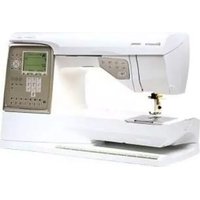
Huskylock 546D - Sewing machine HUSQVARNA - Free user manual and instructions
Find the device manual for free Huskylock 546D HUSQVARNA in PDF.


Pick your language and provide your email: we'll send you a specifically translated version.
| Product type | Overlock sewing machine (serger) |
| Brand | Husqvarna |
| Model | Huskylock 546D |
| Thread system | 4-thread overlock, 3-thread overlock, rolled hem |
| Number of needles | 2 |
| Number of threads | 4 |
| Differential feed | Adjustable ratio from 0.7 to 2.0 |
| Stitch length | Adjustable from 1 to 5 mm |
| Max. sewing speed | 1,500 stitches per minute |
| Needle system | 130/705H (ELx705) |
| Presser foot lift | Up to 6 mm |
| Power supply | 120V, 60Hz (USA/Canada) / 220-240V, 50Hz (EU) |
| Motor power | 90 W (typical energy-efficient motor) |
| Dimensions (W x D x H) | 40 × 30 × 30 cm (approx.) |
| Weight | 7 kg (15.4 lbs) |
| Included accessories | Standard presser foot, rolled hem edge guide, needle set, spool caps, screwdriver, lint brush, oil bottle |
| Maintenance | Regular cleaning and oiling of loopers, needles, and feed dogs |
| Safety features | Finger guard, safety switch, automatic thread tension |
| Warranty | 2 years against manufacturing defects |
| Repairability | Spare parts available; service centers worldwide |
Frequently Asked Questions - Huskylock 546D HUSQVARNA
How do I thread a 4-thread overlock on the Huskylock 546D?
Start by raising the presser foot and setting all tension dials to zero. Thread the upper looper first, then the lower looper, and finally the two needles. Follow the color-coded thread path on the machine: red for upper looper, blue for lower looper, yellow for right needle, and green for left needle. Use an needle threader if available. After threading, pull each thread under the presser foot and perform a test seam.
What is the function of the differential feed and when should I adjust it?
The differential feed controls the ratio between the front and rear feed dogs. Set it to a higher ratio (above 1.0) to prevent stretching on knit fabrics. Use a lower ratio (below 1.0) to create a gentle gather or to handle slippery fabrics like satin. Always test on a scrap piece to achieve a flat, even seam.
How do I prevent skipped stitches?
Ensure the needle is correctly inserted and not bent or dull. Replace it regularly, ideally every 2–3 projects. Use ballpoint needles for knits and sharp needles for woven fabrics. Check that the loopers are timed correctly by turning the handwheel slowly; consult the manual if stitches skip. Also, verify the thread tension is balanced and the needle plate is clean.
Why does the thread keep breaking?
This is often caused by a burr on the needle or looper, or a thread path obstruction. Check the needle for rough spots and replace it if needed. Make sure the tension disks are free of lint and the thread is not caught on spool caps. Use high-quality thread and ensure it is compatible with the needle thickness. For example, use 50wt or 60wt for sharp needles and not with thick thread.
How to change from a 4-thread overlock to a rolled hem?
Disengage the left needle by removing it. Adjust the stitch length to about 2mm and the differential feed to 1.5. Attach the rolled hem foot and engage the rolled hem stitch selection. Set the right needle to a ballpoint or universal needle. Tighten the loopers precisely; use a fabric scrap to fine-tune until the edge curls neatly.
What maintenance is required for my serger?
Clean after every project using the lint brush to remove dust from the needle area, feed dogs, and loopers. Apply a drop of sewing machine oil to the indicated points daily to prevent friction. Never use compressed air as it forces lint deeper. Replace needles frequently and schedule a professional service annually.
How can I adjust the stitch length and width?
Stitch length is controlled by the knob on the left side, typically marked from 1 to 5 mm. Stitch width is adjusted by moving the needle position (left or right) and by using the needle plate with the rolled hem slot. Always set the width while the needle is placed in the fabric to avoid jamming. For narrow widths, use the left needle; for wider, use the right needle.
Can I sew with 2 or 3 threads only?
Yes, the Huskylock 546D is a 4-thread serger but can be converted to 3-thread or 2-thread operation. For 3-thread, remove the left needle and one looper thread. For a 2-thread, use only one needle and one looper. This is useful for decorative stitching or light seams on sheer fabric. Refer to the manual for exact thread paths.
What type of fabric can the Huskylock 546D handle?
It works beautifully on light to medium weight fabrics: knits, woven, silk, linen, and even leather (with a leather needle). For heavy denim, set the differential feed to 1.0 and use a stronger needle. Avoid very thick materials like upholstery; the presser foot may not lift high enough. Test on a scrap to ensure the feed dogs handle the layers.
How to fix unbalanced tension on the loopers?
Use the numbered tension dials: the upper looper is usually red and the lower is blue. Sew a test seam and examine the stitch on both sides. If the thread loops appear on the top, tighten the upper looper or loosen the lower looper; if they appear on the bottom, do the opposite. Adjust one dial at a time to simplify the process, and remember to record your settings for future projects.
User questions about Huskylock 546D HUSQVARNA
0 question about this device. Answer the ones you know or ask your own.
Ask a new question about this device
No questions yet. Be the first to ask one.
Download the instructions for your Sewing machine in PDF format for free! Find your manual Huskylock 546D - HUSQVARNA and take your electronic device back in hand. On this page are published all the documents necessary for the use of your device. Huskylock 546D by HUSQVARNA.
USER MANUAL Huskylock 546D HUSQVARNA

Manual assistant
Powered by Anthropic
Waiting for your message
Product information
Brand : HUSQVARNA
Model : Huskylock 546D
Category : Sewing machine