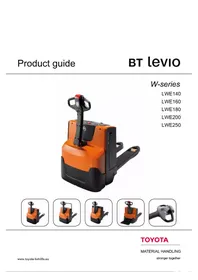
Levio LWE140 - Electric pallet truck BT - Free user manual and instructions
Find the device manual for free Levio LWE140 BT in PDF.


| Type of product | Cordless DECT phone |
| Brand | BT |
| Model | Levio LWE140 |
| Dimensions (handset) | 150 x 50 x 30 mm |
| Weight (handset) | 150 g |
| Power supply | 2x AAA Ni-MH rechargeable batteries |
| Standby time | Up to 200 hours |
| Talk time | Up to 12 hours |
| Display | 1.8-inch monochrome LCD |
| Phonebook capacity | 100 contacts |
| Caller ID support | Yes |
| Hands-free speakerphone | Yes |
| Answering machine | Digital, up to 25 minutes recording |
| Range (indoor) | Up to 50 meters |
| Range (outdoor) | Up to 300 meters |
| Keypad backlight | Yes, amber |
| Ringtones | 10 polyphonic |
| Care and cleaning | Wipe with a dry cloth; avoid liquids |
| Safety | Use only supplied charger; do not disassemble |
| Spare parts and repairability | Batteries and charger available from BT; no user-serviceable parts |
| General information | Compatible with UK landline networks; supports DECT GAP |
Frequently Asked Questions - Levio LWE140 BT
User questions about Levio LWE140 BT
0 question about this device. Answer the ones you know or ask your own.
Ask a new question about this device
Download the instructions for your Electric pallet truck in PDF format for free! Find your manual Levio LWE140 - BT and take your electronic device back in hand. On this page are published all the documents necessary for the use of your device. Levio LWE140 by BT.
USER MANUAL Levio LWE140 BT


TOYOTA
MATERIAL HANDLING
This product guide applies to:
| Model F code TD code |
| LWE140 PT 838aa |
| LWE160 PT 838ab |
| LWE180 PT 838ac |
| LWE200 PT 839aa |
| LWE250 PT 840aa |
Document revision history:
| Edition date Changes |
| April 2008 Next generation Low-lifters |
| February 2011 Technical updates |
| August, 2011 New family and series name |
| Januare, 2012 Technical updates |
Part number: 749851-040
Copyright BT
Edition: January, 2012
BT
Information and Training Services
SE-595 81 Mjölby
Sweden
Contents
Reading instructions 7
Product range information 9
BT Levio W-series (Low-lifter Walkie Electric) 9
LWE140 11
LWE160 11
LWE180 12
LWE200 12
LWE250 13
Applications 15
Industry 16
Warehouses/distribution centres 16
Shops/supermarkets 17
Which truck for which application? 18
Sales arguments 19
Simplicity 20
Safety 22
Durability 23
Product details 25
Operator environment 25
Battery covers and storage compartments 30
Driving features/programming the truck 31
Motor and power pack 36
Drive wheel 39
Electronic components 42
Cover 43
Castor wheels 45
Fork carriage 47
Battery compartments, batteries and chargers 49
Technical information 53
Dimensions and performance figures 53
Ast – Aisle width requirement ..... 57
Aisle width requirements 58
Pallets and pallet sizes 60
Choosing the optimal fork specification 61
Application for different fork lengths 61
Battery weights 62
Battery and charger 63
Options 65
Battery change from the side 65
Battery change table 66
Extra battery cables 66
Battery change cable 66
Built-in charger .... 67
Spacer for long side pallet handling 68
Truck log systems 69
Integrated E-bar with optional accessories 71
Turtle button 72
Operator platform 73
Load support 75
Metal battery cover 75
Rubber border 76
Feature 76
Benefit 76
Hydraulic oil for low temperatures 76
Greasable stainless steel axles....76
Appendix 77
Environmental work within BT 77
Focus on quality within BT 78
Certificates 80
Reading instructions
This product guide is designed as a point of reference. To facilitate searching for specific features, it has an index at the back. In some cases, information is available in two different chapters. This applies especially to the Sales arguments and Product details chapters describing the various features and benefits of the truck. To determine which chapter provides the desired information, please use the following content descriptions.
The various chapters of this product guide cover the following:
- Product range information: Provides a general overview of all truck versions in the series.
- Applications: This chapter describes typical customers and truck applications.
- Sales arguments: Results from market research carried out during fall 2007 are presented here together with truck features and benefits supporting the sales arguments.
- Product details: This chapter offers detailed descriptions of truck features and truck components. It also includes a list of features and benefits.
- Technical information: This chapter presents capacity charts, load carriers, battery weights, x measurements, etc.
- Options: This is a list of truck options together with a description of their features and benefits.
- Appendix: Contains an environmental declaration, a description of environmental work and quality commitment within BT as well as a copy of the company's ISO certification.
Product range information
BT Levio W-series (Low-lifter Walkie Electric)
BT Levio W-series without platform is a complete low-lifter series for walkie applications. These machines are mainly used where space is limited and travel distances are relatively short. All models have a maximum speed of 6 km/h.
LWE200 can, as an option, be equipped with operator platform. This truck is preferably used were travel distances are a bit longer and the operator wants to have the comfort of a stand on platform. For more heavy duty applications were the truck is used continuously in a multi shift operation the recommendation is to use a truck from our LPE range.
The LWE series is built on a modular concept where a large number of components are common for all models. This simplifies production and increases truck performance reliability.
The LWE machines are compact, easy-to-use trucks with AC drive motors. The trucks' drive characteristics can be programmed and adapted to individual operator preferences. The design with rounded body contours together with a 5-point wheel configuration ensures operator comfort and safety. The placement of the tiller arm and controls on the handle provide excellent ergonomics for the operator.
The LWE series has two fork carriages. The 156 mm fork width on the narrow fork carriage is provided on the LWE140 and LWE160. The other LWE versions feature a standard fork carriage with a fork width of 180 mm. The fork carriage on the LWE250 is reinforced to accommodate increased rated load capacity. The LWE200 and LWE250 have larger drive and lift motors. All models are supplied with a standard battery compartment. Moreover, the LWE200 and LWE250 can be optionally fitted with a large battery combined with a side roller bed solution.
Open-end and bottom-boarded pallets account for a large portion of the load carriers handled by low-lifters. Additionally, this truck series offers a variety of fork and wheel configurations to accommodate various load carriers (e.g. pallets, roll containers, half pallets, etc.).
The BT model codes can be used as a guide for choosing the right model for the
intended application:
Type of truck Capacity Feature
LWE = Low-lifter Walkie Electrical 140 = 1400 kg
1 6 0 = 1 6 0 0 kg
1 8 0 = 1 8 0 0 kg
2 0 0 = 2 0 0 0 kg
2 5 0 = 2 5 0 0 kg
L = Low - lifter
W = W a l k i e
E = E l e c t r i c a l
The model code indicates rated truck capacity. Rated capacity indicates the load, which the model with standard configuration can lift and transport.
The diagram below presents an overview of the models included in the LWE series.

The following table provides an overview of battery sizes and some of the usable battery dimensions that apply to the different truck versions in the LWE series.
| LWE140 LWE160 LWE180 LWE200 LWE250 | |||||
| Battery | |||||
| Small1) 150 Ah | X | X | |||
| Medium2) 225 Ah | X X X X | ||||
| Large3) 300 Ah | X X X | ||||
| Large (sideways battery change) 260 Ah | X X | ||||
| Dimensions, mm | |||||
| b1 chassis width | 726 726 7 | 26 726 726 | |||
| I2 chassis length | 481 1) | 481 1)/5382) | 538 2)/5883) | 538 2)/5883) | 538 2)/5883) |
| Ass aisle width for pallets 800x1200 lengthways | 1842 1) | 1842 1)/18992) | 1899 2)/19483) | 1899 2)/19483) | 1899 2)/19483) |
| Wa turning radius | 1420 1) | 1420 1)/14772) | 1447 2)/14963) | 1447 2)/14963) | 1447 2)/14963) |
| I fork length | 810-1520 | 810-1520 | 800-2350 | 800-2350 | 800-2350 |
1) small battery compartment
2) medium battery compartment
3) large battery compartment
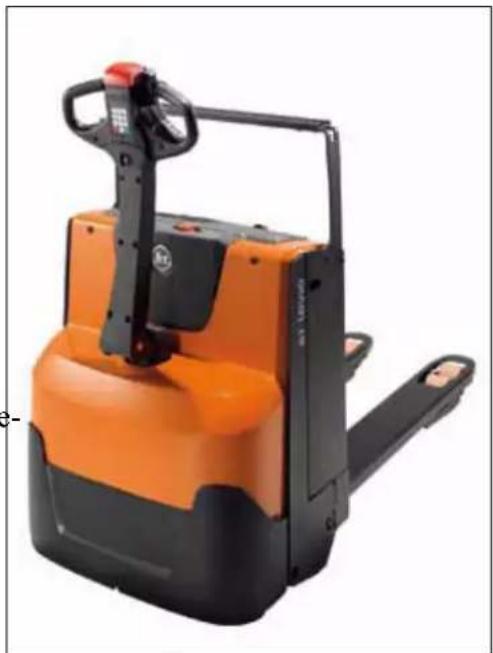
LWE140
- BT Castor link.
- 156 mm narrow fork carriage.
- Chassis width 726 mm.
- Small standard battery compartment only, 150 Ah battery.
- l2 measurement 481 mm.
- Ideal for applications in smaller shops and warehouses.

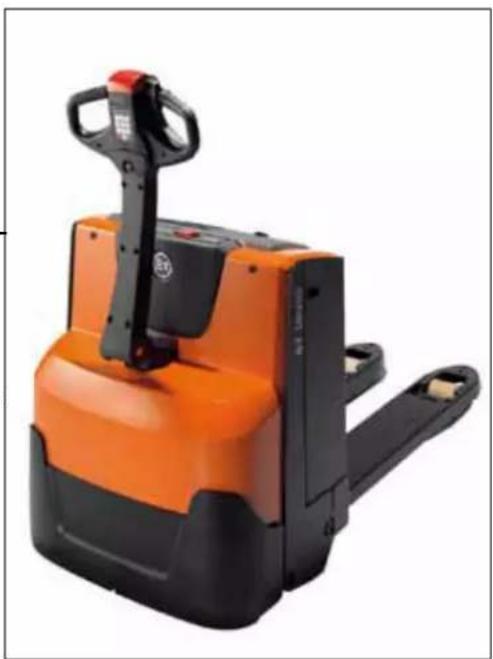
LWE160
- BT Castor link.
- 156 mm narrow fork carriage.
- Chassis width 726 mm.
- Small or medium standard battery compartment, 150/225 Ah battery.
- l2 measurement 481/538 mm.
- Ideal for applications in shops, warehouses and distribution centres.
LWE180
- BT Castor link.
- 180 mm standard fork carriage.
- Chassis width 726 mm.
- Medium or large standard battery compartment, 225/300 Ah battery.
- l2 measurement 538/588 mm.
- Ideal for applications in warehouses and distribution centres.
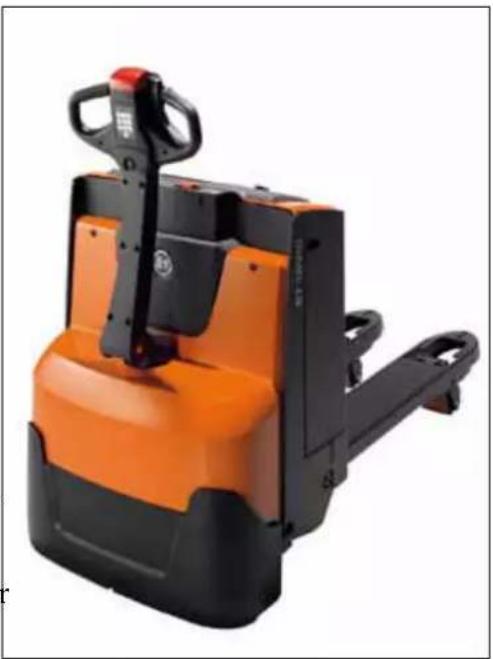
LWE200
- BT Castor link.
- 180 mm standard fork carriage.
- Chassis width 726 mm.
- Medium or large standard battery compartment, 225/300 Ah battery.
- Large battery with battery towards the side, 260 Ah battery.
- 12 measurement 538/588 mm.
- Ideal for applications in warehouses and distribution centres.
- Platform option with optimized tiller arm for longer distances when the driver want the comfort of a stand-on platform.
LWE250
- BT Castor link.
- 180 mm standard fork carriage.
- Reinforced fork carriage.
- Chassis width 726 mm.
- Medium or large standard battery compartment, 225/300 Ah battery.
- Large battery with battery towards the side, 260 Ah battery.
- l2 measurement 538/588 mm.
- Ideal for applications where loads tend to be heavier as in industrial applications.

Applications
Walking
There is always an LWE truck version that is optimised for the application no matter whether this involves loading/unloading of lorries, horizontal transport and/or order picking. These trucks are typically used in warehouses/distribution centres, industrial applications and shops/supermarkets with short to medium transport distances (aprox. up to 50m). The trucks are designed for indoor use with temperatures not falling below 0°C, but they can also be used outdoors on loading docks and lorries. With optional hydraulic oil for low temperatures, the trucks can be used in -35°C.
The wide range of applications, from distribution centres to small warehouses and shops, puts big demands on the trucks. To meet different customer requirements the LWE trucks feature high performance and ease of use.
Riding
LWE200 with platform is preferably used were travel distances are a bit longer and the operator wants to have the comfort of a stand on platform. For more heavy duty applications were the truck is used continuously in a multi shift operation the recommendation is to use a truck from our LPE range.
Because of the wide range of applications from distribution centres and industrial applications to small warehouses and shops, this puts big demands on the trucks. To meet different customer requirements, the LWE trucks feature high performance and ease of use to support staff whose work duties are not limited to only truck operation.

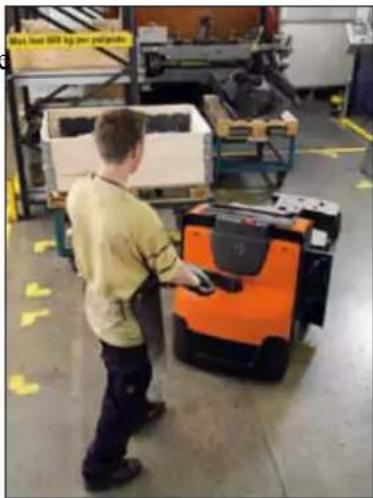
Industry
Industrial applications require trucks with a high level of reliability. Goods must always be in the right place when needed. An increasing trend at many manufacturing companies is to reduce warehouse surfaces and intensify incoming deliveries. Although incoming deliveries may be frequent, usage intensity in these kinds of applications is lower compared to use in warehouses and distribution centres. Nevertheless, the goods handled are often quite heavy. For this type of application, several LWE truck versions can be used especially thanks to the high quality that guarantees the truck is always available when needed. For heavy loads, an LWE250 truck is an excellent choice.
Warehouses/distribution centres
For operation in warehouses and distribution hubs, high productivity is a key factor. Operators are usually adept at truck operation and expect a quick, flexible truck with sturdy design. This is exactly what the LWE trucks offer with the added possibility to adapt operator settings to individual experience.
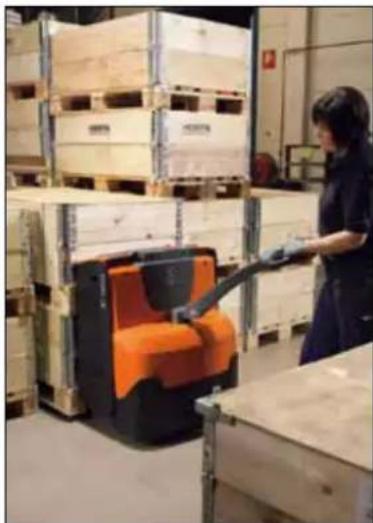
In warehouses and distribution centres, trucks are often used for horizontal transport, loading/unloading and order picking. They are also used to load/unload lorries and trailers outdoors on loading docks and lorry beds.
Shops/supermarkets
In shops and supermarkets, the trucks are often operated by inexperienced staff, and they may even be left unattended on shop floors among customers and children. This environment requires an easy-to-use truck designed to prevent unauthorised use. The LWE trucks feature simple operation, and they have a programmable switch-off timer. If the operator leaves the truck unattended, it will switch off after the programmed time, from one minute to four hours.
In shops and supermarkets, truck use is rarely intensive, however operators want to use the trucks for many different applications, e.g. to unload goods from lorries, transport goods on full, half or quarter pallets and even to handle roll containers. The trucks are also used to pick up products on the shop floor.

Which truck for which application?
The following factors determine which model is suited for a given application:
- Capacity
- Usage intensity
- Travel distances
- Aisle widths
- Ramps/slopes
- Floor conditions
- Load carrier and load centre distance
It is also recommended to explore environmental requirements and future plans, for example to choose a truck that will not become obsolete when the company expands.
Sales arguments
In fall 2007, BT carried out market research with participation from 300 respondents across Europe, all of them potential customers. The results from this survey points to three important criteria for this kind of truck:
- Simplicity
- Safety
- Durability
These three key criteria are interconnected: A truck that is easy to use is also a safe truck. A safe truck cuts down on damaged goods and truck damage, resulting in a durable truck with extended service life.
The main sales arguments for the three identified areas, simplicity, safety and durability, are described in the remainder of this chapter.
Simplicity
These trucks are regarded as a tool. The intention is that both experienced and inexperienced operators should be able to use them. The following features make the LWE series trucks easy to operate:
Manoeuvrability
Feature
- The LWE trucks has a 5-point wheel configuration, i.e. five wheels, and a centrally located tiller arm.
- The tiller arm length is optimised for excellent manoeuvrability.

Benefit
- Central placement of the tiller arm has two benefits: The truck is easy to operate even by inexperienced operators, while the steering angle is the same in both directions enabling easy truck handling in confined areas.
- The design with five wheels, with one in the centre, provides superior truck stability even when driving on ramps.

- Thanks to the length of the tiller arm, the operator has excellent control over truck movements.
Feature
- The LWE series trucks boast a very short l measurement from 478 mm depending on the configuration and selected battery.
- All corners are rounded.

Benefit
- The truck is compact and easy to manoeuvre in confined areas.
- Reduced risk that it will get caught by or knock into obstacles.
View
Feature
The LWE trucks have a well-arranged external design with superior operator view thanks to:
- A compact truck body that is lower on the fork side.
- Optimum distance to the truck with the operator sufficiently close to the truck for an unobstructed view.

Benefit
- Excellent view when picking up pallets/load carriers.
- Excellent view around the machine when goods are being transported or being placed for storage.
Control
Feature
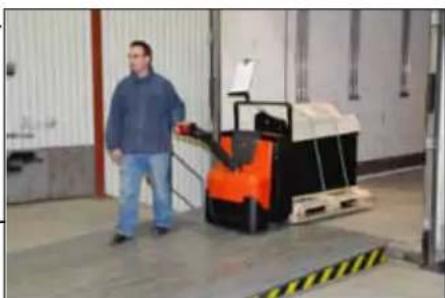
- The trucks are equipped with the BT Powerdrive system, offering quick acceleration and braking.
Benefit
- BT Powerdrive provides quick acceleration and braking for maximum control of truck travel because the truck instantly reacts to operator commands.
Feature
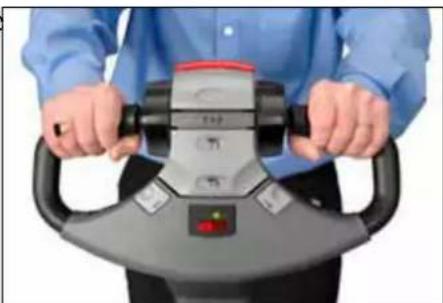
- All LWE trucks have an ergonomic handle with large, easy-to-reach controls and a clear, bright display for truck status confirmation and programming.
Benefit
- The trucks are easy to handle and can be operated with one or two hands. Information on truck status is available at a glance.
Safety
A safe truck prevents injuries and reduces costly damage to goods and the truck. The LWE series trucks come with a number of features that makes them safe in use.
Operator safety
Feature
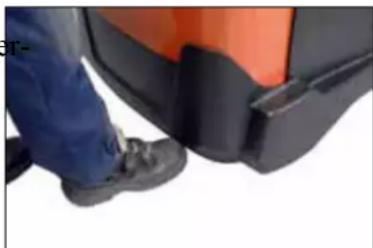
- The distance to the operator's feet is considerable and floor clearance is 35 mm.
- The truck does not roll back unintentionally when starting on an inclination or ramp.
Benefit
- The operator always has safe distance to the truck. This reduces the risk of foot injuries, while the low floor clearance provides added protection in case the operator should get too close to the truck.
- Since the truck does not roll backwards unintentionally when starting uphill, there is no risk it will run over the operator's feet.
Operational adaptable
Feature
- Speed, acceleration, turtle speed and reversing characteristics can be programmed.
- The truck can store up to ten different operator settings.
Benefit
- The truck can be easily adapted to individual operator experience or the intended application. This reduces the risk of accidents.
Durability
A truck that cannot be used costs money. On one hand the truck must always be available when needed in order for business to continue as usual and remain efficient, while on the other hand service costs often represent a significant share of total truck costs during the truck's life cycle. To minimise the risk of an inoperative truck and resulting costly service outlays, the trucks in the LWE series have the following features:
Increased uptime
Feature
On the LWE series trucks, a number of common problem sources that result in downtime have been eliminated thanks to improved truck design.
- All bushings are made from composite materials with Teflon coating to extend the service life and eliminate the need for lubrication.
- AC motor that does not move with the drive wheel – carbon-brushes that wear out and cables that twist have been eliminated.
- The cable connecting the tiller arm to the truck is a spiral shaped cable not affected by bending.
- To prevent entry of dirt, all terminals are insulated.
- No mechanical switches are used; all switches have a non-contact design in an effort to reduce the number of wear surfaces.

- Communication between the steering controls and motor controller relies on a CAN bus. This
type of communication is common in the automotive sector and requires less use of cables in the exposed area between the tiller arm and motor controller.
- The lower part of the chassis has been reinforced to lessen the risk of impact damage on the truck.
- All hydraulic couplings are of quick connection type to almost completely eliminate the possibility of leaks.
Benefit
By designing for durability to eliminate causes of trouble, the following has been achieved:
- Unscheduled downtime that causes business interruptions has been reduced.
- Unnecessary repair costs have been reduced.
- Truck service life has been extended.
Quick and easy service
Feature
In the design of the LWE trucks, a high level of serviceability was a key focus:
- The CAN connector is placed on the tiller arm.
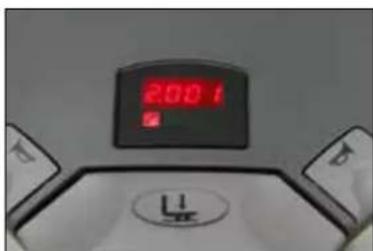
- The display shows error codes.
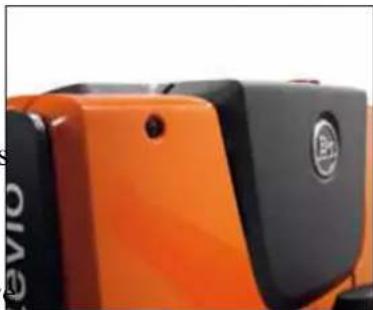
- The cover is made of plastic and secured with two screws.
- The number of components has been considerably reduced.
- The truck is made from standard modules that are shared with several other truck models (e.g. SWE).
- Fixtures are designed to enable use of standard tools.
Benefit
Downtime is reduced as a result of the following:
- When the truck does require service, this process is quick and efficient.
- Prior to his arrival on the site, the service technician can be informed about the existing error codes in the truck.
- Once on site, the CAN connector is easy to access and the cover can easily be removed.
- There are very few parts under the cover, thus enabling quick, easy access. Additionally, only few spare parts and tools are required, further speeding up the service process.
Product details
Operator environment
The LWE trucks are primarily designed for operators walking alongside the truck and not standing on a platform, however, the LWE200 can be ordered with optional platform.
Tiller arm and controls
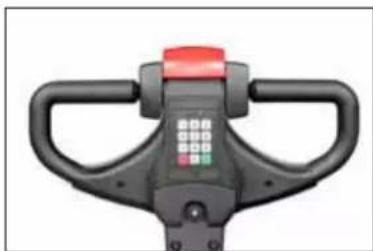
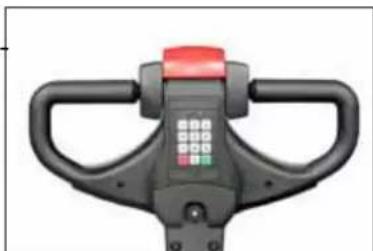
There are two versions of the tiller arm for the LWE series. One is designed for the walkie versions while the other is designed for the platform versions with the operator riding onboard. Both versions use BT's ergonomic handles. On the LWE140 and LWE160, the handle is slightly smaller than on the other versions. Main components and controls are located as follows:
| 1. Battery disconnector and charger connector 6. Travel direction selector and speed control | |
| 2. Tiller arm and brake 7. Safety reversing switch | |
| 3. Emergency switch-off 8. Display | |
| 4. Keypad 9. Control for lifting and lowering the forks | |
| 5. Horn 10. | Creep speed |

Feature
All controls are within easy reach and not placed too close together. The truck and all truck operations can be operated with a single hand, left or right, as preferred.

Benefit
All controls are within immediate reach to reduce the risk of repetitive strain injury while opening up the possibility of productivity gains thanks to improved efficiency. Thanks to the one-hand operation concept, the truck can be easily operated in tight spaces.
In cold environments, the truck can also be operated with gloves.
Starting the truck
Feature
The steering handle can be fitted with two different start up systems.
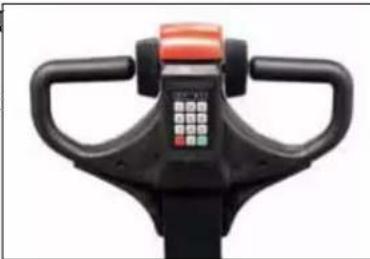
- A keypad for switching on the truck using a PIN code. Up to 100 different PIN codes can be used to start the truck. It is possible to either open up blocks using preselected PIN codes, or user-defined blocks can be programmed with the help of a service technician. PIN codes are assigned to specific operators for individual setting of preferences. Up to ten different operator settings can be stored in the truck, while up to 10 different pin codes can be assigned to each operator setting.
- An ID unit that is activated using an ID key.
This solution requires a key programmer and PC-installed software. This solution is available from BT Service and as an aftermarket option. It is possible to connect as many keys as desired to the same truck, and the same key can be used to start several trucks.
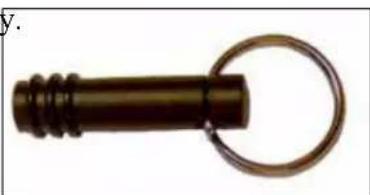
- Programming of operator parameters is done from the truck handle.
It is possible to change the truck's start up system after delivery from the factory.
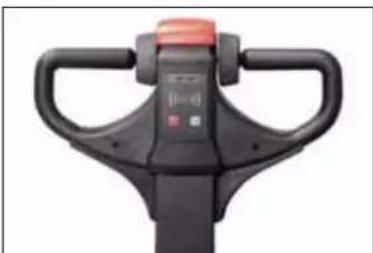
Benefit
No matter whether the truck is protected by a PIN code or ID unit:
- The truck can always be guarded against unauthorised use.
- Up to ten different operator settings can be stored in truck memory.
Some companies prefer a physical key, in case an ID key, for truck access in order to keep track of who is using the trucks, especially in cases where external operators need to temporarily use the truck, while others prefer access via PIN codes that cannot be physically lost like keys.
Tiller arm
Feature
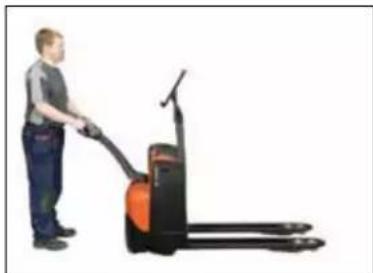
The LWE trucks feature a tiller arm optimised for manoeuvrability and optimum, safe distance to the operator's feet. It is centrally placed and mounted in a low position.
Benefit
Thanks to the long tiller arm, the operator is at a safe distance from the truck. The low mounting of the arm means the grip is at a comfortable height, which is especially appreciated by short persons. The central placement of the tiller arm makes operation of the truck extremely easy, even for inexperienced operators. Thanks to that the steering angle is exactly the same when turning in both directions it is also very easy to maoeuvre the truck in confined areas.
Feature
The maximum steering angle of the tiller arm is +/- 93 degrees.

Benefit
This extended range makes truck handling easy in cramped spaces.
Feature
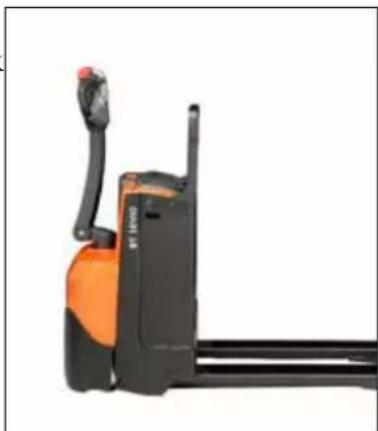
When upright, the arm remains within the truck profile.
Benefit
The tiller arm does not require any space when left in the upright position, a clear advantage in very tight spaces.
Feature
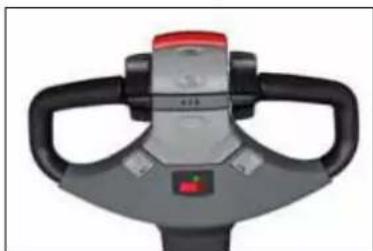
The tiller arm features safety reversing. When the safety reversing switch is pushed, the trucks stops and immediately reverses in the other direction.
Benefit
Safety reversing prevents the operator from becoming pinched between the truck and a wall or other obstacle.
Feature
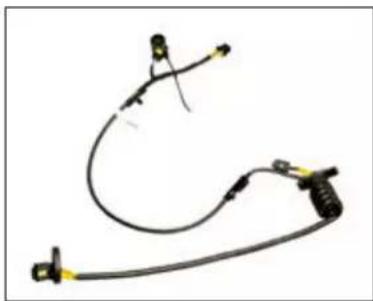
A spiral shaped cable connects in the lower part of the tiller arm.
Benefit
Thanks to the spiral shaped design, the cable is not bent, thus considerably reducing the risk of cable wear in a very exposed truck area.
Emergency stop switch
Feature
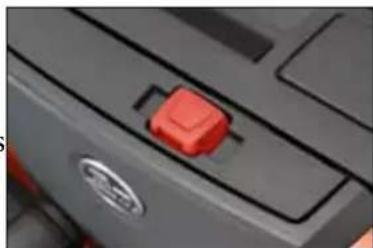
The truck has an emergency stop switch, placed at the highest point. When the emergency stop switch is pushed, the truck brakes and battery power is shut off. The emergency stop switch can be released by pulling it up.
Benefit
The emergency stop switch can be easily activated, e.g. to quickly switch off the truck in case of an accident or other emergency.
Display
The display shows battery status, total travel time and error messages. The display is also used to program operator parameters. Normally, battery capacity is displayed as a percentage (%), but can when needed be replaced by error codes or operator parameters.
Feature
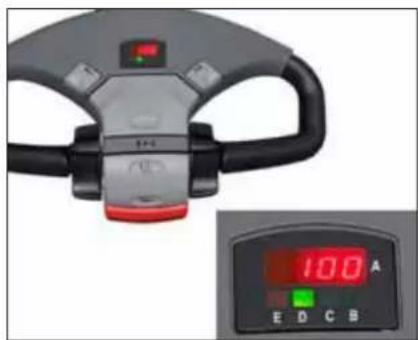
The display provides the following information:
A: Character display – when the power is switched on, the hour meter is displayed initially for a few seconds, while the hour counter indicator lights. After this, the battery capacity is displayed continually together with the battery indicator. If an error should occur, the error code indicator flashes in the display and an error code is shown in the character display.
B: Hour counter indicator – when this symbol lights, the character display indicates total truck use in hours, i.e. the total operating time of the drive and/or pump motor.
C: Parameter indicator – when the parameter control mode is selected (see the chapter on programming and operator settings), this indicator lights. The parameter list can then be verified in the display.
D: Battery indicator – when this indicator lights, battery capacity is displayed as a percentage of full capacity. 100% equals a full charge. At < 10 %, the battery indicator starts blinking. If the battery indicator is allowed to reach 0%, the lift function is blocked to prevent overloading the battery.
E: Error indicator – when this symbol flashes, an error code is displayed in the character display. Error codes are 4-digit codes. The first position shows in which function group the error has occurred. The second position indicates the severity of the error. The severity of the error uses these numbers: 0 = warning, 1–2 = serious error causing the truck to operate at creep speed with lifting/low-ering operations blocked, 4–5 = critical error causing the truck to stop. The third and fourth positions are consecutive numbers describing which area is affected by the error. Whenever an error occurs, it is a good practice to first switch off the truck, disconnect the battery connector and then try to restart the truck. If the error remains after this action, a service technician should be contacted and the error remedied. The truck can store a total of 50 error codes.
Benefit
- The operator can quickly confirm whether something is wrong with the truck, and he can in some cases correct it by restarting the truck.
- If intervention by a service technician is required, he can be informed about what's wrong with the truck before arriving on site.
- It is easy to see when the truck needs charging.
- Thanks to lifting being blocked when the battery symbol on the display shows zero, the risk of excessive battery discharge is reduced.
Battery covers and storage compartments
Two different types of battery covers are available, the standard ABS battery cover and a metal battery cover. The ABS covers are available with three different storage compartment designs depending on battery size and the metal covers are only available without storage compartments.
Feature
The standard battery cover is made of a highly resistant and durable ABS material. The ABS battery cover has a small, closed storage space, a paper holder and a larger storage compartment.
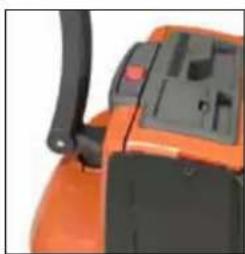
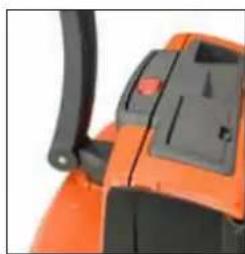

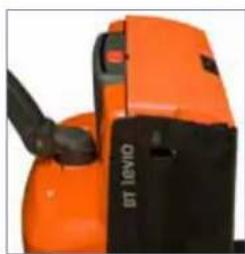
Benefit
This enables the operator to bring along various items needed in his work. The closed compartment has the advantage that items will not fall out, e.g. when the battery cover is opened to charge the battery.
Driving features/programming the truck
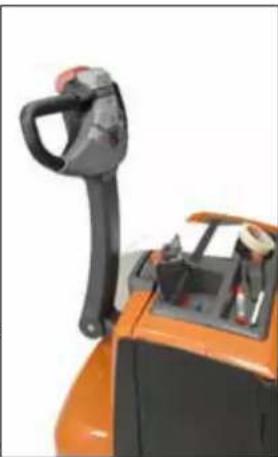
The LWE trucks are highly manoeuvrable and offer individual setting options for the operators. Settings that the operator can change himself are called operator parameters. The trucks also have a machine register in which settings only can be changed by a service technician. Please refer to the service manual for detailed information. Upon delivery from the factory, the trucks are preprogrammed with three different parameter settings. When switched on with PIN 1, the truck offers optimal parameter settings for this truck type, with PIN2 it is switched on in a slower mode and with PIN 3 truck characteristics are set to maximum performance. See all parameters in the parameter table.
Automatic back-up
All parameters are stored in the logic card and the motor controller.
Feature
Each time a parameter is changed, the system automatically backs up the data. This takes approx. 3-5 seconds during which time log-out is impossible. If, for example, the handle in which the logic card is housed needs to be replaced, then the service technician will be asked whether the parameters stored in the motor controller or the logic card should be stored in the new handle. If the technician in this case selects the motor controller, then all existing truck settings will be stored in the new handle.
Benefit
Whenever a component needs replacement, current settings will not be lost. Apart from the operator and service parameters, this also applies to the hour counters.
Operator parameters
To reprogram operator-specific parameters (if the change is permitted), proceed as follows:
- Press the horn button and keep it pressed while starting the truck using either PIN code entry or the ID unit.
- Release the horn button when the display shows "P".
The parameter symbol on the display lights.
- Use the speed control to scroll to the desired parameter.
- Press the horn button once to change the value.
The parameter symbol on the display starts flashing.
- Change the value by turning the speed control.
- Confirm by pressing the horn button once more.
The parameter symbol on the display stops flashing and remains lit.
- Complete programming by pressing "O" (red key) on the keypad or the ID unit.
The following table lists available operator parameters.
Parameters
| No. | Parameter type Unit Min./ | Max. | Slow value | Std. value | Max Perf. | Notes | |
| 4 | Acceleration % 10–100 60 | 80 100 | 10: Slow acceleration | 100: Fast accelerationIn increments of 5 | |||
| 5 | Automatic speed reduction power | % 10– | 100 90 90 | 100 Speed | reduction | when the | speed controlis released to neutral position10: Slow speed reduction100: Fast speed reductionIn increments of 5 |
| 6 | Top speed on % 10–100 90 | 100 100 | 100 10: Lowest top speed setting | 100: Highest top speedsetting In steps of 5There is a pre-set limit so that parameter 7never exceeds parameter 6. | |||
| 7 | Turtle button % 10–100 50 | 50 50 | Press the turtle button | to reduce | speed temporarily. The next time the button is pressed, the speed will revert to the normal parameter 6 value.The display alternately shows battery status and SLO (slow).10: Low speed100: High speedIn increments of 5 | ||
Feature
It is possible to adapt the settings for speed, acceleration and braking characteristics to the operator's level of experience and/or preferences. The truck can store up to ten different settings.
Benefit
By adapting the truck to the operator and/or the application, damage caused by in-experienced operators can be reduced while maximum productivity can be achieved with experienced operators.
Machine register and service parameters
It is possible to see the machine-specific settings in this register, e.g. to confirm service parameters, however, it is not possible to make changes in the register. An example of service parameters are: service interval (time interval when the truck signals service is required), automatic switch-off, battery type settings (to achieve optimum battery discharge), and Creep speed.
Proceed as follows to confirm settings in the operator and machine-specific register:
- Press the horn button and keep it pressed while starting the truck using either PIN code entry or the ID unit.
The display then shows the various functions:
Operating hours and time remaining until next service (H)
Error codes (E)
Parameters (P)
Hardware and software version numbers (Pn)
- Release the horn button at the required display.
- To scroll between the settings for each mode, turn the speed control.
Automatic switch-off
For more information regarding automatic switch-off, see the Service manual.
Feature
A service technician can set the desired time interval for truck switch-off in case the truck is left unattended. This time can be set to either 4 h or in the range of 1-20 minutes in increments of one minute.
Benefit
The truck can be optimised for use in special settings. In surroundings with many people, the time can be set very short to ensure unauthorised persons cannot operate the truck when the operator sometimes need to leave it unattended to take care of other tasks, while in settings with no unauthorised people the time can be set to a longer interval to prevent the truck being switched off before the operator returns.
Creep speed
This feature switches truck travel to inching speed and permits truck travel with the tiller arm in the upright position. It is activated by quickly moving the travel direction selector (R) two times forwards or backwards. When this function is engaged, "SLO" blinks in the display. The function can be cancelled by once again quickly moving the
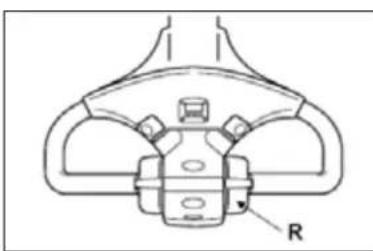
travel direction selector (R) two times in either direction or by 10 seconds of inactivity. The feature is also disabled if the safety reversing button is actuated. Inching speed is 1.7 km/h. A service technician can block this feature to prevent inching speed operation, however, by default the Creep speed mode can be activated by the operator.
Feature
Creep speed enables truck travel at creep speed with the tiller arm in the upright position and without any need to push buttons.
Benefit
The truck can be manoeuvred in confined areas. Because the function works without any need to push buttons, the operator has both hands free to steer the truck.
Brakes
During normal travel, the motor is used to brake the truck, however, it also has an electromechanical parking brake which is applied whenever the truck is not in use. The parking brake can be released by to screws. See service manual for more information.
Feature
When starting uphill or in an inclination, the forward travel mode can be selected without any risk of the truck rolling backwards when the brakes are released. In this case, the motor controller ensures the truck is kept stationary.
Benefit
It is always safe to start the trucks in inclinations. The operator does not risk having the truck roll over his feet.
Feature
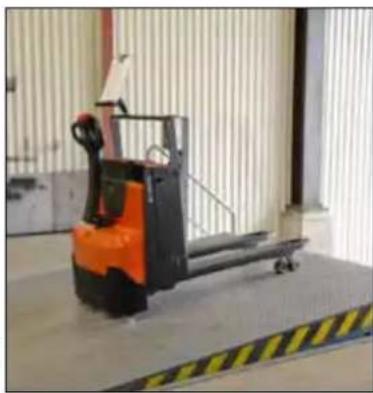
When the tiller arm is in the upright position, the parking brake is applied. The arm automatically returns to upright position when it is released.
Benefit
The parking brake is applied as soon as the operator leaves the truck.
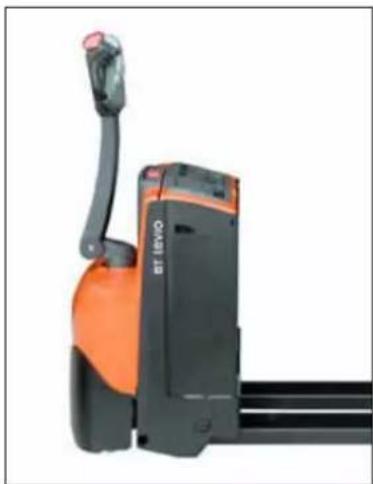
Feature
When the arm is pushed down, the parking brake is released.
Gentle braking when the arm is pushed all the way down.
Benefit
It is always easy to brake the truck.
Braking is more gentle and can be regulated by the operator.
Feature
When the speed control is released to the neutral position or when the travel direction changes, the motor brake is automatically applied.
Benefit
This makes truck travel more gentle and reduces brake plate wear.
Feature
During normal truck travel when the motor is used to brake the truck, energy is regenerated and returned to the battery every time the truck brakes. By converting kinetic energy this way, the motor is basically used as a generator.
Benefit
Regeneration of kinetic energy makes the truck more energy efficient.
Motor and power pack
The LWE trucks feature BT Powerdrive and use AC drive motors and DC pump motors. The reason for using a DC motor for pump operation is primarily to enable use of a less complicated motor controller compared with an AC motor.
Motor controllers
Two different motor controllers are used on the LWE trucks: 165 A and 220 A versions. The LWE200 with platform option and LWE250 use a motor controller rated at 220A, while the other LWE trucks use a motor controller rated at 165 A.
Feature
Motor controllers with IP 65 classification.
Benefit
The high IP classification of the motor controllers means they are well protected against water and dust penetration.
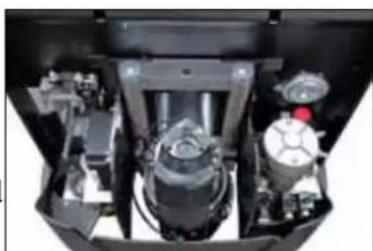
AC drive motor
The size of the motor depends on the truck:
- The LWE140, LWE160 and LWE180 use 1.0 kW drive motors.
- The LWE200 and LWE250 use 1.5 kW drive motors.
Feature
The drive motor is permanently mounted, and the motor does not move when the drive wheel turns. However, as a result of suspension movement of the drive wheel, the motor can move slightly up and down.
Benefit
This reduces wear on cables and allows a compact truck design since the space usually used to allow cable twisting has been eliminated.

Feature
Gear box oil is synthetic with the following features:
- Excellent lubrication properties, even at low temperature.
- API GL-5 quality class rating – the oil is estimated to last for 10 000 usage hours.
Benefit
- Thanks to the excellent lubricating properties of the oil, energy loss is reduced improving overall energy consumption.
- Because the oil never needs to be replaced, the gearbox is maintenance-free.
Feature
Unlike a DC motor, an AC motor does not have any carbon brushes.
Benefit
Thanks to no use of carbon brushes that wear out, the service requirements have been reduced.
BT Powerdrive system
The BT Powerdrive system on the LWE series is a unique combination of contactless controls, CAN bus communication (CAN = Controller Area Network) and AC drive motor.
Feature
Contactless controls
Benefit
High reliability and reduced downtime thanks to the reduced number of moving parts and wear points.
Feature
CAN bus communication - digital communication between different system parts.
Benefit
Provides quick, reliable information with few cables.
![graph TD A["Switches<br>Potentiometer"] --> B["Connection board"] B --> C["Motor controller"] C --> D["Motor"] E["Traditional Drive Systems"] --> F["Motor"] G["Wear points"] --> H["Electrical cables"] I["Magnetic sensors"] --> J["Logic board<br>(the "brain")"] J --> K["Motor controller"] K…](/content/2026/07/1417834/images/7e9623b77ae4184433be6723b00c73bf6909a4d06d503d06c6169c79f5b09807.jpg)
Feature
Thanks to BT Powerdrive, the trucks are easy to program (please refer to the programming chapter above).
Benefit
The truck can be adapted to the operator's level of experience and preferences, resulting in improved safety and increased production.
Drive wheel
The drive wheel diameter is 230 mm. The LWE models offer four different material types.
Drive wheel material
The choice of drive wheel is a matter of balancing price, road holding characteristics and load handling performance. Four different types of materials are available: Topthane, Vulkollan, Powerfriction and Vulkollan mixed with sand. The wheel material can be freely chosen for any truck. The choice of wheel should be made depending on intended load, usage intensity and the application.
1. Vulkollan
Feature
Vulkollan is a hard-wearing wheel rated for very high loads. It is an ideal choice in heavy-duty applications.
Benefit
Clear benefits are the high loads it can handle and resistance to extreme wear. For trucks that travel long distances with heavy loads and considerable physical exposure, this wheel material is the best choice.
2. Topthane
Feature
This wheel is intended for normal load handling, and has a slightly lower friction coefficient compared to Powerfriction.
Benefit
Topthane wheels provide good grip and offer normal load handling characteristics at a lower price than Powerfriction wheels.
3. Powerfriction
Feature
All models can be ordered with Powerfriction drive wheels. This is a non-marking material with high friction coefficient.
Benefit
Powerfriction provides excellent grip, even on moist surfaces, and has superior wear characteristics. It does not leave marks on floors.
4. Vulkollan Quartz
Feature
This wheel has quartz sand mixed in the tread, causing a sand paper effect that results in slight wear on the surfaces on which the truck travels.
Benefit
Clear benefits are the high loads it can handle and resistance to extreme wear. Thanks largely to the sand in the thread, the wheel has an excellent grip, and this type of wheel is an obvious choice e.g in fishing wharfs and slaughterhouses.
5. Treaded Powerfriction
Feature
Drive wheel for coldstore or wet environments.
Benefit
Superior grip as tread pushes out the water and maximises contact to the floor.

Drive wheel bracket
All models feature fixed mounting of the drive wheel with suspended castor wheels. For details, please refer to Castor wheels and BT Castor link.
Feature
The LWE trucks have a 5-point wheel configuration with the drive wheel in the centre. Thanks to the central placement of the drive wheel, the tiller arm is also centred.

Benefit
Because of the central placement of the drive wheel, the machine does not pitch when the wheel regains its grip after spinning, e.g. on wet floors and ramps. With a drive wheel placed off-centre, considerable lateral movement can occur in these situations. The central placement of the tiller arm makes it easier for inexperienced operators to handle the truck and ensures optimum view to both sides.
Feature
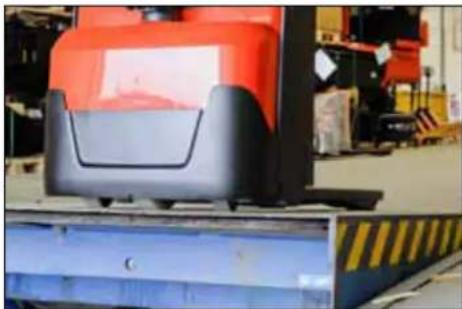
The drive wheel is placed closed to the compression-moulded frame.
Benefit
Thanks to the drive wheel placement and the contour of the lower part of the frame, the truck can easily travel across uneven surfaces and on ramps.
Electronic components
A general design objective of the LWE series, was to use as few electric components and cables as possible, while remaining parts are optimally protected against dirt, humidity, impacts, etc.
Feature
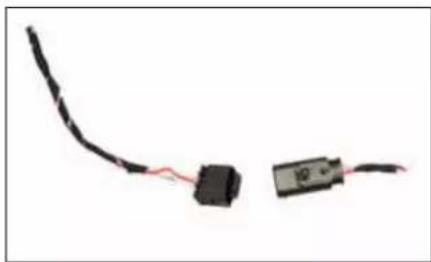
MQS (Micro Quadlok System) terminals are used throughout. The MQS line is designed to withstand humidity and vibrations. The connector is completely sealed, while the electrical connection is mechanically secured in several ways. MQS terminals are used in the automotive sector by leading manufacturers with positive results.
Benefit
Communication is safe and reliable even in severe use.
Feature
The truck models in the LWE and SWE series share many common cables and components.
Benefit
This simplifies service procedures and parts replacement becomes easier.
Feature
Instead of plastic ties, cables run in cable ducts.
Benefit
This is a quality improvement since all machines are the same without any risk of plastic ties that abrade and wear out cables.
Feature
All contactors are cadmium-free. Cadmium is one of the most toxic heavy metals used in the manufacturing industry today. In humans, this substance primarily causes kidney damage, while in large amounts, it is poisonous to all forms of life.
Benefit
By refraining from use of cadmium, the environment is spared potential spreading of this toxic substance.
Cover
Feature
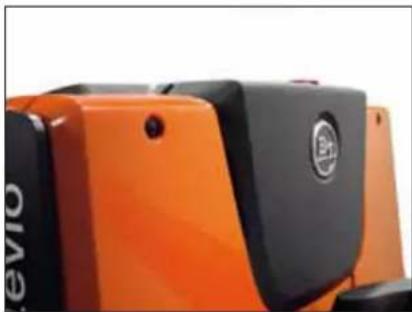
The cover is made of a highly resistant ABS material and is secured with only two screws.
Two different covers exist, one for the walkie models and one for trucks with the platform option.
Benefit
The cover is easy to remove and provides easy access to truck components. This simplifies and speeds up service interventions. The resistant design reduces downtime and eliminates the need for unnecessary repairs.
Chassis
The chassis width on all LWE trucks is identical. The chassis is reinforced and designed not to be caught by or knock into obstacles.
Feature
Chassis width is 726 mm
Benefit
The narrow chassis design is a prerequisite for an optimum view of the entire truck and easy manoeuvrability.
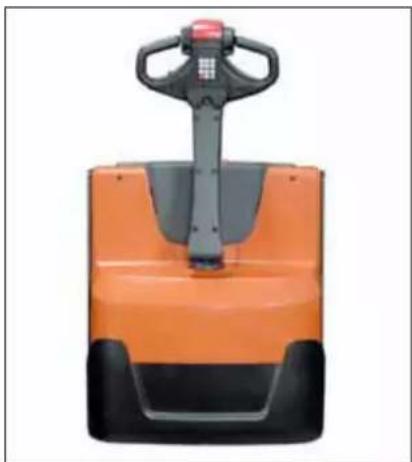
Feature
The castor wheels always swing inside the truck profile.
Benefit
This reduces the risk of injury to the operator's feet and damage to the goods.

Feature
The lower part of the frame is compression-moulded.
Benefit
The moulding makes the truck more rigid while it absorbs impacts in an area where it is most needed, thus protecting the various truck functions.
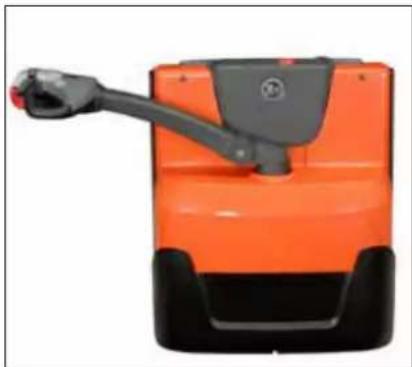
Feature
Floor clearance, i.e. the distance between the floor and bumper, is 35 mm.
Benefit
This short distance protects the operator's feet from being run over by the truck wheels.

Feature
All corners are rounded.
Benefit
This provides excellent manoeuvrability in confined areas and reduces the risk of impact and the truck becoming caught in obstacles.

Castor wheels
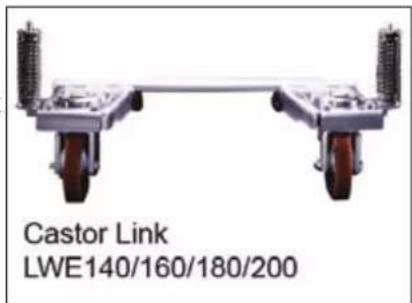
The castor wheels have a width of 50 mm. It is possible to select between Vulkollan and Polyurethane as castor wheel material. Depending on the application, the load on the wheel suspension is handled differently. 3 different types of BT Castor Link are available, but they all rely on the same basic principle.
BT Castor Link
This system was developed to ensure sufficiently high drive wheel pressure and prevent spinning wheels when the truck travels without load while also providing high lateral stability under heavy loads.
The BT Castor Link system relies on two castor wheels suspended by individual springs. These are interconnected by a torsion tube causing the springs to interact and continuously accepting identical loads.
Available on LWE140, LWE160, LWE180, LWE200
LWE200 with the optional operator platform and LWE250 have unique variants of the BT Castor Link system called BT Power Link. This system is a new active hydraulic castor wheel suspension which ensures good stability and easy steering when handling heavy loads. The operating principle is the same as above, however on these trucks two additional springs and two hydraulic cylinders have been added. The hydraulic system will put more pressure on the castor wheels when the pressure increases on the forks, i.e. more load on the forks gives
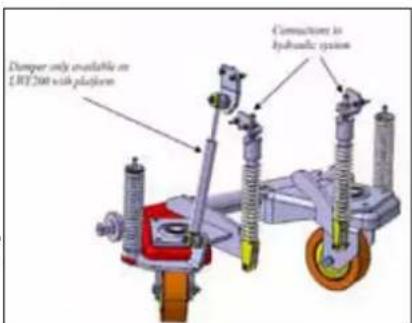
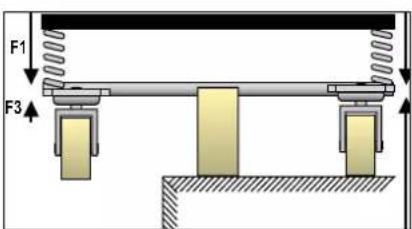
stiffer castor wheel suspension. This also means that the drive wheel pressure is reduced and an easy steering is maintained even with heavy loads on the forks. LWE200 with the optional operator platform uses an added cylinder for dampening movement and further increase the stability for the platform version.
Available on all LWE200 with platform option and LWE250 with fork lengths 1170-1500 mm (U=310 mm) and 1950-2050 mm (U=310 mm).
Feature
When the truck turns or passes a bump, pressure increases on one castor wheel as a result of compression of the spring. Thanks to the torsion tube, the other spring will compress by an identical amount.
Benefit
The truck remains stable and will never start to rock and travel like a 'walking duck', a classic phenomenon when spring forces do not interact.
Feature
When one castor wheel passes a hole or ends up outside a ramp, the torsion tube prevents the spring from extending more than the spring suspending the wheel resting on the surface.
Benefit
In an extreme case, when one castor wheel for example loses its footing outside a ramp edge, there is no risk the wheel suspension assembly will be knocked apart when the wheel regains its footing. This is because the wheel that has lost its footing and become unloaded remains at the same height as the wheel resting on the ramp/surface. With a conventional wheel design, this kind of situation often causes damage to the castor wheel mount.
Material
Two wheel materials are available: Vulkollan and Polyurethane.
Feature
Vulkollan is a hard-wearing material with good physical properties. Polyurethane is a slightly cheaper alternative designed for less intensive applications:
Benefit
For more rough applications, the castor wheels are always in a wear-proof material that will last longer, while still offering the possibility of selecting a more economical option when required.
Fork carriage
As far as the fork carriage is concerned, all bushings and axles, both classic problem sources, have been improved. This chapter describes these parts together with the forks and fork wheels.
Two fork carriages are used, narrow and standard.
Feature
Narrow fork carriage with 156 mm wide forks.
Benefit
The narrow fork carriage offers easy pallet entry/exit, a clear advantage in low and medium intensive applications, even in confined areas where good manoeuvrability is demanded.
Available on: LWE140, LWE160.
Feature
Standard fork carriage with 180 mm wide forks.
Benefit
The standard fork carriage is more robust than the narrow fork carriage. This is a plus in medium and high intensive applications where priority is on higher load capacities.
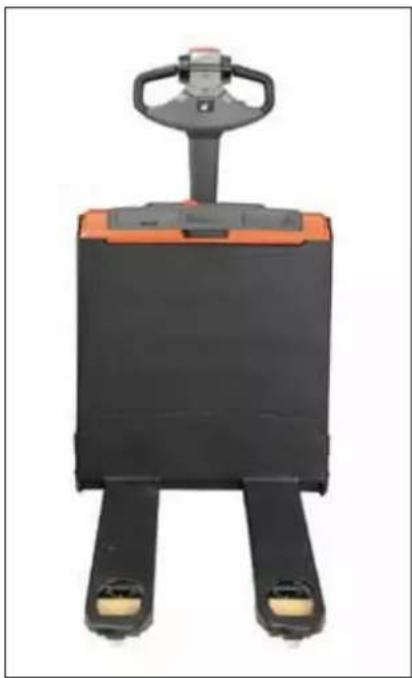
Available on: LWE180 and LWE200
Feature
Reinforced standard fork carriage with 180 mm wide forks
Benefit
The standard fork carriage is reinforced at the base of the fork carriage. This is an advantage in high intensive operations where priority is on very heavy load capacities.

Available on: LWE250.
Axles and bushings
Because bushings and axles are highly vulnerable parts, new high-quality materials have been developed for the LWE and SWE truck series. The results from truck life cycle tests have been very positive.
Feature
The bushings are made from Teflon-coated composite material.
Benefit
Teflon-coated composite bushings offer extended length of service and do not require lubrication.
Feature
The axles are tempered or hardened.
Benefit
This design enables them to withstand any kind of environment and interact optimally with the bushings.
Feature
Zinc coated axles combined with nylon bushings, only on forks wheels
Benefit
This is a cost effective, proven technology for low and medium applications. The fork carriage is common with the LWE130 and the Hand Pallet Truck.
Available on: LWE140, LWE160
Fork wheels
The fork wheel diameter is 85 mm and is available in two different designs, single wheel or bogie wheel.
Feature
The single wheel design relies on one wheel in each fork.
Benefit
The single wheel provides good manoeuvrability and facilitates easy positioning of the forks during long side handling of pallets.
Feature
The bogie wheel design features two wheels in each fork.
Benefit
Bogie wheels can more easily climb over uneven surfaces and they can manage heavy loads.
Battery compartments, batteries and chargers
When selecting the battery, these aspects should be considered:
- Physical limitations of the battery compartment – information on battery compartment sizes is available in the Technical information chapter.
- Minimum and maximum weight -- these weights are indicated in the Technical information chapter. Especially for stackers, the minimum permitted weight is important since it affects truck stability.
- Intended truck application – for lower intensity operations, a smaller battery should be chosen, while for higher intensity operations, a larger battery is required. If a low-capacity battery is selected for intensive applications, battery capacity will be insufficient.
To obtain maximum usefulness from the battery, it is important to select a charger optimised for the battery and the intended application.
Battery compartment
There are two different battery compartment types:
- The standard compartment with vertical battery replacement. This compartment is available in three sizes: small, medium and large.
- A compartment with lateral battery replacement, relying on rollers at the bottom of the battery compartment. It is only available for the large battery compartment. The height to the rollers is 215 mm.
For more information on dimensions and compartments sizes for the various truck models, please refer to the Technical information chapter and the initial chapter in this guide.

Feature
It is possible to select a desired battery compartment size. On the larger models, battery replacement to the side is available as an option.
Benefit
The truck can be optimised for the intended application. For higher intensive applications, lateral battery replacement is a recommended option.
Feature
All models have a sloping power unit.
Benefit
This way, the operator has an excellent view in the fork direction.
Types of battery
The old batteries used on the predecessors, the LWE models in the Orion range, can still be used. This, however, does not apply to lateral battery replacement, since the height of the new battery is lower and a different battery securing system has been introduced.
Two types of batteries can be used to power the LWE series trucks: Freely ventilated batteries (lead-acid) available in all sizes, and ventilated batteries (GEL batteries). The valve-regulated batteries are manufactured by Hawker (GEL Evolution) and are available in medium and large sizes.
Feature
The customer can choose between different battery types
- Freely ventilated batteries – provide high energy capacity, require maintenance by replenishing water, generate oxy-hydrogen gas during charging, have lower price compared to valve-regulated batteries.
- Valve-regulated batteries – have lower energy capacity compared to freely ventilated batteries, are more expensive, do not require water replenishment, present no risk of leaking electrolyte, generate almost no oxy-hydrogen gas during charging, require a regulated charger (see the chapter on chargers).
Benefit
The customer can choose the battery that is best suited for the application.
- In case the customer puts priority on high energy capacity at a low price, then freely ventilated batteries is the obvious choice.
- If the customer instead wants a battery that does not require special charging rooms and maintenance, the valve-regulated batteries can be recommended.
Battery connector and charging
To charge the battery, disconnect the battery connector and connect it to the battery charger. The battery connector should also be disconnected in the following situations to cut the power supply:
• In the event of an accident.
- In connection with welding work.
- If the truck will not be used for 3 days.
Feature
The battery connector has an integrated cable bracket.
Benefit
The cable bracket prevents damage to cable leads when the battery connector is disconnected.
For further instructions on maintenance of the battery and charger as well as change of battery, see Technical information.

Charger
A wide choice of battery chargers is available on the market. These chargers can largely be divided into two types: Conventional transformer chargers, typically unregulated, and High Frequency (HF) chargers with regulated operation and thus a possibility to control the charging process.
The charger must be adapted to the battery. If GEL batteries are used, a regulated charger suited for GEL battery charging must be used. Additionally, for uninterrupted battery warranty cover, battery manufacturers require that a charger approved by them is used. Lead-acid batteries are not as sensitive in terms of charger selection.
Feature
Different types of chargers provide different characteristics:
- Conventional, unregulated chargers are sensitive to line voltage fluctuations. As a result, the charging duration can vary, however, these chargers are cost-effective.
- HF chargers are not as sensitive to fluctuations in the line voltage, and they are able to carefully control the charging process and as a result the charging duration.
Benefit
The choice of charger best suited for the intended application depends on the following:
- If cost is a key issue, a conventional charger with Wa characteristics can be used.
- If the charging duration is decisive (e.g. 8 hours or less), then an HF charger is preferable
Technical information
Dimensions and performance figures
x measurement
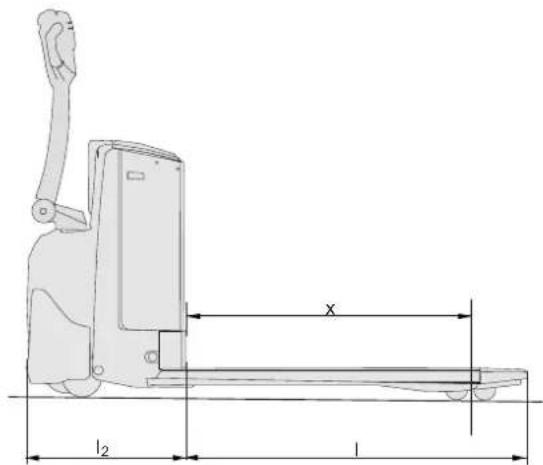
The x measurement is the distance back of fork to the fork wheel centre. For trucks with bogie wheels, it is measured from back of fork to fork bogie-wheel centre. Usually this measurement is available in the Product information.
l measurement
The 1 measurement is the Total fork length.
l2 measurement
The I2 measurement is the Truck length including back of fork.
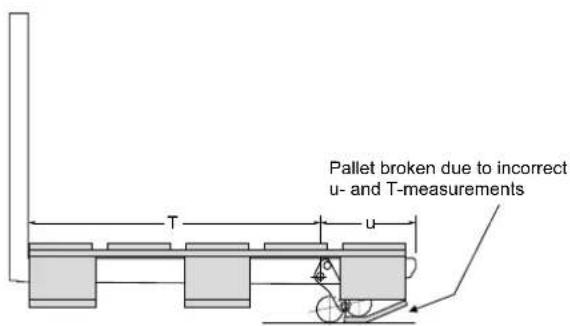
u measurement
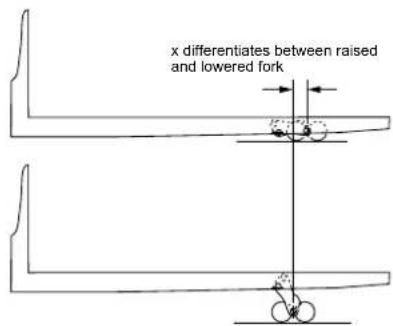
The u measurement is the distance between fork tip and the wheel-fork pivot point.


T measurement
The measurement from back of forks to the wheel fork pivot point is called the T measurement. The T measurement can be calculated with the formula:
T = l - u
As an example the u and T measurements are important for long side handling of pallets. With incorrect u and T measurements, the fork wheels will not fit between the pallet legs. As a result, the truck will crush the pallet during lift operation.
p measurement
The p measurement is also a measurement that can be used to determine placement of the fork wheels.
The p measurement is described as the distance from fork tip to front face of fork wheel, fork down.
| Single wheel, 85 mm Bogle wheel, 85 mm | |
| LWE140/160 Narrow forks p=u-164 p=u-221 | |
| LWE180/200/250 Standard forks p=u-158 p=u-203 |

Standard fork length tables
LWE140/160
| Fl u T X down, Fl-u+119 X up, Fl-u+64 | ||||||||
| 810 | 285 | 525 | 644 | 589 | ||||
| 910 | 285 | 625 | 744 | 689 | ||||
| 965 | 320 | 645 | 764 | 709 | ||||
| 1000 | 320 | 680 | 799 | 744 | ||||
| 1070 | 320 | 750 | 869 | 814 | ||||
| 1120 | 285 | 835 | 954 | 899 | ||||
| 1150 | 285 | 865 | 984 | 929 | ||||
| 1200 | 320 | 880 | 999 | 944 | ||||
| 1220 | 320 | 900 | 1019 | 964 | ||||
| 1370 | 285 | 1085 | 1204 | 1149 | ||||
| 1450 | 285 | 1165 | 1284 | 1229 | ||||
| 1520 | 285 | 1235 | 1354 | 1299 | ||||
LWE180/200/250
| Fl u T X down, Fl-u+116 X up, Fl-u+59 | |||||||
| 800 | 310 | 490 | 606 | 549 | |||
| 850 | 310 | 540 | 656 | 599 | |||
| 900 | 310 | 590 | 706 | 649 | |||
| 950 | 310 | 640 | 756 | 699 | |||
| 1000 | 310 | 690 | 806 | 749 | |||
| 1050 | 310 | 740 | 856 | 799 | |||
| 1070 | 310 | 760 | 876 | 819 | |||
| 1100 | 310 | 790 | 906 | 849 | |||
| 1150 | 310 | 840 | 956 | 899 | |||
| 1200 | 310 | 890 | 1006 | 949 | |||
| 1220 | 310 | 910 | 1026 | 969 | |||
| 1450 | 310 | 1140 | 1256 | 1199 | |||
| 1550 | 630 | 920 | 1036 | 979 | |||
| 2000 | 310 | 1690 | 1806 | 1749 | |||
| 2150 | 780 | 1370 | 1486 | 1429 | |||
| 2350 | 780 | 1570 | 1686 | 1629 | |||
e, b5 and b50 measurements
| LWE140 LWE160 LWE180 LWE200 LWE250 | ||||||||
| h13 | 85 X | X | X | X | X | |||
| h23 | 205 X | X | X | X | X | |||
| e 156 | X | X | ||||||
| 180 | X | X | X | |||||
| b5 | 450 | X | X | X | X | |||
| 520 | X | X | X | X | ||||
| 536 | X | X | X | X | ||||
| 550 | X | X | X | X | ||||
| 570 | X | X | X | X | ||||
| 685 | X | X | X | X | ||||
| b50 | 450 | 138 | 138 | 90 | 90 | 90 | ||
| 520 | 208 | 208 | 160 | 160 | 160 | |||
| 536 | 224 | 224 | 176 | 176 | 176 | |||
| 550 | 238 | 238 | 190 | 190 | 190 | |||
| 570 | 258 | 258 | 210 | 210 | 210 | |||
| 685 | 373 | 373 | 325 | 325 | 325 | |||
h13 measurement, height of fork in lowered position
h23 measurement, height of fork in raised position.
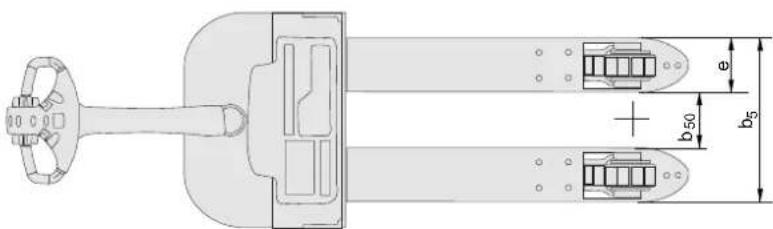
e measurement, fork width
b5 measurement, width over forks
The b5 measurement is referred to as the width over forks. This measurement must suit the pallets to be handled by the truck.
b50 measurement, width between forks
Wa , turning radius
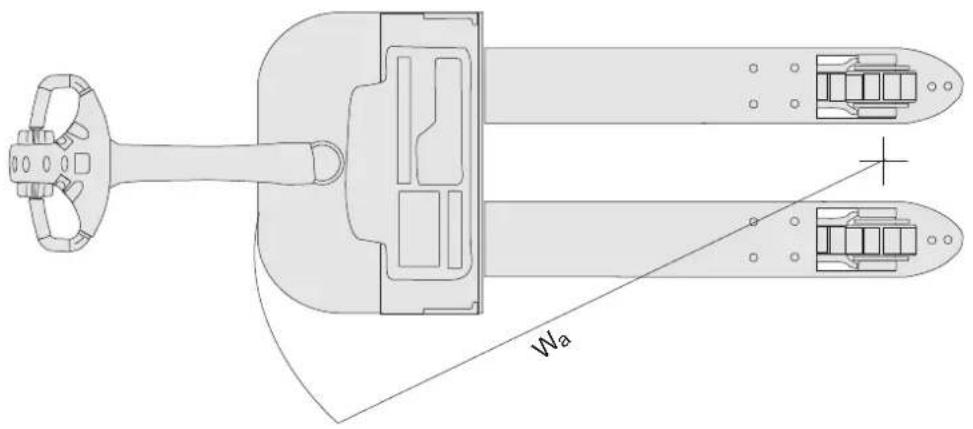
The turning radius is the necessary Distance to turn the truck around a virtual point referred to as the turning centre with forks raised. The product information provides Wa measurements for all LWE truck versions.
Ast – Aisle width requirement
The aisle width requirement can be described as the space required by the truck to pick a pallet from a pallet rack, reverse out in the aisle, turn and proceed down the aisle.
The formula, according to VDI, used to calculate the aisle width requirement (in millimetres) is:
Ast (with raised forks) = Turning radius + (length of pallet - distance between back of fork to fork wheel centre) + safety distance
or
A _ st = W _ a + (L - x) + 2 × 1 0 0
Note: If the length of the pallet is shorter than the length of the fork, then the pallet must be substituted by the total length of the fork. In this formula, the safety distance is assumed to be 2 x 100 mm.
Aisle width requirements
Truck Battery comp. Wa Ast Aisle width for pallets:
LWE140 small 1420 1842 1000x1200 longside handling
small 1420 1892 800x1200 shortside handling
Truck Battery comp. Wa Ast Aisle width for pallets:
LWE160 small 1420 1842 1000x1200 longside handling
small 1420 1892 800x1200 shortside handling
medium 1477 1899 1000x1200 longside handling
medium 1477 1949 800x1200 shortside handling
Truck Battery comp. Wa Ast Aisle width for pallets:
LWE180 medium 1447 1899 1000x1200 longside handling
medium 1447 1949 800x1200 shortside handling
large 1496 1948 1000x1200 longside handling
large 1496 1998 800x1200 shortside handling
Truck Battery comp. Wa Ast Aisle width for pallets:
LWE200 medium 1447 1899 1000x1200 longside handling
medium 1447 1949 800x1200 shortside handling
large 1496 1948 1000x1200 longside handling
large 1496 1998 800x1200 shortside handling
large sideways 1496 1948 1000x1200 longside handling
large sideways 1496 1998 800x1200 shortside handling
Truck Battery comp. Wa Ast Aisle width for pallets:
LWE250 medium 1447 1899 1000x1200 longside handling
medium 1447 1949 800x1200 shortside handling
large 1496 1948 1000x1200 longside handling
large 1496 1998 800x1200 shortside handling
large sideways 1496 1948 1000x1200 longside handling
large sideways 1496 1998 800x1200 shortside handling
Calculating Ast according to the standard, LWE range
- The values are from the Product information sheet for LWE200.
Standard: Ast = 1447 + (1200 - 898) + 2 × 100
A _ st = 1 9 4 9
Length of pallet must be substituted by total fork length
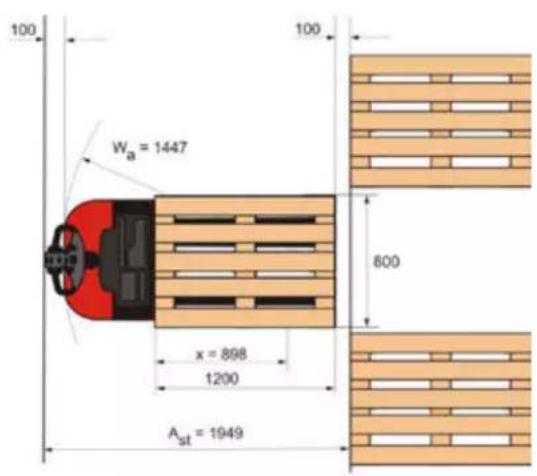
Standard: Ast = 1447 + (1150 - 898) + 2 × 100
A _ st = 1 8 9 9

Pallets and pallet sizes
Euro pallet
- Outer dimensions:
800 × 1200 mm
●Pallet height: 144 mm
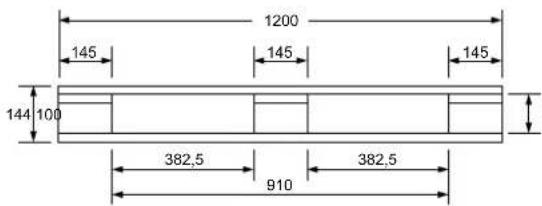
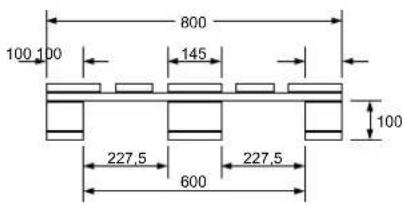
●Height, fork entries: 100 all four sides
•Corners: 45°
●Pallet weight: approximately 27 kg
●Nominal dynamic load capacity: 1000 kg
●Nominal static load capacity: 1500 kg
●Other outer dimensions available: 600 × 800 mm.
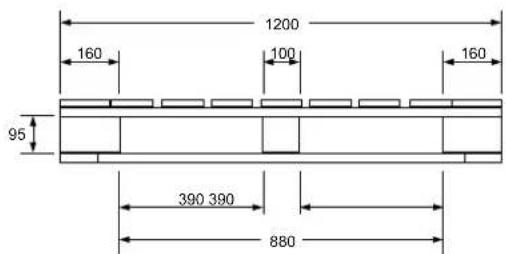
Chep pallet (UK version)
- Outer dimensions:
1000 × 1200 mm
●Pallet height: 162 mm
●Height, fork entries:
120 mm short side handling 95 mm long side handling
- Corners: 45°
●Pallet weight: approximately 31 kg
●Nominal dynamic load capacity: 1250 kg
●Nominal static load capacity: 1750 kg

Choosing the optimal fork specification
When forks suited for a pallet or a specific roll container, these items should be considered:
- The 5 bmeasurement must suit the pallet /roll container to enable positioning of the forks between the pallet legs or between the wheels of the roll container.
Example: With Width over Forks 450 mm and Fork Width 180 mm, only 90 mm remains between the forks and the truck will not be able to handle Euro pallets or Chep pallets.
It is very important to clarify which load carriers will be used in the application and whether they will be handled long side or short side.
Handling of roll containers 700 mm x 800 mm (L x W)
| Recommended fork specifications Number of roll containers | |
| FL 1450 mm | 2 |
| FL 2150 mm 3 | |
Application for different fork lengths
LWE180/LWE200/LWE250
| Euro pallet Chep pallet | ||||||||||
| Fork length | T U Long side Short side Long side Short side | |||||||||
| measurement 1 pallet 2 pallets 1 pallet 2 pallets 1 pallet 2 pallets 1 pallet 2 pallets | ||||||||||
| 800 310 | 490 | + | ||||||||
| 850 310 | 540 | ■ | ||||||||
| 900 310 | 590 | ■ | ||||||||
| 950 310 | 640 | ■ | + | |||||||
| 1000 | 310 | 690 | ■ | + | ||||||
| 1050 | 310 | 740 | ■ | ■ | ||||||
| 1070 | 310 | 760 | ■ | ■ | ||||||
| 1100 | 310 | 790 | ■ | ■ | ||||||
| 1150 | 310 | 840 | = | + | ■ | + | ||||
| 1200 | 310 | 890 | = | + | ■ | + | ||||
| 1220 | 310 | 910 | = | = | ■ | ■ | ||||
| 1450 | 310 | 1140 | = | = | = | ■ | ||||
| 1550 | 630 | 920 | = | = | ■ | ■ | ||||
| 2000 | 310 | 1690 | = | = | = | = | + | = | ||
| 2150 | 780 | 1370 | = | + | = | = | + | = | ||
| 2350 | 780 | 1570 | = | = | = | + | = | = | + | |
+ Specially designed for this application.
= Can be used for this application.
■ Can be used for this application providing the bogie wheel is positioned between bottom boards.
Battery weights
LWE140
| Batt. compartment | Min. batt. weight kg Max. batt. weight kg Capacity Ah Volt V | Size L*W*H mm | |||
| Small 120 175 150 | 24 651 x 150 x 570 | ||||
LWE160
| Batt. compartment | Min. batt. weight kg | Max. batt. weight kg | Capacity Ah Volt V | Size L*W*H mm |
| Small 120 175 150 | 24 651 x 150 x 570 | |||
| Medium 180 235 225 | 24 645 x 196 x 570 |
LWE180
| Batt. compartment | Min. batt. weight kg | Max. batt. weight kg | Capacity Ah Volt V | Size L*W*H mm | |
| Medium 180 | 235 | 225 | 24 645 x 196 x 570 | ||
| Large | 230 | 285 | 300 | 24 | 645 x 245 x 570 |
LWE200
| Batt. compartment | Min. batt. weight kg | Max. batt. weight kg | Capacity Ah | Volt V | Size L*W*H mm |
| Medium | 180 | 235 | 225 | 24 | 645 x 196 x 570 |
| Large | 230 | 285 | 300 | 24 | 645 x 245 x 570 |
| Large, sidewaysbatt. change | 209 | 250 | 260 | 24 | 645 x 245 x 524 |
LWE250
| Batt. compartment | Min. batt. weight kg | Max. batt. weight kg | Capacity Ah | Volt V | Size L*W*H mm |
| Medium 180 | 235 225 24 | 645 x 196 x 570 | |||
| Large | 230 | 285 300 24 | 645 x 245 x | 570 | |
| Large, sidewaysbatt. change | 209 | 250 260 24 | 645 x 245 x | 524 |
Battery and charger
Information on Hawker Evolution GEL batteries
Hawker Evolution GEL batteries is the only type of valve-regulated batteries offered for the trucks in the LWE series. Please note the following if selecting a battery of this type for the truck:
- The batteries are intended for low-intensive applications only, where trucks are used one shift per day and no more than six days per week.
- The expected service life is 1,000 charging cycles.
- The batteries should not be dis-charged more than to 70% (to be compared with 80% for freely ventilated batteries).
- Ambient temperature for battery operation is +5°C to +35°C .
- For uninterrupted battery warranty coverage, only charge with Hawker approved chargers with monitoring of the charge cycle.
- Normal charging duration is 12 h.
- Equalising charging is required after each sixth charge cycle. Never leave the truck completely discharged. Fully charged, the truck can be left inoperative for maximum 2 months with equalising charging once every month.
Freely ventilated batteries
Battery charger recommendation table for freely ventilated batteries:
| Battery size | Unregulated charger, charging duration ≥ 8 h | HF charger (regulated), charging duration ≤ 8 h |
| 150 Ah 30 A 30 Hz | ||
| 225 Ah 50 A 45 Hz | ||
| 260 Ah 60 A 45 Hz | ||
| 300 Ah 60 A 60 Hz |
Options
To adapt the truck to customer preferences, a number of options are available.
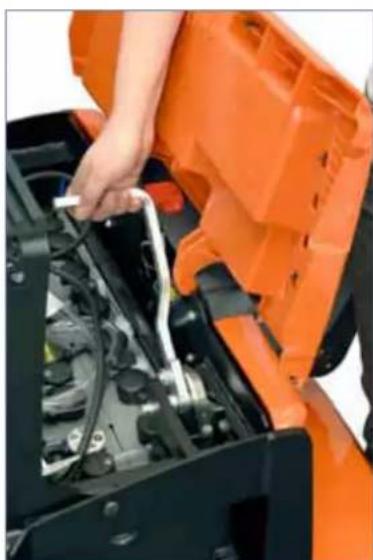
Battery change from the side
Battery roller bed which enables lateral battery replacement (only for trucks with a large battery compartment). Not available for LWE140, LWE160 and LWE180.
Feature
The battery rests on a roller bed inside the battery compartment.

Benefit
Changing the battery is quick and easy, resulting in improved productivity since the truck can be fully utilised.
Feature
The battery is secured using an excenter locking system.
Benefit
Changing the battery is quick and easy.
Battery change table
To facilitate battery change from the side, an external battery change table is also available. The height from the floor to the top of the rollers is adjustable. The battery change table measurements are 834 x 912 mm.
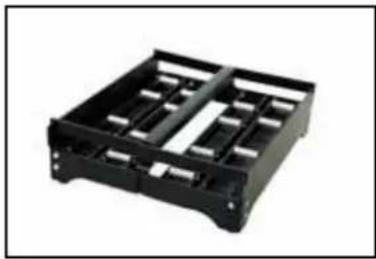
Feature
The battery change table features a roller bed and can hold two batteries.
Benefit
It enables quick, efficient battery replacement.
Extra battery cables
If several batteries are used, optional battery cables can be ordered.
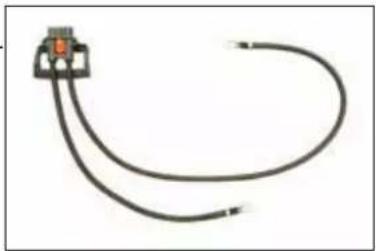
Feature
Each battery can then have its own cable, always fixed to the battery.
Benefit
Battery replacement is even more quick and easy, since there is no need for disconnecting and reconnecting the cables from one battery to the other.
Battery change cable
A battery change cable is used to connect the battery and truck when changing batteries using a battery change table.
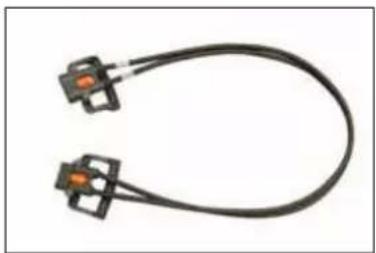
Feature
Length of cable is 1100 mm.
Benefit
The length of the cable makes it possible to move the truck to the charged battery when a battery change table is used.
Built-in charger
When connected to 230 V, the charger has a capacity of 30 A. It is self-adjusting and can be used for voltages between 90 V and 255 V AC, 45 to 400 Hz. For voltages under 200 V, the output current will be reduced. Freely ventilated batteries up to 320 Ah and valve regulated batteries from 134 to 213 Ah can be charged.
Feature
The built-in charger enables battery charging with the truck connected to a wall outlet.
Benefit
This simplifies the charging procedure, especially on sites with only a few trucks. It also is possible to charge the truck in different places in the hall.
Feature
When the truck is charging, this is displayed in the character display. During charging, dashes blink to indicate charging progress. When charging is complete, the character display indicates the number of Ah charged into the battery.
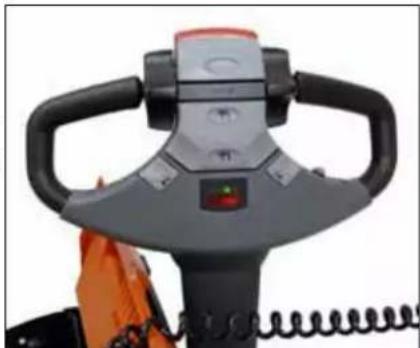
Benefit
It is easy to determine when the battery has been fully charged and how much energy has been used in the process.
Feature
The start function is electronically blocked when the truck is charging. If the operator is logged in when the charger is connected to the wall socket, he will be logged out automatically.
Benefit
This prevents unintentional truck travel with the cable connected to the wall socket. This is a highly reliable function since it does not use any mechanical switches prone to wear.
Feature
A service technician must program the size and type of battery. If the battery is replaced, parameters can easily be changed.
Benefit
Optimised charging even if the battery is replaced during the truck's lifetime.
Feature
Any error codes generated by the battery charger are displayed on the display.
Benefit
This simplifies fault diagnosis if required.
Feature
When the built-in charger is used, it is not possible to charge the battery unless the
battery cover is opened since the power cord needs to be pulled out from behind the cover.

Benefit
Opening of the cover assures proper ventilation during charging.
Feature
The number of Ah charged into the battery during the past 50 charging instances can be verified. For more information, see the service manual.
Benefit
It is possible to monitor battery care.
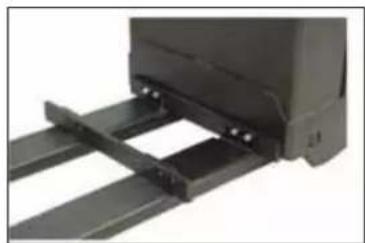
Spacer for long side pallet handling
This spacer is used for optimum long side handling of EUR pallets. It helps the operator determine how far the forks must be inserted into the pallet to avoid incorrect positioning of the fork wheels.

Feature
The spacer is easy to place and remove.
Benefit
Enables quick switching between long side and short side pallet handling.
Truck log systems
Toyota I-site
Toyota I-site is a truck log and fleet management system that provides possibilities to monitor truck usage and operator performance. Toyota I-site is offered a monthly fee basis where we provide a continual process of analysis and consultancy to customers and give them access to our knowledge and skills to help us build customer relations.
Toyota I-site is primarily based on two internally developed systems:
- Easy Management Reports that obtain data from Movex
- Toyota Wireless Information System that obtains data from the truck
Both systems are designed primarily to deliver customer benefits, but they also generate a number of internal benefits to help us operate more efficiently.
Note! The system can be used without Movex update, but this requires a large amount of manual data updating.
Further information about Toyota I-site is available from your local specialist.
Toyota Wireless Information System (T.W.I.S)
T.W.I.S is a part of Toyota I-site that is available in two versions:
• T.W.I.S including DHU (Data Handling Unit) and antenna
• T.W.I.S including DHU, antenna and shock sensor
The DHU collects data from the truck and transfers this data at user-determined intervals to a central server where data can be accessed by logging on to an Internet web site. Communication is done via GSM 900/1800 networks and a SIM card is included in the DHU unit.
Benefit
No hardware installation is required at the customer site.
Reports can be viewed showing for instance:
- Truck utilization
- Operator utilization
- Battery consumption and charging behaviour
- Hour meter readings
If the shock sensor is included in the system, information about collisions and impacts can be viewed.
By monitoring truck usage and operator performance, customers can improve operations and reduce cost.
Access to different levels of information can be set for different users/functions in the company.
Usage hours, error codes and other truck related information can be collected remotely for the benefit of the TMHE organisation.
Shock sensor
When T.W.I.S is combined with a shock sensor the following collision data can be viewed:
- Operator involved in collision
- Severity of collision
- Error codes generated by the collision
- When the collision occurred and for how long the truck had been in use before the collision
There are three possible behaviours of the truck when a collision is recorded:
- The truck continues to operate as usual
- The truck switches to turtle mode; to return to normal operation the truck must be restarted
- The truck switches to turtle mode; to return to normal operation the truck must be restarted with a special ID-key or a special PIN code.
Shock sensitivity and desired behaviour can be set for each individual truck.
NOTE! The shock sensor used for T.W.I.S can also be used as a standalone unit. When used without T.W.I.S, the collision and impact information is shown in the display and more detailed information can also be viewed by the service engineer via the service key.
Benefit
The shock sensor monitors careless driving behaviour and constitutes a tool to take action and improve safety on the site. This will in turn lead to a reduction in damages on trucks, goods and racking. The shock sensor information can also be used to address operator training needs.
Integrated E-bar with optional accessories
All trucks in the LWE series, except for those with small battery compartment, can be fitted with an optional E-bar. This is BT's standard solution for mounting a writing holder, plastic film holder, computer terminal, PC, scanner or other electronic equipment required onboard the truck. These options can be mounted with special mounting brackets designed for the E-bar.
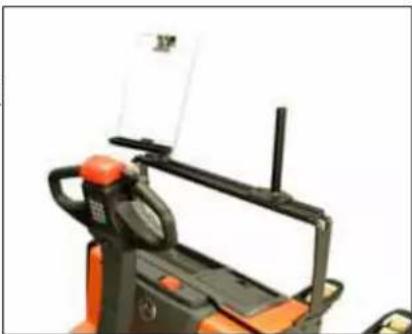
Feature
The mounting brackets can be used on all BT trucks fitted with an E-bar. They are easy to install and just as easy to remove.
Benefit
Accessories can easily be moved between different trucks.

Feature
The E-bar is a tested and rugged solution.
Benefit
Accessories remain securely in place on the truck even during rough handling.
Feature
The e-bar can be equipped with an outlet with a 12 V or 24 V power supply. This option cannot be combined with the built-in charger.
Benefit
Enables connection of optional equipment, e.g. a PC.

Turtle button
The turtle button allows temporary reduction of speed. The default setting for speed reduction is - 50 %, i.e. the travel speed will be reduced to 3 km/h. If necessary, this can be reprogrammed by a service technician.
Feature
When the turtle button is pressed once, the truck enters the turtle mode and travels at reduced speed.
When the button is pressed once more, the truck returns to the standard speed.

Benefit
It is easy to activate and disengage the turtle speed mode. If the truck is used in locations with many people or to handle fragile goods, this is an indispensable option.
Feature
When the truck is in the turtle mode, "SLO" blinks in the character display.
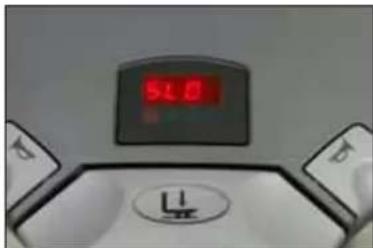
Benefit
The operator can verify the current travel mode at a glance.
Operator platform
An operator platform is a useful option if the travel distances are a bit longer and the operator wants to have the comfort of a stand-on platform. The LWE series offers two different platform types, one with a rubber mat and automatic fold-up and a cold-store version with a checkered plate and also automatic fold-up. The platform is available on the LWE200. The platform option includes a shorter tiller arm, optimized for platform operation. The minimum/maximum height of the tiller arm in operation mode (h14) is 1055/1235 mm.
Feature
In the folded up position, the platform is suspended 610 mm above ground, while the chassis has been designed to offer sufficient space for the feet behind the platform.
Benefit
It is easy to lower the platform with the foot, this way promoting easy entry onto the truck.
Feature
The platform is die cast with crossbars for added rigidity and a reinforced circumferential edge.
Benefit
Thanks to this rugged construction, the platform can withstand heavy-duty use.
Feature
The platform is covered with a thick comfort mat with a rugged pattern.
Benefit
The mat reduces vibration and provides high friction, an important issue to prevent slipping.
Feature
The platform is mounted on a rotating axis.
Benefit
To reduce the risk of strain on the operator's knees, legs and back, the rotating axis has a rugged design with excellent damping characteristics.
Feature
The cold-store version of the platform uses a checkered plate.
Benefit
The checkered plate assures good friction even in cold stores and also in foodstuff applications where operators often wear wet or slippery shoes.
Feature
The platform is secured to a frame with rounded corners.
Benefit
The frame offers numerous benefits:
- In case of collisions, it distributes the force of impact evenly to protect the truck chassis.
- The rounded corners ensure maintained manoeuvrability even on trucks with mounted platform.
- It protects the platform securing points when the operator walks alongside the truck.
- The frame acts as a mechanical stopper to protect the rotating axis when the truck travels across bumps or with very heavy operators.
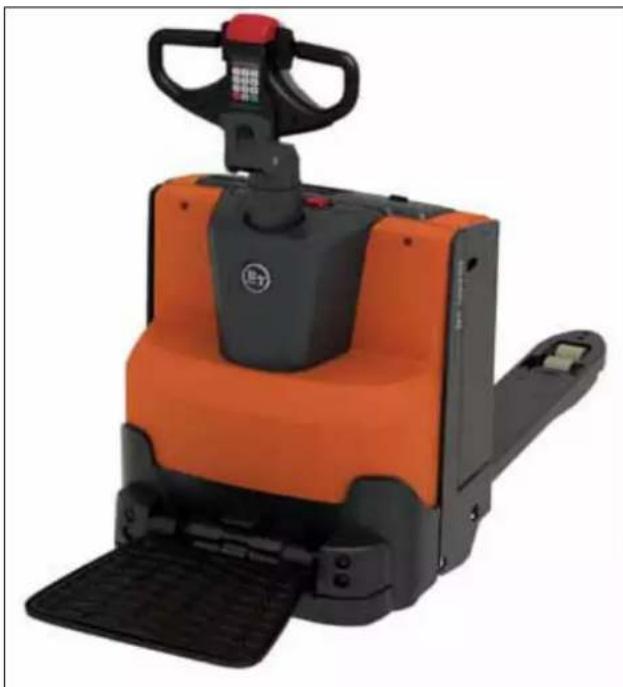
Load support
The optional load support is attached to the back of the forks and is available on all LWE trucks.
Feature
The load support has a height of 1500 mm (from the top of the forks).
Benefit
This added support protects the operator and goods.
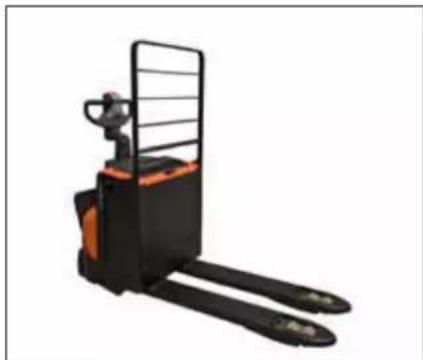
Feature
The load support is bolted onto the fork back.
Benefit
The load support can easily be post-fitted.
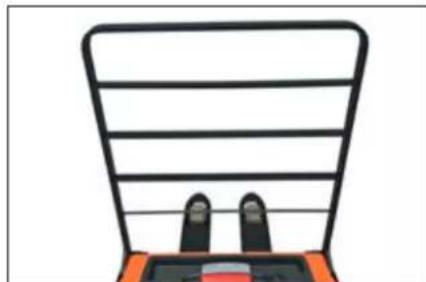
Metal battery cover
The metal battery cover is available for all BT Levio W-series models and all battery compartment sizes; small, medium and large (both standard and sideways change). The cover has a smooth surface without storage compartments.
Feature
Made of metal
Benefit
Robustness is further improved to withstand rough impacts. Can be reshaped if deformed
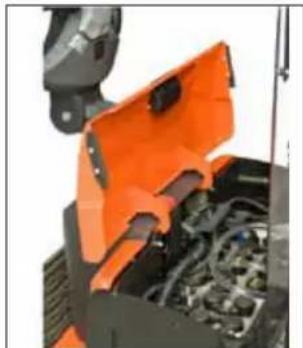
Feature
Even top surface
Benefit
Easier to keep clean
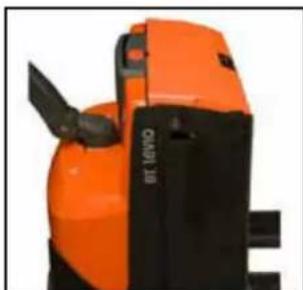
Rubber border
A rubber border is available for all BT Levio W-series models. The trucks can be ordered with a rubber border instead of the standard steel border to allow high gradient ramp handling ability. The rubber border is especially suited for applications with high thresholds, curbs and ramps with high gradients. The rubber is strong enough not to compromise the foot protection but when driving over fixed obstacles like high thresholds or high gradient ramps the rubber border will bend. The rubber border can not be combined with the optional operator platform on LWE200.

Feature
A rubber border is available as an alternative to the standard steel border.
Benefit
The climbing ability of the truck is improved and it is possible to drive over high thresholds and high gradient ramps.
Hydraulic oil for low temperatures
This is used on trucks operated in cold environments. It allows truck operation in temperatures down to -35 degrees Celsius.
Feature
The oil is designed to withstand low temperatures.
Benefit
The truck's lift and lowering functions can be used even in cold environments.
Greasable stainless steel axles
Feature
Stainless steel axles and bronze bushings for the wheels.
Benefit
Ideal for wet and humid applications where tempered axles are not available.
Available on: LWE140 and LWE160
Appendix
Environmental work within BT
The BT trucks are produced at manufacturing sites where environmental issues are in focus. Waste management and reduction of hazardous chemicals used in production are natural parts of the everyday environmental work. We have been ISO 14001 certified since 1997, and in our continuous environmental work we put effort into reducing energy consumption on all levels, while we work with preventive actions to reduce pollution risks and the risk of biological danger.
The paint systems used for BT trucks have been changed and there has been a dramatic reduction of solvent emissions by employing new paint-shop technology at the production sites.
Not only the production, but also the environmental impact of the trucks is focused on. The trucks' contents of substances of concern to the environment are analysed. In this area, we are enforcing environmental demands on our suppliers.
Environmental care is not only limited to reduction of pollution from factories and efficient use of raw materials, it also covers awareness of individual designers when they choose components, materials and take part in decisions on new production methods. Our products are developed without materials from the black list*, while the grey list materials* are reduced to a minimum and we continuously endeavour to completely eliminate them when possible.
For several trucks, environmental declarations are available. The declarations are issued according to ISO 14001:2004. They provide information about the environmental impact of the trucks during manufacturing, usage and scrapping.
Focus on quality within BT
The Toyota Way is based on the Guiding Principles at Toyota. Its five core values express the beliefs and values used in the daily work:





Challenge
To maintain a long-term vision and meet all challenges with the courage and creativity needed to realise that vision.
Kaizen
“Continuous improvement. As no process can ever be declared perfect, there is always room for improvement.”
Genchi Genbutsu
“Going to the source to find the facts to make correct decisions build consensus and achieve goals.”
Respect
Toyota respects others, makes every effort to understand others, accepts responsibility and does its best to build mutual trust.
Teamwork
Toyota stimulates personal and professional growth, shares opportunities for development and maximises individual and team performance.
Toyota Production System (TPS) is a production philosophy based on the Toyota Way that provides a common base for thoughts and methods. Daily quality meetings in production are one part that leads to involvement of employees on all levels in the work with continuous improvements. This means going to the source to correct things that cause problems in order to find short-term and long-term solutions to improve the production process, methods and product quality.
Product quality is of course an essential part of having satisfied customers and the foundation to product quality is laid already in the development phase. At BT we follow the process in each development project to find and take actions on possible risks; both on product and project level.
Products and components are tested and evaluated throughout the development process, both in lab environments and field tests. As a complement to calculations, structural tests as well as life time tests are performed.
Apart from the functional testing and control made on all products before delivery, product quality is continuously monitored during manufacturing through welding audits on components and product audits on completed trucks.
We have had an ISO 9000 certification since 1994.
Certificates

DET NORSKE VERITAS
MANAGEMENT SYSTEM CERTIFICATE
Certificate no: 2006-SKM-AE-1170
This is to certify that
THE ENVIRONMENTAL MANAGEMENT SYSTEM
of
BT Products AB
MJÖLBY in SWEDEN
has been found to conform with the Environmental Management System Standard ISO 14001:2004
This Certificate is valid for management of environmental aspects associated with:
DEVELOPMENT, MANUFACTURE AND SALES OF TRUCKS FOR MATERIAL HANDLING
Place and date
Stockholm, 2006-11-09
for the Accredited Unit
DNV Certification AB, Sweden

Hans Lindgren
Management Representative

电话 EMS
The certificate is valid until 2009-11-30
Company initially certificated 1997-11-24
Certification Audit responsible
Staffan Arve
Lead Auditor

DET NORSKE VERITAS
MANAGEMENT SYSTEM CERTIFICATE
Certificate no: 2006-SKM-AQ-2393
This is to certify that
THE QUALITY MANAGEMENT SYSTEM
of
BT Products AB
MJÖLBY in SWEDEN
has been found to conform with the Quality Management System Standard ISO 9001:2000
This Certificate is valid for the following product or service ranges:
DEVELOPMENT, MANUFACTURE AND SALES OF TRUCKS FOR MATERIAL HANDLING
Place and date
Stockholm, 2006-11-09
for the Accredited Unit
DNV Certification AB, Sweden

Hans Lindgren Management Representative

The certificate is valid until 2009-11-30
Company initially certificated 1997-12-05
Certification Audit responsible
Staffan Arve
Lead Auditor
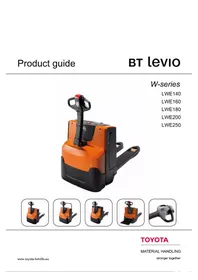
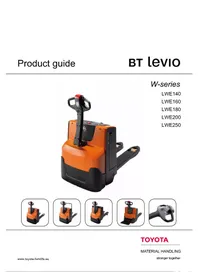
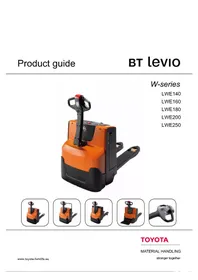

- TOYOTA
- CONTENTS
- READING INSTRUCTIONS 7
- PRODUCT RANGE INFORMATION 9
- APPLICATIONS 15
- SALES ARGUMENTS 19
- PRODUCT DETAILS 25
- TECHNICAL INFORMATION 53
- OPTIONS 65
- APPENDIX 77
- READING INSTRUCTIONS
- PRODUCT RANGE INFORMATION
- BT LEVIO W-SERIES (LOW-LIFTER WALKIE ELECTRIC)
- LWE140
- LWE160
- LWE180
- LWE200
- LWE250
- APPLICATIONS
- WALKING
- RIDING
- INDUSTRY
- WAREHOUSES/DISTRIBUTION CENTRES
- SHOPS/SUPERMARKETS
- WHICH TRUCK FOR WHICH APPLICATION
- SALES ARGUMENTS
- SIMPLICITY
- MANOEUVRABILITY
- FEATURE
- BENEFIT
- VIEW
- CONTROL
- SAFETY
- OPERATOR SAFETY
- OPERATIONAL ADAPTABLE
- DURABILITY
- INCREASED UPTIME
- QUICK AND EASY SERVICE
- PRODUCT DETAILS
- OPERATOR ENVIRONMENT
- TILLER ARM AND CONTROLS
- STARTING THE TRUCK
- TILLER ARM
- EMERGENCY STOP SWITCH
- DISPLAY
- BATTERY COVERS AND STORAGE COMPARTMENTS
- DRIVING FEATURES/PROGRAMMING THE TRUCK
- AUTOMATIC BACK-UP
- OPERATOR PARAMETERS
- MACHINE REGISTER AND SERVICE PARAMETERS
- AUTOMATIC SWITCH-OFF
- CREEP SPEED
- BRAKES
- MOTOR AND POWER PACK
- MOTOR CONTROLLERS
- AC DRIVE MOTOR
- BT POWERDRIVE SYSTEM
- DRIVE WHEEL
- DRIVE WHEEL MATERIAL
- VULKOLLAN
- TOPTHANE
- POWERFRICTION
- VULKOLLAN QUARTZ
- TREADED POWERFRICTION
- DRIVE WHEEL BRACKET
- ELECTRONIC COMPONENTS
- COVER
- CHASSIS
- CASTOR WHEELS
- BT CASTOR LINK
- MATERIAL
- FORK CARRIAGE
- AXLES AND BUSHINGS
- FORK WHEELS
- BATTERY COMPARTMENTS, BATTERIES AND CHARGERS
- BATTERY COMPARTMENT
- TYPES OF BATTERY
- BATTERY CONNECTOR AND CHARGING
- CHARGER
- TECHNICAL INFORMATION
- DIMENSIONS AND PERFORMANCE FIGURES
- X MEASUREMENT
- L MEASUREMENT
- L2 MEASUREMENT
- U MEASUREMENT
- T MEASUREMENT
- P MEASUREMENT
- AST – AISLE WIDTH REQUIREMENT
- AISLE WIDTH REQUIREMENTS
- TRUCK BATTERY COMP. WA AST AISLE WIDTH FOR PALLETS
- PALLETS AND PALLET SIZES
- EURO PALLET
- CHEP PALLET (UK VERSION)
- CHOOSING THE OPTIMAL FORK SPECIFICATION
- APPLICATION FOR DIFFERENT FORK LENGTHS
- BATTERY WEIGHTS
- BATTERY AND CHARGER
- INFORMATION ON HAWKER EVOLUTION GEL BATTERIES
- FREELY VENTILATED BATTERIES
- OPTIONS
- BATTERY CHANGE FROM THE SIDE
- BATTERY CHANGE TABLE
- EXTRA BATTERY CABLES
- BATTERY CHANGE CABLE
- BUILT-IN CHARGER
- SPACER FOR LONG SIDE PALLET HANDLING
- TRUCK LOG SYSTEMS
- TOYOTA I-SITE
- TOYOTA WIRELESS INFORMATION SYSTEM (T.W.I.S)
- SHOCK SENSOR
- INTEGRATED E-BAR WITH OPTIONAL ACCESSORIES
- TURTLE BUTTON
- OPERATOR PLATFORM
- LOAD SUPPORT
- METAL BATTERY COVER
- RUBBER BORDER
- HYDRAULIC OIL FOR LOW TEMPERATURES
- GREASABLE STAINLESS STEEL AXLES
- APPENDIX
- ENVIRONMENTAL WORK WITHIN BT
- FOCUS ON QUALITY WITHIN BT
- CHALLENGE
- KAIZEN
- GENCHI GENBUTSU
- RESPECT
- TEAMWORK
- CERTIFICATES
- DET NORSKE VERITAS
- MANAGEMENT SYSTEM CERTIFICATE
- BT PRODUCTS AB
Brand : BT
Model : Levio LWE140
Category : Electric pallet truck