
DCS6400 - Chain saw MAKITA - Free user manual and instructions
Find the device manual for free DCS6400 MAKITA in PDF.



| Product Type | Gas chainsaw |
| Brand | MAKITA |
| Model | DCS6400 |
| Displacement | 64 cm³ (3.9 cu in) |
| Maximum power | 4.7 hp / 9,000 rpm |
| Maximum torque | 4.2 Nm / 6,500 rpm |
| Weight (without bar and chain) | 6.3 kg (13.9 lbs) |
| Fuel tank capacity | 750 ml (25.36 fl oz) |
| Oil tank capacity | 420 ml (14.20 fl oz) |
| Bar and chain | Pitch 3/8", gauge .058" or .050", lengths 15" to 28" |
| Chain brake | Manual and inertial (automatic activation) |
| Ignition | Electronic |
| Spark plug | NGK BPMR 7A (gap 0.5 mm) |
| Sound level at operator's ear | 101.4 dB(A) |
| Fuel/oil mixture ratio | 50:1 (MAKITA oil) or 40:1 (other oil) |
| Recommended chain oil | BIOTOP biodegradable oil or equivalent |
| Safety | Chain brake, hand guard, anti-kickback guide, emergency stop |
| Maintenance | Washable air filter, replaceable spark plug, chain sharpening |
| Spare parts | MAKITA references for bar, chain, air filter, spark plug, etc. |
Frequently Asked Questions - DCS6400 MAKITA
User questions about DCS6400 MAKITA
0 question about this device. Answer the ones you know or ask your own.
Ask a new question about this device
Download the instructions for your Chain saw in PDF format for free! Find your manual DCS6400 - MAKITA and take your electronic device back in hand. On this page are published all the documents necessary for the use of your device. DCS6400 by MAKITA.
USER MANUAL DCS6400 MAKITA
Owner's and Safety Manual for Gasoline Chain Saws (page 2 - 37)
Read and understand this Manual. Always follow safety precautions in the Owner's and Safety Manual. Improper use can cause serious injury!
The engine exhaust from this product contains chemicals known to the State of California to cause cancer, birth defects or other reproductive harm. Preserve this Manual carefully!
ATTENTION!
MAKITA U.S.A, Inc warrant to the initial retail purchaser and each subsequent owner, that this utility equipment was designed, built, and equipped to conform at the time of initial sale to all applicable regulations of the U.S.
Environmental Protection Agency (EPA), and that the engine is free of defects in materials and workmanship which would cause this engine to fail to conform with EPA regulations during its warranty period.
For the components listed under PARTS COVERED, the service dealer authorized by MAKITA will, at no cost to you, make the necessary diagnosis, repair, or replacement necessary to ensure that the engine complies with applicable U.S. EPA regulations.
EMISSION COMPONENT DEFECT WARRANTY PERIOD
The warranty period for this engine begins on the date of sale to the initial purchaser and continues for a period of 2 years.
PARTS COVERED
Listed below are the parts covered by the Emission Components Defect Warranty. Some of the parts listed below may require scheduled maintenance and are warranted up to the first scheduled replacement point for that part.
Fuel Metering System
Carburetor and internal parts
Fuel filter, if applicable
Throttle stopper, if applicable
Choke System, if applicable
Ignition System
Spark plugs
Flywheel Magneto
Ignition Coil
Air Induction System
Pre filter, if exist
Air filter, Air cleaner case, Intake manifold
Miscellaneous Items Used in Above Systems
Fuel hoses, clamps and sealing gaskets
OBTAINING WARRANTY SERVICE
To obtain warranty service, take your engine to the nearest MAKITA Factory Service Center or service Center authorized by MAKITA. Bring your sales receipts indicating date of purchase for this engine. The dealer of service authorized by MAKITA will perform the necessary repairs or adjustments within a reasonable amount of time and furnish you with a copy of the repair order. All parts and accessories replaced under this warranty become the property of MAKITA.
WHAT IS NOT COVERED
- Conditions resulting from tampering, misuse, improper adjustment (unless they were made by the service dealer authorized by MAKITA during a warranty repair), alteration, accident, failure to use the recommended fuel and oil, or not performing required maintenance services.
- The replacement parts used for required maintenance services.
- Consequential damages such as loss of time, inconvenience, loss of use of the engine or equipment, etc.
- Diagnosis and inspection charges that do not result in warranty-eligible service being performed.
Any non-authorized replacement part, or malfunction of authorized parts due to use of non-authorized parts.
OWNER'S WARRANTY RESPONSIBILITIES
As the engine owner, you are responsible for the performance of the required maintenance listed in your owner's manual. MAKITA recommends that you retain all receipts covering maintenance on your engine, but MAKITA cannot deny warranty solely for the lack of receipts or for your failure to ensure the performance of all scheduled maintenance. As the engine owner, you should however be aware that MAKITA may deny warranty coverage if your engine or a part has failed due to abuse, neglect, improper maintenance or unapproved modifications.
You are responsible for presenting your engine to the nearest service dealer authorized by MAKITA when a problem exists.
If you have any questions regarding your warranty rights and responsibilities, you should contact the MAKITA Warranty service Department at 1-888-OPE-PART for the information.
THINGS YOU SHOULD KNOW ABOUT THE EMISSION CONTROL SYSTEM WARRANTY:
MAINTENANCE AND REPAIRS
You are responsible for the proper maintenance of the engine. You should keep all receipts and maintenance records covering the performance of regular maintenance in the event questions arise. These receipts and maintenance records should be transferred to each subsequent owner of the engine. MAKITA reserves the right to deny warranty coverage if the engine has not been properly maintained. Warranty claims will not be denied, however, solely because of the lack of required maintenance or failure to keep maintenance records.
MAINTENANCE, REPLACEMENT OR REPAIR OF EMISSION CONTROL DEVICES AND SYSTEMS MAY BE PERFORMED BY ANY REPAIR ESTABLISHMENT OR INDIVIDUAL; HOWEVER, WARRANTY REPAIRS MUST BE PERFORMED BY A SERVICE DEALER AUTHORIZED BY MAKITA. THE USE OF PARTS THAT ARE NOT EQUIVALENT IN PERFORMANCE AND DURABILITY TO AUTHORIZED PARTS MAY IMPAIR THE EFFECTIVENESS OF THE EMISSION CONTROL SYSTEM AND MAY HAVE A BEARING ON THE OUTCOME OF A WARRANTY CLAIM.
If other than the parts authorized by MAKITA are used for maintenance replacements or for the repair of components affecting emission control, you should assure yourself that such parts are warranted by their manufacturer to be equivalent to the parts authorized by MAKITA in their performance and durability.
HOW TO MAKE A CLAIM
All repair qualifying under this limited warranty must be performed by a service dealer authorized by MAKITA. In the event that any emission-related part is found to be defective during the warranty period, you shall notify MAKITA Warranty Service Department at 1-888-OPE-PART and you will be advised of the appropriate warranty service dealer or service providers where the warranty repair can be performed.
WARNING!
Careless or improper use of this product can cause serious or even fatal injury.
Before operating a chain saw or other MAKITA products it is important that you read, fully understand and carefully follow the instructions outlined in this owners manual. Kickback may cause severe or fatal injury and is one of many potential dangers in operating a chain saw. Kickback and other safety related precautions are described in detail within this owners manual. Additional owners manuals are available from MAKITA U.S.A., INC., 14930-C Northam Street, La Mirada, CA 90638-5753, USA, Telephone: (714) 522 80 88 and MAKITA CANADA INC., 1950 Forbes Street, Whitby, Ontario, L1N 7B7, Canada, Telephone: (905) 571 22 00.
This product complies with:
American National Standard Institute
Canadian Standards Association
B 175.1-2000 chain saw safety standard.
Z62.1-95 chain saw safety standard.
Z62.3-96 chain saw kickback standard.
Society of Automotive Engineers
SAEJ 335-Jun 95 „Multiposition small engine exhaust system fire ignition suppression"
With the purchase of this chain saw you have chosen a German quality product. Important instructions for the assembly and operation of this saw are given in this manual. For your own safety, we ask you to read the accident prevention instructions very carefully before putting your chain saw into operation, as incorrect handling can, despite all precautions, lead to accidents. With a little care and attention you will have good service and lasting satisfaction from this first-rate product.

DCS6400, 6401, 7300, 7301, 7900, 7901
#
Delivery inventory 4
Symbols 4
Safety precautions 5-16
Denomination of components 17
Technical data 18
Mounting the guide bar and saw chain 19-20
Chain brake 21
Fuel/Refuelling 22-23
Chain lubrication 24
Starting the engine 25
Stopping the engine 25
Checking the chain brake 25
Adjusting the carburetor 26
Working in summer / winter 26
Sharpening the saw chain 27-28
Cleaning the brake band and sprocket interior 29
Contents
Cleaning the guide bar 30
Replacing the saw chain 30
Replacing the fuel filter 30
Cleaning the air filter 31
Replacing the spark plug 32
Replacing the starter cable 33
Replacing the return spring 33
Mounting the fan housing 34
Cleaning the cylinder area 34
Replacing / cleaning the spark arrester screen 34
Instructions for daily and periodic maintenance 35
Service, spare parts and guarantee 35-36
Troubleshooting 36
Extract from the spare parts list 37
Adress list (see enclosure)
The DCS6400, 6401, 7300, 7301, 7900, 7901 will be delivered in a protective cardboard box to prevent transport damage. Cardboard is a basic raw material and is consequently reusable or suitable for recycling (waste paper recycling).


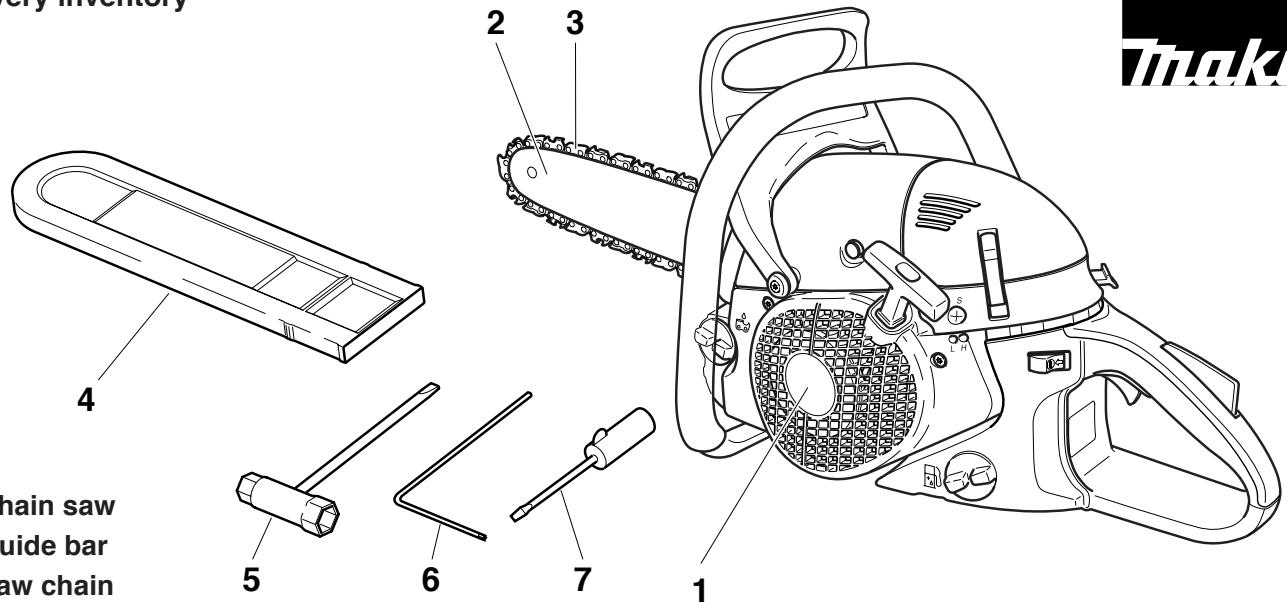
1 Chain saw
2 Guide bar
3 Saw chain
4 Chain protection cover
5 Universal wrench
6 Wrench
7 Screw driver for carburetor adjustment
8 Owner's and Safety Manual (not shown)
In case one of the parts listed should not be included in the delivery inventory, please consult your sales agent.
Symbols
You will notice the following symbols on the chain saw and in the Owner's and Safety Manual:










Read instruction manual and follow the warning- and safety precautions!
Particular care and caution!
Forbidden!
Wear protective helmet, eye and ear protection!
Wear protective gloves!
No smoking!
No open fire!
Stop engine!
Engine - manual start
On/Off (I/O) switch
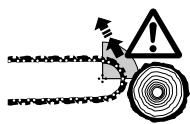
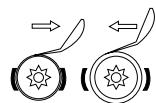




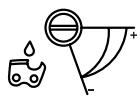



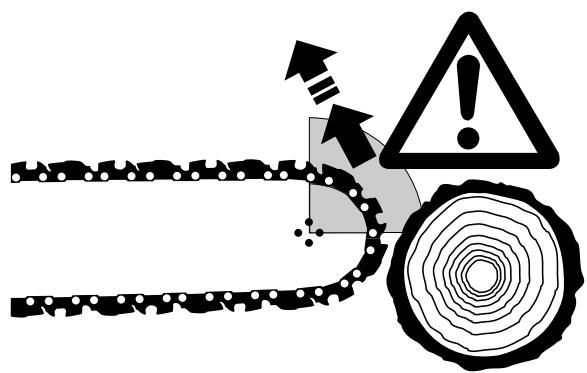
Caution, kickback!
Chain brake
Fuel and oil mixture
Working in summer / winter
Carburetor adjustment
Chain oil fill/oil pump
Saw chain oil adjustment screw
First aid
Recycling
Further symbols see page 6.
Safety precautions for chain saw operators
While operating the chain saw please observe the following rules:
a) Contact of the guide bar nose with any object should be avoided.
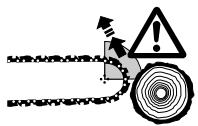
b) Tip contact may cause the guide bar to move suddenly upward and backward, which may cause serious or fatal injury.
c) Always operate the chain saw with both hands.
WARNING!
Read and follow all safety precautions in the owner's manual. Failure to follow instructions could result in serious injury. It is recommended to lend the chain saw only to people who are experienced in working with chain saws. Always hand over the Owner's and Safety Manual.
WARNING!
This chain saw is capable of severe kickback that could result in serious injury to the operator. Do not operate this chain saw unless you have extraordinary cutting needs and experience in and special training for dealing with kickback. Chain saws with significantly reduced kickback potential are available.
WARNING!
Kickback may occur when the nose or tip of the guide bar touches an object, or when the wood closes in and pinches the saw chain in the cut. This contact may abruptly stop the saw chain and in some cases may cause a lightning fast reverse reaction, kicking the guide bar up and back towards the user, or push the guide bar back towards the operator. Kickback may cause you to lose control of the saw.
As a chain saw user, you can take several steps to reduce the risk of a kickback and potential injury.
A. With a basic understanding of kickback, you can reduce or eliminate the element of surprise. It is a sudden surprise that contributes to accidents.
B. Keep a good firm grip on the saw with both hands, your right hand on the rear grip and your left hand on the tubular handle, when the engine is running. Use a firm grip with thumbs and fingers encircling the chain saw handles. A firm grip can neutralize kickback and help you maintain control of the saw. Don't let go!
C. Make sure that the area in which you are cutting is free from obstructions. Do not let the nose of the guide bar contact the log, branch, or any other obstructions which could be hit while you are operating the saw.
D. Do not overreach or cut above shoulder height.
E. Follow manufacturer's sharpening and maintenance instructions for the saw chain.
F. Only use replacement bars and chains specified by the manufacturer or the equivalent.
Additional safety precautions
The following additional safety precautions should be observed by all users of chain saws:
- Do not operate a chain saw when you are fatigued.
- Use safety footwear; snug-fitting clothing; protective gloves; and eye, hearing, and head protection devices.
- Use caution when handling fuel. Move the chain saw at least 10 feet (3 m) from the fueling point before starting the engine.
- Do not allow other persons to be near the chain saw when starting or cutting with the chain saw. Keep bystanders and animals out of the work area.
- Do not start cutting until you have a clear work area, secure footing, and a planned retreat path from the falling tree.
- Keep all parts of your body away from the saw chain when the engine is running.
- Before you start the engine, make sure that the saw chain is not contacting anything.
- Carry the chain saw with the engine stopped, the guide bar and saw chain to the rear, and the muffler away from your body.
- Do not operate a chain saw that is damaged, is improperly adjusted, or is not completely and securely assembled. Be sure that the saw chain stops moving when the throttle control trigger is released.
- Shut off the engine before setting it down.
- Use extreme caution when cutting small size brush and saplings because slender material may catch the saw chain and be whipped toward you or pull you off balance.
- When cutting a limb that is under tension be alert for springback so that you will not be struck when the tension on the wood fibers is released.
- Keep the handles dry, clean, and free of oil or fuel mixture.
- Operate the chain saw only in well-ventilated areas.
- Do not operate a chain saw in a tree unless you have been specifically trained to do so.
- All chain saw service, other than the items listed in the owner's manual maintenance instructions, should be performed by MAKITA. (For example, if improper tools are used to remove the flywheel or if an improper tool is used to hold the flywheel in order to remove the clutch structural damage to the flywheel could occur and could subsequently cause the flywheel to burst.)
- When transporting your chain saw, use the chain protection cover.
- Low kickback bars and low kickback chains are designed to reduce the risk of kickback injury. Ask your MAKITA dealer about these devices.
General Safety Precautions
The use of any chain saw may be hazardous. At full throttle chain speed can reach 45 mph (20 m/s). It is important that you read; fully understand and observe the following safety precautions and warnings. Read the Owner's Manual and the safety instructions periodically.
WARNING!
Reactive forces, including kickback, can be dangerous. Careless or improper use of any chain saw may cause serious or fatal injury.
Have your MAKITA dealer show you how to operate your chain saw. Observe all applicable local safety regulations, standards and ordinances.
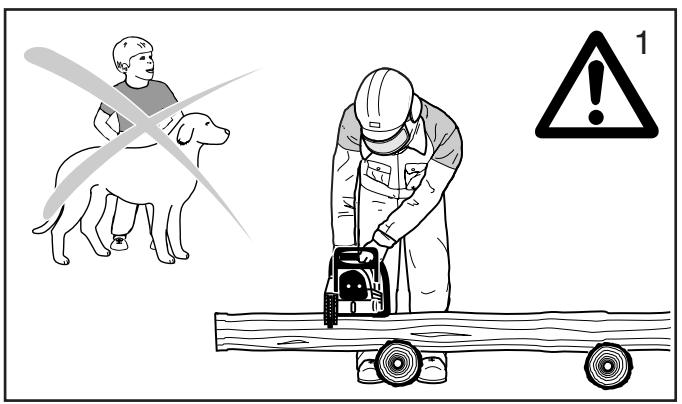
WARNING!
Minors should never be allowed to use a chain saw.
Bystanders, especially children and animals should not be allowed in the area where a chain saw is in use (fig. 1).
Never let the saw run unattended.
Store it in a locked place away from children. Fill the fuel tank to 7/8 th full (see storing the saw).
Do not lend your chain saw without this Owner's and Safety Manual. Be sure that anyone using your saw understands the information given.
Proper use of a chain saw involves
- the operator
- the saw
- the use of the saw.
Discription of symbols used on chain saws:

Z 62.1-95 and
Z62.3-96
Class 1A
Compliance with
CSA -Standards
ANSI B175.1-2000
Compliance with
ANSI -Standards
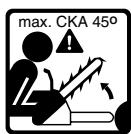
Maximum Computed Kickback Angle (CKA)* without using the chain brake when using the recommended bar and chain combinations (In this example the CKA is 45^ ).
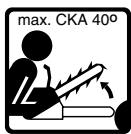
MaximumComputed Kickback Angle (CKA)* with using the chain brake when using the recommended bar and chain combinations (In this example the CKA is 40^ ).
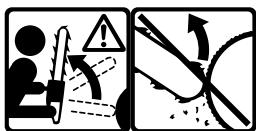
Contact of the guide bar tip with any object should be avoided!
Tip contact may cause the guide bar to move suddenly upward and backward, which may cause serious injury!
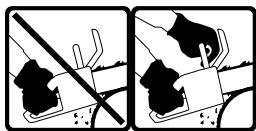
Always use two hands when operating the chain saw!
Reduced Kickback Bar and Chain combination that has been evaluated with the power head to achieve kickback protection (according to ANSI and CSA standards).
- The Computed Kickback Angle is a calculated value from energies measured on a test bench. It is not the angle of the guide bar moved upward in case of a KICKBACK.
The operator
Physical Condition
You must be in good physical condition and mental health and not under the influence of any substance (drugs, alcohol), which might impair vision, dexterity or judgment.
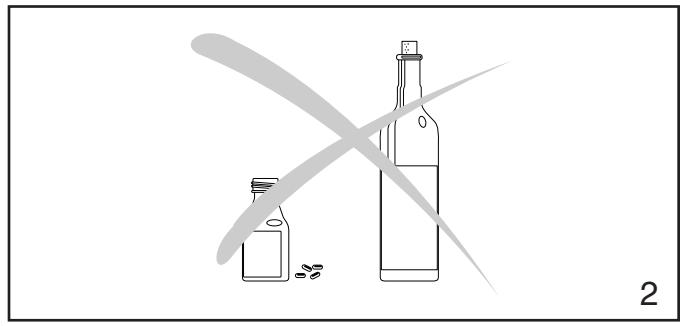
WARNING!
Prolonged use of chain saws exposing the operator to vibrations may produce Whitefinger disease (Raynaud's phenomenon). This phenomenon reduces the hand's ability to feel and regulate temperature, produces numbness and burning sensations and may cause nerve and circulation damage and tissue necrosis.
All MAKITA saws are therefore provided with an antivibration system which is essential for those using chain saws on a regular or sustained basis. Antivibration systems do not guarantee that you will not sustain Whitefinger diseasesase, however, they reduce this danger considerably. Nevertheless, continual and regular users should observe their hands and fingers and in case of any abnormal symptoms, seek medical advice immediately.
Proper clothing
Clothing must be sturdy and snug-fitting, but allow complete freedom of movement. Avoid loose-fitting jackets, scarfs, neckties, jewelry, flared or cuffed pants, or anything that could become entangled with the saw or brush. Wear overalls or jeans with a reinforced cutting resistant insert (fig. 3).
Protect your hands with gloves when handling saw and saw chain. Heavy-duty, nonslip gloves improve your grip and protect your hands.
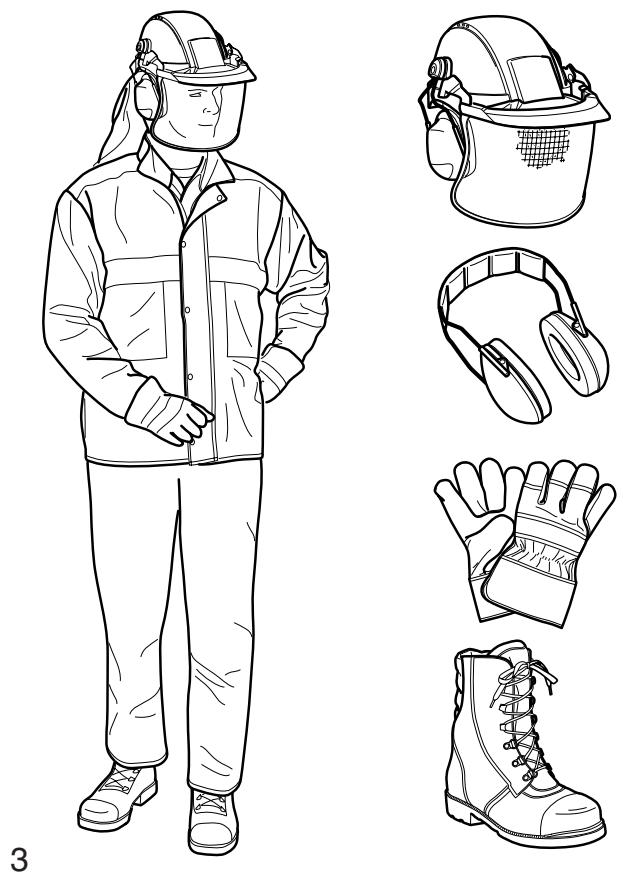
Good footing is most important in chain saw work. Wear sturdy boots with nonslip soles. Steel-toed safety boots are recommended.
Proper eye protection is a must. Non-fogging, vented goggles and a face screen is recommended. Their use reduces the risk of eye and facial injury.
Wear an approved safety hard hat to protect your head. Chain saw noise may damage your hearing. Always wear noise protection equipment (ear plugs or ear muffs) to protect your hearing.
Continual and regular users should have their hearing checked regularly.

Wear protective helmet, eye and ear protection
The saw
Parts of the chain saw: illustrations and description of parts see page 16.
WARNING!
Never modify a chain saw in any way. Only attachments supplied by MAKITA or expressly approved by MAKITA for use with the specific saw are authorized.
WARNING!
Bow guide bars substantially increase the potential for kickback and severe or fatal injury due to the greater kickback zone of the bow design. Bow guide bars are not recommended for use on MAKITA chain saws nor are they approved by the ANSI B 175.1-2000 chain saw safety standard.
The use of the saw
Transporting the chain saw
WARNING!
Always stop the engine before putting a chain saw down or carrying it. Carrying a chain saw with the en-gine running is extremely dangerous. Accidental acceleration of the engine can cause the chain to rotate.
Avoid touching the hot muffler.
4
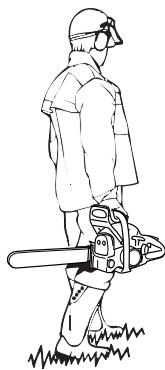
By hand: When carrying your saw by hand, the engine must be stopped and the saw must be in the proper position.
The chain protection cover should be over the chain and the guide bar must point backwards. When carrying your saw the bar should be behind you (fig. 4).
By vehicle: When transporting in a vehicle, keep chain and bar covered with the chain guard. Properly secure your saw to prevent turnover, fuel spillage and damage to the saw. Make sure the saw in not exposed to heat or sparks.
Chain saw operating instructions
For assembly follow the procedure in the appropriate section "Mounting Guide Bar and Chain" of this manual. MAKITA chain, guide bar and sprocket must match each other (see the appropriate section in this manual).
WARNING!
Proper tension of the chain is extremely important. In order to avoid false setting the tensioning procedure must be followed as described in this manual. Always make sure the hexagonal nut(s) for the sprocket guard is (are) tightened securely after tensioning the chain. Check chain tension once more after having tightened the nuts and thereafter at regular intervals (always before starting to work). If the chain becomes loose while cutting, shut off the engine and then tighten. Never try to tighten the chain while the engine is running!
Fueling
Your MAKITA saw uses on oil-gasoline mixture for fuel (see chapter "Fuel" of this manual).
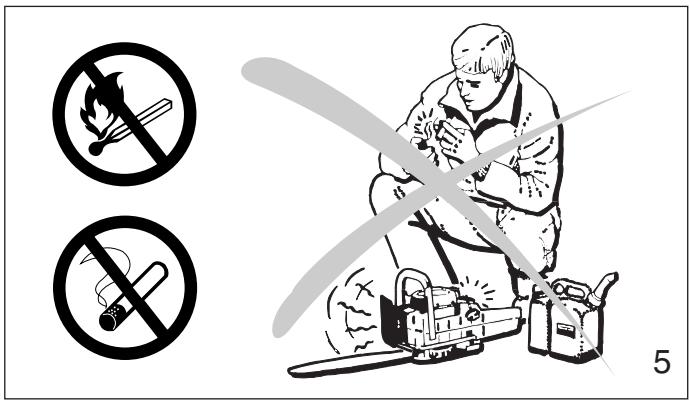
WARNING!
Gasoline is an extremely flammable fuel. Use extreme caution when handling gasoline or fuel mix. Do not smoke or bring any sparks or flame near the fuel (fig. 5).


Fueling instructions
Fuel your chain saw in well ventilated areas or outdoors. Always shut off the engine and allow it to cool before refueling. Select bare ground for fueling and move the chain saw at least 10 feet (3 m) from fueling spot before starting the engine (fig. 5a).
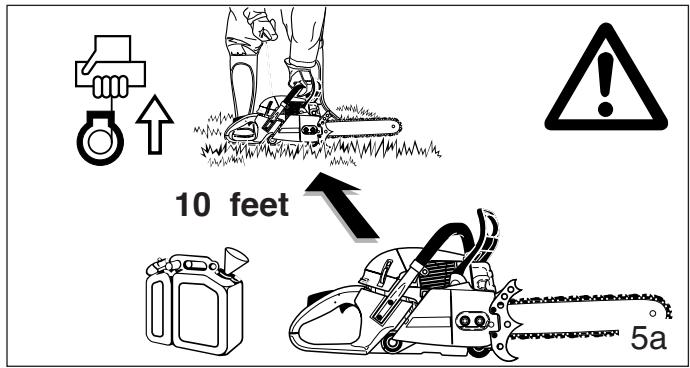
Wipe off any spilled fuel before starting your saw and check for leakage.
Check for fuel leakage while refueling and during operation. If fuel or oil leakage is found, do not start or run the engine until leak is fixed and spilled fuel has been wiped away. Clothing with fuel on it has to be changed immediately (this is a danger to your life!). Avoid skin contact with fuel. Never loosen or remove the cap of the fuel tank while the engine is running.
Starting
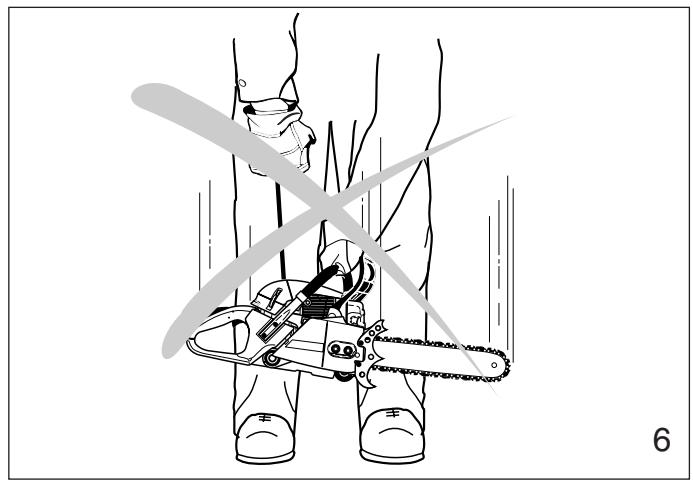
Do not drop start. This method is very dangerous because you may lose control of the saw (fig. 6).
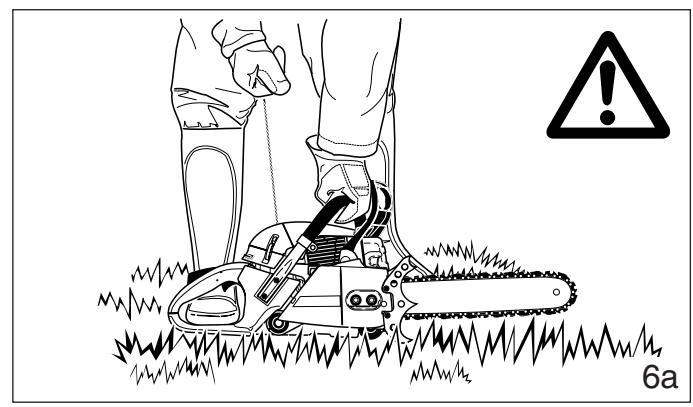
Place the chain saw on firm ground or other solid surface in an open area. Maintain a good balance and secure footing. Place your right foot through the rear handle opening and firmly grasp the front handle with your left hand (fig. 6a).
Be absolutely sure that guide bar and chain are clear of you or all other obstructions and objects, including the ground, because when the engine starts in semithrottle position, engine speed will be fast enough for the clutch to engage the sprocket and turn the chain which may cause a kickback.
Never attempt to start the saw when the guide bar is in a cut or kerf.
When you pull the starter grip, don't wrap the starter rope around your hands. Do not allow the grip to snap back, but guide the starter rope slowly back to permit the rope to rewind properly. Failure to follow this procedure may result in injury to hand or fingers and may damage the starter mechanism.
Important adjustments
WARNING!
At correct idle speed, chain should not turn. For directions to adjust idle speed, see the appropriate section of this instruction manual.
Do not use a saw with incorrect idle speed adjustment. Adjust the idle speed yourself according to the appropriate section of this manual.
Have your MAKITA dealer check your saw and make proper adjustments or repairs.
Check the saw chain tension frequently, especially just after installing a new chain. New chains may stretch more during their initial use. A properly adjusted saw chain can be pulled freely around the guide bar by hand without sagging. Always stop the engine and wear gloves when checking or adjusting the chain tension.
Working conditions
Operate your chain saw only outdoors. Operate the saw under good visibility and daylight conditions only.
WARNING!
Take extreme care in wet and freezing weather (rain, snow, ice). Put off the work when the weather is windy, stormy or rainfall is heavy. Clear the area where you are working.
WARNING!
Avoid stumbling on obstacles such as stumps, roots or rocks and watch out for holes or ditches. Be extremely cautious when working on slopes or uneven ground. There is increased danger of slipping on freshly debarked logs.
Cutting instructions
Always hold the saw firmly with both hands when the engine is running. Place your left hand on the tubular handle and your right hand on grip and throttle lever. Left-handers should follow these instructions too.
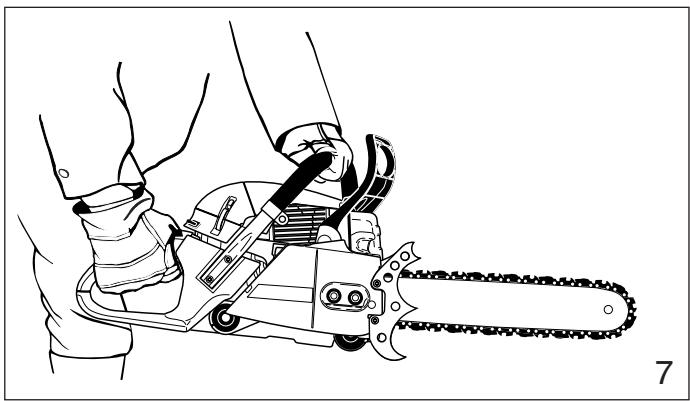
Wrap your fingers tightly around the handles, keeping the handles cradled between your thumb and forefinger (fig. 7). With your hands in this position, you can best oppose and absorb the push, pull and kickback of your saw without having it slip out of your grip (see section of reactive forces). Make sure your chain saw handle and grip are in good condition and free of moisture, pitch, oil or grease.
Always start a cut with the chain running at full speed and the spike bar in contact with the wood.
WARNING!
Never use the saw with one hand. You cannot control reactive forces (see pages 10 to 12) and may lose control of the saw.
WARNING!
Do not operate your chain saw in semi-throttle position. Cutting in this position does not permit the operator proper control of the saw or chain speed.
WARNING!
Never come too close to a rotating chain with your hands or body.
WARNING!
Do not cut any material other than wood or wooden objects.
Use your chain saw for cutting only. It is not designed for prying or shoveling away limbs, roots or other objects.
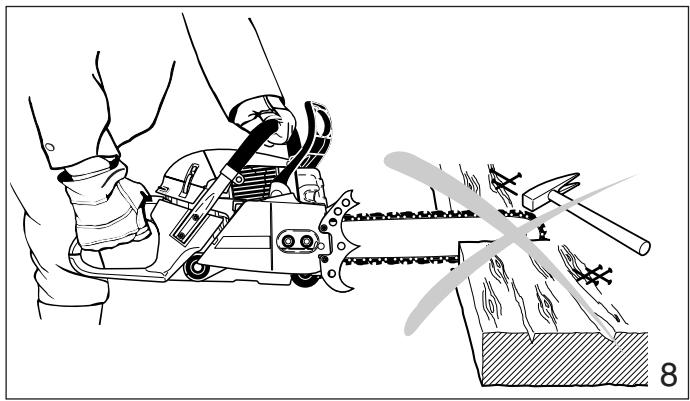
When sawing, make sure that the saw chain does not touch any foreign materials such as rocks, nails and the like (fig. 8). Such objects may be flung off, damage the saw chain or cause the saw to kickback.
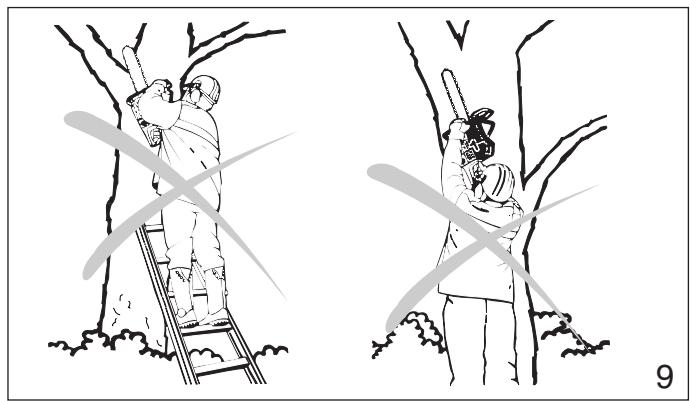
In order to keep control of your saw, always maintain a firm foothold. Never work on a ladder, in a tree or on any other insecure support. Never use the saw above shoulder height (fig. 9).
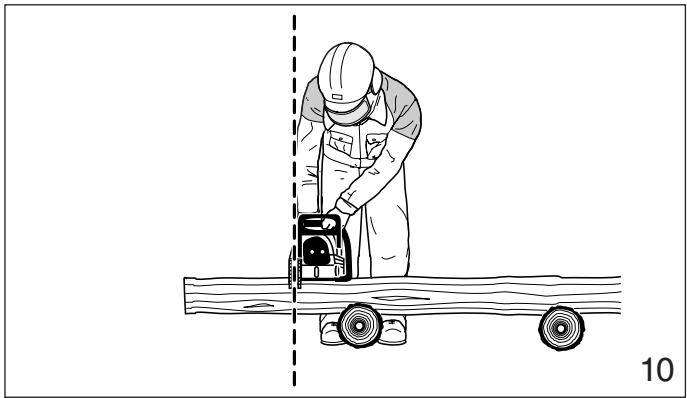
Position the chain saw in such a way that your body is clear of the cutting attachment whenever the engine is running (fig. 10).
Don't put pressure on the saw when reaching the end of a cut. The pressure may cause the bar and rotating chain to pop out of the cut or kerf, go out of control and strike the operator or some other object. If the rotating chain strikes some other object a reactive force (see pages 11 to 13) may cause the chain to strike the operator.
Reactive forces during the cut, including kickback
WARNING!
Reactive forces, that may occur during any cut are kickback, pushback and pull-in. Reactive forces can be dangerous! In any chain saw, the powerful force used to cut wood can be reversed (and work against the operator).
If the rotating chain is suddenly stopped by contact with any solid object like a log or branch or is pinched, the reactive forces instantly occur. These reactive forces may result in loss of control which may, in turn, cause serious or fatal injury. An understanding of the causes of these reactive forces may help you avoid loss of control.
The most common reactive forces are
- kickback,
- pushback,
- pull-in.
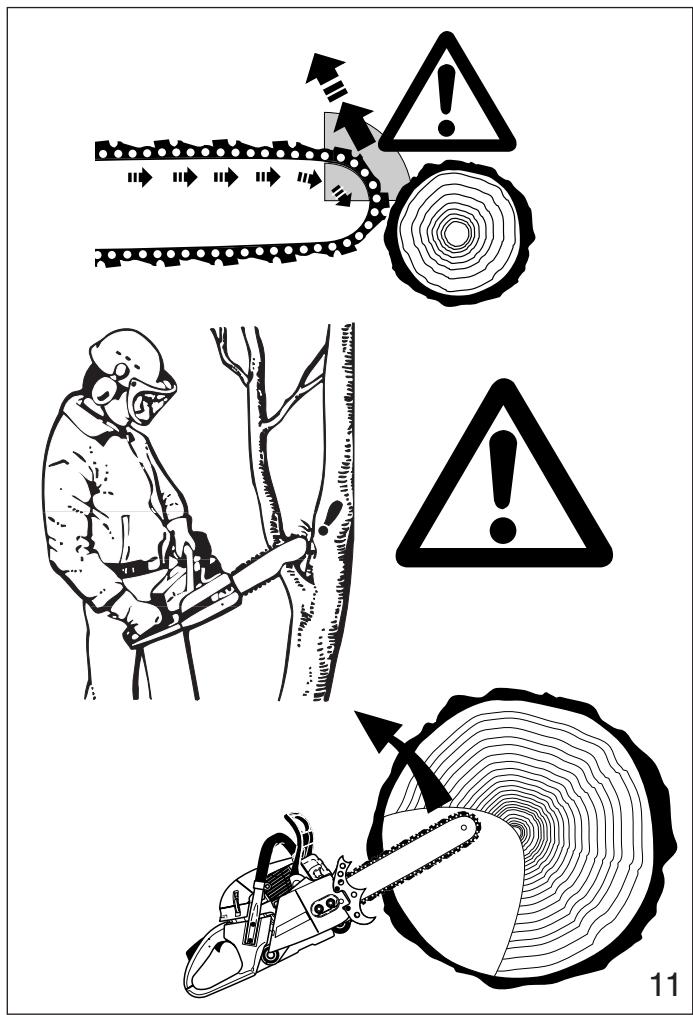
Kickback:
Kickback occurs when the upper quadrant of the bar nose contacts a solid object in the wood or is pinched (fig. 11). The reaction of the cutting force of the chain causes a rotational force of the chain saw in the direction opposite to the chain movement, mainly in the plane of the bar. This may fling the bar in an uncontrolled arc towards the operator.
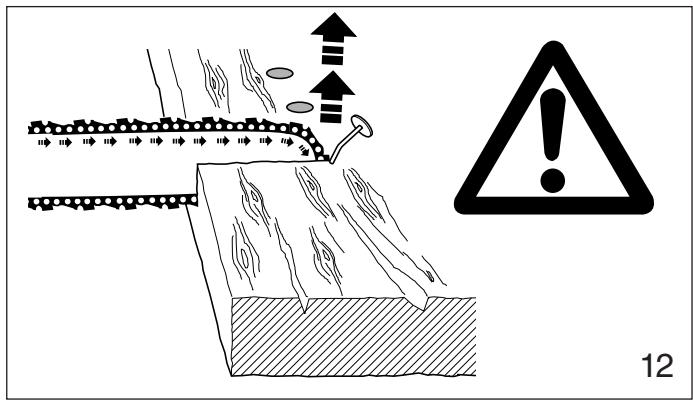
This reaction can occur in a fraction of a second and under some circumstances, cause the guide bar and chain to strike the operator with enough force to cause severe or fatal injury. It may also occur during limbing. It also occurs when the nose of the guide bar is pinched unexpectedly, unintentionally contacts solid material in the wood (fig.12) or is incorrectly used to begin a plunge or boring cut.
The greater the force of the kickback reaction, the more difficult it becomes for the operator to control the saw.
Many factors influence the occurrence and force of the kickback reaction. The type of bar and saw chain you use is a factor in the force of the kickback reaction.
The speed of contact at which the cutter contacts the object.
Kickback force increase with the rate of impact.
The contact angle between the nose of the bar and the foreign object (fig. 11).
Kickback is most pronounced in the upper quadrant of the bar nose.
MAKITA chain types are designed to reduce kickback forces.
The depth gauges:
Improper lowering of the depth gauges also increases the risk of a kickback.
Saw chain cutter sharpness:
WARNING!
A dull improperly sharpened chain may increase the risk of kickback. Always cut with a properly sharpened chain.
Devices for reducing the risk of kickback injury
MAKITA have developed a special chain brake to reduce the risk of kickbacks.
This chain brake increases the safety factor on the job, e.g. when the saw suddenly bucks upwards the chain stops rotating within a fraction of a second. A deflection guard on the disengaging lever of the chain brake and a scoop rear handle ensure that the operator's hands are fully protected at all times.
Kickback tendency increases as the radius or size of the guide bar nose increases. MAKITA have developed guide bars with small nose radius, to reduce the kickback tendency.
WARNING!
No chain brake prevents kickback.
These brakes are designed only to stop the chain, if activated.
To ensure a proper operation of the chain brake, it must be properly maintained. Furthermore, there must be a sufficient distance between the operator and the bar to ensure that the chain brake has sufficient time to activate and stop the chain before potential contact with the operator.
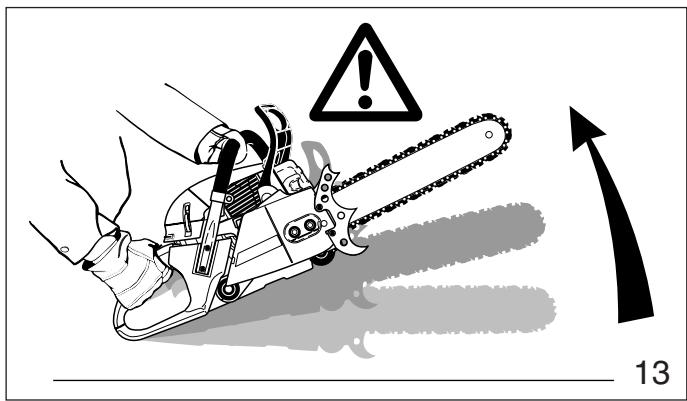
To avoid kickback
The best protection from personal-injury that may result from kickback is to avoid kickback situations:
- Hold the chain saw firmly with both hands and maintain a secure grip.
- Be aware of the location of the guide bar nose at all times.
- Never bring the nose of the guide bar in contact with any object. Do not cut limbs with the nose of the guide bar. Be especially careful with small, tough limbs, small size brush and saplings which may easily catch the chain.
- Don't overreach.
- Don't cut above shoulder height.
- Begin cutting and continue at full throttle.
- Cut only one log at a time.
- Use extreme caution when re-entering a previous cut.
- Do not attempt plunge cuts (see page 14) if you are not experienced with these cutting techniques.
- Be alert for shifting of the log or other forces that may cause the cut to close and pinch the chain.
- Maintain saw chain properly. Cut with a correctly sharpened, properly tensioned chain at all times.
- Stand to the side of the cutting path of the chain saw.
Pushback:
Pushback occurs when the chain on the top of the bar is suddenly stopped when it is pinched, caught or encounters a foreign object in the wood. The reaction of the chain drives the saw straight back toward the operator causing loss of saw control. Pushback frequently occurs when the top of the bar is used for cutting (fig. 14).
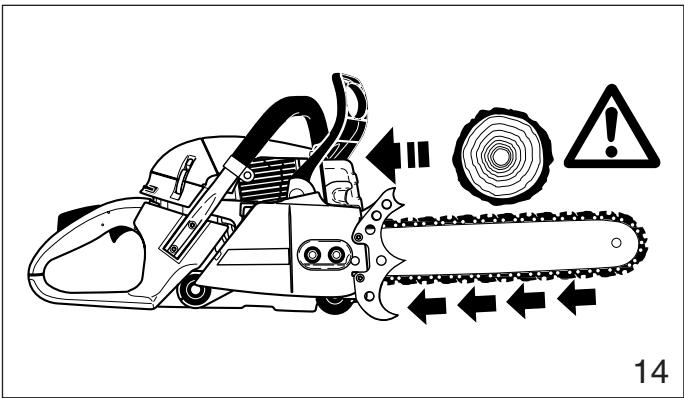
To avoid pushback
- Be alert to forces or situations that may cause material to pinch the top of the chain.
- Do not cut more than one log at a time.
- Do not twist the saw when withdrawing the bar from a plunge cut or under buck cut (figures 25 to 27 and 34, pages 14 and 16), because the chain can pinch.
Pull-in:
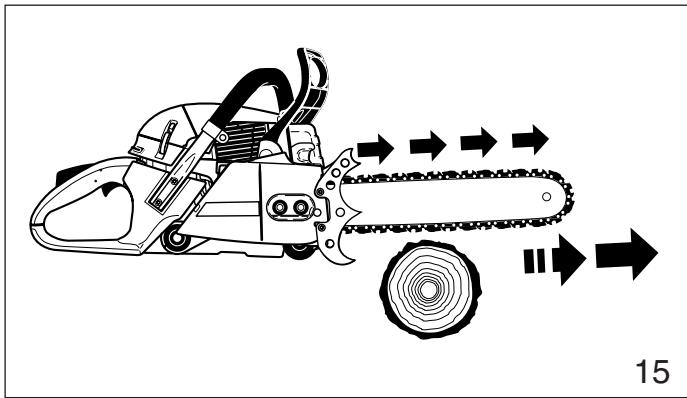
Pull-in occurs when the chain on the bottom of the bar is suddenly stopped. The chain on the bottom of the bar stops when it is pinched, caught or encounters a foreign object in the wood (see fig. 15). The reaction of the chain pulls the saw forward, causing the operator to lose control.
Pull-in frequently occurs when the spike bar of the saw is not held securely against the tree or limb and when the chain is not rotating at full speed before it contacts the wood.
WARNING!
Use extreme caution when cutting small size brush and saplings which may easily catch the chain and pull you off balance.
To avoid pull-in
- Always start a cut with the chain rotating at full speed and the spike bar in contact with the wood.
- Pull-in may also be prevented by using plastic wedges to open the kerf or cut.
Cutting techniques
Felling
Felling is cutting down a tree.
Before felling a tree, consider carefully all conditions which may affect the direction of fall, including:
The intended direction of the fall.
The neutral lean of the tree.
Any unusually heavy limb structure.
Surrounding trees and obstacles.
The wind direction and speed.
WARNING!
Always observe the general condition of the tree. Look for decay and rot in the trunk. If it is rotted inside, it could snap and fall toward the operator while being cut.
Also look for broken or dead branches which could vibrate loose and fall on the operator. When felling on a slope, the operator should stand on the up-hill side.
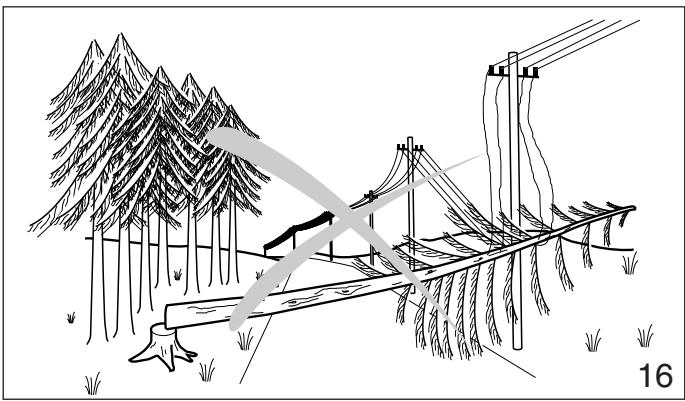
When felling in the vicinity of roads, railways and power lines, etc., take extra precautions (see fig. 16). Inform the police, utility company or railway authority before beginning to cut.
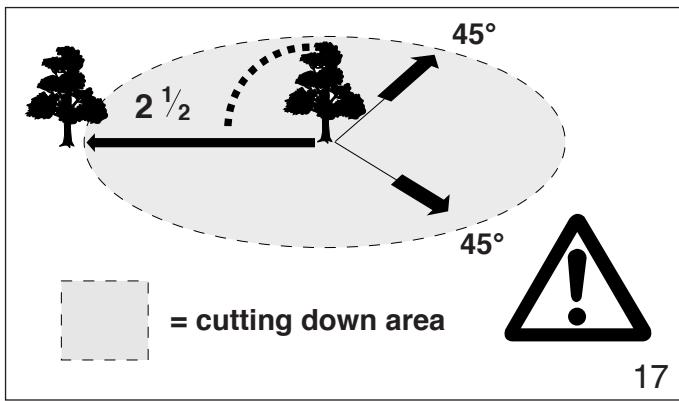
When felling, maintain a distance of at least 2 1/2 tree lengths from the nearest person (see fig. 17).
Note:
The noise of your engine may drown any warning call.
Felling instructions:
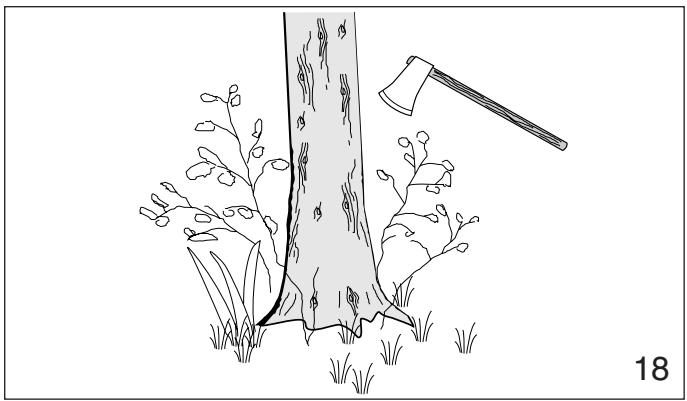
First clear the tree base and work area from interfering limbs and brush and clean its lower portion an axe (see fig. 18).
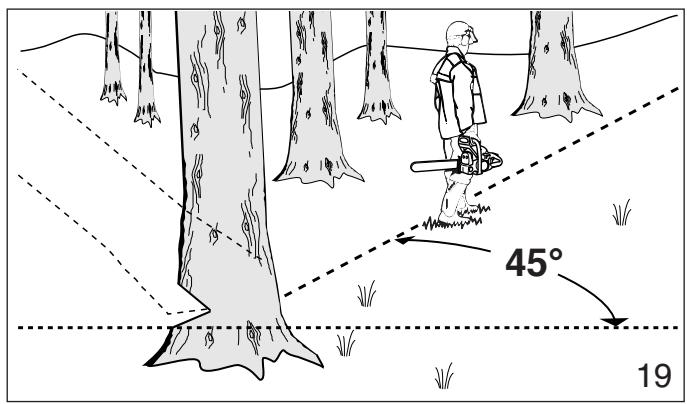
Then, establish a path of escape and remove all obstacles. This path should be opposite to the planned direction of the fall of the tree and at a 45^ angle (fig. 19). An alternate path must also be selected. Place all tools and equipment a safe distance away from the tree, but not on the escape path.
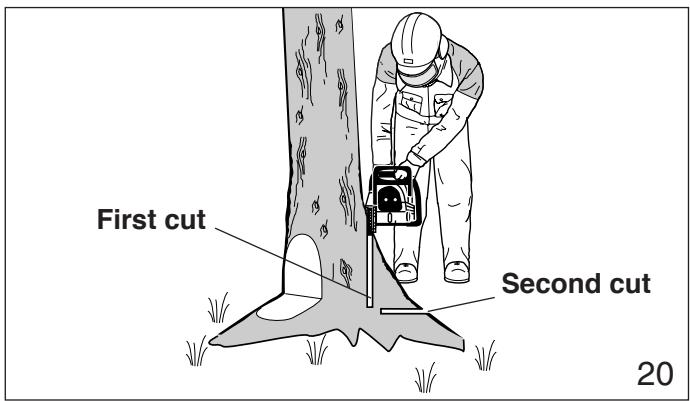
If the tree has large buttress roots, cut into the largest buttresses vertically first (horizontally next) and remove (fig. 20).
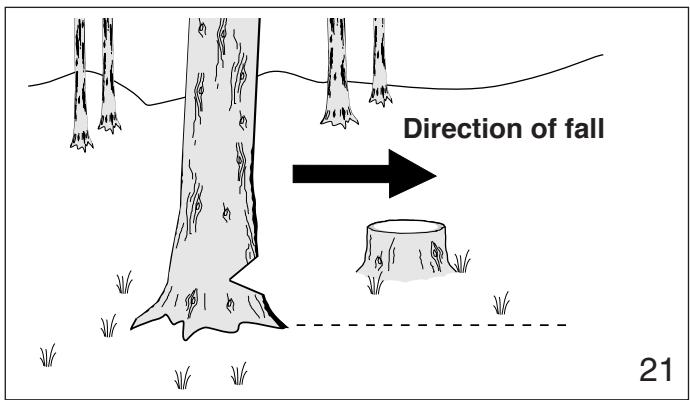
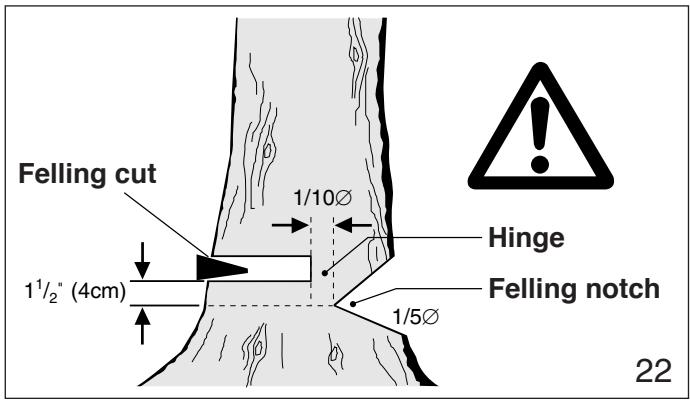
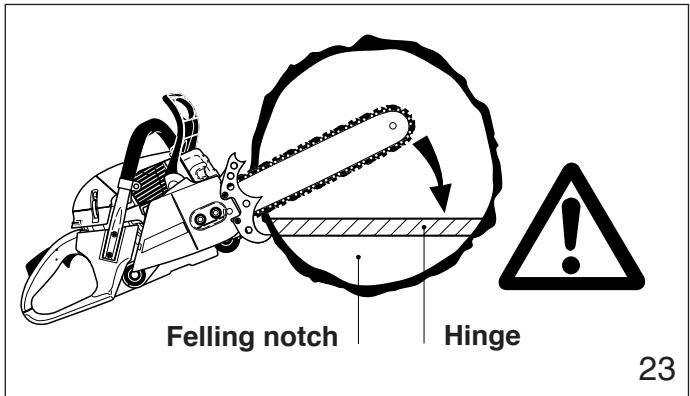
Then, determine the placement of the felling notch (fig. 21). The felling notch when properly placed determines the direction in which the tree will fall. It is made perpendicular to the line of fall and should be as close to the ground as possible. Cut the felling notch to a depth of about one-fifth to one-fourth of the trunk diameter (fig. 22). It should be in no case higher than it is deep. Make the felling notch very carefully.
Begin the felling cut slightly higher than the felling notch and on the opposite side of the tree (fig. 22). Then cut horizontally through towards the felling notch. Apply the chain saw with its spikes directly behind the uncut portion of wood and cut toward the notch (fig. 23). Leave approximately 1/10 of the tree diameter uncut! This is the hinge (fig. 23). Do not cut through the hinge because you could lose control of the direction of the fall. Drive wedges into the felling cut where necessary to control the direction of the fall. Wedges should be of wood, light alloy or plastic - never of steel, which can cause kickback and damage to the chain.
Always keep to the side of the falling tree. When the tree starts to fall, shut off the engine, withdraw the bar and walk away on the pre-planned escape path. Watch out for falling limbs.
WARNING!
Be extremely careful with partially fallen trees which are poorly supported.
When the tree hangs or for some other reason does not fall completely, set the saw aside and pull the tree down with a cable winch, block and tackle or tractor. If you try to cut it down with your saw, you may be injured.
Sectioning Method
WARNING!
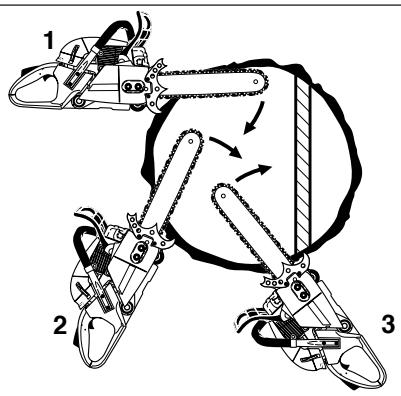
Felling a tree that has a diameter greater than the length of the guide bar requires use of either the sectioning or plunge-cut method. These methods are extremely dangerous because they involve the use of the nose of the guide bar and can result in kickback. Only properly trained professionals should attempt these techniques.
24
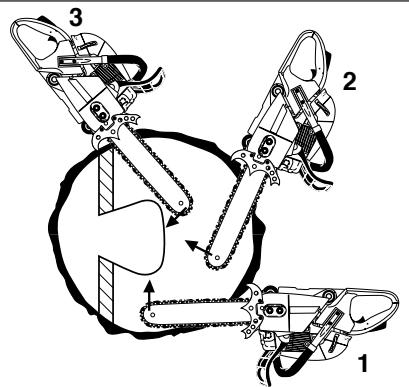
For the sectioning method (fig. 24) make the first cut with the guide bar fanning in toward the hinge. Then, using the bumper spike as a pivot, reposition the saw for the next cut. Avoid repositioning the saw more than necessary. When repositioning for the next cut, keep the guide bar fully engaged in the kerf to keep the felling cut straight. If the saw begins to pinch, insert a wedge to open the cut. On the last cut, do not cut the hinge.
Plunge-Cut Method
Timber having a diameter more than twice the length of the guide bar requaires the use of the plunge-cut method before making the felling cut.
First, cut a large, wide notch. Make a plunge cut in the center of the notch.
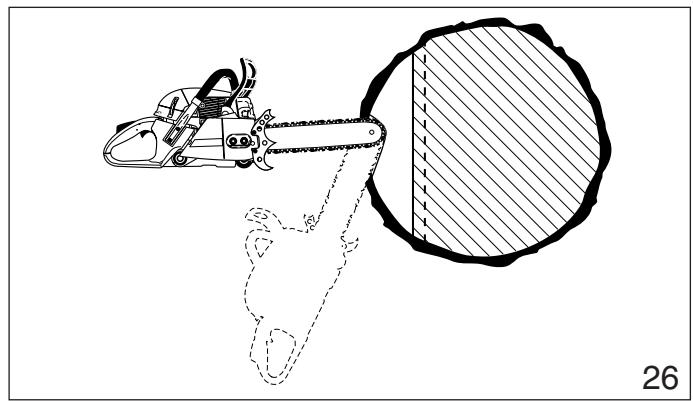
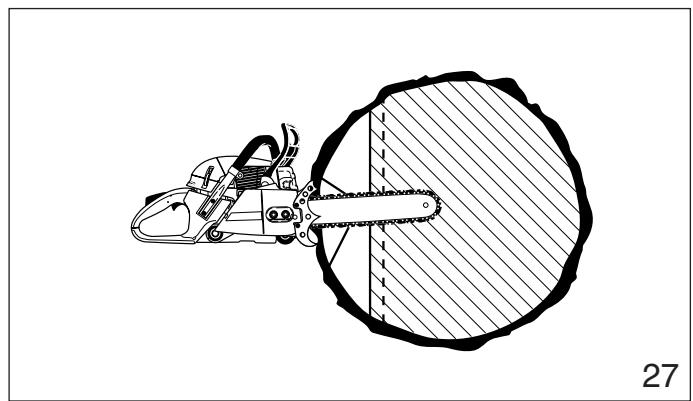
The plunge cut is made with the guide bar nose. Begin the plunge cut by applying the lower portion of the guide bar nose to the tree at an angle (fig. 25). Cut until depth of the kerf is about the same as the width of the guide bar (fig. 26). Next, align the saw in the direction
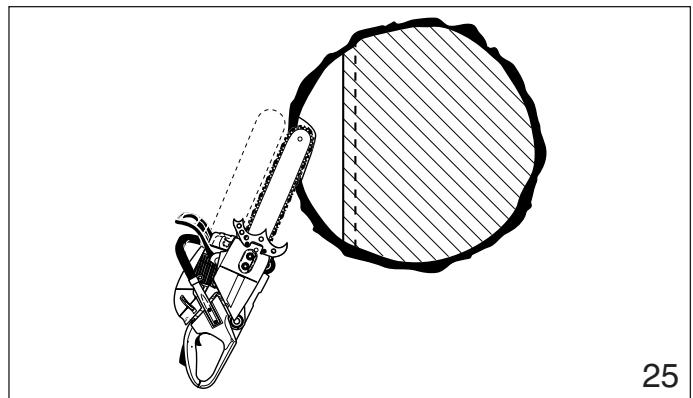
in which the recess is to be cut. With the saw at full throttle, insert the guide bar in the trunk (fig. 27).
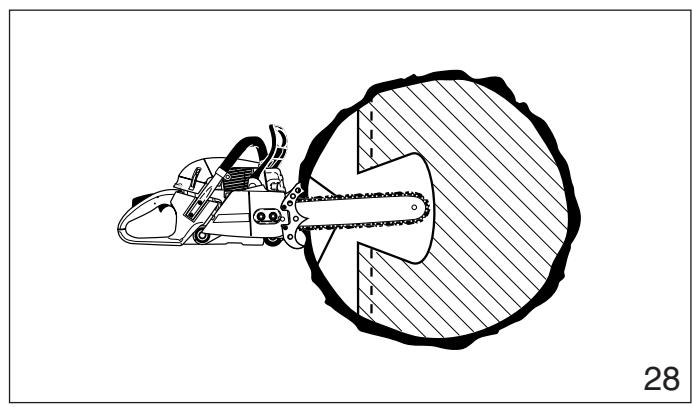
Enlarge the plunge cut as shown in illustration (fig. 28)
29
WARNING!
There is an extreme danger of kickback at this point. Extra caution must be taken to maintain control of the saw. To make the felling cut, follow the sectioning method described previously (fig. 29). If you are inexperienced with a chain saw plunge-cutting should not be attempted. Seek the help of a professional.
Limbing
Limbing is removing the branches from a fallen tree.
WARNING!
There is an extreme danger of kickback during the limbing operation. Do not work with the nose of the bar. Be extremely cautious and avoid contacting the log or other limbs with the nose of the guide bar. Do not stand on a log while limbing it - you may slip or the log may roll.
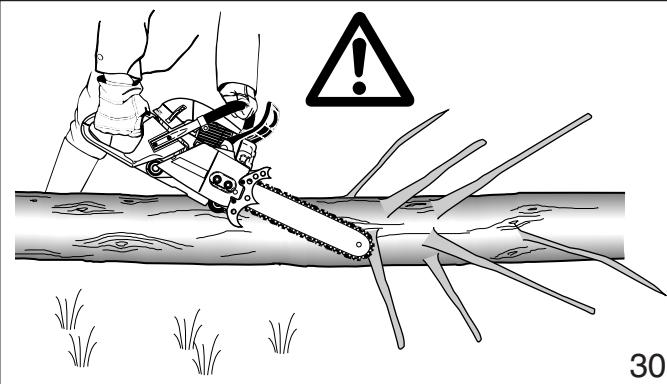
Start limbing by leaving the lower limbs to support the log off the ground (fig. 30). Always cut from the top of the limb. Do not underbuck freely hanging limbs. A pinch may result or the limb may fall, causing loss of control. If a pinch occurs, stop the engine and remove the saw, by lifting the limb.
WARNING!
Be extremely cautious when cutting limbs under tension. The limbs could spring back toward the operator and cause loss of control of the saw or injury to the operator.
Bucking
Bucking is cutting a log into sections.
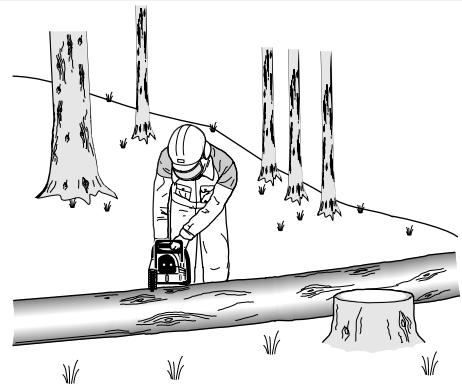
31
WARNING!
- When bucking, do not stand on the log. Make sure the log will not roll down-hill. If on a slope, stand on the up-hill side of the log (see fig. 31). Watch out for rolling logs.
WARNING!
- Cut only one log at a time.
WARNING!
- Shattered wood should be cut very carefully. Sharp slivers of wood may be caught and flung in the direction of the operator of the saw.
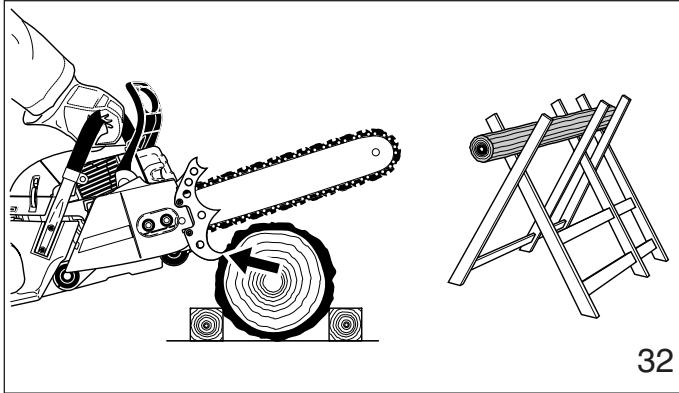
WARNING!
- When cutting small logs, use a sawhorse (fig. 32). Never permit another person to hold the log. Never hold the log with your leg or foot.
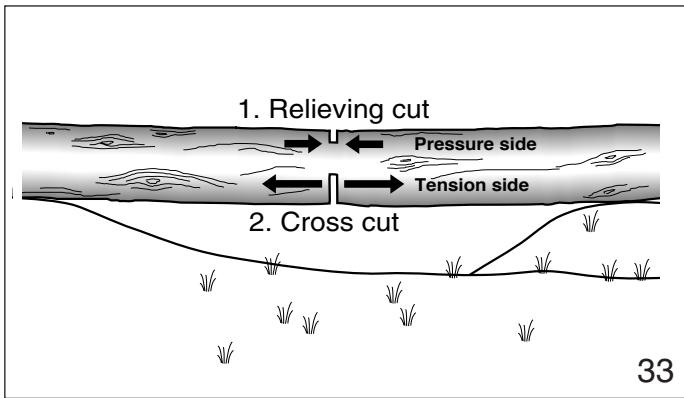
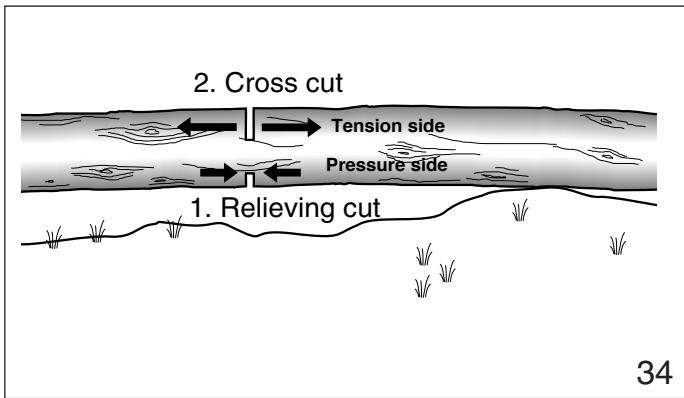
WARNING!
- Logs under strain require special attention to prevent the saw from pinching. The first cut is made on the compression side to relieve the stress on the log (see fig. 33, 34). The bucking cut is then made as shown. If the saw pinches, stop the engine and remove it from the log.
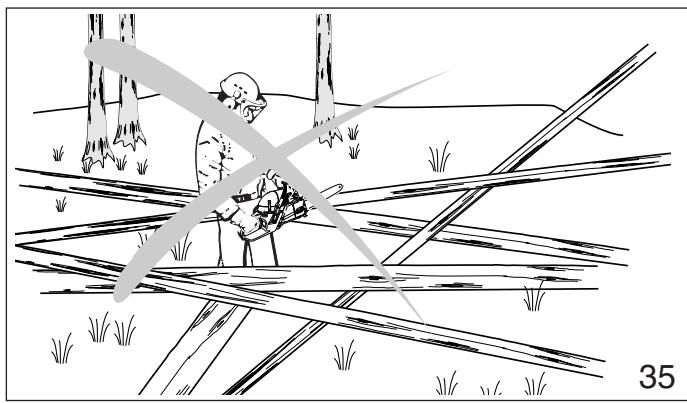
WARNING!
- Only properly trained professionals should work in an area where the logs, limbs and roots are tangled (i.e. a blowdown area, fig. 35). Working in blowdown areas is extremely hazardous.
WARNING!
- Drag the logs into a clear area before cutting. Pull out exposed and cleared logs first.
Maintenance and Repair
Never operate a chain saw that is damaged, improperly adjusted or not completely or securely assembled. Follow the maintenance and repair instructions in the appropriate section of this manual.
WARNING!
Always stop the engine and make sure that the chain is stopped before commencing any maintenance or repair work or cleaning the saw. Do not attempt any maintenance or repair work not described in this manual. Have such work performed by your MAKITA service shop only.
Maintaining and storing the saw
Keep the chain, bar and sprocket clean and lubricated; replace worn sprockets or chains.
Keep the chain sharp. You can spot a dull chain when easy-to-cut wood becomes hard to cut and burn marks appear on the wood.
Keep the chain at proper tension. Tighten all nuts, bolts and screws except the carburetor adjustment screws after each use.
Keep spark plug and wire connection tight and clean.
Store saws in a high or locked place, away from children.
Identification plate
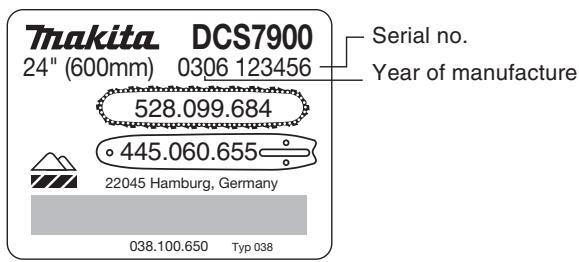
Indicate when ordering spare parts!
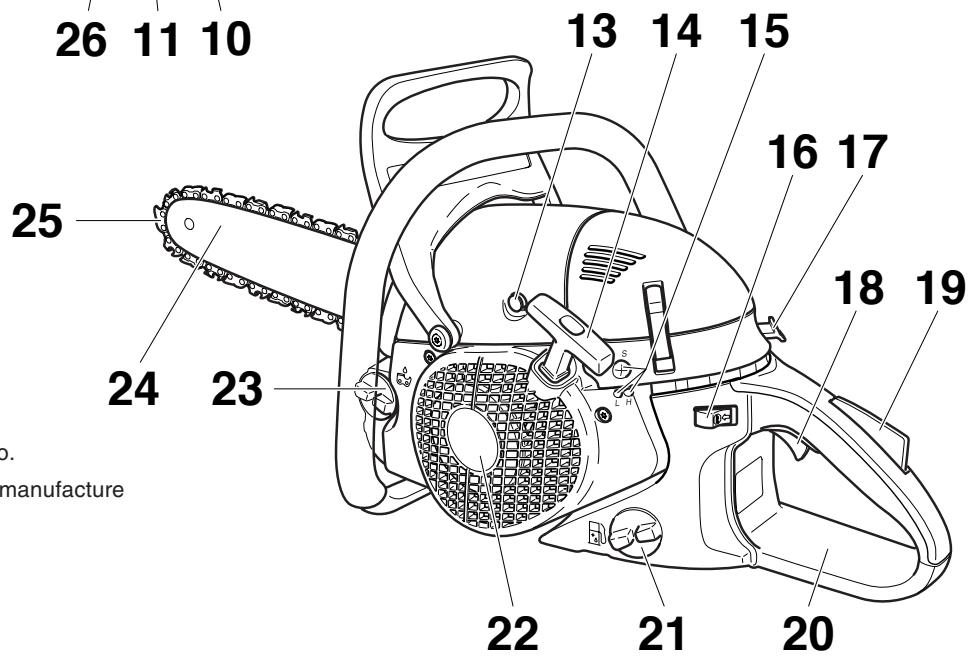
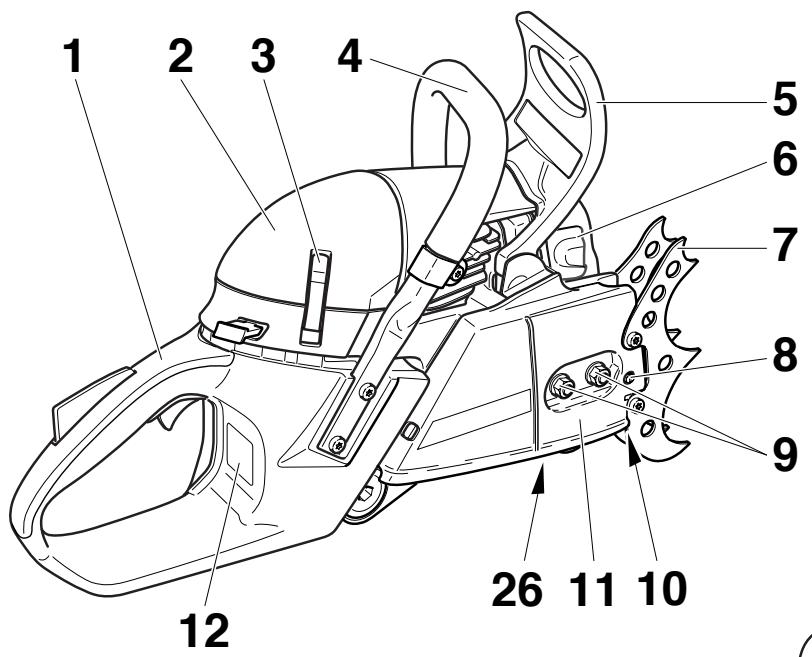
1 Handle
2 Filter cover
3 Filter hood clip
4 Tubular handle
5 Hand guard (release for chain brake)
6 Muffler with spark arrester screen
7 Spike bar (toothed stop for holding saw steady against wood)
8 Chain tensioning screw
9 Retaining nuts
10 Chain catch
11 Sprocket guard
12 Identification plate
13 Decompression valve (option)
14 Starter grip
15 Adjusting screws "S-L-H" for carburetor
16 I/STOP-switch
17 Choke lever
18 Throttle lever
19 Throttle stopper
20 Hand guard
21 Fuel tank cap
22 Fan housing with starting assembly
23 Oil tank cap
24 Guide bar
25 Chain
26 Adjusting screw for oil pump (bottom side)
Technical data
| Technical data | DCS6400 DCS6401 | DCS7300 DCS7301 | DCS7900 DCS7901 | |
| Stroke volume | cu. in (cm³) | 3.9 (64) | 4.4 (72.6) | 4.8 (78.5) |
| Bore | inch (mm) | 1.85 (47) | 1.97 (50) | 2.04 (52) |
| Stroke | inch (mm) | 1.45 (37) | 1.45 (37) | 1.45 (37) |
| Max. power at speed 1) | hp / rpm | 4.7 / 9,000 | 5.6 / 9,500 | 6.2 / 9,500 |
| Max. torque at speed 1) | Nm / rpm | 4.2 / 6,500 | 4.8 / 7,000 | 5.2 / 7,000 |
| Limit speed with guide bar and chain | rpm | 13,500 | 13,500 | 13,500 |
| Idling speed | rpm | 2,500 | 2,500 | 2,500 |
| Coupling speed | rpm | 3,200 | 3,200 | 3,200 |
| Sound Pressure Level at the operator's ear at full load according to ANSI B 175.1 | db(A) | 101,4 | 101,4 | 101,4 |
| Sound Pressure Level at the bystander's position (50 ft/15 m distance) according to ANSI B 175.1 | db(A) | 78,7 | 78,7 | 78,7 |
| Carburetor (diaphragm carburetor) | Type | ZAMA with limiter caps | ||
| Ignition system | Type | electronic | ||
| Spark plug | Type | NGK BPMR 7A | ||
| Electrode gap | inch (mm) | .020 (0.5) | ||
| or spark plug | Type | BOSCH WSR-6F | ||
| Fuel consumption at max. load per ISO 7293 1) | kg/h | 1.72 | 2.33 | 2.3 |
| Specific consumption at max. load per ISO 7293 1) | g/kWh | 500 | 510 | 505 |
| Fuel tank capacity | floz | 25.36 | ||
| Chain oil tank capacity | floz | 14.20 | ||
| Mixture ratio (fuel/two-stroke oil) | ||||
| - when using MAKITA oil | 50:1 | |||
| - when using other oils | 40:1 | |||
| Chain brake | engages manually or in case of kickback | |||
| Sprocket pitch | inch | 3/8 | ||
| Number of teeth | Z | 7 | ||
| Chain type (see the Extract from the spare-parts list) | 099 | |||
| Pitch / Driving element strength | inch | 3/8 / .058 | 3/8 / .050 | |
| Guide bar, length of a cut | inch | 15 / 18 / 20 / 24 / 28 | ||
| Guide-bar type (see the Extract from the spare-parts list) | ||||
| Weight (fuel tank empty, without chain and guide bar) | lbs | 13.9 | 13.9 | 13.9 |
1) For models without decompression valve
WARNING:
This chain saw is capable of severe kickback that could result in serious injury to the user. Do not operate this chain saw unless you have extraordinary cutting needs and experience and specialized training for dealing with kickback. Chain saws with significantly reduced kickback potential are available.



A
Before doing any work on the guide bar or chain, always switch off the engine and pull the plug cap off the spark plug (see "Replacing the spark plug"). Always wear protective gloves!
CAUTION:
Start the chain saw only after having assembled it completely and inspected.
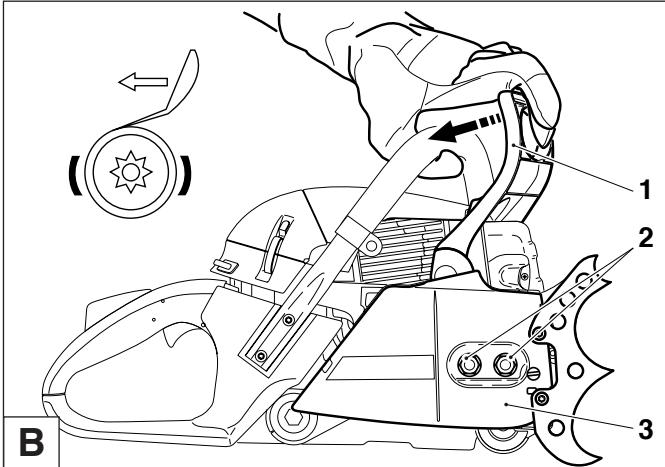
Mounting the guide bar and saw chain
Use the universal wrench delivered with the chain saw for the following work.
Put the chain saw on a stable surface and carry out the following steps for mounting the guide bar and saw chain:
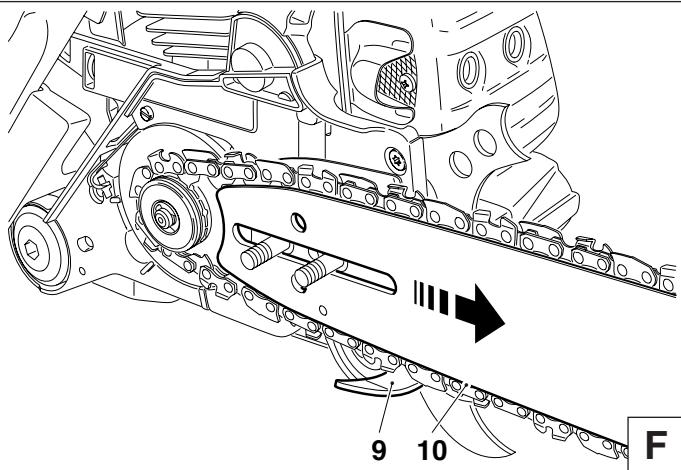
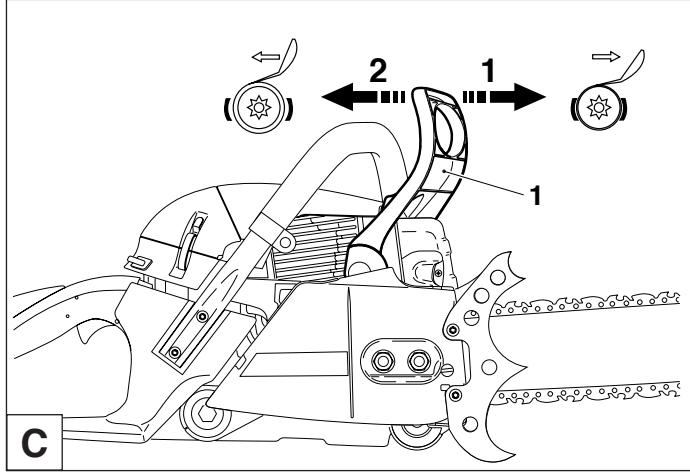
Release the chain brake by pulling the hand guard (1) in direction of arrow.
Unscrew retaining nuts (2).
Pull off the sprocket guard (3).
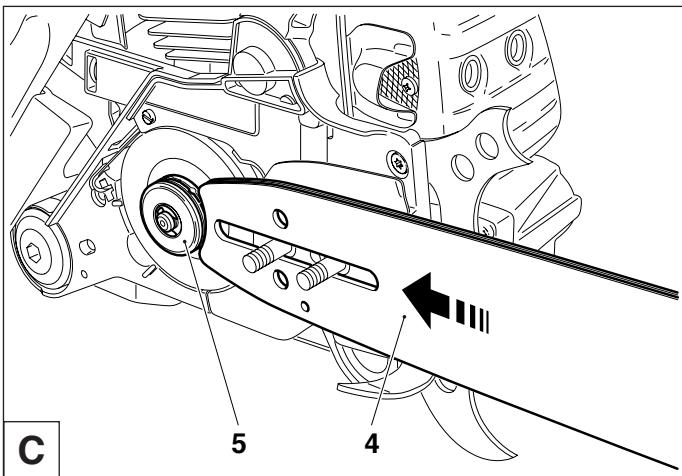
Position the guide bar (4) and push against the sprocket (5) as shown by the arrow.
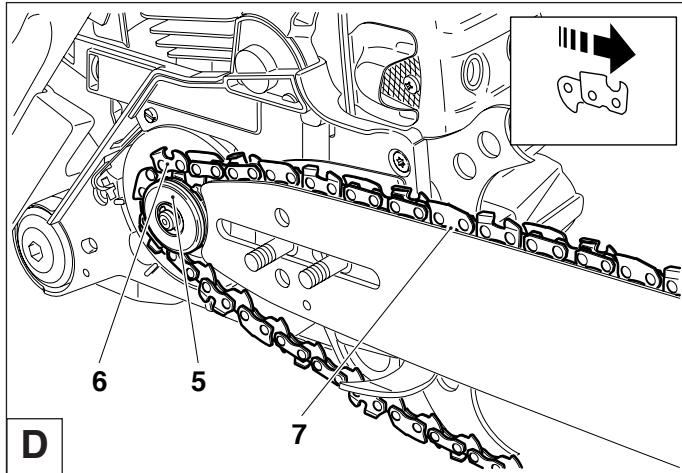
Lift the chain (6) over the sprocket (5). Using your right hand, guide the chain into the top guide groove on the guide bar (7).
CAUTION:
Note that the cutting edges along the top of the chain must point in the direction of the arrow!
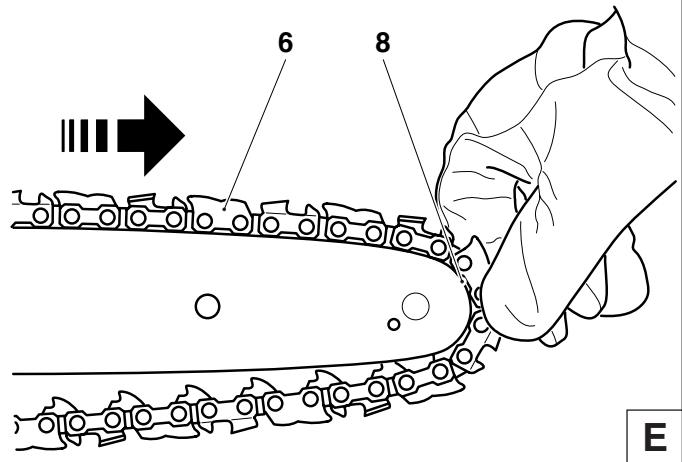
Pull the chain (6) around the sprocket nose (8) of the guide bar in the direction of the arrow.
Guide the chain over the chain catch (9).
Pull the guide bar as shown by the arrow to take the slack out of the chain, so that it comes up to the bottom edge of the guide bar (10).
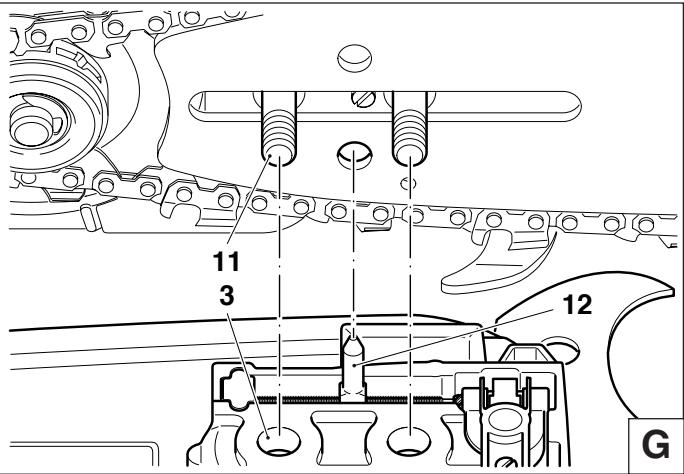
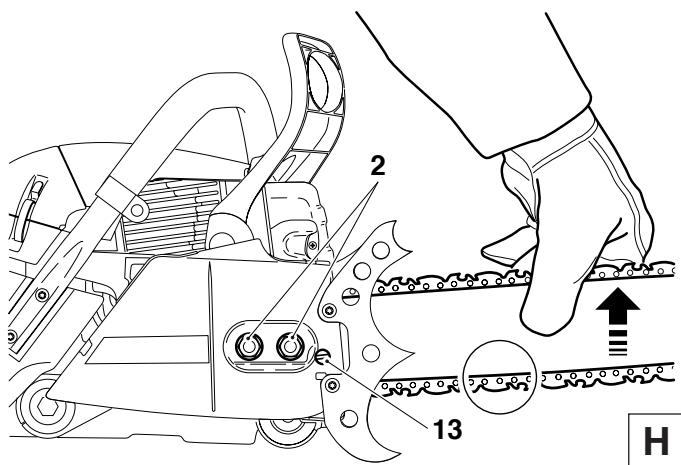
Line up the holes in the sprocket guard (3) with the bolts (11). Turn the chain tensioning screw (H/13) until the chain tensioning bolt (12) is aligned with the hole in the guide bar.
Replace the sprocket guard.
Manually tighten the retaining nuts (H/2).
Tightening the saw chain
Slightly lift the end of the guide bar and turn the chain adjusting screw (13) to the right (clockwise) until the chain rests against the bottom side of the guide bar.
While still holding up the tip of the guide bar, tighten the retaining nuts (2) with the universal wrench.
NOTE:
Before tightening the chain, loosen the two nuts (2) slightly.
A
Checking the chain tension
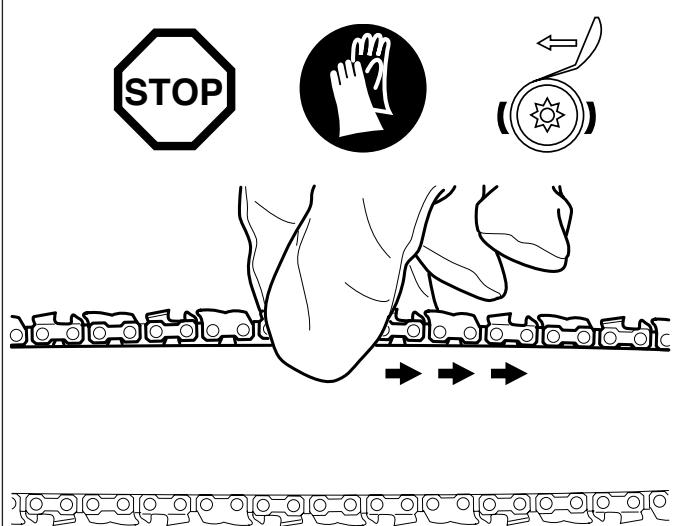
The tension of the chain is correct if the chain rests against the bottom side of the guide bar and can still be easily turned by hand.
While doing so the chain brake must be released.
Check the chain tension frequently - new chains tend to get longer during use!
When checking the chain tension the engine must be switched off.
NOTE:
It is recommended to use 2-3 chains alternatively.
In order to guarantee uniform wear of the guide bar the bar should be turned over whenever replacing the chain.
Chain brake
The DCS6400, 6401, 7300, 7301, 7900, 7901 comes with an inertia chain brake as standard equipment. If kickback occurs due to contact of the guide-bar tip with wood (see SAFETY PRECAUTIONS, page 10), the chain brake will stop the chain through inertia if the kickback is sufficiently strong.
The chain will stop within a fraction of a second.
The chain brake is installed to block the saw chain before starting it and to stop it immediately in case of an emergency.
IMPORTANT: NEVER run the saw with the chain brake activated (except for testing, see "Testing chain brake")! Doing so can very quickly cause extensive engine damage!
ALWAYS release the chain brake before starting the work!

B
Engaging the chain brake (braking)
If the kickback is strong enough the sudden acceleration of the guide bar combined with the inertia of the hand guard (1) will automatically actuate the chain brake.
To engage the chain brake manually, simply push the hand guard (1) forward (towards the tip of the saw) with your left hand (arrow 1).
Releasing the chain brake
Pull the hand guard (1) towards you (arrow 2) until you feel it catch. The brake is now released.
Fuel
CAUTION:
This saw is powered by mineral-oil products (gasoline (petrol) and oil).
Be especially careful when handling gasoline (petrol).
Avoid all flame or fire. Do not smoke (explosion hazard).
Fuel mixture
The engine of the chain saw is a high-efficiency two-stroke engine. It runs on a mixture of gasoline and two-stroke engine oil.
The engine is designed for unleaded regular gasoline with a min. octane value of 91 ROZ. In case no such fuel is available, you can use fuel with a higher octane value. This will not affect the engine.
In order to obtain an optimum engine output and to protect your health and the environment use unleaded fuel only. Gasoline which contens alcohol should not used in MAKITA products.
To lubricate the engine, use a high-performance two-stroke engine oil (quality grade JASO FC or ISO EGD specifications), which is added to the fuel. The engine has been designed for use of MAKITA high-performance two-stroke engine oil and a mixture ratio of only 50:1 to protect the environment. In addition, a long service life and reliable operation with a minimum emission of exhaust gases are ensured. MAKITA high-performance two-stroke engine oil is available in the following sizes to suit your individual requirements:
1 order number 980 008 607
100 ml order number 980 008 606
In case MAKITA high-performance two-stroke engine oil is not available, it is urgently recommended to use a mixture ratio of 40:1 with other two-stroke engine oils, as otherwise optimum operation of the engine cannot be guaranteed.
The correct mixture ratio:
50:1 when using MAKITA high-performance two-stroke engine oil, i. e. mix 50 parts gasoline with 1 part oil.
40:1 when using other two-stroke engine oils, i. e. mix 40 parts gasoline with 1 part oil.
NOTE:
For preparing the fuel-oil mixture first mix the entire oil quantity with half of the fuel required, then add the remaining fuel. Thoroughly shake the mixture before filling it into the chain saw tank.


Gasoline
1.0 Us-gal. (3.7 I)
2.5 Us-gal. (9.4 I)
5.0 Us-gal. (18.9 I)

50:1
2.5 floz. (75 cm³)
6.4 floz. (189~cm^3)
12.8 floz. (378~cm^3)

40:1
3.2 floz. (94~cm^3)
8.0 floz. (236 cm ^3 )
6.0 floz. (473~cm^3)
It is not wise to add more engine oil than specified to ensure safe operation. This will only result in a higher production of combust- tion residues which will pollute the environment and clog the exhaust channel in the cylinder as well as the muffler. In addition, fuel consumption will rise and performance will decrease.
NOTE:
Fuel cannot be stored for an unlimited period of time. Buy only as much as will be consumed in 4 weeks. Use only approved and marked containers for transport and storage.
AVOID SKIN AND EYE CONTACT
Mineral oil products degrease your skin. If your skin comes in contact with these substances repeatedly and for an extended period of time, it will desiccate. Various skin deseases may result. In addition, allergic reactions are known to occur.
Eyes can be irritated by contact with oil. If oil comes into your eyes, immediately wash them with clear water.
If your eyes are still irritated, see a doctor immediately!
D
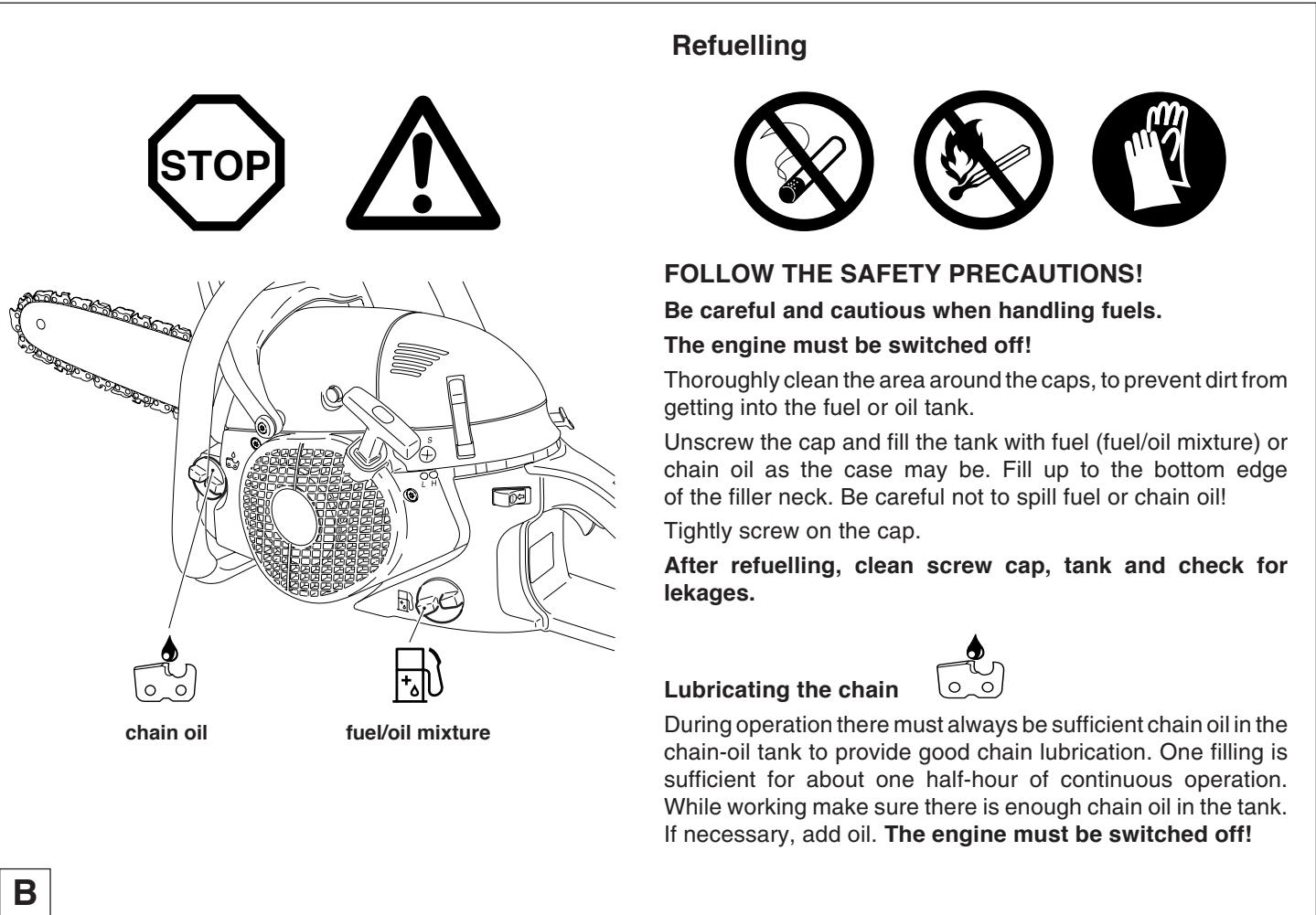
Chain oil

Use an oil with adhesive additive for lubricating the chain and guide bar. The adhesive additive prevents the oil from being flung off the chain too quickly.
We recommend the use of chain oil which is bio-degradable in order to protect the environment. The use of bio-degradable oil may even be required by local regulations.
The chain oil BIOTOP sold by MAKITA is made of special vegetable oils and is 100% bio-degradable. BIOTOP has been granted the "blue angel" (Blauer Umweltschutz-Engel) for being particularly environment-friendly (RAL UZ 48).

BIOTOP chain oil is available in the following sizes:
1 order number 980 008 610
5 I order number 980 008 611
Bio-degradable oil is stable only for a limited period of time. It should be used within 2 years from the date of manufacture (printed on the container).
E
Important note on bio-degradable chain oils
If you are not planning to use the saw again for an extended period of time, empty the oil tank and put in a small amount of regular engine oil (SAE 30), and then run the saw for a time. This is necessary to flush out all remaining bio-degradable oil from the oil tank, oil-feed system, chain and guide bar, as many such oils tend to leave sticky residues over time, which can cause dam-
age to the oil pump or other parts.
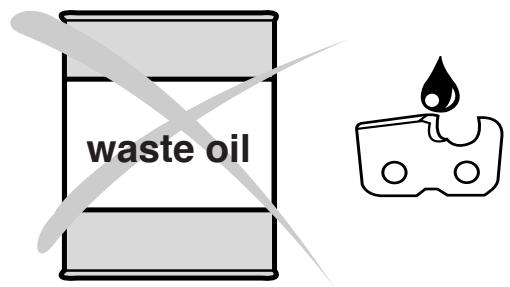
The next time you use the saw, fill the tank with BIOTOP chain oil again. In case of damage caused by using waste oil or inappropriate chain oil the product guarantee will be null and void.
Your salesman will inform you about the use of chain oil.

A
NEVER USE WASTE OIL
Waste oil is very dangerous for the environment.
Waste oil contains high amounts of carcinogenic substances.
Residues in waste oil result in a high degree of wear and tear at the oil pump and the sawing device.
In case of damage caused by using waste oil or inappropriate chain oil the product guarantee will be null and void.
Your salesman will inform you about the use of chain oil.
AVOID SKIN AND EYE CONTACT
Mineral oil products degrease your skin. If your skin comes in contact with these substances repeatedly and for an extended period of time, it will desiccate. Various skin deseases may result. In addition, allergic reactions are known to occur.
Eyes can be irritated by contact with oil. If oil comes into your eyes, immediately wash them with clear water.
If your eyes are still irritated, see a doctor immediately!
Checking the chain lubrication
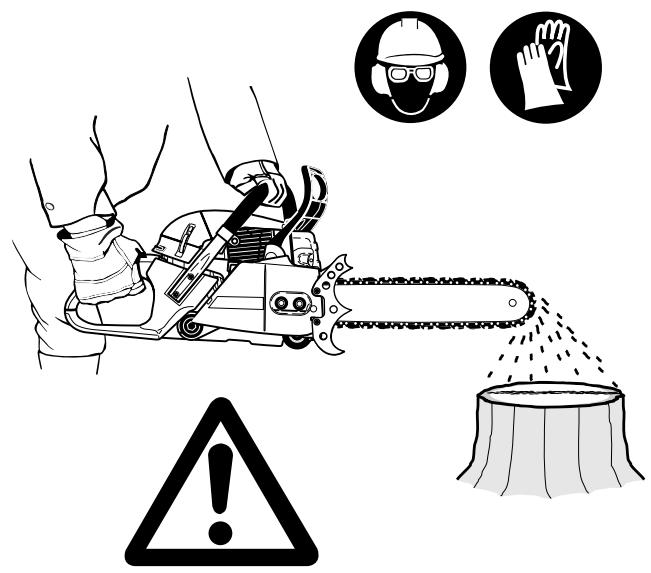
Never work with the chain saw without sufficient chain lubrication. Otherwise the service life of the chain and guide bar will be reduced. Before starting work check the oil level in the tank and the oil feed.
Check the oil feed rate as described below:
Start the chain saw (see „Starting the engine").
Hold the running chain saw approx. 6'' (15 cm) above a trunk or the ground (use an appropriate base).
If the lubrication is sufficient, you will see a light oil trace because oil will be flung off the sawing device. Pay attention to the direction the wind is blowing and avoid unnecessary exposure to the oil spray!
Note:
After the saw has been turned off it is normal for residual chain oil to drip from the oil feed system, the guide bar and the chain for a time. This does not constitute a defect!
Place the saw on a suitable surface.
Adjusting the chain lubrication
The engine must be switched off.

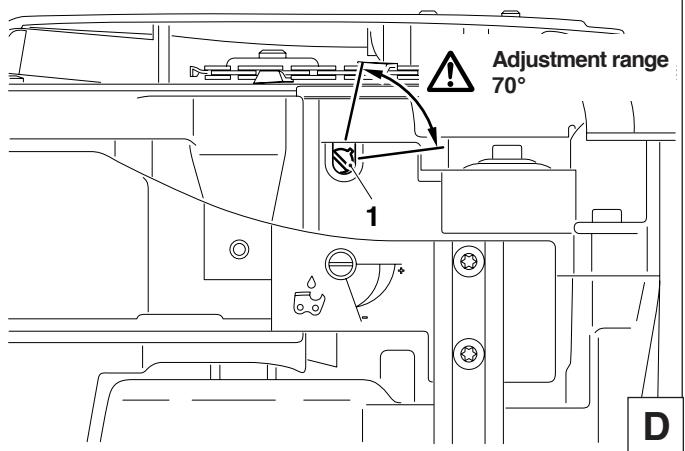
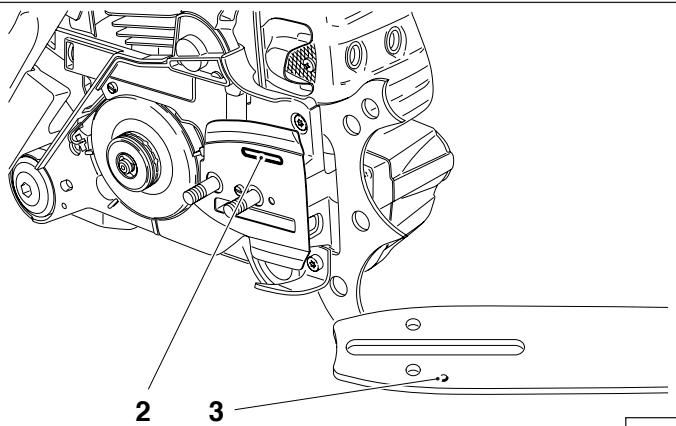
You can adjust the oil pump feed rate with the adjusting screw (1). The adjusting screw is on the bottom side of the housing. The oil pump comes factory-set to a medium feed rate.
To change the feed quantity use a screwdriver and adjust the adjusting screw in the following way:
- Turn to the right to reduce the feed rate.
- Turn to the left to increase the feed rate.
Even very small adjustments to the adjusting screw (1) can influence the oil flow rate. While working make sure there is enough chain oil in the tank. If necessary, add oil.
To ensure troublefree operation of the oil pump the oil guide groove at the crank case (2) and the oil inlet bore in the guide bar (3) must be cleaned regularly.
Note:
After the saw has been turned off it is normal for residual chain oil to drip from the oil feed system, the guide bar and the chain for a time. This does not constitute a defect!
Place the saw on a suitable surface.
Starting the engine
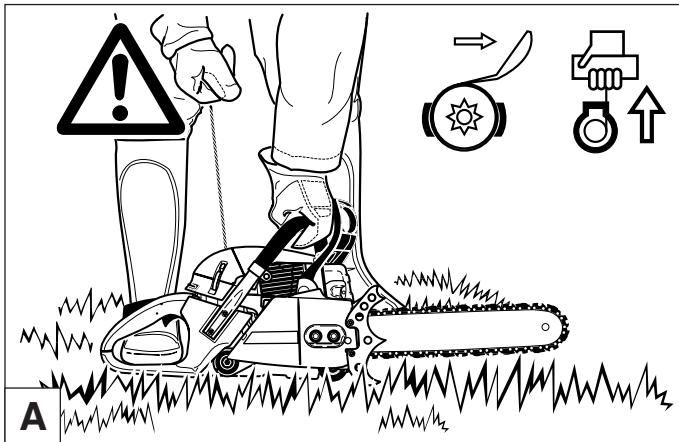
Start the chain saw only after having assembled it completely and inspected.
Move at least 10 feet (3m) away from the place where you fuelled the saw.
Make sure you have a good footing, and place the saw on the ground in such a way that the chain is not touching anything.
Engage the chain brake (lock).
Hold the tubular handle tightly with one hand and press the chain saw to the ground.
Steady the rear handle by standing in the hand guard.


B
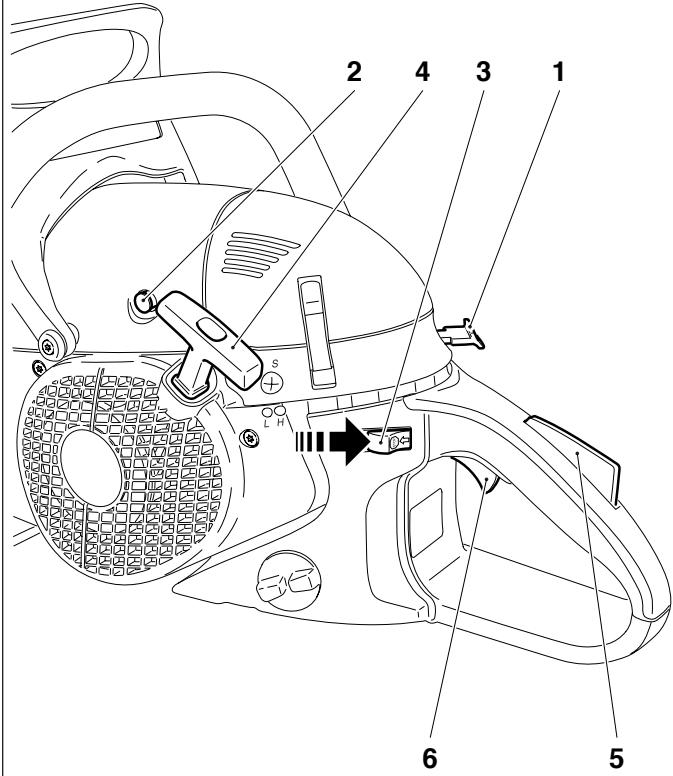
Cold-starting:
Pull the choke (1) out until it audibly clicks. This simultaneously actuates the half-throttle lock.
Move the I/STOP ignition switch (3) as shown by the arrow.
Slowly pull out the starter cable until you notice resistance (the piston is positioned before the top dead center).
Push the decompression valve (2) (option).
Now pull the starter cable with a fast and forceful movement until you hear the first ignition.
CAUTION: Do not pull out the starter cable more than approx. 50 cm, and lead it back by hand.
Push the decompression valve (2) (option).
Depress the choke (1) and pull the starter cable again. As soon as the engine is running, grasp the rear handle (this actuates the throttle stopper (5)) and tap the throttle (6). This will release the half-throttle lock and the engine will run in idle.
CAUTION: As soon as the engine is started it must be put in idle to prevent the chain brake from being damaged.
Now release the chain brake.

Warm starting:
As described for cold starting, except before starting pull the choke (1) all the way out and back in one time, in order to activate the half-throttle lock.
Stopping the engine
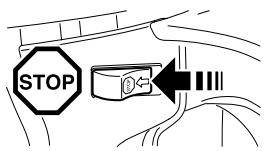
Move the I/STOP ignition switch to the "STOP" position.



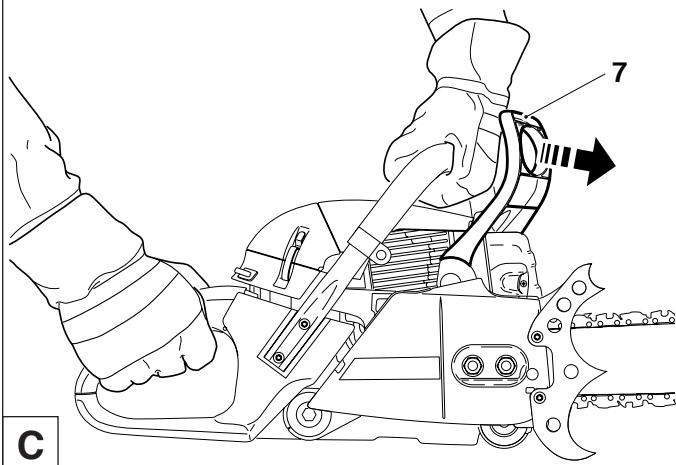
Checking the chain brake
Do not work with the chain saw without first checking the chain brake!
Start the engine as described (make sure you have a good footing, and place the chain saw on the ground in such a way that the guide bar is free of contact).
Grasp the tubular handle firmly with one hand and hold the grip with the other.
With the engine running at moderate speed, press the hand guard (7) in the direction of the arrow with the back of your hand until the chain brake engages. The chain should stop immediately.
Immediately release the throttle and release the chain brake.
IMPORTANT: If the chain does not stop immediately when you test the chain brake, do NOT use the chain saw. Take the chain saw to a MAKITA service center.
Adjusting the carburetor
Important information:
The carburetor of this tool is fitted with limiter caps which restrict the range of adjustment and prevents over-rich mixture settings. This ensures providing good engine power and efficient fuel consumption. Before installing the limiter caps, the manufacturer performs the "Basic Setting" procedure.
Carburetor adjustment is necessary for optimum engine performance, for safer and more economical operation. The engine should be warm, the air filter clean, and the chain properly tensioned. Have carburetor adjustment done by an authorised MAKITA service center.
The carburetor is factory-adjusted for the air pressure at sea level. At other elevations or under other conditions of weather, temperature, or humidity, or when breaking in a new engine, it may be necessary to make slight adjustments to the carburetor.
You will need a tachometer (9, part No. 950 233 210) for optimum adjustment.
Do not go below the specified basic setting of the main nozzle (H). Doing so may cause engine damage due to overheating and insufficient lubrication!
Use the supplied carburetor screwdriver (8) for carburetor adjustment. It has a moulded-on projection that aids in adjusting. Before undertaking the adjustment, run the engine for 3-5 minutes to warm it up, but not at high speed!


For proper adjustment, proceed as follows:
- Basic setting (engine off)
Start engine and warm up. - Set idle
- Check top speed
- Check acceleration
- Check idle speed
Repeat steps 2-5 until you get the right idle speed, good acceleration and maximum permissible
1. Basic setting
Carefully turn the adjusting screw for the idle nozzle (L) clockwise until you feel a stop.
Turn adjusting screw (L) 1 turns counter-clockwise.
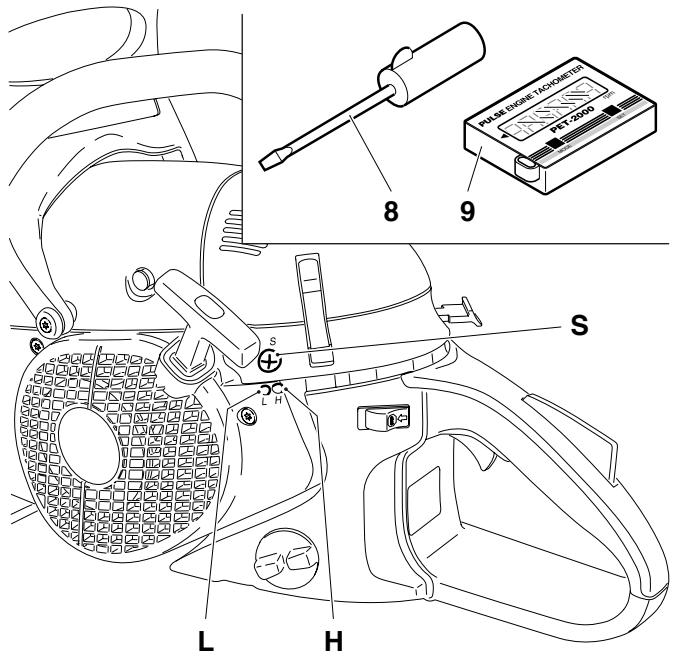
2. Set idle
Set the idle speed per the technical specifications.
Turning the adjusting screw (S) in (clockwise) increases the idle speed. Turning it out (counter-clockwise) lowers the idle speed. In no case should the chain move.
3. Check top speed
The top speed in the governor can be clearly heard from the ignition misses. Important: To prevent engine damage, never go more than a 1/4 turn in clockwise with adjusting screw (H). Note: Since there is an electronic speed governor (limiter) at 13,500 rpm that cuts off the ignition current, the top speed cannot be read from the tachometer.
4. Check acceleration
When the throttle is pressed, the engine should go smoothly from idle to high speed. If this is too slow, turn the adjusting screw (L) in small (max. 1/8 turns) increments counter-clockwise.
5. Check idle speed
Check the idle speed after setting the top speed (the chain must not move).
Repeat the adjustment procedure starting at Step 2, until the engine runs with the correct idle speed, good acceleration, and top speed.
D
Working in winter
In order to prevent carburetor icing in conditions of low temperature combined with high humidity, and below +5^ in order to get up to operating temperature faster, heated air can be taken from the cylinder.
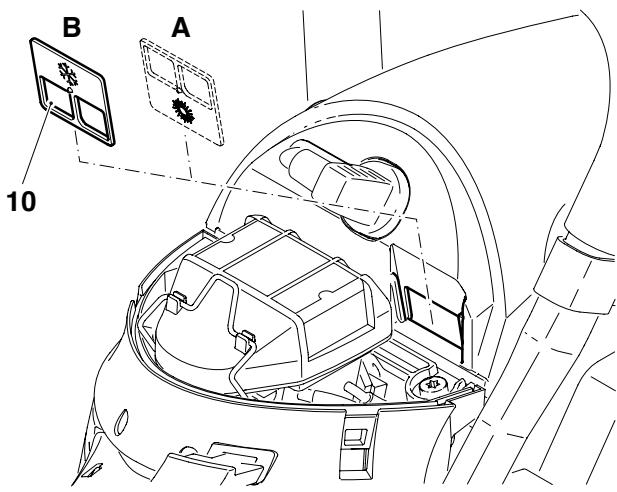
Remove the filter hood (see „Cleaning air filter“)
Remove the insert (10) and insert it as shown in position B for cold-weather operation.
At temperatures above +5^ the carburetor must NOT be fed heated air. Failure to follow these instructions can lead to damage to the cylinder and piston!
At temperatures over +5^ place the insert in position A for normal operation.
Position A

- Normal operation
Position B

- Cold-weather operation
Reinstall the filter hood.
E
MAINTENANCE
Sharpening the saw chain


CAUTION: Before doing any work on the guide bar or chain, always switch off the engine and pull the plug cap off the spark plug (see "Replacing the spark plug"). Always wear protective gloves!
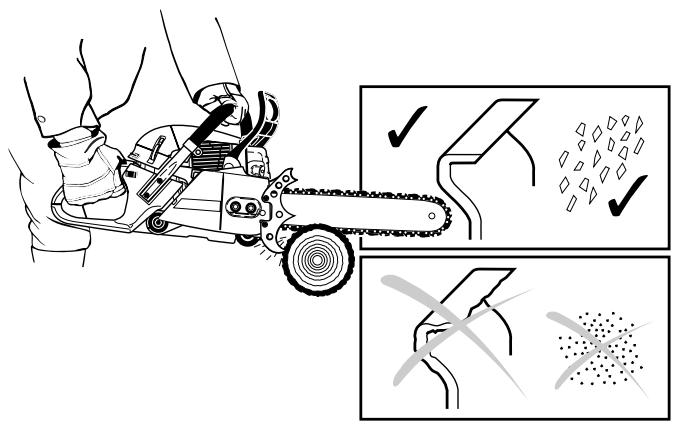
The chain needs sharpening when:
The sawdust produced when sawing damp wood looks like wood flour.
The chain penetrates the wood only under great pressure.
The cutting edge is visibly damaged.
The saw is pulled to the left or right when sawing. This is caused by uneven sharpening of the chain.
Important: Sharpen frequently, but without removing too much metal!
Generally, 2 or 3 strokes of the file will be enough.
Have the chain sharpened at a service center when you have already sharpened it yourself several times.
A
B
Proper sharpening:
CAUTION: Use only chains and guide bars designed for this saw (see the Extract from the spare-parts list)!
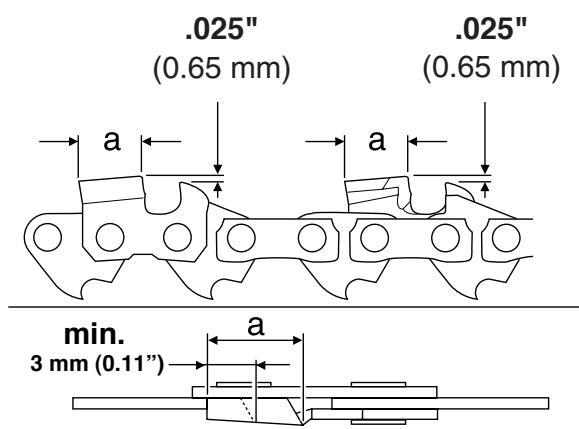
All cutters must be of the same length (dimension a). Cutters with different lengths result in rough running of the chain and can cause cracks in the chain.
The minimum cutter length: 0.11" (3 mm). Do not resharpen the chain when the minimum cutter length has been reached; at this point, the chain must be replaced (see the Extract from the spare-parts list and "Replacing the saw chain").
The depth of the cut is determined by the difference in height between the depth limiter (round nose) and the cutting edge. The best results are obtained with a depth-limiter depth of .025" (0.65 mm).
CAUTION: Excessive depth increases the risk of kickback!
C
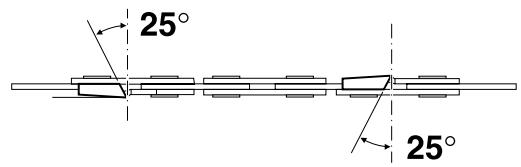
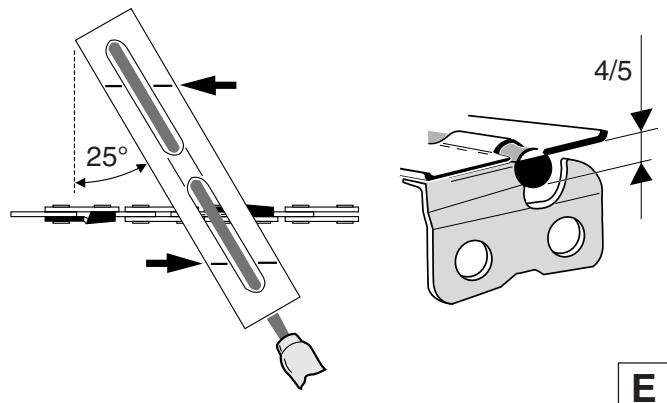
The sharpening angle of 25^ must be identical for all cutters! Different angles result in a roughly, irregularly running chain, increase wear and tear and cause chain beakage.
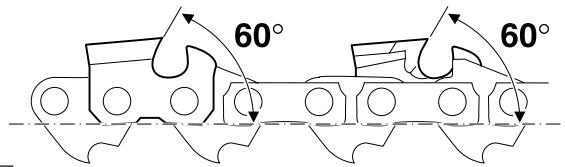
The front rake 60^ of the cutter results from the cut depth of the round file. If the proper file is used in the right manner, the correct front rake will be obtained automatically.
Files and how to work with them
Sharpen using a special file holder with a saw chain round file. Normal round files are not appropriate for this work. See "Accessories" for the order number.
099: File the first cutter half with a 7/32'' (5.5 mm) dia. round saw-chain file, then switch to a 3/16'' (4.8 mm) dia. file.
496: File the cutter with a 7/32'' (5.5 mm) dia. round saw-chain file.
The file should cut only when pushed forwards (arrow). Lift the file when leading it backwards.
First sharpen the shortest cutter. The length of this cutter is then the standard for all other cutters of the chain.
New saw teeth must be filed to the exact same shape as the used teeth, including on their running surfaces.
Always guide the file horizontally (90° to the guide bar).
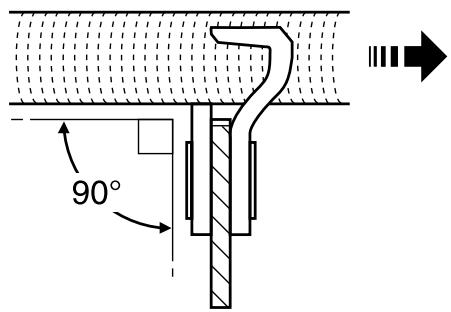
D
The file holder makes file guidance easier. It is marked for the correct sharpening angle of 25^ (keep the marks parallel with the chain when filing, see illustration) and limits the cut depth to the correct 4/5 of the file diameter. See "Accessories" for the order number.
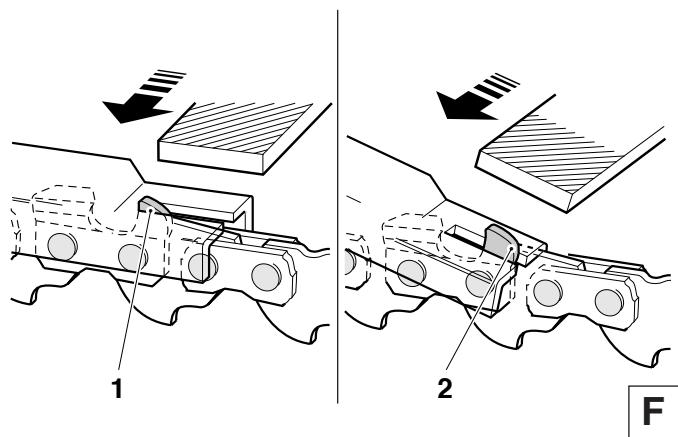
After having sharpened the chain, the height of the depth limiter must be checked by means of a chain gauge. See "Accessories" for the order number.
Correct even the smallest excess height with a special flat file (1). See "Accessories" for the order number.
Round off the front of the depth limiter (2).



Cleaning the brake band and sprocket interior
CAUTION: Before doing any work on the guide bar or chain, always switch off the engine and pull the plug cap off the spark plug (see "Replacing the spark plug"). Always wear protective gloves!
CAUTION: Start the chain saw only after having assembled it completely and inspected.
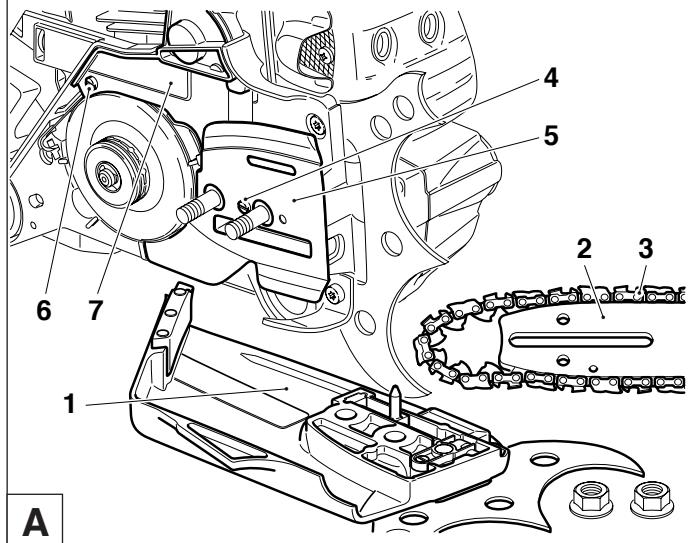
Remove the sprocket guard (1) (See "PUTTING INTO OPE-RATION" figs. B) and clean the interior with a brush Remove the chain (3) and guide bar (2).
Unscrew screw (4) and remove the guide plate (5).
Unscrew screw (6) and remove the brake mechanism cover (7).
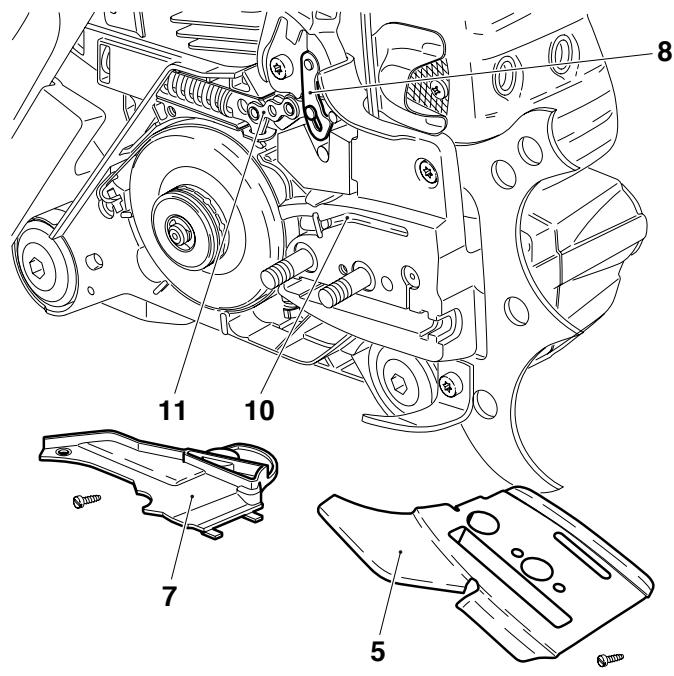

SERVICE
Clean the guide plate (5) and brake mechanism cover (7). Use a brush to clean the interior, especially the brake mechanism (11).
Make sure to leave no residue in the oil guide groove (10)
NOTE:
The brake mechanism cover (7) holds the lever (8) in place. Before putting the cover back on, check the lever for proper positioning.
First put on the brake mechanism cover (7) and then the guide plate (5).
For replacing the guide bar, chain, and sprocket see "PUTTING INTO OPERATION A-H".
After assembly, always check the functioning of the chain brake (see "Checking the chain brake")
NOTE:
The chain brake is a very important safety device and like any other component subject to normal wear and tear.
Regular inspection and maintenance are important for your own safety and must be done by a MAKITA service center.
B
Cleaning the guide bar
CAUTION: Protective gloves must be worn.
Regularly inspect the bearing surfaces of the guide bar for damage, and clean them with a suitable tool.
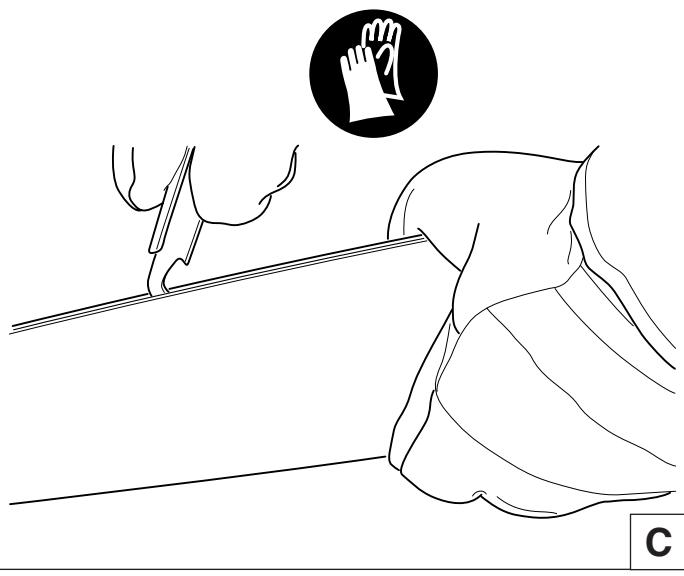
Replacing the saw chain
CAUTION: Use only chains and guide bars designed for this saw (see the Extract from the spare-parts list)!
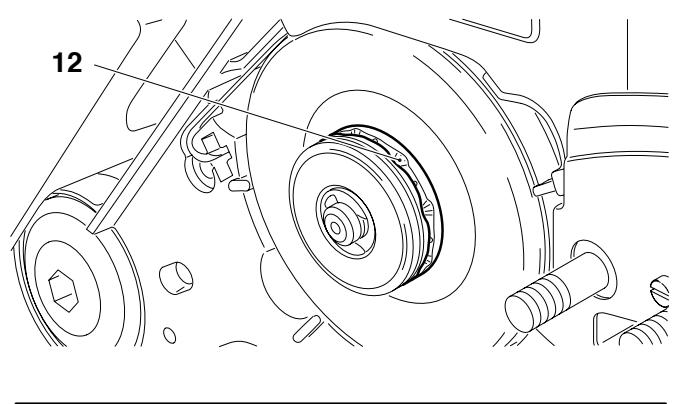
Check the sprocket before mounting a new chain.
Worn out sprockets (12) may damage the new chain and must therefore be replaced.
Remove the sprocket guard (1) (See "PUTTING INTO OPERATION" figs. B).
Remove the chain and guide bar.
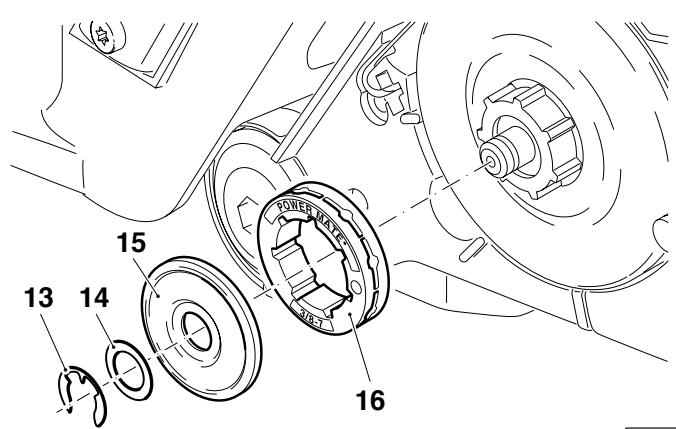
Remove circlip (13).
CAREFUL: The circlip will jump out of the groove unless you hold it down with your thumb while removing it.
Remove thrust washers (14 and 15).
Replace the old sprocket (12) with a new one (16). For the part number consult the "Extract from the spare parts list".
Assemble the new sprocket, thrust washers and circlip.
For replacing the guide bar, chain, and sprocket see "PUTTING INTO OPERATION A-H".
NOTE:
New chains stretch, so check the chain tension frequently (see "Checking the chain tension").
D
Replacing the fuel filter
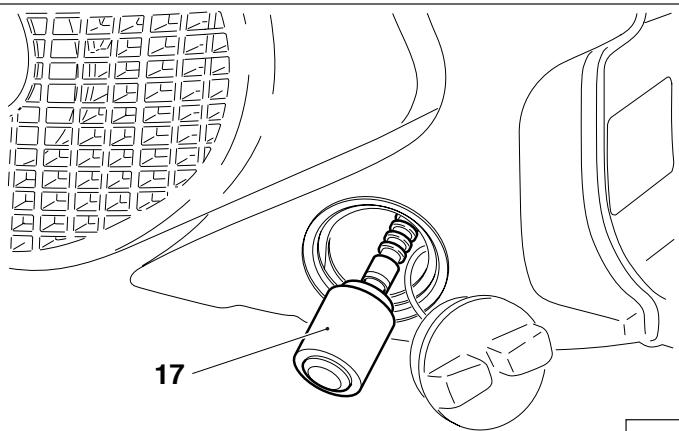
The felt filter (17) of the fuel filter can become clogged. It is recommended to replace the fuel filter once every three months in order to ensure unimpeded fuel flow to the carburetor.
To remove the fuel filter for replacement, pull it out through the tank filler neck using a piece of wire bent at one end to form a hook.
E
A
Cleaning the air filter


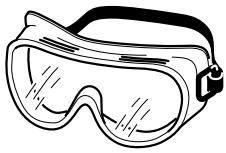
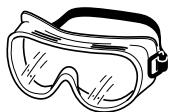
CAUTION: To prevent eye injury, always wear eye protection when cleaning the filter with compressed air!
Do not use fuel to clean the air filter.
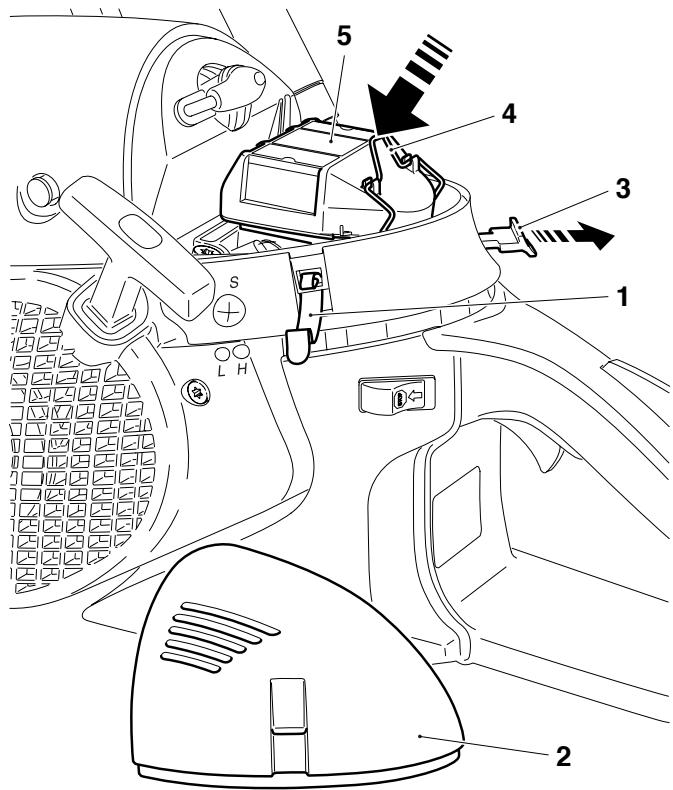
Unhook the filter hood clips (1) with the combination tool and remove the filter hood (2).
Pull out the choke (3) to prevent dirt particles from getting into the carburetor.
Unhook the air filter retainer (4) by pressing in the direction shown by the arrow.
Pull the air filter (5) up and out.
IMPORTANT: Cover the intake opening with a clean cloth to prevent dirt particles from getting into the carburetor.
Choosing the right filter: The fleece filter is for use in dry or dusty conditions. The nylon filter is for use in damp conditions.
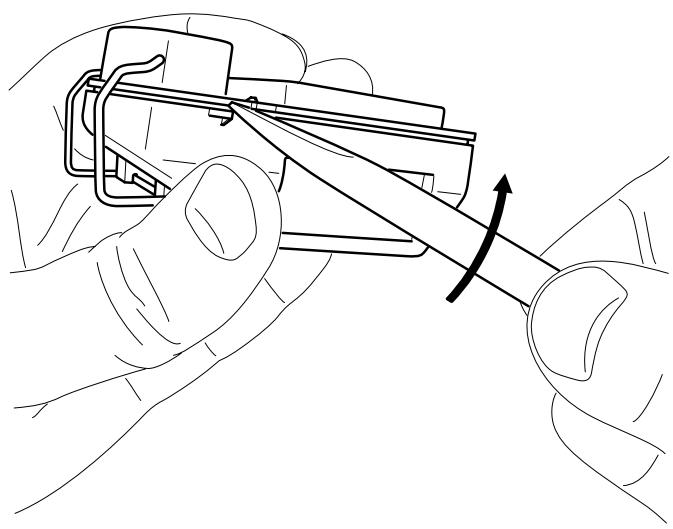
Pry apart the top and bottom of the air filter as shown in Figure.
Cleaning the fleece filter: Carefully tap out dust or carefully blow out dust from the inside with compressed air. Do not brush the fleece, as this will force dirt particles into the fabric. If the filter is very dirty, it can be washed in lukewarm water with regular dishwashing detergent. Note that the fleece filter does not need to be cleaned until there is a noticeable loss of power. If cleaning the filter does not bring an improvement in performance, it is time to replace it.
Cleaning the nylon filter: Use a soft brush or blow out dirt from the inside with compressed air. If the filter is very dirty, it can be washed in lukewarm water with regular dishwashing detergent. Clean frequently (several times a day) when working in very dusty or dirty conditions. Full engine power is possible only with a clean air filter!
Let the air filter dry completely.
Put the top and bottom sections back together.
Before assembling the air filter, check the choke flap for any dirt particles. If there are any, remove them with a brush.
CAUTION: If the air filter becomes damaged, replace immediately! Pieces of cloth or large dirt particles can destroy the engine!
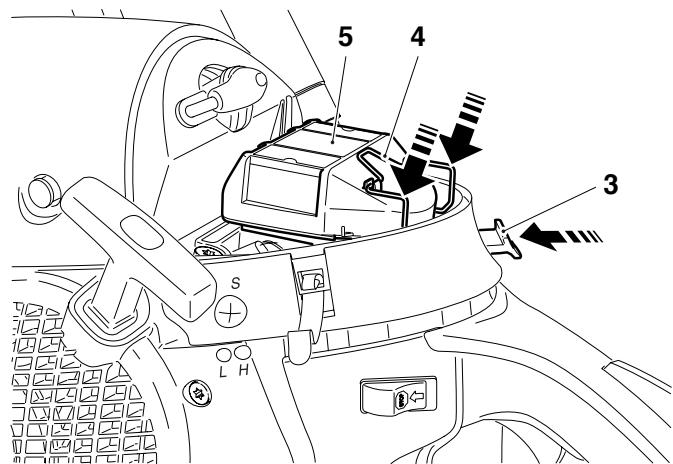
Put in the air filter (5) and press down the air filter retainer (4) evenly with thumb and forefinger until it clicks.
Push in the choke (3) and push the throttle all the way in to deactivate the half-throttle lock.
Put on the filter hood (2) and hook in the clips (1).
Replacing the spark plug


CAUTION:
Do not touch the spark plug or plug cap if the engine is running (high voltage).
Switch off the engine before starting any maintenance work. A hot engine can cause burns. Wear protective gloves!
The spark plug must be replaced in case of damage to the insulator, electrode erosion (burn) or if the electrodes are very dirty or oily.
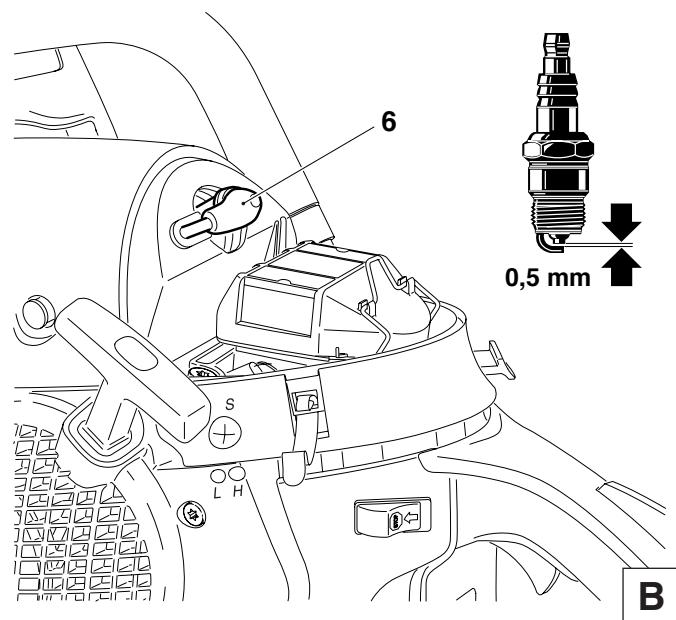
Remove the filter cover (see "Cleaning the air filter").
Pull the plug cap (6) off the spark plug. Use only the combination wrench supplied with the saw to remove the spark plug.
Electrode gap
The electrode gap must be .020" (0.5 mm).
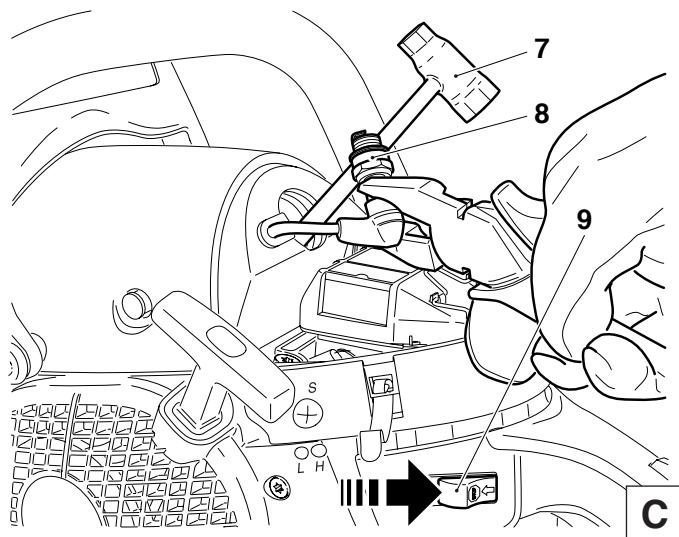
Checking the ignition spark
Stick the combination tool (7) between the hood and cylinder exactly as shown.
IMPORTANT! Do not stick the tool in the spark plug hole. It should touch only the cylinder (otherwise the engine will be damaged!).
With the spark-plug cap firmly attached to the unscrewed spark plug (8), use insulated pliers to hold the plug against the tool (away from the spark-plug hole!).
Switch the I/STOP ignition switch (9) as shown by the arrow. Pull the starter cable hard.
If the function is correct, an ignition spark must be visible near the electrodes.
CAUTION: Use only the following spark plugs: NGK BPMR 7A.
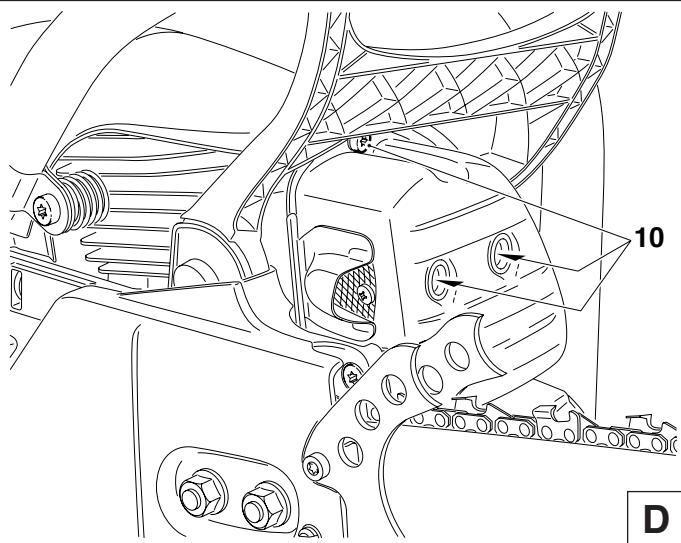
Checking the muffler screws



Careful!
Do not tighten the muffler screws when the engine is hot!
Check the muffler screws (10) for tightness. If they are loose, hand-tighten them. Important - do not overtighten!



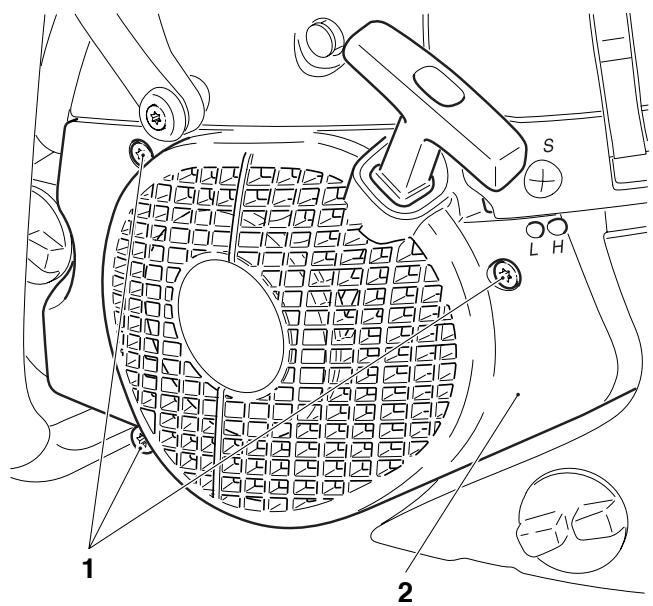
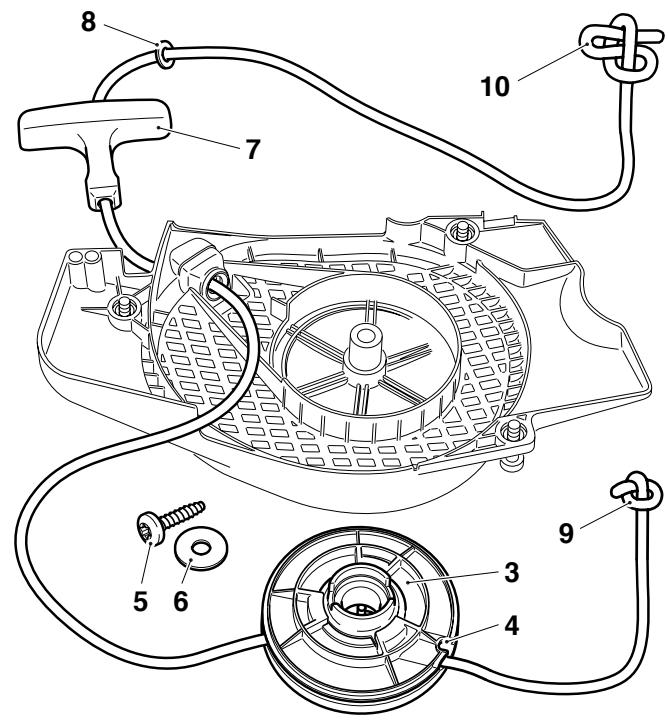
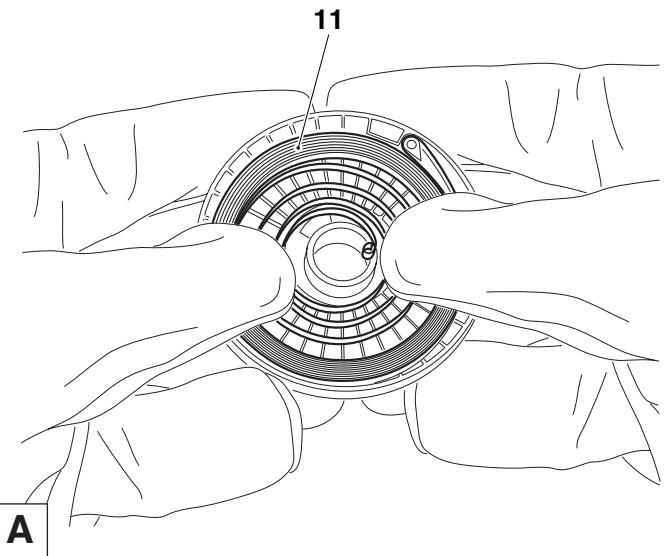
Replacing the starter cable / Replacing the return spring
Unscrew three screws (1).
Remove fan housing (2).
NOTE: The screws (1) are secured against falling out of the housing.
CAREFUL! Injury hazard! Do not unscrew screw (5) if the return spring is under tension.
If the starter cable is to be replaced although it is not broken, it will be necessary to first de-tension the cable drum return spring (3).
To do this, use the grip to pull the cable all the way out of the fan housing.
Hold the cable drum with one hand, and with the other push the cable into the space (4).
Carefully let the drum turn until the return spring is no longer under tension.
Unscrew screw (5) and remove washer (6). Carefully remove the cable drum.
CAREFUL! Injury hazard! The return spring can pop out!
Remove any cable pieces.
Thread a new cable (dia. 1/8" (3 mm), length 38.6" (980 mm) as shown in the illustration (don't forget the washer (8)) and knot both ends as shown.
Pull knot (9) into the cable drum (3).
Pull knot (10) into the starter grip (7).
Put the drum on its spindle and turn it slightly until the return spring engages.
Screw in and tighten screw (5) and washer (6).
Guide the cable into the space (4) on the drum and use the cable to turn the drum two turns clockwise.
Hold the cable drum with your left hand and with your right hand untwist the cable, pull it tight and hold it.
Carefully release the cable drum. The spring will wind the cable around the drum.
Repeat three or four times. The starter grip should now be held upright on the fan housing.
NOTE: With the cable pulled all the way out, it must still be possible to turn the pulley another 1/4 turn against the return spring.
CAUTION: Danger of injury! Secure the cable grip when pulled out! It will whip back if the cable pulley is released by accident.
Replacing the return spring
Disassemble the fan housing and cable drum (see above).
CAUTION: Danger of injury! If the spring is broken it may pop out!
Replacement return springs are supplied pretensioned in the cable drum. CAUTION - the spring can pop out. If it does, it can be put back in as shown in the drawing.
Before installation in the fan housing, lightly grease the new return spring (11) with multipurpose grease (order no. 944 360 000).
Install the cable drum and fan housing (see above).
Mounting the fan housing
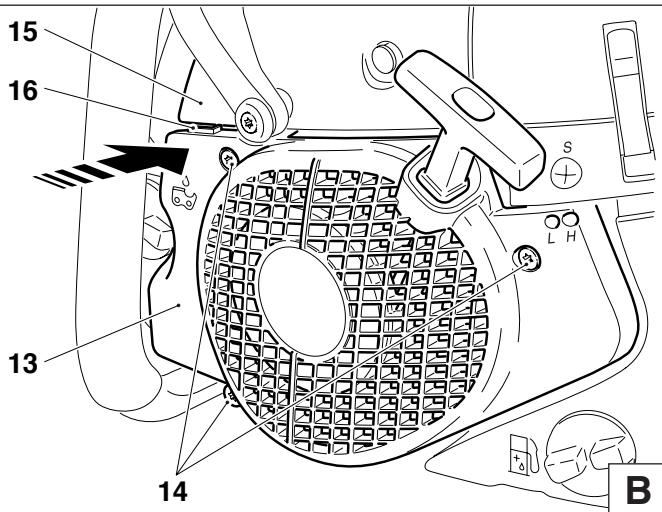
Put the fan housing (13) on.
Press the screws (14) into their holes.
Lift the engine hood (15) slightly and use your thumb to hook in the tab (16) on the fan housing.
Straighten out the fan housing, push lightly against the saw and pull the starter grip until the starting mechanism catches.
Tighten screws (14).
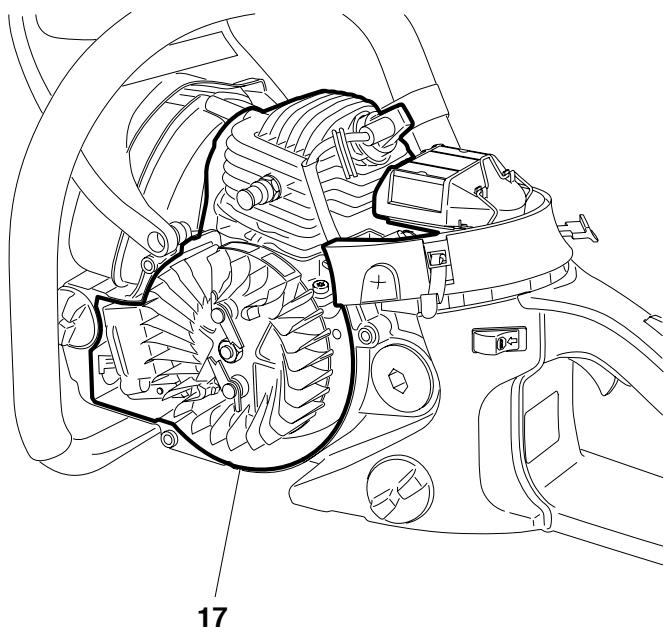
Cleaning the cylinder area



Remove the filter hood and air filter.
Remove the spark plug cap and unscrew the spark plug.
Press in the starting valve and activate the chain brake.
Push the cable cutout and ignition cable out sideways.
Unscrew the two rearmost screws on the cover.
Unscrew the screws on the handguard pivot and remove the bushing.
Lift the cover out of the air intake guide and remove.
IMPORTANT: Put the air filter back on and fasten it. Insert the spark plug and hand-tighten.
Put the spark plug cap on the plug and pull out the starting valve.
Remove the fan housing and remove the air guide.
CAUTION: To prevent eye injury, always wear eye protection when cleaning the filter with compressed air!
The entire area (17) can now be brushed clean or cleaned with compressed air.
A bottle brush can come in handy for cleaning out the cylinder ribs.
C
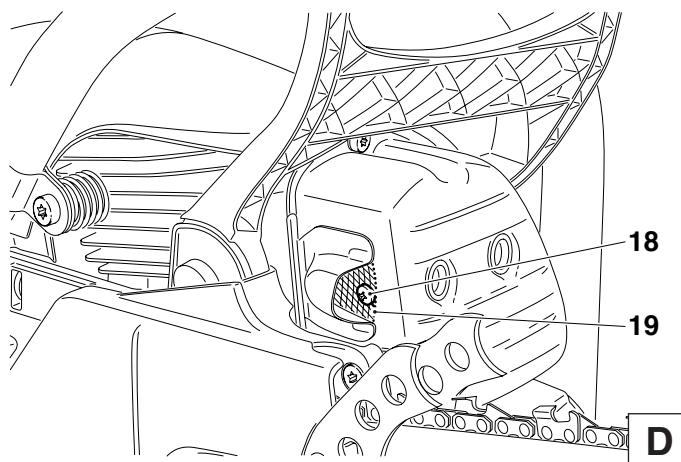
Replacing/cleaning the spark arrester screen
The spark arrester screen should be checked and cleaned regularly.
Loosen the screw (18) and remove the spark arrester screen (19).
Caution: Do not use sharp or pointed objects for screen cleaning. Damaged or misformed screen wires may result.
Reassembly the spark arrester screen and tighten the screw.
Instructions for periodic maintenance
To ensure long life, prevent damage and ensure the full functioning of the safety features the following maintenance must be performed regularly. Guarantee claims can be recognized only if this work is performed regularly and properly. Failure to perform the prescribed maintenance work can lead to accidents!
The user of the chain saw must not perform maintenance work which is not described in the instruction manual. All such work must be carried out by a MAKITA service center.
Page
| General | Chain saw Saw chain Chain brake Guide bar Starter cable | Clean exterior, check for damage. In case of damage, have repaired by a qualified service center immediately Sharpen regulatory, replace in good time Have inspected regularly at an authorized service center Turn over to ensure even wear of bearing surfaces Replace in good time Check for damage. Replace if damaged. | 27-28 21, 30 33 |
| Before each start | Saw chain Guide bar Chain lubrication Chain brake OFF switch, Throttle stopper, Throttle lever Fuel/oil tank cap | Inspect for damage and sharpness Check chain tension Check for damage Functional check Functional check Functional check Functional check Check for tightness and lekages | 27-28 21 24 25 25 23 |
| Every day | Air filter Guide bar Guide bar support Idle speed | Clean (more often if necessary) Check for damage, clean oil intake bore Clean, in particular the oil guide groove Check (chain must not run) | 31 30 24, 29 26 |
| Every week | Fan housing Cylinder area Spark plug Muffler Chain guide | Clean to maintain good cooling air flow. Clean to maintain good cooling air flow. Check and replace if necessary Check tightness of mounting, clean spark arrester screen Check | 17, 34 34 32 32, 34 20 |
| Every 3 months | Fuel filter Fuel, oil tanks | Replace Clean | 30 |
| Annually | Chain saw | Check at an authorized service center | |
| Storage | Chain saw Guide bar/chain Fuel, oil tanks Carburetor | Clean exterior, check for damage. In case of damage, have repaired by a qualified service center immediately Demount, clean and oil slightly Clean the guide groove of the guide bar Empty and clean Run empty | 30 |
Service, spare parts and guarantee
Maintenance and repair
The maintenance and repair of modern engines as well as all safety devices require qualified technical training and a special workshop equipped with special tools and testing devices.
We therefore recommend that you consult a MAKITA service center for all work not described in this instruction manual.
The MAKITA service centers have all the necessary equipment and skilled and experienced personnel, who can work out cost-effective solutions and advise you in all matters.
Please contact your nearest service center (list enclosed).
Spare parts
Reliable long-term operation, as well as the safety of your chain saw, depend among other things on the quality of the spare parts used. Use only original MAKITA parts, marked

Only original spare parts and accessories guarantee the highest quality in material, dimensions, function and safety.
Original spare parts and accessories can be obtained from your local dealer. He will also have the spare part lists to determine the required spare part numbers, and will be constantly informed about the latest improvements and spare part innovations.
Please bear in mind that if parts other than original MAKITA spare parts are used, this will automatically invalidate the MAKITA product guarantee.
Guarantee
MAKITA guarantees the highest quality and will therefore reimburse all costs for repair by replacement of damaged parts resulting from material or production faults occurring within the guarantee period after purchase. Please note that in some countries particular guarantee conditions may exist. If you have any questions, please contact your salesman, who is responsible for the guarantee of the product.
Please note that we cannot accept any responsibility for damage caused by:
- Disregard of the instruction manual.
Non-performance of the required maintenance and cleaning.
Incorrect carburetor adjustment.
Normal wear and tear. - Obvious overloading due to permanent exceeding of the upper performance limits.
Use of guide bars and chains which have not been approved. - Use of guide bar and chain lengths which have not been approved.
Use of force, improper use, misuse or accidents. - Damage from overheating due to dirt on the fan housing.
Work on the chain saw by unskilled persons or inappropriate repairs. - Use of unsuitable spare parts or parts which are not original MAKITA parts, insofar as they have caused the damage.
Use of unsuitable or old oil. - Damage related to conditions arising from lease or rent contracts.
Cleaning, servicing and adjustment work is not covered by the guarantee. All repairs covered by the guarantee must be performed by a MAKITA service center.
Troubleshooting
| Malfunction | System | Observation | Cause |
| Chain does not run | Chain brake | Engine runs | Chain brake actuated. |
| Engine does not start or only with difficulty | Ignition system | Ignition spark | Malfunction in fuel supply system, compression system, mechanical malfunction. Switch on STOP, fault or short-circuit in the wiring, plug cap or spark plug defective. |
| Fuel supply | No ignition spark | ||
| Compression system | Fuel tank is filled | Choke in wrong position, carburetor defective, fuel filter dirty, fuel line bent or interrupted. | |
| Mechanical malfunction | Inside | Cylinder base packing ring defective, radial shaft packings defective, cylinder or piston rings defective | |
| Outside | Spark plug does not seal. | ||
| Starter does not engage | Spring in starter broken, broken parts inside the engine. | ||
| Warm start difficulties | Carburetor | Fuel tank is filled Ignition spark | Wrong carburetor adjustment. |
| Engine starts, but dies immediately | Fuel supply | Fuel tank is filled | Wrong idling adjustment, fuel filter or carburetor dirty. Tank venting defective, fuel line interrupted, cable defective, STOP switch defective. Decompression valve dirty |
| Insufficient power | Several systems may be involved simultaneously | Engine is idling | Air filter dirty, wrong carburetor adjustment, muffler clogged, exhaust channel in cylin- der clogged, spark arrester screen clogged. |
| No chain lubrication | Oil tank/pump | No oil on the chain | Oil tank empty. Oil guide groove dirty. Oil-pump adjusting screw incorrectly adjusted. |
Extract from the spare parts list
Use only original MAKITA parts. For repairs and
replacement of other parts, see your MAKITA service center.
DCS6400, 6401
DCS7300, 7301
DCS7900, 7901

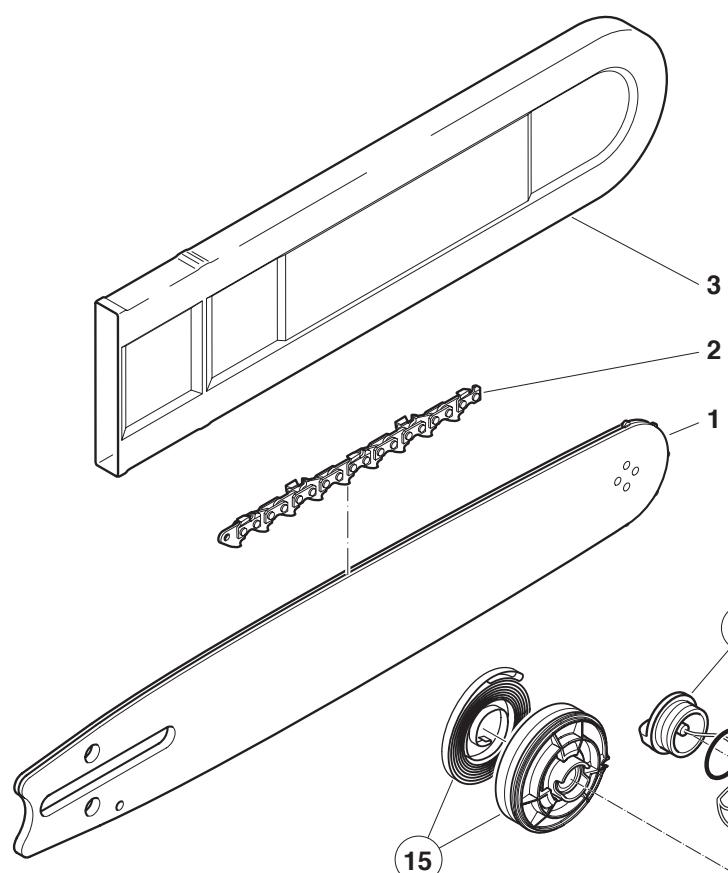
Pos.MAKITA-No. Qty. Denomination
| 1 | 445 038 655 | 1 | Sprocket nose bar (15"), .058" |
| 445 045 655 | 1 | Sprocket nose bar (18"), .058" | |
| 445 050 655 | 1 | Sprocket nose bar (20"), .058" | |
| 445 050 665 | 1 | Sprocket nose bar (20"), .050" | |
| 445 060 655 | 1 | Sprocket nose bar (24"), .058" | |
| 445 070 455 | 1 | Solid nose bar (28"), .058" | |
| 2 | 528 099 660 | 1 | Saw chain 3/8" for 15", .058" |
| 528 099 668 | 1 | Saw chain 3/8" for 18", .058" | |
| 528 099 672 | 1 | Saw chain 3/8" for 20", .058" | |
| 513 496 672 | 1 | Saw chain 3/8" for 20", .050" | |
| 528 099 684 | 1 | Saw chain 3/8" for 24", .058" | |
| 528 099 694 | 1 | Saw chain 3/8" for 28", .058" | |
| 3 | 952 100 643 | 1 | Chain protection for 15"/18" |
| 952 100 653 | 1 | Chain protection for 21" | |
| 952 100 671 | 1 | Chain protection for 24"/28" | |
| 4 | 038 213 602 | 1 | Sprocket guard, CPL. |
| 5 | 923 208 004 | 2 | Hexagonal nut M8 |
| 6 | 941 719 131 | 1 | Universal wrench SW 19/13 |
| 7 | 940 827 000 | 1 | Offset screwdriver |
| 8 | 944 340 001 | 1 | Fuel filter |
| 9 | 963 601 120 | 1 | Fuel -Oil tank cap, CPL. |
| 0 | 010 114 050 | 1 | Fuel-/Oil tank cap, CPL. |
| 1 | 963 228 030 | 1 | O-Ring 28x3 mm |
| 2 | 965 603 021 | 1 | Spark plug |
| 3 | 108 164 020 | 1 | Starter cable |
| 4 | 038 173 011 | 1 | Air filter (nylon) |
| 4 | 038 173 101 | 1 | Air filter (fleece) |
| 5 | 038 162 023 | 1 | Cable drum, complete |
| 6 | 119 224 070 | 1 | 3/8" sprocket |
| 7 | 038 174 040 | 1 | Spark collector, CPL. |
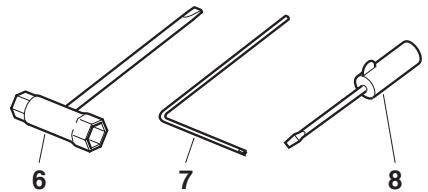
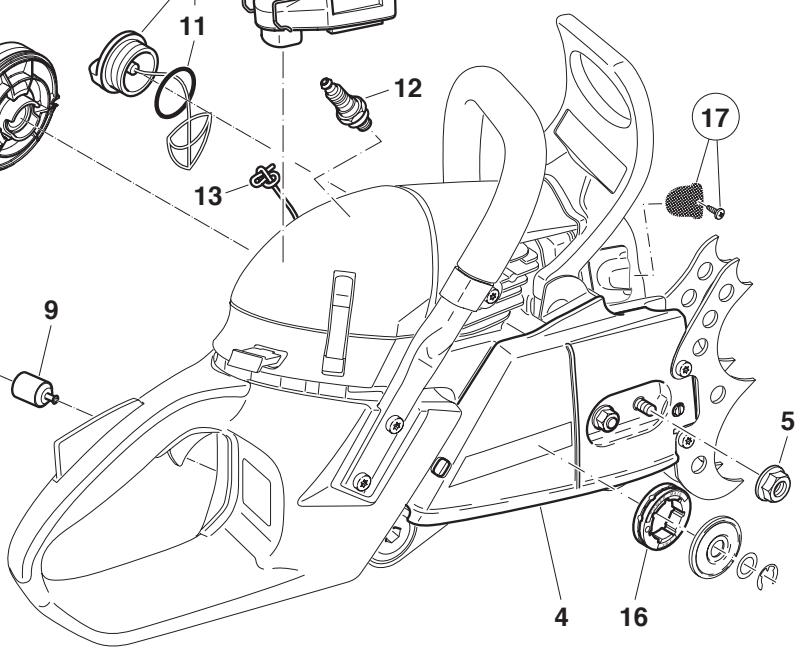
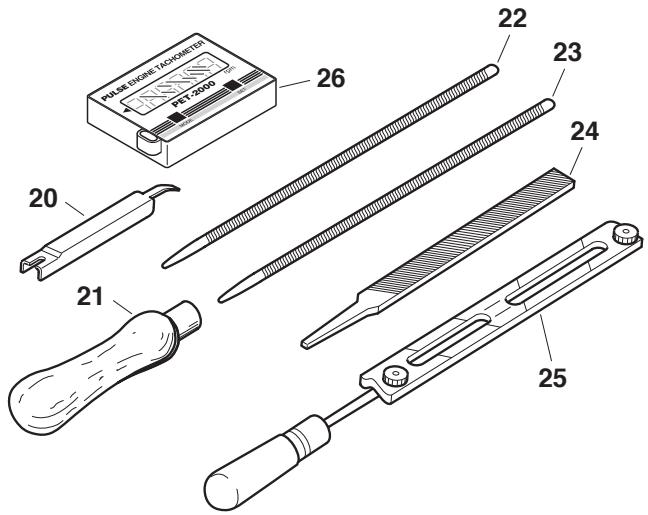
Accessories (not delivered with the chain saw)
20 953 100 071 1 Chain gauge
21 953004010 1 File handle
22 953003040 1 Round file, dia. 7/32"
23 953003070 1 Round file, dia. 3 / 16"
24 953003060 1 Flat file
25 953 030 030 1 File holder 3 / 8"
26 950 233 210 1 Tachometer
- 949000035 1 Combined can (for 5l fuel, 2.5l chain oil)
EMISSIONS COMPONENT DEFECT WARRANTY COVERAGE


- Owner's and Safety Manual for Gasoline Chain Saws (page 2 - 37)
- ATTENTION!
- EMISSION COMPONENT DEFECT WARRANTY PERIOD
- PARTS COVERED
- OBTAINING WARRANTY SERVICE
- WHAT IS NOT COVERED
- OWNER'S WARRANTY RESPONSIBILITIES
- THINGS YOU SHOULD KNOW ABOUT THE EMISSION CONTROL SYSTEM WARRANTY:
- MAINTENANCE AND REPAIRS
- HOW TO MAKE A CLAIM
- WARNING!
- This product complies with:
- #
- Contents
- Symbols
- Safety precautions for chain saw operators
- Additional safety precautions
- General Safety Precautions
- Discription of symbols used on chain saws:
- The operator
- Physical Condition
- Proper clothing
- The saw
- The use of the saw
- Transporting the chain saw
- Chain saw operating instructions
- Fueling
- Fueling instructions
- Starting
- Important adjustments
- Working conditions
- Cutting instructions
- Reactive forces during the cut, including kickback
- Kickback:
- The speed of contact at which the cutter contacts the object.
- The contact angle between the nose of the bar and the foreign object (fig. 11).
- The depth gauges:
- Saw chain cutter sharpness:
- Devices for reducing the risk of kickback injury
- To avoid kickback
- Pushback:
- To avoid pushback
- Pull-in:
- To avoid pull-in
- Cutting techniques
- Felling
- Note:
- Felling instructions:
- Sectioning Method
- Plunge-Cut Method
- Limbing
- Bucking
- Maintenance and Repair
- Maintaining and storing the saw
- WARNING:
- CAUTION:
- Mounting the guide bar and saw chain
- Tightening the saw chain
- Checking the chain tension
- Chain brake
- Engaging the chain brake (braking)
- Releasing the chain brake
- Fuel
- Fuel mixture
- The correct mixture ratio:
- AVOID SKIN AND EYE CONTACT
- Chain oil
- Important note on bio-degradable chain oils
- A
- NEVER USE WASTE OIL
- Checking the chain lubrication
- Adjusting the chain lubrication
- Starting the engine
- Cold-starting:
- Warm starting:
- Stopping the engine
- Checking the chain brake
- Adjusting the carburetor
- Important information:
- For proper adjustment, proceed as follows:
- Basic setting
- Set idle
- Check top speed
- Check acceleration
- Check idle speed
- Working in winter
- MAINTENANCE
- Sharpening the saw chain
- The chain needs sharpening when:
- B
- Proper sharpening:
- C
- Files and how to work with them
- Cleaning the brake band and sprocket interior
- Cleaning the guide bar
- Replacing the saw chain
- Replacing the fuel filter
- Cleaning the air filter
- CAUTION: To prevent eye injury, always wear eye protection when cleaning the filter with compressed air!
- Replacing the spark plug
- Electrode gap
- Checking the ignition spark
- Checking the muffler screws
- Careful!
- Replacing the starter cable / Replacing the return spring
- Replacing the return spring
- Mounting the fan housing
- Cleaning the cylinder area
- Replacing/cleaning the spark arrester screen
- Instructions for periodic maintenance
- Service, spare parts and guarantee
- Spare parts
- Guarantee
- Extract from the spare parts list
- DCS6400, 6401
- Pos.MAKITA-No. Qty. Denomination
- Accessories (not delivered with the chain saw)
- EMISSIONS COMPONENT DEFECT WARRANTY COVERAGE
Brand : MAKITA
Model : DCS6400
Category : Chain saw