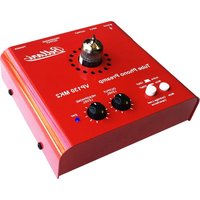
VP130 MK2 - Audio Preamplifier Bellari - Free user manual and instructions
Find the device manual for free VP130 MK2 Bellari in PDF.


| Product Type | Tube Microphone Preamplifier |
| Model | VP130 MK2 |
| Brand | Bellari |
| Dimensions | 6.5 x 4.5 x 2.5 inches |
| Weight | 2.5 lbs |
| Power Supply | External 12V DC adapter |
| Tube Type | 12AX7 |
| Gain Range | Up to 60 dB |
| Input Impedance | 2 kΩ |
| Output Impedance | 600 Ω |
| Phantom Power | +48V switchable |
| Frequency Response | 20 Hz – 20 kHz ±0.5 dB |
| Signal-to-Noise Ratio | >100 dB |
| Total Harmonic Distortion | <0.5% at 1 kHz |
| Input Connector | XLR balanced |
| Output Connector | XLR balanced, 1/4" unbalanced |
| Chassis Material | Steel with black finish |
| Cooling | Passive ventilation slots |
| Cleaning | Wipe with dry cloth; avoid solvents |
| Tube Replacement | User-replaceable; consult manual |
| Safety Certification | CE |
Frequently Asked Questions - VP130 MK2 Bellari
User questions about VP130 MK2 Bellari
0 question about this device. Answer the ones you know or ask your own.
Ask a new question about this device
Download the instructions for your Audio Preamplifier in PDF format for free! Find your manual VP130 MK2 - Bellari and take your electronic device back in hand. On this page are published all the documents necessary for the use of your device. VP130 MK2 by Bellari.
USER MANUAL VP130 MK2 Bellari
1 - Made in USA VP130 MK2
1 - 15V power supply PN PS27s
1 - This owners manual
1 - Love for great audio
The RIAA equalization curve was intended to operate as the global industry standard for records since 1954. However, it is almost impossible to say when the change actually took place.
RIAA equalization is a form of pre-emphasis on recording and de-emphasis on playback. A recording is made with the low frequencies reduced and the high frequencies boosted, and on playback the opposite occurs. The net result is a flat frequency response, but with attenuation of high frequency noise such as hiss and clicks that arise from the recording medium. Reducing the low frequencies also limits the excursions the cutter needs to make when cutting a groove. Groove width is thus reduced, allowing more grooves to fit into a given surface area, permitting longer recording times. This also reduces physical stresses on the stylus which might otherwise cause distortion or groove damage during playback.

CE
Salt Lake City, UT 4/19

VP130 MK2 Phono Preamplifier

SPECIFICATIONS
Cartridge Compatibility:
Gain:
Input Impedance:
Output Impedance:
Equalization:
THD
S/N Ratio:
Crosstalk:
PWR:
Size:
Weight:
Moving Magnet or High output Moving Coil
38.9 dB gain @ 1kHz with 12AX7 Tube
47k ohms
8-200 ohms Headphone, 100 ohms RCA
RIAA +/- .9 dB, 20Hz to 20kHz
05% @ 1KHz
103 dB, unweighted
-75 dB
15 VDC 500mA
6"w x 2.5"h x 5.4"d
2 lb
Connection guide
Thank you for purchasing the VP130. We hope you enjoy using the VP130, and that it makes listening to your music collection rewarding. We sincerely appreciate the opportunity to build a product for you and participate in your love of quality music and sound. We love what we do and we're happy to help. All Bellari products are hand built in Salt Lake City, Utah by people who care about high quality music.
The VP130 uses one 12AX7 tube running at 150 volts. The phono input signal is connected directly to the grid of the tube.
Connecting the VP130: You have an input for the VP130 that connects to your phonograph, and the output of the VP130 plugs into your preamp or amplifier. The ground post is where things can get complicated. Ground hums have always plagued the turntable. We recommend using the ground post to connect to your turntable's ground connection. In our experience we have never seen a situation where not using the ground would sound better than using it. Ground loops are a very common occurrence with audio. The more equipment you use, the higher likelihood you will have a ground loop. The term "loop" refers to your ground generating unwanted noise from traveling back and forth in a loop. The turntable is usually the most likely component to have a ground issue. Another thing you can try if you have a ground loop is connecting the turntable ground to the RCA jack's ground if the ground post is not remedying the issue. One thing to keep in mind is that ground loops can be anywhere in a system so try and isolate the components that are the issue before you spend a lot of time looking at just one component.
Q: Do different tubes have different gain?
A: Yes, but it is not a big enough difference to worry about. With a 12AX7 the VP130 has 38.9 dB of gain. With a 5751 the VP130 has 37.9 of gain. Even though the 12AX7 has a gain factor of 100 and the 5751 (12AXWA) has a gain factor of 70 the slight decrease in max gain will not be noticeable. Even different brands of tubes will have a slightly different gain, but it is so small you will not hear a difference.
Q: Do different tube brands have different specs?
A: Yes, some tubes have better specs than others. The best tube we tested for specs in the VP130 was a N.O.S. 1960's Mullard long plate made in Great Britain 12AX7. The THD was improved quite a lot in our testing. The crosstalk also improved. With most all tubes the frequency response and signal to noise ratio will be about the same. The bad news about the Mullard tube is it is about a \$180 tube if purchased from a reputable tube seller. The included 12AX7 is a wonderful sounding tube with very smooth response. Changing tubes can be fun, but by no means necessary. The specs given for the VP130 are with the included 12AX7.
TUBE TEMP:
The tube will get up to around 140 degrees fahrenheit, it will be warm to the touch. The top chassis will also get warm from the tube's heat. This will not be an issue as the chassis will only get 20 degrees warmer than room temp. The entire top of the chassis will seem hot after the VP130 has been on for a few hours, this is normal and nothing to be concerned about. Some tubes do run hotter than others. In our testing the hottest tube we have seen was a NOS RCA 5751 made in Canada it ran at 147 degrees, and did make the top of the VP130 very warm to the touch after being on for a few hours. This is normal and is not a cause for concern.
Q: Do tubes have a burn in time?
A: Yes, in our testing new tubes need 30 to 50 hours to burn in. The sound difference is very slight, but we recommend giving the tube a few hours from the time it is new. NOS tubes do not have a burn in time, or the burn in time is dramatically shorter than new manufactured tubes. We believe that is because NOS tubes were burned in when manufactured.
Q: What tube comes with my VP130?
A: The tube that came with your VP130 is a RUBY 12AX7 AKA Chinese Grey Plate. They have very good bass response and overall are a great tube for a warm, comfortable listening experience. We use this tube for obvious reasons, If we used NOS tubes we would have to charge considerably more for the VP130. In all honesty I do like the factory tube. It has very good bass response that you will miss with some NOS tubes. Changing tubes is fun and kind of adds to the allure of why you would use a tube in the first place. If you get tired of your gear rather than purchasing new gear you can buy a different tube and get a different sound experience from the same equipment.
Q: Does the power supply for the VP130 need to be upgraded?
A: No. The PS27s that is included is the best power supply available for the VP130. It does not need to be changed.
Q: What is the life expectancy of the vacuum tube in the VP130?
A: 10 to 50 years (longer if you do not use the unit very often) if you use it more often it will have a shorter life, like a light bulb. Less than 10 years if you have the unit on 24/7. 15 years if you use the unit once a day. 25 years if you use the unit a couple times a week. More than 40 years if you use the unit a few times a month. I do not recommend leaving tube equipment on all the time. It creates a lot of heat that is not beneficial to other electronic components.
FAQ:
Q: What is a N.O.S. tube?
A: N.O.S. refers to (new old stock) it is a tube that was manufactured long ago and never used. These tubes are very sought after. They may or may not sound any better, but it is generally thought that most N.O.S. tubes are better in many ways over new foreign manufactured tubes.
Q: What kind of tubes can I use in the VP130?
A: Tubes that can be used in the VP130 are:
12AX7 - The industry standard for preamp tubes.
12AX7A - Same as a 12AX7 but generally has a slightly higher output. The NOS 12AX7A will also have a faster warm up.
7025 - This is the Military part number for a 12AX7.
ECC83 - This is the same as a 12AX7 it is the European part number.
12AX7WA - This is a 12AX7 with slightly lower output.
5751 - This is a Military part number for a 12AX7WA.
There are many other tubes that can be used, but you get where this is going they are essentially the same tube with different part numbers doing almost exactly the same thing.
Q: What is the best sounding tube I can get for the VP130?
A: This is an unanswerable question. Everyone has different tastes. It is up to the individual to decide as all tubes sound slightly different. For me the best tube I have ever heard in a VP130 was a N.O.S. 5751 Telefunken tube.
Q: Does the tube need time to warm up before use?
A: Yes, it will be usable in about 30 seconds. Longer warm up times are not needed, there is no benefit to warming the tube up longer than 30 seconds. Warm up simply means powering the unit on.

Cartridge load capacitance: The VP130 has two settings: 120 pF and 220 pF. Set the switch in the position you feel sounds best to you. The difference might be very slight, but it is there. Most cartridges come with a capacitance load recommendation in the spec sheet for the cartridge. For example the Ortofon 2M series asks for a loading of 150pF to 300pF. Most Audio Technica cartridges state 100pF to 200pF for loading. The VP130 has been tested with multiple turntables and multiple cartridges. We have found it best to use your ears to set the loading. You can set the loading switch to any setting 120 or 220 with any MM cartridge and no damage will be done to the VP130 or your cartridge. If you can not hear a difference we would suggest that you do as the cartridge manufacturer suggests, and set the loading switch to their recommendation for the cartridge you are using.
Brand : Bellari
Model : VP130 MK2
Category : Audio Preamplifier