
HBV 800NV - Musical instrument Harley Benton - Free user manual and instructions
Find the device manual for free HBV 800NV Harley Benton in PDF.


| Product Type | Violin |
| Model | HBV 800NV |
| Brand | Harley Benton |
| Body Material | Maple back and sides, spruce top |
| Fingerboard Material | Ebony |
| String Material | Steel core with nickel winding |
| Overall Length | 59 cm (4/4 size) |
| Body Length | 35.5 cm |
| Weight | 450 g (without case) |
| Tuning Pegs | Ebony pegs with mother-of-pearl inlay |
| Tailpiece | Ebony with four fine tuners |
| Bridge | Maple bridge, pre-fitted |
| Chinrest | Ebony chinrest |
| Bow Included | Yes, brazilwood bow with horsehair |
| Case Included | No |
| Finish | High gloss varnish |
| Recommended Use | Student and intermediate players |
| Maintenance | Clean with soft cloth; rosin bow hair regularly |
| Safety Notes | Keep away from extreme temperatures and humidity; avoid impacts |
| Spare Parts Available | Strings, pegs, bridge, tailpiece, chinrest (contact manufacturer) |
Frequently Asked Questions - HBV 800NV Harley Benton
User questions about HBV 800NV Harley Benton
0 question about this device. Answer the ones you know or ask your own.
Ask a new question about this device
Download the instructions for your Musical instrument in PDF format for free! Find your manual HBV 800NV - Harley Benton and take your electronic device back in hand. On this page are published all the documents necessary for the use of your device. HBV 800NV by Harley Benton.
USER MANUAL HBV 800NV Harley Benton
electro-acoustic violin

natural_image
Close-up of a black violin with visible wood shavings and metal clamps (no text or symbols)Musikhaus Thomann
Thomann GmbH
1.1 Further information.... 4
1.2 Notational conventions.... 4
1.3 Symbols and signal words.... 5
2 Safety instructions.... 6
3 Scope of delivery.... 7
4 Assembly instructions.... 8
4.1 Tuning the strings.... 9
5 Connections and controls.... 10
5.1 Connecting the instrument cable.... 10
5.2 Adjusting Volume and Tone.... 10
6 Maintenance.... 11
6.1 Changing strings.... 11
7 Technical specifications.... 12
8 Plug and connection assignment.... 13
9 Cleaning.... 14
10 Protecting the environment.... 15
1 General information
This manual contains important instructions for the safe operation of the unit. Read and follow the safety instructions and all other instructions. Keep the manual for future reference. Make sure that it is available to all those using the device. If you sell the unit please make sure that the buyer also receives this manual.
Our products are subject to a process of continuous development. Thus, they are subject to change.
1.1 Further information
On our website (www.thomann.de) you will find lots of further information and details on the following points:
| Download This manual is also available as PDF file for you to download. | |
| Keyword search | Use the search function in the electronic version to find the topics of interest for you quickly. |
| Online guides | Our online guides provide detailed information on technical basics and terms. |
| Personal consultation | For personal consultation please contact our technical hotline. |
| Service | If you have any problems with the device the customer service will gladly assist you. |
1.2 Notational conventions
This manual uses the following notational conventions:
Letterings
The letterings for connectors and controls are marked by square brackets and italics.
Examples: [VOLUME] control, [Mono] button.
Instructions
The individual steps of an instruction are numbered consecutively. The result of a step is indented and highlighted by an arrow.
Example:
- Switch on the device.
- Press [Auto].
⇒ Automatic operation is started. - Switch off the device.
1.3 Symbols and signal words
In this section you will find an overview of the meaning of symbols and signal words that are used in this manual.
Signal word Meaning
DANGER! This combination of symbol and signal word indicates an immediate dangerous situation that will result in death or serious injury if it is not avoided.
NOTICE! This combination of symbol and signal word indicates a possible dangerous situation that can result in material and environmental damage if it is not avoided.
Warning signs Type of danger

Warning – danger zone.
2 Safety instructions

DANGER!
Danger for children
Ensure that plastic bags, packaging, etc. are properly disposed of and are not in the reach of babies and young children. Choking hazard!
Ensure that children do not detach any small parts (e.g. knobs or the like) from the product. They could swallow the pieces and choke!
Never let children play unattended with the product.

NOTICE!
Operating conditions
This device has been designed for indoor use only. To prevent damage, never expose the device to any liquid or moisture. Avoid direct sunlight, heavy dirt, and strong vibrations.

NOTICE!
Possible property damage by magnetic fields
Loudspeakers produce a static magnetic field. Therefore, maintain an appropriate distance to devices that can be adversely affected or damaged by an external magnetic field.
3 Scope of delivery
Thank you for purchasing the electro-acoustic violin HBV 800BK / NV / VW. The package includes the following components:
■ 1 × electro-acoustic violin
■ 1 × bridge (pre-assembled)
■ 1 × instrument cable (1/4" jack, mono)
■ 1 × strings set (pre-assembled)
1 × composite bow
1 × bow rosin
■ 1 × suitable transport bag
Assembling and tuning your instrument are described in detail in the following sections.
4 Assembly instructions
Overview

B
natural_image
Close-up of a black robotic device with labeled component (5), no visible text or symbols beyond the label.A (front side) 1 Bridge
2 Chin rest
3 Machine heads
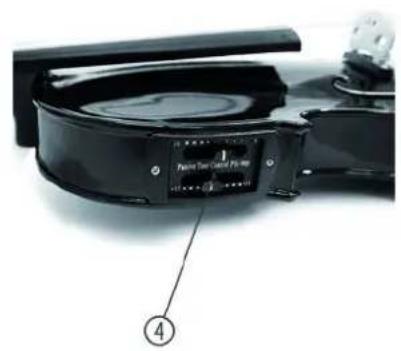
B (sides) 4 Operating elements
[VOL]
With this control you can adjust the volume.
[TONE]
Use this control to shape the tone (treble, bass).
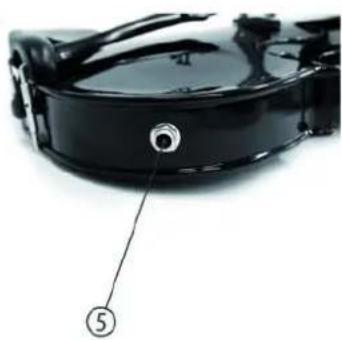
5 Connector for instrument cable (1/4" phone socket, mono)
4.1 Tuning the strings

natural_image
Close-up of a black instrument with multiple knobs and strings (no visible text or symbols)Tune all strings with the machine heads using a tuner device to the correct pitch (usually g-d'-a'-e").
5 Connections and controls

NOTICE!
Risk of breakage, possible deformation
When placing the instrument with the fretboard down, there is a risk of damaging the fingerboard and the tailpiece.
Avoid any compressive load on the rear of the instrument, if it is placed for the assembly or for service work with the fretboard down on a solid surface.

Before connecting an amplifier, the volume control of both violin and amplifier must be set to 'Minimum'. This avoids loud crack noises.
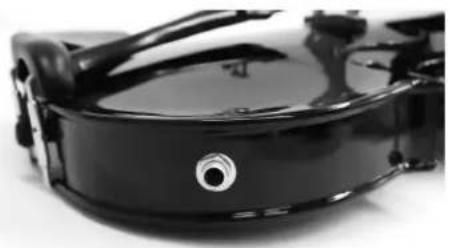
5.1 Connecting the instrument cable
natural_image
Close-up of a black electronic device with a circular connector and metallic components (no visible text or symbols)You find the connector for the instrument cable (1/4" jack, mono) at the side of the instrument.
5.2 Adjusting Volume and Tone

natural_image
Close-up of a black electronic device with a circular button and indicator lights (no visible text or symbols)The controls to adjust the volume [VOL] and the tone [TONE] are located at the side of the instrument.
6 Maintenance
6.1 Changing strings
Proceed as follows to change the strings:
Strings are subject to a natural aging process, which is also affected by the frequency of use of the instrument. Changing the strings is recommended if the sound quality of the instrument decreases audibly. Always replace the complete set of strings (strings of 4/4 length) and always go string by string. In this way you avoid a strong temporary bending of the neck due to reduced string tension. The bridge also remains in the correct position and does not have to be readjusted.
- For example, loosen the run-down E string from the capstan of the machine head and from the tailpiece.
- Thread the new E string into the tailpiece, pull it over the bridge into the capstan bore of the machine head.
- Hook the string end to the capstan and tighten the string tension slowly. At the first windings, pay particular attention that the string is taut to the mechanics.
- Make sure that the string is running correctly through the grooves of bridge and nut at the upper end of the neck.
- Slowly increase the string tension until the correct pitch is reached. Use a tuner or a pitch pipe for reference.
- Proceed in the same way with the A, D and G strings and then tune all strings again successively to the correct pitch. Note that the string tension will drop a little and the instrument needs to be retuned several times until the strings stay in tune.
7 Technical specifications
| HBV 800BK HBV 800NV HBV 800VW | |||
| Item no. 264404 263876 264406 | |||
| Colour black natural violin lacquer vintage white | |||
| Scale approx. 68 cm | |||
| Body material solid spruce top, maple back, hollow body design | |||
| Neck material maple, ebony fretboard | |||
| Pick-up Piezo, passive | |||
| Machine heads Machine heads | |||
| Dimensions (W × H × D) 21 cm × 9.5 cm × 59 cm | |||
| Weight 500 g | |||
8 Plug and connection assignment
Introduction
This chapter will help you select the right cables and plugs to connect your valuable equipment in such a way that a perfect sound experience is ensured.
Please note these advices, because especially in 'Sound & Light' caution is indicated: Even if a plug fits into the socket, an incorrect connection may result in a destroyed power amp, a short circuit or 'just' in poor transmission quality!
Balanced and unbalanced transmission
Unbalanced transmission is mainly used in semi-professional environment and in hifi use. Instrument cables with two conductors (one core plus shielding) are typical representatives of the unbalanced transmission. One conductor is ground and shielding while the signal is transmitted through the core.
Unbalanced transmission is susceptible to electromagnetic interference, especially at low levels, such as microphone signals and when using long cables.
In a professional environment, therefore, the balanced transmission is preferred, because this enables an undisturbed transmission of signals over long distances. In addition to the conductors 'Ground' and 'Signal', in a balanced transmission a second core is added. This also transfers the signal, but phase-shifted by 180°.
Since the interference affects both cores equally, by subtracting the phase-shifted signals, the interfering signal is completely neutralized. The result is a pure signal without any noise interference.
1/4" TS phone plug (mono, unbalanced)
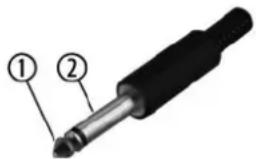
1 Signal
2 Ground, shielding
9 Cleaning
Clean the instrument and especially the strings after playing with a dry, soft, lint-free cloth. Stubborn dirt can be removed with a slightly dampened cloth.
Never use cleaners containing alcohol or thinner.
10 Protecting the environment
Disposal of the packaging material

For the transport and protective packaging, environmentally friendly materials have been chosen that can be supplied to normal recycling.
Ensure that plastic bags, packaging, etc. are properly disposed of.
Do not just dispose of these materials with your normal household waste, but make sure that they are collected for recycling. Please follow the notes and markings on the packaging.
Disposal of your old device
natural_image
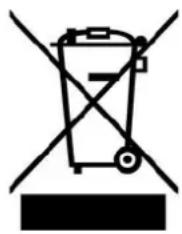
Symbol of a trash bin crossed out by two diagonal lines, no text or labels presentThis product is subject to the European Waste Electrical and Electronic Equipment Directive (WEEE) in its currently valid version. Do not dispose with your normal household waste.
Dispose of this device through an approved waste disposal firm or through your local waste facility. When discarding the device, comply with the rules and regulations that apply in your country. If in doubt, consult your local waste disposal facility.
HBV 800BK / NV / VW

natural_image
Solid olive green background with no visible text, symbols, or patterns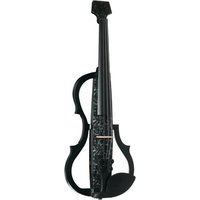



- General information
- Further information
- Notational conventions
- Letterings
- Instructions
- Example:
- Symbols and signal words
- Signal word Meaning
- Warning signs Type of danger
- Safety instructions
- DANGER!
- Danger for children
- NOTICE!
- Operating conditions
- Possible property damage by magnetic fields
- Scope of delivery
- Assembly instructions
- Tuning the strings
- Connections and controls
- Risk of breakage, possible deformation
- Connecting the instrument cable
- Adjusting Volume and Tone
- Maintenance
- Changing strings
- Plug and connection assignment
- Introduction
- Balanced and unbalanced transmission
- 1/4" TS phone plug (mono, unbalanced)
- Cleaning
- Protecting the environment
Brand : Harley Benton
Model : HBV 800NV
Category : Musical instrument