KOR-636T - Microwave DAEWOO - Free user manual and instructions
Find the device manual for free KOR-636T DAEWOO in PDF.


| Product Type | Microwave Oven |
| Brand | Daewoo |
| Model | KOR-636T |
| Capacity | 20 liters |
| Microwave Power | 800 W |
| Power Consumption | 1200 W |
| Voltage | 230 V ~ 50 Hz |
| Dimensions (W x D x H) | 455 x 330 x 260 mm |
| Weight | 10.5 kg |
| Control Type | Rotary dial + push buttons |
| Display | LED digital display |
| Defrost Function | Yes, by weight or time |
| Timer | Up to 95 minutes |
| Turntable | Glass turntable, 255 mm diameter |
| Interior Light | Yes |
| Child Lock | Yes |
| Door Type | Side opening with handle |
| Cleaning | Wipe with damp cloth; avoid abrasive cleaners |
| Spare Parts | Turntable, roller ring, fuse, door hinges available from authorized service |
| Repairability | Repairable by qualified technician; spare parts stocked |
Frequently Asked Questions - KOR-636T DAEWOO
User questions about KOR-636T DAEWOO
0 question about this device. Answer the ones you know or ask your own.
Ask a new question about this device
Download the instructions for your Microwave in PDF format for free! Find your manual KOR-636T - DAEWOO and take your electronic device back in hand. On this page are published all the documents necessary for the use of your device. KOR-636T by DAEWOO.
USER MANUAL KOR-636T DAEWOO
Instruction manual
KOR-636T
Things you SHOULD KNOW!

WARNING
When heating liquids, e.g. soups, sauces and beverages in your microwave oven, overheating the liquid beyond boiling point can occur without evidence of bubbling. This could result in a sudden boil over of the hot liquid. To prevent this possibility the following steps should be taken:
- Avoid using straight sided containers with narrow necks.
- Do not overheat.
- Stir the liquid before placing the container in the oven and again halfway through the heating time.
- After heating, allow to stand in the oven for a short time, stir or shake them again carefully and check the temperature of them before consumption to avoid burns (especially, contents of feeding bottles and baby food jars).
When you unpack your microwave oven from its box, please check it immediately for damage. If the door is damaged or bent, if there are dents inside the oven etc., get in touch with your retail outlet immediately.
Using a microwave oven safely
- Never use the microwave oven if it is damaged. It is particularly important that the door closes properly. The door should not be distorted, the hinges and latch should not be broken, bent or loose, and the seals must be in perfect condition.
- This microwave oven contains no user-serviceable components. Any adjustments or repairs must be performed by a qualified technician.
- Never use the oven with the door open. There is the risk of being exposed to dangerous microwave energy. Never manipulate or tamper with the safety locks and the hinges of the door.
- Keep the seals and seal surfaces clean and free of contamination like food remains and cleaner residue.
- Use the microwave oven for cooking purposes only. Do not use it to dry animals, clothing, paper or other objects or for sterilisation or as a storage space for books, cooking utensils etc.
The right place for your microwave oven
- The microwave oven should stand on a flat, stable surface. This appliance is designed for standing only.
- The area immediately around the oven should be free to allow the circulation of fresh air for cooling.
- Do not place the microwave oven near a radio or television set etc. This might cause interference.
- Never place the oven where it is exposed to hot-air, steam or humidity.
- The minimum height of free space necessary above the top surface of the oven is 100mm.
Connecting up your microwave oven
- The oven requires a mains electrical connection of 230 V\~ / 50 Hz with a 12 Amp. fuse.
- Only insert the plug into properly installed electrical sockets. If in doubt contact an electrician.
- Faulty connections can start fires and create other risks and prevent the oven from working correctly. DAEWOO is not liable for any damage due to faulty connection. If the supply cord is damaged, it must be replaced by the manufacturer or its service agent or a similarly qualified person in order to avoid a hazard.
Things you
S H O U L D
Before using the oven please read these instructions carefully, they contain safety notes and useful tips.
Contents
Microwaves and oven
Cooking safely with microwaves 2
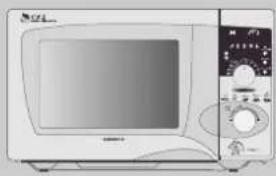
The oven 3
Using the oven
The controls 4
Setting the clock - Child lock 5
Cooking with microwaves
Easy cooking - Fast (Speedy) cooking 6
Cooking with intervals 7
Defrosting and cooking program
Defrosting by time - Defrosting by weight 8
Programmed cooking 9
Defrost chart 10
Recipe for Programmed cooking 11
Appendix
Tips and guidelines 12-13
Before consulting a specialist 14
Microwave suitable cooking utensils - Care and maintenance .....15
Technical data - Moulded plugs....16
Electrical connection (for UK only)
GREEN and YELLOW
BLUE BROWN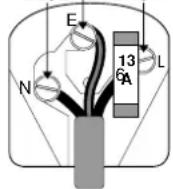

- For your own safety read the following instructions carefully before attempting to connect this unit to mains.
- Check that the voltage on the rating plate corresponds to the voltage in your home. The rating plate is on the back panel of the appliance.
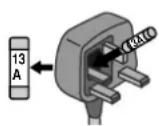
The power cable must be fitted with a fused plug approved by ASTA or BSI to BS 1362 and provided with a 13 A fuse. The fuse cover must always be securely replaced. If the oven is not working, the fuse may need replacing.
The wires of the mains lead fitted to this appliance are coloured in accordance with the following code:
GREEN and YELLOW = EARTH (GREEN or GREEN and YELLOW or )
BLUE = NEUTRAL (BLACK)
BROWN = LIVE (RED)
If the terminals in the plug are unmarked or you are in any doubt as to the correct connections, consult a qualified electrician.
Please read also the chapter "Moulded plugs".
- We recommend the use of a good quality plug.
- The pages of this instruction manual show pictures of the various control buttons referred to in the text. Descriptions of the display information are also shown where applicable.
MICROWAVES and OVEN
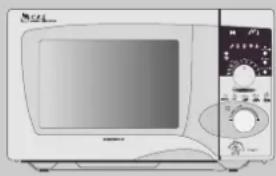

When preparing ready-to-serve food (like TV dinners) always carefully follow the instructions provided by the food manufacturer on the package and also the tips and guidelines contained at the end of this manual.
Cooking safely with microwaves
- Microwaves are high frequency electromagnetic waves like radio waves. They create heat by causing the molecules in water, fat and sugar to vibrate. They only penetrate a certain depth (e.g. approx. 25 mm into meat) and this heat is then conducted to the rest of the item being cooked.
- Tableware must be suitable for use in a microwave oven. For example, dishes made of temperature resistant glass, ceramics, porcelain and plastic. Never place closed metal containers into your microwave oven - the microwaves are reflected and the food will not get warm.
- In the case of TV dinners the food can be left in the aluminium tray with the top removed.
- Microwaves can damage any crockery with gold or silver decoration.
- Never place food in the oven in closed containers - the container could explode.
- Food with a skin or peel can explode. Never place eggs in a microwave. When cooking items such as potatoes, chicken livers etc., puncture the skin using e.g. a fork to allow steam to escape.
- Never heat spirits (alcoholic drinks) to high temperatures; they may self-ignite.
- When heating small amounts of liquid (e.g. a cup of tea/coffee), place a spoon in the cup to prevent boiling over.
- Food which has been cooked with a microwave continues to cook after the oven is switched off. Before allowing others, in particular children or older people, to eat food or drinks from the microwave oven check that the temperature of the food is acceptable (danger of burning/scalding).
- Help the heat to spread uniformly by stirring and turning, in particular after only short heating periods.
- Never turn the microwave oven on without food in the chamber - it might overload and get damaged.
- Metal items, e.g. dishes, should not touch the walls of the oven, this can cause sparking and could cause a fire.
- If you think there is a fire in the oven (smoke), leave the door closed, switch the unit off (press STOP several times) and disconnect from the mains electricity supply.
CAUTION : Always set short cooking times and check the food frequently. If the recommended cooking times are exceeded the food, especially oil or fat, will be spoiled and in extreme circumstances could catch fire.
MICROWAVES AND OVEN
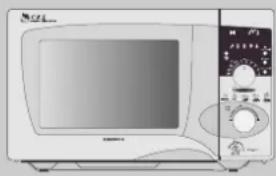
The microwave oven
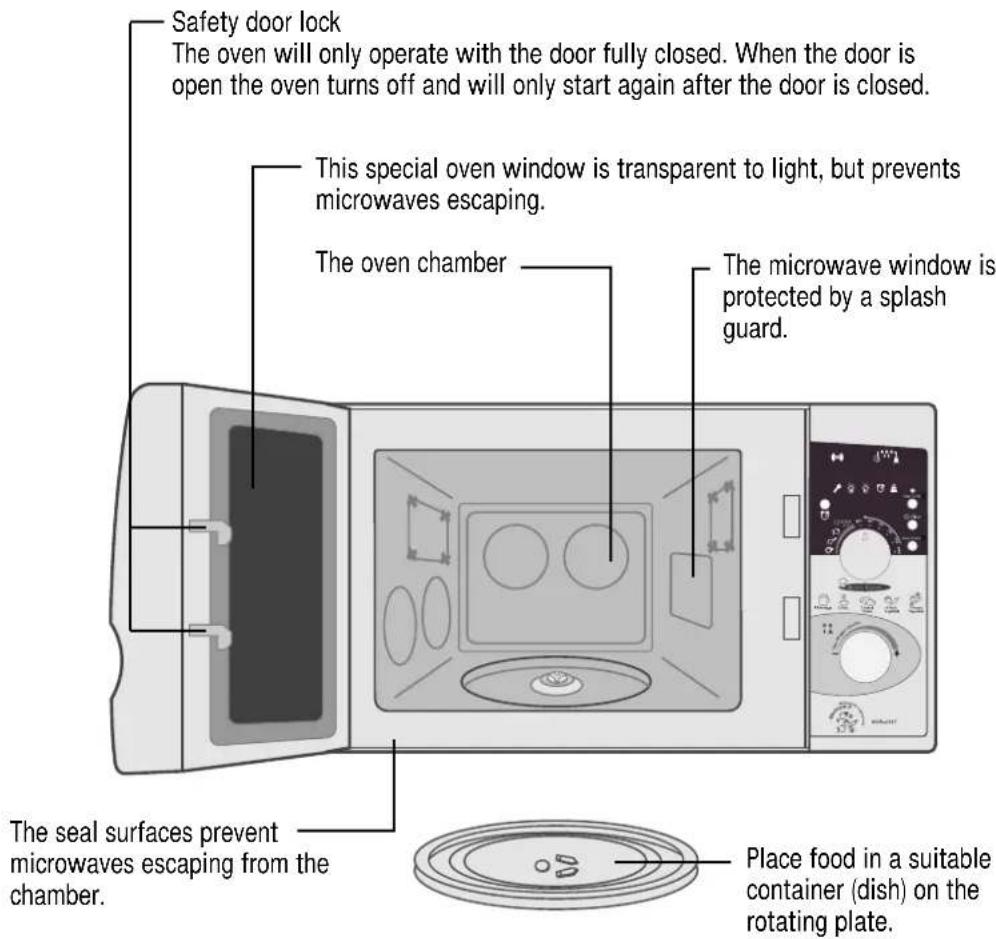
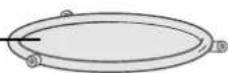
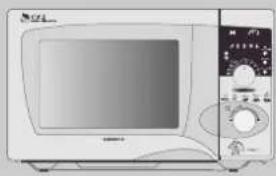
The plastic ring supports the rotating plate. The plate and the support can be easily removed for cleaning. Make sure they are correctly positioned (indentation) when reinserting.

- Only use the oven with the rotating plate in position.
USING THE OVEN

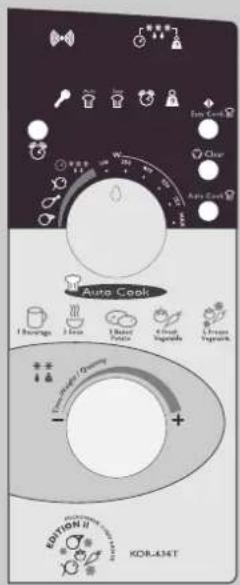
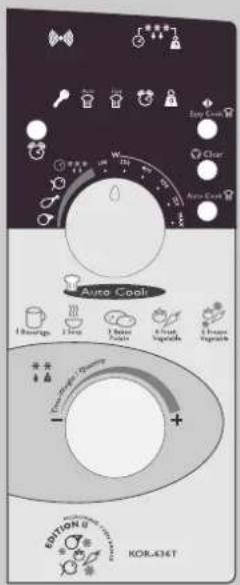
Your DAEWOO microwave oven always keeps you well informed: the display tells you which buttons can be pressed next or which settings are required (user guide).
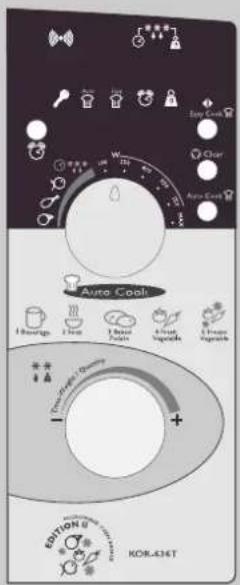
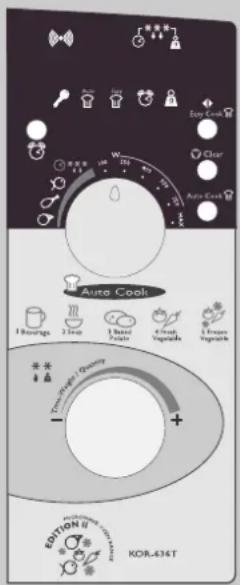
The controls
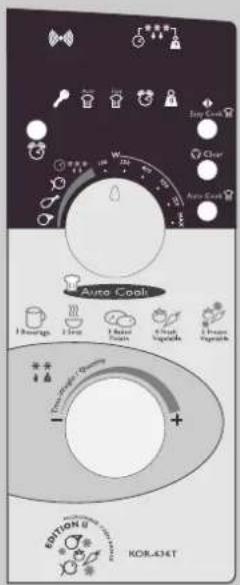
Display (flashes to tell you what the oven is doing):
M/W Cooking with microwaves
EASY COOK Easy Start Cooking
DEFROST - WEIGHT Defrosting food by weight
DEFROST - Time Defrosting food by time
LOCK Child lock activated
AUTO COOK Cooking using a program
CLOCK Clock
g Weight information
Buttons:

Press to cook using a program

Press to start operation, also for Easy start (each press adds 30 seconds microwave cooking time)

Stops the operation, also erases all entries

Clock set
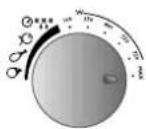
Turn to set the cooking menu
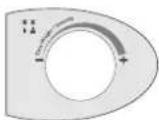
Dial for setting time and weight
(You can also extend the time of the current operation by 1 minute by turning the dial knob, except defrosting)
Using the O V E N
Setting the clock
When not in use the display shows the time.
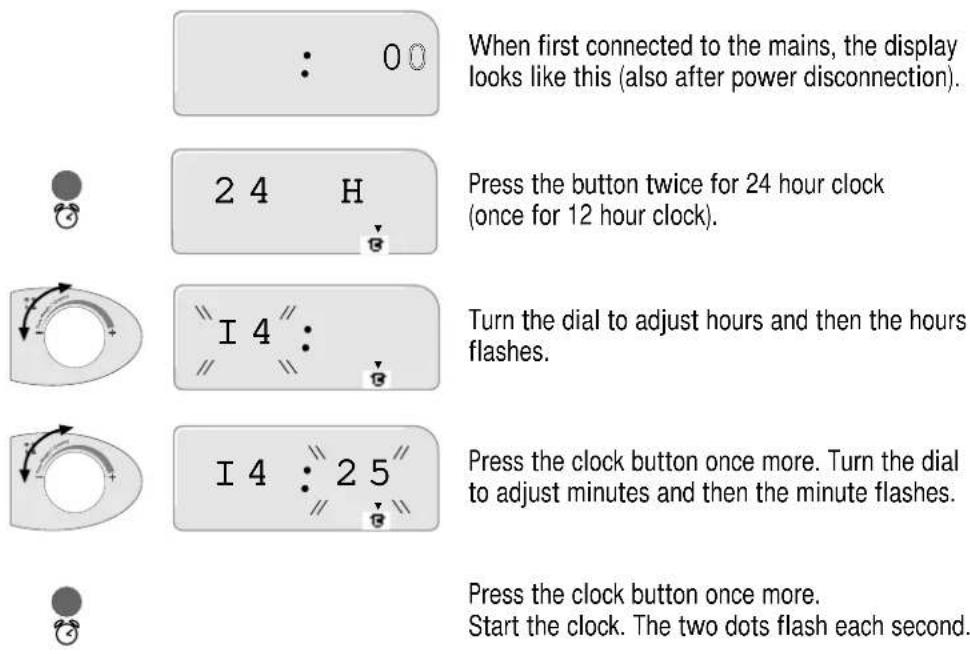
When first connected to the mains, the display looks like this (also after power disconnection).
24
H
Press the button twice for 24 hour clock (once for 12 hour clock).
I4:
G
Turn the dial to adjust hours and then the hours flashes.
I4
25
Press the clock button once more. Turn the dial to adjust minutes and then the minute flashes.
Press the clock button once more.
Start the clock. The two dots flash each second.
Child lock
The child lock prevents the oven from being used. For example because children could hurt themselves on hot liquids etc.

3 sec.
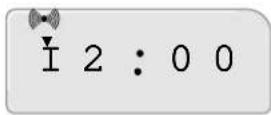
I 5 : 43
Hold the button pressed for a number of seconds,
"▼" flashed above "LOCK" in the display, the oven is locked.
Hold the button for a few seconds to release the lock.
When the time appears in the display, the oven is again available for normal use.
Cooking with MICROWAVES
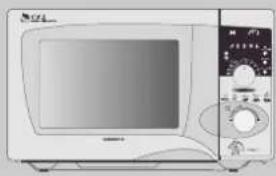
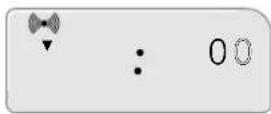
Saving the energy
If this function is set, the display turns off except during operation.

To set, press STOP/CLEAR button for 5 seconds and the display turns off with a beep sound.

To cancel, press STOP/CLEAR button for 5 seconds with a beep sound.
Easy cooking

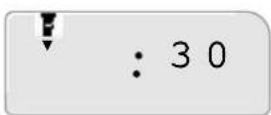
Press the button a number of times to set a cooking time between 30 seconds and 5 minutes.
The oven starts automatically operation at high power level.

When the operation is finished the oven beeps three times, the clock appears in the display, the rotating plate stops turning and the oven light turns off. - You can also extend the time of the current operation by 30 seconds by pressing the Easy Cook button. - Opening the oven door interrupts any operation. To cancel the operation, press STOP. To continue the operation, press START.
Cooking with MICROWAVES
Cookery books and recipes provide details of power settings and times.
Some more complicated recipes include different cooking intervals with different power levels and cooking times.
Cooking with power level

Set one of the 6 power levels.
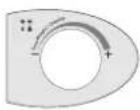
Turn the dial to set the cooking time.
Up to 60 minutes.

Start the operation.
The oven indicates all operations, the current operation flashes.

When the operation is finished the oven beeps three times, the clock appears in the display, the rotating plate stops turning and the oven light turns off. - You can also extend the time of the current operation by 1 minute by turning the dial knob. - Select microwave power setting: MAX ⇔ 750 ⇔ 550 ⇔ 400 ⇔ 250 ⇔ 100 Watt - The oven displays the set cooking time in 10 seconds steps (up to 5 minutes cooking time), in 30 seconds steps (up to 10 minutes cooking time) and in 1 minute steps (up to 60 minutes cooking time). - Opening the oven door interrupts any operation. To cancel the operation, press STOP. To continue the operation, press START.
DEFROSTING AND
cooking programs ...

Defrosting by time
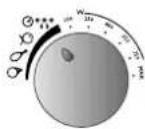

Set the dial knob on Time-Def. mode.
"▲" appears below "TIME" in the display.
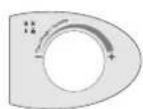
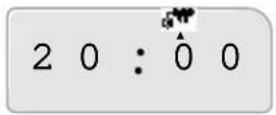
Set the defrost time on the dial.
Up to 60 minutes.

Start the operation.
"▲" flashes below "TIME" in the display.
Defrosting by weight

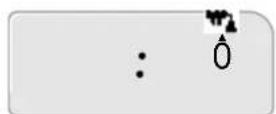
Set the dial knob on the menu to defrost.
"▲" appears below "WEIGHT" in the display.
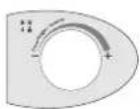
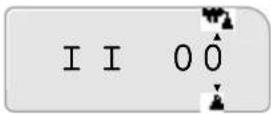
Use the dial to adjust the weight of the food.
Weights from 100 g up to 3000 g are possible.
MEAT : 200g ~ 1500g
POULTRY : 200g ~ 3000g
FISH : 100g ~ 1500g

Start the operation.
"▲" flashes below "WEIGHT" in the display.

- When the operation is finished the oven beeps three times, the clock appears in the display, the rotating plate stops turning and the oven light turns off.
- Turn the food over during defrosting after the beep to ensure complete and even defrosting.
- Opening the oven door interrupts any operation. To cancel the operation (and clear the memory), press STOP. To continue the operation, press START.
- Place meat, poultry, or fish on the microwave plate. Let them stand for a while and finish with cold running water.
DEFROSTING AND
cooking programs ...
You need set neither power nor time.
Defrost Chart
| ITEM Special Introdu | Defrost time By time | Standing time | |
| BEEFGround beef | Break apart and remove thawed portions with a fork. | 10 minutes per 500g | 15 minutes |
| Beef Hamburger Patties | At beeps, turn patties over. | 9 minutes per 500g | 10 minutes |
| Beef Cubes, boneless | At beeps, separate and rearrange. | 8 minutes per 500g | 20 minutes |
| Beef Short Ribs | At beeps, rearrange. | 8 minutes per 500g | 20 minutes |
| PORKPork Cubes | At beeps, separate and rearrange. | 8 minutes per 500g | 20 minutes |
| Pork Loin Roast,boneless | At beeps, turn over and shield as needed. After frist cycle,dial MEAT and dial half of the original defrosted time. | 13 minutes per 500g | 30 minutes |
| Bulk Pork Sausage | Cut metal holders off both ends of sausage. At beeps, remove defrosted meat. | 9 minutes per 500g | 10 minutes |
| Pork Chops | At beef, separate and shield bone or outer edge. | 9 minutes per 500g | 20 minutes |
| POULTRYWhole Chicken | breast side down. Turn over and shield as needed. | 10 minutes per 500g | 20 minutes |
| Whole chicken, cut-up or Chicken Pieces, bone-in | At beeps, turn over, separate and rearrange; shield bones. | 10 minutes per 500g | 15 minutes |
| Chicken Wings | At beeps, turn over, separate and shield as needed. | 7 minutes per 500g | 20 minutes |
| Chicken Breast, boneless or Chicken Thigh | At beeps, turn over, separate and shield as needed. | 6 minutes per 500g | 15 minutes |
| FISHFish Fillets;frozen in block | At beeps, turn over and separate. | 5 minutes per 500g | 10 minutes |
| Shrimp | At beeps, separate and rearrange. | 4 minutes per 500g | 5 minutes |
| Lobster Tail | At beeps, rearrange tails.Shield thinner end with 5 cm strip of foil. | 4 minutes per 500g | 5 minutes |
DEFROSTING AND
cooking programs ...
Programmed cooking
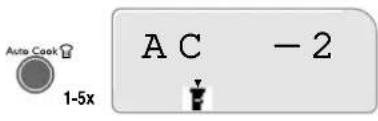
Select one of the five menu programs. Select by pressing the button 1 - 5 times.
KOR-636T
Cooking programs: Min : Sec.
AC-1 ⇔ Beverage 0.5 cup 1:00 1 Cup 1:30 2 Cups 3:00 3 Cups 4:20
AC-2 ⇌ Soup 200 g 1:40 350 g 2:50 500 g 3:50 700 g 5:20
Please consult cookery books for recipes.

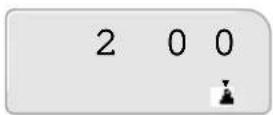
Turn the dial to set the amount you wish to cook. See the table above.

Start the operation.
"AUTO COOK" flashes in the display, and the cooking time is also displayed.
DEFROSTING AND
cooking programs...
Recipe for programmed cooking
| ITEM DIRECTIONS | |
| AC-1 Beverage Pour beverage in a microwave mug.Place it on the turntable.Do not cover. Stir before serving. | |
| AC-2 Soup Pour soup into microwave bowl or mug.Stir before serving. | |
| AC-3 Baked Potato Wash and pierce potatoes with a fork.Place them on the turntable. | |
| AC-4 Fresh Vegetable Trim and wash the mixed vegetables.Place them in the round dish. Add to 2 Tbsp. water. | |
| AC-5 Frozen Vegetable Place the vegetables in the round dish.Add to 2 Tbsp. water. | |

- You can also extend the cooking time of the current operation by 10 seconds to 3 minutes by turning the dial knob. When the operation is finished, the oven beeps three times, the clock appears in the display, the rotating plate stops turning, and the oven light turns off.
- Opening the oven door interrupts any operation. To cancel the operation, press STOP. To continue the operation, press START.
DAEWOO APPENDIX

Cooking with microwaves differs in some aspects from normal cooking. The guidelines and tips below will help you get better results using a microwave oven.
Guidelines and tips
Wait time
Microwaves do not usually completely penetrate the food on the rotary plate. The wait times allow the food to continue cooking even after the oven has switched off. The temperature can rise by up to 8°C inside the food.
After heating food in the microwave, let it stand in the oven for a short time to allow the temperature to equalise. The wait time depends on the weight, volume, and density of the food (and can be up to 10 minutes).
How to cook food without overcooking (drying, charring etc.)
- Select the right cooking level.
- Select the right cooking time. Times quoted in recipes are approximate and depend upon initial temperature, weight, density of food etc. ◆ Always use microwave-suitable dishes.
Defrosting
◆ Defrosting is faster in flatter dishes than in higher dishes. - Divide large pieces of food into smaller pieces for faster defrosting. ◆ Cover the smaller pieces when they start to warm up. - Do not defrost completely under power, let the food stand for a while.
Amount
To warm up more food you need more time. Rule of thumb: double the food, double the time (almost).
Initial temperature
The colder the food, the more time is needed.
Different foods
When cooking a meal with various ingredients remember that fat and sugar heat up faster than water. This means that ingredients with higher fat and sugar contents will have higher temperatures after cooking than those containing water. The more dense a food, the longer it takes to cook/defrost. Very dense foods, like meat, take much longer to warm up than say sponge cake. Microwave heating of beverages can result in delayed eruptive boiling, therefore care has to be taken when handling the container.
Skins, peels, shells ...
Some foods have a skin or peel or a shell (eggs, potatoes, apples, liver, sausages).
Puncture the skin or peel with for example a fork to allow steam to escape and the food to expand - this releases pressure and prevents the food from bursting.
Water
Cooking in a microwave needs very little water. For 100 g of vegetables or potatoes, use 1 tablespoon of water.
Covering food
Food can be covered with foils or tops which let microwaves through in order
◆ to prevent splashing ◆ to shorten the cooking time and/or - to retain any natural moisture in the food (→ Microwave suitable dishes and utensils).
Arranging food - size and shape
To achieve the shortest cooking times and the best results it is sometimes useful to arrange the food in a certain way.
Small pieces cook faster than big pieces.
Pieces of the same size cook more evenly than different sized pieces.
In the case of irregularly shaped pieces, the thin sections will cook faster than the thick sections.
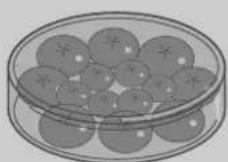
When cooking several of the same item, e.g. stuffed tomatoes, arrange them on the rotating plate in a circle to achieve even cooking.
When cooking irregularly shaped items or food with different thicknesses, place the smaller or thinner parts in the middle and the thicker (denser) parts towards the outside. Alternatively, cover thinner parts with a piece of aluminium foil to prevent drying or charring.
Where possible, place fish with the tail towards the centre, slit the skin to prevent the skin tearing or bursting open. Another possibility is to cover the head and the tail ends with aluminium foil to prevent premature drying or charring.
When warming up pre-cooked meals, place the thinner and lighter items towards the middle, the heavier and denser items towards the outside of the plate.
Place thin slices (e.g. bacon) on top of one another (fully or partially).
Arrange sausages close together.
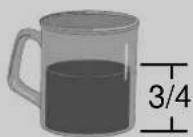
Drinks, sauces and gravy should be heated in separate containers. Fill tall narrow vessels only 3/4 full.
Stir or turn the food every now and then to help spread the heat more evenly.
No components of this microwave oven are user-serviceable. Any repairs or adjustments must always be performed by qualified service technicians.
Before calling technical service
Before calling your technical service, check the following:
Oven doesn't work?
◆ Is the power supply correctly connected? ◆ Is the oven door shut? ◆ Has a cooking time been set? ◆ Has the house mains switch disconnected or the fuse blown?
Sparks in the oven?
- Is there metal, or a dish with metal edges or aluminium foil, in the oven? Metal must never touch the inner walls of the oven.
Turn the microwave on without food in oven?
- Although switching the oven on for short periods will cause no damage, it is not recommended.
Use the oven without the rotating plate?
- No – always ensure that the rotating plate and its support ring are correctly inserted.
Open door during cooking?
The door can be opened at any time during an operation (e.g., to stir or turn over food). The oven immediately stops the operation. Any settings are retained, and when the door is closed again, the operation can be continued by pressing START, or cancelled by pressing STOP.
Condensation on oven walls and/or door?
Condensation on the inner surfaces is normal when cooking food that contains water.
Can microwaves pass through the door window?
No – the window is made of a special glass that does not let microwaves through.

- For more information, read the first chapter and the appendix. This should answer most of your questions. ◆ If you cannot solve your problem, ask a qualified service technician.
Microwave-safe dishes and utensils
Microwave-safe dishes are transparent to microwaves (i.e., made of materials such as plastic, glass, and ceramics), especially when they are also fireproof. Suitable dishes only become slightly warm after one minute of microwave cooking at high power.
Dishes unsuitable for microwave ovens are all metal dishes, which reflect microwaves. Also unsuitable for microwaves are dishes made of lead glass, dishes with metal applications (e.g., gold edges), and paper or plastic containers that cannot withstand high temperatures (120°C).

- If in doubt, check for information such as "microwave safe".
- Dishes, foils, and covers should never be allowed to touch the walls of the oven compartment.
Best cooking results are achieved if not only the material but also the shape of the dish is suitable.
Round dishes promote more even heating, whereas in square or rectangular dishes, the food can easily dry out or char in the corners.
Food in flat dishes will cook more evenly.
Small pieces of aluminum foil are good for covering any vulnerable sections (e.g., the thin flat tail end of a fish).
Care and maintenance
Although this microwave oven is fitted with state-of-the-art safety arrangements...
- never manipulate or tamper with the door locks or hinges,
- make sure the seals and seal surfaces are free of contamination e.g. food remains or cleaner residues. Clean the oven – especially the seal areas of the door – with a mild cleaning agent. Do not use any abrasive agents or abrasive pads. Make sure the oven door is not mistreated (e.g. that children don't swing on it). Do not use the oven if it is damaged. It is especially important that the door closes properly. The door must have no distortions, the hinges and locks must not be broken, bent or loose and the seal surfaces must not be corroded. Only allow children to use the oven without supervision when adequate instructions have been given so that the child is able to use the oven in a safe way and understands the hazards of improper use. The contents of feeding bottles and baby food jars are to be stirred or shaken and the temperature is to be checked before consumption, in order to avoid burns;
DAEWOO APPENDIX
Technical data
Power supply 230 V~, 50 Hz
Microwave
Power consumption 1200 Watt
Power 850 Watt (IEC 705)
Frequency 2450 MHz
Dimensions (w-h-d) 465 x 279 x 370 mm
Oven chamber (w-h-d) 290 x 220 x 306 mm
Weight 13.5 kg
The right to make technical improvements is reserved. Errors and omissions excepted.
Moulded plugs (for UK only)
- Should it be necessary to remove a moulded plug from the mains cable, it should be cut off and replaced with a suitable replacement. The moulded plug cannot be used for any other appliance, therefore remove the fuse and dispose immediately and safely to prevent anyone, especially children, from plugging it into a wall socket, which would create a safety hazard.
- Should the mains lead ever require replacement, it is essential that this operation be carried out by a qualified electrician and should only be replaced with a flexible cord obtained from the manufacturer. ◆ Applicable only if a moulded plug is fitted.
- After replacement of a fuse in the plug, the fuse cover must be refitted. If the fuse cover is lost, a replacement cover must be obtained. The colour of the correct replacement fuse cover is that of the coloured insert in the base of the plug or the colour that is embossed in words in the base of the plug recess or elsewhere on the plug. Always state this colour when ordering a replacement fuse cover.
- Only 6 A replacement fuses which are ASTA approved to BS 1362 should be fitted.


This symbol means that this unit is double insulated; an earth connection is not necessary.
Caution: To prevent electric shock, do not remove any covers. No user serviceable parts inside; refer servicing to qualified service personnel.
Caution: When operating this unit on 230 V~ mains supply, please note that when the power switch is in the off mode, the unit is not disconnected from the mains supply. However, please be assured that it is perfectly safe to leave the unit connected to the mains supply.
- THINGS YOU SHOULD KNOW
- WARNING
- USING A MICROWAVE OVEN SAFELY
- THE RIGHT PLACE FOR YOUR MICROWAVE OVEN
- CONNECTING UP YOUR MICROWAVE OVEN
- THINGS YOU
- S H O U L D
- CONTENTS
- MICROWAVES AND OVEN
- USING THE OVEN
- COOKING WITH MICROWAVES
- DEFROSTING AND COOKING PROGRAM
- APPENDIX
- ELECTRICAL CONNECTION (FOR UK ONLY)
- COOKING SAFELY WITH MICROWAVES
- THE MICROWAVE OVEN
- THE CONTROLS
- BUTTONS
- USING THE O V E N
- SETTING THE CLOCK
- CHILD LOCK
- SAVING THE ENERGY
- EASY COOKING
- COOKING WITH POWER LEVEL
- DEFROSTING AND
- DEFROSTING BY TIME
- DEFROSTING BY WEIGHT
- COOKING PROGRAMS
- PROGRAMMED COOKING
- DAEWOO APPENDIX
- GUIDELINES AND TIPS
- WAIT TIME
- HOW TO COOK FOOD WITHOUT OVERCOOKING (DRYING, CHARRING ETC.)
- DEFROSTING
- AMOUNT
- INITIAL TEMPERATURE
- DIFFERENT FOODS
- SKINS, PEELS, SHELLS
- WATER
- COVERING FOOD
- ARRANGING FOOD - SIZE AND SHAPE
- BEFORE CALLING TECHNICAL SERVICE
- OVEN DOESN'T WORK
- SPARKS IN THE OVEN
- TURN THE MICROWAVE ON WITHOUT FOOD IN OVEN
- USE THE OVEN WITHOUT THE ROTATING PLATE
- OPEN DOOR DURING COOKING
- CONDENSATION ON OVEN WALLS AND/OR DOOR
- CAN MICROWAVES PASS THROUGH THE DOOR WINDOW
- MICROWAVE-SAFE DISHES AND UTENSILS
- CARE AND MAINTENANCE
- TECHNICAL DATA
- MOULDED PLUGS (FOR UK ONLY)
Brand : DAEWOO
Model : KOR-636T
Category : Microwave