
GT 302 ES ECO Plus - Freezer MIELE - Free user manual and instructions
Find the device manual for free GT 302 ES ECO Plus MIELE in PDF.


| Product Type | Freezer |
| Model | GT 302 ES ECO Plus |
| Brand | Miele |
| Energy Efficiency Class | ECO Plus (high efficiency) |
| Height | Approx. 85 cm |
| Width | Approx. 60 cm |
| Depth | Approx. 64 cm |
| Weight | Approx. 45 kg |
| Power Supply | 220-240 V, 50 Hz |
| Annual Energy Consumption | Approx. 182 kWh |
| Freezing Capacity | Approx. 12 kg per 24 hours |
| Storage Time in Case of Power Failure | Approx. 24 hours |
| Noise Level | Approx. 38 dB(A) |
| Climate Class | SN-T (extended temperate to tropical) |
| Freezer Compartment Features | Automatic defrost, interior light, adjustable shelves, door alarm |
| Door Hinge | Right, reversible |
| Control Type | Electronic with digital display |
| Temperature Setting | -15°C to -24°C |
| Refrigerant | R600a (isobutane) |
| Cleaning and Maintenance | Clean with mild detergent, avoid abrasive cleaners; condenser cleaning recommended |
| Safety Features | Child lock, overheating protection, door open alarm |
| Spare Parts Availability | Original Miele spare parts available for at least 15 years |
| Warranty | 2 years standard, extendable |
| Repairability Index | High (Miele supports repairability) |
| Installation Type | Freestanding |
Frequently Asked Questions - GT 302 ES ECO Plus MIELE
User questions about GT 302 ES ECO Plus MIELE
0 question about this device. Answer the ones you know or ask your own.
Ask a new question about this device
Download the instructions for your Freezer in PDF format for free! Find your manual GT 302 ES ECO Plus - MIELE and take your electronic device back in hand. On this page are published all the documents necessary for the use of your device. GT 302 ES ECO Plus by MIELE.
USER MANUAL GT 302 ES ECO Plus MIELE
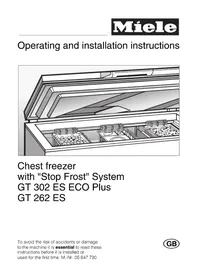
Operating and installation instructions
Chest freezer with "Stop Frost" System GT 302 ES ECO Plus GT 262 ES
To avoid the risk of accidents or damage to the machine it is essential to read these instructions before it is installed or used for the first time. M.-Nr. 05 647 730
Contents
Guide to the appliance 4
Caring for the environment 5
Warning and safety instructions....6
Switching on and off 10
Switching off for longer periods of time 10
The correct temperature 11
... in the freezer 11
Temperature selection 11
Thermometer 12
Warning light 13
Super freeze 14
Freezing fresh food 14
Super freeze.... 14
Interior 15
Baskets 15
Initial freezing section 15
Freezing and storing food 16
Maximum freezing capacity.... 16
Storing frozen food. 16
Home freezing 16
Hints on home freezing.... 16
Packing 17
Placing food in the freezer 17
Freezer planner 17
Defrosting....17
Cooling drinks 18
Defrosting 19
"Stop Frost" system.... 19
Cleaning and care 21
Cleaning the outer casing, the interior and accessories 21
E-Cloth 21
Ventilation grille 21
Freezer lid seal.... 21
Problem solving guide.... 23
After sales service 25
Electrical connection 26
Electrical connection U.K. 26
Installation 28
Location 28
Climate range 28
Ventilation....28
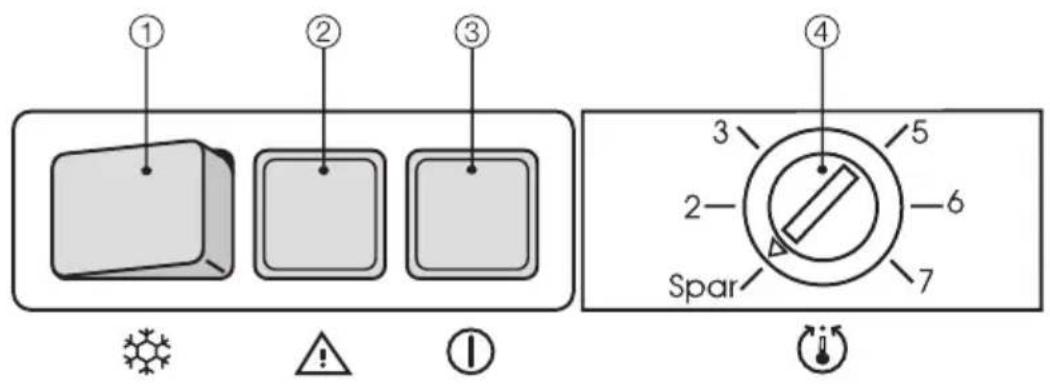
①Super freeze switch with indicator light
②Warning light
③In-operation indicator light
④Temperature control (Spar = Economy)
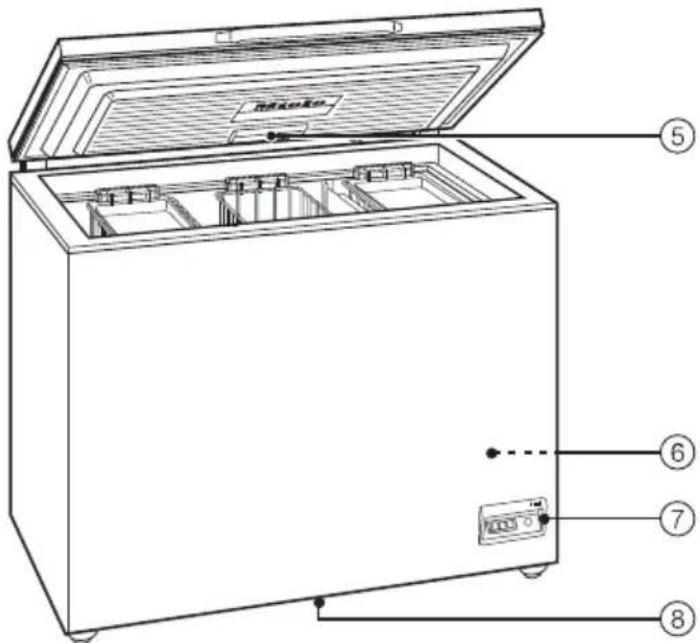
⑤Interior lighting
⑥Ventilation grille
⑦Control panel
⑧Defrosting outlet
Disposal of the packing material
The transport and protective packing has been selected from materials which are environmentally friendly for disposal and can normally be recycled.
Rather than just throwing these materials away, please ensure they are offered for recycling.
Ensure that any plastic wrappings, bags etc. are disposed of safely and kept out of the reach of babies and young children. Danger of suffocation!
Disposal of your old appliance
Old appliances contain materials which can be reclaimed or recycled. Please contact your dealer, your waste collection centre or scrap merchant about potential recycling schemes.
Make sure that the pipework is not damaged whilst moving an old appliance. This is to ensure that the refrigerant and oil in the compressor cannot leak into the environment. It is important that they are disposed of in a safe manner by authorised persons only.
Ensure that the appliance presents no danger to children while being stored for disposal.
See the appropriate section in the Warning and safety instructions.
This appliance complies with all relevant legal safety requirements. Improper use of the appliance can, however, present a risk of both personal injury and material damage.
Before installation and before using for the first time, read the operating instructions carefully. They contain important notes on safety, the operation and care of the appliance. This way you will avoid the risk of accidents and damage to the appliance.
Keep these instructions in a safe place and pass them on to any future user.
Correct usage
This appliance is intended for domestic use only. It must only be used for storing deep frozen food, for freezing fresh food and for preparing ice. Any other usage is not supported by the manufacturer and could be dangerous. The manufacturer cannot be held responsible for damage caused by improper use of the appliance.
Technical safety
This appliance contains the coolant Isobutane (R600a), a natural gas which which is very environment friendly. Although it is flammable, it does not damage the ozone layer and does not increase the green house effect. The use of this environment friendly coolant has however led to a slight increase in the noise level of the appliance. In addition to the noise of
the compressor you might be able to hear the coolant flowing around the system. This is unavoidable, but does not have any adverse effect on the performance of the appliance. Care must be taken during transportation and setting up of the appliance that no parts of the cooling system are damaged. Leaking coolant can damage the eyes.
In the event of any damage:
- avoid open fires
and anything which creates a spark,
– disconnect from the mains,
– air the room in which the appliance is located for several minutes and - contact the Service Department. for advice.
The more refrigerant there is in an appliance the larger the room it should be installed in. In the event of a leakage, if the appliance is in a small room, there is the danger of combustible gases building up.
For every 8 g of coolant at least 1 m 3 room space is required. The amount of coolant in the appliance is stated on the data plate inside the appliance.
Before connecting the appliance to the mains supply, make sure that the rating on the data plate corresponds to the voltage and frequency of the household supply.
This data must correspond in order to avoid risk of damage to the appliance. If in any doubt, consult a qualified electrician.
The electrical safety of this appliance can only be guaranteed when continuity is complete between the appliance and an effective earthing system which complies with local and national safety regulations. It is most important that this basic safety requirement is tested by a qualified electrician.
The manufacturer cannot be held responsible for the consequences of an inadequate earthing system (e.g. electric shock).
■ Safe operation of the appliance is only assured if it has been installed and connected in accordance with these operating and installation instructions.
This equipment is not designed for maritime use of for use in mobile installations such as caravans, aircraft etc. However, it may be suitable for such usage subject to a risk assessment of the installation being carried out by a suitably qualified engineer.
Installation work, maintenance and repairs may only be carried out by suitably qualified and competent persons.
Repairs and other work by unqualified persons could be dangerous and the manufacturer will not be held responsible.
■ Ensure current is not supplied to the appliance while maintenance or repair work is being carried out.
The appliance is only completely isolated from the electricity supply when:
- the plug has been withdrawn. Do not pull on the cable, only on the plug. - the mains fuse is withdrawn, or - the screw-out fuse is removed in countries where this is applicable.
Do not connect the appliance to the mains electricity supply by an extension lead.
Extension leads do not guarantee the required safety of the appliance. (e.g. danger of overheating).
Use
Never handle frozen food with wet hands. Your hands may freeze to the frozen food.
Do not take ice cubes out with your bare hands and never place ice cubes or ice lollies in your mouth straight from the freezer. The very low temperature of the frozen ice or lollies can cause frost burn to the lips and tongue.
Do not refreeze thawed or partially thawed food.
Defrosted food should be used as quickly as possible as food soon loses its nutritional value and goes off. Defrosted food may only be re-frozen after it has been cooked.
Never store explosive materials in the appliance. Switching on thermostats may produce sparks which could present a fire hazard.
Do not store cans or bottles containing carbonated drinks or liquids which could freeze in the freezer. The cans or bottles could explode. Danger of injury and damage to the appliance.
When cooling drinks quickly in the freezer make sure bottles are not left in for more than one hour, otherwise they could burst. Danger of injury and damage to the appliance.
Observe the "use by" dates given on food to avoid the risk of food poisoning. Storage times will depend on several factors including the freshness and quality of the food as well as the temperature at which it is stored. Follow the instructions given on food manufacturer's packaging on storage conditions required as well as the "use by" date.
Do not use sharp edged objects to – remove frost and ice, – separate frozen foods and remove ice trays. They will damage the evaporator and the appliance will not be able to be used again (total damage).
Never place electric heaters or candles in the appliance to defrost it. These can damage the plastic parts.
Do not use defrosting sprays, or de-icers as they could contain substances which could damage the plastic parts and which may cause the build up of gases and pose a danger to health.
Do no use any grease or oil on the seal of the freezer lid. These cause
the seal to become porous in the course of time.
Do not block the ventilation gap in the appliance as this would impair the efficiency of the appliance, increase the electricity consumption and could cause damage to the appliance.
The appliance is designed for use within certain climate ranges (ambient temperatures). It must not be used in ranges for which it is not designed. The climate range for your appliance is stated on the data plate inside the appliance. Installing it in a room with too low an ambient temperature will lead to the appliance switching off for longer periods so that it cannot maintain the required temperature.
Never use steam cleaning apparatus to defrost or clean the appliance. The steam could attack the electrical components and cause a short circuit.
In countries where there are areas which may be subject to infestation by cockroaches or other vermin, pay particular attention to keeping the appliance and its surroundings in a clean condition at all times.
Any damage which may be caused by cockroaches or other vermin will not be covered by the appliance guarantee.
Disposal of old appliances
Before disposing of an old appliance first make the door latch or lock unusable.
This way you will prevent children from accidentally locking themselves in and endangering their lives.
Before disposing of an old appliance, unplug it and render the plug useless. Cut off the cable directly behind the appliance and at the plug to prevent misuse.
Be careful not to damage any part of the pipework whilst awaiting disposal, e.g. by
- puncturing the refrigerant channels in the evaporator.
- bending any pipework.
- scratching the surface coating.
Splashes of refrigerant can damage the eyes.
The manufacturer cannot be held liable for damage caused by non-compliance with these Warning and safety instructions.
Before using for the first time
■ Clean the appliance interior and all accessories. Use warm water and a little washing up liquid and dry with a soft cloth.
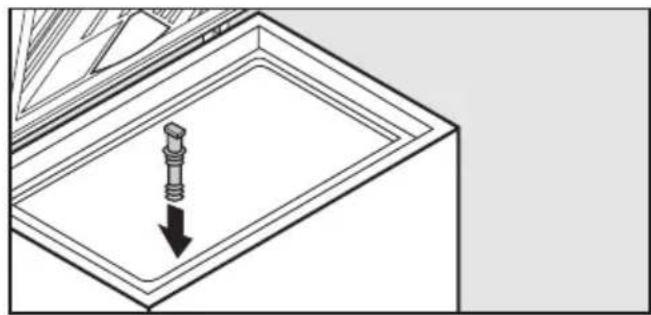
■ Use the stopper supplied to plug the defrosting outlet in the bottom of the interior of the appliance.
Important:
To ensure correct functioning of the appliance, let it stand for between 1/2 and 1 hour after transporting it to its final location before connecting it to the mains.
Switching on
Plug in and switch on at the wall socket.
The in-operation indicator light and the warning light will come on. The appliance will start to cool.
Allow the appliance to run for a few hours before placing food in it. This will ensure that the temperature is sufficiently low.
The warning light remains lit until the temperature which has been set is reached.
Switching off
■ Disconnect and remove the mains plug from the socket.
All indicator lights go out and the cooling process is switched off.
Switching off for longer periods of time
If the appliance is not going to be used for a longer period of time, e.g. whilst on holiday
■ Switch off at the socket and withdraw the plug (pull on the plug and not the cable),
■ defrost the appliance and then clean it, and
■ leave the lid open to air the appliance.
If, during a long absence, the appliance is switched off but not cleaned out and the lid is left shut, there is a danger of mould and odours building up inside the appliance.
... in the freezer
It is very important to set the correct temperature for storing food in the freezer. Micro organisms will cause food which is not stored at the correct temperature to deteriorate rapidly. Temperature influences the growth rate of these micro organisms. Reducing the temperature reduces their growth rate.
For freezing fresh food and storing frozen food for a long time a temperature of at least -18 °C is needed. At this temperature the growth of micro organisms is generally halted. As soon as the temperature rises to above -10 °C, the micro organisms become active in the food again so that it cannot be kept as long. For this reason partially defrosted or defrosted food must not be re-frozen. Food may be re-frozen once it has been cooked as the high temperatures achieved when cooking destroy most micro organisms.
The temperature in the appliance will rise:
– the more often the lid is opened and the longer it is kept open,
- if too much food is stored in it at once,
- if too much fresh food is being frozen at once,
– the higher the ambient temperature surrounding the appliance.
The appliance is designed for a particular climate range (ambient room temperature), and should not be used outside this range.
Temperature selection
The temperature is set with the temperature selector.
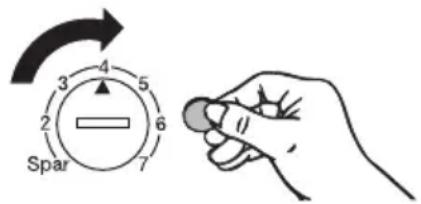
■ Use a coin to turn the temperature selector clockwise to a setting between 2 and 7.
Turn it only as far as it will go, then turn it back again. Turning it beyond its range would damage it.
The higher the setting, the lower the temperature in the appliance.
We recommend a setting between 2 and 3.
■ If the freezer is only filled to a maximum of 30 cm below the top rim of the basket then turn the temperature selector to the "Spar" (Economy) setting.
The energy consumption will be lower.
If the freezer has very little food stored in it and for this reason the temperature selector has been set at "Spar" (Economy), it is very important to monitor the temperature to ensure that it remains at least -18 °C. You can check the temperature by placing a thermometer on the top layer of frozen food.
Thermometer
During normal operation the thermometer inside the freezer shows the temperature in the warmest part of the appliance. The thermometer only measures temperatures below 0 °C accurately.
If you have adjusted the temperature selector in order to set a different temperature, wait for approx. 6 hours if the freezer is not very full and for approx. 24 hours if the freezer is full before checking the temperature display. It will take this long for the display to show the accurate temperature of the freezer. If the temperature displayed is too low or too high, then adjust the temperature once more.
A temperature above -18 °C is no cause for concern in the following circumstances:
- when the appliance has just been switched on,
- when the lid has been left open for a while, e.g. for removing or storing a large amount of food,
– when fresh food is being frozen.
However, if the temperature remains above -18 °C for a long time, check that the frozen food has not started to defrost. If it has started to defrost check that it is safe to use and if it is, use it as soon as possible.
Your appliance has been fitted with a warning system which ensures that the temperature in the freezer cannot rise unnoticed. The warning light will come on as soon as the temperature becomes too warm. The temperature selector determines the range of temperatures the appliance recognises as too warm.
The warning light will come on
- when the freezer is switched on.
- when the lid has been left open for a while, e.g. in order to load, to re-arrange or to take out food.
– when freezing large amounts of food. - when there has been a lengthy interruption to the power supply.
The warning light will go out when the temperature which has been set is reached.
Freezing fresh food
Fresh food should be frozen as quickly as possible. This way the nutritional value of the food, its vitamin content, appearance and taste are not impaired.
Food which takes a long time to freeze will lose more water from its cells which then shrink.
During the defrosting process only some of this water is reabsorbed by the cells.
In practice this means that the food loses a large degree of its moisture.
The rest collects around the food.
If food is frozen quickly the cells have less time to lose moisture so they shrink less.
As there is not so much moisture it is easier for the food to reabsorb it during the defrosting process. There will be very little water around the defrosted food.
Super freeze
This function should be used when freezing more than 2 kg of fresh food at once.
Super freeze is not necessary:
- when putting in frozen food.
- when freezing up to 2 kg fresh food daily.
Switching on super freeze
Switch the super freeze function on before putting fresh food into the freezer.
When freezing small quantities of food in the freezer, the super freeze function should be switched on 4 – 6 hours beforehand. When freezing the maximum load of food the super freeze function should be switched on 24 hours beforehand.
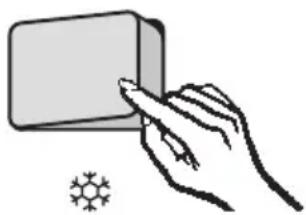
■ Press the super freeze button. The super freeze indicator light will come on.
The appliance works at full power to lower the temperature in the freezer.
Switching super freeze off
To save energy the super freeze function can be switched off once a constant temperature of at least -18 °C has been reached in the freezer.
■ To switch it off press the super freeze switch. The super freeze indicator light will go out.
The appliance will continue to operate at normal power.
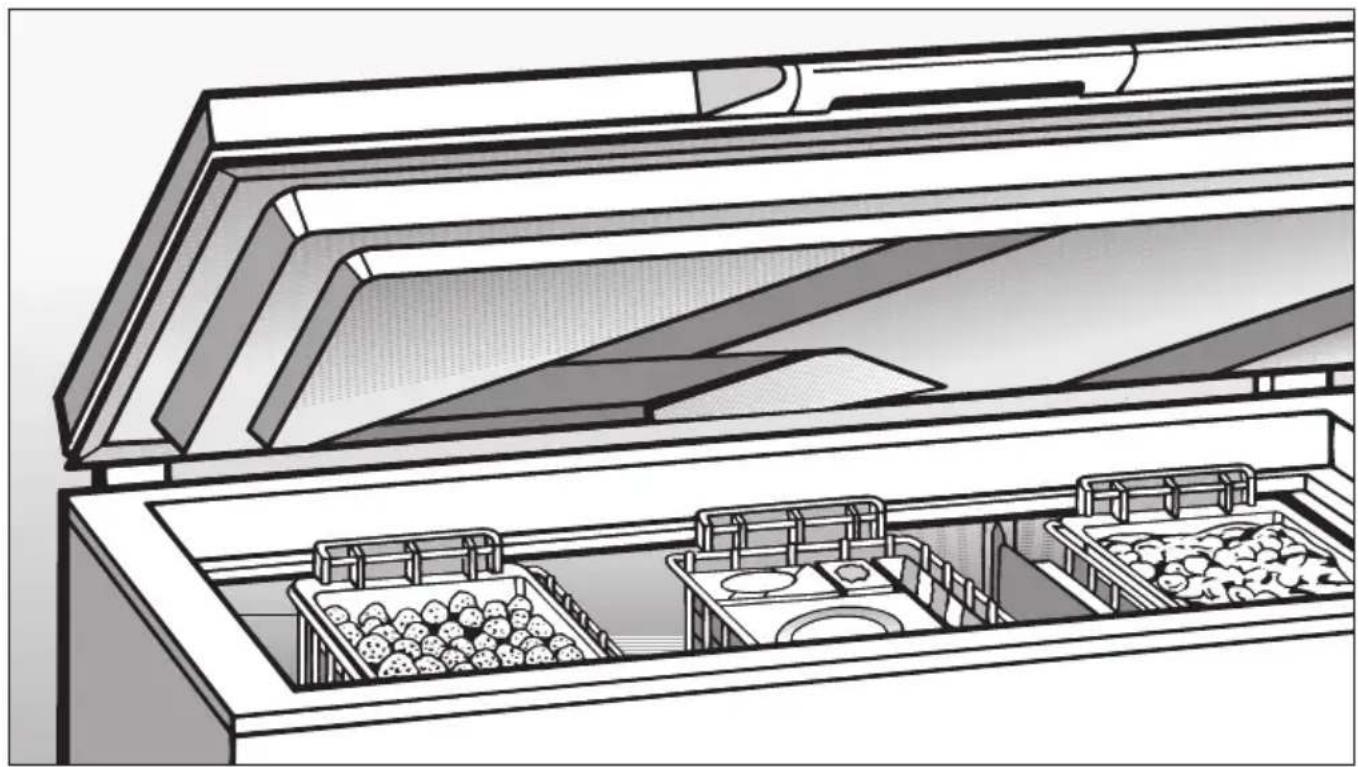
Baskets
The baskets make it easier to arrange the food in the freezer.
■ Hang the baskets by hooking the handles on to the rim of the freezer, or
- Stack the baskets in the freezer: – place one of the baskets on the floor of the freezer.
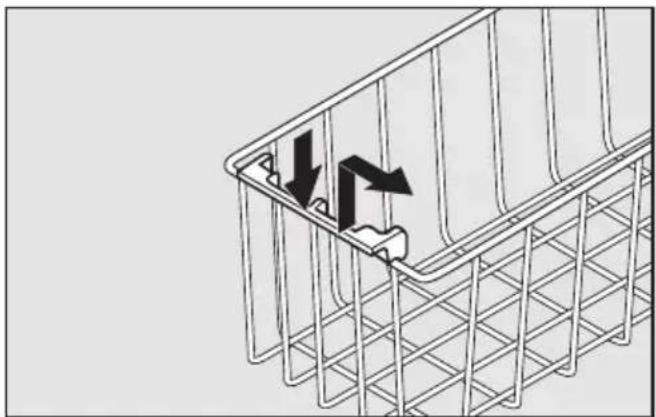
- press down the handles on this basket, lift them up and swing them inwards.
– now place another basket on top of the lower basket.
Initial freezing section
You can separate an area from the rest of the freezer to use for freezing fresh food.
This allows you to place fresh food separately from food which is already frozen, avoiding the possibility of the fresh food causing the already frozen food to thaw before the fresh food has itself become frozen.
Maximum freezing capacity
To ensure that fresh food placed in the freezer freezes through to the core as quickly as possible, the maximum freezing capacity must not be exceeded. The maximum freezing capacity for freezing within a 24 hour period is given on the data plate “Freezing capacity ....kg/24 hrs”.
Storing frozen food
When buying frozen food to store in your freezer check
– that the packaging is not damaged,
– the use by date,
- the temperature at which the frozen food is being stored in the shop. The length of time it can be kept is reduced if it has been stored at a temperature warmer than -18°C .
■ Buy frozen food once you have finished the rest of your shopping and wrap it in newspaper or use a cool bag or box to transport it.
■ Store it in the freezer as soon as possible.
Never re-freeze partially or fully defrosted food. Consume defrosted food as soon as possible as it will lose its nutritional value and spoil if left for too long. Defrosted food may only be re-frozen after it has been cooked.
Home freezing
Only freeze fresh food which is in a good condition.
Hints on home freezing
- The following types of food are suitable for freezing :
Fresh meat, poultry, game, fish, vegetables, herbs, fresh fruit, dairy products, pastry, leftovers, egg yolks, egg whites and a range of pre-cooked meals. - The following types of food are not suitable for freezing:
grapes, lettuces, radishes, sour cream, mayonnaise, eggs in their shells, onions, whole raw apples and pears. - To retain colour, taste and vitamin C, vegetables should be blanched after they have been trimmed and washed. To blanch: bring a large saucepan of water to the boil, immerse the vegetables in the fast boiling water for 2-3 minutes, depending on variety. Remove and cool quickly in cold water. Drain and pack ready for freezing.
- Lean meat freezes better than fatty meat and can be stored for considerably longer.
- To prevent chops, steaks, cutlets or rolled meat from freezing together in solid blocks when packed, separate with a sheet of plastic freezer film.
- Do not season fresh foods or blanched vegetables before freezing. Only season cooked food lightly before freezing but care should be taken as the taste of some spices alters when frozen.
- Do not place hot foods or drinks in the freezer. This causes already frozen food to thaw and increases the energy consumption considerably. Allow hot foods and drinks to cool down before placing them in the freezer.
Packing
■ Freeze food in portions.
Suitable packing material
- plastic freezer film
- freezer bags
- freezer containers
- aluminium foil
Freezer bags may also be sealed using home heat sealing kits.
■ Expel as much air as possible from bags etc. before sealing them to prevent freezer burn on food.
■ Close the packaging tightly with
- rubber bands
- plastic clips
- string or bag ties
– cold resistant adhesive tape.
■ Make a note of the contents and the date of freezing on the packaging.
Unsuitable packing material
- wrapping paper
- grease-proof paper
- cellophane
- dustbin liners
- plastic carrier bags
Placing food in the freezer
■ Place fresh food into the area that you have already divided from the rest of the freezer by means of the divider, so that it is separated from food which is already frozen.
When freezing, make sure that food already frozen does not come into contact with fresh food being frozen as this could cause the frozen food to begin to defrost.
■ Arrange frozen food in an organised way in the freezer.
■ Make sure that the packaging and containers are dry to prevent them sticking together when frozen.
Freezer planner
The freezer planner on the inside of the lid shows the number of months for which various foods can be stored effectively. However, these times should be regarded only as a guide, as various factors can affect the storage time, e.g. the quality of the food, how it is handled prior to freezing etc.
Defrosting
Frozen food can be defrosted in different ways:
– in the microwave oven,
- in the oven using the "Fan" or "Defrost" setting,
- at room temperature,
- in the fridge.
Fruit should be defrosted at room temperature in its packing or in a covered bowl.
Most vegetables can be cooked while still frozen. Just put straight into boiling water or hot fat. The cooking time is slightly less than that of fresh vegetables.
Poultry It is particularly important to observe food hygiene rules when defrosting poultry. Do not use the liquid from defrosted poultry. Pour it away and wash the container it was in, the sink and your hands.
Never re-freeze partially or fully defrosted food. Consume defrosted food as soon as possible as it will lose its nutritional value and spoil if left for too long. Defrosted food may only be re-frozen after it has been cooked.
Cooling drinks
When cooling drinks quickly, make sure bottles are not left in the freezer for more than one hour, as they could burst.
"Stop Frost" system
In normal use ice and frost will form on the evaporator plates. If allowed to accumulate, this will impair the efficiency of the freezer and increase the consumption of electricity.
The stop frost system reduces the build up of ice and frost by approx. 70 % in comparison to other appliances. This means that it is not necessary to defrost the appliance nearly as often.
Only use the scraper supplied with the appliance to scrape off ice and frost.
Otherwise the evaporator plates could be damaged making the freezer unusable.
The freezer should be defrosted from time to time. It must be defrosted if a layer of ice approx. 5 mm thick has accumulated. It is best to defrost when only very little food or no food at all is left in the freezer.
Before defrosting
■ Switch on the super freeze function at least 4 hours before defrosting to ensure frozen food retains its cold reserve for longer when taken out of the freezer.
■ Remove the frozen food from the freezer and place it in another freezer or cool box or wrap it in several layers of newspaper or cloths and store in a cool place until the freezer is ready for use again.
To defrost
Carry out the defrosting procedure as quickly as possible if food has not been placed in another freezer. The longer the food is left out at room temperature, the faster it defrosts.
■ Disconnect and remove the mains plug from the socket.
■ Place the divider or a flat container under the defrosting outlet. Any defrosted water will then collect in the divider / container.
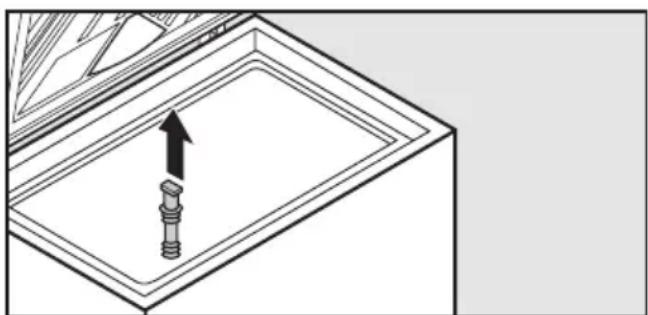
■ Pull the stopper out of the floor of the appliance.
■ Leave the lid of the freezer open.
To speed up defrosting, a bowl with hot water (not boiling) can be placed in the appliance.
We do not recommend the use of hot air blowers such as hair dryers for defrosting your freezer.
Never place electric heaters or candles in the appliance to defrost it. These can damage the plastic parts.
Do not use defrosting sprays, or de-icers as they could contain sub-stances which could damage the plastic parts and which may cause a build up of gases and pose a danger to health.
After defrosting
■ Mop up any residual water still in the freezer with a sponge or absorbent cloth.
■ Clean the freezer and then dry it thoroughly.
■ Replace the stopper in the outlet for defrosted water.
■ Close the lid and insert the mains plug in the socket.
■ Switch on the super freeze function so that the freezer can cool down quickly.
The super freeze indicator light will come on.
■ Once the temperature in the freezer has reached the required temperature place the food back in the freezer.
■ The super freeze function can be switched off as soon as -18°C is reached.
The indicator light will go out.
Never use cleaning agents containing abrasive substances such as sand, soda, acids or chemical solvents.
“Non-abrasive” cleaning agents are also unsuitable as they can cause matt areas to appear.
Make sure that no water can penetrate into the electronic unit or into the ventilation gaps.
Never use steam cleaning apparatus to defrost or clean the appliance. The steam could attack the electrical components and cause a short circuit.
The data plate located on the outside the appliance must not be removed. It contains information which is required in the event of a service call.
■ Clean the appliance immediately after defrosting it.
■ Switch the appliance off, take any food out of the appliance and store it in a suitable cool place (e.g. cool box or another freezer).
Cleaning the outer casing, the interior and accessories
Use lukewarm water with a little washing up liquid. Accessories and baskets should be hand washed only. Do not wash in a dishwasher.
■ After cleaning wipe the outer casing, interior and accessories with a damp
cloth and dry with a soft cloth. Leave the lid of the freezer open for a while.
E-Cloth
A microfibre "E-Cloth" is available from the Miele UK Spare Parts Department, Part number 98013530, which is suitable for cleaning surfaces such as stainless steel, glass, plastic and chrome without the use of chemicals.
Ventilation grille
- The ventilation grille should be cleaned on a regular basis with a brush or vacuum cleaner. A build up of dust will increase the appliance's energy consumption.
Freezer lid seal
Do not use any oils or grease on the seal as these will cause the seal to deteriorate and become porous over time.
The seal should be cleaned regularly with clean water and then wiped dry with a soft cloth.
After cleaning
■ Close the lid and insert the mains plug in the socket.
■ Switch on the super freeze function so that the freezer can cool down quickly.
The super freeze indicator light will come on.
Cleaning and care
■ Once the temperature in the freezer has reached the required temperature place the food back in the freezer.
■ The super freeze function can be switched off as soon as -18\ °C is reached.
The indicator light will go out.
Repairs to electrical appliances should only be carried out by a suitably qualified and competent person in accordance with local and national safety regulations. Repairs and other work by unqualified persons could be dangerous. The manufacturer cannot be held responsible for unauthorised work.
The following can be corrected without contacting the Miele Service Department:
What to do if ...
... strange noises can be heard after switching on the appliance, especially after it has just been installed.
- Check to see whether any pieces of furniture next to the appliance are vibrating whilst the appliance is in operation.
Switch the appliance off then:
■ Check whether the appliance is aligned correctly.
■ Are all removable parts securely located in the appliance?
Remember that the noise of the compressor and the coolant circulating in the system is unavoidable.
... the appliance does not get cool.
- Check that the plug is correctly inserted in the socket.
- Check that the fuse is not defective and that the mains fuse has not blown. If it has, consult the Miele Service department.
... the temperature is too low.
■ Turn the temperature selector to a setting closer to the "Off" position.
■ The super freeze function has not been switched off. The indicator light is still on.
... the appliance is switching in too frequently and for too long.
■ Check whether the ventilation grille has been covered over or become too dusty.
■ The lid has been opened too frequently, or a large amount of fresh food has been put in at once for freezing.
■ Check that the lid has been properly closed.
■ Check whether a thick layer of ice has built up. If it has then the freezer will need defrosting.
... the warning light is on.
The temperature has risen above the setting on the temperature selector because
■ the lid has been opened too frequently, or large amounts of fresh food have been put in at once for freezing.
■ the ventilation grille is blocked.
■ there has been a lengthy interruption to the power supply.
Once the problem has been resolved the warning light will go out.
... food has frozen together.
Use a blunt instrument, e.g. a spoon handle or plastic scraper to carefully prise it apart.
... there is a thick layer of ice in the freezer.
■ Check that the lid has been properly closed.
■ Defrost and then clean the freezer.
Too thick a layer of ice reduces efficiency and increases energy consumption.
... the interior light is not working.
The lamp needs changing.
■ Disconnect and remove the mains plug from the socket.
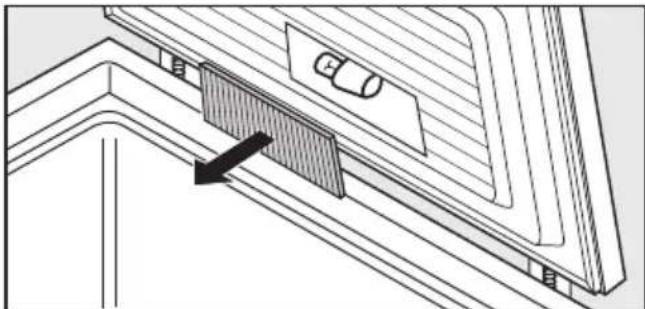
■ Take off the cover in the direction of the arrow.
■ Unscrew the lamp and replace it with a new one.
Lamp specification: 220 – 240 V, max. 15 W, E14 fitting
■ Replace the cover cap.
If you still cannot remedy the fault having followed these suggestions, then contact the Miele Service Department.
To prevent unnecessary loss of temperature it is advisable not to open the lid while waiting for the appliance to be serviced.
In the event of a fault which you cannot correct yourself, or if the appliance is under guarantee please contact:
- Your Miele Dealer
or
– The Miele Service Department (see back cover for address).
When contacting the Service Department, please quote the model and serial number of your appliance, both of which are shown on the data plate on the outside of the appliance.
Please note that telephone calls may be monitored and recorded to improve our service.
Electrical connection U.K.
The appliance is supplied with a mains cable and moulded plug ready for connection to an a.c. single phase 220 – 240 V 50 Hz supply. The fuse rating is 13 amps.
All electrical work should be carried out by a suitably qualified and competent person in accordance with local and national safety regulations. Connection should be made via a fused plug and suitable switched socket which is easily accessible. For extra safety it is advisable to install a residual current device (RCD) with a trip current of 30 mA (in accordance with DIN VDE 0664, VDE 0100, Section 739).
Do not connect the appliance to the mains electricity supply by an extension lead. Extension leads do not guarantee the required safety of the appliance (e.g. danger of overheating).
The appliance must not be connected to an inverter and must not be used with a plug adapter as these can cause damage to the appliance's electronic unit.
Important
The wires in the mains lead are coloured in accordance with the following code:
Green/yellow = earth
Blue = neutral
Brown = live
As the colours of the wires in the mains lead of this appliance may not correspond with the coloured markings identifying the terminals in your plug, proceed as follows:
The wire which is coloured green and yellow must be connected to the terminal in the plug which is marked with the letter E or by the earth symbol ( ± ) or coloured green or green and yellow.
The wire which is coloured blue must be connected to the terminal which is marked with the letter N or coloured black.
The wire which is coloured brown must be connected to the terminal which is marked with the letter L or coloured red.
WARNING
THIS APPLIANCE MUST BE EARTHED
Non-rewireable plugs (BS 1363)
If this machine is fitted with a non-rewireable plug, the following information applies:
If the socket outlets are not suitable for the plug supplied with this product, it must be cut off and an appropriate plug fitted.
The fuse carrier and the fuse should be removed from the old plug and disposed of. The plug cut from the flexible cord should then be disposed of and on no account be inserted into any socket elsewhere in the house (electric shock hazard).
The fuse cover must be re-fitted when changing the fuse, and if the fuse cover is lost, the plug must not be used until a suitable replacement is obtained. The colour of the correct replacement cover is that of the coloured insert in the base of the plug, or the colour that is embossed in words in the base of the plug (as applicable to the design of the plug fitted).
The correct fuse rating of the replacement fuses that are ASTA approved to BS 1362 should be fitted. Replacement fuse covers may be purchased from your local electrical supplier, or Miele Service agent.
Location
The appliance should be installed on a level and stable surface.
It should be situated far enough away from a wall to ensure that the lid can be opened and closed easily.
The appliance should be installed in a dry well ventilated room.
The room temperature should not go above or below the climate range for which the appliance is designed. The higher the ambient temperature of the room the more energy the appliance requires to operate. It should not be installed where it is exposed to direct sunlight or directly adjacent to a heat-producing appliance such as an oven or a radiator.
To not install the appliance up against other appliances or units. There must be a minimum distance of 20 mm all around the appliance to ensure sufficient ventilation.
Climate range
The appliance is designed for a particular climate range (ambient room temperature), and should not be used outside this range. The climate range of this appliance is stated on the data plate outside the appliance.
| Climate range Ambient room temperature | |
| SN, N | to + 32 °C |
| ST | to + 38 °C |
| T | to + 43 °C |
The appliance will function perfectly down to a temperature of +5 °C.
Ventilation
In order to ensure sufficient ventilation
- the gap between the bottom edge of the freezer and the floor on which it is standing must not be covered.
– there must be a minimum distance of 20 mm from the ventilation grille to the wall to ensure sufficient ventilation.
– the ventilation grille should be dusted on a regular basis.
United Kingdom
Miele Co. Ltd., Fairacres, Marcham Road, Abingdon, Oxon, OX14 1TW tel. Abingdon (01235) 554455 - fax (01235) 554477
Service Office, tel. Abingdon (01235) 554466
Internet: www.miele.co.uk
Alteration rights reserved / 44 / 000 GB - 2201


- OPERATING AND INSTALLATION INSTRUCTIONS
- CONTENTS
- CLEANING AND CARE
- PROBLEM SOLVING GUIDE
- AFTER SALES SERVICE
- ELECTRICAL CONNECTION
- INSTALLATION
- DISPOSAL OF THE PACKING MATERIAL
- DISPOSAL OF YOUR OLD APPLIANCE
- CORRECT USAGE
- TECHNICAL SAFETY
- USE
- DISPOSAL OF OLD APPLIANCES
- BEFORE USING FOR THE FIRST TIME
- SWITCHING ON
- SWITCHING OFF
- SWITCHING OFF FOR LONGER PERIODS OF TIME
- IN THE FREEZER
- TEMPERATURE SELECTION
- THERMOMETER
- FREEZING FRESH FOOD
- SUPER FREEZE
- SUPER FREEZE IS NOT NECESSARY
- SWITCHING ON SUPER FREEZE
- SWITCHING SUPER FREEZE OFF
- BASKETS
- INITIAL FREEZING SECTION
- MAXIMUM FREEZING CAPACITY
- STORING FROZEN FOOD
- HOME FREEZING
- HINTS ON HOME FREEZING
- PACKING
- SUITABLE PACKING MATERIAL
- UNSUITABLE PACKING MATERIAL
- PLACING FOOD IN THE FREEZER
- FREEZER PLANNER
- DEFROSTING
- COOLING DRINKS
- STOP FROST" SYSTEM
- BEFORE DEFROSTING
- TO DEFROST
- AFTER DEFROSTING
- CLEANING THE OUTER CASING, THE INTERIOR AND ACCESSORIES
- E-CLOTH
- VENTILATION GRILLE
- FREEZER LID SEAL
- AFTER CLEANING
- WHAT TO DO IF
- STRANGE NOISES CAN BE HEARD AFTER SWITCHING ON THE APPLIANCE, ESPECIALLY AFTER IT HAS JUST BEEN INSTALLED
- THE APPLIANCE DOES NOT GET COOL
- THE TEMPERATURE IS TOO LOW
- THE APPLIANCE IS SWITCHING IN TOO FREQUENTLY AND FOR TOO LONG
- THE WARNING LIGHT IS ON
- FOOD HAS FROZEN TOGETHER
- THERE IS A THICK LAYER OF ICE IN THE FREEZER
- THE INTERIOR LIGHT IS NOT WORKING
- ELECTRICAL CONNECTION U.K
- IMPORTANT
- WARNING
- THIS APPLIANCE MUST BE EARTHED
- NON-REWIREABLE PLUGS (BS 1363)
- LOCATION
- CLIMATE RANGE
- VENTILATION
Brand : MIELE
Model : GT 302 ES ECO Plus
Category : Freezer