Xeon X3440 - Processor INTEL - Free user manual and instructions
Find the device manual for free Xeon X3440 INTEL in PDF.


| Brand | Intel |
| Model | Xeon X3440 |
| Product Type | Processor |
| Socket | LGA 1156 |
| Core Count | 4 |
| Thread Count | 8 |
| Base Frequency | 2.53 GHz |
| Max Turbo Frequency | 2.93 GHz |
| L3 Cache | 8 MB |
| Thermal Design Power (TDP) | 95 W |
| Manufacturing Technology | 45 nm |
| Memory Support | DDR3-1066/1333 |
| Memory Channels | Dual Channel |
| Max Memory Capacity | 32 GB (est.) |
| Integrated Graphics | None |
| PCI Express Version | 2.0 |
| Max Number of PCIe Lanes | 16 |
| Compatible Chipset | Intel 3400/3420/3450 |
| Operating Temperature Range | 0°C to 69°C (est.) |
Frequently Asked Questions - Xeon X3440 INTEL
User questions about Xeon X3440 INTEL
0 question about this device. Answer the ones you know or ask your own.
Ask a new question about this device
Download the instructions for your Processor in PDF format for free! Find your manual Xeon X3440 - INTEL and take your electronic device back in hand. On this page are published all the documents necessary for the use of your device. Xeon X3440 by INTEL.
USER MANUAL Xeon X3440 INTEL
Intel® Xeon® Processor 3400 Series-based Platforms
A new generation of intelligent server processors delivering dependability, productivity, and outstanding performance

natural_image
Office scene with three employees at computer workstations, no visible text or symbolsDependability, productivity, and intelligent performance for real server applications
Businesses today need to be productive all day, every day. Intel® Xeon® processor 3400 series-based servers provide businesses with technologies designed to deliver 24/7 dependability to help them improve productivity and performance that automatically adapts to changing workloads at an entry-level price point.
Based on Intel ^® microarchitecture, codenamed Nehalem, the Intel Xeon processor 3400 series is designed with innovative features that adapt performance to software and business needs, help energy consumption for optimum performance and efficiency, and enable hardware-based virtualization capabilities. The capabilities found in servers featuring the Intel Xeon processor 3400 series make them ideal for small businesses stepping up to a first server, companies requiring a dedicated server for a workgroup, or education departments that need a server to support multiple clients.
Trust Your Company to Intel's Proven Server Technology
With nearly 40 million Intel® processor-based servers shipped since 1996, and a 20-year track record of delivering enterprise-class performance, more companies trust their businesses to Intel processor-based servers. Intel Xeon processor-based entry-level servers give companies the dependability, improved productivity, and performance they need to focus on their business instead of their computers.
Our entry-level server platforms are comprehensive solutions that have the flexibility to grow with your business. We combine effective technologies, software, and industry alliances to give you servers optimized for your business with incredible value. Intel has used its world-class manufacturing technology combined with its next-generation microarchitecture (codenamed Nehalem) to deliver innovative features that provide compelling performance for value-conscious customers. You can count on Intel to deliver superior quality and reliability to drive your business forward.
Server Platform Architecture
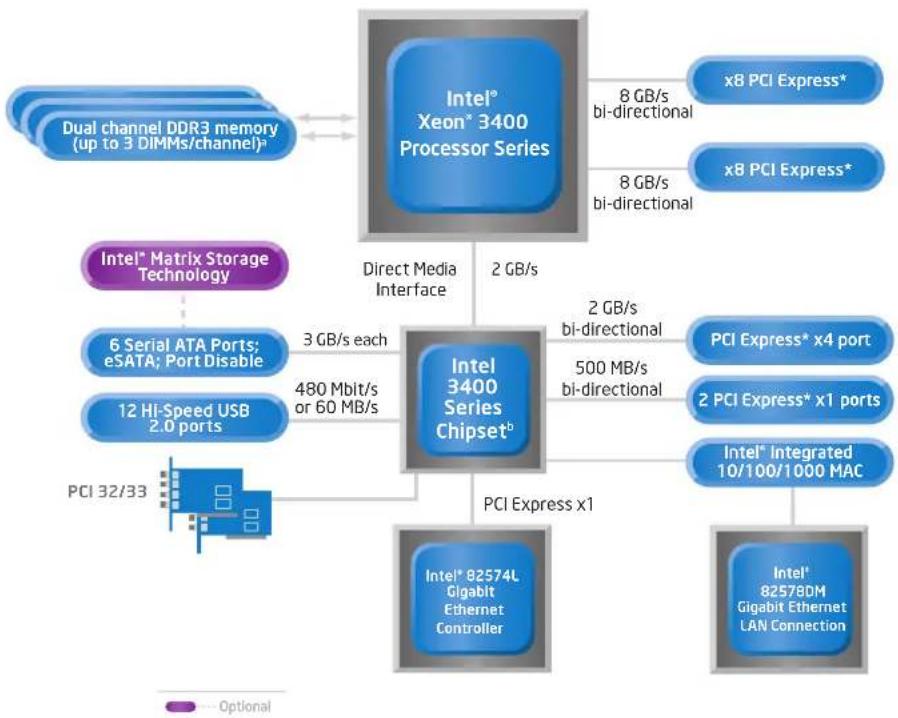
flowchart
graph TD
    A["Dual channel DDR3 memory (up to 3 DIMMs/channel)"] <--> B["Intel® Xeon® 3400 Processor Series"]
    B --> C["Direct Media Interface"]
    C --> D["PCI Express x1"]
    C --> E["Intel® 82574L Gigabit Ethernet Controller"]
    B --> F["PCI Express x4 port"]
    B --> G["2 PCI Express* x1 ports"]
    B --> H["Intel® Integrated 10/100/1000 MAC"]
    B --> I["Intel® 82578DM Gigabit Ethernet LAN Connection"]
    J["Intel® Matrix Storage Technology"] --> K["6 Serial ATA Ports; eSATA; Port Disable"]
    K --> L["3 GB/s each"]
    L --> M["480 Mbit/s or 60 MB/s"]
    M --> N["PCI 32/33"]
    N --> O["PCI Express x1"]
    B --> P["x8 PCI Express*"]
    B --> Q["x8 PCI Express*"]
Up to 3 DIMMs per channel with registered DIMMs. 2 DIMMs per channel with unbuffered DIMMs. Inle® 3420 Chipset features shown.
Figure 1. Intel ^® Xeon ^® processor 3400 series and Intel ^® 3400 series chipsets.
The Ideal Entry-level Server
Entry-level server platforms featuring the Intel Xeon processor 3400 series and the Intel 3400 series chipset are ideal for value-conscious organizations looking for their first server or a replacement for an older server. These platforms are designed to deliver 24/7 dependability and improve business productivity with industry-leading performance. These new server platforms are easy to set up and manage, provide trouble-free operation and help ensure that your operational needs are met at every stage of your business growth. Our entry-level server platforms integrate the most advanced technologies:
- Innovative Integration - Intel® Xeon® processor 3400 series is based on the next-generation Intel microarchitecture, with an integrated high speed, 1333 MHz dual-channel DDR3 memory controller and flexible x16 PCI Express* 2.0 controller. The Intel® 3400 series chipset offers additional PCI Express I/O for even more expansion possibilities.
- Memory Flexibility - Intel Xeon processor 3400 series provides flexible memory configurations with support of up to 16 GB of memory with DDR3 Unbuffered DIMMs or 32 GB of memory with DDR3 Registered DIMMs.
- Memory Error Correction – The Intel Xeon processor 3400 series supports Error Correcting Code (ECC) memory to improve reliability and integrity of data by keeping system running by self correcting memory errors.
- Power-Saving Architecture - The Intel Xeon processor 3400 series includes architectural improvements such as Integrated Power Gates that reduce idle CPU cores to near zero power and Automated Low Power States that adjust system power consumption based on real-time CPU loads.
- Intel® Turbo Boost Technology ^2 – The Intel Xeon processor 3400 series is designed with innovative features that adapt performance to software and business needs. With Intel® Turbo Boost Technology, applications take advantage of higher speed execution on demand by using available power to run at a higher frequency.
-
Intel® Hyper-Threading Technology ^3 - For applications that lend themselves to parallel, multi-threaded execution, Intel® Hyper-Threading Technology enables simultaneous multi-threading within each processor core, improving multi-threaded application performance.
-
Lower Power Option – The Intel® Xeon® processor L3426 operates at only 45W thermal design power (TDP) which provides a 50W TDP reduction from our standard power processors. The lower TDP makes this processor ideal for building entry-level servers for thermally sensitive, space-constrained environments.
- Improved Virtualization Experience – Intel® Virtualization Technology provides hardware assist to virtualization software, enabling your servers to support both 32-bit and 64-bit operating systems and applications on the same server.
- Gigabit Ethernet – Intel® 82574L Gigabit Ethernet Controller and Intel® 82578DM Gigabit Ethernet Connection provide gigabit Ethernet LAN connectivity for high-speed network access.
- External SATA* Support – Native support of external SATA ports (eSATA), combined with Intel® Matrix Storage Technology (Intel® MST), provides the flexibility to add an external drive for increased data storage. Support for eSATA enables the full SATA interface speed of up to 3 Gb/s outside the chassis.
- Data Reliability with RAID – Supports Frame Information Structure (FIS)-based port multipliers, and RAID levels 0, 1, 5, and 10 enable greater reliability for personal data, or maximum storage performance for intensive applications.
- Fast and Easy Recovery – Intel® Rapid Recover Technology (Intel® RRT) provides RAID level 1 configurations, a fast, easy-to-use method to boot instantly off a hard drive clone allowing the end user to recover their data and quickly return their system to an operational status.
Protect Your Critical Data with 24/7 Dependability
Intel Xeon processor 3400 series-based platforms support Error Correction Code (ECC) memory for a high level of data integrity, reliability, and system uptime. ECC can detect multiple-bit memory errors, and locate and correct single-bit errors to keep business applications running smoothly.
With Intel MST, support for RAID levels 1, 5, and 10 data is protected from drive failure through drive redundancy. With RAID 5, digital assets are protected by writing data to multiple hard drives. This makes data recovery easy by simply replacing the failed drive. Intel RRT provides RAID level 1 configurations in a fast, easy-to-use method allowing the end users to recover their data and return their system to an operational status. This is accomplished by supporting the capability to boot instantly off of a hard drive clone.
Improved Productivity
Intel Xeon processor 3400 series-based platforms support technologies that are designed to improve productivity of your server applications. The Intel Xeon processor 3400 series supports up to 6 RDIMMs for flexible memory configurations and future cost-effective upgrades as your business grows. The processors also support up to 32 GB of DDR3 memory to support applications that are memory bound.
Intel MST with Intel® 3420 chipset can improve server performance on disk-intensive retrieval applications by using RAID 0, 5 or 10. In RAID 0 volumes of two drives, and RAID 5 volumes of three to six drives, data can be accessed at higher speeds, because data is striped across multiple drives. Access time is reduced resulting in reduced response time for data-intensive applications. Also, due to drive load balancing, even systems with RAID 1 can take advantage of faster boot times and data reads. In office applications there are more background tasks such as virus scans, data backup, e-mail, and data processing that consume storage resources. Implementing a basic RAID 1 configuration helps alleviate bottlenecks encountered by running these added tasks.
A New Generation of Intelligent Server Processors Delivering Outstanding Performance for Education and Small Businesses
These next-generation Intel Xeon processors based on the Nehalem architecture deliver innovative features that adapt performance to software and business needs, help energy consumption for optimum performance and efficiency to adapt more quickly to your business needs.
Intel® Turbo Boost Technology. Allows the processor to deliver higher speed execution on demand by using available power to run at a higher frequency.
Intel® Hyper-Threading Technology. Enables simultaneous multi-threading within each processor core to reduce computational latency, making optimal use of every clock cycle.
Intel® Intelligent Power Technology. Minimizes power consumption when server components are not used with Integrated Power Gates which allow individual idling CPU cores to be reduced to near-zero power, and Automated Low Power States which automatically put the processor and memory into the lowest available power states to meet the requirements of the workload.
Low-Power Intel ^® Xeon ^® L3400 Processor Series. Lower power Intel Xeon processors are available for building entry-level servers for thermally sensitive, space-constrained environments.
Intel* Advanced Smart Cache. A large on-die shared L3 cache that reduces latency to data, helping to improve performance and power efficiency.
Intel® Xeon® 3400 Processor Series Performance Comparisons
Compute-Intensive Throughput General-Purpose Server
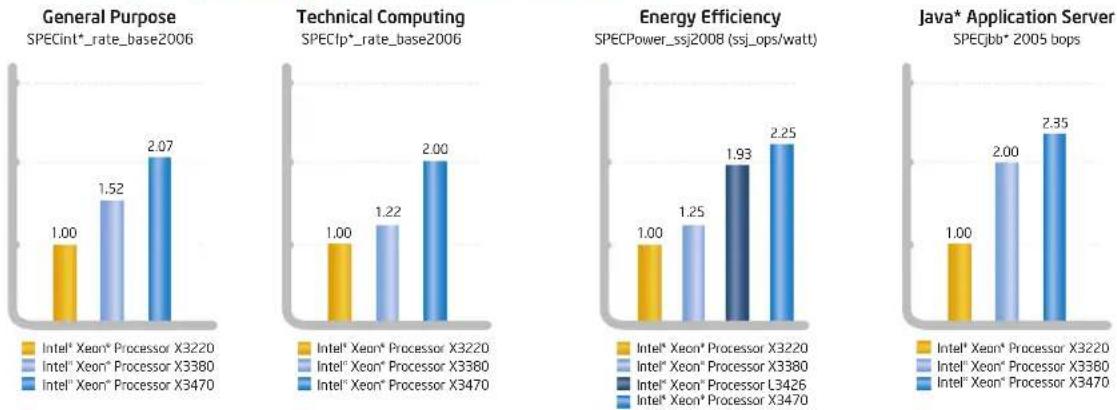
Intel® Xeon® Processor X3220
Intel™ Xeon® Processor X3380
Intel® Xeon® Processor X3470
Intel® Xeon® Processor X3220
Intel® Xeon® Processor X3380
Intel® Xeon® Processor X3470
Intel® Xeon® Processor X3220
Intel" Xeon" Processor X3380
Intel® Xeon® Processor L3426
Intel® Xeon® Processor X3470
Intel® Xeon® Processor X3220
Intel" Xeon" Processor X3380
Intel® Xeon® Processor X3470
Server Performance
SPECint* rate_base2006 on Linux* with X3220 Configuration and Score on Benchmark: Supermicro Motherboard CPSRX* with one Intel® Xcon® processor X3220 (Quad Core, 240 GHz, 8 MB LZ cache, 1065 MHz System Bus), 4 GB (4x1 GB PC3 8500U-7.00 BP, DCR3-1065), western Digital WDBCDJ* 80 GB SATA 7200-RPM, 54-Bit SuSE® Linux Enterprise Server 10 with SP1. Source: Published result as of April 2008; Score: 53.7.
SPECfp_*rate_base2006 on Linux* with X3220 Configuration and Score on Benchmark: Supermicro Motherboard C2SBX* with one Inte* Xeon* processor X3220 (Quad-Core, 243 GHz, 8 MB LZ corche, 1065 MHz System Bus), 4 GB (4x1 GB PC3-B5D00-A-00-BF-00R3-106S), Western Digital WD800JD* 80 GB SATA Z20RFM, 64-bit SuSF* Linux Enterprise Server 10 with SP1. Source: Published result as of April 2008. Score: 42.5.
SPECint* rate_base2006 on Linux* with X3380 Configuration and Score on Benchmark: Fujitsu PRIMLRCY* RX100 S5 system with one Intel® Xeon® processor X3380 (Quad Core, 3.16 GHz, 2 MB L2 cache, 1333 MHz System Busj), Hardware Prefect = Disable, Adjacent Sector Prefect = Disable, 8 GB/4x2 GB PC2 S400E, 2 rank, CL5 6 6, FCC, SA'A 250 GB 7200 rpm, 64 Bit SuSE® Linux Enterprise Server 10 with SP2 (kancel 2.616.60 0.21 simpl). Source: Published result as of Merch 2009. Score: 81.6.
SPECfp_rate_base2006 on Linux with X3380 Configuration and Score on Benchmark: Fujitsu PRIMERGY® RX100 S5 system with one intel® Xeon® processor X3380 (Quad-Core, 3.16 GHz, 2 MBL Z2 cache, 1333 MHz System Bus), Hardware Prefect = Disable, Adjacent Sector Prefect = Disable, B GU4x2 GU PC2-5400L, 2 rank, CLS-6-6, FCC, SATA 250 G3 7200 rpm, 64-bit SuSE® Linux Enterprise Server 10 with SP2 (kernel 2.61.66.0-0.21-smpi). Source: Published results as of March 2009. Score: 517
SPECint* rate_base2006 on Linux* with X3470 Configuration and Score on Benchmark: Intel® BK Beta system with one Intel® Xeon® processor X3470 (Quad-Core, 2.93 GHz, 8M3 L3 cache), LIST Enabled, Turbo Enabled, HIT Enabled, 8 GB memory (4x2 G3 DDR3-333 RD/MM ECO), 146 GB SATA 1000CRPM HCD, SuSE® Linux Enterprise Server 11 for x86_64. Source: Intel internal testing as of July 2009. Score: 111.
SPECfpc_rate_base2006 on Linux* with X3470 Configuration and Score on Benchmark: Intel® BIK Beta system with one Intel® Xeon® processor X3470 (Quad Core, 2.93 GF z, 8M3 L3 cache), LIST Enabled, Turbo Enabled, ITI Enabled, 8 GB memory (4x2 GB DDR3-333 RDIMM CC), 146 GB SATA 1000CRPMTCD, SuSE® Linux Enterprise Server 11 for x86_64. Source: Intel Internal testing as of July 2009. Score: B5.2.
SPECpower_ssj2008 with X3220 Configuration and Score on Benchmark: Fujitsu Siemens PRIMLRGY* 1X15C S6 system with one Intel® Xeon® processor X3220 (Quad-Core, 240 CI-2, 9 MB L2 cache, 1065 MI-lz System Bus), Hardware Prefetch - Disable, Adolescent Sector Prefetch - Disable, 9 G3 (4x2 GB FC2-5400E-656-12-G3 2R (Samsung)), Seagate ST3100B1SAS* (SATA, 7.2kipm, 160CB), Microsoft Windows Server* 2008 Enterprise x64 Edition Service Pack 1 Build 3790. Source: Published result as of December 2007. Score: 567.
SPECpower_ssj2008 with X3380 Configuration and Score on Benchmark: Supermicro X7SBE® system with one mini® Xcore® processor X3380 (3.16 GHz, 2x6 MB L2 cache, 1333 MHz front system bus), HiMP and ASP Disabled, EIST Enabled, Fine Screen control mode 3-pin (server), 8 GB memory (4x2 GB DDR2 800), 150 GB SATA 10000RPM HDD, Microsoft Windows Server® 2008 x54 Edition SP1 OS. Source: Intel internal testing as of April 17, 2009. Score B33.
SPECpower_ssj2008 with X3470 Configuration and Score on Benchmark: Intel® B-K Beta system with one Intel® Xeon® processor X3470 (2.53 GB, 6 MB L3 cache, 4.8 G/s @QPI), HWP and ASP Disabled, LIST Enabled, Turbo Disabled, FI Enabled, System Acoustics and Performance Configuration C1 I, 4 GB memory (2x2 GB DDR3-1333), 150 GB SATA 10000RPM H2D, Microsoft Windows Server 2006 x64 Edition SP2 CS. Source: Intel Internal testing as of July 2009. Score: 1502.
SPECpower_ssj2008 with L3426 New Configuration and Estimated Score on Benchmark: Intel® BK Beta system with one Intel® Xeon® processor L3426 (1.86 GHz, 8 MB L3 cache, 4 B CT/s @QPI), HWP and ASP Disabled, EIST Enabled, Turbo Disabled, HT Enabled, System Acoustics and Performance Configuration CLTT, 4 CB memory (2x2 GDDR3 1333), 150 GB SATA 1000RPM HDD, Microsoft Windows Server 2008 x64 Edition SP2 OS. Source: Intel internal projections as of August 2009. Score: 1287.
SPECjbb2005 with X3220 Configuration and Score on Benchmark: Dell PowerEdge® 860 system with one Hte® Xeon® processor X3220 (Quad Core, 2.40 GHz, 6 MB L2 cache, 1066 Mhz System Bus) hardware Prefecton = Disable, Adjacent Sector Prefetch = Disable, 8 GB (4x2 GB, 533 Mhz DDR2 SDKRAM), 73 GB SAS, Microsoft Windows Server® 2008 Enterprise x34 Edition + SP1 (54-bit). Source: Published result as of January 2007. Score: 112092.
SPECjb2005 with X3380 Configuration and Score on Benchmark: Fujitsu, PRIMERGY* TX100.51 system with ore Intel® Xeon® processor X3380 (Quad Core, 3.16 GHz, 12 Mb L2 cache, 1333 MHz System Bus), Hardware Prefetch = Disable, Adjacent Sector Prefetch = Disable, 8 GB (4x2 GB PC2-6400E, C16.6.6), Seagate (3.5', SATA, 250 CB, 72.6pm), Microsoft Windows Server * 2008 Enterprise x64 Edit on + SP2. Source: Published results as of July 2009. Score: 223591
SPECjbb2005 with X3470 Configuration and Score on Benchmark: Intel® BK Beta system with one Intel® Xcore® processor X3470 (2.93 GHz, 8 MB / 3 cache, 48 CT/s gOP), IWP and ASP Disabled, LIST Enabled, Turbo Enabled, HIT Enabled, System Acoustics and Performance Configuration CLT1, 8 GB memory (4x2 GB DDR3-133), 150 GB SATA 1000RPM HD, Microsoft windows Server 2008 x64 Edition SP2 CS Source: Intel internal testing as of July 2009. Score 263,786 bops.
For more information on performance, please visit
www.intel.com/performance

natural_image
Close-up of a woman in a blue shirt looking at a server rack in a data center (no visible text or symbols)Intel® Xeon® Processor 3400 Series-based Platform Overview
Features Benefits
| Intel® Xeon® processor 34001 series | Designed to support server-class features at an entry-level price pointTested and validated with server operating systems and applications for peace of mind |
| Up to 8 MB Shared L3 Cache | Boosts performance while reducing traffic to the processor cores |
| Larger Memory Capacity | Supports up to 32 GB of Error Correcting Code (ECC) DDR3 DIMMs for better application performanceSupport for up to 6 DIMMs for flexible memory configurations |
| Support for ECC Memory | Protects data by self correcting memory errors to keep the system up and running |
| Integrated PCI-Express* | Integrated x16 PCI Express* 2.0 serial I/O for reduced board complexity to allow for innovative form factor designs |
| Intel® Turbo Boost Technology2 | Delivers on-demand performance to your business applications as needed when processor power headroom is available |
| Intel® Hyper-Threading Technology3 | Enables simultaneous multi-threading within each processor core, up to two threads per core or up to eight threads per processor. Hyper-threading reduces computational latency, making optimal use of every clock cycle. |
| Intel® Virtualization Technology4 | Provides hardware assist to virtualization software, enabling your server to more effectively support multiple current and legacy operating systems and applications on the same system, allowing businesses to maximize their server investmentExtended Page Tables (EPT) provide better performance by reducing the overhead caused by page-table utilization of virtual machines |
| Intel® Intelligent Power Technology5 | Integrated Power Gates that reduce idle CPU cores to near zero power when not in use to lower operating costs through power conservationAutomated Low Power States that adjust system power consumption based on real-time CPU loads |
| Intel® Matrix Storage Technology for software RAID 0, 1, 5, 10 | Accelerates system performanceProtects against hard drive failure and loss of critical business dataProvides a fast, easy-to-use method for the end user to recover their data and return their system to an operational status in the event of a hard drive failure |
| Optimized for Microsoft Windows Small Business Server* and Linux* Operating Systems | Support for server-class applicationsEasier setup and administration of clientsRemote access to network and files |
What is the 3000 Sequence?
At Intel, our processor sequence numbers are intended to help clarify processor features, capabilities and intended usages. Intel offers four processor number sequences for server applications:
- Intel® Xeon® processor 3000 sequence: One-processor servers for small business, education, and for customers looking for their first server based on the Intel Xeon processor.
- Intel® Xeon® processor 5000 sequence: Two-processor general-purpose, standard high-volume servers, HPC systems, and workstations based on the Intel Xeon processor.
- Intel® Xeon® processor 7000 sequence: Greater scalability with 4- to 32-processor enterprise servers based on the Intel Xeon processor.
- Intel® Itanium® processor 9000 sequence: Maximum performance and scalability for RISC replacement usage with 2- to 512-processor servers.
Intel® Xeon® Processor 3400 Series
Third-generation Intel Xeon processor 3400 series is based on Intel's next-generation microarchitecture, integrates up to 8 MB L3 cache, a Dual-Channel Memory Controller with support to up to 32 GB of DDR3 memory, a x16 PCI Express 2.0 serial I/O controller, and Intel Virtualization Technology. Intel Xeon processor 3400 series provides significant performance headroom, especially for multi-threaded applications, with technologies such as Intel Turbo Boost and Intel Hyper-Threading Technology, which helps improve application responsiveness and system utilization through virtualization.
| Processor Number^1 | CPU Frequency | L3 Cache Size | Intel^® HT Technology^3 | Intel^® Turbo Boost Technology^2 | Number of Cores Power ^a |
| Intel^® Xeon^® Processor X3470 | 2.93 GHz 8 MB • • 4 95 W | ||||
| Intel^® Xeon^® Processor X3460 | 2.80 GHz 8 MB • • 4 95 W | ||||
| Intel^® Xeon^® Processor X3450 | 2.66 GHz 8 MB • • 4 95 W | ||||
| Intel^® Xeon^® Processor X3440 | 2.53 GHz 8 MB • • 4 95 W | ||||
| Intel^® Xeon^® Processor X3430 | 2.40 GHz 8 MB • 4 95 W | ||||
| Intel^® Xeon^® Processor L3426 | 1.86 GHz 8 MB • • 4 45 W |
^a Thermal Design Power
Intel® 3400 Series Chipset
Intel 3400 Series chipset is a consolidated chipset architecture that integrates multiple platform capabilities in one small package. Intel 3400 Series chipset provides new levels of I/O capabilities, cost-effective data protection, performance, expanded security, virtualization and power management options.
| Chipset Number | Intel® Matrix Storage Technology | SATA Ports (3 Gb/s) | PCI Express* 2.0 Ports | USB 2.0 Ports Legacy PCI LAN | ||
| Intel® 3400 Chipset | - | 4 | 6 | 8 | 4 Devices | Integrated MAC |
| Intel® 3420 Chipset | RAID 0, 1, 5, 10 | 6 | 8 | 12 | 4 Devices | Integrated MAC |

natural_image
Office scene with two employees at a desk, one using a headset and the other typing on a laptop (no visible text or symbols)Learn More
For more information on the Intel Xeon processor 3400 series, visit www.intel.com/xeon.
For more information about Intel Microarchitecture codenamed Nehalem visit www.intel.com/technology/architecture-silicon/next-gen.
^18 processor numbers are not a measure of performance. Processor numbers differentiate features within each processor series, not across different processor sequences. See www.intel.com/products/processor_number for details.
2 Intel® Turbo Boost Technology requires a Platform with a processor with Intel Turbo Boost Technology capability. Intel Turbo Boost Technology performance varies depending on hardware, software and overall system configuration. Check with your platform manufacturer on whether your system delivers Intel Turbo Boost Technology. For more information, see www.intel.com/technology/turboboost.
^3 Hyper-Threading Technology requires a computer system with a processor supporting Hyper-Threading Technology and an HT Technology enabled chipset, BIOS and operating system. Performance will vary depending on the specific hardware and software you use. See www.intel.com/info/hyperthreading/ for more information including details on which processors support HT Technology.
Intel Virtualization Technology requires a computer system with an enabled Intel *processor, BIOS, virtual machine monitor (VMM) and, for some uses, certain platform software enabled for it. Functionality, performance or other benefits will vary depending on hardware and software configurations and may require a BIOS update. Software applications may not be compatible with all operating systems. Please check with your application vendor.
^5 Intel Intelligent Power Technology requires a computer system with an enabled Intel processor, chipset, BIOS and for some features, an operating system enabled for it. Functionality or other benefits may vary depending on hardware implementation and may require a BIOS and/or operating system update. Please check with your system vendor for details.
Performance tests and ratings are measured using specific computer systems and/or components and reflect the approximate performance of Intel products as measured by those tests. Any difference in system hardware or software design or configuration may affect actual performance. Buyers should consult other sources of information to evaluate the performance of systems or components they are considering purchasing. For more information on performance tests and on the performance of Intel products, visit www.intel.com/performance/resources/limits.htm or call (U.S.) 1-800-628-8686 or 1-916-356-3104.
All dates and products specified are for planning purposes only and are subject to change without notice.
Relative performance for each benchmark is calculated by taking the actual benchmark result for the first platform tested and assigning it a value of 1.0 as a baseline. Relative performance for the remaining platforms tested was calculated by dividing the actual benchmark result for the baseline platform into each of the specific benchmark results of each of the other platforms and assigning them a relative performance number that correlates with the performance improvements reported.
Information in this document is provided in connection with Intel products. No license, express or implied, by estoppel or otherwise, to any intellectual property rights is granted by this document. Except as provided in Intel's Terms and Conditions of Sale for such products, Intel assumes no liability whatsoever, and Intel disclaims any express or implied warranty, relating to sale and/or use of Intel products including liability or warranties relating to fitness for a particular purpose, merchantability, or infringement of any patent, copyright or other intellectual property right. Intel products are not intended for use in medical, life saving, or life sustaining applications. Intel may make changes to specifications and product descriptions at any time, without notice.
Copyright © 2009 Intel Corporation. All rights reserved. Intel, the Intel logo, Xeon, Intel Core, Pentium, Itanium, and Xeon inside are trademarks of Intel Corporation in the U.S. and other countries.
*Other names and brands may be claimed as the property of others.
Printed in USA 0809/CW/OCG/XX/PDF
- Intel® Xeon® Processor 3400 Series-based Platforms
- Dependability, productivity, and intelligent performance for real server applications
- Trust Your Company to Intel's Proven Server Technology
- The Ideal Entry-level Server
- Protect Your Critical Data with 24/7 Dependability
- Improved Productivity
- A New Generation of Intelligent Server Processors Delivering Outstanding Performance for Education and Small Businesses
- Intel® Xeon® 3400 Processor Series Performance Comparisons
- Server Performance
- Intel® Xeon® Processor 3400 Series-based Platform Overview
- What is the 3000 Sequence?
- Intel® Xeon® Processor 3400 Series
- Intel® 3400 Series Chipset
- Learn More
Brand : INTEL
Model : Xeon X3440
Category : Processor