
Rockefeller Plaza® - Toys LEGO - Free user manual and instructions
Find the device manual for free Rockefeller Plaza® LEGO in PDF.


| Product Type | LEGO Architecture Set |
| Model Number | 21007 (Rockefeller Center) |
| Number of Pieces | Approximately 240 pieces |
| Age Range | 12+ years |
| Dimensions (Assembled) | 10.3 x 10.3 x 4.4 inches (26 x 26 x 11 cm) |
| Weight (Box) | Approximately 1.5 lbs (0.68 kg) |
| Material | ABS plastic |
| Batteries Required | None |
| Main Functions | Build a detailed model of Rockefeller Center, including the GE Building, Lower Plaza, and Channel Gardens |
| Special Features | Includes a miniature Prometheus statue represented by a 1x1 round plate; Art Deco styling; realistic layout of the complex |
| Instructions Language | English (printed), additional languages available online |
| Cleaning and Maintenance | Wipe with a soft, dry cloth; avoid water and solvents |
| Safety Warnings | Choking hazard – small parts. Not for children under 3 years. |
| Spare Parts and Repairability | Spare parts available from LEGO.com; model can be disassembled and rebuilt |
| Range | LEGO Architecture Landmark Series |
| Release Year | 2011 |
| Recommended Number of Builders | 1-2 |
Frequently Asked Questions - Rockefeller Plaza® LEGO
User questions about Rockefeller Plaza® LEGO
0 question about this device. Answer the ones you know or ask your own.
Ask a new question about this device
Download the instructions for your Toys in PDF format for free! Find your manual Rockefeller Plaza® - LEGO and take your electronic device back in hand. On this page are published all the documents necessary for the use of your device. Rockefeller Plaza® by LEGO.
USER MANUAL Rockefeller Plaza® LEGO
John Davison Rockefeller, Jr. (January 29, 1874 – May 11, 1960) was a major philanthropist and a pivotal member of the prominent Rockefeller family. He was the sole son among the fi ve children of businessman and Standard Oil industrialist John D. Rockefeller and the father of the fi ve famous Rockefeller brothers. In biographies, he was invariably referred to as “Junior” to distinguish him from his more celebrated father, known as “Senior”.
After graduation, Rockefeller, Jr. joined his father's business (October 1, 1897) and set up operations in the newly-formed family office at Standard Oil's headquarters at 26 Broadway. He became a Standard Oil director; he later also became a director in J. P. Morgan's U.S. Steel company, which had been formed in 1901. After a scandal involving the then head of Standard Oil, John Dustin Archbold (the successor to Senior), and bribes he had made to two prominent Congressmen, unearthed by the Hearst media empire, Junior resigned from both companies in 1910 in an attempt to "purify" his ongoing philanthropy from commercial and financial interests.
During the Great Depression he developed and was the sole fi nancier of a vast 14-building real estate complex in the geographical center of Manhattan, Rockefeller Center. He probably gave more attention to the development of Rockefeller Center than to any other project.
John D. Rockefeller, Jr., leased the space from Columbia University in 1928 and began development in 1930. The land was cleared of more than 200 browstone houses and other antiquated buildings. Rockefeller initially planned a syndicate to build an opera house for the Metropolitan Opera on the site, but changed his mind after the stock market crash of 1929 and the withdrawal of the Metropolitan from the project. Rockefeller stated “It was clear that there were only two courses open to me. One was to abandon the entire development. The other to go forward with it in the definite knowledge that I myself would have to build it and fi nance it alone.” Negotiating a line of credit with the Metropolitan Life Insurance Company and covering ongoing expenses through the sale of oil company stock, he took on the
enormous project as the sole investor, entering into an 87-year lease agreement with Columbia. It was the largest private building project ever undertaken in modern times. More than 75,000 people worked on the construction of the Center during those Depression years.
The name “Rockefeller Center” was first suggested for the complex in 1931 by Ivy Lee, public relations pioneer and prominent adviser to the family. Junior initially did not want the Rockefeller family name associated with the commercial project, but was persuaded on the grounds that the name would attract far more tenants.
Within its first decade, the complex had attracted exciting tenants such as the RKO Pictures, the French bookstore Librairie de France and the brand new publication News-Week (as it was originally called). The Center's western side was home to many show business firms, but movie history was also made in one of the Fifth Avenue. buildings, where John Hay Whitney and David O. Selznick decided to produce Gone with the Wind.

natural_image
Black-and-white portrait of a man wearing a bowler hat and suit, holding papers (no visible text or symbols)Library of Congress, Prints & Photographs Division, photograph by Harris & Ewing, [reproduction number, e.g., LC-USZ62-123456]
John D Rockefeller, Jr.
Building Rockefeller Center
Construction of the 14 buildings in the Art Deco style (without the originally proposed opera house) began on May 17, 1930 and was completed on November 1, 1939, when John D. Rockefeller, Jr. drove the final (silver) rivet into 10 Rockefeller Center.
Built between 1932 and 1940, the original buildings have a similar architectural vocabulary that features gray Indiana limestone, simple geometric forms,

natural_image
Group of men in suits standing around a detailed architectural model of skyscrapers on a table (no visible text or symbols)The final design of Rockefeller Center was unveiled to the press on March 5, 1931. (Image: Wired New York)
and bold facades with little decoration except for vertical lines used to emphasize the height of the buildings. The central focus of the project is the former RCA building, a tower rising 70 stories above the Channel Gardens, which serve as a monumental passage to the building from Fifth Avenue.
Seventy-fi ve thousand construction workers made the site a center of activity so attractive to passers-by that

natural_image
Two vertical columns of tall, textured objects with no visible text or symbols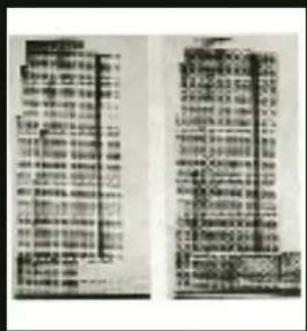
During the preliminary design phase in 1931, Hood experimented with many ideas for the facade of the RCA Building. (Image: Wired New York)
an offi cial "Sidewalk Superintendents' Club" was established, complete with membership cards providing access to a viewing platform.
The principal builder and “managing agent” for the massive project was John R. Todd and the principal architect was Raymond M. Hood, who worked with and directed a team from three different architectural firms. Hood was the greatest skyscraper architect of the 1920s, embodying and inspiring the evolution of skyscraper design in America during the decade, and the Rockefeller Center was his last major project. Though the actual design was the work of a consortium of architects, he has been described as the “key man” in its development, and the massing of the buildings, their monochromatic exteriors, and their rooftop landscape gardens almost certainly reflect his influence.
Construction of the RCA Building and Lower Plaza in progress in September 1932. The Center Theatre, on the left, and the RKO Building, rear right, were already complete. Next to the RKO Building, the Radio City Music Hall was nearing completion. (Image: Wired New York)

natural_image
Aerial black-and-white view of a tall, modern skyscraper under construction with cranes, surrounded by urban buildings (no visible text or signage)Rockefeller Center
Rockefeller Center is a complex of 19 commercial buildings covering 22 acres (89,000 m²) between 48th and 51st streets in New York City. Built by the Rockefeller family, it is located in the center of Midtown Manhattan, spanning the area between Fifth Avenue and Sixth Avenue.
Rockefeller Center represents a turning point in the history of architectural sculpture: It is among the last major building projects in the United States to incorporate a program of integrated public art. Sculptor Lee Lawrie contributed the largest number of individual pieces—twelve—including the statue of Atlas facing Fifth Avenue and the conspicuous friezes above the main entrance to the RCA Building.
The Center is a combination of two building complexes: the older and original fourteen Art Deco office buildings from the 1930s, and a set of four International-style towers built along the west side of Avenue of the Americas during the 1960s and 1970s.
Art Deco was a popular international art design movement from 1925 until the 1940s, affecting the decorative arts such as architecture, interior design and industrial design, as well as the visual arts such as fashion, painting, the graphic arts and film. At the time, this style was seen as elegant, glamorous, functional and modern. The movement was a mixture of many different styles and movements of the early 20th century, including Neoclassical, Constructivism, Cubism, Modernism, Art Nouveau, and Futurism. Its popularity peaked in Europe during the Roaring Twenties and continued strongly in the United States through the 1930s. Although many

natural_image
Exterior view of a tall, modern building with a prominent spire under a clear blue sky (no signage or text visible)Bullocks Wilshire In Los Angeles, California. (Image: Wikimedia Commons)

natural_image
Exterior view of a modern high-rise building with a distinctive conical tower (no signage or text visible)City Hall In Buffalo, New York, an Art Deco building.
design movements have political or philosophical roots or intentions, Art Deco was purely decorative.
Art Deco experienced a decline in popularity during the late '30s and early '40s but experienced a popular resurgence in the graphic design of the 1980s. Art Deco had a profound influence on many later artistic movements, such as Memphis and Pop art.
Surviving examples may still be seen in many different locations worldwide, in countries as diverse as China (Shanghai), the United Kingdom, Spain, Cuba, Indonesia, the Philippines, Argentina, Romania, Australia, New Zealand, India, Brazil and the United States (primarily in Miami, Los Angeles and New York City). Many classic examples still exist in the form of architecture in many major cities. The Empire State Building, Rockefeller Center and Chrysler Building, all in New York City, are some of the largest and best-known examples of the style.
The centerpiece of Rockefeller Plaza is the 70-fl oor, 872-foot (266 m) GE Building at 30 Rockefeller Center ("30 Rock")—formerly known as the RCA Building—centered

natural_image
Nighttime aerial view of a modern skyscraper with illuminated high-rise buildings (no visible text or signage)Rockefeller Center 1933. (Image: Wikimedia Commons)
behind the sunken plaza. The building is the setting for the famous "Lunchtime atop a Skyscraper" photograph, taken by Charles C. Ebbets in 1932 of workers having lunch, sitting on a steel beam, without safety harnesses.
Unlike most other Art Deco towers built during the 1930s, the GE Building was constructed as a slab with a fl at roof. The Center's newly-renovated "Top of the Rock" observation deck, dating originally from 1933, is located on the GE Building roof.

natural_image
Exterior view of a modern multi-story building with landscaped greenery and a paved road (no visible text or signage)Roof garden of Rockefeller Center buildings. (image: Wikimedia Commons)

natural_image
Exterior view of a modern office building (no signage)Lower Plaza of Rockefeller Center. (Image: Wikimedia Commons)
At the front of 30 Rock is the Lower Plaza, in the very center of the complex, which is reached from 5th Avenue through the Channel Gardens and Promenade. The acclaimed sculptor Paul Manship was commissioned in 1933 to create a masterwork to adorn the central axis, below the famed annual Rockefeller Center Christmas Tree, but all the other original plans to fill the space were abandoned over time. It was not until Christmas Day in 1936 that the ice-skating rink was finally installed and the popular Center activity of ice-skating began.
Radio City Music Hall at 50th Street and Avenue of the Americas was completed in December, 1932. At the time it was promoted as the largest and most opulent theater in the world. Its original intended name was the “International Music Hall” but this was changed to reflect the name of its neighbor, “Radio City”, as the new NBC Studios in the RCA Building were known. RCA was one of the complex’s first and most important tenants and the entire Plaza itself was sometimes referred to as “Radio City”.
The Music Hall was planned by a consortium of three architectural firms, who employed Edward Durell Stone to design the exterior. At the urging of Junior's wife Abby, the interior design was assigned to Donald Deskey, an exponent of the European Modernist style and innovator of a new American design aesthetic. Deskey, who believed the place could be enhanced by sculpture and murals, commissioned various arists to create elaborate works for the theater. The Music Hall seats 6,000 people and after an initial slow start became the
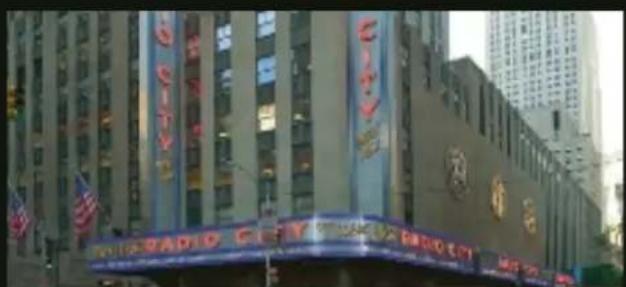
Radio City Music Hall at 50th Street and Avenue of the Americas. (Image: Rockefeller Center)
single biggest tourist destination in the city. Its interior was declared a New York City landmark in 1978. Painstakingly restored in 1999, the Music Hall interior is one of the world's greatest examples of Art Deco design.
The Center Theatre, seating 3,500 people, was located at the Southeast corner of Sixth Avenue and 49th Street. Originally designed as a movie palace in 1932, it later achieved fame as a showcase for live musical ice-skating spectacles. It was demolished in 1954, the only building in the original Rockefeller Center complex to have been torn down. The Center Theatre was originally called the RKO Roxy Theatre and opened on December 29, 1932. It was intended as a smaller sister to the 6,000-seat Radio City Music Hall one block away, which at fi rst did not show fi lms. A successful lawsuit in 1933 by the owners of the original Roxy Theatre on Seventh Ave., claiming ownership of the "Roxy" name, caused the new theater to be re-named the RKO Plaza.
After its demolition, the Center Theatre was replaced by a 19-story office building.
Center Art
Paul Manship's well-known bronze gilded statue of "The Titan Prometheus recumbent, bringing fi re to mankind", depicting the Greek legend, features prominently in the sunken plaza at the front of 30 Rockefeller Center.
A large number of other artists contributed work at the Center, including Isamu Noguchi, whose gleaming stainless steel bas-relief "News", placed over the main entrance to 50 Rockefeller Center (the Associated Press Building), is particularly outstanding. At the time it was created it was the largest metal bas-relief in the world. Other artists included Carl Milles, Hildreth Meiere, Margaret Bourke-White, Dean Cornwell, and Leo Friedlander.
A selection of the art at Rockefeller Plaza.
["Wisdom" and "Sound" – Photos courtesy of Tishman Speyer/Photographer Denis Vlasov. "News" and "The story of mankind" – Photos courtesy of Tishman Speyer/Photographer Nick Wood. "Friendship between America and France", "Prometheus" and "Atlas" – Photos courtesy of Rockefeller Center Archives.]

natural_image
Collage of nine diverse golden statues and sculptures, including a statue, globe, flags, and relief figures (no visible text or symbols)Facts about Rockefeller Center
Location: Midtown Manhattan,
New York City, NY
Architect: Raymond Mathewson Hood
was a senior architect on a
large design team
Style: ...... Modern, Art Deco
Materials: Limestone
Construction: .... Limestone cladding, 4 to 8 inches
thick, fastened to a masonry
backing, which is itself supported
by a structural steel frame
Date: From 1930 to 1939 (the original
14 buildings)
Footprint: 19 commercial buildings covering
22 acres (89,000 m 4 )
Height: 872 ft. (266 m.) (GE Building)
Stories: 70 (GE Building)

natural_image
Exterior view of a modern city skyline with tall skyscrapers under a clear blue sky (no visible text or signage)Rockefeller Center. (Image: Wikimedia Commons)

natural_image
3D architectural model of a city skyline with yellow walls and staircases, no visible text or symbols
natural_image
Two LEGO-shaped objects: a single rectangular block labeled '1x' and a grid-patterned rectangular block labeled '1x' (no text or symbols on the blocks themselves)1

natural_image
3D rendering of a LEGO base with circular indentations and a central rectangular block (no text or symbols)
natural_image
Two LEGO-shaped blocks with rounded tops, one small and labeled '1x1x' (no other text or symbols)2
natural_image
3D illustration of a LEGO brick with circular indentations and a red outline highlighting the interior (no text or symbols)
natural_image
Two LEGO brick slabs with rounded tops, labeled '1x' (no text or symbols on the bricks themselves)3

natural_image
Diagram of three LEGO blocks with red arrows indicating movement or force, no text or symbols present
natural_image
3D rendering of a LEGO brick base with rounded corners and a 1x label (no other text or symbols)4

natural_image
3D diagram of a LEGO floor with circular indentations and a highlighted rectangular section (no text or symbols)
natural_image
Four LEGO-shaped blocks arranged in a row against a black background, no text or symbols visible.5

natural_image
3D diagram of a LEGO floor plan with circular blocks and a highlighted rectangular structure (no text or symbols)
natural_image
Four LEGO brick models of varying sizes and bases arranged on a black background (no text or symbols)6

natural_image
3D diagram of a LEGO floor with circular indentations and a central rectangular structure (no text or symbols)
natural_image
Four identical 3D-rendered rectangular objects with dimension labels (1x, 5x, 1x) on a black background, no text or symbols on the objects themselves.7

natural_image
3D diagram of a LEGO floor planter with circular holes and central blocks (no text or symbols)
natural_image
Illustration of various LEGO blocks with one highlighted (no text or symbols)8
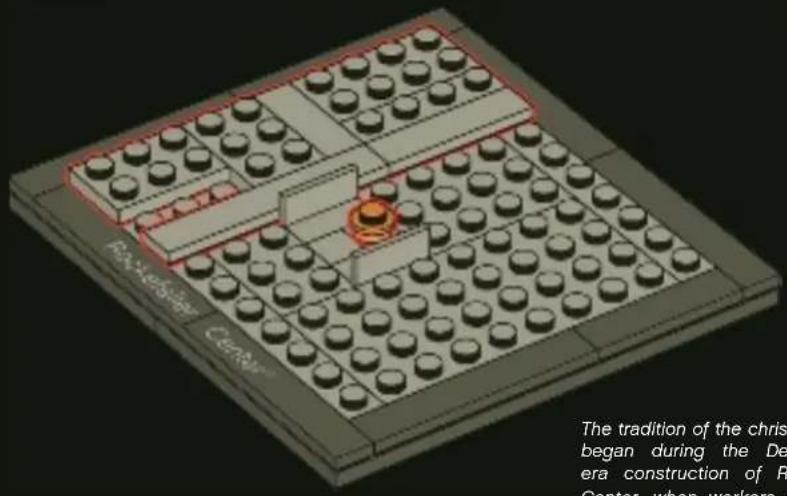
The tradition of the christmas tree began during the Depression-era construction of Rockefeller Center, when workers decorated a small balsam fi r tree with strings of cranberries, garlands of paper, and even a few tin cans on Christmas Eve, December 24, 1931.


natural_image
3D diagram of a LEGO floor plan with numbered blocks and a central orange button (no text or symbols)
natural_image
Three LEGO-shaped blocks with rounded tops and a black base, displayed against a dark background (no text or symbols on the blocks themselves)10
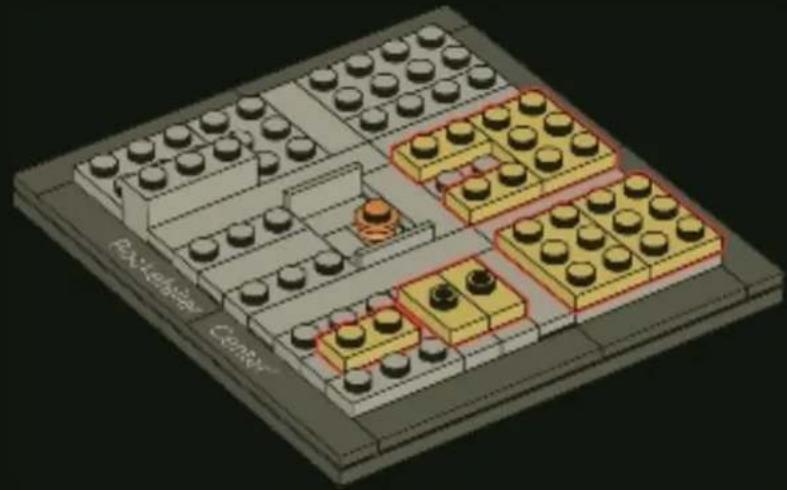
natural_image
3D diagram of a LEGO base with multiple brick units and yellow blocks, no text or symbols present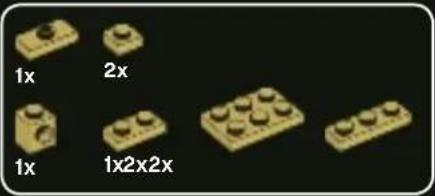
natural_image
Illustration of six LEGO blocks with labeled dimensions (1x, 2x, 1x2x2x) on a black background11
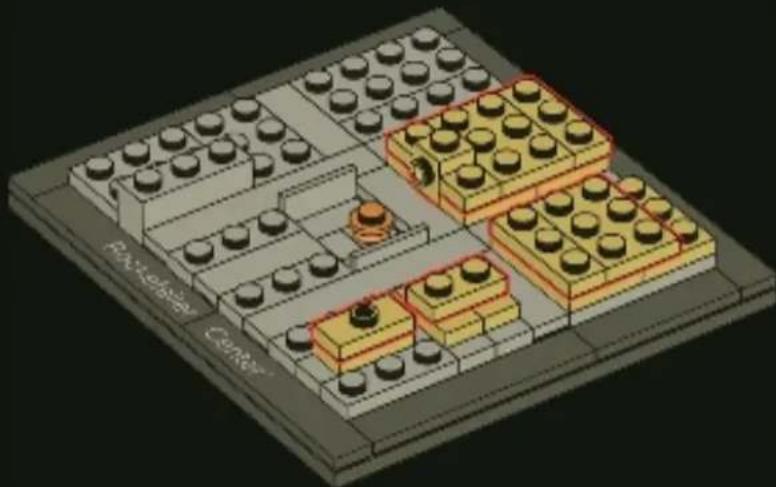
natural_image
3D diagram of a LEGO structure with multiple brick blocks and a central orange block, labeled 'Revolution Center' (no text or symbols on the diagram itself)
natural_image
Six LEGO-shaped blocks arranged on a black background, labeled 1x1x1x1 and 1x2x1x, with no visible text or symbols on the blocks themselves.12

natural_image
3D diagram of a LEGO building layout with labeled components (no text or symbols on the structure itself)
4x5x

13

natural_image
3D architectural rendering of a building complex with multiple yellow and gray blocks, labeled 'Rockering Center' at the base (no other text or symbols)
natural_image
Six LEGO-shaped blocks arranged in two rows, each labeled with a multiplier (2x, 7x, 1x, 3x7x, 1x, 1x) on a black background.14

natural_image
3D architectural rendering of a multi-story building complex with yellow and black components, labeled 'Building Address' and 'Cement' (no other text or symbols)
natural_image
Four yellow LEGO-shaped blocks arranged on a black background, labeled '1x1x5x6x' (no other text or symbols)15

natural_image
3D architectural model of a building complex with yellow and gray blocks, labeled 'Residential Center' at the base (no other text or symbols)
natural_image
Three LEGO blocks with one cube and two stacked blocks, all labeled '1x' (no additional text or symbols)16

natural_image
3D architectural model of a building complex with yellow and gray blocks, featuring embedded red structural elements (no text or symbols)

natural_image
3D illustration of a yellow rectangular box with dashed outlines against a black background (no text or symbols)
natural_image
Two LEGO blocks with rounded tops, one labeled '1x1x' (no other text or symbols)1


2x
2

natural_image
Two stacked LEGO blocks with red arrows indicating movement or transformation (no text or symbols)
18

Indiana Limestone is a freestone, which means that it exhibits no preferential direction of splitting and can, therefore, be cut and carved in an almost limitless variety of shapes and sizes. This property allows the stone to be planed, turned on a lathe, sawed and hand-worked to match the requirements of the most demanding architectural designs.


natural_image
3D rendered yellow mechanical part with stepped structure against black background (no text or symbols)
natural_image
Yellow LEGO brick with four rounded pins, labeled '2x' below (no other text or symbols)1
34

3x1x

2


natural_image
Yellow LEGO brick with four rounded pins, labeled '2x' below (no other text or symbols)3

natural_image
Illustration of two stacked LEGO blocks with circular components and red arrows indicating assembly or movement (no text or symbols)
3x1x

4
natural_image
Illustration of a LEGO brick with multiple circular holes (no text or symbols)
natural_image
3D rendered image of a LEGO brick with three rounded pins, labeled '2x' below (no other text or symbols)5

natural_image
Illustration of a LEGO brick structure with circular holes and red arrows indicating assembly or component (no text or symbols)36

3x1x

6

natural_image
Isometric illustration of a multi-layered LEGO structure with circular holes (no text or symbols)
natural_image
Two LEGO brick blocks with rounded tops, one labeled '2x1x' (no other text or symbols)7


natural_image
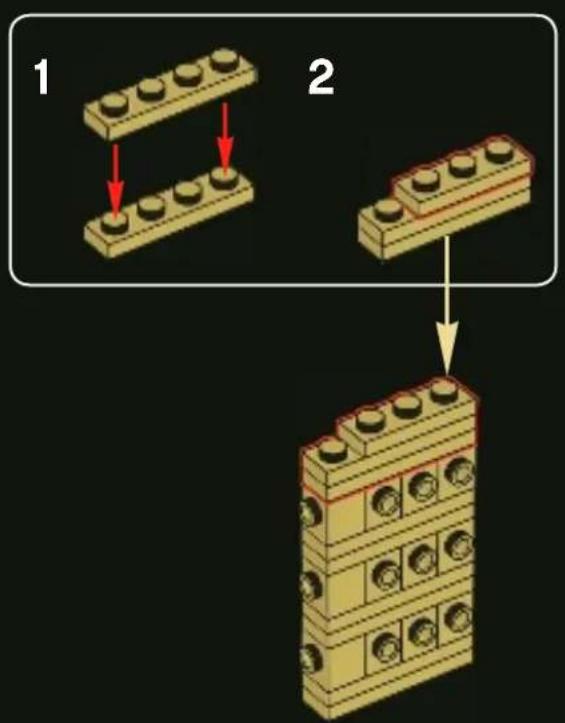
Two gold-colored 3D blocks labeled '2x1x' on a black background (no other text or symbols)10

natural_image
Isometric illustration of stacked yellow blocks with circular holes, no text or symbols present
natural_image
Yellow LEGO brick with three rounded corners on a black background, labeled '2x' below (no other text or symbols)11

natural_image
3D diagram of a multi-tiered LEGO structure with circular holes and a top platform (no text or symbols)

natural_image
Two yellow LEGO blocks on a black background, labeled '1x1x' (no other text or symbols)14

natural_image
3D illustration of a multi-tiered LEGO structure with circular components, no text or symbols present
natural_image
A small yellow LEGO brick with three protrusions, labeled '2x' below it (no other text or symbols)15
natural_image
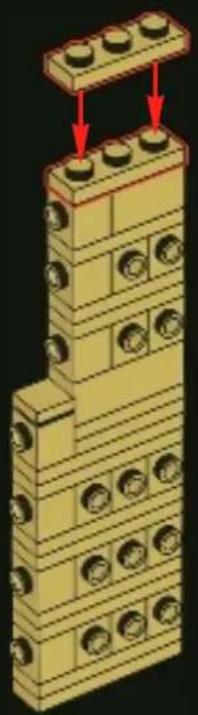
3D illustration of a LEGO structure with stacked blocks and red arrows indicating assembly or component (no text or symbols)
natural_image
Three yellow plastic electronic components on a black background, labeled '1x1x1x' (no other text or symbols visible)16

natural_image
3D illustration of a multi-tiered mechanical or structural assembly with circular components, no visible text or symbols42

natural_image
Three yellow rectangular blocks of increasing length on black background, labeled '1x1x1x' at bottom left (no other text or symbols)17
natural_image
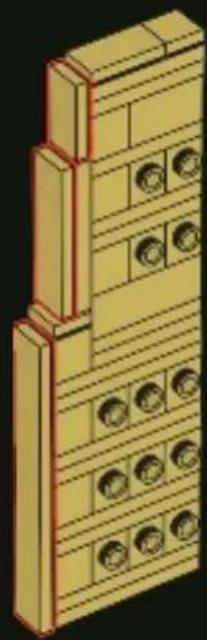
Isometric illustration of a multi-story building facade with circular windows and horizontal beams (no text or symbols)
natural_image
Four yellow plastic electronic components with labeled dimensions (1x, 2x, 1x, 2x) on a black background, no text or symbols present.18

natural_image
3D architectural diagram of a rectangular building with internal structural lines and two circular openings, shown with a rotation arrow (no text or symbols)
natural_image
Two small rectangular electronic components labeled '1x1x' on a black background (no other text or symbols visible)19

natural_image
3D architectural rendering of a rectangular building facade with internal structural lines and a highlighted red section (no text or symbols)
natural_image
Four yellow LEGO-like blocks with labeled dimensions (1x, 2x, 1x, 2x) on a black background, no text or symbols present.20

natural_image
3D diagram of a yellow mechanical component with internal channels and mounting holes, showing a circular arrow indicating rotation (no text or symbols present)44

natural_image
Two small rectangular electronic components labeled '1x1x' on a black background (no other text or symbols visible)21

natural_image
3D architectural or mechanical diagram showing layered structure with no visible text or symbols
With the country facing economic catastrophe and the world between two wars, John D. Rockefeller's vision for his center never wavered. Rockefeller Center and the observation deck were his gifts to Manhattan—a place for locals and visitors to marvel at the city he loved.


natural_image
3D rendered image of a yellow industrial control panel or enclosure with no visible text or symbols
natural_image
Two LEGO brick blocks labeled '1x' on a black background (no additional text or symbols)1

natural_image
Illustration of two stacked LEGO blocks with red arrows indicating movement or force (no text or symbols)
natural_image
Simple 3D-rendered object resembling a cube with a label '4x' on its side (no other text or symbols)2



natural_image
3D rendered image of a LEGO brick with three rounded pins, labeled '2x' below (no other text or symbols)3

natural_image
Illustration of a LEGO brick base with circular holes and red arrows indicating assembly or movement (no text or symbols)50

1x3x

4
natural_image
Illustration of a LEGO brick structure with multiple circular holes (no text or symbols)
natural_image
Yellow LEGO brick with three rounded pins, labeled '1x' at bottom (no other text or symbols)5


natural_image
Illustration of a yellow LEGO brick with multiple circular holes (no text or symbols)
6

natural_image
Illustration of a LEGO brick structure with multiple circular holes (no text or symbols)
natural_image
Three yellow rectangular blocks arranged horizontally on a black background, labeled '2x2x1x' in the corner (no other text or symbols)9


natural_image
Isometric view of a yellow rectangular electronic component with internal structure and mounting holes (no text or symbols)
natural_image
Three yellow rectangular electronic components on a black background, labeled '2x2x1x' (no other text or symbols)10

natural_image
3D architectural rendering of a yellow building facade with red structural lines (no text or symbols)
Rockefeller Center through the 1930s
"Don't give the people what they want," said S.L. "Roxy" Rothafel, the man who created Radio City Music Hall. "Give 'em something better." Throughout the 1930s, Rockefeller Center steadily improved, including some accidental innovations like the Christmas Tree tradition in 1931 and the skating rink in 1936. By 1939, more than 125,000 people were visiting Rockefeller Center daily; on its own, it would have been the 51st largest city in the U.S.
1930: Construction of the "city within a city" begins, employing over 75,000 people.
1933: Following the completion of 30 Rockefeller Center in May, Rockefeller Plaza opens for business.
1934: The Rainbow Room opens on the 65th floor of 30 Rock; Noel Coward is among the first patrons.
1935: More than 2,100 people are using the Rockefeller Center post off ce every day.
1936: The skating rink opens just in time for Christmas.
1937: A "sports garden" is created on the roof of the Radio City Music Hall for the use of the Rockettes, the orchestra and other staff members.
1938: The Associated Press Building, at 50 Rockefeller Plaza, is the first Plaza building to operate profi tably the year it opens.
1939: John D. Rockefeller Jr. drives "The Last Rivet" at a ceremony marking completion of the Center's original buildings.

Rockefeller Center was declared a National Historic Landmark in 1989. (Wikimedia Commons)
A Word from the Artist
As an Architectural Artist my desire is to capture the essence of a particular architectural landmark in its pure sculptural form. I first and foremost do not view my models as literal replicas, but rather my own artistic interpretations through the use of LEGO® bricks as a medium. The LEGO brick is not initially thought of as a material typically used in creating art or used as an artist's medium. However, I quickly discovered the LEGO brick was lending itself as naturally to my applications as paint to a painter or metal to a blacksmith. As I explore how to capture these buildings with the basic shapes of the bricks and plates, I find the possibilities and challenges they offer almost magical.
Rockefeller Center
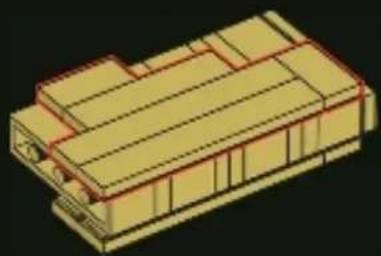
Unlike the other models in this series, Rockefeller Center celebrates a gathering of buildings. With this in mind, the essence of this landmark had to be thoughtfully expressed to convey both the art deco styling and its function as a center of commerce. Before concepts were explored I had to first determine what elements needed to be included to best represent the spirit of the Center as a whole and in detail. The heartbeat of the Center can be defined where the social activities intersect, the plaza highlighted by the sculpture & waterfall feature. How to represent these small details next to towering buildings was the challenge. Using a simple 1 x 1 round plate to represent the Prometheus statue was how the entire design concept came to be. From there laying out the streets and buildings quickly took shape defining the perimeter of the overall model. Applying the art deco styling to the buildings was done using half plate techniques and smooth tiles in a monotone color to allow the subtle forms to speak more clearly.


natural_image
Man in blue shirt examining a small yellow object with a black base, surrounded by office buildings (no visible text or symbols)"Architecture—a wonderful game"
This was the title, or rather a paraphrase of the French title ("L'architecture est un jeu ... magnifi que") of a 1985 exhibition hosted by the Pompidou Centre in Paris where 30 young European architects were given the opportunity to play with the famous Dani bricks. The original idea was actually Dutch, Rotterdam's Kunststichting arranging a small event the previous year where ten local architects were let loose on a large number of LEGO bricks. Such was the success of this first
initiative that the Pompidou Centre decided to expand the idea to include 30 young aspiring architects from across Europe—their goal: to each draw an imaginary villa which would then, brick by brick, be built at LEGO HQ in Billund.
During the event, many a quotation was made from the history of architecture. For example, the Italian Renaissance architect Palladio was quoted alongside modernists such as Mies van der Rohe and Gerit Rietveld, the quotes relating to architectural projects from oil platforms to romantic ruins. It was a case of no wonderful game.

natural_image
Three-panel illustration of a building with a blue-topped tower, green trees, and a yellow-topped structure (no text or symbols)barred and, even though some of the projects produced by the 30 talents ended in weird and wonderful pseudophilosophical comments on opportunities, or rather the lack of same in the Eighties, it was all, nevertheless, a
wonderful game.


References
Text credits:
www.rockefellercenter.com
www.u-s-history.com
www.rockarch.org
www.wikipedia.org
Photo credits pages 19, 31 and 45:
Rockefeller Center
Customer Service
Kundenservice
www.lego.com/service or dial

LEGO
Architecture

LEGO and the LEGO logo are trademarks of the LEGO Group. ©2011 The LEGO Group. 4644803




Brand : LEGO
Model : Rockefeller Plaza®
Category : Toys